

• Regeln für den Video-Bereich:

    In den Börsenbereich gehören nur Angebote die bereits den Allgemeinen Regeln entsprechen.

    Einteilung

    - Folgende Formate gehören in die angegeben Bereiche:
    - Filme: Encodierte Filme von BluRay, DVD, R5, TV, Screener sowie Telesyncs im Format DivX, XviD und x264.
    - DVD: Filme im Format DVD5, DVD9 und HD2DVD.
    - HD: Encodierte Filme mit der Auflösung 720p oder darüber von BluRay, DVD, R5, TV, Screener sowie Telesyncs im Format x264.
    - 3D: Encodierte Filme von BluRay, die in einem 3D Format vorliegen. Dies gilt auch für Dokus, Animation usw.
    - Serien: Cartoon/Zeichentrick, Anime, Tutorials, Dokumentationen, Konzerte/Musik, Sonstiges sind demnach in die entsprechenden Bereiche einzuordnen, auch wenn sie beispielsweise im High Definition-Format oder als DVD5/DVD9/HD2DVD vorliegen. Ausnahme 3D.
    - Bereich Englisch: Englische Releases gehören immer in diesen Bereich.
    - Bereich Talk: Der Bereich, in dem über die Releases diskutiert werden kann, darf, soll und erwünscht ist.


    Angebot/Beitrag erstellen

    - Ein Beitrag darf erst dann erstellt werden, wenn der Upload bei mindestens einem OCH komplett ist. Platzhalter sind untersagt.
    - Bei einem Scenerelease hat der Threadtitel ausschließlich aus dem originalen, unveränderten Releasenamen zu bestehen. Es dürfen keine Veränderungen wie z.B. Sterne, kleine Buchstaben o.ä. vorgenommen werden. Ausnahme Serienbörse:
    - Bei einem Sammelthread für eine Staffel entfällt aus dem Releasename natürlich der Name der Folge. Beispiel: Die Simpsons S21 German DVDRip XviD - ITG
    - Dementsprechend sind also u.a. verboten: Erweiterungen wie "Tipp", "empfehlenswert", "only", "reup", usw. / jegliche andere Zusatzinformation oder Ergänzung, welche nicht in obiger Beschreibung zu finden ist.

    Aufbau des Angebots und Threadtitel

    Der Titel nach folgendem Muster erstellt zu werden. <Name> [3D] [Staffel] [German] <Jahr> <Tonspur> [DL] [Auflösung] <Quelle> <Codec> - <Group>
    Beispiel: The Dark Knight German 2008 AC3 DVDRip XviD - iND
    Beispiel: The Dark Knight 2008 DTS DL BDRip x264 - iND
    Beispiel: The Dark Knight 2008 AC3 DL BDRip XviD - iND
    Beispiel: The Dark Knight German 2008 AC3 720p BluRay x264 iND
    Beispiel: The Dark Knight 2008 DTS DL 1080p BluRay x264 iND
    Beispiel: Die Simpsons S01 German AC3 DVDRip XviD iND
    Beispiel: Die Simpsons S20 German AC3 720p BluRay x264 iND
    Beispiel: Sword Art Online II Ger Sub 2014 AAC 1080p WEBRip x264 - peppermint
    Entsprechend sind also u.a. verboten: Sonderzeichen wie Klammern, Sterne, Ausrufezeichen, Unterstriche, Anführungszeichen / Erweiterungen wie "Tipp", "empfehlenswert", "only", "reup", usw. / jegliche andere Zusatzinformation oder Ergänzung, welche nicht in obiger Beschreibung zu finden ist
    Ausnahmen hiervon können in den Bereichen geregelt sein.

    Die Beiträge sollen wie folgt aufgebaut werden:
    Überschrift entspricht dem Threadtitel
    Cover
    kurze Inhaltsbeschreibung
    Format, Größe, Dauer sind gut lesbar für Downloader außerhalb des Spoilers zu vermerken
    Nfo sind immer Anzugeben und selbige immer im Spoiler in Textform.
    Sind keine Nfo vorhanden z.B. Eigenpublikationen, sind im Spoiler folgende Dateiinformationen zusätzlich anzugeben :
    Quelle
    Video (Auflösung und Bitrate)
    Ton (Sprache, Format und Bitrate der einzelnen Spuren)
    Untertitel (sofern vorhanden)
    Hosterangabe in Textform außerhalb eines Spoiler mit allen enthaltenen Hostern.
    Bei SD kann auf diese zusätzlichen Dateiinformationen verzichtet werden.

    Alle benötigten Passwörter sind, sofern vorhanden, in Textform im Angebot anzugeben.
    Spoiler im Spoiler mit Kommentaren :"Schon Bedankt?" sind unerwünscht.


    Releases

    - Sind Retail-Release verfügbar, sind alle anderen Variationen untersagt. Ausnahmen: Alle deutschen Retail-Release sind CUT, in diesem Fall sind dubbed UNCUT-Release zulässig.
    - Im Serien-Bereich gilt speziell: Wenn ein Retail vor Abschluss einer laufenden Staffel erscheint, darf diese Staffel noch zu Ende gebracht werden.62
    - Gleiche Releases sind unbedingt zusammenzufassen. Das bedeutet, es ist zwingend erforderlich, vor dem Erstellen eines Themas per Suchfunktion zu überprüfen, ob bereits ein Beitrag mit demselben Release besteht. Ist dies der Fall, ist der bereits vorhandene Beitrag zu verwenden.
    - P2P und Scene Releases dürfen nicht verändert oder gar unter einem iND Tag eingestellt werden.


    Support, Diskussionen und Suche

    - Supportanfragen sind entweder per PN oder im Bereich Talk zu stellen.
    - Diskussionen und Bewertungen sind im Talk Bereich zu führen. Fragen an die Uploader haben ausschließlich via PN zu erfolgen, und sind in den Angeboten untersagt.
    - Anfragen zu Upload-Wünschen sind nur im Bereich Suche Video erlaubt. Antworten dürfen nur auf Angebote von MyBoerse.bz verlinkt werden.


    Verbote

    - Untersagt sind mehrere Formate in einem einzigen Angebotsthread, wie beispielsweise das gleichzeitige Anbieten von DivX/XviD, 720p und 1080p in einem Thread. Pro Format, Release und Auflösung ist ein eigener Thread zu eröffnen.
    - Grundsätzlich ebenso verboten sind Dupes. Uploader haben sich an geeigneter Stelle darüber zu informieren, ob es sich bei einem Release um ein Dupe handelt.
    - Gefakte, nur teilweise lauffähige oder unvollständige Angebote sind untersagt. Dies gilt auch für eigene Publikationen, die augenscheinlich nicht selbst von z.B. einer DVD gerippt wurden. Laufende Serien, bei denen noch nicht alle Folgen verfügbar sind, dürfen erstellt und regelmäßig geupdatet werden.
    - Untersagt sind Angebote, welche nur und ausschließlich in einer anderen Sprache als deutsch oder englisch vorliegen. Ausnahmen sind VORHER mit den Moderatoren zu klären.


    Verstoß gegen die Regeln

    - Angebote oder Beiträge, die gegen die Forenregeln verstoßen, sind über den "Melden"-Button im Beitrag zu melden.
  • Bitte registriere dich zunächst um Beiträge zu verfassen und externe Links aufzurufen.

*** Bestes IPTV *** bester Preis *** gratis Test ***


Englische Tutorials

Sap Abap : For Beginner'S Training 2022

4tyufjoc2enqjr5yms2ao72ccw.jpg


Sap Abap : For Beginner'S Training 2022
Published 7/2022
MP4 | Video: h264, 1280x720 | Audio: AAC, 44.1 KHz
Language: English | Size: 11.58 GB | Duration: 30h 40m

BEGIN YOUR SAP JOURNEY FROM HERE


What you'll learn
Enhance your existing SAP Skill-set
Help pass SAP ABAP Certification Exams
Write ABAP Programs
Interpret existing ABAP programs
Be conversant with most major programming constructs and paradigms

Requirements
No pre-requisites . You'll get everything here!

Description
ABAP is the programming language of SAP - the most well-known ERP. In the realm of SAP counseling, there are 3 kinds of specialists.Practical Consultants ( SD, MM, FI, and so forth )Specialized Consultants ( ABAP, WebDynpro, Workflow, Fiori, and so on )Premise and security advisors ( Basis Admin, GRC, and so forth )This course establishes the groundwork for anyone ( regardless of programming foundation ) to be a specialized expert.SAP ABAP is the famous endeavor programming language created by SAP and involved by the greatest associations on the planet to maintain their business frameworks.In this SAP ABAP video instructional class, Peter Moxon acquaints you with the essential abilities expected to comprehend SAP ABAP programming and begin making your own ABAP programs.You will advance by watching the creator really play out the activity he is educating on, as he clears up bit by bit how to make and adjust ABAP code. The preparation makes sense of SAP ABAP from the beginning with the outright nuts and bolts to guarantee you have an intensive handle of the how best to program SAP venture frameworks. He gradually stirs you up by learning the vital parts of ABAP improvement presenting new ideas and language components remembered for SAP, and covers subjects such as structure report interfaces and modularizing your programs with 'Incorporates', 'Structures', and 'Capability Modules'.This instructional class not just gives you an exhaustive knowledge of how the SAP programming language functions yet is conveyed so that each and every individual who takes the course will have definitely no issue in seeing every one of the subjects examined.This course makes it so natural to learn SAP ABAP, you will compose and try out your own code quickly. So as not to impede you with hypothesis this course centers around learning through an involved methodology and is stuffed brimming with pragmatic bit-by-bit models so you are making code from the very beginning.Whether you're new to programming or only new to ABAP, this SAP ABAP course is your manual for fast, certifiable venture programming advancement.

Overview

Section 1: Introduction

Lecture 1 Introduction

Section 2: SECTION 2

Lecture 2 SAP overview

Section 3: SECTION 3

Lecture 3 Basic functions of SAP ABAP

Section 4: SECTION 4

Lecture 4 Data types formatting and parameters of SAP

Section 5: SECTION 5

Lecture 5 Types of data type in SAP and string functions

Section 6: SECTION 6

Lecture 6 Control statement in SAP ABAP

Section 7: SECTION 7

Lecture 7 DD Table Creation

Section 8: SECTION 8

Lecture 8 DD Foreign Key

Section 9: SECTION 9

Lecture 9 DD Table Type and Type Groups

Section 10: SECTION 10

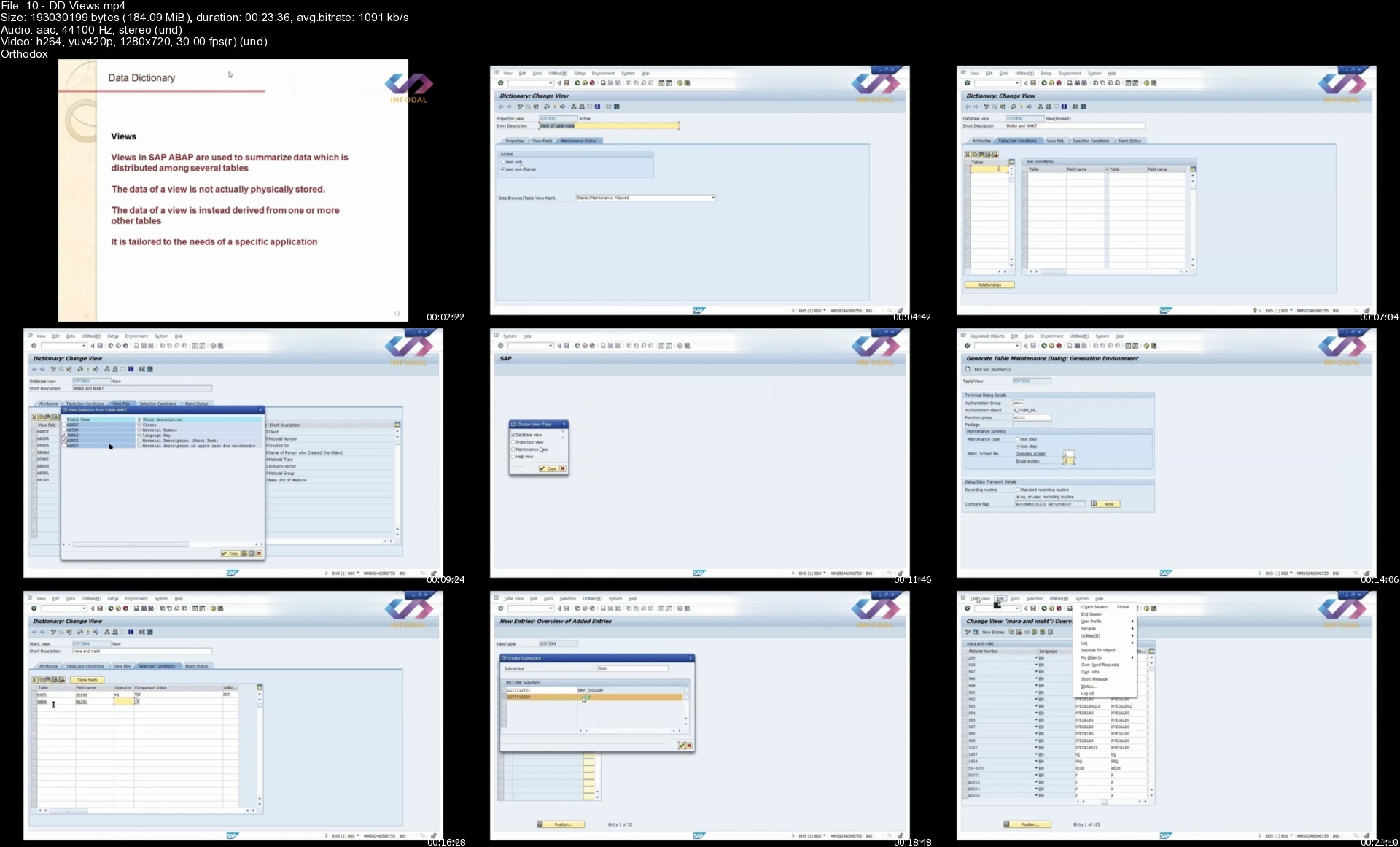
Lecture 10 DD Views

Section 11: SECTION 11

Lecture 11 DD Search Help

Section 12: SECTION 12

Lecture 12 DD Structure

Section 13: SECTION 13

Lecture 13 DD Lock Objects

Section 14: SECTION 14

Lecture 14 Structures statement in SAP

Section 15: Internal tables in SAP ABAP

Lecture 15 Internal tables in SAP ABAP Part 1

Lecture 16 Internal tables in SAP ABAP Part 2

Lecture 17 Internal tables in SAP ABAP Part 3

Section 16: SECTION 18

Lecture 18 SQL Statements

Section 17: SECTION 19

Lecture 19 Basic uses and importance of inner join

Section 18: SECTION 20

Lecture 20 MOD functions in SAP ABAP

Section 19: SECTION 21

Lecture 21 Modularization functions modules

Section 20: SECTION 22

Lecture 22 Basic uses of reports theory in SAP ABAP

Section 21: Create practical reports in SAP ABAP

Lecture 23 Create practical reports in SAP ABAP Part -1

Lecture 24 Create practical reports in SAP ABAP Part -2

Lecture 25 Create practical reports in SAP ABAP Part -3

Lecture 26 Create practical reports in SAP ABAP Part -4

Section 22: SECTION 27

Lecture 27 Uses of message class in SAP

Section 23: SECTION 28

Lecture 28 Importance of screen programming in SAP ABAP

Section 24: Screen programs in SAP ABAP

Lecture 29 Screen programs in SAP ABAP Part - 1

Lecture 30 Screen programs in SAP ABAP Part - 2

Lecture 31 Screen programs in SAP ABAP Part - 3

Lecture 32 Screen programs in SAP ABAP Part - 4

Lecture 33 Screen programs in SAP ABAP Part - 5

Lecture 34 Screen programs in SAP ABAP Part - 6

Lecture 35 Screen programs in SAP ABAP Part - 7

Section 25: SECTION 35

Lecture 36 BDC theory and also sender and receiver systems in SAP

Section 26: SECTION 37

Lecture 37 BDC Call Transaction

Section 27: SECTION 38

Lecture 38 BDC Session Method

Section 28: SECTION 39

Lecture 39 ALV Basic

Section 29: SECTION 40

Lecture 40 ALV Line Color

Section 30: SECTION 41

Lecture 41 Basic rules of creating column color of ALV

Section 31: SECTION 42

Lecture 42 ALV Block List

Section 32: SECTION 43

Lecture 43 ALV Events

Section 33: SECTION 44

Lecture 44 ALV Tree

Section 34: SECTION 45

Lecture 45 ALV Hierarchical List

Section 35: SECTION 46

Lecture 46 ALV Variant - ALV Checkbox

Section 36: SECTION 47

Lecture 47 ALV screen master data

Section 37: SECTION 48

Lecture 48 Legacy System Migration Workbench

Section 38: SECTION 49

Lecture 49 Performance Tuning

Section 39: SECTION 50

Lecture 50 ABAP Performance

Section 40: SECTION 51

Lecture 51 Debugging Theory

Section 41: SECTION 52

Lecture 52 Debugging Practicals

Section 42: SECTION 53

Lecture 53 Menu Painter

Section 43: SECTION 54

Lecture 54 Objects Theory

Section 44: SECTION 55

Lecture 55 Object Simple Class

Section 45: SECTION 56

Lecture 56 Object Inheritance

Section 46: SECTION 57

Lecture 57 Object Constructor

Section 47: SECTION 58

Lecture 58 Object Class

Section 48: SECTION 59

Lecture 59 Object Events

Section 49: SECTION 60

Lecture 60 Functions of BADI theory

Section 50: SECTION 61

Lecture 61 BADI Practical

Section 51: SECTION 62

Lecture 62 Business Application Programming Interface

Section 52: SECTION 63

Lecture 63 BAPI Practical

Section 53: SECTION 64

Lecture 64 SAP Script Theory

Section 54: SECTION 65

Lecture 65 SAP Script Practical

Section 55: SECTION 66

Lecture 66 SAP Script Output

Section 56: SECTION 67

Lecture 67 SmartForms Theory

Section 57: SECTION 68

Lecture 68 SmartForm Practical

Section 58: SECTION 69

Lecture 69 User Exit

Section 59: SECTION 70

Lecture 70 Function module exit theory and basic modules of ABAP

Section 60: SECTION 71

Lecture 71 Application Link Enabling and Electronic data interchange in ABAP

Section 61: SECTION 72

Lecture 72 ALE intermediate documents practicals

Section 62: SECTION 73

Lecture 73 Transport Organizer

Section 63: SECTION 74

Lecture 74 SAP MM process flow in ABAP

Section 64: SECTION 75

Lecture 75 SD flows in SAP ABAP

Section 65: SECTION 76

Lecture 76 SAP Landscape

Section 66: SECTION 77

Lecture 77 Importance of variant creation in SAP ABAP

Anyone who wants to learn ABAP programming and advance their SAP skill set

Homepage

10ddviewssc6d7p.jpg


Salesforce Certified Platform Developer I (Lwc & Aura Also)

lervenbo6uznhsdomrl2cyfdsh.jpg


Salesforce Certified Platform Developer I (Lwc & Aura Also)
Last updated 10/2022
MP4 | Video: h264, 1280x720 | Audio: AAC, 44.1 KHz
Language: English | Size: 19.75 GB | Duration: 38h 29m

Pass your Platform Developer 1 certification exam with this course.Learn Apex, Visualforce,LWC, Lightning Aura Framework


What you'll learn
You will be able to pass your Platform Developer 1 exam.
Understand the Salesforce data model and query languages.
Learn about Apex triggers and best practices for writing triggers
You will learn about DML statements, Database Methods, Salesforce Object Search Language (SOSL), Salesforce object Query Language (SOQL).
You will learn about Triggers, Test classes, Debugging
They will become masters of APEX programming
Jump start your career in Salesforce Development.
This course covers everything you need to know to become Salesforce Developer
Use standard controllers with basic Visualforce pages
Utilize Visualforce with custom-built Apex controllers
Write test coverage
Configure your Salesforce development environment
Learn about Governor Limits in Salesforce
Learn about Save order of Execution in Salesforce
Learn about Apex Design patterns


Requirements
Students must know the basic object-oriented concepts
Students must know the basics of programming language
You must have an Internet connection


Description
Complete Course updated with NEW Videos. (All videos recorded in new Lightning UI) Oct 4th,2022: LWC (Lightning Web Component) Videos addedOct 4th,2022: Lightning Aura Framework videos AddedAre you looking to pass your Platform Developer 1 exam? If yes, this is the course for you. In order to pass your Platform Developer 1 exam, the knowledge and experience of the Salesforce Platform are not enough. You also need to get to grips with the exam itself. And that's why I have designed this "Salesforce Certified Platform Developer I".This course covers all the topics related to the study guide of Platform Developer 1 Certification exam. Not only that, after end of every section, I have also included the sample questions similar to the Platform Developer 1 exam. Exam Topics for the Platform Developer 1 exam :Developer Fundamentals 23%Process Automation and Logic: Declarative Features 30% Process Automation and Logic: Basic Apex Process Automation and Logic: Advanced TopicsUser Interface 25%Testing, Debugging and Deployment : Testing 22% Testing, Debugging and Deployment: Debugging and DeploymentJune 2022 Exam Outline Update:Salesforce has updated the official exam guide on June 17, 2022. There were small to medium type of updates, the main highlight was decreasing the sections from 5 to 4 and rebalancing the weighted percentages.Salesforce Fundamentals and Data Modeling and Management were combined into 1 section which resulted with a lesser number of Objectives. There were a couple of Objectives from Process Automation and Logic and User Interface that were retired.There was no new content introduced, most of the changes will involve migrating of content from one section to another. Our team has started analyzing these changes and we will be gradually updating our materials. What strategy we will follow in order to pass the exam?The goal is to obtain 90% so you are well above the passing score. We will work on the sections from most-weighted to least-weighted, giving us the most coverage early on in your learning path. Key Features of this course :22+ hours of video trainingTopics aligned with the official study guide of Platform Developer 1 exam [Course updated Sep 2022]Hands on practice on the Salesforce platformReal time scenarios and examples coveredQuizzes after every section of the course
Overview
Lecture 1 Introduction to the course

Lecture 2 Create your Developer Account to practice along with me

Section 1: Navigating Salesforce UI : Learn about Objects and fields

Lecture 3 What is Object, Tabs, User and Profiles in Salesforce: Quick overview

Lecture 4 Standard and Custom Object in Salesforce: How to create a custom object ?

Lecture 5 How to add fields to the custom object: Adding fields using Object Manager.

Lecture 6 Schema Builder in Salesforce: How to add fields using Schema Builder?

Section 2: Types of Relationship in Salesforce: Lookup, Master Detail, Many to Many

Lecture 7 Relationship fields in Salesforce : Types of relationship in Salesforce

Lecture 8 Lookup vs Master Detail relationship: Difference between lookup & Master Detail

Lecture 9 Many to Many relationship in Salesforce: Junction Object in Salesforce

Lecture 10 Hierarchical Relationship in Salesforce

Section 3: Quiz

Section 4: External Object in Salesforce and their associated relationships

Lecture 11 Salesforce External Object: External Objects and its relationships

Section 5: External ID in Salesforce

Lecture 12 External Ids in Salesforce:Which all field data types can be used as external ID

Section 6: Validation Rules in Salesforce: What are validation rules & why do we need them

Lecture 13 Validation Rule in Salesforce: Create your first Validation rule

Lecture 14 Restrict Data Input by using Validation rules: Validation rules Example 2

Lecture 15 Learn about isPickVal() and isBlank() functions: Validation rule example 3

Lecture 16 REGEX Validation in Salesforce : Learn Regex In Salesforce with Example

Section 7: Importing and Exporting Data in Salesforce: Data Loader and Data Import Wizard

Lecture 17 Importing and exporting data in Salesforce: Data Import Wizard and Data Loader

Lecture 18 Steps to install Data Loader and Jdk

Lecture 19 Import Records using Data Loader: Insert new records using Data loader

Lecture 20 Update records using Data Loader

Lecture 21 Upsert and Delete operation Using Data Loader

Lecture 22 Export Data using Data loader: Difference between Export and Export All

Lecture 23 Insert records using Data Import Wizard

Lecture 24 Update and Upsert using Data Import Wizard : Update and Upsert operation

Lecture 25 Difference between Data loader and Import Wizard

Lecture 26 Data Export Service in Salesforce: Salesforce Data Export

Section 8: Salesforce Automation Tools : Workflow, Process Builder, Approval Process & Flow

Lecture 27 Automate Business processes: What is a workflow in salesforce and how to create?

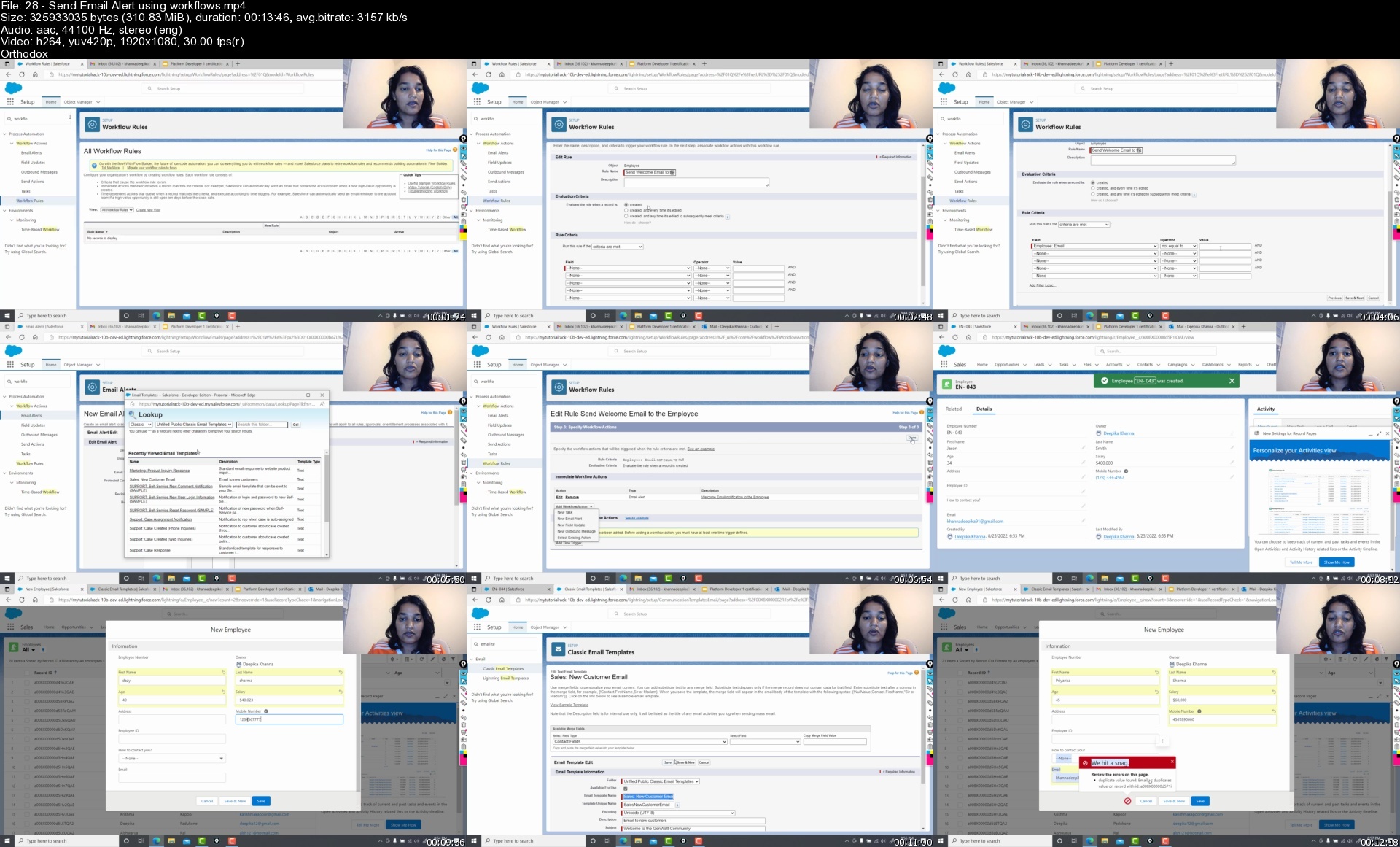
Lecture 28 Send Email Alert using workflows

Lecture 29 Workflow Field update using Workflow

Section 9: Automate Business Processes using Approval Process

Lecture 30 What are approval process and how to create an approval process

Lecture 31 Create an Approval Process using Standard Wizard

Section 10: Automate Business Process using Process Builder

Lecture 32 Process builder in Salesforce

Lecture 33 Automate Business Process using Process Builder Part 1

Lecture 34 Automate Business Process using Process Builder Part 2

Section 11: Flows in Salesforce: What are flows in Salesforce and different types of Flows

Lecture 35 Flows in Salesforce: What are flows and different types of flows

Lecture 36 Record Triggered flow in Salesforce with Example

Lecture 37 Screen flow in Salesforce with example

Lecture 38 How to launch a flow from button in Salesforce?

Lecture 39 How to create a Screen flow in Salesforce?

Lecture 40 Add Actions to your flow: Add Send email action to your flow

Lecture 41 Schedule triggered flows in Salesforce: What is Schedule triggered flow ?

Lecture 42 Platform Event Trigger flow in Salesforce

Lecture 43 Platform Event Trigger flow: How to create a Platform Event trigger flow?

Lecture 44 How to test Platform Event Trigger flow in Salesforce?

Lecture 45 What is Auto launched flow in Salesforce? What is the use of auto launched flow?

Lecture 46 How to create Auto Launched flow ?

Lecture 47 Create Auto Launched flow in Salesforce

Lecture 48 Salesforce auto launched flow with example

Lecture 49 Invoke flow from Apex

Section 12: Quiz

Section 13: Developer Fundamentals: Basics of Apex

Lecture 50 What is Apex? When to use Apex? Overview of Apex Programming

Lecture 51 Apex Syntax: Overview of Apex Code (Variables, Expression, SOQL , DML statement)

Lecture 52 Overview of Developer Console: What Is Developer Console used for?

Lecture 53 Variable in Apex: What is a variable and why do we need them?

Lecture 54 Write our first Program in Apex?

Lecture 55 Apex Data types: What are the different data types available in apex?

Section 14: Date, Time, Datetime Data types in Apex

Lecture 56 Date data type in apex: How to declare a date variable in apex?

Lecture 57 Time Data type in apex: Time Class and its methods

Lecture 58 Datetime data type and its associated methods

Lecture 59 Datetime variable explanation with example

Section 15: String Data type

Lecture 60 String Data type in apex: Declare a String variable

Lecture 61 String class and important methods of String class

Lecture 62 String data type in use

Section 16: Conditional (If-else) statement in Apex and Switch Statement in Apex

Lecture 63 If else statement in Apex explained with the help of an example

Lecture 64 What are conditional statement in apex ? how does if else statement work in apex

Lecture 65 If Else explained with the help on an example

Lecture 66 If ElseIf statement in Apex

Lecture 67 If ElseIf statement in apex explained with the help of an example

Lecture 68 Switch Statement in Apex

Lecture 69 How to use switch statement in apex?

Lecture 70 Switch Statement in Apex with example explained

Section 17: Loops in Apex: For Loop, Nested for loop and While loop

Lecture 71 What are the different types of loops in Apex?

Lecture 72 While loop in Apex with an example

Lecture 73 For loop in Apex

Lecture 74 For Loop in Practice: How to write a for loop ?

Lecture 75 Different types of for loop in apex

Lecture 76 Break and Continue statement in apex: When to use Break and continue ?

Lecture 77 Nested for loop in apex: How does nested loop work?

Section 18: Different types of collections in Apex: List, Set and Map in Apex

Lecture 78 Different types of Collection in apex

Lecture 79 Collection in Apex

Lecture 80 Declare a list variable: Important List methods

Lecture 81 Incompatible type exception in List

Lecture 82 Set Collection in apex: Difference between Set and List in apex

Section 19: Classes in Apex

Lecture 83 Classes and Objects in Apex

Lecture 84 Create a new Apex Class

Lecture 85 Difference between Public and Private Access Modifier in Apex

Lecture 86 Method Declaration in Apex

Lecture 87 What is Method Overloading?

Section 20: Constructors in Apex

Lecture 88 Constructors in Apex. What are constructors in Apex?

Lecture 89 Why Instance variables needs to be declared with Private Access modifier?

Lecture 90 Constructors in Apex with example

Section 21: Practice test 2

Section 22: Static and Non- static Method AND Static and Non Static Variable in Apex

Lecture 91 Difference between Static and Non-static Method in Apex

Lecture 92 Difference between Static and Non static variable in Apex

Lecture 93 Difference between Static and Non static variable with example

Section 23: Working with sObject: What is sObject?

Lecture 94 SObject in salesforce: Declare a List of Sobject in salesforce

Section 24: Salesforce Inspector : powerful extension for Salesforce Developers

Lecture 95 Install Salesforce Inspector extension for your browser

Section 25: SOSL and SOQL queries in apex

Lecture 96 What is SOSL and SOQL queries in Salesforce?

Lecture 97 Retrieve records using SOQL

Lecture 98 Salesforce Object Query Language

Lecture 99 Group by query salesforce | Count number of records in SOQL query

Section 26: Quiz

Section 27: DML statements in Apex: Insert, Update, Upsert, Delete, Undelete statements

Lecture 100 DML statements salesforce: What are DML statements in Salesforce?

Lecture 101 How to write DML statements in Salesforce? Insert and Update DML with Example

Lecture 102 DML statements in Salesforce : Delete and Undelete DML statement in Salesforce

Lecture 103 Upsert DML statement with Example

Lecture 104 DML Operations in Salesforce with Example: Create Account Utility Class

Lecture 105 Salesforce Apex DML statement with example

Section 28: Quiz

Section 29: Database Methods in Apex: Difference between DML statements and Database methods

Lecture 106 Difference between DML statement and Database methods

Lecture 107 Partial Update allowed in database methods

Lecture 108 Database Save Result[]

Lecture 109 Database Save Result [] retrieve the success and failure

Section 30: Relationship Queries in Apex

Lecture 110 Relationship Queries in Salesforce: What are relationship query in Salesforce?

Lecture 111 Relationship Query: How do I query a child record from a parent in Salesforce?

Lecture 112 Relationship Query in Salesforce: Child to Parent relationship Query

Lecture 113 Relationship Query for Custom Object in Salesforce

Lecture 114 How do I query a parent to a child custom object in Salesforce?

Section 31: Triggers in Apex

Lecture 115 Apex Triggers in salesforce

Lecture 116 Trigger Context Variables salesforce

Lecture 117 Create Apex Trigger: Apex trigger in Salesforce with example

Lecture 118 Apex Trigger Salesforce with Example: Before Delete Apex Trigger

Lecture 119 Apex Trigger with example: Before Insert Apex Trigger

Section 32: Batch Apex: What is Batch apex and when to use batch apex?

Lecture 120 What is batch apex and what are the different methods of batch class?

Lecture 121 What is a batch Apex? Is batch Apex synchronous or asynchronous?

Lecture 122 Batch Apex in Salesforce with example

Lecture 123 Difference between Stateless and Stateful Batch apex

Lecture 124 Stateless VS Stateful with example

Section 33: REST and SOAP webservices

Lecture 125 How to expose your apex class as REST webservice and SOAP webservice?

Section 34: Exceptions in Apex: What are exceptions in Apex and how to handle exceptions ?

Lecture 126 Exception in apex: What is try catch finally block in apex?

Lecture 127 How to handle exception in apex using try-catch block?

Lecture 128 What is ListException in apex and how to handle this exception ?

Lecture 129 Null Pointer exception in Apex

Lecture 130 SObject Exception in Salesforce

Lecture 131 Common Exception methods and their usage

Lecture 132 DML exception in apex and how to handle them?

Lecture 133 DML Exception methods

Lecture 134 Exception methods related to DML exception

Lecture 135 Try with Multiple Catch block

Lecture 136 Custom exception in apex: How to create a custom exception in apex?

Section 35: Apex Testing and Debugging

Lecture 137 Apex test classes: How to write test classes?

Lecture 138 Create an Apex class and its test class

Lecture 139 Code coverage in Apex

Lecture 140 Code Coverage in Apex

Lecture 141 Code Coverage needed from one Sandbox to another

Section 36: Practice Test

Section 37: Governor Limits in Apex

Lecture 142 Governor Limits in Apex

Lecture 143 What happens when governor limit exception is thrown?

Lecture 144 What are limit apex methods in salesforce? Limit class in apex

Lecture 145 Salesforce Governor Limits

Section 38: Quiz

Section 39: Security Vulnerabilities in Apex and Visualforce

Lecture 146 Overview of different vulnerabilities which exist in Salesforce

Lecture 147 What is SOQL Injection and how can we prevent it?

Section 40: Save Order of Execution in Salesforce

Lecture 148 Save order of execution salesforce: Sequence of events after we save the record

Lecture 149 Relationship between Apex transaction and Save order of Execution

Section 41: Dynamic Apex in Salesforce

Lecture 150 Dynamic apex in salesforce: Use of Schema Class in Salesforce

Lecture 151 How to programmatically access and utilize the object schema?

Lecture 152 How to get all fields of object in salesforce using Dynamic Apex?

Lecture 153 Getting ChildRelationships from an object

Lecture 154 DescribingTabSetResult class: Describing tabs using Schema methods

Lecture 155 How to fetch Required fields of an object dynamically?

Section 42: Quiz

Section 43: Lightning Aura Components

Lecture 156 How to setup your custom Domain for salesforce Org??

Lecture 157 What is Salesforce Lightning component framework ???

Lecture 158 To add Styling to your Lightning Application using external static resource

Lecture 159 What are Attributes???

Lecture 160 What are component Attributes??

Lecture 161 Component Composition with example

Lecture 162 What is Salesforce Expression and aura:if component

Lecture 163 What are Global value provider?

Lecture 164 Standard and Force.com components

Lecture 165 Salesforce ui components: Input Text, Output TeXT and button

Lecture 166 Handling Events Using Client Side Controller

Lecture 167 Apex Server-Side Controller Overview

Lecture 168 How to Retrieve records from standard object in Lightning??

Lecture 169 Debugging Lightning Components

Section 44: Building our First Lightning App from scratch

Lecture 170 Overview of our Lightning App

Lecture 171 Creating the ContactController Class

Lecture 172 Creating the Lightning Application

Lecture 173 Creating the ContactList Component

Lecture 174 SearchBar component

Lecture 175 Creating the ContactDetails Component

Section 45: Lightning Web Components

Lecture 176 Lightning Web Component Introduction

Lecture 177 Overview of Lightning Web Components: Benefits of Lightning Web Components

Section 46: Setting up Development Environment for LWC Component

Lecture 178 Setting up Development Environment: Install Salesforce CLI and VIsual Studio

Lecture 179 Important Message

Lecture 180 Setting Up My Domain and Enable Dev Hub in Salesforce

Lecture 181 Create a Scratch Org

Lecture 182 Commands commands to use in Visual studio

Section 47: Building Lightning Web Components

Lecture 183 Building our First Lightning Web Component

Lecture 184 Data binding in Lightning Web Component

Section 48: Rendering Components Conditionally in LWC

Lecture 185 Render DOM Elements Conditionally using if:true|false directive

Lecture 186 If:True|False directive in Lightning Web Components

Section 49: Rendering List of Items in Lightning Web Components

Lecture 187 How to Render a List of Items in Lightning Web Components?

Lecture 188 How to Render a List using Iterator directive?

Section 50: Building Applications In Lightning Web Components

Lecture 189 Building a Simple Application: Simple Interest Calculator

Lecture 190 Building a Simple Application with Lightning Web Components: Shape Calculator

Section 51: Types of properties in lwc

Lecture 191 What are Public Properties in LWC?

Lecture 192 Salesforce Update related to LWC

Lecture 193 How to pass Data from Parent Component to Child Component in LWC?

Section 52: Lightning Web components Lifecycle Methods

Lecture 194 Component Lifecycle Hooks: Lifecycle Hooks in Lightning Web Components

Section 53: Lightning Web Components Communication

Lecture 195 How to call child component method from parent?

Lecture 196 Custom Event Communication from Child to Parent component

Lecture 197 Communicate with Events: Create and Dispatch of events

Lecture 198 Communicate with Events: Create and Dispatch of events

Lecture 199 Overview of Pub Sub Model in Lightning Web Component

Lecture 200 Learn about Pub Sub model with help of an example

Section 54: Working with Records inside Lightning Web Components

Lecture 201 Different ways to access salesforce data in Lightning web components

Lecture 202 How to create a Record using Lightning Data Service in Lightning web component?

Lecture 203 View and Create Record using Lightning Data Service

Lecture 204 Work With Records Using Base Components

Lecture 205 Work with Records Using Base Components

Lecture 206 Display a Record with custom layout using base component

Lecture 207 How to access Salesforce Data using Base Components: lightning-record-edit-form

Lecture 208 How to create a new record using lightning-record-edit-form?

Lecture 209 Create and view the record using lightning-record-edit-form component

Lecture 210 How to fetch Records Via Apex?

Lecture 211 How to fetch records Via Apex?

Section 55: Toast Notifications in Lightning Web Components

Lecture 212 Using toast notifications in Lightning Web components

Section 56: Navigation Service in Lightning Web Components

Lecture 213 Navigation Service in Lightning Web Components

Lecture 214 Navigating to Object Record Pages

Lecture 215 Navigating to Account Record Recent List and Related Contact Records

Lecture 216 Navigating to Web Page

Lecture 217 Navigating to Home Page and Chatter Page

Section 57: Setting up our Salesforce Application

Lecture 218 10 Salesforce Extensions that will make you a Salesforce Expert

Section 58: Visualforce Components Tutorial

Lecture 219 What is Visualforce? When and Where to use Visualforce?

Lecture 220 Advantages of Visualforce?

Lecture 221 How do I enable Visualforce Developer Mode?

Lecture 222 Visualforce tags in salesforce

Lecture 223 Visualforce page tags in Salesforce: pageBlock and pageBlockSection tags

Lecture 224 Visualforce Components: PageBlockButtons tag in visualforce

Lecture 225 How to use apex:pageMessage in Visualforce Page?

Lecture 226 Overview of input tags in visualforce

Lecture 227 Visualforce input tags with example

Lecture 228 Visualforce Apex: outputlabel Tag and outputLink tag in Salesforce

Lecture 229 Apex PanelBar and PanelBarItem tags in Salesforce

Lecture 230 Apex PanelBar and PanelBarItem tags with Example

Lecture 231 Apex panelBarItem attributes : onLeave and onEnter with example

Lecture 232 Visualforce Component: apex panelGrid column width

Lecture 233 Apex panelGrid example

Lecture 234 tabPanel example in salesforce

Lecture 235 Apex toolbar tag in Visualforce

Lecture 236 Apex toolbar tag with example

Lecture 237 Standard Controller in Salesforce

Lecture 238 Standard Controller Salesforce Example

Lecture 239 How to use Standard Controller in Visualforce page?

Lecture 240 Standard List Controller In Salesforce

Lecture 241 Standard list controller apex

Lecture 242 Standard List Controller with Example

Lecture 243 What is standard list controller in salesforce?

Lecture 244 Standard list controller Actions

Lecture 245 Standard List Controller Pagination

Lecture 246 Using the standard list controller to edit multiple records

Lecture 247 Difference between Custom Controller and Extension in Salesforce

Lecture 248 Custom Controller in Salesforce

Lecture 249 Custom Controller in salesforce example

Lecture 250 What is Controller extension in Salesforce?

Lecture 251 Salesforce Multiple Controller Extensions

Lecture 252 How to call two multiple controller Extensions in visualforce page?

Lecture 253 Overview of custom list controller

Lecture 254 Salesforce custom list controller example

Lecture 255 StandardSetController Class example

If you want to pass your Platform Developer 1 exam.,Students who wants to explore the programming side of Salesforce.,Students who are familiar with out-of-the-box features of Salesforce and want to learn about Salesforce APEX programming.,Salesforce Adminstrators who wish to transition to Salesforce Development,Salesforce Developers who want to pass their Platform developer 1 exam.,Students who are familiar with the basics of Apex programming and want to learn in-depth about Apex, this course is for you.

Homepage


28sendemailalertusingbieuu.jpg


Pentesting Fundamentals for Beginners [June 2022]

l88ccakj1qzy6ovhcg71blmd4p.jpg


Pentesting Fundamentals for Beginners [June 2022]
.MP4, AVC, 1280x720, 30 fps | English, AAC, 2 Ch | 7h 30m | 7.56 GB
Instructor: Cliff Krahenbill

Ethical hacking fundamentals do not change from one exam to the next. One can expect to see questions about Nmap, what commands were used to generate a specific output, and which tool would you use, regardless of the exam vendor.

An individual is expected to know what pentesting framework would be used to meet a specific condition and what information should be delivered in an executive summary. You should know how to scope an assessment and identify what document is used for what purpose and the OWASP Top 10 and identify the hacking methodology used to exploit each one. These are just a few fundamentals that remain constant from one ethical hacking exam.

This course provides you with the fundamental knowledge every ethical hacker is expected to know. Throughout this course, you will learn about cybersecurity tools, reverse shells, scripting basics, identifying output, and what commands were used to generate the output.

This course will help you identify security tools and ethical hacking techniques, exploit web application vulnerabilities, appropriate documentation for starting and finalizing a pentest, correct reporting procedures, and appropriately exploit for a given vulnerability.

By the end of this course, you will have learned the fundamentals of pentesting, and renewed your confidence, and recharged your cyber security career with ease.

All the resource files are added to the GitHub repository at:


Homepage

00031windowsprivilege37dkr.jpg


Dp-100: Azure Machine Learning & Data Science Exam Prep 2022

4560436b47c3aoco4.jpg


Dp-100: Azure Machine Learning & Data Science Exam Prep 2022
Last updated 10/2022
MP4 | Video: h264, 1280x720 | Audio: AAC, 44.1 KHz
Language: English | Size: 8.49 GB | Duration: 21h 27m

Azure Machine Learning, AzureML, Exam DP-100: Designing and Implementing a Data Science Solution, 4 End-to-End Projects


What you'll learn
Prepare for DP-100 Exam
Getting Started with Azure ML
Setting up Azure Machine Learning Workspace
Running Experiments and Training Models
Deploying the Models
AzureML Designer: Data Preprocessing
Regression Using AzureML Designer
Classification Using AzureML Designer
AzureML SDK: Setting up Azure ML Workspace
AzureML SDK: Running Experiments and Training Models
Use Automated ML to Create Optimal Models
Tune hyperparameters with Azure Machine Learning
Use model explainers to interpret models

Requirements
Basic Understanding of Machine Learning
A Free or Paid Subscription to Microsoft Azure

Description
Machine Learning and Data Science are one of the hottest tech fields now a days ! There are a lot of opportunities in these fields. Data Science and Machine Learning has applications in almost every field, like transportation, Finance, Banking, Healthcare, Defense, Entertainment, etc.Most of the professionals and students learn Data Science and Machine Learning but specifically they are facing difficulties while working on cloud environment. To solve this problem I have created this course, DP-100. It will help you to apply your data skills in Azure Cloud smoothly.This course will help you to pass the "Exam DP-100: Designing and Implementing a Data Science Solution on Azure". In this course you will understand what to expect on the exam and it includes all the topics that are require to pass the DP-100 Exam.Below are the skills measured in DP-100 Exam,1) Manage Azure resources for machine learning (25-30%)Create an Azure Machine Learning workspaceManage data in an Azure Machine Learning workspaceManage compute for experiments in Azure Machine LearningImplement security and access control in Azure Machine LearningSet up an Azure Machine Learning development environmentSet up an Azure Databricks workspace2) Run experiments and train models (20-25%)Create models by using the Azure Machine Learning designerRun model training scriptsGenerate metrics from an experiment runUse Automated Machine Learning to create optimal modelsTune hyperparameters with Azure Machine Learning3) Deploy and operationalize machine learning solutions (35-40%)Select compute for model deploymentDeploy a model as a serviceManage models in Azure Machine LearningCreate an Azure Machine Learning pipeline for batch inferencingPublish an Azure Machine Learning designer pipeline as a web serviceImplement pipelines by using the Azure Machine Learning SDKApply ML Ops practices4) Implement responsible machine learning (5-10%)Use model explainers to interpret modelsDescribe fairness considerations for modelsDescribe privacy considerations for dataSo what are you waiting for, Enroll Now and understand Azure Machine Learining to advance your career and increase your knowledge!

Overview

Section 1: Getting Started with Azure ML

Lecture 1 Introduction to Azure Machine Learning

Lecture 2 Introduction to Azure Machine Learning Studio

Lecture 3 Azure ML Cheat Sheet

Lecture 4 DP-100 Exam Skills Measured (Exam Curriculum)

Lecture 5 Course Slides, Colab Notebooks and Datasets

Section 2: Microsoft Azure Fundamentals - Introduction

Lecture 6[OPTIONAL] Introduction to Microsoft Azure

Lecture 7[OPTIONAL] Introduction to Microsoft Azure Fundamentals

Lecture 8[OPTIONAL] Introduction to Cloud Computing

Lecture 9[OPTIONAL] Introduction to Azure Portal

Lecture 10[OPTIONAL] Introduction to Azure Marketplace

Lecture 11[OPTIONAL] Azure Free Account

Lecture 12 Creating Microsoft Azure Account

Section 3: Setting up Azure Machine Learning Workspace

Lecture 13 Azure ML: Architecture and Concepts

Lecture 14 Creating AzureML Workspace

Lecture 15 Workspace Overview

Lecture 16 AzureML Studio Overview

Lecture 17 Introduction to Azure ML Datasets and Datastores

Lecture 18 Creating a Datastore

Lecture 19 Creating a Dataset

Lecture 20 Exploring AzureML Dataset

Lecture 21 Introduction to Azure ML Compute Resources

Lecture 22 Creating Compute Instance and Compute Cluster

Lecture 23 Deleting the Resources

Section 4: Running Experiments and Training Models

Lecture 24 Azure ML Pipeline

Lecture 25 Creating New Pipeline using AzureML Designer

Lecture 26 Submitting the Designer Pipeline Run

Section 5: Deploying the Models

Lecture 27 Creating Real-Time Inference Pipeline

Lecture 28 Deploying Real-Time Endpoint in AzureML Designer

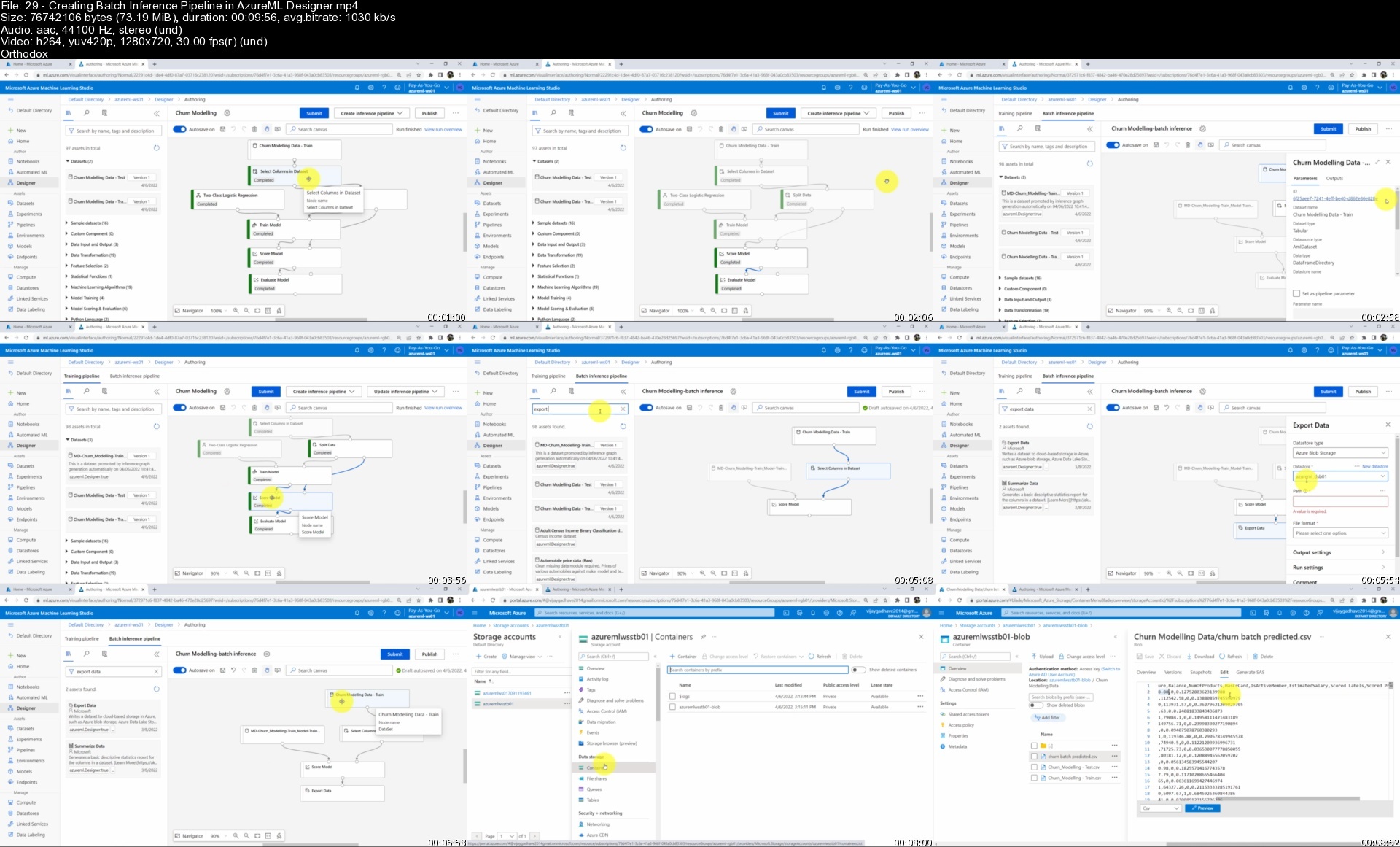
Lecture 29 Creating Batch Inference Pipeline in AzureML Designer

Lecture 30 Running Batch Inference Pipeline in AzureML Designer

Lecture 31 Deleting the Resources

Section 6: AzureML Designer: Data Preprocessing

Lecture 32 Setting up Workspace and Compute Resources

Lecture 33 Sample Datasets

Lecture 34 Select Columns in Dataset

Lecture 35 Importing External Dataset From Web URL

Lecture 36 Edit Metadata - Column Names

Lecture 37 Edit Metadata - Feature Type and Data Type

Lecture 38 Creating Storage Account, Datastore and Datasets

Lecture 39 Adding Columns From One Dataset to Another One

Lecture 40 Adding Rows From One Dataset to Another One

Lecture 41 Clean Missing Data Module

Lecture 42 Splitting the Dataset

Lecture 43 Normalizing Dataset

Lecture 44 Exporting Data to Blob Storage

Lecture 45 Deleting the Resources

Section 7: Project 1: Regression Using AzureML Designer

Lecture 46 Creating Workspace, Compute Resources, Storage Account, Datastore and Dataset

Lecture 47 Business Problem

Lecture 48 Analyzing the Dataset

Lecture 49 Data Preprocessing

Lecture 50 Training ML Model with Linear Regression (Online Gradient Descent)

Lecture 51 Evaluating the Results

Lecture 52 Training ML Model with Linear Regression (Ordinary least squares)

Lecture 53 Training ML Model with Boosted Decision Tree and Decision Forest Regression

Lecture 54 Finalizing the ML Model

Lecture 55 Creating and Deploying Real-Time Inference Pipeline

Lecture 56 Creating and Deploying Batch Inference Pipeline

Lecture 57 Deleting the Resources

Section 8: Project 2: Classification Using AzureML Designer

Lecture 58 Creating Workspace, Compute Resources, Storage Account, Datastore and Dataset

Lecture 59 Business Problem

Lecture 60 Analyzing the Dataset

Lecture 61 Data Preprocessing

Lecture 62 Training ML Model with Two-Class Logistic Regression

Lecture 63 Training ML Model with Two-Class SVM

Lecture 64 Training ML Model with Two-Class Boosted Decision Tree & Decision Forest

Lecture 65 Finalizing the ML Model

Lecture 66 Creating and Deploying Batch Inference Pipeline

Section 9: AzureML SDK: Setting up Azure ML Workspace

Lecture 67 AzureML SDK Introduction

Lecture 68 Creating Workspace using AzureMl SDK

Lecture 69 Creating a Datastore using AzureMl SDK

Lecture 70 Creating a Dataset using AzureMl SDK

Lecture 71 Accessing the Workspace, Datastore and Dataset with AzureML SDK

Lecture 72 AzureML Dataset and Pandas Dataset Conversion

Lecture 73 Uploading Local Datasets to Storage Account

Section 10: AzureML SDK: Running Experiments and Training Models

Lecture 74 Running Sample Experiment in AzureML Environment

Lecture 75 Logging Values to Experiment in AzureML Environment

Lecture 76 Introduction to Azure ML Environment

Lecture 77 Running Script in AzureML Environment Part 1

Lecture 78 Running Script in AzureML Environment Part 2

Lecture 79 Uploading the output file to Existing run in AzureML Environment

Lecture 80 Logistic Regression in Local Environment Part 1

Lecture 81 Logistic Regression in Local Environment Part 2

Lecture 82 Creating Python Script - Logistic Regression

Lecture 83 Running Python Script for Logistic Regression in AzureML Environment

Lecture 84 log_confusion_matrix Method

Lecture 85 Provisioning Compute Cluster in AzureML SDK

Lecture 86 Automate Model Training - Introduction

Lecture 87 Automate Model Training - Pipeline Run Part 1

Lecture 88 Automate Model Training - Pipeline Run Part 2

Lecture 89 Automate Model Training -Data Processing Script

Lecture 90 Automate Model Training - Model Training Script

Lecture 91 Automate Model Training - Running the Pipeline

Section 11: Use Automated ML to Create Optimal Models

Lecture 92 Introduction to Automated ML

Lecture 93 Automated ML in Azure Machine Learning studio

Lecture 94 Automated ML in Azure Machine Learning SDK

Section 12: Tune hyperparameters with Azure Machine Learning

Lecture 95 What Hyperparameter Tuning Is?

Lecture 96 Define the Hyperparameters Search Space

Lecture 97 Sampling the Hyperparameter Space

Lecture 98 Specify Early Termination Policy

Lecture 99 Configuring the Hyperdrive Run - Part 1

Lecture 100 Configuring the Hyperdrive Run - Part 2

Lecture 101 Creating the Hyperdrive Training Script

Lecture 102 Getting the Best Model and Hyperparameters

Section 13: Use Model Explainers to Interpret Models

Lecture 103 Interpretability Techniques in Azure

Lecture 104 Model Explainer on Local Machine

Lecture 105 Model Explainer in AzureML Part 1

Lecture 106 Model Explainer in AzureML Part 2

Section 14: Model Registration and Deployment Using Azureml SDK

Lecture 107 Introduction to Serialization and Deserialization

Lecture 108 Serialization Using Joblib

Lecture 109 Deserialization Using Joblib

Lecture 110 Handling Dummy Variables in Production

Lecture 111 Train ML Model for Webservice Deployment

Lecture 112 Register the Model Using Run ID pkl File

Lecture 113 Register the Model Using Local pkl File

Lecture 114 Provision AKS Production Cluster

Lecture 115 Revising the Steps Learned

Lecture 116 Project 3: Step 1 (Creating and Accessing the Workspace)

Lecture 117 Project 3: Step 2 (Train and Serialize ML Model)

Lecture 118 Project 3: Step 3 (Register the Model to Workspace)

Lecture 119 Project 3: Step 4 (Register an Environment)

Lecture 120 Project 3: Step 5 (Create AKS Cluster)

Lecture 121 Project 3: Step 6 (Inference and Deployment Configuration)

Lecture 122 Project 3: Step 7 (Creating the Entry Script)

Lecture 123 Project 3: Step 8 (Creating an Endpoint)

Lecture 124 Project 3: Step 9 (Testing the Web Service)

Lecture 125 Project 4: Deploy Multiple Models as Webservice (Step 1)

Lecture 126 Project 4: Deploy Multiple Models as Webservice (Step 2)

Lecture 127 Project 4: Deploy Multiple Models as Webservice (Step 3)

Lecture 128 Project 4: Deploy Multiple Models as Webservice (Step 4)

Section 15: Azure Fundamentals: Virtual Machines

Lecture 129 Introduction to Azure Virtual Machines

Lecture 130 Creating Virtual Machine in Azure

Lecture 131 Connecting to Virtual Machine and Running Commands

Lecture 132 Key Concepts - Image, Size and Disks

Lecture 133 Commands executed in Tutorial

Lecture 134 Installing nginx on Azure Virtual Machine

Lecture 135 Commands executed in Tutorial

Lecture 136 Simplification of Software Installation on Azure Virtual Machine

Lecture 137 Availability Sets and Zones

Lecture 138 Virtual Machine Scale Sets

Lecture 139 Scaling and Load Balancing with VM Scale Sets

Lecture 140 Static IP, Monitoring, Dedicated Host and Reducing the Cost

Lecture 141 Designing Good Solutions with Azure VMs

Section 16: Azure Fundamentals: Managed Compute Services

Lecture 142 Introduction to Azure Managed Compute Services

Lecture 143 Introduction to IaaS, PaaS and SaaS

Lecture 144 Introduction to Azure App Service

Lecture 145 Creating First Web App using Azure App Service

Lecture 146 More about the Azure App Service

Lecture 147 Introduction to Containers

Lecture 148 Introduction to Azure Container Instances

Lecture 149 Container Orchestration - AKS and Service Fabric

Lecture 150 Introduction to Azure Serverless

Lecture 151 Azure Serverless Service - Azure Functions

Lecture 152 Logic Apps

Lecture 153 Azure Shared Responsibility Model

Lecture 154 Review - Azure Compute Services

Lecture 155 Deleting Recourse Groups

Section 17: Azure Fundamentals: Storage

Lecture 156 Introduction to Azure Storage

Lecture 157 Managed and Unmanaged Block Storage in Azure

Lecture 158 Azure Files

Lecture 159 Azure Blob Storage and Tiers

Section 18: Azure Fundamentals: Databases

Lecture 160 Introduction to Database

Lecture 161 Snapshots, Transaction Logs, Standby Database

Lecture 162 RTO and RPO

Lecture 163 Data Consistency

Lecture 164 How to Select a Database ?

Lecture 165 Introduction to Relational Database

Lecture 166 Relational Database-OLTP

Lecture 167 Creating MySQL Server in Azure

Lecture 168 Code executed in next tutorial

Lecture 169 Exploring MySQL Server in Azure

Lecture 170 Relational Database - OLAP (Online Analytics Processing)

Lecture 171 Azure NoSQL Database: Azure Cosmos DB

Lecture 172 Exploring Azure NoSQL Database: Azure Cosmos DB

Lecture 173 Azure In-Memory Database: Azure Cache for Redis

Lecture 174 Review: Databases

Lecture 175 Databases: Scenarios

Lecture 176 Deleting Database Recourse Groups

Anyone who wants to learn Azure Machine Learning,Students and Professionals Who Wants to Pass DP-100 Exam

Homepage


29creatingbatchinfere31iwg.jpg


Google Cloud Developer - Gcp Professional Certification

xvanhxywdhdyaofil2qjte8fyr.jpg


Google Cloud Developer - Gcp Professional Certification
Last updated 9/2022
MP4 | Video: h264, 1280x720 | Audio: AAC, 44.1 KHz
Language: English | Size: 6.57 GB | Duration: 20h 51m

Get Google Cloud Developer Professional Certification. Develop Solutions for Google Cloud Platform - GCP.


What you'll learn
Start your journey to become a Google Cloud Certified Professional Cloud Developer
Get hands-on with compute, networking, storage, and database services in Google Cloud Platform
Understand how to develop and deploy secure and robust applications on Google Cloud Platform
Understand the best practices for building secure applications on the Google Cloud Platform

Requirements
You have an attitude to learn while having fun :)
Zero Knowledge of Google Cloud Platform is expected
Journey to become a Google Cloud Certified Professional Cloud Developer is NOT a cake walk. You need a lot of patience and dedication!
You would need a valid debit or credit card to create your Google Cloud Platform account

Description
ONLY COURSE YOU NEED TO GET READY for Google Cloud (GCP) Certified Professional Cloud Developer Exam!6 Things YOU need to know about this Google Cloud Professional Cloud Developer Course:#1: BRAND NEW - JULY 2021 (with case study)#2: HANDS-ON - The best way to learn GCP (Google Cloud Platform) is to get your hands dirty!#3: Designed for ABSOLUTE BEGINNERS to GCP (Google Cloud Platform)#4: MULTI-CLOUD INSTRUCTOR - MORE THAN 100,000 Learners are learning AWS, Azure, and Google Cloud with us#5: COMPLETE PREP for Google Cloud Professional Cloud Developer#6: FREE Downloadable PDF - Quickly Review for the examWhy should do a Google Cloud Certification?Here are few results from Google's 2020 Survey:87% of Google Cloud certified individuals are more confident about their cloud skillsMore than 1 in 4 of Google Cloud certified individuals took on more responsibility or leadership roles at workWhy should you aim for Google Cloud - GCP Cloud Developer Certification?Google Cloud Professional Cloud Developer certification helps you gain an understanding of cloud architecture and Google Cloud Platform.As a Cloud Developer, you will learn to design, develop, and deploy amazing solutions to the Google Cloud Platform.The Google Cloud Certified - Professional Cloud Developer exam assesses your ability to:Design highly scalable, available, and reliable cloud-native applicationsBuild and test applicationsDeploy applicationsIntegrate Google Cloud servicesManage application performance monitoringWe have designed this amazing course to help you learn the Compute, Storage, Database, and Networking solutions in Google Cloud (GCP).Are you ready to get started on this amazing journey to becoming a Google Cloud Developer?Do you want to join 700,000+ learners having Amazing Learning Experiences with in28Minutes?Look No Further!

Overview

Section 1: Google Cloud Certification - Professional Cloud Developer - Getting Started

Lecture 1 Introduction - Google Cloud Certification - Professional Cloud Developer

Lecture 2 Course Overview - Google Cloud Certification - Professional Cloud Developer

Lecture 3 DO NOT SKIP - Course Downloads - PDF Presentation - Professional Cloud Developer

Lecture 4 Introduction to Cloud and GCP - Google Cloud Platform

Lecture 5 Creating GCP - Google Cloud Platform - Account V2

Lecture 6 Why do we need Regions and Zones?

Lecture 7 Understanding Regions and Zones in GCP - Google Cloud Platform

Section 2: Google Compute Engine for Professional Cloud Developer

Lecture 8 Step 00 - Getting started with Google Compute Engine - Section Introduction

Lecture 9 Step 01 - Getting started with Google Compute Engine - GCE

Lecture 10 Step 02 - Creating your first Virtual Machine in GCP

Lecture 11 Step 03 - Understanding Machine Types and Images in Google Compute Engine - GCE

Lecture 12 Commands executed in next steps - GCE

Lecture 13 Step 04 - Installing HTTP Webserver on Google Compute Engine Virtual Machine

Lecture 14 Step 05 - Understanding Internal and External IP Addresses V2

Lecture 15 Step 06 - Playing with a Static IP Addresses V2

Lecture 16 Step 07 - Understanding Static IP Address in GCP - Google Cloud Platform

Lecture 17 Startup Script - For next lecture

Lecture 18 Step 08 - Simplifying Web Server setup with Compute Engine Startup Script V2

Lecture 19 Step 09 - Simplifying VM creation with Instance Templates

Lecture 20 Step 10 - Reducing Launch Time with a Custom Image

Lecture 21 Step 11 - Troubleshooting Launch of Apache on GCP Virtual Machine

Lecture 22 Step 12 - Reducing Costs - Compute Engine Virtual Machines

Lecture 23 Step 13 - Achieving High Availability with Live Migration and Automatic Restart

Lecture 24 Step 14 - Playing with Google Cloud Platform (Web) Console

Lecture 25 Step 15 - Best Practices - Virtual Machines in Google Cloud Platform

Lecture 26 Step 16 - Scenarios - Virtual Machines in Google Cloud Platform

Lecture 27 Step 17 - Quick Review - Google Compute Engine

Section 3: Getting started with Instance Groups and Cloud Load Balancing in Google Cloud

Lecture 28 Getting started with MIGs and Cloud Load Balancing - Section Introduction

Lecture 29 Step 01 - Getting Started with Instance Groups

Lecture 30 Step 02 - Creating Managed Instance Groups (MIG) V2

Lecture 31 Step 03 - Playing with Managed Instance Groups (MIG)

Lecture 32 Step 04 - Updating a Managed Instance Groups (MIG) - Rolling Updates - V2

Lecture 33 Step 05 - Getting Started with Cloud Load Balancing

Lecture 34 Step 06 - Creating a Load Balancer in GCP - Google Cloud Platform V2

Lecture 35 Step 07 - Understanding Cloud Load Balancing Terminology in GCP

Lecture 36 Step 08 - Exploring the Load Balancer in GCP - Google Cloud Platform

Lecture 37 Step 09 - Choosing a Load Balancer in GCP - Google Cloud Platform V2

Lecture 38 Step 10 - Exploring Scenarios - Cloud Load Balancing

Lecture 39 Optimize Your Cloud Usage

Lecture 40 Do you want to help us?

Section 4: Getting Started with Gcloud

Lecture 41 Step 01 - Getting Started with Gcloud

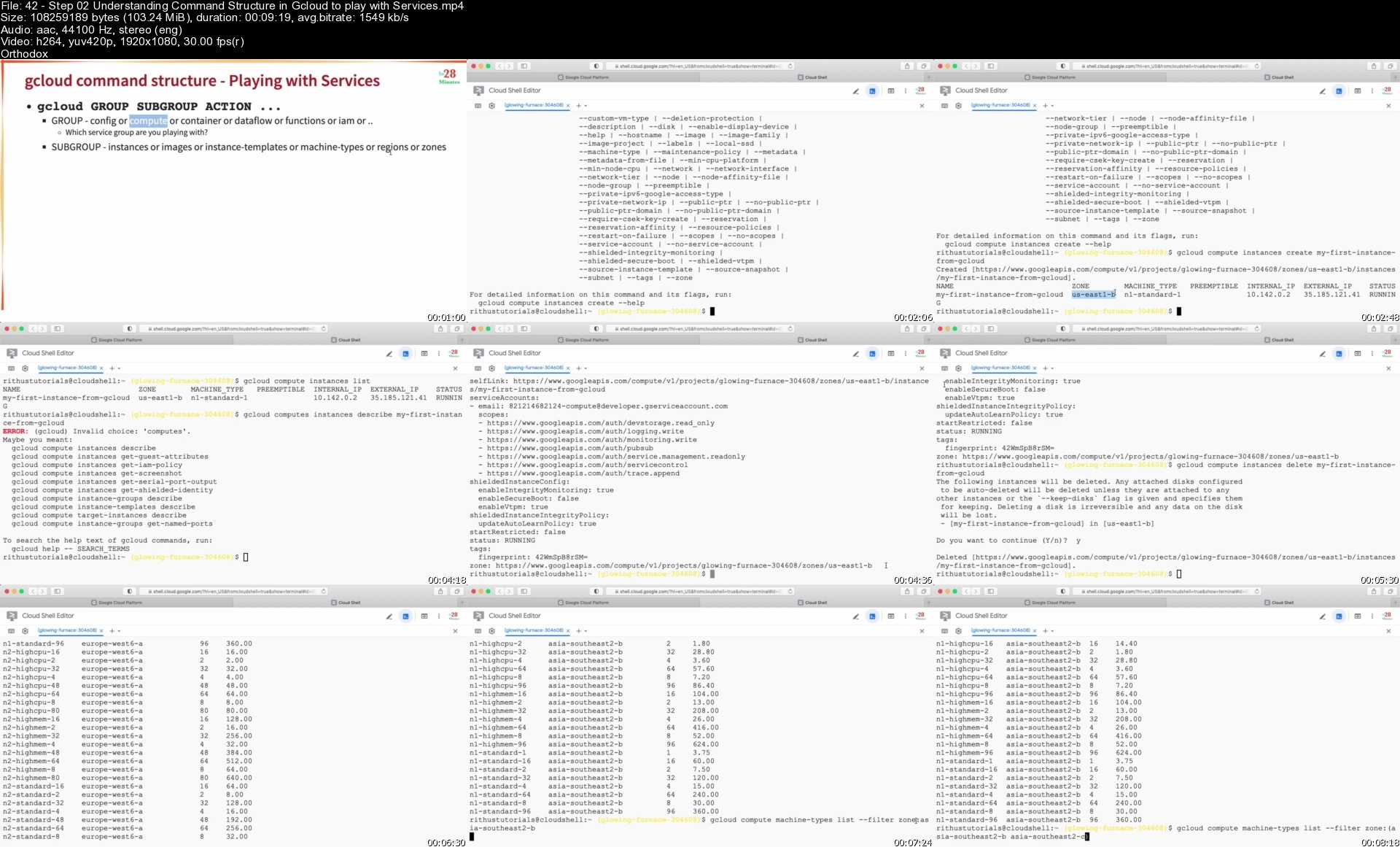
Lecture 42 Step 02 - Understanding Command Structure in Gcloud to play with Services

Lecture 43 Step 03 - Cloud Shell - Things to remember

Section 5: Managed Services in Google Cloud Platform

Lecture 44 Step 01 - Getting Started with Managed Services

Lecture 45 Step 02 - Getting Started with IAAS and PAAS

Lecture 46 Step 03 - Getting Started with Containers and Container Orchestration

Lecture 47 Step 04 - Getting Started with Serverless

Lecture 48 Step 05 - Getting Started with Google Cloud Platform GCP Compute Services

Section 6: Getting Started with Google App Engine

Lecture 49 Step 01 - Getting Started with Google App Engine (GAE)

Lecture 50 Step 02 - Understanding App Engine Environments - Standard and Flexible

Lecture 51 Step 03 - Understanding App Engine Component Hierarchy

Lecture 52 Step 04 - Comparing App Engine Environments - Standard vs Flexible

Lecture 53 Step 05 - Scaling Google App Engine Instances

Lecture 54 App Engine - Downloads

Lecture 55 Step 06 - Playing with App Engine in GCP - Google Cloud Platform

Lecture 56 From the command line: App Engine

Lecture 57 Step 07 - Exploring App Engine in GCP - App, Services and Versions

Lecture 58 Step 08 - Splitting Traffic between Multiple versions in App Engine

Lecture 59 Step 09 - Create a New Service and Playing with App Engine

Lecture 60 Step 10 - Understanding App Engine app.yaml

Lecture 61 Step 11 - Creating Cron Jobs in App Engine

Lecture 62 Step 12 - Deploying New App Engine Versions without Downtime in GCP

Lecture 63 Step 13 - Important Things to Remember - Google App Engine

Lecture 64 Step 14 - App Engine - Scenarios

Lecture 65 Optimize Your Cloud Usage

Section 7: Getting Started with Google Kubernetes Engine

Lecture 66 Step 00 - Getting Started with Google Kubernetes Engine - Section Introduction

Lecture 67 Step 01 - Getting Started with Google Kubernetes Engine GKE

Lecture 68 Step 02 - Kubernetes Journey - Creating a GKE Cluster

Lecture 69 From the command line: GKE

Lecture 70 Step 03 - Kubernetes Journey - Create a Deployment and a Service

Lecture 71 Step 04 - Exploring GKE in GCP Console

Lecture 72 Step 05 - Kubernetes Journey - Scaling Deployments and Resizing Node Pools

Lecture 73 Step 06 - Kubernetes Journey - Autoscaling, Config Map and Secrets

Lecture 74 Step 07 - Exploring Kubernetes Deployments with YAML Declarative Configuration

Lecture 75 Step 08 - Kubernetes Journey - The End

Lecture 76 Step 09 - Understanding Kubernetes Clusters - Google Kubernetes Engine GKE

Lecture 77 Step 10 - Understanding Pods in Kubernetes

Lecture 78 Step 11 - Understanding Deployments and Replica Sets in Kubernetes

Lecture 79 Step 12 - Understanding Services in Kubernetes

Lecture 80 Step 13 - Using Kubernetes Namespaces

Lecture 81 Step 14 - Understanding Service Discovery - Namespaces and DNS

Lecture 82 Step 15 - Troubleshooting Kubernetes Deployment Errors

Lecture 83 Step 16 - Important Things to Remember - Google Kubernetes Engine GKE

Lecture 84 COURSE UPDATE - Quick Review of Kubernetes Concepts

Lecture 85 Step 17 - Scenarios - Google Kubernetes Engine GKE

Section 8: Getting Started with Google Kubernetes Engine YAML Configuration

Lecture 86 Google Kubernetes Engine Declarative YAML Configuration - Section Introduction

Lecture 87 Step 01 - Understanding Kubernetes YAML - Basics

Lecture 88 Step 02 - Understanding Kubernetes YAML - Deployment

Lecture 89 Step 03 - Understanding Kubernetes YAML - Service

Lecture 90 Step 04 - Understanding Kubernetes YAML - Labels

Lecture 91 Downloads - Kubernetes

Lecture 92 Step 05 - Demo - Getting Setup for Kubernetes Declarative Configuration

Lecture 93 Step 06 - Demo - Playing with Kubernetes Declarative Configuration

Lecture 94 Step 07 - Understanding Liveness and Readiness Probes

Lecture 95 Step 08 - GKE - Deployment Strategy

Lecture 96 Step 09 - Understanding Kubernetes Ingress

Lecture 97 Step 10 - Understanding PersistentVolume & PersistentVolumeClaim

Lecture 98 Step 11 - Understanding Kubernetes Network Policies

Lecture 99 Step 12 - Exploring Graceful shutdown - Kubernetes

Lecture 100 Step 13 - Kubernetes - More Scenarios

Section 9: Getting Started with Google Cloud Functions and Cloud Run

Lecture 101 Step 01 - Getting Started with Google Cloud Functions V2

Lecture 102 Step 02 - Understanding Google Cloud Functions - Important Concepts

Lecture 103 Step 03 - Creating your first Google Cloud Functions V2

Lecture 104 Step 04 - Getting Started with Google Cloud Run V2

Lecture 105 Step 05 - Cloud Run and Cloud Functions - Scenarios

Section 10: Encryption in Google Cloud with Cloud KMS

Lecture 106 Step 01 - Understanding Data States

Lecture 107 Step 02 - Understanding Encryption - Symmetric and Asymmetric

Lecture 108 Step 03 - Getting Started with Cloud KMS

Lecture 109 Step 04 - Playing with Cloud KMS

Section 11: Object Storage in Google Cloud Platform - Cloud Storage

Lecture 110 Cloud Storage - Downloads

Lecture 111 Step 01 - Playing with Object Storage in GCP - Cloud Storage

Lecture 112 Step 02 - Exploring Cloud Storage in GCP

Lecture 113 Step 03 - Understanding Cloud Storage - Objects and Buckets

Lecture 114 Step 04 - Understanding Cloud Storage - Storage Classes

Lecture 115 Step 05 - Understanding Cloud Storage - Lifecycle Management

Lecture 116 Step 06 - Understanding Cloud Storage - Versioning

Lecture 117 Step 07 - Encrypting Cloud Storage Data - Cloud KMS

Lecture 118 Step 08 - Playing with gsutil - Cloud Storage from Command Line

Section 12: Authentication and Authorization in Google Cloud with Cloud IAM

Lecture 119 Step 01 - Getting started with Cloud IAM

Lecture 120 Step 02 - Exploring Cloud IAM with an Example

Lecture 121 Step 03 - Exploring Cloud IAM - Roles

Lecture 122 Step 04 - Playing with IAM Roles - Predefined, Basic and Custom Roles

Lecture 123 Step 05 - Exploring Cloud IAM - Members, Role and Policy

Lecture 124 From the command line: IAM

Lecture 125 Step 06 - Demo - Playing with IAM V2

Lecture 126 Step 07 - Getting Started with Service Accounts

Lecture 127 Step 08 - Demo - Playing with Service Accounts

Lecture 128 Step 09 - Exploring Service Account Use Cases V2

Lecture 129 Step 10 - Scenarios - Service Accounts

Lecture 130 Step 11 - Exploring Cloud Storage - ACL (Access Control Lists)

Lecture 131 Step 12 - Exploring Cloud Storage - Signed URLs

Lecture 132 Step 13 - Exposing a Public Website using Cloud Storage

Lecture 133 Step 14 - IAM - Scenarios

Section 13: Authorization for Kubernetes Workloads and Users

Lecture 134 Step 00 - Authorization for Kubernetes Workloads - Section Introduction

Lecture 135 Step 01 - Exploring Kubernetes Node level permissions

Lecture 136 Step 02 - Exploring Kubernetes Pod level permissions

Lecture 137 Step 03 - Exploring Kubernetes Pod level permissions - Workload Identity

Lecture 138 Step 04 - Authorization for Kubernetes Workloads - Summary

Lecture 139 Step 05 - Kubernetes RBAC and Google Cloud IAM - Getting Started

Lecture 140 Step 06 - Exploring Google Cloud IAM Roles for GKE

Lecture 141 Step 07 - Exploring Kubernetes Role based access control (RBAC)

Lecture 142 Step 08 - Understanding Kubernetes RBAC - Role & ClusterRole

Lecture 143 Step 09 - Understanding Kubernetes RBAC - RoleBinding and ClusterRoleBinding

Lecture 144 Step 10 - Kubernetes RBAC and Google Cloud IAM - Summary

Lecture 145 Step 11 - Understanding Kubernetes Security Best Practices

Lecture 146 Step 12 - Deleting Kubernetes Cluster

Lecture 147 Step 13 - Authorization for Kubernetes - Scenarios

Section 14: Authentication and Authorization with Identity Aware Proxy

Lecture 148 Step 01 - Getting Started with OAuth

Lecture 149 Step 02 - Playing with OAuth 2.0

Lecture 150 Step 03 - Getting Started with OpenID Connect (OIDC)

Lecture 151 Step 04 - Getting Started with Identity Aware Proxy (IAP)

Lecture 152 Identity Aware Proxy - Downloads

Lecture 153 Step 05 - Exploring Identity Aware Proxy with App Engine - Demo - 1

Lecture 154 Step 06 - Exploring Identity Aware Proxy with App Engine - Demo - 2

Lecture 155 Step 07 - Identity Aware Proxy (IAP) - How does it work?

Lecture 156 Step 08 - Using Identity Aware Proxy (IAP) with Kubernetes

Lecture 157 Step 09 - Deleting App Engine Project for Identity Aware Proxy

Section 15: Exploring DevOps and SRE

Lecture 158 Step 00 - DevOps and SRE - Section Introduction

Lecture 159 Step 01 - Understanding SDLC Evolution - Waterfall to Agile

Lecture 160 Step 02 - What is DevOps?

Lecture 161 Step 03 - Exploring DevOps Practices - Continuous Integration, Deployment and De

Lecture 162 Step 04 - DevOps in Google Cloud - Continuous Integration, Deployment and Delive

Lecture 163 Step 05 - Exploring DevOps Practices - Infrastructure as Code

Lecture 164 Step 06 - Getting Started with Cloud Deployment Manager

Lecture 165 Step 07 - Understanding Cloud Deployment Manager

Lecture 166 Step 08 - Demo - Cloud Marketplace and Deployment Manager

Lecture 167 Step 09 - Exploring Container Registry and Artifact Registry

Lecture 168 Step 10 - Getting Started with Site Reliability Engineering (SRE)

Lecture 169 Step 11 - Understanding Key Metrics for Site Reliability Engineering (SRE)

Lecture 170 Step 12 - Understanding Best Practices for Site Reliability Engineering (SRE)

Section 16: Getting Started with Cloud Build

Lecture 171 Step 01 - Getting Started with Cloud Build

Lecture 172 Step 02 - How does Cloud Build work?

Lecture 173 Step 03 - Understanding Cloud Build Configuration - Build Steps

Lecture 174 Step 04 - Controlling Order of Cloud Build Steps

Lecture 175 Step 05 - Choosing Builder Image for Each Cloud Build Step

Lecture 176 Cloud Build - Downloads

Lecture 177 Step 06 - Cloud Build Demo - Getting Code Ready with Cloud Source Repository

Lecture 178 Step 07 - Cloud Build Demo - Exploring Python App and Cloud Build Configuration

Lecture 179 Step 08 - Cloud Build Demo - Creating Cloud Build Trigger

Lecture 180 Step 09 - Cloud Build Demo - Creating Artifact Registry Repository

Lecture 181 Step 10 - Cloud Build Demo - Exploring Cloud Run App

Lecture 182 Step 11 - Understanding Flexibility of Cloud Build Configuration

Lecture 183 Step 12 - Exploring Cloud Build Configuration - Substitutions

Lecture 184 Step 13 - Sharing Files between Cloud Build Steps

Lecture 185 Step 14 - Managing Permissions for Cloud Build - Service Account

Lecture 186 Step 15 - Deploying to Kubernetes - Cloud Build

Lecture 187 Step 16 - Exploring Cloud Build Best Practices

Lecture 188 Step 17 - Getting Started with Spinnaker

Lecture 189 Step 18 - Getting Started with Tekton Pipelines

Lecture 190 Step 19 - Cloud Build - Scenarios

Section 17: Creating Private Networks with Google Cloud VPC

Lecture 191 Step 01 - Understanding the Need for Google Cloud VPC - Virtual Private Cloud

Lecture 192 Step 02 - Understanding the Need for VPC Subnets

Lecture 193 Step 03 - Creating VPCs and Subnets in Google Cloud Platform

Lecture 194 Step 04 - Understanding CIDR Blocks

Lecture 195 Step 05 - Demo - Creating VPCs and Subnets in GCP V2

Lecture 196 Step 06 - Understanding Firewall Rules in Google Cloud Platform

Lecture 197 Step 07 - Getting Started with Shared VPC

Lecture 198 Step 08 - Getting Started with VPC Peering

Lecture 199 Step 09 - Implementing Hybrid Cloud with Cloud VPN and Cloud Interconnect

Section 18: Exploring IAM and Project Organization in Google Cloud Platform

Lecture 200 Step 01 - Organizing Google Cloud Resources - Projects, Folders and Organization

Lecture 201 Step 02 - Exploring Billing Accounts

Lecture 202 Step 03 - Understanding IAM Best Practices

Lecture 203 Step 04 - Understanding User Identity Management in GCP

Lecture 204 Step 05 - Exploring IAM Members and Identities

Lecture 205 Step 06 - Exploring IAM Policy at multiple levels - Resourcing Hierarchy

Lecture 206 Optimize Your Cloud Usage

Section 19: Exploring Google Cloud APIs and Client Libraries with Cloud Storage

Lecture 207 Step 01 - Designing APIs/ gRPC vs REST

Lecture 208 Step 02 - Exploring Google Cloud APIs and Client Libraries

Lecture 209 Step 03 - Using Cloud Client Libraries - Cloud Storage

Lecture 210 Step 04 - Consuming Google Cloud APIs - Remember

Lecture 211 Step 05 - What should you do when an API errors out?

Lecture 212 Step 06 - Exploring Flat Namespace - Cloud Storage

Lecture 213 Step 07 - Exploring Cloud Storage Scenarios

Section 20: Choosing Databases in Google Cloud

Lecture 214 Step 00 - Databases in Google Cloud - Section Introduction

Lecture 215 Step 01 - Understanding Database Fundamentals - Choosing Databases

Lecture 216 Step 02 - OLTP Relational Databases in Google Cloud - Cloud SQL and Cloud Spanne

Lecture 217 Step 03 - OLAP Relational Database in Google Cloud - BigQuery

Lecture 218 Step 04 - NoSQL Databases in Google Cloud - Firestore, Datastore and BigTable

Lecture 219 Step 05 - In memory Database in Google Cloud - Memorystore

Lecture 220 Step 06 - Databases in Google Cloud Platform - A Quick Review

Lecture 221 Step 07 - Databases in Google Cloud Platform - Scenarios

Section 21: Getting started with Cloud SQL

Lecture 222 Step 01 - Getting started with Cloud SQL

Lecture 223 From the command line: Cloud SQL

Lecture 224 Step 02 - Demo - Playing with Cloud SQL

Lecture 225 Step 03 - Demo - Playing with Cloud SQL - 2

Lecture 226 Step 04 - Understanding Cloud SQL Features

Lecture 227 Step 05 - Understanding Cloud SQL High Availability Features

Section 22: Connecting to Cloud SQL instances

Lecture 228 Step 01 - Getting Started with Cloud SQL Auth proxy

Lecture 229 From the command line: Cloud SQL Auth Proxy

Lecture 230 Step 02 - Configuring Cloud SQL Auth proxy - Step By Step

Lecture 231 Step 03 - Configuring Authorization for Cloud SQL Auth proxy

Lecture 232 Step 04 - Getting Started with Private Service Connection

Lecture 233 Step 05 - Getting Started with Serverless VPC Access

Lecture 234 Step 06 - How to connect to Cloud SQL instance?

Lecture 235 Step 07 - Understanding Cloud SQL Best Practices

Lecture 236 Step 08 - Connect to Cloud SQL instance - Scenarios

Section 23: Getting started with Cloud Spanner

Lecture 237 Step 01 - Getting started with Cloud Spanner

Lecture 238 Cloud Spanner - Table Creation Script

Lecture 239 Step 02 - Demo - Playing with Cloud Spanner V2

Lecture 240 Step 03 - Designing Cloud Spanner Tables - Interleaved Tables

Lecture 241 Step 04 - Exploring Cloud Spanner Queries - UNNEST

Lecture 242 Step 05 - Understanding Cloud Spanner Client Libraries

Lecture 243 Step 06 - Exploring Cloud Spanner Transactions

Lecture 244 Step 07 - Understanding Cloud Spanner Best Practices

Section 24: NoSQL in Google Cloud - Cloud Datastore, Cloud Firestore and Cloud BigTable

Lecture 245 Step 01 - Getting started with Cloud Datastore and Cloud Firestore

Lecture 246 Step 02 - Demo - Playing with Firestore

Lecture 247 Step 03 - Exploring Cloud Firestore - Native mode vs Datastore mode

Lecture 248 Step 04 - Deciding Firestore locations - Regional vs Multi region

Lecture 249 Step 05 - Using Indexes with Firestore

Lecture 250 Step 06 - Exploring Firestore client libraries

Lecture 251 Step 07 - Exploring Transactions with Firestore

Lecture 252 Step 08 - Understanding Cloud Firestore Best Practices

Lecture 253 Step 09 - Getting started with Cloud BigTable

Lecture 254 Step 10 - Designing BigTable Tables

Lecture 255 Step 11 - Understanding Cloud BigTable Best Practices

Section 25: Asynchronous Communication in Google Cloud - Pub Sub and Cloud Tasks

Lecture 256 Step 01 - Understanding Need for Asynchronous Communication

Lecture 257 Step 02 - Getting Started with Cloud Pub Sub

Lecture 258 Step 03 - Exploring Cloud Pub Sub - Publishing and Consuming a Message

Lecture 259 From the command line: Cloud Pub Sub

Lecture 260 Step 04 - Demo - Playing with Cloud Pub Sub V2

Lecture 261 Step 05 - Using Cloud Client Libraries - Pub Sub

Lecture 262 Step 06 - Getting Started with Cloud Tasks

Lecture 263 Step 07 - Scheduling with Google Cloud Scheduler

Section 26: Operations in Google Cloud Platform

Lecture 264 Step 00 - Operations in Google Cloud - Section Introduction

Lecture 265 Step 01 - Getting Started with Google Cloud Monitoring

Lecture 266 Step 02 - Getting Started with Google Cloud Logging

Lecture 267 Step 03 - Exploring Google Cloud Logging - Audit Logs

Lecture 268 Step 04 - Exploring Google Cloud Logging - Routing Logs and Exports

Lecture 269 Step 05 - Creating a Cloud Storage Bucket and Cloud Function

Lecture 270 Step 06 - Demo - Playing with Cloud Logging

Lecture 271 Step 07 - Demo - Playing with Cloud Monitoring

Lecture 272 Step 08 - Setting up Cloud Monitoring for Virtual Machines

Lecture 273 Step 09 - Collecting Logs for Cloud Logging

Lecture 274 Step 10 - Creating Custom Metrics - Cloud Monitoring

Lecture 275 Step 11 - Creating Logs based metrics for Cloud Monitoring

Lecture 276 Step 12 - Configuring Cloud Monitoring & Cloud Logging - GKE

Lecture 277 Step 13 - Getting Started with Cloud Trace

Lecture 278 Step 14 - Instrumenting your application - Cloud Trace

Lecture 279 Step 15 - Getting Started with Cloud Debugger

Lecture 280 Step 16 - Getting Started with Cloud Profiler

Lecture 281 Step 17 - Getting Started with Error Reporting

Lecture 282 Step 18 - What is Stackdriver?

Lecture 283 Step 19 - Exploring Cloud Operations Scenarios

Section 27: Exploring Security in Google Cloud

Lecture 284 Step 01 - Enhance Security with Cloud Armor

Lecture 285 Step 02 - Managing Secrets with Google Cloud Secret Manager

Lecture 286 Step 03 - Getting Started with Container Scanning API

Lecture 287 Step 04 - Getting Started with Binary Authorization

Lecture 288 Step 05 - Getting Started with VPC Service Controls

Lecture 289 Step 06 - Implement Data Security with Cloud Data Loss Prevention

Lecture 290 Step 07 - Exploring Other Google Cloud Security Offerings

Lecture 291 Step 08 - Getting Started with Security Command Center

Lecture 292 Step 09 - Exploring Google Cloud and Security - Scenarios

Section 28: Getting Started with Anthos and Anthos Service Mesh

Lecture 293 Step 00 - Getting Started with Anthos

Lecture 294 Step 01 - Getting Started with Service Mesh

Lecture 295 Step 02 - Getting Started with Istio and Anthos Service Mesh

Lecture 296 From the command line: ASM

Lecture 297 Step 03 - Demo - Istio and Anthos Service Mesh - Getting Started

Lecture 298 Step 04 - Demo - Installing Anthos Service Mesh

Lecture 299 Step 05 - Demo - Deploying Demo Microservices to GKE

Lecture 300 Step 06 - Demo - Exploring Anthos Service Mesh

Lecture 301 Step 07 - A Quick Review - Putting things into context

Section 29: Exploring Google Cloud Compute Engine VMs

Lecture 302 Step 01 - GCE VMs - Internal DNS

Lecture 303 Step 02 - SSHing into Linux VMs - 1

Lecture 304 Step 03 - SSHing into Linux VMs - 2

Lecture 305 Step 04 - Executing Shutdown Script on a GCE VM

Lecture 306 Step 05 - GCE VMs - Project and Instance Custom Metadata

Lecture 307 Step 06 - Troubleshooting VM startup

Section 30: Release Management in Google Cloud

Lecture 308 Step 01 - Getting Started with Release Management

Lecture 309 Step 02 - Deployment Approach - Recreate

Lecture 310 Step 03 - Deployment Approach - Canary and A/B Testing

Lecture 311 Step 04 - Deployment Approach - Rolling and Rolling with Additional Batch

Lecture 312 Step 05 - Deployment Approach - Blue Green and Shadow Testing

Lecture 313 Step 06 - Exploring Deployment Approaches for MIGs

Lecture 314 Step 07 - Exploring Deployment Approaches for App Engine

Lecture 315 Step 08 - GKE - Releasing New Versions

Section 31: Google Cloud Developer - Best Practices

Lecture 316 Step 01 - Understanding Best Practices for Creating Docker Images - Dockerfile

Lecture 317 Step 02 - Understanding Semantic Versioning - Docker Images

Lecture 318 Step 03 - Exploring Function Identity for Cloud Functions

Lecture 319 Step 04 - Exploring Google Cloud IDE Integration - Cloud Code

Lecture 320 Step 05 - Simplify Development with Google Cloud Emulators

Section 32: Architecture at 10,000 feet for Google Cloud Developer

Lecture 321 10000 Feet Overview - Architectures in Google Cloud - Section Introduction

Lecture 322 Step 00 - Content Distribution with Cloud CDN

Lecture 323 Step 01 - Architecture - Loose Coupling with Pub Sub

Lecture 324 Step 02 - Architecture 1 - Big Data Flow - Batch Ingest

Lecture 325 Step 03 - Architecture 2 - Streaming Data - Realtime Querying

Lecture 326 Step 04 - Architecture 3 - IOT

Lecture 327 Step 05 - Architecture 4 - Serverless Full Stack

Lecture 328 Step 06 - Architecture 5 - Logging

Lecture 329 Step 07 - Exploring Load Testing in Google Cloud

Lecture 330 Step 08 - Exploring API management - Apigee, Endpoints, API Gateway

Lecture 331 Step 09 - Monolith to Microservices: Application Modernisation

Section 33: Case Study - Google Cloud Certified Professional Cloud Developer

Lecture 332 Step 01 - Getting Started with Case Study - Hip Local

Lecture 333 Step 02 - Case Study - HipLocal - Overview and Requirements

Lecture 334 Step 03 - Case Study - HipLocal - Discussion

Section 34: Google Cloud Professional Cloud Developer Certification - Getting Ready

Lecture 335 Resources - Google Cloud Certification - Professional Cloud Developer

Lecture 336 Getting Ready - Google Cloud Certification - Professional Cloud Developer

Lecture 337 Congratulations - Google Cloud Certification - Professional Cloud Developer

Lecture 338 Bonus Lecture

You want to start your Cloud Journey with Google Cloud Platform,You want to become a Google Cloud Certified Professional Cloud Developer

Homepage


42step02understanding59f6j.jpg


Comptia Security Plus | Comptia Security+ (SY0-601) Prep Lab

4912768f3d73sad34.jpg


Comptia Security Plus | Comptia Security+ (SY0-601) Prep Lab
Published 10/2022
MP4 | Video: h264, 1280x720 | Audio: AAC, 44.1 KHz, 2 Ch
Genre: eLearning | Language: English | Duration: 320 lectures (25h 43m) | Size: 12.1 GB

Comptia Security Plus| Get the Comptia Security+ Certification & be ready for cybersecurity& security jobs with this lab


What you'll learn
Every internet-connected person is affected by issues pertaining to cybersecurity. As a result, cybersecurity professionals are increasingly in-demand.
Security+ opens the door to your cybersecurity career!
Oak Academy offers top-rated CompTIA Security+ exam prep courses to help you prepare for the job market.
CompTIA Security+ is a global certification that validates the baseline skills necessary to perform core security functions and pursue an IT security career.
CompTIA Security+ is the first security certification a candidate should earn. It establishes the core knowledge required of any cybersecurity role.
What is CompTIA Security+ exam?
Why is the CompTIA Security + course important?
All information on CompTIA Security + exam topics.
What are Attacks, Threats and Vulnerabilities in comtia?
What should the architecture and design covered under CompTIA Security + be?
What are network topologies and network attacks?
What is threat, what are threat types, how is threat analysis done?
What are Social Engineering Attacks?
What is a database, how is Database Security provided?
What is Cryptography and PKI? What type of Cryptography is used?
comptia security
CompTIA Security+(SYO-601)
comptia server
comptia security plus
CompTIA Security+certification
comptia sec+
comptia
CompTIA Security+(SYo-601)


Requirements
Desire to get CompTIA Security plus certification
Watching the lecture videos completely, to the end and in order.
Internet Connection
Any device you can watch the course, such as a mobile phone, computer or tablet
Determination and patience to learn


Description
Hello there,

Welcome to the "Comptia Security Plus | Comptia Security+ (SY0-601) Prep Lab" course.
Comptia Security Plus| Get the Comptia Security+ Certification & be ready for cybersecurity& security jobs with this lab

CompTIA Security+ is a global certification that validates the baseline skills necessary to perform core security functions and pursue an IT security career.

CompTIA Security+ opens the door to your cybersecurity career!

Every internet-connected person is affected by issues pertaining to cybersecurity. As a result, cybersecurity professionals are increasingly in-demand. That's why Udemy offers top-rated CompTIA Security+ exam prep courses to help you prepare for the job market. Comptia security plus, Comptia Security+, cybersecurity, Comptia Security+ Certification, security, Comptia Security+ (SY0-601).

CompTIA Security+ is the first security certification a candidate should earn. It establishes the core knowledge required of any cybersecurity role and provides a springboard to intermediate-level cybersecurity jobs. Security+ incorporates best practices in hands-on troubleshooting, ensuring candidates have practical security problem-solving skills required to

Assess the security posture of an enterprise environment and recommend and implement appropriate security solutions

Monitor and secure hybrid environments, including cloud, mobile, and IoT

Operate with an awareness of applicable laws and policies, including principles of governance, risk, and compliance

Identify, analyze, and respond to security events and incidents

Cybersecurity attacks continue to grow. Increasingly, more job roles are tasked with baseline security readiness and response to address today's threats. Updates to Security+ reflect skills relevant to these job roles and prepare candidates to be more proactive in preventing the next attack. To combat these emerging threats, IT Pros must be able to

Help identify attacks and vulnerabilities to mitigate them before they infiltrate IS

Understand secure virtualization, secure application deployment, and automation concepts

Identify and implement the best protocols and encryption

Understand the importance of compliance

This course walks you through all the things you need to pass the CompTIA Security + (SY601) exam, step by step.

You can pass the CompTIA Security + exam by studying the topics covered throughout the course.

By the way, you don't need to know anything about CompTIA security +.

We will tell you all the things you need to pass the comtia security plus (SY601) exam.

In order to better understand the topics, these basic topics are divided into parts and explained in chapters in CompTIA Security+(SYo-601).

Each of the sections is important on its own. It also relates to other departments.

As you follow the course, you will hear the same terms in different lessons. This is because many terms in the field of Security can be used in relation to each other in different subjects.

For example, the subject of encryption is mentioned in many places.

Although the basic meaning is the same, usage types can gain different meanings on different platforms.

The narration of the topics is brief and for the exam.

If you wish, you can improve yourself by using the topics covered in the lessons.

Because at the end of the course, you will see all the topics used in the field of Security.

All you have to do is search the subject on the internet and continue learning in comptia security.

During the course, sample questions were given at the end of each section in comptia.

These questions are generally similar to questions that were previously found in the CompTIA Security + exam.

There is no such thing as the same question will always appear in the exam in CompTIA.

However, the questions to be asked on a certain subject are also close to each other in comtia.

This course is for Comptia Security + (SY0-601).

CompTIA updates its exams every 3 years.

SY0-601 exam has been updated in 2020.
CompTIA Security+(SYO-601)

Basically in CompTIA Security + (SY0-601) exam;

1. Attacks, Threats, and Vulnerabilities

2. Architecture and Design

3. Implementation

4. Operations and Incident Response

5. Governance, Risk, and Compliance

Questions are asked from the fields. Throughout the course, topics related to these areas are explained.

In this course you will learn;

Passing the CompTIA Security+ certification exam with confidence

Understand computer security, its functions, and its components

Performing basic security configurations

Become an effective security technician in a business environment

Network topologies

Threat analysis

Frequently asked questions

Is the CompTIA Security+ worth it?

Certifications tell hiring managers that potential hires have the necessary skills to perform specific tasks and can save time spent on training. Specifically speaking, the CompTIA Security+ says that a candidate understands basic cybersecurity concepts and can perform cybersecurity tasks. When you are new to the field, this certificate proves you have this knowledge when you have little experience. The CompTIA Security+ certification ranks high on Global Knowledge's list of top-paying certifications because it is a vendor-neutral certification that will help you get many well-paying, entry-level jobs. Once you have a few years of experience working in IT security, it will count for more than the certification.

What are the skills evaluated in Security+?

The CompTIA Security+ exam (SY0-501) tests that the applicant has a basic knowledge to perform IT security tasks and work in the cybersecurity field. Applicants will demonstrate their ability to assess the security of an enterprise environment, find security flaws, and implement solutions to improve security. They will also need to know how to monitor and secure cloud, mobile, and IoT environments. The exam will test knowledge of the principles of governance, risk, and compliance and the ability to follow those principles. Applicants that pass the CompTIA Security+ certification will also be able to identify, track, and respond to a security-related incident in the enterprise IT environment. The CompTIA Security+ is an entry-level certification and is the first certification an IT security candidate should earn.

What types of places hire people with a Security+ certification?

Just about any business that requires IT staff to manage the software, applications, and infrastructure necessary to keep the business running are looking for security professionals that have a CompTIA Security+ certification. Because this certification meets the Department of Defense standards for security professionals, a Security+ professional can find a job working for a government agency, for laboratories that do work for the government, and for other companies that have government contracts. Other businesses looking for penetration testers, systems administrators, network administrators, and security administrators that are Security+ certified include major tech companies, state universities, healthcare companies, and insurance companies.

What skills or experience do I need before pursuing the CompTIA Security+ certification?

The CompTIA Security+ certification is an entry-level certification for information technology security professionals, so it is the first certificate a candidate on the CompTIA+ cybersecurity career path should take. Although this is an entry-level certificate, there are some things you should know to ensure you can succeed at taking the Security+ exam. You should have a fundamental knowledge of computer and networking concepts. It will also help if you already have the CompTIA A+ and Network+ certifications or equivalent knowledge. You should have some on-the-job experience in the IT field as well. It is recommended that you have six to nine months of networking experience and two years of IT administration experience before you take the exam.

What domains are covered in the CompTIA Security+ exam?

The CompTIA Security+ exam is a vendor-neutral exam that tests applicants' knowledge of IT security and their ability to perform core security functions. Around 20% of the questions will cover the topics of threats, vulnerabilities, and attacks. Applicants will have to understand various types of compromise and understand penetration testing and vulnerability scanning. An equal portion of the test will cover the technologies and tools a security professional will use to accomplish security tasks. Next, about 16% of the test will be questions that test a candidate's knowledge of identity and access management. Around 15% of the exam will cover secure network concepts, architecture, and design. The remaining portion of the exam will validate an applicant's knowledge of risk management best practices, cryptography, and Public Key Infrastructure (PKI).

What are some careers that use CompTIA Security+?

The CompTIA Security+ certification is the industry standard for testing the minimum skills that an IT security professional needs on the job. This certificate complies with ISO 17024 standards and meets the directive 8140/8570.01-M requirements of the Department of Defense. This certification covers the role of junior IT auditor/penetration tester. Another job title an applicant with a Security+ might pursue is system administrator, whose responsibilities include maintaining user accounts and access, which requires a knowledge of enterprise security. Network administrator and security administrator jobs may also require that applicants have CompTIA Security+ certification. Of course, any hiring manager looking to fill positions that involve IT security, like security specialist, security consultant, or security engineer, would most likely consider Security+ certification a bonus.

No prior knowledge is needed!

Why would you want to take this course?

Our answer is simple: The quality of teaching.

Video and Audio Production Quality

All our videos are created/produced as high-quality video and audio to provide you the best learning experience.

You will be,

Seeing clearly

Hearing clearly

Moving through the course without distractions

You'll also get

Lifetime Access to The Course

Fast & Friendly Support in the Q&A section

Udemy Certificate of Completion Ready for Download

Dive in now into "Comptia Security Plus | Comptia Security+ (SY0-601) Prep Lab" course.
Comptia Security Plus| Get the Comptia Security+ Certification & be ready for cybersecurity& security jobs with this lab

We offer full support, answering any questions.

See you in the course!

Who this course is for
Those who want to get CompTIA Security + certificate
Anyone interested in cyber security and want a job career in IT security
Those who have a career goal in the field of cybersecurity
Those who have a basic knowledge of security and want to take it to higher levels
Those who want to step into the world of cybersecurity
Those whose Jobs (like Security Administrator, Systems Administrator, Security Engineer / Analyst) that use CompTIA Security+ and want to improve themselves
Junior Security elements

Homepage


6.hydracrackingthepasvxft5.jpg


JavaScript: The Advanced Concepts (2023 Update)

1501104967d13qwini.jpg


JavaScript: The Advanced Concepts (2023 Update)
Last updated 1/2022
MP4 | Video: h264, 1280x720 | Audio: AAC, 44.1 KHz, 2 Ch
Genre: eLearning | Language: English + srt | Duration: 229 lectures (25h 23m) | Size: 6.79 GB

Learn modern advanced JavaScript practices and be in the top 10% of JavaScript developers


What you'll learn
Advanced JavaScript Practices
Object Oriented Programming
Functional Programming
Scope and Execution Context
Inheritance + Prototype Chain
Latest features: ES6, ES7, ES8, ES9, ES10, ES2020, ES2021
Closures
Asynchronous JavaScript + Event Loop
JavaScript Modules
`this` keyword
JavaScript Engine and Runtime
Error Handling
Stack Overflow
Memory Leaks
Composition vs Inheritance
Type Coersion
Pass By Reference vs Pass by Value
Higher Order Functions
IIFE
.call(), .apply(), .bind()
Interpreter/ Compiler/ JIT Compiler
Garbage Collection
Hoisting
JavaScript best practices


Requirements
Any computer will work: Windows, macOS or Linux
Basic/Minimal understanding of JavaScript


Description
Updated for 2022! This course is unlike any JavaScript course you will find online. Join a live online community of over 600,000+ developers and a course taught by an industry expert that has actually worked both in Silicon Valley and Toronto as a senior developer. Graduates of this course are now working at Google, Tesla, Amazon, Apple, IBM, JP Morgan, Facebook + other top tech companies.

After many years of working with the language, Andrei has taken decades of experience, combining best practices from some of the top developers in the world, to get you to become one of the top performing Javascript developers. You will go from understanding the basics of JavaScript, to learning it to the point that you can teach it to others, impress coworkers, and wow future employers. You will be in the top 10% of JavaScript Programmers by the end of this course.

This course is the accumulation of years in the field, and combining the best resources, tools, and tutorials out there to create the ultimate JavaScript course that will teach you everything you need to know to be considered a Senior Javascript Developer.

Instead of spending years learning advanced Javascript concepts, you can fast track and get the knowledge that senior javascript developers have in just 30 days.

With this course you are going to learn beyond just the basics like most online courses. You won't just learn patterns, techniques and best practices. You are going to understand the "why" of the toughest part of the language, to the point that when you get asked any question about Javascript in an interview or in a meeting, you will be able to explain concepts that would truly make people see that you are a senior javascript programmer.

Most importantly, you will become a top 10% javascript developer by going beyond the superficial basics that a lot of courses cover. We are going to dive deep and come out the other end a confident advanced javascript developer. I guarantee it. Whether you are a web developer, a React, Angular, Vue.js developer (frontend developer), or a Node.js backend developer, you will benefit from this course because Javascript is at the core of these professions.

Some of the topics covered in this course are

Javascript Engine

Javascript Runtime

Interpreter, Compiler, JIT Compiler

Writing Optimized Code

Call Stack + Memory Heap

Stack Overflow + Memory Leaks

Garbage Collection

Node.js

ES6, ES7, ES8, ES9, ES10, ES2020, ES2021 features

Single Threaded Model

Execution Context

Lexical Environment

Scope Chain

Hoisting

Function Invocation

Function Scope vs Block Scope

Dynamic vs Lexical Scope

this - call(), apply(), bind()

IIFEs

Context vs Scope

Static vs Dynamically Typed

Primitive Types

Pass by Reference vs Pass by Value

Type Coercion

Arrays, Functions, Objects

Closures

Prototypal Inheritance

Class Inheritance

Memoization

Higher Order Functions

Functions vs Objects

Scheme + Java in JavaScript

OOP (Object Oriented Programming)

Private vs Public properties

Functional Programming

Immutability

Imperative vs Declarative code

Composition vs Inheritance

Currying

Partial Application

Pure Functions

Referential Transparency

Compose

Pipe

Error Handling

Asynchronous JavaScript

Callbacks, Promises, Async/Await

Event Loop + Callback Queue

Task Queue + Microtask Queue

Concurrency + Parallelism

Modules in Javascript

The topics you will learn in this course are timeless and will allow you to stay current with any new library or framework that comes out in the javascript ecosystem since you will have the core concepts understood.

I guarantee you that you will not find a course as detailed and as well explained as this one at the end of the course I guarantee you that you will be in the top 10% of JavaScript developers or your money back! And remember,

By joining this course you will also get access to one of the largest online communities and classroom for full stack developers.

See you inside the course!

---------------------------

Taught by
Andrei is the instructor of the highest rated Web Development courses on Udemy as well as one of the fastest growing. His graduates have moved on to work for some of the biggest tech companies around the world like Apple, Google, JP Morgan, IBM, etc... He has been working as a senior software developer in Silicon Valley and Toronto for many years, and is now taking all that he has learned, to teach programming skills and to help you discover the amazing career opportunities that being a developer allows in life.

Having been a self taught programmer, he understands that there is an overwhelming number of online courses, tutorials and books that are overly verbose and inadequate at teaching proper skills. Most people feel paralyzed and don't know where to start when learning a complex subject matter, or even worse, most people don't have $20,000 to spend on a coding bootcamp. Programming skills should be affordable and open to all. An education material should teach real life skills that are current and they should not waste a student's valuable time. Having learned important lessons from working for Fortune 500 companies, tech startups, to even founding his own business, he is now dedicating 100% of his time to teaching others valuable software development skills in order to take control of their life and work in an exciting industry with infinite possibilities.

Andrei promises you that there are no other courses out there as comprehensive and as well explained. He believes that in order to learn anything of value, you need to start with the foundation and develop the roots of the tree. Only from there will you be able to learn concepts and specific skills(leaves) that connect to the foundation. Learning becomes exponential when structured in this way.

Taking his experience in educational psychology and coding, Andrei's courses will take you on an understanding of complex subjects that you never thought would be possible.

Who this course is for
Developers who want to be considered in the top 10% of JavaScript programmers
Bootcamp or online tutorial graduates that want to go beyond the basics
Junior JavaScript Developers
Junior Web Developers
Programmers who don't want to waste time on basics and want to dive deep

Homepage


010jtsdynamicvsstaticktdeh.jpg


MasterClass - Robert Reffkin Teaches Buying and Selling Real Estate

maxresdefaultd0i0s.jpg


MasterClass - Robert Reffkin Teaches Buying and Selling Real Estate
Released 05/2021
MP4 | Video: h264, 1920x1080 | Audio: AAC, 44.1 KHz, 2 Ch
Genre: eLearning | Language: English + srt | Duration: 16 Lessons (2h 23m) | Size: 6.4 GB


Robert Reffkin, the founder and CEO of Compass, helps you get closer to finding your dream home by simplifying and demystifying real estate

As the CEO and founder of Compass, Robert Reffkin has used modern technology to revolutionize the real estate industry in the U.S. Now he's demystifying the ins and outs of the American home-buying process and sharing tools that will help you buy or sell a home with confidence. Learn how to approach your search, choose an agent, make an offer, and more. Your future home is waiting-let Robert help you find it.


robertreffkinteachesb0tdgc.jpg


Arbitrage Experts Blueprint - Amazon Beginner To 6/7 Figures

4773400be260cewy.jpg


Arbitrage Experts Blueprint - Amazon Beginner To 6/7 Figures
Published 08/2022
MP4 | Video: h264, 1280x720 | Audio: AAC, 44.1 KHz, 2 Ch
Genre: eLearning | Language: English + srt | Duration: 86 lectures (8h 38m) | Size: 6.9 GB


The complete Amazon Arbitrage FBA blueprint. Start reselling everyday products, buy low, sell high, from home and create


What you'll learn
Leverage the Amazon platform to create a full-time living or much, much more by selling physical products with high sales volume and low competition
Learn the proven sourcing techniques, where and how to source winning products that you can flip for profit
Use a specific set of rules to uncover the easiest and most profitable items to sell
Avoid the pitfalls and costly mistakes often made by new sellers
Understand how the top 1% of Amazon sellers play the game and replicate the system
Follow our step by step prep, pack and shipping guidance to dispatch your goods to Amazon FBA fast
Take advantage of advanced tactics to take sales to a whole new level
Follow a simple step-by-step blueprint to fast forward the entire process and get started on a small budget

Requirements
"The basic requirements are a computer/laptop, Internet connection, notepad or similar text editor and optionally a spreadsheet program such as Excel or a free alternative such as Google docs Students do not need any knowledge or experience of online selling before beginning this course. However, basic computer and Internet skills are a requirement"

Description
Learn step-by-step how to start from scratch and make a full-time income, or much more, as an Amazon FBA seller, selling through a strategy called Arbitrage. Follow along with me while I demonstrate over-the-shoulder how to copy my results using my proven systems, processes and techniques.

Making money while you sleep. Everybody wants it.

But is it really possible?

The short answer is "yes."

The longer answer is "yes, but it isn't easy to accomplish."

If it was, wouldn't everyone be doing it?

We've taught 1000s of students across the globe and operate our own eCom businesses in the UK, Europe and beyond!

This course is continually kept up to date.

Start a Profitable and Sustainable Venture as an Amazon Seller by Following a Proven, Up-to-Date Blueprint for Beginners or Existing Sellers Who Want More Sales

• Start on a small budget and scale up fast

• Use a set of rules to uncover profitable items to sell

• Get hot selling items for low price and sell high

• Discover simple, little known techniques to super-charge your results

Everything you need to be a successful seller is at your fingertips and scale the business to 6/7 figure empire.

Learning how to leverage the Amazon FBA programme to sell physical products means that you build an additional income as a side hustle or turn it into a full time opportunity.

Course Content and Overview

Designed for you if you are either a complete beginner, or you already sell on Amazon but want to get better results. The course contains deep dive video lessons into each sector of the business and how to perform to a high level. You will learn every single step required for earning a significant income.

Starting with the set-up, tools and software required, so that you know what to expect when you begin your journey. Moving on to follow a specific set of rules to discover the easiest and most profitable items to buy and resell and where to get them. How to mitigate against the pitfalls that could cost you money and learn more best tactics for finding repeat winning products.

You will learn how to analysis the products like a pro, avoiding procrastination and the full process required to prep, pack and ship your products to Amazon so they can take care of the customer service and dispatch of orders for you.

Learn how to benefit from compounding cashback, rewards and loyalty points for every purchase to save you money and what steps you need to take to scale your business to the next level.

After completing the course you will be set-up on Amazon, have all the necessary tools installed and be able to quickly identify the best items to sell on Amazon. Know where and how to get these items. Be able to create listings and how to ship stock in and manage your sales.

Who this course is for
"This course suits complete beginners but it is also for existing Amazon sellers who are not getting the results they want. The course also includes advanced tactics and valuable downloads which are suitable for all levels"


arbitrageexpertsbluep6diwp.jpg


Primavera P6 by Aakash Kumar Sah

4797410957a29oebm.jpg


Primavera P6 by Aakash Kumar Sah
Published 08/2022
MP4 | Video: h264, 1280x720 | Audio: AAC, 44.1 KHz, 2 Ch
Genre: eLearning | Language: English + srt | Duration: 34 lectures (8h 30m) | Size: 7.86 GB

Project Planning & Management Tool


What you'll learn
Project Planning , Scheduling & Management
Labour Productivity, Project Budgeting & Resource Analysis & Resource Levelling
Risk Analysis, Cost Controlling & Project Monitoring
Tracking, Monthly Cash Flow, S-Curve, Earned Value Management , Resource Allocation & Resource Forecasting
Complete a case Study of a Complete project from conception to completion


Requirements
No prior experience is required. You will learn everything required from beginning to completion


Description
This course is on Primavera P6. Basically, Primavera P6 is a planning and management software. This course is designed for project management professional, Civil Engineers, Construction Manager,Planning Enginer, Project Engineer, Project Managers & Engineering students who want to build their career in Project management. This course is divided in 8 sections and 34 lecture classes. In section 1, we will be learning about project planning, scheduling & management basic. Along with that we will be learning about Basic of Primavera P6 and its Installation too in the first section itself. In the second section, we will be learning about Project creation in P6 where we will be discussing about EPS, OBS, Calendar, Project creation, WBS & Columns. Similarlly, in the third section we will be learing about Project planning and scheduling where we will be discussing on labour productivity, activity, relationship, time scheduling, CPM, and activity codes. In the same way, in the fourth section, we will be discussing about resource management where we will bw talking about resource define, resource assign, resource analysis and resource levelling. Similarly, in the fifth section we will be talking about risk analysis. And, in the sixth section we will be learning about updation of time, cost and resource with the progress of the work. Similarly , in the seventh section we will learn about Project monitoring, and cost controlling by generating the various report such as resource allocation report, resource S- curve report, activity usage profile & earned value report . And, in the last section we will learn how we can print, import and export those reports.

Who this course is for
Planning Engineer
Project Manager
Civil Engineer
Site manager
Project Engineer

Homepage


primaverap6hdd5o.jpg


The Complete Foundation Stock Trading Course

1288044d262554cgm.jpg


The Complete Foundation Stock Trading Course
Last Updated 04/2022
MP4 | Video: h264, 1280x720 | Audio: AAC, 44.1 KHz, 2 Ch
Genre: eLearning | Language: English + srt | Duration: 41 lectures (9h 29m) | Size: 5.33 GB


Learn To Trade The Stock Market. #1 Trading course. Inc: Technical Analysis, Candlesticks, Stocks, Day Trading +++


What you'll learn
Completely understand how the stock market works.
Know the process that a company goes through to become a Publicly Traded Company.
Know the history of the Stock Market and it's Evolution.
Master Technical Analysis: Candlestick Patterns, Chart Patters, Volume and Technical Indicators.
Filter out the noise, get to know what our traders use and how they think. Get insight from a professional trader's standpoint.
How to send Orders and different Order Types.
Different Exchanges: NYSE, NASDAQ & AMEX.
Risk Management: how to reduce losses and manage overall portfolio risk.
Money Management: how to manage risk on each position, how many shares to buy, and where to take a loss.
How to short sell so you can make money if the market goes down.
Trading Psychology: become an Expert in human Emotions and the different Biases that affect people when Money is involved.

Requirements
An Open Mind & Willingness to Learn

Description
This is the Number One ranked Stock Trading course on Udemy.

In this course, you will learn how to trade the Stock Market. It's a course designed for Complete Beginners and Intermediate market participants.

We start off by covering basic concepts and work our way up to more advanced level material.

By the end of this course, you will completely understand how the Stock Market works. You will understand what a Stock is, why you need a Broker, and what are Exchanges.

You will learn about Orders to buy and sell stocks and how they determine the price of a stock. Furthermore, you will get a list of Recommended Resources.

We then cover Technical Analysis, including Charts and Candlesticks, Trends, Supports & Resistances, Chart Patterns, Volume, etc.

We also cover some Technical Indicators like Bollinger Bands, Relative Strength Index, and the Average True Range.

Following this, we cover one of the most important aspects in trading: Risk Management and Money Management. Here we dive deep into how to protect your account from major losses.

We continue by covering another major aspect that is often forgotten in many courses: Trading Psychology. How to control your emotions when making decisions involving money.

This course has been crafted with care. I hope to see you inside, alongside the many happy students.

Who this course is for
Beginners who want to decrease their learning curve.
Traders who are starting out and Intermediary level Traders who want to learn more.
Anyone who wants to Trade the Stock Market.
People who want to learn the most important concepts that are needed in trading.
Traders who want to better time their entries and exits.


thecompletefoundationf9dmj.jpg


Acca Fa (F3) - A Complete Course

8shpvyruqqqshobenudyzudioz.jpg


Acca Fa (F3) - A Complete Course
Last updated 11/2021
MP4 | Video: h264, 1280x720 | Audio: AAC, 44.1 KHz
Language: English | Size: 11.33 GB | Duration: 25h 59m

A complete course to pass your ACCA FA (F3) exam


What you'll learn
This a complete course on fundamentals of Financial Accounting. The main purpose of this course is to teach students Financial Accounting from basics.
The course contains videos for full syllabus, downloadable short notes for each chapter as well as videos for question and their solutions with explanations.
It is a complete financial accounting course starting from zero level and then moving to advance levels.
Book Keeping. Financial Accounting. Interpretation of Financial Statement.

Requirements
This course starts with the very basics of financial accounting and thus does not require any previous knowledge in accounting. Everyone can join.

Description
COURSE DESCRIPTION WHO THIS COURSE IS FOR:Students from ACCA FA (F3), CIMA (CO2), CA, CAT, BBA, MBAYoung Accountants.Individuals and Business owners who want to understand the process of accounting and how financial statements are prepared.COURSE OVERVIEW This course is focused on teaching students and young accountants the Fundamentals of Financial Accounting based on IFRS.It covers all the academic and theoretical topics of financial accounting which are actively used in the real life. Students as well as working accountants can equally benefit from this course.At the end of the course you can confidently claim to have complete knowledge of Financial Accounting Fundamentals.COMPLETE SYLLABUS- Introduction to accounting- The regulatory framework- The qualitative characteristics of financial information- Sources, records and books of prime entry- Ledger accounts and double entry- From trial balance to financial statements- Inventory- Tangible non-current assets- Intangible non-current assets- Accruals and prepayments- Irrecoverable debts and allowances- Provisions and contingencies- Sales Tax- Control accounts- Bank reconciliations- Correction of errors- Preparation of financial statements for sole traders- Incomplete records- Introduction to company accounting- Preparation of financial statements for companies- Events after the reporting period- Statements of cash flows- Introduction to consolidated financial statements- The consolidated statement of financial position- The consolidated statement of profit or loss and other comprehensive income- Interpretation of financial statementsHOW ACCOUNTANTS CAN GET BENEFIT FROM THIS COURSE:In this course we start to learn accounting from very basics on how to record the financial transactions in accounting books, make the journals, ledgers, trails balance and finally the preparation and interpretation of financial statements.HOW STUDENTS GET BENEFIT FROM THIS COURSEThis course is created to help students pass their ACCA FA (F3) exam with high marks in the very first attempt. The list of topics (chapters) and their sequence is from BPP Learning Media which is considered as one of the world's best publishers of accounting books.However, students with other qualifications such as CIMA, CA, CAT, BBA or MBA can also get great value since the topics of Fundamentals of Financial Accounting remain same in all qualifications and degrees.The course includes video tutorials for full syllabus coverage of ACCA F3 as well as videos for practice questions with solutions and explanation by the tutor. As part of the learning materials students will also find course notes and chapter presentations in PDF format.ABOUT THE INSTRUCTORI am a qualified accounting and finance professional with over twenty years of professional experience. I have been teaching accounting and finance courses for over fifteen years and have taught more than twenty thousand delegates including students, young accountants, chief accountant and finance managers.Who this course is for:Students from ACCA FA (F3), CIMA (CO2), CA, BBA, MBA as well as young accountants.

Overview

Section 1: Chapter 1 - Introduction to Accounting

Lecture 1 Course Introduction

Lecture 2 Chapter 1 - Part 1 Introduction To Accounting

Lecture 3 Chapter 1 - Part 2 Elements Of Accounting

Lecture 4 Chapter 1 - Part 3 Accounting Equation-1

Lecture 5 Chapter 1 - Part 4 Answers To Short Questions 1.1 Full Video-1

Section 2: Chapter 2 - Conceptual Framework

Lecture 6 Chapter 3 - Part 2 Conceptual Framework 2-1

Lecture 7 Chapter 3 - Part 3 Questions And Answers - Series 2.1 Bpp-1

Section 3: Chapter 3 - Regulatory Framework

Lecture 8 Chapter 3 - Part 1 Conceptual Framework

Lecture 9 Chapter 3 - Part 2 Conceptual Framework 2

Lecture 10 Chapter 3 - Part 3 Questions And Answers

Section 4: Chapter 4 - Sources of Records and Books of Prime Entry

Lecture 11 Chapter 4 - Part 1 - Source Documents-1

Lecture 12 Chapter 4 - Part 2 - Books Of Prime Entry-1

Section 5: Chapter 5 - Ledger Accounting

Lecture 13 Chapter 5 - Ledger Accounting - Journal-1

Lecture 14 Chapter 5 - Ledger Accounting- Journal -2

Lecture 15 Chapter 5 - Grace Exercise - Part 1

Lecture 16 Chapter 5 - Grace Exercise - Part 2

Lecture 17 Chapter 5 - Grace Exercise - Part 3

Section 6: Chapter 6 - Trial Balance to Financial Statements

Lecture 18 Chapter 6 - Part 2 Alpha Financial Statements-1

Lecture 19 Chapter 6 - Part 3 Blubbermouth Financial Statements

Section 7: Chapter 7 - Inventory

Lecture 20 Chapter 7 - Part 1 Inventory Intro - Part 1

Lecture 21 Chapter 7 - Part 2 Inventory Fifo - Lifo - Part 2

Lecture 22 Chapter 7 - Part 3 Inventory Average Cost - Part 3

Lecture 23 Chapter 7 - Part 4 Inventory Questions-1

Section 8: Chapter 8 - Tangible Non Current Assets

Lecture 24 Chapter 8 - Part 1 Nca - Introduction

Lecture 25 Chapter 8 - Part 2 Nca - Depreciation

Lecture 26 Chapter 8 - Part 3 Nca - Revaluation of Assets

Lecture 27 Chapter 8 - Part 4 Nca - Disposal of Non Current Assets

Lecture 28 NCA - Questions and Answers - Session 3

Lecture 29 NCA - Question and Answers - Session 5

Section 9: Chapter 9 - Intangible Non Current Assets

Lecture 30 Chapter 9 - Part 1 Intangible Non Current Assets - Introduction

Lecture 31 Chapter 9 - Part 2 Intangible Non Current Assets - Capitalization Criteria

Lecture 32 Chapter 9 - Part 3 NCA - Question - Answers

Section 10: Chapter 10 - Accruals

Lecture 33 Chapter 10 - Accruals And Prepayments Complete

Lecture 34 Chapter 10 - Accruals - Questions And Answers

Section 11: Chapter 11

Lecture 35 Chapter 11 - Part 1 Provisions And Contigencies - Intro

Lecture 36 Chapter 11 - Part 2 Provisions - Three Criteria

Lecture 37 F3 - Chapter 11 - Part 3 Prov And Contigencies - Example

Lecture 38 Chapter 11 - Part 4 Provisions Questions

Section 12: Chapter 12 - Receivables and Doubtful Debts

Lecture 39 Chapter 12 - Part 2 Irrecoverable Debts-1

Lecture 40 Chapter 12 - Part 3 - Irrecoverable Debts - Questions1

Lecture 41 Chapter 12 - Part 4 - Irrecoverable Debts - Questions 2

Section 13: Chapter 13 - Sales Tax

Lecture 42 Chapter 13 - Part 2 Sales Tax-1

Lecture 43 Chapter 13 - Part 3 Sales Tax Questions 1

Lecture 44 Chapter 13 - Part 4 Sales Tax Questions 2

Section 14: Chapter 14 - Control Accounts

Lecture 45 Chapter 14 - Part 1 Control Accounts-1

Lecture 46 Chapter 14 - Part 2 Control Accounts-1

Section 15: Chapter 15 - Bank Reconcilliation

Lecture 47 Chapter 15 - Part 1 Bank Reconciliation - Complete Lecture

Lecture 48 Chapter 15 - Part 2 Bank Reconciliation - Questions

Section 16: Chapter 16 - Correction of Errors

Lecture 49 Chapter 16 - Part 1 Correction Of Errors

Lecture 50 Chapter 16 - Part 2 Correction Of Errors

Lecture 51 Chapter 16 - Part 3 Correction of Errors Questions 1

Lecture 52 Chapter 16 - Part 4 Correction of Errors Questions 2

Lecture 53 Chapter 16 - Part 5 Correction Of Errors Questions 3

Lecture 54 Chapter 16 - Part 7 Questions Further Explanation

Lecture 55 Chapter 16 - Part 8 - Explanation of Opening and Closing Bal on T Account

Section 17: Chapter 17

Lecture 56 Incomplete Records - Full Chapter

Section 18: Chapter 18 - Preparation Of Financial Statements For Companies

Lecture 57 Chapter 18 - Preparation Of Financial Statements For Companies

Section 19: Chapter 19 Capital Structure

Lecture 58 Chapter 19 - Part 4 Capital Structure Interest Calculation

Lecture 59 Chapter 19 - Part 5 Capital Structure Interest Calculation - 1

Lecture 60 Chapter 19 - Part 6 Capital Structure Interest Calculation

Section 20: Chapter 20

Lecture 61 Chapter 20 - Part 1 Presentation Of Financial Statements - Sofp

Lecture 62 Chapter 20 - Part 2 Presentation Of Financial Statements - SOCI

Lecture 63 Chapter 20 - Part 3 Presentation of Financial Statements - Equity Statement

Section 21: Chapter 21 - Events after the reporting period

Lecture 64 Chapter 21 - Events after the reporting period

Section 22: Chapter 22 - Statement of Cash Flow

Lecture 65 Statement Of Cash Flows - Introduction 2

Lecture 66 Statement Of Cash Flow - Introduction 1

Lecture 67 Statement Of Cash Flows - Direct Method

Lecture 68 Statement Of Cash Flows - Indirect Method

Lecture 69 Cash Flow Questions Part 1

Lecture 70 Cash Flow Questions Part 2

Section 23: Chapter 23 - Introduction to Consolidtion

Lecture 71 Chapter 23 - Complete Lecture

Section 24: Chapter 24

Lecture 72 2. Consolidated Balance Sheet Questions-1

Lecture 73 3. Consolidated Baslance Sheet-1

Lecture 74 4. Consolidation Long Question

Section 25: Chapter 25

Lecture 75 Consolidated Income Statement - Questions And Soultions

Lecture 76 Chapter 25 - Part 2 Consolidation Long Question

Section 26: Chapter 26

Lecture 77 Chapter 26 - Part 1 - Interpretation of Financial Statements - Introduction

Lecture 78 Chapter 26 - Part 2 - Interpretation of Financial Statements - Overview

Lecture 79 Chapter 26 - Part 3 - Interpretation of Financial Statements

This course is suitable for everyone who wants to learn financial accounting from basics.


accafaf3acompletecourq3cri.jpg


Zurück
Oben Unten