

• Regeln für den Video-Bereich:

    In den Börsenbereich gehören nur Angebote die bereits den Allgemeinen Regeln entsprechen.

    Einteilung

    - Folgende Formate gehören in die angegeben Bereiche:
    - Filme: Encodierte Filme von BluRay, DVD, R5, TV, Screener sowie Telesyncs im Format DivX, XviD und x264.
    - DVD: Filme im Format DVD5, DVD9 und HD2DVD.
    - HD: Encodierte Filme mit der Auflösung 720p oder darüber von BluRay, DVD, R5, TV, Screener sowie Telesyncs im Format x264.
    - 3D: Encodierte Filme von BluRay, die in einem 3D Format vorliegen. Dies gilt auch für Dokus, Animation usw.
    - Serien: Cartoon/Zeichentrick, Anime, Tutorials, Dokumentationen, Konzerte/Musik, Sonstiges sind demnach in die entsprechenden Bereiche einzuordnen, auch wenn sie beispielsweise im High Definition-Format oder als DVD5/DVD9/HD2DVD vorliegen. Ausnahme 3D.
    - Bereich Englisch: Englische Releases gehören immer in diesen Bereich.
    - Bereich Talk: Der Bereich, in dem über die Releases diskutiert werden kann, darf, soll und erwünscht ist.


    Angebot/Beitrag erstellen

    - Ein Beitrag darf erst dann erstellt werden, wenn der Upload bei mindestens einem OCH komplett ist. Platzhalter sind untersagt.
    - Bei einem Scenerelease hat der Threadtitel ausschließlich aus dem originalen, unveränderten Releasenamen zu bestehen. Es dürfen keine Veränderungen wie z.B. Sterne, kleine Buchstaben o.ä. vorgenommen werden. Ausnahme Serienbörse:
    - Bei einem Sammelthread für eine Staffel entfällt aus dem Releasename natürlich der Name der Folge. Beispiel: Die Simpsons S21 German DVDRip XviD - ITG
    - Dementsprechend sind also u.a. verboten: Erweiterungen wie "Tipp", "empfehlenswert", "only", "reup", usw. / jegliche andere Zusatzinformation oder Ergänzung, welche nicht in obiger Beschreibung zu finden ist.

    Aufbau des Angebots und Threadtitel

    Der Titel nach folgendem Muster erstellt zu werden. <Name> [3D] [Staffel] [German] <Jahr> <Tonspur> [DL] [Auflösung] <Quelle> <Codec> - <Group>
    Beispiel: The Dark Knight German 2008 AC3 DVDRip XviD - iND
    Beispiel: The Dark Knight 2008 DTS DL BDRip x264 - iND
    Beispiel: The Dark Knight 2008 AC3 DL BDRip XviD - iND
    Beispiel: The Dark Knight German 2008 AC3 720p BluRay x264 iND
    Beispiel: The Dark Knight 2008 DTS DL 1080p BluRay x264 iND
    Beispiel: Die Simpsons S01 German AC3 DVDRip XviD iND
    Beispiel: Die Simpsons S20 German AC3 720p BluRay x264 iND
    Beispiel: Sword Art Online II Ger Sub 2014 AAC 1080p WEBRip x264 - peppermint
    Entsprechend sind also u.a. verboten: Sonderzeichen wie Klammern, Sterne, Ausrufezeichen, Unterstriche, Anführungszeichen / Erweiterungen wie "Tipp", "empfehlenswert", "only", "reup", usw. / jegliche andere Zusatzinformation oder Ergänzung, welche nicht in obiger Beschreibung zu finden ist
    Ausnahmen hiervon können in den Bereichen geregelt sein.

    Die Beiträge sollen wie folgt aufgebaut werden:
    Überschrift entspricht dem Threadtitel
    Cover
    kurze Inhaltsbeschreibung
    Format, Größe, Dauer sind gut lesbar für Downloader außerhalb des Spoilers zu vermerken
    Nfo sind immer Anzugeben und selbige immer im Spoiler in Textform.
    Sind keine Nfo vorhanden z.B. Eigenpublikationen, sind im Spoiler folgende Dateiinformationen zusätzlich anzugeben :
    Quelle
    Video (Auflösung und Bitrate)
    Ton (Sprache, Format und Bitrate der einzelnen Spuren)
    Untertitel (sofern vorhanden)
    Hosterangabe in Textform außerhalb eines Spoiler mit allen enthaltenen Hostern.
    Bei SD kann auf diese zusätzlichen Dateiinformationen verzichtet werden.

    Alle benötigten Passwörter sind, sofern vorhanden, in Textform im Angebot anzugeben.
    Spoiler im Spoiler mit Kommentaren :"Schon Bedankt?" sind unerwünscht.


    Releases

    - Sind Retail-Release verfügbar, sind alle anderen Variationen untersagt. Ausnahmen: Alle deutschen Retail-Release sind CUT, in diesem Fall sind dubbed UNCUT-Release zulässig.
    - Im Serien-Bereich gilt speziell: Wenn ein Retail vor Abschluss einer laufenden Staffel erscheint, darf diese Staffel noch zu Ende gebracht werden.62
    - Gleiche Releases sind unbedingt zusammenzufassen. Das bedeutet, es ist zwingend erforderlich, vor dem Erstellen eines Themas per Suchfunktion zu überprüfen, ob bereits ein Beitrag mit demselben Release besteht. Ist dies der Fall, ist der bereits vorhandene Beitrag zu verwenden.
    - P2P und Scene Releases dürfen nicht verändert oder gar unter einem iND Tag eingestellt werden.


    Support, Diskussionen und Suche

    - Supportanfragen sind entweder per PN oder im Bereich Talk zu stellen.
    - Diskussionen und Bewertungen sind im Talk Bereich zu führen. Fragen an die Uploader haben ausschließlich via PN zu erfolgen, und sind in den Angeboten untersagt.
    - Anfragen zu Upload-Wünschen sind nur im Bereich Suche Video erlaubt. Antworten dürfen nur auf Angebote von MyBoerse.bz verlinkt werden.


    Verbote

    - Untersagt sind mehrere Formate in einem einzigen Angebotsthread, wie beispielsweise das gleichzeitige Anbieten von DivX/XviD, 720p und 1080p in einem Thread. Pro Format, Release und Auflösung ist ein eigener Thread zu eröffnen.
    - Grundsätzlich ebenso verboten sind Dupes. Uploader haben sich an geeigneter Stelle darüber zu informieren, ob es sich bei einem Release um ein Dupe handelt.
    - Gefakte, nur teilweise lauffähige oder unvollständige Angebote sind untersagt. Dies gilt auch für eigene Publikationen, die augenscheinlich nicht selbst von z.B. einer DVD gerippt wurden. Laufende Serien, bei denen noch nicht alle Folgen verfügbar sind, dürfen erstellt und regelmäßig geupdatet werden.
    - Untersagt sind Angebote, welche nur und ausschließlich in einer anderen Sprache als deutsch oder englisch vorliegen. Ausnahmen sind VORHER mit den Moderatoren zu klären.


    Verstoß gegen die Regeln

    - Angebote oder Beiträge, die gegen die Forenregeln verstoßen, sind über den "Melden"-Button im Beitrag zu melden.
  • Bitte registriere dich zunächst um Beiträge zu verfassen und externe Links aufzurufen.

*** Bestes IPTV *** bester Preis *** gratis Test ***


Englische Tutorials

Master Quickbooks: The Complete Quickbooks Training Course

wehibzcja2qawjvfge8xe6se12.jpg


Master Quickbooks: The Complete Quickbooks Training Course
Published 7/2022
MP4 | Video: h264, 1280x720 | Audio: AAC, 44.1 KHz
Language: English | Size: 13.69 GB | Duration: 31h 37m

From Beginner to Advanced--the most comprehensive, 100% practical-based, step-by-step QuickBooks Training Course


What you'll learn
By the end of this training course program you will be able to
Understand the concept of accounting system, and how you and companies use accounting systems to automate accounting operations
You'll learn how to build accounting system for any organization using QuickBooks. Example: creating company file to automate company's accounting operation
You'll learn how to handle customers. Example: handling all customer transactions-writing quotation, sales, invoicing, handling refunds, receipts, sales-tax
You'll learn how to handle vendors. Example: creating purchase orders, receiving stock, entering bills, paying bills, recording refunds, discounts etc.
You'll learn how to handle employees. Example: enter employee personal details, compensation details, processing payroll, deductions, bonus, allowances, etc
You learn how to handle assets: Example: entering stock items (product & service), fixed assets, setting prices, manual adjustment of inventory etc.
You'll lean how to handle liabilities & make cheque payments. Example: entering loan details, making loan payments, making cheque payments etc.
You'll learn how to work with chart of accounts. Example: read & understand chart of accounts, record transactions, create or delete appropriate accounts etc
You'll learn how to handle banking operations. Example: creating appropriate bank accounts, depositing funds, transferring funds, withdrawals, statements etc
You'll learn how to perform all accounting operations. Example: bank reconciliation, generating profit & loss report, balance sheet, trial balance, etc
You'll learn how to integrate QuickBooks with Microsoft Excel : Example: export financial reports from QuickBooks to Excel, export list of vendors etc.
You'll learn how to read and understand reports. Example: sales reports, financial reports, create report chart, interpret report charts etc.
By the end of this course, you'll develop the skills to not only be very competent in the market, but also to do virtually everything with QuickBooks

Requirements
Unlike other courses you might have taken, in this course, NO PRIOR quickbooks' knowledge, skill or experience required. I'll simply get you from "novice" to "pro"!
This is from "Beginner to Advanced" step-by-step course. The course is for desktop version, not online version, and so all you need are 2 things: (a) Computer or laptop--I created this course using windows/PC, (b) QuickBooks software installed in your computer--Accountant Edition. Notice, while I used accountant edition of quickbooks, the steps are more or less the same with slight variation if you're other editions of QuickBooks like pro, premier, enterprise or UK version.
The rest is up to me to deliver to you on of the best and amazing training experience!

Description
Welcome to join Advanced QuickBooks Training Course Program-the most comprehensive, step-by-step, highly-compressed and practical-based QuickBooks Training Course for accountants and accounting students, who want to land better job opportunities and grow their career.In a nutshell, let me give you a "sneak-peek" on what I've packed for you in this course:You'll get 30+ Hours of Step-by-step video content: unlike most QuickBooks courses that scheme the surface, we'll dive deep. I'll help you move from 'beginner' or intermediate to 'expert-level skill', so you are highly competent by end of this course.You'll get crystal-clear well-explained video lessons: I built the video lessons so crystal-clear and well-explained, that you'll never get lost along the way. I'll be your personal coach-only virtual-holding your hand every step on the way, clearly explaining, demonstrating, showing and guiding you along the way so you never get lost.You'll get highly-compressed 100% practical-based training: companies aren't just looking for knowledgeable candidate, but for those with practical and transferable skillset that solve real problems in organization. In this course, you get 100% practical training, so you walk away with tangible practical skills that solve real problems and get you paid.You'll get 99.9% Stable Audible & Clear Voice with Zero Background Noise: most online courses tend to have fluctuating or inaudible instructor voice, or background noise or music which make it a little hard for the leaner to hear instructor's instruction clearly. As a result, the learner miss some key steps, info or instructions. When developing this course, I eliminate that 99.9%, so I can give you an amazing training experience.You'll access to Over 43 step-by-step, detailed video lessons: anyone can say they know QuickBooks, but most people have only basics. The problem with that is; companies are looking for the BEST not candidates with fundamentals. In this course, you'll get over 43 highly-detailed video lessons, where I'll help you go from where you are to the BEST, so you can compete at the highest level in the job market, land better jobs and grow your career.You'll have lifetime access: once you join this course, you'll have lifetime access to all the course video lessons. That means if for some reason you've forgotten anything you've learnt, you can always come back for reference. This is one of the most enormous value and benefit of joining this course.You'll get Udemy Certificate: when you complete this training course program, you'll get Udemy certificate, a proof that you've developed the skills needed to gain market recognition and land better job opportunities. This is one of the keys to your career growth!You have access to 8+ modules: becoming the best in order to grow your career doesn't happen by accident. It's by conscious decision to invest in proper training and become one of the top best professionals the market is looking for. This is why, in this course, you get over 8 modules of practical-based training to develop the core skills necessary to deliver in the job market.You've 24-Hour Course Accessibility anywhere anytime: of the most valuable things and benefits of online courses is being able to access the course anytime from anywhere around the world. This course comes with that benefit for you. We eliminates all the inconveniences of geographical location and time so you can access the course from anywhere, anytime and give you the opportunity to keep investing in your career growth.What students are saying about Eric Mulwa online courses Having run my online QuickBooks Training course programs--among other courses--in other platforms outside Udemy, here's what online students have say about their experience with the courses... "Thank you Eric. Lessons are clear and clean video. Audibility is also excellent. Thank you" "The first five lessons were great, and I personally love the video and explanation part of it. I now believe that even if one has zero knowledge.... with your training and explanation, anyone can become expert in easy way. Thank you. May God bless you" ~ Mohamud"Good evening Eric,.this is the first time am taking an online course. It's well informative and every lesson is well-articulated and as easy and comfort at your own time. Thank you." ~ Sang. R."Hello,...the[first] two lectures were great. Lesson one gave me the enthusiasm I needed to study this course. It was created in a simple manner and this made me want to learn more. The pitch is great and the speed comfortable for me...not so fast, not too slow. Lesson two was also nice...Thanks for the lectures"~ Grace. O"Thank you Eric for the lessons. I...loved your AUDIBLE voice coupled with the Detailed STEP-BY-STEP explanations. I look forward to more lessons. -Joy. KWhy Should you join this course?I've asked our students why they join the this QuickBooks Course--on other platforms where I run this course, --and I think sharing some of their reasons may resonate and answer that question for you. So, here are some of their reasons for joining this course, which they shared with me..."Thank you for the[course]. The tutorial sounds promising and great. I'm a junior at my field[ accounting], just stating off with work, and I think that learning and furthering my skills on QuickBooks will enable me to deliver better. In addition, it'll give me a competitive edge over people with whom I posses the same qualification" ~ Stephen -Accountant "I'm currently working as an internal auditor and run my own business as a business consultant--which I started this year. The few clients I have currently need solution to their businesses, and from my point of view, QuickBooks will be their solution. If I get QuickBooks knowledge, it'll open more opportunities for me, and I will also automate my business. I'm eager to learn and gain more skills" ~ Stan-Auditor & consultant "I'm a finance graduate and also doing CPA. I chose to join this course because I thought it would be important to acquire skills that are going to help me later and in the process of my career development. I believe employer prefer candidates who have QuickBooks knowledge and therefore, when I saw your message[about the course] on LinkedIn, I knew it was time to make the most of of this opportunity" ~ Mercy - Finance GraduateIf you've been looking for serious training that go beyond the basics, and turn you into a "pro" so you can compete at the highest level in the job market, land better job opportunities and grow your career, I'm her to help you make that happen.Join Master QuickBooks Training Course Program, and let me help you get there!

Overview

Section 1: Course Overview video

Lecture 1 Welcome on board!

Section 2: Module 1

Lecture 2 Lesson 1 | Getting started: How to open Quickbooks and create company file

Lecture 3 Lesson 2 | Method 1_How to add customers and employees into your company system

Lecture 4 Lesson 3| Method 2_How to add customers & vendors into your company system

Lecture 5 Lesson 4 | How to add employee personal info & details into the company system

Lecture 6 Lesson 5 | How to set up employee salary & compensation details into the system

Lecture 7 Lesson 6 | How to set up employee deductions, allowances & company contributions

Section 3: Module 2

Lecture 8 Lesson1 |Part 1_How to customize Quickbook Interface based on company preference

Lecture 9 Lesson 2|Part 2_How to customize Quickbook Interface based on company preference

Lecture 10 Lesson 3 | How to set up system users and control their access to system info

Lecture 11 Lesson 4 | How to read, understand, record and handle the chart of accounts

Lecture 12 Lesson 5 | How to set up job-costing to the cost of a given customer job/project

Lecture 13 Lecture 6 | How to create quotations, estimates and proposals for customers

Section 4: Module 3

Lecture 14 Lesson 1 | How to create customer sales invoice

Lecture 15 Lesson 2 | The 3 ways of invoicing customer based product, service or project

Lecture 16 Lesson 3 |How to set up mark-up price and track sales based on product class

Section 5: Module 4

Lecture 17 Lesson 1 | How to receive and record payments based on customer invoice

Lecture 18 Lesson 2 | How to deposit funds, read, understand record & handle check register

Lecture 19 Lesson 3 | How to export vendors/suppliers' list from QuickBooks to MS Excel

Lecture 20 Lesson 4 | How to enter bills in the system and track customer-job expenses

Lecture 21 Lesson 5 | How to set up the right account type to track customer-job expenses

Lecture 22 Lesson 6 | How to record bills and pay vendors or suppliers

Lecture 23 Lesson 7 | How to handle and record refunds and vendor discounts

Section 6: Module 5

Lecture 24 Lesson 1 | How to enter stock items/service and track sales-income per class

Lecture 25 Lesson 2 | How to create a purchase order, receive inventory and enter bills

Lecture 26 Lesson 3 | How to pay bills for received inventory

Lecture 27 Lesson 4 | How to perform manual adjustment of your stock /inventory

Lecture 28 Lesson 5 | How to handle and work with registers

Section 7: Module 6

Lecture 29 Lesson 1| How to perform bank reconciliation and write cheque payments

Lecture 30 Lesson 2 | How to create loan account and make loan payments

Lecture 31 Lesson 3 | How to create Loan Manager to track & auto-recalculate loan interest

Lecture 32 Lesson 4 | How to make credit card purchase, payment, refunds and reconciliation

Lecture 33 Lesson 5 | How to set up single ad group taxes

Lecture 34 How to generate tax-reports and export to MS Excel

Section 8: Module 7

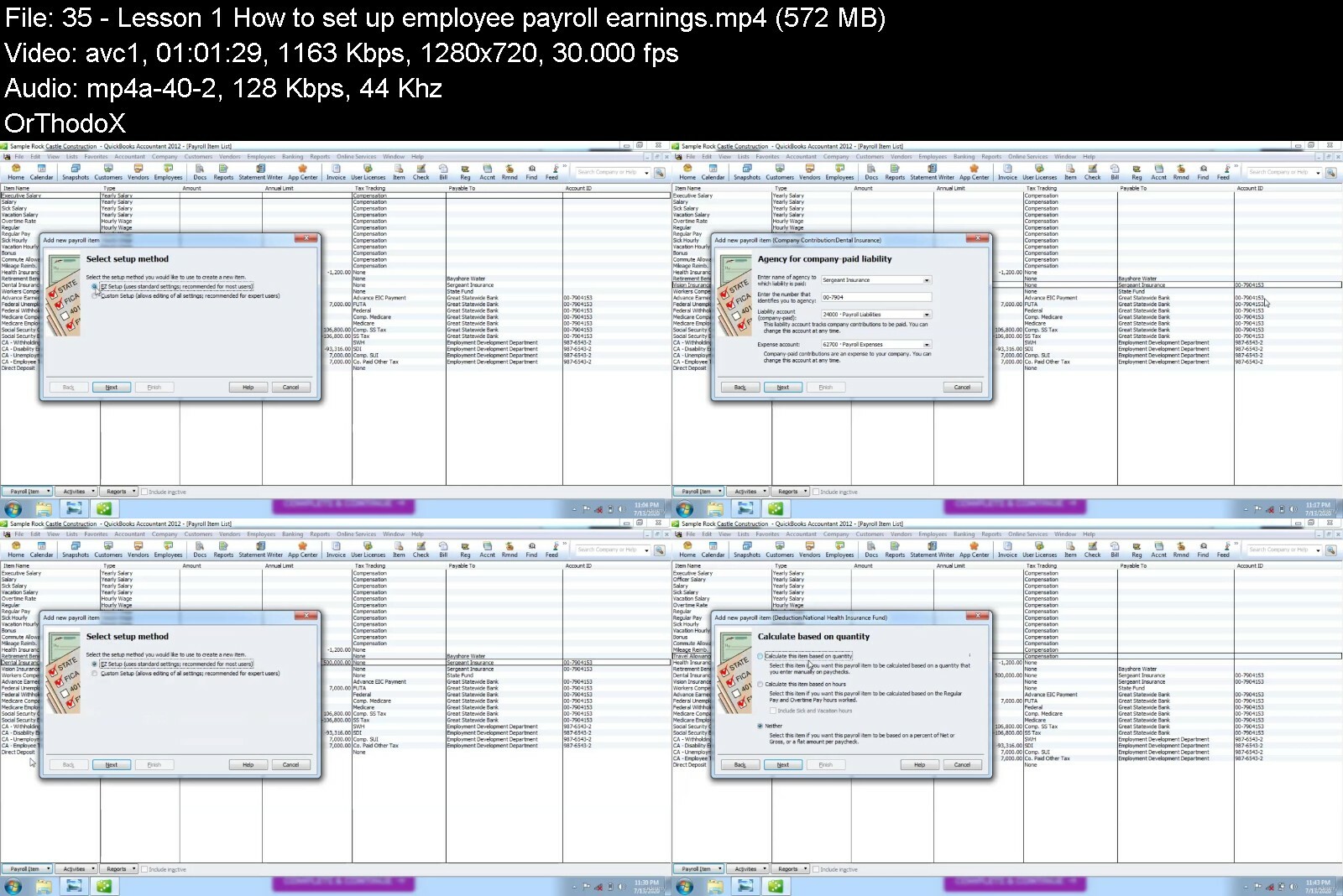
Lecture 35 Lesson 1 | How to set up employee payroll earnings

Lecture 36 Lesson 2 | How to set up employee payroll schedule

Lecture 37 Lesson 3| How to run employee payroll an automatically generate salaries

Lecture 38 Lesson 4 | How to make payment on payroll liabilities

Lecture 39 Lesson 5 | How to create sales orders and sales receipts

Section 9: Module 8

Lecture 40 Lesson 1 | How to back-up company data, enter fixed assets and create reminders

Lecture 41 Lesson 2|How to create & interpret budget report to forecast company performance

Lecture 42 Lesson 3 | How to customize invoices and sales receipts

Lecture 43 Lesson 4 | How to customize the layout designs of invoices and receipts

Lecture 44 Lesson 5 | How to automate routine transactions & create portable company file

Section 10: Module 9

Lecture 45 Lesson 1 | How to generate and interpret reports

The most Comprehensive, step-by-step "Beginner to Advanced" QuickBooks Training Course Program for accountants and accounting students who want to:,a) Learn the "in-demand" QuickBooks skills to not only gain competitive edge in the market,b) Land better jobs --almost every company hiring for accounting requires the suitable candidates to have QuickBook skills,c) Grow their career--when you have the skills the market is looking for, you set yourself up for a great career,Whether you are experienced accountant or an accounting student aspiring to be an accountant or in-between, in this course, I will help you move from "Zero knowledge to Expert-level skill" working with QuickBooks. You'll not only love the course and the positive impact it'll have on your career, but you'll also enjoy the training journey as I walk you through this training course program. Welcome for an amazing training experience! I'm so thrilled and excited walk you through the entire course. I've helped others, and now I want to help you. Click the "overview video" to learn more of what we are going to cover in this course. I can't wait to see you in the course!,d) Master how to use accounting system to automate almost all their accounting operations, eliminate paperwork and reduce work-related stress.


masterquickbooksthecomzf3i.jpg


Persuasion: 30-Days To Mastering Persuasive Sales Skills

egt0lvbxmncgevaeg7jjuwoc4h.jpg


Persuasion: 30-Days To Mastering Persuasive Sales Skills
Last updated 7/2022
MP4 | Video: h264, 1280x720 | Audio: AAC, 44.1 KHz
Language: English | Size: 6.15 GB | Duration: 5h 43m

Unleash Your Powers of Persuasion in 30 Days & Influence Others So They WANT to Buy Your Offers and Buy Them From YOU!


What you'll learn
Watch video to discover how, within only 30 days from now you will be a master of persuasive psychology and sales skills!
You will discover the one thing you MUST do before you even think about closing the sale!
Revealed: Why it's NOT your fault if you lose a sale; it's all to do with choosing the right moment with the right words!
In 30 days from now, you'll wonder how you managed to sell before at all, once you learn these powerful selling techniques.

Requirements
No prior knowledge of selling is required - this course is geared for everyone from absolute beginners who are yearning for success to sales people who are already in the business but need to rocket boost their sales figures.
You should be excited to learn sales techniques and understand human persuasive psychology, and ready to take action to benefit yourself!
You should have an open mind and willingness to learn about powerful sales and marketing techniques.
View the videos on a PC, MAC, Laptop, Tablet or Smartphone. Notebooks and pens to take notes

Description
When you discover the true power of persuasion psychology and combine that with the art of selling...Your income potential will become limitless!Imagine for a minute if you could easily sell ANYTHING to ANYONE...To make visitors actually WANT to buy whatever you offer and want to buy it from YOU!Whether you sell products or services online, at live events, in a retail store or showroom or via phone in a call centre.When you can sell without selling, you will become unstoppable!The ability to connect with people and guide them to making a purchase decision, through subtle persuasion techniques is so powerful and the best part is, those new customers are also more likely to buy from you again and again.So, if you're struggling to turn new visitors into clients, customers or subscribersIf you're trying to write sales copy that converts to boost your sales and profitsIf you want to discover the secrets to having almost anything you ever want from othersAnd you want all of this within the next 30 days from now...Then you'll want to get started right now with our 30 Days to Persuasive Sales Skills Course.Whether you've NEVER sold a thing in your life or you're the companies 'Sales Person of the Year!'Mastering the art of Persuasion Psychology over the next 30 days, will take your sales skills far beyond what you ever thought possible.As well as providing you with an easy to follow step-by-step 30 day plan, you will also receive;- 125 page illustrated text version of the entire course- "100 Sales and Persuasion Tips"- Essential "Wordpower" document to help inspire your sales and marketing copy writing!- Q&A videos the answer your specific questions- Assignments that make you productive while taking the course- An experienced instructor who truly cares about your successOur happiness guarantee...Udemy has a 30-day 100% money back guarantee, so if you aren't happy with your purchase, please contact Udemy to ask for a full refund.We can't wait to see you in the course!Enrol now, and we'll help you take your sales skills and profits to the next level through using the power of persuasion psychology!

Overview

Section 1: Your 30-Days to Mastering the Art of Persuasive Sales Skills!

Lecture 1 Day 1: Introduction to Your 30 Days to Persuasive Sales Skills

Lecture 2 The Udemy Student Support Centre

Lecture 3 Day 2: A Brief History of Persuasion Tactics

Lecture 4 Day 3: Discover the Power of Empathy Part One

Lecture 5 Day 4: Discover the Power of Empathy Part Two

Lecture 6 Day 5: Knowing Me Knowing You!

Lecture 7 Day 6: Powerfully Persuasive Words Part One

Lecture 8 Day 7: Powerfully Persuasive Words Part Two

Section 2: Persuasion Techniques

Lecture 9 Day 8: Old Vs New Persuasive Sales Techniques

Lecture 10 Day 9: Mirroring Sales Techniques

Lecture 11 Day 10: 'Careful' Flattery

Lecture 12 Day 11: Priming

Lecture 13 Day 12: Persuasion Techniques for Any Occassion

Lecture 14 Day 13: Selling to the Value

Lecture 15 Day 14: BEWARE The Very Eager Buyer!

Lecture 16 Day 15: Motivational Interviewing

Lecture 17 Day 16: Authority and Sales Structures

Lecture 18 Day 17: Nice Techniques and Balanced Arguments

Section 3: Objections and Complaints

Lecture 19 Day 18: How to Deal with Conflict and Complaints

Lecture 20 Day 19: Objections and Complaints

Section 4: Voice Training

Lecture 21 Day 20: How to Improve Your Speech

Lecture 22 Day 21: The Right Voice for the Right Situation

Lecture 23 Day 22: Voice Emphasis and Acting

Lecture 24 Day 23: More Persuasive Voice Styles

Lecture 25 Day 24: Voice Exercises

Section 5: Body Language

Lecture 26 Day 25: Body Language that Will Boost Your Sales Skills Part One

Lecture 27 Day 26: Body Language that Will Boost Your Sales Skills Part Two

Section 6: Killer Persuasive Stock Phrases

Lecture 28 Day 27: Killer Persuasive Stock Phrases Part One

Lecture 29 Day 28: Killer Persuasive Stock Phrases Part Two

Lecture 30 Day 29: Using the Art of Persuasion in Job Interviews

Lecture 31 Day 30: Summary and On-Going Support

Lecture 32 BONUS!

This course is for YOU if you struggle with relating to clients when you first meet them, cold-calling and closing sales.,This course is for YOU if you dream of beating every sales target you have ever been given before, and also growing your business and your reputation.,This course is for YOU if you want to avoid failing your sales targets and even losing your job because of it.,This course is for YOU if you want to truly understand the needs and desires of your potential customers and be able to satisfy them.

Homepage


7day6powerfullypersuav4eku.jpg


Pmi-Acp Exam Prep Success

hkw8478iswbcrbe0wmx5mhrcfz.jpg


Pmi-Acp Exam Prep Success
Last updated 11/2021
MP4 | Video: h264, 1280x720 | Audio: AAC, 44.1 KHz
Language: English | Size: 7.01 GB | Duration: 13h 12m

Pass the PMI-ACP Exam based on the PMBOK: Everything You Need to Pass the PMI-ACP


What you'll learn
Qualify for the PMI-ACP Certification Exam
Build an Agile Mindset
Identify characteristics of value-driven projects
Claim 21 Professional Development Units (PDUs)
Identify the characteristics of a successful agile project
Discuss agile project management in depth
Pass the PMI-ACP examination

Requirements
Understanding of PMI-ACP certification
What agile project management is and is not
Qualifications for the PMI-ACP examination

Description
Looking for a PMI-ACP exam prep course with 21 PDUs? This is it!You want to earn the PMI-ACP certification and you need quality training without all the nonsense and fluff so many courses offer. You do want to learn from an authority in project management that's also certified as a PMI-ACP.This is the course you want. This course provides 21 hours of Agile project management education and is taught by project management author and expert Joseph Phillips. You can claim these 21 hours as 21 PDUs for your continuing PMI education.Our PMI-ACP® Exam Prep course provides complete coverage of the PMI-ACP® exam objectives and the library of Agile resources PMI recommends. Start today, invest in your career, and begin working to clear your PMI-ACP® exam. Here's what's included in our PMI-ACP® Exam Prep Online Seminar:►21 Professional Development Units (PDUs)►Complete coverage of the entire PMI-ACP® exam objectives►21 contact hours of project management education►Practice exam questions and answers on all exam objectives►Module exams covering every PMI-ACP exam objective►PDF course workbook; entire course for note-taking and following along►Videos of all concepts, formulas, theories, and agile project management practices►Lectures on the entire PMI-Agile® exam objectives►24 x 7 Web and mobile access►All terms for the PMI-ACP terms you must know for exam success►Course discussions with the Instructor and peers►30-day satisfaction guaranteed

Overview

Section 1: Preparing to Pass the PMI-ACP Exam

Lecture 1 All About the PMI-ACP Certification

Lecture 2 Qualifications for the PMI-ACP Exam

Lecture 3 Applying for the PMI-ACP Exam

Lecture 4 Money and the PMI-ACP Exam

Lecture 5 Join PMI

Lecture 6 Passing the PMI-ACP Exam

Lecture 7 Preparing a Study Strategy - to Pass!

Lecture 8 What to Expect on Testing Day

Lecture 9 What Your Exam is Based Upon

Lecture 10 PMI-ACP Exam Domains

Lecture 11 PMI-ACP Exam Handbook

Lecture 12 PMI-ACP Coach

Lecture 13 PMI-ACP Exam Details Learning Game

Lecture 14 Section Summary

Lecture 15 Key terms

Section 2: Agile Principles and the PMI-ACP Mindset

Lecture 16 Overview of Domain I: Agile Principles and Mindset

Lecture 17 Defining Agile Values for Projects

Lecture 18 Managing Knowledge-Work Projects

Lecture 19 Comparing Empirical Processes and Defined Processes

Lecture 20 Exploring the Declaration of Interdependence

Lecture 21 Being Agile and Doing Agile

Lecture 22 Inverting the Triple Constraints

Lecture 23 Leading Organizational Agility

Lecture 24 Thinking About Agile Practices

Lecture 25 Doing Agile Project Management

Lecture 26 Encouraging Others to Embrace Agile

Lecture 27 Reviewing the Agile Manifesto

Lecture 28 Individuals and Interactions Over Processes and Tools

Lecture 29 Working Software Over Comprehensive Documentation

Lecture 30 Customer Collaboration Over Contract Negotiation

Lecture 31 Responding to Change Over Following a Plan

Lecture 32 Twelve Principles of Agile

Lecture 33 Comparing Agile Project Management Approaches

Lecture 34 Introducing Scrum

Lecture 35 All About Kanban

Lecture 36 Extreme Programming

Lecture 37 Lean Product Development

Lecture 38 Dynamic Systems Development Method

Lecture 39 Feature-Driven Development

Lecture 40 Introducing Crystal

Lecture 41 Leading an Agile Project

Lecture 42 Management and Leadership in Agile

Lecture 43 Serving as a Leader

Lecture 44 PMI-ACP Coach

Lecture 45 Create a Safe and Trustful Team Environment

Lecture 46 Experiment to Find Efficient And Effective Ways Of Working (NULL)

Lecture 47 Encourage Emergent Leadership

Lecture 48 Agile Principles and Mindset Learning Game

Lecture 49 Section Summary

Section 3: Value-Driven Delivery

Lecture 50 Overview of Domain II: Value-Driven Delivery

Lecture 51 Delivering Value in Agile Projects

Lecture 52 Creating Value ASAP

Lecture 53 Removing Waste

Lecture 54 Defining Value in Organizations

Lecture 55 Exploring the Time Value of Money

Lecture 56 Introducing Earned Value Management

Lecture 57 Agile Project Accounting

Lecture 58 Creating Key Performance Indicators

Lecture 59 Managing Risks in Agile Projects

Lecture 60 Adhering to Regulatory Compliance in Agile

Lecture 61 Prioritizing Value in Agile Projects

Lecture 62 Deliver High-Value Requirements First

Lecture 63 Utilizing MoSCoW

Lecture 64 Using Kano Analysis

Lecture 65 How to do Dot Voting

Lecture 66 Spending Monopoly Money

Lecture 67 Trying the 100-Point Method

Lecture 68 Setting Requirements Prioritization

Lecture 69 Relative Prioritization and Ranking

Lecture 70 Delivering Value in Increments

Lecture 71 Reviewing the Cost of Change

Lecture 72 Creating the MVP

Lecture 73 Embracing Low-Tech/High-Touch Tools

Lecture 74 Value and Validation

Lecture 75 Creating Kanban Boards

Lecture 76 Making a Task Board

Lecture 77 Setting the WIP Limit

Lecture 78 Exploring Little's Law

Lecture 79 Working with Vendors In Agile Projects

Lecture 80 Introducing DSDM Contracting

Lecture 81 Graduated Fixed Priced Contracts

Lecture 82 Fixed-Price Work Packages

Lecture 83 Validating Value in Agile Projects

Lecture 84 Software Testing and Verification

Lecture 85 Exploratory Testing

Lecture 86 Usability Testing

Lecture 87 Implementing Continuous Integration

Lecture 88 Working with Test-Driven Development

Lecture 89 PMI-ACP Coach

Lecture 90 Acceptance Test-Driven Development

Lecture 91 Value-Driven Delivery Learning Game

Lecture 92 Section Summary

Section 4: Stakeholder Engagement

Lecture 93 Overview of Domain III: Stakeholder Engagement

Lecture 94 Leading Stakeholder Stewardship

Lecture 95 Defining Stakeholder Values

Lecture 96 Defining Community Values

Lecture 97 Managing Stakeholder Engagement

Lecture 98 Identifying Project Stakeholders

Lecture 99 Building Stakeholder Synergy

Lecture 100 Keeping Stakeholders Involved

Lecture 101 Leading Stakeholder Conversations

Lecture 102 Sharing the Project Vision

Lecture 103 Creating the Project Charter

Lecture 104 Defining Done in Agile Projects

Lecture 105 Modeling an Agile Project

Lecture 106 Use Case Diagrams

Lecture 107 Leveraging Data Models

Lecture 108 Knowing Wireframes

Lecture 109 Meeting Personas

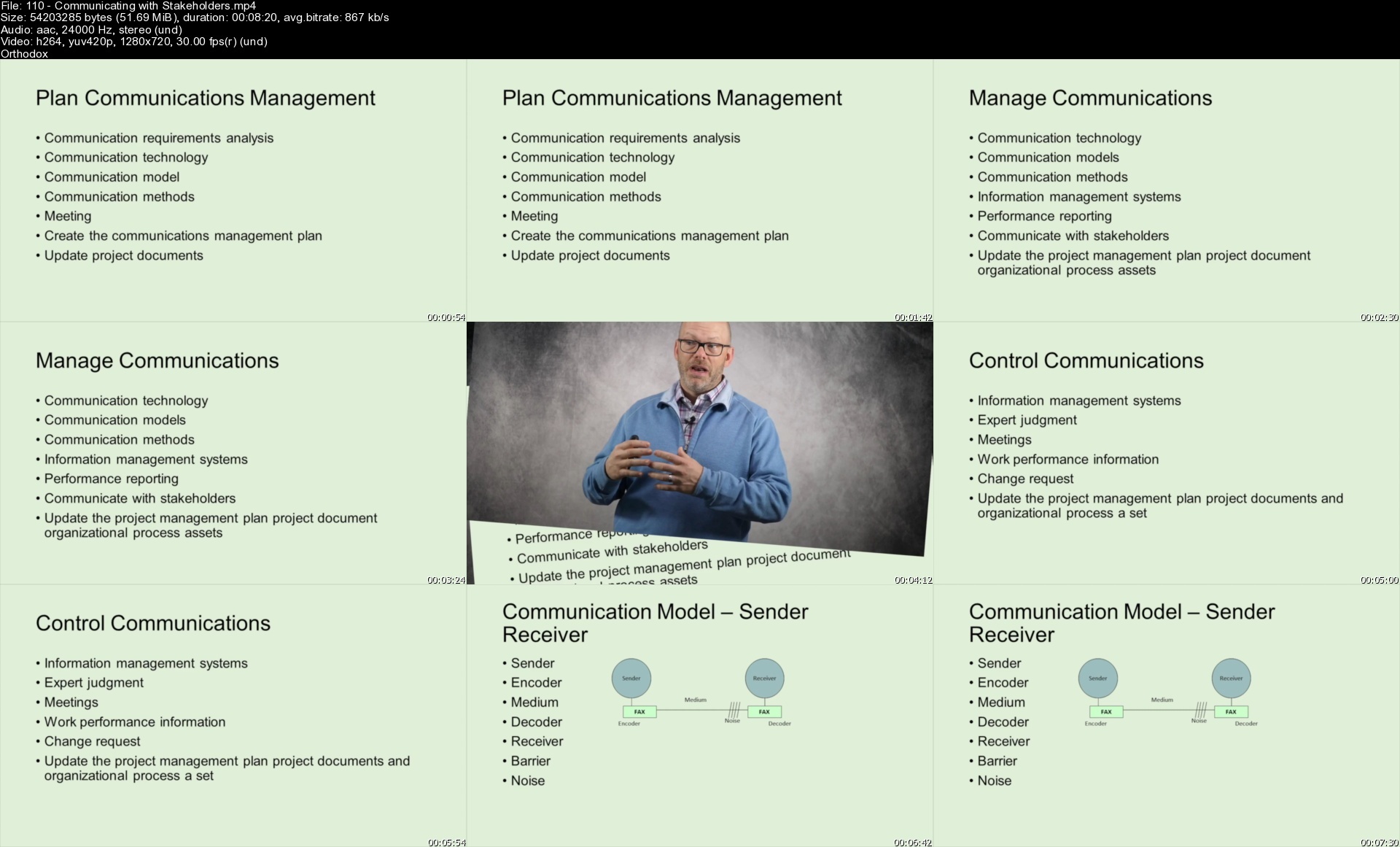
Lecture 110 Communicating with Stakeholders

Lecture 111 Leading Face-to-Face Communication

Lecture 112 Sharing Knowledge with Stakeholders

Lecture 113 Building an Information Radiator

Lecture 114 Collaborating with Stakeholders

Lecture 115 Creating Green and Red Zones

Lecture 116 Hosting a Workshop

Lecture 117 Brainstorming Ideas

Lecture 118 Playing Collaboration Games

Lecture 119 Defining Soft Skills for Agile Projects

Lecture 120 Basics of Emotional Intelligence

Lecture 121 How to Listen Actively and Effectively

Lecture 122 Facilitating Meetings

Lecture 123 Negotiating with Stakeholders

Lecture 124 Resolving Conflicts

Lecture 125 Making Good Project Decisions

Lecture 126 Empowering the Project Team

Lecture 127 Making Decisions as a Group

Lecture 128 Stakeholder Engagement Learning Game

Lecture 129 PMI-ACP Coach

Lecture 130 Section Summary

Section 5: Team Performance

Lecture 131 Overview of Domain IV: Team Performance

Lecture 132 Valuing People Over Processes

Lecture 133 Defining the Delivery Team

Lecture 134 Identifying the Product Owner

Lecture 135 Responsibility of the Team Leader

Lecture 136 Recognizing the Project Sponsor

Lecture 137 Forming the Agile Project Team

Lecture 138 Working with Generalizing Specialists

Lecture 139 Building a High-Performing Team

Lecture 140 Developing the Project Team

Lecture 141 Leading the Project Team

Lecture 142 Providing Motivation

Lecture 143 Training the Project Team

Lecture 144 Coaching Team Members

Lecture 145 Building a Collaborative Team Space

Lecture 146 Working with Co-Located Teams

Lecture 147 Defining the Project Team Space

Lecture 148 Identifying Osmotic Communications

Lecture 149 Managing Team Diversity

Lecture 150 Working with Distributed Teams

Lecture 151 Monitoring Team Performance

Lecture 152 Building Burn Charts

Lecture 153 Calculating Team Velocity

Lecture 154 Team Performance Learning Game

Lecture 155 Section Summary

Section 6: Adaptive Planning

Lecture 156 Overview of Domain V: Adaptive Planning

Lecture 157 Agile Planning Concepts

Lecture 158 Adaptive Planning

Lecture 159 Agile and Non-Agile Planning Activities

Lecture 160 Principles of Agile Planning

Lecture 161 Agile Discovery

Lecture 162 Leading Progressive Elaboration

Lecture 163 Value-Based Analysis

Lecture 164 Timeboxing Meetings and Events

Lecture 165 Creating Estimate Ranges

Lecture 166 Working with Ideal Time

Lecture 167 User Stories

Lecture 168 Creating the User Story Backlog

Lecture 169 User Stories: Sizing, Estimating, and Planning

Lecture 170 Breaking Down the Project

Lecture 171 Grooming the Backlog

Lecture 172 Utilizing Affinity Estimating

Lecture 173 Sizing T-Shirts

Lecture 174 Creating a Product Roadmap

Lecture 175 Using Wideband Delphi

Lecture 176 Planning with Poker

Lecture 177 Creating Release and Iteration Plans

Lecture 178 Using Spikes

Lecture 179 Visioning the Releases

Lecture 180 Planning for Releases

Lecture 181 Planning Project Iterations

Lecture 182 Completing Daily Stand-Ups

Lecture 183 Adaptive Planning Learning Game

Lecture 184 PMI-ACP Coach

Lecture 185 Section Summary

Section 7: Problem Detection and Resolution

Lecture 186 Overview of Domain VI: Problem Detection and Resolution

Lecture 187 Controlling Project Problems

Lecture 188 Cost of Change

Lecture 189 Reviewing Technical Debt

Lecture 190 Create a Safe and Open Environment

Lecture 191 Failure and Success Modes in a Project

Lecture 192 Strategies for Success

Lecture 193 Detecting Problems and Defects

Lecture 194 Understanding Lead Time and Cycle Time

Lecture 195 Completing Variance Analysis

Lecture 196 Identifying Trends in a Project

Lecture 197 Setting Control Limits

Lecture 198 Creating a Risk-Adjusted Backlog

Lecture 199 Determining Risk Severity

Lecture 200 Creating Risk Burndown Charts

Lecture 201 What's the Problem?

Lecture 202 Solving Problems in Agile Projects

Lecture 203 PMI-ACP Coach

Lecture 204 Problem Detection and Resolution Learning Game

Lecture 205 Section Summary

Section 8: Continuous Improvement

Lecture 206 Overview of Domain VII Review: Continuous Improvement

Lecture 207 Leading Continuous Improvement as a Process

Lecture 208 Tailoring Processes

Lecture 209 Completing Systems Thinking

Lecture 210 Participating in Process Analysis

Lecture 211 Creating Value Stream Maps

Lecture 212 Hosting a Project Pre-Mortem

Lecture 213 Leading Product Review Sessions

Lecture 214 Examining a Product Feedback Loop

Lecture 215 Understanding Approved Iterations

Lecture 216 Leading a Retrospective

Lecture 217 Completing Team Assessments

Lecture 218 Section Summary

Lecture 219 Continuous Improvement Learning Game

Lecture 220 Course Wrap and the PMI-ACP Coach

Lecture 221 How to Claim PDUs and the Certificate of Completion

Lecture 222 Link to Certificate

Project managers who qualify for the PMI-ACP examination,Project managers seeking more information about agile project manager

Homepage


110communicatingwithsyeemi.jpg


Pmp Exam Prep Seminar - Complete Exam Coverage With 35 Pdus

153estimatingtheproje4xdo4.jpg


Pmp Exam Prep Seminar - Complete Exam Coverage With 35 Pdus
Last updated 1/2023
MP4 | Video: h264, 1280x720 | Audio: AAC, 44.1 KHz
Language: English | Size: 37.00 GB | Duration: 29h 54m

PMP Exam Prep Seminar - Earn 35 PDUs by completing the entire PMP course


What you'll learn
Earn 35 PDUs/Contact Hours by completing the entire course
You will get all the resources you need to pass the PMI PMP certification exam.
You will earn 35 exam contact hours as required by PMI
You will be able to discuss the PMBOK Guide with confidence.
Explain the project management processes
Discuss the project management knowledge areas
Demonstrate the formulas, charts, and theories of project management
Calculate float for complex project network diagrams
Memorize the formulas for earned value management
Compare and contrast processes, knowledge areas, theories, and project management best practices
Build a strong foundation in Agile project management for the new PMP exam
Complete hands-on assignments and exercises


Requirements
Participants should qualify for the PMP exam
Understand fundamentals of project management
Dedicated to completing this PMP Exam Prep Seminar
Have a deep desire to pass the PMP exam


Description
Updated November 2022 for the current PMP Exam and based on PMI's Exam Content Outline.Join the thousands of others who've completed this top-rated course and passed their PMP exam. You can do this!PMP® Exam Prep Seminar: ID 109EPSWB 20 hours for technical skills9 hours for business skills6 hours for leadership skills35 PDUs / 35 contact hours for the PMP exam application90-question pre-assessment exam90-question end-of-course assessment exam20-questions in each sectionAssignments and discussionCoaching sections throughout to keep you motivated - You can do this!You MUST complete all assignments and exercises to claim the 35 Contact Hours.You need to pass the PMP exam and you need quality training that'll help you in your role as a project manager. You also want to learn from an authority in project management, in an online environment with plenty of assignments, videos, and concise explanations. This course provides 35 PDUs and is taught by project management author and expert Joseph Phillips. Joseph is the author of several project management books from McGraw-Hill, the American Management Association, and Dummies Press. He is certified as a PMP, PMI-ACP, ITIL, Project+, and is a Certified Technical Trainer.The 35 hours of project management education are earned by completing all of the course, the assignments, exercises, and quizzes. The Learning Management System tracks your completion of the course; if you complete all the videos, assignments, and interactive sessions, you can claim these hours for your PMP exam application or maintain your PMP certification.

Overview
Section 1: Preparing to Pass the PMP

Lecture 1 Welcome to the PMP Exam Prep Seminar

Lecture 2 Certificate of Completion

Lecture 3 Frequently Asked Questions

Lecture 4 Explore the Entire Course

Lecture 5 All About the PMP Exam Details

Lecture 6 All About the PMP Exam

Lecture 7 PMP Exam Application Audit

Lecture 8 PMP Coach: Getting Started

Lecture 9 PMP Exam - January 2, 2021

Lecture 10 Section Summary: Preparing to Pass the PMP Exam

Section 2: Get the Most from this course

Lecture 11 Section Overview: Get the Most from the Course

Lecture 12 Frequently Asked Questions

Lecture 13 PDUs Or Contact Hours

Lecture 14 Create a Study Strategy

Lecture 15 Explore the PMBOK Guide, Sixth Edition

Lecture 16 Course Resources

Lecture 17 Maintaining Your PMP

Lecture 18 PMP Coach: Confidence

Lecture 19 Section Summary: Get the Most from the Course

Section 3: PMBOK Guide, Sixth Edition

Lecture 20 Section Overview: PMBOK Guide, Sixth Edition

Lecture 21 Introduction to the PMBOK Guide

Lecture 22 Environments in Which Projects Operate

Lecture 23 Role of the Project Manager

Lecture 24 Project Integration Management

Lecture 25 Project Scope Management

Lecture 26 Project Schedule Management

Lecture 27 Project Cost Management

Lecture 28 Quality in Project Management

Lecture 29 Project Resources Management

Lecture 30 Project Communications Management

Lecture 31 Project Risk Management Overview

Lecture 32 Project Procurement Management

Lecture 33 Project Stakeholder Management

Lecture 34 PMP Coach: Daily Work

Lecture 35 Section Summary: PMBOK Guide, Sixth Edition Overview

Section 4: Define Project Management Foundations

Lecture 36 Section Overview: Project Management Foundations

Lecture 37 Projects are Temporary

Lecture 38 Project Create Unique Products, Services, Or Results

Lecture 39 Projects Enable Business Value Creation

Lecture 40 Project Initiation Context - Why Projects are Created

Lecture 41 Defining Project Management

Lecture 42 Project Management Application areas

Lecture 43 Reviewing a Project Life Cycle

Lecture 44 PMP Coach: Don't Think too Much

Lecture 45 Section Wrap: Define Project Management Foundations

Section 5: Related Areas of Project Management

Lecture 46 Section Overview: Related Areas of Project Management

Lecture 47 Program Management

Lecture 48 Portfolio Management

Lecture 49 Working with a Project Management Office

Lecture 50 Projects Vs. Operations

Lecture 51 OPM and Strategies

Lecture 52 Understanding the Project Environment

Lecture 53 PMP Coach: Know Your Terms

Lecture 54 Section Wrap: Related Areas of Project Management

Section 6: Project Management Components

Lecture 55 Section Overview: Project Management Processes Groups and Knowledge Areas

Lecture 56 Reviewing the Project Management Process Groups

Lecture 57 Work Performance Data, Information, and Reports

Lecture 58 Tailoring the Processes

Lecture 59 Introducing Adaptive Environments

Lecture 60 Introducing Business Documents

Lecture 61 Project Business Case

Lecture 62 Project Benefits Management Plan

Lecture 63 Reviewing the Project Management Knowledge Areas

Lecture 64 PMP Coach: What's your benefit?

Lecture 65 Section Wrap: Project Management Components

Section 7: Project Environments

Lecture 66 Section Overview: Project Environments

Lecture 67 Enterprise Environmental Factors

Lecture 68 Organizational Process assets

Lecture 69 Processes, Policies, and Procedures

Lecture 70 Organizational Knowledge Repositories

Lecture 71 Organizational Systems

Lecture 72 Frameworks

Lecture 73 Management Elements

Lecture 74 Organizational Structure Types

Lecture 75 Project Management Office

Lecture 76 PMP Coach: Keep going!

Lecture 77 Section Wrap: Project Environments

Section 8: Role of the Project Manager

Lecture 78 Section Overview: Role of the Project Manager

Lecture 79 Definition of a Project Manager

Lecture 80 Project Manager's Sphere of Influence

Lecture 81 Project Management Competencies

Lecture 82 Technical Project Management Skills

Lecture 83 Strategic and Business Management Skills

Lecture 84 Leadership Skills

Lecture 85 Politics, Power, and Getting Things Done

Lecture 86 Comparing Leadership and Management

Lecture 87 Performing Integration

Lecture 88 PMP Coach: It's Problem Solving

Lecture 89 Section Wrap: Role of the Project Manager

Section 9: Implementing Project Integration Management

Lecture 90 Section Overview: Implementing Project Integration Management

Lecture 91 Trends and Emerging Practices in Project Integration Management

Lecture 92 Tailoring Project Integration Management

Lecture 93 Considerations for Adaptive Environments

Lecture 94 Developing the Project Charter

Lecture 95 Examining Benefit Measurement Methods

Lecture 96 Creating an Assumptions Log

Lecture 97 Developing the Project Management Plan

Lecture 98 Directing and Managing the Project Work

Lecture 99 Actions as Project Manager

Lecture 100 Deliverables

Lecture 101 Work Performance Data

Lecture 102 Issue Log

Lecture 103 Manage Project Knowledge

Lecture 104 Monitoring and Controlling the Project Work

Lecture 105 Performing Integrated Change Control

Lecture 106 Closing the Project or Phase

Lecture 107 PMP Coach: Interruptions

Lecture 108 Section Wrap: Implementing Project Integration Management Project integration

Section 10: Managing the Project Scope

Lecture 109 Section Overview: Managing the Project Scope

Lecture 110 Planning Project Scope Management

Lecture 111 Project Scope Vs. Product Scope

Lecture 112 Trends and Emerging Practices in Project Scope Management

Lecture 113 Considerations for Adaptive Environments

Lecture 114 Collecting the Project Requirements

Lecture 115 Managing the Project Requirements

Lecture 116 Defining the Project Scope Statement

Lecture 117 Creating the Work Breakdown Structure

Lecture 118 Validating the Project Scope

Lecture 119 Controlling the Project Scope

Lecture 120 PMP Coach: Control Your Scope

Lecture 121 Section Wrap: Managing the Project Scope

Section 11: Introducing Project Schedule Management

Lecture 122 Section Overview: Introducing Project Schedule Management

Lecture 123 Trends and Emerging Practices in Project Schedule Management

Lecture 124 Considerations for Adaptive Environments

Lecture 125 Creating the Schedule Management Plan

Lecture 126 Defining the Project Activities

Lecture 127 Rolling Wave Planning

Lecture 128 Compiling the Activity List

Lecture 129 Creating the Milestone List

Lecture 130 Sequencing Project Activities

Lecture 131 Creating Network Diagrams

Lecture 132 Walk Through a Float Sample

Lecture 133 Considering Leads and Lags

Lecture 134 Estimating Activity Durations

Lecture 135 Creating an Analogy

Lecture 136 Applying Parametric Estimates

Lecture 137 Creating a Three-Point Estimate

Lecture 138 Bottom-Up Estimating

Lecture 139 Factoring in Reserve Time

Lecture 140 Developing the Project Schedule

Lecture 141 Evaluating the Project Constraints and Assumptions

Lecture 142 Performing Schedule Network Analysis

Lecture 143 Using a Project Simulation

Lecture 144 Applying Duration Compression

Lecture 145 Agile Release Planning

Lecture 146 Controlling the Project Schedule

Lecture 147 Measuring Project Performance

Lecture 148 PMP Coach: Control Your Schedule

Lecture 149 Section Wrap: Project Schedule Management

Section 12: Project Cost Management

Lecture 150 Section Overview: Project Cost Management

Lecture 151 Trends and Emerging Practices in Project Cost Management

Lecture 152 Planning the Project Costs

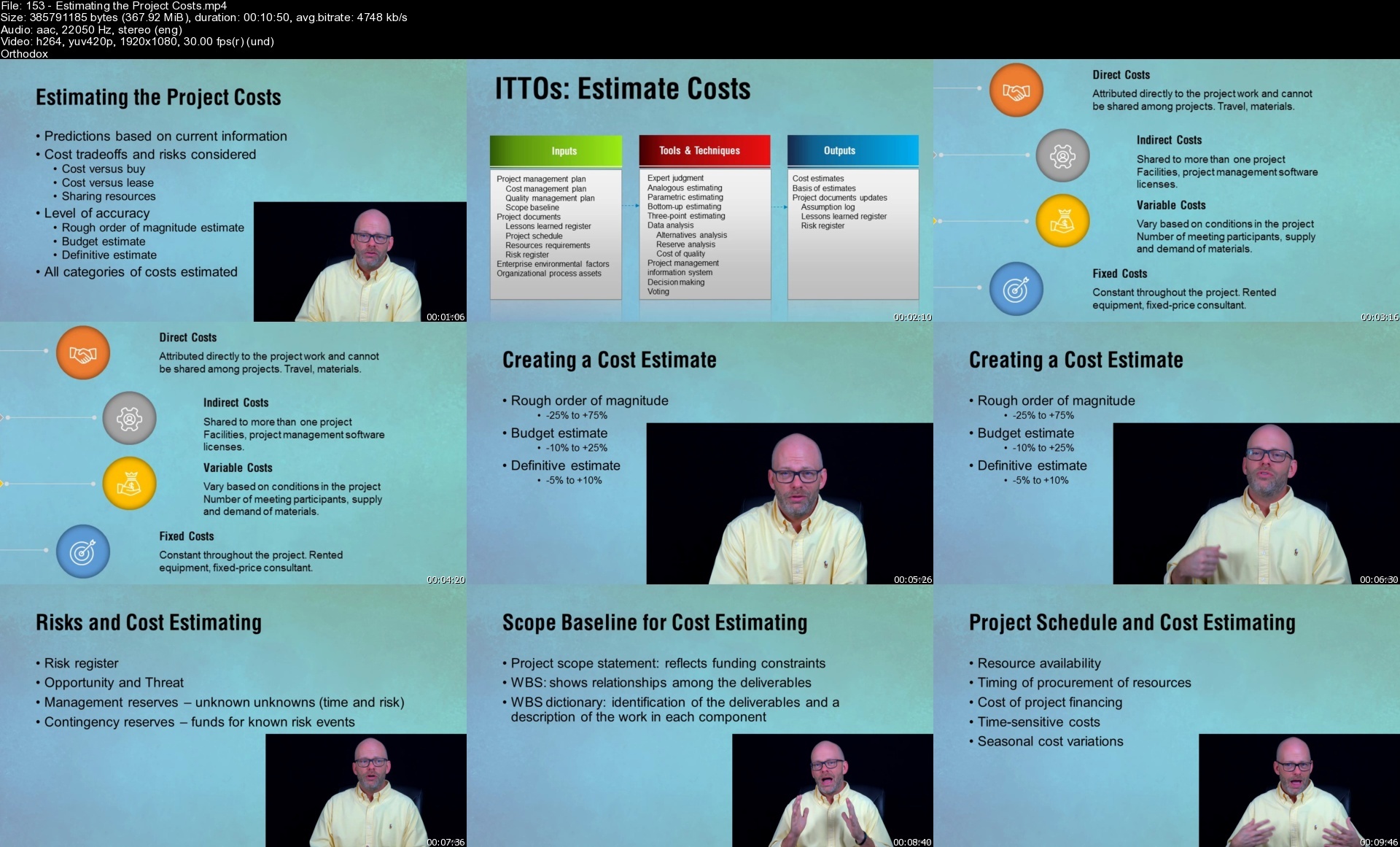
Lecture 153 Estimating the Project Costs

Lecture 154 Using Analogous Estimating

Lecture 155 Using Parametric Estimating

Lecture 156 Using Bottom-Up Estimating

Lecture 157 Creating a Three-Point Cost Estimate

Lecture 158 Creating a Project Budget

Lecture 159 Creating the Cost Baseline

Lecture 160 Establishing Project Funding Requirements

Lecture 161 Implementing Cost Control

Lecture 162 Measuring Project Performance

Lecture 163 Section Wrap: Project Cost Management

Section 13: Project Quality Management

Lecture 164 Section Overview: Project Quality Management

Lecture 165 Looking at the Big Quality Picture

Lecture 166 Considerations for Adaptive Environments

Lecture 167 Quality and Grade

Lecture 168 Planning for Quality

Lecture 169 Applying Benchmarking Practices

Lecture 170 Design of Experiments

Lecture 171 Trend Analysis

Lecture 172 Tailoring the Quality Management Processes

Lecture 173 Considering the Cost of Quality

Lecture 174 Creating the Quality Management Plan

Lecture 175 Manage Quality

Lecture 176 Design For X

Lecture 177 Results of Managing Quality

Lecture 178 Controlling Quality in a Project

Lecture 179 Inspecting Results

Lecture 180 Testing and Product Evaluations

Lecture 181 Creating Flowcharts and Control Charts

Lecture 182 Creating Pareto, Histograms, Scatter and Run Charts

Lecture 183 Completing a Statistical Sample

Lecture 184 Meet Your Quality Goals

Lecture 185 Section Wrap: Project Quality Management

Section 14: Introducing Project Resource Management

Lecture 186 Section Overview: Project Resource Management

Lecture 187 Key Concepts for Project Resource Management

Lecture 188 Trends and Emerging Practices in Resource Management

Lecture 189 Considerations for Adaptive Environments

Lecture 190 Preparing for Resource Planning

Lecture 191 Relating to Organizational Theories

Lecture 192 Creating the Resource Management Plan

Lecture 193 Estimating Activity Resources

Lecture 194 Acquiring Resources

Lecture 195 Negotiating for Resources

Lecture 196 Acquiring Staff

Lecture 197 Working with Virtual Teams

Lecture 198 Developing the Project Team Up

Lecture 199 Creating Team-Building activities

Lecture 200 Naturally Developing Project Teams

Lecture 201 Rewarding the Project Team

Lecture 202 Completing Assessments

Lecture 203 Managing the Project Team

Lecture 204 Controlling Resources

Lecture 205 Section Wrap: Project Resource Management

Section 15: Introducing Project Communications Management

Lecture 206 Section Overview: Project Communications Management

Lecture 207 Key Concepts for Project Communications Management

Lecture 208 Trends and Emerging Practices in Project Communications Management

Lecture 209 Considerations for Adaptive Environments

Lecture 210 Communications Planning

Lecture 211 Exploring Communication Technologies

Lecture 212 Communication Methods

Lecture 213 Interpersonal and Team Styles assessment

Lecture 214 Data Representation

Lecture 215 Creating Successful Communications

Lecture 216 Creating the Communications Plan

Lecture 217 Managing Project Communications

Lecture 218 Monitoring Communications

Lecture 219 Section Wrap: Project Communications Management

Section 16: Introducing Project Risk Management

Lecture 220 Section Overview: Project Risk Management

Lecture 221 Key Concepts for Project Risk Management

Lecture 222 Trends and Emerging Practices in Project Risk Management

Lecture 223 Considerations for Adaptive Environments

Lecture 224 Planning for Risk Management

Lecture 225 Examining Stakeholder Tolerance

Lecture 226 Relying on Risk Management Policies

Lecture 227 Creating the Risk Management Plan

Lecture 228 Creating Risk Categories

Lecture 229 Identifying Risks

Lecture 230 Identifying Risks Through Interviews

Lecture 231 Analyzing SWOT

Lecture 232 Creating a Risk Register

Lecture 233 Using Qualitative Risk analysis

Lecture 234 Preparing for Quantitative Risk analysis

Lecture 235 Applying Sensitivity Analysis

Lecture 236 Finding the Expected Monetary Value

Lecture 237 Using a Decision Tree

Lecture 238 Performing a Project Simulation

Lecture 239 Planning Risk Responses

Lecture 240 Justifying Risk Reduction

Lecture 241 Implementing Risk Responses

Lecture 242 Monitoring Risks

Lecture 243 Section Wrap: Project Risk Management

Section 17: Leading Project Procurement Management

Lecture 244 Section Overview: Project Procurement Management

Lecture 245 Key Concepts for Procurement Management

Lecture 246 Emerging Trends in Procurement

Lecture 247 Procurement Considerations for Agile Projects

Lecture 248 Planning for Procurement

Lecture 249 Planning for the Project Requirements

Lecture 250 Determining the Contract Type

Lecture 251 Determining to Make or Buy

Lecture 252 Creating Procurement Management Plan

Lecture 253 Creating the Procurement Documents

Lecture 254 Conducting Procurements

Lecture 255 Selecting the Seller

Lecture 256 Controlling Procurements

Lecture 257 Preparing for Contract administration

Lecture 258 Performing Claims Administration

Lecture 259 Performing Contract Closure

Lecture 260 Section Wrap: Project Procurement Management

Section 18: Engaging Project Stakeholders

Lecture 261 Section Overview: Project Stakeholder Management

Lecture 262 Stakeholder Management

Lecture 263 Identifying the Project Stakeholders

Lecture 264 Performing Stakeholder Analysis

Lecture 265 Planning Stakeholder Management

Lecture 266 Manage Stakeholder Engagement

Lecture 267 Monitor Stakeholder Engagement

Lecture 268 Section Wrap: Project Stakeholder Management

Section 19: The PMI Code of Ethics and Professional Conduct

Lecture 269 Section Overview: Code of Ethics and Professional Responsibility

Lecture 270 Responsibilities to the Profession

Section 20: Agile Introduction

Lecture 271 Agile Overview

Lecture 272 Agile Slide Deck - Resource

Lecture 273 Agile Mindset

Lecture 274 Agile Manifesto

Lecture 275 Agile Manifesto and Principles

Lecture 276 Nine Keys of Great Agile Projects

Lecture 277 Diving Deeper: Scrum Basics

Lecture 278 Agile Terms

Lecture 279 Agile Introduction Conclusion

Section 21: Exploring Scrum

Lecture 280 Overview: Agile Components

Lecture 281 Consider Predictive or Hybrid Approaches

Lecture 282 Incremental and Iterative Life Cycles

Lecture 283 Walking through a Sprint

Lecture 284 Agile Sprint Planning

Lecture 285 Hosting a Daily Scrum

Lecture 286 Completing the Sprint Review

Lecture 287 Performing a Sprint Retrospective

Lecture 288 Sprint Activity Considerations

Lecture 289 Exploring Scrum Conclusion

Section 22: Agile Roles and Responsibilities

Lecture 290 Meeting the Agile Project Team Overview

Lecture 291 Scrum Team Rules and Characteristics

Lecture 292 Meet the Product Owner

Lecture 293 You are the Scrum Master

Lecture 294 Consider Other Agile Roles

Lecture 295 Management and Leadership

Lecture 296 Agile Roles and Responsibilities Conclusion

Section 23: Refining Requirements

Lecture 297 Refining Requirements Overview

Lecture 298 Working With User Stories

Lecture 299 Hosting Workshops

Lecture 300 Working With Agile Modeling

Lecture 301 Use Case Diagram Purpose

Lecture 302 Defining Data Models

Lecture 303 Contracts and Agile Approaches

Lecture 304 Value-Based Analysis

Lecture 305 Refining Requirements Conclusion

Section 24: Estimating User Stories and Iterations

Lecture 306 Estimating User Stories and Iterations Overview

Lecture 307 Providing Estimate Ranges

Lecture 308 Voting on Requirements

Lecture 309 Creating Product Roadmap

Lecture 310 Defining Releases and Iterations

Lecture 311 Estimating Story Sizes

Lecture 312 Planning for Iterations

Lecture 313 Estimating User Stories and Iterations Conclusion

Section 25: Agile Project Performance

Lecture 314 Agile Project Performance Overview

Lecture 315 Monitoring Project Progress

Lecture 316 Earned Value Management in Agile

Lecture 317 Agile Project Accounting

Lecture 318 Measurements in Agile Projects

Lecture 319 Understanding Team Velocity

Lecture 320 Agile Project Performance Conclusion

Section 26: Exploring Different Agile Approaches

Lecture 321 Exploring Different Agile Approaches Overview

Lecture 322 All About Kanban

Lecture 323 eXtreme Programming

Lecture 324 Lean Product Development

Lecture 325 Other Agile Approaches

Lecture 326 Exploring Different Agile Approaches Conclusion

Section 27: Agile Projects and Products

Lecture 327 Agile Projects and Products Overview

Lecture 328 Releasing the Product

Lecture 329 Regulations, Risk, and Requirements

Lecture 330 Creating Project Priorities

Lecture 331 Agile Project Prioritization Schemes

Lecture 332 Low Tech and High Touch Solutions

Lecture 333 WIP and Little's Law

Lecture 334 Agile Projects and Products Conclusion

Section 28: Testing and Verifying in Agile Projects

Lecture 335 Testing and Verifying in Agile Projects Overview

Lecture 336 Verification and Validation

Lecture 337 Continuous Integration System

Lecture 338 Exploring Test-Driven Development

Lecture 339 Testing and Verifying in Agile Projects Conclusion

Section 29: Agile Stakeholder Engagement

Lecture 340 Agile Stakeholder Engagement Overview

Lecture 341 Stakeholder Engagement in Agile

Lecture 342 Incorporating Stakeholder Values

Lecture 343 Building Stakeholder Synergy

Lecture 344 Leading Stakeholder Conversations

Lecture 345 Creating an Agile Charter

Lecture 346 Agile Communication Consideration

Lecture 347 Agile Knowledge Sharing

Lecture 348 Social Media and Agile Projects

Lecture 349 Agile Collaboration

Lecture 350 Green and Red Zones

Lecture 351 Negotiation and Collaboration

Lecture 352 Resolving Conflicts in Agile Projects

Lecture 353 Agile Teams Considerations

Lecture 354 Completing Team Assessments

Lecture 355 Agile Stakeholder Engagement Conclusion

Section 30: Agile Project Risks and Issues

Lecture 356 Agile Project Risk and Issues Overview

Lecture 357 Problem Detection and Resolution

Lecture 358 Completing Variance Analysis

Lecture 359 Working With the Risk-Adjusted Backlog

Lecture 360 Problem Solving is Continuous Improvement

Lecture 361 Continuous Improvement Tasks

Lecture 362 Hosting the Project Pre-mortem

Lecture 363 Completing a Product Review

Lecture 364 Retrospective for People Improvement

Lecture 365 Agile Projects and Risk Conclusion

Section 31: PMP Blitz Review

Lecture 366 Section Overview: PMP Blitz Review

Lecture 367 Project Integration Management

Lecture 368 Project Scope Management

Lecture 369 Project Schedule Management

Lecture 370 Project Cost Management

Lecture 371 Project Quality Management

Lecture 372 Project Resources Management

Lecture 373 Project Communications Management

Lecture 374 Project Risk Management

Lecture 375 Project Procurement Management

Lecture 376 Project Stakeholder Management

Lecture 377 Section Wrap: Code of Ethics and Professional Responsibility

Lecture 378 Section Wrap: PMP Blitz Review

Section 32: Wrapping Up the Course

Lecture 379 PMI Certificate of Completion for PMP Application

Lecture 380 Wrapping up the Entire Course

Project managers who are preparing to PASS their PMI PMP examination,Project managers who need 35 contact hours to qualify for the PMP examination - by completing the entire course,Project managers who want to pass their PMP exam on the first try,People who want 35 PDUs from a PMI Registered Education Provider - by completing the entire course,This course is NOT for new project managers,This course is NOT for project managers seeking a project management guide

Homepage


153estimatingtheproje4xdo4.jpg


"Do It" Basic Business Course

473437435b425aifu.jpg


"Do It" Basic Business Course
Published 07/2022
MP4 | Video: h264, 1280x720 | Audio: AAC, 44.1 KHz, 2 Ch
Genre: eLearning | Language: English + srt | Duration: 29 lectures (5h 18m) | Size: 6.54 GB

Learn the principles to building a thriving business with Professor Abiola Awosika-Fapetu


What you'll learn
Find The right business idea.
Build a sustainable business.
Price your products right.
Incorporate the right process that helps you to sustain your competitive advantage.
Be accountable and attract more business/ investment


Requirements
No prior business knowledge or experience needed.


Description
Roughly 50% per cent of businesses fail in the first 5 years and more than 80% fail to reach their 10th year. however, with the right knowledge and skills, you can ensure that your business thrives for as long as you want it to.

Build and scale your business with time-tested practical and academic knowledge. No jargon, no prior business education required. We provide you with everything you need to DO IT.

In this course you wll learn how to

Incorporate the right process that helps you to sustain your competitive advantage

Build sustainability

Become a serial entrepreneur

Price your products right

Be accountable and attract more business/ investment

Course Outline

The course is designed to cover the four key areas of setting up a business and provides the key thoughts into the theory and practical application of business concepts and the journey to mastery.

The basic course covers these key areas

Idea Generation

Launching your product

Market your product

Manage your team

Here are a few ways our course can be beneficial to you

World-class Tutors: the course was designed by serial entrepreneurs with vast experience across different sectors. Meet our Tutors.

Easy to understand: the course is purposefully rid of business jargon and easy to follow and understand.

Guided exercises: our course takes students through a guided set of exercises that helps them proper structure their businesses.

Fully online. The course can be accessed on any internet-connected device and is available for life to all students.

Extra support: We can also provide extra modules, and extra support such as business clinics and consulting services for MSMEs.

Certification: we will provide your participants with certificates after successful completion of the modules certificates etc for participants to ensure that your needs are totally taken care of.

Who this course is for
New or aspiring business owners, looking to turn their skills, passions or special knowledge into a profitable business

Homepage


1.managingyourbusines60en5.jpg


Pass The Exam: Comptia Project+ Pk0-004

4gyhl89cf0unce8nnfmeq3de5u.jpg


Pass The Exam: Comptia Project+ Pk0-004
Last updated 11/2021
MP4 | Video: h264, 1280x720 | Audio: AAC, 44.1 KHz
Language: English | Size: 8.30 GB | Duration: 11h 37m

Earn the Project+ Certification and Become a Better Project Manager


What you'll learn
Pass the CompTIA Project+ Certification Exam
Explain the project management processes found in Initiating, Planning, Executing, Monitoring and Controlling, and Closing
Demonstrate the formulas, charts, and theories of project management
Compare and contrast processes, knowledge areas, theories, and project management best practices
How to be a better project manager
High-level overview of Scrum projects

Requirements
Some project management experience
Relative knowledge of project concepts
Dedication to completing the course
Goal-minded individuals dedicated to passing the Project+ examination

Description
You need to pass the CompTIA Project+ exam and you need quality training that'll help you in your role as a project manager. You also want to learn from an authority in project management, in an online environment with plenty of exercises, videos, and concise explanations. This course fully prepares you to pass the CompTIA Project+ exam and is taught by project management author and expert Joseph Phillips.Joseph Phillips wrote the book for this exam and he's been teaching project management since 2003. He had led and consulted on multimillion-dollar projects in technology, construction, organizational change, and education. His certifications include:CompTIA Project+CompTIA A+CompTIA Network+CompTIA Certified Technical Trainer+Project Management ProfessionalPMI-Agile Certified PractitionerITILProfessional Scrum MasterThis Project+ Exam Prep course provides complete coverage of the exam objectives CompTIA Project Exam. Start today, invest in your career, and begin working to clear your exam. Here's what's included in our Project+ Exam Prep Online Seminar:Complete coverage of the entire Project+ exam objectives180 practice exam questions and answers on all exam objectives - including a 90-question assessment examVideos of all concepts, formulas, theories, and project management practicesLectures on the entire Project+ exam objectivesMath and concepts the for Project+ exam formulas24 x 7 Web and mobile accessFlashcards of every term used in this courseCourse discussions with the Instructor and peers30-day satisfaction guaranteed

Overview

Section 1: Introduction

Lecture 1 CompTIA Project+ Course Overview

Lecture 2 Projects and Project Management

Lecture 3 Role of the Project Manager

Lecture 4 Working in Programs

Lecture 5 Projects and Operations

Lecture 6 Project Management Offices

Lecture 7 Identify Project Stakeholders

Lecture 8 Project Manager Role

Lecture 9 Project Life Cycle

Lecture 10 Project Governance

Lecture 11 Building the Project Docs

Lecture 12 Project Influence

Lecture 13 Organizational Structure

Lecture 14 Define Agile Methodology

Lecture 15 Scrummy Stakeholders

Lecture 16 Section Close

Section 2: Initiating the Project

Lecture 17 Initiating the Project

Lecture 18 Project Pre-launch

Lecture 19 Project Statement of Work

Lecture 20 Create the Project Charter

Lecture 21 Project Business Case

Lecture 22 Identify Project Stakeholders

Lecture 23 Initiating the Project: Section Close

Section 3: Planning the Project

Lecture 24 Planning the Project

Lecture 25 Building the Project Management Plan

Lecture 26 Understanding Stakeholder Needs and Wants

Lecture 27 Performing Stakeholder Interviews One of the first things you'll have to achieve

Lecture 28 Observing Stakeholders

Lecture 29 Requirements Traceability Matrix (RTM)

Lecture 30 Product and Project Scopes

Lecture 31 Create the Project Scope

Lecture 32 Planning the Project: Section Close

Section 4: Preparing to Develop the Project Schedule

Lecture 33 Preparing to Develop the Project Schedule

Lecture 34 Develop the WBS

Lecture 35 Create the Activity List

Lecture 36 Identify the Relationships Among Project Activities

Lecture 37 Planning the Project Resources

Lecture 38 Estimate Durations

Lecture 39 Buffering the Project

Lecture 40 Section Close: Preparing to Develop the Project Schedule

Section 5: Developing the Project Schedule

Lecture 41 Developing the Project Schedule

Lecture 42 Develop the Project Schedule

Lecture 43 Find the Critical Path

Lecture 44 Utilizing Critical Chain

Lecture 45 Optimize the Project Schedule

Lecture 46 Baselining the Schedule

Lecture 47 Section Close: Developing the Project Schedule

Section 6: Planning Project Costs

Lecture 48 Planning Project Costs

Lecture 49 Estimating the Project Costs

Lecture 50 Create the Cost Baseline

Lecture 51 Reconcile Funding and Costs

Lecture 52 Section Close: Planning Project Costs

Section 7: Planning Human Resources Management

Lecture 53 Planning Human Resources Management

Lecture 54 Create a Human Resources Plan

Lecture 55 Acquiring Project Resources

Lecture 56 Section Close: Planning Human Resources Management

Section 8: Planning Project Quality Management

Lecture 57 Planning Project Quality Management

Lecture 58 Create a Quality Management Plan

Lecture 59 Planning Quality Management

Lecture 60 Exploring Quality Management Tools

Lecture 61 Exploring the Quality Management Plan

Lecture 62 Section Close: Planning Project Quality Management

Section 9: Communicating During the Project

Lecture 63 Communicating During the Project

Lecture 64 Identify Communications Methods

Lecture 65 Create a Communications Management Plan

Lecture 66 Section Close: Communicating During the Project

Section 10: Planning for Risk

Lecture 67 Planning for Risk

Lecture 68 Risk Management Planning Considerations

Lecture 69 Create a Risk Management Plan

Lecture 70 Identify Project Risks and Triggers

Lecture 71 Perform Qualitative Analysis

Lecture 72 Perform Quantitative Analysis

Lecture 73 Develop a Risk Response Plan

Lecture 74 Section Close: Planning for Risk

Section 11: Planning Project Procurements

Lecture 75 Planning Project Procurements

Lecture 76 Build or Buy

Lecture 77 Create a Procurement Management Plan

Lecture 78 Create a Procurement Management Plan

Lecture 79 Section Close: Planning Project Procurements

Section 12: Planning for Change and Transitions

Lecture 80 Planning for Change and Transitions

Lecture 81 Develop an Integrated Change Control Approach

Lecture 82 Defining Integrated Change Control

Lecture 83 Develop a Transition Plan

Lecture 84 Section Close: Planning for Change and Transitions

Section 13: Executing the Project

Lecture 85 Executing the Project

Lecture 86 Direct Project Execution

Lecture 87 Execute Quality Assurance

Lecture 88 Assemble the Project Team

Lecture 89 Develop the Project Team

Lecture 90 Reward the Project Team

Lecture 91 Assessing the Team Performance

Lecture 92 Managing the Project Team

Lecture 93 More Project Team Management

Lecture 94 Distribute Project Information

Lecture 95 Manage Stakeholder Relationships and Expectation

Lecture 96 Section Close: Executing the Project

Section 14: Executing the Procurement Plan

Lecture 97 Executing the Procurement Plan

Lecture 98 Request Vendor Responses

Lecture 99 Select the Project Vendors

Lecture 100 Procurement Workflow

Lecture 101 Contracts and Projects

Lecture 102 Section Close: Executing the Procurement Plan

Section 15: Monitoring and Controlling Project Performance

Lecture 103 Monitoring and Controlling Project Performance

Lecture 104 Monitor and Control Project Work

Lecture 105 Controlling Project Changes

Lecture 106 Inspecting the Project Work

Lecture 107 Report Project Performance

Lecture 108 Section Close: Monitoring and Controlling Project Performance

Section 16: Monitoring and Controlling Project Constraints

Lecture 109 Monitoring and Controlling Project Constraints

Lecture 110 Control the Project Scope

Lecture 111 Control the Project Schedule

Lecture 112 Control the Project Costs

Lecture 113 Manage Project Quality

Lecture 114 Section Close: Monitoring and Controlling Project Constraints

Section 17: Monitoring and Controlling Project Risks

Lecture 115 Monitoring and Controlling Project Risks

Lecture 116 Monitor the Risk and Responses

Lecture 117 How to Monitor Risks

Lecture 118 Section Close: Monitoring and Controlling Project Risks

Section 18: Monitoring and Controlling Procurements

Lecture 119 Monitoring and Controlling Procurements

Lecture 120 Monitor and Control Project Vendors

Lecture 121 Controlling the Procurement Processes

Lecture 122 Contract Negative Outcomes

Lecture 123 Section Close: Monitoring and Controlling Procurements

Section 19: Closing the Project

Lecture 124 Deliver the Final Product

Lecture 125 Archive Project Information

Lecture 126 Officially Close the Project

Lecture 127 Section Close: Closing the Project

Lecture 128 Custom Certificate of Completion

Lecture 129 Bonus lecture

The CompTIA Project+ Exam Prep is geared for project managers who are preparing to PASS their Project+ examination.,The Project+ Exam Prep course is ideal for new project managers looking to earn a credential to boost their career, help their job search, or to move into management.

Homepage


92managingtheprojectt4vcb3.jpg


Acca: Aa(F8) Complete Audit & Assurance Course (Exam Focus)

467905201212fxeeo.jpg


Acca: Aa(F8) Complete Audit & Assurance Course (Exam Focus)
Last updated 9/2022
MP4 | Video: h264, 1280x720 | Audio: AAC, 44.1 KHz
Language: English | Size: 10.13 GB | Duration: 22h 52m

Award Winning Audit & Assurance (AA) Course


What you'll learn
A) Explain the concept of audit and assurance and the functions of audit, corporate governance, including ethics and professional conduct.
B) Demonstrate how the auditor obtains and accepts audit engagements, obtains an understanding of the entity and its environment, assess risk of m. misstatement
C) Describe and evaluate internal controls, techniques and audit tests, including IT systems to identify and communicate control risks.
D) Identify and describe the work and evidence obtained by the auditor and others required to meet the objectives of audit engagements & the application of ISA
E) Explain how consideration of subsequent events, going concern principle can inform the conclusions from audit work and are reflected in auditor's report

Requirements
All level

Description
The Audit and Assurance (AA) course is essentially divided into six sections. The course starts with the nature, purpose, and scope of assurance engagements, including the statutory audit, and its regulatory environment, and introduces governance and professional ethics relating to audit and assurance.It then leads to audit planning the audit and performing a risk assessment. The course then covers a range of areas relating to an audit of financial statements including the scope of internal control and the role and function of internal audit. These include the evaluation of internal controls, audit evidence, and a review of the financial statements.In addition to final review procedures, the course concentrates on reporting, including the form and content of the independent auditor's report.The AA exam is assessed by a three-hour computer-based examination. All questions are compulsory. The exam will contain both computational and discursive elements. Some questions will adopt a scenario/case study approach. Prior to the start of the exam, candidates are given an extra 10 minutes to read the exam instructions.Section A-----------Section A of the exam comprises three 10 mark case-based questions. Each case has five objective test questions worth 2 marks each.Section B----------Section B of the exam comprises one 30 mark question and two 20 mark questions.Section B of the exam will predominantly examine one or more aspects of audit and assurance from planning and risk assessment, internal control, or audit evidence, although topics from other syllabus areas may also be included.Total 100 marks

Overview

Section 1: Introduction to Audit & Assurance

Lecture 1 Overview of AA

Section 2: Course Content

Lecture 2 Chapter 1: The Concept of Audit & Other Assurance Engagements

Lecture 3 Chapter 2: External Audit

Lecture 4 Chapter 3: Corporate Governance

Lecture 5 Chapter 4: Professional Ethics & ACCA's Code of Ethics and Conduct

Lecture 6 Chapter 5: Obtaining & Accepting Audit Engagement

Lecture 7 Chapter 6: Assessing Audit Risk

Lecture 8 Chapter 7: Audit Planning

Lecture 9 Chapter 8: Audit Documentation & Reliance on Works of Others

Lecture 10 Chapter 9: System of Internal Control

Lecture 11 Chapter 10: Internal Audit & Outsourcing

Lecture 12 Chapter 11: Transactional Cycle

Lecture 13 Chapter 12: Audit Evidence & Audit Procedures

Lecture 14 Chapter 13: Audit Sampling & Other means of Testing

Lecture 15 Chapter 14: Audit of Assets

Lecture 16 Chapter 15: Audit of Liabilities & Equity

Lecture 17 Chapter 16: Subsequent Event, Going Concern, Written Representation

Lecture 18 Chapter 17: The Independent Auditor's Report

ACCA Students,Audit Staff,Undergraduate students,Anyone wants to learn about audit

Homepage


12chapter11transactiod0cej.jpg


Acca:Sbr: Complete Strategic Business Reporting (Exam Focus)

etpbliyztuk6hoyju6lzm23ezn.jpg


Acca:Sbr: Complete Strategic Business Reporting (Exam Focus)
Last updated 11/2022
MP4 | Video: h264, 1280x720 | Audio: AAC, 44.1 KHz
Language: English | Size: 27.20 GB | Duration: 60h 15m

Pass in a single attempt of Strategic Business Reporting (SBR) paper


What you'll learn
A. Apply fundamental ethical and professional principles to ethical dilemmas and discuss the consequences of unethical behaviour
B. Evaluate the appropriateness of the financial reporting framework and critically discuss changes in accounting regulation.
C. Apply professional judgement in the reporting of the financial performance of a range of entities.
D. Prepare the financial statements of groups of entities
E. Interpret financial statements for different stakeholders
F. Communicate the impact of changes and potential changes in accounting regulation on financial reporting.


Requirements
No prerequisites.


Description
The aim of the syllabus is to discuss, apply and evaluate the concepts, principles, and practices that underpin the preparation and interpretation of corporate reports in various contexts including the ethical assessment of management's stewardship and the information needs of a diverse group of stakeholders.The syllabus for Strategic Business Reporting assumes knowledge acquired at the Applied Skills level including the core technical capabilities to prepare and analyze financial reports for single and combined entities.The syllabus requires students to examine corporate reporting from a number of perspectives, not only from the point of view of the preparer of corporate reports but also from the perspective of a variety of different stakeholders such as finance providers and investors. The syllabus further requires the assessment and evaluation of the reporting decisions made by management and their implications for a range of stakeholders and entities. It also explores the professional and ethical responsibilities of the accountant to these stakeholders.The subject matter of the syllabus requires students to have a cohesive understanding of the IASB's Conceptual Framework for Financial Reporting® and to use the Framework as a basis for judgment in applying International Financial Reporting Standards in corporate reports. The syllabus considers both the principles and practices of IFRS® Standards and uses these principles as a basis for the preparation of the financial statements of single entities and groups.The syllabus requires students to reflect on the usefulness of corporate reports to stakeholders including developments in narrative reporting such as Integrated Reporting and sustainability reporting and to discuss the nature of the information that would help stakeholders assess the future prospects of the entity. This involves the analysis and interpretation of corporate reports and the provision of advice on the reporting implications of transactions.The penultimate section of the syllabus addresses current developments in corporate reporting and the implications of any potential changes. This includes a discussion of the deficiencies of existing accounting standards and the ability to explain the implications for a business and its stakeholders of significant changes to reporting frameworks. Question scenarios will be based on contemporary business settings, however, candidates will not be required to have detailed knowledge of these businesses. Question scenarios will be current and relevant for example the impact of climate change.The final section of the syllabus contains outcomes relating to the demonstration of appropriate digital and employability skills in preparing for and taking the SBR examination. This includes being able to access and open exhibits, requirements, and response options from different sources and being able to use the relevant functionality and technology to prepare and present response options in a professional manner.

Overview
Section 1: Strategic Business Reporting (SBR)

Lecture 1 Overview of SBR

Lecture 2 Chapter 1: The financial reporting framework, professional and ethical duty.

Lecture 3 Chapter 2: Professional and Ethical Duty of the Accountant (IESBA)

Lecture 4 Chapter 3: Revenue (IFRS 15)

Lecture 5 Chapter 4: Non-Current Assets (IAS16, 20, 23,36,38,40,41)

Lecture 6 Chapter 5: Employee Benefits (IAS19)

Lecture 7 Chapter 6: Provisions,CL& CA (IAS37) & Events After the Reporting Period (IAS10)

Lecture 8 Chapter 7: Income Taxes (IAS12)

Lecture 9 Chapter 8: Financial Instruments (IAS32)(IFRS7,9)

Lecture 10 Chapter 9: Leases (IFRS16)

Lecture 11 Chapter 10: Share based payment (IFRS2)

Lecture 12 Chapter 11: Basic Groups (IAS28, IFRS3,10,11,12,13)

Lecture 13 Chapter 12: Changes in group structure: acquisition, disposal &re-organization

Lecture 14 Chapter 13: Non current assets held for sales and discontinued operation (IFRS5)

Lecture 15 Chapter 14: Foreign transactions and entities (IAS21)

Lecture 16 Chapter 15: Group statements of cash flows (IAS7)

Lecture 17 Chapter 16: Interpretation of financial statements for different stakeholders

Lecture 18 Chapter 17: Segment Reporting (IFRS8)

Lecture 19 Chapter 18: Reporting Requirement

Lecture 20 Chapter 19: Impact of changes and potential changes in accounting regulation.

Section 2: Professional Marks

Lecture 21 Professional Marks

Section 3: Tutorials

Lecture 22 Tutorial 1: PYQ 2018 Dec

Lecture 23 Tutorial 2: PYQ 2019 Dec

Lecture 24 Tutorial 3: PYQ2020 March Q1

Lecture 25 Tutorial 4: PYQ2020 March Q2

ACCA students & accounting practitioners

Homepage


21professionalmarkss1scd7.jpg


Supply Chain, Production Follow-Up And Qa Control Process

vjzlnscsx0fwbsehfy8nct8e4f.jpg


Supply Chain, Production Follow-Up And Qa Control Process
Last updated 11/2021
MP4 | Video: h264, 1280x720 | Audio: AAC, 44.1 KHz
Language: English | Size: 6.67 GB | Duration: 7h 36m

Manufacturing in supply chain: Learn the manufacturing operations-planning, process, inspection and management


What you'll learn
You will be able to follow-up your productions and to set up your Quality Assurance Policy properly everywhere in the world
You will have the Techniques to follow-up your productions and to set up your Quality Assurance with factories and suppliers
You will know how to anticipate problems and avoid delays or manage the corrective actions
You will know how to manage a production in case of delay or hazards

Requirements
No specific knowledge, just the desire to learn

Description
Hello,This course embodies my humble experience of 17 years as CEO of my company of export/import in China and Professor for several MBA business schools throughout the world. It means this is concrete and not purely theoretical but down to earth and practical!This course will allow you to have the big picture of quality assurance and the production follow-up proposing a rigorous methodology to make sure all is produced on time with the good quality explaining the different tools: audit, In-line inspection, final inspection, the notion of planning. In addition, we will see the different actors of a Quality Control policy for you to organize yourself and to set up your own Quality Assurance strategy. What are the obstacles to avoid, the different tips and parameters to take into account? We will cover a maximum of examples with simulations, case studies, and real testimonies. Therefore you will have at the end a maximum of operational tools and templates to use for your own business.Concretely what will you learn? 1-How to manage a production from A to Z2-How to set up a Quality policy/assurance3-How to anticipate problems and to solve them4-How to handle corrective actions and making sure of improvement5-How to manage operational follow-up with respect of timeNB: This course can be seen as the part of the big picture "International Trade Import and Export" which includes 3 other courses of mine:1-Prospection and negotiation2-Sourcing and buying/purchasing3-Production follow-up and quality assurance4-Transportation and logisticsNB: In addition to that, as a kind of bonus and for free, I share with you my YouTube channelJust type "Aurelien Millot Master Key(s)" you will find it. It is for opening your mind, discovering new perspectives of life in general for those who are on a certain quest for the meaning of life. Who knows! A word to the wise?Enjoy the course! Hoping it will be the most practical possible for your working life!All the best AM

Overview

Section 1: Introduction

Lecture 1 Introduction and Syllabus

Section 2: Part1: What is a supply chain?

Lecture 2 Part1: What is a supply chain?

Section 3: Part2: Understand the source: the demand

Lecture 3 Part2: Understand the source: the demand

Section 4: Part3: Create a technical file: Product Sheet

Lecture 4 Part3: Create a technical file: Product Sheet

Section 5: Part4: Supplier analysis & checking

Lecture 5 Part4: Supplier analysis & checking

Section 6: Part5: System of Sampling

Lecture 6 Part5: System of Sampling

Section 7: Part6: Quality control policy/QA & production follow-up

Lecture 7 A-Why and how to create of production schedule?

Lecture 8 Production schedule

Lecture 9 Operational production schedule

Lecture 10 B-Organization of the QC policy: the actors

Lecture 11 C-The tools-session1

Lecture 12 C-The tools-session2

Lecture 13 Example of a DPI (During Production Inspection ) Report

Section 8: Part7: Negotiation during production

Lecture 14 Case Study:Negotiation during the production

Lecture 15 Part7: Negotiation during production

Section 9: Conclusion

Lecture 16 Conclusion

Section 10: EXPLORE FURTHER

Lecture 17 DISCOUNT: Get my oTher business courses

Lecture 18 Global vision

Section 11: Assessment

Beginners who want to discover production follow-up & Quality Assurance from scratch,Students in business who want to have skills-experience for starting their career,Buyers, purchasers, product managers already working who want to deepen production follow-up & Quality Assurance with new perspectives and operational dimensions,People who launch their company with great idea but need to make sure about their production for their business with clients and suppliers

Homepage


6part5systemofsamplinq9eee.jpg


QlikView Industry - Certificate in Procurement Analytics

4370056e6d5162fd6i.jpg


QlikView Industry - Certificate in Procurement Analytics
Published 08/2022
MP4 | Video: h264, 1280x720 | Audio: AAC, 44.1 KHz, 2 Ch
Genre: eLearning | Language: English + srt | Duration: 171 lectures (15h 7m) | Size: 6.1 GB


Learn to develop QlikView BI and Analytics working within a real industry project scenario - The business of procurement


What you'll learn
QlikView business intelligence development and advanced techniques
Scripting for data loading (ELT, Data Island)
Set expression development (Simple to complex)
Requirements gathering (Analytics, Functional, Data)
The development cycle (Phases)
Data tiering

Requirements
64bit MS Windows installed on your PC or VM (QlikView is a Windows based product)
A basic understanding of Excel and data concepts

Description
This course is the latest instalment of my Qlik training delivery

The course has been developed to provide you with the knowledge and confidence to work in Business Intelligence projects wherever you may be employed.

Rather than the many good old Retail Sales based Business Intelligence courses we see today, I have built a course that is focussed around Procurement Management and the analytics that accompany this activity within an organisation.

This whole course is a project scenario (Analysis, Design and Construction) to simulate a real corporate development environment.

Consequently you know this course is different!

QlikView is a mature and stable stalwart of the Qlik product suite that is is widely used and the demand for skills is high, this is borne out by more than 24,000 students currently enrolled in my existing QlikView course and a further 25,000 students across my Qlik Sense courses with a large student cohort in the Udemy business offering.

When you enrol in this course you can be assured that you are receiving the best Qlik training available as I teach the industry qualified techniques that no one else will teach in addition I work as a Qlik Analyst/Developer.

The great thing about learning QlikView is that 60% of what you learn is easily transferable to Qlik Sense development.

Checkout transferrable skills below...

^ Associative modelling

^ Script coding

^ Set Analysis (Set expressions)

^ Variables

In addition; you will develop a large part of this project by way of fully spec'd student tasks to hone your skills with.

Not to mention the many section quizzes that test your knowledge as you progress and develop your skills.

There are substantial resources included in the course to enhance the immersive feel of a real project experience.

I look forward to assisting with your QlikView journey.

Who this course is for
Anyone that is keen to learn QlikView business intelligence development


qlikviewindustrycertiz1chl.jpg


Hybrid Teams Teamwork Certification7 Management Coaching

yddmxcvuh91rgxfrbdoua79f0v.jpg


Hybrid Teams Teamwork Certification7 Management Coaching
Last updated 7/2022
MP4 | Video: h264, 1280x720 | Audio: AAC, 44.1 KHz
Language: English | Size: 8.69 GB | Duration: 12h 57m

Hybrid Teams Teamwork Management Coaching Practitioner Course Graduates Prepared Professionals in Managing Hybrid Teams


What you'll learn
July 2022 Updated + Level 2 Certification Bonus $1791 We Cover (Watch Preview) Work as a Management Coach in Level 2 Coaching Practicums.
Hybrid Teams Teamwork Management 13 hours Interactive Video Training, 185+ PDFs, 10 Ready-to-Use Sessions + Skills Training to Master Management Coaching.
Hybrid Teams Teamwork Management Coaching Training using Proprietary Get Results Coaching System Empowers You to Confidently Coach Hybrid Teams.
Hybrid Teams Teamwork Management Coaching Mentoring to Move You Past the Blocks and Obstacles to Developing Your Management Coaching Career.

Requirements
Before buying, click on PREVIEW THIS COURSE found on this page. Watch the Certification + FAQ video to discover our world-class approach to training and certifying Hybrid Teams Teamwork Management Coaching Professionals plus the cost-saving bonuses Get Results Coach Academy gives you.
Hybrid Teams Teamwork Management Certification Management Coaching Training offers its own verifiable certificate of completion plus it is Certification #7 in the 10 Course Master Management Coaching Certification Program offered by Get Results Coach Academy on Udemy. Read the Udemy Instructor Profile to learn more.

Description
Teamwork in the new normal requires a new Hybrid Teams approach! Be prepared to meet those needs by becoming a Certified Get Results Teamwork Management Coach. With 13 hours of step-by-step video training, 185+ downloadable and ready to use resources, you become skilled in using a proprietary 10 Session Get Results Management Coaching Program that has been done-for-you so that you can begin Teamwork Management Coaching Sessions with your online, in-person or hybrid teams or corporate clients starting TODAY.Hybrid Teams Teamwork Management Coaching Training Prepares You to Get ResultsYou don't have to waste time trying to figure out what works and what doesn't. The hard work, research and carefully crafted Hybrid Teams Teamwork Management Coaching Session guides give you the exact timings, coaching questions, activities, and resources so you can start coaching work teams or clients immediately. With 2 Levels of Certification, your skill and professionalism as a trained Get Results Hybrid Teams Teamwork Management Coach is of the highest priority.Hybrid Teams Teamwork Management Coaching Training for the New NormalHybrid Teams Teamwork and team building are more important in the post Covid-19 workplace. According to a CNBC workforce report, the hybrid workplace is here to stay for roughly 45% of the companies they surveyed. A Mercer survey found 70% of companies reported that a blend of in-person and remote working will be the new normal. The challenge for most companies will be the sustainability of their hybrid workforce structure; especially if they reactively rushed into a remote plan with zero thought for the future. If this describes your organization, then you are not alone and you need my Hybrid Teams Teamwork Management Coaching Program to get new results in the new normal.An Innovative and Integrative Hybrid Teams Teamwork Approach for the New Normal WorkplaceAgility, change, innovate or shake-things-up! This is the language often heard in boardrooms across the globe when improvement is needed. Yet from the statistics gathered post Covid-19, many companies were not prepared to have their teams working remotely. The change was unexpected as opposed to planned.Surprising, many companies experienced an up-tick in engagement and productivity when the remote work structure was first implemented. No more long commutes meant more time to work. As the newness wore off, ill-constructed remote teamwork plans became an obstruction to team building creating stressed-out, burned-out and conflictive teams. When anxiety and tension is up, collaboration and productivity is down. You need a Teamwork and Team Building Management plan that is innovative and done-for-you giving you the essential must-know insight so that you can quickly and confidently empower the team with the exact virtual hybrid approach that will support them moving forward.Teamwork and Team Building to improve productivity, onboard new employees, keep the team engaged, empower your diverse team to unlock their potential and/or retain top talent, you must understand the virtual work world and how to manage in that world. You need the technology and communication skills know-how to coach a hybrid remote/in-office team to work collaboratively while still maintaining a safe-space for innovation. You need to understand the top 10 unconscious bias that fuel misunderstandings at work and how to manage them. You need a proven Teamwork Team Building Management Group Coaching Program with the exact questions and interactive online resources to GET BETTER RESULTS in the new normal.Excel as a Hybrid Teams Teamwork Management Professional/Team Lead Using Proven Get Results Coaching ModelAs Curriculum Developer and Lead Instructor for Get Results Coach Academy, I designed Hybrid Teams Teamwork Management Certification Management Coaching Training to give you everything you need to confidently manage a diverse team toward collaborative success starting today.Whether you lead a remote team, an in-office team or a combination of both, you are guided step-by-step with the exact how to implement a remote team building plan to support a remote/hybrid team through mastery of the Hybrid Teams Teamwork Team Building Management Coaching Program for getting results in the new normal.Build your virtual team building skills, even if you have never organized a virtual workspace or ran a virtual meeting, through Level 1 behind-the-scenes Teamwork Team Building video training, hands-on practicums and my step-by-step guidance for delivering the innovative Teamwork Team Building management program.Reduce employee stress, burn-out, tension and frustration and maximize your impact using my done-for-you action focused Teamwork Team Building Management Get Results Coaching Model to engage a remote team, in-office team or a combination of both.Improve retention and advance your Teamwork Team Building skills with 10 unconscious bias re-enactments that take the guesswork out of understanding your teams' underlying communication challenges.Increase your virtual Teamwork Team Building skills in using the latest technology for delivering engaging virtual collaborative meetings and managing virtual workspaces.Accelerate your Teamwork Team Building Management Coaching Career or Business/Practice with free but optional Level 2 coaching practicums and Teamwork Team Building Management Coach Directory Listing.Hybrid Teams Teamwork and Team Building Statistics and the Effects of Dysfunctional TeamsIneffective Teams that can't work well together, whether in-office or remote, costs both the employer and employee! In studies by the Queens School of Business and by the Gallup Organization, disengaged workers had 37% higher absenteeism, 49% more accidents, and 60% more errors and defects. In organizations with low employee engagement scores, they experienced 18% lower productivity, 16% lower profitability, 37% lower job growth, and 65% lower share price over time. Importantly, businesses with highly engaged employees enjoyed 100% more job applications.Lack of loyalty is a REAL cost. Research shows that workplace stress leads to an increase of almost 50% in voluntary turnover. People go on the job market, decline promotions, or resign. And the turnover costs associated with recruiting, training, lowered productivity, lost expertise, and so forth, are significant. The Center for American Progress estimates that replacing one employee costs approximately 20% of that employee's salary.These statistics paint a clear picture that an innovative and integrative Teamwork and Team Building Management approach is needed for companies to be competitive in the New Normal. You need a solution so that you can manage a diverse team to work collaboratively and cooperatively toward goals without adding any more work to your already over-scheduled day.If virtual/hybrid teamwork and team building is not proactively managed competently, the exponential domino effect of unchecked misunderstandings will have both short and long-term implications. Now more than ever, you need a targeted program that mitigates any further negative impact. You need a Teamwork and Team Building Management Program that Gets New Results.Hybrid Teams Teamwork Management Get Results Management Coaching Certification Content OverviewWith over 13 hours of video tutorials, 181+ downloadable ready-to-use resources, hands-on practice assignments, interactive learning and Q & A, this continually updated 2-Level Hybrid Teams Teamwork Management Coaching Certification Course keeps you relevant and indispensable as a Leader. Let's break it down for you:Onboard new hires and build a diverse team to communicate and collaborate to Get Results. Coaching is the new approach for training, managing and leading in the New Normal. I developed my GET RESULTS Management Coaching Program to provide you with the professionalism yet agility that is required in today's fast-paced ever-changing workplace. In each section of the course, you receive specific Teamwork and Team Building Management insight for managing hybrid teams.Stop conflict among the team before it starts by understanding people. Through case-study re-enactments, you look closely at the complexity of the human psyche impacted by unconscious bias that is sometimes responsible for misunderstandings among diverse hybrid teams and how this negatively impacts teamwork success if left unchecked. You assess your own bias and with what you discover, adjust as needed before coaching your team.When your team feels supported, whether remote or in-office, they are more productive. You learn how to set up a Slack Workspace for delivering the Hybrid Teams Teamwork Management GET RESULTS Program. Even if you have used Slack before, you will learn how to develop an engaged virtual workplace that supports workplace communication and collaboration.You are given step-by-step instruction designed to improve your proficiency using the latest technology to deliver the remote meetings as well as the how-to insight for delivering the Teamwork and Team Building professional program.Even if there is no money for Hybrid Teams Teamwork Management initiatives, the strategically selected interactive online resources are free to use. The research, coaching questions and the usable PDF documents have been developed for your use saving you time and money.2 LEVELS OF CERTIFICATION: Students and Graduates of Get Results Coach Academy on Udemy benefit from the G.R.C.A 2 Levels of Certification at no extra cost. Here are the details of the 2 Levels + the benefits of joining:LEVEL 1 CERTIFICATIONIncluded with your one-time low-cost enrollment fee on Udemy is life-time access to the course content and features on Udemy; including a verifiable Udemy generated certificate of completion.GET RESULTS COACH ACADEMY COVERS THE $995 U.S.D. RIGHT OF USE FEE: When you join this course on Udemy and stay enrolled (no refund), you have permission to use my Proprietary Accredited Management Coaching Session Guides with your work team or to coach clients.PLEASE NOTE: A "right-of-use fee" is not a licensing fee. I own the copyright to the accredited session guides including the processes and material which means that you do not have permission to re-sell it or develop training, workshops, speaking or books based on my proprietary program.1) Watch 100% of the coursework lectures as fast or as slow as you want.2) Download all of the accredited resources including the session guides.3) Download your Udemy generated certificate of completion when you have completed 100% of the coursework.LEVEL 2 CERTIFICATIONIn addition to the cost-saving benefits and features of Level One, when you remain enrolled in the program past 35 days, you have access to LEVEL 2 benefits; a total of $1791 U.S.D in fees that we cover when you join this one course on Udemy and graduate Level 2.GET RESULTS COACH ACADEMY COVERS THE $995 U.S.D. RIGHT OF USE FEE: When you join this course on Udemy and stay enrolled (no refund), you have permission to use my Proprietary Accredited Management Coaching Session Guides to coach work teams or clients.GET RESULTS COACH ACADEMY COVERS THE $199 U.S.D. ACCREDITATION FEE: Level 2 requires that you complete a mandatory Management Coaching Practicum which assesses your competency using my accredited proprietary session guides with real work teams or clients. This is referred to as hands-on coaching fieldwork. This is step-by-step easy to complete but submission is mandatory for Level 2 Graduation. This is what differentiates this program and the Get Results Coach Academy Management Coaching Graduates above the rest. While a quickie diploma or certification from having just simply watched videos is appealing and what some coaching courses on Udemy use as a marketing tool to get you to buy, this is not the solution to long-term success. If that is your goal and expectation, this professional coaching program is not for you.GET RESULTS COACH ACADEMY COVERS THE $99 U.S.D. CERTIFICATION FEE: This is a one-time fee to create one individualized certificate of completion from Get Results Coach Academy that displays your certification designation verifying your completion of accreditation.GET RESULTS COACH ACADEMY COVERS THE $199 U.S.D. COACH DIRECTORY LISTING FEE: This is a one-time listing one-time fee to add your first and last name to this niche specific management coaching directory on Get Results Coach Academy.GET RESULTS COACH ACADEMY COVERS THE $299 U.S.D ASSOCIATION FEE: This is a one-time membership fee to keep your certification current and valid.GET RESULTS COACH ACADEMY COVERS $1791 U.S.D IN FEES WHEN YOU JOIN ON UDEMY AND GRADUATE LEVEL 2Now you might be thinking "this sounds too good to be true; what's the catch?" or you might be saying "Management Coaching Training like this should cost 5 thousand or more; why would such a valuable program be available on Udemy for such a low price?" There is no catch just a vision, a purpose and a mission to empower more hybrid work teams to excel in the new normal.Excel as a Leader in the New Normal with Hybrid Teams Teamwork Management Coaching that Gets ResultsLet me show you how to implement innovative Hybrid Teams Teamwork practices to manage your team to succeed in the new normal! If you have never met me before my name is Louise Anne Maurice. The thousands and thousands of people I have either coached, trained, consulted or taught over the past 30+ years have benefited from my Empowered Coaching Approach™.I teamed up with the Udemy E-Learning Platform to make my proprietary Hybrid Teams Teamwork Management Coaching Certification Training Course easily accessible to a global audience at an affordable price. This comprehensive and streamlined curriculum shortens the learning curve for you to become a Professional World-Class Hybrid Teams Teamwork Management Coach.I invite you to join with me as well as the other students starting today! Simply click on the "Buy now" button to enroll in this course or click on the "Add to cart" button to enroll in all 10 courses of the Master Management Coaching Certification Training Program.I will see you in the first lecture.LouiseYour Coach Louise Anne Maurice© Intellectual Property of Hybrid Teams Teamwork Management Coaching Certification Training Course Content and Description are copyright and owned by Louise Anne Maurice of Get Results Coach Academy

Overview

Section 1: Hybrid Teams Teamwork Session 1 Management Coaching

Lecture 1 Hybrid Teams Teamwork Management Get Results Coaching Program Overview

Lecture 2 Hybrid Teams Teamwork Analysis

Lecture 3 Hybrid Teams Teamwork Statistics for Management Coaching

Lecture 4 Hybrid Teams Teamwork A-Q Remote Prep Management Coaching

Lecture 5 Hybrid Teams Teamwork R-T Remote Prep Management Coaching

Lecture 6 Hybrid Teams Teamwork 1 Session Intro Management Coaching

Lecture 7 Hybrid Teams Teamwork 1 Session UX Prep Management Coaching

Lecture 8 Hybrid Teams Teamwork 1 Session YZ Prep Management Coaching

Lecture 9 Hybrid Teams Teamwork 1 Session Step 1 Management Coaching

Lecture 10 Hybrid Teams Teamwork 1 Session Step 2 Management Coaching

Lecture 11 Hybrid Teams Teamwork 1 Session Step 3 Management Coaching

Lecture 12 Hybrid Teams Teamwork 1 Session Step 4 Management Coaching

Lecture 13 Hybrid Teams Teamwork 1 Session Step 5 Management Coaching

Lecture 14 Hybrid Teams Teamwork 1 Session End Management Coaching

Lecture 15 Hybrid Teams Teamwork 1 Session Practicum Management Coaching

Lecture 16 Certification + FAQ

Section 2: Hybrid Teams Teamwork Session 2 Management Coaching

Lecture 17 Hybrid Teams Teamwork 2 Session Intro Management Coaching

Lecture 18 Hybrid Teams Teamwork 2 Session UX Prep Management Coaching

Lecture 19 Hybrid Teams Teamwork 2 Session YZ Prep Management Coaching

Lecture 20 Hybrid Teams Teamwork 2 Session Step 1 Management Coaching

Lecture 21 Hybrid Teams Teamwork 2 Session Step 2 Management Coaching

Lecture 22 Hybrid Teams Teamwork 2 Session Step 3 Management Coaching

Lecture 23 Hybrid Teams Teamwork 2 Session Step 4 Management Coaching

Lecture 24 Hybrid Teams Teamwork 2 Session Step 5 Management Coaching

Lecture 25 Hybrid Teams Teamwork 2 Session End Management Coaching

Lecture 26 Hybrid Teams Teamwork 2 Session Practicum Management Coaching

Section 3: Hybrid Teams Teamwork Session 3 Management Coaching

Lecture 27 Hybrid Teams Teamwork 3 Session Intro Management Coaching

Lecture 28 Hybrid Teams Teamwork 3 Session UX Prep Management Coaching

Lecture 29 Hybrid Teams Teamwork 3 Session YZ Prep Management Coaching

Lecture 30 Hybrid Teams Teamwork 3 Session Step 1 Management Coaching

Lecture 31 Hybrid Teams Teamwork 3 Session Step 2 Management Coaching

Lecture 32 Hybrid Teams Teamwork 3 Session Step 3 Management Coaching

Lecture 33 Hybrid Teams Teamwork 3 Session Step 4 Management Coaching

Lecture 34 Hybrid Teams Teamwork 3 Session Step 5 Management Coaching

Lecture 35 Hybrid Teams Teamwork 3 Session End Management Coaching

Lecture 36 Hybrid Teams Teamwork 3 Session Practicum Management Coaching

Section 4: Hybrid Teams Teamwork Session 4 Management Coaching

Lecture 37 Hybrid Teams Teamwork 4 Session Intro Management Coaching

Lecture 38 Hybrid Teams Teamwork 4 Session UX Prep Management Coaching

Lecture 39 Hybrid Teams Teamwork 4 Session YZ Prep Management Coaching

Lecture 40 Hybrid Teams Teamwork 4 Session Step 1 Management Coaching

Lecture 41 Hybrid Teams Teamwork 4 Session Step 2 Management Coaching

Lecture 42 Hybrid Teams Teamwork 4 Session Step 3 Management Coaching

Lecture 43 Hybrid Teams Teamwork 4 Session Step 4 Management Coaching

Lecture 44 Hybrid Teams Teamwork 4 Session Step 5 Management Coaching

Lecture 45 Hybrid Teams Teamwork 4 Session End Management Coaching

Lecture 46 Hybrid Teams Teamwork 4 Session Practicum Management Coaching

Section 5: Hybrid Teams Teamwork Session 5 Management Coaching

Lecture 47 Hybrid Teams Teamwork 5 Session Intro Management Coaching

Lecture 48 Hybrid Teams Teamwork 5 Session UX Prep Management Coaching

Lecture 49 Hybrid Teams Teamwork 5 Session YZ Prep Management Coaching

Lecture 50 Hybrid Teams Teamwork 5 Session Step 1 Management Coaching

Lecture 51 Hybrid Teams Teamwork 5 Session Step 2 Management Coaching

Lecture 52 Hybrid Teams Teamwork 5 Session Step 3 Management Coaching

Lecture 53 Hybrid Teams Teamwork 5 Session Step 4 Management Coaching

Lecture 54 Hybrid Teams Teamwork 5 Session Step 5 Management Coaching

Lecture 55 Hybrid Teams Teamwork 5 Session End Management Coaching

Lecture 56 Hybrid Teams Teamwork 5 Session Practicum Management Coaching

Section 6: Hybrid Teams Teamwork Session 6 Management Coaching

Lecture 57 Hybrid Teams Teamwork 6 Session Intro Management Coaching

Lecture 58 Hybrid Teams Teamwork 6 Session UX Prep Management Coaching

Lecture 59 Hybrid Teams Teamwork 6 Session YZ Prep Management Coaching

Lecture 60 Hybrid Teams Teamwork 6 Session Step 1 Management Coaching

Lecture 61 Hybrid Teams Teamwork 6 Session Step 2 Management Coaching

Lecture 62 Hybrid Teams Teamwork 6 Session Step 3 Management Coaching

Lecture 63 Hybrid Teams Teamwork 6 Session Step 4 Management Coaching

Lecture 64 Hybrid Teams Teamwork 6 Session Step 5 Management Coaching

Lecture 65 Hybrid Teams Teamwork 6 Session End Management Coaching

Lecture 66 Hybrid Teams Teamwork 6 Session Practicum Management Coaching

Section 7: Hybrid Teams Teamwork Session 7 Management Coaching

Lecture 67 Hybrid Teams Teamwork 7 Session Intro Management Coaching

Lecture 68 Hybrid Teams Teamwork 7 Session UX Prep Management Coaching

Lecture 69 Hybrid Teams Teamwork 7 Session YZ Prep Management Coaching

Lecture 70 Hybrid Teams Teamwork 7 Session Step 1 Management Coaching

Lecture 71 Hybrid Teams Teamwork 7 Session Step 2 Management Coaching

Lecture 72 Hybrid Teams Teamwork 7 Session Step 3 Management Coaching

Lecture 73 Hybrid Teams Teamwork 7 Session Step 4 Management Coaching

Lecture 74 Hybrid Teams Teamwork 7 Session Step 5 Management Coaching

Lecture 75 Hybrid Teams Teamwork 7 Session End Management Coaching

Lecture 76 Hybrid Teams Teamwork 7 Session Practicum Management Coaching

Section 8: Hybrid Teams Teamwork Session 8 Management Coaching

Lecture 77 Hybrid Teams Teamwork 8 Session Intro Management Coaching

Lecture 78 Hybrid Teams Teamwork 8 Session UX Prep Management Coaching

Lecture 79 Hybrid Teams Teamwork 8 Session YZ Prep Management Coaching

Lecture 80 Hybrid Teams Teamwork 8 Session Step 1 Management Coaching

Lecture 81 Hybrid Teams Teamwork 8 Session Step 2 Management Coaching

Lecture 82 Hybrid Teams Teamwork 8 Session Step 3 Management Coaching

Lecture 83 Hybrid Teams Teamwork 8 Session Step 4 Management Coaching

Lecture 84 Hybrid Teams Teamwork 8 Session Step 5 Management Coaching

Lecture 85 Hybrid Teams Teamwork 8 Session End Management Coaching

Lecture 86 Hybrid Teams Teamwork 8 Session Practicum Management Coaching

Section 9: Hybrid Teams Teamwork Session 9 Management Coaching

Lecture 87 Hybrid Teams Teamwork 9 Session Intro Management Coaching

Lecture 88 Hybrid Teams Teamwork 9 Session UX Prep Management Coaching

Lecture 89 Hybrid Teams Teamwork 9 Session YZ Prep Management Coaching

Lecture 90 Hybrid Teams Teamwork 9 Session Step 1 Management Coaching

Lecture 91 Hybrid Teams Teamwork 9 Session Step 2 Management Coaching

Lecture 92 Hybrid Teams Teamwork 9 Session Step 3 Management Coaching

Lecture 93 Hybrid Teams Teamwork 9 Session Step 4 Management Coaching

Lecture 94 Hybrid Teams Teamwork 9 Session Step 5 Management Coaching

Lecture 95 Hybrid Teams Teamwork 9 Session End Management Coaching

Lecture 96 Hybrid Teams Teamwork 9 Session Practicum Management Coaching

Section 10: Hybrid Teams Teamwork Session 10 Management Coaching

Lecture 97 Hybrid Teams Teamwork 10 Session Intro Management Coaching

Lecture 98 Hybrid Teams Teamwork 10 Session UX Prep Management Coaching

Lecture 99 Hybrid Teams Teamwork 10 Session YZ Prep Management Coaching

Lecture 100 Hybrid Teams Teamwork 10 Session Step 1 Management Coaching

Lecture 101 Hybrid Teams Teamwork 10 Session Step 2 Management Coaching

Lecture 102 Hybrid Teams Teamwork 10 Session Step 3 Management Coaching

Lecture 103 Hybrid Teams Teamwork 10 Session Step 4 Management Coaching

Lecture 104 Hybrid Teams Teamwork 10 Session Step 5 Management Coaching

Lecture 105 Hybrid Teams Teamwork 10 Session End Management Coaching

Lecture 106 Hybrid Teams Teamwork 10 Session Practicum Management Coaching

Lecture 107 Hybrid Teams Teamwork 10 Session Wrap Management Coaching

Section 11: Hybrid Teams Teamwork Next Steps for Management Coaching

Lecture 108 Hybrid Teams Teamwork Management Coaching Program Review

Lecture 109 Level 2 Self-Assessment

Lecture 110 Level 2 Fieldwork Instructions

Lecture 111 Level 2 Fieldwork Templates

Lecture 112 Ongoing Personal and Professional Development

Lecture 113 Level 1 Graduates

Lecture 114 Level 2 Graduates

If you are a Project Manager looking for a new approach to manage a diverse global hybrid team to collaborate and innovate to Get Results, then the Hybrid Teams Teamwork Coaching Course will give you the tools to competently lead.,If you are in a leadership position working with teams experiencing conflict, then the Hybrid Teams Teamwork Management Coaching will give you the inside track on the skills necessary to lead a diverse team to get results.,If you want to start a new business or private practice as a Management Coach in a highly sought-after niche area of remote teamwork and team building, then Hybrid Teams Teamwork Management Coaching Certification Training will give you a head start.,If you are fresh out of school and have been told that your resume/CV needs more professional experience, enroll in Hybrid Teams Teamwork Management Coaching Training and participate in the hands-on coaching practicum so that your resume stands-out.


hybridteamsteamworkce69cug.jpg


Recommender Systems and Deep Learning in Python

swnkd0tnoem7xyfkic4kq6rdlf.jpg


Recommender Systems And Deep Learning In Python
Last updated 10/2022
MP4 | Video: h264, 1280x720 | Audio: AAC, 44.1 KHz
Language: English | Size: 4.01 GB | Duration: 12h 31m

The most in-depth course on recommendation systems with deep learning, machine learning, data science, and AI techniques


What you'll learn
Understand and implement accurate recommendations for your users using simple and state-of-the-art algorithms
Big data matrix factorization on Spark with an AWS EC2 cluster
Matrix factorization / SVD in pure Numpy
Matrix factorization in Keras
Deep neural networks, residual networks, and autoencoder in Keras
Restricted Boltzmann Machine in Tensorflow

Requirements
For earlier sections, just know some basic arithmetic
For advanced sections, know calculus, linear algebra, and probability for a deeper understanding
Be proficient in Python and the Numpy stack (see my free course)
For the deep learning section, know the basics of using Keras

Description
Believe it or not, almost all online businesses today make use of recommender systems in some way or another.What do I mean by "recommender systems", and why are they useful?Let's look at the top 3 websites on the Internet, according to Alexa: Google, YouTube, and Facebook.Recommender systems form the very foundation of these technologies.Google:*Search resultsThey are why Google is the most successful technology company today.YouTube: Video dashboardI'm sure I'm not the only one who's accidentally spent hours on YouTube when I had more important things to do! Just how do they convince you to do that?That's right. Recommender systems!Facebook: So powerful that world governments are worried that the newsfeed has too much influence on people! (Or maybe they are worried about losing their own power... hmm...)Amazing!This course is a big bag of tricks that make recommender systems work across multiple platforms.We'll look at popular news feed algorithms, like Reddit, Hacker News, and Google PageRank.We'll look at Bayesian recommendation techniques that are being used by a large number of media companies today.But this course isn't just about news feeds.Companies like Amazon, Netflix, and Spotify have been using recommendations to suggest products, movies, and music to customers for many years now.These algorithms have led to billions of dollars in added revenue.So I assure you, what you're about to learn in this course is very real, very applicable, and will have a huge impact on your business.For those of you who like to dig deep into the theory to understand how things really work, you know this is my specialty and there will be no shortage of that in this course. We'll be covering state of the art algorithms like matrix factorization and deep learning (making use of both supervised and unsupervised learning - Autoencoders and Restricted Boltzmann Machines), and you'll learn a bag full of tricks to improve upon baseline results.As a bonus, we will also look how to perform matrix factorization using big data in Spark. We will create a cluster using Amazon EC2 instances with Amazon Web Services (AWS). Most other courses and tutorials look at the MovieLens 100k dataset - that is puny! Our examples make use of MovieLens 20 million.Whether you sell products in your e-commerce store, or you simply write a blog - you can use these techniques to show the right recommendations to your users at the right time.If you're an employee at a company, you can use these techniques to impress your manager and get a raise!I'll see you in class!NOTE:This course is not "officially" part of my deep learning series. It contains a strong deep learning component, but there are many concepts in the course that are totally unrelated to deep learning."If you can't implement it, you don't understand it"Or as the great physicist Richard Feynman said: "What I cannot create, I do not understand".My courses are the ONLY courses where you will learn how to implement machine learning algorithms from scratchOther courses will teach you how to plug in your data into a library, but do you really need help with 3 lines of code?After doing the same thing with 10 datasets, you realize you didn't learn 10 things. You learned 1 thing, and just repeated the same 3 lines of code 10 times...Suggested Prerequisites:For earlier sections, just know some basic arithmeticFor advanced sections, know calculus, linear algebra, and probability for a deeper understandingBe proficient in Python and the Numpy stack (see my free course)For the deep learning section, know the basics of using KerasFor the RBM*section, know TensorflowWHAT*ORDER*SHOULD*I*TAKE*YOUR*COURSES*IN?:Check out the lecture "Machine Learning and AI*Prerequisite Roadmap" (available in the FAQ of any of my courses, including the free Numpy course)

Overview

Section 1: Welcome

Lecture 1 Introduction

Lecture 2 Outline of the course

Lecture 3 Where to get the code

Lecture 4 How to Succeed in this Course

Section 2: Simple Recommendation Systems

Lecture 5 Section Introduction and Outline

Lecture 6 Perspective for this Section

Lecture 7 Basic Intuitions

Lecture 8 Associations

Lecture 9 Hacker News - Will you be penalized for talking about the NSA?

Lecture 10 Reddit - Should censorship based on politics be allowed?

Lecture 11 Problems with Average Rating & Explore vs. Exploit (part 1)

Lecture 12 Problems with Average Rating & Explore vs. Exploit (part 2)

Lecture 13 Bayesian Ranking (Beginner Version)

Lecture 14 Demographics and Supervised Learning

Lecture 15 PageRank (part 1)

Lecture 16 PageRank (part 2)

Lecture 17 Evaluating a Ranking

Lecture 18 Section Conclusion

Lecture 19 Suggestion Box

Section 3: Collaborative Filtering

Lecture 20 Collaborative Filtering Section Introduction

Lecture 21 User-User Collaborative Filtering

Lecture 22 Collaborative Filtering Exercise Prep

Lecture 23 Data Preprocessing

Lecture 24 User-User Collaborative Filtering in Code

Lecture 25 Item-Item Collaborative Filtering

Lecture 26 Item-Item Collaborative Filtering in Code

Lecture 27 Collaborative Filtering Section Conclusion

Section 4: Beginner Q&A

Lecture 28 How do I Choose Which Model to Use?

Lecture 29 How do I Solve the Cold-Start Problem?

Lecture 30 What if I Don't Like Math or Programming?

Section 5: Matrix Factorization and Deep Learning

Lecture 31 Matrix Factorization Section Introduction

Lecture 32 Matrix Factorization - First Steps

Lecture 33 Matrix Factorization - Training

Lecture 34 Matrix Factorization - Expanding Our Model

Lecture 35 Matrix Factorization - Regularization

Lecture 36 Matrix Factorization - Exercise Prompt

Lecture 37 Matrix Factorization in Code

Lecture 38 Matrix Factorization in Code - Vectorized

Lecture 39 SVD (Singular Value Decomposition)

Lecture 40 Probabilistic Matrix Factorization

Lecture 41 Bayesian Matrix Factorization

Lecture 42 Matrix Factorization in Keras (Discussion)

Lecture 43 Matrix Factorization in Keras (Code)

Lecture 44 Deep Neural Network (Discussion)

Lecture 45 Deep Neural Network (Code)

Lecture 46 Residual Learning (Discussion)

Lecture 47 Residual Learning (Code)

Lecture 48 Autoencoders (AutoRec) Discussion

Lecture 49 Autoencoders (AutoRec) Code

Section 6: Restricted Boltzmann Machines (RBMs) for Collaborative Filtering

Lecture 50 RBMs for Collaborative Filtering Section Introduction

Lecture 51 Intro to RBMs

Lecture 52 Motivation Behind RBMs

Lecture 53 Intractability

Lecture 54 Neural Network Equations

Lecture 55 Training an RBM (part 1)

Lecture 56 Training an RBM (part 2)

Lecture 57 Training an RBM (part 3) - Free Energy

Lecture 58 Categorical RBM for Recommender System Ratings

Lecture 59 RBM Code pt 1

Lecture 60 RBM Code pt 2

Lecture 61 RBM Code pt 3

Lecture 62 Speeding up the RBM Code

Section 7: Big Data Matrix Factorization with Spark Cluster on AWS / EC2

Lecture 63 Big Data and Spark Section Introduction

Lecture 64 Setting up Spark in your Local Environment

Lecture 65 Matrix Factorization in Spark

Lecture 66 Spark Submit

Lecture 67 Setting up a Spark Cluster on AWS / EC2

Lecture 68 Making Predictions in the Real World

Section 8: Basics Review

Lecture 69 (Review) Keras Discussion

Lecture 70 (Review) Keras Neural Network in Code

Lecture 71 (Review) Keras Functional API

Lecture 72 (Review) How to easily convert Keras into Tensorflow 2.0 code

Lecture 73 (Review) Confidence Intervals

Lecture 74 (Review) Gaussian Conjugate Prior

Section 9: Bayesian Ranking (Scary Version)

Lecture 75 Bayesian Approach part 0 (Preparation)

Lecture 76 Bayesian Approach part 1 (Optional)

Lecture 77 Optional: Bayesian Approach part 2 (Sampling and Ranking)

Lecture 78 Optional: Bayesian Approach part 3 (Gaussian)

Lecture 79 Optional: Bayesian Approach part 4 (Code)

Lecture 80 Why don't we just use a library?

Section 10: Setting Up Your Environment (FAQ by Student Request)

Lecture 81 Anaconda Environment Setup

Lecture 82 How to How to install Numpy, Theano, Tensorflow, etc...

Section 11: Extra Help With Python Coding for Beginners (FAQ by Student Request)

Lecture 83 How to Code by Yourself (part 1)

Lecture 84 How to Code by Yourself (part 2)

Lecture 85 Proof that using Jupyter Notebook is the same as not using it

Lecture 86 Python 2 vs Python 3

Section 12: Effective Learning Strategies for Machine Learning (FAQ by Student Request)

Lecture 87 How to Succeed in this Course (Long Version)

Lecture 88 Is this for Beginners or Experts? Academic or Practical? Fast or slow-paced?

Lecture 89 Machine Learning and AI Prerequisite Roadmap (pt 1)

Lecture 90 Machine Learning and AI Prerequisite Roadmap (pt 2)

Section 13: Appendix / FAQ Finale

Lecture 91 What is the Appendix?

Lecture 92 BONUS

Anyone who owns or operates an Internet business,Students in machine learning, deep learning, artificial intelligence, and data science,Professionals in machine learning, deep learning, artificial intelligence, and data science


recommendersystemsandxadsy.jpg


Zurück
Oben Unten