


Django 4.X Orm Mastery
Django 4.X Orm Mastery
Published 6/2022
MP4 | Video: h264, 1280x720 | Audio: AAC, 44.1 KHz
Language: English | Size: 6.33 GB | Duration: 13h 48m
Learn and master building and interacting with databases within a Django project
What you'll learn
Prepare an environment ready to develop Python Django applications
@ Level 1 - Describe the underpinning role of object-relational mapping and the Django ORM
@ Level 1 - Connect Django applications to SQLite and PostgreSQL database technologies
@ Level 1 - Build Django models to model foreign keys, many-to-many and one-to-many relationships
@ Level 1 - Create and propagate changes to database tables from within a Django project
@ Level 1 - Using a variety of methods, create and save data to a database from within a Django database
@ Level 1 - Query and filter subsets of data from a database utilising a variety Queryset API features
@ Level 1 - Inspect and explore the SQL that is generated and executed by the Django ORM
@ Level 1 - Create raw SQL queries to query a database
@ Level 1 - Update single and multiple records
@ Level 1 - Select and delete records
@ Level 1 - Work with Docker to connect a Django Projects to Postgres databases hosted within a Docker container
@ Level 1 - Impliment a variety of filed lookup keywords to return subsets of data from a specified table
@ Level 1 - Impliment a variety of utility QuerySet API methods to limit and order data returned from a query
Requirements
Prior experience of using the django framework would be advantageous
Knowledge of relational database principles would be advantageous
Description
This course is designed to be an introduction to the Django Framework ORM (Object-relational mapping) through applied learning. In this course you'll learn about the features of the Django ORM. By better understanding features of the Django ORM, you will learn how to interact with databases from within a Django project, like you would with SQL. You will learn how to administrate tables and perform common Create, Return, Update and Delete (CRUD) operations through the Django ORM. This course is designed to be an introduction to the Django Framework ORM (Object-relational mapping) through applied learning. I have collated and structured a course which I believe to be introductory Django ORM topics. You can see from the course structure that we refer to these introductory topics as level 1. There are 3 planned levels on the topic of the Django ORM, so much more to come.Django 4.x ORM Mastery series level 1. The first section of the course accommodates those who are completely new to the subject matter, you'll learn how to prepare the working environment ready to follow along with tutorials and scaffold underpinning knowledge related to Object-relational mapping. Next, you'll discover how to build database tables by creating Django models and propagating changes to the database through migrations. Finally, you'll learn how to interact with the Django QuerySet API to create return update and delete data in the database.In addition to this core learning, we have embedded into the course an optional introduction to SQL. SQL is the language used to communicate with the database to perform changes. We get under the hood and learn how to create SQL to perform database operations manually.
Overview
Section 1: Django 4.x ORM Mastery
Lecture 1 Course Introduction
Lecture 2 Why learn Django ORM?
Section 2: Python Installation
Lecture 3 Section Introduction
Lecture 4 Python Installation - Mac OS
Lecture 5 Python Installation - Windows 10 or 11 OS
Section 3: Create Isolated Python Environments
Lecture 6 Section Introduction
Lecture 7 Why virtual isolate environments?
Lecture 8 Create a new Virtual Environment on MacOS
Lecture 9 Create a new Virtual Environment on Windows 10/11
Section 4: Preparing the Development Environment
Lecture 10 Section Introduction
Lecture 11 Visual Studio Code and Venv Setup on MacOS
Lecture 12 Create a new Virtual Environment on Windows 10/11
Lecture 13 VSCode Extensions used in this course
Section 5: Django ORM[Level 1] - Object Relational Mapping
Lecture 14 Section Introduction
Lecture 15 Introducing Object Relational Mapping Concept
Lecture 16 Django ORM - Models, QuerySet API and Managers
Section 6: Working with SQLite Database[Level 1]
Lecture 17 Section Introduction
Lecture 18 Introducing SQLite databases
Lecture 19 Connect an SQLite database to a Django project
Section 7: Models[Level 1] - Building Models
Lecture 20 Section Introduction
Lecture 21 Section setup guide - step-by-step
Lecture 22 Section setup guide (CodeBase-0)
Lecture 23 Database Terminology
Lecture 24 Create your first Django model
Lecture 25 Adding a string representation of a model
Lecture 26 The model verbose field name
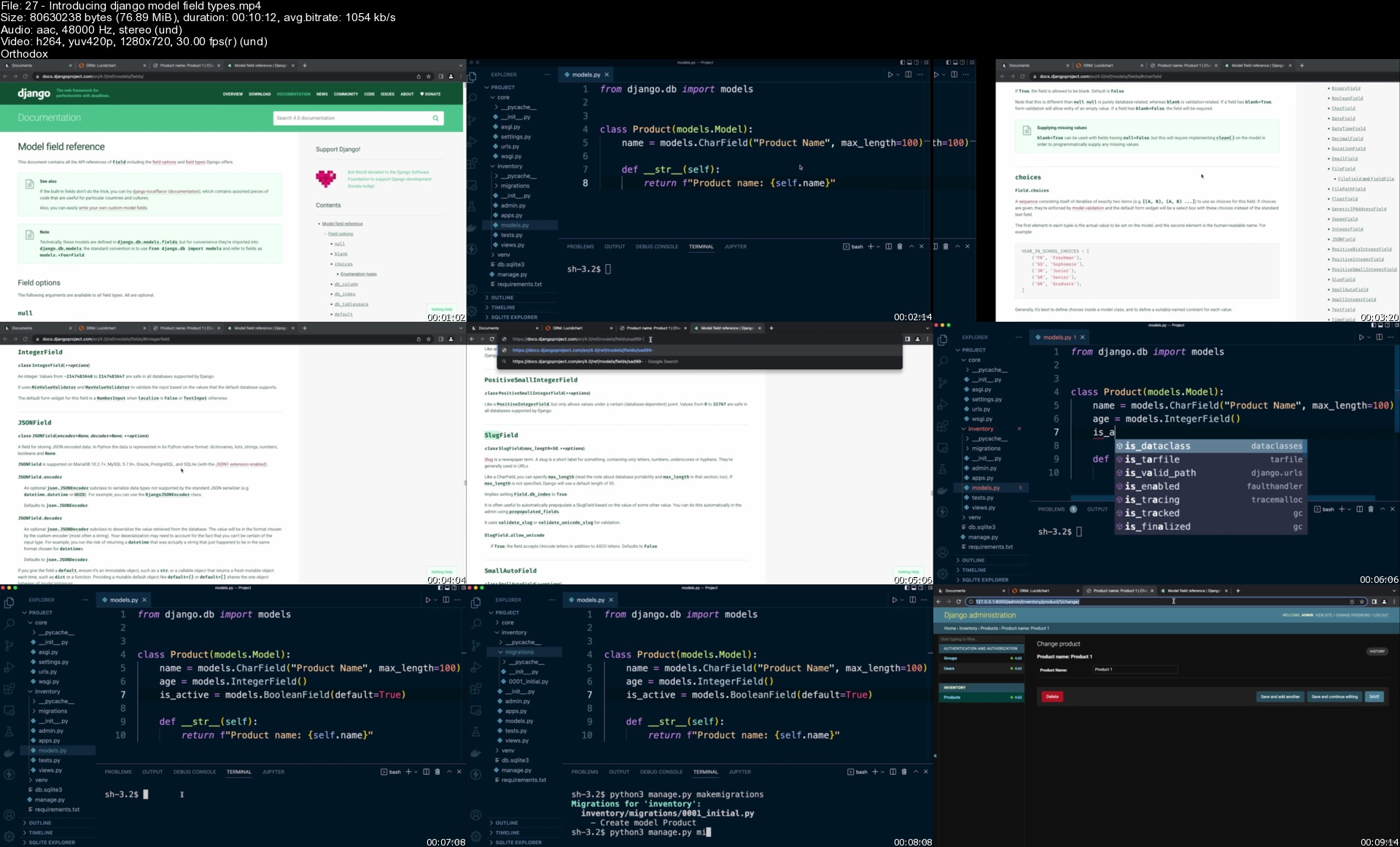
Lecture 27 Introducing django model field types
Lecture 28 Introducing Django model field options
Lecture 29 Defining model primary keys
Lecture 30 Defining model Foreign Keys
Lecture 31 Defining one-to-one model relationships
Lecture 32 Defining Many-to-Many model relationships
Lecture 33 Introducing model meta options
Section 8: Migrations[Level 1] - Committing to the Database
Lecture 34 Section Introduction
Lecture 35 Migrate model changes to the database schema
Section 9: QuerySet API[Level 1] - Inspecting Queries & Performance Analysis
Lecture 36 Section Introduction
Lecture 37 Section setup guide - Codebase-1
Lecture 38 Inspect queries with the query attribute
Lecture 39 Inspect queries - connection and reset queries
Lecture 40 Pretty print SQL
Section 10: QuerySet API[Level 1] - Utility
Lecture 41 Section Introduction
Lecture 42 Counting returned queryset objects
Lecture 43 Conveniently View data returned in queryset objects
Section 11: QuerySet API[Level 1] - Create and Save Objects
Lecture 44 Section Introduction
Lecture 45 Section setup guide - Codebase-1
Lecture 46 Getting familiar with the database design (optional)
Lecture 47 Insert data into a single table with create()
Lecture 48 Insert data into a single table with save()
Lecture 49 Explore the difference between save() and create()
Lecture 50 SQL Insert - Executing custom SQL Inserts
Lecture 51 Insert into single table with foreign key
Lecture 52 SQL Insert - Working with datetime fields and foreign keys
Lecture 53 Insert data into a single table with a many-to-many relationship
Lecture 54 SQL Insert - Working with many-to-many relationships
Lecture 55 Insert data into multiples tables & using atomic operations
Lecture 56 Insert data into a single table with a one-to-one relationship
Lecture 57 Insert multiple objects into single table - bulk create
Lecture 58 Query Profiling - bulk_create() vs create() performance analysis
Lecture 59 Creating and automating a set of Django Fixtures
Section 12: QuerySet API[Level 1] - Retrieving objects
Lecture 60 Section Introduction
Lecture 61 Section setup guide (Codebase-2)
Lecture 62 Return all objects from a single table - all()
Lecture 63 SQL - Return all objects from a single table
Lecture 64 Retrieving single objects from a single table - get()
Lecture 65 SQL - Return single objects from a single table
Lecture 66 Filter & Exclude - Retrieving specific objects
Lecture 67 SQL - Filter retrieving objects - filter()
Lecture 68 Retrieve objects from multiple tables through a foreign key relationship
Lecture 69 SQL - Retrieve objects foreign key relationship
Lecture 70 Retrieve objects from multiple tables through a one-to-one relationship
Lecture 71 Retrieve objects from multiple tables through a many-to-many relationship
Section 13: QuerySet API[Level 1] - Update Fields/Records
Lecture 72 Section Introduction
Lecture 73 Section setup guide (Codebase-2)
Lecture 74 Modify existing data for a specified record in a table
Lecture 75 Implementing update_or_create()
Lecture 76 bulk_update records in a single table
Section 14: QuerySet API[Level 1] - Delete Records
Lecture 77 Section Introduction
Lecture 78 Section setup guide (Codebase-2)
Lecture 79 Delete single and multiple objects
Section 15: Working with PostgreSQL Database[Level 1]
Lecture 80 Section introduction
Lecture 81 Docker introduction
Lecture 82 Installing Docker MacOS
Lecture 83 Installing Docker Desktop for Windows 10/11
Lecture 84 Create a Postgres Docker container
Lecture 85 Configuring Django to work with a PostgreSQL database
Section 16: QuerySet API[Level 1] - Field lookup keywords arguments
Lecture 86 Section Introduction
Lecture 87 Section setup guide (Codebase-3)
Lecture 88 Field lookups
Lecture 89 Field lookup contains
Lecture 90 Field lookup with greater or less than
Lecture 91 Field lookup with start or end with
Lecture 92 Field lookup range
Lecture 93 Field lookup Day Week Month
Section 17: QuerySet API[Level 1] - QuerySet Ordering and Limiting
Lecture 94 Section Introduction
Lecture 95 Section setup guide (Codebase-3)
Lecture 96 Ordering a new QuerySet
Lecture 97 Reverse the output of a new QuerySet
Lecture 98 Return the first or last object matched by the queryset
Lecture 99 Return the earliest or latest object matched by the QuerySet
Lecture 100 Limit the objects returned from a QuerySet
Section 18: QuerySet API[Level 1] - Practical Exercises & Answers
Lecture 101 Section Introduction
Lecture 102 Section setup guide (Codebase-4)
Lecture 103 Reintroducing the database design and dataset
Lecture 104 Retrieve all sub-products for an individual product
Lecture 105 Retrieve a product featured image
Lecture 106 Retrieve all values associated to a sub-product
Lecture 107 Retrieve the product attributes for a given product type
Lecture 108 Retrieve all products associated to product attribute id:1
Lecture 109 Retrieve all sub-products that has less than 50 units left in stock
Lecture 110 Retrieve all sub-products which have been stock checked in the last month
Lecture 111 Retrieve all woman shoe products
Lecture 112 Retrieve all woman shoes by the xyz brand
Lecture 113 Retrieve all products associated to the xyz brand
Developers, Students, Enthusiasts new to the Django Framework,Developers, Students, Enthusiasts looking to refresh their knowledge of the Django ORM
Homepage
Django 4.X Orm Mastery
Published 6/2022
MP4 | Video: h264, 1280x720 | Audio: AAC, 44.1 KHz
Language: English | Size: 6.33 GB | Duration: 13h 48m
Learn and master building and interacting with databases within a Django project
What you'll learn
Prepare an environment ready to develop Python Django applications
@ Level 1 - Describe the underpinning role of object-relational mapping and the Django ORM
@ Level 1 - Connect Django applications to SQLite and PostgreSQL database technologies
@ Level 1 - Build Django models to model foreign keys, many-to-many and one-to-many relationships
@ Level 1 - Create and propagate changes to database tables from within a Django project
@ Level 1 - Using a variety of methods, create and save data to a database from within a Django database
@ Level 1 - Query and filter subsets of data from a database utilising a variety Queryset API features
@ Level 1 - Inspect and explore the SQL that is generated and executed by the Django ORM
@ Level 1 - Create raw SQL queries to query a database
@ Level 1 - Update single and multiple records
@ Level 1 - Select and delete records
@ Level 1 - Work with Docker to connect a Django Projects to Postgres databases hosted within a Docker container
@ Level 1 - Impliment a variety of filed lookup keywords to return subsets of data from a specified table
@ Level 1 - Impliment a variety of utility QuerySet API methods to limit and order data returned from a query
Requirements
Prior experience of using the django framework would be advantageous
Knowledge of relational database principles would be advantageous
Description
This course is designed to be an introduction to the Django Framework ORM (Object-relational mapping) through applied learning. In this course you'll learn about the features of the Django ORM. By better understanding features of the Django ORM, you will learn how to interact with databases from within a Django project, like you would with SQL. You will learn how to administrate tables and perform common Create, Return, Update and Delete (CRUD) operations through the Django ORM. This course is designed to be an introduction to the Django Framework ORM (Object-relational mapping) through applied learning. I have collated and structured a course which I believe to be introductory Django ORM topics. You can see from the course structure that we refer to these introductory topics as level 1. There are 3 planned levels on the topic of the Django ORM, so much more to come.Django 4.x ORM Mastery series level 1. The first section of the course accommodates those who are completely new to the subject matter, you'll learn how to prepare the working environment ready to follow along with tutorials and scaffold underpinning knowledge related to Object-relational mapping. Next, you'll discover how to build database tables by creating Django models and propagating changes to the database through migrations. Finally, you'll learn how to interact with the Django QuerySet API to create return update and delete data in the database.In addition to this core learning, we have embedded into the course an optional introduction to SQL. SQL is the language used to communicate with the database to perform changes. We get under the hood and learn how to create SQL to perform database operations manually.
Overview
Section 1: Django 4.x ORM Mastery
Lecture 1 Course Introduction
Lecture 2 Why learn Django ORM?
Section 2: Python Installation
Lecture 3 Section Introduction
Lecture 4 Python Installation - Mac OS
Lecture 5 Python Installation - Windows 10 or 11 OS
Section 3: Create Isolated Python Environments
Lecture 6 Section Introduction
Lecture 7 Why virtual isolate environments?
Lecture 8 Create a new Virtual Environment on MacOS
Lecture 9 Create a new Virtual Environment on Windows 10/11
Section 4: Preparing the Development Environment
Lecture 10 Section Introduction
Lecture 11 Visual Studio Code and Venv Setup on MacOS
Lecture 12 Create a new Virtual Environment on Windows 10/11
Lecture 13 VSCode Extensions used in this course
Section 5: Django ORM[Level 1] - Object Relational Mapping
Lecture 14 Section Introduction
Lecture 15 Introducing Object Relational Mapping Concept
Lecture 16 Django ORM - Models, QuerySet API and Managers
Section 6: Working with SQLite Database[Level 1]
Lecture 17 Section Introduction
Lecture 18 Introducing SQLite databases
Lecture 19 Connect an SQLite database to a Django project
Section 7: Models[Level 1] - Building Models
Lecture 20 Section Introduction
Lecture 21 Section setup guide - step-by-step
Lecture 22 Section setup guide (CodeBase-0)
Lecture 23 Database Terminology
Lecture 24 Create your first Django model
Lecture 25 Adding a string representation of a model
Lecture 26 The model verbose field name
Lecture 27 Introducing django model field types
Lecture 28 Introducing Django model field options
Lecture 29 Defining model primary keys
Lecture 30 Defining model Foreign Keys
Lecture 31 Defining one-to-one model relationships
Lecture 32 Defining Many-to-Many model relationships
Lecture 33 Introducing model meta options
Section 8: Migrations[Level 1] - Committing to the Database
Lecture 34 Section Introduction
Lecture 35 Migrate model changes to the database schema
Section 9: QuerySet API[Level 1] - Inspecting Queries & Performance Analysis
Lecture 36 Section Introduction
Lecture 37 Section setup guide - Codebase-1
Lecture 38 Inspect queries with the query attribute
Lecture 39 Inspect queries - connection and reset queries
Lecture 40 Pretty print SQL
Section 10: QuerySet API[Level 1] - Utility
Lecture 41 Section Introduction
Lecture 42 Counting returned queryset objects
Lecture 43 Conveniently View data returned in queryset objects
Section 11: QuerySet API[Level 1] - Create and Save Objects
Lecture 44 Section Introduction
Lecture 45 Section setup guide - Codebase-1
Lecture 46 Getting familiar with the database design (optional)
Lecture 47 Insert data into a single table with create()
Lecture 48 Insert data into a single table with save()
Lecture 49 Explore the difference between save() and create()
Lecture 50 SQL Insert - Executing custom SQL Inserts
Lecture 51 Insert into single table with foreign key
Lecture 52 SQL Insert - Working with datetime fields and foreign keys
Lecture 53 Insert data into a single table with a many-to-many relationship
Lecture 54 SQL Insert - Working with many-to-many relationships
Lecture 55 Insert data into multiples tables & using atomic operations
Lecture 56 Insert data into a single table with a one-to-one relationship
Lecture 57 Insert multiple objects into single table - bulk create
Lecture 58 Query Profiling - bulk_create() vs create() performance analysis
Lecture 59 Creating and automating a set of Django Fixtures
Section 12: QuerySet API[Level 1] - Retrieving objects
Lecture 60 Section Introduction
Lecture 61 Section setup guide (Codebase-2)
Lecture 62 Return all objects from a single table - all()
Lecture 63 SQL - Return all objects from a single table
Lecture 64 Retrieving single objects from a single table - get()
Lecture 65 SQL - Return single objects from a single table
Lecture 66 Filter & Exclude - Retrieving specific objects
Lecture 67 SQL - Filter retrieving objects - filter()
Lecture 68 Retrieve objects from multiple tables through a foreign key relationship
Lecture 69 SQL - Retrieve objects foreign key relationship
Lecture 70 Retrieve objects from multiple tables through a one-to-one relationship
Lecture 71 Retrieve objects from multiple tables through a many-to-many relationship
Section 13: QuerySet API[Level 1] - Update Fields/Records
Lecture 72 Section Introduction
Lecture 73 Section setup guide (Codebase-2)
Lecture 74 Modify existing data for a specified record in a table
Lecture 75 Implementing update_or_create()
Lecture 76 bulk_update records in a single table
Section 14: QuerySet API[Level 1] - Delete Records
Lecture 77 Section Introduction
Lecture 78 Section setup guide (Codebase-2)
Lecture 79 Delete single and multiple objects
Section 15: Working with PostgreSQL Database[Level 1]
Lecture 80 Section introduction
Lecture 81 Docker introduction
Lecture 82 Installing Docker MacOS
Lecture 83 Installing Docker Desktop for Windows 10/11
Lecture 84 Create a Postgres Docker container
Lecture 85 Configuring Django to work with a PostgreSQL database
Section 16: QuerySet API[Level 1] - Field lookup keywords arguments
Lecture 86 Section Introduction
Lecture 87 Section setup guide (Codebase-3)
Lecture 88 Field lookups
Lecture 89 Field lookup contains
Lecture 90 Field lookup with greater or less than
Lecture 91 Field lookup with start or end with
Lecture 92 Field lookup range
Lecture 93 Field lookup Day Week Month
Section 17: QuerySet API[Level 1] - QuerySet Ordering and Limiting
Lecture 94 Section Introduction
Lecture 95 Section setup guide (Codebase-3)
Lecture 96 Ordering a new QuerySet
Lecture 97 Reverse the output of a new QuerySet
Lecture 98 Return the first or last object matched by the queryset
Lecture 99 Return the earliest or latest object matched by the QuerySet
Lecture 100 Limit the objects returned from a QuerySet
Section 18: QuerySet API[Level 1] - Practical Exercises & Answers
Lecture 101 Section Introduction
Lecture 102 Section setup guide (Codebase-4)
Lecture 103 Reintroducing the database design and dataset
Lecture 104 Retrieve all sub-products for an individual product
Lecture 105 Retrieve a product featured image
Lecture 106 Retrieve all values associated to a sub-product
Lecture 107 Retrieve the product attributes for a given product type
Lecture 108 Retrieve all products associated to product attribute id:1
Lecture 109 Retrieve all sub-products that has less than 50 units left in stock
Lecture 110 Retrieve all sub-products which have been stock checked in the last month
Lecture 111 Retrieve all woman shoe products
Lecture 112 Retrieve all woman shoes by the xyz brand
Lecture 113 Retrieve all products associated to the xyz brand
Developers, Students, Enthusiasts new to the Django Framework,Developers, Students, Enthusiasts looking to refresh their knowledge of the Django ORM
Homepage

 u möchtest die moderne und effektive Programmiersprache C++ erlernen und beherrschen?Du bist ein Programmier-Anfänger oder kennst dich bereits in anderen Sprachen aus?Dann ist mein C++ Kurs genau richtig für dich!Dieser Kurs besteht aus folgenden Themengebieten