• Regeln für den Video-Bereich:

    In den Börsenbereich gehören nur Angebote die bereits den Allgemeinen Regeln entsprechen.

    Einteilung

    - Folgende Formate gehören in die angegeben Bereiche:
    - Filme: Encodierte Filme von BluRay, DVD, R5, TV, Screener sowie Telesyncs im Format DivX, XviD und x264.
    - DVD: Filme im Format DVD5, DVD9 und HD2DVD.
    - HD: Encodierte Filme mit der Auflösung 720p oder darüber von BluRay, DVD, R5, TV, Screener sowie Telesyncs im Format x264.
    - 3D: Encodierte Filme von BluRay, die in einem 3D Format vorliegen. Dies gilt auch für Dokus, Animation usw.
    - Serien: Cartoon/Zeichentrick, Anime, Tutorials, Dokumentationen, Konzerte/Musik, Sonstiges sind demnach in die entsprechenden Bereiche einzuordnen, auch wenn sie beispielsweise im High Definition-Format oder als DVD5/DVD9/HD2DVD vorliegen. Ausnahme 3D.
    - Bereich Englisch: Englische Releases gehören immer in diesen Bereich.
    - Bereich Talk: Der Bereich, in dem über die Releases diskutiert werden kann, darf, soll und erwünscht ist.


    Angebot/Beitrag erstellen

    - Ein Beitrag darf erst dann erstellt werden, wenn der Upload bei mindestens einem OCH komplett ist. Platzhalter sind untersagt.
    - Bei einem Scenerelease hat der Threadtitel ausschließlich aus dem originalen, unveränderten Releasenamen zu bestehen. Es dürfen keine Veränderungen wie z.B. Sterne, kleine Buchstaben o.ä. vorgenommen werden. Ausnahme Serienbörse:
    - Bei einem Sammelthread für eine Staffel entfällt aus dem Releasename natürlich der Name der Folge. Beispiel: Die Simpsons S21 German DVDRip XviD - ITG
    - Dementsprechend sind also u.a. verboten: Erweiterungen wie "Tipp", "empfehlenswert", "only", "reup", usw. / jegliche andere Zusatzinformation oder Ergänzung, welche nicht in obiger Beschreibung zu finden ist.

    Aufbau des Angebots und Threadtitel

    Der Titel nach folgendem Muster erstellt zu werden. <Name> [3D] [Staffel] [German] <Jahr> <Tonspur> [DL] [Auflösung] <Quelle> <Codec> - <Group>
    Beispiel: The Dark Knight German 2008 AC3 DVDRip XviD - iND
    Beispiel: The Dark Knight 2008 DTS DL BDRip x264 - iND
    Beispiel: The Dark Knight 2008 AC3 DL BDRip XviD - iND
    Beispiel: The Dark Knight German 2008 AC3 720p BluRay x264 iND
    Beispiel: The Dark Knight 2008 DTS DL 1080p BluRay x264 iND
    Beispiel: Die Simpsons S01 German AC3 DVDRip XviD iND
    Beispiel: Die Simpsons S20 German AC3 720p BluRay x264 iND
    Beispiel: Sword Art Online II Ger Sub 2014 AAC 1080p WEBRip x264 - peppermint
    Entsprechend sind also u.a. verboten: Sonderzeichen wie Klammern, Sterne, Ausrufezeichen, Unterstriche, Anführungszeichen / Erweiterungen wie "Tipp", "empfehlenswert", "only", "reup", usw. / jegliche andere Zusatzinformation oder Ergänzung, welche nicht in obiger Beschreibung zu finden ist
    Ausnahmen hiervon können in den Bereichen geregelt sein.

    Die Beiträge sollen wie folgt aufgebaut werden:
    Überschrift entspricht dem Threadtitel
    Cover
    kurze Inhaltsbeschreibung
    Format, Größe, Dauer sind gut lesbar für Downloader außerhalb des Spoilers zu vermerken
    Nfo sind immer Anzugeben und selbige immer im Spoiler in Textform.
    Sind keine Nfo vorhanden z.B. Eigenpublikationen, sind im Spoiler folgende Dateiinformationen zusätzlich anzugeben :
    Quelle
    Video (Auflösung und Bitrate)
    Ton (Sprache, Format und Bitrate der einzelnen Spuren)
    Untertitel (sofern vorhanden)
    Hosterangabe in Textform außerhalb eines Spoiler mit allen enthaltenen Hostern.
    Bei SD kann auf diese zusätzlichen Dateiinformationen verzichtet werden.

    Alle benötigten Passwörter sind, sofern vorhanden, in Textform im Angebot anzugeben.
    Spoiler im Spoiler mit Kommentaren :"Schon Bedankt?" sind unerwünscht.


    Releases

    - Sind Retail-Release verfügbar, sind alle anderen Variationen untersagt. Ausnahmen: Alle deutschen Retail-Release sind CUT, in diesem Fall sind dubbed UNCUT-Release zulässig.
    - Im Serien-Bereich gilt speziell: Wenn ein Retail vor Abschluss einer laufenden Staffel erscheint, darf diese Staffel noch zu Ende gebracht werden.62
    - Gleiche Releases sind unbedingt zusammenzufassen. Das bedeutet, es ist zwingend erforderlich, vor dem Erstellen eines Themas per Suchfunktion zu überprüfen, ob bereits ein Beitrag mit demselben Release besteht. Ist dies der Fall, ist der bereits vorhandene Beitrag zu verwenden.
    - P2P und Scene Releases dürfen nicht verändert oder gar unter einem iND Tag eingestellt werden.


    Support, Diskussionen und Suche

    - Supportanfragen sind entweder per PN oder im Bereich Talk zu stellen.
    - Diskussionen und Bewertungen sind im Talk Bereich zu führen. Fragen an die Uploader haben ausschließlich via PN zu erfolgen, und sind in den Angeboten untersagt.
    - Anfragen zu Upload-Wünschen sind nur im Bereich Suche Video erlaubt. Antworten dürfen nur auf Angebote von MyBoerse.bz verlinkt werden.


    Verbote

    - Untersagt sind mehrere Formate in einem einzigen Angebotsthread, wie beispielsweise das gleichzeitige Anbieten von DivX/XviD, 720p und 1080p in einem Thread. Pro Format, Release und Auflösung ist ein eigener Thread zu eröffnen.
    - Grundsätzlich ebenso verboten sind Dupes. Uploader haben sich an geeigneter Stelle darüber zu informieren, ob es sich bei einem Release um ein Dupe handelt.
    - Gefakte, nur teilweise lauffähige oder unvollständige Angebote sind untersagt. Dies gilt auch für eigene Publikationen, die augenscheinlich nicht selbst von z.B. einer DVD gerippt wurden. Laufende Serien, bei denen noch nicht alle Folgen verfügbar sind, dürfen erstellt und regelmäßig geupdatet werden.
    - Untersagt sind Angebote, welche nur und ausschließlich in einer anderen Sprache als deutsch oder englisch vorliegen. Ausnahmen sind VORHER mit den Moderatoren zu klären.


    Verstoß gegen die Regeln

    - Angebote oder Beiträge, die gegen die Forenregeln verstoßen, sind über den "Melden"-Button im Beitrag zu melden.
  • Bitte registriere dich zunächst um Beiträge zu verfassen und externe Links aufzurufen.

*** Bestes IPTV *** bester Preis *** gratis Test ***


Englische Tutorials

bcf6ec49-2953-40e3-8b14-41c4ab2fed0f.png

The Ultimate Network Security Training Course: All In One
Published 04/2022
MP4 | Video: h264, 1280x720 | Audio: AAC, 44.1 KHz, 2 Ch
Genre: eLearning | Language: English + srt | Duration: 47 lectures (4h 49m) | Size: 1.68 GB


Understanding network architectures and securing communications technologies and network protocols
What you'll learn
Introduction to Network Security
Learning Types of Transmission
Learning Networking Foundations
Learning Network Services
Understanding Wireless Networks
Understanding Protocols
Understanding Different Sizes of Networks
Understanding Network Attacks
Learning Open Systems Interconnection (OSL) Model
Requirements
Access to a computer with an internet connection.
Description
Welcome to this course. While almost every country in the world has had to deal with hard economic times, one industry that has not been greatly affected by the downward economies is information security. Organizations and government agencies do not have a large enough pool of people with the necessary skill set to hire from, and the attacks against these entities are only increasing and becoming more critical. Security is a good business to be in, if you are truly knowledgeable, skilled, and disciplined.
Telecommunications and networking use various mechanisms, devices, software, and protocols that are interrelated and integrated. Networking is one of the more complex topics in the computer field, mainly because so many technologies are involved and are evolving. Our current technologies are constantly evolving, and every month there seems to be new "emerging" technologies that we have to learn, understand, implement, and secure. A network administrator must know how to configure networking software, protocols and services, and devices; deal with interoperability issues; install, configure, and interface with telecommunications software and devices; and troubleshoot effectively. A security professional must understand these issues and be able to analyze them a few levels deeper to recognize fully where vulnerabilities can arise within each of these components and then know what to do about them. This can be a challenging task. However, if you are knowledgeable, have a solid practical skill set, and are willing to continue to learn, you can have more career opportunities than you know what to do with.
In this course, you'll learn
OSI and TCP/IP models
Protocol types and security issues
LAN, WAN, MAN, intranet, and extranet technologies
Cable types and data transmission types
Network devices and services
Software-defined routing
Content distribution networks
Multilayer protocols
Convergent network technologies
Communications security management
Telecommunications devices and technologies
Remote connectivity technologies
Wireless technologies
Network encryption
Threats and attacks
Who this course is for
Anyone interested in Network Security
Homepage


bbfbd7f5-7d41-4229-bcc9-e377bc0f2383.png

Unity 3rd Person Combat & Traversal
Published 04/2022
MP4 | Video: h264, 1280x720 | Audio: AAC, 44.1 KHz, 2 Ch
Genre: eLearning | Language: English + srt | Duration: 23 lectures (2h 56m) | Size: 1.7 GB


Make a complete 3rd Person Combat System for an RPG in Unity!
What you'll learn
Create your own custom state machine using the state machine pattern
Control the player camera using Cinemachine
Use events to drive the movement and animation of the player character
How to use the Unity Animator
Requirements
You'll need a basic understanding of C# and the Unity engine
Description
If you're interested in learning how to make your own third person action combat game, similar to Dark Souls or Assassin's Creed, then this is the course for you!
Get in early for this exciting course! The course is being developed right now, using the most up-to-date version of Unity - Unity 2022.1. You'll be one of the first people to access the content, and your input could help shape the course!
Learn how to create your own 3rd person combat system (similar to that used in games like Dark Souls or Assassin's Creed). It can easily be added to your RPG project, or any other 3rd person game you're working on.
You'll learn about player input, animation state machines, attack combos, dodging, target locking, cinemachine camera options, simple enemy attack AI and more.
By the end of the course you'll have created your very own sandbox arena where you can hack and slash as many enemies as you like, using a 3rd person camera and control system - with either mouse / keyboard or game controller.
This course is aimed at a beginner plus to intermediate level. You'll need a basic understanding of the Unity interface and C# (if you've taken any of our other Unity courses then you should be good to go).
All students have access to the Q&A forums where our Instructors, Teaching Assistants and Community are ready to help answer your questions and cheer on your success.
Ready to supercharge your Unity editor? Come join the course now!
Who this course is for
If you're interested in learning how to make your own third person action combat game, similar to Dark Souls or Assassin's Creed.
It can easily be added to your RPG project, or any other 3rd person game you're working on.
If you've got some experience in Unity and are looking to level-up your skills.
Homepage


eRvi3cJs0m24DMz7CG7tJBrPAWXQh5SK.jpg

7 Steps To The Perfect Essay
MP4 | Video: h264, 1280x720 | Audio: AAC, 44.1 KHz
Language: English | Size: 0.98 GB | Duration: 1h 16m​


A simple but powerful set of tools from an Oxford-educated tutor with years of experience in international education.
What you'll learn
WHY essay-writing is one of the most sought-after skills in education, and how it can help you on your learning journey. Learn the connection between thinking c
How to get a clear understanding of the essay question. It's all about clarity and focus.
The different PURPOSES of essays: e.g. compare and contrast, explain, or analyze
Who is my READER and why does it matter?
How the purpose and intended reader help us make the right language choices in a good essay.
PLANNING. Learn how to prioritise and order your main ideas. We also look at common problems and how to fix them, such as time management stress.
Revising your writing to avoid unnecessary language errors, especially in an exam situation.
Real-life example of essay-drafting process
Requirements
This course will be useful for secondary to university students - Cambridge B2 First and CAE, IB Diploma, as well as university essays.
Description
Essay writing is one of the most useful skills to learn on our educational journey, but many students find it scary and confusing.
This is a sure sign we need to get back to basics.
So, what are essays, why do we write them, and how do they help us on our learning journey?
An essay showcases our ability to understand a question title clearly and to answer it coherently. We usually rephrase the question title in our introduction to clarify for our reader what we think it means. Clarity of understanding and purpose are the key to a good essay. We need a clear understanding of our question title, and a way of answering it that will be clear to our reader, every step of the way.
Two important questions we have to ask before we start writing are: what is the purpose of my essay, and who is going to read it? An essay for a college professor is going to be very different from an essay for a student magazine. Being clear about our purpose and our reader from the outset is very important for keeping our essay on a clear path in terms of content, and using the right kind of language.
Once we learn how to focus on those all-important questions about what the essay title is really asking us to do, everything else falls into place. Then we can focus on completing our writing task without getting distracted and confused.
Join me on this step-by-step course and become an ace essay writer!
Who this course is for
Anyone from secondary school age to college level who wants to develop their writing skills.
Also suitable for ESL, IELTS, Cambridge CAE etc. students of secondary to college level
Screenshots


gIQpGar1F4UrhV1Bl7uMSaOIrMQNzBWa.jpg

Be the Usain Bolt of Chemistry Calculations with React Calc
MP4 | Video: h264, 1280x720 | Audio: AAC, 44.1 KHz
Language: English | Size: 1.10 GB | Duration: 2h 8m​

Practical Skill Development for All Synthetic Chemists of The World with Boosted Learning Course in 2 hours
What you'll learn
To perform chemistry calculations and learn how these are used in laboratory experiments
To speed up; save time and efforts; bring accuracy while doing calculations using React Calc
To understand the fundamentals of moles, molarity, normality, reaction setting and yield calculation
To get the skills on the use of[Solution Preparation],[Reaction Setting] and[Yield Calculation] module of React Calc - A calculator built for the Chemists
Requirements
No prior experience needed - I'll teach you everything you need to know
A computer with access to the internet
No paid software required
I'll walk you through, step-by-step how to get all the calculations right
Description
Description
This course aims to impart knowledge on the subject of molecules, moles, Avogadro's number, concentrated solutions; chemical reactions and equilibrium; stoichiometry of reactions and solutions. The subtopics will cover the equations for the calculation of moles; %w/w; %w/v; %v/v; ppm; molarity; normality; molarity, dilution factor, reactants calculation -mmol, equivalence, catalyst mol%; the importance of reaction table; limiting reagent, theoretical yield and %yield calculation and management of records. After successful completion of this course work the candidate will be able to prepare solutions of different concentrations in laboratory work; perform reactants and %yield calculation which can be applied in advanced research work. The course will also nurture independent thinking and help candidates to design new scientific experiments. The candidate will also inculcate the habit of record-keeping and an honest approach toward reporting actual values in research papers. The event will also cover the global launch of React Calc: a web-based calculator built for chemists to perform all the above-mentioned calculations, faster, easily, and accurately.
Content
Module 1 (45 mins)
Solution Preparation: Getting familiar with the concept and equations of moles; %w/w; %w/v; %v/v; ppm; molarity; normality; molarity and dilution equation.
Learning outcomes: After successful completion of this module candidate will be able to prepare solutions of different concentrations in laboratory work. Using ReactCalc, the efficiency and accuracy in carrying out such tasks will be improved.
Module 2 (45 mins)
Reaction Table: Getting familiar with the concept and equations of reactants calculation -mmol, equivalence, catalyst mol%; the importance of reaction table; and records management.
Learning outcomes: After successful completion of this module candidate will be able to perform reactants calculations which can be applied in advanced research work. The module will also develop independent thinking and help candidate to design new scientific experiments. The candidate will also inculcate the habit of record keeping.
Module 3 (30 mins)
Yield calculation: Getting familiar with the concept and equations of limiting reagent, theoretical yield, and %yield calculation.
Learning outcomes: After successful completion of this module candidate will be able to use equations and ReactCalc to efficiently and accurately calculate %yield. The candidate will also inculcate the habit of reporting actual values in research papers.
Salient features of certificate course
Theory sessions for a better understanding of all scientific concepts;
Demonstration sessions which will include the entire process of performing the calculations;
Boosted learning: Course duration: Only 2 hours
At the end of the course candidate will be able to use their expertise for their independent research work;
A certificate will be issued to the successful candidates.
Who this course is for
If you are an undergraduate or postgraduate chemist who wants to build fundamentals and know the practical application of such concepts, then take this course. It is a must-do course for all the chemists before entering the laboratory work.
If you are a chemist involved in research, then this course trains you on React Calc which can save you time and efforts in doing calculations, so you can dedicate yourself in solving other research problems.
If you want to learn how to perform chemistry calculations and learn how these are used in laboratory experiments, then take this course.
If you want to speed up; save time and efforts; bring accuracy while doing calculations, then take this course.
Screenshots


aUlwugz0LnyY47GvPbdbNUKcmR8dvPtV.jpg

JUnit and Mockito Crash Course
Genre: eLearning | MP4 | Video: h264, 1280x720 | Audio: AAC, 44.1 KHz
Language: English | Size: 1.49 GB | Duration: 121 lectures • 6h 3m
Learn how to use JUnit and Mockito and Unit Test in easy steps.

What you'll learn
Learn what Unit Testing is
Understand the importance of Unit Testing
Learn the JUnit Framework and API
Learn what mocking is and why we should mock
Write tests using JUnit and Mockito
Learn What Test Coverage is and how to measure it
All in simple and easy steps
Spring Testing Quick Start
PowerMock Quick Start
Parameterized JUnit
Requirements
Java Knowledge
Eclipse IDE Kepler(or Higher) For Java Developers
Description
Sample of the reviews
Very good teacher, knows the material. Hands on exercises that are quick to write, but very useful to support the learning of the course content. I'll keep these tiny projects and I'll refer to it often when coding. I've learned a lot about JUnit testing and Mockito, but also about other tools useful in software unit testing: Ex: Spring, shortcuts in Eclipse. - Guy Audet
Very well explained, to the point, on short interval to grasp the content. Every lecture has purpose achieved. Simple examples. Really nice course. - Kaushal Trivedi
I enjoyed the course. The Course is well structured, principles were clearly explained, the sound and picture quality was good. I recommend the course to everyone who would like to begin with java unit testing. Thanks, Bharath! - Mario Banay
---
Are you a java developer who want to become an expert at Unit Testing ? Then this course is a quick practical guide for you. Learn how to write real unit tests using JUnit and Mockito. This course will simplify things with concepts and step by step implementations .
There are so many java professionals who write great code , but not unit tests. This course aims at filling that gap by covering JUnit and Mockito the two required frameworks to write good unit tests.
Learn and master the most popular unit testing technologies in this comprehensive course.
Understand the importance of writing Unit Tests
Learn the Syntax of JUnit 4 and 5
Demystify the topics of Mocking
Write Unit tests using JUnit and Mockito
Learn what test coverage is and how to measure it
Run unit tests as a part of your Maven build
All in easy steps
Mastering Unit Testing for Java Professionals
JUnit is a open source Framework to test and assert code behavior . Mockito mocks out the dependencies and stub the expectations allowing testing a particular layer/unit in isolation.
Any java developer at any level can access the key lessons and concepts in this course and learn to write quality unit tests.
This course is perfect for every java developer who works on building high quality applications .
Contents and Overview
In over 2 hours of lectures this course covers necessary JUnit API and its usage with Mockito.
This course covers the importance of unit testing , how to effectively use JUnit ,how mocking works and how to use Mockito to write real unit tests.
Up on completion you will be able to test Java and JavaEE applications ,run unit tests as a part of your build and measure code coverage and improve it.
Who this course is for
Anyone who wants to write quality code
Student with java background
Java Developers
Java EE Developers
Screenshots


th_EsQ6ZoeheC3k5Ij36WB4JlQUoASAi0il.jpg

Practical OpenGL and GLSL shaders fundamentals with C++
Serhii K | Duration: 2h 22m | Video: H264 1280x720 | Audio: AAC 48 kHz 2ch | 1,25 GB | Language: English​

Master the OpenGL and GLSL shading language - by writing code! Illustrated theory and practice (from basics to advanced)
Welcome to the OpenGL, GLSL and computer graphics course!
It is practical and illustrated program, designed to give you a visual intuition and practical skills to program computer graphics using OpenGL, GLSL and C ++
It is raw concentrated squeeze of OpenGL and GLSL knowledge (no "water"! no long talks that make you fall asleep)
The course is designed to start from fundamentals - and move to advanced topics like shaders, matrices, transformations, GLSL language, raster effects, texturing and shading.
In fact, the course is very easy to master. Because it is practical, visually illustrated and has code samples and live coding sessions.
It's created to help you develop the visual intuition about 3D programming models (so I developed some beautiful illustrations and visualizations - just to show you how things work "under the hood")
It will help you to build the proper mental models, patterns, and coding skills - to grasp the underlying concepts and internal elegancy of OpenGL machinery, as well as 3D math (because they're tricky)
There are live coding sessions and you get the full access to the source code
The course covers all important topics of modern OpenGL, such as
- geometry, and buffers, VBOs and VAOs
- transformations and matrices, matrix hierarchy
- shaders and GLSL
- procedural art (and GLSL shaders-generated images)
- texturing
Homepage


iawcMBKKtPlk6sJJlanM62UgRkQFtfKQ.jpg

Unit Testing Swift Mobile App
Genre: eLearning | MP4 | Video: h264, 1280x720 | Audio: AAC, 44.1 KHz
Language: English | Size: 1.89 GB | Duration: 135 lectures • 8h 39m
Apply Test-Driven Development(TDD) process to iOS mobile app development in Swift

What you'll learn
Unit Test iOS Mobile App
XCTest Framework
Create, Run and Debug Unit Tests
Mock Dependencies
Use Dependency Injection
UI Testing
Requirements
Knowledge of Swift
Mac OS and Xcode
Description
Unit Testing is a must-have skill and this video course is about unit testing.
If you take this video course, you will learn how to follow a Test Driven Development process to implement a feature for an iOS mobile app built with Swift.
This video course starts with Unit Test basics and continues with a very practical set of lessons that demonstrates how to follow a Test-Driven process to implement the User Signup feature in the Model View Presenter mobile app.
By the end of this video course, you will have a very clear understanding of how to write Unit Tests and UI Tests.
If you are a freelance developer you might postpone learning how to unit test iOS app for some time. But if you are planning to join a bigger team, then unit testing is a must-have skill for you to be able to work on important app features.
Who this course is for
Beginner Swift developers with no experience with Unit Testing
Screenshots


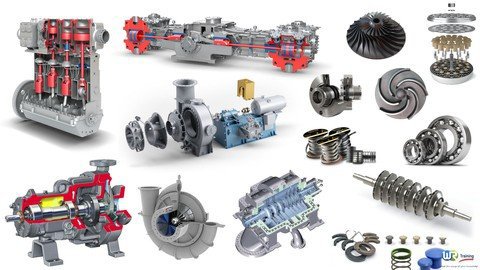
Rotating Equipment Masterclass Pumps & Compressors

wnp0cfecjbih15ldnktp9j3kjs.jpg


Rotating Equipment Masterclass Pumps & Compressors
Genre: eLearning | MP4 | Video: h264, 1280x720 | Audio: AAC, 44.1 KHz
Language: English | Size: 6.59 GB | Duration: 20h 17m

A compelete understanding of pumps & compressors used in process industries for a successful operation of your facility


What you'll learn
Understand rotating equipment working principles for successful operation of your plant and piping systems
Understand the various rotating equipment construction details
Lear how to read and interpret pump and compressor curves
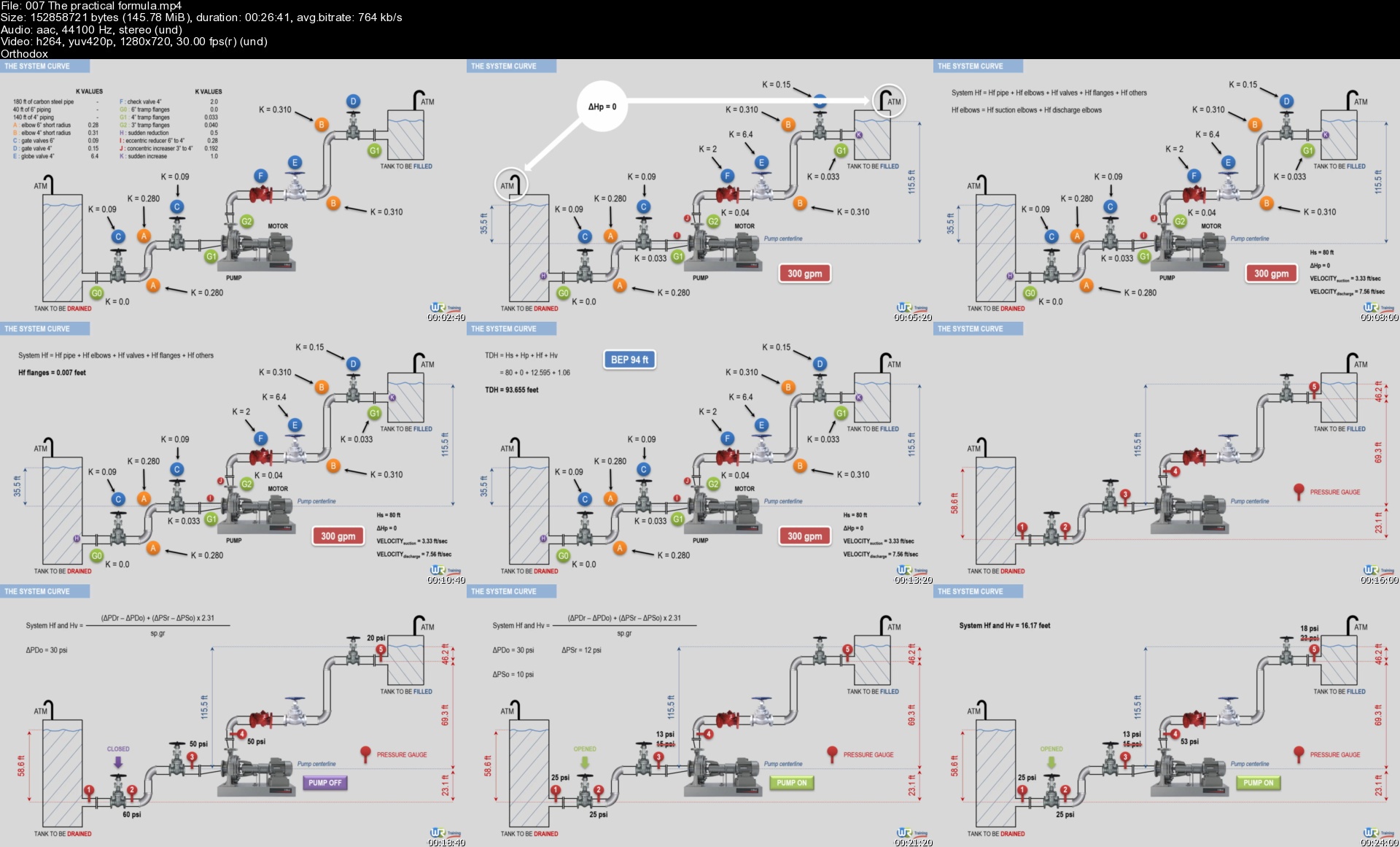
Learn how to determine and interpret your piping system curve
Optimize the operation efficiency of your pumping and/or compression systems
Perform various calculations to size and assess rotating equipment performance (head, discharge temp, inlet capacity, volumetric efficiency.)
Understand what affects the selection and design of rotating equipment (process conditions, fluid characteristics, interstaging, foundation needs...)
Understand the concept of pulsation, how it can affect your compressor performance and how to control it according to the API 618 standard
Know how to size suction and discharge volume bottles to control reciprocating compressor pulsation
Analyze the problems in operation related to packing, mechanical seals, bearings and flow control
Apply the best practices and guidelines for maintenance, problem solving and troubleshooting of rotating equipment
Be an active and efficient communicator during meetings with rotating equipment vendors
Test your knowledge with 500+ question quiz
Get access to useful charts and diagrams to solve daily rotating equipment problems
Download our valuable Compressor Performance Excel Workbook
And much more...

Requirements
Some engineering or field knowledge is preferable but not mandatory. All the concepts are explained in depth using an easy to understand language to allow students to build their knowledge from the ground up
Having attended our "Flow of Fluid Through Piping systems" online course is a plus but not mandatory

Description
Rotating equipment of various designs and applications are encountered nowadays throughout refining, petrochemical and process industries as well as in power generation and environmental engineering.

This 20H masterclass is designed to provide you with a complete understanding of construction details and functioning of

Pumps

Centrifugal compressors

Reciprocating compressors

This understanding is a prerequisite for a successful and flawless operation of your plant and piping system.

This 20H masterclass includes extensive graphics, 3D animations and cross-sectional views to give you a virtual practical exposure on rotating equipment.

The objective of this masterclass is threefold

1. Break down for you all the pumps, centrifugal compressor and reciprocating compressors operating principles into easily digestible concepts like

Cavitation

Performance curves

Fluid Head

Net Positive Suction Head, NPSH

System resistance

Surge and Stonewall

Capacity control

Pulsation control

Lubrication

Cooling

...

2. Illustrate through 3D animations and cross-sectional views the main rotating equipment mechanical components, state their function and operating limits, like

Impellers

Bearings

Mechanical seals

Packing

Crossheads

Pistons

Compressor valves

...

3. Provide guidelines and best practices for operation, maintenance and troubleshooting of rotating equipment in accordance with the latest API Standards

Also included in this masterclass 2 valuable Excel Workbook

Centrifugal Compressor Performance Excel Workbook

Pump Calculations Excel Workbook

These workbooks provide qualitative and quick comparisons and application notes for centrifugal compressors and pumps. They describe calculations and procedures to predict performance characteristics, especially head, discharge pressure and power.

So with no further ado, check out the free preview videos and the curriculum of the course and we look forward to seeing you in the first section.

Hope to see you there

WR Training

Spread the wings of your knowledge

NOTE : These Excel workbooks include Visual Basic for Application function subroutines. Macros must be enabled for them to work

-------------------------------------------------------------------

INSTRUCTION TO DOWNLOAD THE EXCEL WORKBOOKS

1. Upon enrolling in, expand the last section "DOWNLOADABLE RESOURCES"

2. Under the lecture "Download me", click on the folder "Resources" => A list of downloadable files will appear

3. Click on any of the Excel Workbook files

4. A download window will pop-up. Select the location where you want to save the Excel file

5. Once downloaded and saved on your computer, you can start using these valuable Workbooks

DISCLAIMER

These Excel Workbooks are provided by WR Training "as is" and any express or implied warranties, including, but not limited to, the implied warranties of merchantability and fitness for a particular purpose are disclaimed. In no event shall the Copyright owner or contributors be liable for any direct, indirect, incidental, special, exemplary, or consequential damages (including, but not limited to, procurement of substitute goods or services, loss of use, data, or profits, or business interruption) however caused and on any theory of liability, whether in contract, strict liability, or tort (including negligence or otherwise) arising in any way out of the use of these Excel Workbooks, even if advised of the possibility of such damage.

Who this course is for
Chemical, Process and Mechanical Engineers
Product Engineers and Technologists
Operation, technical service and maintenance professionals
Engineers, Consultants and Sales professionals
Technical professionals responsible for piping system inspection
Technical professionals responsible for interdisciplinary energy projects

Homepage


007thepracticalformulwgjvm.jpg


Playwright JS Automation Testing from Scratch with Framework

oodge0xlwfsn7cqwpwzwin4jsb.jpg


Playwright JS Automation Testing from Scratch with Framework
Genre: eLearning | MP4 | Video: h264, 1280x720 | Audio: AAC, 44.1 KHz
Language: English | Size: 7.22 GB | Duration: 14h 4m

Playwright -Modern Testing tool for reliable Web Automation. Support API calls with in UI tests for Smarter Automation.


What you'll learn
Understand the Web Automation with Playwright on Live Applications
Comprehensive knowledge on all Playwright Methods and their usage with examples
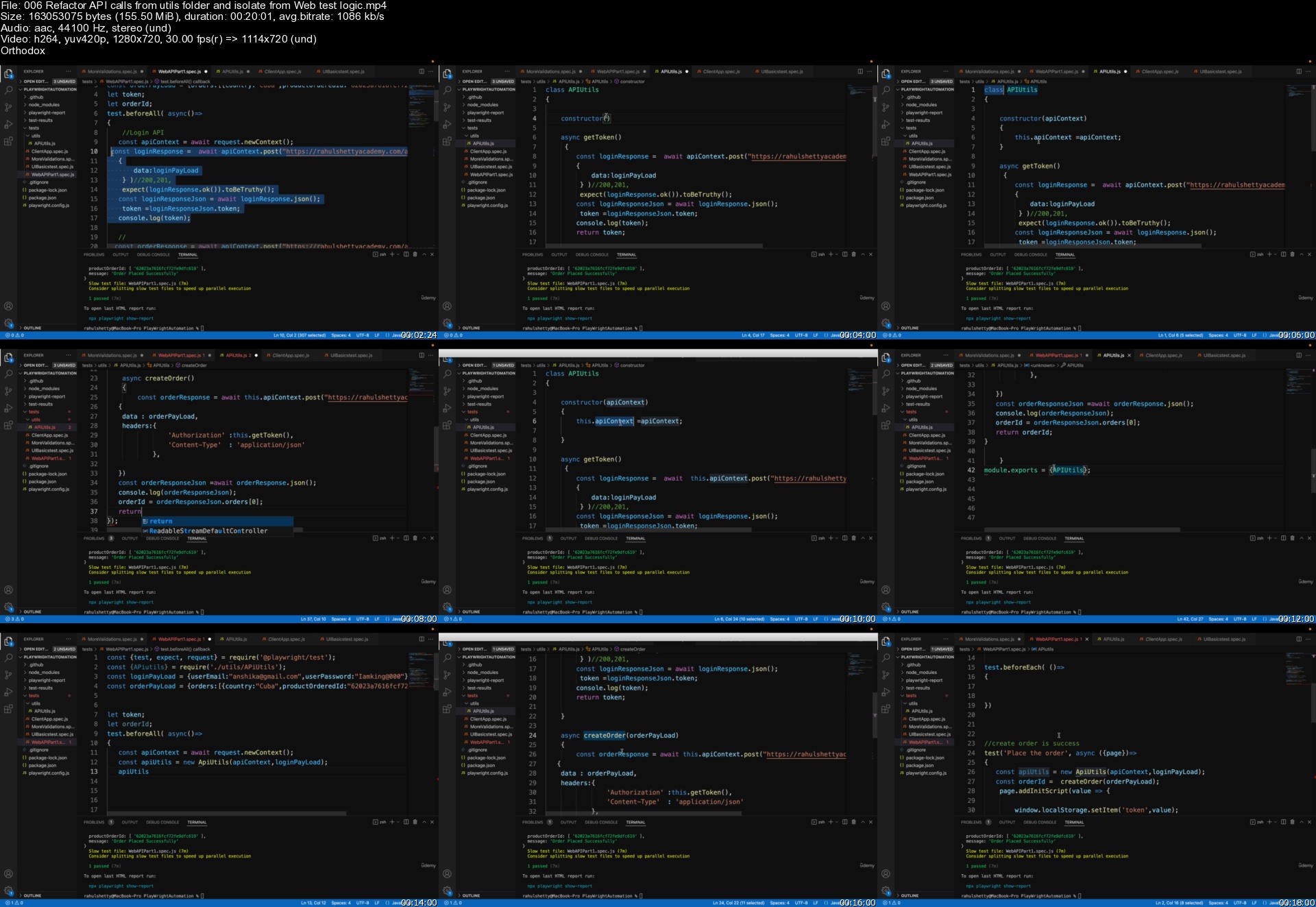
Learn How to make API calls with in UI Automation tests to perform smart automation
Understand how to Intercept Network/API requests & responses with Playwright
Get Familiar with Playwright Inspector tool, Trace Viewer & Code Gen (Record Playback) tools
Develop End to end Framework with Playwright utilizing all the features available in the tool
Learn Visual testing with Playwright to compare the Images
Learn JavaScript fundamentals required for Playwright Automation testing

Requirements
No Programming experience required. JavaScript basics are fully taught in the course in a dedicated section

Description
PLAYWRIGHT - The Most trending Automation tool which is an tough competitor to Selenium & Cypress
This is one and only Comprehensive Playwright course available online which covers everything from basics to Framework including JavaScript basics

**********10 reasons why Playwright can be future of UI Automation******************

Playwright enables reliable end-to-end testing for modern web apps with its Auto-wait capability

· Works on major Browser which uses Chromium Engine, (Chrome & Edge) Firefox, Safari (Web kit) & Opera

· Works on any OS - Windows, MAC, Linux & Supports Native mobile emulation of Google Chrome for Android and Mobile IOS in Safari

· Works with any language - JavaScript, TypeScript, Java, Python, C#(.NET). - (This course is made on JavaScript)

· Playwright have excellent inbuilt features called Traces which can take automatic Screenshots, test video recording, Flaky test retry & Logging mechanism

· Playwright provides inspector tool which help us to monitor and debug every step of execution, see click points and verify page locators on fly

· Playwright has inbuilt API Testing libraries to fire the Network calls on fly within Web Application. (Test Edge Case scenarios with the mix of web & API testing)

· Playwright provides browser context feature which help to save and transfer the browser state to any other new browser.

· Playwright provides codegen tool which Generate test code by recording your actions. Save them into any language.

With all the above top features it has, Playwright is now tough competitor for Selenium & Cypress automation tools.

Breakdown of Playwright topics in this course

We are using JavaScript language binding to build Playwright Automation tests. (Js is mainly picked language for Playwright)
For Beginners, there is 2 hours Javascript video in the last section of this course which covers all JS basics from Scratch.

Playwright Web/UI Automation (covers all core concepts) - 50%

Mix of Web & API Tests including Network mocking. - 25%

Playwright Advanced Framework features. - 25%

JavaScript Basics for Beginners (optional)

Who this course is for
Automation testers
QA
Developers

Homepage


006refactorapicallsfrsvjnp.jpg


Master Laravel 8 for Beginners & Intermediate

ftxpedgjtkpykfq0zjev2kuke8.jpg


Master Laravel 8 for Beginners & Intermediate
MP4 | Video: h264, 1280x720 | Audio: AAC, 44.1 KHz
Language: English | Size: 9.18 GB | Duration: 33h 14m

Get from zero to proficiency in the Laravel Framework! Course for beginners and intermediate students!


What you'll learn
Eloquent - ORM for interacting with the database
Advanced features like Queues, Polymorphic relationships, Service Container
Learn all the theory while building a real application as you progress!
Setting up PHP with Apache on Windows and Mac
How to use Visual Studio Code effectively
Creating APIs, serializing data, API resources and API testing
Routes and Controllers
Laravel Tinker - command line playground to Laravel
Blade templates
Blade componenets
Creating Forms, CSRF tokens
One to One, One to Many, Many to Many relationships
Polymorphic relationships
Testing
Local and Global Eloquent Query Scopes
Database migrations
Database seeding and factories
Authentication (Guard)
Authorization (Policies and Gates)
Authorization
Caching
How to use queues
Files and file uploads
How to send e-mails
Observers, Events, Listeners and Subscribers
Localization
Services, Service Container, Contracts and Facades
Using Traits in Laravel - SoftDeletes and creating your own!

Requirements
Basic PHP and Object Oriented Programming understanding

Description
Learn Laravel with this brand new course covering Laravel from A-Z for beginners!

Laravel is the most popular choice among PHP developers these days. It's easiest to start with, most fun to use and a very performant ecosystem of tools, that just lets you get the job done.

Laravel can change the way you look at PHP in general. With PHP 8 ahead, it's a completely different language than it used to be.

Laravel is like Ruby on Rails in the PHP world. Or even better. It's expressive, fun, fluent, easy to learn, easy to use. Beginners and professionals alike just love it! You have the chance to join this group of happy people, having fun while building things and getting paid to do so :)

This course is the only resource you will ever need (apart from my other courses) to learn everything about Laravel. How to set it up, how to get started, and then, how to achieve all the powerful things modern web development has to offer!

Let's have a break with me talking and see what my current students have to say about my courses (those are real reviews of my courses publicly visible here on Udemy!)

First

"Amazing course! In-depth explanations, perfect talking pace, talk slow and is direct to the point. I had no previous knowledge in Symfony before starting, and this course gave me the confidence to start developing real-world apps using Symfony. You will learn a lot of the Symfony framework, and some other cool techniques like Ajax Calls, Testing, Server configuration and Continous Deployment of your code."

Second

"This is a Fantastic Course for Symfony exceeds expectations !!

Piotr is an experienced, knowledgeable, and serious developer.

This course not only helped me to learn the inner workings of Symfony but also improve my OO PHP syntax, improve on git, get a better understanding of development stages, introduced me to cloud deployment ... even CI/CD.

From where I stand as a beginner, is a mini MVC developer course.

Couldn't recommend it enough.

You will certainly learn.

Thanks, Piotr."

Third

"Did the instructor write Symfony? He is very very knowledgeable."

Fourth

"This guy is by far the best instructor I've ever come across. I took his other Symfony 4 course and advanced my understanding of the Framework more in a week than I have in the past year.

This course has filled a ton of gaps. He understands the complex learning curve and it's the relationship to the content he covers thoroughly... a rarity in teaching, never mind coding complex Frameworks.

Just stick with the course.. you'll have that "Aha!" moment.

I'm working on my own Symfony 4 Framework based project(s) as I take this course... between Piotr, Github, and Google... it's getting done!

Two of the most effective courses I've ever taken. I can't wait for what he puts out next."

Don't wait!

If you don't want to waste your time, this 30+ hours course would be the most productive week you will have in your life. I'm sure you will feel very comfortable with Laravel after that time.

If you're on a tight schedule, no worries. These 30 hours are here waiting for you forever. You can watch as many as you wish and whenever you wish. The first section will cover all Laravel basics that will get you started in around 3-4 hours. If you are ready for more, go back and watch the rest.

Who this course is for
Any Novice PHP developer without previous framework exposure

Homepage


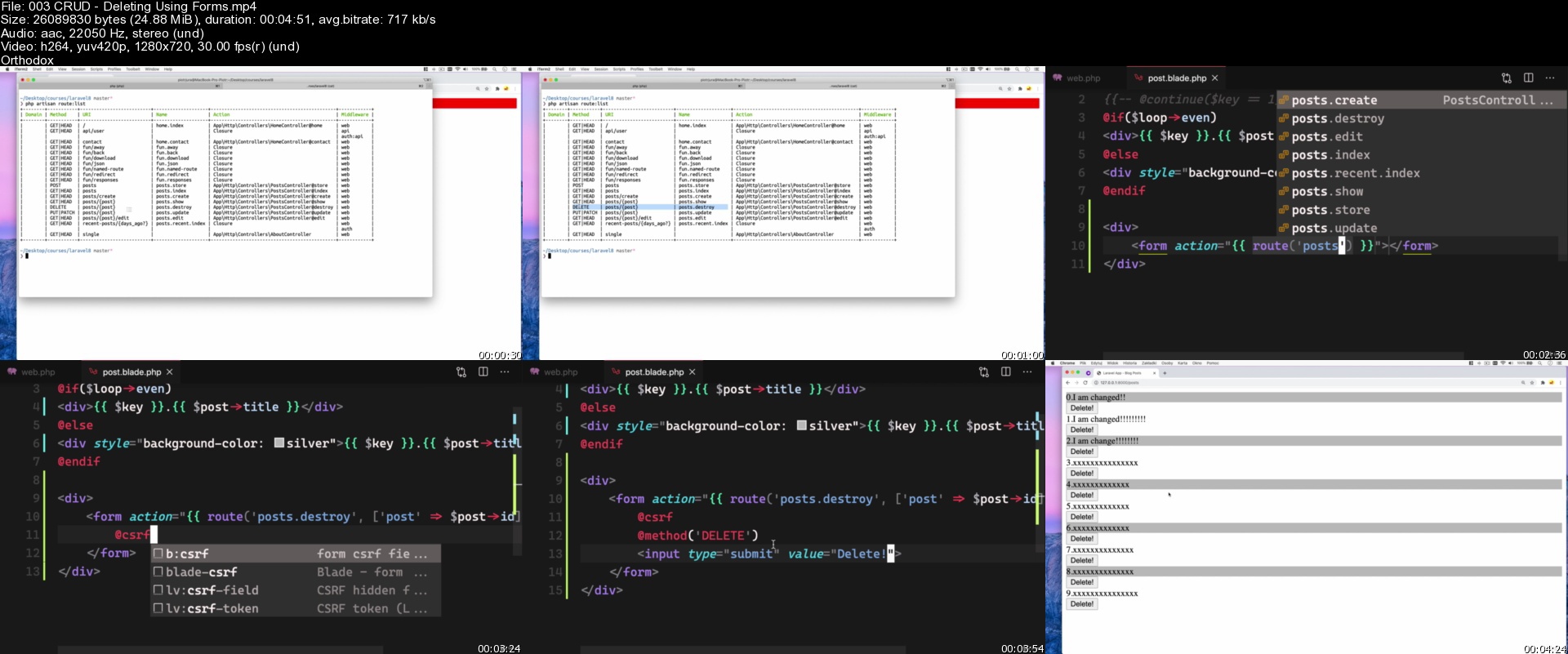
003cruddeletingusingf9vjti.jpg


Django 4 Masterclass 2022 : Build Web Apps With Django

4488504994dx1k3d.jpg


Django 4 Masterclass 2022 : Build Web Apps With Django
MP4 | Video: h264, 1280x720 | Audio: AAC, 44.1 KHz, 2 Ch
Genre: eLearning | Language: English + srt | Duration: 136 lectures (11h 51m) | Size: 5 GB

Learn Django from scratch, build & deploy Django apps with advanced features like authentication & payment integration.


What you'll learn
Learn The Latest Django Version i.e Django 4
Learn Django Basics From Scratch & Gain Essential Skills To Apply For Junior Level Django Developer Positions
Learn About Models, Views & Templates in Django
Learn How To Integrate Stripe Payment Gateway To Collect Payments In Your Django App
Deploy Django App To A Real Server With Digital Ocean
Learn How To Design & Style Your Django App Using Tailwind CSS
Learn How To Perform Authentication i.e Register, Login, Logout Users In Your Django App
Learn How To Implement Class Based Views In Django
Learn How To Customise Django Admin Panel
Add Pagination & Search Functionality To Django Apps
Learn How to Build Web Applications With Django & Python

Requirements
Must be familiar with the basics of Python
Need to create a Stripe account (required only for payment gateway integration section)
Need to create a Digital Ocean account (required only for deployment section)
Need a credit/ debit card or PayPal account for Digital Ocean (required only for deployment section)


Description
Django 4 Masterclass 2022 : Build Web Apps With Django

Here Is What You Get By Enrolling In This Course

Word-By-Word Explanation: In the entire course, I explain each line of code, without skipping a single line of code.

Awesome Quality Content: Over 11+ hours of HD Videos.

Well Structured & Easy To Learn: Course has been specially designed to make it easy for the students to learn Django starting from a basic level and gradually moving up to advance concepts.

24 X 7 Support: I will always be there to guide you in your journey to become a Django expert.

_________________________________________________________________________

Here Is Everything You Will Learn In This Complete Course

In this hands-on course, you will learn how to build complex web applications from scratch using Django.

The course will teach you Django, right from scratch from a very basic level and will gradually move towards advanced topics like authentication.

The entire course is divided into 14 major sections.

Here is a brief description of what you will learn in each section of the course

Section 1: Introduction and installing required software.

In this section we will learn what Django is and why it is used. We will also install the tools you will need to start making Django web apps. We will learn how to install Django and setup a Django project both on Windows & Mac individually.

Section 2: Views & URL Patterns

Django is based on the MVT(Model, Views & Templates) architecture and hence we start learning about what are views, how to create our very first view in Django which will power up our first webpage in Django. We then learn how to attach a view with a URL using URL patterns. We learn what are URL patterns and how they can be used to handle incoming URL requests to our Django app. This view section covers function based views as they are much simpler and offer more functionality, however in the later part of the course we will also learn class based views as well which is another way of implementing views in Django.

Section 3: Database & Models In Django

After learning about Views and URLs, it's now time to learn about models. In Django models are a blueprint to create database tables. Unlike other backend frameworks, in Django you don't have to create a database connection and then create database tables by writing SQL queries but instead Django provides you with models using which database tables are automatically generated at the backend without having to write a single SQL query. In this section we learn how to create a model and how to map that model to create a database table out of it in the backend.

Section 4: Django ORM

Just as you don't have to write SQL queries to create a model, you don't have to write any queries for querying data from the database either. Django comes with a built-in ORM which stands for Object Relational Mapper which allows you to treat database table entries as individual objects. In this section we learn how to add data to database tables using the ORM and also learn how to retrieve data as well from the database using the same. We also learn how to access the Django admin panel by creating a super user from where data could be added by the site administrator.

Section 5: Views & Templates

Once we have learned the basics of how views work in Django, we now learn how to populate these views with some database data. We also learn how to connect these views with templates which are nothing but HTML pages rendered dynamically by Django. We also learn how dynamic database data can be injected into these templates by passing context. We also learn how to create detailed views for products and handling hardcoded URLs associated with these detail views.

Section 6: Adding Styling To Django Project With CSS & Tailwind

After making a barebones app, we now learn how to style up our Django app. There are multiple CSS frameworks and libraries that can be used for styling apps but the one we will be using is Tailwind CSS. It is one of the most modern ways of styling the webpage. With its utility classes we can style every element of our webpage inline without having to create an external CSS file for it. We will learn how to setup Tailwind for a Django project, how to create a navigation bar with it and also how to stye out Django powered webpages with Tailwind.

Section 7: Form & CRUD Operations In Django

Every web application has to perform basic operations like create, read, update & delete data which is also termed as CRUD. In this section we will learn how to design forms in Django so that the end user of our website could perform all these four operations without any issues. Once you learn how to implement CRUD in Django you will be capable of building almost any basic web application in Django.

Section 8: Authentication

It important that we limit certain features of our website to registered users and this is exactly what we will be learning in this section. We learn how to register a user to our Django app, how to login a user and how to control access to certain pages and certain actions to just these logged in users. We also learn how to design the logout functionality so that the users could log out of our application. This entire process is called authentication and we will learn how to implement authentication in our Django app.

Section 9: Creating User Profile

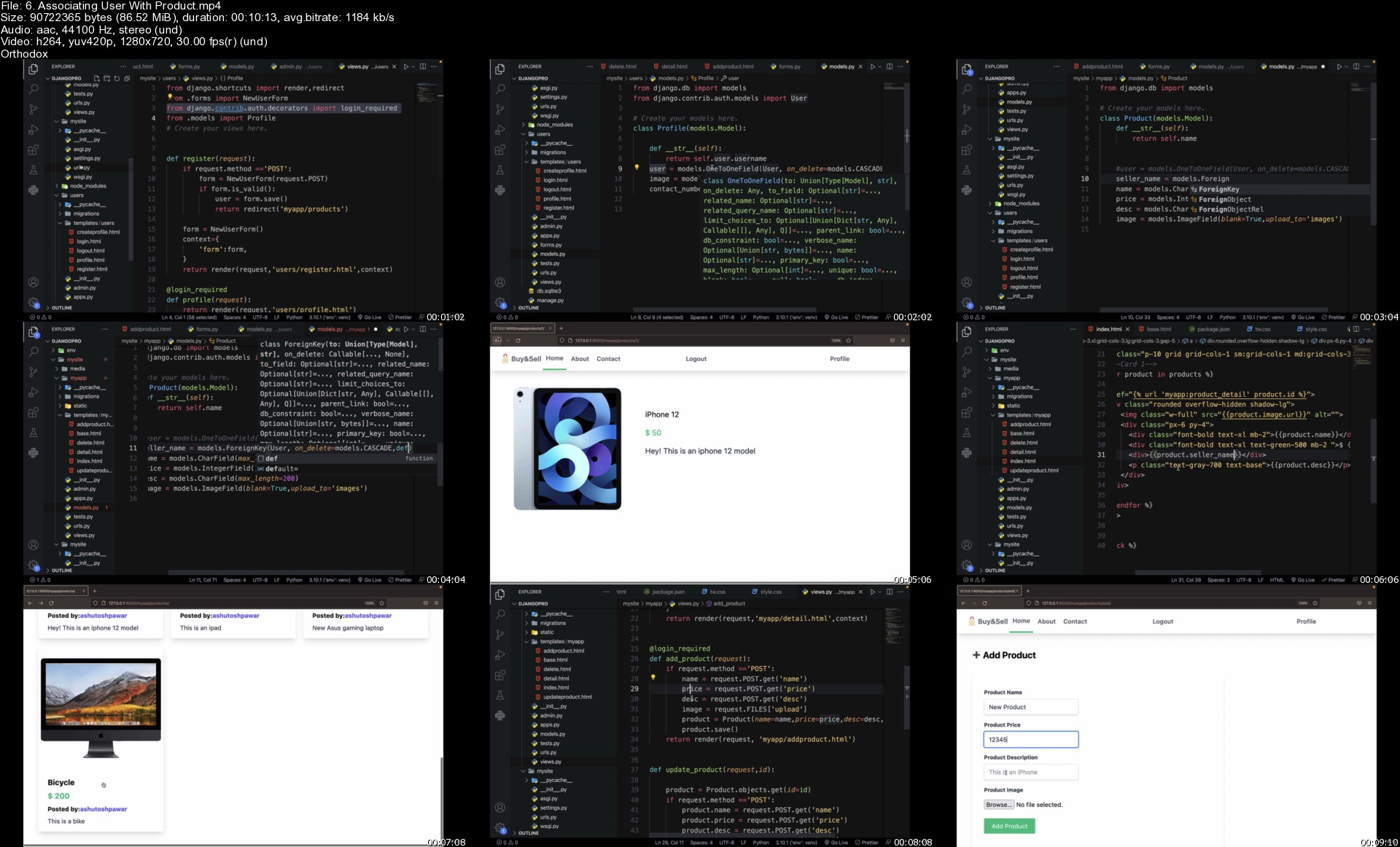
Every registered user must have their own profile, in this section we will start off by learning how to add a functionality that allows every user to create their own profile. We will then learn how to associate a user with the products which they have posted for selling on our Django web app. This can be done by using relationships and keys between two models. We will connect the user model with the product model so that every product would be associated with a user. We will also create a listing page for every user where they can view all the products listed by them on our web app.

Section 10: Class Based Views In Django

We have already learned about the function based view in the earlier part of the course but there is an alternative and a cleaner approach of creating views and that is using class based views. In this section we will re-create every single function based view which is present in our application into a class based view and in the process also learn about the generic views offered by Django such as the ListView, DetailView, CreateView, UpdateView & the DeleteView. we also learn how to add a redirect URL to these views as well.

Section 11: Customising Admin Panel

Every Django application we create comes with a built in Admin panel & it provides us with a functionality to customise this admin panel as per our own needs. In this section we will learn how we could modify the admin headers, how to add custom fields to our model in the admin panel, how to add custom search fields and custom actions as well and how to make fields of a model editable inside the admin panel.

Section 12: Pagination & Search

Displaying hundreds of products on a single page can be challenging, loading them all on a single page might increase the page load times and here is where pagination comes into picture. Pagination is a process of spreading out items in your database to multiple web pages instead of listing them all on a single page. This ensures a better user experience and quick page load times. In this section we will learn how to implement pagination functionality in our Django application and also implement a search functionality which allows users to search multiple products on our web application.

Section 13: Payment Gateway Integration With Stripe

Accepting payments is an integral part of any commercial website, hence in this section we will learn how to integrate stripe payment gateway into our Django app so that end users could pay for products and buy them. We will learn how to create a stipe account, how to add secret keys to our application ,we learn how to design the payment and checkout flow to buy any product on our site and return a payment success view upon successful payment. This payment flow could be integrated into any other Django application which you could create.

Section 14: Deployment

This is one of the most interesting part of the course because we will finally be able to deploy our website to the public internet where anyone in the world could access it. We will be using Git & GitHub to initially host our entire project code online and then deploy the same code form GitHub to DigitalOcean app platform. We learn how to create a code pipeline in such a way that code could be deployed from your local code editor, to Git, to GitHub and finally to DigitalOcean app platform. We learn how to set the environment variables to keep our secret app key private and also learn how to host a remote database and then connect it to our deployed Django application. We will also learn how to fix any issues which may arise in the due process.

So let's begin the journey of becoming a Django expert.

In addition to the Udemy 30-day money back guarantee, you have my personal guarantee that you will love what you learn in this course. If you ever have any questions please feel free to message me directly and I will do my best to get back to you as soon as possible!

_________________________________________________________________________

Make sure to enrol in the course before the price changes.

Take yourself one step closer towards becoming a professional API developer by clicking the "take this course button" now!

Join the journey.

Sincerely,

Ashutosh Pawar

Who this course is for
Beginner Python developers or students who want to learn Django
Django developers who want to know how to add payment gateway and host their Django apps on a real server with little effort
Developers from other domains who want to switch roles & get a job as a Django developer.

Homepage


6.associatinguserwithksj3u.jpg


AWS Serverless Microservices with Patterns & Best Practices

s2b9620eq56tdwa4vdfkqsgkd7.jpg


AWS Serverless Microservices with Patterns & Best Practices
Genre: eLearning | MP4 | Video: h264, 1280x720 | Audio: AAC, 48.0 KHz
Language: English | Size: 12.9 GB | Duration: 30h 19m

AWS Event-driven Serverless Microservices using AWS Lambda, API Gateway, EventBridge, SQS, DynamoDB and CDK for IaC


What you'll learn
AWS Event-driven Serverless Microservices
AWS Lambda, AWS DynamoDB, AWS API Gateway, AWS EventBridge, AWS SQS and AWS CDK
REST API and CRUD endpoints with using AWS Lambda, API Gateway
Data persistence with using AWS DynamoDB
Decouple microservices with events using AWS EventBridge
Message Queues for cross-service communication using AWS SQS
Cloud stack development with IaC using AWS CloudFormation CDK
Serverless Design Patterns and Best Practices
Develop E-commerce Event-driven Microservices Application
RESTful Microservices with using AWS Lambda, Api Gateway and DynamoDb for performing CRUD operations
Event-Driven asynchronous Communication between Microservices using Amazon EventBridge
Serverless e-commerce application infrastructure development with using AWS CDK
AWS API Gateway -for- Restful API-Driven Development and Synchronous Event Sources
AWS EventBridge -for- Event-Driven asynchronous Communication between Microservices
AWS SQS -for- Decouple Microservices and processing events asynchronously using queues
Publish and create event to Serverless Eventbus which is AWS EventBridge
Create Rules and Target definitions for AWS EventBridge
Microservices send polling request and get event from the AWS SQS queue.
Synchronous communication with AWS Api Gateway for routing request from client applications to downstream microservices
Asynchronous communication with AWS Serverless Eventbus which is EventBridge for applying Event Driven asynchronous Communication patterns
Event Source mapping communication polling queue records from lambda services to AWS SQS-Simple Queue Service for Decouple Microservice
Devops best practices develop infrastructure as code Serverless Stacks with using AWS CDK - Cloud Development Kit
AWS Developer and AWS Solution Architecture Jobs
Prepare your AWS Certification with practical way
AWS Serverless + CDK Automation + Integration Patterns = AWSome Microservices!

Requirements
Cloud Basics
Javascript Basics
Typescript Basics

Description
In this course, we will learn AWS Event-driven Serverless Microservices with using

AWS Lambda,

AWS DynamoDB,

AWS API Gateway,

AWS EventBridge,

AWS SQS which stands for Simple Queue Service,

AWS CDK stands for Cloud Development Kit for IaC - Infrastructure as Code tool and

AWS CloudWatch for monitoring.

This course will be 100% hands-on, and you will be developing a real-world application which includes;

REST API and CRUD endpoints with using (AWS Lambda, API Gateway)

Data persistence with using (AWS DynamoDB)

Decouple microservices with events using (AWS EventBridge)

Message Queues for cross-service communication using (AWS SQS)

Cloud stack development with IaC using (AWS CloudFormation CDK)

By the end of the course, you will learn how to develop reliable and scalable Serverless applications, following the microservices architecture. We will develop event-driven microservices with AWS Serverless services which comes with power of cloud high availability and high scalability by nature. Of course we will follow the Serverless Design Patterns and Best Practices when developing our e-commerce event-driven microservices application.

There is a couple of microservices which implemented e-commerce modules over Product, Basket and Ordering microservices. We will use AWS Lambda service as a microservices and use power of lambda functions. And this microservices databases will store NoSQL AWS DynamoDB databases.

And also we have followed communication patterns and best practices when designing Serverless microservice communications for synchronous and asynchronous communications with using AWS API Gateway, AWS EventBridge as a Eventbus and AWS SQS as a queue service. That means we design our architecture rely on asynchronous connections that gives us much more flexible and resilient application.

We will use

AWS API Gateway -for- Restful API-Driven Development and Synchronous Event Sources

AWS EventBridge -for- Event-Driven asynchronous Communication between Microservices

AWS SQS -for- Decouple Microservices and processing events asynchronously using queues

The course proposes a microservice oriented architecture implementation with AWS Serverless world using event-driven patterns and best practices. So the project will be the e-commerce application that will be totally Serverless components.

Let me try to introduce Serverless components one by one;

Api Gateway

This is entry point of our microservices.

API Gateway provides Restful API-Driven Development and Synchronous Event Sources.

Synchronous commands are request/response.

API Gateway is a synchronous event source and provides a Serverless API proxy to Lambda.

API Gateway Redirects to CRUD request to internal microservices.

Product Lambda microservices which performs;

CRUD operations using DynamoDB table over the AWS API Gateway

This will cover product table operations fully Serverless in microservices architecture.

Synchronous requests will manage by AWS API Gateway and routing requests to Product Lambda Microservices that perform CRUD operations.

We will write Lambda functions with using AWS SDK for interacting other AWS resources for example in Product case we will interact with AWS Serverless DynamoDB to perform all crud operations.

Basket Lambda microservices which performs;

Add-Remove synchronous basket operations with using AWS API Gateway and DynamoDB

Again synchronous requests will manage by AWS API Gateway and routing requests to Basket Lambda Microservices that perform CRUD operations.

We will write Lambda functions with using AWS SDK for interacting other AWS resources. For example in Basket case we interact with AWS Serverless DynamoDB to perform all crud operations.

But also,

Basket microservice triggers to Event-driven use case which is the Checkout Basket.

When checkout basket, this will publish and create event to Serverless Eventbus which is AWS EventBridge.

So this asynchronous communication will held by Basket Lambda Microservice and AWS EventBridge and consumed by Ordering microservices over the AWS SQS.

AWS Event Bridge

So asynchronous communication held by AWS Serverless Eventbus service which is AWS EventBridge.

We will create Rules and Target definitions for AWS EventBridge from Basket Lambda microservices.

That means we will develop Basket Lambda Microservices when publishing checkout message to AWS EventBridge with using AWS SDK for development purpose.

AWS SQS and Ordering Lambda microservices

So after publishing checkout event to the EventBridge, this event will consume by Ordering part.

EventBridge send to event to AWS SQS in order to gain power of AWS queue.

After that Ordering lambda microservice will consume this event with polling.

That means we will use event source mapping communication type here when consuming events, ordering lambda microservices send polling request and get event from the AWS queue.

After consuming the event from the AWS queue, Ordering lambda microservices process the event with creating order record into its DynamoDB table.

Ordering lambda microservices perform all these operations with developing lambda functions with using AWS SDK.

We have 3 communication types;

Synchronous communication with AWS API Gateway for routing request from client applications to downstream microservices

Asynchronous communication with AWS Serverless Eventbus which is EventBridge for applying Event Driven asynchronous Communication patterns.

And lastly we have Event Source mapping communication when polling queue records from lambda services to AWS SQS-Simple Queue Service for Decouple Microservice and processing events asynchronously.

During the course we will follow these Microservice communication types with Lambda invocations, and develop our sections following these arrows.

IaC Serverless Stacks with AWS CDK - Cloud Development Kit

Will follow Devops best practices when coding infrastructure. The whole project, we will develop infrastructure as code Serverless Stacks with using AWS CDK - Cloud Development Kit.

We will use AWS CDK for IaC Serverless Stacks developments that we will develop and provision all services step by step with together.

AWS Developer and AWS Solution Architecture Jobs

This course prepares to you real AWS Developer and AWS Solution Architecture jobs, which's offers to you 3 figure salaries.

Because we are going to develop a real-world Serverless application which is already used and developed by lots of companies in the world.

Prepare your AWS Certification with Practical Way

AWS Certified Developer Associate

AWS Certified Solutions Architect Associate

Don't memorize all topics, feel and develop by hands-on, dirty your hands by this way you can achieve to onboard your target AWS jobs. This course will help you to prepare AWS Developer and Solutions Architect Associate certifications both theoretical and mostly practical way with developing Serverless e-commerce applications.

AWS Serverless + CDK Automation + Integration Patterns = AWSome!

This will be the manifesto of our course. We will follow these manifesto every place of our course and the Serverless e-commerce application.

Integration Patterns that we will follow Queue-Chaning, Publish-Subscribe and Fan-out design patterns during the course when developing our serverless e-commerce application.

By the end of this course, you'll learn how to design and developing AWS Event-driven microservices with using Serverless patterns and best practices.

This course will be 100% hands-on, and we will be develop all infrastructure and microservice codes with together and step by step.

I hope you'll join me on this journey and develop this project with me.

Who this course is for
Software Developer who wants to develop real-world project with AWS Serverless Services
Software/Solutions Architects who wants to develop real-world project with AWS Serverless Services

Homepage


004awscdkclouddevelopn4jqe.jpg


Zurück
Oben Unten