SAP S/4HANA Finance Full Course From Beginner to Consultant
Published 6/2026
MP4 | Video: h264, 1920x1080 | Audio: AAC, 44.1 KHz, 2 Ch Language: English | Duration: 42h 3m | Size: 29.84 GB
SAP S/4 Hana Finance, Learn SAP S/4HANA Finance, Master SAP S/4HANA Finance from Beginner to Advanced, Financial Account
What you'll learn
Understand the architecture, navigation, and core business processes of SAP S/4HANA Finance.
Configure and manage organizational structures such as Company Codes, Fiscal Year Variants, and Chart of Accounts.
Perform General Ledger (G/L) Accounting transactions and manage financial postings using the Universal Journal.
Process Accounts Payable (AP) activities, including vendor master data, invoice processing, and payment management.
Manage Accounts Receivable (AR) functions, including customer master data, billing, incoming payments, and dunning procedures.
Configure and execute Asset Accounting processes, including asset acquisition, depreciation, transfers, and retirement.
Implement Cost Center Accounting, Internal Orders, and Profit Center Accounting for effective cost control and profitability analysis.
Perform Bank Accounting, cash management, and bank reconciliation activities within SAP S/4HANA Finance.
Execute month-end and year-end closing activities and generate accurate financial reports and statements.
Gain practical knowledge of real-world SAP Finance business scenarios and prepare for SAP S/4HANA Finance consultant or end-user roles.
Requirements
This course is designed for both beginners and professionals. No prior SAP experience is required, as all concepts are explained from the ground up.
Basic understanding of accounting and finance concepts such as journal entries, balance sheets, and profit & loss statements is helpful but not mandatory.
Familiarity with business processes and enterprise operations is an advantage.
Basic computer skills, including navigating software applications and using the internet.
Willingness to learn SAP S/4HANA Finance and practice hands-on exercises.
Access to an SAP training system is beneficial but not required for understanding the course concepts.
Description
SAP S/4HANA Finance Full Course is one of the most sought-after enterprise resource planning solutions used by organizations worldwide to manage financial accounting, controlling, reporting, compliance, asset management, cost management, and business performance analysis. This comprehensive
SAP S/4HANA Finance course is designed to provide learners with practical and theoretical knowledge required to work confidently as SAP Finance consultants, end users, business analysts, accountants, and implementation professionals.
Throughout this course, students will gain a deep understanding of SAP S/4HANA Finance architecture, enterprise structure configuration, financial accounting processes, controlling functions, asset accounting, accounts payable, accounts receivable, bank accounting, profitability analysis, and financial reporting. The training follows a structured learning path that begins with SAP fundamentals and gradually progresses to advanced business scenarios, real-world implementation concepts, and industry best practices.
Learners will explore SAP navigation, SAP Fiori applications, organizational structures, company code configuration, fiscal year variants, posting periods, chart of accounts, and General Ledger Accounting. The course demonstrates practical transaction processing, including customer management, vendor management, invoice processing, payment processing, reconciliation procedures, and financial closing activities.
The training also covers essential controlling components such as Cost Center Accounting, Cost Element Accounting, Internal Orders, Profit Center Accounting, Product Costing, Cost Allocation, Assessment Cycles, and Profitability Analysis. Students will understand how organizations monitor operational costs, improve profitability, and generate management reports for strategic decision-making.
Special emphasis is placed on SAP S/4HANA innovations such as Universal Journal, Embedded Analytics, SAP Fiori Reporting, Real-Time Financial Reporting, and Financial Dashboard analysis. Learners will also gain hands-on knowledge of Asset Accounting processes including asset acquisition, depreciation, transfer, retirement, and financial reporting.
The course concludes with month-end closing, year-end closing, financial statement preparation, implementation methodology, data migration, testing procedures, go-live activities, and SAP Finance career guidance. By the end of this training, students will possess the practical skills required to participate in SAP S/4HANA Finance implementation, support, migration, and consulting projects across various industries.
SAP S/4HANA Finance course Topics Covered
• Introduction to Enterprise Resource Planning (ERP), SAP ecosystem, SAP S/4HANA Finance architecture, business process integration, digital transformation concepts, and modern financial management practices used by global organizations.
• SAP navigation fundamentals including SAP GUI, SAP Easy Access Menu, SAP Fiori Launchpad, transaction codes, user personalization, menu management, and efficient navigation techniques for daily business operations.
• SAP project methodology, implementation lifecycle, project preparation, business blueprint creation, requirement gathering, realization phase, testing strategies, deployment planning, and project management best practices.
• Enterprise structure configuration including client setup, company creation, company code configuration, organizational assignments, business areas, segments, and financial accounting organizational structures.
• Fiscal Year Variant configuration, posting period management, accounting period controls, year-dependent and year-independent fiscal years, and financial reporting period management.
• Company Code configuration, global parameter maintenance, currency settings, country-specific requirements, language settings, and organizational structure validation within SAP S/4HANA Finance.
• General Ledger Accounting fundamentals including G/L master records, journal entries, document posting, document types, posting keys, debit-credit rules, and financial transaction processing.
• Chart of Accounts management, G/L Account Master Data creation using FS00, account groups, Profit and Loss accounts, Balance Sheet accounts, and financial statement integration.
• Customer Master Data creation through SAP Business Partner approach, customer account groups, company code data, sales area data, and customer relationship management fundamentals.
• Vendor Master Data management including supplier creation, business partner configuration, purchasing data maintenance, payment settings, and vendor lifecycle management.
• Accounts Payable processes including vendor invoice posting using FB60, tax calculations, document validation, vendor reconciliation, and supplier accounting operations.
• Accounts Receivable processes including customer invoicing, incoming payments, customer account maintenance, collections management, and customer reconciliation procedures.
• Vendor payment processing using F-53, customer receipt processing using F-28, open item management, account balance analysis, and financial reconciliation activities.
• Down Payments, Partial Payments, Residual Payments, payment clearing procedures, advance payment processing, and practical Accounts Payable transaction management.
• Automatic Payment Program (F110) configuration including payment methods, bank determination, ranking orders, payment proposals, payment runs, and automated vendor payment processing.
• Dunning Process configuration, customer collections management, overdue receivables monitoring, dunning levels, payment reminders, and credit management procedures.
• Asset Accounting configuration including asset classes, chart of depreciation, depreciation areas, depreciation keys, useful life settings, and fixed asset management fundamentals.
• Asset Master creation, asset acquisition, capitalization process, asset valuation, accounting entries, and integration with procurement and financial accounting.
• Asset Depreciation processing, depreciation runs, planned depreciation, posted depreciation, Asset Explorer analysis, and fixed asset reporting.
• Asset Retirement, asset disposal, asset transfer, asset scrapping, gain-loss calculations, asset lifecycle management, and compliance reporting requirements.
• Cost Center Accounting configuration, controlling area setup, standard hierarchy management, cost center creation, planning, budgeting, and managerial accounting concepts.
• Cost Element Accounting including primary cost elements, secondary cost elements, cost allocation principles, FI-CO integration, and cost tracking methodologies.
• New General Ledger concepts including document splitting, segment reporting, ledger management, multiple currency reporting, and financial transparency improvements.
• Internal Orders configuration, budgeting, planning, settlement processes, expense tracking, project costing, and internal cost monitoring activities.
• Profit Center Accounting configuration, profitability tracking, business unit analysis, financial performance measurement, and management reporting capabilities.
• Product Costing fundamentals including costing variants, cost component structures, material costing, manufacturing cost analysis, and standard cost estimation procedures.
• Cost Center Planning, Assessment Cycles, Distribution Cycles, Statistical Key Figures, overhead allocation, and cost distribution methodologies.
• Profitability Analysis (CO-PA), Account-Based CO-PA, Costing-Based CO-PA, customer profitability analysis, product profitability analysis, and strategic business reporting.
• Financial Statement Reporting including Financial Statement Versions, Balance Sheet reporting, Profit and Loss reporting, Trial Balance analysis, and management reporting frameworks.
• Month-End Closing activities including accrual postings, foreign currency valuation, reconciliation procedures, open item clearing, and period-end financial controls.
• Year-End Closing activities including balance carry forward, financial statement finalization, audit preparation, compliance reporting, and fiscal year transition procedures.
• SAP S/4HANA Embedded Analytics, SAP Fiori Reporting, KPI dashboards, real-time financial reporting, business intelligence capabilities, and decision-support analytics.
• SAP implementation projects, data migration strategies, testing methodologies, user acceptance testing, cutover planning, go-live support, post-production support, and SAP Finance career development roadmap.
Who this course is for
Finance and accounting professionals who want to upgrade their skills and learn SAP S/4HANA Finance for career growth.
SAP FICO consultants looking to transition from SAP ECC to SAP S/4HANA Finance and understand the latest innovations and business processes.
Fresh graduates, commerce students, MBA students, and aspiring SAP professionals seeking a career in SAP consulting, implementation, or support.
Business analysts, financial analysts, auditors, controllers, and ERP users who want to understand how financial processes are managed in SAP S/4HANA.
Corporate employees involved in financial reporting, accounts payable, accounts receivable, asset accounting, controlling, or financial planning activities.
SAP end users who want practical knowledge of daily finance operations and transaction processing within SAP S/4HANA.
Project team members participating in SAP S/4HANA Finance implementation, migration, or digital transformation projects.
Professionals from non-SAP backgrounds who want to learn SAP S/4HANA Finance from scratch and build a strong foundation for future SAP certifications and consulting opportunities.
Homepage
Premium Links
Download from RapidGator









 You will learn to bring your own 3D cartoon character to life from start to finish, created solely in Blender.
 It is not essential to have prior 3D knowledge, although having basic notions is recommended.
 To artists, designers, or anyone who is interested in getting started in the creation of 3D cartoon characters.
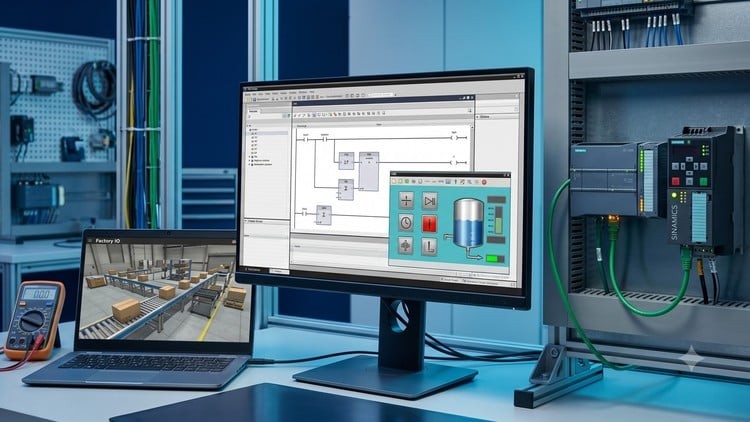
 Comunicación MODBUS Serial uniendo un PLC S7-1200 (con CB1241) y un variador PowerFlex 525.