• Regeln für den Video-Bereich:

    In den Börsenbereich gehören nur Angebote die bereits den Allgemeinen Regeln entsprechen.

    Einteilung

    - Folgende Formate gehören in die angegeben Bereiche:
    - Filme: Encodierte Filme von BluRay, DVD, R5, TV, Screener sowie Telesyncs im Format DivX, XviD und x264.
    - DVD: Filme im Format DVD5, DVD9 und HD2DVD.
    - HD: Encodierte Filme mit der Auflösung 720p oder darüber von BluRay, DVD, R5, TV, Screener sowie Telesyncs im Format x264.
    - 3D: Encodierte Filme von BluRay, die in einem 3D Format vorliegen. Dies gilt auch für Dokus, Animation usw.
    - Serien: Cartoon/Zeichentrick, Anime, Tutorials, Dokumentationen, Konzerte/Musik, Sonstiges sind demnach in die entsprechenden Bereiche einzuordnen, auch wenn sie beispielsweise im High Definition-Format oder als DVD5/DVD9/HD2DVD vorliegen. Ausnahme 3D.
    - Bereich Englisch: Englische Releases gehören immer in diesen Bereich.
    - Bereich Talk: Der Bereich, in dem über die Releases diskutiert werden kann, darf, soll und erwünscht ist.


    Angebot/Beitrag erstellen

    - Ein Beitrag darf erst dann erstellt werden, wenn der Upload bei mindestens einem OCH komplett ist. Platzhalter sind untersagt.
    - Bei einem Scenerelease hat der Threadtitel ausschließlich aus dem originalen, unveränderten Releasenamen zu bestehen. Es dürfen keine Veränderungen wie z.B. Sterne, kleine Buchstaben o.ä. vorgenommen werden. Ausnahme Serienbörse:
    - Bei einem Sammelthread für eine Staffel entfällt aus dem Releasename natürlich der Name der Folge. Beispiel: Die Simpsons S21 German DVDRip XviD - ITG
    - Dementsprechend sind also u.a. verboten: Erweiterungen wie "Tipp", "empfehlenswert", "only", "reup", usw. / jegliche andere Zusatzinformation oder Ergänzung, welche nicht in obiger Beschreibung zu finden ist.

    Aufbau des Angebots und Threadtitel

    Der Titel nach folgendem Muster erstellt zu werden. <Name> [3D] [Staffel] [German] <Jahr> <Tonspur> [DL] [Auflösung] <Quelle> <Codec> - <Group>
    Beispiel: The Dark Knight German 2008 AC3 DVDRip XviD - iND
    Beispiel: The Dark Knight 2008 DTS DL BDRip x264 - iND
    Beispiel: The Dark Knight 2008 AC3 DL BDRip XviD - iND
    Beispiel: The Dark Knight German 2008 AC3 720p BluRay x264 iND
    Beispiel: The Dark Knight 2008 DTS DL 1080p BluRay x264 iND
    Beispiel: Die Simpsons S01 German AC3 DVDRip XviD iND
    Beispiel: Die Simpsons S20 German AC3 720p BluRay x264 iND
    Beispiel: Sword Art Online II Ger Sub 2014 AAC 1080p WEBRip x264 - peppermint
    Entsprechend sind also u.a. verboten: Sonderzeichen wie Klammern, Sterne, Ausrufezeichen, Unterstriche, Anführungszeichen / Erweiterungen wie "Tipp", "empfehlenswert", "only", "reup", usw. / jegliche andere Zusatzinformation oder Ergänzung, welche nicht in obiger Beschreibung zu finden ist
    Ausnahmen hiervon können in den Bereichen geregelt sein.

    Die Beiträge sollen wie folgt aufgebaut werden:
    Überschrift entspricht dem Threadtitel
    Cover
    kurze Inhaltsbeschreibung
    Format, Größe, Dauer sind gut lesbar für Downloader außerhalb des Spoilers zu vermerken
    Nfo sind immer Anzugeben und selbige immer im Spoiler in Textform.
    Sind keine Nfo vorhanden z.B. Eigenpublikationen, sind im Spoiler folgende Dateiinformationen zusätzlich anzugeben :
    Quelle
    Video (Auflösung und Bitrate)
    Ton (Sprache, Format und Bitrate der einzelnen Spuren)
    Untertitel (sofern vorhanden)
    Hosterangabe in Textform außerhalb eines Spoiler mit allen enthaltenen Hostern.
    Bei SD kann auf diese zusätzlichen Dateiinformationen verzichtet werden.

    Alle benötigten Passwörter sind, sofern vorhanden, in Textform im Angebot anzugeben.
    Spoiler im Spoiler mit Kommentaren :"Schon Bedankt?" sind unerwünscht.


    Releases

    - Sind Retail-Release verfügbar, sind alle anderen Variationen untersagt. Ausnahmen: Alle deutschen Retail-Release sind CUT, in diesem Fall sind dubbed UNCUT-Release zulässig.
    - Im Serien-Bereich gilt speziell: Wenn ein Retail vor Abschluss einer laufenden Staffel erscheint, darf diese Staffel noch zu Ende gebracht werden.62
    - Gleiche Releases sind unbedingt zusammenzufassen. Das bedeutet, es ist zwingend erforderlich, vor dem Erstellen eines Themas per Suchfunktion zu überprüfen, ob bereits ein Beitrag mit demselben Release besteht. Ist dies der Fall, ist der bereits vorhandene Beitrag zu verwenden.
    - P2P und Scene Releases dürfen nicht verändert oder gar unter einem iND Tag eingestellt werden.


    Support, Diskussionen und Suche

    - Supportanfragen sind entweder per PN oder im Bereich Talk zu stellen.
    - Diskussionen und Bewertungen sind im Talk Bereich zu führen. Fragen an die Uploader haben ausschließlich via PN zu erfolgen, und sind in den Angeboten untersagt.
    - Anfragen zu Upload-Wünschen sind nur im Bereich Suche Video erlaubt. Antworten dürfen nur auf Angebote von MyBoerse.bz verlinkt werden.


    Verbote

    - Untersagt sind mehrere Formate in einem einzigen Angebotsthread, wie beispielsweise das gleichzeitige Anbieten von DivX/XviD, 720p und 1080p in einem Thread. Pro Format, Release und Auflösung ist ein eigener Thread zu eröffnen.
    - Grundsätzlich ebenso verboten sind Dupes. Uploader haben sich an geeigneter Stelle darüber zu informieren, ob es sich bei einem Release um ein Dupe handelt.
    - Gefakte, nur teilweise lauffähige oder unvollständige Angebote sind untersagt. Dies gilt auch für eigene Publikationen, die augenscheinlich nicht selbst von z.B. einer DVD gerippt wurden. Laufende Serien, bei denen noch nicht alle Folgen verfügbar sind, dürfen erstellt und regelmäßig geupdatet werden.
    - Untersagt sind Angebote, welche nur und ausschließlich in einer anderen Sprache als deutsch oder englisch vorliegen. Ausnahmen sind VORHER mit den Moderatoren zu klären.


    Verstoß gegen die Regeln

    - Angebote oder Beiträge, die gegen die Forenregeln verstoßen, sind über den "Melden"-Button im Beitrag zu melden.
  • Bitte registriere dich zunächst um Beiträge zu verfassen und externe Links aufzurufen.

*** Bestes IPTV *** bester Preis *** gratis Test ***


Englische Tutorials

IATF Core Tools - PFLOW, FMEA, CPLAN, SPC, MSA, PPAP, APQP.

amcsdi0x1aoeqmpvvw7ts59c6l.jpg


IATF Core Tools - PFLOW, FMEA, CPLAN, SPC, MSA, PPAP, APQP.
Last updated 7/2022
MP4 | Video: h264, 1280x720 | Audio: AAC, 44.1 KHz
Language: English | Size: 18.93 GB | Duration: 31h 37m

All Core Tools of IATF 16949: Process Flow, Process FMEA, Control Plan, Design FMEA, SPC, MSA, PPAP and APQP


What you'll learn
Clear understanding of various elements of All Core Tools of IATF 16949: 2016 QMS and processes.
Will be able to prepare and review PPAP document effectively to improve effectiveness of product design, process design and development activities.
Will be able to review the PPAP of suppliers effectively.
Will be able to formulate effective PROCESS FLOW, DFMEA, PFMEA and CONTROL PLAN for different types of processes.
Will be able to contribute in internal audit and supplier audit process effectively.
Will be able to implement SPC in the organization for quality improvement.
Will be able to conduct MSA for Variable and Attribute Measurements Effectively.
Will be able to practice APQP process effectively to meet the customer's timeline.
People from Bulk Material industries will get a clear understanding (in PPAP section) about how the core tools are applied differently for bulk materials.


Requirements
Person should have a degree / diploma in science / engineering / technology.
Person should have some involvement in operational function of the company such as production, quality assurance, engineering, design, testing, inspection, supplier assessment, purchase, service etc.
Person should be familiar with working in excel for making simple documentation, calculation, formatting etc.
An awareness of Quality Management System, such as ISO 9001, IATF 16949 would be added advantage.
Should cultivate team work in organization.


Description
This course covers the following IATF Core Tools in details, namely: 1. Process Flow Diagram,2. Process Failure Mode and Effect Analysis (PFMEA),3. Control Plan,4. Design Failure Mode and Effect Analysis (DFMEA),5. Statistical Process Control (SPC),6. Measurement System Analysis (MSA),7. Production Part Approval Process (PPAP) and8. Advanced Product Quality Planning (APQP).The course material is in line with the following AIAG Manuals:AIAG FMEA Manual - 4th edition,AIAG SPC Manual - 2nd edition,AIAG MSA Manual - 4th edition,AIAG PPAP Manual - 4th edition andAIAG APQP Manual - 2nd edition.Apart from details explanation of the various elements of Core Tools, downloadable resources are provided (in excel file) which can used in practice.Also there are quizzes in every section for testing the knowledge gained from the course.

Overview
Section 1: Introduction

Lecture 1 Overview of the program

Section 2: Process Flow, PFMEA and Control Plan

Lecture 2 Overview of Process Flow, Process FMEA and Control Plan

Lecture 3 Process Flow - Details Explanation

Lecture 4 Process Flow Example

Lecture 5 Process FMEA Detail Explanation

Lecture 6 Process FMEA example

Lecture 7 Process FMEA example of OCCURRENCE NUMBER reduction

Lecture 8 Control Plan - Details Explanation

Lecture 9 Control Plan - Example

Lecture 10 Summary of the program - PFLOW-PFMEA-CPLAN.

Section 3: Design Failure Mode and Effects Analysis (Design FMEA)

Lecture 11 General FMEA Guidelines.

Lecture 12 Overview of FMEA Strategy, Planning and Implementation.

Lecture 13 Introduction to DFMEA.

Lecture 14 Prerequisites for Design FMEA.

Lecture 15 Block or Boundary Diagram.

Lecture 16 Interface Matrix.

Lecture 17 P - Diagram or Parameter Diagram.

Lecture 18 Explanation of Design FMEA Format.

Lecture 19 Example of Design FMEA.

Lecture 20 Activities after Design FMEA.

Lecture 21 Summary of the Design FMEA Training Program.

Section 4: Statistical Process Control (SPC).

Lecture 22 Purpose of SPC in automotive manufacturing.

Lecture 23 Basic understanding of SPC.

Lecture 24 Steps for Implementation of SPC.

Lecture 25 Making X-bar/R - control chart in shop floor.

Lecture 26 Calculation of Control Limits for X-bar/R - control chart.

Lecture 27 Analysis and Correction of Control Limits for X-bar / R Control Chart.

Lecture 28 Implementation of X-bar / R Control Chart

Lecture 29 Other variable control charts.

Lecture 30 Attribute control charts.

Lecture 31 Process Capability and Process Performance.

Lecture 32 Over-adjustment.

Lecture 33 Selection of appropriate control chart.

Lecture 34 Stoplight and Pre-Control methods.

Lecture 35 Use of Minitab for SPC

Lecture 36 Summary of SPC Training.

Section 5: Measurement System Analysis (MSA).

Lecture 37 Introduction and Purpose of MSA.

Lecture 38 Terminology related to MSA.

Lecture 39 Measurement Process.

Lecture 40 Replicable Measurement System - Test Procedure.

Lecture 41 Stability Study.

Lecture 42 Bias Study.

Lecture 43 Linearity Study.

Lecture 44 Gage R&R Study Methods.

Lecture 45 Gage R&R Study - Range Method.

Lecture 46 Gage R&R Study - Average and Range Method.

Lecture 47 Gage R&R Study - ANOVA Method.

Lecture 48 Gage R&R Study by using MINITAB Software.

Lecture 49 MSA for Attribute Measurement Data.

Lecture 50 MSA for Attribute Measurement Data - Effectiveness Parameters.

Lecture 51 MSA for Attribute Measurement Data - Interraters Reliability.

Lecture 52 Non-Replicable Measurements - MSA Study.

Lecture 53 Summary MSA Training Program.

Section 6: Production Part Approval Process (PPAP)

Lecture 54 Introduction to PPAP.

Lecture 55 General understanding of Submission of PPAP.

Lecture 56 Significant Production Run.

Lecture 57 18 Elements of PPAP Document and Parts.

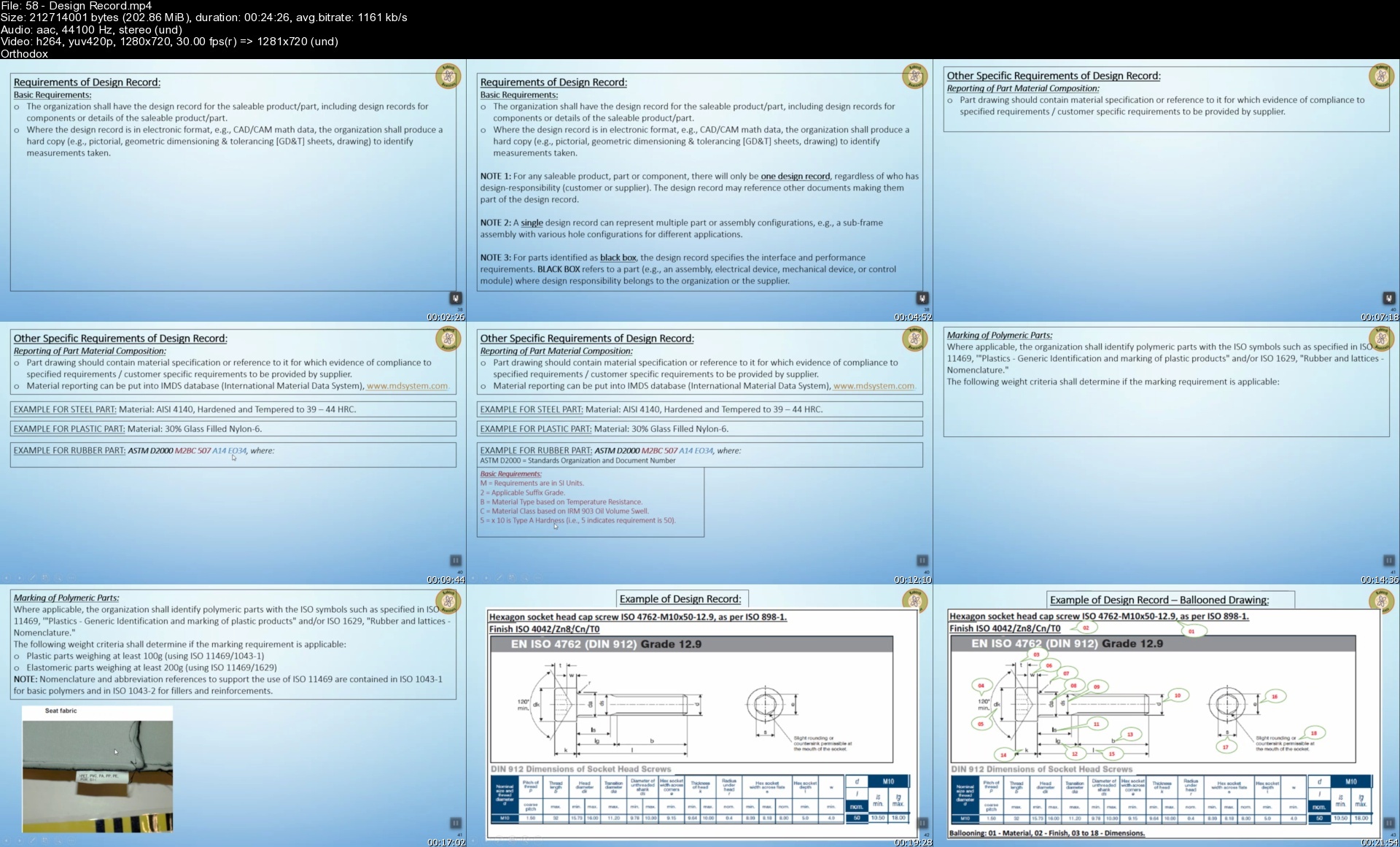
Lecture 58 Design Record.

Lecture 59 Authorized Engineering Change Documents.

Lecture 60 Customer Engineering Approval.

Lecture 61 Design FMEA.

Lecture 62 Process Flow Diagram.

Lecture 63 Process FMEA.

Lecture 64 Control Plan.

Lecture 65 Measurement System Analysis (MSA).

Lecture 66 Dimensional Result.

Lecture 67 Material Test Results.

Lecture 68 Performance Test Results.

Lecture 69 Initial Process Studies.

Lecture 70 Qualified Laboratory Documentation.

Lecture 71 Appearance Approval Report (AAR).

Lecture 72 Sample Production Parts.

Lecture 73 Master Sample.

Lecture 74 Checking Aids.

Lecture 75 Customer-Specific Requirements.

Lecture 76 Part Submission Warrant (PSW).

Lecture 77 Customer Notification.

Lecture 78 Submission to Customer.

Lecture 79 PPAP Submission Levels.

Lecture 80 PPAP Submission Status.

Lecture 81 Record Retention for PPAP.

Lecture 82 Bulk Material Specific Requirements Part-1.

Lecture 83 Bulk Material Specific Requirements - Part-2.

Lecture 84 Bulk Material Specific Requirements - Part-3.

Lecture 85 Tire / Tyre Industry Specific Requirements.

Lecture 86 Truck Industries Specific Requirements.

Lecture 87 Summary of PPAP Training Program.

Section 7: Advanced Product Quality Planning (APQP)

Lecture 88 Fundamentals of Product Quality Planning

Lecture 89 Phases of APQP - General Understanding

Lecture 90 Phase-1: Plan and Define Program

Lecture 91 Phase-2: Product Design and Development

Lecture 92 Phase-3: Process Design and Development

Lecture 93 Phase-4: Product and Process Validation

Lecture 94 Phase-5: Feedback, Assessment and Corrective Action

Lecture 95 Control Plan Format and Example

Lecture 96 Dominating Factors in Control Plan

Lecture 97 Product Quality Planning Checklist

Lecture 98 Analytical Techniques

Lecture 99 Summary of APQP program

Design Engineer, Process Engineer or Engineers of other technical and tecno-commercial functions in automotive industry.,Young engineers / scientists involved in technical activities in manufacturing industry and wants to enhance their career, with a formal added professional qualification.,Departmental Heads / Trainers who wants to provide training to their subordinates in IATF Core Tools, without sending the participants for outside training for saving of time and money.,Executive of a company can provide training to vendors of the company by casting these video training's.,An individual working as consultant in IATF 16949 field.

Homepage

58designrecords1hd6z.jpg


Deep Learning Prerequisites: Logistic Regression in Python

26satcbsygmvembhizynbene0j.jpg


Deep Learning Prerequisites: Logistic Regression in Python
Genre: eLearning | MP4 | Video: h264, 1278x796 | Audio: aac, 44100 Hz
Language: English + SRT | Size: 1.10 GB | Duration: 6h 19m

What you'll learn
program logistic regression from scratch in Python
describe how logistic regression is useful in data science
derive the error and update rule for logistic regression
understand how logistic regression works as an analogy for the biological neuron
use logistic regression to solve real-world business problems like predicting user actions from e-commerce data and facial expression recognition
understand why regularization is used in machine learning

Requirements
Derivatives, matrix arithmetic, probability
You should know some basic Python coding with the Numpy Stack

Description
This course is a lead-in to deep learning and neural networks - it covers a popular and fundamental technique used in machine learning, data science and statistics: logistic regression. We cover the theory from the ground up: derivation of the solution, and applications to real-world problems. We show you how one might code their own logistic regression module in Python.

This course does not require any external materials. Everything needed (Python, and some Python libraries) can be obtained for free.

This course provides you with many practical examples so that you can really see how deep learning can be used on anything. Throughout the course, we'll do a course project, which will show you how to predict user actions on a website given user data like whether or not that user is on a mobile device, the number of products they viewed, how long they stayed on your site, whether or not they are a returning visitor, and what time of day they visited.

Another project at the end of the course shows you how you can use deep learning for facial expression recognition. Imagine being able to predict someone's emotions just based on a picture!

If you are a programmer and you want to enhance your coding abilities by learning about data science, then this course is for you. If you have a technical or mathematical background, and you want use your skills to make data-driven decisions and optimize your business using scientific principles, then this course is for you.

This course focuses on "how to build and understand", not just "how to use". Anyone can learn to use an API in 15 minutes after reading some documentation. It's not about "remembering facts", it's about "seeing for yourself" via experimentation. It will teach you how to visualize what's happening in the model internally. If you want more than just a superficial look at machine learning models, this course is for you.

"If you can't implement it, you don't understand it"

Or as the great physicist Richard Feynman said: "What I cannot create, I do not understand".

My courses are the ONLY courses where you will learn how to implement machine learning algorithms from scratch

Other courses will teach you how to plug in your data into a library, but do you really need help with 3 lines of code?

After doing the same thing with 10 datasets, you realize you didn't learn 10 things. You learned 1 thing, and just repeated the same 3 lines of code 10 times...

Suggested Prerequisites:

calculus (taking derivatives)

matrix arithmetic

probability

Python coding: if/else, loops, lists, dicts, sets

Numpy coding: matrix and vector operations, loading a CSV file

WHAT ORDER SHOULD I TAKE YOUR COURSES IN?:

Check out the lecture "Machine Learning and AI Prerequisite Roadmap" (available in the FAQ of any of my courses, including the free Numpy course)

Who this course is for:
Adult learners who want to get into the field of data science and big data
Students who are thinking of pursuing machine learning or data science
Students who are tired of boring traditional statistics and prewritten functions in R, and want to learn how things really work by implementing them in Python
People who know some machine learning but want to be able to relate it to artificial intelligence
People who are interested in bridging the gap between computational neuroscience and machine learning

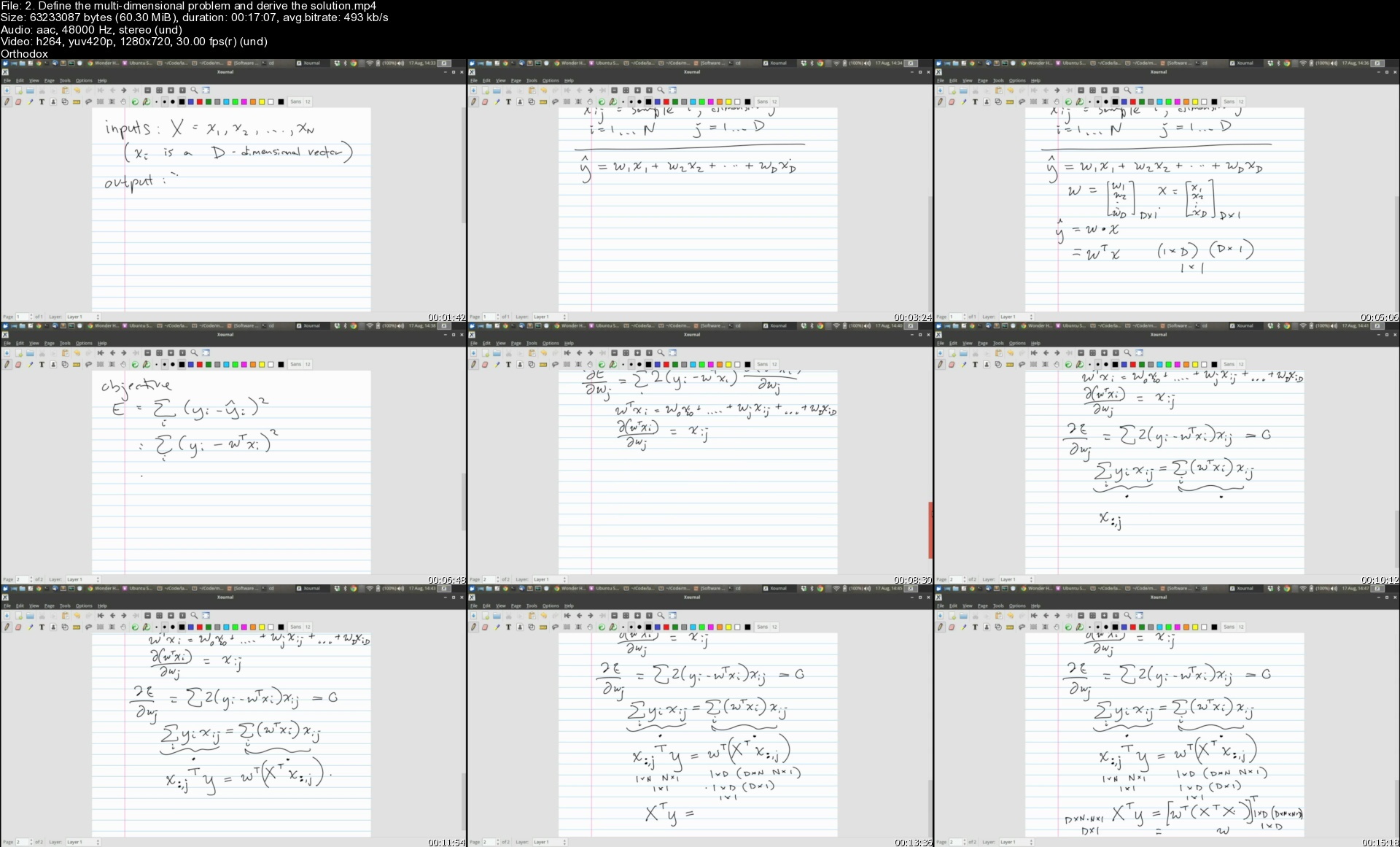
2.definethemultidimenigi0y.jpg


Zuletzt bearbeitet:
Deep Learning Prerequisites: Linear Regression in Python (Update)

3j6k9dt66st7adknkmiwt8qcvt.jpg


Deep Learning Prerequisites: Linear Regression in Python (Update)
Bestseller | h264, yuv420p, 1280x720 | ENGLISH, aac, 44100 Hz, 2 channels | 6h 10mn | 1.08 GB
Created by: Lazy Programmer Inc.

Data science: Learn linear regression from scratch and build your own working program in Python for data analysis.


What you'll learn

Derive and solve a linear regression model, and apply it appropriately to data science problems
Program your own version of a linear regression model in Python


Requirements

How to take a derivative using calculus
Basic Python programming
For the advanced section of the course, you will need to know probability


Description

This course teaches you about one popular technique used in machine learning, data science and statistics: linear regression. We cover the theory from the ground up: derivation of the solution, and applications to real-world problems. We show you how one might code their own linear regression module in Python.

Linear regression is the simplest machine learning model you can learn, yet there is so much depth that you'll be returning to it for years to come. That's why it's a great introductory course if you're interested in taking your first steps in the fields of:

deep learning

machine learning

data science

statistics

In the first section, I will show you how to use 1-D linear regression to prove that Moore's Law is true.

What's that you say? Moore's Law is not linear?

You are correct! I will show you how linear regression can still be applied.

In the next section, we will extend 1-D linear regression to any-dimensional linear regression - in other words, how to create a machine learning model that can learn from multiple inputs.

We will apply multi-dimensional linear regression to predicting a patient's systolic blood pressure given their age and weight.

Finally, we will discuss some practical machine learning issues that you want to be mindful of when you perform data analysis, such as generalization, overfitting, train-test splits, and so on.

This course does not require any external materials. Everything needed (Python, and some Python libraries) can be obtained for FREE.

If you are a programmer and you want to enhance your coding abilities by learning about data science, then this course is for you. If you have a technical or mathematical background, and you want to know how to apply your skills as a software engineer or "hacker", this course may be useful.

This course focuses on "how to build and understand", not just "how to use". Anyone can learn to use an API in 15 minutes after reading some documentation. It's not about "remembering facts", it's about "seeing for yourself" via experimentation. It will teach you how to visualize what's happening in the model internally. If you want more than just a superficial look at machine learning models, this course is for you.

Suggested Prerequisites:

calculus (taking derivatives)

matrix arithmetic

probability

Python coding: if/else, loops, lists, dicts, sets

Numpy coding: matrix and vector operations, loading a CSV file

TIPS (for getting through the course):

Watch it at 2x.

Take handwritten notes. This will drastically increase your ability to retain the information.

Write down the equations. If you don't, I guarantee it will just look like gibberish.

Ask lots of questions on the discussion board. The more the better!

Realize that most exercises will take you days or weeks to complete.

Write code yourself, don't just sit there and look at my code.

WHAT ORDER SHOULD I TAKE YOUR COURSES IN?:

Check out the lecture "What order should I take your courses in?" (available in the Appendix of any of my courses, including the free Numpy course)


Who this course is for:

People who are interested in data science, machine learning, statistics and artificial intelligence
People new to data science who would like an easy introduction to the topic
People who wish to advance their career by getting into one of technology's trending fields, data science
Self-taught programmers who want to improve their computer science theoretical skills
Analytics experts who want to learn the theoretical basis behind one of statistics' most-used algorithms

034thedonutproblems0efnq.jpg


Bayesian Machine Learning in Python: A/B Testing (updated 11/2022)

1011712a062z6fdm.jpg


Bayesian Machine Learning in Python: A/B Testing (updated 11/2022)
Last updated 11/2022
MP4 | Video: h264, 1280x720 | Audio: AAC, 44.1 KHz
Language: English | Size: 2.59 GB | Duration: 10h 24m

Data Science, Machine Learning, and Data Analytics Techniques for Marketing, Digital Media, Online Advertising, and More


What you'll learn
Use adaptive algorithms to improve A/B testing performance
Understand the difference between Bayesian and frequentist statistics
Apply Bayesian methods to A/B testing


Requirements
Probability (joint, marginal, conditional distributions, continuous and discrete random variables, PDF, PMF, CDF)
Python coding with the Numpy stack


Description
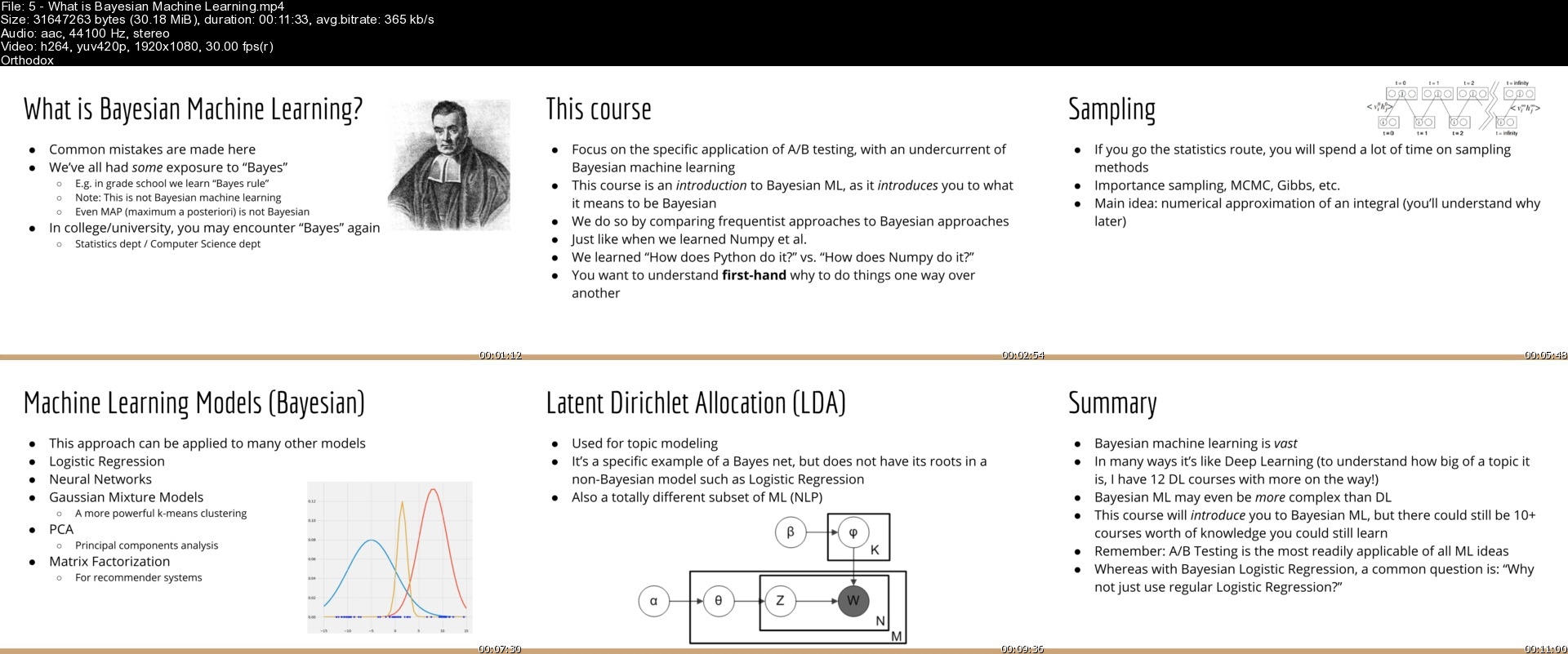
This course is all about A/B testing.A/B testing is used everywhere. Marketing, retail, newsfeeds, online advertising, and more.A/B testing is all about comparing things.If you're a data scientist, and you want to tell the rest of the company, "logo A is better than logo B", well you can't just say that without proving it using numbers and statistics.Traditional A/B testing has been around for a long time, and it's full of approximations and confusing definitions.In this course, while we will do traditional A/B testing in order to appreciate its complexity, what we will eventually get to is the Bayesian machine learning way of doing things.First, we'll see if we can improve on traditional A/B testing with adaptive methods. These all help you solve the explore-exploit dilemma.You'll learn about the epsilon-greedy algorithm, which you may have heard about in the context of reinforcement learning.We'll improve upon the epsilon-greedy algorithm with a similar algorithm called UCB1.Finally, we'll improve on both of those by using a fully Bayesian approach.Why is the Bayesian method interesting to us in machine learning?It's an entirely different way of thinking about probability.It's a paradigm shift.You'll probably need to come back to this course several times before it fully sinks in.It's also powerful, and many machine learning experts often make statements about how they "subscribe to the Bayesian school of thought".In sum - it's going to give us a lot of powerful new tools that we can use in machine learning.The things you'll learn in this course are not only applicable to A/B testing, but rather, we're using A/B testing as a concrete example of how Bayesian techniques can be applied.You'll learn these fundamental tools of the Bayesian method - through the example of A/B testing - and then you'll be able to carry those Bayesian techniques to more advanced machine learning models in the future.See you in class!"If you can't implement it, you don't understand it"Or as the great physicist Richard Feynman said: "What I cannot create, I do not understand".My courses are the ONLY courses where you will learn how to implement machine learning algorithms from scratchOther courses will teach you how to plug in your data into a library, but do you really need help with 3 lines of code?After doing the same thing with 10 datasets, you realize you didn't learn 10 things. You learned 1 thing, and just repeated the same 3 lines of code 10 times...Suggested Prerequisites:probability (joint, marginal, conditional distributions, continuous and discrete random variables, PDF, PMF, CDF)Python coding: if/else, loops, lists, dicts, setsNumpy, Scipy, MatplotlibWHAT ORDER SHOULD I TAKE YOUR COURSES IN?:Check out the lecture "Machine Learning and AI Prerequisite Roadmap" (available in the FAQ of any of my courses, including the free Numpy course)UNIQUE FEATURESEvery line of code explained in detail - email me any time if you disagreeNo wasted time "typing" on the keyboard like other courses - let's be honest, nobody can really write code worth learning about in just 20 minutes from scratchNot afraid of university-level math - get important details about algorithms that other courses leave out
Overview
Section 1: Introduction and Outline

Lecture 1 What's this course all about?

Lecture 2 Where to get the code for this course

Lecture 3 How to succeed in this course

Section 2: The High-Level Picture

Lecture 4 Real-World Examples of A/B Testing

Lecture 5 What is Bayesian Machine Learning?

Section 3: Bayes Rule and Probability Review

Lecture 6 Review Section Introduction

Lecture 7 Probability and Bayes' Rule Review

Lecture 8 Calculating Probabilities - Practice

Lecture 9 The Gambler

Lecture 10 The Monty Hall Problem

Lecture 11 Maximum Likelihood Estimation - Bernoulli

Lecture 12 Click-Through Rates (CTR)

Lecture 13 Maximum Likelihood Estimation - Gaussian (pt 1)

Lecture 14 Maximum Likelihood Estimation - Gaussian (pt 2)

Lecture 15 CDFs and Percentiles

Lecture 16 Probability Review in Code

Lecture 17 Probability Review Section Summary

Lecture 18 Beginners: Fix Your Understanding of Statistics vs Machine Learning

Lecture 19 Suggestion Box

Section 4: Traditional A/B Testing

Lecture 20 Confidence Intervals (pt 1) - Intuition

Lecture 21 Confidence Intervals (pt 2) - Beginner Level

Lecture 22 Confidence Intervals (pt 3) - Intermediate Level

Lecture 23 Confidence Intervals (pt 4) - Intermediate Level

Lecture 24 Confidence Intervals (pt 5) - Intermediate Level

Lecture 25 Confidence Intervals Code

Lecture 26 Hypothesis Testing - Examples

Lecture 27 Statistical Significance

Lecture 28 Hypothesis Testing - The API Approach

Lecture 29 Hypothesis Testing - Accept Or Reject?

Lecture 30 Hypothesis Testing - Further Examples

Lecture 31 Z-Test Theory (pt 1)

Lecture 32 Z-Test Theory (pt 2)

Lecture 33 Z-Test Code (pt 1)

Lecture 34 Z-Test Code (pt 2)

Lecture 35 A/B Test Exercise

Lecture 36 Classical A/B Testing Section Summary

Section 5: Bayesian A/B Testing

Lecture 37 Section Introduction: The Explore-Exploit Dilemma

Lecture 38 Applications of the Explore-Exploit Dilemma

Lecture 39 Epsilon-Greedy Theory

Lecture 40 Calculating a Sample Mean (pt 1)

Lecture 41 Epsilon-Greedy Beginner's Exercise Prompt

Lecture 42 Designing Your Bandit Program

Lecture 43 Epsilon-Greedy in Code

Lecture 44 Comparing Different Epsilons

Lecture 45 Optimistic Initial Values Theory

Lecture 46 Optimistic Initial Values Beginner's Exercise Prompt

Lecture 47 Optimistic Initial Values Code

Lecture 48 UCB1 Theory

Lecture 49 UCB1 Beginner's Exercise Prompt

Lecture 50 UCB1 Code

Lecture 51 Bayesian Bandits / Thompson Sampling Theory (pt 1)

Lecture 52 Bayesian Bandits / Thompson Sampling Theory (pt 2)

Lecture 53 Thompson Sampling Beginner's Exercise Prompt

Lecture 54 Thompson Sampling Code

Lecture 55 Thompson Sampling With Gaussian Reward Theory

Lecture 56 Thompson Sampling With Gaussian Reward Code

Lecture 57 Exercise on Gaussian Rewards

Lecture 58 Why don't we just use a library?

Lecture 59 Nonstationary Bandits

Lecture 60 Bandit Summary, Real Data, and Online Learning

Lecture 61 (Optional) Alternative Bandit Designs

Section 6: Bayesian A/B Testing Extension

Lecture 62 More about the Explore-Exploit Dilemma

Lecture 63 Confidence Interval Approximation vs. Beta Posterior

Lecture 64 Adaptive Ad Server Exercise

Section 7: Practice Makes Perfect

Lecture 65 Intro to Exercises on Conjugate Priors

Lecture 66 Exercise: Die Roll

Lecture 67 The most important quiz of all - Obtaining an infinite amount of practice

Section 8: Setting Up Your Environment (FAQ by Student Request)

Lecture 68 Anaconda Environment Setup

Lecture 69 How to install Numpy, Scipy, Matplotlib, Pandas, IPython, Theano, and TensorFlow

Section 9: Extra Help With Python Coding for Beginners (FAQ by Student Request)

Lecture 70 How to Code by Yourself (part 1)

Lecture 71 How to Code by Yourself (part 2)

Lecture 72 Proof that using Jupyter Notebook is the same as not using it

Lecture 73 Python 2 vs Python 3

Section 10: Effective Learning Strategies for Machine Learning (FAQ by Student Request)

Lecture 74 How to Succeed in this Course (Long Version)

Lecture 75 Is this for Beginners or Experts? Academic or Practical? Fast or slow-paced?

Lecture 76 Machine Learning and AI Prerequisite Roadmap (pt 1)

Lecture 77 Machine Learning and AI Prerequisite Roadmap (pt 2)

Section 11: Appendix / FAQ Finale

Lecture 78 What is the Appendix?

Lecture 79 BONUS

Students and professionals with a technical background who want to learn Bayesian machine learning techniques to apply to their data science work

Homepage


5whatisbayesianmachindgfby.jpg


SAP Ariba Simplified Procurement & Supply Chain Solutions 2022

cln7tmjwiijm9ekq7gogu41i8g.jpg


SAP Ariba Simplified Procurement & Supply Chain Solutions 2022
Published 07/2022
Genre: eLearning | MP4 | Video: h264, 1280x720 | Audio: AAC, 44.1 KHz
Language: English | Size: 8.47 GB | Duration: 112 lectures • 35h 42m

Complete SAP Ariba End To End Implementation Training Courses


What you'll learn
Configuration and Implementation for SAP Ariba module
Requirements gathering for the Business Record to Report process cycle
After Completing this course, you will become SAP Ariba Consultant with understanding of logic behind configuration
Hands-on experience with SAP Ariba


Requirements
Mobile
PC Or Laptop

Description
Why choose SAP Ariba?

Influence what happens next for your organization. Digitalize and fully integrate your source-to-pay process with market-leading spend management solutions for sourcing and procurement. You'll get the data-drive intelligence and supply chain visibility you need to mitigate supplier risk and achieve long-term resiliency against supply chain disruption. And working within the connected community of the world's largest business network, engage in real-time supplier collaboration and dynamic partnerships to drive innovation and keep your business moving forward.

What is SAP Ariba?

SAP Ariba is a cloud-based innovative solution that allows suppliers and buyers to connect and do business on a single platform. It improves over all vendor management system of an organization by providing less costly ways of procurement and making business simple. Ariba acts as supply chain, procurement service to do business globally. SAP Ariba digitally transforms your supply chain, procurement and contract management process.

In today's world, there is a need to control your supply chain and to collaborate with your suppliers in an efficient way. To enable healthy supply chain, you need to have suppliers with visibility to every part of procurement process so that they can maintain an efficient supply chain and help organizations to grow their and own business.

The cloud based innovative solution was first developed in 1996 by a company named Ariba and was later acquired by SAP in 2012 with a total acquisition cost of 4.3 billion USD with each share cost $45. Thus, the name SAP Ariba. At the onset, Ariba was a B2B company to do procurement over Internet and was the first one to introduce IPO in 1999.

Key Features of SAP Ariba

In this section, we will learn about the key features of SAP Ariba.

SAP Ariba is a B2B solution that allows you to connect to the world's largest network of vendors and suppliers and enhance business collaboration with the right business partners.

SAP Ariba allows organizations to connect with the right suppliers with deep visibility to your inside vendor and procurement management processes giving way to error free business transactions.

With SAP Ariba, you can directly connect Ariba network with millions of suppliers meeting your business needs and managing supply chain.

SAP Ariba network removes overall complexity in procurement process and suppliers and buyers can manage all key terms of vendor management on a single network.

With acquisition of SAP, Ariba can easily integrate with different SAP ERP solutions like SAP ECC and S/4 HANA with easy to configure workflows to automate different processes in complete procurement cycle.

You can easily integrate master and transactional data from different ERP solution to Ariba processes.

Who this course is for
SAP Ariba Consultant
SAP Ariba Developer
SAP Ariba End-User

Homepage


30.processingsp1et3.jpg


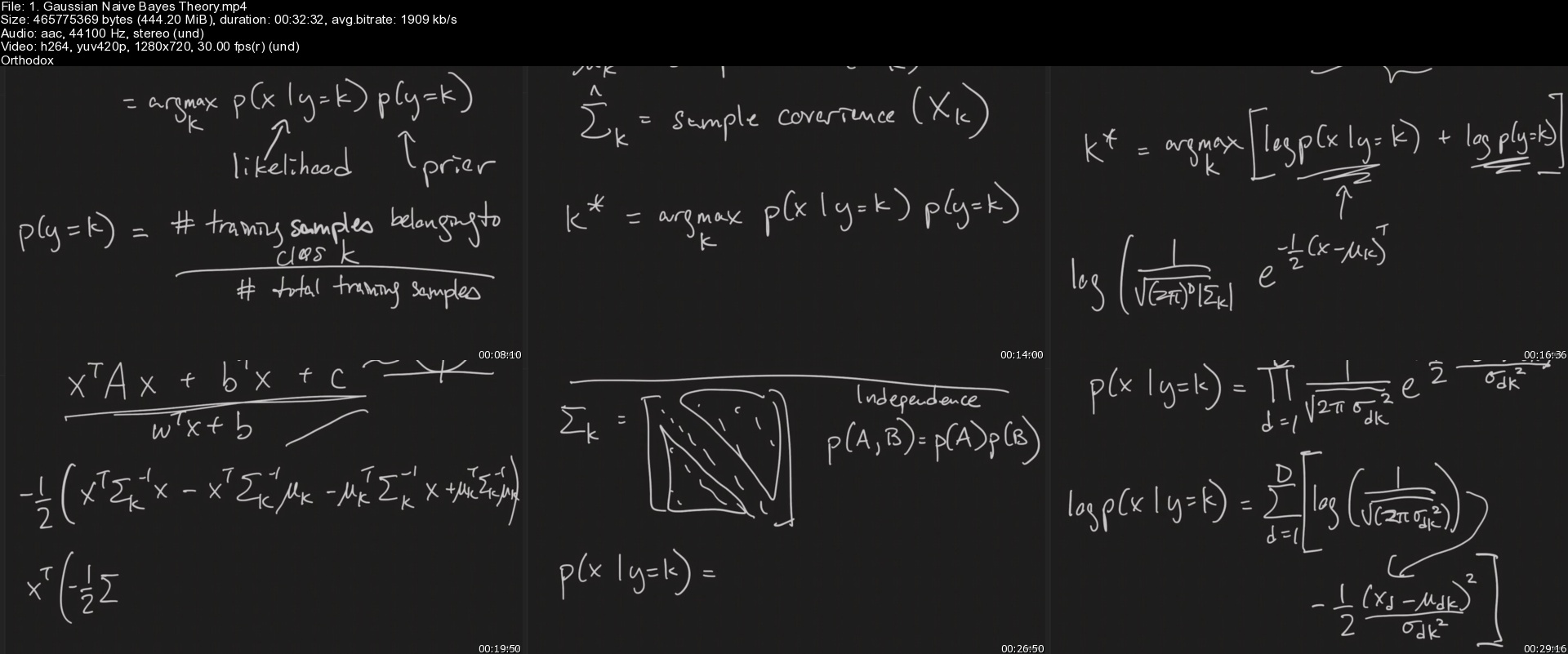
Data Science & Machine Learning Naive Bayes in Python

4929064b97dd8iy8.jpg


Data Science & Machine Learning Naive Bayes in Python
Published 11/2022
MP4 | Video: h264, 1280x720 | Audio: AAC, 44.1 KHz, 2 Ch
Genre: eLearning | Language: English | Duration: 32 lectures (5h) | Size: 2.2 GB

Master a crucial artificial intelligence algorithm and skyrocket your Python programming skills


What you'll learn
Apply Naive Bayes to image classification (Computer Vision)
Apply Naive Bayes to text classification (NLP)
Apply Naive Bayes to Disease Prediction, Genomics, and Financial Analysis
Understand Naive Bayes concepts and algorithm
Implement multiple Naive Bayes models from scratch


Requirements
Decent Python programming skills
Experience with Numpy, Matplotlib, and Pandas (we'll be using these)
For advanced portions: know probability


Description
In this self-paced course, you will learn how to apply Naive Bayes to many real-world datasets in a wide variety of areas, such as

computer vision

natural language processing

financial analysis

healthcare

genomics

Why should you take this course? Naive Bayes is one of the fundamental algorithms in machine learning, data science, and artificial intelligence. No practitioner is complete without mastering it.

This course is designed to be appropriate for all levels of students, whether you are beginner, intermediate, or advanced. You'll learn both the intuition for how Naive Bayes works and how to apply it effectively while accounting for the unique characteristics of the Naive Bayes algorithm. You'll learn about when and why to use the different versions of Naive Bayes included in Scikit-Learn, including GaussianNB, BernoulliNB, and MultinomialNB.

In the advanced section of the course, you will learn about how Naive Bayes really works under the hood. You will also learn how to implement several variants of Naive Bayes from scratch, including Gaussian Naive Bayes, Bernoulli Naive Bayes, and Multinomial Naive Bayes. The advanced section will require knowledge of probability, so be prepared!

Thank you for reading and I hope to see you soon!

Suggested Prerequisites

Decent Python programming skill

Comfortable with data science libraries like Numpy and Matplotlib

For the advanced section, probability knowledge is required

WHAT ORDER SHOULD I TAKE YOUR COURSES IN?

Check out the lecture "Machine Learning and AI Prerequisite Roadmap" (available in the FAQ of any of my courses, including my free course)

UNIQUE FEATURES

Every line of code explained in detail - email me any time if you disagree

Less than 24 hour response time on Q&A on average

Not afraid of university-level math - get important details about algorithms that other courses leave out
Who this course is for
Beginner Python developers curious about data science and machine learning
Students and professionals interested in machine learning fundamentals

Homepage


1.gaussiannaivebayest1yi4g.jpg


CBTNuggets - Windows Server Hybrid Administrator Associate Certification Training (AZ-800 & AZ-801)

1ogaaoiqjsyvahhhvwqss0bizd.jpg


CBTNuggets - Windows Server Hybrid Administrator Associate Certification Training (AZ-800 & AZ-801)
Released 08/2022
MP4 | Video: h264, 1920x1080 | Audio: AAC, 44.1 KHz, 2 Ch
Genre: eLearning | Language: English | Duration: 354 Lessons (56h 11m) | Size: 52.2 GB

This intermediate-level Server Hybrid Administrator Associate training prepares systems administrators to take the AZ-800 and AZ-801 exams, which are the two exams required to earn the Windows Server Hybrid Administrator Associate certification

The AZ-800 is the first half of Microsoft's overall Windows Server Hybrid Administrator Associate. The AZ-800 is the exam someone should take if they're focused on administering servers and workloads that run on Windows Server, whether on-premises or in hybrid environments.

Even for an administrator who isn't planning on earning the whole certification, the AZ-800 is a good intermediate-level exam for testing familiarity with managing operations on Windows Servers - on-prem or hybrid.

For IT managers, this Microsoft training can be used for AZ-800 and AZ-801 exam prep, onboarding new systems administrators, individual or team training plans, or as a Microsoft reference resource.

Windows Server Hybrid Administrator Associate: What You Need to Know
This Windows Server Hybrid Administrator Associate training maps to the AZ-800 and AZ-801 exam objectives, and covers topics such as

Deploying and managing Active Directory Domain services in hybrid environments
Managing Windows Server servers and workloads in hybrid environments
Managing virtual machines and containers
Implementing and managing network infrastructure in hybrid and on-prem environments
Managing storage and file services
Who Should Take Windows Server Hybrid Administrator Associate Training?
This Windows Server Hybrid Administrator Associate training is considered associate-level Microsoft training, which means it was designed for systems administrators. This Windows Server skills course is valuable for new IT professionals with at least a year of experience with server administration tools and experienced systems administrators looking to validate their Microsoft skills.

New or aspiring systems administrators. If you're a brand new systems administrator, the AZ-800 is an essential step to earning the Windows Server Hybrid Administrator Associate - a truly excellent choice for your first certification in administration. Preparing for and passing the AZ-800 will teach you all the basics of managing hybrid network environments, which will prove fundamental to the rest of your career.

Experienced systems administrators. If you've already been working as a systems administrator for several years, passing the AZ-800 probably won't be very challenging so long as you're familiar with AD DS, hybrid workloads and virtual machines. This Windows Server Hybrid Administrator Associate training is a way to advance your career in server administration by helping you pass the AZ-800 and help you prove that you know your way around integrating Windows Server environments with Azure services.

Homepage


163.azureextendednetwvoc90.jpg


Zuletzt bearbeitet:
Juniper JNCIA - Junos JN0-104 with 7 hours of Extra Content

4653690572b4ogc7b.jpg


Juniper JNCIA - Junos JN0-104 with 7 hours of Extra Content
Published 08/2022
MP4 | Video: h264, 1280x720 | Audio: AAC, 44.1 KHz, 2 Ch
Genre: eLearning | Language: English + srt | Duration: 109 lectures (24h 48m) | Size: 9.35 GB


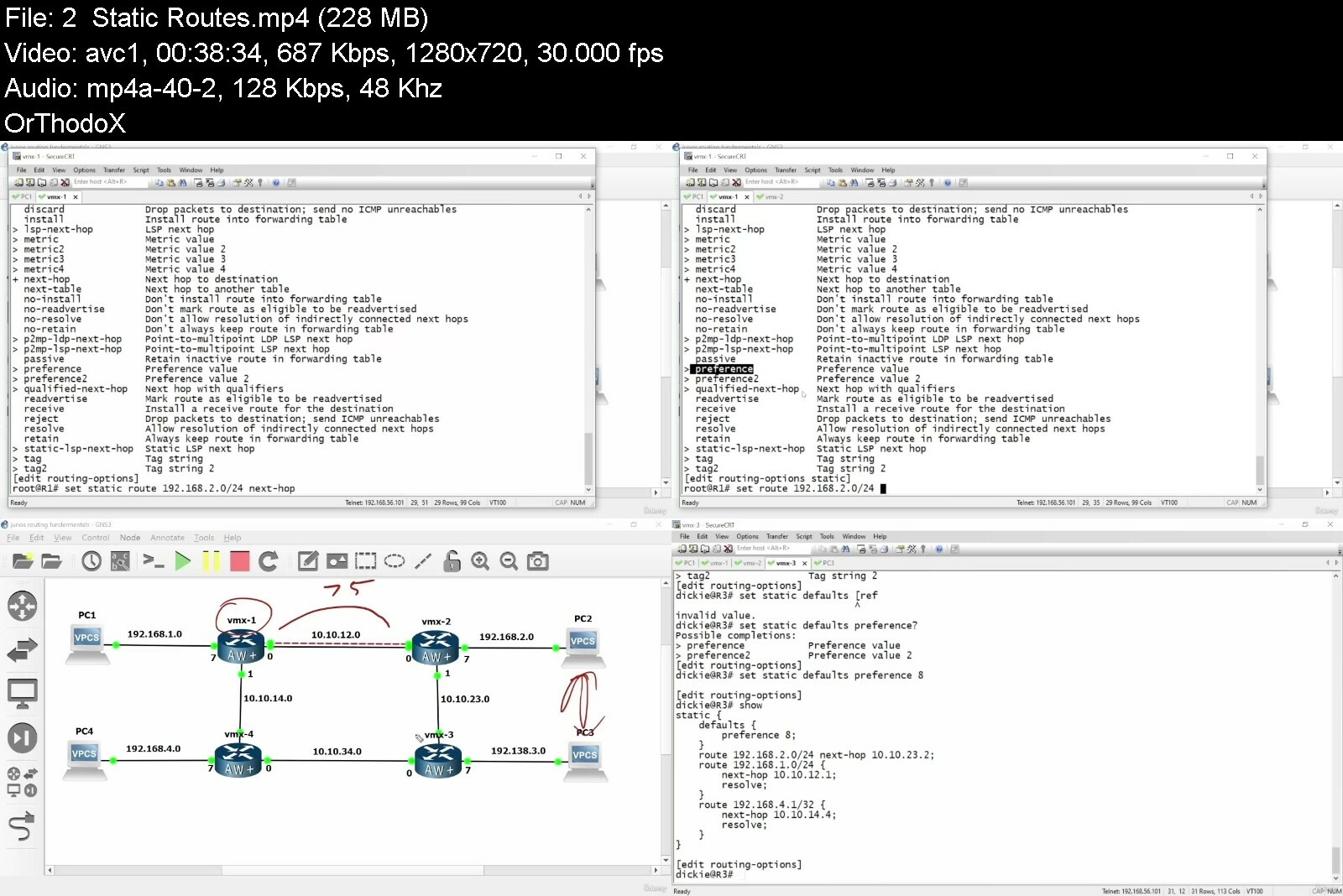
Pass your Juniper JNCIA Junos JN0-104 with added Extras BGP, ISIS, OSPF and Layer 2 Protocols on vMX, QFX, SRX devices


What you'll learn
An understanding of the Juniper Junos OS and how it fits into modern networking with both enterprise and service provider environments, JNCIA JN0-104 success
How networking is the same across multiple vendors, once you know a protocol or concept you will see how easy it is to transfer your learned skills to Junos
You will be confident in dealing with Juniper equipment in your work place and stand out from the others who can't or won't
you will see Extra content from the JNCIS-ENT and the JNCIS-SP like BGP, OSPF, ISIS, and Layer 2 so you can succeed in further studies or at the work place
A good foundation into the Juniper JNCIS Enterprise and JNCIS Service Provider , Bring these skills to the workplace
Advanced Juniper JNCIS topics not included in any other JNCIA course, see how Cisco and Juniper can work well with each other
JNCIA certification will open doors at work and is the cornerstone of Juniper certification, progress from the JNCIA to the JNCIS and higher

Requirements
A basic level of networking would be great but it is not required as you will learn everything needed to pass your Juniper JNCIA JN0-104 exam but most important to progress at work or in your other networking studies
Access to either Juniper Vlabs which is free, GNS3 or EVE-NG to pratice would be of benefit however it's not required

Description
This Juniper JNCIA JN0-104 course is my first outing into video training - please be gentle on me, I have designed this course to cover all the topics on the JNCIA and I have included the PowerPoint presentations that I use.

I have included 7 hours of EXTRA content found on the Juniper JNCIS-ENT and Juniper JNCIS-SP covering basic juniper Vlans, juniper switching, juniper BGP and OSPF as well as ISIS and RIP mainly because when i done the Juniper JNCIA I was lucky that I was working with Juniper devices in a service provider environment so I was familiar with layer 2 and routing protocols but the JNCIA Junos JN0-104 does not provide this information.

Juniper certification is rewarding and a very intresting take on networking and after following my Juniper JNCIA junos jn0-104 certification course you will be ready to move on to Juniper JNCIS.

In the work place you will be able to show that you know how to monitor and configure the likes of Spanning Tree, BGP and OSPF, ISIS, RIP and more.

I believe that this course will cover two things, it will provide a solid level of knowledge if you do intend to progress to the Juniper JNCIS and it will allow you to have confidence going into your work place by being able to demonstrate that you can preform configuration on and monitor a live production network.

We will look at configuration on devices like the Juniper SRX Firewall , Juniper vMX Router and the Juniper QXF Switch

Who this course is for
Network Engineers of all levels that want to learn Juniper Junos. this course is the foundation for your further studies
Engineers that want to further their study into the Juniper JNCIS -SP or JNCIS -ENT as the Extra content will be a great help
network engineers who want to complete the JNCIA certification program and learn the fantastic Junos OS


juniperjnciajunosjn01o1ei2.jpg


Learn Advanced Modern C++

tefm3afv9bjyffatcrxnw0lc9q.jpg


Learn Advanced Modern C++
Last updated 7/2022
MP4 | Video: h264, 1280x720 | Audio: AAC, 44.1 KHz
Language: English | Size: 7.67 GB | Duration: 24h 2m

Take your knowledge of C++ to the next level!


What you'll learn
Know and understand all the important features of modern C++
Acquire a good knowledge of the Standard Template Library
Obtain a thorough grounding in the C++ programming language
Be familiar with idiomatic uses of modern C++

Requirements
Some knowledge of C++ beyond beginner level
A compiler which supports C++11, preferably C++14 or C++17
Proficiency in English (B2 level, preferably C1)

Description
This course will enhance your knowledge of the technically challenging but powerful and efficient C++ programming language.It is designed to give you*an intermediate-to-advanced level understanding of the language. There is extensive coverage of the Standard Template Library, including standard algorithm functions. Finally, a project in which you will exercise your new skills by writing a simple game.After successfully completing this course, you should be able to apply for jobs and courses which require a good knowledge of C++.The material is based around the modern version*of the language. I teach*the C++11, C++14 and C++17 standards, but also cover*older*variations which are still widely used.The course is thorough and goes into the material in depth. It assumes basic C++ knowledge, such as the material in my course "Begin Programming with Modern C++":*function calls, loops, conditionals and classes.There are downloadable exercises for each video, with solutions, so you*can check your understanding as you learn,*gaining familiarity and confidence with the material. I will be actively supporting the course and I will respond promptly*if you have*any questions*or experience difficulties with*the course content. Please feel free to use the Q&A feature or alternatively you can send me a private message.

Overview

Section 1: Introduction

Lecture 1 Introduction to the Course

Lecture 2 Lecturer Introduction

Lecture 3 Source Code for this Course

Section 2: Review of C++

Lecture 4 Local Variables and Function Arguments

Lecture 5 Reference and Value Semantics

Lecture 6 Declaration and Initialization

Lecture 7 Classes

Lecture 8 Special Member Functions

Lecture 9 Pointers and Memory

Lecture 10 Array, String and Vector

Lecture 11 Conway's Game of Life Overview

Lecture 12 Two-Dimensional Arrays

Lecture 13 Conway's Game of Life Practical

Lecture 14 Conway's Game of Life Practical Continued

Lecture 15 Numeric Types and Literals

Lecture 16 String Literals

Lecture 17 Casting

Lecture 18 Iterator Introduction

Lecture 19 The auto keyword

Lecture 20 Loops and Iterators

Lecture 21 Iterator Arithmetic and Iterator Ranges

Lecture 22 If Statements and Switch in C++17

Lecture 23 Templates Overview

Lecture 24 Namespaces

Lecture 25 Function Pointer

Section 3: C++ String Interface

Lecture 26 Basic String Operations

Lecture 27 Searching Strings

Lecture 28 Adding Elements to Strings

Lecture 29 Removing Elements from Strings

Lecture 30 Converting between Strings and Numbers

Lecture 31 Miscellaneous String Operations

Lecture 32 Character Functions

Section 4: Files and Streams

Lecture 33 Files and Streams

Lecture 34 File Streams

Lecture 35 Streams and Buffering

Lecture 36 Unbuffered Input and Output

Lecture 37 File Modes

Lecture 38 Stream Member Functions and State

Lecture 39 Stream Manipulators and Formatting

Lecture 40 Floating-point Output Formats

Lecture 41 Stringstreams

Lecture 42 Resource Management

Lecture 43 Random Access to Streams

Lecture 44 Stream Iterators

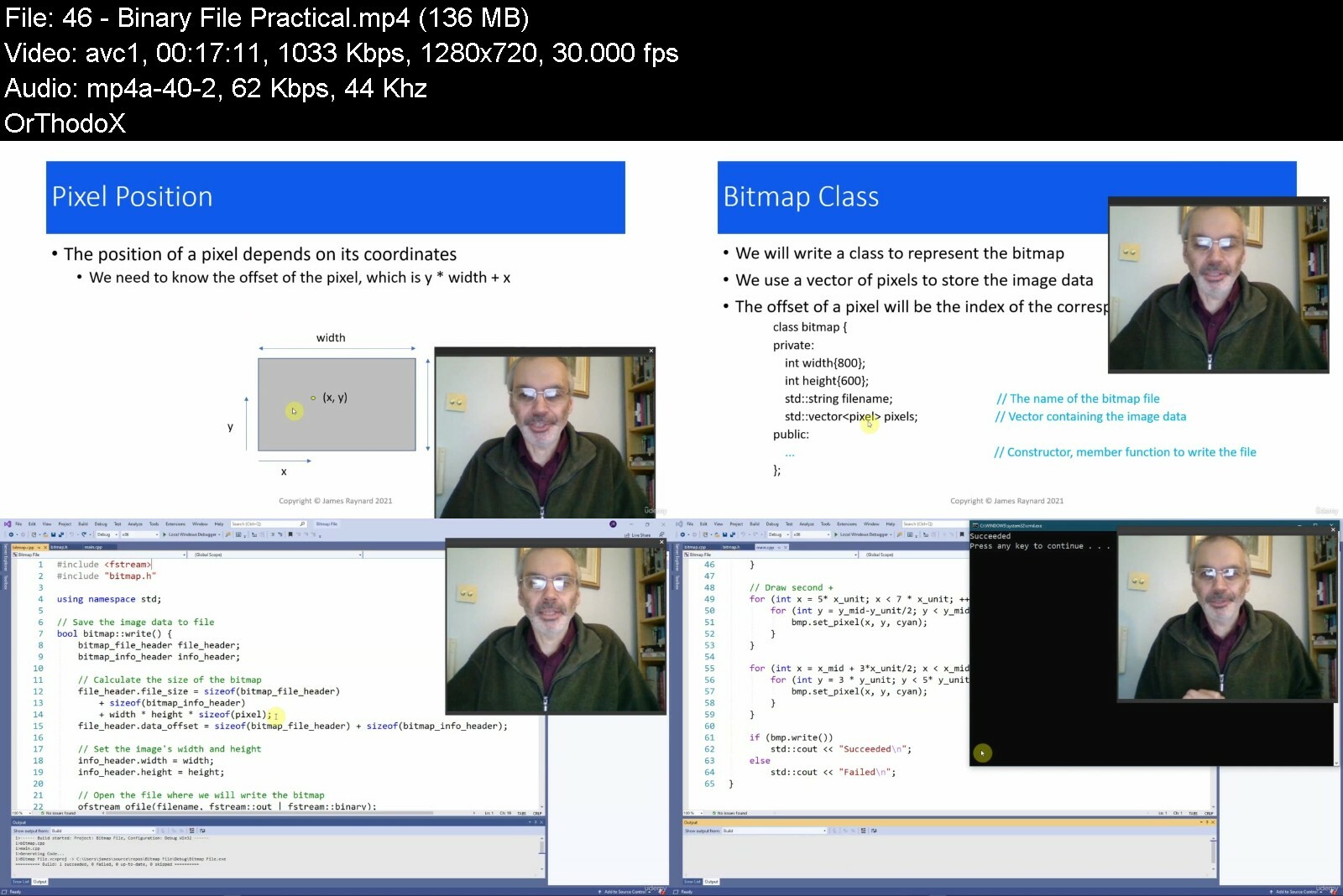
Lecture 45 Binary Files

Lecture 46 Binary File Practical

Section 5: Special Member Functions and Operator Overloading

Lecture 47 Constructors in Modern C++

Lecture 48 Copy Constructor Overview

Lecture 49 Assignment Operator Overview

Lecture 50 Synthesized Member Functions

Lecture 51 Shallow and Deep Copying

Lecture 52 Copy Elision

Lecture 53 Conversion Operators

Lecture 54 Default and Delete Keywords

Lecture 55 Operators and Overloading.

Lecture 56 Which Operators to Overload

Lecture 57 The Friend Keyword

Lecture 58 Member and Non-member Operators

Lecture 59 Addition Operators

Lecture 60 Equality and Inequality Operators

Lecture 61 Less-than Operator

Lecture 62 Prefix and Postfix Operators

Lecture 63 Function Call Operator

Lecture 64 Printing Out Class Member Data

Section 6: Algorithms Introduction and Lambda Expressions

Lecture 65 Algorithms Overview

Lecture 66 Algorithms with Predicates

Lecture 67 Algorithms with _if Versions

Lecture 68 Lambda Expressions Introduction

Lecture 69 Lambda Expressions Practical

Lecture 70 Lambda Expressions and Capture

Lecture 71 Lambda Expressions and Capture Continued

Lecture 72 Lambda Expressions and Partial Evaluation

Lecture 73 Lambda Expressions in C++14

Lecture 74 Pair Type

Lecture 75 Insert Iterators

Lecture 76 Library Function Objects

Section 7: Algorithms Continued

Lecture 77 Searching Algorithms

Lecture 78 Searching Algorithms Continued

Lecture 79 Numeric Algorithms

Lecture 80 Write-only Algorithms

Lecture 81 for_each Algorithm

Lecture 82 Copying Algorithms

Lecture 83 Write Algorithms

Lecture 84 Removing Algorithms

Lecture 85 Removing Algorithms Continued

Lecture 86 Transform Algorithm

Lecture 87 Merging Algorithms

Lecture 88 Reordering Algorithms

Lecture 89 Partitioning Algorithms

Lecture 90 Sorting Algorithms

Lecture 91 Sorting Algorithms Continued

Lecture 92 Permutation Algorithms

Lecture 93 Min and Max Algorithms

Lecture 94 Further Numeric Algorithms

Lecture 95 Further Numeric Algorithms Continued

Lecture 96 Introduction to Random Numbers

Lecture 97 Random Numbers in Older C++

Lecture 98 Random Numbers in Modern C++

Lecture 99 Random Number Algorithms

Lecture 100 Palindrome Checker Practical

Lecture 101 Random Walk Practical

Section 8: Containers

Lecture 102 Container Introduction

Lecture 103 Standard Library Array

Lecture 104 Forward List

Lecture 105 List

Lecture 106 List Operations

Lecture 107 Deque

Lecture 108 Tree Data Structure

Lecture 109 Sets

Lecture 110 Map

Lecture 111 Maps and Insertion

Lecture 112 Maps in C++17

Lecture 113 Multiset and Multimap

Lecture 114 Searching Multimaps

Lecture 115 Unordered Associative Containers

Lecture 116 Unordered Associative Containers Continued

Lecture 117 Associative Containers and Custom Types

Lecture 118 Nested Maps

Lecture 119 Queues

Lecture 120 Priority Queues

Lecture 121 Stack

Lecture 122 Emplacement

Lecture 123 Mastermind Game Practical

Lecture 124 Containers Workshop

Section 9: Inheritance and Polymorphism

Lecture 125 Class Hierarchies and Inheritance

Lecture 126 Base and Derived Classes

Lecture 127 Member Functions and Inheritance

Lecture 128 Overloading Member Functions

Lecture 129 Pointers, References and Inheritance

Lecture 130 Static and Dynamic Type

Lecture 131 Virtual Functions

Lecture 132 Virtual Functions in C++11

Lecture 133 Virtual Destructor

Lecture 134 Interfaces and Virtual Functions

Lecture 135 Virtual Function Implementation

Lecture 136 Polymorphism

Section 10: Error Handling and Exceptions

Lecture 137 Error Handling

Lecture 138 Error codes and Exceptions

Lecture 139 Exceptions Introduction

Lecture 140 Try and Catch Blocks

Lecture 141 Catch-all Handlers

Lecture 142 Exception Mechanism

Lecture 143 std::exception Hierarchy

Lecture 144 Standard Exception Subclasses

Lecture 145 Exceptions and Special Member Functions

Lecture 146 Custom Exception Class

Lecture 147 Exception Safety

Lecture 148 The throw() Exception Specifier

Lecture 149 The noexcept keyword

Lecture 150 Swap Function

Lecture 151 Exception-safe Class

Lecture 152 Copy and Swap

Lecture 153 Comparison with Java and C# Exceptions

Section 11: Move Semantics

Lecture 154 Move Semantics

Lecture 155 Lvalues and Rvalues

Lecture 156 Lvalue and Rvalue References

Lecture 157 Value Categories

Lecture 158 Move Operators

Lecture 159 RAII Class with Move Operators

Lecture 160 Move-only Types and RAII

Lecture 161 Special Member Functions in C++11

Lecture 162 Using Special Member Functions in C++11

Lecture 163 Function Arguments and Move Semantics

Lecture 164 Forwarding References

Lecture 165 Perfect Forwarding

Lecture 166 Perfect Forwarding Practical

Lecture 167 Move Semantics Workshop

Section 12: Smart Pointers

Lecture 168 Smart Pointers Introduction

Lecture 169 Unique Pointer

Lecture 170 Unique Pointers and Polymorphism

Lecture 171 Unique Pointers and Custom Deleters

Lecture 172 The Handle-Body Pattern

Lecture 173 The pImpl Idiom

Lecture 174 Reference Counting

Lecture 175 Shared pointer

Lecture 176 Weak Pointer

Lecture 177 Weak Pointer and Cycle Prevention

Section 13: Miscellaneous Features

Lecture 178 Chrono Library Introduction

Lecture 179 Chrono Duration Types

Lecture 180 Chrono Clocks and Time Points

Lecture 181 Bitsets

Lecture 182 Tuples

Lecture 183 Tuples in C++17

Lecture 184 Unions

Lecture 185 Unions Continued

Lecture 186 Mathematical Types

Lecture 187 Bind

Lecture 188 Callable Objects

Lecture 189 Member Function Pointers

Lecture 190 Interfacing to C

Lecture 191 Run-time Type Information

Lecture 192 Multiple Inheritance

Lecture 193 Virtual Inheritance

Lecture 194 Inline Namespaces

Lecture 195 Attributes

Section 14: Compile-time Programming

Lecture 196 Compile-time Programming Overview

Lecture 197 Constant Expressions

Lecture 198 Constexpr Functions

Lecture 199 Classes and Templates

Lecture 200 Template Specialization

Lecture 201 Extern Templates

Lecture 202 Variadic Templates

Lecture 203 Miscellaneous Template Features

Lecture 204 Library-defined Operators

Lecture 205 Constexpr If Statement

Lecture 206 Constexpr If Examples

Lecture 207 The decltype Keyword

Section 15: Project: A Breakout Game Using Modern C++ with SFML

Lecture 208 Project Breakout

Lecture 209 SFML Introduction

Lecture 210 Compiler Configuration for SFML

Lecture 211 Basic Window

Lecture 212 Random Walk Revisited

Lecture 213 Sprite

Lecture 214 Ball

Lecture 215 Bouncing Ball

Lecture 216 Paddle

Lecture 217 Moving Paddle

Lecture 218 Ball-Paddle Interaction

Lecture 219 Bricks

Lecture 220 Ball Interaction with Bricks

Lecture 221 Game Manager

Lecture 222 Entity Manager Overview

Lecture 223 Entity Manager and Object Creation

Lecture 224 Entity Manager and Object Operations

Lecture 225 Brick Strength

Lecture 226 More Features

Lecture 227 Conclusion

Section 16: Resources

Lecture 228 Recommended Books

Lecture 229 C++ "Cheat Sheet" Infographics

Lecture 230 The "Awesome C++ Frameworks and Libraries" Github

Lecture 231 The "Awesome Modern C++ Resources" Github

Programmers who have some knowledge of Intermediate C++ and want to learn more,C++ developers who wish to refresh and/or update their skills


learnadvancedmodernclyckw.jpg


Check Point Firewalls Troubleshooting Expert Course (CCTE)

46762587e877nei9c.jpg


Check Point Firewalls Troubleshooting Expert Course (CCTE)
Last Updated 05/2022
MP4 | Video: h264, 1280x720 | Audio: AAC, 44.1 KHz, 2 Ch
Genre: eLearning | Language: English | Duration: 39 lectures (13h 31m) | Size: 6.54 GB


Learn Check Point Firewall Core Concepts


What you'll learn
Check Point Firewall Advanced Concepts and Troubleshooting - VPNs , Check Point Process, Check Point Core Concepts like CoreXL and SecureXL , Connection Tables
Course is design in simple terms so easy to understand, Student can learn Concepts withing scope of timeline.
Course is mainly focus on Core Concepts of Check Point Firewalls and Troubleshooting Core Features
Student will learn and walk through various scenarios and use case while learning Course contents

Requirements
• General knowledge of TCP/IP
• Working knowledge of Windows and/or UNIX
• Working knowledge of networking technology
• Working knowledge of the Internet

Description
The following course Check Point Firewalls Troubleshooting Experts Course includes lectures on how Check Point advanced study concepts and Features work and the walk-through of the configuration in the lab/production environment. From the very beginning following step-by-step approach you will be able to grasp advanced concepts and step on the next level. The course is structured in an easy to follow manner starting from the very basic to advanced topics. The topics that are covered are: Installing Check Point in a lab environment, understanding general principles of Firewalling.

You will Learn : CLI Tools, Configuring NAT, Identity Awareness Site-to-Site VPN Between Corporate and Branch Office, VPN Troubleshooting Advanced Firewall, Advanced Clustering and Acceleration, Advanced User Management, Advanced IPsec VPN and Remote Access, Core Elements of Firewall Administration, Core Processes, User mode Process Debugs, Kernel mode process Debugs, relationship between User mode and Kernel mode process, Check Point MDS and VSX and VS configurations-Troubleshooting and Upgrade. Advanced and New Concepts of Check Point Firewall Maestro and Virtualization and Much More..

I have applied the streamlined, step-by-step method to excel as a Check Point professional in less time than you ever thought possible. I'm going to walk you through the main challenges, so you can step on the next level.

Who this course is for

System Administrators

Information Security Analysts

Support Analysts

Network Engineers

Firewall Enthusiasts

Security Engineers


Requirements

General knowledge of TCP/IP

Working knowledge of Windows and/or UNIX

Working knowledge of networking technology

Working knowledge of the Internet

CCSA basic concepts

Introductory product information is provided in video guided instruction and labs, and the more advanced, technical training is instructor-led classroom based.

Who this course is for
• System Administrators
• Information Security Analysts
• Support Analysts
• Network Engineers
• Firewall Enthusiasts
Security Engineers


checkpointfirewallstr1lchi.jpg


Factory Automation using PLC Logics

54200410fe2mxcu9.jpg


Factory Automation using PLC Logics
Last updated 1/2023
Created by Rajvir Singh
MP4 | Video: h264, 1280x720 | Audio: AAC, 44.1 KHz, 2 Ch
Genre: eLearning | Language: English + srt | Duration: 62 Lectures ( 9h 15m ) | Size: 8.12 GB


Interactive 3D platform to build and simulate Industrial Automation system


What you'll learn
To learn how to build Industrial Automation System as per the application
Learn mechanics of installing sensors and actuators in machine
Simulating your industrial system with PLC Logics
Testing and analyzing feasibility of the project.

Requirements
Basics of Mechanics

Description
This course has been created for the users who wants quick learning on real time industrial application like Sorting, Packaging, We have used high end software like FACTORY I/O and CONTROL I/O to explain PLC Logics.

Factory I/O is the world's first flexible 3D simulation software that takes the simulation of industrial systems to a new level. With state-of-the-art graphics, physics and dynamic sound, Factory I/O immerses users in a realistic 3D industrial environment . With this real time sandbox, users can edit pre-built industrial systems or build new ones. All systems are completely interactive and can be controlled by a wide range of technologies

Note: Standard license has limited/unlimited access to all drivers and the SDK, a .NET Framework 2.0 assembly, which enables inter-process communication (IPC) between FACTORY I/O and the user's own applications. With the Open (SDK), you can develop your own drivers and use CONTROL I/O.

EDUCATIONAL AND TRAINING TOOL FOR

Industrial Automation Industrial Mechanics Industrial Maintenance Electrical Engineering Mechanical Engineering Mechatronics

This fully interactive simulation includes cutting edge physics, high quality graphics and sound, providing a realistic environment. FACTORY I/O uses an innovative technology that allows an easy and quick creation of 3D industrial systems through a drag and drop approach.

Who this course is for
Mechatronics Engineers
Electrical/ Electronics Engineers
Instrumentation Technician
Engineering Students


factoryautomationusinrwe3v.jpg


Digital Electronics: Robotics, Learn By Building Module Ii

nj9nj1c4zapjlm9fiswgfz3fsa.jpg


Digital Electronics: Robotics, Learn By Building Module Ii
Last updated 1/2020
MP4 | Video: h264, 1280x720 | Audio: AAC, 44.1 KHz
Language: English | Size: 11.37 GB | Duration: 13h 6m

Over 12,000 enrolled! Open doors to careers and hobbies and have fun while learning digital electronics!


What you'll learn
Design and construct digital electronic circuits, use microcontrollers to control real world items like robots you build!
You will be able to program microcontrollers like the PIC and Arduino.

Requirements
You will need knowledge of analog electronics and the parts listed in the first lesson.
No prior experience or knowledge in digital electronics is needed - just some basic math and computer skills!

Description
Building on the knowledge you gained in the Analog Electronics module opens even more doors to diverse careers and hobbies. Think about how many industries / businesses / hobbies that involve computers or computer control. Even automobiles are chock full of digital electronics now.*All of this involves*digital electronics, and you want in on it today.*In this module 2*course, you will build digital electronic circuits, use and program microcontrollers like the PIC and Arduino, and connect to the real world with them. You'll need a good understanding of basic electronics (i.e., you've completed*the Robotics:*Learn by building,*module I),*some basic math skills, a computer,*and that's it! With over 12,000 students enrolled and more than 300 five star ratings, students aged 8 to 60+ have enjoyed the course and its projects.No prior knowledge of digital*electronics or programming*is required, and yet by the end of this course you'll have built functioning digital*electronic circuits like a digital memory, and programmed microcontrollers which are basically a computer on a microchip. You will connect these to the real world for home automation and of course, controlling your robots.*All courses have*captions for the hearing impaired.
Course materials:You will need the analog*electronic parts and a breadboard, which you can purchase as an accompanying kit*(i.e.,*the Analog Electronics Kit from module I) or provide your own.You will also*need the digital electronics kit which again you can purchase as an accompanying kit or provide your own parts. The first lesson is a walk-through of what is in the kit and acts as a parts list for this module.This series of "Robotics:*Learn by building" modules has an end-goal focus on the diverse field of robotics. In module I we learned the basics of electricity and electronics. In this module II you further develop your knowledge and skills to include digital electronics and practice your skills on real-life digital components.*This course is the prerequisite for the module III course where*you'll learn robotic drive systems and physics, and gain a wide variety of skills in prototyping so you can actually build your own robots and manufacture your own parts. In module IV, you'll culminate all you've learned so far as you build a 3D printer from scratch, hook it up to a desktop computer and make your own plastic parts. The 3D printer is, in effect, a robot which you can then use to make parts for your other robot designs. In module V you can take your robot design and construction skills to the next level with a hands-on approach to autonomous robotic systems: learning about various sensors to know where you are and what your robot is doing, GPS navigation, basic artificial intelligence, powerful microchips known as FPGA's where you literally design a custom circuit on the chip, vision systems and more.Lesson overview:In this course we'll be covering:What is digital?Binary & Hexadecimal*system and ASCIIAnalog to digital and digital to analog conversionLogic gates and you'll make your own RAMDigital Addressing/demultiplexingMicroprocessors & microcontrollers - what are they?Programming & using PIC*microcontrollers to:-display information on an LCD display-Read both digital and analog inputs-PWM*control a DC*motor and servo motor-Read keypad matrixes-control*LED displays-writing to flash memory on board for remote systemsWhat is Arduino?-using Arduino for all of the PIC*projects above, as well as using*full-colour TFT*touch screensBuilding our mobile robotGiving our mobile robot a "brain"Ultrasonics and*ultrasonic radar / external sensingProgrammable IR remoteand more!

Overview

Section 1: Introduction to digital electronics

Lecture 1 Introduction and Whatcha gonna need: The kit of parts

Lecture 2 Parts list

Lecture 3 What is digital? Why digital? Free preview!

Lecture 4 Binary and ASCII

Lecture 5 Hexawhat?

Lecture 6 Logic gates

Lecture 7 Registers and memory

Lecture 8 Demultiplexing/Addressing

Lecture 9 What is a microprocessor? Part I - Free preview!

Lecture 10 Microprocessors, Part II: The stack and the ALU

Lecture 11 What is a microcontroller?

Lecture 12 Installing IDE

Lecture 13 Our first PIC program

Lecture 14 Troubleshooting our program

Lecture 15 Deconstructing our first program

Lecture 16 PIC program #2: Binary counter

Lecture 17 PIC program #3: Pushbutton binary counter

Lecture 18 "Debouncing???"

Lecture 19 Two quick points

Lecture 20 Variables

Lecture 21 KITT car challenge!

Lecture 22 Using the Hitachi LCD displays, part 1

Lecture 23 Using the Hitachi LCD displays, part 2

Lecture 24 Interfacing the PIC with the LCD display, project 1, part 1

Lecture 25 Interfacing the PIC with LCD display, project 1, part 2

Lecture 26 Tables on the PIC and interfacing to the LCD, project 2, part 1

Lecture 27 Tables on the PIC and interfacing to the LCD, project 2, part 2

Lecture 28 Analog and digital converting

Lecture 29 How to convert Analog to Digital

Lecture 30 Direct feedback and calibration

Lecture 31 A/D converter to LCD display, part I

Lecture 32 A/D converter to LCD display, part 2

Lecture 33 Configuration settings on the PIC microcontrollers

Lecture 34 What is Arduino?

Lecture 35 Installing Arduino IDE

Lecture 36 "Hello world" on the Arduino

Lecture 37 Arduino programming basics

Lecture 38 Timing on the Arduino

Lecture 39 Inputs on Arduino

Lecture 40 If, Else statements

Lecture 41 Variables on the Arduino

Lecture 42 PWM on the Arduino

Lecture 43 The L298 H-bridge and Arduino

Lecture 44 Using PWM and an H-bridge

Lecture 45 driving servos with the Arduino

Lecture 46 Serial Communication

Lecture 47 Using the serial monitor

Lecture 48 Analog to digital conversion on the Arduino

Lecture 49 Internal Pull-up resistors

Lecture 50 Loops in Arduino

Lecture 51 Keypad and keyboards

Lecture 52 Base numbering in Arduino

Lecture 53 Shift registers

Lecture 54 Using the TM1638 contoller and LED & KEY board, part 1

Lecture 55 Using the TM1638 contoller and LED & KEY board, part 2

Lecture 56 Reading buttons on the TM1638 controller

Lecture 57 Using our reflective Infrared sensor with Arduino

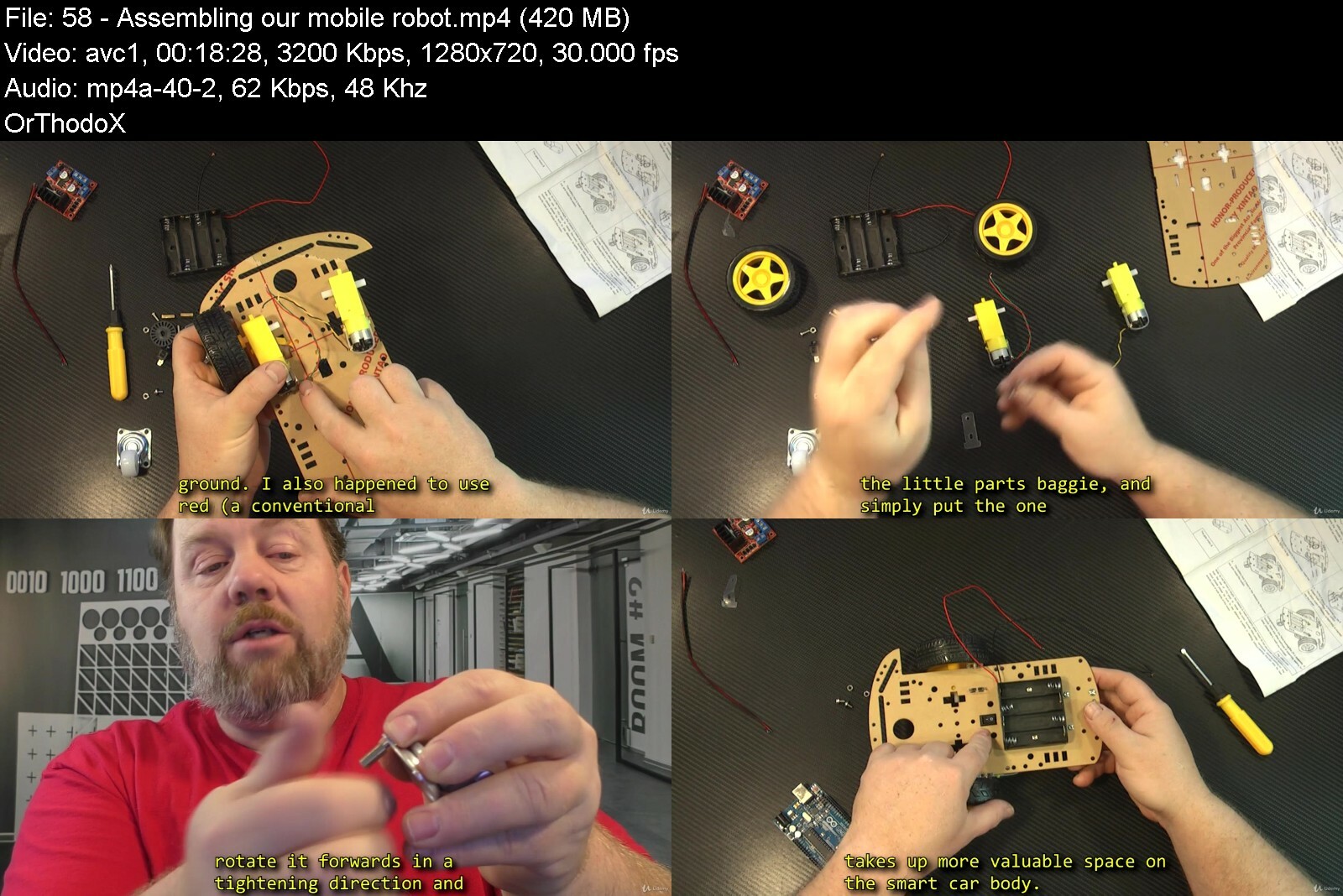
Lecture 58 Assembling our mobile robot

Lecture 59 Adding electronics to our mobile robot

Lecture 60 Programming and calibrating movements on our mobile robot - Free preview!

Lecture 61 Obstacle avoidance with infrared sensor

Lecture 62 Subroutines, aka functions in Arduino

Lecture 63 Libraries in Arduino

Lecture 64 Using our ultrasonic shield

Lecture 65 Arrays & String variables

Lecture 66 Multidimensional arrays

Lecture 67 Using a library to drive our Hitachi display

Lecture 68 Identifying and wiring our TFT displays

Lecture 69 Starting up our TFT display

Lecture 70 Bonus lesson: Line following robot

You have a desire to learn computer control and electronics, especially geared towards building and controlling robots.,You want to understand the heartbeat of computers and digital systems, and want to build your own digital electronic devices.


digitalelectronicsrob87dge.jpg


Zurück
Oben Unten