• Regeln für den Video-Bereich:

    In den Börsenbereich gehören nur Angebote die bereits den Allgemeinen Regeln entsprechen.

    Einteilung

    - Folgende Formate gehören in die angegeben Bereiche:
    - Filme: Encodierte Filme von BluRay, DVD, R5, TV, Screener sowie Telesyncs im Format DivX, XviD und x264.
    - DVD: Filme im Format DVD5, DVD9 und HD2DVD.
    - HD: Encodierte Filme mit der Auflösung 720p oder darüber von BluRay, DVD, R5, TV, Screener sowie Telesyncs im Format x264.
    - 3D: Encodierte Filme von BluRay, die in einem 3D Format vorliegen. Dies gilt auch für Dokus, Animation usw.
    - Serien: Cartoon/Zeichentrick, Anime, Tutorials, Dokumentationen, Konzerte/Musik, Sonstiges sind demnach in die entsprechenden Bereiche einzuordnen, auch wenn sie beispielsweise im High Definition-Format oder als DVD5/DVD9/HD2DVD vorliegen. Ausnahme 3D.
    - Bereich Englisch: Englische Releases gehören immer in diesen Bereich.
    - Bereich Talk: Der Bereich, in dem über die Releases diskutiert werden kann, darf, soll und erwünscht ist.


    Angebot/Beitrag erstellen

    - Ein Beitrag darf erst dann erstellt werden, wenn der Upload bei mindestens einem OCH komplett ist. Platzhalter sind untersagt.
    - Bei einem Scenerelease hat der Threadtitel ausschließlich aus dem originalen, unveränderten Releasenamen zu bestehen. Es dürfen keine Veränderungen wie z.B. Sterne, kleine Buchstaben o.ä. vorgenommen werden. Ausnahme Serienbörse:
    - Bei einem Sammelthread für eine Staffel entfällt aus dem Releasename natürlich der Name der Folge. Beispiel: Die Simpsons S21 German DVDRip XviD - ITG
    - Dementsprechend sind also u.a. verboten: Erweiterungen wie "Tipp", "empfehlenswert", "only", "reup", usw. / jegliche andere Zusatzinformation oder Ergänzung, welche nicht in obiger Beschreibung zu finden ist.

    Aufbau des Angebots und Threadtitel

    Der Titel nach folgendem Muster erstellt zu werden. <Name> [3D] [Staffel] [German] <Jahr> <Tonspur> [DL] [Auflösung] <Quelle> <Codec> - <Group>
    Beispiel: The Dark Knight German 2008 AC3 DVDRip XviD - iND
    Beispiel: The Dark Knight 2008 DTS DL BDRip x264 - iND
    Beispiel: The Dark Knight 2008 AC3 DL BDRip XviD - iND
    Beispiel: The Dark Knight German 2008 AC3 720p BluRay x264 iND
    Beispiel: The Dark Knight 2008 DTS DL 1080p BluRay x264 iND
    Beispiel: Die Simpsons S01 German AC3 DVDRip XviD iND
    Beispiel: Die Simpsons S20 German AC3 720p BluRay x264 iND
    Beispiel: Sword Art Online II Ger Sub 2014 AAC 1080p WEBRip x264 - peppermint
    Entsprechend sind also u.a. verboten: Sonderzeichen wie Klammern, Sterne, Ausrufezeichen, Unterstriche, Anführungszeichen / Erweiterungen wie "Tipp", "empfehlenswert", "only", "reup", usw. / jegliche andere Zusatzinformation oder Ergänzung, welche nicht in obiger Beschreibung zu finden ist
    Ausnahmen hiervon können in den Bereichen geregelt sein.

    Die Beiträge sollen wie folgt aufgebaut werden:
    Überschrift entspricht dem Threadtitel
    Cover
    kurze Inhaltsbeschreibung
    Format, Größe, Dauer sind gut lesbar für Downloader außerhalb des Spoilers zu vermerken
    Nfo sind immer Anzugeben und selbige immer im Spoiler in Textform.
    Sind keine Nfo vorhanden z.B. Eigenpublikationen, sind im Spoiler folgende Dateiinformationen zusätzlich anzugeben :
    Quelle
    Video (Auflösung und Bitrate)
    Ton (Sprache, Format und Bitrate der einzelnen Spuren)
    Untertitel (sofern vorhanden)
    Hosterangabe in Textform außerhalb eines Spoiler mit allen enthaltenen Hostern.
    Bei SD kann auf diese zusätzlichen Dateiinformationen verzichtet werden.

    Alle benötigten Passwörter sind, sofern vorhanden, in Textform im Angebot anzugeben.
    Spoiler im Spoiler mit Kommentaren :"Schon Bedankt?" sind unerwünscht.


    Releases

    - Sind Retail-Release verfügbar, sind alle anderen Variationen untersagt. Ausnahmen: Alle deutschen Retail-Release sind CUT, in diesem Fall sind dubbed UNCUT-Release zulässig.
    - Im Serien-Bereich gilt speziell: Wenn ein Retail vor Abschluss einer laufenden Staffel erscheint, darf diese Staffel noch zu Ende gebracht werden.62
    - Gleiche Releases sind unbedingt zusammenzufassen. Das bedeutet, es ist zwingend erforderlich, vor dem Erstellen eines Themas per Suchfunktion zu überprüfen, ob bereits ein Beitrag mit demselben Release besteht. Ist dies der Fall, ist der bereits vorhandene Beitrag zu verwenden.
    - P2P und Scene Releases dürfen nicht verändert oder gar unter einem iND Tag eingestellt werden.


    Support, Diskussionen und Suche

    - Supportanfragen sind entweder per PN oder im Bereich Talk zu stellen.
    - Diskussionen und Bewertungen sind im Talk Bereich zu führen. Fragen an die Uploader haben ausschließlich via PN zu erfolgen, und sind in den Angeboten untersagt.
    - Anfragen zu Upload-Wünschen sind nur im Bereich Suche Video erlaubt. Antworten dürfen nur auf Angebote von MyBoerse.bz verlinkt werden.


    Verbote

    - Untersagt sind mehrere Formate in einem einzigen Angebotsthread, wie beispielsweise das gleichzeitige Anbieten von DivX/XviD, 720p und 1080p in einem Thread. Pro Format, Release und Auflösung ist ein eigener Thread zu eröffnen.
    - Grundsätzlich ebenso verboten sind Dupes. Uploader haben sich an geeigneter Stelle darüber zu informieren, ob es sich bei einem Release um ein Dupe handelt.
    - Gefakte, nur teilweise lauffähige oder unvollständige Angebote sind untersagt. Dies gilt auch für eigene Publikationen, die augenscheinlich nicht selbst von z.B. einer DVD gerippt wurden. Laufende Serien, bei denen noch nicht alle Folgen verfügbar sind, dürfen erstellt und regelmäßig geupdatet werden.
    - Untersagt sind Angebote, welche nur und ausschließlich in einer anderen Sprache als deutsch oder englisch vorliegen. Ausnahmen sind VORHER mit den Moderatoren zu klären.


    Verstoß gegen die Regeln

    - Angebote oder Beiträge, die gegen die Forenregeln verstoßen, sind über den "Melden"-Button im Beitrag zu melden.
  • Bitte registriere dich zunächst um Beiträge zu verfassen und externe Links aufzurufen.

++ Premium IPTV ++ 7000 Live Sender ++ UHD Qualität ++ Mediathek mit 18.000 Inhalten ++


VenneTV


Englische Tutorials

TTC - The Scientific Wonder of Birds

h8ybmqbjmcv0ig6gw2fupu9ju9.jpg


TTC - The Scientific Wonder of Birds
Duration: 5h 29m | Video: .MP4 1280x720, 25fps(r) | Audio: AAC, 44100Hz, 2ch | Size: 4.61 GB
Genre: eLearning | Language: English

Birds are endlessly compelling and fascinating creatures. Millions of people around the world engage in the organized activity of birding, and countless more enjoy casually watching our avian neighbors in their daily activities. But beyond what we can observe on the surface, birds are phenomenally interesting-and often extremely surprising-in their biology, physiology, aerodynamics, and their multifaceted behavioral adaptations.

Birds are among the most ingenious and resourceful of living creatures, and astonishingly more intelligent than we often imagine. A few amazing aspects of birds and their behaviors include:

Avian research reveals sophistication of birds' tool use and vocal communication that were thought to be exclusive to primates and humans;
Birds' diverse sexual and mating habits show uncanny similarities to human behavior;
Among nature's most amazing vocalists, North America's brown thrasher can learn and retain over 1,000 songs; and
Evidence suggests that birds are able to appreciate aesthetic beauty.

In The Scientific Wonder of Birds, biologist and bird expert Professor Bruce E. Fleury of Tulane University guides you in a spirited discovery of the amazing beneath-the-surface world of birds-their evolution, fascinating lives in the wild, and the science that underlies their adaptations and behaviors. The Scientific Wonder of Birds is, in many ways, a companion course to our popular Guide to Birding in North America, casting a wider net as it delves into bird life and behavior around the world, as well as revealing the marvels of birds' physiology, psychology, brainpower, and the complexities of their remarkable lifestyles and habits.

Uncover the Amazing Biophysics of Bird Life and Behavior

In these 12 vividly illustrated lectures, Professor Fleury reveals numerous enthralling aspects and features of bird life. Beginning with an excursion into the ancestry and evolution of birds, you'll discover how birds are directly descended from dinosaurs. In probing into the process by which agile, bipedal reptiles took to the air, you'll explore the miraculous mechanics of flight, and the many physiological adaptations that keep birds aloft.

From there, you'll study the science of their remarkable feats of navigation and the complex matter of avian migration. You'll delve into further elements of bird life, such as their foraging and feeding strategies, birdsong and bird calls, the language of plumage, courtship behavior, mating and roosting, avian territorial behavior, and more. Professor Fleury presents everything with an infectious passion for the subject, an often humorous perspective, and a deep knowledge based on a lifetime of birding and bird study. Whether you're an experienced birder or a newcomer to the bird world, these lectures will surprise and delight you, and give you a deeper appreciation for the beauty and diversity of our feathered friends.

Take a Broad Look at the Fascinating Elements of Ornithology

Throughout these lectures, Professor Fleury offers you a detailed look at the scope of ornithological study, encompassing the life cycles of birds in the wild, and key subject matter such as:

The Miracle of Flight-Beginning with leading views of how flight evolved, learn the aerodynamic properties of birds' wings, as they produce lift and thrust, and how feathers allow birds to expertly maneuver in the air. Learn how birds' entire physiology, on multiple levels, adapts them for flight and how a bird's feathers did not evolve for flight, but were a coincidental adaptation for it.
The Science of Avian Navigation and Migration-Penetrate the mysteries of how birds navigate over huge distances, using such aids as Sun and star positions and magnetic fields, and take account of the incredible navigational abilities of species such as homing pigeons, buntings, and albatrosses. Study how ornithologists explain migration and observe the fabulous range of avian migratory behavior across the globe.
The Remarkable Brainpower of Birds-Contrast avian brain structure with our own and track the intelligence of birds in numerous surprising and revelatory examples. Note how diverse species can distinguish shapes, colors, and numbers; remember 2,000 seed cache locations; start fires to flush out prey; make hooks to catch food; tie slip knots; and, believe it or not, differentiate between artistic styles such as Cubism and Impressionism.
Territoriality and Competition-Among the most dramatic and intriguing avian behavior, delve into the fierce territorial tactics of birds. See how birds stand their ground using specific visual signals regarding threats, courtship, territorial defense, and predators. Learn the many reasons why birds stake out and defend territory, including group and "portable" territories, and note how non-territorial birds establish dominance hierarchies ("pecking orders").
The Avian Arts of Love: Mating and Breeding-Observe the striking ways in which females judge potential mates on abilities such as virtuoso singing, "macho" feats, food offerings, and the outlandish courtship displays of species such as the blue manikin and the bowerbird. Investigate the avian mating systems of monogamy, polygamy, and promiscuity and the colorful variations of sex roles, role reversal, same-sex couples, and avian "infidelity" and "divorce."
Gain a Richer Understanding and Appreciation of Our Natural World

In addition to his remarkably far-reaching knowledge of the bird world, Professor Fleury brings a delightful accessibility to avian science and has a talent for uncovering a huge range of singular and often astounding aspects of bird life. The Scientific Wonder of Birds is a passion project for Professor Fleury-declining health due to Parkinson's disease has not stopped him from bringing a beloved subject to life in an endlessly engaging and enlightening series of lectures.

Accompanied by exceptionally rich visuals, from vivid color images and diagrams to video clips of bird behavior, animations, and moving graphics, this course unfolds as a thrilling and many-sided panorama of avian life. Ultimately, this course offers you remarkable insight into some of the most beautiful and extraordinary of living creatures.

Homepage

03burningbrightavianahyjdr.jpg


TTC - The Great Questions of Philosophy and Physics

sguuogz4zn9yhlbxz2u7h3ikq0.jpg


TTC - The Great Questions of Philosophy and Physics
Duration: 6h 13m | Video: .MP4 1280x720, 25fps(r) | Audio: AAC, 44100Hz, 2ch | Size: 5.23 GB
Genre: eLearning | Language: English

No field of the humanities is so closely tied to physics as philosophy. Since ancient times, philosophers have puzzled over the nature of space, time, and matter-inquiries that led to the flowering of physics in the 17th century with Isaac Newton and other pioneers of the Scientific Revolution. Since then, the spectacular success of modern physics might imply that philosophy is no longer relevant to the field. Far from it! Surprising discoveries in the atomic and cosmic realms have opened a floodgate of new philosophical questions, such as:

Is time travel possible? Time travel is an idea that would have seemed absurd to a classical physicist like Newton. But it appears to be a real option according to Albert Einstein's general theory of relativity-raising the prospect of time machines, along with a host of paradoxes including whether the past can be altered.
Is the universe fine-tuned for life? The more we learn about the universe, the more it looks tailor-made expressly for us. Does this imply a Creator? On the other hand, where else could we live except in a universe conducive to life? This suggests that countless other universes may exist with quite different properties.
Is Schrödinger's cat dead or alive? A thought experiment proposed by the physicist Erwin Schrödinger features a cat whose life hangs in the balance subject to a quantum event, which is inherently probabilistic and unobservable. The implications have led to startling proposals about the nature of reality.
Treating these and other puzzles with a light and accessible touch, award-winning teacher and philosopher Steven Gimbel of Gettysburg College guides you through the concepts, theories, and speculations that underlie our understanding of reality in The Great Questions of Philosophy and Physics. In 12 wide-ranging, half-hour lectures, Professor Gimbel covers many of the fundamental ideas of modern physics, highlighting the role of philosophy in setting ground rules, interpreting results, and posing new questions.

The only prerequisite for the course is a desire to think critically and abstractly-in other words, philosophically. No prior background in science, mathematics, or philosophy is assumed. Trained as a philosopher of physics, Professor Gimbel deftly introduces the major players, sketches the intellectual terrain, and outlines the most important debates. He also tells a few jokes, displaying the playful side of his profession.

Wrestle with Profound Questions

Dr. Gimbel's humor is on display when he brings up the topic of atoms. "Do atoms exist?" he often asks his classes. "Of course they do," his students invariably tell him. "What about Santa Claus?" Dr. Gimbel counters. "Does he exist?" The point is that our evidence for atoms is indirect, much like the clues for Santa's visit (packages under the tree and missing cookies). While the analogy should not be stretched too far, there is a long tradition in the philosophy of science that regards unobservables as being metaphysically out of bounds. This view is called empiricism. There is an equally venerable tradition, called realism, that views strong evidence for entities such as atoms as proof of their existence, in spite of the fact that they can't be observed directly.

In The Great Questions of Philosophy and Physics, you wrestle with tricky debates like this, assessing the arguments on both sides. Inevitably, you will find yourself persuaded by one position and then having second thoughts when you hear the arguments against it, which is a mark of the subtlety of the underlying philosophical issues.

Consider these questions, which you address in the course:

Why is math so effective? Mathematics is the hallmark of a rigorous science such as physics. But why should that be? Is the world a mathematical system, as some philosophers contend? Or is mathematics simply our most powerful, logical tool for making sense of the relations between things in nature?
Is space a thing or a relation? Newton believed that space is a kind of amphitheater that the universe occupies. His rival, Leibniz, argued that space is just a set of relations. If the contents of the universe were removed, there would be nothing left, not even "space." Einstein cast this debate in a remarkable new light.
What is scientific truth? Philosopher Nancy Cartwright points out that the laws of physics are idealized and do not describe reality. If fundamental laws don't lead us to the truth, then what does? It may be that we have to settle for statements that are true enough to give the best explanation-and no more.
Probe the Surprising Nature of Reality

For a 19th-century physicist trying to formulate physical laws, an empirical approach was common sense. "Seeing is believing" was hard to argue with. The deep reality at the root of nature was interesting to contemplate, but hardly accessible at the time. However, in the 20th century, a revolution swept physics, eventually giving us two comprehensive theories of reality: the standard model of particle physics, which unifies the strong, weak, and electromagnetic forces that control events in the atomic realm; and general relativity, which covers gravity, the force that operates without limit across the universe.

Both theories are extraordinarily successful at predicting events at their respective scales. Both imply an underlying reality that is counterintuitive, if not bizarre. Both have major philosophical implications. And each is incompatible with the other, hinting that an eventual theory that unifies both will sketch a reality of utmost strangeness-as proposals such as string theory do.

One of philosophy's most important roles is clearing up misconceptions. There are plenty of those surrounding modern physics, as you learn in this course. For example, the Heisenberg uncertainty principle is often cited as an epistemological claim. That is, for a given subatomic particle, the uncertainty principle limits our knowledge of simultaneous values for a pair of quantities, such as position and momentum. You can know one or the other, but not both. But that's not the whole story. The uncertainty principle is really a metaphysical claim: precise, simultaneous values for both quantities simply don't exist. According to one theory, after you know one value, the other disappears into a parallel universe!

Homepage

12thephysicsofgods6tkxk.jpg


Zenva - Survival Game Development Academy

yen6sfiu2emmcvzdlkmfqebjub.jpg


Zenva - Survival Game Development Academy
MP4 | Video: h264, 1920x1080 | Audio: AAC, 44.1 KHz, 2 Ch
Genre: eLearning | Language: English | Duration: 143 Lessons (15h 20m) | Size: 7.1 GB

Build your own survival game from scratch in Unity while learning core mechanics for player needs, base building, crafting, and more Since the launch of Minecraft, survival games have become one of the hottest genres in the industry. Not only have both single-player and multiplayer projects seen massive success, but it's a genre that has found vast popularity on PC, consoles, and mobile. With numerous opportunities for indie and professional game developers alike, learning the core mechanics of survival games will pave the road to success for any developer!

In Survival Game Development Academy, you'll explore this popular genre with Unity and build a fully functional survival game over the duration of several courses. You'll learn core mechanics found in many games of this genre including player needs, item crafting, base building, combat, and more - all with systems that can easily be expanded and adapted to your own projects. By the end, you'll not only possess a portfolio-worthy piece to impress potential employers, but also have the skills necessary to build your own survival games with robust features to entice your players.

Homepage

4sr7jsp.jpg


Master Creative Advanced CSS Animations - Create 100 Projects!

wqnwzoeefc8cuxvkanqsg2rj58.png


Master Creative Advanced CSS Animations - Create 100 Projects!
11h 28mins | mkv , 1280x720 , 30 fps | aac, 44100 Hz, stereo, s16 | 5.2 GB
Genre: eLearning | Language: English

Have you ever seen a web animation on codepen or on any website and then you think "Ohh that is awesome! I want to do that!" but then think it's complex and far beyond your skills?

Well I'm here to tell you: No, it definitely is not!, I'm Ahmed Sadek, a full stack web developer and freelancer with more than 7 years of experience, and I wanna welcome you to my CSS Animations, Transitions and Transforms Creativity Course.

Css animation is quickly becoming an essential design tool that's increasingly used to help our users understand and interact with our websites. It's definitely the next big step in css! Absolutely amazing things can be done with it. It's literally up to your imagination! It gives life to your website and enhances the user experience and you know better user experience means a higher reputation and more satisfied visitors. So css animations, transitions, and transforms are critical skills for any web developer nowadays.and I'm here to make sure you learn it the right way.

So in this course you will master css animations, transitions, and transforms, starting from scratch, and not only that, we're also gonna get our hands dirty and create many examples together so that you will get tons of ideas, and lots of inspiration to help you create any complex animation you can think of.

We'll start by looking at the css transition property, learning what it is and how it can give life to html elements.

Then we will move on to css transforms, which open the doors for many creative options, from moving elements around the page, to scaling and rotating them. So we'll talk about all the transform functions that we can use in 2D and 3D environments.

After that, we get to the fun part! We will use all the techniques and properties we learned about the css transforms and transitions, and we'll start building some creative examples that will give you inspiration and help you make full use of what you've learned!

We'll start this section by creating some button hover effects, then some image hover effects, and so much more!

Then we will move over to css animations and keyframes, where we'll learn everything about them and all their properties.

And finally we will move on to the last section of the course, where we will be creating many css animations examples that will kickstart your imagination and help you create any animation you can think of!

By then end of this course, you'll be able to understand how any web animation works, and you'll have created more than 100 different projects with different ideas that will help you increase your creativity, and stand out from other web developers. So if you are as excited as I am, hit the enroll button, and let's dive right in with this CSS Animations, Transitions and Transforms Creativity Course!

HOMEPAGE

011creativeadvancedcsj6kuv.jpg


TTC - Introduction to Astrophysics

n9qszwqnvxmqlqjjsflyujojtp.jpg


TTC - Introduction to Astrophysics
Duration: 13h 12m | Video: .MP4 1280x720, 25fps(r) | Audio: AAC, 44100Hz, 2ch | Size: 11.1 GB
Genre: eLearning | Language: English

Everyone loves to observe the beauty of the star-studded night sky, to say nothing of the dazzling images from the Hubble Space Telescope. But how many of us truly understand how stars shine, where Saturn's rings come from, or why galaxies have their distinctive shapes? Observational astronomy excels at imaging and cataloging celestial objects, but it takes a more rigorous discipline to come up with physical explanations for them. That field is astrophysics.

Astrophysics uses the laws of physics to investigate everything beyond Earth. In the process, it has made breakthroughs such as these:

Celestial motion: Astrophysics got its start with Isaac Newton's laws of motion and universal gravitation, proposed in the late 1600s. Together, these cornerstones of classical physics explain why everything in the universe moves the way it does.
A universe of galaxies: In the 1920s, Edwin Hubble's study of an enigmatic nebula proved that it was, in fact, another galaxy-at a time when the Milky Way was thought to be the only galaxy there was. Since then, we have amassed evidence for hundreds of billions of galaxies.
Exoplanets: The hunt for planets orbiting other stars was considered impractical, until a range of clever techniques were developed in the 1990s. Thousands of "exoplanets" have since been discovered, many in planetary orbits unlike anything seen in our solar system.
Introduction to Astrophysics plunges you into this exciting quest, taking you step by step through the calculations that show how planets, stars, and galaxies work. In these 24 illuminating half-hour lectures, taught by noted astrophysicist Professor Joshua Winn of Princeton University, you tour the universe of exploding stars, colliding black holes, dark matter, and other wonders, just as in a traditional astronomy course. But Professor Winn takes you beyond the images and descriptions to teach you how to understand and solve the physics problems at the heart of the field.

Throughout the course, Dr. Winn uses custom-designed graphics and animations to help you visualize what's happening. As he makes clear from the first lecture, this course relies heavily on high school and first-year college math. As Dr Winn says: "I'll also rely on first-year physics. Sometimes I'll go deeper-I'll use vectors, or take derivatives, which I hope will be helpful to those of you who've studied more math. But if not, don't worry, I promise to do my very best to help you understand the results, even if you can't follow every step."

Even if you feel like math and physics are not your strongest subjects, you will find his presentation enthralling, as you witness how astrophysicists frame, analyze, and solve problems that have led to astonishing discoveries throughout the universe.

Experience the Thrill of Discovery

Dr. Winn has wide experience using Earth- and space-based telescopes in his research, and in Introduction to Astrophysics he puts you in the driver's seat-showing you how to gather data, pick formulas, simplify mathematical expressions, and come up with results that give you the thrill of discovering something concrete and often unexpected about the universe. For example:

How dense is the Sun: From observations of total solar eclipses and ocean tides, you can deduce that the Sun is, on average, half as dense as the Moon, or about 1.5 grams per cubic centimeter. This is an important clue about how the Sun and other stars work.
The Milky Way's core: At the center of our galaxy, stars orbit a seemingly empty point in space. It can only be a black hole. But how big is it? Given the orbital period and semimajor axis of one of the stars, the calculation is simple: four million solar masses.
Faster than light: The spectra of galaxies reveal that all except the closest are speeding away from us; the farther, the faster-with the most distant seeming to exceed light speed! But this apparent violation of the cosmic speed limit is an illusion, caused by the expansion of space itself.
Cover the Fundamentals

One of the intellectual delights of this course is retracing the steps that led to some of the great ideas in astrophysics. In a typical physics class, Newton's laws are memorized with little appreciation for where they came from. But Professor Winn shows how Newton was inspired by Johannes Kepler's three laws of planetary motion. Analyzing the laws with calculus (which he invented for the purpose), Newton discovered principles such as the inverse square law of gravity. His astonishing achievement was to prove that physical laws that apply on Earth also operate throughout the universe-something we take for granted today but which was a revelation to thinkers at the time.

Similarly, most astronomy lectures on the electromagnetic spectrum-the range of wavelengths from radio to visible light to gamma ray-don't normally explain the ultimate origin of radiation. James Clerk Maxwell's equations, published in the 1860s, show that electrically charged particles, when accelerated, generate a pattern of electric fields accompanied by magnetic fields-an electromagnetic wave-that travels at the speed of light. Quantum theory later modified this description to handle the case of electrons orbiting around a nucleus. Dr. Winn believes that ideas so fundamental to the physics of stars and telescopes deserve to be treated in detail.

In other cases, detail is exactly what you want to avoid. One of the tricks for dealing with the vast range of concepts and spatial scales in astrophysics is using shortcuts whenever possible, such as:

Order of magnitude: Dispense with constants, extra significant figures, and other unnecessary marks of precision, to zero in on the order of magnitude-the nearest factor of ten-of the answer you seek.
Dimensional analysis: Normally used to keep units straight in a calculation, this technique sometimes lets you guess the right equation you need, by reverse-engineering it from the known units of the solution.
Scaling relation: This trick is a shortcut for creating a streamlined version of an equation, based on a benchmark case with known values. Analogous cases can then be scaled up or down by the appropriate factor.
The Most Amazing Subject in the Universe

An award-winning teacher at both the undergraduate and graduate levels, Professor Winn has a fresh, exciting approach to astrophysics. For example, while many traditional astrophysics classes often don't touch on black holes until the end of the course, Professor Winn believes it is "a terrible idea-it's educational malpractice! Black holes are some of the most fascinating things in the universe." His infectious joy in the subject-even when it is at its most complex-is palpable in every lecture.

He then explains these intriguing objects in depth, walking you through the calculations for the theoretical boundaries of black holes with the mass of Earth (9 millimeters), the Sun (3 kilometers), and the supermassive black hole at the core of the Milky Way Galaxy (12 million kilometers). His treatment of black holes flows seamlessly from his discussion of gravity and tidal forces in the preceding lectures.

Homepage

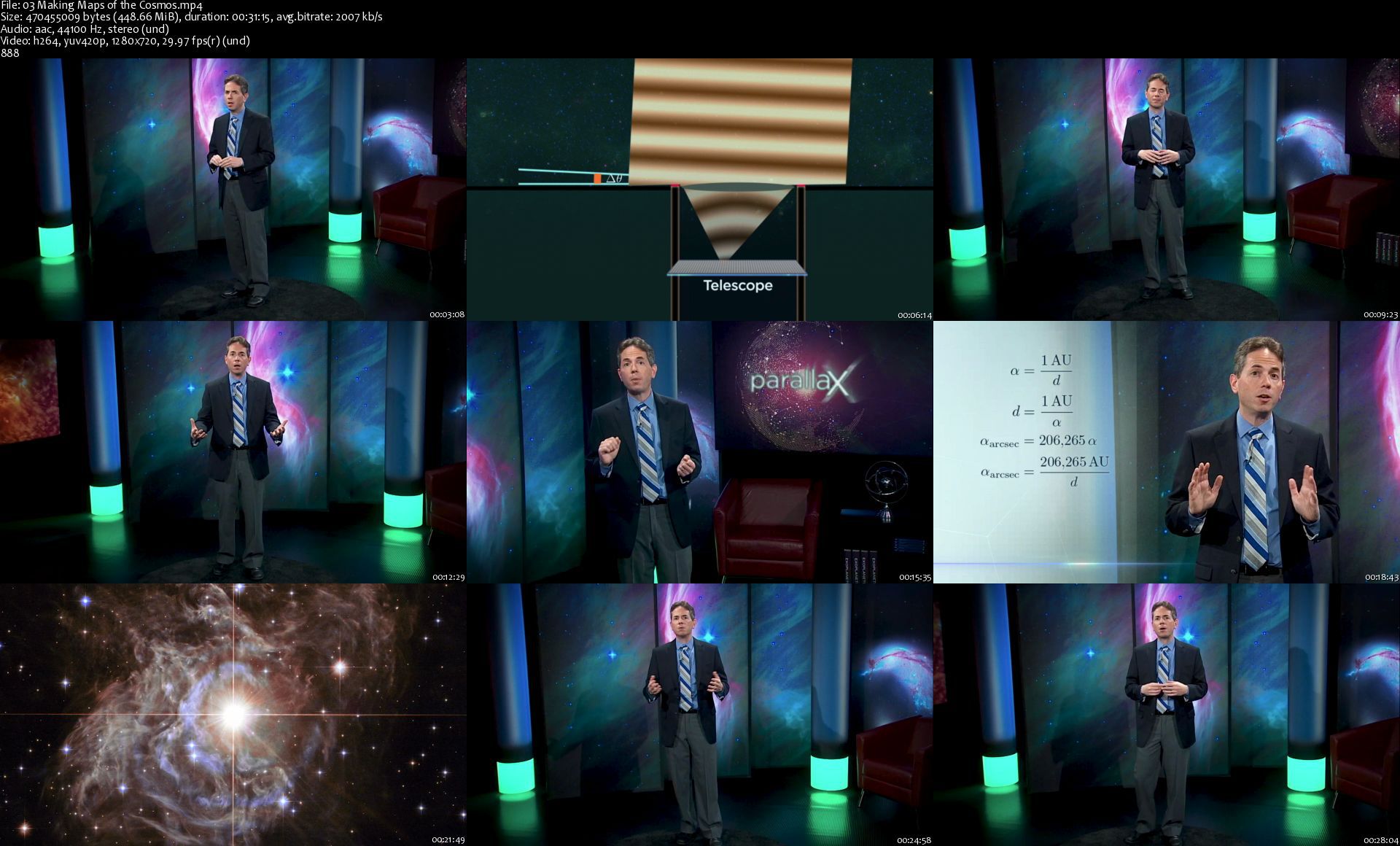
03makingmapsofthecosmkwkom.jpg


How To Build a Computer: A Beginner's Guide

pmu739nvofoecfn5hewk816kdq.jpg


How To Build a Computer: A Beginner's Guide
MP4 | Video: h264, 1280x720 | Audio: AAC, 44100 Hz
Language: English | Size: 7 GB | Duration: 12h 36m


What you'll learn
Build your first computer from scratch!
Gain a basic knowledge of PC components and how they interact!
Learn how to shop for components that have a high dollar-to-performance ratio!
Requirements
Knowledge of basic computer usage is necessary for this course.

Description
** Note For New Students **
The first section of my course is designed to be a classroom format, with pictures and documents for learning. If you're looking for a step by step video guide on handling physical hardware, what it is and how to put it together, please skip to the 2nd half of the course (the Lab section).

Over 1000 students joined in the first week of release!
Over 2700 students at the time of this writing!
A big THANK YOU to my students for making this the HIGHEST RATED (5 STARS!), MOST POPULAR COURSE for building a computer on Udemy!
Just added in 2017 - How to build a liquid cooled high-performance gaming PC!
________________________________________

Have you ever wanted to build your own computer?

Would you like to know what each component does?

Do you want to know how to get the best bang for your buck?

This course will begin with some explanation of different terminology when it comes to PC components. You'll learn how each component connects to each other, their purposes, things to watch out for when purchasing components, and how to decide what parts need to perform better based on the tasks you want the computer will do.

You'll go through the steps of building your first computer piece by piece, with great attention to detail along the way. Afterwhich, you'll learn the process of installing an operating system on the computer, to make the system fully functional and ready to use!

This course will evolve over time.. Later installments may include things like:

High-end Gaming PC Builds (Done and added to course!)
Water Cooling (Done and added to course!)
Home Theater PC Builds
Raspberry PI Builds
Hackintosh Builds
In the first installment, you'll learn how to build a general usage PC that will perform well for daily use, using a classroom lecture format.

** First course expansion released! **

Showing how to build a computer hands-on was easily the most requested feature after the course's original release. So, we've put together a giant new section on building an extremely high performance liquid cooled overclocked gaming PC! You will find this section at the end of the course.

Buy now to get the most value!

Original Pricing - $25
After 2017 Expansion - $50

As the course evolves and content is added, the pricing will go up with each installment. Get in now at the low cost of $50 and receive all of the new content for free!

As a student, you will also receive special discounts unavailable elsewhere for Nathan's other courses that are currently in the works!

And as always, 30-day refunds are 100% guaranteed if your satisfaction is not met!

Thank you! Thank you for taking a look at this course on Udemy!


Who this course is for:
This course is meant for hobbyists, students and technology enthusiasts that want to build a well performing computer for themselves or for a friend!


Homepage

2.installingdriversups1kzq.jpg


Go For Data Science and Natural Language Processing (Golang)

l05i7cndqsezjgsni5kag1rjmx.jpg


Go For Data Science and Natural Language Processing (Golang)
MP4 | Video: h264, 1280x720 | Audio: AAC, 44.1 KHz, 2 Ch
Genre: eLearning | Language: English + srt | Duration: 54 lectures (12h 44m) | Size: 6.3 GB

Experimenting with Golang For Data Science & Natural Language Processing

What you'll learn:
Using Golang/Go For Data Science
Natural Language Processing with Golang
Building Simple Web Apps with Golang (GoFiber)

Requirements
Willingness to Experiment with Go in a Thriving Field
Basic Understanding of Data Science & NLP Concepts


Description
Go, also know as Golang, is a modern programming language created by 3 Great individuals and backed by Google to address

certain types of issues.

Being one of the fastest growing languages used in the DevOps and Microservices world, can it also be used for Data Science?

Data Science is being used everywhere and has several applications in the real world such as Machine Learning Applications to Natural Language processing and Deep Learning.

As everyone knows and would agree with me,Python is known to be the best language for doing Data Science in this present era, but can we also use Golang for doing Data Science?

With all the benefits and features of Golang - is it easy for beginners to pick up Golang and use it for Data Science?

Go is fast, easy to learn and cross compatible with a great concurrency feature as well as several web frameworks,etc but is it Data Science friendly?

Introducing Go4DataScience & Go4NLP.

This course seeks to explore and address the challenges we have in doing Data Science and NLP using Golang for beginners.

I believe this is one of the first training programs on this platform intended to perform data science with Golang for beginners.

Go For Data Science(Go4Datascience) is the course where Golang meets Data Science i.e, two growing fields meeting together.

Although Go has several Libraries and Package with a massive growing community,I faced a lot of challenges when performing data science using Golang. So this course is my attempt to document the process of performing datascience and NLP using Golang.

Join me as we experiment together - we will meet a lot of challenges and shortcomings but we will prevail and pave the way for others to find it easier for doing data science with Golang.


What you'll learn

Learn the basics of Go relevant enough for DataScience and NLP

Find out how to read files such as CSV,Txt and PDF in Golang

How to Clean data using Regex and more

Perform Statistics using Several Packages in Go such as Gonum,Stats,etc

Data Analysis and Exploration using Golang via GoTa,etc.

Understand NLP concepts and their implementation in a simple way

Perform Sentiment Analysis with Golang using Two Approaches

Perform Named Entity Recognition in Golang

Build NLP and Data Applications using Go Web Frameworks like Go Fiber,etc

Perform Predictive Analytics and Machine Learning using GoML, etc

Keyword Extraction using Rakes in Golang.

And more

Tips for getting through the course

Please write or code along with us do not just watch,this will enhance your understanding.

You can regulate the speed and audio of the video as you wish,preferably at -0.75x if the speed is too fast for you.

The course is intensive and lengthy but yet exciting and unscripted.

Suggested Prerequisites is understanding of Golang and Data Science

This course is NOT a 'Theoretical Introduction to Data Science' nor 'Advanced Concepts in Golang' although we try our best to cover some concepts for the beginner and the pro.

Rather it is about experimenting with Golang for performing Data Science and Natural Language Processing.

Go4DataScience & Go4NLP.

Get Job ready with Go and DataScience today.

Join us as we explore the world of Golang 4 Datascience and NLP.

See you in the Course,Stay blessed.

Who this course is for
Developers curious about data science and NLP using Go/Golang

Homepage

3.sentimentanalysisin0ejzj.jpg


TTC - Experiencing Hubble: Exploring the Milky Way

jglqfyy0nxdbeeiqbxxkfx6j13.jpg


TTC - Experiencing Hubble: Exploring the Milky Way
Duration: 6h 1m | Video: .MP4 1280x720, 25fps(r) | Audio: AAC, 44100Hz, 2ch | Size: 5.06 GB
Genre: eLearning | Language: English

On a dark, clear night, a magnificent band of hazy light arches overhead that ancient Greeks likened to a trail of milk spilled across the sky. It is the Milky Way, the galaxy where we live, seen edge-on from our vantage point on the inside. There are countless stars at all stages of stellar life, vast clouds of interstellar gas and dust, star clusters, and even satellite galaxies, but no close-up view can match that of the Hubble Space Telescope, which has been surveying the wonders of the Milky Way for three decades.

In 12 beautifully illustrated half-hour lectures, Experiencing Hubble: Exploring the Milky Way leads you on a tour like no other-to pulsating stars, iridescent nebulae, giant star clusters, and regions of frenzied activity that signal black holes. Your guide is David M. Meyer, Professor of Physics and Astronomy at Northwestern University and an award-winning teacher, noted for using Hubble images to bring the latest research to his introductory classes. This course requires no background in astronomy or science, and it compliments Dr. Meyer's previous course: Experiencing Hubble: Understanding the Greatest Images of the Universe, which covers Hubble's greatest hits through 2009. Since then, Hubble has amassed half a million new observations, many with an advanced high-resolution camera for visible light and near infrared imaging.

Orbiting some 300 miles above the blurring effects of Earth's turbulent atmosphere, Hubble has an unrivaled perspective on galactic sights near and far, including:

Horsehead Nebula: Quite by chance, a hot, young star has sculpted nature's most spectacular equine monument-a two-light-year, tall pillar of gas and dust resembling a horse's head. Through Hubble's sharp eye, the structure provides fascinating insight into the process of star formation.

Veil Nebula supernova remnant: Prehistoric inhabitants of the Northern Hemisphere witnessed the sudden appearance of a star that outshone all others in the heavens for many weeks. Today, this type II supernova has dimmed and expanded to form a beautiful, veil-like feature that Hubble shows in exquisite detail.

Galactic center: Our view of the Milky Way's core is hidden at visible wavelengths by thick clouds of dust. However, Hubble's near infrared camera has peered through the dust to record millions of stars at the galactic center, which are orbiting a supermassive black hole.

Launched in 1990, Hubble has been periodically updated and repaired by astronauts, so that today it is a vastly improved instrument from its original design. That's why now is the perfect time to catch up on Hubble's latest views of our home galaxy.

More Wondrous Than You Ever Imagined

Exploring the Milky Way takes you from comets in the solar system, through the Milky Way to its core, and then to the galaxy's farthest outskirts. Putting Hubble's observations in context, each of the featured images is first pinpointed on a starfield like what you would see from your backyard. To the unaided eye, the target is often an apparently undistinguished piece of sky. Then, you dramatically zoom in, closer and closer, taking in ever more detail until you see exactly what Hubble sees. The effect is to make the night sky more wondrous than you ever imagined.

Dr. Meyer directs your attention to intriguing features that allow each one of the Hubble images to tell a remarkable story. You learn an impressive amount of astronomy, all while admiring a view that can be appreciated for its grandeur alone. Using no mathematics, Dr. Meyer introduces, and makes visual, concepts such as the electromagnetic spectrum, star classes, stellar evolution, parallax shifts, nucleosynthesis, galactic evolution, and much more. For comparison, he makes lavish use of images from other observatories, both ground- and space-based.

And because spiral galaxies like the Milky Way are common in the universe, the processes going on here are being replicated throughout the cosmos. The story of the Milky Way is a plot being played, with variations, almost everywhere.

Savor the Sights as You Tour Our Galaxy

Hubble's field of view is tiny, yet it has imaged objects covering sky areas larger than the full Moon by making a mosaic of frames, which have been seamlessly composited to create stunning panoramas. Furthermore, the telescope's ability to take exposures lasting many hours allows it to discern details that are otherwise invisible. And the fact that it has been operating for many years means that features that change over time can be regularly revisited.

For these reasons, Exploring the Milky Way includes much more than static sky images in a uniform format. Some of the impressive visuals you see include:

Cosmic jets: Star birth often involves a phase where infalling matter shoots out of the polar regions of an infant star at high speed. Time-lapse images from Hubble show these clumps of matter jetting across a distance equal to 1,000 times the radius of the solar system.

Pulsating stars: In another time-lapse movie, pulses of light from a Cepheid variable star gently ripple through a surrounding nebula. Thanks to Hubble, we can watch this spectacle unfold through repeated cycles. You also learn how such stars serve as cosmic yardsticks.

Andromeda Galaxy: Hubble imaged a portion of the nearby Andromeda Galaxy in a mosaic of 411 separate starfields. Amazingly, Hubble can resolve many millions of stars in Andromeda, which is like photographing a beach and resolving individual grains of sand.

Indeed, the Andromeda Galaxy-the closest large galaxy to the Milky Way-is your last stop in the course, because in a few billion years, Andromeda is due to transform the Milky Way beyond recognition, as the two galaxies collide and merge. An enormous burst of new star formation will ensue, until all the interstellar gas has been consumed and the combined systems evolve into an elliptical galaxy of older, low-mass stars.

Exploring the Milky Way will take you on an unparalleled tour of recently revealed visual wonders, letting you experience, as never before, what it means to say that the Milky Way galaxy is our home.

Homepage

01theunseenfaceofoursnikcw.jpg


Embedded Systems STM32 HAL APIs Driver Development

rih6hhpafku4ymi75fkmc7gjdv.jpg


Embedded Systems STM32 HAL APIs Driver Development
MP4 | Video: h264, 1280x720 | Audio: AAC, 44100 Hz
Language: English | Size: 5.28 GB | Duration: 10h 34m


What you'll learn
Write firmware using only HAL functions
Understand the Cortex-M Architecture
Write Analog-to-Digital Converter (ADC) drivers using HAL functions
Write PWM drivers using HAL functions
Write UART drivers using HAL functions
Write TIMER drivers using HAL functions
Write Interrupt drivers using HAL functions
Write SPI drivers using HAL functions
Write I2C drivers using HAL functions
Write RTC drivers using HAL functions
Write DMA drivers using HAL functions
Write RCC drivers using HAL functions
Requirements
No programming experience needed - I'll teach you everything you need to know.
STM32F411-NUCLEO.
We shall be using the STM32CubeIDE which is FREE.

Description
Welcome to the Embedded Systems STM32 Hardware Abstraction Layer (HAL) Driver Development course.

The STM32 Hardware Abstraction Layer (HAL) provides a simple, generic multi-instance set of APIs (application programming interfaces) to interact with the upper layers like the user application, libraries and stacks.

The HAL driver APIs are split into two categories: generic APIs, which provide common and generic functions for all the STM32 series and extension APIs, which include specific and customized functions for a given line or part number. The HAL drivers include a complete set of ready-to-use APIs that simplify the user application implementation. For example, the communication peripherals contain APIs to initialize and configure the peripheral, manage data transfers in polling mode, handle interrupts or DMA, and manage communication errors.

In summary, the HAL offers high-level and feature-oriented APIs with a high-portability level. These hide the MCU and peripheral complexity from the end-user.

With a programming based approach, this course is designed to give you a solid foundation in firmware and peripheral driver development for the STM32 family of microcontrollers. The goal of this course is to teach you how to navigate the microntroller reference manual and datasheet to extract the right information to professionally build peripheral drivers and firmware using the STM32 HAL APIs

By the end of this course you will be able to develop drivers for peripherals like the ADC, UART,PWM, GPIO, TIMER,I2C, SPI, RTC, RCC, EXTI etc. You will also master the STM32 architecture and how to build professional embedded firmware for STM32 microcontrollers.

Please take a look at the full course curriculum.

REMEMBER : I have no doubt you will love this course. Also it comes with a FULL money back guarantee for 30 days! So put simply, you really have nothing to loose and everything to gain.

Sign up and let's start toggling some register bits.

--------------------------------------Some highlights------------------------------------

Write Analog-to-Digital Converter (ADC) drivers using HAL functions

Write PWM drivers using HAL functions

Write UART drivers using HAL functions

Write TIMER drivers using HAL functions

Write Interrupt drivers using HAL functions

Write SPI drivers using HAL functions

Write I2C drivers using HAL functions

Write RTC drivers using HAL functions

Write DMA drivers using HAL functions

Write RCC drivers using HAL functions


Who this course is for:
If you are an absolute beginner to embedded systems, then take this course.
If you are an experienced embedded developer and want to learn how to professionally develop embedded applications for ARM processors, then take this course.


Homepage

2.codingdevelopingthe4tjjl.jpg


Character Painting in Phototshop

6lnfpmexyfsqo619pym9npcjsh.jpg


Character Painting in Phototshop
MP4 | ENG | Video: h264, yuv420p, 1920x1080 | Audio: aac, 44100 Hz | Duration: 25h | Size File: 11.3 GB
Genre: eLearning

The tutorial covers a full set of workflow for character creation, ranging from designing, coloring and detailing. Apart from practical techniques, the tutorial also features fine arts theory and in-depth analysis of the model. To create a good piece of artwork, your understanding is the key. Knowing one step or two or simply copying over the techniques will not yield a complete artwork of your own. By breaking down every step, the lecturer will guide you through the whole process, showing you how to relate theory to real life.

Homepage

23.chestpaintings76kq9.jpg


Automation with Ansible

vmo7i1bqlmfh7ong8lfoxg5kxi.jpg


Automation with Ansible
MP4 | Video: h264, 1280x720 | Audio: AAC, 44.1 KHz, 2 Ch
Genre: eLearning | Language: English + srt | Duration: 69 lectures (12h 44m) | Size: 6.5 GB

Learn Ansible from zero to DevOps. Based on Red Hat Enterprise Linux 8, 7, and CentOS 7

What you'll learn:
Automation with Ansible (DO407) is designed for system administrators who are intending to use Ansible for automation, configuration, and management. Students will learn how to install and configure

Requirements
Red Hat Certified System Administrator (RHCSA in Red Hat Enterprise Linux) certification or equivalent experience.


Description
Designed for system administrators who are intending to use Ansible for automation, configuration, and management. Students will learn how to install and configure Ansible. Students will also create and run playbooks to configure systems, and learn to manage inventories. Students will manage encryption for Ansible with Ansible Vault. Students will use Ansible in a DevOps environment with Vagrant.

Who this course is for
System and cloud administrators needing to automate cloud provisioning, configuration management, application deployment, intra-service orchestration, and other IT needs.

Homepage

5.labimplementingrole02kq7.jpg


Anatomy and Form in Blender - Sculpting Course

mp5uw5ckzfrlk9fyea6cioej5o.jpg


Anatomy and Form in Blender - Sculpting Course
MP4 | ENG | Video: h264, yuv420p, 1920x1080 | Audio: aac, 48000 Hz | 6h:17m | Size File: 6.52 GB
Genrew: eLearning

To sculpt characters, stylized or realistic, a basic knowledge of anatomy and form is a must!

With this course, you will get 6+ hours of real time tutorials on sculpting a male character from a sphere to a full body male sculpt in Blender.

While sculpting a new male character in real time, I cover things like basic anatomy, proportions, showing you the skeleton underneath another male sculpt I did, how it affects the form, talk about muscles, shapes and more.

This course contains:

- An 11 part Video Tutorials WITH AUDIO (≈ 6H Total):

Part 00 - Blend Scene Intro
Part 01 - Blockout
Part 02 - Sculpting The Torso
Part 03 - Sculpting The Legs
Part 04 - Sculpting The Feet
Part 05 - Sculpting The Arms
Part 06 - Sculpting The Hands
Part 07 - Sculpting The Head
Part 08 - Adjustments
Part 09 - Refining The Body
Part 10 - Refining The Head
Part 11 - Final Touches

- Blend Files

Important:

This course focuses on anatomy and form. Minumum knowledge on how to sculpt with and navigate in Blender is required to avoid any confusion when following the "Anatomy and Form in Blender - Sculpting Course".

Homepage

part10refiningthehead0ckp3.jpg


Zurück
Oben Unten