• Regeln für den Video-Bereich:

    In den Börsenbereich gehören nur Angebote die bereits den Allgemeinen Regeln entsprechen.

    Einteilung

    - Folgende Formate gehören in die angegeben Bereiche:
    - Filme: Encodierte Filme von BluRay, DVD, R5, TV, Screener sowie Telesyncs im Format DivX, XviD und x264.
    - DVD: Filme im Format DVD5, DVD9 und HD2DVD.
    - HD: Encodierte Filme mit der Auflösung 720p oder darüber von BluRay, DVD, R5, TV, Screener sowie Telesyncs im Format x264.
    - 3D: Encodierte Filme von BluRay, die in einem 3D Format vorliegen. Dies gilt auch für Dokus, Animation usw.
    - Serien: Cartoon/Zeichentrick, Anime, Tutorials, Dokumentationen, Konzerte/Musik, Sonstiges sind demnach in die entsprechenden Bereiche einzuordnen, auch wenn sie beispielsweise im High Definition-Format oder als DVD5/DVD9/HD2DVD vorliegen. Ausnahme 3D.
    - Bereich Englisch: Englische Releases gehören immer in diesen Bereich.
    - Bereich Talk: Der Bereich, in dem über die Releases diskutiert werden kann, darf, soll und erwünscht ist.


    Angebot/Beitrag erstellen

    - Ein Beitrag darf erst dann erstellt werden, wenn der Upload bei mindestens einem OCH komplett ist. Platzhalter sind untersagt.
    - Bei einem Scenerelease hat der Threadtitel ausschließlich aus dem originalen, unveränderten Releasenamen zu bestehen. Es dürfen keine Veränderungen wie z.B. Sterne, kleine Buchstaben o.ä. vorgenommen werden. Ausnahme Serienbörse:
    - Bei einem Sammelthread für eine Staffel entfällt aus dem Releasename natürlich der Name der Folge. Beispiel: Die Simpsons S21 German DVDRip XviD - ITG
    - Dementsprechend sind also u.a. verboten: Erweiterungen wie "Tipp", "empfehlenswert", "only", "reup", usw. / jegliche andere Zusatzinformation oder Ergänzung, welche nicht in obiger Beschreibung zu finden ist.

    Aufbau des Angebots und Threadtitel

    Der Titel nach folgendem Muster erstellt zu werden. <Name> [3D] [Staffel] [German] <Jahr> <Tonspur> [DL] [Auflösung] <Quelle> <Codec> - <Group>
    Beispiel: The Dark Knight German 2008 AC3 DVDRip XviD - iND
    Beispiel: The Dark Knight 2008 DTS DL BDRip x264 - iND
    Beispiel: The Dark Knight 2008 AC3 DL BDRip XviD - iND
    Beispiel: The Dark Knight German 2008 AC3 720p BluRay x264 iND
    Beispiel: The Dark Knight 2008 DTS DL 1080p BluRay x264 iND
    Beispiel: Die Simpsons S01 German AC3 DVDRip XviD iND
    Beispiel: Die Simpsons S20 German AC3 720p BluRay x264 iND
    Beispiel: Sword Art Online II Ger Sub 2014 AAC 1080p WEBRip x264 - peppermint
    Entsprechend sind also u.a. verboten: Sonderzeichen wie Klammern, Sterne, Ausrufezeichen, Unterstriche, Anführungszeichen / Erweiterungen wie "Tipp", "empfehlenswert", "only", "reup", usw. / jegliche andere Zusatzinformation oder Ergänzung, welche nicht in obiger Beschreibung zu finden ist
    Ausnahmen hiervon können in den Bereichen geregelt sein.

    Die Beiträge sollen wie folgt aufgebaut werden:
    Überschrift entspricht dem Threadtitel
    Cover
    kurze Inhaltsbeschreibung
    Format, Größe, Dauer sind gut lesbar für Downloader außerhalb des Spoilers zu vermerken
    Nfo sind immer Anzugeben und selbige immer im Spoiler in Textform.
    Sind keine Nfo vorhanden z.B. Eigenpublikationen, sind im Spoiler folgende Dateiinformationen zusätzlich anzugeben :
    Quelle
    Video (Auflösung und Bitrate)
    Ton (Sprache, Format und Bitrate der einzelnen Spuren)
    Untertitel (sofern vorhanden)
    Hosterangabe in Textform außerhalb eines Spoiler mit allen enthaltenen Hostern.
    Bei SD kann auf diese zusätzlichen Dateiinformationen verzichtet werden.

    Alle benötigten Passwörter sind, sofern vorhanden, in Textform im Angebot anzugeben.
    Spoiler im Spoiler mit Kommentaren :"Schon Bedankt?" sind unerwünscht.


    Releases

    - Sind Retail-Release verfügbar, sind alle anderen Variationen untersagt. Ausnahmen: Alle deutschen Retail-Release sind CUT, in diesem Fall sind dubbed UNCUT-Release zulässig.
    - Im Serien-Bereich gilt speziell: Wenn ein Retail vor Abschluss einer laufenden Staffel erscheint, darf diese Staffel noch zu Ende gebracht werden.62
    - Gleiche Releases sind unbedingt zusammenzufassen. Das bedeutet, es ist zwingend erforderlich, vor dem Erstellen eines Themas per Suchfunktion zu überprüfen, ob bereits ein Beitrag mit demselben Release besteht. Ist dies der Fall, ist der bereits vorhandene Beitrag zu verwenden.
    - P2P und Scene Releases dürfen nicht verändert oder gar unter einem iND Tag eingestellt werden.


    Support, Diskussionen und Suche

    - Supportanfragen sind entweder per PN oder im Bereich Talk zu stellen.
    - Diskussionen und Bewertungen sind im Talk Bereich zu führen. Fragen an die Uploader haben ausschließlich via PN zu erfolgen, und sind in den Angeboten untersagt.
    - Anfragen zu Upload-Wünschen sind nur im Bereich Suche Video erlaubt. Antworten dürfen nur auf Angebote von MyBoerse.bz verlinkt werden.


    Verbote

    - Untersagt sind mehrere Formate in einem einzigen Angebotsthread, wie beispielsweise das gleichzeitige Anbieten von DivX/XviD, 720p und 1080p in einem Thread. Pro Format, Release und Auflösung ist ein eigener Thread zu eröffnen.
    - Grundsätzlich ebenso verboten sind Dupes. Uploader haben sich an geeigneter Stelle darüber zu informieren, ob es sich bei einem Release um ein Dupe handelt.
    - Gefakte, nur teilweise lauffähige oder unvollständige Angebote sind untersagt. Dies gilt auch für eigene Publikationen, die augenscheinlich nicht selbst von z.B. einer DVD gerippt wurden. Laufende Serien, bei denen noch nicht alle Folgen verfügbar sind, dürfen erstellt und regelmäßig geupdatet werden.
    - Untersagt sind Angebote, welche nur und ausschließlich in einer anderen Sprache als deutsch oder englisch vorliegen. Ausnahmen sind VORHER mit den Moderatoren zu klären.


    Verstoß gegen die Regeln

    - Angebote oder Beiträge, die gegen die Forenregeln verstoßen, sind über den "Melden"-Button im Beitrag zu melden.
  • Bitte registriere dich zunächst um Beiträge zu verfassen und externe Links aufzurufen.

*** Bestes IPTV *** bester Preis *** gratis Test ***


Englische Tutorials

Java Programming Essentials (5-Course Bundle)

3687388233agqie2.jpg


Java Programming Essentials (5-Course Bundle)
Last updated 12/2020
MP4 | Video: h264, 1280x720 | Audio: AAC, 44.1 KHz
Language: English | Size: 5.14 GB | Duration: 10h 36m

Build your first app with Java, the all-time favorite language for application development.


What you'll learn
Understand programming syntax, variables, and expressions to create your algorithms
Use Object Oriented Programming concepts for efficient programming
Understand some of the fundamental concepts behind key algorithms
Correctly implement basic and complex data structures
Master graph representations and learn about different graph algorithms
Utilize the functional programming paradigm on practical problems in Java
Focus on the pros and cons of alternative Reactive frameworks, Reactor, and RxJava
Build efficient and elegant code with popular parallel Java frameworks, including ForkJoin and Streams

Requirements
Prior knowledge of Java is not required.
Basic understanding of computer programming will be helpful.

Description
Java is one of the most well-known programming languages out there, primarily due to how adaptable and perfect it is. Java can be utilized for an extensive number of tasks, including programming improvement and versatile applications. Knowing Java opens a lot of doors for you as a developer.In this series of 5 courses, you'll build professional Java projects and be confident with your programming skills.Course 1:From installation to key features, this course will be your companion as you build robust and efficient applications with the latest features of Java 11. This tutorial will give you a head start in programming. It supplies enough material for you to start creating something with it right from the word go.Course 2:Next, you will be introduced to algorithms, big O notation, bubble, merge, quicksort, and other popular programming patterns. You'll also learn about data structures such as binary trees, hash tables, and graphs. The course progresses to advanced concepts, such as algorithm design paradigms and graph theory. By the end of the course, you will know how to correctly implement common algorithms and data structures within your applications.Course 3:This course takes a thought-leadership approach, gently introduces you to Functional Programming, and takes you all the way to becoming a master of the paradigm. You'll then learn how to work with higher-order functions, lambda functions, collections and more. You'll learn how to apply the best data structures and algorithms that optimize functions and also how to reuse and refactor functional blocks of code.Course 4:This course is a step-by-step guide to creating applications with Java 12 by applying reactive programming. You will get hands-on experience; each section will build on the previous one, so that you will be able to make your app responsive and reliable by implementing reactive principles with Java.Course 5:Multi-core processors are everywhere-from super-computers to mobile devices right in your pocket. That's why a modern developer must know how to leverage the power of multithreading.This course will teach you how to use parallelism and concurrency in Java. You will learn how to parallelize tasks and functions with the ForkJoin framework and Streams. You will also learn how to work with the very popular Reactive Streams recently introduced to Java. Furthermore, you will master concurrent collections and lower-level synchronization techniques with locks.

Overview

Section 1: Learning Java 11

Lecture 1 The Course Overview

Lecture 2 Setup, Installation, and Runthrough of IntelliJ IDEA

Lecture 3 Writing Your First Java Code

Lecture 4 Understanding the Programming Basics

Lecture 5 Uses of Variables and Types

Lecture 6 Using Expressions

Lecture 7 Working with More Expressions

Lecture 8 IF Statements

Lecture 9 WHILE Loops

Lecture 10 FOR Loops

Lecture 11 Using Switch Statements

Lecture 12 Understanding Arrays

Lecture 13 Understanding Methods

Lecture 14 Exception Handling

Lecture 15 Files Input and Output

Lecture 16 Introduction to Classes and Objects

Lecture 17 Enum Class

Lecture 18 Understanding Inheritance

Lecture 19 Understanding Abstraction

Lecture 20 Java Interfaces

Lecture 21 Recursive Methods

Lecture 22 ArrayList and LinkedList

Lecture 23 TreeSet and HashSet

Lecture 24 HashMap and TreeMap

Lecture 25 Multi-Dimensional Arrays

Section 2: Beginning Java Data Structures and Algorithms

Lecture 26 Course Overview

Lecture 27 Lesson Overview

Lecture 28 Developing Our First Algorithm

Lecture 29 Measuring Algorithmic Complexity with Big O Notation

Lecture 30 Identifying Algorithms with Different Complexities

Lecture 31 Summary

Lecture 32 Lesson Overview

Lecture 33 Introducing Bubble Sorting

Lecture 34 Understanding Quick Sort

Lecture 35 Using Merge Sort

Lecture 36 Getting Started with Fundamental Data Structures

Lecture 37 Summary

Lecture 38 Lesson Overview

Lecture 39 Introducing Hash Tables Part 1

Lecture 40 Introducing Hash Tables Part 2

Lecture 41 Getting Started with Binary Search Trees

Lecture 42 Traversing a Binary Search Tree

Lecture 43 Summary

Lecture 44 Lesson Overview

Lecture 45 Introducing Greedy Algorithms

Lecture 46 Getting Started with Divide and Conquer Algorithms

Lecture 47 Understanding Dynamic Programming

Lecture 48 Summary

Lecture 49 Lesson Overview

Lecture 50 Naive Search Algorithms

Lecture 51 Getting Started with the Boyer-Moore String Searching Algorithm

Lecture 52 Introducing Other String Matching Algorithms

Lecture 53 Summary

Lecture 54 Lesson Overview

Lecture 55 Representing Graphs

Lecture 56 Traversing a Graph

Lecture 57 Calculating Shortest Paths

Lecture 58 Prime Numbers in Algorithms

Lecture 59 Other Concepts in Graphs

Lecture 60 Summary

Section 3: Hands-On Functional Programming with Java

Lecture 61 The Course Overview

Lecture 62 What Is Functional Programming?

Lecture 63 Implementing Anonymous Classes (Example A)

Lecture 64 Lambda Expression (Lambda Version of Example A)

Lecture 65 Differentiating Interfaces versus Functional Interfaces

Lecture 66 Implementing the Syntax of Lambda Expressions

Lecture 67 Replacing Anonymous Classes

Lecture 68 Using Method References

Lecture 69 Best Practices for Using Lambda Expressions

Lecture 70 Introduction to the Collections Framework

Lecture 71 Implementing the Set Interface Using HashSet and LinkedHashSet

Lecture 72 Implementation of the SortedSet Interface

Lecture 73 Deploying the List Interface

Lecture 74 Working with the Queue Interface

Lecture 75 Introduction and Implementations of Maps

Lecture 76 Understanding the Stream API and Constructing Streams

Lecture 77 Intermediate Stream Operations

Lecture 78 Terminal Stream Operations and the Optional Class

Lecture 79 Implementing Stream Operations in Examples

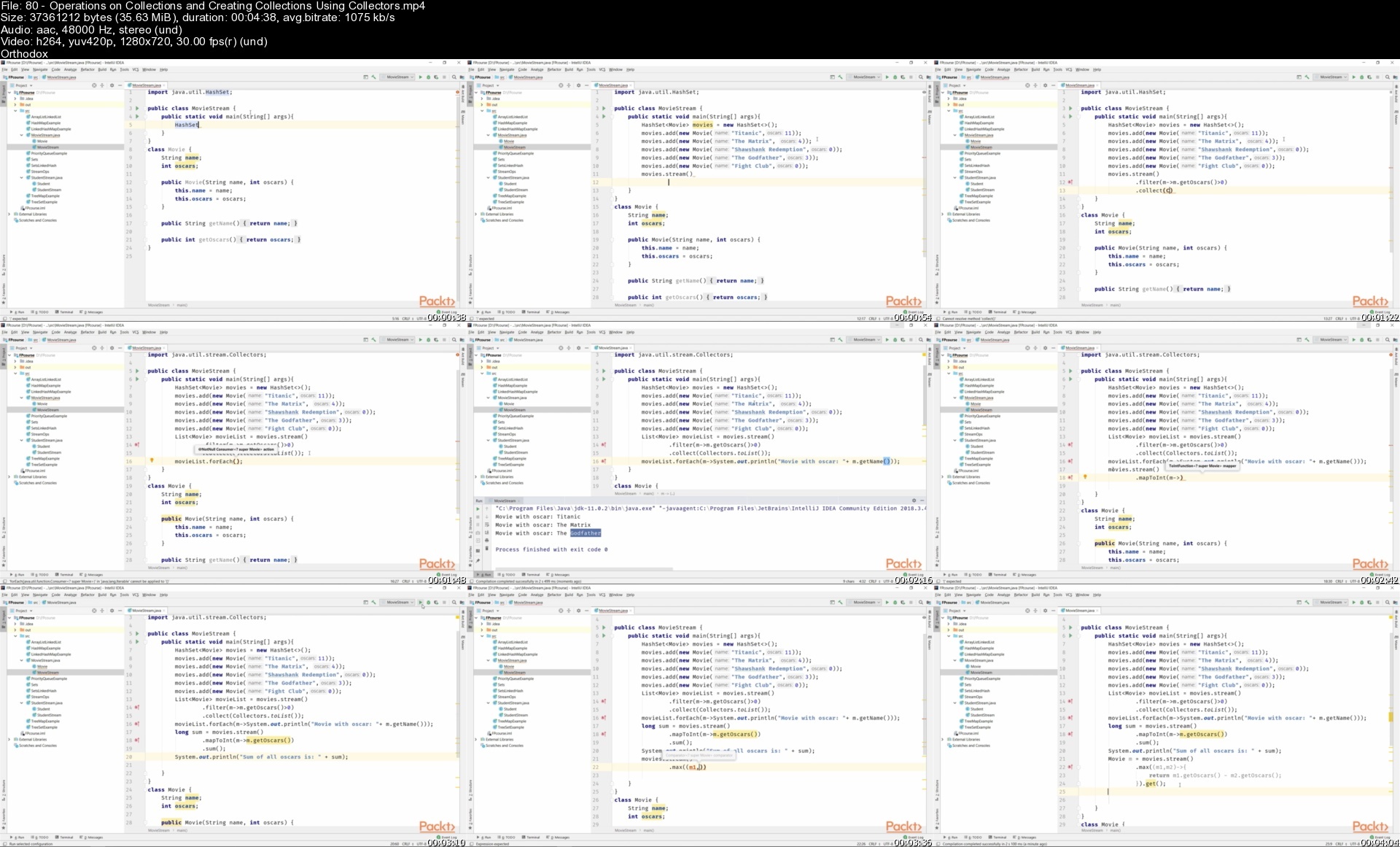
Lecture 80 Operations on Collections and Creating Collections Using Collectors

Lecture 81 Hands-on Collection Sorting Using Streams

Lecture 82 Advanced Filtering and Mapping Using Streams

Lecture 83 Using Reduce for Advanced Transformations

Lecture 84 Implementing flatMap in Examples

Lecture 85 Advanced Grouping of Objects Using Streams

Lecture 86 Advanced Joining and Partitioning of Objects Using Streams

Lecture 87 Benefits of Concurrent Streams and Concurrency in General

Lecture 88 Implementing Parallel Streams

Lecture 89 Parallel Stream Operations

Lecture 90 Comparing Sequential to Parallel Streams

Section 4: Hands-On Reactive Programming with Java 12

Lecture 91 The Course Overview

Lecture 92 Flow: The Main Entry Point of Every Reactive App

Lecture 93 Subscriber versus Publisher: When to Use Which

Lecture 94 Hot Publisher: Why It Is Hard to Take Control Over It

Lecture 95 Cold Publisher: Pairing with Back Pressure

Lecture 96 Consuming Messages: Creating a Subscriber

Lecture 97 Using Publisher to Emit Stock Events

Lecture 98 Testing Stock Reactive Flow

Lecture 99 Handling Errors in Subscriber

Lecture 100 Flow.Processor API for the Skeleton of Transformation

Lecture 101 Using SubmissionPublisher for Proxying Event to Another Publisher in the Chain

Lecture 102 Plugging the TransformProcessor for Transformation Logic

Lecture 103 Testing Stock Transformation Logic

Lecture 104 Leveraging Subscription Object for Controlling the Number of Fetched Stocks

Lecture 105 Controlling the Speed of Consumer with AtomicInteger

Lecture 106 Creating Overproducing Publisher

Lecture 107 Testing Backpressure in Stock Exchange Application

Lecture 108 RxJava - Observables Abstractions

Lecture 109 RxJava - Advanced Operations - flatMap

Lecture 110 Reactor - Flux

Lecture 111 Reactor - Combining Publishers

Lecture 112 Reactive Spring Boot

Lecture 113 Creating Reactive Data Access Layer

Lecture 114 Creating Reactive Controller

Lecture 115 Testing Reactive Microservices

Section 5: Java Concurrency and Multithreading in Practice

Lecture 116 The Course Overview

Lecture 117 Executing Tasks in Parallel with ForkJoinPool

Lecture 118 Joining the Results of the Tasks

Lecture 119 RecursiveAction and RecursiveTask

Lecture 120 Exception Handling and Cancelling a Task

Lecture 121 Callable and Future

Lecture 122 Thread and Thread Pool

Lecture 123 CompletableFuture

Lecture 124 Sequential Streams

Lecture 125 Parallel Streams

Lecture 126 Overview: Publishers, Subscribers, and Subscriptions

Lecture 127 Subscriber: Consuming Messages

Lecture 128 Publisher and SubmissionPublisher: Providing Messages

Lecture 129 Processor: Transforming Messages

Lecture 130 Threads: Thread Lifecycle

Lecture 131 Structured Locks (The "synchronized" Keyword)

Lecture 132 Working with Locks

Lecture 133 Object#wait(), notify(), and the New onSpinWait()

Lecture 134 Possible Problems: Data Races, Deadlock, Livelock, and Resource Starvation

Lecture 135 Atomic Types and the Compare-and-Set Approach

Lecture 136 Concurrent Collections: ConcurrentHashMap, ConcurrentLinkedQueue

Lecture 137 Blocking Queues

Lecture 138 Copy-on-Write Collections

Lecture 139 Wrap Up and Next Steps

This course is for anyone who wants to get ahead in Java programming.

Homepage

80operationsoncollectoxdr4.jpg


Microsoft 70-243 Administering & Deploying System Center2012

w1mkszvpqlshckptcsyp5obio2.jpg


Microsoft 70-243 Administering & Deploying System Center2012
Last updated 7/2017
MP4 | Video: h264, 1280x720 | Audio: AAC, 44.1 KHz
Language: English | Size: 5.39 GB | Duration: 17h 52m

Administering and Deploying System Center 2012 Configuration Manager


What you'll learn
This course will prepare you to pass the exam Microsoft 70-243 Administering & Deploying System Center2012
This new course provides you the needed training for the complete System Center Configuration Manager Infrastructure, as well as configuring roles, Central Administration Site, Secondary Site, Replication, Client Deployment, Manager Console, Manager Site, Resources and more.

Requirements
Basic knowledge of Administering and Deploying System Center 2012 Configuration Manager

Description
The new and exciting System Center 2012 Configuration Manager course provides full coverage of the knowledge and skills required to configure and manage a System Center 2012 Configuration Manager site and any associated site systems for the Configuration Manager administrator role.
This new course provides you the needed training for the complete System Center Configuration Manager Infrastructure, as well as configuring roles, Central Administration Site, Secondary Site, Replication, Client Deployment, Manager Console, Manager Site, Resources and more.
This course brings together all the features of using System Center 2012 Configuration Manager.
Some of the skills you will learn in this class are
Plan and deploy a single primary sitePlan and configure administrative rolesDescribe replication and data types and monitor the replication of data throughout the hierarchyPerform maintenance tasks and monitor site systemsPerform migration of objects from Configuration Manager 2007 to Configuration Manager 2012Discovery and organize resourcesManage inventory and software meteringManage software deployments by using packages and programsCreate and deploy applicationsImplement System Center 2012 Endpoint ProtectionManage mobile devicesConfigure Wake On LAN, power management and Remote Control

Overview

Section 1: Module 1

Lecture 1 Course Introduction

Lecture 2 Instructor Introduction

Lecture 3 Course Overview

Lecture 4 Student Prerequisites Part1

Lecture 5 Student Prerequisites Part2

Lecture 6 Certification Overview Part1

Lecture 7 Certification Overview Part2

Lecture 8 Certification Overview Part3

Lecture 9 Chapter Review

Section 2: Module 2

Lecture 10 Course Details Overview Part1

Lecture 11 Course Details Overview Part2

Lecture 12 Course Details Overview Part3

Lecture 13 Chapter Review

Section 3: Module 3

Lecture 14 System Center History

Lecture 15 Server Product Family History

Lecture 16 Microsoft System Center 2012 Website Part1

Lecture 17 Microsoft System Center 2012 Website Part2

Lecture 18 Configuration Manager Overview Part1

Lecture 19 Configuration Manager Overview Part2

Lecture 20 Configuration Manager Overview Part3

Lecture 21 What's New In SP1 Part1

Lecture 22 What's New In SP1 Part2

Lecture 23 Chapter Review

Section 4: Module 4

Lecture 24 System Center Roles

Lecture 25 Automating System Tasks

Lecture 26 Configuration Manager Features Part1

Lecture 27 Configuration Manager Features Part2

Lecture 28 Configuration Manager Features Part3

Lecture 29 Configuration Manager Features Part4

Lecture 30 Configuration Manager Console

Lecture 31 CM Console Demonstration Part1

Lecture 32 CM Console Demonstration Part2

Lecture 33 CM Console Demonstration Part3

Lecture 34 CM Console Demonstration Part4

Lecture 35 Chapter Review

Section 5: Module 5

Lecture 36 Hierarchy and Infrastructure

Lecture 37 Hierarchy, Sites and Roles

Lecture 38 Primary Sites Part1

Lecture 39 Primary Sites Part2

Lecture 40 Primary Sites Part3

Lecture 41 Core Roles

Lecture 42 Optional Roles Part1

Lecture 43 Optional Roles Part2

Lecture 44 Optional Roles Part3

Lecture 45 Optional Roles Part4

Lecture 46 Configuration Manager Prerequisites Checker

Lecture 47 Configuration Manager Pre-Installation Requirements Part1

Lecture 48 Configuration Manager Pre-Installation Requirements Part2

Lecture 49 Configuration Manager Pre-Installation Requirements Part3

Lecture 50 Configuration Manager Pre-Installation Requirements Part4

Lecture 51 Configuration Manager Pre-Installation Part1

Lecture 52 Configuration Manager Pre-Installation Part2

Lecture 53 Configuration Manager Pre-Installation Part3

Lecture 54 Running Configuration Manager Prerequisites Check

Lecture 55 Installing Configuration Manager Part1

Lecture 56 Installing Configuration Manager Part2

Lecture 57 Installing Configuration Manager Part3

Lecture 58 Installing Configuration Manager Part4

Lecture 59 Chapter Review

Section 6: Module 6

Lecture 60 Boundaries, Sites and Discovery

Lecture 61 Discovery and Boundaries

Lecture 62 Active Directory Discovery

Lecture 63 Active Directory Discovery Methods Part1

Lecture 64 Active Directory Discovery Methods Part2

Lecture 65 Active Directory Discovery Methods Part3

Lecture 66 Active Directory Discovery Methods Part4

Lecture 67 Boundaries

Lecture 68 Configuring Boundaries & Boundary Groups Part1

Lecture 69 Configuring Boundaries & Boundary Groups Part2

Lecture 70 Post Installation Tasks Part1

Lecture 71 Post Installation Tasks Part2

Lecture 72 Post Installation Tasks Part3

Lecture 73 Chapter Review

Section 7: Module 7

Lecture 74 Collections and Inventory

Lecture 75 Collections

Lecture 76 Maintenance Window

Lecture 77 Configuring a Device Collection

Lecture 78 Configuring a User Collection

Lecture 79 Maintenance Window Setup Part1

Lecture 80 Maintenance Window Setup Part2

Lecture 81 Inventory Collections

Lecture 82 Inventory DATA

Lecture 83 Hardware and Software Inventory Part1

Lecture 84 Hardware and Software Inventory Part2

Lecture 85 Configuring and Managing Inventory Part1

Lecture 86 Configuring and Managing Inventory Part2

Lecture 87 Chapter Review

Section 8: Module 8

Lecture 88 Collections, Queries and Asset Intelligence

Lecture 89 Asset Intelligence

Lecture 90 Asset Data

Lecture 91 Asset Data Gathering

Lecture 92 Asset Intelligence Gathering Demonstration Part1

Lecture 93 Asset Intelligence Gathering Demonstration Part2

Lecture 94 Pre-Query Setup Part1

Lecture 95 Pre-Query Setup Part2

Lecture 96 Pre-Query Setup Part3

Lecture 97 Pre-Query Setup Part4

Lecture 98 Queries Part1

Lecture 99 Queries Part2

Lecture 100 Creating and Testing Data Queries Part1

Lecture 101 Creating and Testing Data Queries Part2

Lecture 102 Creating and Testing Data Queries Part3

Lecture 103 Creating Status Queries Part1

Lecture 104 Creating Status Queries Part2

Lecture 105 Chapter Review

Section 9: Module 9

Lecture 106 Client Deployment, Settings, Monitoring and Managing

Lecture 107 Configuration Manager Client Part1

Lecture 108 Configuration Manager Client Part2

Lecture 109 Applet Settings Part1

Lecture 110 Applet Settings Part2

Lecture 111 Installing Configuration Manager Client Part1

Lecture 112 Installing Configuration Manager Client Part2

Lecture 113 Preparing Client Deployment

Lecture 114 Setting Up Group Policy Management Part1

Lecture 115 Setting Up Group Policy Management Part2

Lecture 116 Deployment Part1

Lecture 117 Deployment Part2

Lecture 118 Client and Server Side Properties Part1

Lecture 119 Client and Server Side Properties Part2

Lecture 120 Client and Server Side Properties Part3

Lecture 121 Device and Client Management

Lecture 122 Configuration Manager Client Settings Part1

Lecture 123 Configuration Manager Client Settings Part2

Lecture 124 Client Monitoring Part1

Lecture 125 Client Monitoring Part2

Lecture 126 Client Monitoring Part3

Lecture 127 Client Monitoring Part4

Lecture 128 Chapter Review

Section 10: Module 10

Lecture 129 Software Packaging

Lecture 130 Software Deployment Part1

Lecture 131 Software Deployment Part2

Lecture 132 Distribution

Lecture 133 Packages Part1

Lecture 134 Packages Part2

Lecture 135 Programs within Packages

Lecture 136 Distribution

Lecture 137 Package Deployment Part1

Lecture 138 Package Deployment Part2

Lecture 139 Deployment Configuration Wizard

Lecture 140 Client Side Deployment

Lecture 141 Building Packages Part1

Lecture 142 Building Packages Part2

Lecture 143 Building Packages Part3

Lecture 144 Building Packages Part4

Lecture 145 Chapter Review

Section 11: Module 11

Lecture 146 Software Applications

Lecture 147 Configuration Manager Software Applications Part1

Lecture 148 Configuration Manager Software Applications Part2

Lecture 149 Applications Vs. Packages

Lecture 150 Application Requirements

Lecture 151 Application Deployment Types

Lecture 152 Application Management

Lecture 153 Creating an Application Part1

Lecture 154 Creating an Application Part2

Lecture 155 Creating an Application Part3

Lecture 156 Creating an Application Part4

Lecture 157 Creating an Application Part5

Lecture 158 Creating an Application Part6

Lecture 159 Detect and Deploy

Lecture 160 Creating and Deploying an Application Part1

Lecture 161 Creating and Deploying an Application Part2

Lecture 162 Creating and Deploying an Application Part3

Lecture 163 Creating and Deploying an Application Part4

Lecture 164 Creating and Deploying an Application Part5

Lecture 165 Chapter Review

Section 12: Module 12

Lecture 166 Software Distribution, Metering and Monitoring

Lecture 167 Software Distribution

Lecture 168 Configuration Manager Components

Lecture 169 Metering

Lecture 170 Distributing Content To a Distribution Point

Lecture 171 App Catalog Advertisements Part1

Lecture 172 App Catalog Advertisements Part2

Lecture 173 App Catalog Advertisements Part3

Lecture 174 Configuring an Agent and Creating Rules for Software Metering Part1

Lecture 175 Configuring an Agent and Creating Rules for Software Metering Part2

Lecture 176 Advanced Application Deployment Part1

Lecture 177 Advanced Application Deployment Part2

Lecture 178 Application Supersedence and Removal Part1

Lecture 179 Application Supersedence and Removal Part2

Lecture 180 Chapter Review

Section 13: Module 13

Lecture 181 Software Updates Part1

Lecture 182 Software Updates Part2

Lecture 183 Configuration Manager Software Updates

Lecture 184 Configuration Manager Updating

Lecture 185 Site Components and Role SU Point

Lecture 186 Metadata

Lecture 187 WSUS Pieces

Lecture 188 Software Update Setup Part1

Lecture 189 Software Update Setup Part2

Lecture 190 Software Update Setup Part3

Lecture 191 Software Update Setup Part4

Lecture 192 Software Update Setup Part5

Lecture 193 Software Update Setup Part6

Lecture 194 Chapter Review

Section 14: Module 14

Lecture 195 Operating System Deployment (OSD)

Lecture 196 Operating System Deployment Basics Part1

Lecture 197 Operating System Deployment Basics Part2

Lecture 198 Operating System Deployment Basics Part3

Lecture 199 WDS Basics

Lecture 200 Configuration Manager Components Part1

Lecture 201 Configuration Manager Components Part2

Lecture 202 General Deployment Steps Part1

Lecture 203 General Deployment Steps Part2

Lecture 204 Task Sequence Deployment

Lecture 205 Configuring State Migration Point and Software Distribution Component

Lecture 206 Distributing Driver Packages

Lecture 207 Distributing Boot Images

Lecture 208 Creating and Installing Packages Part1

Lecture 209 Creating and Installing Packages Part2

Lecture 210 Capture and Distribute Ref Image Part1

Lecture 211 Capture and Distribute Ref Image Part2

Lecture 212 Capture and Distribute Ref Image Part3

Lecture 213 Performing an In Place Upgrade & Deploying OSD Part1

Lecture 214 Performing an In Place Upgrade & Deploying OSD Part2

Lecture 215 Performing an In Place Upgrade & Deploying OSD Part3

Lecture 216 Chapter Review

Section 15: Module 15

Lecture 217 Endpoint Protection (FEP)

Lecture 218 AV Security 101

Lecture 219 FEP Basics Part1

Lecture 220 FEP Basics Part2

Lecture 221 FEP Prerequisites

Lecture 222 Client Settings

Lecture 223 Policies and Alerts

Lecture 224 Installing and Deploying In Point Protection

Lecture 225 Protection Policy Setup and Deployment Part1

Lecture 226 Protection Policy Setup and Deployment Part2

Lecture 227 Protection Policy Setup and Deployment Part3

Lecture 228 Monitoring Part1

Lecture 229 Monitoring Part2

Lecture 230 Monitoring Part3

Lecture 231 Chapter Review

Section 16: Module 16

Lecture 232 Role Based Administration (RBA)

Lecture 233 Configuration Manager RBA Part1

Lecture 234 Configuration Manager RBA Part2

Lecture 235 Actions

Lecture 236 Standard IT Team

Lecture 237 Roles

Lecture 238 Scopes

Lecture 239 Collections

Lecture 240 IT Correlation

Lecture 241 Creating Scopes, Collections and Roles Part1

Lecture 242 Creating Scopes, Collections and Roles Part2

Lecture 243 Creating Scopes, Collections and Roles Part3

Lecture 244 Chapter Review

Section 17: Module 17

Lecture 245 Security Compliance

Lecture 246 Compliance Part1

Lecture 247 Compliance Part2

Lecture 248 Compliance Baselines

Lecture 249 Configuration Packs

Lecture 250 Creating Configuration Items Part1

Lecture 251 Creating Configuration Items Part2

Lecture 252 Creating and Deploying Configuration Baselines

Lecture 253 Configuration Items Evaluation and Reports Part1

Lecture 254 Configuration Items Evaluation and Reports Part2

Lecture 255 Wake On LAN (WOL)

Lecture 256 Out Of Band Management (OOB MGT)

Lecture 257 Power Management

Lecture 258 Remote Control

Lecture 259 Applying a Power Management Plan

Lecture 260 Remote Control Setup Part1

Lecture 261 Remote Control Setup Part2

Lecture 262 Remote Control Setup Part3

Lecture 263 Remote Control Setup Part4

Lecture 264 Chapter Review

Section 18: Module 18

Lecture 265 Reporting

Lecture 266 Configuration Manager Reporting

Lecture 267 SQL Reporting Services

Lecture 268 SQL Prerequisites

Lecture 269 Reporting Services Point Setup Part1

Lecture 270 Reporting Services Point Setup Part2

Lecture 271 Report Subscriptions

Lecture 272 Role Security

Lecture 273 Chapter Review

Section 19: Module 19

Lecture 274 Mobile Device and Mobile Security

Lecture 275 Mobile Device Management (MDM)

Lecture 276 Enrollment

Lecture 277 Settings and Application Deployment

Lecture 278 Infrastructure Preparation and Enrollment Part1

Lecture 279 Infrastructure Preparation and Enrollment Part2

Lecture 280 Infrastructure Preparation and Enrollment Part3

Lecture 281 Infrastructure Preparation and Enrollment Part4

Lecture 282 Mobile Device Configuration Settings

Lecture 283 Deploying Mobile Device Applications Part1

Lecture 284 Deploying Mobile Device Applications Part2

Lecture 285 Chapter Review

Section 20: Module 20

Lecture 286 Complex Hierarchy - Multi Site

Lecture 287 Hierarchy Sites and Roles

Lecture 288 Primary

Lecture 289 Secondary

Lecture 290 Central Administration Site

Lecture 291 Roles

Lecture 292 Prerequisites Checker

Lecture 293 Pre CAS Installation Setup

Lecture 294 CAS Installation

Lecture 295 Post CAS Tasks

Lecture 296 Chapter Review

Section 21: Module 21

Lecture 297 Course Review Part1

Lecture 298 Course Review Part2

Lecture 299 Certification Review

Lecture 300 Study Recommendations and Exam Preparations

IT Professionals

Homepage


247compliancepart2s6ber9.jpg


Vmware Vsphere 6.5 Administration Basics Ultimate Part 1

9yooe78bp7cralxvdzluvh9cck.jpg


Vmware Vsphere 6.5 Administration Basics Ultimate Part 1
Last updated 2/2019
MP4 | Video: h264, 1280x720 | Audio: AAC, 44.1 KHz
Language: English | Size: 5.11 GB | Duration: 10h 20m

VMware vSphere 6.5 Administration Basics Ultimate Part 1


What you'll learn
Understand and describe the concept behind software-defined data center
Have a thorough understanding of vSphere
Create and deploy a virtual machine or ESXi host
Comprehend vCenter Server architecture
Manage virtual machines using vCenter
Configure standard network policies
Configure new storage features in vSphere
Control user access and passwords
Understand the working of vMotion
Understand various components of vSphere
Create, clone, and export a vApp
Describe and use the content library
Migrate virtual machines and storages with VMware vMotion
Monitor resource usage and manage resource pools.
Configure vSphere HA

Requirements
The course requires the students to have operational experience of managing and administering a Windows or Linux based environment.
A brief know-how of virtualization technologies and cloud computing is an added advantage.

Description
The VMware vSphere 6.5 Administration Basics Ultimate Bootcamp is a hands-on training course that features intensive practical training that focuses on administration basics of the VMware vSphere 6.5, which includes VMware ESXi 6.5 and VMware vCenter Server 6.5. This course enables the candidates to efficiently manage and administer a vSphere infrastructure of any size for any organization. It is the foundation course for most of the other VMware technologies courses and also provides a starting point to explore deeper in the field of software-defined data center.The VMware vSphere 6.5 Administration Basics Ultimate Bootcamp course covers the fundamental tools and techniques required to plan, install and administer a VMware environment including disaster recovery and backup. It also teaches the students on creating, configuring and securing virtual machines. The students will get a basic understanding of licensing and different components of the VMware vSphere suite of applications. The course will be helpful in preparing for the Certified Virtualization Expert (CVE) exam from VMware.

Overview

Section 1: Course Introduction

Lecture 1 Course Introduction

Lecture 2 Instructor Introduction

Section 2: Chapter 01 - Getting Started with PowerPoint

Lecture 3 Learn IT! Do IT! Know IT!

Lecture 4 Certified Virtualization Expert (CVE) Certification

Section 3: Chapter 02 - Virtualization Overview

Lecture 5 Introduction

Lecture 6 Topic 1: VMware Virtualization Overview

Lecture 7 Topic 1: VMware Virtualization

Lecture 8 The Software-Defined Datacenter (SDDC)

Lecture 9 vCloud Suite 7.0

Lecture 10 Class Exercise - Why Virtualize?

Lecture 11 Why Virtualize? - Simplified Management!

Lecture 12 VMware TCO Comparison Calculator

Lecture 13 What is Virtual Infrastructure?

Lecture 14 VMware vSphere 6.x

Lecture 15 Type 1 and Type 2 Hypervisors

Lecture 16 Hypervisors Comparison

Lecture 17 What is Virtual Machine (VM)

Lecture 18 Topic 2: Other VMware & 3rd Party Virtualization Virrtual Machine (VM)?

Lecture 19 VMware Horizon View 7.x (Virtual Desktop Infrastructure)

Lecture 20 VMware Horizon FLEX

Lecture 21 VMware Workstation Pro 12.5

Lecture 22 VMware Fusion 8.5

Lecture 23 VMware Workstation Player

Lecture 24 Windows Server Virtualization Hyper-V (Windows Server 2012 R2)

Lecture 25 System Center Virtual Machine Manager 2012 R2

Lecture 26 XenServer Enterprise v7.x

Lecture 27 XenDesktop & Essentials for XenServer

Lecture 28 Topic 3: What's New vSphere 6.5 Overview

Lecture 29 What's New in vSphere 6.5

Lecture 30 Chapter 02 Review

Section 4: Chapter 03 - Planning and Installing ESXi

Lecture 31 Introduction

Lecture 32 Chapter 03 Overview

Lecture 33 Topic 1: Planning the ESXi Deployment

Lecture 34 Physical Hardware Requirements

Lecture 35 vSphere Hypervisor 6.5 (VMware ESXi)

Lecture 36 VMware ESXi 6.5

Lecture 37 Booting ESXi from a SAN LUN (Fibre Channel or iSCSI)

Lecture 38 Booting ESXi from a SAN LUN

Lecture 39 Linux, Windows & ESXi

Lecture 40 Topic 2: vSphere 6.x Deployment Guidelines

Lecture 41 Overview of Deployment Planning

Lecture 42 ESXi Compatibility Guides

Lecture 43 Storage: Capacity and Performance

Lecture 44 VMware Capacity Planner

Lecture 45 Topic 3: vSphere Hypervisor (ESXi) Installation

Lecture 46 vSphere Hypervisor 6.x Installable

Lecture 47 ESXi Installation Options

Lecture 48 VMware Software Manager

Lecture 49 Demo: Installation of ESXi 6.5

Lecture 50 Local Configuration of ESXi 6.0 using DCUI

Lecture 51 vSphere 6.x ESXi Image Builder CLI

Lecture 52 vSphere 5.x/6.x Auto Deploy Architecture

Lecture 53 vSphere 6.x Auto Deploy for ESXi PXE Boot

Lecture 54 Auto Deploy/ESXi Image Builder in vSphere 6.5

Lecture 55 Auto Deploy/ESXi Image Builder in vSphere 6.5 - Demo

Lecture 56 Topic 4: Configuring Hostname Resolution and NTP

Lecture 57 Configuring DNS Settings

Lecture 58 Time Synchronization

Lecture 59 Topic 5: Troubleshooting ESXi

Lecture 60 ESXi Host Health Check

Lecture 61 ESXi System Logs

Lecture 62 ESXi Host Boot Process

Lecture 63 Resetting root Password ESXi 6.x

Lecture 64 Troubleshooting: hostd

Lecture 65 Troubleshooting ESXi Management Agents

Lecture 66 Purple Screen of Death (PSOD)

Lecture 67 Chapter 03 Review

Section 5: Chapter 04 - Using Tools to Administer a VMware Environment

Lecture 68 Introduction

Lecture 69 Chapter 04 Overview

Lecture 70 Topic 1: Overview of 3rd Party Tools

Lecture 71 WinSCP 5.x.x (Free)

Lecture 72 ISO Programs

Lecture 73 RVTools v 3.x

Lecture 74 Other Tools

Lecture 75 Topic 2: ESXi Management

Lecture 76 ESXi Host & vCenter Server Management Overview

Lecture 77 Direct Console User Interface (DCUI)

Lecture 78 Managing ESXi with the vSphere Client (VIC)

Lecture 79 VMware Host Client

Lecture 80 The Management User Interface (MUI) (ESXi or vCenter)

Lecture 81 Managing with the vSphere Web Client

Lecture 82 NEW vSphere Client 6.5 (HTML5)

Lecture 83 SSH Access: PuTTY, SecureCRT, WinSCP, etc.

Lecture 84 Datastore Browser

Lecture 85 Configuration of Troubleshooting Options in ESXi 6.x

Lecture 86 Troubleshooting Options: ESXi 6.x

Lecture 87 CLI Commands Overview

Lecture 88 PowerCLI 6.5 Release 1

Lecture 89 Topic 3: Linux Command Review

Lecture 90 Windows Commands vs. Linux Commands

Lecture 91 Common Command Line Interface (CLI) Options

Lecture 92 Working at the Command Line (CLI)

Lecture 93 ESXi 6.x Text Editor

Lecture 94 Topic 4: Troubleshooting Host/VC Connections

Lecture 95 Cannot Login Using any Client

Lecture 96 Chapter 04 Review

Section 6: Chapter 05 - vCenter Server 6.5 and Licensing

Lecture 97 Introduction

Lecture 98 Chapter 05 Overview

Lecture 99 Topic 1: Licensing

Lecture 100 vCenter Server 6.x & ESXi Host Licensing Model

Lecture 101 vSphere Essentials 6.5 for Small Business

Lecture 102 vSphere 6.5 License Types and Pricing

Lecture 103 vSphere with Operations Management Enterprise Plus (vSOM)

Lecture 104 Upgrade Enterprise to Enterprise Plus Promotion - 50% off

Lecture 105 Topic 2: Planning vCenter Server Deployment

Lecture 106 vCenter Server 6.5 Summary

Lecture 107 Windows vCenter Server 6.5 Specs

Lecture 108 Windows vCenter Database Specs

Lecture 109 vCenter Server Virtual Appliance (vCSA) 6.0 Specifications

Lecture 110 vCenter Server Virtual Appliance (vCSA) 6.5 Specifications

Lecture 111 Comparing Windows vCenter 6.0 to vCSA 6.0/vCSA 6.5

Lecture 112 vCenter Server 6.0/6.5 Host Functionality

Lecture 113 vCenter Server 6.0/6.5 Managing Multiple Locations

Lecture 114 vCenter Server 6.0/6.5 Connection through SSO

Lecture 115 VC Server 6.x Architecture

Lecture 116 Components of vCenter 6.x - Platform Services Controller (PSC)

Lecture 117 Components of vCenter 6.x - vCenter Server

Lecture 118 Topologies for vCenter 6.x

Lecture 119 HA Topologies for vCenter 6.5

Lecture 120 vCenter Server APIs

Lecture 121 vCenter Server 6.x Database Sizing

Lecture 122 Backup Strategy for vCenter Server

Lecture 123 Native vCenter Server Backup

Lecture 124 Native vCenter Server Restore

Lecture 125 vCenter Server HA

Lecture 126 Topic 3: vCenter Server Installation

Lecture 127 vCenter 6.0/6.5 Installation (Windows or VCSA)

Lecture 128 Windows vCenter 6.5 Installation

Lecture 129 vCenter Server Appliance 6.5 for Embedded PSC (Linux Photon)

Lecture 130 vCenter Server 6.0/6.5 Post Install

Lecture 131 Topic 4: vSphere Web Client & vSphere Client

Lecture 132 vSphere Web Client

Lecture 133 Client Integration Plugin (CIP)

Lecture 134 vSphere Web Client 6.5

Lecture 135 vSphere Web Client - Requirements

Lecture 136 vSphere Client (HTML5)

Lecture 137 Using vSphere Web Client 6.5

Lecture 138 Summary of Clients in vSphere 6.5

Lecture 139 Topic 5: vCenter Server Inventory

Lecture 140 vCenter Server Home Page

Lecture 141 Hosts and Clusters: Datacenters

Lecture 142 Hosts and Clusters: Folders and Clusters (Default View)

Lecture 143 VMs and Templates: Subfolders

Lecture 144 vCenter Inventory: VMs/Templates Additional Information

Lecture 145 Storage: Folders and Datastores

Lecture 146 Networking: Portgroups & Distributed Switches (vDS)

Lecture 147 Content Library Basics

Lecture 148 What's New in Content Library 6.5

Lecture 149 Content Library Creation in 6.5

Lecture 150 Topic 6: Managing vCenter Server

Lecture 151 Scheduled Tasks

Lecture 152 Events

Lecture 153 Sessions

Lecture 154 Tasks/Alarms/Work in Progress & Logged On As

Lecture 155 New Recent Objects Pane

Lecture 156 Flings at VMware Labs

Lecture 157 Topic 7: Troubleshooting vCenter Server and Database

Lecture 158 Refreshing vCenter Server & ESXi

Lecture 159 Monitoring - Hardware Status

Lecture 160 Monitoring - vCenter Server Status

Lecture 161 VCSA root Account Timeout

Lecture 162 Chapter 05 Review

Section 7: Chapter 06 - Configuring Networking

Lecture 163 Introduction

Lecture 164 Chapter 06 Overview

Lecture 165 Topic 1: Creating & Modifying Virtual Networks

Lecture 166 Networking Terms

Lecture 167 vSphere 6.x Virtual Switch Types

Lecture 168 Network Connections in ESXi

Lecture 169 Add/Edit Networking

Lecture 170 Standard Virtual Switches (vSS)

Lecture 171 More Lanes on the Highway

Lecture 172 Virtual Switch & Connection Type Identification

Lecture 173 VMware Assigned MAC Addresses

Lecture 174 Custom MAC Address

Lecture 175 Virtual Switch Physical NIC Configurations

Lecture 176 NIC Teaming

Lecture 177 Cisco Discovery Protocol on vSS

Lecture 178 Modifying vSS Properties (Ports Tab in VIC)

Lecture 179 Ports

Lecture 180 Modifying vSwitch Properties (Network Adapters Tab)

Lecture 181 VLAN Overview

Lecture 182 VLAN Implementations

Lecture 183 Standard vSwitch VLAN Configuration

Lecture 184 Standard vSwitch Protection and VLANs

Lecture 185 Standard vSwitch & Port Group Policy Settings: Security

Lecture 186 Standard vSwitch and Port Group Policy Exceptions: Traffic Shaping

Lecture 187 Standard vSwitch and Port Group Policy Exceptions: NIC Teaming

Lecture 188 Network Failure and NIC Teaming Options

Lecture 189 Load Balancing Method: Route Based on the Originating Virtual Port ID (Default)

Lecture 190 Load Balancing Method: Route Based on Source MAC Hash

Lecture 191 Load Balancing Method: Route Based on IP Hash (Source + Destination)

Lecture 192 Requirements for IP Hash

Lecture 193 Port Group: Override vSwitch Failover Order

Lecture 194 Multiple Policies Applied to a Single Team

Lecture 195 vSphere Packet Routing

Lecture 196 Overriding Default Gateway of a Vmkernal Adapter

Lecture 197 Network Performance Improvements

Lecture 198 Physical Switch Configuration

Lecture 199 Topic 2: vSphere Distributed Switches

Lecture 200 vSphere Distributed vSwitch (vDS) Overview

Lecture 201 vSphere Distributed Switch (vDS) New Features in vSphere 5.0

Lecture 202 vSphere Distributed Switch (vDS) New Features in vSphere 5.1

Lecture 203 vSphere Distributed Switch (vDS) New Features in vSphere 5.5

Lecture 204 vSphere Distributed Switch (vDS) New Features in vSphere 6.0

Lecture 205 vSphere Distributed Switch (vDS) New Features in vSphere 6.5

Lecture 206 Creating a vSphere Distributed Switch

Lecture 207 Edit vDS Settings

Lecture 208 Edit vDS Uplink Settings

Lecture 209 Edit vDS Port Group Settings

Lecture 210 Port Binding Methods

Lecture 211 Private VLAN (PVLAN) Tagging

Lecture 212 Private VLANs

Lecture 213 Migrating VMkernel Port to vDS

Lecture 214 Network I/O Control (NIOC)

Lecture 215 Network I/O Control (NIOC) - Best Practices

Lecture 216 Create NetFlow

Lecture 217 Using Port Mirroring

Lecture 218 vDS Health Check

Lecture 219 vDS Backup & Restore

Lecture 220 Traffic Filtering and Marking

Lecture 221 Per VM NIOC 3 Settings

Lecture 222 Support for ERSPAN

Lecture 223 Configuring ERSPAN

Lecture 224 Networking Review

Lecture 225 Chapter 06 Review

Section 8: Chapter 07 - Configuring Storage

Lecture 226 Introduction

Lecture 227 Chapter 07 Overview

Lecture 228 Topic 0: New Storage Features in vSphere 6.5

Lecture 229 Storage Related Enhancements (1)

Lecture 230 Storage Related Enhancements (2)

Lecture 231 Topic 1: Storage Concepts

Lecture 232 Storage Terms

Lecture 233 SAN vs NAS in vSphere

Lecture 234 Device and Path Naming

Lecture 235 vSphere's Family of Storage APIs

Lecture 236 Storage API - Array Integration

Lecture 237 Storage API - Storage Awareness (VASA)

Lecture 238 Comparison of Storage Provider Versions (VASA)

Lecture 239 Multipathing

Lecture 240 Storage API - Multipathing (PSA)

Lecture 241 Path Selection Considerations

Lecture 242 Viewing Multipathing from VIC

Lecture 243 Viewing Multipathing - Web Client

Lecture 244 Example of 3rd Party Multipathing Plugin Installation (NMP)

Lecture 245 All Paths Down (APD)

Lecture 246 All Paths Down (APD) Cont.

Lecture 247 Storage API - I/O Filtering

Lecture 248 Storage API - I/O Filtering Info

Lecture 249 Storage I/O Control (SIOC)

Lecture 250 SIOC setup in Web Client

Lecture 251 SIOC Enhancements

Lecture 252 Configuring SIOC v2 Policy

Lecture 253 SIOC Monitoring

Lecture 254 Scanning LUNs - iSCSI/Fibre Channel

Lecture 255 Topic 2: iSCSI Storage (GUI & Command Line)

Lecture 256 Internet Small Computers Systems Interface (iSCSI) Overview

Lecture 257 iSCSI Terms for ESX / ESXi

Lecture 258 ESX / ESXi and iSCSI SAN Environment and Addressing

Lecture 259 Hardware vs. Software Initiators

Lecture 260 Multipathing with iSCSI

Lecture 261 Setup Steps - Multipathing with Software iSCSI

Lecture 262 iSCSI Software Initiator Networking

Lecture 263 Configuring iSCSI

Lecture 264 Jumbo Frames

Lecture 265 Configure Software Initiator: CHAP Authentication

Lecture 266 iSCSI Software Initiator Troubleshooting

Lecture 267 iSCSI Vendors and Products

Lecture 268 Topic 3: Fibre Channel Storage

Lecture 269 What is Fibre Channel?

Lecture 270 Fibre Channel Terms for ESXi

Lecture 271 ESX / ESXi and Fibre Channel SAN Environment and Addressing

Lecture 272 Multipathing with Fibre Channel

Lecture 273 Fibre Channel Vendors and Products

Lecture 274 Network/Storage Architecture Review

Lecture 275 Topic 4: VMFS Datastores (GUI & Command Line)

Lecture 276 Virtual Machine File System (VMFS-5)

Lecture 277 Virtual Machine File System (Updates in 5.5/6.x)

Lecture 278 About VMFS6

Lecture 279 New Block Sizes for Small Files and Large Files

Lecture 280 File Block Usage Example

Lecture 281 vSphere Storage APIs - Array Integration & Automatic UNMAP

Lecture 282 VMFS6 vs VMFS5

Lecture 283 Upgrade VMFS-3 to VMFS-5

Lecture 284 Upgrading VMFS5

Lecture 285 Viewing and Creating a VMFS-5 Datastore

Lecture 286 Extending your VMFS Datastore using Extents

Lecture 287 Add an Extent to Existing VMFS

Lecture 288 Expand an ESXi 6.x VMFS Volume

Lecture 289 Hidden System Files on a VMFS

Lecture 290 Topic 5: NAS Storage and NFS Datastores (GUI & Command Line)

Lecture 291 Network Attached Storage (NAS)

Lecture 292 NFS v4.1

Lecture 293 NFS 4.1 Improvements in 6.5

Lecture 294 NFS Components, Addressing and Access Control with NFS on Linux

Lecture 295 NFS target on Windows 2003 R2 & higher

Lecture 296 Mount an NFS Datastore to Host

Lecture 297 Topic 6: Raw Device Mapping (RDM)

Lecture 298 Raw Device Mapping (RDM)

Lecture 299 RDM Compatibility Modes

Lecture 300 Raw Device Mapping

Lecture 301 Topic 7: Solid State Disks (SSD)

Lecture 302 Solid State Disks (SSD)

Lecture 303 Using SMART with SSD

Lecture 304 When ESXi fails to identify SSDs

Lecture 305 vSphere Virtual Flash

Lecture 306 Configure a Virtual Flash Resource

Lecture 307 Configure Virtual Flash Host Swap

Lecture 308 Virtual Flash Read Cache

Lecture 309 Virtual Flash Read Cache (cont)

Lecture 310 Topic 8: Storage & Management Solutions

Lecture 311 vFoglight for Storage - Quest

Lecture 312 vOptimizer Pro (vOPS Storage Optimizer) - Quest Software

Lecture 313 Topic 9: VMware Virtual SAN (VSAN)

Lecture 314 VSAN Overview

Lecture 315 VSAN Device Configuration

Lecture 316 VSAN Cluster Configuration

Lecture 317 VSAN Architecture

Lecture 318 VSAN 6.0 - What's new

Lecture 319 VSAN Version 6.2

Lecture 320 VSAN Version 6.5

Lecture 321 VSAN Version 6.6

Lecture 322 Topic 10: vSphere Virtual Volumes (VVols)

Lecture 323 vSphere Virtual Volumes (Vvols) - Concepts

Lecture 324 vSphere Virtual Volumes (Vvols) - Architecture

Lecture 325 vSphere Virtual Volumes (Vvols) - Characteristics

Lecture 326 vSphere Virtual Volumes (Vvols) - Considerations, Limitations & Guidelines

Lecture 327 Virtual Volumes Replication

Lecture 328 Replication Storage Policies

Lecture 329 VVols Certified Storage Vendors

Lecture 330 Chapter 07 Review

Section 9: Chapter 08 - VM Creation, Configuration, and Snapshots

Lecture 331 Introduction

Lecture 332 Chapter 08 Overview

Lecture 333 Topic 1: Create a VM

Lecture 334 VM Virtual Hardware

Lecture 335 Types of Virtual NICs (vNIC)

Lecture 336 Virtual Machine Files

Lecture 337 VMDK Disk Provisioning

Lecture 338 Virtual Disk

Lecture 339 VM HW v13 Properties

Lecture 340 VM Hardware Versions Compared

Lecture 341 Virtual SCSI Controller Type

Lecture 342 Install Guest OS into VM

Lecture 343 VM Console & Menus - VIC

Lecture 344 VMRC or Web Console 6.5

Lecture 345 VMware Tools

Lecture 346 VMware Tools 5.0 & earlier vs 5.1/5.5/6.0

Lecture 347 VMware Tools 10.1 & 10.0.12

Lecture 348 Topic 2: Create Multiple VMs, Templates & Clones

Lecture 349 Clones & Templates

Lecture 350 Deploy VM from Template

Lecture 351 Customizing the OS in a Virtual Machine

Lecture 352 Customization Specification Manager

Lecture 353 Topic 3: Virtual Appliances

Lecture 354 Virtual Appliances

Lecture 355 Import Virtual Appliances

Lecture 356 Export VM to OVF Format

Lecture 357 Content Library - Store Template

Lecture 358 Use Template from Library

Lecture 359 Customize existing VM

Lecture 360 Deploying Across Datacenters

Lecture 361 Topic 4: Configuration and Use of vApps

Lecture 362 vApp Overview

Lecture 363 Creating and using vApps

Lecture 364 Topic 5: Manage VMs

Lecture 365 Hot Add Memory and CPUs

Lecture 366 VM Properties - Hardware Tab

Lecture 367 Adding USB Devices to VM

Lecture 368 VM Properties - Options Tab

Lecture 369 Resize a Virtual Disk

Lecture 370 Extend VMDK

Lecture 371 Dell's extpart - NO REBOOT

Lecture 372 Extend partitions using gparted

Lecture 373 vOptimizer Pro

Lecture 374 Raxco PerfectStorage

Lecture 375 Renaming a Virtual Machine

Lecture 376 Topic 6: Virtual Machine Startup / Shutdown

Lecture 377 Startup/Shutdown of VMs

Lecture 378 Enabling VM Startup/Shutdown

Lecture 379 Topic 7: Virtual Machine Snapshots

Lecture 380 Virtual Machine Snapshots

Lecture 381 Files used by Snapshots

Lecture 382 Taking Snapshots

Lecture 383 Snapshot Manager

Lecture 384 Reverting to a Snapshot

Lecture 385 Deleting Snapshots

Lecture 386 Consolidating Snapshots

Lecture 387 Topic 8: Virtual Machine Troubleshooting & Best Practices

Lecture 388 Troubleshooting VM Problems

Lecture 389 Differences between VMs and Physical Servers (Best Practices)

Lecture 390 Chapter 08 Review

Section 10: Chapter 09 - Security and Permissions

Lecture 391 Introduction

Lecture 392 Chapter 09 Overview

Lecture 393 Topic 1: Controlling User Access and Passwords

Lecture 394 Types of Users

Lecture 395 ESXi Account Security

Lecture 396 ESXi Account Security Configuration

Lecture 397 ESXi Security Enhancements

Lecture 398 Lockdown Modes in vSphere 6.x

Lecture 399 vSphere 6.5: Security Enhancements

Lecture 400 VM Encryption

Lecture 401 VM Encryption Workflow

Lecture 402 vMotion Encryption

Lecture 403 ESXi 6.5 Secure Boot

Lecture 404 UEFI Secure Boot for ESXi 6.5 Hosts

Lecture 405 VM Secure Boot

Lecture 406 vCenter/ESXi Host Security Model

Lecture 407 Permissions

Lecture 408 Global Permissions

Lecture 409 Roles

Lecture 410 Privileges Explained

Lecture 411 ESXi Host Permissions

Lecture 412 Windows vCenter Permissions

Lecture 413 vCSA Permissions

Lecture 414 Topic 2: ESXi Active Directory (AD) Integration

Lecture 415 AD ESXi Authentication Services

Lecture 416 Assign ESXi Permissions Directly to AD Users

Lecture 417 Topic 3: Managing Firewalls

Lecture 418 ESXi Firewall

Lecture 419 TCP & UDP Ports

Lecture 420 ESXi Firewall Configuration via vSphere Web Client

Lecture 421 Topic 4: Managing Security Certificates

Lecture 422 Data Encryption

Lecture 423 Certificate Changes in vSphere 6.0

Lecture 424 VMware Certificate Management

Lecture 425 Addition Certificate Information

Lecture 426 Chapter 09 Review

Section 11: Chapter 10 - Server and VM Monitoring

Lecture 427 Introduction

Lecture 428 Chapter 10 Overview

Lecture 429 Topic 1: Optimizing Resources

Lecture 430 Transparent Memory Page Sharing

Lecture 431 TPS Modified - ESXi 5.0 - 6.x

Lecture 432 Memory Overcommitment

Lecture 433 Balloon-Driver: vmmemctl

Lecture 434 Memory Compression

Lecture 435 VMkernel Swap

Lecture 436 VM Swap Files

Lecture 437 Memory Overhead

Lecture 438 VMkernel Swap Location

Lecture 439 Host System Swap File

Lecture 440 Memory Usage

Lecture 441 ESXi v5.x vs v6.x Reclamation

Lecture 442 Virtual CPUs (vCPUs)

Lecture 443 VMkernel CPU Load Balancing

Lecture 444 VMs' CPU & Memory Resource Setting Terms

Lecture 445 CPU Resource Settings

Lecture 446 Memory Resource Settings

Lecture 447 ESXi 6.x Utilization per VM

Lecture 448 Resource Shares

Lecture 449 Topic 2: Resource Pools

Lecture 450 Resource Pools Overview

Lecture 451 Resource Pool Configuration

Lecture 452 Expandable Reservations

Lecture 453 Troubleshooting Memory Resources

Lecture 454 Best Practices for VM Resources

Lecture 455 Topic 3: Latency Sensitive Applications

Lecture 456 Deploying Extremely Latency-Sensitive Applications

Lecture 457 Latency-Sensitive Feature

Lecture 458 Best Practices for Extremely Latency-Sensitive Applications

Lecture 459 Topic 4: Performance Monitoring

Lecture 460 Performance Monitoring - Overview

Lecture 461 Performance Monitoring - Advanced

Lecture 462 Customize Performance Chart

Lecture 463 Troubleshooting Performance

Lecture 464 Problem: High CPU Utilization

Lecture 465 Problem: High Memory Utilization

Lecture 466 Problem: High Disk Utilization

Lecture 467 Problem: High Network Utilization

Lecture 468 VMware vRealize Operations (formerly vCenter Operations Management Suite)

Lecture 469 Topic 5: Configuring Alarms

Lecture 470 vCenter Alarms

Lecture 471 Default Alarms in vCenter

Lecture 472 Alarm Settings

Lecture 473 Configure vCenter Notifications

Lecture 474 Topic 6: ESXi & vCenter Logs

Lecture 475 ESXi 5.x/6.x Log Files from DCUI

Lecture 476 ESXi 6.x Log File Locations

Lecture 477 ESXi 6.x Log Files

Lecture 478 System Logs

Lecture 479 Collecting Windows vCenter Log Files

Lecture 480 GUI Collecting vCSA Log Files in 6.x

Lecture 481 Collecting vCenter Diagnostics Data

Lecture 482 Configuring Syslog on ESXi (GUI)

Lecture 483 Sending VC Event Stream to a Syslog Server

Lecture 484 Syslog Servers

Lecture 485 Logging Enhancements in VC 6.5

Lecture 486 VMware Log Insight

Lecture 487 Chapter 10 Review

Section 12: Chapter 11 - Advanced ESXi and vCenter Server Management

Lecture 488 Introduction

Lecture 489 Chapter 11 Overview

Lecture 490 Topic 1: Storage vMotion

Lecture 491 Storage vMotion Migration

Lecture 492 Requirements for Storage vMotion

Lecture 493 Storage vMotion Architecture

Lecture 494 Storage vMotion in vSphere 5.x/6.x

Lecture 495 Storage vMotion in vSphere 5.x/6.0

Lecture 496 Topic 2: Configuring vMotion

Lecture 497 vMotion Migration

Lecture 498 How vMotion Works

Lecture 499 vMotion: Host Requirements

Lecture 500 Identifying CPU Characteristics

Lecture 501 vMotion Errors and Warnings

Lecture 502 Advanced vMotion Errors

Lecture 503 vMotion Improvements

Lecture 504 Enhanced vMotion Migration "Shared Nothing" vMotion

Lecture 505 Enhanced vMotion Migration "Shared Nothing" vMotion ( cont.)

Lecture 506 Cross vSwitch vMotion

Lecture 507 Cross vCenter vMotion

Lecture 508 Long Distance vMotion

Lecture 509 Topic 3: Distributed Resource Scheduler (DRS) Cluster

Lecture 510 vCenter Host Cluster

Lecture 511 Distributed Resource Scheduler (DRS) Overview

Lecture 512 DRS Cluster in the vCenter Inventory

Lecture 513 Retaining Host Resource Pools

Lecture 514 Configure Automation Level

Lecture 515 Initial Placement

Lecture 516 DRS Recommendations, Faults & History

Lecture 517 Virtual Machine Rules

Lecture 518 Groups & Rules - Virtual Machine to Host

Lecture 519 VM Overrides

Lecture 520 Distributed Power Management (DPM)

Lecture 521 Enhanced vMotion Compatibility (EVC)

Lecture 522 VM Swapfile location

Lecture 523 Planned Downtime: Maintenance Mode

Lecture 524 Snapshot & Restore DRS tree

Lecture 525 vSphere 6.5 DRS Enhancements

Lecture 526 Topic 4: DRS Cluster Monitoring

Lecture 527 Monitor Cluster Objects State

Lecture 528 Monitoring the DRS Cluster - Resource Allocation

Lecture 529 Monitoring the DRS Cluster - DRS Resource Distribution Graph

Lecture 530 Monitoring the DRS Cluster - What to look for .

Lecture 531 Topic 5: Storage Policy-Based Management (SPBM)

Lecture 532 Storage Policy-Based Management (SPBM)

Lecture 533 vSphere Storage API for Storage Awareness (VASA) Storage Providers

Lecture 534 VM Storage Policies

Lecture 535 Apply VM Storage Policies to VMs

Lecture 536 Apply VM Storage Policies to VMs (cont.)

Lecture 537 Topic 6: Datastore Clusters & Storage DRS (SDRS)

Lecture 538 Datastore Clusters

Lecture 539 Storage DRS (SDRS)

Lecture 540 Create a Datastore Cluster for SDRS

Lecture 541 Datastore Cluster Information

Lecture 542 Edit a Datastore Cluster

Lecture 543 Topic 7: Enhanced Linked Mode

Lecture 544 Manage Multiple vCenters - vSphere 6.0/6.5

Lecture 545 Enhanced Linked Mode 6.x

Lecture 546 Chapter 11 Review

System administrators,System engineers working in IT administration,Support and technical staff,Professionals who are responsible for installation, deployment and optimization of cloud computing and virtualized infrastructure.

Homepage


324vspherevirtualvoluyketq.jpg


Learn Bootstrap 4 The Complete Guide By Building 8 Projects

jteofntscbwcrhvvjryry95cwu.jpg


Learn Bootstrap 4 The Complete Guide By Building 8 Projects
Last updated 6/2019
MP4 | Video: h264, 1280x720 | Audio: AAC, 44.1 KHz
Language: English | Size: 9.52 GB | Duration: 18h 2m

Learn Bootstrap 4 CSS Framework by Building 8 Projects & 1 WordPress Theme from Scratch with this 100% practical course!


What you'll learn
Create Responsive websites in NO TIME thanks to bootstrap
Take any PSD or JPG design and convert it into a Bootstrap Project
Build Websites with the New Bootstrap Version with the new Flexbox Grid!
Connect PHP / MySQL with a Bootstrap Website
Learn almost all the Components and Bootstrap Classes with a Hands On Training Course
Take your existing site into a fully dynamic WordPress site
Convert a Bootstrap site into a WordPress Theme!
Create 8 different & amazing projects!

Requirements
Basic Knowledge of CSS and HTML if you have ever writen a little HTML or CSS you will be fine!
A Text Editor i will be using ATOM & Visual studio Code, Brackets or Sublime Text are free too and available for Windows, Mac and Linux
A Local Server will be needed for the PHP section, i will be using MAMP, for the WordPress section i will show you a great tool called Local
6 Photoshop files are included, but if you don't have photoshop don't worry, i'll provide the images, colors and everything you need to complete the course
A great desire to LEARN with a 8 Real World Projects

Description
UPDATE AUGUST 2018:Just Added more than 100 videos and 7 Projects with the newest Bootstrap Version!Learn Bootstrap 4 The Complete Guide by Building 8 ProjectsWelcome to the course!! What makes this course the best about Bootstrap?In this course we will build 8 different projects (Beautiful and well Designed Websites)The projects included in this Bootstrap 4 Course:Spa WebsiteReal State WebsiteMusic Festival WebsiteAdmin PanelE-commerce DesignFiverr CloneArchitecture Studio WebsiteCuisine School WebsiteThis Course contains everything you need to know about the new Bootstrap 4 Version + Building a Complete Project from Scratch ( 7 Different Projects included also! & a WordPress Theme )The new version of Bootstrap contains a lot of new classes, helper utilities, a Flexbox powered grid and new components which all will be covered in this new course.We're building a complete Website (with 6 internal pages) and i'm gonna show you how to integrate PHP / MySQL with Bootstrap 4.Also we're building the Homepage of 7 Different ProjectsAlso we will take our design and create an amazing WordPress Theme.You will also learn how to extend Bootstrap components with CSS to make them look the way that you need to.6 Photoshop files (PSD) are included in this course that are going to be converted intro a Bootstrap 4 Website, so if you're looking for a PSD to Bootstrap course, this is the course that you should take!

Overview

Section 1: Course introduction

Lecture 1 The Projects Included in this Course

Lecture 2 The PSD Files for this Course

Lecture 3 The Code for this Course

Lecture 4 The Images for this Course

Section 2: Bootstrap 101 - The Basics of Bootstrap Grid, Buttons, Typography & More

Lecture 5 First steps with the Grid

Lecture 6 More About the Grid

Lecture 7 Typography Classes in Bootstrap

Lecture 8 Working with Images

Lecture 9 Margins & Paddings

Lecture 10 Tables in Bootstrap

Lecture 11 Buttons

Lecture 12 The Card Component

Lecture 13 Card Columns & Masonry Effect

Lecture 14 The Carousel Component

Lecture 15 Finishing the Carousel

Lecture 16 The Collapse or Accordion Component

Lecture 17 The Modal (or Lightbox) Component

Lecture 18 All About Navigation Menus

Lecture 19 The ScrollSpy Component

Lecture 20 The ToolTip Component

Lecture 21 The DropDown Component

Lecture 22 The Jumbotron Component

Section 3: PROJECT: Building the Home Page

Lecture 23 Starting our Project

Lecture 24 Working With The Header

Lecture 25 Creating the Main Navigation

Lecture 26 Styling the Main Navigation

Lecture 27 Adding Google Fonts

Lecture 28 Adding the Carousel

Lecture 29 Styling the Carousel

Lecture 30 Working with the New Website Section

Lecture 31 Styling the New Website Section

Lecture 32 Working With the Image Links Section

Lecture 33 Styling the Image Links Section

Lecture 34 Adding CSS3 Transitions

Lecture 35 Working with the Business Hours Section

Lecture 36 Adding a Table

Lecture 37 Styling the Working Hours Section

Lecture 38 Developing the Products Section

Lecture 39 Styling the Products

Lecture 40 Working With The Appointment Section

Lecture 41 Styling the Appointments Section

Lecture 42 Working with the Footer

Lecture 43 Working with the Social Networks Menu

Lecture 44 Printing the Social Icons

Lecture 45 Moving the File to a Local Server

Lecture 46 Splitting the Website into different PHP Files

Section 4: PROJECT: Building the About Us Page

Lecture 47 Adding the Main HTML For this Section

Lecture 48 Styling the Hero Image & adding the main content

Lecture 49 Adding the Business Hours Table

Lecture 50 Adding a Gallery

Section 5: PROJECT: Working with the Services Section

Lecture 51 Creating the services page

Lecture 52 Printing the Services into a Tab / Collapse

Lecture 53 Building the Coupon Sidebar

Lecture 54 Styling the Services Section

Lecture 55 Re using the Appointments Section from the home page

Section 6: PROJECT: Building the Shop / Products Section

Lecture 56 Creating the Main Products / Shop Page

Lecture 57 Adding the Single Page Product

Section 7: PROJECT: Building the Contact Section

Lecture 58 Building the Contact Form

Lecture 59 Styling the Contact Form

Section 8: PROJECT: PHP / MySQL - Creating the Database to display the Products

Lecture 60 Creating the Database

Lecture 61 Populating the Database

Lecture 62 Creating the Connection to the Database

Lecture 63 Printing the Products in the Home Page

Lecture 64 Printing the Products in the Products page from the Database

Lecture 65 Working with the Single Product Page

Lecture 66 Printing the Information from the database to the Single Product Page

Section 9: PROJECT: Building the Contact Form with jQuery, AJAX and PHP

Lecture 67 Adding Validation with jQuery

Lecture 68 Refactoring our Code

Lecture 69 Printing feedback in the Contact Form

Lecture 70 Validating the other fields

Lecture 71 Checking that there're no errors in our contact form

Lecture 72 Adding AJAX

Lecture 73 Building the Send PHP File

Lecture 74 Finishing the AJAX function

Lecture 75 Testing our Project

Section 10: Adding a Responsive Navigation (Hamburger Menu)

Lecture 76 Adding the markup (HTML)

Lecture 77 Styling our Hamburger Menu

Lecture 78 Making the Menu Fixed when scrolling to the bottom of the page

Section 11: How to Migrate your website into the latest version

Lecture 79 Migrate to the new Beta Version

Section 12: Converting our Website into a WordPress Theme - First Steps

Lecture 80 Local by Flywheel

Lecture 81 Installing WordPress locally with MAMP

Lecture 82 Creating our theme

Lecture 83 Adding the main Stylesheet

Section 13: WordPress Theme: Working with the Header

Lecture 84 Working with the header

Lecture 85 Adding the Main Social to the functions file

Lecture 86 Printing the Menu in our header

Lecture 87 Creating all the Pages and Adding the Main Navigation

Lecture 88 Printing the Main Menu

Lecture 89 Finishing the Main Menu

Section 14: WordPress Theme: Working with the Footer

Lecture 90 First steps with the footer file

Lecture 91 Adding a widget in the footer

Lecture 92 Adding two more widgets in the footer

Lecture 93 Finishing the footer

Lecture 94 Adding the JavaScript Files in the footer

Section 15: WordPress Theme: Working with the About Us Page

Lecture 95 Adding a Page Template for the About Us Page

Lecture 96 Adding a Gallery for the About Us Page

Lecture 97 Making the Gallery compatible with Bootstrap

Lecture 98 Final Adjustments to our Gallery

Lecture 99 Adding the Business Hours and the Sidebar

Lecture 100 Printing the Business Hours in the Sidebar

Lecture 101 Creating a Widget in the Sidebar for the Business Hours

Section 16: WordPress Theme: Working with the Services Page

Lecture 102 Adding the Page Template and Registering the Fields

Lecture 103 Printing the Information

Lecture 104 Displaying the Coupon on the Sidebar

Section 17: WordPress Theme: Working with the Products Page

Lecture 105 First Steps with the Products Page

Lecture 106 Adding all the Products into WordPress

Lecture 107 Adding a Shortcut to Display all the Products

Lecture 108 Working with the Single Product Page

Section 18: WordPress Theme: Working with the Contact Us Page

Lecture 109 Displaying the Contact Form with a Shortcut

Section 19: WordPress Theme: Working with the Home Page

Lecture 110 Adding the Posts for the Carousel

Lecture 111 Querying the Database to display the posts in the slider

Lecture 112 Finishing the Slider

Lecture 113 Printing the Slogan

Lecture 114 Adding the Main Information for some Pages

Lecture 115 Querying the Database to display the Main Information

Lecture 116 Printing the Business hours in the front page

Lecture 117 Displaying the Products in the Homepage

Lecture 118 Working with the Make An Appointment Section

Lecture 119 Adding Dynamic Titles to the pages for better SEO

Lecture 120 Taking a Screenshot

Section 20: PROJECT 2 : Building an E-Commerce Website

Lecture 121 Preview of the Finished Project

Lecture 122 Kicking off the Project

Lecture 123 Styling the Sitename

Lecture 124 Adding the Main Navigation

Lecture 125 Styling the Main Nav

Lecture 126 Adding the Main Image

Lecture 127 Adding the Categories with Bootstrap

Lecture 128 Styling the Categories with CSS

Lecture 129 Coding the About Us Section

Lecture 130 CSS for the about us Section

Lecture 131 Adding the Products Section (Working with the main product)

Lecture 132 Adding the second level of products

Lecture 133 Adding the Third Level or Products

Lecture 134 Styling the Products with CSS

Lecture 135 Working with the Footer

Lecture 136 Styling the Footer with CSS & Finishing the Project

Lecture 137 How to use BrowserSync to check the project in your site before uploading

Lecture 138 Emulators and Simulators for Mobile Devices

Section 21: PROJECT 3: Real State Website

Lecture 139 Preview of the Finished Project

Lecture 140 Working with the Top Bar

Lecture 141 Adding the Main Menu with a SubMenu

Lecture 142 Working with the Sider

Lecture 143 Adding extra content to the Slider

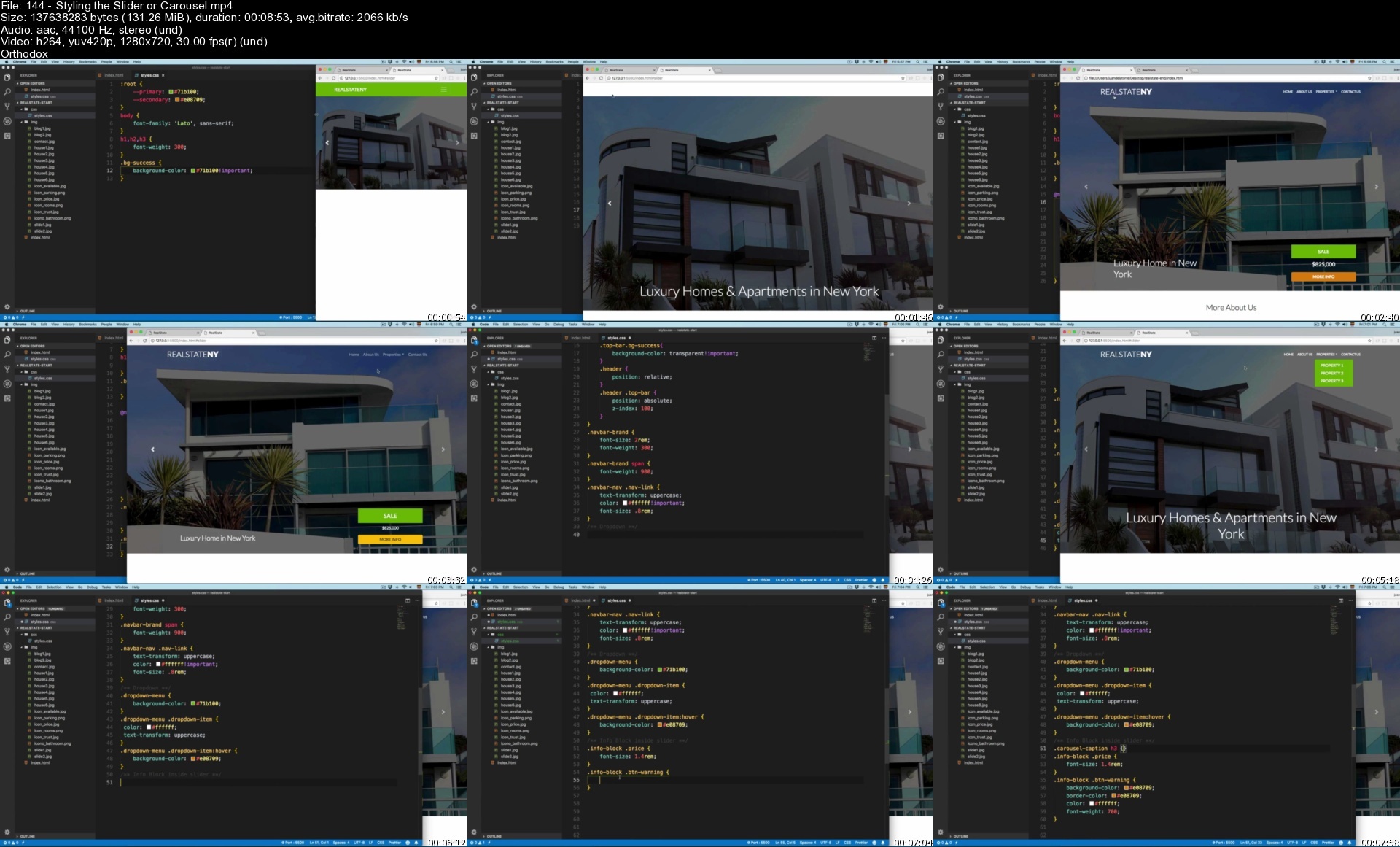
Lecture 144 Styling the Slider or Carousel

Lecture 145 Working with the Company Features Section

Lecture 146 First steps with the Properties Section

Lecture 147 Adding the rest of the properties

Lecture 148 Finishing the Properties Section

Lecture 149 Working with the contact us section

Lecture 150 Styling the Contact Us Section

Lecture 151 Working with the Blog Section

Lecture 152 Adding CSS to the Blog

Lecture 153 Adding the Testimonials Section with Carousel (Slider)

Lecture 154 Styling the Testimonials Slider

Lecture 155 Working with the Footer & Finishing the Project

Lecture 156 Checking the project in a mobile device

Section 22: PROJECT 4: Music Festival Website

Lecture 157 Preview of the Finished Project

Lecture 158 Kicking off the Project

Lecture 159 Styling the Top Section

Lecture 160 Styling the Event Name & Date

Lecture 161 Working with the Main Section

Lecture 162 Working with the Lineup HTML

Lecture 163 Styling the Lineup

Lecture 164 Working with the Gallery

Lecture 165 Adding a Countdown with jQuery

Lecture 166 Styling the Countdown

Lecture 167 Adding the Price List

Lecture 168 Styling the Price List

Lecture 169 Adding the Main Navigation

Lecture 170 Styling the Main Navigation

Lecture 171 Changing the Background color of the Top Bar when Scrolling

Lecture 172 Adding ScrollSpy

Lecture 173 Adding Smooth Scroll Effect

Lecture 174 Checking the project in a mobile device

Section 23: PROJECT 5: Architecture / Construction Website

Lecture 175 Preview of the Finished Project

Lecture 176 Working with the Main Navigation

Lecture 177 Adding the Hero Image

Lecture 178 Styling the Sitename and Navigation

Lecture 179 Working with the About Us Section

Lecture 180 Working with the Basic Model House

Lecture 181 Styling the Basic Model

Lecture 182 Working with the Premier Model

Lecture 183 Working with the Elite Model

Lecture 184 Adding the Gallery with Card Columns

Lecture 185 Working with the Footer

Lecture 186 Checking the project in a mobile device

Section 24: PROJECT 6: Building a Fivrr Clone Homepage

Lecture 187 Preview of the Finished Project

Lecture 188 Kicking off the Project

Lecture 189 Building the Header

Lecture 190 Building the Main Nav

Lecture 191 Building the Hero Image and Form

Lecture 192 Building the Main Section

Lecture 193 Adding CSS Animations to the Main Features Section

Lecture 194 Building the PRO Section

Lecture 195 Working with the first steps section

Lecture 196 Adding some Custom Flexbox Code !

Lecture 197 Finishing the first steps section

Lecture 198 Building the "yours..." section

Lecture 199 Adding the Testimonials Carousel

Lecture 200 Styling the Carousel (or Slider)

Lecture 201 Building the Fiverr Guides Section

Lecture 202 Working with the Footer

Lecture 203 Working with the Top Bar Section (a second header)

Lecture 204 Styling the Top Bar

Lecture 205 Adding a CSS Animation when Scrolling

Section 25: PROJECT 7: Creating an Admin Panel

Lecture 206 Preview of the Finished Project

Lecture 207 Kicking off the Project

Lecture 208 Styling the Login Page

Lecture 209 Developing the Clients Page

Lecture 210 Building the Sidebar Menu

Lecture 211 Styling the Topbar and the sidebar

Lecture 212 Adding more content to the Clients Page

Lecture 213 Adding the Add New Client Button

Lecture 214 Adding some clients to the list

Lecture 215 Working with the Add New Client Page

Lecture 216 How to Validate Bootstrap Forms

Lecture 217 Adding a Graph Library

Section 26: PROJECT 8: Website for Culinary School

Lecture 218 Preview of the Finished Project

Lecture 219 Kicking off the Project

Lecture 220 Working with the main section

Lecture 221 Styling the Main Section

Lecture 222 Building the Take a class with us section

Lecture 223 Adding a Graphic after the titles

Lecture 224 Working with the Upcoming Courses Section

Lecture 225 Adding the Rest of the Courses

Lecture 226 Styling the Upcoming Courses

Lecture 227 Working with the Degree Section

Lecture 228 Styling the Degree Section

Lecture 229 Working with the Footer

If you're a web designer that's trying to create responsive websites this course is for you,Bootstrap is really popular, and the new version is amazing, if you want to add bootstrap to your skills this course is for you,If you learn most by building real world projects this course is for you

Homepage


144stylingthesliderorsxcbm.jpg


Forward-Facing® Professional Resilience

kbmqd53ewr66odaapw71y1rigm.jpg


Forward-Facing® Professional Resilience
Last updated 2/2022
MP4 | Video: h264, 1280x720 | Audio: AAC, 44.1 KHz
Language: English | Size: 5.93 GB | Duration: 5h 18m

Prevention and Resolution of Burnout, Toxic Stress, and Compassion Fatigue


What you'll learn
This is training for professional helpers to prevent compassion fatigue and other work-related stress disorders.

Requirements
This is a discussion of the elements of trauma informed care and supporting materials on the nature of how trauma/adversity can impact life and health throughout the lifespan.

Description
Forward-Facing® Professional Resilience:prevention and Resolution of Burnout, Toxic Stress and Compassion FatigueCONSULTING SERVICES FOR RESILIENCE & LEADERSHIP

What you'll learnForward-Facing™ Professional Resilience is the result of 20+ years of research and development in the area of burnout and compassion fatigue prevention. We have published nine empirical peer-reviewed studies that have demonstrated the skills in this workshop lessen the stress-related effects of caregiving and service work. Additionally, these same skills-when implemented in a displaced approach-enhance well-being, performance and professional quality of life. This course provides the participant with training in each of the five (5) resilience skills for the prevention and resolution of work-related stress while, simultaneously, enhancing professional performance.RequirementsAnyone interested in learning how to lessen stress, improve resilience, enhance performance (cognitive and motor) and optimize personal/professional life is welcome to engage this course. There are no prerequisites.DescriptionJoin Dr. Eric Gentry, LMHC in this workshop as he draws from the Accelerated Recovery Program for Compassion Fatigue and the Certified Compassion Fatigue Specialist training to provide an intensive one-day experiential training for professional helpers to prevent compassion fatigue and other work-related stress disorders. This course is an inoculation or vaccination against the potentially painful effects to caregivers working with troubled and traumatized populations. This training is also intended to produce an ameliorative effect upon the current compassion fatigue symptoms that participants may be experiencing. This training-as-treatment effect for this training has been published in several journals and is recognized as an effective treatment for the symptoms of compassion fatigue. The day is a potent alchemy of didactic information, experiential processing, and transformative techniques that assists the professional and/or volunteer care provider in resolving symptoms of compassion fatigue while, at once, developing resiliency skills and practices that prevent compassion fatigue symptoms in the future. Dr. Gentry has offered this training to over 100,000 satisfied professional and volunteer care providers in the U.S. and abroad.Learning Objectives1. Understand the history, causes, treatment and prevention of work-related stress for professional caregiver.2. Identify the true causes of stress in personal and professional life.3. Learn skills for successful self-regulation of anxiety, no matter the external context.4. Develop knowledge and skills necessary to prevent the symptoms of work-related stress and fatigue through enhanced resiliency.5. Utilization of self-regulations and perceptual maturation skills to significantly lessen the negative effects of work.6. Development of a self-directed Professional Resiliency Plan that can be easily integrated into professional practice and personal life.Credentialing: Participants who successfully complete this course are eligible to pursue credentialing as a Registered Forward-Facing® Practitioner. This course is not available for NBCC credit.

Overview

Section 1: Forward Facing Professional Resilience

Lecture 1 Welcome

Lecture 2 Module I. Introduction to Resilience

Lecture 3 Module I. Introduction to Resilience

Lecture 4 Module II. Compassion Fatigue

Lecture 5 Module II. Compassion Fatigue

Lecture 6 Module III. Perceived Threat

Lecture 7 Module III. Perceived Threat

Lecture 8 Module IV. Self-Regulation

Lecture 9 Module IV. Self-Regulation

Lecture 10 Module V. Intentionality

Lecture 11 Module V. Intentionality

Lecture 12 Bonus lecture

• Mental health, teachers, probation, courts, child-protective agencies, foster parents, faith leaders; HR professionals, leadership.

Homepage


11modulevintentionalisxew2.jpg


Forward-Facing® Trauma Therapy

gaqgxztwkof2vtdhgbcgx61fu5.jpg


Forward-Facing® Trauma Therapy
Last updated 5/2021
MP4 | Video: h264, 1280x720 | Audio: AAC, 44.1 KHz
Language: English | Size: 6.72 GB | Duration: 5h 33m

Healing the Moral Wound


What you'll learn
The focus is to increase understanding of individuals through the trauma/adversity history lens.
Motivation and meaning of behaviors will be explored and defined as an attempt to decrease feelings of distress.
Trauma-informed care is an established practice that can dramatically improve the outcomes for individuals, children, and families.

Requirements
This is a discussion of the elements of trauma informed care and supporting materials on the nature of how trauma/adversity can impact life and health throughout the lifespan.

Description
Forward-Facing®Trauma Therapy: Healing the Moral WoundCONSULTING SERVICES FOR HEALTH & WELLNESS

What you'll learnForward-Facing® Trauma Therapy is a 21st Century psychotherapeutic approach to healing the negative effects of trauma and painful past experiences. It was designed as an alternative to current models of treatment that focus upon memory retrieval and processing as the primary method for resolving traumatic stress, FFTT, instead, has utilized a present day in vivo ("in life") approach that provides desensitization and integration of trauma memories while confronting situations here in the present. This method and course will teach licensed mental health and healthcare professionals to implement FFTT into their practice and a potent ancillary to traditional psychotherapy. However, over the past several years, FFTT has emerged as a method that does not require psychotherapeutic skills or licensure to effectively implement its healing capacity. You will learn how to engage anyone who is struggling with any stress-related issue in a p[process that teaches them the skills to resolve distress and begin a Couse of effective living. This is achieved by teaching clients to self-regulate their own autonomic nervous system and interrupting the involuntary physical and cognitive engagement of the threat response where there is little or no danger. As survivors begin to master these skills of self-regulation-through the aide of an effective consultant or coach (not necessarily a licensed health professional)-they significantly lessen their distress; restore comfort in their bodies; improve cognitive and motor functioning; and optimize their lives. The very exciting thing about FFTT, which the student of this course will learn, is how when people live in chronically dysregulated autonomic nervous systems then they frequently breach their intention and integrity (i.e., "moral wounding). By helping clients develop the capacity for self-regulation and assisting them with clarifying and articulating their intentions (e.g, mission and code-of-honor), they are able to utilize the Forward-Facing™ skills to increasingly and effectively practice principle-based intentional living. The skills required to live in this way are the same skills that resolve stress-related problems.Students completing this course will be equipped to immediately implement Forward-Facing™ skills and principles in their work with clients and patients in either a psychotherapeutic or coaching/consulting context.RequirementsWhile FFTT was originally developed and utilized a psychotherapeutic approach implemented by qualified psychotherapists, these principles and practices are also deliverable in a non-clinical coaching or consultation approach. Anyone interested in learning how to lessen stress, improve resilience, enhance performance (cognitive and motor) and optimize personal/professional life is welcome to engage this course. There are no prerequisites.DescriptionIn Forward-Facing Trauma Therapy (FFTT) presented by Dr. Eric Gentry, PhD, LMHC, the participant will take a journey from hardship to healing. FFTT begins by exploring some of the common myths and misconceptions about the causes and meaning of stress and will examine the destruction it can wreak on our bodies, our minds, our spirits, and our relationships. FFTT is designed to discover the triggers that can lead us to act reflexively in ways that we deeply regret afterwards. FFTT will encourage participants to consider what it means to live an intentional life and how cultivating the skill of interoception, or "bodifulness," can help us achieve this essential goal. Along the way, Dr. Gentry will share some inspiring stories about women and men he has known who successfully put these lessons into practice; vanquishing stress, regaining their resilience, and finding new joy, optimization, and fulfillment in their lives.Objectives:1. Discover the "active ingredients"/common elements for treating posttraumatic stress advocated as best practice for treatment of PTSD by leading agencies and organizations2. Employ a staged "active ingredient/"common elements" approach to evidence-based practice for treating survivors of trauma. This is contrasted with current practice of utilizing only EBT model-driven approaches.3. Conceptualize, articulate and utilize specific evidence-based treatment tasks within each of the (dynamic elements/active ingredients) of treatment that resolve symptoms of posttraumatic stress.4. Learn and employ the Empowerment & Resilience Treatment Structure (Gentry, Baranowsky & Rhoton, 2017) for delivery of treatment with trauma survivors.5. Efficiently and effectively facilitate resolution and healing of posttraumatic conditions.6. Learn specific psychoeducation and cognitive restructuring techniques for maximizing engagement and participation in early treatment.Credentialing: Participants who successfully complete this course are eligible to pursue credentialing as a Registered Forward-Facing® Practitioner.

Overview

Section 1: Introduction

Lecture 1 Welcome

Lecture 2 Module I. Introduction to Forward- Facing Trauma Therapy™

Lecture 3 Module I. Introduction to Forward- Facing Trauma Therapy™

Lecture 4 Module II. Active Ingredients

Lecture 5 Module II. Active Ingredients

Lecture 6 Module III. Empowerment & Resilience Structure

Lecture 7 Module III. Empowerment & Resilience Structure

Lecture 8 Module IV. Psychoeducation

Lecture 9 Module IV. Psychoeducation

Lecture 10 Module V. Skill Building

Lecture 11 Module V. Skill Building

Lecture 12 Module VI. Maintaining Integrity

Lecture 13 Module VI. Maintaining Integrity

Lecture 14 Congratulations on the successful completion of the training!

Mental health, teachers, probation, courts, child-protective agencies, foster parents, faith leaders; HR professionals, leadership.

Homepage


7moduleiiiempowermentaqcce.jpg


[NEW] AWS Certified Cloud Practitioner Video Course - 2022

472544039fd7fcewv.jpg


[NEW] AWS Certified Cloud Practitioner Video Course - 2022
Last Update: 8/2022
Duration: 17h 53m | Video: .MP4, 1280x720 30 fps | Audio: AAC, 48 kHz, 2ch | Size: 9.53 GB
Genre: eLearning | Language: English

AWS Certified Cloud Practitioner | 100% Syllabus | 16+ Hrs | Quizzes | Labs | AWS CLF-C01 | AWS Cloud Practitioner


What you'll learn:
All Objectives of AWS Certified Cloud Practitioner foundational exam
Cloud Computing Fundamentals
AWS Basics, Free Account creation, Portal overview
AWS IAM - Identity and Access Management Services
AWS Compute Services - AWS Certified Cloud Practitioner objectives
AWS Storage Services - AWS Certified Cloud Practitioner objectives
AWS Database and Analytics Services - AWS Certified Cloud Practitioner objectives
AWS Deployments & Managing Infrastructure related Services - AWS Certified Cloud Practitioner objectives
AWS Global Infrastructure Services - AWS Certified Cloud Practitioner objectives
AWS Integration Services - AWS Certified Cloud Practitioner objectives
AWS Monitoring Services - AWS Certified Cloud Practitioner objectives
AWS Networking Services - AWS Certified Cloud Practitioner objectives
AWS Security Services - AWS Certified Cloud Practitioner objectives
AWS Organization, Pricing, Billing and Support - AWS Certified Cloud Practitioner objectives
AWS Machine Learning - AWS Certified Cloud Practitioner objectives
AWS Well Architected Framework - AWS Certified Cloud Practitioner objectives
AWS Best Practices - AWS Certified Cloud Practitioner objectives


Requirements
This course is for non-techies and cloud newbies.
No prior knowledge, experience or any certification.
This is foundational course, we'll cover everything from scratch


Description
The AWS Cloud Practitioner certification shows and certifies your expertise of AWS Cloud Platform in general, regardless of your technical position. This is a foundational certification for AWS. Unlike the other AWS certifications, this exam is not focused on a single technical role.

What's Included in this course?
100% syllabus covered for AWS Certified Cloud Practitioner Exam.
15+ hours of 230+ detailed videos on all the topics and sub-topics of the AWS Certified Cloud Practitioner certification.
2 x Practice Tests[150 unique questions] with detailed explanations that simulate the real exam environment
Each section ends with a quiz.
500+ PPTs
Unlimited and lifetime access.
30 Day "No Questions Asked" Money Back Guarantee
Certificate from Udemy

How this course is different?
100% up to date with the most recent exam objectives
It's jam-packed with practical demos so that you can learn by doing.
Key points and tips are included to prepare for the AWS exam easily.
Detailed but to-the-point videos on all the topics and sub-topics
It follows a logical sequence of topics to make you feel comfortable while learning.
Quizzes at the end of each section to check your learning.
2x Practice Tests simulate the real exam environment.
I will always keep you on the AWS Free Tier, so it won't cost you anything while practicing demos.

Real Exam Format and Information
Certification Name: AWS Certified Cloud Practitioner Certification
Certification Exam Code: CLF-C01
Exam Duration: 90 Minutes
Exam Format: Multiple Choice and Multiple Answer Type Exam
Number of Questions: 65-68
Passing score: 65-75%
Exam Fee: $100
Eligibility/Pre-requisite: None
Validity: 3 years
Exam Languages: English, Japanese, Korean, and Simplified Chinese

Exam Objectives
AWS Certified Cloud Practitioner exam (CLF-C01) check knowledge on the following areas
Domain 1: Cloud Concepts - AWS Certified Cloud Practitioner
1.1 Define the AWS Cloud and its value proposition
1.2 Identify aspects of AWS Cloud economics
1.3 List the different cloud architecture design principles
Domain 2: Security and Compliance - AWS Certified Cloud Practitioner
2.1 Define the AWS shared responsibility model
2.2 Define AWS Cloud security and compliance concepts
2.3 Identify AWS access management capabilities
2.4 Identify resources for security support
Domain 3: Technology - AWS Certified Cloud Practitioner
3.1 Define methods of deploying and operating in the AWS Cloud
3.2 Define the AWS global infrastructure
3.3 Identify the core AWS services
3.4 Identify resources for technology support
Domain 4: Billing and Pricing - AWS Certified Cloud Practitioner
4.1 Compare and contrast the various pricing models for AWS
4.2 Recognize the various account structures in relation to AWS billing and pricing
4.3 Identify resources available for billing support

AWS Services and Features we are going to cover in this course
Analytics: AWS Certified Cloud Practitioner
AWS Athena
AWS Kinesis
AWS QuickSight
Application Integration: AWS Certified Cloud Practitioner
AWS Simple Notification Service (Amazon SNS)
AWS Simple Queue Service (Amazon SQS)
Compute and Serverless: AWS Certified Cloud Practitioner
AWS Batch
AWS EC2
AWS Elastic Beanstalk
AWS Lambda
AWS Lightsail
AWS WorkSpaces
AWS CodeDeploy: AWS Certified Cloud Practitioner
AWS CodePipeline
AWS CodeStar
Customer Engagement: AWS Certified Cloud Practitioner
AWS Connect
Management, Monitoring, and Governance: AWS Certified Cloud Practitioner
AWS Auto Scaling
AWS Budgets
AWS CloudFormation
AWS CloudTrail
AWS CloudWatch
AWS Config
AWS Cost and Usage Report
AWS EventBridge (Amazon CloudWatch Events)
AWS License Manager
AWS Managed Services
AWS Organizations
AWS Secrets Manager
AWS Systems Manager
AWS Systems Manager Parameter Store
AWS Trusted Advisor
Networking and Content Delivery: AWS Certified Cloud Practitioner
AWS API Gateway
AWS CloudFront
AWS Direct Connect
AWS Route 53
AWS VPC
Security, Identity, and Compliance: AWS Certified Cloud Practitioner
AWS Artifact
AWS Certificate Manager (ACM)
AWS CloudHSM
AWS Cognito
AWS Detective
AWS GuardDuty
AWS Identity and Access Management (IAM)
AWS Inspector
AWS License Manager
AWS Macie
AWS Shield
AWS WAF
Storage: AWS Certified Cloud Practitioner
AWS Backup
AWS Elastic Block Store (Amazon EBS)
AWS Elastic File System (Amazon EFS)
AWS S3
AWS S3 Glacier
AWS Snowball Edge
AWS Storage Gateway

Who this course is for
Anyone seeking to become an AWS Certified Cloud Practitioner
Anyone who wants to learn AWS from the basics.
Anyone interested in pursuing a career in AWS Cloud Computing
Anyone who wants to have a quick overview of AWS important services.
Anyone who wish to ace AWS technical interview
This comprehensive ALL-IN-ONE Training Course will help you grasp the cloud and prepare for the - AWS Certified Cloud Practitioner Exam.

Homepage

5.demoroute53sxvikp.jpg


Comptia Linux+ Lx0-101 & Lx0-102

fdjpw3qmqrfjscytxcefd1qc55.jpg


Comptia Linux+ Lx0-101 & Lx0-102
Last updated 3/2017
MP4 | Video: h264, 1280x720 | Audio: AAC, 44.1 KHz
Language: English | Size: 6.83 GB | Duration: 16h 49m

CompTIA Linux+ LX0-101 & LX0-102


What you'll learn
Should be able to perform maintenance tasks with the command line.
Should be able to install & configure a workstation and be able to configure a basic network.

Requirements
Basic understanding of CompTIA Linux

Description
LPIC-1 is a junior level certification for Linux administrators. You should be able to perform maintenance tasks with the command line, install & configure a workstation and be able to configure a basic network.

The Linux footprint continues to grow. In addition to its significant presence in the server room, all the major public cloud providers offer Linux images as a way of speeding up virtual instance creation.

Large organizations such as the U.S. Navy, Dell, HP, BAE Systems, Northrop Grumman and the U.S. Department of Defense employ CompTIA Linux+ Powered by LPI certified IT professionals.

IT professionals who earn their CompTIA Linux+ certification can receive the LPIC-1 from LPI. Earning a Linux+ certification is the beginning of a path that will lead you to advanced, distribution-specific Linux certifications such as SUSE Certified Engineer.

Overview

Section 1: Instructions

Lecture 1 Introduction

Lecture 2 Introduction to Building Labs

Lecture 3 Things You Need To Do

Lecture 4 Install Demo Virtual Box

Lecture 5 Navigation

Lecture 6 Commands with Lab Demo

Lecture 7 Internaland External Commands

Lecture 8 Overview of Shell Commands Tricks

Lecture 9 Exploring Shell Configuration

Lecture 10 Stream Redirection

Lecture 11 Overview of Processing Text Using Filters

Lecture 12 Overview File - Viewing Commands

Lecture 13 Overview Using Grep

Lecture 14 Sed Syntax and Summary

Lecture 15 Overview of Exam Essentials

Section 2: Managing Software

Lecture 16 Managing Software

Lecture 17 Overview Using RPM

Lecture 18 RPM part 2

Lecture 19 Overview Using Cpio

Lecture 20 Overview Using Debian and Apt Cache

Lecture 21 Using Apt-get

Lecture 22 Debian Tools

Lecture 23 Managing Shared Libraries

Lecture 24 Overview Locating Library Files

Lecture 25 Foreground and Background Processes

Lecture 26 Managing Software Summary

Section 3: Configuring Hardware

Lecture 27 Configuring Hardware

Lecture 28 Configuring Devices

Lecture 29 Configuring USB

Lecture 30 Configuring Hard Disk

Lecture 31 Designing Hard Disk Layout

Lecture 32 Logical Volume Management

Lecture 33 Creating Partitions Filesystems

Lecture 34 Overview Using Fdisk

Lecture 35 Overview Common Filesystem Types

Lecture 36 Creating Filesystem

Lecture 37 Overview Maintaining Filesystem Health

Lecture 38 Configuring Hardware Summary

Section 4: Managing Files

Lecture 39 Managing Files

Lecture 40 File Archiving Commands

Lecture 41 Managing Files Ownership

Lecture 42 Managing Disk Quotas

Lecture 43 Directories and Content

Lecture 44 Overview Tools for Locating Files

Section 5: Booting Files

Lecture 45 Overview of Exam Essentials

Lecture 46 Booting Linux and Editing Files

Lecture 47 Boot and Reboot

Lecture 48 Understanding the Boot Process

Lecture 49 Runlevels Process

Lecture 50 Managing Runlevel Services

Lecture 51 Editing with Vi

Lecture 52 Booting Summary

Section 6: X

Lecture 53 X Windows Systems

Lecture 54 X Configuration Options

Lecture 55 X Configuration Options part 2

Lecture 56 Configuring X Fonts

Lecture 57 Configuring X ft Fonts

Lecture 58 Overview Managing GUI Logins

Lecture 59 Using X for Remote Access

Lecture 60 X Accessibility

Lecture 61 Addition Assistive Technologies

Lecture 62 Configuring Localization and Internationalization

Lecture 63 Querying and Setting Your Locale

Lecture 64 Configuring Printing

Lecture 65 Configuring Printing part 2

Lecture 66 Using Web-based CUPS Utilities

Section 7: Admin

Lecture 67 Administering

Lecture 68 Directly Modifying Account Configuration

Lecture 69 Components of Account

Lecture 70 Adding Groups

Lecture 71 Tuning User and System Environments

Lecture 72 Reviewing Log File Contents

Lecture 73 Maintaining System Time

Lecture 74 Admin Summary

Section 8: Basic Networking

Lecture 75 Basic Networking

Lecture 76 Network Addressing

Lecture 77 Network Addressing part 2

Lecture 78 DNS Data Flow Zone and Resolution

Lecture 79 Network Ports

Lecture 80 Connections

Lecture 81 Testing Connectivity

Lecture 82 Wireshark Demo

Lecture 83 Basic Networking Summary

Section 9: Scripts

Lecture 84 Scripts, E-mail and Databases

Lecture 85 Writing Scripts

Lecture 86 Writing Scripts part 2

Lecture 87 Managing E-mail

Lecture 88 Managing Data with SQL

Lecture 89 Advantages of Database

Lecture 90 Scripts Summary

Section 10: Security

Lecture 91 Security

Lecture 92 Controlling Access Via TCP Wrappers

Lecture 93 Configuring Xinetd

Lecture 94 Uninstalling Or Reconfiguring Servers

Lecture 95 Tools for Managing Passwords

Lecture 96 Configuring SSH

Lecture 97 Controlling SSH Access

Lecture 98 SSH Keys

Lecture 99 Using GPG

Lecture 100 Security Summary

Science & Technology Professionals,Anyone interested in Linux,Linux administrators

Homepage


34overviewusingfdisks1ec2k.jpg


Creating an MP3 Player Using Unity and C#

9gnd5b9g3aqur5aym9y7987fai.jpg


Creating an MP3 Player Using Unity and C#
Published 08/2022
Genre: eLearning | MP4 | Video: h264, 1280x720 | Audio: AAC, 48.0 KHz
Language: English | Size: 6.5 GB | Duration: 97 lectures • 18h 34m

Learn how to create an application using Unity and C# while creating your own MP3 Player with stereo audio visualizer


What you'll learn
Download, install and configure Unity and Visual Studio
Build a scene using a canvas, panels and objects
Learn to code in C# to control how objects behave
Create your very own MP3 player with stereo audio visualizer


Requirements
No Unity or programming experience needed. You just follow what the instructor does.

Description
All software and resources used in this course are free.

In this course, you will learn from an instructor with 40 years application development experience how to create a single scene application in the Unity game engine. You will build the scene starting with a canvas and adding to it panels and objects. You will learn to write C# code in Visual Studio to control how the objects you create in Unity behave. When done, you will have your very own, fully featured MP3 player with stereo audio visualizer. No unity or programming experience needed. All you need to do is follow what the instructor does. This is what you will learn in the course.

- How to download, install and configure Unity and Visual Studio for C#

- How to use the different panes in the Unity editor

- How to use the controls in the Scene pane

- How to create a canvas

- How to create a panel

- How to create objects

- Game Objects

- Text objects

- Text Mesh Pro objects

- Image objects

- Checkbox objects

- Button objects

- Slider objects

- How to create a scrolling list

- How to import asset packages

- How to create and use prefabs

- How to assign objects to public variables

- How to create and assign scripts to objects

- How to set script functions to be called when buttons and checkboxes are clicked

- How to investigate and resolve errors

- How to test the application throughout the development process

- How to build the application into a stand alone, executable program

- How to write C# scripts in Visual Studio

- Directives

- Variables

- Statements

- Conditional logic (IF...ELSE blocks)

- Loops (For, Foreach, While)

- Standard functions

- IEnumerator functions (wait for something to happen)

- Functions that accept and return values as parameters

- The Start, Awake and Update functions

- Nested logic

- Creating a class

- Sharing data between scripts

- importing and decoding an MP3 file

- Browsing to a folder and selecting an MP3 file

- Browsing to a folder and loading all MP3 files in that folder

- Adding MP3 files to a play list

- Removing MP3 files from a play list

- Cycling through all MP3 files in a play list and playing each one

- Animating a left channel audio visualizer and a right channel audio visualizer

Who this course is for
Anyone curious about the Unity game development engine and how to write programs using C#

Homepage


2.creatingbuttonsusinwqd6u.jpg


Google Ads Bootcamp by Aaron Young

d915222389184a085078e11cb48fb9c2.jpg

Aaron Young - Google Ads Bootcamp | 5.37 GB
Introducing my Google Ads Bootcamp
After completing my Google Ads Bootcamp I promise you will have the skills, knowledge & processes required to create successful and profitable campaigns everytime with a repeatable formula and battle plan that allows you to manage any Google Ads campaign in under 1 hour per week.

In my Google Ads Search Bootcamp, you will learn:
- Module 1: What is Google Ads & How the Google Ads auction process actually works. (If you don't understand this process you won't be able to create a successful campaign)
- Module 2: How to create your very own Google Ads Battle Plan, so you can successfully plan your campaign and make adjustments is the market conditions change.
- Module 3: Keyword research done right, you will be surprised to hear how I start my successful profit making keyword research. Plus I will teach you my 1 keyword method.
Plus you also get my Keyword research template
- Module 4: How to get creative with Ad Copy to write ads that scream 'CLICK ME'. I will also share my 4 elements that are a MUST for every ad.
Plus you also get my Ad Copy character limit counter
- Module 5: Track what's what with Conversion tracking. Get the data you need so you can scale your campaign and grow your business.
- Module 6: How to create your campaign - correctly. Plus learning why campaign and ad group naming conventions are important and by just calling your Ad group 'Ad Group 1' is a massive mistake that will cost you hours of time in the future.
- Module 7: How to save money & increase profits with my step by step optimisation process. Learn what to optimise and when to optimise every 72 hours, weekly, monthly or every quarter.
Plus I will give you my optimisation checklist. Which is a checklist that I still use for all of my Google Ads campaigns.
- Module 8: 'PRO TIPS' on how to optimise a Google Ads campaign like a 15,000 hour master.

HOmepage:

Screenshots
41ea0507b1763934adc0bc1426279d2e.jpg


Link Download
Extract files with WinRar 5 or Latest !
 
Adrian Gee - The T8 - How To Transform Your Life In 8 Weeks

9047fecd470e01e31fb436b0cfbd55ac.jpg

Adrian Gee - The T8 System | 5.75 GB
Everything you need to know on how to attract women, regardless of your looks, your age, or your money.
The T8 System is a step-by-step ****** guide and a seduction program by Adriana Gee that builds a strong base on ****** basics.

It teaches you the techniques and skills on how to handle a lady best, being romantic, and how to build a great relationship.
Relationships are difficult for EVERYONE, but it's mainly because they don't know what to do. Now, you'll have everything you need to learn and have the best relationship you've ever had.
The T8 System is a comprehensive video system crafted by someone who has the experience and studied and perfected skills in this game. He comes to help you go through all the phases of:
- Bagging a woman
- Attracting her
- Make her fall for you on the first date
- Letting her crave for your calls
- Seducing her
- Sleeping with her
- Having a long relationship.

Here, you will get a step-by-step blueprint to master the art of seduction and pick up, thus changing your entire life. You will improve not only your ****** life but also your whole life, the way of life, among others.

HOmepage:

Screenshots
26730483e6e1fbf00f4e51358f4c6449.jpg


Link Download
Extract files with WinRar 5 or Latest !
 
Alen Sultanic - Nothing Held Back (NHB Plus) (Update 10.2022)

704973a2e7f79a8255d9d6100f669802.jpg

Alen Sultanic - Nothing Held Back (NHB Plus) (10/2022) | 67.4 GB
What You Get:
One Training Call Per Week: We run a training call every week that are approximately 1-2 hours each.
We'll cover everything from offer building, upsell architecture, traffic, copywriting, pricing strategy, funnel economics, design, and more .

Access To All Calls with Top Tier Coaches & Trainers Every Week: Sharpen your skills and get trained by the best working copywriters, media buyers, conversion specialist, offer builders, and more every week - become a full-stack marketer or go deep with one to two skills. it's YOUR choice.
Recordings and Replays of All Calls: Watch and rewatch as often as you need - you're getting video replays, audio replays, and transcripts from every call.
Call, Training & Coaching Summaries: Quick hit notes and timestamps to make every call easier to digest and rewatch later.
World Class Guest Speakers & Presenters: Learn from the likes of Ron Lynch, Mike Gandia, Matt Bacak, and other hidden players too busy winning the game to run the event circuit or teach their best secrets anywhere else.
Swipes: Access Alen's personal swipe stash, plus the additional swipes and resources our community contributes from their own archives as well as with every win they share
Templates, Funnels & Resources: We're giving you access to all of my templates, funnels and resources (including upsells, downsells, emails, scripts, etc.) so you can use them in your own or client offers. PLUS resources from our 7-, 8-, and 9- figure members who choose to share their resources exclusively within NHB. Implement fast and furiously with templates built on the marketing theory and principles you're learning inside NHB+.

Homepage:

Screenshots
0c1378c7fc1b53f783f75c23706a2d91.jpg


Link Download
Extract files with WinRar 5 or Latest !
 
Zurück
Oben Unten