• Regeln für den Video-Bereich:

    In den Börsenbereich gehören nur Angebote die bereits den Allgemeinen Regeln entsprechen.

    Einteilung

    - Folgende Formate gehören in die angegeben Bereiche:
    - Filme: Encodierte Filme von BluRay, DVD, R5, TV, Screener sowie Telesyncs im Format DivX, XviD und x264.
    - DVD: Filme im Format DVD5, DVD9 und HD2DVD.
    - HD: Encodierte Filme mit der Auflösung 720p oder darüber von BluRay, DVD, R5, TV, Screener sowie Telesyncs im Format x264.
    - 3D: Encodierte Filme von BluRay, die in einem 3D Format vorliegen. Dies gilt auch für Dokus, Animation usw.
    - Serien: Cartoon/Zeichentrick, Anime, Tutorials, Dokumentationen, Konzerte/Musik, Sonstiges sind demnach in die entsprechenden Bereiche einzuordnen, auch wenn sie beispielsweise im High Definition-Format oder als DVD5/DVD9/HD2DVD vorliegen. Ausnahme 3D.
    - Bereich Englisch: Englische Releases gehören immer in diesen Bereich.
    - Bereich Talk: Der Bereich, in dem über die Releases diskutiert werden kann, darf, soll und erwünscht ist.


    Angebot/Beitrag erstellen

    - Ein Beitrag darf erst dann erstellt werden, wenn der Upload bei mindestens einem OCH komplett ist. Platzhalter sind untersagt.
    - Bei einem Scenerelease hat der Threadtitel ausschließlich aus dem originalen, unveränderten Releasenamen zu bestehen. Es dürfen keine Veränderungen wie z.B. Sterne, kleine Buchstaben o.ä. vorgenommen werden. Ausnahme Serienbörse:
    - Bei einem Sammelthread für eine Staffel entfällt aus dem Releasename natürlich der Name der Folge. Beispiel: Die Simpsons S21 German DVDRip XviD - ITG
    - Dementsprechend sind also u.a. verboten: Erweiterungen wie "Tipp", "empfehlenswert", "only", "reup", usw. / jegliche andere Zusatzinformation oder Ergänzung, welche nicht in obiger Beschreibung zu finden ist.

    Aufbau des Angebots und Threadtitel

    Der Titel nach folgendem Muster erstellt zu werden. <Name> [3D] [Staffel] [German] <Jahr> <Tonspur> [DL] [Auflösung] <Quelle> <Codec> - <Group>
    Beispiel: The Dark Knight German 2008 AC3 DVDRip XviD - iND
    Beispiel: The Dark Knight 2008 DTS DL BDRip x264 - iND
    Beispiel: The Dark Knight 2008 AC3 DL BDRip XviD - iND
    Beispiel: The Dark Knight German 2008 AC3 720p BluRay x264 iND
    Beispiel: The Dark Knight 2008 DTS DL 1080p BluRay x264 iND
    Beispiel: Die Simpsons S01 German AC3 DVDRip XviD iND
    Beispiel: Die Simpsons S20 German AC3 720p BluRay x264 iND
    Beispiel: Sword Art Online II Ger Sub 2014 AAC 1080p WEBRip x264 - peppermint
    Entsprechend sind also u.a. verboten: Sonderzeichen wie Klammern, Sterne, Ausrufezeichen, Unterstriche, Anführungszeichen / Erweiterungen wie "Tipp", "empfehlenswert", "only", "reup", usw. / jegliche andere Zusatzinformation oder Ergänzung, welche nicht in obiger Beschreibung zu finden ist
    Ausnahmen hiervon können in den Bereichen geregelt sein.

    Die Beiträge sollen wie folgt aufgebaut werden:
    Überschrift entspricht dem Threadtitel
    Cover
    kurze Inhaltsbeschreibung
    Format, Größe, Dauer sind gut lesbar für Downloader außerhalb des Spoilers zu vermerken
    Nfo sind immer Anzugeben und selbige immer im Spoiler in Textform.
    Sind keine Nfo vorhanden z.B. Eigenpublikationen, sind im Spoiler folgende Dateiinformationen zusätzlich anzugeben :
    Quelle
    Video (Auflösung und Bitrate)
    Ton (Sprache, Format und Bitrate der einzelnen Spuren)
    Untertitel (sofern vorhanden)
    Hosterangabe in Textform außerhalb eines Spoiler mit allen enthaltenen Hostern.
    Bei SD kann auf diese zusätzlichen Dateiinformationen verzichtet werden.

    Alle benötigten Passwörter sind, sofern vorhanden, in Textform im Angebot anzugeben.
    Spoiler im Spoiler mit Kommentaren :"Schon Bedankt?" sind unerwünscht.


    Releases

    - Sind Retail-Release verfügbar, sind alle anderen Variationen untersagt. Ausnahmen: Alle deutschen Retail-Release sind CUT, in diesem Fall sind dubbed UNCUT-Release zulässig.
    - Im Serien-Bereich gilt speziell: Wenn ein Retail vor Abschluss einer laufenden Staffel erscheint, darf diese Staffel noch zu Ende gebracht werden.62
    - Gleiche Releases sind unbedingt zusammenzufassen. Das bedeutet, es ist zwingend erforderlich, vor dem Erstellen eines Themas per Suchfunktion zu überprüfen, ob bereits ein Beitrag mit demselben Release besteht. Ist dies der Fall, ist der bereits vorhandene Beitrag zu verwenden.
    - P2P und Scene Releases dürfen nicht verändert oder gar unter einem iND Tag eingestellt werden.


    Support, Diskussionen und Suche

    - Supportanfragen sind entweder per PN oder im Bereich Talk zu stellen.
    - Diskussionen und Bewertungen sind im Talk Bereich zu führen. Fragen an die Uploader haben ausschließlich via PN zu erfolgen, und sind in den Angeboten untersagt.
    - Anfragen zu Upload-Wünschen sind nur im Bereich Suche Video erlaubt. Antworten dürfen nur auf Angebote von MyBoerse.bz verlinkt werden.


    Verbote

    - Untersagt sind mehrere Formate in einem einzigen Angebotsthread, wie beispielsweise das gleichzeitige Anbieten von DivX/XviD, 720p und 1080p in einem Thread. Pro Format, Release und Auflösung ist ein eigener Thread zu eröffnen.
    - Grundsätzlich ebenso verboten sind Dupes. Uploader haben sich an geeigneter Stelle darüber zu informieren, ob es sich bei einem Release um ein Dupe handelt.
    - Gefakte, nur teilweise lauffähige oder unvollständige Angebote sind untersagt. Dies gilt auch für eigene Publikationen, die augenscheinlich nicht selbst von z.B. einer DVD gerippt wurden. Laufende Serien, bei denen noch nicht alle Folgen verfügbar sind, dürfen erstellt und regelmäßig geupdatet werden.
    - Untersagt sind Angebote, welche nur und ausschließlich in einer anderen Sprache als deutsch oder englisch vorliegen. Ausnahmen sind VORHER mit den Moderatoren zu klären.


    Verstoß gegen die Regeln

    - Angebote oder Beiträge, die gegen die Forenregeln verstoßen, sind über den "Melden"-Button im Beitrag zu melden.
  • Bitte registriere dich zunächst um Beiträge zu verfassen und externe Links aufzurufen.

*** Bestes IPTV *** bester Preis *** gratis Test ***


Englische Tutorials

9b2aae25-85ef-40bf-ad65-51530bfb17ab.png

Data Modelling in Power BI
MP4 | Video: h264, 1280x720 | Audio: AAC, 44.1 KHz
Language: English | Size: 1.16 GB | Duration: 1h 6m.​

Model and Optimize data in Power BI : Learn the key concepts of data modelling on Power BI.
What you'll learn
Create relationships between your data sources
Create a new field with calculated columns
Optimize data by hiding fields and sorting visualization data
Create a measure to perform calculations on your data
Use a calculated table to create a relationship between two tables
Format time-based data so that you can drill down for more details
Requirements
Basic knowledge of excel advised
Description
Proper data modelling is the foundation of data analysis and creating reports in Power BI. This course lets you explore a toolbox of data cleaning, shaping, and loading techniques, which you can apply to your data.
The process of creating a complicated data model in Power BI is straightforward. If your data is coming in from more than one transactional system, before you know it, you can have dozens of tables that you have to work with. Building a great data model is about simplifying the disarray.
Creating a great data model is one of the most important tasks that a data analyst can perform in Microsoft Power BI. By doing this job well, you help make it easier for people to understand your data, which will make building valuable Power BI reports easier for them and for you.
Providing set rules for what makes a good data model is difficult because all data is different, and the usage of that data varies. Generally, a smaller data model is better because it will perform faster and will be simpler to use. However, defining what a smaller data model entails is equally as problematic because it's a heuristic and subjective concept.
Typically, a smaller data model is comprised of fewer tables and fewer columns in each table that the user can see. If you import all necessary tables from a sales database, but the total table count is 30 tables, the user will not find that intuitive. Collapsing those tables into five tables will make the data model more intuitive to the user, whereas if the user opens a table and finds 100 columns, they might find it overwhelming. Removing unneeded columns to provide a more manageable number will increase the likelihood that the user will read all column names. To summarize, you should aim for simplicity when designing your data models.
Who this course is for
Business Analyst beginners
Data Analyst beginners
Microsoft Power Platform beginners
Power BI beginners
Screenshots


7809b310-801a-4842-ae8d-59e470e1d0a7.png

Bubble Visual Programming: The Introductory Videocourse
MP4 | Video: h264, 1280x720 | Audio: AAC, 44.1 KHz
Language: English | Size: 221 MB | Duration: 48m
Learning From Scratch​

What you'll learn
Bubble Visual Programming at basic level.
Requirements
Computer and speakers.
Description
Do you want to learn Bubble Visual Programming and do not know where to start? Is this the first time you learn about Bubble Visual Programming and would like to get the basics? Then this is the course for you! Here you will learn basic concepts and steps that you should follow while using Bubble Visual Programming. Let's do it, it is time to learn!
Who this course is for
Anyone who wants to learn Bubble Visual Programming.
Screenshots


5146fe86-54fc-4435-8575-dda10ef4defa.png

Fundamentals of Manufacturing Materials, Processes & Systems 2022
Genre: eLearning | MP4 | Video: h264, 1280x720 | Audio: AAC, 44.1 KHz
Language: English | Size: 7.21 GB | Duration: 17h 58m
18 Hours Course to Understand the Industrial Manufacturing Processes for Plastics and Metals and Joining of Metals 2022

What you'll learn
Discuss in detail the manufacturing processes of metallic and plastic parts.
Compare between different types of metal forming processes and differentiate between their output product.
Describe different types of joining process and introduce the concept of sustainable manufacturing.
Recognize, understand and develop working knowledge of broad range of manufacturing processes that are used in the industry.
To compare the existing technologies used in casting, shaping, forming, property enhancing, joining and assembly process.
To learn how component can be manufactured in sustainable manner and learn about the environmental hazards of different manufacturing processes.
Apply appropriate manufacturing processes for a product and determine its parameters.
Analyze process dynamics and performance of different manufacturing processes.
Description
This course provides an introduction to the manufacturing processes that are used in industry to manufacture products that are widely used in daily life.
Introduction to Manufacturing: Types of manufacturing industries, materials used in manufacturing and properties of materials, different processing operation.
Sand Casting
Introduction: Sand casting, molding, heating, pouring, solidification, and cooling. Pattern: making, material, types, construction, pattern allowances.
Core: making, types, sand conditioning, testing of the sand, molding process, tools and equipment, molding machines, different types of casting, cleaning and finishing of castings, an inspection of castings.
Permanent Mold Casting (PMC): Introduction, types of PMC, gravity die casting, and its types. Pressure die casting, Centrifugal casting, and their types. Furnaces used in PMC.
Metal Forming
Fundamentals, Types, hot, warm, and cold working.
Bulk Deformation Processes
Rolling; rolled products, rolling types: flat, shape, thread, gear, ring rolling, and rolling mill configurations.
Forging; open die, impression die, press, upset, roll, net shape, isothermal forging and swaging.
Extrusion; solid & hollow shapes, direct & indirect, hot & cold, continuous & discrete, impact extrusion, hydrostatic.
Drawing; bar, wire, tube drawing and its types tike tube sinking, fixed mandrel, floating plug.
Other metal forming processes; roll extrusion, riveting, staking, peening, coining, hubbing, burnishing.
Sheet metal forming processes: Shearing operations: slitting, blanking, piercing, cutoff, parting, dinking, slotting, perforating, notching, semi-notching, lancing, nibbling, trimming, shaving, fine blanking. Bending operations: V bending, edge bending, flanging, curling, hemming, seaming. Drawing operations like deep and shallow drawing, embossing.
Welding Processes: Classification, Fusion welding and its types such as oxyfuel gas welding and oxygen torch cutting, arc welding (shielded metal, flux-cored, gas metal, submerged, gas tungsten, plasma, stud welding, Arc cutting), resistance welding (spot, seam and projection. Heating, pressure, current control and power supply for resistance welding).
Solid-state welding and its types include diffusion welding, friction welding, and ultrasonic welding.
Other welding processes: Forge, Roll, Friction, Explosion, Thermic, Electron beam, Laser welding and cutting, Brazing and Soldering.
Fabrication of Plastics: Casting, Blow molding and its types, Compression molding, Transfer molding, Cold molding, Injection molding: Injection molding machine, mold design, and construction, types of mold, cooling and ejection of mold, Reaction injection molding, Welding of plastics.
In the end, there are videos that are videos related to the course for better understanding.
Course Outline
Introduction to Manufacturing
Lecture 1
Introduction to Manufacturing Processes
What is manufacturing
Manufacturing Industries
Manufacturing Products
Production Quantity and Product variety
Materials in Manufacturing
Manufacturing Processes (Processing operations and Assembly operations)
Sand Casting
Lecture 2
Overview of casting technologies
Difference between casting and molding
Advantages and Disadvantages of casting processes
Casting Processes (Expendable mold casting and permanent mold casting)
Lecture 3
Sand casting and Engineering analysis of sand casting y sand
Pouring and Engineering Analysis of Pouring
Flow rate and time required to fill the mold
Fluidity
Solidification and Cooling
Lecture 4
Solidification of pure metals and alloys (Alloys and Eutectic Alloys)
Solidification time and Shrinkage
Directional Solidification
Lecture 5
Riser Design with Exercise Problems.
Lecture 6
Pattern for casting
Materials used for pattern
Types of pattern
Mold making and Classification of sand molds
What is foundry sand?
Lecture 7
Buoyancy Force
Metal casting processes
Shell molding
Advantages and Disadvantages of Shell molding
Vacuum molding
Advantages and Disadvantages of Vacuum molding
Expanded Polystyrene Casting
Advantages and Disadvantages of Expanded Polystyrene Casting
Investment casting
Plaster and Ceramic Mold casting
Permanent Mold Casting (PMC)
Lecture 8
Types of pattern allowance (Shrinkage and contraction allowance, Draft allowance, Machining allowance, and Distortion allowance)
Permanent mold casting and its Applications.
Slush casting
Low-pressure casting
Vacuum permanent mold casting
Die casting (Hot and cold chamber die casting)
Advantages and Limitations
Centrifugal casting and Semi centrifugal casting
Lecture 9
Furnaces
Cupolas Furnace
Direct Fuel Fired Furnace
Crucible Furnace
Electric Arc Furnace
Induction Furnace
Metal Forming
Lecture 10
Fundamentals of metal forming
Types of deformation processes of metal
Bulk deformation (Rolling, Forging, Extrusion, Wire Drawing)
Sheet metal working
Stress-Strain Curve
Derivation of the relation between stress and strain
Flow stress and Average flow stress
The temperature in metal forming (Cold working and Hot-working)
Recrystallization
Iso thermal forming (recovery and Grain growth)
Strain rate Sensitivity
Lecture 11
Introduction of rolling
Shapes used for rolling
Types of rolling
Working of the rolling process
Analysis of the rolling
Rolling mills
No-Slip Point for rolling
Flatness control and rolling defect
Lecture 12
Numerical Problems related to the rolling process
Lecture 13
Introduction to forging
Classification of forging
Types of forging
Analysis of the forging
Barreling effect in forging
Open Die forging and its practices
Impression Die forging and its practices
Advantages and Limitations of Impression Die forging
Fleshless forging
Forging Press and Forging Hammers
Lecture 14
Numerical Problems related to the forging process
Lecture 15
Introduction to the extrusion process
Classification of extrusion
Direct and Indirect extrusion
Hot and Cold extrusion
Direct and Continuous extrusion
Analysis of the extrusion process
Effect of friction on extrusion
Extrusion Dies and Orifice
Extrusion press and other extrusion processes
Lecture 16
Numerical Problems related to the extrusion process
Introduction to Drawing
Difference between drawing and wire drawing
Bar Drawing
Wire Drawing
Features of Draw Die
Preparation of the work
Analysis of the drawing process
Sheet metal forming processes
Lecture 17
Introduction to sheet metal cutting process
Characteristics of Edges
Types of sheet metal cutting
Shearing
Blanking and Punching
Clearance in Sheet metal cutting
Analysis of sheet metal cutting processes
Numerical Problems related to the sheet metal cutting process
Lecture 18
Introduction of sheet metal bending process
Types of sheet metal bending
Analysis of the sheet metal bending process
Numerical Problems related to the sheet metal bending process
Spring Back
Lecture 19
Introduction to the drawing process
Mechanics of drawing
Stages of deformation
Analysis of the drawing process
Tests of Drawing Feasibility
Blank force and blank size determination
Numerical Problems related to the drawing process
Lecture 20
Other drawing processes (Redrawing, Reverse Drawing and Drawing without Blank holder)
Defects in Drawing
The operation performed with metal tooling
Ironing
Coining & Embossing
Lancing & Twisting
The operation performed with flexible Rubber tooling
Guerin and Hydro forming process
Lecture 21
Numerical Problems related to the other drawing processes
Welding Processes
Lecture 22
Fundamentals of welding
Difference between joining and welding
Advantages and Disadvantages of Welding
History of welding
Types of the welding process
Components used for welding process (Filler material, Flux, and Electrolyte)
Consumable and Non-consumable electrolyte
Welding positions
Welding Electrode Nomenclature
Type of Weld Joints (Butt joint, Corner Joint, Lap joint, Tee Joint, Edge Joint)
Types of Weld (Filler Weld, Groove Weld, Plug weld or slot weld, Spot and Seam weld, Flange and Surface Weld)
Features of Fusion Welded Joints
Physics of welding (Power Density and Numerical of Power Density)
Heat Balance in Fusion Welding
Welding as Commercial Operation
Automation in Welding (Machine, Automatic and Robotic)
Welding Safety
Lecture 23
Welding Categories (Fusion Welding, Solid State Welding, Soldering and Brazing)
Arc Welding
Arc Shielding
The power source in Arc welding
Types of Arc Welding (Shielding metal arc welding, Gas Metal Arc Welding, Flux Cored Arc Welding, Submerged Arc Welding,
Gas Tungsten welding
Plasma arc welding
Lecture 24
Oxyfuel arc welding
Oxyacetylene welding
Resistance welding
Spot Welding
Resistance seam welding
Resistance projection welding
Energy beam welding (Electron beam welding, Laser beam welding)
Numerical Problems related to the welding processes
Lecture 25
Numerical Problems Related to the welding processes
Lecture 26
Solid-state welding
Types of solid-state welding
(Diffusion welding, Friction welding, and Ultrasonic welding)
Welding Defects of Solid State Welding
Brazing and Soldering
Fabrication of Plastics
Lecture 27
Plastics
Type of Plastics
Properties of polymer melt (Viscosity and Viscoelasticity)
Extrusion process for Plastics in detail
Extruder Screw
Feed Section
Compression Section
Metering Section
Process Parameters
Solid and Hollow Profiles
Wire and Tube coating
Defects in the extrusion process
Lecture 28
Injection molding for Plastics in detail
Clamping
Injection
Cooling
Ejection
Application and Material
Advantages and Disadvantages
Lecture 29
Blow Molding
Extrusion Blow Molding
Injection Blow Molding
Stretched Blow Molding
Compression Molding
Transfer Molding (A pot transfer molding and B plunger-type transfer molding)
OZIS Academy is the best platform for struggling students and professionals who want to improve their skills for the workfield as it provides a large no of quality and detailed courses. We offer courses from brilliant Ph.D. Professors from prestigious Universities who are experts in their relative fields. We have a team of well-experienced, full-time faculty and dedicated staff including talented retired and working University professors. Our mission is to impart most qualitative education by the way of systematic methodical and scientific approaches.
Visit our WEBSITE to get limited-time FREE & DISCOUNT COUPONS for our Udemy Courses
Who this course is for
ll concepts are introduced slowly and gradually, but comfort with thinking analytically will be helpful.
Engineering students and professionals who want to level up their skills.
Engineers in Mechanical, Manufacturing, Industrial, Electrical and other related fields looking for a way out of traditional processes for their projects and products.
Anyone starting their career in the manufacturing and production world.
Screenshots
















6af86141-709e-4ce0-855e-172ecaa44ff9.png

Hold2Earn: Best Profits Generation Casino Tokens To HODL
MP4 | Video: h264, 1280x720 | Audio: AAC, 44.1 KHz
Language: English | Size: 1.08 GB | Duration: 2h 1m
In this Cryptocurrency Masterclass for Beginners we cover the Best Profits Generation Casino Tokens To Buy & HODL.​

What you'll learn
Learn how to get in crypto
Learn how to use Web3 wallets
Anyone who wants to learn how to invest in Cryptocurrency and doesn't know where to start
Learn everything you need to know about the top gambling tokens
Learn everything you need to know about the top casinos integrating their own tokens and the blockchain technology
Requirements
The course is for newbies in the crypto space - starting from scratch
0 knowledge in the gambling or blockchain fields are required
You need access to the internet
You should have an open mind and be prepared to be blown away by the concept of DeFi
You should have a bank account and/or debit card to be able to buy cryptocurrencies and to get started
Description
Hi and welcome to this 'Hold2Earn: Best Profits Generation Casino Tokens To HODL' with us Top Things To Know.
The global casino and online gambling industry consists of gambling facilities that offer gambling possibilities such as table wagering games and gaming machines. It is common for these establishments to also provide dining, beverage, and lodging services. Legal online gaming on casino-style games is also a part of this industry. In 2021, the market size of the global casinos and online gambling industry reached 231 billion U.S. dollars. In that year, there were over one million workers employed at 5.3 thousand establishments worldwide.
Landing on our course page means you are in the right place at the right time.
The continuous novel coronavirus outbreak in 2020-2022, the money printing, the rising inflation rates, the new all time high real estate global prices, and the "new" work from home environment are only some of the reasons why Wall Street and retail investors are hedging their money in Bitcoin and other cryptocurrencies.
So is it late to join and make the first steps towards your early retirement and a better life? - NO! It is never too late to join at any time. The rise and development of the blockchain technology are yet to show their full potential and effects on everything around us!
What is Hold2Earn?
Depending on the casino the Hold2Earn concept allows you to choose your holding period(example: 1 day, 1 week, 1 month, etc.)
Gambling platforms or staking platforms allow you to track your holding's current results online
At the end of the holding period, you receive your share of the token pool
What is Play2Earn?
Most gambling tokens are play-to-earn tokens used in the blockchain casinos. The more you play, the more tokens you receive in the form of rewards or cashback.
So you are about to join something that will change our whole generation and understanding of finance, banking, internet, gaming, art, metaverse, decentralization, anonymity and more!
Are you ready to start your journey today and never look back again!
DISCLAIMER: The content of our course and lectures is intended FOR GENERAL INFORMATION PURPOSES not financial advice. The information contained herein is for educational informational purposes only. Nothing herein shall be construed to be financial, legal or tax advice. The content of this course is solely the opinions of the speaker who is not a licensed financial advisor or registered investment advisor. Purchasing cryptocurrencies poses considerable risk of loss. The speaker does not guarantee any particular outcome. Past performance does not indicate future results.
Who this course is for
Anyone who wants to learn how to invest in Cryptocurrency and doesn't know where to start
Investors interested to expand their portfolio
Traders & investors looking for hidden gems
People looking to create their retirement fund
Screenshots


bd96fb7f-1c64-4cfe-9421-d6038adc33cb.png

Microsoft Power BI for Beginners 2022
MP4 | Video: h264, 1280x720 | Audio: AAC, 44.1 KHz
Language: English | Size: 521 MB | Duration: 1h 34m
Hands on Data Analysis and Visualization
What you'll learn​

Setup Power BI Environment
Connect to Data source
Load Data
Create visualizations and charts
Analyse Data
Create reports
Publish report to power BI Service
Create dashboards
Connect Power BI to SQL Server Database
Requirements
Basic knowledge of Excel will be good but not mandatory
Basic knowledge of databases will be good but not mandatory
Description
Power BI is an interactive data visualization software developed by Microsoft with primary focus on business intelligence.
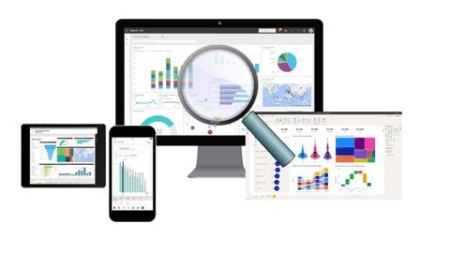
Power BI is a collection of software services, apps, and connectors that work together to turn your unrelated sources of data into coherent, visually immersive, and interactive insights. Your data may be an Excel spreadsheet, or a collection of cloud-based and on-premises hybrid data warehouses. Power BI lets you easily connect to your data sources, visualize and discover what's important, and share that with anyone or everyone you want.
Power BI consists of several elements that all work together, starting with these three basics
A Windows desktop application called Power BI Desktop.
An online SaaS (Software as a Service) service called the Power BI service.
Power BI mobile apps for Windows, iOS, and Android devices.
These three elements-Power BI Desktop, the service, and the mobile apps-are designed to let you create, share, and consume business insights in the way that serves you and your role most effectively.
How you use Power BI may depend on your role in a project or on a team. Other people, in other roles, might use Power BI differently.
For example, you might primarily use the Power BI service to view reports and dashboards. Your number-crunching, business-report-creating co-worker might make extensive use of Power BI Desktop or Power BI Report Builder to create reports, then publish those reports to the Power BI service, where you view them. Another co-worker, in sales, might mainly use the Power BI phone app to monitor progress on sales quotas, and to drill into new sales lead details.
If you're a developer, you might use Power BI APIs to push data into datasets or to embed dashboards and reports into your own custom applications. Have an idea for a new visual? Build it yourself and share it with others.
You also might use each element of Power BI at different times, depending on what you're trying to achieve or your role for a given project.
Who this course is for
Beginners to Power BI
Screenshots


6f5e5643-2b24-42a1-8ecb-7625190fd308.png

Brainstorm Academy - Teach me AE! 2.0 - Complete After Effects Course
Video: MPEG4 Video (H264) 1280x720 29.97fps 294kbps | Audio: AAC 48000Hz stereo 256kbps
Genre: eLearning | Duration: 10hrs+ | Language: Spanish (No Subtitles) | File size: 3.9 GB​


After Effects is here to give you creative freedom to create whatever is on your mind: from special effects to vignettes , from simple animated elements for your videos to complex animations .
Screenshots


f63aca52-7ee0-4658-8e9e-37ca08992228.png

ArtStation - Sci-Fi Corridor 3D by Eric Huang (With UE Assets)
Video: MPEG4 Video (H264) 1684x1066 30fps 59kbps | Audio: AAC 48000Hz stereo 160kbps
Genre: eLearning | Duration: 3hrs+ | Language: English | File size: 2.1 GB​

In this project, I was inspired by the visual direction of overwatch, I didn't go with the fully stylized art style, I'm trying to achieve a grudge and unique looking. The whole scene was baked in lightmaps, used Blender and substance painter for modeling and texturing.
Screenshots


98537a15750a325a80fcca39917ad3ac.jpeg

Beginners OBV Volume Analysis (Technical Analysis Indicator)
Instructors: Saad T. Hameed (STH)
5 sections • 18 lectures • 2h 6m
Video: MP4 1280x720 44 KHz | English + Sub
Published 10/2017 | Size: 487 MB​


Learn to Position your trades in tandem with Volume analysis. Not only this Spot the Big player through Volume Analysis
What you'll learn
Learn Volume Analysis when trading the financial markets
How Volume Indicator reveal the future rise
Become an Expert in Volume Analysis
Learn 1st and foremost Volume Indicator that is used by Pros
A Basic strategy to simplify volume.
Volume Analysis reveal the big money truth
Volume price analysis explained
Requirements
Understanding of Stock Trading
Interest in Technical analysis skills
You commit that after the course you will do demo trading on this strategy for at-least 6 Months.
Description
*** Course access includes quizzes & homework exercises, 1-on-1 instructor support and LIFETIME access! ***
Hear why this is one of the TOP-NOTCH Volume Analysis Course on Udemy
Its very good course and helped me to improve my old mistakes made by me and also explained about future chances. So its an excellent course.
-Visheshkumar Mukund Datwani
The instructor is very knowledgeable and informative. I always learn useful information from his courses that helps me in my trading.
-Eric Thompson
This man is passionate and knows what he's talking about. Thank you, my friend.
-Jakov Marsic
TOP-NOTCH Volume Analysis Instructor
I currently have 71 Knowledge programs with 20,520+ Minutes of Content (342 hours in total) with 112,000+ Satisfied Students enrolled. That's 14+ days of learning material!
I am currently mentioned in "Popular Instructors" tab on Udemy Business/Finance Section.
OBV Volume Analysis Course Details
A Basic Volume analysis strategy to simplify volume.
OBV Volume is one indicator that is most under-rated. It is under-rated as it shows the activities of institutional money flow and that is what the big player doesn't want you to see. Volume Analysis is hidden from Retail investors.
Analyze Volume through OBV Indicator.
Learn how to enter and Exit a Trade through OBV and its analysis of volume.
In This Course I will discuss 1 potent Volume Indicator to show how you can spot the bull trend before the rise and bear trap before the fall. Volume shows the complete history of the stock i.e how with the rise in volume, stock falls and with falling volume it rises.
In This course you will Learn 1 Top Volume Indicator to understand when the Smart money is coming in or going out and in the process save your trading account. Volume Analysis is your Savior and therefore use it intelligently.
I will explain you basic concepts of Volume Analysis in easy way as if I am explaining to a 5 year old.
I will explain how to enter and exit a Trade through Volume.
I will explain how to avoid traps in Stock investment through OBV Volume Analysis.
I will explain complicated Volume tools to trade with confidence.
Learn Volume Analysis on Charts as no other course does that.
This Volume Analysis course comes with guarantee that you can always apply for 100% Refund within 30 days.
A Basic strategy to simplify volume.
Disclaimer Note: This Volume Analysis course is for educational and informational purposes only. Not recommending of any particular investments such as a particular stock or mutual fund.
Other Reviews
Easy and Simple
-Anant Shaligram
Who this course is for
Anyone Who wants to learn the tips and tricks of Volume
Anyone who wants to learn Volume indicator
Anyone interested in learning a new skill
Screenshots


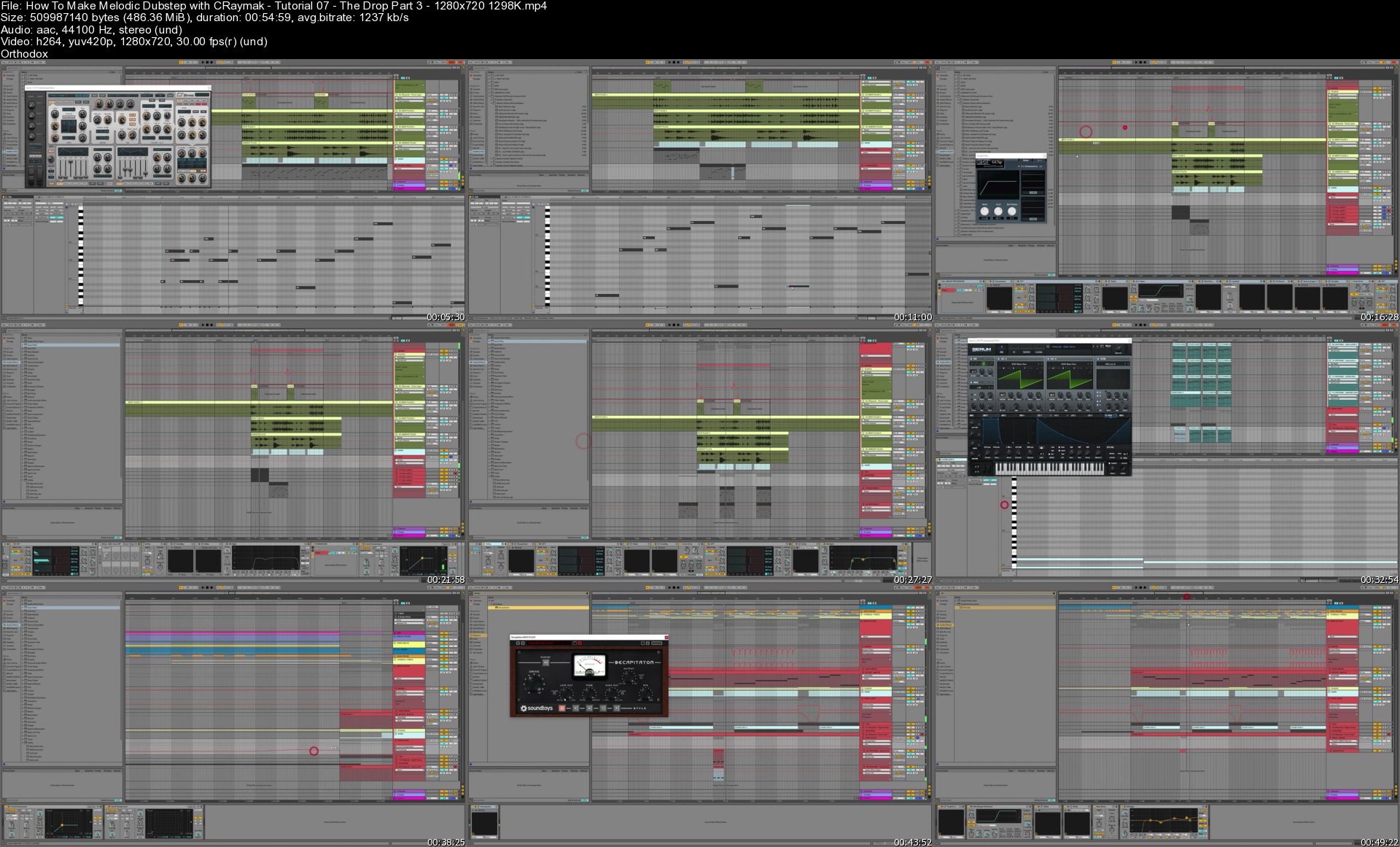
Sonic Academy - How to Make: Melodic Dubstep with CRaymak

z5jm2glmmukpuxk0day7lpmjrk.jpg


Sonic Academy - How to Make: Melodic Dubstep with CRaymak
CRaymak | Duration: 6:39 h | Video: H264 1280x720 | Audio: AAC 44,1 kHz 2ch | 5,44 GB | Language: English

'Super September' continues so back by popular demand, we welcome CRaymak for a brand new epic 'How To Make' course where he recreates his recent melodic dubstep track 'Goodbye' featuring Micah Martin.

Not for the faint-hearted, this is a multi-layered monster of a track with a build-up and drop that will give your CPU a wake-up call! However, the production skillz CRaymak shares in this detailed six and a half hour course are priceless if you're into bass music.

From using massive orchestral drum hits and gritty basslines to melodic plucks, powerful leads and huge layered super-saws right through to vocal processing, mixing and mastering - this course has it all.

Recreating a track of this size from scratch is no mean feat but CRaymak totally nails it, so what are you waiting for?

Homepage


howtomakemelodicdubstdzjug.jpg


Online Japanese N5 Course(All 15 lessons)

jwsotnkma3hkialsdw8qlc6k0o.jpg


Online Japanese N5 Course(All 15 lessons)
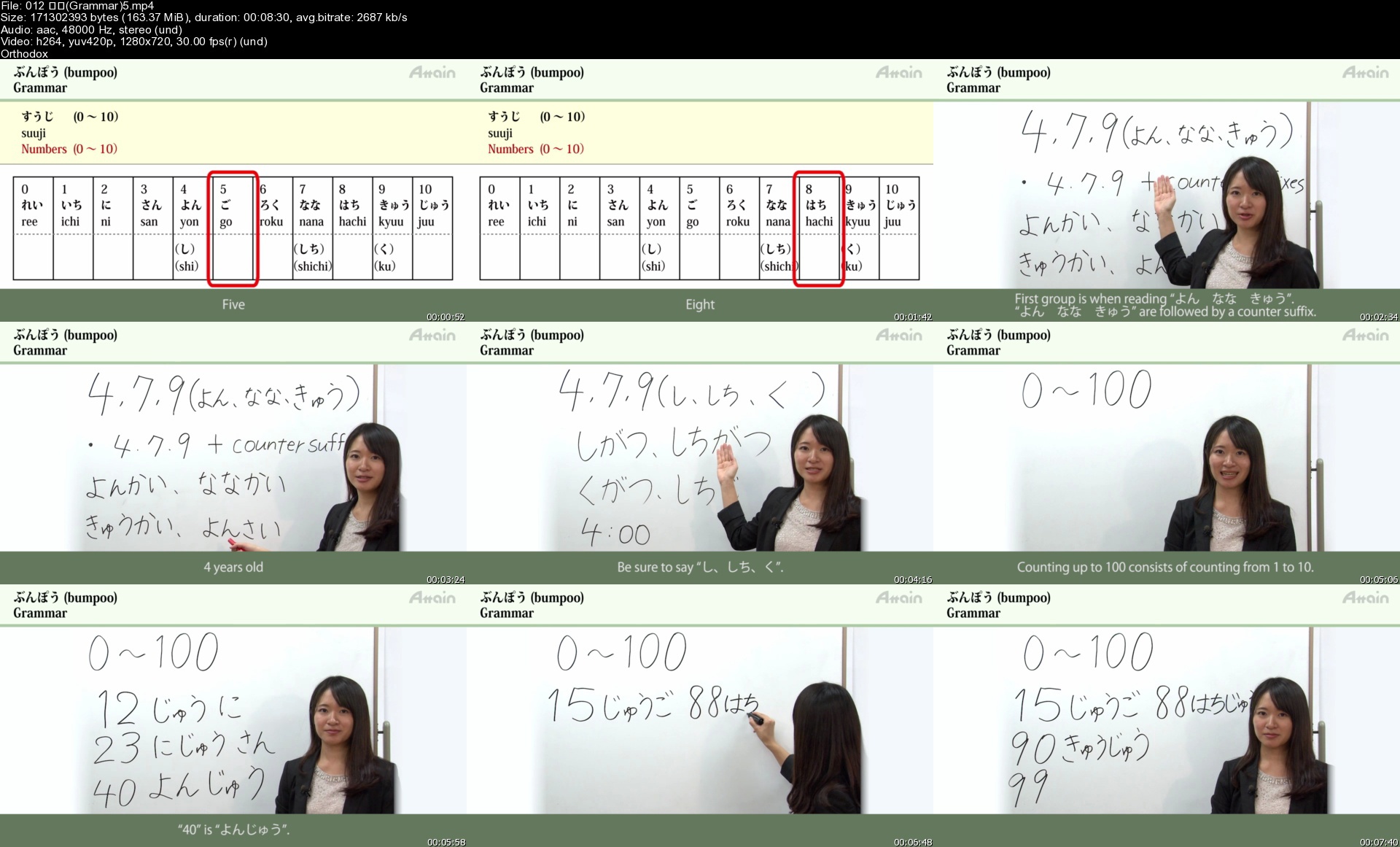
MP4 | Video: h264, 1280x720 | Audio: AAC, 44.1 KHz
Language: English | Size: 18.6 GB | Duration: 21h 14m

日本語能力試験N5対応教材 (JLPT N5 Level Elementary Japanese Study Course)


What you'll learn
Master the basics of writing and pronunciation of Japanese vocabulary.
Master vocabulary, expressions, and grammar related to the JLPT N5 level.
Being able to use basic greetings often used in daily life.
Being able to comprehend hiragana and katakana, as well as read common phrases and sentences written in N5 level Kanji.
Being able to have short simple conversations in daily life, and understand.
This course is useful for advancing your proficiency in Japanese language study, acquiring the proper qualifications of JLPT N5 as well as business Japanese.
This course is made for: Beginners wanting to study general Japanese, learners who want to study entry level business Japanese, and those taking the JLPT N5.

Description
日本語能力試験N5対応教材 (JLPT N5 Level Elementary Japanese Study Course)

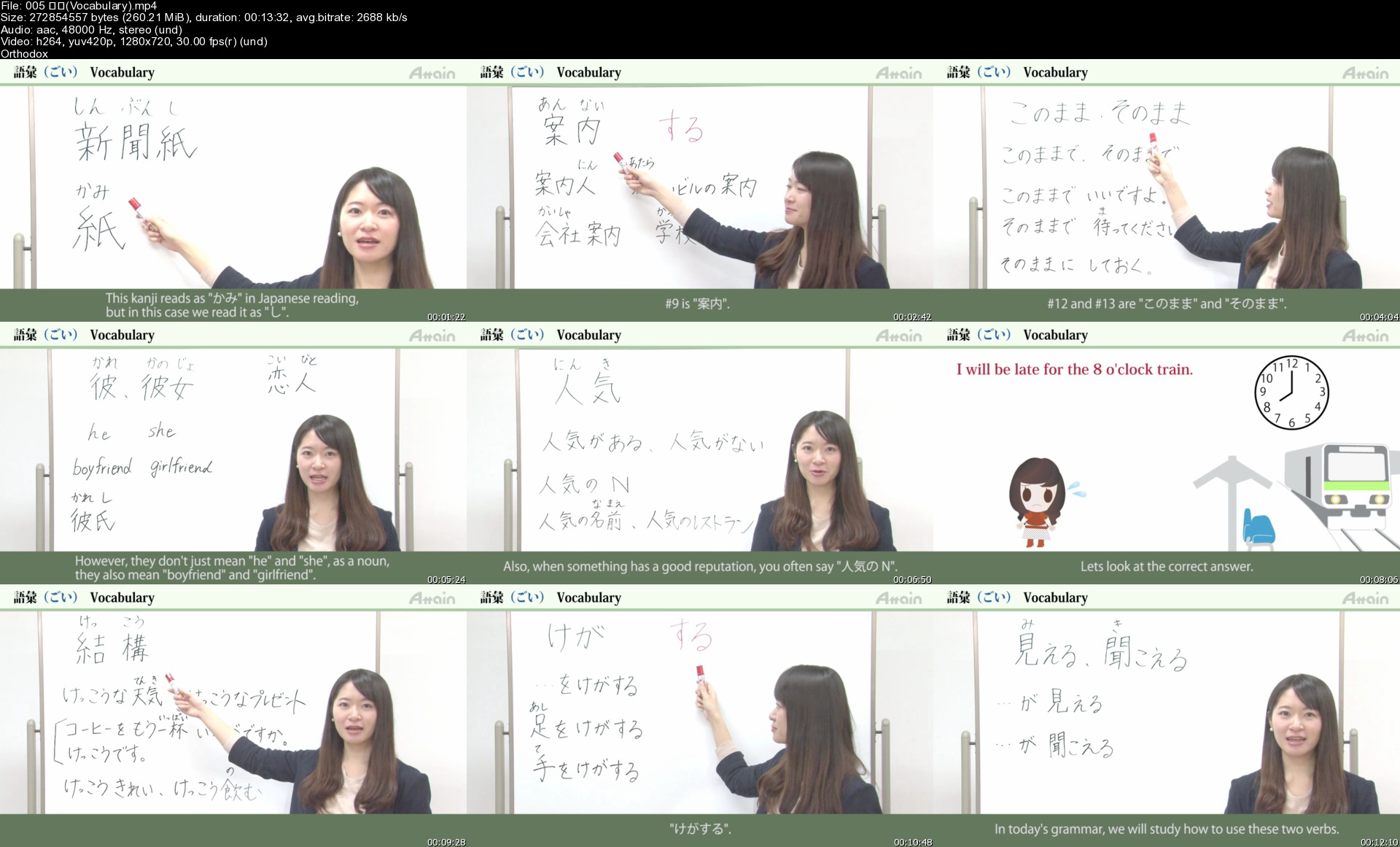
The "Online Japanese N5 Course" is Japanese study materials related to the JLPT N5 level. You can study vocabulary, expressions, and grammar that correspond to the JLPT N5 level. Furthermore, in order to advance communication proficiency in Japanese, you can watch video clips that show actual N5 level Japanese being used in daily conversations. All of the narration contains English subtitles, so that those learning Japanese for the first time can freely study the materials. In addition, for those countries unfamiliar with kanji, all of the Japanese is written in roman letters from Lesson 1 to Lesson 3, and all of the lesson examples are shown in English, so that all learners can study effectively.


Who this course is for:
(Essentials)Learners who understand English and whose native language is not Japanese.
(Essentials)Learners of elementary Japanese who have, to an extent, mastered hiragana and katakana.
Learners who want to take the JLPT N5.
Learners who want to study business Japanese.
Learners who want to be proficient in conversational Japanese.
Students enrolled in a Japanese language school or majoring in Japanese in college.
International students coming to Japan.
Foreign employees of a Japanese company who need Japanese language training.

Homepage


012grammar5s44kqr.jpg


Calculus 3 (multivariable calculus), part 1 of 2.

nacxcrtykwwnkwgtiuspbtmjzm.jpg


Calculus 3 (multivariable calculus), part 1 of 2.
MP4 | Video: h264, 1280x720 | Audio: AAC, 44100 Hz
Language: English | Size: 31.21 GB | Duration: 47h 42m


What you'll learn
How to solve problems in multivariable calculus (illustrated with more than 200 solved problems) and why these methods work.
Parameterize some curves (straight lines, circles, ellipses, graphs of functions of one variable, intersections of two surfaces).
Describe position, velocity, speed and acceleration; compute arc length of parametric curves; arc length parametrization.
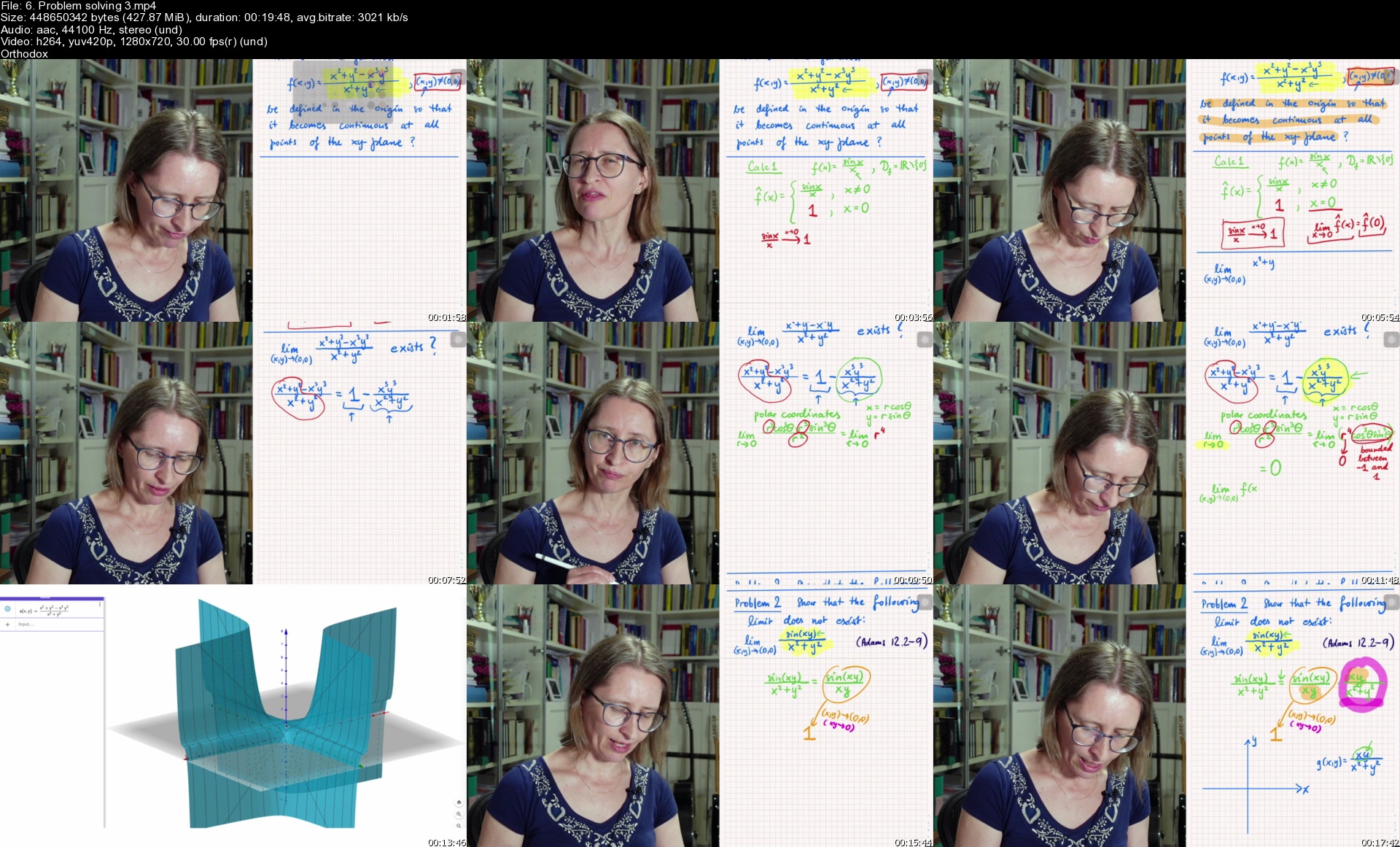
Limits, continuity and differentiability for functions of several variables. Theory, geometric intuitions, and lots of problem solving.
Several variants of the Chain Rule, involving different kinds os functions. You will also learn how to apply these variants of the Chain Rule for problem solving.
Several variants of the Implicit Function Theorem, with various geometrical interpretations; problem solving.
Optimization of functions of several variables, both on open domains and on compact domains (Lagrange multipliers on the boundary, etc.).
Requirements
Calculus 1 and 2
Some linear algebra

Description
Calculus 3 / Multivariable Calculus. Part 1 of 2.

Towards and through the vector fields.

(Chapter numbers in Robert A. Adams, Christopher Essex: Calculus, a complete course. 8th or 9th edition.)

C0 Introduction to the course; preliminaries (Chapter 10: very briefly; most of the chapter belongs to prerequisites)

About the course

Analytical geometry in R^n (n = 2 and n = 3): points, position vectors, lines and planes, distance between points (Ch.10.1)

Conic sections (circle, ellipse, parabola, hyperbola) and quadric surfaces (spheres, cylinders, cones, ellipsoids, paraboloids etc) (Ch.10.5)

Topology in R^n: distance, open ball, neighbourhood, open and closed set, inner and outer point, boundary point. (Ch.10.1)

Coordinates: Cartesian, polar, cylindrical, spherical coordinates (Ch.10.6)

You will learn: to understand which geometrical objects are represented by simpler equations and inequalities in R^2 and R^3, determine whether a set is open or closed, if a point is an inner, outer or boundary point, determine the boundary points, describe points and other geometrical objects in the different coordinate systems.

C1 Vector-valued functions, parametric curves (Chapter 11: 11.1, 11.3)

Introduction to vector-valued functions

Some examples of parametrisation

Vector-valued calculus; curve: continuous, differentiable and smooth

Arc length

Arc length parametrisation

You will learn: Parametrise some curves (straight lines, circles, ellipses, graphs of functions of one variable); if r(t) = (x(t), y(t), z(t)) is a function describing a particle's position in R^3 with respect to time t, describe position, velocity, speed and acceleration; compute arc length of parametric curves, arc length parametrisation.

C2 Functions of several variables; differentiability (Chapter 12)

Real-valued functions in multiple variables, domain, range, graph surface, level curves, level surfaces
You will learn: describe the domain and range of a function, Illustrate a function f(x,y) with a surface graph or with level curves.

Limit, continuity
You will learn: calculate limit values, determine if a function has limit value or is continuous at one point, use common sum-, product-, ... rules for limits.

Partial derivative, tangent plane, normal line
You will learn: calculate first-order partial derivatives, compute scalar products (two formulas) and cross pro- duct, give formulas for normals and tangent planes; understand functions from R^n to R^m, gradients and Jacobians.

Higher partial derivates
You will learn: compute higher order partial derivatives, use Schwarz' theorem. Solve and verify some simple PDE's.

Chain rule: different versions
You will learn: calculate the chain rule using dependency diagrams and matrix multiplication.

Linear approximation, linearisation, differentiability, differential
You will learn: determine if a function is differentiable in a point, linearisation of a real-valued function, use linearisation to derive an approximate value of a function, use the test for differentiability (continuous partial derivatives), and properties of differentiable functions.

Gradient, directional derivatives
You will learn: calculate the gradient, find the direction derivative in a certain direction, properties of gradients, understand the geometric interpretation of the directional derivative, give a formula for the tangent and normal lines to a level curve.

Implicit functions
You will learn: calculate the Jacobian determinant, derive partial derivatives with dependent and free variables of implicit functions.

Taylor's formula, Taylor's polynomial
You will learn: derive Taylor's polynomials and Taylor's formula. Understand quadratic forms and learn how to determine if they are positive definite, negative definite, or indefinite.

C3 Optimisation of functions of several variables (Chapter 13: 13.1-3)

Optimisation on open domains (critical points)

Optimisation on compact domains

Lagrange multipliers (optimisation with constraints)

You will learn: classify critical points: local max and min, saddle points; find max and min values for a given function and region; use Lagrange multipliers with one or more conditions.

Also make sure that you check with your professor what parts of the course you will need for your midterms. Such things vary from country to country, from university to university, and they can even vary from year to year at the same university.

A detailed description of the content of the course, with all the 255 videos and their titles, and with the texts of all the 216 problems solved during this course, is presented in the resource file "Outline_Calculus3.pdf" under video 1 ("Introduction to the course"). This content is also presented in video 1.


Who this course is for:
University and college engineering

Homepage


6.problemsolving3se6jmh.jpg


Online Japanese N4 Course(All 15 lessons)

ufxmkuzc4x8ankn8wrgygwgkgr.jpg


Online Japanese N4 Course(All 15 lessons)
MP4 | Video: h264, 1280x720 | Audio: AAC, 44.1 KHz
Language: English | Size: 12.4 GB | Duration: 13h 52m

日本語能力試験N4対応教材 (JLPT N4 Level Elementary Japanese Study Course)


What you'll learn
Master vocabulary, expressions, and grammar related to the JLPT N4 level.
Be able to comprehend contents slowly spoken in daily life conversations.
Be able to comprehend and read typical phrases and sentences written in N4 level kanji.
Be able to have Japanese elementary level conversations in everyday life.
Be able to have speak and understand easy words of the honorific expressions.
This is useful for advancing your proficiency in Japanese language study, acquiring the proper JLPT N4 level Japanese, as well as mastering business Japanese.

Description
日本語能力試験N4対応教材 (JLPT N4 Level Elementary Japanese Study Course)

The "Online Japanese N4 Course" are Japanese study materials related to the JLPT N4 level. You can study vocabulary, expressions, and grammar that correspond to the JLPT N4 level. The Japanese of N4 level is applied in actual conversations, so this course is useful for JLPT preparation and advancing your Japanese communication proficiency. All of the narration contains English subtitles, so that beginner Japanese learners can freely study. In addition, for those countries unfamiliar with kanji, hiragana characters are added above all of the kanji, so that learners can study effectively.


Who this course is for:
(Essentials)Learners who understand English and whose native language is not Japanese
(Essentials)Learners who have mastered JLPT N5 Japanese and Intro level Japanese.
Learners who want to take the JLPT N4.
Learners who want to study elementary business Japanese.
Learners who want to be proficient in conversational Japanese.
Students enrolled in a Japanese language school or majoring in Japanese in college
International students coming to Japan
Foreign employees of a Japanese company who need Japanese language training

Homepage


005vocabularys07jfd.jpg


Zurück
Oben Unten