




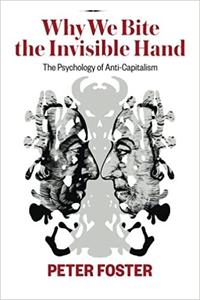
Peter Foster, "Why We Bite the Invisible Hand: The Psychology of Anti-Capitalism"
English | 2014 | ISBN: 0992127602 | 504 pages | AZW3 | 0.736 MB
In Why We Bite the Invisible Hand, Peter Foster delves into a conundrum: How can we at once live in a world of expanding technological wonders and unprecedented well-being, and yet hear a constant drumbeat of condemnation of the system that created it? That system, capitalism, which is based on private property and voluntary dealings, is guided by the "Invisible Hand," the metaphor for economic markets associated with the great Eighteenth Century Scottish philosopher Adam Smith. The hand guides people to serve others while pursuing their own interests, and produces a broader good that, as Smith put it, is "no part of their intention." Critics. however, claim that the hand is tainted by greed, leads to inequity and dangerous corporate power, and threatens not merely resource depletion but planetary disaster. Foster probes misunderstanding, fear and dislike of capitalism from the dark satanic mills of the Industrial Revolution through to the murky concept of sustainable development. His journey takes him from Kirkcaldy, the town of Smith's birth, through Moscow McDonald's and Karl Marx's Manchester, on a trip to Cuba to smuggle dollars, and into the backrooms of the United Nations. His cast of characters includes the man who wrote the entry for "capitalism" in the Great Soviet Encyclopaedia, a family of Kirkcaldy butchers, radical individualist Ayn Rand, father of evolutionary theory Charles Darwin, numerous Nobel prizewinning economists, colonies of chimpanzees, and "philanthrocapitalist" Bill Gates. Foster suggests that the key to his conundrum lies in the field of evolutionary psychology, which offers to help us understand both why some of what Adam Smith called our complex "moral sentiments" may be outdated, and why so many of our economic assumptions tend to be wrong. We are hunter gatherers with iPhones. The Invisible Hand is counterintuitive to minds formed predominantly in small close-knit tribal communities where there were no extensive markets, no money, no technological advance and no economic growth. Equally important, we don't have to understand the rapidly evolving economic "natural order" to operate within it and enjoy its benefits any more than we need to understand our nervous or respiratory systems to stay alive. But that also makes us prone to support morally-appealing but counterproductive policies, such as minimum wage legislation. Foster notes that politicians and bureaucrats - consciously or unconsciously - exploit moral confusion and economic ignorance. Ideological obsession with market imperfections, income gaps, corporate power, resource exhaustion and the environment are useful justifications for those seeking political control of our lives. The book refutes claims that capitalism's validity depends on the system being "perfect" or economic actors "rational." It also notes the key difference between capitalism and capitalists, who are inclined to misunderstand the system as much as anyone. Foster points to the astonishing rise in recent decades of radical, unelected environmental non-governmental organizations, ENGOs. Closely related to that rise, Foster examines with one of the biggest and most contentious issues of our time: projected catastrophic man-made climate change. He notes that while this theory is cited as the greatest example in history of "market failure," it in fact demonstrates how both scientific analysis and economic policy can become perverted once something is framed as a "moral issue," and thus allegedly "beyond debate." Foster's book is not a paean to greed, selfishness or radical individualism. He stresses that the greatest joys in life come from family, friendship and participation in community, sport and the arts. What has long fascinated him is the relentless claim that capitalism taints or destroys these aspects of humanity rather than promoting them. Moreover, he concludes, when you bite the Invisible Hand... it always bites back.
Recommend Download Link Hight Speed | Please Say Thanks Keep Topic Live
