• Regeln für den Video-Bereich:

    In den Börsenbereich gehören nur Angebote die bereits den Allgemeinen Regeln entsprechen.

    Einteilung

    - Folgende Formate gehören in die angegeben Bereiche:
    - Filme: Encodierte Filme von BluRay, DVD, R5, TV, Screener sowie Telesyncs im Format DivX, XviD und x264.
    - DVD: Filme im Format DVD5, DVD9 und HD2DVD.
    - HD: Encodierte Filme mit der Auflösung 720p oder darüber von BluRay, DVD, R5, TV, Screener sowie Telesyncs im Format x264.
    - 3D: Encodierte Filme von BluRay, die in einem 3D Format vorliegen. Dies gilt auch für Dokus, Animation usw.
    - Serien: Cartoon/Zeichentrick, Anime, Tutorials, Dokumentationen, Konzerte/Musik, Sonstiges sind demnach in die entsprechenden Bereiche einzuordnen, auch wenn sie beispielsweise im High Definition-Format oder als DVD5/DVD9/HD2DVD vorliegen. Ausnahme 3D.
    - Bereich Englisch: Englische Releases gehören immer in diesen Bereich.
    - Bereich Talk: Der Bereich, in dem über die Releases diskutiert werden kann, darf, soll und erwünscht ist.


    Angebot/Beitrag erstellen

    - Ein Beitrag darf erst dann erstellt werden, wenn der Upload bei mindestens einem OCH komplett ist. Platzhalter sind untersagt.
    - Bei einem Scenerelease hat der Threadtitel ausschließlich aus dem originalen, unveränderten Releasenamen zu bestehen. Es dürfen keine Veränderungen wie z.B. Sterne, kleine Buchstaben o.ä. vorgenommen werden. Ausnahme Serienbörse:
    - Bei einem Sammelthread für eine Staffel entfällt aus dem Releasename natürlich der Name der Folge. Beispiel: Die Simpsons S21 German DVDRip XviD - ITG
    - Dementsprechend sind also u.a. verboten: Erweiterungen wie "Tipp", "empfehlenswert", "only", "reup", usw. / jegliche andere Zusatzinformation oder Ergänzung, welche nicht in obiger Beschreibung zu finden ist.

    Aufbau des Angebots und Threadtitel

    Der Titel nach folgendem Muster erstellt zu werden. <Name> [3D] [Staffel] [German] <Jahr> <Tonspur> [DL] [Auflösung] <Quelle> <Codec> - <Group>
    Beispiel: The Dark Knight German 2008 AC3 DVDRip XviD - iND
    Beispiel: The Dark Knight 2008 DTS DL BDRip x264 - iND
    Beispiel: The Dark Knight 2008 AC3 DL BDRip XviD - iND
    Beispiel: The Dark Knight German 2008 AC3 720p BluRay x264 iND
    Beispiel: The Dark Knight 2008 DTS DL 1080p BluRay x264 iND
    Beispiel: Die Simpsons S01 German AC3 DVDRip XviD iND
    Beispiel: Die Simpsons S20 German AC3 720p BluRay x264 iND
    Beispiel: Sword Art Online II Ger Sub 2014 AAC 1080p WEBRip x264 - peppermint
    Entsprechend sind also u.a. verboten: Sonderzeichen wie Klammern, Sterne, Ausrufezeichen, Unterstriche, Anführungszeichen / Erweiterungen wie "Tipp", "empfehlenswert", "only", "reup", usw. / jegliche andere Zusatzinformation oder Ergänzung, welche nicht in obiger Beschreibung zu finden ist
    Ausnahmen hiervon können in den Bereichen geregelt sein.

    Die Beiträge sollen wie folgt aufgebaut werden:
    Überschrift entspricht dem Threadtitel
    Cover
    kurze Inhaltsbeschreibung
    Format, Größe, Dauer sind gut lesbar für Downloader außerhalb des Spoilers zu vermerken
    Nfo sind immer Anzugeben und selbige immer im Spoiler in Textform.
    Sind keine Nfo vorhanden z.B. Eigenpublikationen, sind im Spoiler folgende Dateiinformationen zusätzlich anzugeben :
    Quelle
    Video (Auflösung und Bitrate)
    Ton (Sprache, Format und Bitrate der einzelnen Spuren)
    Untertitel (sofern vorhanden)
    Hosterangabe in Textform außerhalb eines Spoiler mit allen enthaltenen Hostern.
    Bei SD kann auf diese zusätzlichen Dateiinformationen verzichtet werden.

    Alle benötigten Passwörter sind, sofern vorhanden, in Textform im Angebot anzugeben.
    Spoiler im Spoiler mit Kommentaren :"Schon Bedankt?" sind unerwünscht.


    Releases

    - Sind Retail-Release verfügbar, sind alle anderen Variationen untersagt. Ausnahmen: Alle deutschen Retail-Release sind CUT, in diesem Fall sind dubbed UNCUT-Release zulässig.
    - Im Serien-Bereich gilt speziell: Wenn ein Retail vor Abschluss einer laufenden Staffel erscheint, darf diese Staffel noch zu Ende gebracht werden.62
    - Gleiche Releases sind unbedingt zusammenzufassen. Das bedeutet, es ist zwingend erforderlich, vor dem Erstellen eines Themas per Suchfunktion zu überprüfen, ob bereits ein Beitrag mit demselben Release besteht. Ist dies der Fall, ist der bereits vorhandene Beitrag zu verwenden.
    - P2P und Scene Releases dürfen nicht verändert oder gar unter einem iND Tag eingestellt werden.


    Support, Diskussionen und Suche

    - Supportanfragen sind entweder per PN oder im Bereich Talk zu stellen.
    - Diskussionen und Bewertungen sind im Talk Bereich zu führen. Fragen an die Uploader haben ausschließlich via PN zu erfolgen, und sind in den Angeboten untersagt.
    - Anfragen zu Upload-Wünschen sind nur im Bereich Suche Video erlaubt. Antworten dürfen nur auf Angebote von MyBoerse.bz verlinkt werden.


    Verbote

    - Untersagt sind mehrere Formate in einem einzigen Angebotsthread, wie beispielsweise das gleichzeitige Anbieten von DivX/XviD, 720p und 1080p in einem Thread. Pro Format, Release und Auflösung ist ein eigener Thread zu eröffnen.
    - Grundsätzlich ebenso verboten sind Dupes. Uploader haben sich an geeigneter Stelle darüber zu informieren, ob es sich bei einem Release um ein Dupe handelt.
    - Gefakte, nur teilweise lauffähige oder unvollständige Angebote sind untersagt. Dies gilt auch für eigene Publikationen, die augenscheinlich nicht selbst von z.B. einer DVD gerippt wurden. Laufende Serien, bei denen noch nicht alle Folgen verfügbar sind, dürfen erstellt und regelmäßig geupdatet werden.
    - Untersagt sind Angebote, welche nur und ausschließlich in einer anderen Sprache als deutsch oder englisch vorliegen. Ausnahmen sind VORHER mit den Moderatoren zu klären.


    Verstoß gegen die Regeln

    - Angebote oder Beiträge, die gegen die Forenregeln verstoßen, sind über den "Melden"-Button im Beitrag zu melden.
  • Bitte registriere dich zunächst um Beiträge zu verfassen und externe Links aufzurufen.

++ Premium IPTV ++ 7000 Live Sender ++ UHD Qualität ++ Mediathek mit 18.000 Inhalten ++


VenneTV


Ultimate Electrical Panel Design Course from Zero to Hero

konami

MyBoerse.bz Pro Member
bb25df13e02c6145a335fb036c8e3442.webp

Free Download Ultimate Electrical Panel Design Course from Zero to Hero
Published 10/2025
Created by Eng. Amr Ramadan
MP4 | Video: h264, 1280x720 | Audio: AAC, 44.1 KHz, 2 Ch
Level: All | Genre: eLearning | Language: English | Duration: 27 Lectures ( 2h 52m) | Size: 1.65 GB


Complete Guide to Electrical LV Panel Design - Learn from Zero, No Experience Needed.
What you'll learn
Understand the fundamentals of electrical power distribution systems.
Explore external distribution equipment
Distributors and Kiosks in medium and low voltage networks
RMU (Ring Main Unit)
Coffre Pillar (street distribution box)
Main Distribution Panels (MDP)
Sub Main Distribution Panels (SMDP)
Final Distribution Boards (FDB)
Automatic Transfer Switch (ATS) Panels
Motor Control Centers (MCC)
Capacitor Bank Panels
Lighting and Power Panels
Difference Between Manufacturing Factories and Assembly Factories
Differentiate between Type Tested Panels (TTA) and Local Assembled Panels.
Learn the manufacturing process of electrical panels in factories: CNC cutting and punching of sheet metal. Sheet bending/forming using hydraulic press brakes
Explore panel enclosure materials such as: Sheet steel (cold rolled / galvanized) Stainless steel enclosures
Understand enclosure classifications and ratings: IP ratings (Ingress Protection against dust/water). IK ratings (Mechanical impact resistance).
Panel shapes, sizes, and forms of separation (IEC 61439).
Learn installation methods: Wall-mounted (surface/flush). Floor-standing and free-standing panels. Outdoor weatherproof panels
Learn the types of circuit breakers and their applications.
MCB (Miniature Circuit Breaker)
MCCB (Molded Case Circuit Breaker)
ACB (Air Circuit Breaker)
Understand and apply control devices
Timers (ON delay, OFF delay, star-delta)
Push buttons, selectors, limit switches, and control wiring
Contactors, overload relays, auxiliary relays
learn about AutoCAD.
Learn electrical calculations
Breaker sizing (current rating, short circuit capacity, trip curves)
Cable sizing (ampacity, derating factors, voltage drop, short circuit withstand)
Select and integrate all panel components including breakers, contactors, relays, CTs, meters, busbars, terminals, Omega rails, and wiring ducts.
Read and prepare Single Line Diagrams (SLD), wiring schematics, load schedules, and shop drawings.
Develop complete Bill of Materials (BOM) and professional design documentation.
Follow the workflow of design → fabrication → assembly → wiring → testing → inspection → commissioning.
Gain practical tips for panel troubleshooting, maintenance, and quality control.
Build confidence to deliver complete electrical panel projects for residential, commercial, and industrial applications.
Busbar sizing and copper calculations (cross-sectional area, current density, temperature rise)
Sheet metal calculations (panel dimensions, thickness, weight, and structural strength)
Material estimation for copper and sheet steel during panel design
Perform testing and quality checks, including.
Insulation resistance test (Megger test).
Functional testing of breakers, relays, and control circuits.
Understand Factory Acceptance Testing (FAT) and Site Acceptance Testing (SAT) procedures.
Learn the process of handover and client approval, including documentation, checklists, and compliance certificates.
Build confidence to deliver residential, commercial, and industrial electrical distribution projects from zero to hero.
Requirements
No prior experience with electrical panel design is required - the course starts from the basics.
A laptop or PC to follow along with design exercises and drawings.
(Optional) Access to AutoCAD or any drawing software for practice, but you can still learn the concepts without it.
Description
Are you ready to become confident in Electrical Low Voltage (LV) Panel Design, even if you have no prior experience?This course is your complete step-by-step guide to learning how electrical distribution panels are designed, fabricated, assembled, tested, and commissioned in real-world projects. Starting from the basics, you will gradually progress to advanced concepts, building both the theoretical knowledge and the practical design skills required in the industry.Unlike many traditional courses that only focus on theory, this course takes a hands-on approach. You will not only understand the fundamentals of panel design but also practice essential calculations such as breaker sizing, cable sizing, and copper busbar design. You will learn how to prepare Bill of Materials (BOMs), develop shop drawings, interpret Single Line Diagrams (SLDs), and apply international standards such as IEC 61439 and NEC.What you will learn:Fundamentals of electrical power distribution and LV systems.Types of panels: MDP, SMDP, FDB, MCC, ATS, capacitor banks, lighting & power panels.External equipment: RMUs, coffret pillars, kiosks, distributors.Panel fabrication processes: CNC sheet cutting, sheet bending, CO₂/MIG welding, powder coating.Difference between Type Tested Panels (TTA) and locally assembled panels.Panel enclosure materials: sheet steel, stainless steel, aluminum, FRP, polycarbonate.Circuit breakers: MCB, MCCB, ACB, RCCB - functions, selection, applications.Control devices: contactors, relays, timers, push buttons, limit switches.Electrical calculations: breaker sizing, cable sizing, copper busbar sizing, sheet metal thickness.Preparing BOMs, SLDs, shop drawings, load schedules, and design documentation.Testing and commissioning: insulation test, continuity test, dielectric withstand, functional checks.Factory Acceptance Testing (FAT) and Site Acceptance Testing (SAT) procedures.Preparing final documentation and client handover. Who this course is for:Electrical engineering students and fresh graduates.Technicians and site engineers looking to enhance design knowledge.Practicing engineers who want to update their skills with IEC/NEC standards.Anyone who wants to master LV electrical panel design from zero to hero. By the end of this course, you will:Have a solid foundation in LV panel design and electrical distribution.Be able to design complete panels from scratch, including calculations and drawings.Gain the confidence to participate in or supervise manufacturing, assembly, and testing.Develop a skill set that will boost your career and make you stand out in the electrical engineering field.Join now and transform your understanding of electrical panel design - from zero to hero.
Who this course is for
Electrical engineering students who want to gain practical, real-world skills in panel design beyond what is taught in university.
Fresh graduates looking to strengthen their CVs and become job-ready with hands-on electrical panel design knowledge.
Junior electrical engineers and technicians who are starting their careers in construction, contracting, or industrial projects.
Practicing engineers who want to update their knowledge of international standards (IEC/NEC) and modern panel manufacturing practices.
Professionals in related fields (mechanical, civil, project managers) who want to understand the basics of electrical panels for better coordination in projects.
Anyone interested in learning electrical panel design from scratch - even without prior experience - and building confidence to handle both residential and industrial projects.
Homepage:

Rapidgator

 

b0882d658aea9add1192f6049d30b7da.jpg

Ultimate Electrical Panel Design Course from Zero to Hero
Published 10/2025
Duration: 2h 53m | .MP4 1280x720 30 fps(r) | AAC, 44100 Hz, 2ch | 1.65 GB
Genre: eLearning | Language: English​

Complete Guide to Electrical LV Panel Design - Learn from Zero, No Experience Needed.

What you'll learn
- Understand the fundamentals of electrical power distribution systems.
- Explore external distribution equipment
- Distributors and Kiosks in medium and low voltage networks
- RMU (Ring Main Unit)
- Coffre Pillar (street distribution box)
- Main Distribution Panels (MDP)
- Sub Main Distribution Panels (SMDP)
- Final Distribution Boards (FDB)
- Automatic Transfer Switch (ATS) Panels
- Motor Control Centers (MCC)
- Capacitor Bank Panels
- Lighting and Power Panels
- Difference Between Manufacturing Factories and Assembly Factories
- Differentiate between Type Tested Panels (TTA) and Local Assembled Panels.
- Learn the manufacturing process of electrical panels in factories: CNC cutting and punching of sheet metal. Sheet bending/forming using hydraulic press brakes
- Explore panel enclosure materials such as: Sheet steel (cold rolled / galvanized) Stainless steel enclosures
- Understand enclosure classifications and ratings: IP ratings (Ingress Protection against dust/water). IK ratings (Mechanical impact resistance).
- Panel shapes, sizes, and forms of separation (IEC 61439).
- Learn installation methods: Wall-mounted (surface/flush). Floor-standing and free-standing panels. Outdoor weatherproof panels
- Learn the types of circuit breakers and their applications.
- MCB (Miniature Circuit Breaker)
- MCCB (Molded Case Circuit Breaker)
- ACB (Air Circuit Breaker)
- Understand and apply control devices:
- Timers (ON delay, OFF delay, star-delta)
- Push buttons, selectors, limit switches, and control wiring
- Contactors, overload relays, auxiliary relays
- learn about AutoCAD.
- Learn electrical calculations
- Breaker sizing (current rating, short circuit capacity, trip curves)
- Cable sizing (ampacity, derating factors, voltage drop, short circuit withstand)
- Select and integrate all panel components including breakers, contactors, relays, CTs, meters, busbars, terminals, Omega rails, and wiring ducts.
- Read and prepare Single Line Diagrams (SLD), wiring schematics, load schedules, and shop drawings.
- Develop complete Bill of Materials (BOM) and professional design documentation.
- Follow the workflow of design → fabrication → assembly → wiring → testing → inspection → commissioning.
- Gain practical tips for panel troubleshooting, maintenance, and quality control.
- Build confidence to deliver complete electrical panel projects for residential, commercial, and industrial applications.
- Busbar sizing and copper calculations (cross-sectional area, current density, temperature rise)
- Sheet metal calculations (panel dimensions, thickness, weight, and structural strength)
- Material estimation for copper and sheet steel during panel design
- Perform testing and quality checks, including.
- Insulation resistance test (Megger test).
- Functional testing of breakers, relays, and control circuits.
- Understand Factory Acceptance Testing (FAT) and Site Acceptance Testing (SAT) procedures.
- Learn the process of handover and client approval, including documentation, checklists, and compliance certificates.
- Build confidence to deliver residential, commercial, and industrial electrical distribution projects from zero to hero.

Requirements
- No prior experience with electrical panel design is required - the course starts from the basics.
- A laptop or PC to follow along with design exercises and drawings.
- (Optional) Access to AutoCAD or any drawing software for practice, but you can still learn the concepts without it.

Description
Are you ready to become confident in Electrical Low Voltage (LV) Panel Design, even if you have no prior experience?

This course is yourcomplete step-by-step guideto learning how electrical distribution panels are designed, fabricated, assembled, tested, and commissioned in real-world projects. Starting from the basics, you will gradually progress to advanced concepts, building both the theoretical knowledge and thepractical design skillsrequired in the industry.

Unlike many traditional courses that only focus on theory, this course takes ahands-on approach. You will not only understand the fundamentals of panel design but also practice essential calculations such as breaker sizing, cable sizing, and copper busbar design. You will learn how to prepareBill of Materials (BOMs), developshop drawings, interpretSingle Line Diagrams (SLDs), and apply international standards such asIEC 61439 and NEC.

What you will learn:

Fundamentals of electrical power distribution and LV systems.

Types of panels:MDP, SMDP, FDB, MCC, ATS, capacitor banks, lighting & power panels.

External equipment:RMUs, coffret pillars, kiosks, distributors.

Panel fabrication processes: CNC sheet cutting, sheet bending, CO₂/MIG welding, powder coating.

Difference betweenType Tested Panels (TTA)andlocally assembled panels.

Panel enclosure materials: sheet steel, stainless steel, aluminum, FRP, polycarbonate.

Circuit breakers: MCB, MCCB, ACB, RCCB - functions, selection, applications.

Control devices: contactors, relays, timers, push buttons, limit switches.

Electrical calculations:breaker sizing, cable sizing, copper busbar sizing, sheet metal thickness.

PreparingBOMs, SLDs, shop drawings, load schedules, and design documentation.

Testing and commissioning: insulation test, continuity test, dielectric withstand, functional checks.

Factory Acceptance Testing (FAT)andSite Acceptance Testing (SAT)procedures.

Preparing final documentation and client handover.

Who this course is for:

Electrical engineeringstudents and fresh graduates.

Technicians and site engineerslooking to enhance design knowledge.

Practicing engineerswho want to update their skills with IEC/NEC standards.

Anyone who wants to master LV electrical panel design fromzero to hero.

By the end of this course, you will:

Have asolid foundationin LV panel design and electrical distribution.

Be able todesign complete panels from scratch, including calculations and drawings.

Gain the confidence to participate in or supervisemanufacturing, assembly, and testing.

Develop a skill set that willboost your careerand make you stand out in the electrical engineering field.

Join now and transform your understanding ofelectrical panel design - from zero to hero.

Who this course is for:
- Electrical engineering students who want to gain practical, real-world skills in panel design beyond what is taught in university.
- Fresh graduates looking to strengthen their CVs and become job-ready with hands-on electrical panel design knowledge.
- Junior electrical engineers and technicians who are starting their careers in construction, contracting, or industrial projects.
- Practicing engineers who want to update their knowledge of international standards (IEC/NEC) and modern panel manufacturing practices.
- Professionals in related fields (mechanical, civil, project managers) who want to understand the basics of electrical panels for better coordination in projects.
- Anyone interested in learning electrical panel design from scratch - even without prior experience - and building confidence to handle both residential and industrial projects.


cUjiSFfy_o.jpg


5c03325a4fa946896fd9409a026acd16.jpg

Ultimate Electrical Panel Design Course from Zero to Hero
Published 10/2025
Duration: 2h 53m | .MP4 1280x720 30 fps(r) | AAC, 44100 Hz, 2ch | 1.65 GB
Genre: eLearning | Language: English​

Complete Guide to Electrical LV Panel Design - Learn from Zero, No Experience Needed.

What you'll learn
- Understand the fundamentals of electrical power distribution systems.
- Explore external distribution equipment
- Distributors and Kiosks in medium and low voltage networks
- RMU (Ring Main Unit)
- Coffre Pillar (street distribution box)
- Main Distribution Panels (MDP)
- Sub Main Distribution Panels (SMDP)
- Final Distribution Boards (FDB)
- Automatic Transfer Switch (ATS) Panels
- Motor Control Centers (MCC)
- Capacitor Bank Panels
- Lighting and Power Panels
- Difference Between Manufacturing Factories and Assembly Factories
- Differentiate between Type Tested Panels (TTA) and Local Assembled Panels.
- Learn the manufacturing process of electrical panels in factories: CNC cutting and punching of sheet metal. Sheet bending/forming using hydraulic press brakes
- Explore panel enclosure materials such as: Sheet steel (cold rolled / galvanized) Stainless steel enclosures
- Understand enclosure classifications and ratings: IP ratings (Ingress Protection against dust/water). IK ratings (Mechanical impact resistance).
- Panel shapes, sizes, and forms of separation (IEC 61439).
- Learn installation methods: Wall-mounted (surface/flush). Floor-standing and free-standing panels. Outdoor weatherproof panels
- Learn the types of circuit breakers and their applications.
- MCB (Miniature Circuit Breaker)
- MCCB (Molded Case Circuit Breaker)
- ACB (Air Circuit Breaker)
- Understand and apply control devices:
- Timers (ON delay, OFF delay, star-delta)
- Push buttons, selectors, limit switches, and control wiring
- Contactors, overload relays, auxiliary relays
- learn about AutoCAD.
- Learn electrical calculations
- Breaker sizing (current rating, short circuit capacity, trip curves)
- Cable sizing (ampacity, derating factors, voltage drop, short circuit withstand)
- Select and integrate all panel components including breakers, contactors, relays, CTs, meters, busbars, terminals, Omega rails, and wiring ducts.
- Read and prepare Single Line Diagrams (SLD), wiring schematics, load schedules, and shop drawings.
- Develop complete Bill of Materials (BOM) and professional design documentation.
- Follow the workflow of design → fabrication → assembly → wiring → testing → inspection → commissioning.
- Gain practical tips for panel troubleshooting, maintenance, and quality control.
- Build confidence to deliver complete electrical panel projects for residential, commercial, and industrial applications.
- Busbar sizing and copper calculations (cross-sectional area, current density, temperature rise)
- Sheet metal calculations (panel dimensions, thickness, weight, and structural strength)
- Material estimation for copper and sheet steel during panel design
- Perform testing and quality checks, including.
- Insulation resistance test (Megger test).
- Functional testing of breakers, relays, and control circuits.
- Understand Factory Acceptance Testing (FAT) and Site Acceptance Testing (SAT) procedures.
- Learn the process of handover and client approval, including documentation, checklists, and compliance certificates.
- Build confidence to deliver residential, commercial, and industrial electrical distribution projects from zero to hero.

Requirements
- No prior experience with electrical panel design is required - the course starts from the basics.
- A laptop or PC to follow along with design exercises and drawings.
- (Optional) Access to AutoCAD or any drawing software for practice, but you can still learn the concepts without it.

Description
Are you ready to become confident in Electrical Low Voltage (LV) Panel Design, even if you have no prior experience?

This course is yourcomplete step-by-step guideto learning how electrical distribution panels are designed, fabricated, assembled, tested, and commissioned in real-world projects. Starting from the basics, you will gradually progress to advanced concepts, building both the theoretical knowledge and thepractical design skillsrequired in the industry.

Unlike many traditional courses that only focus on theory, this course takes ahands-on approach. You will not only understand the fundamentals of panel design but also practice essential calculations such as breaker sizing, cable sizing, and copper busbar design. You will learn how to prepareBill of Materials (BOMs), developshop drawings, interpretSingle Line Diagrams (SLDs), and apply international standards such asIEC 61439 and NEC.

What you will learn:

Fundamentals of electrical power distribution and LV systems.

Types of panels:MDP, SMDP, FDB, MCC, ATS, capacitor banks, lighting & power panels.

External equipment:RMUs, coffret pillars, kiosks, distributors.

Panel fabrication processes: CNC sheet cutting, sheet bending, CO₂/MIG welding, powder coating.

Difference betweenType Tested Panels (TTA)andlocally assembled panels.

Panel enclosure materials: sheet steel, stainless steel, aluminum, FRP, polycarbonate.

Circuit breakers: MCB, MCCB, ACB, RCCB - functions, selection, applications.

Control devices: contactors, relays, timers, push buttons, limit switches.

Electrical calculations:breaker sizing, cable sizing, copper busbar sizing, sheet metal thickness.

PreparingBOMs, SLDs, shop drawings, load schedules, and design documentation.

Testing and commissioning: insulation test, continuity test, dielectric withstand, functional checks.

Factory Acceptance Testing (FAT)andSite Acceptance Testing (SAT)procedures.

Preparing final documentation and client handover.

Who this course is for:

Electrical engineeringstudents and fresh graduates.

Technicians and site engineerslooking to enhance design knowledge.

Practicing engineerswho want to update their skills with IEC/NEC standards.

Anyone who wants to master LV electrical panel design fromzero to hero.

By the end of this course, you will:

Have asolid foundationin LV panel design and electrical distribution.

Be able todesign complete panels from scratch, including calculations and drawings.

Gain the confidence to participate in or supervisemanufacturing, assembly, and testing.

Develop a skill set that willboost your careerand make you stand out in the electrical engineering field.

Join now and transform your understanding ofelectrical panel design - from zero to hero.

Who this course is for:
- Electrical engineering students who want to gain practical, real-world skills in panel design beyond what is taught in university.
- Fresh graduates looking to strengthen their CVs and become job-ready with hands-on electrical panel design knowledge.
- Junior electrical engineers and technicians who are starting their careers in construction, contracting, or industrial projects.
- Practicing engineers who want to update their knowledge of international standards (IEC/NEC) and modern panel manufacturing practices.
- Professionals in related fields (mechanical, civil, project managers) who want to understand the basics of electrical panels for better coordination in projects.
- Anyone interested in learning electrical panel design from scratch - even without prior experience - and building confidence to handle both residential and industrial projects.


RFE6lDE4_o.jpg


762618921_yxusj-44n2gtd272wx.jpg

Ultimate Electrical Design Course from Zero to Hero HV MV LV
MP4 | Video: h264, 1920x1080 | Audio: AAC, 44.1 KHz, 2 Ch
Genre: eLearning | Language: English (US) | Duration: 43 mins | Size: 313 MB​

Electrical Power Distribution Systems & Practical Electrical Design
From Generation to LV Loads - Part One & Part Two

Are you an electrical engineer, electrical student, fresh graduate, site engineer, MEP engineer, supervisor, or designer who wants to understand how electrical power distribution systems really work in real projects?
This course is designed to take you step by step from the basic concept of electrical power distribution to practical electrical design and installation for mega construction projects.
Instead of memorizing equipment names separately, you will understand how all electrical components are connected together as one complete system - from the power source to the final load.
In this course, you will learn both the theoretical and practical sides of electrical distribution, design, drafting, installation, and documentation. The course follows a clear step-by-step method to help you move from scratch to a professional level in a short time.

What's Included?
This course includes practical and theoretical topics covering electrical design and installation for large-scale and mega construction projects.
You will start with an introduction to electrical projects, project types, design standards, and the general structure of electrical systems.
Then, you will learn how electrical power is generated, transmitted, transformed, distributed, and finally delivered to low-voltage loads.
You will also study lighting systems, power and socket systems, HVAC power supplies, distribution panels, load schedules, power cables, earthing systems, lightning protection systems, single-line diagrams, backup power systems, UPS systems, generators, and extra low-voltage systems.
The course also introduces practical software applications such as AutoCAD, Dialux, Dialux Evo, Excel, and ETAP to help you connect engineering theory with real project documentation and design outputs.

In this course, Electrical Power Distribution Systems & Practical Electrical Design, you will learn the complete journey of electrical power from generation to final loads.
We will start with power generation, step-up substations, high-voltage transmission networks, and step-down substations. Then we will move into medium-voltage distribution, including MV switchgear, RMUs, kiosk substations, and distribution transformers.
After that, you will understand how low-voltage power is distributed through MDPs, SMDPs, DPs, MCCs, power factor correction panels, ATS systems, standby generators, feeder pillars, coffres, and street lighting feeders.
This course is not only about knowing the name of each component. It is about understanding the role of every component, where it is installed, how it is connected, and how it works inside the complete electrical network.
This is Part One of the training series.

In Part Two, we will go deeper into internal low-voltage design, including lighting circuits, power and socket circuits, panel schedules, cable routing, shop drawings, load calculations, electrical design documentation, and practical installation requirements.
By the end of this course, you will have a strong foundation in electrical power distribution and practical electrical design for real construction projects.
Course Content Part Two
1. Introduction to Electrical Projects
2. Types of Projects and Electrical Standards
3. Electrical Power Distribution Overview
4. Generation, Transmission, and Distribution Systems
5. High Voltage, Medium Voltage, and Low Voltage Networks
6. MV Switchgear, RMU, Kiosk Substation, and Distribution Transformer
7. Main Distribution Panel, Sub-Main Distribution Panel, and Distribution Panel
8. ATS, Generator, MCC, Power Factor Panel, Feeder Pillar, and Coffre
9. Lighting System Parameters
10. Manual Lighting Calculations
11. Drafting Lighting Systems in AutoCAD
12. Lighting Design Using Dialux
13. Lighting Design Using Dialux Evo
14. Finalizing Lighting System Drawings
15. Power Outlet and Socket System Design
16. Power Circuits and Small Power Systems
17. HVAC Systems and Mechanical Equipment Power Supplies
18. Power Distribution Inside Buildings
19. Distribution Panel Components and Types
20. Load Schedule Preparation
21. Power Cables: Types, Selection, and Calculations
22. Installation of Power Cables
23. Voltage Drop Calculations
24. Short-Circuit Calculations
25. Earthing and Grounding Systems
26. Sizing of Neutral and Earthing Conductors
27. Lightning Protection System
28. Single-Line Diagram Design
29. Riser Diagram Design
30. Transformer Room Sizing
31. Generator Room Sizing
32. UPS System Design
33. Backup Generator Installation and Integration
34. MV/LV Power Installation Basics
35. Low Current and Extra-Low-Voltage Systems
36. Fire Alarm System Design Basics
37. CCTV System Design Basics
38. MATV System Design Basics
39. Data, Telephone, and Sound Systems
40. Practical Design Documentation and Shop Drawings


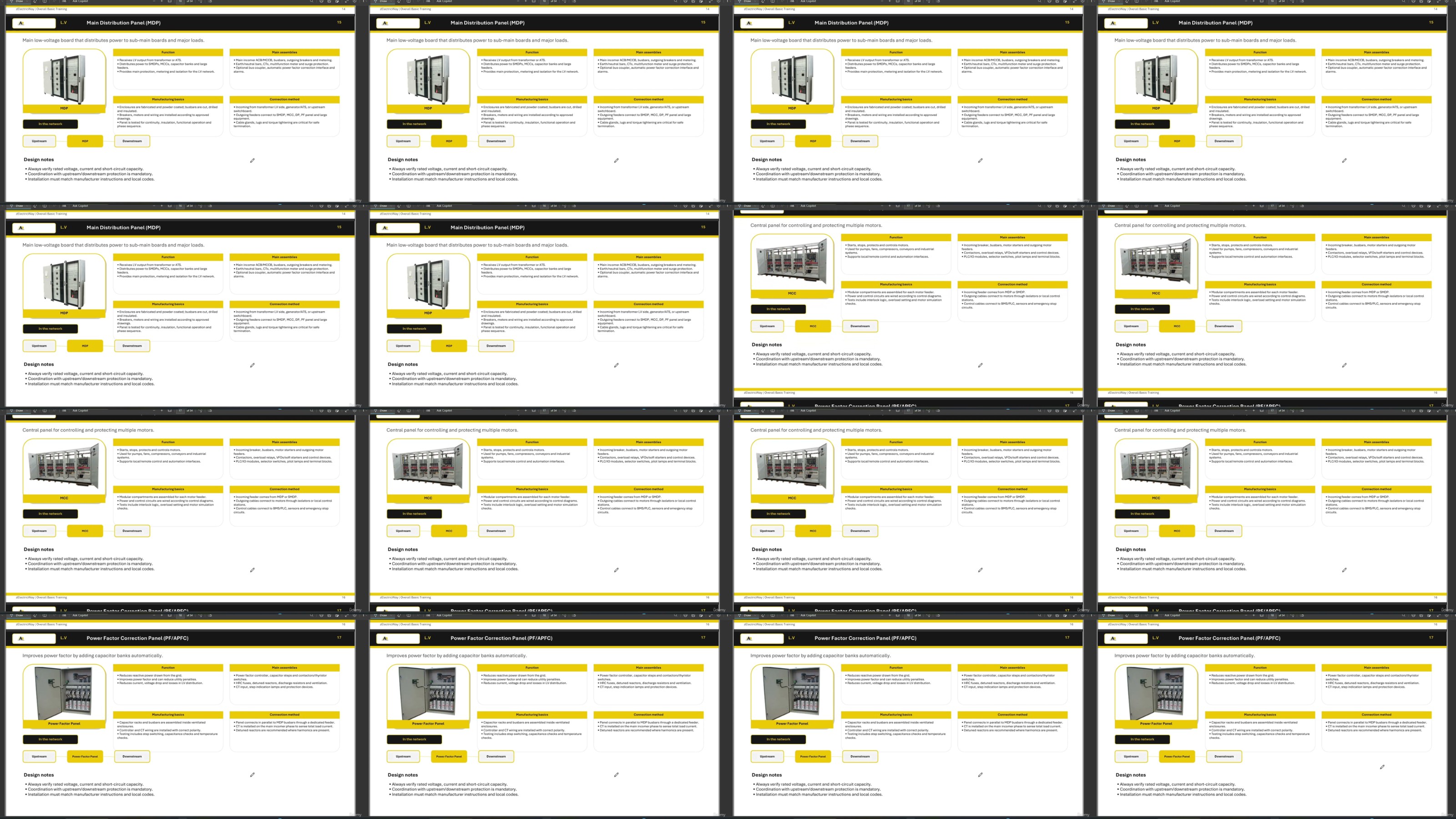
yxusj-14-Mdp-Mcc-Pfapfc.jpg

762619000_yxusj-5h454g62wydv.jpg

 
Zurück
Oben Unten