• Regeln für den Video-Bereich:

    In den Börsenbereich gehören nur Angebote die bereits den Allgemeinen Regeln entsprechen.

    Einteilung

    - Folgende Formate gehören in die angegeben Bereiche:
    - Filme: Encodierte Filme von BluRay, DVD, R5, TV, Screener sowie Telesyncs im Format DivX, XviD und x264.
    - DVD: Filme im Format DVD5, DVD9 und HD2DVD.
    - HD: Encodierte Filme mit der Auflösung 720p oder darüber von BluRay, DVD, R5, TV, Screener sowie Telesyncs im Format x264.
    - 3D: Encodierte Filme von BluRay, die in einem 3D Format vorliegen. Dies gilt auch für Dokus, Animation usw.
    - Serien: Cartoon/Zeichentrick, Anime, Tutorials, Dokumentationen, Konzerte/Musik, Sonstiges sind demnach in die entsprechenden Bereiche einzuordnen, auch wenn sie beispielsweise im High Definition-Format oder als DVD5/DVD9/HD2DVD vorliegen. Ausnahme 3D.
    - Bereich Englisch: Englische Releases gehören immer in diesen Bereich.
    - Bereich Talk: Der Bereich, in dem über die Releases diskutiert werden kann, darf, soll und erwünscht ist.


    Angebot/Beitrag erstellen

    - Ein Beitrag darf erst dann erstellt werden, wenn der Upload bei mindestens einem OCH komplett ist. Platzhalter sind untersagt.
    - Bei einem Scenerelease hat der Threadtitel ausschließlich aus dem originalen, unveränderten Releasenamen zu bestehen. Es dürfen keine Veränderungen wie z.B. Sterne, kleine Buchstaben o.ä. vorgenommen werden. Ausnahme Serienbörse:
    - Bei einem Sammelthread für eine Staffel entfällt aus dem Releasename natürlich der Name der Folge. Beispiel: Die Simpsons S21 German DVDRip XviD - ITG
    - Dementsprechend sind also u.a. verboten: Erweiterungen wie "Tipp", "empfehlenswert", "only", "reup", usw. / jegliche andere Zusatzinformation oder Ergänzung, welche nicht in obiger Beschreibung zu finden ist.

    Aufbau des Angebots und Threadtitel

    Der Titel nach folgendem Muster erstellt zu werden. <Name> [3D] [Staffel] [German] <Jahr> <Tonspur> [DL] [Auflösung] <Quelle> <Codec> - <Group>
    Beispiel: The Dark Knight German 2008 AC3 DVDRip XviD - iND
    Beispiel: The Dark Knight 2008 DTS DL BDRip x264 - iND
    Beispiel: The Dark Knight 2008 AC3 DL BDRip XviD - iND
    Beispiel: The Dark Knight German 2008 AC3 720p BluRay x264 iND
    Beispiel: The Dark Knight 2008 DTS DL 1080p BluRay x264 iND
    Beispiel: Die Simpsons S01 German AC3 DVDRip XviD iND
    Beispiel: Die Simpsons S20 German AC3 720p BluRay x264 iND
    Beispiel: Sword Art Online II Ger Sub 2014 AAC 1080p WEBRip x264 - peppermint
    Entsprechend sind also u.a. verboten: Sonderzeichen wie Klammern, Sterne, Ausrufezeichen, Unterstriche, Anführungszeichen / Erweiterungen wie "Tipp", "empfehlenswert", "only", "reup", usw. / jegliche andere Zusatzinformation oder Ergänzung, welche nicht in obiger Beschreibung zu finden ist
    Ausnahmen hiervon können in den Bereichen geregelt sein.

    Die Beiträge sollen wie folgt aufgebaut werden:
    Überschrift entspricht dem Threadtitel
    Cover
    kurze Inhaltsbeschreibung
    Format, Größe, Dauer sind gut lesbar für Downloader außerhalb des Spoilers zu vermerken
    Nfo sind immer Anzugeben und selbige immer im Spoiler in Textform.
    Sind keine Nfo vorhanden z.B. Eigenpublikationen, sind im Spoiler folgende Dateiinformationen zusätzlich anzugeben :
    Quelle
    Video (Auflösung und Bitrate)
    Ton (Sprache, Format und Bitrate der einzelnen Spuren)
    Untertitel (sofern vorhanden)
    Hosterangabe in Textform außerhalb eines Spoiler mit allen enthaltenen Hostern.
    Bei SD kann auf diese zusätzlichen Dateiinformationen verzichtet werden.

    Alle benötigten Passwörter sind, sofern vorhanden, in Textform im Angebot anzugeben.
    Spoiler im Spoiler mit Kommentaren :"Schon Bedankt?" sind unerwünscht.


    Releases

    - Sind Retail-Release verfügbar, sind alle anderen Variationen untersagt. Ausnahmen: Alle deutschen Retail-Release sind CUT, in diesem Fall sind dubbed UNCUT-Release zulässig.
    - Im Serien-Bereich gilt speziell: Wenn ein Retail vor Abschluss einer laufenden Staffel erscheint, darf diese Staffel noch zu Ende gebracht werden.62
    - Gleiche Releases sind unbedingt zusammenzufassen. Das bedeutet, es ist zwingend erforderlich, vor dem Erstellen eines Themas per Suchfunktion zu überprüfen, ob bereits ein Beitrag mit demselben Release besteht. Ist dies der Fall, ist der bereits vorhandene Beitrag zu verwenden.
    - P2P und Scene Releases dürfen nicht verändert oder gar unter einem iND Tag eingestellt werden.


    Support, Diskussionen und Suche

    - Supportanfragen sind entweder per PN oder im Bereich Talk zu stellen.
    - Diskussionen und Bewertungen sind im Talk Bereich zu führen. Fragen an die Uploader haben ausschließlich via PN zu erfolgen, und sind in den Angeboten untersagt.
    - Anfragen zu Upload-Wünschen sind nur im Bereich Suche Video erlaubt. Antworten dürfen nur auf Angebote von MyBoerse.bz verlinkt werden.


    Verbote

    - Untersagt sind mehrere Formate in einem einzigen Angebotsthread, wie beispielsweise das gleichzeitige Anbieten von DivX/XviD, 720p und 1080p in einem Thread. Pro Format, Release und Auflösung ist ein eigener Thread zu eröffnen.
    - Grundsätzlich ebenso verboten sind Dupes. Uploader haben sich an geeigneter Stelle darüber zu informieren, ob es sich bei einem Release um ein Dupe handelt.
    - Gefakte, nur teilweise lauffähige oder unvollständige Angebote sind untersagt. Dies gilt auch für eigene Publikationen, die augenscheinlich nicht selbst von z.B. einer DVD gerippt wurden. Laufende Serien, bei denen noch nicht alle Folgen verfügbar sind, dürfen erstellt und regelmäßig geupdatet werden.
    - Untersagt sind Angebote, welche nur und ausschließlich in einer anderen Sprache als deutsch oder englisch vorliegen. Ausnahmen sind VORHER mit den Moderatoren zu klären.


    Verstoß gegen die Regeln

    - Angebote oder Beiträge, die gegen die Forenregeln verstoßen, sind über den "Melden"-Button im Beitrag zu melden.
  • Bitte registriere dich zunächst um Beiträge zu verfassen und externe Links aufzurufen.

++ Premium IPTV ++ 7000 Live Sender ++ UHD Qualität ++ Mediathek mit 18.000 Inhalten ++


VenneTV


Udemy - OpenStack and NFV (TelcoCloud)

Tutorials

MyBoerse.bz Pro Member
c409611207d8fdb90047e1609af1921c.jpeg

MP4 | Video: h264, 1280x720 | Audio: AAC, 44.1 KHz, 2 Ch
Genre: eLearning | Language: English | Duration: 71 lectures (9h 39m) | Size: 3.36 GB
(Latest Coupon = NEW-OPENSTACK) Learn OpenStack and network function virtualization NFV together

What you'll learn:
Excellent Hands-On experience on all the OpenStack & NFV components. Build your own lab (for free) & create VMs & VNFs
Completely understand the purpose of Virtualization & Cloud computing & also understand why Openstack is essential for mobile operators.
Excellent understanding & decoupling of TelcoCloud components. Journey of a legacy Telco node from a proprietory machine to a Virtual network function (VNF).
Capacity planning for cloud infrastructure, Deep dive in Openstack networking concepts, Basic linux hands-on
ETSI - MANO, NFV & SDN concepts
Requirements
Absolutely nothing. I cover everything from scratch however, it will be good to have basic knowledge of Linux & Networking
No programming knowledge required.
You just need your own time & zeal to learn this course. The biggest prerequisite is our own will-power. Rest, be assured about the contents
Description
For DISCOUNT COUPONS please connect with me over email or LinkedIn
This course contains theory & practice for all the components of OpenStack & that too in the context of a telco cloud i.e. in the context of NFV.
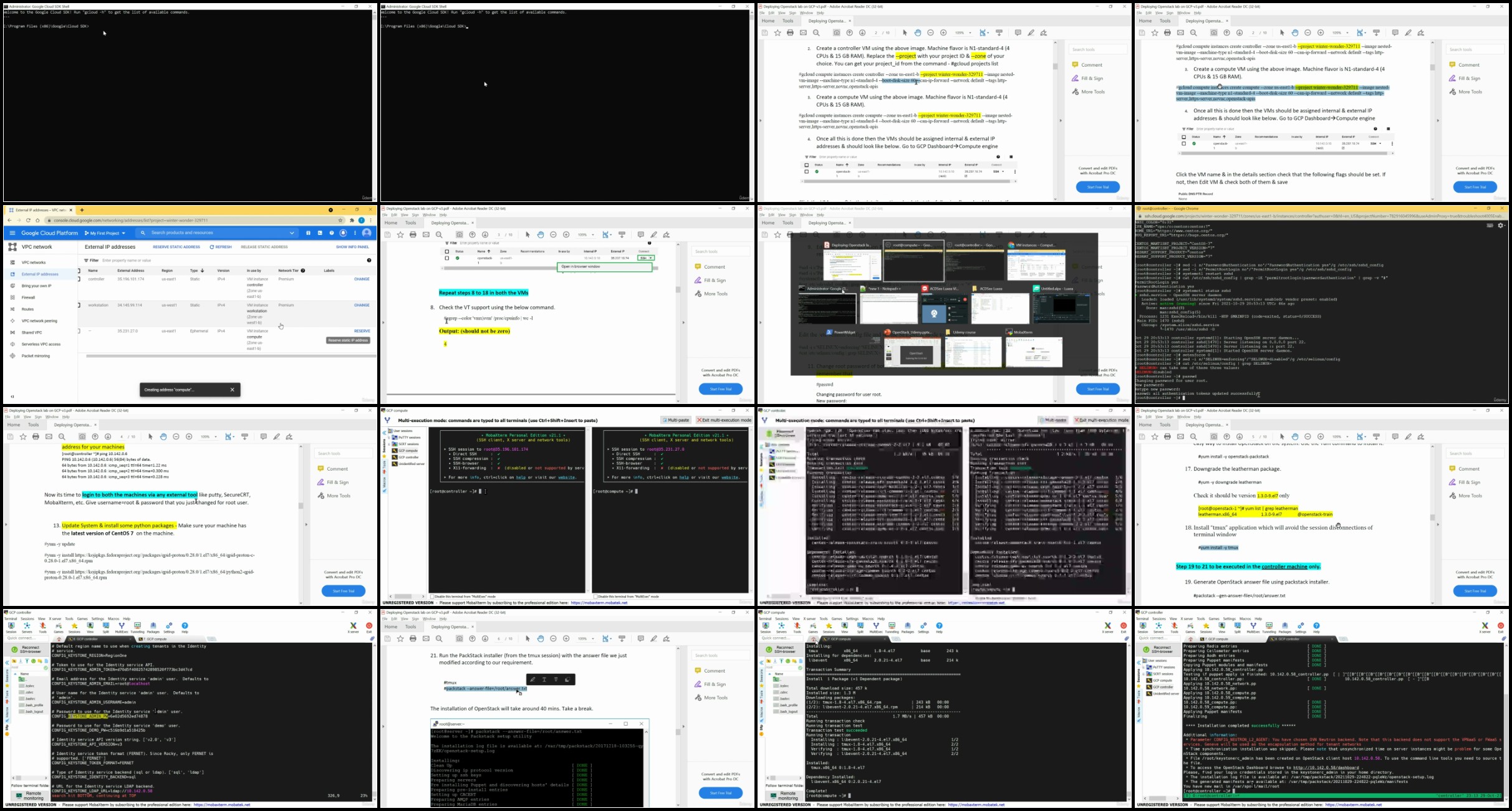
The main challenge in learning OpenStack is to get a lab for practice. In this course, we will learn how to build our own lab of OpenStack on Google cloud for free, so that you have a lab to practice even after the completion of the course. However, this lab is not the exact replica of a production-grade data center. Around 80% of tasks can be performed here as compared to the actual environment.
The course has been designed considering the daily job of a Telco cloud operations engineer but, anyone who is interested to understand Telco cloud or Openstack, in general, can benefit from this course. It contains core concepts of NFV, VNF, ETSI/MANO, SDN & the overall cloudification of the core network & RAN.
We will create flavors, images, VMs & VNFs during the course so that, you get a real-time experience of the technology.
Course contents-
Module-1 Virtualization & Cloud computing
Module-2 Public & Private cloud
Module-3 Telco cloud infrastructure
Module-4 OpenStack components
Module-5 Setup GCP account
Module-6 Basic Linux practice
Module-7 Openstack Connectivity, node types & documentation
Module-8 Building OpenStack lab on GCP
Module-9 Exploring the CLI & GUI in OpenStack
Module-10 Creating virtual machines & related components
Module-11 User & Projects management
Module-12 VM migration & evacuation
Module-13 OpenStack networking
Module-14 NFV & ETSI MANO
Module-15 Traffic flows
Module-16 Software-defined networking (SDN)
Course exclusions (not included in the course) -
Vendor-specific OpenStack customization
VNF lifecycle management
Ceph Storage
Scale-out/in (addition/deletion) of a compute server
Integration of OpenStack with any external tool or API
Who this course is for
Any Telecom Engineer who wants to shift his career from Legacy to Cloud - System integrators, RAN engineers, Core network, Packet core , RF , Maintenence (O&M), Transmission, Configuration, Network
Sales people - Sales engineers, Pre-sales enginners, Solution engineers
Managers - Project managers, Product managers, Incident & Problem managers
Budding TelcoCloud enthusiasts who aspires to be a - Solution architect, Solution designer, Cloud engineer, Cloud integrator, etc
Any managment executive who wants to understand NFV & OpenStack
Homepage

Recommend Download Link Hight Speed | Please Say Thanks Keep Topic Live
Links are Interchangeable - No Password - Single Extraction

 

7c62366777c5b240c2e44c2434962ab8.jpg

Openstack And Nfv (Telcocloud)
Last updated 2/2023
MP4 | Video: h264, 1280x720 | Audio: AAC, 44.1 KHz
Language: English | Size: 5.01 GB | Duration: 10h 52m​

Learn OpenStack and network function virtualization NFV together.

What you'll learn
Excellent Hands-On experience on all the OpenStack & NFV components. Build your own lab (for free) & create VMs & VNFs
Completely understand the purpose of Virtualization & Cloud computing & also understand why Openstack is essential for mobile operators.
Excellent understanding & decoupling of TelcoCloud components. Journey of a legacy Telco node from a proprietory machine to a Virtual network function (VNF).
Capacity planning for cloud infrastructure, Deep dive in Openstack networking concepts, Basic linux hands-on
ETSI - MANO, NFV & SDN concepts
Advanced OpenStack topics for VNF performance like CPU pinning, NUMA awareness & Hugepages
Advanced networking topics like OVS, DPDK & SRIOV

Requirements
Absolutely nothing. I cover everything from scratch however, it will be good to have basic knowledge of Linux & Networking
No programming knowledge required.
You just need your own time & zeal to learn this course. The biggest prerequisite is our own will-power. Rest, be assured about the contents

Description
For C O U P O N S please connect with me on LinkedIn or by email. See the details in my Bio sectionThis course contains theory & practice for all the components of OpenStack & that too in the context of a telco cloud i.e. in the context of NFV. The main challenge in learning OpenStack is to get a lab for practice. In this course, we will learn how to build our own lab of OpenStack on Google cloud for free, so that you have a lab to practice even after the completion of the course. However, this lab is not the exact replica of a production-grade data center. Around 80% of tasks can be performed here as compared to the actual environment.The course has been designed considering the daily job of a Telco cloud operations engineer but, anyone who is interested to understand Telco cloud or Openstack, in general, can benefit from this course. It contains core concepts of NFV, VNF, ETSI/MANO, SDN & the overall cloudification of the core network & RAN.We will create flavors, images, VMs & VNFs during the course so that, you get a real-time experience of the technology. Course contents- Module-1 Virtualization & Cloud computing Module-2 Public & Private cloud Module-3 Telco cloud infrastructure Module-4 OpenStack components Module-5 Setup GCP account Module-6 Basic Linux practice Module-7 Openstack Connectivity, node types & documentationModule-8 Building OpenStack lab on GCPModule-9 Exploring the CLI & GUI in OpenStackModule-10 Creating virtual machines & related componentsModule-11 User & Projects managementModule-12 VM migration & evacuationModule-13 OpenStack networkingModule-14 NFV & ETSI MANOModule-15 Traffic flowsModule-16 Software-defined networking (SDN)Module-17 Advanced OpenStack topicsCourse exclusions (not included in the course) - Vendor-specific OpenStack customizationVNF lifecycle managementCeph StorageScale-out/in (addition/deletion) of a compute serverIntegration of OpenStack with any external tool or API

Who this course is for:
Any Telecom Engineer who wants to shift his career from Legacy to Cloud - System integrators, RAN engineers, Core network, Packet core , RF , Maintenence (O&M), Transmission, Configuration, Network,Sales people - Sales engineers, Pre-sales enginners, Solution engineers,Managers - Project managers, Product managers, Incident & Problem managers,Budding TelcoCloud enthusiasts who aspires to be a - Solution architect, Solution designer, Cloud engineer, Cloud integrator, etc,Any managment executive who wants to understand NFV & OpenStack

For More Courses Visit & Bookmark Your Preferred Language Blog
From Here: - - - - - - - -


1eiscg8L_o.jpg


a57237d4aa153de8d101f05e782538e6.jpg

Openstack And Nfv (Telcocloud)
Last updated 7/2024
MP4 | Video: h264, 1280x720 | Audio: AAC, 44.1 KHz
Language: English (India) | Size: 2.92 GB | Duration: 10h 46m​

Learn OpenStack and network function virtualization NFV together.

What you'll learn
Excellent Hands-On experience on all the OpenStack & NFV components. Build your own lab (for free) & create VMs & VNFs
Completely understand the purpose of Virtualization & Cloud computing & also understand why Openstack is essential for mobile operators.
Excellent understanding & decoupling of TelcoCloud components. Journey of a legacy Telco node from a proprietory machine to a Virtual network function (VNF).
Capacity planning for cloud infrastructure, Deep dive in Openstack networking concepts, Basic linux hands-on
ETSI - MANO, NFV & SDN concepts
Advanced OpenStack topics for VNF performance like CPU pinning, NUMA awareness & Hugepages
Advanced networking topics like OVS, DPDK & SRIOV

Requirements
Absolutely nothing. I cover everything from scratch however, it will be good to have basic knowledge of Linux & Networking
No programming knowledge required.
You just need your own time & zeal to learn this course. The biggest prerequisite is our own will-power. Rest, be assured about the contents

Description
For C O U P O N S please use the code in the format of "Initial 3 letters of the month -YEAR". For ex - JAN-2024 for JanuaryFEB-2024 for February and so onORKindly connect with me on LinkedIn or by email. See the details in my Bio sectionThis course contains theory & practice for all the components of OpenStack & that too in the context of a telco cloud i.e. in the context of NFV. The main challenge in learning OpenStack is to get a lab for practice. In this course, we will learn how to build our own lab of OpenStack on Google cloud for free, so that you have a lab to practice even after the completion of the course. However, this lab is not the exact replica of a production-grade data center. Around 80% of tasks can be performed here as compared to the actual environment.The course has been designed considering the daily job of a Telco cloud operations engineer but, anyone who is interested to understand Telco cloud or Openstack, in general, can benefit from this course. It contains core concepts of NFV, VNF, ETSI/MANO, SDN & the overall cloudification of the core network & RAN.We will create flavors, images, VMs & VNFs during the course so that, you get a real-time experience of the technology. Course contents- Module-1 Virtualization & Cloud computing Module-2 Public & Private cloud Module-3 Telco cloud infrastructure Module-4 OpenStack components Module-5 Setup GCP account Module-6 Basic Linux practice Module-7 Openstack Connectivity, node types & documentationModule-8 Building OpenStack lab on GCPModule-9 Exploring the CLI & GUI in OpenStackModule-10 Creating virtual machines & related componentsModule-11 User & Projects managementModule-12 VM migration & evacuationModule-13 OpenStack networkingModule-14 NFV & ETSI MANOModule-15 Traffic flowsModule-16 Software-defined networking (SDN)Module-17 Advanced OpenStack topicsCourse exclusions (not included in the course) - Vendor-specific OpenStack customizationVNF lifecycle managementCeph StorageScale-out/in (addition/deletion) of a compute serverIntegration of OpenStack with any external tool or API

Who this course is for:
Any Telecom Engineer who wants to shift his career from Legacy to Cloud - System integrators, RAN engineers, Core network, Packet core , RF , Maintenence (O&M), Transmission, Configuration, Network,Sales people - Sales engineers, Pre-sales enginners, Solution engineers,Managers - Project managers, Product managers, Incident & Problem managers,Budding TelcoCloud enthusiasts who aspires to be a - Solution architect, Solution designer, Cloud engineer, Cloud integrator, etc,Any managment executive who wants to understand NFV & OpenStack

For More Courses Visit & Bookmark Your Preferred Language Blog
From Here: - - - - - - - -


DY6KXkvk_o.jpg


f3e8157ffb108a6cbb1002f00f48b342.jpg

Openstack And Nfv (Telcocloud)
Last updated 7/2024
MP4 | Video: h264, 1280x720 | Audio: AAC, 44.1 KHz
Language: English (India) | Size: 2.92 GB | Duration: 10h 46m​

What you'll learn
Excellent Hands-On experience on all the OpenStack & NFV components. Build your own lab (for free) & create VMs & VNFs
Completely understand the purpose of Virtualization & Cloud computing & also understand why Openstack is essential for mobile operators.
Excellent understanding & decoupling of TelcoCloud components. Journey of a legacy Telco node from a proprietory machine to a Virtual network function (VNF).
Capacity planning for cloud infrastructure, Deep dive in Openstack networking concepts, Basic linux hands-on
ETSI - MANO, NFV & SDN concepts
Advanced OpenStack topics for VNF performance like CPU pinning, NUMA awareness & Hugepages
Advanced networking topics like OVS, DPDK & SRIOV

Requirements
Absolutely nothing. I cover everything from scratch however, it will be good to have basic knowledge of Linux & Networking
No programming knowledge required.
You just need your own time & zeal to learn this course. The biggest prerequisite is our own will-power. Rest, be assured about the contents

Description
For C O U P O N S please use the code in the format of "Initial 3 letters of the month -YEAR". For ex - JAN-2024 for JanuaryFEB-2024 for February and so onORKindly connect with me on LinkedIn or by email. See the details in my Bio sectionThis course contains theory & practice for all the components of OpenStack & that too in the context of a telco cloud i.e. in the context of NFV. The main challenge in learning OpenStack is to get a lab for practice. In this course, we will learn how to build our own lab of OpenStack on Google cloud for free, so that you have a lab to practice even after the completion of the course. However, this lab is not the exact replica of a production-grade data center. Around 80% of tasks can be performed here as compared to the actual environment.The course has been designed considering the daily job of a Telco cloud operations engineer but, anyone who is interested to understand Telco cloud or Openstack, in general, can benefit from this course. It contains core concepts of NFV, VNF, ETSI/MANO, SDN & the overall cloudification of the core network & RAN.We will create flavors, images, VMs & VNFs during the course so that, you get a real-time experience of the technology. Course contents- Module-1 Virtualization & Cloud computing Module-2 Public & Private cloud Module-3 Telco cloud infrastructure Module-4 OpenStack components Module-5 Setup GCP account Module-6 Basic Linux practice Module-7 Openstack Connectivity, node types & documentationModule-8 Building OpenStack lab on GCPModule-9 Exploring the CLI & GUI in OpenStackModule-10 Creating virtual machines & related componentsModule-11 User & Projects managementModule-12 VM migration & evacuationModule-13 OpenStack networkingModule-14 NFV & ETSI MANOModule-15 Traffic flowsModule-16 Software-defined networking (SDN)Module-17 Advanced OpenStack topicsCourse exclusions (not included in the course) - Vendor-specific OpenStack customizationVNF lifecycle managementCeph StorageScale-out/in (addition/deletion) of a compute serverIntegration of OpenStack with any external tool or API

Who this course is for:
Any Telecom Engineer who wants to shift his career from Legacy to Cloud - System integrators, RAN engineers, Core network, Packet core , RF , Maintenence (O&M), Transmission, Configuration, Network,Sales people - Sales engineers, Pre-sales enginners, Solution engineers,Managers - Project managers, Product managers, Incident & Problem managers,Budding TelcoCloud enthusiasts who aspires to be a - Solution architect, Solution designer, Cloud engineer, Cloud integrator, etc,Any managment executive who wants to understand NFV & OpenStack

For More Courses Visit & Bookmark Your Preferred Language Blog
From Here: - - - - - - - -


002-Creating-Openstack-lab-on-GCP.jpg

 
Zurück
Oben Unten