




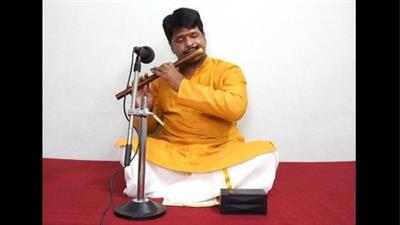
MP4 | Video: h264, 1280x720 | Audio: AAC, 44.1 KHz
Language: English | Size: 0.99 GB | Duration: 46m
What you'll learn
Students will get to learn the simple notations to understand and practice.
Students can easily pick up the fingering skills by learning line by line of the Keerthanams.
Students can practice and play along while watching the fingering and notations simultaneously.
Students can learn the Half Notes on Flute.
Students can learn the Basic Classical Songs of Carnatic Music.
Students need to note down the notations physically which helps their offline practice.
Students can understand 12 different notes known as "Dwadasa Swara Sthanas" of Carnatic Classical Music.
Requirements
Students need 2 and half (D#) pitch, 8 holes Carnatic Flute to practice the Keerthanams.
Students who have learnt the basics of Classical Music.
Description
Kancharla Gopanna popularly known as Bhakta Ramadasu or Bhadrachala Ramadasu was a 17th-century devotee of the Hindu god Rama, a saint-poet and a composer of Carnatic music. He is a famous Vaggeyakara (classical composer)[a] from the Telugu classical era. He was born in the village of Nelakondapalli in Khammam district, and orphaned as a teenager. He spent his later years in Bhadrachalam and 12 years in solitary confinement at the Golconda prison during the Qutb Shahi-rule. Different mythical stories about his life circulate in the Telugu tradition. He is renowned for constructing the famous Sita Ramachandraswamy Temple and pilgrimage center on the banks of river Godavari at Bhadrachalam. His devotional kirtana lyrics to Rama illustrate the classical Pallavi, Anupallavi and Caranam genre composed mostly in Telugu, some in Sanskrit and with occasional use of Tamil language. These are famous in South Indian classical music as Ramadaasu Keertanalu. He influenced later composers such as the doyen of South Indian classical music and bhakti movement saint Tyagaraja. His songs continue to be sung at the Sita Ramachandraswamy Temple in Bhadrachalam.
Ramadasu was a Sri Vaishnava. Ramadasu was a writer of Telugu satakams. He wrote the Daasarathi Satakamu with a 'makuTamu'' Daasarathee Karunaa payonidhee', a collection of nearly 108 poems dedicated to Rama.
Early life and background
Kancherla Gopanna (Goparaju), later known as Bhakta Ramadasu, was born in a moderately well to do Telugu speaking Niyogi Brahmin family to Linganna Mantri and Kamamba in Nelakondapalli village in the Khammam District of Telangana. He was orphaned in the teens, triggering an impoverished life, sustained by singing bhakti songs to Rama and collecting rice door to door. His life story has been largely reconstructed from poems he composed or is assumed to have composed, where there is a mention of events of his life. For example, one bhakti song mentions Narayanadasulu, a term linked to the Narayana mantra, is believed to be linked to Sri Vaishnavism guru Raghunatha Bhattacharya, who initiated him as a boy into the Dasarathi tradition. These and other hagiographic accounts found in Yakshagana or Harikatha compilations present him as a boy-prodigy with an impulsively creative mind composing lyrics on the Hindu god Rama.
His maternal uncles were the Madanna and Akkanna brothers. They had helped Abul Hasan Qutb Shah (Tana Shah) gain power after the death of Abdullah Qutb Shah in 1672, Tana Shah's father-in-law. As reward for their material support during a period of power struggle with Aurangzeb and the Mughal Empire, the brothers were appointed ministers at the court of Tana Shah of the Qutb Shahi dynasty in Kingdom of Golconda. They helped their orphaned nephew Gopanna. Beyond this, little is known about his early life and much is shrouded in mythistory created by the later hagiographic tradition. He is said to have learned Telugu, Sanskrit, Kannada, Persian, and Urdu.
Career
In 1650, Gopanna traveled to Hyderabad to meet his maternal uncles, who were at that time working in the tax department of Golconda Sultanate under the minister Mirza Mohammed Sayyad. They persuaded the minister to give a job to their nephew Gopanna. Mirza Mohammed Sayyad appointed Gopanna in tax collection department in Bhadrachalam, where the temple dedicated to Rama already existed.
A different version of his career is found in Ramadasu Charitra, a hagiographic Telugu text. It states that sometime after 1672, Ramadasu in his early 50s, was appointed as the tahsildar (tax collector) of 'Palvoncha Paragana' by Akkanna, his uncle, who was then a minister and the administrative head in the court of Qutub Shahi Sultan Abul Hassan Tana Shah.
There are contradictory stories about his life after he became the tehsildar and led the tax collection activities at Bhadrachalam. All these stories share a common theme - he collecting Jizya religious tax from Hindus in Bhadrachalam area, he reconstructing or building anew the famed large Rama temple of Bhadrachalam, partly with donations and partly with tax he had collected for the Golconda Sultanate, his arrest on charges of fraud and misuse of the taxes, he spending 12 years in solitary confinement in Golconda prison where he composed poems for the Hindu god Rama, his release and return to Bhadrachalam. In some version, god Rama and his brother Lakshmana reappear on earth and pay the ransom demanded by Golconda Sultanate for his release. In other versions, the Sultan under attack from Aurangzeb forces and facing imminent collapse, opens a new trial, finds him innocent and acquits him. The varying accounts are found in the records of the Dutch East India company, the temple's hagiography, and the regional Telugu oral traditions. Two Telugu movies provide additional creative versions of his career and events, again with different and conflicting accounts.
Reconstruction of temple
Once, Ramadasu visited Bhadrachalam for a Jatara (fair) and was disturbed by the dilapidated state of the Rama temple there. Bhadrachalam is significant to devotees of Rama for many reasons. Lord Rama stayed near the Parnasala there with Sita and Lakshmana during his exile and also visited Shabari near Bhadrachalam (although it is believed that Shabari used to live near Kishkindha, the kingdom of Vanaras in Ramayana which is believed to be near Hampi ). Pothana is believed to have been given direction by Rama to translate the Bhagavata Purana into Telugu here. In spite of its significance, the temple was utterly neglected. So, Ramadasu started to raise funds for the renovation and reconstruction of the temple. After he emptied his coffers and could raise no more money, the villagers appealed him to spend his revenue collections for the reconstruction and promised to repay the amount after harvesting crops. As such, Ramadas finished the reconstruction of the temple with six hundred thousand rupees collected from land revenues - without the permission of the Abul Hasan Qutb Shah.
As the temple was nearing completion, he was perplexed one night about fixing the Sudarshana Chakra at the crest of the main temple. On the same night, it is believed that he saw Rama in his dream and asked him to have a holy dip in the Godavari River. When Gopanna did so the next day, it is believed that he found the holy Sudarshana Chakra in the river very easily.
Compositions
Ramadasu is one of the bhakti movement poet-saints of Hinduism, and a revered composer in the Carnatic music tradition. His compositions are largely kirtan genre, all focused on the Hindu god Rama of the Ramayana fame. He is most known for his pallavi, anupallavi and caranam compositions in Telugu and some in Sanskrit. His musical mudras vary and are remembered by his name or his favorite place Bhadrachalam; for example, Ramadas, Bhadrachalavasa, Bhadradri, Bhadragiri, Bhadrasyla and others. His compositions were popular in his days, and influenced many into the modern age. This includes Tyagaraja who dedicated 5 of his own compositions in praise of Ramadasu, with one equating him to figures such as the Narada muni and bhakta Prahlada, legendary and much loved personalities in Hinduism.
He composed Dasarathi Satakam, a bhakti poem with didactic metric style whose lines and stanzas are often sung or shared in the regional Telugu tradition.However, like the works of many poet-saints and philosophers on the Indian subcontinent, it is unclear which of the poems attributed to Ramadasu were authentically composed by him. There are six compilations named after Ramadasu, four of which are all called Ramadasu Charitra, one called Bhadrachala Ramadasu and another called Bhakta Ramadasu. These are in the form of a Yakshagana or Harikatha about Ramadasu and his songs. They are from six authors - Yadavadasu, Singaridasu, Krishnadasu, Ayyagiri Veerbhadra Rao, Balaji Dasu, and Pentapati Rao. Many contain between 100 and 108, but one has 137 songs attributed to Ramadasu. Taken together, a total of 190 different compositions have been attributed to him, with one critical edition attributing 37 songs before he was arrested by Islamic authorities, 64 while he was held in jail for 12 years, and 31 songs in the final years after his release. Thus, 132 songs are likely to have been composed by Ramadasu. Further, a notable feature of Ramadasu's compositions is his knowledge and his use of ragas from both South Indian schools (20 ragas) and North Indian schools (17 ragas), thereby uniting the two classical musical traditions.
Ramachandraya Janaka Rajaaja Manohara in Kurinji
Tarakamantramu in Dhanyasi
Ye Teeruga Nanu in Nadanamakriya
Adigo Bhadradri in Varali
Anta Ramamayam in Darbari Kannada
Charanamulae Nammidhi in Kapi
Rama Ra Ra in Kamas
Dasharatha Rama Govindha in Kamas
O Rama ni namamu in Poorvi Kalyani
Paluke bangara mayena in Ananda Bhairavi
Who this course is for:
Those who are curious to learn Classical Carnatic Music.
Students who want to know the Key tips of practicing.
Homepage
Recommend Download Link Hight Speed | Please Say Thanks Keep Topic Live
Links are Interchangeable - No Password - Single Extraction
