• Regeln für den Video-Bereich:

    In den Börsenbereich gehören nur Angebote die bereits den Allgemeinen Regeln entsprechen.

    Einteilung

    - Folgende Formate gehören in die angegeben Bereiche:
    - Filme: Encodierte Filme von BluRay, DVD, R5, TV, Screener sowie Telesyncs im Format DivX, XviD und x264.
    - DVD: Filme im Format DVD5, DVD9 und HD2DVD.
    - HD: Encodierte Filme mit der Auflösung 720p oder darüber von BluRay, DVD, R5, TV, Screener sowie Telesyncs im Format x264.
    - 3D: Encodierte Filme von BluRay, die in einem 3D Format vorliegen. Dies gilt auch für Dokus, Animation usw.
    - Serien: Cartoon/Zeichentrick, Anime, Tutorials, Dokumentationen, Konzerte/Musik, Sonstiges sind demnach in die entsprechenden Bereiche einzuordnen, auch wenn sie beispielsweise im High Definition-Format oder als DVD5/DVD9/HD2DVD vorliegen. Ausnahme 3D.
    - Bereich Englisch: Englische Releases gehören immer in diesen Bereich.
    - Bereich Talk: Der Bereich, in dem über die Releases diskutiert werden kann, darf, soll und erwünscht ist.


    Angebot/Beitrag erstellen

    - Ein Beitrag darf erst dann erstellt werden, wenn der Upload bei mindestens einem OCH komplett ist. Platzhalter sind untersagt.
    - Bei einem Scenerelease hat der Threadtitel ausschließlich aus dem originalen, unveränderten Releasenamen zu bestehen. Es dürfen keine Veränderungen wie z.B. Sterne, kleine Buchstaben o.ä. vorgenommen werden. Ausnahme Serienbörse:
    - Bei einem Sammelthread für eine Staffel entfällt aus dem Releasename natürlich der Name der Folge. Beispiel: Die Simpsons S21 German DVDRip XviD - ITG
    - Dementsprechend sind also u.a. verboten: Erweiterungen wie "Tipp", "empfehlenswert", "only", "reup", usw. / jegliche andere Zusatzinformation oder Ergänzung, welche nicht in obiger Beschreibung zu finden ist.

    Aufbau des Angebots und Threadtitel

    Der Titel nach folgendem Muster erstellt zu werden. <Name> [3D] [Staffel] [German] <Jahr> <Tonspur> [DL] [Auflösung] <Quelle> <Codec> - <Group>
    Beispiel: The Dark Knight German 2008 AC3 DVDRip XviD - iND
    Beispiel: The Dark Knight 2008 DTS DL BDRip x264 - iND
    Beispiel: The Dark Knight 2008 AC3 DL BDRip XviD - iND
    Beispiel: The Dark Knight German 2008 AC3 720p BluRay x264 iND
    Beispiel: The Dark Knight 2008 DTS DL 1080p BluRay x264 iND
    Beispiel: Die Simpsons S01 German AC3 DVDRip XviD iND
    Beispiel: Die Simpsons S20 German AC3 720p BluRay x264 iND
    Beispiel: Sword Art Online II Ger Sub 2014 AAC 1080p WEBRip x264 - peppermint
    Entsprechend sind also u.a. verboten: Sonderzeichen wie Klammern, Sterne, Ausrufezeichen, Unterstriche, Anführungszeichen / Erweiterungen wie "Tipp", "empfehlenswert", "only", "reup", usw. / jegliche andere Zusatzinformation oder Ergänzung, welche nicht in obiger Beschreibung zu finden ist
    Ausnahmen hiervon können in den Bereichen geregelt sein.

    Die Beiträge sollen wie folgt aufgebaut werden:
    Überschrift entspricht dem Threadtitel
    Cover
    kurze Inhaltsbeschreibung
    Format, Größe, Dauer sind gut lesbar für Downloader außerhalb des Spoilers zu vermerken
    Nfo sind immer Anzugeben und selbige immer im Spoiler in Textform.
    Sind keine Nfo vorhanden z.B. Eigenpublikationen, sind im Spoiler folgende Dateiinformationen zusätzlich anzugeben :
    Quelle
    Video (Auflösung und Bitrate)
    Ton (Sprache, Format und Bitrate der einzelnen Spuren)
    Untertitel (sofern vorhanden)
    Hosterangabe in Textform außerhalb eines Spoiler mit allen enthaltenen Hostern.
    Bei SD kann auf diese zusätzlichen Dateiinformationen verzichtet werden.

    Alle benötigten Passwörter sind, sofern vorhanden, in Textform im Angebot anzugeben.
    Spoiler im Spoiler mit Kommentaren :"Schon Bedankt?" sind unerwünscht.


    Releases

    - Sind Retail-Release verfügbar, sind alle anderen Variationen untersagt. Ausnahmen: Alle deutschen Retail-Release sind CUT, in diesem Fall sind dubbed UNCUT-Release zulässig.
    - Im Serien-Bereich gilt speziell: Wenn ein Retail vor Abschluss einer laufenden Staffel erscheint, darf diese Staffel noch zu Ende gebracht werden.62
    - Gleiche Releases sind unbedingt zusammenzufassen. Das bedeutet, es ist zwingend erforderlich, vor dem Erstellen eines Themas per Suchfunktion zu überprüfen, ob bereits ein Beitrag mit demselben Release besteht. Ist dies der Fall, ist der bereits vorhandene Beitrag zu verwenden.
    - P2P und Scene Releases dürfen nicht verändert oder gar unter einem iND Tag eingestellt werden.


    Support, Diskussionen und Suche

    - Supportanfragen sind entweder per PN oder im Bereich Talk zu stellen.
    - Diskussionen und Bewertungen sind im Talk Bereich zu führen. Fragen an die Uploader haben ausschließlich via PN zu erfolgen, und sind in den Angeboten untersagt.
    - Anfragen zu Upload-Wünschen sind nur im Bereich Suche Video erlaubt. Antworten dürfen nur auf Angebote von MyBoerse.bz verlinkt werden.


    Verbote

    - Untersagt sind mehrere Formate in einem einzigen Angebotsthread, wie beispielsweise das gleichzeitige Anbieten von DivX/XviD, 720p und 1080p in einem Thread. Pro Format, Release und Auflösung ist ein eigener Thread zu eröffnen.
    - Grundsätzlich ebenso verboten sind Dupes. Uploader haben sich an geeigneter Stelle darüber zu informieren, ob es sich bei einem Release um ein Dupe handelt.
    - Gefakte, nur teilweise lauffähige oder unvollständige Angebote sind untersagt. Dies gilt auch für eigene Publikationen, die augenscheinlich nicht selbst von z.B. einer DVD gerippt wurden. Laufende Serien, bei denen noch nicht alle Folgen verfügbar sind, dürfen erstellt und regelmäßig geupdatet werden.
    - Untersagt sind Angebote, welche nur und ausschließlich in einer anderen Sprache als deutsch oder englisch vorliegen. Ausnahmen sind VORHER mit den Moderatoren zu klären.


    Verstoß gegen die Regeln

    - Angebote oder Beiträge, die gegen die Forenregeln verstoßen, sind über den "Melden"-Button im Beitrag zu melden.
  • Bitte registriere dich zunächst um Beiträge zu verfassen und externe Links aufzurufen.

*** Bestes IPTV *** bester Preis *** gratis Test ***


Udemy - ITIL 4 Strategist - Digital & IT Strategy (DITS) Exam Prep

babymore87

MyBoerse.bz Pro Member
f5213351868a24e8c92b17b07b2ffc20.avif

Free Download Udemy - ITIL 4 Strategist - Digital & IT Strategy (DITS) Exam Prep
Published: 3/2025
MP4 | Video: h264, 1920x1080 | Audio: AAC, 44.1 KHz
Language: English | Size: 7.75 GB | Duration: 6h 25m
Prepare for ITIL 4 DITS: Advance Your Digital & IT Strategy Skills with Expert Guidance for Exam Success!

What you'll learn
Master ITIL 4 DITS Concepts - Learn digital transformation, business models, and strategic risk management.
Develop & Implement IT Strategies - Align IT with business goals, create roadmaps, and drive innovation.
Apply Risk Management & Governance - Assess, mitigate, and manage digital transformation risks.
Pass the ITIL 4 DITS Exam - Gain expert insights, practice questions, and real-world scenarios.
Requirements
ITIL 4 Foundation
Description
Are you ready to master digital transformation and strategic IT leadership? The ITIL 4 Strategist: Digital & IT Strategy (DITS) Exam Prep Course is designed to help you confidently pass the ITIL 4 DITS exam while equipping you with the skills to drive digital innovation and long-term business success.This course delves into the core principles of digital strategy, risk management, innovation, and leadership in the digital age. You'll learn how to align IT and business strategies, manage emerging technologies, and create resilient digital organizations that thrive in today's fast-changing landscape.With decades of experience in IT Service Management (ITSM) and thousands of satisfied students, I bring you a comprehensive, structured, and engaging learning experience that breaks down complex ITIL 4 DITS concepts into easy-to-understand modules. You'll gain valuable insights, real-world examples, and practical applications to solidify your understanding.By the end of this course, you'll be fully prepared for the ITIL 4 DITS exam-a key milestone towards the sought-after ITIL Master certification-and ready to take on strategic IT leadership roles.This course is one of a series of my ITIL Managing Professional Courses. Be sure to check out my other courses on this topic.Enroll now and take the next step in your ITIL journey!
Overview
Section 1: Digital & IT Strategy Introduction
Lecture 1 Digital & IT Strategy Section Introduction
Lecture 2 The Impact of Digital & IT Innovation on Modern Society.
Lecture 3 The Evolution of Business Models in the Digital Age
Lecture 4 The Changing Role of Technology Leadership
Lecture 5 Section Conclusion
Section 2: Key Concepts
Lecture 6 Section 2 Introduction: Key Concepts
Lecture 7 Understanding Digital Organizations, Digital Business, and Digitization
Lecture 8 Digital transformation
Lecture 9 Tiers of Strategy
Lecture 10 Understanding Business Models in Organizational Strategy
Lecture 11 Understanding Operating Models in Organizations
Lecture 12 Strategy and the Service Value System
Lecture 13 Understanding Value in Strategy
Lecture 14 Understanding Governance in Organizational Strategy
Lecture 15 Continual Improvement and Practices in Strategy Introduction
Lecture 16 Key Concepts Section Conclusion
Section 3: What is the Vision?
Lecture 17 What is the Vision Section Introduction
Lecture 18 Introduction to Digital Disruption
Lecture 19 Deciding on a Balanced Strategic Focus
Lecture 20 Positioning Tools for Digital Organizations
Lecture 21 Creating the Vision
Lecture 22 Defining the Vision
Lecture 23 Crafting a Vision Statement
Lecture 24 What is the Vision Conclusion
Section 4: Where Are We Now?
Lecture 25 Where Are We Now Section Introduction
Lecture 26 Analyzing the External Environment for Strategic Advantage
Lecture 27 Interaction Between the Organization and Its Environment
Lecture 28 Opportunity Analysis
Lecture 29 Digital Readiness Assessment
Lecture 30 Risks and Challenges of Digital Readiness Assessment
Lecture 31 Where Are We Now Section Conclusion
Section 5: Where Do We Want To Be And How Do We Get There?
Lecture 32 Where Do We Want To Be And How Do We Get There Introduction
Lecture 33 Financial Aspects of Digital and IT Strategy
Lecture 34 Using Business Models for Strategy Planning
Lecture 35 Business Models for Validation, Benchmarking, Communication, and Alignment
Lecture 36 Strategic Approaches to Customer Journeys and Market Relevance
Lecture 37 Strategic Approaches for Operational Excellence
Lecture 38 Strategic Approaches to Social Responsibility and Sustainability
Lecture 39 Strategy Discussion and Approval
Lecture 40 Communicating the Business Case
Lecture 41 Where Do We Want To Be And How Do We Get There Section Closure
Section 6: Take Action!
Lecture 42 Take Action! Introduction
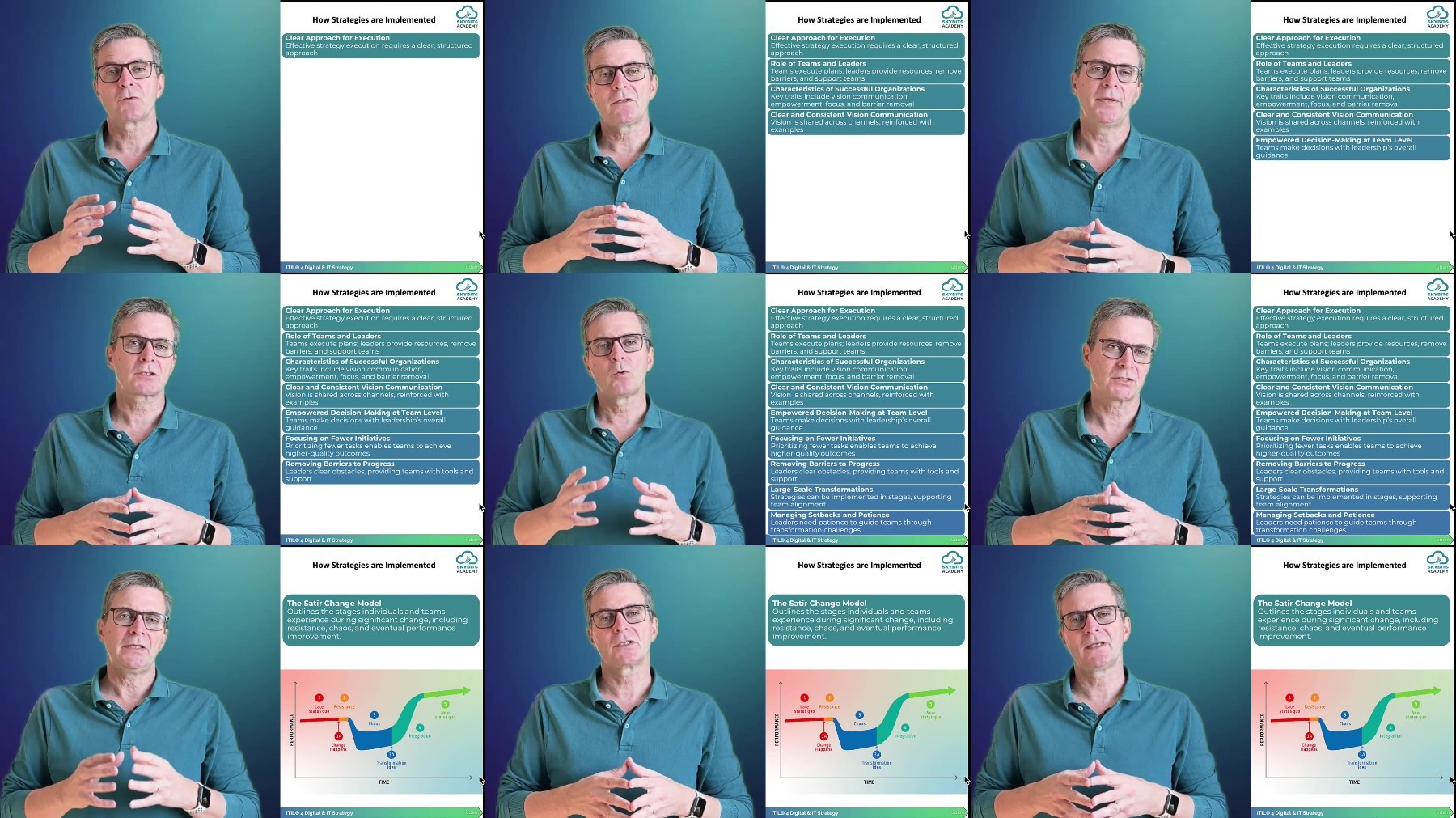
Lecture 43 How Strategies are Implemented
Lecture 44 Approaches to Transformation in Strategy Implementation
Lecture 45 Coordinating Strategy and Strategic Initiatives
Lecture 46 Leading Digital Transformation
Lecture 47 Introducing Digital Technology
Lecture 48 Identifying the Best Role to Lead Digital Transformation Programs
Lecture 49 Scoping Digital Transformation
Lecture 50 Strategy Communication and Implementation
Lecture 51 Take Action! Section Conclusion
Section 7: Did We Get There?
Lecture 52 Did We Get There Section Introduction
Lecture 53 Key Facts About Measurement
Lecture 54 Types of Metrics and Their Applications
Lecture 55 Cascading and Linking Measurement
Lecture 56 Objectives and Key Results (OKR)
Lecture 57 Measuring a Strategy
Lecture 58 Measuring the Progress
Lecture 59 Instrumenting Strategy
Lecture 60 Strategy Review
Lecture 61 Did We Get There Section Conclusion
Section 8: How Do We Keep The Momentum Going?
Lecture 62 How Do We Keep The Momentum Going Section Introduction
Lecture 63 Understanding the VUCA Environment
Lecture 64 Strategic Approaches to Address VUCA
Lecture 65 Short-Term Momentum and Parallel Operation
Lecture 66 Pace of Transition from the Old Model to a Digital Model
Lecture 67 Key Behavior Patterns for Success
Lecture 68 How Do We Keep The Momentum Going Section Conclusion
Section 9: Digital Leadership
Lecture 69 Digital Leadership Section Introduction
Lecture 70 Understanding and Adopting a Digital Mindset
Lecture 71 Effective Communication in Digital Leadership
Lecture 72 Relationship Management in Digital Leadership
Lecture 73 Education and Learning in Digital Leadership
Lecture 74 Key Leadership Aspects in Digital Organizations
Lecture 75 Digital Leadership Section Conclusion
Section 10: Managing Innovation and Emerging Technologies
Lecture 76 Managing Innovation and Emerging Technologies Section Introduction
Lecture 77 Defining Innovation
Lecture 78 Managing Innovation and Adoption in Digital Leadership
Lecture 79 Achieving a Balanced Approach to Innovation
Lecture 80 Activities in Managing Innovation
Lecture 81 Characteristics of Organizations with an Innovative Culture
Lecture 82 Building a Culture That Supports Innovation
Lecture 83 Approaches to Innovation
Lecture 84 Evaluating and Adopting Emerging Technology
Lecture 85 Managing Innovation and Emerging Technologies Section Conclusion
Section 11: Managing Strategic Risk
Lecture 86 Managing Strategic Risk Section Introduction
Lecture 87 Understanding Risk Management
Lecture 88 Risk Management in Digital Organizations
Lecture 89 Organizing Risk Management and Evaluating Opportunities
Lecture 90 Risk Identification in Digital Organizations
Lecture 91 Risk Register
Lecture 92 Risk Analysis
Lecture 93 Risk Triggers and Risk Posture
Lecture 94 Risk Treatment in Risk Management
Lecture 95 Achieving a Risk-Informed Mindset and Culture
Lecture 96 Managing Strategic Risk
Section 12: Structuring for Digital Business
Lecture 97 Structuring for Digital Business Section Intro
Lecture 98 Understanding Governance in Digital Business
Lecture 99 The Role of Leadership in Governance
Lecture 100 Linking Strategies and Enabling Digital Co-Evolution
Lecture 101 Business and IT Strategy Co-Evolution in Digital Organizations
Lecture 102 The Role of Compliance in Protecting Economies and Organizations
Lecture 103 Structuring the Organization for Digital Transformation
Lecture 104 The Role of the Service Management Office (SMO)
Lecture 105 Transitioning from Traditional to New Organizational Structures
Lecture 106 Structuring for Digital Business Section Conclusion
IT Managers & Leaders - Professionals responsible for aligning IT & business strategies & leading digital transformation.,ITIL Practitioners & Consultants - Individuals looking to advance their ITIL 4 knowledge and obtain the ITIL Master certification.,CIOs, CTOs, & Senior Executives - Decision-makers seeking to leverage ITIL 4 strategies for innovation, risk management, and long-term business success.,Digital Transformation & IT Strategy Professionals - Those involved in driving digital initiatives & managing emerging technologies.
Homepage:


Recommend Download Link Hight Speed | Please Say Thanks Keep Topic Live
No Password - Links are Interchangeable

 

b3577422a071e8579544734396166777.jpg

Itil 4 Strategist: Digital & It Strategy (Dits) Exam Prep
Published 3/2025
MP4 | Video: h264, 1920x1080 | Audio: AAC, 44.1 KHz
Language: English | Size: 7.75 GB | Duration: 6h 25m​

Prepare for ITIL 4 DITS: Advance Your Digital & IT Strategy Skills with Expert Guidance for Exam Success!

What you'll learn

Master ITIL 4 DITS Concepts - Learn digital transformation, business models, and strategic risk management.

Develop & Implement IT Strategies - Align IT with business goals, create roadmaps, and drive innovation.

Apply Risk Management & Governance - Assess, mitigate, and manage digital transformation risks.

Pass the ITIL 4 DITS Exam - Gain expert insights, practice questions, and real-world scenarios.

Requirements

ITIL 4 Foundation

Description

Are you ready to master digital transformation and strategic IT leadership? The ITIL 4 Strategist: Digital & IT Strategy (DITS) Exam Prep Course is designed to help you confidently pass the ITIL 4 DITS exam while equipping you with the skills to drive digital innovation and long-term business success.This course delves into the core principles of digital strategy, risk management, innovation, and leadership in the digital age. You'll learn how to align IT and business strategies, manage emerging technologies, and create resilient digital organizations that thrive in today's fast-changing landscape.With decades of experience in IT Service Management (ITSM) and thousands of satisfied students, I bring you a comprehensive, structured, and engaging learning experience that breaks down complex ITIL 4 DITS concepts into easy-to-understand modules. You'll gain valuable insights, real-world examples, and practical applications to solidify your understanding.By the end of this course, you'll be fully prepared for the ITIL 4 DITS exam-a key milestone towards the sought-after ITIL Master certification-and ready to take on strategic IT leadership roles.This course is one of a series of my ITIL Managing Professional Courses. Be sure to check out my other courses on this topic.Enroll now and take the next step in your ITIL journey!

Overview

Section 1: Digital & IT Strategy Introduction

Lecture 1 Digital & IT Strategy Section Introduction

Lecture 2 The Impact of Digital & IT Innovation on Modern Society.

Lecture 3 The Evolution of Business Models in the Digital Age

Lecture 4 The Changing Role of Technology Leadership

Lecture 5 Section Conclusion

Section 2: Key Concepts

Lecture 6 Section 2 Introduction: Key Concepts

Lecture 7 Understanding Digital Organizations, Digital Business, and Digitization

Lecture 8 Digital transformation

Lecture 9 Tiers of Strategy

Lecture 10 Understanding Business Models in Organizational Strategy

Lecture 11 Understanding Operating Models in Organizations

Lecture 12 Strategy and the Service Value System

Lecture 13 Understanding Value in Strategy

Lecture 14 Understanding Governance in Organizational Strategy

Lecture 15 Continual Improvement and Practices in Strategy Introduction

Lecture 16 Key Concepts Section Conclusion

Section 3: What is the Vision?

Lecture 17 What is the Vision Section Introduction

Lecture 18 Introduction to Digital Disruption

Lecture 19 Deciding on a Balanced Strategic Focus

Lecture 20 Positioning Tools for Digital Organizations

Lecture 21 Creating the Vision

Lecture 22 Defining the Vision

Lecture 23 Crafting a Vision Statement

Lecture 24 What is the Vision Conclusion

Section 4: Where Are We Now?

Lecture 25 Where Are We Now Section Introduction

Lecture 26 Analyzing the External Environment for Strategic Advantage

Lecture 27 Interaction Between the Organization and Its Environment

Lecture 28 Opportunity Analysis

Lecture 29 Digital Readiness Assessment

Lecture 30 Risks and Challenges of Digital Readiness Assessment

Lecture 31 Where Are We Now Section Conclusion

Section 5: Where Do We Want To Be And How Do We Get There?

Lecture 32 Where Do We Want To Be And How Do We Get There Introduction

Lecture 33 Financial Aspects of Digital and IT Strategy

Lecture 34 Using Business Models for Strategy Planning

Lecture 35 Business Models for Validation, Benchmarking, Communication, and Alignment

Lecture 36 Strategic Approaches to Customer Journeys and Market Relevance

Lecture 37 Strategic Approaches for Operational Excellence

Lecture 38 Strategic Approaches to Social Responsibility and Sustainability

Lecture 39 Strategy Discussion and Approval

Lecture 40 Communicating the Business Case

Lecture 41 Where Do We Want To Be And How Do We Get There Section Closure

Section 6: Take Action!

Lecture 42 Take Action! Introduction

Lecture 43 How Strategies are Implemented

Lecture 44 Approaches to Transformation in Strategy Implementation

Lecture 45 Coordinating Strategy and Strategic Initiatives

Lecture 46 Leading Digital Transformation

Lecture 47 Introducing Digital Technology

Lecture 48 Identifying the Best Role to Lead Digital Transformation Programs

Lecture 49 Scoping Digital Transformation

Lecture 50 Strategy Communication and Implementation

Lecture 51 Take Action! Section Conclusion

Section 7: Did We Get There?

Lecture 52 Did We Get There Section Introduction

Lecture 53 Key Facts About Measurement

Lecture 54 Types of Metrics and Their Applications

Lecture 55 Cascading and Linking Measurement

Lecture 56 Objectives and Key Results (OKR)

Lecture 57 Measuring a Strategy

Lecture 58 Measuring the Progress

Lecture 59 Instrumenting Strategy

Lecture 60 Strategy Review

Lecture 61 Did We Get There Section Conclusion

Section 8: How Do We Keep The Momentum Going?

Lecture 62 How Do We Keep The Momentum Going Section Introduction

Lecture 63 Understanding the VUCA Environment

Lecture 64 Strategic Approaches to Address VUCA

Lecture 65 Short-Term Momentum and Parallel Operation

Lecture 66 Pace of Transition from the Old Model to a Digital Model

Lecture 67 Key Behavior Patterns for Success

Lecture 68 How Do We Keep The Momentum Going Section Conclusion

Section 9: Digital Leadership

Lecture 69 Digital Leadership Section Introduction

Lecture 70 Understanding and Adopting a Digital Mindset

Lecture 71 Effective Communication in Digital Leadership

Lecture 72 Relationship Management in Digital Leadership

Lecture 73 Education and Learning in Digital Leadership

Lecture 74 Key Leadership Aspects in Digital Organizations

Lecture 75 Digital Leadership Section Conclusion

Section 10: Managing Innovation and Emerging Technologies

Lecture 76 Managing Innovation and Emerging Technologies Section Introduction

Lecture 77 Defining Innovation

Lecture 78 Managing Innovation and Adoption in Digital Leadership

Lecture 79 Achieving a Balanced Approach to Innovation

Lecture 80 Activities in Managing Innovation

Lecture 81 Characteristics of Organizations with an Innovative Culture

Lecture 82 Building a Culture That Supports Innovation

Lecture 83 Approaches to Innovation

Lecture 84 Evaluating and Adopting Emerging Technology

Lecture 85 Managing Innovation and Emerging Technologies Section Conclusion

Section 11: Managing Strategic Risk

Lecture 86 Managing Strategic Risk Section Introduction

Lecture 87 Understanding Risk Management

Lecture 88 Risk Management in Digital Organizations

Lecture 89 Organizing Risk Management and Evaluating Opportunities

Lecture 90 Risk Identification in Digital Organizations

Lecture 91 Risk Register

Lecture 92 Risk Analysis

Lecture 93 Risk Triggers and Risk Posture

Lecture 94 Risk Treatment in Risk Management

Lecture 95 Achieving a Risk-Informed Mindset and Culture

Lecture 96 Managing Strategic Risk

Section 12: Structuring for Digital Business

Lecture 97 Structuring for Digital Business Section Intro

Lecture 98 Understanding Governance in Digital Business

Lecture 99 The Role of Leadership in Governance

Lecture 100 Linking Strategies and Enabling Digital Co-Evolution

Lecture 101 Business and IT Strategy Co-Evolution in Digital Organizations

Lecture 102 The Role of Compliance in Protecting Economies and Organizations

Lecture 103 Structuring the Organization for Digital Transformation

Lecture 104 The Role of the Service Management Office (SMO)

Lecture 105 Transitioning from Traditional to New Organizational Structures

Lecture 106 Structuring for Digital Business Section Conclusion

IT Managers & Leaders - Professionals responsible for aligning IT & business strategies & leading digital transformation.,ITIL Practitioners & Consultants - Individuals looking to advance their ITIL 4 knowledge and obtain the ITIL Master certification.,CIOs, CTOs, & Senior Executives - Decision-makers seeking to leverage ITIL 4 strategies for innovation, risk management, and long-term business success.,Digital Transformation & IT Strategy Professionals - Those involved in driving digital initiatives & managing emerging technologies.

fe6JQvD4_o.jpg


e5608ea3a323ec7d6826196296ea5cf0.jpg

Itil 4 Strategist: Digital & It Strategy (Dits) Exam Prep
Published 3/2025
MP4 | Video: h264, 1920x1080 | Audio: AAC, 44.1 KHz
Language: English | Size: 7.75 GB | Duration: 6h 25m​

Prepare for ITIL 4 DITS: Advance Your Digital & IT Strategy Skills with Expert Guidance for Exam Success!

What you'll learn

Master ITIL 4 DITS Concepts - Learn digital transformation, business models, and strategic risk management.

Develop & Implement IT Strategies - Align IT with business goals, create roadmaps, and drive innovation.

Apply Risk Management & Governance - Assess, mitigate, and manage digital transformation risks.

Pass the ITIL 4 DITS Exam - Gain expert insights, practice questions, and real-world scenarios.

Requirements

ITIL 4 Foundation

Description

Are you ready to master digital transformation and strategic IT leadership? The ITIL 4 Strategist: Digital & IT Strategy (DITS) Exam Prep Course is designed to help you confidently pass the ITIL 4 DITS exam while equipping you with the skills to drive digital innovation and long-term business success.This course delves into the core principles of digital strategy, risk management, innovation, and leadership in the digital age. You'll learn how to align IT and business strategies, manage emerging technologies, and create resilient digital organizations that thrive in today's fast-changing landscape.With decades of experience in IT Service Management (ITSM) and thousands of satisfied students, I bring you a comprehensive, structured, and engaging learning experience that breaks down complex ITIL 4 DITS concepts into easy-to-understand modules. You'll gain valuable insights, real-world examples, and practical applications to solidify your understanding.By the end of this course, you'll be fully prepared for the ITIL 4 DITS exam-a key milestone towards the sought-after ITIL Master certification-and ready to take on strategic IT leadership roles.This course is one of a series of my ITIL Managing Professional Courses. Be sure to check out my other courses on this topic.Enroll now and take the next step in your ITIL journey!

Overview

Section 1: Digital & IT Strategy Introduction

Lecture 1 Digital & IT Strategy Section Introduction

Lecture 2 The Impact of Digital & IT Innovation on Modern Society.

Lecture 3 The Evolution of Business Models in the Digital Age

Lecture 4 The Changing Role of Technology Leadership

Lecture 5 Section Conclusion

Section 2: Key Concepts

Lecture 6 Section 2 Introduction: Key Concepts

Lecture 7 Understanding Digital Organizations, Digital Business, and Digitization

Lecture 8 Digital transformation

Lecture 9 Tiers of Strategy

Lecture 10 Understanding Business Models in Organizational Strategy

Lecture 11 Understanding Operating Models in Organizations

Lecture 12 Strategy and the Service Value System

Lecture 13 Understanding Value in Strategy

Lecture 14 Understanding Governance in Organizational Strategy

Lecture 15 Continual Improvement and Practices in Strategy Introduction

Lecture 16 Key Concepts Section Conclusion

Section 3: What is the Vision?

Lecture 17 What is the Vision Section Introduction

Lecture 18 Introduction to Digital Disruption

Lecture 19 Deciding on a Balanced Strategic Focus

Lecture 20 Positioning Tools for Digital Organizations

Lecture 21 Creating the Vision

Lecture 22 Defining the Vision

Lecture 23 Crafting a Vision Statement

Lecture 24 What is the Vision Conclusion

Section 4: Where Are We Now?

Lecture 25 Where Are We Now Section Introduction

Lecture 26 Analyzing the External Environment for Strategic Advantage

Lecture 27 Interaction Between the Organization and Its Environment

Lecture 28 Opportunity Analysis

Lecture 29 Digital Readiness Assessment

Lecture 30 Risks and Challenges of Digital Readiness Assessment

Lecture 31 Where Are We Now Section Conclusion

Section 5: Where Do We Want To Be And How Do We Get There?

Lecture 32 Where Do We Want To Be And How Do We Get There Introduction

Lecture 33 Financial Aspects of Digital and IT Strategy

Lecture 34 Using Business Models for Strategy Planning

Lecture 35 Business Models for Validation, Benchmarking, Communication, and Alignment

Lecture 36 Strategic Approaches to Customer Journeys and Market Relevance

Lecture 37 Strategic Approaches for Operational Excellence

Lecture 38 Strategic Approaches to Social Responsibility and Sustainability

Lecture 39 Strategy Discussion and Approval

Lecture 40 Communicating the Business Case

Lecture 41 Where Do We Want To Be And How Do We Get There Section Closure

Section 6: Take Action!

Lecture 42 Take Action! Introduction

Lecture 43 How Strategies are Implemented

Lecture 44 Approaches to Transformation in Strategy Implementation

Lecture 45 Coordinating Strategy and Strategic Initiatives

Lecture 46 Leading Digital Transformation

Lecture 47 Introducing Digital Technology

Lecture 48 Identifying the Best Role to Lead Digital Transformation Programs

Lecture 49 Scoping Digital Transformation

Lecture 50 Strategy Communication and Implementation

Lecture 51 Take Action! Section Conclusion

Section 7: Did We Get There?

Lecture 52 Did We Get There Section Introduction

Lecture 53 Key Facts About Measurement

Lecture 54 Types of Metrics and Their Applications

Lecture 55 Cascading and Linking Measurement

Lecture 56 Objectives and Key Results (OKR)

Lecture 57 Measuring a Strategy

Lecture 58 Measuring the Progress

Lecture 59 Instrumenting Strategy

Lecture 60 Strategy Review

Lecture 61 Did We Get There Section Conclusion

Section 8: How Do We Keep The Momentum Going?

Lecture 62 How Do We Keep The Momentum Going Section Introduction

Lecture 63 Understanding the VUCA Environment

Lecture 64 Strategic Approaches to Address VUCA

Lecture 65 Short-Term Momentum and Parallel Operation

Lecture 66 Pace of Transition from the Old Model to a Digital Model

Lecture 67 Key Behavior Patterns for Success

Lecture 68 How Do We Keep The Momentum Going Section Conclusion

Section 9: Digital Leadership

Lecture 69 Digital Leadership Section Introduction

Lecture 70 Understanding and Adopting a Digital Mindset

Lecture 71 Effective Communication in Digital Leadership

Lecture 72 Relationship Management in Digital Leadership

Lecture 73 Education and Learning in Digital Leadership

Lecture 74 Key Leadership Aspects in Digital Organizations

Lecture 75 Digital Leadership Section Conclusion

Section 10: Managing Innovation and Emerging Technologies

Lecture 76 Managing Innovation and Emerging Technologies Section Introduction

Lecture 77 Defining Innovation

Lecture 78 Managing Innovation and Adoption in Digital Leadership

Lecture 79 Achieving a Balanced Approach to Innovation

Lecture 80 Activities in Managing Innovation

Lecture 81 Characteristics of Organizations with an Innovative Culture

Lecture 82 Building a Culture That Supports Innovation

Lecture 83 Approaches to Innovation

Lecture 84 Evaluating and Adopting Emerging Technology

Lecture 85 Managing Innovation and Emerging Technologies Section Conclusion

Section 11: Managing Strategic Risk

Lecture 86 Managing Strategic Risk Section Introduction

Lecture 87 Understanding Risk Management

Lecture 88 Risk Management in Digital Organizations

Lecture 89 Organizing Risk Management and Evaluating Opportunities

Lecture 90 Risk Identification in Digital Organizations

Lecture 91 Risk Register

Lecture 92 Risk Analysis

Lecture 93 Risk Triggers and Risk Posture

Lecture 94 Risk Treatment in Risk Management

Lecture 95 Achieving a Risk-Informed Mindset and Culture

Lecture 96 Managing Strategic Risk

Section 12: Structuring for Digital Business

Lecture 97 Structuring for Digital Business Section Intro

Lecture 98 Understanding Governance in Digital Business

Lecture 99 The Role of Leadership in Governance

Lecture 100 Linking Strategies and Enabling Digital Co-Evolution

Lecture 101 Business and IT Strategy Co-Evolution in Digital Organizations

Lecture 102 The Role of Compliance in Protecting Economies and Organizations

Lecture 103 Structuring the Organization for Digital Transformation

Lecture 104 The Role of the Service Management Office (SMO)

Lecture 105 Transitioning from Traditional to New Organizational Structures

Lecture 106 Structuring for Digital Business Section Conclusion

IT Managers & Leaders - Professionals responsible for aligning IT & business strategies & leading digital transformation.,ITIL Practitioners & Consultants - Individuals looking to advance their ITIL 4 knowledge and obtain the ITIL Master certification.,CIOs, CTOs, & Senior Executives - Decision-makers seeking to leverage ITIL 4 strategies for innovation, risk management, and long-term business success.,Digital Transformation & IT Strategy Professionals - Those involved in driving digital initiatives & managing emerging technologies.

CYTl5MXG_o.jpg

 
Zurück
Oben Unten