• Regeln für den Video-Bereich:

    In den Börsenbereich gehören nur Angebote die bereits den Allgemeinen Regeln entsprechen.

    Einteilung

    - Folgende Formate gehören in die angegeben Bereiche:
    - Filme: Encodierte Filme von BluRay, DVD, R5, TV, Screener sowie Telesyncs im Format DivX, XviD und x264.
    - DVD: Filme im Format DVD5, DVD9 und HD2DVD.
    - HD: Encodierte Filme mit der Auflösung 720p oder darüber von BluRay, DVD, R5, TV, Screener sowie Telesyncs im Format x264.
    - 3D: Encodierte Filme von BluRay, die in einem 3D Format vorliegen. Dies gilt auch für Dokus, Animation usw.
    - Serien: Cartoon/Zeichentrick, Anime, Tutorials, Dokumentationen, Konzerte/Musik, Sonstiges sind demnach in die entsprechenden Bereiche einzuordnen, auch wenn sie beispielsweise im High Definition-Format oder als DVD5/DVD9/HD2DVD vorliegen. Ausnahme 3D.
    - Bereich Englisch: Englische Releases gehören immer in diesen Bereich.
    - Bereich Talk: Der Bereich, in dem über die Releases diskutiert werden kann, darf, soll und erwünscht ist.


    Angebot/Beitrag erstellen

    - Ein Beitrag darf erst dann erstellt werden, wenn der Upload bei mindestens einem OCH komplett ist. Platzhalter sind untersagt.
    - Bei einem Scenerelease hat der Threadtitel ausschließlich aus dem originalen, unveränderten Releasenamen zu bestehen. Es dürfen keine Veränderungen wie z.B. Sterne, kleine Buchstaben o.ä. vorgenommen werden. Ausnahme Serienbörse:
    - Bei einem Sammelthread für eine Staffel entfällt aus dem Releasename natürlich der Name der Folge. Beispiel: Die Simpsons S21 German DVDRip XviD - ITG
    - Dementsprechend sind also u.a. verboten: Erweiterungen wie "Tipp", "empfehlenswert", "only", "reup", usw. / jegliche andere Zusatzinformation oder Ergänzung, welche nicht in obiger Beschreibung zu finden ist.

    Aufbau des Angebots und Threadtitel

    Der Titel nach folgendem Muster erstellt zu werden. <Name> [3D] [Staffel] [German] <Jahr> <Tonspur> [DL] [Auflösung] <Quelle> <Codec> - <Group>
    Beispiel: The Dark Knight German 2008 AC3 DVDRip XviD - iND
    Beispiel: The Dark Knight 2008 DTS DL BDRip x264 - iND
    Beispiel: The Dark Knight 2008 AC3 DL BDRip XviD - iND
    Beispiel: The Dark Knight German 2008 AC3 720p BluRay x264 iND
    Beispiel: The Dark Knight 2008 DTS DL 1080p BluRay x264 iND
    Beispiel: Die Simpsons S01 German AC3 DVDRip XviD iND
    Beispiel: Die Simpsons S20 German AC3 720p BluRay x264 iND
    Beispiel: Sword Art Online II Ger Sub 2014 AAC 1080p WEBRip x264 - peppermint
    Entsprechend sind also u.a. verboten: Sonderzeichen wie Klammern, Sterne, Ausrufezeichen, Unterstriche, Anführungszeichen / Erweiterungen wie "Tipp", "empfehlenswert", "only", "reup", usw. / jegliche andere Zusatzinformation oder Ergänzung, welche nicht in obiger Beschreibung zu finden ist
    Ausnahmen hiervon können in den Bereichen geregelt sein.

    Die Beiträge sollen wie folgt aufgebaut werden:
    Überschrift entspricht dem Threadtitel
    Cover
    kurze Inhaltsbeschreibung
    Format, Größe, Dauer sind gut lesbar für Downloader außerhalb des Spoilers zu vermerken
    Nfo sind immer Anzugeben und selbige immer im Spoiler in Textform.
    Sind keine Nfo vorhanden z.B. Eigenpublikationen, sind im Spoiler folgende Dateiinformationen zusätzlich anzugeben :
    Quelle
    Video (Auflösung und Bitrate)
    Ton (Sprache, Format und Bitrate der einzelnen Spuren)
    Untertitel (sofern vorhanden)
    Hosterangabe in Textform außerhalb eines Spoiler mit allen enthaltenen Hostern.
    Bei SD kann auf diese zusätzlichen Dateiinformationen verzichtet werden.

    Alle benötigten Passwörter sind, sofern vorhanden, in Textform im Angebot anzugeben.
    Spoiler im Spoiler mit Kommentaren :"Schon Bedankt?" sind unerwünscht.


    Releases

    - Sind Retail-Release verfügbar, sind alle anderen Variationen untersagt. Ausnahmen: Alle deutschen Retail-Release sind CUT, in diesem Fall sind dubbed UNCUT-Release zulässig.
    - Im Serien-Bereich gilt speziell: Wenn ein Retail vor Abschluss einer laufenden Staffel erscheint, darf diese Staffel noch zu Ende gebracht werden.62
    - Gleiche Releases sind unbedingt zusammenzufassen. Das bedeutet, es ist zwingend erforderlich, vor dem Erstellen eines Themas per Suchfunktion zu überprüfen, ob bereits ein Beitrag mit demselben Release besteht. Ist dies der Fall, ist der bereits vorhandene Beitrag zu verwenden.
    - P2P und Scene Releases dürfen nicht verändert oder gar unter einem iND Tag eingestellt werden.


    Support, Diskussionen und Suche

    - Supportanfragen sind entweder per PN oder im Bereich Talk zu stellen.
    - Diskussionen und Bewertungen sind im Talk Bereich zu führen. Fragen an die Uploader haben ausschließlich via PN zu erfolgen, und sind in den Angeboten untersagt.
    - Anfragen zu Upload-Wünschen sind nur im Bereich Suche Video erlaubt. Antworten dürfen nur auf Angebote von MyBoerse.bz verlinkt werden.


    Verbote

    - Untersagt sind mehrere Formate in einem einzigen Angebotsthread, wie beispielsweise das gleichzeitige Anbieten von DivX/XviD, 720p und 1080p in einem Thread. Pro Format, Release und Auflösung ist ein eigener Thread zu eröffnen.
    - Grundsätzlich ebenso verboten sind Dupes. Uploader haben sich an geeigneter Stelle darüber zu informieren, ob es sich bei einem Release um ein Dupe handelt.
    - Gefakte, nur teilweise lauffähige oder unvollständige Angebote sind untersagt. Dies gilt auch für eigene Publikationen, die augenscheinlich nicht selbst von z.B. einer DVD gerippt wurden. Laufende Serien, bei denen noch nicht alle Folgen verfügbar sind, dürfen erstellt und regelmäßig geupdatet werden.
    - Untersagt sind Angebote, welche nur und ausschließlich in einer anderen Sprache als deutsch oder englisch vorliegen. Ausnahmen sind VORHER mit den Moderatoren zu klären.


    Verstoß gegen die Regeln

    - Angebote oder Beiträge, die gegen die Forenregeln verstoßen, sind über den "Melden"-Button im Beitrag zu melden.
  • Bitte registriere dich zunächst um Beiträge zu verfassen und externe Links aufzurufen.

*** Bestes IPTV *** bester Preis *** gratis Test ***


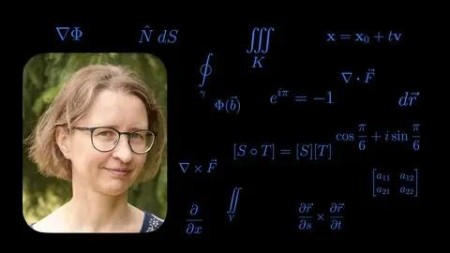
Udemy - Calculus 3 (Multivariable Calculus), Part 1 Of 2

babymore87

MyBoerse.bz Pro Member

291801a271d41373088d347434e3abe4.webp

Free Download Udemy - Calculus 3 (Multivariable Calculus), Part 1 Of 2
Last updated 4/2025
MP4 | Video: h264, 1920x1080 | Audio: AAC, 44.1 KHz
Language: English | Size: 53.25 GB | Duration: 47h 52m
Towards and through the vector fields, part 1 of 2: Functions of several real variables and vector-valued functions

What you'll learn
How to solve problems in multivariable calculus (illustrated with more than 200 solved problems) and why these methods work.
Parameterize some curves (straight lines, circles, ellipses, graphs of functions of one variable, intersections of two surfaces).
Describe position, velocity, speed and acceleration; compute arc length of parametric curves; arc length parametrization.
Limits, continuity and differentiability for functions of several variables. Theory, geometric intuitions, and lots of problem solving.
Several variants of the Chain Rule, involving different kinds functions. You will also learn how to apply these variants of the Chain Rule for problem solving.
Several variants of the Implicit Function Theorem, with various geometrical interpretations; problem solving.
Optimization of functions of several variables, both on open domains and on compact domains (Lagrange multipliers on the boundary, etc.).
Requirements
Calculus 1 and 2
Some Linear Algebra (a brief summary of some topics is contained in Section 2 of this course)
You are always welcome with your questions. If something in the lectures is unclear, please, ask. It is best to use QA, so that all the other students can see my additional explanations about the unclear topics. Remember: you are never alone with your doubts, and it is to everybody's advantage if you ask your questions on the forum.
Description
Calculus 3 (multivariable calculus), part 1 of 2Towards and through the vector fields, part 1 of 2(Chapter numbers in Robert A. Adams, Christopher Essex: Calculus, a complete course. 8th or 9th edition.)C0: Introduction to the course; preliminaries (Chapter 10: very briefly; most of the chapter belongs to prerequisites) S1. About the courseS2. Analytical geometry in R^n (n = 2 and n = 3): points, position vectors, lines and planes, distance between points (Ch.10.1)S3. Conic sections (circle, ellipse, parabola, hyperbola)S4. Quadric surfaces (spheres, cylinders, cones, ellipsoids, paraboloids etc) (Ch.10.5)S5. Topology in R^n: distance, open ball, neighbourhood, open and closed set, inner and outer point, boundary point (Ch.10.1)S6. Coordinates: Cartesian, polar, cylindrical, spherical coordinates (Ch.10.6)You will learn: to understand which geometrical objects are represented by simpler equations and inequalities in R^2 and R^3, determine whether a set is open or closed, if a point is an inner, outer or boundary point, determine the boundary points, describe points and other geometrical objects in the different coordinate systems.C1: Vector-valued functions, parametric curves (Chapter 11: 11.1, 11.3)S7. Introduction to vector-valued functionsS8. Some examples of parametrisationS9. Vector-valued calculus; curve: continuous, differentiable and smoothS10. Arc lengthS11. Arc length parametrisationYou will learn: Parametrise some curves (straight lines, circles, ellipses, graphs of functions of one variable);if r(t) = (x(t), y(t), z(t)) is a function describing a particle's position in R^3 with respect to time t, describe position, velocity, speed and acceleration; compute arc length of parametric curves, arc length parametrisation.C2: Functions of several variables; differentiability (Chapter 12) S12. Real-valued functions in multiple variables, domain, range, graph surface, level curves, level surfacesYou will learn: describe the domain and range of a function, Illustrate a function f(x,y) with a surface graph or with level curves.S13. Limit, continuityYou will learn: calculate limit values, determine if a function has limit value or is continuous at one point, use common sum-, product-, ... rules for limits.S14. Partial derivative, tangent plane, normal line, gradient, JacobianYou will learn: calculate first-order partial derivatives, compute scalar products (two formulas) and cross pro- duct, give formulas for normals and tangent planes; understand functions from R^n to R^m, gradients and Jacobians.S15. Higher partial derivatesYou will learn: compute higher order partial derivatives, use Schwarz' theorem. Solve and verify some simple PDE's.S16. Chain rule: different versionsYou will learn: calculate the chain rule using dependency diagrams and matrix multiplication.S17. Linear approximation, linearisation, differentiability, differentialYou will learn: determine if a function is differentiable in a point, linearisation of a real-valued function, use linearisation to derive an approximate value of a function, use the test for differentiability (continuous partial derivatives), and properties of differentiable functions.S18. Gradient, directional derivativesYou will learn: calculate the gradient, find the direction derivative in a certain direction, properties of gradients, understand the geometric interpretation of the directional derivative, give a formula for the tangent and normal lines to a level curve.S19. Implicit functionsYou will learn: calculate the Jacobian determinant, derive partial derivatives with dependent and free variables of implicit functions.S20. Taylor's formula, Taylor's polynomialYou will learn: derive Taylor's polynomials and Taylor's formula. Understand quadratic forms and learn how to determine if they are positive definite, negative definite, or indefinite.C3: Optimisation of functions of several variables (Chapter 13: 13.1-3)S21. Optimisation on open domains (critical points)S22. Optimisation on compact domainsS23. Lagrange multipliers (optimisation with constraints)You will learn: classify critical points: local max and min, saddle points; find max and min values for a given function and region; use Lagrange multipliers with one or more conditions.Make sure that you check with your professor what parts of the course you will need for your midterms. Such things vary from country to country, from university to university, and they can even vary from year to year at the same university.A detailed description of the content of the course, with all the 255 videos and their titles, and with the texts of all the 216 problems solved during this course, is presented in the resource file "001 Outline_Calculus3.pdf" under video 1 ("Introduction to the course"). This content is also presented in video 1.
University and college engineering

Homepage

Recommend Download Link Hight Speed | Please Say Thanks Keep Topic Live
No Password - Links are Interchangeable

 

3d1b579ac13af4f39be76201a537f334.jpg

Calculus 3 (multivariable calculus), part 1 of 2.
MP4 | Video: h264, 1280x720 | Audio: AAC, 44100 Hz
Language: English | Size: 3.21 GB | Duration: 47h 42m​

Towards and through the vector fields, part 1 of 2.

What you'll learn
How to solve problems in multivariable calculus (illustrated with more than 200 solved problems) and why these methods work.
Parameterize some curves (straight lines, circles, ellipses, graphs of functions of one variable, intersections of two surfaces).
Describe position, velocity, speed and acceleration; compute arc length of parametric curves; arc length parametrization.
Limits, continuity and differentiability for functions of several variables. Theory, geometric intuitions, and lots of problem solving.
Several variants of the Chain Rule, involving different kinds os functions. You will also learn how to apply these variants of the Chain Rule for problem solving.
Several variants of the Implicit Function Theorem, with various geometrical interpretations; problem solving.
Optimization of functions of several variables, both on open domains and on compact domains (Lagrange multipliers on the boundary, etc.).
Requirements
Calculus 1 and 2
Some linear algebra
Description
Calculus 3 / Multivariable Calculus. Part 1 of 2.

Towards and through the vector fields.

(Chapter numbers in Robert A. Adams, Christopher Essex: Calculus, a complete course. 8th or 9th edition.)

C0 Introduction to the course; preliminaries (Chapter 10: very briefly; most of the chapter belongs to prerequisites)

About the course

Analytical geometry in R^n (n = 2 and n = 3): points, position vectors, lines and planes, distance between points (Ch.10.1)

Conic sections (circle, ellipse, parabola, hyperbola) and quadric surfaces (spheres, cylinders, cones, ellipsoids, paraboloids etc) (Ch.10.5)

Topology in R^n: distance, open ball, neighbourhood, open and closed set, inner and outer point, boundary point. (Ch.10.1)

Coordinates: Cartesian, polar, cylindrical, spherical coordinates (Ch.10.6)

You will learn: to understand which geometrical objects are represented by simpler equations and inequalities in R^2 and R^3, determine whether a set is open or closed, if a point is an inner, outer or boundary point, determine the boundary points, describe points and other geometrical objects in the different coordinate systems.

C1 Vector-valued functions, parametric curves (Chapter 11: 11.1, 11.3)

Introduction to vector-valued functions

Some examples of parametrisation

Vector-valued calculus; curve: continuous, differentiable and smooth

Arc length

Arc length parametrisation

You will learn: Parametrise some curves (straight lines, circles, ellipses, graphs of functions of one variable); if r(t) = (x(t), y(t), z(t)) is a function describing a particle's position in R^3 with respect to time t, describe position, velocity, speed and acceleration; compute arc length of parametric curves, arc length parametrisation.

C2 Functions of several variables; differentiability (Chapter 12)

Real-valued functions in multiple variables, domain, range, graph surface, level curves, level surfaces
You will learn: describe the domain and range of a function, Illustrate a function f(x,y) with a surface graph or with level curves.

Limit, continuity
You will learn: calculate limit values, determine if a function has limit value or is continuous at one point, use common sum-, product-, . rules for limits.

Partial derivative, tangent plane, normal line
You will learn: calculate first-order partial derivatives, compute scalar products (two formulas) and cross pro- duct, give formulas for normals and tangent planes; understand functions from R^n to R^m, gradients and Jacobians.

Higher partial derivates
You will learn: compute higher order partial derivatives, use Schwarz' theorem. Solve and verify some simple PDE's.

Chain rule: different versions
You will learn: calculate the chain rule using dependency diagrams and matrix multiplication.

Linear approximation, linearisation, differentiability, differential
You will learn: determine if a function is differentiable in a point, linearisation of a real-valued function, use linearisation to derive an approximate value of a function, use the test for differentiability (continuous partial derivatives), and properties of differentiable functions.

Gradient, directional derivatives
You will learn: calculate the gradient, find the direction derivative in a certain direction, properties of gradients, understand the geometric interpretation of the directional derivative, give a formula for the tangent and normal lines to a level curve.

Implicit functions
You will learn: calculate the Jacobian determinant, derive partial derivatives with dependent and free variables of implicit functions.

Taylor's formula, Taylor's polynomial
You will learn: derive Taylor's polynomials and Taylor's formula. Understand quadratic forms and learn how to determine if they are positive definite, negative definite, or indefinite.

C3 Optimisation of functions of several variables (Chapter 13: 13.1-3)

Optimisation on open domains (critical points)

Optimisation on compact domains

Lagrange multipliers (optimisation with constraints)

You will learn: classify critical points: local max and min, saddle points; find max and min values for a given function and region; use Lagrange multipliers with one or more conditions.

Also make sure that you check with your professor what parts of the course you will need for your midterms. Such things vary from country to country, from university to university, and they can even vary from year to year at the same university.

A detailed description of the content of the course, with all the 255 videos and their titles, and with the texts of all the 216 problems solved during this course, is presented in the resource file "Outline_Calculus3.pdf" under video 1 ("Introduction to the course"). This content is also presented in video 1.

Who this course is for:
University and college engineering

nyx8LgX3_o.jpg

 
Zurück
Oben Unten