0daytutorial
MyBoerse.bz Pro Member
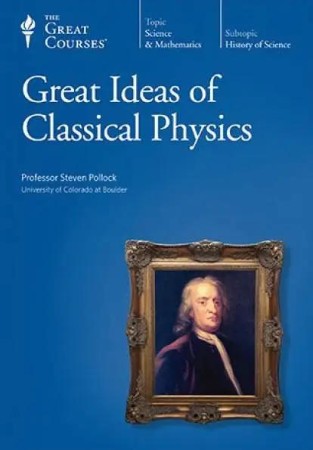
TTC Video - Great Ideas of Classical Physics
Course No. 1295 | .AVI, XviD, 800 kbps, 640x464 | English, MP3, 128 kbps, 2 Ch | 24x30 mins | + PDF Guidebook | 5.57 GB
Lecturer: Steven Pollock, Ph.D.
There is a hidden order in the ceaselessly changing world around us. It's called classical physics, and it's about how the world is put together. Classical physics is about how things move, why they move, and how they work. It's about making sense of motion, gravity, light, heat, sound, electricity, and magnetism, and seeing how these phenomena interweave to create the rich tapestry of everyday experience.
Sound complicated? It's not-you already know more physics than you think, says award-winning science educator Steven Pollock.
Basic Principles You Can Learn
In this mind-expanding series of 24 lectures, Professor Steven Pollock takes you step by step through the Great Ideas of Classical Physics, showing that landmark concepts such as Newton's laws of motion are intuitively understood by anyone who has ever ridden a bike, thrown a ball, slid across ice, or simply picked up an object and set it down.
Created over the course of three centuries by a series of brilliant thinkers, including Galileo Galilei, Isaac Newton, Michael Faraday, and James Clerk Maxwell, classical physics is an elegant system of ideas that connect a range of seemingly unrelated phenomena.
Everything from the acceleration of a car, to the orbit of a planet, to the deflection of a compass needle, to the baking of a cake, to the flow of electricity through a light bulb as you read this-and much more-is linked by a set of basic principles that you can learn.
And you don't have to study complicated mathematical equations to see these connections-as Professor Pollock proves by teaching this course largely without math, by relying on metaphor, life experience, ordinary logic, and common sense. Dr. Pollock will be familiar to many Teaching Company customers for his course, Particle Physics for Non-Physicists: A Tour of the Microcosmos.
The Universe Is Your Laboratory
What are the great ideas of classical physics? They are the conceptual tools that allow us to make sense of the world. They include discoveries, theories, insights, methods, and philosophical points of view. You will explore many of these breakthrough ideas, for example:
Experiment: It may seem obvious that if you want to understand something, you should experiment on it and not just think about it. But this idea did not catch on until Galileo performed a series of revolutionary investigations of motion in the early 1600s.
Use standards: One of the secrets of Galileo's success was that he used standard procedures, units, and techniques of analysis to compare his results. This approach led him to conclusions, like his principle of inertia, that no else had ever imagined.
Simplify: Another powerful insight of Galileo's was to start with simple cases and add complexity later. All physicists do this. In fact, they have a joke about it: A physicist is hired to advise a dairy farmer and says, "First, assume a spherical cow"!
Recognize the fundamental nature of obvious things: The common observation that hot objects cool down and cold ones warm up became the basis for the second law of thermodynamics, proposed by the French engineer Sadi Carnot in the early 1800s. The second law has profound implications for heat engines and for the "direction" of time.
Along with these and other general concepts, you learn about such basic features of reality as force and energy, space and time, electricity and magnetism; and you learn how these properties interact in a range of situations. As you proceed through the course, you will find that the entire universe-from atoms to galaxies-is your laboratory.
Powerful and Surprisingly Beautiful Ideas
The course opens in ancient Greece with Aristotle's commonsense analysis of motion. His ideas held sway until the early 1600s, when Galileo challenged them with one of the simplest yet most profound experiments of all time-he rolled marbles down an inclined plane.
The technique allowed Galileo to explore the action of gravity "in slow motion" to show that, contrary to Aristotle's claims, all objects fall at the same rate regardless of mass, and that the speed of a falling object steadily increases-it accelerates.
A generation after Galileo, Newton united the laws of heavenly and earthly motion in a grand synthesis that marked the full dawn of classical physics. The exploration of Newton's three laws of motion and his universal law of gravitation forms the core of the first half of the course.
In the second half of the course, Professor Pollock introduces the ideas of electricity and magnetism. Considered curiosities in Newton's day, these seemingly minor marvels were integrated into the classical picture in the 19th century through the remarkable work of Faraday, Maxwell, and others.
The course concludes with a series of lectures on waves, optics, atoms, and thermodynamics, bringing classical physics to the brink of the watershed theories of relativity and quantum mechanics in the early 20th century, which marked the start of modern physics.
Your Homework: Play a Little Bit
Classical physics was invented by people at play, and Dr. Pollock encourages you to do the same. "There will be many times in this course when you should just go after class and play a little bit," he counsels. That's what Galileo, Faraday, and other pioneer scientists did.
Here are some playful activities that Dr. Pollock recommends:
Falling objects: When you drop a pen and a piece of paper at the same time, it seems to confirm the commonsense expectation that heavier objects fall faster than lighter ones. But now crumple the sheet of paper and drop them again. What happens?
Static electricity: Put one piece of sticky tape on top of another, and then attach them to a table. Label the top piece of tape "T" and the bottom piece "B." Yank the pair off, and then quickly separate them. Investigate their behavior near each other and near identically prepared pieces. What's going on?
Magnetism: Using two magnets, probe their interacting force fields by passing one all around the other. Where are the areas of attraction and repulsion? What accounts for this invisible force?
Waves: A Slinky demonstrates the particlelike properties of some waves. To see how, expand a Slinky and jerk your hand, making a pulse travel from one end to the other. Like a particle, the pulse is localized; it also has a speed, and it can reflect off boundaries. Yet it is a wave.
The Course Guidebook that comes with this course includes many more activities for creative play through online computer simulations, developed by Dr. Pollock's education research colleagues.
On the Shoulders of Giants
Some people accept the mystery of the world at face value and never inquire further. Physicists can't help but seek answers, and you will feel the same way.
If you want to understand how a baseball behaves in a baseball stadium, or how the electricity for your house is generated, or how your microwave oven works, these are ideas that can be understood from classical physics. If you are concerned about energy and the environment, then the tools provided by this course are sufficient for you to understand the scientific questions.
Isaac Newton once commented that if he had seen farther than others, it was because he stood on the shoulders of giants. "Classical physics is the giant on whose shoulder we stand today," says Professor Pollock, "as we move into new realms of study, into modern physics, or contemporary biology, or any of a number of modern disciplines."