0daytutorial
MyBoerse.bz Pro Member
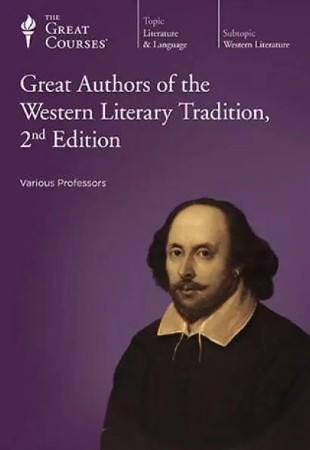
TTC Video - Great Authors of the Western Literary Tradition, 2nd Edition
Course No. 2100 | .AVI, XviD, 770 kbps, 720x480 | English, MP3, 76 kbps, 2 Ch | 84x30 mins | + PDF Guidebook | 15.3 GB
Lecturers: Elizabeth Vandiver, Ph.D., James A. W. Heffernan, Ph.D., Thomas F. X. Noble, Ph.D., Ronald B. Herzman, Ph.D., Susan Sage Heinzelman, Ph.D.
Novelists, poets, dramatists, historians, biographers, essayists, and philosophers-whether famous or anonymous, many of Western culture's greatest figures have been writers. Ranging from the anonymous author of the Epic of Gilgamesh in ancient Mesopotamia to William Faulkner writing about 19th- and 20th-century Mississippi 3,600 years later, Western writers have each played important parts in establishing the West's rich literary tradition. Their landmark themes, unique insights into human nature, dynamic characters, experimental storytelling techniques, and rich philosophical ideas helped create the vibrant storytelling methods we find reflected in today's authors. They've also played critical roles in Western history and culture as well, influencing everything from religion to politics.
Great Authors of the Western Literary Tradition, 2nd Edition is your chance to survey over 70 literary geniuses and masterpieces of Western literature. In 84 lectures taught by five award-winning professors who are experts in particular literary time periods, you explore the vast collection of Western writers and their respective works.
With its broad historical scope and its depth of insight, this course is a veritable encyclopedia of Western literature's greatest writers. It's your chance to get a look at their works, styles, themes, and relationships with one another without having to pour through thousands upon thousands of pages of their writing. And you'll see the role they played both within the context of their own time and within the larger span of literary history.
What Is the Western Literary Tradition? What do the words "Western" and "literature" mean in the context of writers as diverse as the ancient Greek poet Homer, the anonymous author of Beowulf, the metaphysical poet William Blake, and Modernist Samuel Beckett? How can we draw connections between writers who lived throughout the centuries in places as widely separated as the Near East and the New World?
The Western literary tradition, you discover in this course, derives as its main sources of inspiration the Bible and ancient Greek and Roman literature. While we sometimes think of literature as anything written, it is in fact writing that lays claim to consideration on the grounds of beauty, form, and emotional effect. To present you with an effective and comprehensive survey of Western writers, this course considers history, biography, essays, and philosophical works in addition to poems, plays, and prose fiction.
Great Authors of the Western Literary Tradition is divided into seven parts consisting of 12 lectures each. The parts are grouped around various themes in the history of Western literature, from its origins in the Near East and the Mediterranean world to the literary heavyweights of the Renaissance and the men and women who defined the traditions of Modern literature in the 20th century. The end result is a course that spans 40 centuries of literary masterpieces.
Witness the Birth of Literary Genres and Movements
Throughout Great Authors of the Western Literary Tradition, you witness how brilliant writers created and developed the various literary genres now considered staples of Western storytelling. Some of the many genres you explore include:
Epics: Homer's Iliad and Odysseyare the first fully developed epics in Western culture. They were composed orally sometime before the invention of the Greek alphabet in the 8th century B.C., and they are the models for virtually all subsequent epics.
Biographies: Composed in the first century A.D., Plutarch's Parallel Lives was immensely popular for centuries and served as the model for later biographies-and also as the source for some of Shakespeare's tragedies.
Romances: The medieval romance-a stylized tale of love, intrigue, quest, and valor, often involving the court of King Arthur-is a 12th-century French invention. Interestingly, Gawain, not Lancelot, is the hero of most of these stories.
Novels: Though there are ancient precursors to the novel in the works of Petronius and Apuleius, the modern novel arguably began with Don Quixote, written by Cervantes in the 17th century.
Literary Criticism: The discipline of literary criticism was pioneered by Samuel Johnson in the 18th century in works such as Lives of the Poets.
In addition to new genres, literary movements played an important role in the development of Western literature. These various movements illustrate how writers reacted to their particular cultural environments and demonstrate the crucial relationship between a writer and his or her time.
Throughout the course, you learn about literary movements such as
Neoclassicism: The French writers Molière and Jean Racine offer a window into concepts of Neoclassicism. Their works reflect the movement's focus on the study of human nature as a universal principle and the appeal of the rational and the moderate.
Romanticism: A reaction to the Enlightenment, Romanticism was championed by writers like Johan Wolfgang von Goethe, Jean-Jacques Rousseau, William Blake, and William Wordsworth. It placed a strong emphasis on emotion and the power of the human imagination.
Realism: Writers like Gustave Flaubert and Stendhal used their novels to depict the frank reality of their characters' emotions and their social environments. Realism emphasized an honest depiction of life as it was lived, without any embellishments.
Modernism: This 20th-century movement, developed by such writers as Joseph Conrad, Franz Kafka, William Faulkner, and Virginia Woolf, sparked revolutionary new styles of literary expression including stream of consciousness and nonlinear narratives.
Discover a Panorama of Literary Relationships
The texts and authors featured in Great Authors of the Western Literary Tradition are so richly varied and cover so many different centuries, societies, literary movements, and genres that you may think there is little to connect them. But you discover an interesting thing as you listen to these lectures: What formerly may have been a few isolated literary peaks soon resolve into a detailed landscape in which you see the full panorama of relationships between periods, authors, and the paths that brought us to where we are in literature today.
Here are some of the connections you explore:
Virgil's Aeneid stands as one of the most influential texts in Western culture. The poem itself is deeply indebted to Homer and went on to inspire such authors as Dante, Christopher Marlowe, and John Milton.
Modeled on the Confessions of St. Augustine, Jean-Jacques Rousseau's Confessions, written 13 centuries later, led to a flood of autobiographies-from the superficial and mundane to great fictional recreations like Johann Wolfgang von Goethe's The Sorrows of Young Werther, James Joyce's A Portrait of the Artist as a Young Man, and Marcel Proust's In Search of Lost Time.
In the satirical drama The Importance of Being Earnest, first performed in 1895, Oscar Wilde puts his own playful twist on the well-established theme of the foundling (an abandoned child), which writers like Charles Dickens and Thomas Hardy had previously mined for deep psychological insights.
William Faulkner's masterpiece As I Lay Dying owes a large debt to the Modernist technique of Joyce's Ulysses. But it also harks back to Joyce's prime source, Homer's Odyssey-recalling the ghost of Agamemnon lamenting that his murderous wife would not even close his eyes "as I lay dying."
An All-Star Faculty
Great Authors of the Western Literary Tradition features an all-star faculty whose literary expertise makes learning about these great authors a rich, unforgettable experience. Few, if any, colleges or universities offer such a wide-ranging course with the same strength of teaching talent assembled here.
Elizabeth Vandiver, Whitman College: Professor Vandiver earned her M.A. and Ph.D. from the University of Texas at Austin. She received the American Philological Association's Excellence in Teaching Award, the most prestigious teaching prize given to American classicists.
Thomas F. X. Noble, the University of Notre Dame: Professor Noble is the Robert M. Conway Director of the Medieval Institute and Professor of History at the University of Notre Dame. A Fellow of the Medieval Academy of America, Professor Noble earned his doctorate from Michigan State University and holds numerous honors and awards, including two National Endowment for the Humanities Fellowships.
Ronald B. Herzman, the State University of New York at Geneseo: Distinguished Teaching Professor of English at SUNY Geneseo, Professor Herzman earned his Ph.D. from the University of Delaware. The co-author of The Apocalyptic Imagination in Medieval Literature, he received the Chancellor's Award for Excellence in Teaching.
Susan Sage Heinzelman, the University of Texas at Austin: Professor Heinzelman, Associate Professor of English and Women's and Gender Studies at the University of Texas at Austin, earned her Ph.D. from the University of Western Ontario. She has received numerous teaching awards, including the President's Associates Teaching Award, and is president of the Association for the Study of Law, Culture, and the umanities.
James A. W. Heffernan, Dartmouth College: Professor Heffernan is Emeritus Professor of English at Dartmouth College, where he was Chair of the English Department and also Frederick Sessions Beebe '35 Professor in the Art of Writing. A widely published author and international lecturer, he received his Ph.D. from Princeton University.
The Never-Ending Story of Literature
Amid the discussions of scores of authors and their works, you return again and again to the question: What makes literature such a powerful force in our lives? The various professors who lend their expert knowledge to Great Authors of the Western Literary Tradition give their own reasons for why literature has endured throughout Western history. You'll come to see that literature:
Continually asks the question of what it means to be human and explores fundamental human themes
Gives us a fresh perspective on the past and on ourselves
Is always being reinvented, recreated, and rewritten
By the conclusion of Great Authors of the Western Literary Tradition, you'll have gained a well-rounded and well-informed understanding of both these literary icons and the larger role that literature has played in our cultural history.