




babymore87
MyBoerse.bz Pro Member
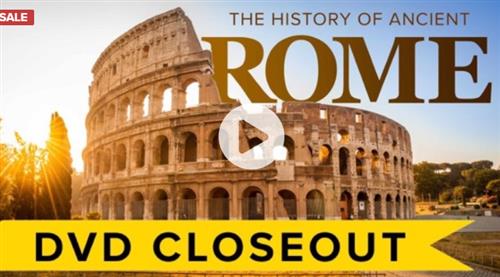
Free Download TTC - History of Ancient Rome
Last updated 10/2024
MP4 | Video: h264, 1280x720 | Audio: AAC, 44.1 KHz, 2 Ch
Genre: eLearning | Language: English | Duration: 48 Lessons ( 24h 12m ) | Size: 20.2 GB
There are many reasons to study ancient Rome. Rome's span was vast. In the regional, restless, and shifting history of continental Europe, the Roman Empire stands as a towering monument to scale and stability. At its height, the Roman Empire, unified in politics and law, stretched from the sands of Syria to the moors of Scotland, and it stood for almost 700 years.
Rome's influence is indelible. Europe and the world owe a huge cultural debt to Rome in so many fields of human endeavor, such as art, architecture, engineering, language, literature, law, and religion. In this course you see how a small village of shepherds and farmers rose to tower over the civilized world of its day and left an indelible mark on history.
Rome's story is riveting. Professor Garrett G. Fagan draws on a wealth of primary and secondary sources, including recent historical and archaeological scholarship, to introduce the fascinating tale of Rome's rise and decline. You learn about all the famous events and personalities
Horatius at the bridge
Hannibal crossing the Alps during Rome's life-or-death war with Carthage
Caesar assassinated before a statue of his archrival Pompey
Doomed lovers Antony and Cleopatra
Mad and venal emperors Nero and Caligula
The conversion of Constantine, and more.
From pre-Roman Italy through the long centuries of Republican and then Imperial rule, Professor Fagan interweaves narrative and analysis. Chronologically, the focus is on the years from 200 B.C.E. to 200 A.D., when Roman power was at its height.
The narrative of the rise and fall of Rome is itself compelling, and Professor Fagan's richly detailed and often humorous discussions of Roman life are uniquely memorable. You study women and the family, slaves, cities, religious customs, the ubiquitous and beloved institution of public bathing, the deep cultural impact of Hellenism, and such famous Roman amusements as chariot racing and gladiatorial games.
"Images and themes derived from or rooted in ancient Rome continue to exert an influence on the modern mind," says Professor Fagan. "Unlike many ancient states, Rome changed hugely in many spheres over the course of its 1,500-year history, and thus the history of Rome is an engaging, complex, and challenging subject."
From Village to Monarchy to Republic
The first 10 lectures of this course map the development of a group of preliterate hamlets into the Roman Republic. In them, you learn about
The nature of the historical evidence for antiquity
The geopolitical and cultural shape of pre-Roman Italy
The foundation legends of Rome itself
The cycle of stories that surrounds the kings of Rome
The shape of early Roman society
The fall of the monarchy at Rome and the foundation, in its wake, of the Republic (traditionally dated to 509 B.C.E.).
These lectures examine two major forces that shaped the early Republic: the Struggle of the Orders and Roman military expansion in Italy. The lectures also explain how the Romans ruled their conquered territories in Italy, setting the foundations for the later acquisition and maintenance of the Empire.
Early Expansion and Rapid Collision
Moving outside of Italy, you next explore the expansion of Roman power in the 3rd and 2nd centuries B.C.E.
In two lectures Professor Fagan charts the course of the Romans' first two titanic struggles with their archrival in the west, Carthage.
In these wars, the Romans developed a large-scale navy, sent armies overseas, acquired foreign territories, and displayed what was to become one of their chief characteristics: a dogged determination to prevail, even in the face of seemingly impossible odds. This was particularly clear in the Second Punic War, when the gifted Carthaginian general Hannibal roamed freely in Italy, threatening the city of Rome itself.
Greek Influence and Roman Government
In Lectures 16-19, Professor Fagan pauses the narrative to examine the influence of Greek culture on Rome and the nature of the Roman Republican system of government.
This latter system-complex and replete with archaisms and redundancies-has influenced the form of several modern policies, including that of the United States.
Finally, Professor Fagan examines the pressures of empire on Roman society, charting considerable social, economic, and political changes brought about by Rome's overseas expansion. On the rocks of these pressures, the Republic was destined to founder.
The Roman Revolution
Lectures 20-27 follow the course of what modern scholars have termed the "Roman Revolution."
In the century between 133 and 31 B.C.E., the Roman Republic tore itself apart. It is a period of dramatic political and military developments, of ambitious generals challenging the authority of the state, of civil wars and vicious violence, and of some of the first great personalities of European history: Marius, Sulla, Pompey, and Julius Caesar.
The story is intriguing, complicated, and at times horrendous, and it illustrates perfectly the historical principle of contingency. With a few exceptions, each protagonist in the drama of the Revolution acted within the bounds of necessity or precedent, and thereby set new and dangerous precedents for later protagonists to follow.
In this way, the Roman Revolution was not a staged or planned event, but a cumulative snowball of crises that combined to shatter the system of Republican government.
After pausing to examine the social and cultural life of the Late Republic, you return to the last phases of the Revolution and the rise to power of the man who was to become Rome's first emperor, Augustus.
The Roman Empire
Lectures 31-33 examine the long reign of Augustus (31 B.C.E.-14 A.D.) and his new political order, the Principate. The Principate stood for centuries and brought stability and good government in a way that the old Republic could not.
Augustus's solution to the Republic's problems was clever and subtle. It also had a flaw at its core-the issue of succession-and what happened when an emperor died was to prove the single most destabilizing factor in the Principate's existence.
The next three lectures cover the early Imperial period, from the death of Augustus to the instability of the 3rd century. This is the era of such familiar Roman historical figures as Caligula, Claudius, Nero, and Hadrian.
Finally, Professor Fagan shows how the problem of the succession combined with ominous developments among Rome's external enemies in the 2nd and 3rd centuries A.D. to generate a period of great crisis, indeed near-collapse, in the mid-3rd century A.D.
Life in Classical Rome
Leaving the Empire under pressure, Professor Fagan considers life in classical Roman civilization in nine lectures. He explores the broad shape of Roman society, slavery, the Roman family, the role of women in Roman society, urbanism, public leisure and mass entertainment, paganism, and the rise of Christianity.
The End and a New Beginning
To conclude the course, the final three lectures return to the Empire's last centuries. The Empire is restored to order and stability at the end of the 3rd century, but under an increasingly oppressive government.
The institutionalization of Christianity to legitimize Imperial power and a more openly autocratic regime created, in many ways, a Roman Empire closer to medieval Europe than to the Empire of Augustus. As such, the later Empire is treated only in general terms here, since it warrants closer study by itself.
The course ends with one of the great questions in history: Why did the Roman Empire fall? We see how, in the eyes of most modern scholars, the Empire did not fall at all but just changed into something very different, a less urbanized, more rural, early medieval world.
Homepage
Screenshot
Recommend Download Link Hight Speed | Please Say Thanks Keep Topic Live
No Password - Links are Interchangeable
