• Regeln für den Video-Bereich:

    In den Börsenbereich gehören nur Angebote die bereits den Allgemeinen Regeln entsprechen.

    Einteilung

    - Folgende Formate gehören in die angegeben Bereiche:
    - Filme: Encodierte Filme von BluRay, DVD, R5, TV, Screener sowie Telesyncs im Format DivX, XviD und x264.
    - DVD: Filme im Format DVD5, DVD9 und HD2DVD.
    - HD: Encodierte Filme mit der Auflösung 720p oder darüber von BluRay, DVD, R5, TV, Screener sowie Telesyncs im Format x264.
    - 3D: Encodierte Filme von BluRay, die in einem 3D Format vorliegen. Dies gilt auch für Dokus, Animation usw.
    - Serien: Cartoon/Zeichentrick, Anime, Tutorials, Dokumentationen, Konzerte/Musik, Sonstiges sind demnach in die entsprechenden Bereiche einzuordnen, auch wenn sie beispielsweise im High Definition-Format oder als DVD5/DVD9/HD2DVD vorliegen. Ausnahme 3D.
    - Bereich Englisch: Englische Releases gehören immer in diesen Bereich.
    - Bereich Talk: Der Bereich, in dem über die Releases diskutiert werden kann, darf, soll und erwünscht ist.


    Angebot/Beitrag erstellen

    - Ein Beitrag darf erst dann erstellt werden, wenn der Upload bei mindestens einem OCH komplett ist. Platzhalter sind untersagt.
    - Bei einem Scenerelease hat der Threadtitel ausschließlich aus dem originalen, unveränderten Releasenamen zu bestehen. Es dürfen keine Veränderungen wie z.B. Sterne, kleine Buchstaben o.ä. vorgenommen werden. Ausnahme Serienbörse:
    - Bei einem Sammelthread für eine Staffel entfällt aus dem Releasename natürlich der Name der Folge. Beispiel: Die Simpsons S21 German DVDRip XviD - ITG
    - Dementsprechend sind also u.a. verboten: Erweiterungen wie "Tipp", "empfehlenswert", "only", "reup", usw. / jegliche andere Zusatzinformation oder Ergänzung, welche nicht in obiger Beschreibung zu finden ist.

    Aufbau des Angebots und Threadtitel

    Der Titel nach folgendem Muster erstellt zu werden. <Name> [3D] [Staffel] [German] <Jahr> <Tonspur> [DL] [Auflösung] <Quelle> <Codec> - <Group>
    Beispiel: The Dark Knight German 2008 AC3 DVDRip XviD - iND
    Beispiel: The Dark Knight 2008 DTS DL BDRip x264 - iND
    Beispiel: The Dark Knight 2008 AC3 DL BDRip XviD - iND
    Beispiel: The Dark Knight German 2008 AC3 720p BluRay x264 iND
    Beispiel: The Dark Knight 2008 DTS DL 1080p BluRay x264 iND
    Beispiel: Die Simpsons S01 German AC3 DVDRip XviD iND
    Beispiel: Die Simpsons S20 German AC3 720p BluRay x264 iND
    Beispiel: Sword Art Online II Ger Sub 2014 AAC 1080p WEBRip x264 - peppermint
    Entsprechend sind also u.a. verboten: Sonderzeichen wie Klammern, Sterne, Ausrufezeichen, Unterstriche, Anführungszeichen / Erweiterungen wie "Tipp", "empfehlenswert", "only", "reup", usw. / jegliche andere Zusatzinformation oder Ergänzung, welche nicht in obiger Beschreibung zu finden ist
    Ausnahmen hiervon können in den Bereichen geregelt sein.

    Die Beiträge sollen wie folgt aufgebaut werden:
    Überschrift entspricht dem Threadtitel
    Cover
    kurze Inhaltsbeschreibung
    Format, Größe, Dauer sind gut lesbar für Downloader außerhalb des Spoilers zu vermerken
    Nfo sind immer Anzugeben und selbige immer im Spoiler in Textform.
    Sind keine Nfo vorhanden z.B. Eigenpublikationen, sind im Spoiler folgende Dateiinformationen zusätzlich anzugeben :
    Quelle
    Video (Auflösung und Bitrate)
    Ton (Sprache, Format und Bitrate der einzelnen Spuren)
    Untertitel (sofern vorhanden)
    Hosterangabe in Textform außerhalb eines Spoiler mit allen enthaltenen Hostern.
    Bei SD kann auf diese zusätzlichen Dateiinformationen verzichtet werden.

    Alle benötigten Passwörter sind, sofern vorhanden, in Textform im Angebot anzugeben.
    Spoiler im Spoiler mit Kommentaren :"Schon Bedankt?" sind unerwünscht.


    Releases

    - Sind Retail-Release verfügbar, sind alle anderen Variationen untersagt. Ausnahmen: Alle deutschen Retail-Release sind CUT, in diesem Fall sind dubbed UNCUT-Release zulässig.
    - Im Serien-Bereich gilt speziell: Wenn ein Retail vor Abschluss einer laufenden Staffel erscheint, darf diese Staffel noch zu Ende gebracht werden.62
    - Gleiche Releases sind unbedingt zusammenzufassen. Das bedeutet, es ist zwingend erforderlich, vor dem Erstellen eines Themas per Suchfunktion zu überprüfen, ob bereits ein Beitrag mit demselben Release besteht. Ist dies der Fall, ist der bereits vorhandene Beitrag zu verwenden.
    - P2P und Scene Releases dürfen nicht verändert oder gar unter einem iND Tag eingestellt werden.


    Support, Diskussionen und Suche

    - Supportanfragen sind entweder per PN oder im Bereich Talk zu stellen.
    - Diskussionen und Bewertungen sind im Talk Bereich zu führen. Fragen an die Uploader haben ausschließlich via PN zu erfolgen, und sind in den Angeboten untersagt.
    - Anfragen zu Upload-Wünschen sind nur im Bereich Suche Video erlaubt. Antworten dürfen nur auf Angebote von MyBoerse.bz verlinkt werden.


    Verbote

    - Untersagt sind mehrere Formate in einem einzigen Angebotsthread, wie beispielsweise das gleichzeitige Anbieten von DivX/XviD, 720p und 1080p in einem Thread. Pro Format, Release und Auflösung ist ein eigener Thread zu eröffnen.
    - Grundsätzlich ebenso verboten sind Dupes. Uploader haben sich an geeigneter Stelle darüber zu informieren, ob es sich bei einem Release um ein Dupe handelt.
    - Gefakte, nur teilweise lauffähige oder unvollständige Angebote sind untersagt. Dies gilt auch für eigene Publikationen, die augenscheinlich nicht selbst von z.B. einer DVD gerippt wurden. Laufende Serien, bei denen noch nicht alle Folgen verfügbar sind, dürfen erstellt und regelmäßig geupdatet werden.
    - Untersagt sind Angebote, welche nur und ausschließlich in einer anderen Sprache als deutsch oder englisch vorliegen. Ausnahmen sind VORHER mit den Moderatoren zu klären.


    Verstoß gegen die Regeln

    - Angebote oder Beiträge, die gegen die Forenregeln verstoßen, sind über den "Melden"-Button im Beitrag zu melden.
  • Bitte registriere dich zunächst um Beiträge zu verfassen und externe Links aufzurufen.

++ Premium IPTV ++ 7000 Live Sender ++ UHD Qualität ++ Mediathek mit 18.000 Inhalten ++


VenneTV


The ML System Design Interview Depth, Not Templates

babymore87

MyBoerse.bz Pro Member
8b4c558b0c2e17cc92c670b6800e5ef2.webp

Free Download The ML System Design Interview Depth, Not Templates
Published 8/2026
Created by OfferLab Courses
MP4 | Video: h264, 1280x720 | Audio: AAC, 44.1 KHz, 2 Ch
Level: Expert | Genre: eLearning | Language: English + subtitle | Duration: 25 Lectures ( 2h 27m ) | Size: 803.2 MB
Interviewers can hear a template. Learn the eight-step spine, then the judgment that sits on top of it.

What you'll learn
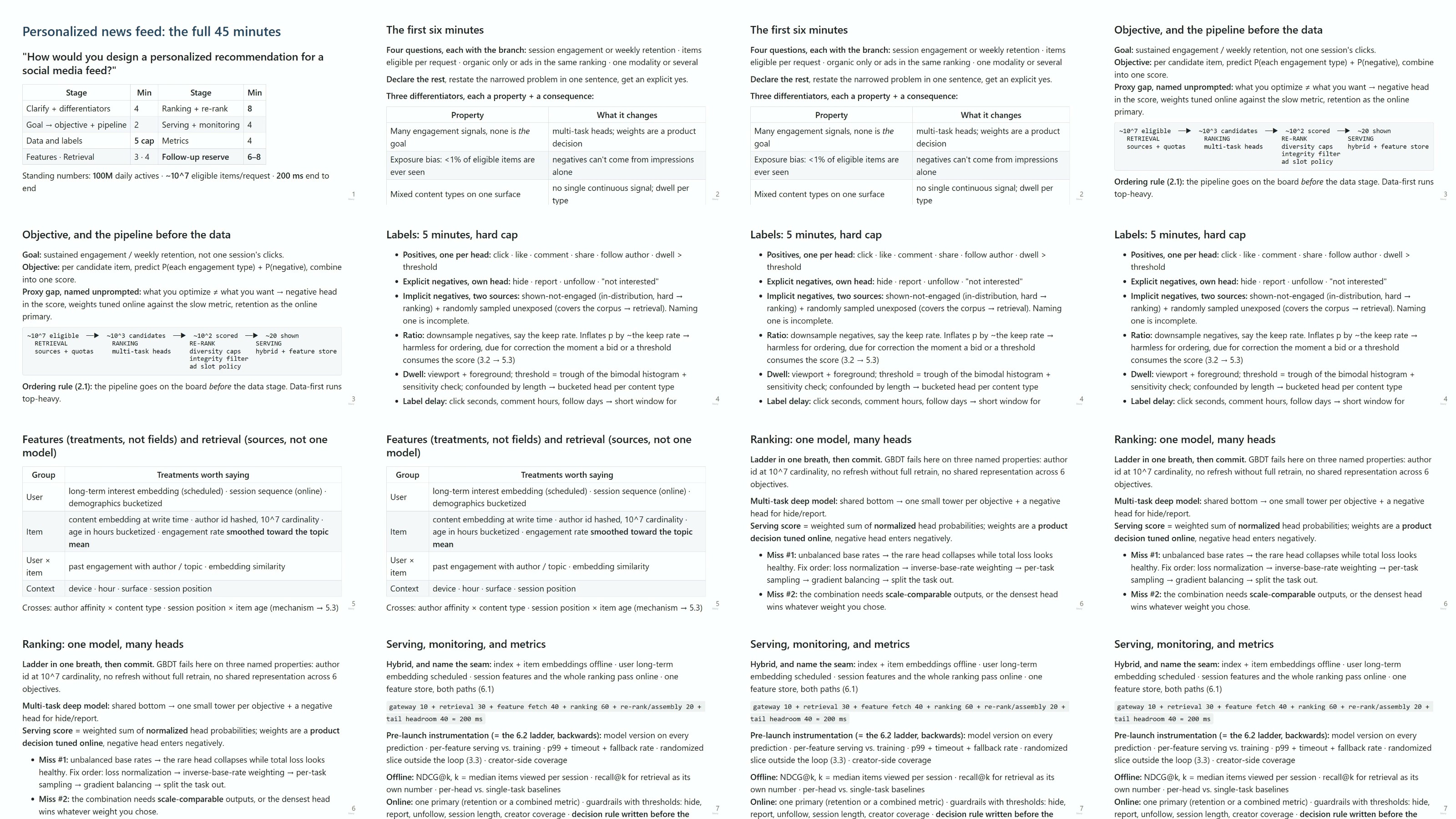
⚡ Allocate 45 minutes so no stage starves, and self-monitor the clock while you are talking
⚡ Turn a one-line prompt into a scoped problem using clarifying questions that already score points
⚡ Run the eight-step spine on any prompt: clarify, goal, data and labels, features, retrieval, ranking, serving, metrics
⚡ Open any design by naming what makes this system different from a generic recommender
⚡ Derive labels from product events, and detect when a proposed label is really another model's output
⚡ Design retrieval for a hundred million items under a latency budget, and explain cold start
⚡ Justify each rung of the ranking ladder, and say why AUC can flatter a model that is miscalibrated
⚡ Answer "how did you deploy it" without freezing, and run two timed mocks scored against a senior rubric
Requirements
❗ Working knowledge of classical ML (you can explain a gradient-boosted tree and a train/validation split)
❗ Some professional or project experience building models. This is not a first ML course
❗ No coding is required during the round, and none is required here
Description
This course contains the use of artificial intelligence.
"Your answer was correct. It sounded rehearsed." That is a real coaching note, and it is the reason this course exists.
Everyone can find the standard pipeline. Retrieval, ranking, re-ranking, serving, metrics. Interviewers know that, which is why a fluent walk through the standard pipeline no longer passes a senior loop. What they are listening for is whether the judgment is yours, growing out of this problem, or imported from a different one.
So the course teaches both halves. The eight-step spine gives you a structure that never leaves you stranded. The differentiator doctrine gives you the opening move that separates you from everyone reciting: before you touch the pipeline, name what makes this system different. Ads means freshness, calibration, and bid. Nearby places means distance filtering in retrieval. Harmful content means label scarcity and adversarial drift. Two sentences, and the room hears that you know which system you are designing.
The format is design-along, not lecture. Each case gives you the prompt, stops and lets you attempt the stage, then shows the worked decision, then fires the follow-ups interviewers actually ask. Those follow-ups were mined from years of coaching sessions and rebuilt fresh for the course.
Five full cases: personalized news feed, ads click prediction, harmful content detection in the LLM era, and a catalog module that maps any new prompt to its nearest solved family, so an unfamiliar question stops being a cliff.
The hard parts get the most room. Data and labels is a full module, because it is where most candidates overspend and still say nothing scoreable. Serving and monitoring is a full module, because "how did you deploy your model?" is a documented screen-killer.
It ends with two timed mocks and a scoring rubric you run against yourself, at the senior bar rather than a passing one.
Module 1 is free, along with the first ten minutes of the news feed case.
The other three OfferLab courses: Cracking the US Data Science & ML Interview · NLP to LLMs · The US Tech Interview: Behavioral, Communication, Offer. Each stands on its own; take them in whatever order fits what you are preparing for.
Who this course is for
⭐ MLE and Applied Scientist candidates facing the system design round at a senior loop
⭐ Data scientists moving into MLE roles who have never been asked to design a full system
⭐ Engineers who have shipped models but never had to defend the whole pipeline out loud
⭐ Not for: complete beginners, or people looking for distributed-systems design (this is the ML round, not the infra round)
Homepage
Recommend Download Link Hight Speed | Please Say Thanks Keep Topic Live
No Password - Links are Interchangeable

 

764912109_yxusj-mk09xu2v988y.jpg

The ML System Design Interview: Depth, Not Templates
Published 8/2026
MP4 | Video: h264, 1920x1080 | Audio: AAC, 44.1 KHz, 2 Ch
Genre: eLearning | Language: English (US) | Duration: 2.5 h | Size: 803 MB​

This course contains the use of artificial intelligence.
"Your answer was correct. It sounded rehearsed."
That is a real coaching note, and it is the reason this course exists.
Everyone can find the standard pipeline. Retrieval, ranking, re-ranking, serving, metrics. Interviewers know that, which is why a fluent walk through the standard pipeline no longer passes a senior loop. What they are listening for is whether the judgment is yours, growing out of this problem, or imported from a different one.
So the course teaches both halves.
The eight-step spine gives you a structure that never leaves you stranded. The differentiator doctrine gives you the opening move that separates you from everyone reciting: before you touch the pipeline, name what makes this system different. Ads means freshness, calibration, and bid. Nearby places means distance filtering in retrieval. Harmful content means label scarcity and adversarial drift. Two sentences, and the room hears that you know which system you are designing.
The format is design-along, not lecture.
Each case gives you the prompt, stops and lets you attempt the stage, then shows the worked decision, then fires the follow-ups interviewers actually ask. Those follow-ups were mined from years of coaching sessions and rebuilt fresh for the course.
Five full cases:
personalized news feed, ads click prediction, harmful content detection in the LLM era, and a catalog module that maps any new prompt to its nearest solved family, so an unfamiliar question stops being a cliff.
The hard parts get the most room.
Data and labels is a full module, because it is where most candidates overspend and still say nothing scoreable. Serving and monitoring is a full module, because "how did you deploy your model?" is a documented screen-killer.
It ends with two timed mocks and a scoring rubric
you run against yourself, at the senior bar rather than a passing one.
Module 1 is free, along with the first ten minutes of the news feed case.
The other three OfferLab courses:
Cracking the US Data Science & ML Interview · NLP to LLMs · The US Tech Interview: Behavioral, Communication, Offer. Each stands on its own; take them in whatever order fits what you are preparing for.


yxusj-21-Personalized-news-feed-the-full-forty-five-minutes.jpg

764912419_yxusj-04ky3co3vk36.jpg

 
Zurück
Oben Unten