• Regeln für den Dokumente-Bereich:

    In den Börsenbereich gehören nur Angebote die bereits den Allgemeinen Regeln entsprechen.

    Allgemeines:

    Nicht erlaubt im Dokumente-Bereich sind:

    - indizierte Titel (inkl. Comics)
    - extremistische Werke, Zeitschriften und Comics (egal, welche Richtung)
    - jegliche Art von Pornographie
    - Anleitungen zu kriminellen Handlungen, gleich welcher Art
    - sadistische, menschenverachtende oder ähnliche Werke

    Nutzt den "Bedanken"-Button, bei Sammelthreads führen jegliche Kommentare, positiv wie negativ, sehr schnell zu einer Unübersichtlichkeit des Threads. Downmeldungen sind an den Uploader zu richten

    Vor dem Einstellen zu beachten:

    - Suchfunktion

    Vergewissert euch, dass es euer Dokument noch nicht im Board gibt, Doppelposts werden kommentarlos gelöscht. Ist es schon vorhanden, tragt es als Mirror im bestehenden Post ein.

    - Threadtitel

    Idealerweise ist sofort zu erkennen um was es sich handelt. Verseht euren Titel mit den relevanten Informationen, das hilft euch und damit auch uns und allen Suchenden erheblich weiter.

    Beispiel: [Thriller] Dan Brown - Inferno oder bei Magazinen:

    Computerbild - 14/2014 (es muss ersichtlich sein, um welche Ausgabe und welches Magazin es sich handelt)

    Folgende Präfixe stehen im Unterforum "Unterhaltung" zur Verfügung:

    [Humor]
    [Drama]
    [Erotik]
    [Fantasy]
    [Krimi]
    [Roman]
    [Thriller]
    [Horror]
    [Science Fiction]

    Inhalt des Beitrags:

    Folgende Pflichtangaben gilt es einzuhalten:

    - Autor
    - Titel
    - Präfix
    - Cover
    - Genre
    - Inhaltsbeschreibung
    - enthaltene Formate
    - Gesamtgröße des Downloads
    - Hoster
    - ggf. Passwort

    Nicht erlaubt sind alle Dateien, die den Download unnötig aufblähen um eine Affiliategrenze zu erreichen, wie zB. mp3-files, übergroße Bilder, etc.

    Ebenso nicht erlaubt sind sämtliche Dateien mit DRM, persönlichen Daten, etc., diese werden kommentarlos zu eurem eigenem Schutz gelöscht.

    Achtet bitte bei der Konvertierung der Formate auf die Lesbarkeit, ein epub, was nur einfach durch Calibre gejagt wird um ein PDF zu erhalten, ist zu 99% eben nicht lesbar. Wenn ihr es nicht könnt, dann lasst es besser oder lest euch ein, wie man es richtig macht.


    Unterforum Comics:

    Threadtitel:

    Ähnlich, wie bei Unterhaltung und Magazinen, sollte der Titel alle relevanten Informationen enthalten, hier bitte

    - den Titel des Comics
    - den Verlag (einige Comics sind in verschiedenen Verlagen erschienen)
    - das Erscheinungsjahr

    Erlaubt sind folgende Formate:

    - CBR
    - CBZ

    Grundsätzlich gilt: jede Version eines Comics erhält einen eigenen Thread, Ersteller eines Comics können ihre Bände gerne mit dem Zusatz (Original-Release) versehen.

    Bei Unsicherheiten zur korrekten Benennung bitte die Informationen von www.comicguide.de nutzen.

    Inhalt des Beitrags:

    Pflichtangaben hier sind:

    - Titel des Bandes und ggf. Nummer
    - Cover
    - falls bekannt technische Daten (DPI, Breite, Speicherqualität)
    - Größe des Downloads
    - Hoster
    - ggf. Passwort
    - falls bekannt Releasenamen
  • Bitte registriere dich zunächst um Beiträge zu verfassen und externe Links aufzurufen.

*** Bestes IPTV *** bester Preis *** gratis Test ***


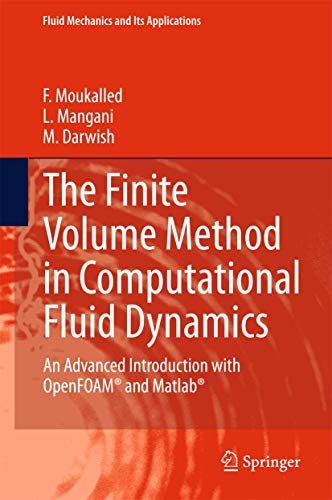
The Finite Volume Method in Computational Fluid Dynamics An Advanced Introduction with OpenFOAM® and Matlab (2024)

storylove

MyBoerse.bz Pro Member
9c78b30215b7ce2cb408b971eead966b.jpeg

Free Download The Finite Volume Method in Computational Fluid Dynamics: An Advanced Introduction with OpenFOAM® and Matlab by F. Moukalled , L. Mangani , M. Darwish
English | PDF (True) | 2016 | 798 Pages | ISBN : 3319168738 | 26 MB
This textbook explores both the theoretical foundation of the Finite Volume Method (FVM) and its applications in Computational Fluid Dynamics (CFD). Readers will discover a thorough explanation of the FVM numerics and algorithms used for the simulation of incompressible and compressible fluid flows, along with a detailed examination of the components needed for the development of a collocated unstructured pressure-based CFD solver. Two particular CFD codes are explored. The first is uFVM, a three-dimensional unstructured pressure-based finite volume academic CFD code, implemented within Matlab. The second is OpenFOAM®, an open source framework used in the development of a range of CFD programs for the simulation of industrial scale flow problems.​

With over 220 figures, numerous examples and more than one hundred exercise on FVM numerics, programming, and applications, this textbook is suitable for use in an introductory course on the FVM, in an advanced course on numerics, and as a reference for CFD programmers and researchers.
[/b]

Links are Interchangeable - Single Extraction
 

288cf28ea5d2e271224ab76e142b35f3.jpg

Computational Fluid Dynamics 2
Last updated 3/2022
MP4 | Video: h264, 720x1280 | Audio: AAC, 44.1 KHz
Language: English | Size: 1.02 GB | Duration: 2h 18m​

Further Develop Your Own Working CFD Code: unsteady flows, energy equation, collocated variables, turbulence & more.

What you'll learn

Implementation of additional types of boundary conditions

Implementation of second-order interpolation for convection terms

Coding for unsteady flows

Mesh clustering

Energy equation

Collocated variable approach

Two-equation turbulence modelling

Requirements

Students should have completed my first course, An Introduction to Computational Fluid Dynamics, or have an equivalent understanding of the topic.

Description

This course is a follow-up to my Introduction to Computational Fluid Dynamics course. In this course we extend the capabilities of the two-dimensional, incompressible Navier-Stokes solver developed in the first course to include enhancements such as unsteady flow capabilities, second-order and blended interpolations for the convection terms, pressure, symmetry, and periodic boundary conditions, mesh clustering, the energy equation, and perhaps other topics as deemed appropriate.All codes are written in Fortran90 and are available for download, as are the course notes. Upon successful completion of the course students should be able to develop their own codes or modify the available codes to solve problems of varying complexity. To get the maximum benefit from this course, I recommend that students complete the first course, or have an equivalent background.Recently added the description of a finite-difference-based Poisson solver using red/black iteration scheme with OpenMP for parallelization.Recently added a collocated grid approach to the finite volume formulation of the incompressible Navier-Stokes equations. In the collocated variable approach, the velocity control volumes are not staggered, but are coincident with the scalar control volumes. Although we limit our approach to structured Cartesian meshes, most commercial CFD solvers utilize a collocated variable approach using Cartesian velocity components on unstructured grids.A new section on two-equation k-epsilon turbulence modelling using wall functions has been added.The course is such that one can generally pick and choose which sections/lectures to watch.

Overview

Section 1: Introduction

Lecture 1 Introduction

Lecture 2 Index Notation

Lecture 3 Solver

Lecture 4 Base Fortran90 Code

Lecture 5 Driven Cavity Results

Section 2: Different Boundary Conditions

Lecture 6 Periodic Boundary Conditions

Lecture 7 Periodic Boundary Condition Code

Lecture 8 Periodic Boundary Condition Results

Lecture 9 Pressure Boundary Conditions

Lecture 10 Pressure Boundary Condition Code

Lecture 11 Pressure Boundary Condition Results

Lecture 12 Symmetry Boundary Conditions

Lecture 13 Symmetry Boundary Condition Code

Lecture 14 Symmetry Boundary Condition Results

Section 3: Higher Order Interpolation of Convection Terms

Lecture 15 Blended 1st Order Upwind and Second Order Central Interpolation

Lecture 16 Modifications to Base Code

Lecture 17 Driven Cavity Results

Section 4: Unsteady Flows

Lecture 18 Added Unsteady Terms

Lecture 19 Addition of Terms to Base Code

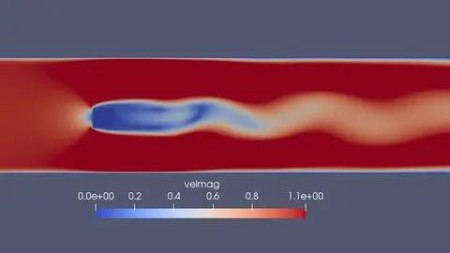
Lecture 20 Shedding From a Square Cylinder in a Channel

Section 5: Mesh Clustering

Lecture 21 Background Information

Lecture 22 Implementation into Base Code

Lecture 23 Channel Flow Results Using Mesh Clustering

Section 6: Energy Equation

Lecture 24 Discretization of Energy Equation

Lecture 25 Addition to Base Code

Lecture 26 Driven Cavity Results with Heat Transfer

Lecture 27 Buoyancy Using the Boussinesq Approximation

Lecture 28 Adding Boussinesq Approximation to the Code

Lecture 29 Boussinesq Approximation Results

Section 7: Additional Results

Lecture 30 Pressure Driven Flow

Lecture 31 Buoyancy Driven Flow via Heat Source

Lecture 32 Parallel Jets

Section 8: Miscellaneous Topics

Lecture 33 Red-Black Iteration Scheme for Loop-Level Parallelization

Lecture 34 Red-Black Poisson Solver with OpenMP Implementation

Section 9: Collocated Variable Approach to Finite Volume Method (on a Cartesian Mesh)

Lecture 35 Collocated Variable Numerical Formulation

Lecture 36 Collocated Variable Fortran Code Description

Lecture 37 Running the Collocated Mesh Code for Driven Cavity

Lecture 38 Driven Cavity Results Using ParaView

Section 10: K-Epsilon Turbulence Modelling

Lecture 39 Preliminary Material

Lecture 40 Reynolds-Averaging Process

Lecture 41 Boussinesq Approximation

Lecture 42 Two-Equation k-epsilon Model

Lecture 43 Viscous Sublayer and Log-Law Layer

Lecture 44 Wall Function Approach

Lecture 45 Implementation into CFD Code

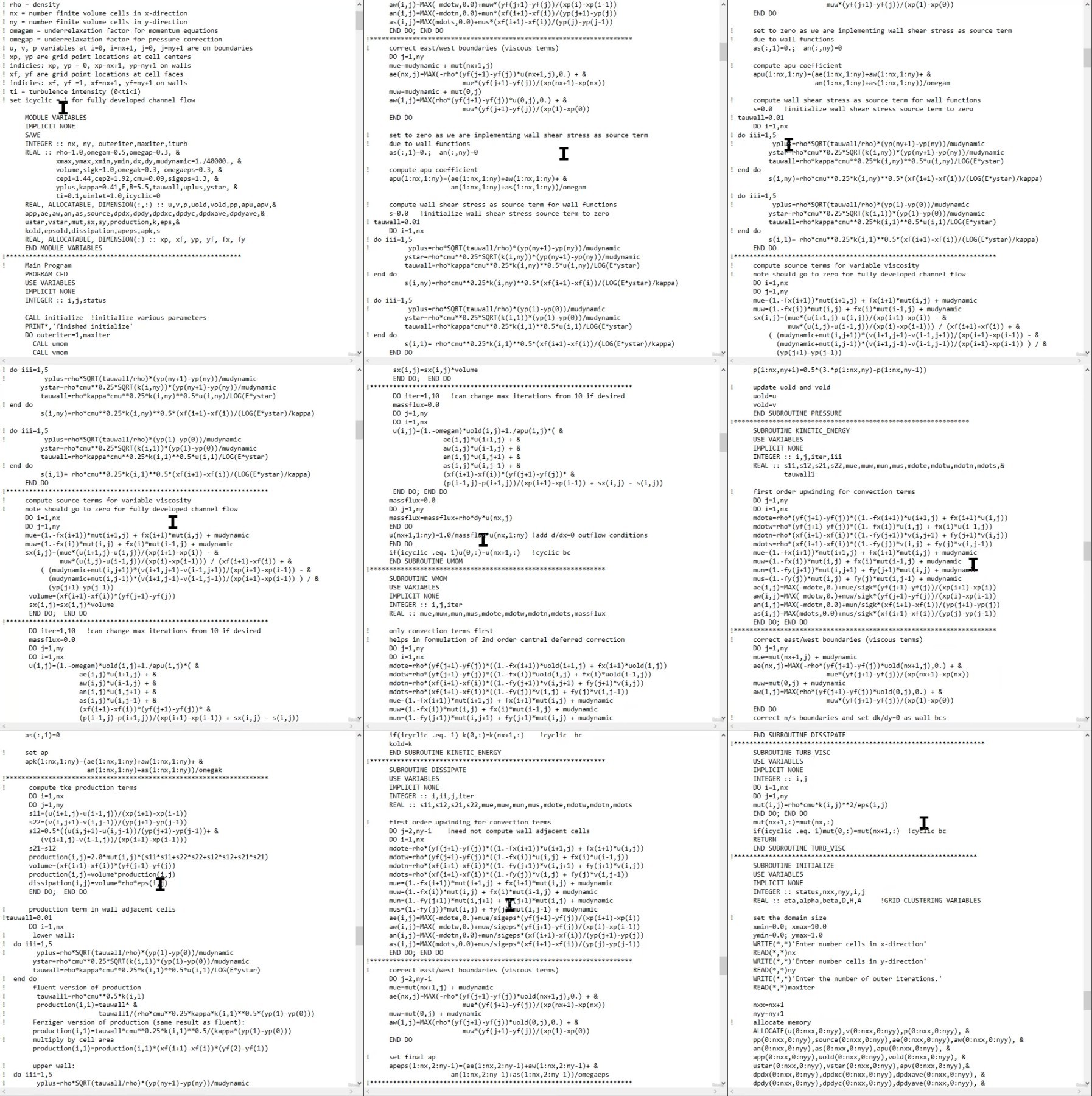
Lecture 46 Fortran Code For Turbulent Channel Flow

Lecture 47 Running the Code

Lecture 48 Channel Flow Results

Lecture 49 Applicability of k-epsilon model

Lecture 50 Commercial CFD Solvers

University upper-division and beginning graduate-level engineering and mathematics students

RiOypAgN_o.jpg


Zurück
Oben Unten