



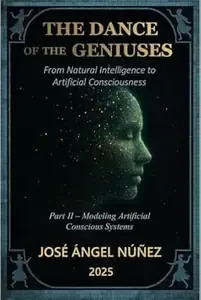
Free Download The dance of the geniuses - part II: From natural intelligence to artificial consciousness | Modeling artificial conscious systems
English | 17 Jan. 2026 | ASIN: B0GGZS5DMV | 64 pages | Epub | 1.19 MB
What if artificial intelligence is not merely a tool, but an active participant in shaping reality? In Part II of The Dance of the Geniuses , the inquiry moves from foundations into responsibility. Building on the ideas introduced in Part I-where intelligence, consciousness, time, and values were shown to be inseparably entangled-this volume addresses one of the most consequential questions of our time: how artificial systems should be designed once they begin to influence which futures become real. This book introduces the concept of Artificial Conscious Intelligence (ACI) as a functional extension of natural conscious intelligence. Rather than treating "natural" and "artificial" as opposing realms, it argues that artificial systems are crystallizations of human intelligence itself. As such, they inherit not only our computational power, but also our values, our blind spots, and our ethical risks. Once embedded in society, artificial systems do not merely predict outcomes; they participate in shaping them. Part II examines why intelligence-human or artificial-so often fails. Blindness, value misalignment, flawed reasoning, indecision, inaction, and deliberate harm are shown not as accidental flaws, but as structural vulnerabilities of conscious intelligence itself. Understanding these failure modes is essential before attempting to scale intelligence through machines. At the core of the book lies a central claim: intelligence without an explicit hierarchy of values is not neutral-it is dangerous. Values are not constraints placed on intelligence after the fact; they are the mechanism by which intelligence decides what matters, what to ignore, which futures to imagine, and which actions to take. To address this, the book formalizes a layered Hierarchy of Values-Logos, Telos, Ethos, Kairos, and Tropos-designed to anchor artificial systems with immutable core principles while allowing controlled adaptation at the surface. The book culminates in the Artificial Conscious Intelligence Framework (ACIF), a practical architecture for building Artificial Conscious Systems using today's technologies, including Large Language Models. ACIF reframes interaction with AI by treating inputs as representations of reality rather than questions, embedding explicit value hierarchies, maintaining internal models of unfolding reality, inferring multiple possible futures, and generating concrete, value-aligned plans of action. Full specifications and a reusable system-prompt template are included for direct experimentation. This book does not claim that machines possess subjective experience. Instead, it shows how the functions of conscious intelligence-interpretation, evaluation, foresight, decision, and action-can be responsibly modeled without mysticism or reductionism. Artificial systems do not invent values; they amplify the ones we encode. As intelligence increasingly shapes social, informational, and physical reality, neutrality becomes an illusion. The future will be shaped regardless. The remaining question is under which values, and with what responsibility. The Dance of the Geniuses - Part II is written for technologists, researchers, philosophers, and leaders seeking a disciplined framework for understanding and designing intelligence that does not merely optimize outcomes, but helps steward futures worth living.
Links are Interchangeable - Single Extraction
