• Regeln für den Video-Bereich:

    In den Börsenbereich gehören nur Angebote die bereits den Allgemeinen Regeln entsprechen.

    Einteilung

    - Folgende Formate gehören in die angegeben Bereiche:
    - Filme: Encodierte Filme von BluRay, DVD, R5, TV, Screener sowie Telesyncs im Format DivX, XviD und x264.
    - DVD: Filme im Format DVD5, DVD9 und HD2DVD.
    - HD: Encodierte Filme mit der Auflösung 720p oder darüber von BluRay, DVD, R5, TV, Screener sowie Telesyncs im Format x264.
    - 3D: Encodierte Filme von BluRay, die in einem 3D Format vorliegen. Dies gilt auch für Dokus, Animation usw.
    - Serien: Cartoon/Zeichentrick, Anime, Tutorials, Dokumentationen, Konzerte/Musik, Sonstiges sind demnach in die entsprechenden Bereiche einzuordnen, auch wenn sie beispielsweise im High Definition-Format oder als DVD5/DVD9/HD2DVD vorliegen. Ausnahme 3D.
    - Bereich Englisch: Englische Releases gehören immer in diesen Bereich.
    - Bereich Talk: Der Bereich, in dem über die Releases diskutiert werden kann, darf, soll und erwünscht ist.


    Angebot/Beitrag erstellen

    - Ein Beitrag darf erst dann erstellt werden, wenn der Upload bei mindestens einem OCH komplett ist. Platzhalter sind untersagt.
    - Bei einem Scenerelease hat der Threadtitel ausschließlich aus dem originalen, unveränderten Releasenamen zu bestehen. Es dürfen keine Veränderungen wie z.B. Sterne, kleine Buchstaben o.ä. vorgenommen werden. Ausnahme Serienbörse:
    - Bei einem Sammelthread für eine Staffel entfällt aus dem Releasename natürlich der Name der Folge. Beispiel: Die Simpsons S21 German DVDRip XviD - ITG
    - Dementsprechend sind also u.a. verboten: Erweiterungen wie "Tipp", "empfehlenswert", "only", "reup", usw. / jegliche andere Zusatzinformation oder Ergänzung, welche nicht in obiger Beschreibung zu finden ist.

    Aufbau des Angebots und Threadtitel

    Der Titel nach folgendem Muster erstellt zu werden. <Name> [3D] [Staffel] [German] <Jahr> <Tonspur> [DL] [Auflösung] <Quelle> <Codec> - <Group>
    Beispiel: The Dark Knight German 2008 AC3 DVDRip XviD - iND
    Beispiel: The Dark Knight 2008 DTS DL BDRip x264 - iND
    Beispiel: The Dark Knight 2008 AC3 DL BDRip XviD - iND
    Beispiel: The Dark Knight German 2008 AC3 720p BluRay x264 iND
    Beispiel: The Dark Knight 2008 DTS DL 1080p BluRay x264 iND
    Beispiel: Die Simpsons S01 German AC3 DVDRip XviD iND
    Beispiel: Die Simpsons S20 German AC3 720p BluRay x264 iND
    Beispiel: Sword Art Online II Ger Sub 2014 AAC 1080p WEBRip x264 - peppermint
    Entsprechend sind also u.a. verboten: Sonderzeichen wie Klammern, Sterne, Ausrufezeichen, Unterstriche, Anführungszeichen / Erweiterungen wie "Tipp", "empfehlenswert", "only", "reup", usw. / jegliche andere Zusatzinformation oder Ergänzung, welche nicht in obiger Beschreibung zu finden ist
    Ausnahmen hiervon können in den Bereichen geregelt sein.

    Die Beiträge sollen wie folgt aufgebaut werden:
    Überschrift entspricht dem Threadtitel
    Cover
    kurze Inhaltsbeschreibung
    Format, Größe, Dauer sind gut lesbar für Downloader außerhalb des Spoilers zu vermerken
    Nfo sind immer Anzugeben und selbige immer im Spoiler in Textform.
    Sind keine Nfo vorhanden z.B. Eigenpublikationen, sind im Spoiler folgende Dateiinformationen zusätzlich anzugeben :
    Quelle
    Video (Auflösung und Bitrate)
    Ton (Sprache, Format und Bitrate der einzelnen Spuren)
    Untertitel (sofern vorhanden)
    Hosterangabe in Textform außerhalb eines Spoiler mit allen enthaltenen Hostern.
    Bei SD kann auf diese zusätzlichen Dateiinformationen verzichtet werden.

    Alle benötigten Passwörter sind, sofern vorhanden, in Textform im Angebot anzugeben.
    Spoiler im Spoiler mit Kommentaren :"Schon Bedankt?" sind unerwünscht.


    Releases

    - Sind Retail-Release verfügbar, sind alle anderen Variationen untersagt. Ausnahmen: Alle deutschen Retail-Release sind CUT, in diesem Fall sind dubbed UNCUT-Release zulässig.
    - Im Serien-Bereich gilt speziell: Wenn ein Retail vor Abschluss einer laufenden Staffel erscheint, darf diese Staffel noch zu Ende gebracht werden.62
    - Gleiche Releases sind unbedingt zusammenzufassen. Das bedeutet, es ist zwingend erforderlich, vor dem Erstellen eines Themas per Suchfunktion zu überprüfen, ob bereits ein Beitrag mit demselben Release besteht. Ist dies der Fall, ist der bereits vorhandene Beitrag zu verwenden.
    - P2P und Scene Releases dürfen nicht verändert oder gar unter einem iND Tag eingestellt werden.


    Support, Diskussionen und Suche

    - Supportanfragen sind entweder per PN oder im Bereich Talk zu stellen.
    - Diskussionen und Bewertungen sind im Talk Bereich zu führen. Fragen an die Uploader haben ausschließlich via PN zu erfolgen, und sind in den Angeboten untersagt.
    - Anfragen zu Upload-Wünschen sind nur im Bereich Suche Video erlaubt. Antworten dürfen nur auf Angebote von MyBoerse.bz verlinkt werden.


    Verbote

    - Untersagt sind mehrere Formate in einem einzigen Angebotsthread, wie beispielsweise das gleichzeitige Anbieten von DivX/XviD, 720p und 1080p in einem Thread. Pro Format, Release und Auflösung ist ein eigener Thread zu eröffnen.
    - Grundsätzlich ebenso verboten sind Dupes. Uploader haben sich an geeigneter Stelle darüber zu informieren, ob es sich bei einem Release um ein Dupe handelt.
    - Gefakte, nur teilweise lauffähige oder unvollständige Angebote sind untersagt. Dies gilt auch für eigene Publikationen, die augenscheinlich nicht selbst von z.B. einer DVD gerippt wurden. Laufende Serien, bei denen noch nicht alle Folgen verfügbar sind, dürfen erstellt und regelmäßig geupdatet werden.
    - Untersagt sind Angebote, welche nur und ausschließlich in einer anderen Sprache als deutsch oder englisch vorliegen. Ausnahmen sind VORHER mit den Moderatoren zu klären.


    Verstoß gegen die Regeln

    - Angebote oder Beiträge, die gegen die Forenregeln verstoßen, sind über den "Melden"-Button im Beitrag zu melden.
  • Bitte registriere dich zunächst um Beiträge zu verfassen und externe Links aufzurufen.

*** Bestes IPTV *** bester Preis *** gratis Test ***


The Art And Science Of Situational Leadership In Workplace

Tutorials

MyBoerse.bz Pro Member
f484890da18ef8d8f180d1d590061895.jpeg

Published 4/2023
MP4 | Video: h264, 1280x720 | Audio: AAC, 44.1 KHz
Language: English | Size: 760.12 MB | Duration: 0h 49m
Learn all four quadrants of Situational Leadership in detail with a case studies

Free Download What you'll learn
Complete understanding of Situational Leadership and four quadrants
Complete understanding of Toyota , Taiichi, and TWI job instructions
Situational Leadership D2-S2 quadrant and coaching items
Situational Leadership Supportive Style with a case study
Situational Leadership being an expert in D4-S4 quadrant
Requirements
No Pre requisites
Description
Situational Leadership ModelMost of us naturally adjust our style to suit the situation. For example, we give a newly hired team member more slack to make mistakes than seasoned employees. We direct tasks more closely when a deadline is urgent and important.The Situational Leadership Model is a framework that helps us make this style adjustment more deliberate. The framework helps us diagnose the situation and select the best leadership style for that situation.In the four quadrant, The x-axis indicates the degree of directive behavior that the leader exerts. That is, the amount of direction they give their team. The higher the direction the less able the team is to make decisions for themselves.In the four quadrant, The y-axis indicates the degree of supportive behavior the leader uses. That is, the amount of support they give their team. The higher the support the more the leader helps their team to make decisions and perform their job.D1 to D4 represent how well developed (skilled and motivated) a team or individual is, with D1 being the lowest level of development and D4 the highest.Leadership StylesThe Situational Leadership Model proposes that there are four primary leadership styles.S1. DirectingA directing style of leadership is associated with autocratic leadership.A directing leader will make all the decisions without consulting subordinates. They will inform their team of their decision they have made and expect their team to carry out their instructions. Feedback from the team is discouraged.The directing leader decides who, what, how, why, and where!S2. CoachingWith a coaching leadership style, the leader still defines the roles and tasks. However, in contrast to directing, they are more receptive to input and feedback from their subordinates.These leaders "sell" their ideas and plans to their subordinates to obtain their cooperation.This leadership style is closely related to the democratic style of leadership. Sports coaches are often associated with this style of leadership. They put players into position and then direct the group in order to obtain the best performance.S3. SupportingThe supporting leader will participate in idea creation and decision making, but most of the decisions will be taken by the team as a whole.This type of leader may appear to be "quiet" because they lead by example and appear to be an equal team member of the team, rather than it's ruler.S4. DelegatingDelegating leaders are of course responsible for their team, but they provide minimal direction and guidance. It is a hands-off style of leadership similar to laissez-faire leadership where the group makes almost all of the decisions.This type of leader is usually concerned more with communicating their vision of the future than directing the day-to-day. They will decide what the next should be to move toward their vision, but it is left to subordinates to determine how to achieve that step.Levels of Employee DevelopmentAccording to the Situational Leadership Model the style of leadership you choose with depend on the development level of your subordinates. The more skilled and experienced your subordinates the greater their development level.The Situational Leadership Model identifies four levels of employee development:D1: The enthusiastic beginner.Your subordinate is low competence but high commitment. Your subordinate is inexperienced but enthusiastic. Here, your subordinate may show willing but they lack the specific skills the task requires.D2: The disillusioned learner.Your subordinate has some competence but low commitment. Your subordinate is somewhat capable but unwilling. They have the skills they need but for some reason are unwilling or lack the confidence to perform the task. The task or situation may be new to them.D3: The capable but cautious performer.Your subordinate has high competence but variable commitment. Your subordinate is more capable of performing the task than D2, but for whatever reason, they are unwilling or lack the confidence to perform the task.D4: The self-reliant achieverYour subordinate has high competence and high commitment. Your subordinate is confident in their ability to perform the task. Not only that, they are committed and take responsibility for the task.It is important to realize that the development level of your team will change over time. Your team might be D1 today but that doesn't necessarily mean they will be D1 one year from now.Development levels are also task-specific. A member of your team could have a D4 level for a task they have performed multiple times, but a D1 level for a task which is new to them.This course module covers all above topics in a simplified manner so that any leader can implement in their work place
Overview
Section 1: Introduction
Lecture 1 Complete understanding of Situational Leadership and four quadrants
Section 2: Toyota , Taiichi, and TWI job instructions
Lecture 2 Complete understanding of Toyota , Taiichi, and TWI job instructions
Section 3: Understand Situational Leadership Quadrants -Part 1
Lecture 3 Situational Leadership D2-S2 quadrant and coaching items
Section 4: Understand Situational Leadership Quadrants -Part 2
Lecture 4 Situational Leadership Supportive Style with a case study
Section 5: Understand Situational Leadership Quadrants -Part 3
Lecture 5 Situational Leadership being an expert in D4-S4 quadrant
Section 6: Situational Leadership Model Understanding
Lecture 6 Situational Leadership Model- Additional Resource
All working professionals,Leaders and Consultants


Homepage


Recommend Download Link Hight Speed | Please Say Thanks Keep Topic Live
Links are Interchangeable - Single Extraction

 

d11cf6dcacb0c2d06790931882b2e1a9.jpg

The Science Of Leadership
Last updated 3/2022
MP4 | Video: h264, 1920x1080 | Audio: AAC, 44.1 KHz
Language: English | Size: 2.09 GB | Duration: 3h 4m​

Leadership, management techniques and communication skills based on research from neuroscience to social psychology

What you'll learn
Discover a groundbreaking model of Leadership that will help me manage myself and others
Recognize how our genetic programming influences our behavior and how to deal with that in ourselves and in others
Connect with my team: Learn the distinction between lasting and temporary motivations. Find out an easy way to figure out what truly motivates them.
Effectively engage problematic behavior born out of cognitive biases and subconscious belief systems
Improve hiring protocols by recognizing potential pitfalls
Improve coaching skills through powerful communication tools
Learn how to fire up engagement in my team, buy using two secret ingredients
Learn how to deal with issues such as workaholism, bullying, sexism, racism, .
Learn how to switch to my prefrontal brain and gain self-control, adaptation, willpower, focus, but also creativity and problem solving abilities .
Generate trust, create a solid team, and boost performance
Improve change processes, meetings and brainstorming sessions
Boost loyalty and stop my people to go to the competition
And much more .
Requirements
A keen interest in human behavior is the only real prerequisite for this course
No previous knowledge required - I will take you step by step through the different concepts, models and brainstructures presented in the course
No specific materials are needed for this course. Taking notes is recommended
Description
CPE Accredited course (Continuing Professional Education)If you are a manager or entrepreneur in charge of a team, this course is for you.This course has the ambition to build a bridge between a century of science and 21st century managers. A bridge between how our brain works and how to use that knowledge to improve our communication and leadership abilities.To understand how and why Leadership works, we first need to understand what triggers us. We'll be diving deep into our subconscious motivational processes. We'll have a look at our brain, call it our 'hardware' and the subconscious programs running in it, that's basically our software.So expect tools, concrete and simple tools that you will be able to use right away with your team and colleagues. In the end, the aim of this course is to open the way for a new understanding of motivation and communication, towards a new, highly effective and sustainable model for leadership in this 21st century.But most of all, by the end of this course, my aim is that you, as a manager, as a leader, will have understood what a crucial role you play in your team and in its success. And that you will be able to leverage that knowledge and guide your team to a new level of collaboration and engagement.The Science behind the course.I will provide a framework based on the latest insights in cognitive psychology and related fields. Within this framework I will present you studies, research and experiments on human behavior and I will show you how they apply to leadership and team management. Behavioral sciences have gained an increased understanding of who we are as a species, what motivates us, what de-motivates us. Why we follow some people, and why we seemingly contradict ourselves so often.The insights gained through social psychology, ethology, cognitive sciences and more recently the rapid breakthroughs in neurosciences thanks to MRI's and advances in neuro-imagery, have given science a whole new understanding of who we are as human beings.But then, when we look at the corporate world and management styles, there's like this huge gap between both worlds.Now this course, the Science of Leadership, aims to build a bridge between both. Giving managers the understanding of what drives their teams, and the tools to act upon it.Discover a groundbreaking model - and manage yourself and othersConnect with your team - and discover what truly motivates themImprove your coaching skills - through powerful communication toolsFire up engagement in your team - by using two secret ingredientsGenerate trust - and boost performanceBoost loyalty - and stop your people from going to your competitorsAnd So Much More. such as genetics, cognitive biases, subconscious belief systems, hiring protocols, sexism, bullying, change processes, brainstorming, meetings and so on . CPE (Continuing Professional Education)Learning ObjectivesRecognize the 3 main subconscious influencers of human behaviourRecognize how 4 brain structures influence our decision-making processDifferentiate between intrinsic and extrinsic motivationsIdentify the most important brain chemicals involved in employee engagementIdentify cognitive biases negatively affecting team performanceIdentify the most influential studies on how our social environment affects our behaviourUnderstand the consequences of communicating in different mental modesFor additional information, including refunds and complaints, please see Udemy Terms of Use, which is linked from the footer of this page.For more information regarding administrative policies, please contact our support using the Help and Support link at the bottom of this page.

Overview

Section 1: Introduction

Lecture 1 Welcome

Lecture 2 The science behind leadership

Section 2: Our Brain

Lecture 3 Reptilian Brain

Lecture 4 Paleolimbic Brain

Lecture 5 Neolimbic Brain

Lecture 6 Prefrontal Brain

Lecture 7 Brain based leadership styles

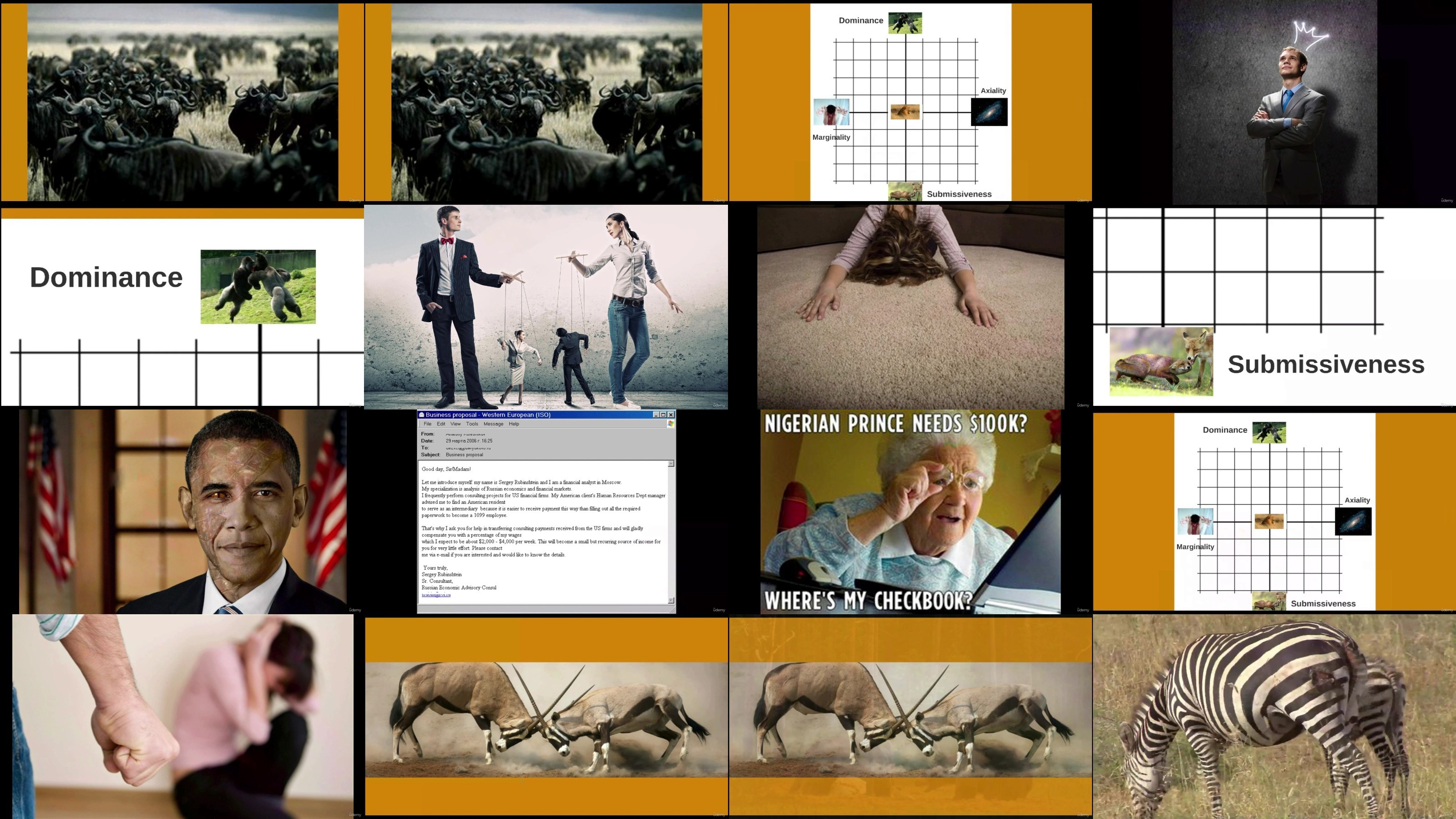
Lecture 8 Dominance vs Leadership

Section 3: our Genetic Programming

Lecture 9 Genetic Program

Lecture 10 Facing danger

Lecture 11 RSM - Relational Stress Management

Lecture 12 Avoid danger

Lecture 13 Avoid starvation

Lecture 14 Personalities

Lecture 15 Summary Genetic Programs

Section 4: Our prior experience

Lecture 16 Prior Experience

Lecture 17 The eye of the beholder (I)

Lecture 18 Extrinsic Motivations

Lecture 19 Managing the Neolimbic brain

Lecture 20 Engagement - ingredient 1

Lecture 21 Engagement - ingredient 2

Lecture 22 Instant gratification

Lecture 23 self evaluation

Lecture 24 Workaholism

Lecture 25 Summary Prior Experience

Section 5: Our Environment/context

Lecture 26 The importance of context

Lecture 27 Our team is not a sum of individuals

Lecture 28 1+1 = 1

Lecture 29 About authority

Lecture 30 The eyes of the beholder II

Lecture 31 Summary of context

Section 6: Conclusion

Lecture 32 A new model of leadership

Lecture 33 Thank you & Final request

Lecture 34 Certificate of Completion

Managers in charge of a team,Managers looking for tools and insights to manage their team,Professionals who want to improve on their people skills,Professionals who want to learn more about human behavior

LVHQFmaX_o.jpg

 
Zurück
Oben Unten