




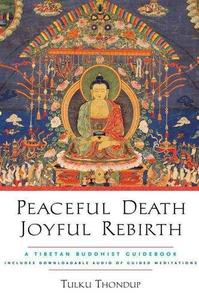
Free Download Peaceful Death, Joyful Rebirth: A Tibetan Buddhist Guidebook By Tulku Thondup, Harold Talbott
2012 | 317 Pages | ISBN: 159030182X | EPUB | 1 MB
Buddhism teaches that death can be a springboard to enlightenment-yet for all but the most advanced meditators, it will be the gateway to countless future lives of suffering in samsara. Tulku Thondup wrote this guide to help us heal our fear and confusion about death and strengthen our practice in anticipation of this transition, and to help us realize the enlightened goal of ultimate peace and joy-not only for death and rebirth, but for this very lifetime. In simple language, he distills a vast range of sources, including scriptures, classic commentaries, oral teachings, and firsthand accounts. The book includes: * An overview of the dying process, the after-death bardo states, and teachings on why, where, and how we take rebirth * Accounts by Tibetan "near-death experiencers" (delogs), who returned from death with amazing reports of their visions * Ways to train our minds during life, so that at death, all the phenomena before us will arise as a world of peace, joy, and enlightenment * Simple meditations, prayers, and rituals to benefit the dead and dying * Advice for caregivers, helpers, and survivors of the dyingThis edition includes an audio program providing guided instructions by the author on how to visualize Amitabha Buddha in the Pure Realm; how to receive his blessings; how to visualize transforming your body into light and sound at the time of death; how to share the blessings with compassion for all sentient beings; and how to rest in oneness. By becoming intimate with this practice while we're alive, we can alleviate our fear of death, improve our appreciation of this life, and prepare for death in a very practical way, while planting the seeds for rebirth in the Pure Land.From Publishers WeeklyHoping to "help us realize... ultimate peace and joy... for death and beyond," Thondup, a Tibetan-born teacher, translator and former visiting scholar at Harvard, offers a remarkably lucid distillation of Tibetan Buddhist teachings on how the state of our minds in life affects the nature and quality of our experiences in death. Thondup opens the book with a discussion of some fundamental Buddhist concepts such as impermanence, karma and the importance of meditation for altering our mental habits. He then deconstructs the actual experience of dying (the "crucial hour of life"), a process of distinct stages, including glimpsing the "true nature of the mind" and dwelling in the bardo, a transitional period before rebirth. He even includes lengthy reports of death experiences by delogs, devout Tibetan Buddhists resurrected from the dead for the purpose of explaining how to negotiate the bardo. Thondup rounds out the book with discussions of reincarnation and the importance of-and practical instructions for-performing rituals for the dead. While the teachings can become sophisticated, Thondup's great strength is his consistent focus on a thesis equally accessible to novices: how we train our minds in life will profoundly influence our "afterdeath" experiences. The result is a provocative and surprisingly compelling work that will appeal to beginners and advanced practitioners alike. Review"A remarkably lucid distillation of Tibetan Buddhist teachings on how the state of our minds in life affects the nature and quality of our experiences in death. The result is a provocative and surprisingly compelling work that will appeal to beginners and advanced practitioners alike."-Publishers Weekly"A healing treasure from Tulku Thondup: a clear, complete, and compassionate guidebook to the journey through life, dying, death, and beyond. Drawing on an extraordinary range of sources, including the Tibetan near-death experiences, he shows to what extent the quality of our life, death, and rebirth all depend upon the mind."-Sogyal Rinpoche, author of The Tibetan Book of Living and Dying"Tulku Thondup has opened this vast treasury of knowledge in a clear, simple, and powerful way for the modern audience."-Sakyong Mipham Rinpoche, author of Turning the Mind into an Ally"Tulku Thondup explains fully and clearly each stage of the process that leads from this life to the next. The book contains a valuable section devoted to the care and support of those who are approaching death, and includes a selection of meditations and rituals that may be used to help the dying and the dead, which will be of great benefit to many people. " -Francesca Fremantle, author of Luminous Emptiness: Understanding the Tibetan Book of the Dead. About the AuthorTulku Thondup Rinpoche, an esteemed author and teacher, was born in East Tibet and studied at the famed Dodrupchen Monastery. In 1958 he settled in India, where he taught at Indian universities for many years. He came to the United States in 1980 as a visiting scholar at Harvard University. For the past two decades he has lived in Cambridge, Massachusetts, engaging in translation and writing on Tibetan Buddhism, particularly the Nyingma teachings, under the auspices of the Buddhayana Foundation. Among his books are The Healing Power of Mind, which has been published in seventeen languages, and Boundless Healing, in twelve languages.
Links are Interchangeable - Single Extraction
