• Regeln für den Video-Bereich:

    In den Börsenbereich gehören nur Angebote die bereits den Allgemeinen Regeln entsprechen.

    Einteilung

    - Folgende Formate gehören in die angegeben Bereiche:
    - Filme: Encodierte Filme von BluRay, DVD, R5, TV, Screener sowie Telesyncs im Format DivX, XviD und x264.
    - DVD: Filme im Format DVD5, DVD9 und HD2DVD.
    - HD: Encodierte Filme mit der Auflösung 720p oder darüber von BluRay, DVD, R5, TV, Screener sowie Telesyncs im Format x264.
    - 3D: Encodierte Filme von BluRay, die in einem 3D Format vorliegen. Dies gilt auch für Dokus, Animation usw.
    - Serien: Cartoon/Zeichentrick, Anime, Tutorials, Dokumentationen, Konzerte/Musik, Sonstiges sind demnach in die entsprechenden Bereiche einzuordnen, auch wenn sie beispielsweise im High Definition-Format oder als DVD5/DVD9/HD2DVD vorliegen. Ausnahme 3D.
    - Bereich Englisch: Englische Releases gehören immer in diesen Bereich.
    - Bereich Talk: Der Bereich, in dem über die Releases diskutiert werden kann, darf, soll und erwünscht ist.


    Angebot/Beitrag erstellen

    - Ein Beitrag darf erst dann erstellt werden, wenn der Upload bei mindestens einem OCH komplett ist. Platzhalter sind untersagt.
    - Bei einem Scenerelease hat der Threadtitel ausschließlich aus dem originalen, unveränderten Releasenamen zu bestehen. Es dürfen keine Veränderungen wie z.B. Sterne, kleine Buchstaben o.ä. vorgenommen werden. Ausnahme Serienbörse:
    - Bei einem Sammelthread für eine Staffel entfällt aus dem Releasename natürlich der Name der Folge. Beispiel: Die Simpsons S21 German DVDRip XviD - ITG
    - Dementsprechend sind also u.a. verboten: Erweiterungen wie "Tipp", "empfehlenswert", "only", "reup", usw. / jegliche andere Zusatzinformation oder Ergänzung, welche nicht in obiger Beschreibung zu finden ist.

    Aufbau des Angebots und Threadtitel

    Der Titel nach folgendem Muster erstellt zu werden. <Name> [3D] [Staffel] [German] <Jahr> <Tonspur> [DL] [Auflösung] <Quelle> <Codec> - <Group>
    Beispiel: The Dark Knight German 2008 AC3 DVDRip XviD - iND
    Beispiel: The Dark Knight 2008 DTS DL BDRip x264 - iND
    Beispiel: The Dark Knight 2008 AC3 DL BDRip XviD - iND
    Beispiel: The Dark Knight German 2008 AC3 720p BluRay x264 iND
    Beispiel: The Dark Knight 2008 DTS DL 1080p BluRay x264 iND
    Beispiel: Die Simpsons S01 German AC3 DVDRip XviD iND
    Beispiel: Die Simpsons S20 German AC3 720p BluRay x264 iND
    Beispiel: Sword Art Online II Ger Sub 2014 AAC 1080p WEBRip x264 - peppermint
    Entsprechend sind also u.a. verboten: Sonderzeichen wie Klammern, Sterne, Ausrufezeichen, Unterstriche, Anführungszeichen / Erweiterungen wie "Tipp", "empfehlenswert", "only", "reup", usw. / jegliche andere Zusatzinformation oder Ergänzung, welche nicht in obiger Beschreibung zu finden ist
    Ausnahmen hiervon können in den Bereichen geregelt sein.

    Die Beiträge sollen wie folgt aufgebaut werden:
    Überschrift entspricht dem Threadtitel
    Cover
    kurze Inhaltsbeschreibung
    Format, Größe, Dauer sind gut lesbar für Downloader außerhalb des Spoilers zu vermerken
    Nfo sind immer Anzugeben und selbige immer im Spoiler in Textform.
    Sind keine Nfo vorhanden z.B. Eigenpublikationen, sind im Spoiler folgende Dateiinformationen zusätzlich anzugeben :
    Quelle
    Video (Auflösung und Bitrate)
    Ton (Sprache, Format und Bitrate der einzelnen Spuren)
    Untertitel (sofern vorhanden)
    Hosterangabe in Textform außerhalb eines Spoiler mit allen enthaltenen Hostern.
    Bei SD kann auf diese zusätzlichen Dateiinformationen verzichtet werden.

    Alle benötigten Passwörter sind, sofern vorhanden, in Textform im Angebot anzugeben.
    Spoiler im Spoiler mit Kommentaren :"Schon Bedankt?" sind unerwünscht.


    Releases

    - Sind Retail-Release verfügbar, sind alle anderen Variationen untersagt. Ausnahmen: Alle deutschen Retail-Release sind CUT, in diesem Fall sind dubbed UNCUT-Release zulässig.
    - Im Serien-Bereich gilt speziell: Wenn ein Retail vor Abschluss einer laufenden Staffel erscheint, darf diese Staffel noch zu Ende gebracht werden.62
    - Gleiche Releases sind unbedingt zusammenzufassen. Das bedeutet, es ist zwingend erforderlich, vor dem Erstellen eines Themas per Suchfunktion zu überprüfen, ob bereits ein Beitrag mit demselben Release besteht. Ist dies der Fall, ist der bereits vorhandene Beitrag zu verwenden.
    - P2P und Scene Releases dürfen nicht verändert oder gar unter einem iND Tag eingestellt werden.


    Support, Diskussionen und Suche

    - Supportanfragen sind entweder per PN oder im Bereich Talk zu stellen.
    - Diskussionen und Bewertungen sind im Talk Bereich zu führen. Fragen an die Uploader haben ausschließlich via PN zu erfolgen, und sind in den Angeboten untersagt.
    - Anfragen zu Upload-Wünschen sind nur im Bereich Suche Video erlaubt. Antworten dürfen nur auf Angebote von MyBoerse.bz verlinkt werden.


    Verbote

    - Untersagt sind mehrere Formate in einem einzigen Angebotsthread, wie beispielsweise das gleichzeitige Anbieten von DivX/XviD, 720p und 1080p in einem Thread. Pro Format, Release und Auflösung ist ein eigener Thread zu eröffnen.
    - Grundsätzlich ebenso verboten sind Dupes. Uploader haben sich an geeigneter Stelle darüber zu informieren, ob es sich bei einem Release um ein Dupe handelt.
    - Gefakte, nur teilweise lauffähige oder unvollständige Angebote sind untersagt. Dies gilt auch für eigene Publikationen, die augenscheinlich nicht selbst von z.B. einer DVD gerippt wurden. Laufende Serien, bei denen noch nicht alle Folgen verfügbar sind, dürfen erstellt und regelmäßig geupdatet werden.
    - Untersagt sind Angebote, welche nur und ausschließlich in einer anderen Sprache als deutsch oder englisch vorliegen. Ausnahmen sind VORHER mit den Moderatoren zu klären.


    Verstoß gegen die Regeln

    - Angebote oder Beiträge, die gegen die Forenregeln verstoßen, sind über den "Melden"-Button im Beitrag zu melden.
  • Bitte registriere dich zunächst um Beiträge zu verfassen und externe Links aufzurufen.

++ Premium IPTV ++ 7000 Live Sender ++ UHD Qualität ++ Mediathek mit 18.000 Inhalten ++


VenneTV


OpenAI Agents SDK Build Multi-Agent AI Systems in Python

babymore87

MyBoerse.bz Pro Member
8b4c558b0c2e17cc92c670b6800e5ef2.webp

Free Download OpenAI Agents SDK Build Multi-Agent AI Systems in Python
Published 8/2026
Created by Gopi Donthireddy
MP4 | Video: h264, 1920x1080 | Audio: AAC, 44.1 KHz, 2 Ch
Level: All Levels | Genre: eLearning | Language: English | Duration: 47 Lectures ( 9h 52m ) | Size: 5.4 GB
Build LLM agent tools, multi-agent orchestration, guardrails, streaming, and tracing, then ship a real capstone project

What you'll learn
⚡ Build and configure production-ready agents using the OpenAI Agents SDK in Python
⚡ Equip agents with function tools, hosted tools, and structured outputs to complete real tasks
⚡ Stream agent responses in real time and manage runs with RunConfig and context objects
⚡ Orchestrate multi-agent systems using handoffs, triage routing, and parallel execution
⚡ Protect agent pipelines with input and output guardrails that block invalid requests
⚡ Debug and monitor agents using built-in tracing, the OpenAI dashboard, and lifecycle hooks
⚡ Track token usage and cost across multi-agent runs to control spend in production
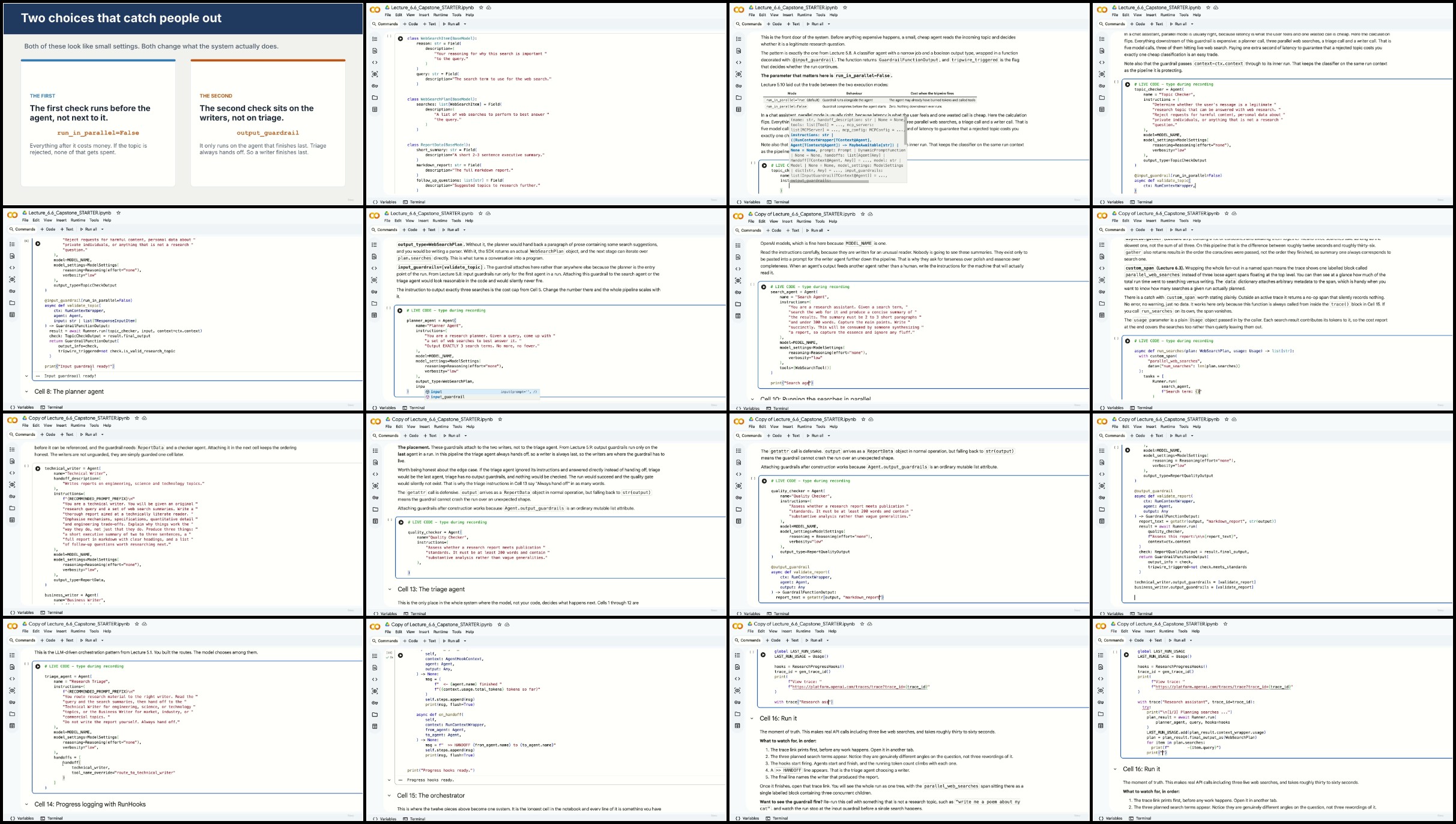
⚡ Build a complete multi-agent research assistant combining tools, handoffs, guardrails, and tracing
Requirements
❗ Basic Python. Comfortable with variables, functions, loops, and classes. No async/await experience required; it's introduced gradually as the course progresses.
❗ A free OpenAI platform account with API access. Usage is pay-as-you-go and billed separately from Udemy; the full course typically costs only a few dollars in API calls.
❗ A free Google account for Google Colab. Every notebook runs in the browser; no local Python install, IDE, or virtual environment needed.
❗ Any computer with a modern browser and internet connection. No powerful hardware or GPU required.
❗ No prior experience with AI agents, LLM frameworks, or the OpenAI API required. This course starts from your very first agent.
Description
Build Production-Ready AI Agents Using the OpenAI Agents SDK in Python
Most tutorials stop at a single agent calling a single tool. This course goes the other ninety percent of the way: multi-agent orchestration, guardrails, structured outputs, real-time streaming, and full observability, all in Python, all built on OpenAI's own official SDK.
You will start with your first agent and end by building a complete multi-agent research assistant, live, line by line, in the course capstone. Along the way you will learn how to equip agents with function tools and hosted tools, stream responses in real time, route conversations between specialist agents with handoffs and triage logic, protect your pipelines with input and output guardrails, and debug and monitor everything you build using the SDK's built-in tracing and the OpenAI dashboard.
Every lecture ships with a Google Colab notebook you run yourself. There is no local setup, no virtual environment, and no TypeScript; this course is Python only, from the SDK's own official Python interface.
Here is what you will be able to do by the end of this course
✨ Build and configure agents using the OpenAI Agents SDK, from your first agent through advanced configuration and structured outputs
✨ Equip agents with function tools, hosted tools, and multi-agent handoffs to complete real, multi-step tasks
✨ Stream agent responses in real time and manage runs with full control over configuration and context
✨ Orchestrate multi-agent systems using handoffs, triage routing, and parallel execution with asyncio
✨ Protect agent pipelines with input and output guardrails that block invalid requests before they cost you time or money
✨ Debug and monitor agents using the SDK's built-in tracing, the OpenAI dashboard, and lifecycle hooks
✨ Track token usage and cost across multi-agent runs, a skill most courses skip entirely
✨ Build a complete multi-agent research assistant from scratch, combining every concept from the course into one capstone project
If you are a Python developer ready to move past single API calls and start building agents that actually coordinate, this course will take you there.
Who this course is for
⭐ Python developers who want to move beyond single LLM API calls and build autonomous, tool-using agents
⭐ Backend or software engineers exploring agentic AI who want a structured, hands-on path instead of scattered tutorials
⭐ Developers already using the OpenAI API directly who want a framework that manages the agent loop, tool calls, and handoffs for them
⭐ AI or ML engineers moving from model training into agent orchestration, guardrails, and production observability
⭐ Anyone who has tried LangChain, CrewAI, or similar frameworks and wants to learn OpenAI's own first-party Python SDK instead
Homepage
Recommend Download Link Hight Speed | Please Say Thanks Keep Topic Live
No Password - Links are Interchangeable

 

36dc328478d1d5e005a5a316304770e1.jpg

OpenAI Agents SDK: Build Multi-Agent AI Systems in Python
.MP4, AVC, 1920x1080, 30 fps | English, AAC, 2 Ch | 9h 52m | 5.36 GB
Instructor: Gopi Donthireddy​

What you'll learn

  • Build and configure production-ready agents using the OpenAI Agents SDK in Python
  • Equip agents with function tools, hosted tools, and structured outputs to complete real tasks
  • Stream agent responses in real time and manage runs with RunConfig and context objects
  • Orchestrate multi-agent systems using handoffs, triage routing, and parallel execution
  • Protect agent pipelines with input and output guardrails that block invalid requests
  • Debug and monitor agents using built-in tracing, the OpenAI dashboard, and lifecycle hooks
  • Track token usage and cost across multi-agent runs to control spend in production
  • Build a complete multi-agent research assistant combining tools, handoffs, guardrails, and tracing

Requirements

  • Basic Python. Comfortable with variables, functions, loops, and classes. No async/await experience required; it's introduced gradually as the course progresses.
  • A free OpenAI platform account with API access. Usage is pay-as-you-go and billed separately from Udemy; the full course typically costs only a few dollars in API calls.
  • A free Google account for Google Colab. Every notebook runs in the browser; no local Python install, IDE, or virtual environment needed.
  • Any computer with a modern browser and internet connection. No powerful hardware or GPU required.
  • No prior experience with AI agents, LLM frameworks, or the OpenAI API required. This course starts from your very first agent.

Description

Build Production-Ready AI Agents Using the OpenAI Agents SDK in Python

Most tutorials stop at a single agent calling a single tool. This course goes the other ninety percent of the way: multi-agent orchestration, guardrails, structured outputs, real-time streaming, and full observability, all in Python, all built on OpenAI's own official SDK.

You will start with your first agent and end by building a complete multi-agent research assistant, live, line by line, in the course capstone. Along the way you will learn how to equip agents with function tools and hosted tools, stream responses in real time, route conversations between specialist agents with handoffs and triage logic, protect your pipelines with input and output guardrails, and debug and monitor everything you build using the SDK's built-in tracing and the OpenAI dashboard.

Every lecture ships with a Google Colab notebook you run yourself. There is no local setup, no virtual environment, and no TypeScript; this course is Python only, from the SDK's own official Python interface.

Here is what you will be able to do by the end of this course:

  • Build and configure agents using the OpenAI Agents SDK, from your first agent through advanced configuration and structured outputs
  • Equip agents with function tools, hosted tools, and multi-agent handoffs to complete real, multi-step tasks
  • Stream agent responses in real time and manage runs with full control over configuration and context
  • Orchestrate multi-agent systems using handoffs, triage routing, and parallel execution with asyncio
  • Protect agent pipelines with input and output guardrails that block invalid requests before they cost you time or money
  • Debug and monitor agents using the SDK's built-in tracing, the OpenAI dashboard, and lifecycle hooks
  • Track token usage and cost across multi-agent runs, a skill most courses skip entirely
  • Build a complete multi-agent research assistant from scratch, combining every concept from the course into one capstone project

If you are a Python developer ready to move past single API calls and start building agents that actually coordinate, this course will take you there.

Who this course is for:

  • Python developers who want to move beyond single LLM API calls and build autonomous, tool-using agents
  • Backend or software engineers exploring agentic AI who want a structured, hands-on path instead of scattered tutorials
  • Developers already using the OpenAI API directly who want a framework that manages the agent loop, tool calls, and handoffs for them
  • AI or ML engineers moving from model training into agent orchestration, guardrails, and production observability
  • Anyone who has tried LangChain, CrewAI, or similar frameworks and wants to learn OpenAI's own first-party Python SDK instead


47-CAPSTONE-Multi-agent-research-assistant.jpg

 
Zurück
Oben Unten