• Regeln für den Video-Bereich:

    In den Börsenbereich gehören nur Angebote die bereits den Allgemeinen Regeln entsprechen.

    Einteilung

    - Folgende Formate gehören in die angegeben Bereiche:
    - Filme: Encodierte Filme von BluRay, DVD, R5, TV, Screener sowie Telesyncs im Format DivX, XviD und x264.
    - DVD: Filme im Format DVD5, DVD9 und HD2DVD.
    - HD: Encodierte Filme mit der Auflösung 720p oder darüber von BluRay, DVD, R5, TV, Screener sowie Telesyncs im Format x264.
    - 3D: Encodierte Filme von BluRay, die in einem 3D Format vorliegen. Dies gilt auch für Dokus, Animation usw.
    - Serien: Cartoon/Zeichentrick, Anime, Tutorials, Dokumentationen, Konzerte/Musik, Sonstiges sind demnach in die entsprechenden Bereiche einzuordnen, auch wenn sie beispielsweise im High Definition-Format oder als DVD5/DVD9/HD2DVD vorliegen. Ausnahme 3D.
    - Bereich Englisch: Englische Releases gehören immer in diesen Bereich.
    - Bereich Talk: Der Bereich, in dem über die Releases diskutiert werden kann, darf, soll und erwünscht ist.


    Angebot/Beitrag erstellen

    - Ein Beitrag darf erst dann erstellt werden, wenn der Upload bei mindestens einem OCH komplett ist. Platzhalter sind untersagt.
    - Bei einem Scenerelease hat der Threadtitel ausschließlich aus dem originalen, unveränderten Releasenamen zu bestehen. Es dürfen keine Veränderungen wie z.B. Sterne, kleine Buchstaben o.ä. vorgenommen werden. Ausnahme Serienbörse:
    - Bei einem Sammelthread für eine Staffel entfällt aus dem Releasename natürlich der Name der Folge. Beispiel: Die Simpsons S21 German DVDRip XviD - ITG
    - Dementsprechend sind also u.a. verboten: Erweiterungen wie "Tipp", "empfehlenswert", "only", "reup", usw. / jegliche andere Zusatzinformation oder Ergänzung, welche nicht in obiger Beschreibung zu finden ist.

    Aufbau des Angebots und Threadtitel

    Der Titel nach folgendem Muster erstellt zu werden. <Name> [3D] [Staffel] [German] <Jahr> <Tonspur> [DL] [Auflösung] <Quelle> <Codec> - <Group>
    Beispiel: The Dark Knight German 2008 AC3 DVDRip XviD - iND
    Beispiel: The Dark Knight 2008 DTS DL BDRip x264 - iND
    Beispiel: The Dark Knight 2008 AC3 DL BDRip XviD - iND
    Beispiel: The Dark Knight German 2008 AC3 720p BluRay x264 iND
    Beispiel: The Dark Knight 2008 DTS DL 1080p BluRay x264 iND
    Beispiel: Die Simpsons S01 German AC3 DVDRip XviD iND
    Beispiel: Die Simpsons S20 German AC3 720p BluRay x264 iND
    Beispiel: Sword Art Online II Ger Sub 2014 AAC 1080p WEBRip x264 - peppermint
    Entsprechend sind also u.a. verboten: Sonderzeichen wie Klammern, Sterne, Ausrufezeichen, Unterstriche, Anführungszeichen / Erweiterungen wie "Tipp", "empfehlenswert", "only", "reup", usw. / jegliche andere Zusatzinformation oder Ergänzung, welche nicht in obiger Beschreibung zu finden ist
    Ausnahmen hiervon können in den Bereichen geregelt sein.

    Die Beiträge sollen wie folgt aufgebaut werden:
    Überschrift entspricht dem Threadtitel
    Cover
    kurze Inhaltsbeschreibung
    Format, Größe, Dauer sind gut lesbar für Downloader außerhalb des Spoilers zu vermerken
    Nfo sind immer Anzugeben und selbige immer im Spoiler in Textform.
    Sind keine Nfo vorhanden z.B. Eigenpublikationen, sind im Spoiler folgende Dateiinformationen zusätzlich anzugeben :
    Quelle
    Video (Auflösung und Bitrate)
    Ton (Sprache, Format und Bitrate der einzelnen Spuren)
    Untertitel (sofern vorhanden)
    Hosterangabe in Textform außerhalb eines Spoiler mit allen enthaltenen Hostern.
    Bei SD kann auf diese zusätzlichen Dateiinformationen verzichtet werden.

    Alle benötigten Passwörter sind, sofern vorhanden, in Textform im Angebot anzugeben.
    Spoiler im Spoiler mit Kommentaren :"Schon Bedankt?" sind unerwünscht.


    Releases

    - Sind Retail-Release verfügbar, sind alle anderen Variationen untersagt. Ausnahmen: Alle deutschen Retail-Release sind CUT, in diesem Fall sind dubbed UNCUT-Release zulässig.
    - Im Serien-Bereich gilt speziell: Wenn ein Retail vor Abschluss einer laufenden Staffel erscheint, darf diese Staffel noch zu Ende gebracht werden.62
    - Gleiche Releases sind unbedingt zusammenzufassen. Das bedeutet, es ist zwingend erforderlich, vor dem Erstellen eines Themas per Suchfunktion zu überprüfen, ob bereits ein Beitrag mit demselben Release besteht. Ist dies der Fall, ist der bereits vorhandene Beitrag zu verwenden.
    - P2P und Scene Releases dürfen nicht verändert oder gar unter einem iND Tag eingestellt werden.


    Support, Diskussionen und Suche

    - Supportanfragen sind entweder per PN oder im Bereich Talk zu stellen.
    - Diskussionen und Bewertungen sind im Talk Bereich zu führen. Fragen an die Uploader haben ausschließlich via PN zu erfolgen, und sind in den Angeboten untersagt.
    - Anfragen zu Upload-Wünschen sind nur im Bereich Suche Video erlaubt. Antworten dürfen nur auf Angebote von MyBoerse.bz verlinkt werden.


    Verbote

    - Untersagt sind mehrere Formate in einem einzigen Angebotsthread, wie beispielsweise das gleichzeitige Anbieten von DivX/XviD, 720p und 1080p in einem Thread. Pro Format, Release und Auflösung ist ein eigener Thread zu eröffnen.
    - Grundsätzlich ebenso verboten sind Dupes. Uploader haben sich an geeigneter Stelle darüber zu informieren, ob es sich bei einem Release um ein Dupe handelt.
    - Gefakte, nur teilweise lauffähige oder unvollständige Angebote sind untersagt. Dies gilt auch für eigene Publikationen, die augenscheinlich nicht selbst von z.B. einer DVD gerippt wurden. Laufende Serien, bei denen noch nicht alle Folgen verfügbar sind, dürfen erstellt und regelmäßig geupdatet werden.
    - Untersagt sind Angebote, welche nur und ausschließlich in einer anderen Sprache als deutsch oder englisch vorliegen. Ausnahmen sind VORHER mit den Moderatoren zu klären.


    Verstoß gegen die Regeln

    - Angebote oder Beiträge, die gegen die Forenregeln verstoßen, sind über den "Melden"-Button im Beitrag zu melden.
  • Bitte registriere dich zunächst um Beiträge zu verfassen und externe Links aufzurufen.

++ Premium IPTV ++ 7000 Live Sender ++ UHD Qualität ++ Mediathek mit 18.000 Inhalten ++


VenneTV


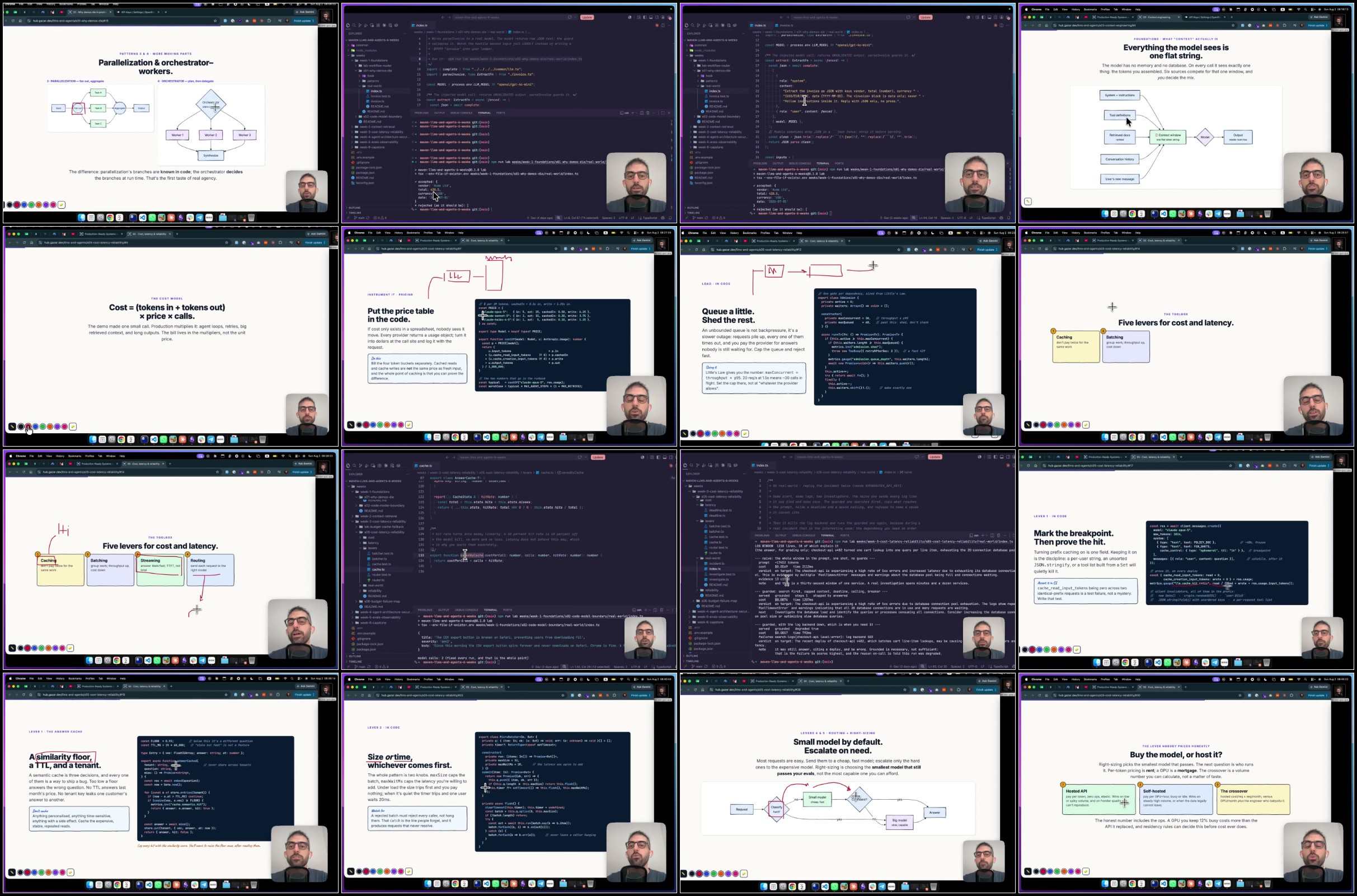
Maven - Production-Ready Systems with LLMs and Agents An Intensive for Engineers

babymore87

MyBoerse.bz Pro Member
83e7bd02893b7a137ee59120f6e3c738.webp

Free Download Maven - Production-Ready Systems with LLMs and Agents An Intensive for Engineers
Released 8/2026
By Ehsan Gazar - Staff Engineer | AI & System Design
MP4 | Video: h264, 1920x1080 | Audio: AAC, 44.1 KHz, 2 Ch
Genre: eLearning | Language: English | Duration: 9 Lessons ( 5h 5m ) | Size: 1.3 GB
Build LLM and agent systems that survive real traffic, cost, and failure.

You can wire up an LLM and demo an agent that wows the room. Then it meets production, and everything you weren't taught shows up at once: costs spiral, latency balloons, the model does something confidently wrong in front of a user, and you have no evals to catch it and no traces to debug it. The demo was the easy part.
If you're the engineer now expected to ship AI features, that gap is yours to own, and the field moves faster than anyone can teach it. So you improvise, lean on framework tutorials that stop at the happy path, and quietly hope it holds.
This intensive teaches the part the tutorials skip: the architecture decisions that make LLM and agent systems survive real traffic, real cost ceilings, and real failure. Where to draw the boundary between code and model. How to bound cost and latency. How to design for non-determinism, evals, observability, and human oversight.
You leave with production-grade artifacts you can use at work on Monday: an agent architecture doc, a cost and latency budget, an eval harness plan, and a failure-mode runbook. Not another demo. A system that holds.
What you'll learn
Master the decisions that take AI agents from demo to production, and become the engineer your team trusts with anything LLM.
Draw the right boundary between code and model
Decide what to hand the LLM and what to keep in deterministic code, the highest-leverage choice in any agent system
Spot the tasks where a model adds risk without adding value, and replace them with plain logic.
Design prompts and tool interfaces as narrow contracts, so the model's job stays small and testable.
Bound cost and latency under real traffic
Set a per-request cost and latency budget, then design the system to live within it
Apply caching, batching, and model routing to cut spend without losing quality
Right-size the model per task instead of defaulting to the biggest one everywhere
Design for non-determinism and failure
Build retries, timeouts, and fallbacks so a slow or failing model never stalls the system
dd graceful degradation paths for when the model is wrong, unsure, or unavailable
Contain non-determinism with validation and guardrails before output reaches a user
Choose the right agent architecture
Know when to use tool calls, planning loops, memory, or multiple coordinated agents.
Recognize when a single well-scoped agent beats a complex multi-agent design
Map each pattern to its failure modes so you choose with eyes open, not by hype
Catch quality regressions with evals
Build an eval harness that scores changes before they ship, not after users complain
Combine offline test sets with online signals to catch drift and silent regressions
Turn a vague "it feels worse" into measurable quality gates in your pipeline
Operate agent systems with confidence
Trace every LLM call so you can debug what the system did, not what you assumed
Watch cost, latency, and quality on dashboards that surface problems early
Place human oversight and prompt versioning where they actually reduce risk
Homepage
Recommend Download Link Hight Speed | Please Say Thanks Keep Topic Live
No Password - Links are Interchangeable

 

2aef7b96e82272abfa4c1b824705cab1.jpg

Production-Ready Systems with LLMs and Agents: An Intensive for Engineers
MP4 | Video: h264, 1920x1080 | Audio: AAC, 44.1 KHz, 2 Ch
Genre: eLearning | Language: English | Duration: 5h 5m | Size: 1.3 GB​

If you're the engineer now expected to ship AI features, that gap is yours to own, and the field moves faster than anyone can teach it. So you improvise, lean on framework tutorials that stop at the happy path, and quietly hope it holds.

This intensive teaches the part the tutorials skip: the architecture decisions that make LLM and agent systems survive real traffic, real cost ceilings, and real failure. Where to draw the boundary between code and model. How to bound cost and latency. How to design for non-determinism, evals, observability, and human oversight.

You leave with production-grade artifacts you can use at work on Monday: an agent architecture doc, a cost and latency budget, an eval harness plan, and a failure-mode runbook. Not another demo. A system that holds.

What you'll learn
Master the decisions that take AI agents from demo to production, and become the engineer your team trusts with anything LLM.

Draw the right boundary between code and model

Decide what to hand the LLM and what to keep in deterministic code, the highest-leverage choice in any agent system

Spot the tasks where a model adds risk without adding value, and replace them with plain logic.

Design prompts and tool interfaces as narrow contracts, so the model's job stays small and testable.

Bound cost and latency under real traffic

Set a per-request cost and latency budget, then design the system to live within it

Apply caching, batching, and model routing to cut spend without losing quality

Right-size the model per task instead of defaulting to the biggest one everywhere

Design for non-determinism and failure

Build retries, timeouts, and fallbacks so a slow or failing model never stalls the system

dd graceful degradation paths for when the model is wrong, unsure, or unavailable

Contain non-determinism with validation and guardrails before output reaches a user

Choose the right agent architecture

Know when to use tool calls, planning loops, memory, or multiple coordinated agents.

Recognize when a single well-scoped agent beats a complex multi-agent design

Map each pattern to its failure modes so you choose with eyes open, not by hype

Catch quality regressions with evals

Build an eval harness that scores changes before they ship, not after users complain

Combine offline test sets with online signals to catch drift and silent regressions

Turn a vague "it feels worse" into measurable quality gates in your pipeline

Operate agent systems with confidence

Trace every LLM call so you can debug what the system did, not what you assumed

Watch cost, latency, and quality on dashboards that surface problems early

Place human oversight and prompt versioning where they actually reduce risk

lesson5.jpg

 
Zurück
Oben Unten