• Regeln für den Video-Bereich:

    In den Börsenbereich gehören nur Angebote die bereits den Allgemeinen Regeln entsprechen.

    Einteilung

    - Folgende Formate gehören in die angegeben Bereiche:
    - Filme: Encodierte Filme von BluRay, DVD, R5, TV, Screener sowie Telesyncs im Format DivX, XviD und x264.
    - DVD: Filme im Format DVD5, DVD9 und HD2DVD.
    - HD: Encodierte Filme mit der Auflösung 720p oder darüber von BluRay, DVD, R5, TV, Screener sowie Telesyncs im Format x264.
    - 3D: Encodierte Filme von BluRay, die in einem 3D Format vorliegen. Dies gilt auch für Dokus, Animation usw.
    - Serien: Cartoon/Zeichentrick, Anime, Tutorials, Dokumentationen, Konzerte/Musik, Sonstiges sind demnach in die entsprechenden Bereiche einzuordnen, auch wenn sie beispielsweise im High Definition-Format oder als DVD5/DVD9/HD2DVD vorliegen. Ausnahme 3D.
    - Bereich Englisch: Englische Releases gehören immer in diesen Bereich.
    - Bereich Talk: Der Bereich, in dem über die Releases diskutiert werden kann, darf, soll und erwünscht ist.


    Angebot/Beitrag erstellen

    - Ein Beitrag darf erst dann erstellt werden, wenn der Upload bei mindestens einem OCH komplett ist. Platzhalter sind untersagt.
    - Bei einem Scenerelease hat der Threadtitel ausschließlich aus dem originalen, unveränderten Releasenamen zu bestehen. Es dürfen keine Veränderungen wie z.B. Sterne, kleine Buchstaben o.ä. vorgenommen werden. Ausnahme Serienbörse:
    - Bei einem Sammelthread für eine Staffel entfällt aus dem Releasename natürlich der Name der Folge. Beispiel: Die Simpsons S21 German DVDRip XviD - ITG
    - Dementsprechend sind also u.a. verboten: Erweiterungen wie "Tipp", "empfehlenswert", "only", "reup", usw. / jegliche andere Zusatzinformation oder Ergänzung, welche nicht in obiger Beschreibung zu finden ist.

    Aufbau des Angebots und Threadtitel

    Der Titel nach folgendem Muster erstellt zu werden. <Name> [3D] [Staffel] [German] <Jahr> <Tonspur> [DL] [Auflösung] <Quelle> <Codec> - <Group>
    Beispiel: The Dark Knight German 2008 AC3 DVDRip XviD - iND
    Beispiel: The Dark Knight 2008 DTS DL BDRip x264 - iND
    Beispiel: The Dark Knight 2008 AC3 DL BDRip XviD - iND
    Beispiel: The Dark Knight German 2008 AC3 720p BluRay x264 iND
    Beispiel: The Dark Knight 2008 DTS DL 1080p BluRay x264 iND
    Beispiel: Die Simpsons S01 German AC3 DVDRip XviD iND
    Beispiel: Die Simpsons S20 German AC3 720p BluRay x264 iND
    Beispiel: Sword Art Online II Ger Sub 2014 AAC 1080p WEBRip x264 - peppermint
    Entsprechend sind also u.a. verboten: Sonderzeichen wie Klammern, Sterne, Ausrufezeichen, Unterstriche, Anführungszeichen / Erweiterungen wie "Tipp", "empfehlenswert", "only", "reup", usw. / jegliche andere Zusatzinformation oder Ergänzung, welche nicht in obiger Beschreibung zu finden ist
    Ausnahmen hiervon können in den Bereichen geregelt sein.

    Die Beiträge sollen wie folgt aufgebaut werden:
    Überschrift entspricht dem Threadtitel
    Cover
    kurze Inhaltsbeschreibung
    Format, Größe, Dauer sind gut lesbar für Downloader außerhalb des Spoilers zu vermerken
    Nfo sind immer Anzugeben und selbige immer im Spoiler in Textform.
    Sind keine Nfo vorhanden z.B. Eigenpublikationen, sind im Spoiler folgende Dateiinformationen zusätzlich anzugeben :
    Quelle
    Video (Auflösung und Bitrate)
    Ton (Sprache, Format und Bitrate der einzelnen Spuren)
    Untertitel (sofern vorhanden)
    Hosterangabe in Textform außerhalb eines Spoiler mit allen enthaltenen Hostern.
    Bei SD kann auf diese zusätzlichen Dateiinformationen verzichtet werden.

    Alle benötigten Passwörter sind, sofern vorhanden, in Textform im Angebot anzugeben.
    Spoiler im Spoiler mit Kommentaren :"Schon Bedankt?" sind unerwünscht.


    Releases

    - Sind Retail-Release verfügbar, sind alle anderen Variationen untersagt. Ausnahmen: Alle deutschen Retail-Release sind CUT, in diesem Fall sind dubbed UNCUT-Release zulässig.
    - Im Serien-Bereich gilt speziell: Wenn ein Retail vor Abschluss einer laufenden Staffel erscheint, darf diese Staffel noch zu Ende gebracht werden.62
    - Gleiche Releases sind unbedingt zusammenzufassen. Das bedeutet, es ist zwingend erforderlich, vor dem Erstellen eines Themas per Suchfunktion zu überprüfen, ob bereits ein Beitrag mit demselben Release besteht. Ist dies der Fall, ist der bereits vorhandene Beitrag zu verwenden.
    - P2P und Scene Releases dürfen nicht verändert oder gar unter einem iND Tag eingestellt werden.


    Support, Diskussionen und Suche

    - Supportanfragen sind entweder per PN oder im Bereich Talk zu stellen.
    - Diskussionen und Bewertungen sind im Talk Bereich zu führen. Fragen an die Uploader haben ausschließlich via PN zu erfolgen, und sind in den Angeboten untersagt.
    - Anfragen zu Upload-Wünschen sind nur im Bereich Suche Video erlaubt. Antworten dürfen nur auf Angebote von MyBoerse.bz verlinkt werden.


    Verbote

    - Untersagt sind mehrere Formate in einem einzigen Angebotsthread, wie beispielsweise das gleichzeitige Anbieten von DivX/XviD, 720p und 1080p in einem Thread. Pro Format, Release und Auflösung ist ein eigener Thread zu eröffnen.
    - Grundsätzlich ebenso verboten sind Dupes. Uploader haben sich an geeigneter Stelle darüber zu informieren, ob es sich bei einem Release um ein Dupe handelt.
    - Gefakte, nur teilweise lauffähige oder unvollständige Angebote sind untersagt. Dies gilt auch für eigene Publikationen, die augenscheinlich nicht selbst von z.B. einer DVD gerippt wurden. Laufende Serien, bei denen noch nicht alle Folgen verfügbar sind, dürfen erstellt und regelmäßig geupdatet werden.
    - Untersagt sind Angebote, welche nur und ausschließlich in einer anderen Sprache als deutsch oder englisch vorliegen. Ausnahmen sind VORHER mit den Moderatoren zu klären.


    Verstoß gegen die Regeln

    - Angebote oder Beiträge, die gegen die Forenregeln verstoßen, sind über den "Melden"-Button im Beitrag zu melden.
  • Bitte registriere dich zunächst um Beiträge zu verfassen und externe Links aufzurufen.

++ Premium IPTV ++ 7000 Live Sender ++ UHD Qualität ++ Mediathek mit 18.000 Inhalten ++


VenneTV


LLM Engineering Prompting, RAG, Fine-Tuning, and RLHF

babymore87

MyBoerse.bz Pro Member
7282e848f6c6b34028c5738329f8aeb1.webp

Free Download LLM Engineering Prompting, RAG, Fine-Tuning, and RLHF
Published 8/2026
MP4 | Video: h264, 1920x1080 | Audio: AAC, 44.1 KHz, 2 Ch
Language: English | Duration: 5h 32m | Size: 6.3 GB
Build Production LLM Systems: prompt engineering, RAG pipelines, PEFT fine-tuning (LoRA), and RLHF (DPO/PPO) alignment.

What you'll learn
Design advanced prompts-zero-shot, few-shot, and chain-of-thought reasoning-that reliably produce high-quality, structured outputs at scale.
Architect and build complete RAG systems-covering ingestion, retrieval, and synthesis-then evaluate them rigorously for accuracy and grounding.
Fine-tune base models into specialized assistants using parameter-efficient methods like LoRA, QLoRA, rsLoRA, and LoRA-FA.
Align LLM behavior to human preferences using the full RLHF workflow and algorithms including PPO, DPO, and GRPO.
Combine prompting, retrieval, fine-tuning, and alignment into an end-to-end, production-ready LLM system.
Requirements
Understanding of Transformers & LLMs: Familiarity with neural networks, attention, and how LLMs are trained and generate text (Course 1 or equivalent knowledge).
Intermediate Python: Comfort reading and writing functions, loops, and basic data structures (code is explained step-by-step, but you should be comfortable reading Python).
Basic ML Intuition: Comfort with vectors, embeddings, and core training concepts like loss and gradients (all key ideas are refreshed intuitively throughout the course).
Description
Move beyond calling models to engineering them-master prompting, retrieval-augmented generation, parameter-efficient fine-tuning, and preference alignment to build production-grade LLM systems.
Agentic AI Mastery: Your 3-Stage Complete Learning Path
- Course 1: Large Language Models: From Foundations to Transformers
-Course 2: LLM Engineering: Prompting, RAG, Fine-Tuning, and RLHF
- Course 3: Agentic AI Engineering: Multimodal, MLOps & Agents
New to the series? Start with Course 1 to build your core baseline in deep learning, NLP, embedding spaces, vector search, transformer architectures, decoding methods, and LLMs.
Already comfortable with these foundations? You are in the right place. This course turns that theoretical foundation into practical engineering skills. Upon completing this course, you will be fully prepared for Course 3: Agentic AI Engineering: Multimodal, MLOps & Agents.
Why This Course
Most AI courses stop at "here's how to call an API", leaving you stuck when outputs are unreliable, knowledge is outdated, or a general-purpose model doesn't fit your domain. This course takes a different path.
We bridge the gap between knowing how models work and building systems that work in production. You'll master the four techniques that separate AI engineers from API users, prompt engineering, RAG, supervised fine-tuning, and alignment, working ground-up from core principles so your skills stay relevant as tools and frameworks evolve.
Course Modules
Module 1: Large Language Models (Review from Course 1)
Refresh and solidify the LLM foundations that everything else builds on. This module revisits how modern LLMs generate text-scaling laws, pre-training, SFT, and preference alignment-and takes you hands-on with decoding strategies and hallucination inspection, ensuring you're ready to engineer these models rather than just use them.
Module 2: Prompt Engineering
Master the craft of communicating with LLMs. Move from prompting fundamentals through proven engineering techniques to advanced strategies, learning to design prompts that consistently produce high-quality, reliable outputs across any application.
Module 3: Retrieval-Augmented Generation (RAG)
Build AI systems that combine LLMs with external knowledge. Walk through every stage of the RAG pipeline-ingestion, retrieval, and synthesis-then learn to rigorously evaluate your system, enabling responses that are accurate, up-to-date, and verifiable.
Module 4: Supervised Fine-Tuning (SFT)
Transform general-purpose models into specialized experts. Explore the limits of in-context learning, the fundamentals of fine-tuning, and efficient methods like LoRA and QLoRA (PEFT)-mastering datasets and training dynamics to adapt models to your domain without massive compute.
Module 5: Reinforcement Learning from Human Feedback (RLHF)
Shape model behavior to match human preferences. Understand why alignment matters, the reinforcement learning fundamentals behind it, and the full RLHF workflow-including PPO, DPO, and GRPO alignment algorithms.
This Course Features
-33 Bite-Sized FHD Video Lessons: Clear, structured lectures breaking down prompting, RAG, fine-tuning, and alignment across 5 comprehensive modules.
-5 Hands-on Coding Labs (Industry-Inspired Mini-Projects): Implement decoding inspection, prompt engineering pipelines, RAG systems, parameter-efficient fine-tuning, and preference alignment using industry-standard tools.
-5 Deep Dive Audio Podcasts: Reinforce every module's concepts on the go with custom podcast discussions.
-Industry-Standard Tools & Ecosystem: Hands-on experience with production-grade frameworks and libraries used to build, retrieve, fine-tune, and align real LLM systems.
-Intuitive Visual Diagrams: Complex mechanics, like RAG pipelines, LoRA/QLoRA/LoRA-FA/rsLoRA, the RLHF workflow, and PPO vs. DPO vs. GRPO, explained through clean visual architecture diagrams.
-5 MCQ Quizzes: Evaluate your knowledge and understanding at the end of every module.
-3-Part Series Progression: The essential middle stage connecting the foundations of Course 1 to the advanced agentic engineering in Course 3.
Who this course is for
Software Engineers & Developers ready to move from calling LLM APIs to architecting reliable, production-grade LLM systems.
Data Scientists & ML Practitioners who understand model basics and want practical skills in RAG, fine-tuning, and alignment.
Computer Science Students & Tech Professionals seeking the engineering patterns used by leading AI teams to customize and deploy language models.
Prerequisites
Understanding of Transformers & LLMs: Familiarity with neural networks, attention, and how LLMs are trained and generate text (Course 1 or equivalent knowledge).
Intermediate Python: Comfort reading and writing functions, loops, and basic data structures (code is explained step-by-step).
Basic ML Intuition: Comfort with vectors, embeddings, and core training concepts (all key ideas are refreshed intuitively throughout the course).
New to transformers and LLMs? We recommend starting with Course 1: Large Language Models: From Foundations to Transformers.
What You'll Master
Design advanced prompts, zero-shot, few-shot, and chain-of-thought reasoning, that reliably produce high-quality outputs.
Architect and build complete RAG systems, from ingestion and retrieval to synthesis, then evaluate them rigorously.
Fine-tune models efficiently for specific domains using parameter-efficient methods like LoRA, rsLoRA, LoRA-FA and QLoRA.
Align model behavior to human preferences using the RLHF workflow, PPO, DPO, and GRPO.
Combine prompting, retrieval, fine-tuning, and alignment into optimized, production-ready LLM solutions.
Join us for the practical core of the Agentic AI Mastery series and build the engineering skills that turn general-purpose models into powerful, specialized systems.
Module 1: Large Language Models (Review - Module 5 from Course 1)
Video Lessons
- Lesson 1.1: Language Models - From N-grams to Neural
- Lesson 1.2: Scaling Laws and the Discovery of LLMs
- Lesson 1.3: How LLMs Learn: Pre-training, SFT, and Preference Alignment
- Lesson 1.4: Decoding Strategies for Text Generation
- Lesson 1.5: Current Limitations and Challenges
- Lesson 1.6: Preview of LLM Engineering Techniques
Resources
Module 1 summary notes
- Quiz 1
- Lab 1 - Text Generation: Decoding, Creativity & Hallucination
- Lab 1 (Deep Dive Podcast)
Module 2: Prompt Engineering
Video Lessons
- Lesson 2.1: Fundamentals of Prompting
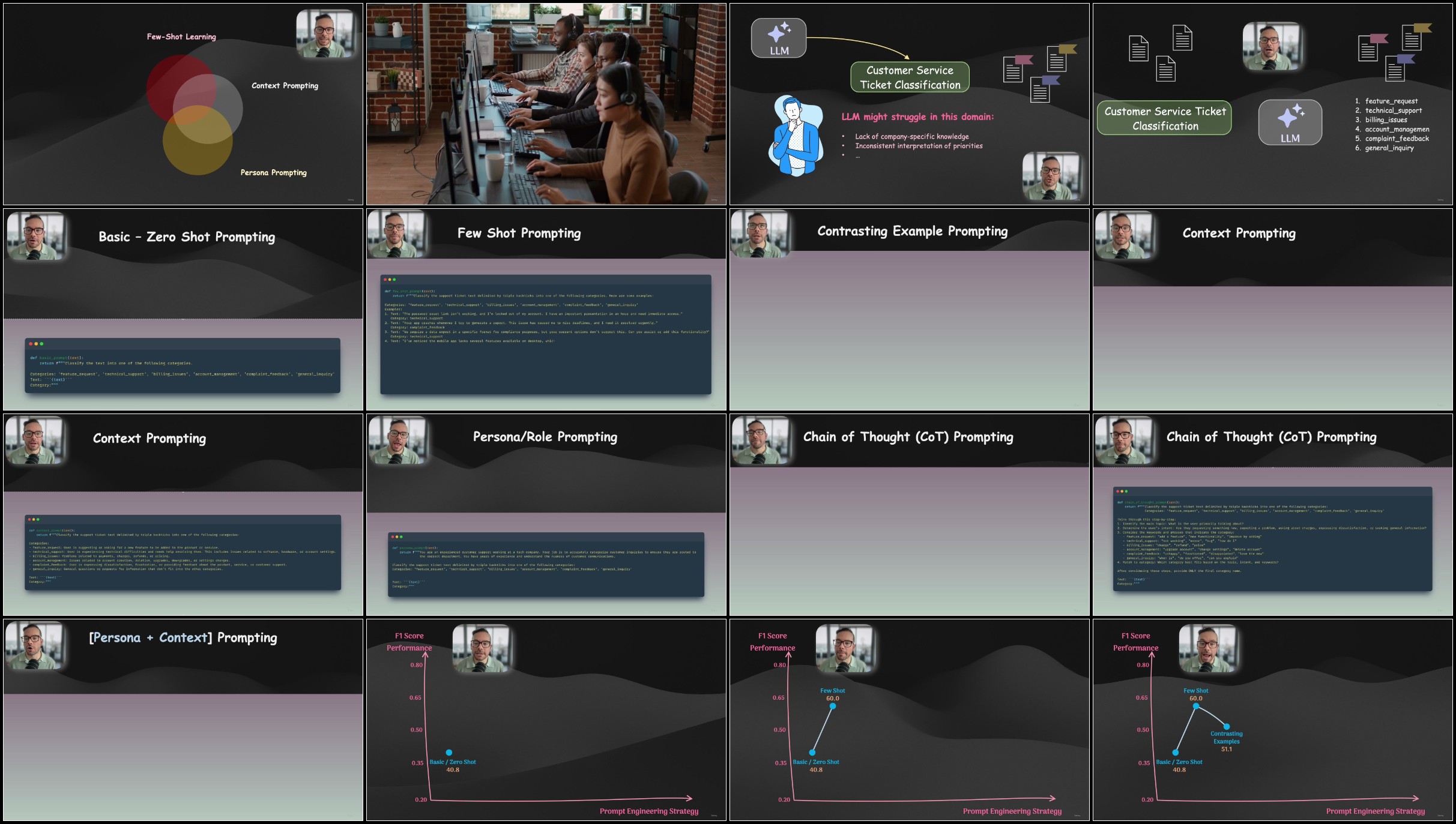
- Lesson 2.2: Prompt Engineering Techniques
- Lesson 2.3: Advanced Techniques
- Lesson 2.4: Lab Overview
Resources
- Module 2 summary notes
- Quiz 2
- Lab 2 - Prompt Engineering: Building a Complaint Router (Instructing LLMs at Scale)
- Lab 2 (Deep Dive Podcast)
Module 3: Retrieval-Augmented Generation (RAG)
Video Lessons
- Lesson 3.1: Significance of RAG
- Lesson 3.2: RAG Pipeline
- Lesson 3.3: Stage 1 - Ingestion
- Lesson 3.4: Stage 2 - Retrieval
- Lesson 3.5: Stage 3 - Synthesis
- Lesson 3.6: RAG Evaluation
- Lesson 3.7: Lab Overview
Resources
- Module 3 summary notes
- Quiz 3
- Lab 3 - RAG: Building a Medical Q&A Engine (Grounding the Answer)
- Lab 3 (Deep Dive Podcast)
Module 4: Supervised Fine-Tuning (SFT)
Video Lessons
- Lesson 4.1: The Limits of In-Context Learning
- Lesson 4.2: Fundamentals of Fine-Tuning
- Lesson 4.3: Efficient Fine-Tuning with PEFT (LoRA, rsLoRA, LoRA-FA & QLoRA)
- Lesson 4.4: SFT Datasets and Training Dynamics
- Lesson 4.5: Lab Overview
Resources
- Module 4 summary notes
- Quiz 4
- Lab 4 - SFT: Turning a Base Model into an Assistant (Teaching Behavior)
- Lab 4 (Deep Dive Podcast)
Module 5: Reinforcement Learning from Human Feedback (RLHF)
Video Lessons
- Lesson 5.1: Why RLHF?
- Lesson 5.2: Fundamentals of Reinforcement Learning
- Lesson 5.3: RLHF Workflow
- Lesson 5.4: Alignment Algorithms (PPO, DPO, GRPO)
- Lesson 5.5: Lab Overview
Resources
- Module 5 summary notes
- Quiz 5
- Lab 5 - RLHF: Aligning an LLM for Safety (Aligning the Values)
- Lab 5 (Deep Dive Podcast)
Who this course is for
Software Engineers & Developers wanting to transition from standard application development to AI/LLM engineering.
Data Scientists & ML Beginners looking to move past traditional scikit-learn pipelines into modern Transformer architectures.
Computer Science Students & Tech Professionals who want a deep, principled understanding of how LLMs work under the hood rather than just calling third-party APIs.
Homepage

Recommend Download Link Hight Speed | Please Say Thanks Keep Topic Live
No Password - Links are Interchangeable

 

c39a61a5cc250bce13dca16a32c18b5c.jpg

LLM Engineering: Prompting, RAG, Fine-Tuning, and RLHF
MP4 | Video: h264, 1920x1080 | Audio: AAC, 44.1 KHz, 2 Ch
Language: English | Duration: 5h 32m | Size: 6.3 GB​

Move beyond calling models to engineering them-master prompting, retrieval-augmented generation, parameter-efficient fine-tuning, and preference alignment to build production-grade LLM systems.

Agentic AI Mastery: Your 3-Stage Complete Learning Path
- Course 1: Large Language Models: From Foundations to Transformers

-Course 2: LLM Engineering: Prompting, RAG, Fine-Tuning, and RLHF

- Course 3: Agentic AI Engineering: Multimodal, MLOps & Agents

New to the series? Start with Course 1 to build your core baseline in deep learning, NLP, embedding spaces, vector search, transformer architectures, decoding methods, and LLMs.

Already comfortable with these foundations? You are in the right place. This course turns that theoretical foundation into practical engineering skills. Upon completing this course, you will be fully prepared for Course 3: Agentic AI Engineering: Multimodal, MLOps & Agents.

Why This Course
Most AI courses stop at "here's how to call an API", leaving you stuck when outputs are unreliable, knowledge is outdated, or a general-purpose model doesn't fit your domain. This course takes a different path.

We bridge the gap between knowing how models work and building systems that work in production. You'll master the four techniques that separate AI engineers from API users, prompt engineering, RAG, supervised fine-tuning, and alignment, working ground-up from core principles so your skills stay relevant as tools and frameworks evolve.

Course Modules

Module 1: Large Language Models (Review from Course 1)
Refresh and solidify the LLM foundations that everything else builds on. This module revisits how modern LLMs generate text-scaling laws, pre-training, SFT, and preference alignment-and takes you hands-on with decoding strategies and hallucination inspection, ensuring you're ready to engineer these models rather than just use them.

Module 2: Prompt Engineering
Master the craft of communicating with LLMs. Move from prompting fundamentals through proven engineering techniques to advanced strategies, learning to design prompts that consistently produce high-quality, reliable outputs across any application.

Module 3: Retrieval-Augmented Generation (RAG)
Build AI systems that combine LLMs with external knowledge. Walk through every stage of the RAG pipeline-ingestion, retrieval, and synthesis-then learn to rigorously evaluate your system, enabling responses that are accurate, up-to-date, and verifiable.

Module 4: Supervised Fine-Tuning (SFT)
Transform general-purpose models into specialized experts. Explore the limits of in-context learning, the fundamentals of fine-tuning, and efficient methods like LoRA and QLoRA (PEFT)-mastering datasets and training dynamics to adapt models to your domain without massive compute.

Module 5: Reinforcement Learning from Human Feedback (RLHF)
Shape model behavior to match human preferences. Understand why alignment matters, the reinforcement learning fundamentals behind it, and the full RLHF workflow-including PPO, DPO, and GRPO alignment algorithms.

This Course Features
-33 Bite-Sized FHD Video Lessons: Clear, structured lectures breaking down prompting, RAG, fine-tuning, and alignment across 5 comprehensive modules.

-5 Hands-on Coding Labs (Industry-Inspired Mini-Projects): Implement decoding inspection, prompt engineering pipelines, RAG systems, parameter-efficient fine-tuning, and preference alignment using industry-standard tools.

-5 Deep Dive Audio Podcasts: Reinforce every module's concepts on the go with custom podcast discussions.

-Industry-Standard Tools & Ecosystem: Hands-on experience with production-grade frameworks and libraries used to build, retrieve, fine-tune, and align real LLM systems.

-Intuitive Visual Diagrams: Complex mechanics, like RAG pipelines, LoRA/QLoRA/LoRA-FA/rsLoRA, the RLHF workflow, and PPO vs. DPO vs. GRPO, explained through clean visual architecture diagrams.

-5 MCQ Quizzes: Evaluate your knowledge and understanding at the end of every module.

-3-Part Series Progression: The essential middle stage connecting the foundations of Course 1 to the advanced agentic engineering in Course 3.

Who This Course Is For
Software Engineers & Developers ready to move from calling LLM APIs to architecting reliable, production-grade LLM systems.

Data Scientists & ML Practitioners who understand model basics and want practical skills in RAG, fine-tuning, and alignment.

Computer Science Students & Tech Professionals seeking the engineering patterns used by leading AI teams to customize and deploy language models.

Prerequisites
Understanding of Transformers & LLMs: Familiarity with neural networks, attention, and how LLMs are trained and generate text (Course 1 or equivalent knowledge).

Intermediate Python: Comfort reading and writing functions, loops, and basic data structures (code is explained step-by-step).

Basic ML Intuition: Comfort with vectors, embeddings, and core training concepts (all key ideas are refreshed intuitively throughout the course).

New to transformers and LLMs? We recommend starting with Course 1: Large Language Models: From Foundations to Transformers.

9-Lesson-2-2-Prompt-Engineering-Techniques.jpg

 
Zurück
Oben Unten