




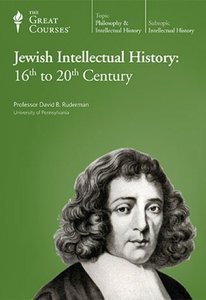
Jewish Intellectual History: 16th to 20th Century
Audio CDs in MP3 / English: MP3, 128 kb/s (2 ch) | Duration: 12:19:00 | 2002 | ISBN-10: 1565855213 | 675 MB
Genre: History, Cultures
God. Torah. Israel. These three concepts incorporated in personal belief, the meaning of Jewish ritual acts, and the purpose of continued Jewish existence have been the focus of Jewish thought throughout history.
But the last four centuries have presented Jewish thinkers with difficult challenges:
In a world having a history of untold suffering especially, it seemed, for Jews was the existence of an all-powerful and comforting God still tenable?
What were the purpose and meaning of Jewish practices and customs, given the increasing number of Jews who placed greater value on their own autonomy?
Could Jews still justify the notion of a "chosen people" in a society where Jewish integration and full participation with the rest of humanity had become the norm?
These lectures present the varying ways in which a small group of thinkers has attempted to answer these challenges.
These men and, in recent years, women, have reflected deeply on the relevance of Jewish texts and traditions to modern Jews.
Different Routes to a Common Goal
Though their approaches and solutions differed, most shared a common goal: provide a continuing sense of faith, meaning, and identity for their fellow Jews.
Through these lectures, you will observe the time-honored intellectual tradition through which Judaism analyzes, rethinks, and reformulates itself.
This process of preserving its essential character while still trying to accommodate itself to the modern world has kept Judaism a vital and vibrant, rather than static, religion.
This course may serve to introduce you to a new and rich body of thinkers and thinking, for until recently, Jewish intellectual history, though an integral part of Western intellectual history, has been less heralded.
But one of the contributions of the young field of Jewish Studies has been to bring the thinkers featured in this series to a wider audience.
Spinoza's Devastating Challenge
The central figure in the course is well known: the prominent philosopher Benedict (Baruch) Spinoza (1632 1677).
Spinoza's impact was so significant, Professor Ruderman notes, that much of the course might be viewed as a series of responses to his thinking.
Spinoza received a traditional rabbinical education, but he broke with Judaism after his father died. He was raised in Amsterdam, a city in which both Jews and Christians lived in an increasingly tolerant and secular atmosphere.
In his Theological Political Treatise, published anonymously in 1670, Spinoza became the first Jew to break with the medieval Jewish tradition espoused by Moses Maimonides (1132 1204).
Breaking with Four Centuries of Tradition
Spinoza disputed Maimonides's belief that reason and faith could be reconciled. Because biblical texts were believed to have been inspired by God, he asserted, they were supernatural. They could be interpreted through faith or reason, but not both.
If one chose reason, then the Bible was not divinely inspired but a document created by Man.
This argument was devastating to the question of Jewish identity.
Essentially, it negated God, Torah, and Israel, denying any rationale for Jews to think of themselves as the chosen people, observe ceremonial laws, or accept the authority of the rabbis.
Spinoza's critique laid bare the contradiction between Jewish communal values and secular liberal ones. He was the first to pose a fundamental question that remains relevant to this day: Is it possible to be a true liberal and a traditional Jew?
Three Responses: Insiders, Outsiders, and Rejectionists
This course considers modern Jewish thought largely in terms of two issues:
The response to Spinoza and his attack on the very viability of Judaism
The shift in the standard by which Jews defined themselves and their faith. In the Middle Ages, this defining factor had been God. In the modern age, it became the non-Jewish world.
