• Regeln für den Video-Bereich:

    In den Börsenbereich gehören nur Angebote die bereits den Allgemeinen Regeln entsprechen.

    Einteilung

    - Folgende Formate gehören in die angegeben Bereiche:
    - Filme: Encodierte Filme von BluRay, DVD, R5, TV, Screener sowie Telesyncs im Format DivX, XviD und x264.
    - DVD: Filme im Format DVD5, DVD9 und HD2DVD.
    - HD: Encodierte Filme mit der Auflösung 720p oder darüber von BluRay, DVD, R5, TV, Screener sowie Telesyncs im Format x264.
    - 3D: Encodierte Filme von BluRay, die in einem 3D Format vorliegen. Dies gilt auch für Dokus, Animation usw.
    - Serien: Cartoon/Zeichentrick, Anime, Tutorials, Dokumentationen, Konzerte/Musik, Sonstiges sind demnach in die entsprechenden Bereiche einzuordnen, auch wenn sie beispielsweise im High Definition-Format oder als DVD5/DVD9/HD2DVD vorliegen. Ausnahme 3D.
    - Bereich Englisch: Englische Releases gehören immer in diesen Bereich.
    - Bereich Talk: Der Bereich, in dem über die Releases diskutiert werden kann, darf, soll und erwünscht ist.


    Angebot/Beitrag erstellen

    - Ein Beitrag darf erst dann erstellt werden, wenn der Upload bei mindestens einem OCH komplett ist. Platzhalter sind untersagt.
    - Bei einem Scenerelease hat der Threadtitel ausschließlich aus dem originalen, unveränderten Releasenamen zu bestehen. Es dürfen keine Veränderungen wie z.B. Sterne, kleine Buchstaben o.ä. vorgenommen werden. Ausnahme Serienbörse:
    - Bei einem Sammelthread für eine Staffel entfällt aus dem Releasename natürlich der Name der Folge. Beispiel: Die Simpsons S21 German DVDRip XviD - ITG
    - Dementsprechend sind also u.a. verboten: Erweiterungen wie "Tipp", "empfehlenswert", "only", "reup", usw. / jegliche andere Zusatzinformation oder Ergänzung, welche nicht in obiger Beschreibung zu finden ist.

    Aufbau des Angebots und Threadtitel

    Der Titel nach folgendem Muster erstellt zu werden. <Name> [3D] [Staffel] [German] <Jahr> <Tonspur> [DL] [Auflösung] <Quelle> <Codec> - <Group>
    Beispiel: The Dark Knight German 2008 AC3 DVDRip XviD - iND
    Beispiel: The Dark Knight 2008 DTS DL BDRip x264 - iND
    Beispiel: The Dark Knight 2008 AC3 DL BDRip XviD - iND
    Beispiel: The Dark Knight German 2008 AC3 720p BluRay x264 iND
    Beispiel: The Dark Knight 2008 DTS DL 1080p BluRay x264 iND
    Beispiel: Die Simpsons S01 German AC3 DVDRip XviD iND
    Beispiel: Die Simpsons S20 German AC3 720p BluRay x264 iND
    Beispiel: Sword Art Online II Ger Sub 2014 AAC 1080p WEBRip x264 - peppermint
    Entsprechend sind also u.a. verboten: Sonderzeichen wie Klammern, Sterne, Ausrufezeichen, Unterstriche, Anführungszeichen / Erweiterungen wie "Tipp", "empfehlenswert", "only", "reup", usw. / jegliche andere Zusatzinformation oder Ergänzung, welche nicht in obiger Beschreibung zu finden ist
    Ausnahmen hiervon können in den Bereichen geregelt sein.

    Die Beiträge sollen wie folgt aufgebaut werden:
    Überschrift entspricht dem Threadtitel
    Cover
    kurze Inhaltsbeschreibung
    Format, Größe, Dauer sind gut lesbar für Downloader außerhalb des Spoilers zu vermerken
    Nfo sind immer Anzugeben und selbige immer im Spoiler in Textform.
    Sind keine Nfo vorhanden z.B. Eigenpublikationen, sind im Spoiler folgende Dateiinformationen zusätzlich anzugeben :
    Quelle
    Video (Auflösung und Bitrate)
    Ton (Sprache, Format und Bitrate der einzelnen Spuren)
    Untertitel (sofern vorhanden)
    Hosterangabe in Textform außerhalb eines Spoiler mit allen enthaltenen Hostern.
    Bei SD kann auf diese zusätzlichen Dateiinformationen verzichtet werden.

    Alle benötigten Passwörter sind, sofern vorhanden, in Textform im Angebot anzugeben.
    Spoiler im Spoiler mit Kommentaren :"Schon Bedankt?" sind unerwünscht.


    Releases

    - Sind Retail-Release verfügbar, sind alle anderen Variationen untersagt. Ausnahmen: Alle deutschen Retail-Release sind CUT, in diesem Fall sind dubbed UNCUT-Release zulässig.
    - Im Serien-Bereich gilt speziell: Wenn ein Retail vor Abschluss einer laufenden Staffel erscheint, darf diese Staffel noch zu Ende gebracht werden.62
    - Gleiche Releases sind unbedingt zusammenzufassen. Das bedeutet, es ist zwingend erforderlich, vor dem Erstellen eines Themas per Suchfunktion zu überprüfen, ob bereits ein Beitrag mit demselben Release besteht. Ist dies der Fall, ist der bereits vorhandene Beitrag zu verwenden.
    - P2P und Scene Releases dürfen nicht verändert oder gar unter einem iND Tag eingestellt werden.


    Support, Diskussionen und Suche

    - Supportanfragen sind entweder per PN oder im Bereich Talk zu stellen.
    - Diskussionen und Bewertungen sind im Talk Bereich zu führen. Fragen an die Uploader haben ausschließlich via PN zu erfolgen, und sind in den Angeboten untersagt.
    - Anfragen zu Upload-Wünschen sind nur im Bereich Suche Video erlaubt. Antworten dürfen nur auf Angebote von MyBoerse.bz verlinkt werden.


    Verbote

    - Untersagt sind mehrere Formate in einem einzigen Angebotsthread, wie beispielsweise das gleichzeitige Anbieten von DivX/XviD, 720p und 1080p in einem Thread. Pro Format, Release und Auflösung ist ein eigener Thread zu eröffnen.
    - Grundsätzlich ebenso verboten sind Dupes. Uploader haben sich an geeigneter Stelle darüber zu informieren, ob es sich bei einem Release um ein Dupe handelt.
    - Gefakte, nur teilweise lauffähige oder unvollständige Angebote sind untersagt. Dies gilt auch für eigene Publikationen, die augenscheinlich nicht selbst von z.B. einer DVD gerippt wurden. Laufende Serien, bei denen noch nicht alle Folgen verfügbar sind, dürfen erstellt und regelmäßig geupdatet werden.
    - Untersagt sind Angebote, welche nur und ausschließlich in einer anderen Sprache als deutsch oder englisch vorliegen. Ausnahmen sind VORHER mit den Moderatoren zu klären.


    Verstoß gegen die Regeln

    - Angebote oder Beiträge, die gegen die Forenregeln verstoßen, sind über den "Melden"-Button im Beitrag zu melden.
  • Bitte registriere dich zunächst um Beiträge zu verfassen und externe Links aufzurufen.

++ Premium IPTV ++ 7000 Live Sender ++ UHD Qualität ++ Mediathek mit 18.000 Inhalten ++


VenneTV


Java SE 21 Developer Oracle Certified Professional 1Z0 - 830 1080

AgentofHeart

MyBoerse.bz Pro Member
537368816_que-es-udemy-analisis-opiniones.jpg

8.35 GB | 1h 25min 40s | mp4 | 1920X1080 | 16:9
Genre:eLearning |Language:English​


17c0f1b94ee69f191a0cfa8f07f42ad4.jpg

Oracle Java Se 21 Developer Professional: 1Z0-830
Published 11/2024
MP4 | Video: h264, 1920x1080 | Audio: AAC, 44.1 KHz
Language: English | Size: 23.60 GB | Duration: 31h 15m​

Preparation for Oracle Certification (Java Certification) Java SE 21 1Z0-830 with examples, quizes and home tasks

What you'll learn

Master handling primitives, wrapper classes, and type conversions in Java

Evaluate and apply arithmetic and boolean expressions with precedence rules

Effectively manipulate text using String, StringBuilder, and text blocks

Work with Java Date-Time API to handle date, time, period, and timezone objects

Create and manage control flow constructs like if/else, switch, and loops

Implement advanced object-oriented concepts, including encapsulation and inheritance

Create classes, records, and instantiate fields, methods, and constructors

Apply polymorphism, method overriding, and the instanceof operator with pattern matching

Work with Java interfaces, functional methods, and enums effectively

Handle exceptions using try/catch/finally, try-with-resources, and multi-catch blocks

Create and manipulate arrays and Java Collections like List, Set, Map, and Deque

Process data using Streams and lambda expressions for filtering, transforming, and sorting

Perform advanced operations on Streams like decomposition, reduction, and grouping

Understand modular Java, compile code, and create modular/non-modular JARs

Manage concurrent code execution with threads, ExecutorService, and parallel streams

Develop thread-safe code with locking mechanisms and concurrent APIs

Use Java I/O API for reading/writing files and serializing/deserializing objects

Implement localization using resource bundles and locale-specific parsing/formatting

Understand additional Java features, including annotations and the Java Logging API

Requirements

No Prior Java Knowledge Required: The course is beginner-friendly and comprehensive

Willingness to Learn: Openness to explore Java's in-depth concepts

Stable Internet Connection: For accessing course materials and completing exercises online

Time Commitment: Availability to dedicate consistent time to learning and practice

Description

What Is Oracle 1Z0-830 Certification?The Oracle 1Z0-830 certification, also known as the Java SE 21 Developer Certification, is an advanced credential that validates your expertise in modern Java development. This certification is specifically designed for professionals who want to showcase their skills in Java SE 21 features, covering a wide range of programming concepts, from object-oriented principles to modular applications.Benefits of Earning This CertificationCareer Growth: Elevate your profile with a globally recognized certification.Updated Knowledge: Stay ahead with expertise in Java SE 21, the latest long-term support version.Credibility: Demonstrates a deep understanding of core and advanced Java programming concepts.Real-World Applications: Gain skills that are highly relevant to modern enterprise applications.How This Course Prepares YouThis course is crafted to help you master every topic required for the Oracle 1Z0-830 certification. It includes lessons to build your understanding and quizzes to test your knowledge. By the end of the course, you'll be well-prepared to tackle the certification exam with confidence.Topics Covered in This CourseThe Oracle 1Z0-830 certification requires proficiency across various domains of Java development. Below is a breakdown of the topics:1. Handling Date, Time, Text, Numeric, and Boolean ValuesUse primitives and wrapper classes, evaluate arithmetic and boolean expressions, and apply precedence rules, type conversions, and casting.Manipulate text using String, StringBuilder, and text blocks.Work with date, time, duration, period, and time-zone objects, including daylight saving time, using the Date-Time API.2. Controlling Program FlowCreate and manage control flow constructs such as if/else, switch statements and expressions, loops, and break/continue statements.3. Using Object-Oriented Concepts in JavaDeclare and instantiate objects, including nested classes, and explain object lifecycles.Create classes, records, and define/instantiate instance and static fields, methods, constructors, and initializers.Implement method overloading, including var-arg methods.Understand variable scopes, apply encapsulation, and create immutable objects.Use local variable type inference.Implement inheritance, including abstract and sealed types, record classes, and overriding methods, including those of the Object class.Use polymorphism, casting, and the instanceof operator with pattern matching and switch constructs.Create and use interfaces with functional methods, and private, static, and default methods.Work with enums including fields, methods, and constructors.4. Handling ExceptionsHandle exceptions with try/catch/finally, try-with-resources, and multi-catch blocks.Create and use custom exceptions.5. Working with Arrays and CollectionsCreate and manipulate arrays, List, Set, Map, and Deque collections, including adding, removing, updating, retrieving, and sorting elements.6. Working with Streams and Lambda ExpressionsUse Java Streams, including lambda expressions implementing functional interfaces, to filter, transform, process, and sort data.Perform decomposition, concatenation, reduction, grouping, and partitioning on sequential and parallel streams.7. Packaging and Deploying Java CodeDefine and expose module content, including by reflection, and declare module dependencies.Compile Java code, create modular/non-modular JARs, runtime images, and implement migration to modules using unnamed/automatic modules.8. Managing Concurrent Code ExecutionCreate platform and virtual threads using Runnable and Callable objects.Manage thread lifecycles and use different ExecutorService implementations and concurrent APIs.Develop thread-safe code with locking mechanisms and process Java collections concurrently with parallel streams.9. Using Java I/O APIRead/write console and file data using I/O Streams.Serialize and deserialize Java objects.Work with Path objects and their properties using the java.nio.file API.10. Implementing LocalizationImplement localization using locales and resource bundles.Parse and format messages, dates, times, and numbers, including currency and percentage values.11. Additional Java FeaturesUnderstand the basics of the Java Logging API.Use annotations like @Override, @FunctionalInterface, @Deprecated, @SuppressWarnings, and @SafeVarargs.Comprehensive Scope of CertificationBy completing this course, you will develop proficiency in:Handling Date, Time, Text, Numeric, and Boolean ValuesControlling Program FlowObject-Oriented Concepts in JavaHandling ExceptionsArrays and CollectionsStreams and Lambda ExpressionsPackaging and Deploying Java CodeManaging Concurrent Code ExecutionJava I/O APILocalizationAdditional Java FeaturesThis comprehensive preparation ensures you are fully equipped to pass the Oracle 1Z0-830 certification and advance your career in Java development. Let's begin!

Overview

Section 1: Introduction

Lecture 1 Communication plan

Lecture 2 Unlimited access to 'Learn IT' application for students

Lecture 3 Tips to Improve Your Course Taking Experience

Lecture 4 Additional Free Learning Materials to Use During the Course

Lecture 5 About 1Z0-830 Certification and the Course

Section 2: Java Basics

Lecture 6 Why Java and why this course? What is JDK, JRE and JVM?

Lecture 7 About Latest Java Version

Lecture 8 JDK Installation

Lecture 9 First application: Hello World App

Lecture 10 Homework Solution: .bat file creation

Lecture 11 Integrated Development Environment, Eclipse Overview

Lecture 12 Comments in Java source code

Lecture 13 Quiz: Java Basics - Check yourself

Section 3: Primitive Data Types, Variables and Arrays

Lecture 14 Primitive types and variables

Lecture 15 Number Systems

Lecture 16 Arrays

Lecture 17 Quiz: Primitive data types, variables and arrays - Check yourself

Section 4: Eclipse: Tips and Tricks

Lecture 18 Packages: creation and package presentation in eclipse

Lecture 19 Plugins: how to install free plugins, eclipse marketplace, workspace styles

Lecture 20 Code Refactoring in Eclipse

Section 5: Operators and Operations with primitive types

Lecture 21 Operators in Java

Lecture 22 Operations with integers and floating-point numbers, BigDecimal type

Lecture 23 Math class, NaN, Infinity

Lecture 24 Type of the expression in Java

Lecture 25 Compare primitive and reference types & Java Memory Model

Lecture 26 Read user input from console

Lecture 27 Homework review: Operators and Operations

Lecture 28 Quiz: Operators and Operations with primitive types - Check yourself

Section 6: Strings in Java

Lecture 29 String: object creation and main methods overview

Lecture 30 String comparison: How to compare Strings and what is String Pool

Lecture 31 Escape Sequences in Java

Lecture 32 String Formatting

Lecture 33 Regular expressions in Java

Lecture 34 Homework review: String

Lecture 35 Quiz: Strings in Java - Check yourself

Section 7: Control Statements

Lecture 36 'if - else' construction

Lecture 37 Homework review: 'if' statement

Lecture 38 'switch' construction

Lecture 39 Homework review: 'switch' statement

Lecture 40 Quiz: Control Statements - Check yourself

Section 8: Miscellaneous

Lecture 41 Random numbers generation

Section 9: Iteration Statements (Loops) in Java

Lecture 42 'while' loop

Lecture 43 'do-while' loop

Lecture 44 'for' with condition loop

Lecture 45 'for each' loop

Lecture 46 Nested loops

Lecture 47 Jump Statements - Break and Continue

Lecture 48 Labels in Java

Lecture 49 Homework review: Iteration Statements (Loops)

Lecture 50 Quiz: Iteration Statements (Loops) in Java - Check yourself

Section 10: Methods in Java

Lecture 51 Methods in Java: Overview

Lecture 52 Parameter Passing Mechanism in Java

Lecture 53 Recursive methods

Lecture 54 Variable Length Arguments

Lecture 55 Homework review: Methods

Section 11: Enumerations in Java

Lecture 56 Enumerations in Java

Section 12: Debugging Tools

Lecture 57 How to debug Java programs

Section 13: Object-oriented programming

Lecture 58 Object-oriented programming: Basics

Lecture 59 Classes & Objects

Lecture 60 Different types of Classes, Abstract keyword and Abstract classes

Lecture 61 Interfaces

Lecture 62 Inheritance

Lecture 63 Polymorphism and 'final' keyword

Lecture 64 'static' keyword

Lecture 65 Encapsulation

Lecture 66 Object, JNI and Object class overview

Lecture 67 SOLID principles overview & Single Responsibility Principle

Lecture 68 Open / Closed Principle

Lecture 69 Liskov Substitution Principle

Lecture 70 Interface Segregation Principle

Lecture 71 Dependency Inversion Principle

Lecture 72 KISS Principle in OOP

Lecture 73 YAGNI Principle in OOP

Lecture 74 DRY Principle in OOP | Part 1

Lecture 75 DRY Principle in OOP | Part 2 - Practice

Section 14: ===== OOP: Interview Preparation =====

Lecture 76 How to be prepared for the interview?

Lecture 77 Part 1: OOP Interview - Questions and Answers

Lecture 78 Part 2: OOP Interview - Questions and Answers

Lecture 79 Part 3: OOP & Design Patterns Interview - Questions and Answers

Section 15: ===== EXAM: OOP & Object Oriented e-Commerce console applications =====

Lecture 80 Exam and homework for OOP topic

Section 16: Excpetion Handling

Lecture 81 Exception Handling in Java

Section 17: Java Collections Framework

Lecture 82 Java Collections Framework: Overview

Lecture 83 Collection Interface

Lecture 84 Interfaces List, Set and Queue: Overview

Lecture 85 List implementations - ArrayList, Vector, CopyOnWriteArrayList & Stack

Lecture 86 LinkedList VS ArrayList, Big O Notation & Homework

Lecture 87 Comparator and Comparable

Lecture 88 Iterable, Iterator & ListIterator

Lecture 89 Queue and Deque

Lecture 90 Map Hierarchy

Lecture 91 Hash Tables & HashMap

Lecture 92 LinkedHashMap

Lecture 93 SortedMap, NavigableMap & TreeMap

Lecture 94 Set Implementations (HashSet practice) & java.util.Colelctions class

Section 18: Generics

Lecture 95 Generics in Java

Section 19: ===== Java Collections Framework: Interview Preparation =====

Lecture 96 How to be prepared for the interview?

Lecture 97 Part 1: Java Collections Framework Interview - Questions and Answers

Lecture 98 Part 2: Java Collections Framework Interview - Questions and Answers

Lecture 99 Part 3: Java Collections Framework Interview - Questions and Answers

Lecture 100 Part 4: Java Collections Framework Interview - Questions and Answers

Lecture 101 Part 5: Java Collections Framework Interview - Questions and Answers

Section 20: Functional Programming in Java

Lecture 102 Functional Programming in Java: Overview

Lecture 103 Functional Interface, Lambda Functions & Method References

Lecture 104 Function & BiFunction: Theory & Practice

Lecture 105 Consumer, BiConsumer, Predicate & BiPredicate

Section 21: Stream API

Lecture 106 Stream API with Practical Exercises

Section 22: ===== Functional Programming in Java: Interview Preparation =====

Lecture 107 How to be prepared for the interview?

Lecture 108 Part 1: Java Functional Programming Interview - Questions and Answers

Lecture 109 Part 2: Java Functional Programming Interview - Questions and Answers

Section 23: Input and Output Streams in Java (I/O & NIIO)

Lecture 110 Input and Output Streams in Java

Lecture 111 Serialization and Cloning

Section 24: ===== I/O in Java: Interview Preparation =====

Lecture 112 Part 1: Java I/O Interview - Questions and Answers

Lecture 113 Part 2: Java I/O Interview - Questions and Answers

Section 25: Multithreading

Lecture 114 Multithreading Overview

Lecture 115 First Multithreading Program: Thread & Runnable

Lecture 116 Thread Scheduler, Race Condition, Daemon Threads & Thread Groups

Lecture 117 Synchronization Basics

Lecture 118 Memory Management in Multithreading Programs

Lecture 119 Deadlock & Livelock

Lecture 120 Executor Services, Callable & Future

Lecture 121 Executor Service Implementations & ThreadFactory

Lecture 122 Fork/Join Framework

Lecture 123 CompletableFuture

Lecture 124 Lock API - Lock, ReadWriteLock, ReentrantLock, ReentrantReadWriteLock, StampedLo

Lecture 125 Synchronizers - CyclicBarrier, CountDownLatch, Semaphore, Exchanger & Phaser

Lecture 126 Homework: Multithreading

Section 26: ===== Multithreading in Java: Interview Preparation =====

Lecture 127 Part 1: Java Multithreading Interview - Questions and Answers

Lecture 128 Part 2: Java Multithreading Interview - Questions and Answers

Section 27: Date and Time in JDK

Lecture 129 Time Standards (GMT, UTC), Date and Calendar from java.util

Lecture 130 java.time Package (Instant, LocalDateTime, ZonedDateTime etc)

Section 28: Java Reflection API & Annotations

Lecture 131 Java Reflection API

Lecture 132 Annotations

Section 29: JDK API

Lecture 133 StringBuilder & StringBuffer

Lecture 134 java.util.Optional - Optional in Java

Lecture 135 Reactive Programming in Java: Flow API, Reactive Streams

Section 30: Modules in Java & Migration of Java Apps

Lecture 136 Modules in Java: Modular Application Example

Lecture 137 Migration of Java Apps: Example of migration to a modular application

Section 31: I18N & L10N

Lecture 138 [Part 1] Localization and Internationalization

Lecture 139 [Part 2] Localization and Internationalization

Section 32: ===== Java Core: Interview Preparation =====

Lecture 140 How to be prepared for the interview?

Lecture 141 Part 1: Java Core Interview: Questions and Answers

Lecture 142 Part 2: Java Core Interview: Questions and Answers

Lecture 143 Part 3: Java Core Interview: Questions and Answers

Lecture 144 Part 4: Java Core Interview: Questions and Answers

Lecture 145 Part 5: Java Core Interview: Questions and Answers

Lecture 146 Part 6: Java Core Interview: Questions and Answers

Lecture 147 Part 7: Java Core Interview: Questions and Answers

Section 33: Logging in Java

Lecture 148 Logging in Java: Part 1 (Logging theory, Logging Levels, Java Logging Framework)

Lecture 149 Logging in Java: Part 2 (Log4J, Logback, SLF4J)

Section 34: Java: New Versions

Lecture 150 Java 8 Features (Lambda, Stream API, Optional, Effectively Final, etc.)

Lecture 151 Java 9: Stream API Updates, Multi-Resolution Image, Stack-Walking API, etc.

Lecture 152 Java 9: Process API & CompletableFuture API updates, Interface Private Methods

Lecture 153 Java 9: jlink & jshell

Lecture 154 Java 9: Multi-Release JAR Files & Compact Strings

Lecture 155 Java 9: Deprecated & Removed Features

Lecture 156 Java 10: 'var' variables (Type inference), Docker support, Flex Heap Size, etc.

Lecture 157 Java 10: Other improvements, Removals, Deprecations, Release Versioning

Lecture 158 Java 11: LTS Concept, New HTTP Client, String & Files API Updates

Lecture 159 Java 11: Collection & Predicate API Updates, Nest-Based Access Control & more

Lecture 160 Java 12: CompactNumberFormat, Teeing Collector, String.indent(), transform()

Lecture 161 Java 13: Socket API, newFileSystem() method, ZGC Uncommit Unused Memory & others

Lecture 162 Java 14: Switch expressions, Currency Format, Helpful NullPointerExceptions

Lecture 163 Java 15: Text Blocks, Hidden Classes, new String methods

Lecture 164 Java 16: JEP 395 - Records

Lecture 165 Java 16: instanceof, Day Period Support, Stream.toList() & others

Lecture 0 Java 17: Sealed Classes & other improvements

Section 35: == EXAM Java Standard Edition - Online Store - Task description and solution ==

Lecture 166 Implement online store application

Section 36: Bonus section

Lecture 167 Bonus lesson

Beginner Programmers: Those new to programming and looking to start with Java,Intermediate Java Developers: Developers seeking to deepen their understanding of Java features and best practices,Students Preparing for Oracle Certification: Individuals aiming to pass the Oracle 1Z0-830 certification exam,Software Engineers: Professionals looking to enhance their Java skills for career growth,Tech Enthusiasts: Anyone interested in learning Java for personal or professional projects,College Students: Computer science or IT students wanting to strengthen their Java knowledge,Backend Developers: Developers focused on server-side programming and Java-based applications

PVFxBfat_o.jpg


ef01a330a2a5ac8f88f7aa46d550da89.jpg

Java Se 21 Developer | Oracle Certified Professional 1Z0-830
Published 3/2025
MP4 | Video: h264, 1920x1080 | Audio: AAC, 44.1 KHz
Language: English | Size: 7.84 GB | Duration: 35h 58m​

What you'll learn

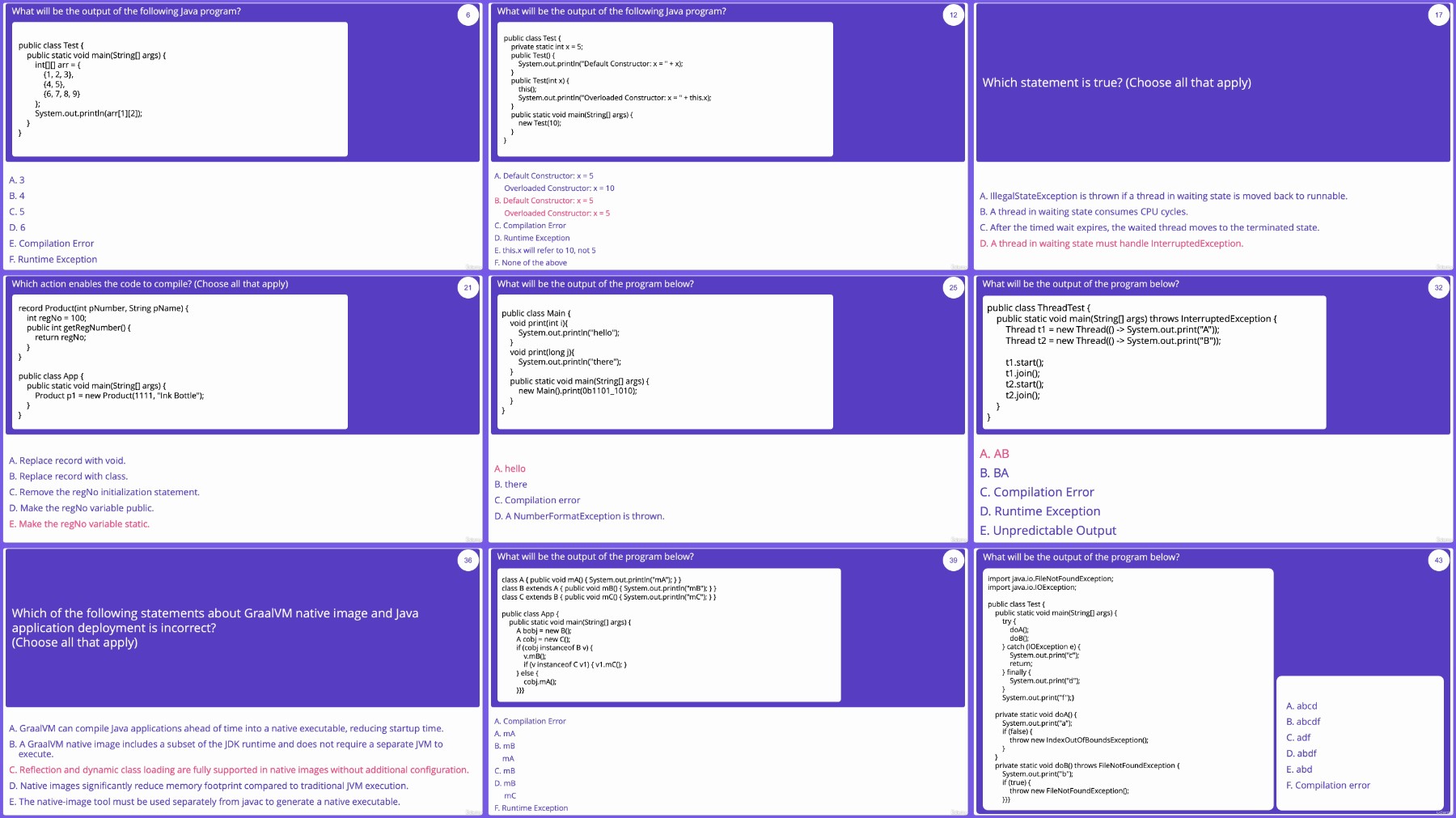
Sample Oracle Certified Professional Exam Questions and Answers with solutions

Java programming language

Java SE 21

Essential Java basics

What Java is and how it works

Programming fundamentals with Java

Java Development Kit - JDK

Java Runtime Environment - JRE

Java Virtual Machine - JVM

All concepts of Object-Oriented Programming (core java programming)

How to use 'static' keyword and 'nested and inner' classes

Super Classes and Sub Classes

Strings

Wrapper Classes

Throw vs Throws

Exceptions

Enum Types and more

Arrays

Collections

Lambda Expression

Stream API

Date and Time

Java Input/Output (Java I/O)

Concurrency

Requirements

No prior knowledge is required about Java 21 and Java SE 21 Developer Certified Professional 1Z0-830 Exam

Basic Computer Knowledge

Desire to learn Java and Java Core Skills

A computer with a 64-bit operating system

We preferred MacOS (64-bit) but this is not mandatory. You can prefer to use other Operating Systems. We also provided specific videos on installations for each platform

We preferred IntelliJ which is a powerful and advanced text editor with a lot of plug-ins and tools

Nothing else! It's just you, your computer, and your ambition to get started today

Description

Hello there,Welcome to the "Java SE 21 Developer | Oracle Certified Professional 1Z0-830" course.Oracle 1Z0-830 | Java SE 21 Developer Certification Exam Prep Course with Lambda Expression & Java Collections FrameworkThe Oracle Certified Professional: Java SE 21 Developer (Exam 1Z0-830) is a globally recognized certification that validates your expertise in Java programming, object-oriented principles, and modern Java development practices. This certification is highly valued by employers and serves as proof of your proficiency in Java, one of the most in-demand programming languages in the world.In this course, we aimed to make you a good Java developer and pass the exam required for Oracle Certified Professional: Java SE 21 Developer Certification (Exam number 1Z0-830).You may have taken many Java courses so far, but the exams you will take to get Java certificates to require you to know many tips and exam tactics, apart from Java knowledge. Therefore, being a perfect Java developer is not enough to get a passing grade on the exam.So why should you become a Java SE 21 Developer? Because if you want to apply for a Java developer job, having a certificate will put you one step ahead of other candidates. Remember that a certified developer is always preferable to a non-certified developer.In this course, you'll learn Java from scratch, along with essential exam tactics, tips, and practice questions. You'll also work on 8 real-world projects and complete 50+ coding exercises to reinforce your learning.By the end of the course, you'll be fully prepared to tackle the Oracle Certified Java SE 21 Developer Exam and advance your career with confidence!In this course you will learn;What is Oracle Certified Professional: Java SE 21 Developer Professional Exam 1Z0-830,What Java is and how it works,Programming Fundamentals with Java,IntelliJ IDEAJava Development Kit - JDK,Java Runtime Environment - JRE,Java Virtual Machine - JVMAll Concepts of Object-Oriented ProgrammingVariables and Data Types,Arrays,Control Flow Statements,Methods,Collections,Strings,Wrapper Classes,Exceptions,Enum Types and more,Lambda Expression,Stream API,Date and Time,Java Input/Output,ConcurrencyNo Previous Knowledge is needed!This course will take you from a beginner to a more experienced level.This Java course starts with absolute beginner core concepts, such as showing you the free tools you need to download and install, and takes you all the way to mastering the skills required for the Oracle Certified Professional: Java SE 21 Developer certification. You will gradually learn core Java skills through hands-on examples, building your knowledge step by step. If you're already in the field and need a refresher, this course will also serve as a valuable guide. Every time you return to this course, you will learn something new or improve your existing skills, getting you one step closer to passing the Java SE 21 certification exam.What is Java?Java is a programming language and platform initially developed by Sun Microsystems and now owned by Oracle. Java is inspired by C and C++ and uses an object-oriented programming model, which means that concepts or things are represented as "objects" that have data fields and methods. One of the biggest advantages of Java is that it runs on a Java Virtual Machine (JVM), meaning that you can execute Java code on any platform that has a JVM, without re-compilation. This is different from C and C++, which require re-compilation for every hardware platform you execute the code on. Java has many other advantages, including automatic memory management. This eliminates hard-to-understand pointers used in languages like C, which can help Java developers write better code in a shorter period of time.What does it mean that Java is an object-oriented programming language?Java is an object-oriented programming (OOP) language, which means concepts or things are represented as "objects" that have data fields and methods. In object-oriented programming, models called "objects" represent either a programming entity or an abstract concept. These objects are created and assembled independently of one another but can work with each other in logical ways. Objects are manifestations of classes and can inherit code allowing for code re-use, which can drastically reduce code duplication if used correctly. Additionally, encapsulation, another core OOP concept, allows you to create code with the implementation hidden. Although, in many cases, writing OOP code in Java (and other OOP languages) can take longer than using a procedural language, the benefits obtained with OOP, namely code reusability, encapsulation of data, and readability of code, often result in code that is easier to maintain in the long run.What is Java used for?Java is a very versatile language. Several fields use Java, including Android app development, desktop applications that work on many operating systems, server-side applications, and more. The virtual machine required to run Java programs has been ported to numerous operating systems allowing Java to run on virtually all hardware. According to the TIOBE index, Java has consistently been in the top 3 most-used and popular languages since its initial release in the 1990s. Many developers still consider Java the language of choice in areas such as enterprise and application servers, and even in embedded systems development. Many Fortune 500 companies rely on Java to run their core systems and employers often view Java experience on a résumé as favorable due to its popularity.What certification is best for Java?Oracle, the owner of the Java programming language, has the Oracle Certified Developer: Java SE 21 Developer program, which is easily the best certification to obtain for Java developers. The main reason why it's the best certification, is, unlike most other certifications for Java, the Oracle certification is both well known and universally accepted by employers all over the world. The exam is challenging. You also must bring an ID with you to the exam, so you cannot get anyone to take it for you. Certification is really valuable for both the certification holder and for future employers. There are few, if any, other certification programs so universally accepted as Oracle's Java certification. Thus, getting Java certification is one of the surest ways to give yourself an advantage over other job seekers in the marketplace.Why would you want to take this course?Our answer is simple: The quality of teachingOAK Academy based in London is an online education company OAK Academy gives education in the field of IT, Software, Design, development in Turkish, English, Portuguese, and a lot of different language on Udemy platform where it has over 2000 hours of video education lessons. When you enroll, you will feel the OAK Academy`s seasoned developers' expertiseVideo and Audio Production QualityAll our content is created/produced as high-quality video/audio to provide you the best learning experienceYou will be,Seeing clearlyHearing clearlyMoving through the course without distractionsYou'll also get:Lifetime Access to The CourseFast & Friendly Support in the Q&A sectionUdemy Certificate of Completion Ready for DownloadWe offer full support, answering any questionsDive in now into the "Java SE 21 Developer | Oracle Certified Professional 1Z0-830" course.

Overview

Section 1: Introduction to Java SE 21 Developer Certification Course

Lecture 1 What Will We Learn In This Course?

Section 2: Introduction to Java and Environment Setup

Lecture 2 Section Overview

Lecture 3 Some Information about Java SE 21 Developer Certified Professional 1Z0-830 Exam

Lecture 4 Basic Programming Terms

Lecture 5 Getting Started With Java?

Lecture 6 Download and Install Java on Windows

Lecture 7 Download and Install Java on MacOS

Lecture 8 What is IDE?

Lecture 9 Download and Install IntelliJ on Windows

Lecture 10 Download and Install IntelliJ on MacOS

Lecture 11 First Java Program - Hello World

Lecture 12 Compiling and Running Applications

Lecture 13 Closer Look at the First Java Program

Section 3: Basics of Java

Lecture 14 Section Overview

Lecture 15 Basic Output in Java

Lecture 16 Basic Input in Java

Lecture 17 Comments in Java

Lecture 18 Variables

Lecture 19 Data Types

Lecture 20 Numbers in Java

Lecture 21 Type Conversion and Type Casting

Section 4: Operators

Lecture 22 Section Overview

Lecture 23 Arithmetic Operators

Lecture 24 Assignment Operators

Lecture 25 Unary Operators

Lecture 26 Equality and Relational Operators

Lecture 27 Conditional Operators

Lecture 28 Bitwise and Bitshift Operators

Lecture 29 Char Data Type

Lecture 30 Operator Precedence

Lecture 31 Expressions, Statements, and Blocks

Section 5: Array

Lecture 32 Introduction to Array

Lecture 33 Sorting Array

Lecture 34 Searching Array

Lecture 35 Multi-dimensional Arrays

Section 6: Control Flow Statements

Lecture 36 If and If-Else Statement

Lecture 37 Ternary Operator

Lecture 38 If-Else - If Ladder Statement, Nested If Statement

Lecture 39 Switch-Case Statement

Lecture 40 Simple Calculator App with Switch Statement

Lecture 41 For Loops

Lecture 42 Enhanced For Loop (For-Each Loop)

Lecture 43 While Loop

Lecture 44 Infinite Loop

Lecture 45 Do - While Loop

Lecture 46 Break Keyword

Lecture 47 Continue Keyword

Lecture 48 Return Keyword

Lecture 49 Labeled Loops

Lecture 50 Fibonacci Series

Section 7: Methods

Lecture 51 Section Overview

Lecture 52 What is Method?

Lecture 53 Method Calling

Lecture 54 Types of Methods

Lecture 55 Java Variable Arguments (Java Var-Args)

Lecture 56 Method Overloading

Lecture 57 Find Exponential Number

Section 8: Java Object-Oriented Concept

Lecture 58 Section Overview

Lecture 59 OOP Concept, Object & Class

Lecture 60 Stack & Heap

Lecture 61 Access Modifiers

Lecture 62 Naming Conventions

Lecture 63 Constructor

Lecture 64 Packages and Import - Part 1

Lecture 65 Packages and Import - Part 2

Lecture 66 "static" Keyword

Lecture 67 Static import

Lecture 68 Nested & Inner Classes

Lecture 69 Local inner classes

Section 9: Java Object-Oriented Programming

Lecture 70 Section Overview

Lecture 71 Inheritance

Lecture 72 Sealed Class

Lecture 73 Method Overriding

Lecture 74 "super" and "this" Keywords - Part 1

Lecture 75 "super" and "this" Keywords - Part 2

Lecture 76 "super" and "this" Keywords - Part 3

Lecture 77 "final" Keyword

Lecture 78 "abstract" Keyword

Lecture 79 Interface

Lecture 80 Polymorphism

Lecture 81 Encapsulation

Lecture 82 Anonymous Class

Lecture 83 Record Class

Lecture 84 "var" Keyword

Section 10: Wrapper Classes, Auto-Boxing and Unboxing

Lecture 85 Introduction to Wrapper Class in Java

Lecture 86 Conversion of Types

Lecture 87 Autoboxing - UnBoxing

Section 11: Strings

Lecture 88 Section Overview

Lecture 89 What is String?

Lecture 90 Equality of Strings

Lecture 91 Immutability of Strings

Lecture 92 Useful Methods of String - Part 1

Lecture 93 Useful Methods of String - Part 2

Lecture 94 StringBuffer Class

Lecture 95 StringBuilder Class

Lecture 96 String vs String Buffer vs String Builder

Lecture 97 Reverse String

Section 12: Collections

Lecture 98 Section Overview

Lecture 99 Introduction to Collections

Lecture 100 List Interface

Lecture 101 ArrayList Class

Lecture 102 Conversion Between Lists and Arrays

Lecture 103 Sorting Array List

Lecture 104 Comparator

Lecture 105 Searching ArrayList

Lecture 106 Itrator and ListIterator

Lecture 107 Set Interface - Part 1

Lecture 108 Set Interface - Part 2

Lecture 109 Queue

Lecture 110 Deque

Lecture 111 Map Interface - Part 1

Lecture 112 Map Interface - Part 2

Section 13: Exception Handling in Java

Lecture 113 Intro to Exception

Lecture 114 Error vs Exception

Lecture 115 Exception Types

Lecture 116 Try - Catch Block

Lecture 117 "finally" Block

Lecture 118 "throw" Keyword

Lecture 119 "throws" Keyword

Lecture 120 "throw" vs "throws"

Lecture 121 Useful Methods of Throwable Class

Lecture 122 Bank Account Balance

Section 14: Enum Types

Lecture 123 Enum Types

Lecture 124 Traffic Lights Program With Enum

Section 15: Lambda Expression

Lecture 125 Section Overview

Lecture 126 Marker and Functional Interfaces

Lecture 127 Lambda Expression

Lecture 128 Predicate

Lecture 129 Method Reference

Lecture 130 Switch Expression (Enhanced Switch Statement)

Lecture 131 Simple Calculator app with Lambda

Section 16: Stream API

Lecture 132 Introduction to Stream

Lecture 133 Reduction Operations - Part 1

Lecture 134 Reduction Operations - Part 2

Lecture 135 Parallelism and Parallel Stream

Section 17: Date&Time

Lecture 136 Section Overview

Lecture 137 Calendar Class

Lecture 138 Local Date Class

Lecture 139 Local Time Class

Lecture 140 Local Date Time Class

Lecture 141 Period Class

Lecture 142 Date Time Formatting (DateTimeFormatter Class)

Section 18: Java IO (Java Input / Output)

Lecture 143 Section Overview

Lecture 144 Introduction to Java I/O

Lecture 145 OutputStream Class

Lecture 146 InputStream Class - Part 1

Lecture 147 InputStream Class - Part 2

Lecture 148 Writer Class

Lecture 149 Reader Class

Lecture 150 Copying a file with Java IO

Lecture 151 Object Serialization and Deserialization

Lecture 152 transient keyword

Section 19: Overview of Threads

Lecture 153 What is Thread?

Lecture 154 Create Thread Class

Lecture 155 Create Runnable Class

Section 20: Thread Creation and Management

Lecture 156 Thread and Processes

Lecture 157 Thread management

Lecture 158 Thread states and monitoring

Section 21: Synchronization and Concurrency Control

Lecture 159 Introduction to Synchronization

Lecture 160 "synchronized" Keyword

Lecture 161 "volatile" Keyword

Section 22: High-level Concurrency APIs

Lecture 162 Introduction to Concurrency APIs

Lecture 163 Executor Service

Lecture 164 Scheduled Executor Service

Lecture 165 Concurrent Collection

Lecture 166 Future and Callable

Lecture 167 Atomic Variables

Section 23: Thread Coordination

Lecture 168 Introduction to Thread Coordination

Lecture 169 Inter-thread communication

Lecture 170 Locks and Conditions

Section 24: Locks and Advanced Synchronization

Lecture 171 ReentrantLock and ReentrantReadWriteLock

Lecture 172 Condition variables

Section 25: Concurrent Collections

Lecture 173 Thread-safe collections

Lecture 174 Blocking queues

Section 26: Performance and Scalability

Lecture 175 Thread contention and deadlocks

Lecture 176 Thread safety and immutability

Lecture 177 Optimizing Thread Pools

Lecture 178 Parallel stream

Section 27: Java Virtual Machine and Threads

Lecture 179 JVM's role in thread management

Lecture 180 Thread priorities

Lecture 181 Daemon threads

Section 28: Best Practices and Advanced Topics

Lecture 182 Concurrency Design Patterns

Lecture 183 Handling exceptions in threads

Lecture 184 Advanced locking mechanisms

Section 29: Case Studies and Practical Scenarios

Lecture 185 Building a multithreaded web server

Lecture 186 Implementing a producer-consumer system

Lecture 187 Developing a real-time chat system

Section 30: Tools and Testing

Lecture 188 Thread debugging tools

Lecture 189 Unit testing multithreaded code

Lecture 190 Profiling multithreaded applications

Section 31: Extra

Lecture 191 Java SE 21 Developer | Oracle Certified Professional 1Z0-830

Anyone looking to pass the Java SE 21 Developer Certified Professional 1Z0-830 Exam,Anyone looking to get Oracle Java Certification,Those who want to learn the Java Programming language from scratch,Those who want to be one step ahead in job applications related to Java,Java developers who want to increase their knowledge,Beginners with no previous coding experience in Java programming,Those who want to learn tips and tricks in Java SE 21 Developer Certified Professional 1Z0-830 Exam,Programmers who are looking to sharpen their Java programming skills to the expert level,Anyone who is planning job transformation and wants to become a Java developer

1-Mock-Exam-Java-SE-21-Developer-Professional-Certification-Exam-Number-1Z0830.jpg


6396ef199ceec25e576d471f772e1fd4.jpg

Java Se 21 Developer | Oracle Certified Professional 1Z0-830
Published 3/2025
MP4 | Video: h264, 1920x1080 | Audio: AAC, 44.1 KHz
Language: English | Size: 7.84 GB | Duration: 35h 58m​

What you'll learn

Sample Oracle Certified Professional Exam Questions and Answers with solutions

Java programming language

Java SE 21

Essential Java basics

What Java is and how it works

Programming fundamentals with Java

Java Development Kit - JDK

Java Runtime Environment - JRE

Java Virtual Machine - JVM

All concepts of Object-Oriented Programming (core java programming)

How to use 'static' keyword and 'nested and inner' classes

Super Classes and Sub Classes

Strings

Wrapper Classes

Throw vs Throws

Exceptions

Enum Types and more

Arrays

Collections

Lambda Expression

Stream API

Date and Time

Java Input/Output (Java I/O)

Concurrency

Requirements

No prior knowledge is required about Java 21 and Java SE 21 Developer Certified Professional 1Z0-830 Exam

Basic Computer Knowledge

Desire to learn Java and Java Core Skills

A computer with a 64-bit operating system

We preferred MacOS (64-bit) but this is not mandatory. You can prefer to use other Operating Systems. We also provided specific videos on installations for each platform

We preferred IntelliJ which is a powerful and advanced text editor with a lot of plug-ins and tools

Nothing else! It's just you, your computer, and your ambition to get started today

Description

Hello there,Welcome to the "Java SE 21 Developer | Oracle Certified Professional 1Z0-830" course.Oracle 1Z0-830 | Java SE 21 Developer Certification Exam Prep Course with Lambda Expression & Java Collections FrameworkThe Oracle Certified Professional: Java SE 21 Developer (Exam 1Z0-830) is a globally recognized certification that validates your expertise in Java programming, object-oriented principles, and modern Java development practices. This certification is highly valued by employers and serves as proof of your proficiency in Java, one of the most in-demand programming languages in the world.In this course, we aimed to make you a good Java developer and pass the exam required for Oracle Certified Professional: Java SE 21 Developer Certification (Exam number 1Z0-830).You may have taken many Java courses so far, but the exams you will take to get Java certificates to require you to know many tips and exam tactics, apart from Java knowledge. Therefore, being a perfect Java developer is not enough to get a passing grade on the exam.So why should you become a Java SE 21 Developer? Because if you want to apply for a Java developer job, having a certificate will put you one step ahead of other candidates. Remember that a certified developer is always preferable to a non-certified developer.In this course, you'll learn Java from scratch, along with essential exam tactics, tips, and practice questions. You'll also work on 8 real-world projects and complete 50+ coding exercises to reinforce your learning.By the end of the course, you'll be fully prepared to tackle the Oracle Certified Java SE 21 Developer Exam and advance your career with confidence!In this course you will learn;What is Oracle Certified Professional: Java SE 21 Developer Professional Exam 1Z0-830,What Java is and how it works,Programming Fundamentals with Java,IntelliJ IDEAJava Development Kit - JDK,Java Runtime Environment - JRE,Java Virtual Machine - JVMAll Concepts of Object-Oriented ProgrammingVariables and Data Types,Arrays,Control Flow Statements,Methods,Collections,Strings,Wrapper Classes,Exceptions,Enum Types and more,Lambda Expression,Stream API,Date and Time,Java Input/Output,ConcurrencyNo Previous Knowledge is needed!This course will take you from a beginner to a more experienced level.This Java course starts with absolute beginner core concepts, such as showing you the free tools you need to download and install, and takes you all the way to mastering the skills required for the Oracle Certified Professional: Java SE 21 Developer certification. You will gradually learn core Java skills through hands-on examples, building your knowledge step by step. If you're already in the field and need a refresher, this course will also serve as a valuable guide. Every time you return to this course, you will learn something new or improve your existing skills, getting you one step closer to passing the Java SE 21 certification exam.What is Java?Java is a programming language and platform initially developed by Sun Microsystems and now owned by Oracle. Java is inspired by C and C++ and uses an object-oriented programming model, which means that concepts or things are represented as "objects" that have data fields and methods. One of the biggest advantages of Java is that it runs on a Java Virtual Machine (JVM), meaning that you can execute Java code on any platform that has a JVM, without re-compilation. This is different from C and C++, which require re-compilation for every hardware platform you execute the code on. Java has many other advantages, including automatic memory management. This eliminates hard-to-understand pointers used in languages like C, which can help Java developers write better code in a shorter period of time.What does it mean that Java is an object-oriented programming language?Java is an object-oriented programming (OOP) language, which means concepts or things are represented as "objects" that have data fields and methods. In object-oriented programming, models called "objects" represent either a programming entity or an abstract concept. These objects are created and assembled independently of one another but can work with each other in logical ways. Objects are manifestations of classes and can inherit code allowing for code re-use, which can drastically reduce code duplication if used correctly. Additionally, encapsulation, another core OOP concept, allows you to create code with the implementation hidden. Although, in many cases, writing OOP code in Java (and other OOP languages) can take longer than using a procedural language, the benefits obtained with OOP, namely code reusability, encapsulation of data, and readability of code, often result in code that is easier to maintain in the long run.What is Java used for?Java is a very versatile language. Several fields use Java, including Android app development, desktop applications that work on many operating systems, server-side applications, and more. The virtual machine required to run Java programs has been ported to numerous operating systems allowing Java to run on virtually all hardware. According to the TIOBE index, Java has consistently been in the top 3 most-used and popular languages since its initial release in the 1990s. Many developers still consider Java the language of choice in areas such as enterprise and application servers, and even in embedded systems development. Many Fortune 500 companies rely on Java to run their core systems and employers often view Java experience on a résumé as favorable due to its popularity.What certification is best for Java?Oracle, the owner of the Java programming language, has the Oracle Certified Developer: Java SE 21 Developer program, which is easily the best certification to obtain for Java developers. The main reason why it's the best certification, is, unlike most other certifications for Java, the Oracle certification is both well known and universally accepted by employers all over the world. The exam is challenging. You also must bring an ID with you to the exam, so you cannot get anyone to take it for you. Certification is really valuable for both the certification holder and for future employers. There are few, if any, other certification programs so universally accepted as Oracle's Java certification. Thus, getting Java certification is one of the surest ways to give yourself an advantage over other job seekers in the marketplace.Why would you want to take this course?Our answer is simple: The quality of teachingOAK Academy based in London is an online education company OAK Academy gives education in the field of IT, Software, Design, development in Turkish, English, Portuguese, and a lot of different language on Udemy platform where it has over 2000 hours of video education lessons. When you enroll, you will feel the OAK Academy`s seasoned developers' expertiseVideo and Audio Production QualityAll our content is created/produced as high-quality video/audio to provide you the best learning experienceYou will be,Seeing clearlyHearing clearlyMoving through the course without distractionsYou'll also get:Lifetime Access to The CourseFast & Friendly Support in the Q&A sectionUdemy Certificate of Completion Ready for DownloadWe offer full support, answering any questionsDive in now into the "Java SE 21 Developer | Oracle Certified Professional 1Z0-830" course.

Overview

Section 1: Introduction to Java SE 21 Developer Certification Course

Lecture 1 What Will We Learn In This Course?

Section 2: Introduction to Java and Environment Setup

Lecture 2 Section Overview

Lecture 3 Some Information about Java SE 21 Developer Certified Professional 1Z0-830 Exam

Lecture 4 Basic Programming Terms

Lecture 5 Getting Started With Java?

Lecture 6 Download and Install Java on Windows

Lecture 7 Download and Install Java on MacOS

Lecture 8 What is IDE?

Lecture 9 Download and Install IntelliJ on Windows

Lecture 10 Download and Install IntelliJ on MacOS

Lecture 11 First Java Program - Hello World

Lecture 12 Compiling and Running Applications

Lecture 13 Closer Look at the First Java Program

Section 3: Basics of Java

Lecture 14 Section Overview

Lecture 15 Basic Output in Java

Lecture 16 Basic Input in Java

Lecture 17 Comments in Java

Lecture 18 Variables

Lecture 19 Data Types

Lecture 20 Numbers in Java

Lecture 21 Type Conversion and Type Casting

Section 4: Operators

Lecture 22 Section Overview

Lecture 23 Arithmetic Operators

Lecture 24 Assignment Operators

Lecture 25 Unary Operators

Lecture 26 Equality and Relational Operators

Lecture 27 Conditional Operators

Lecture 28 Bitwise and Bitshift Operators

Lecture 29 Char Data Type

Lecture 30 Operator Precedence

Lecture 31 Expressions, Statements, and Blocks

Section 5: Array

Lecture 32 Introduction to Array

Lecture 33 Sorting Array

Lecture 34 Searching Array

Lecture 35 Multi-dimensional Arrays

Section 6: Control Flow Statements

Lecture 36 If and If-Else Statement

Lecture 37 Ternary Operator

Lecture 38 If-Else - If Ladder Statement, Nested If Statement

Lecture 39 Switch-Case Statement

Lecture 40 Simple Calculator App with Switch Statement

Lecture 41 For Loops

Lecture 42 Enhanced For Loop (For-Each Loop)

Lecture 43 While Loop

Lecture 44 Infinite Loop

Lecture 45 Do - While Loop

Lecture 46 Break Keyword

Lecture 47 Continue Keyword

Lecture 48 Return Keyword

Lecture 49 Labeled Loops

Lecture 50 Fibonacci Series

Section 7: Methods

Lecture 51 Section Overview

Lecture 52 What is Method?

Lecture 53 Method Calling

Lecture 54 Types of Methods

Lecture 55 Java Variable Arguments (Java Var-Args)

Lecture 56 Method Overloading

Lecture 57 Find Exponential Number

Section 8: Java Object-Oriented Concept

Lecture 58 Section Overview

Lecture 59 OOP Concept, Object & Class

Lecture 60 Stack & Heap

Lecture 61 Access Modifiers

Lecture 62 Naming Conventions

Lecture 63 Constructor

Lecture 64 Packages and Import - Part 1

Lecture 65 Packages and Import - Part 2

Lecture 66 "static" Keyword

Lecture 67 Static import

Lecture 68 Nested & Inner Classes

Lecture 69 Local inner classes

Section 9: Java Object-Oriented Programming

Lecture 70 Section Overview

Lecture 71 Inheritance

Lecture 72 Sealed Class

Lecture 73 Method Overriding

Lecture 74 "super" and "this" Keywords - Part 1

Lecture 75 "super" and "this" Keywords - Part 2

Lecture 76 "super" and "this" Keywords - Part 3

Lecture 77 "final" Keyword

Lecture 78 "abstract" Keyword

Lecture 79 Interface

Lecture 80 Polymorphism

Lecture 81 Encapsulation

Lecture 82 Anonymous Class

Lecture 83 Record Class

Lecture 84 "var" Keyword

Section 10: Wrapper Classes, Auto-Boxing and Unboxing

Lecture 85 Introduction to Wrapper Class in Java

Lecture 86 Conversion of Types

Lecture 87 Autoboxing - UnBoxing

Section 11: Strings

Lecture 88 Section Overview

Lecture 89 What is String?

Lecture 90 Equality of Strings

Lecture 91 Immutability of Strings

Lecture 92 Useful Methods of String - Part 1

Lecture 93 Useful Methods of String - Part 2

Lecture 94 StringBuffer Class

Lecture 95 StringBuilder Class

Lecture 96 String vs String Buffer vs String Builder

Lecture 97 Reverse String

Section 12: Collections

Lecture 98 Section Overview

Lecture 99 Introduction to Collections

Lecture 100 List Interface

Lecture 101 ArrayList Class

Lecture 102 Conversion Between Lists and Arrays

Lecture 103 Sorting Array List

Lecture 104 Comparator

Lecture 105 Searching ArrayList

Lecture 106 Itrator and ListIterator

Lecture 107 Set Interface - Part 1

Lecture 108 Set Interface - Part 2

Lecture 109 Queue

Lecture 110 Deque

Lecture 111 Map Interface - Part 1

Lecture 112 Map Interface - Part 2

Section 13: Exception Handling in Java

Lecture 113 Intro to Exception

Lecture 114 Error vs Exception

Lecture 115 Exception Types

Lecture 116 Try - Catch Block

Lecture 117 "finally" Block

Lecture 118 "throw" Keyword

Lecture 119 "throws" Keyword

Lecture 120 "throw" vs "throws"

Lecture 121 Useful Methods of Throwable Class

Lecture 122 Bank Account Balance

Section 14: Enum Types

Lecture 123 Enum Types

Lecture 124 Traffic Lights Program With Enum

Section 15: Lambda Expression

Lecture 125 Section Overview

Lecture 126 Marker and Functional Interfaces

Lecture 127 Lambda Expression

Lecture 128 Predicate

Lecture 129 Method Reference

Lecture 130 Switch Expression (Enhanced Switch Statement)

Lecture 131 Simple Calculator app with Lambda

Section 16: Stream API

Lecture 132 Introduction to Stream

Lecture 133 Reduction Operations - Part 1

Lecture 134 Reduction Operations - Part 2

Lecture 135 Parallelism and Parallel Stream

Section 17: Date&Time

Lecture 136 Section Overview

Lecture 137 Calendar Class

Lecture 138 Local Date Class

Lecture 139 Local Time Class

Lecture 140 Local Date Time Class

Lecture 141 Period Class

Lecture 142 Date Time Formatting (DateTimeFormatter Class)

Section 18: Java IO (Java Input / Output)

Lecture 143 Section Overview

Lecture 144 Introduction to Java I/O

Lecture 145 OutputStream Class

Lecture 146 InputStream Class - Part 1

Lecture 147 InputStream Class - Part 2

Lecture 148 Writer Class

Lecture 149 Reader Class

Lecture 150 Copying a file with Java IO

Lecture 151 Object Serialization and Deserialization

Lecture 152 transient keyword

Section 19: Overview of Threads

Lecture 153 What is Thread?

Lecture 154 Create Thread Class

Lecture 155 Create Runnable Class

Section 20: Thread Creation and Management

Lecture 156 Thread and Processes

Lecture 157 Thread management

Lecture 158 Thread states and monitoring

Section 21: Synchronization and Concurrency Control

Lecture 159 Introduction to Synchronization

Lecture 160 "synchronized" Keyword

Lecture 161 "volatile" Keyword

Section 22: High-level Concurrency APIs

Lecture 162 Introduction to Concurrency APIs

Lecture 163 Executor Service

Lecture 164 Scheduled Executor Service

Lecture 165 Concurrent Collection

Lecture 166 Future and Callable

Lecture 167 Atomic Variables

Section 23: Thread Coordination

Lecture 168 Introduction to Thread Coordination

Lecture 169 Inter-thread communication

Lecture 170 Locks and Conditions

Section 24: Locks and Advanced Synchronization

Lecture 171 ReentrantLock and ReentrantReadWriteLock

Lecture 172 Condition variables

Section 25: Concurrent Collections

Lecture 173 Thread-safe collections

Lecture 174 Blocking queues

Section 26: Performance and Scalability

Lecture 175 Thread contention and deadlocks

Lecture 176 Thread safety and immutability

Lecture 177 Optimizing Thread Pools

Lecture 178 Parallel stream

Section 27: Java Virtual Machine and Threads

Lecture 179 JVM's role in thread management

Lecture 180 Thread priorities

Lecture 181 Daemon threads

Section 28: Best Practices and Advanced Topics

Lecture 182 Concurrency Design Patterns

Lecture 183 Handling exceptions in threads

Lecture 184 Advanced locking mechanisms

Section 29: Case Studies and Practical Scenarios

Lecture 185 Building a multithreaded web server

Lecture 186 Implementing a producer-consumer system

Lecture 187 Developing a real-time chat system

Section 30: Tools and Testing

Lecture 188 Thread debugging tools

Lecture 189 Unit testing multithreaded code

Lecture 190 Profiling multithreaded applications

Section 31: Extra

Lecture 191 Java SE 21 Developer | Oracle Certified Professional 1Z0-830

Anyone looking to pass the Java SE 21 Developer Certified Professional 1Z0-830 Exam,Anyone looking to get Oracle Java Certification,Those who want to learn the Java Programming language from scratch,Those who want to be one step ahead in job applications related to Java,Java developers who want to increase their knowledge,Beginners with no previous coding experience in Java programming,Those who want to learn tips and tricks in Java SE 21 Developer Certified Professional 1Z0-830 Exam,Programmers who are looking to sharpen their Java programming skills to the expert level,Anyone who is planning job transformation and wants to become a Java developer

Kq3OF844_o.jpg

 
Zurück
Oben Unten