How to Listen to and Understand Opera
32xDVDRip | MP4/AVC1, ~800 kb/s | 640x480 | Duration: 24:24:48 | English: AAC, 96 kb/s (2 ch) | 8.57 GB
Genre: eLearning Video / Opera, Classical Music
With the knowledge of opera from this course, you will understand how music has the power to reveal truths beyond the spoken word; how opera is a unique marriage of words and music in which the whole is far greater than its parts. You will learn the reasons for opera's enduring popularity. And you will be able to explore in great depth the extraordinary and compelling world of opera.
Part I: The Full Flower and Its Origins
The first eight lectures are foundational. You examine the origins of opera and the adaptations of other musical forms that allowed opera to achieve its full effects, first accomplished in Monteverdi's Orfeo of 1607.
But Professor Greenberg does not hide the result while waiting on history to get us there. The course opens with one of the most powerful moments in opera-the dramatically loaded aria "Nessun dorma" ("No one shall sleep") from Giacomo Puccini's Turandot.
In Turandot, you are exposed to opera's unique incorporation of soliloquy, dialogue, scenery, action, and continuous music into an incredibly expressive and exciting whole.
This famous aria shows us the power of the composer-the power of creating music that goes beyond the words of the libretto to express thoughts and feelings that cannot be expressed in words.
The study continues with a discussion of how music reveals character and the unconscious state. You are introduced to operatic archetypes such as Figaro and Carmen.
You examine how the rediscovery of ancient Greek and Roman culture contributed to the riches of the Renaissance. You see the evolution of the madrigal, a form that was ultimately rejected in favor of a more expressive vocal medium: early opera.
Part I of the course concludes with an analysis of the first successful attempt to combine words and music into musical drama, Monteverdi's Orfeo of 1607.
Part II: The Aria, the Golden Age, Opera Seria, Opera Buffa
Recitative, the essence of Monteverdi's style, made music subservient to words, but because of its forward-driving nature, recitative cannot express personal reflection.
You learn how the invention of the aria gave opera composers a powerful tool to stop the dramatic action for characters' moments of self-reflection.
Gluck's reforms and his Orfeo ed Euridice of 1762 are addressed as the starting point for the modern opera repertory. The explosion of operas in the Golden Age-Dark Age of opera is discussed. You learn how different voice types are assigned different roles, and how this has varied by culture.
The rise of opera seria and its characteristics are discussed, along with an analysis of the second act of Mozart's Idomeneo-opera seria transcendent.
You examine the development of opera buffa, from its origins in the popular folklore of the Commedia dell'Arte to its eventual replacement of opera seria. Mozart's brilliant The Marriage of Figaro is discussed as one of the greatest contributions to the opera buffa genre.
Part III: Rossini and Verdi: The Development of French Opera
You see how the Italian language and culture gave rise to the bel canto style, with its comic plots, one-dimensional characters, appealing melodies, and florid melodic embellishments.
Dr. Greenberg reveals how highly pressurized the business of opera was in the 18th century. Rossini once remarked, "In my time, all the impresarios of Italy were bald by 30." You are introduced to Rossini's The Barber of Seville of 1816 as the quintessential bel canto opera.
You learn how Giuseppi Verdi broke the bel canto mold. He dominated Italian opera for over half a century by virtue of his lyricism, his emphasis on human emotions and psychological insight, and his use of the orchestra and parlante to drive the dramatic action and maintain musical continuity.
Verdi's Otello is discussed as one of the greatest operas of all time.
You next study French opera and why it became a distinctly different genre from Italian opera. Nineteenth-century French opera-grand opera, opéra comique, and lyric opera-are three distinctive French genres. You'll hear why in Act 2 of Bizet's dramatically powerful Carmen .
Part IV: Wagner, Strauss, Puccini
You see how German singspiel, a play with music, grew from humble origins as a low-class entertainment to high art with Mozart's The Rescue from the Harem (1782) and The Magic Flute (1791). You learn how Carl Maria von Weber's Der Freischütz established 19th-century German opera.
You then study Richard Wagner: his personal beliefs, musical theories, and operatic innovations. Wagner turned to the ancient Greek ideal for inspiration, and from it he conceived the idea of an all-encompassing artwork, or music drama, in which the orchestra plays the role of a purveyor of unspoken truths. Dr. Greenberg cites Wagner's Tristan und Isolde as the most influential composition of the 19th century, next to Beethoven's Ninth Symphony.
Richard Strauss and his controversial opera Salome exemplifies late Romantic German opera.
You examine Russian opera and nationalism. The late development of Russian opera is outlined from Mikhail Glinka's Ruslan and Lyudmila to Modest Mussorgsky's Boris Godunov. You see how the Russian language shaped the vocal style of Russian opera.
The course concludes with an overview of opera verismo, a 19th- and 20th-century genre that favors depictions of the darker side of the human condition; a transcendent example of it is in the pivotal second act of Giacomo Puccini's Tosca.
The essence of opera is debated as you hear part of a scene from Richard Strauss's Capriccio. Is it words, or is it music? It is an indefinable combination of both, with the whole greater than the parts.
Course Lecture Titles
32 Lectures:
45 minutes / lecture
01. Introduction and Words and Music, I
02. Introduction and Words and Music, II
03. A Brief History of Vocal Expression in Music, I
04. A Brief History of Vocal Expression in Music, II
05. Invention of Opera and Monteverdi's Orfeo, I
06. Invention of Opera and Monteverdi's Orfeo, II
07. Invention of Opera and Monteverdi's Orfeo, III
08. Invention of Opera and Monteverdi's Orfeo, IV
09. The Growth of Opera, the Development of Italian Opera Seria, and Mozart's Idomeneo, I
10. The Growth of Opera, the Development of Italian Opera Seria, and Mozart's Idomeneo, II
11. The Growth of Opera, the Development of Italian Opera Seria, and Mozart's Idomeneo, III
12. The Growth of Opera, the Development of Italian Opera Seria, and Mozart's Idomeneo, IV
13. The Rise of Opera Buffa and Mozart's The Marriage of Figaro, I
14. The Rise of Opera Buffa and Mozart's The Marriage of Figaro, II
15. The Rise of Opera Buffa and Mozart's The Marriage of Figaro, III
16. The Rise of Opera Buffa and Mozart's The Marriage of Figaro, IV
17. The Bel Canto Style and Rossini's The Barber of Seville, I
18. The Bel Canto Style and Rossini's The Barber of Seville, II
19. Verdi and Otello, I
20. Verdi and Otello, II
21. Verdi and Otello, III
22. Verdi and Otello, IV
23. French Opera, I
24. French Opera, II
25. German Opera Comes of Age
26. Richard Wagner and Tristan und Isolde, I
27. Richard Wagner and Tristan und Isolde, II
28. Late Romantic German Opera-Richard Strauss and Salome
29. Russian Opera, I
30. Russian Opera, II
31. Verismo, Puccini, and Tosca, I
32. Verismo, Puccini, and Tosca, II
also You can find my other last:
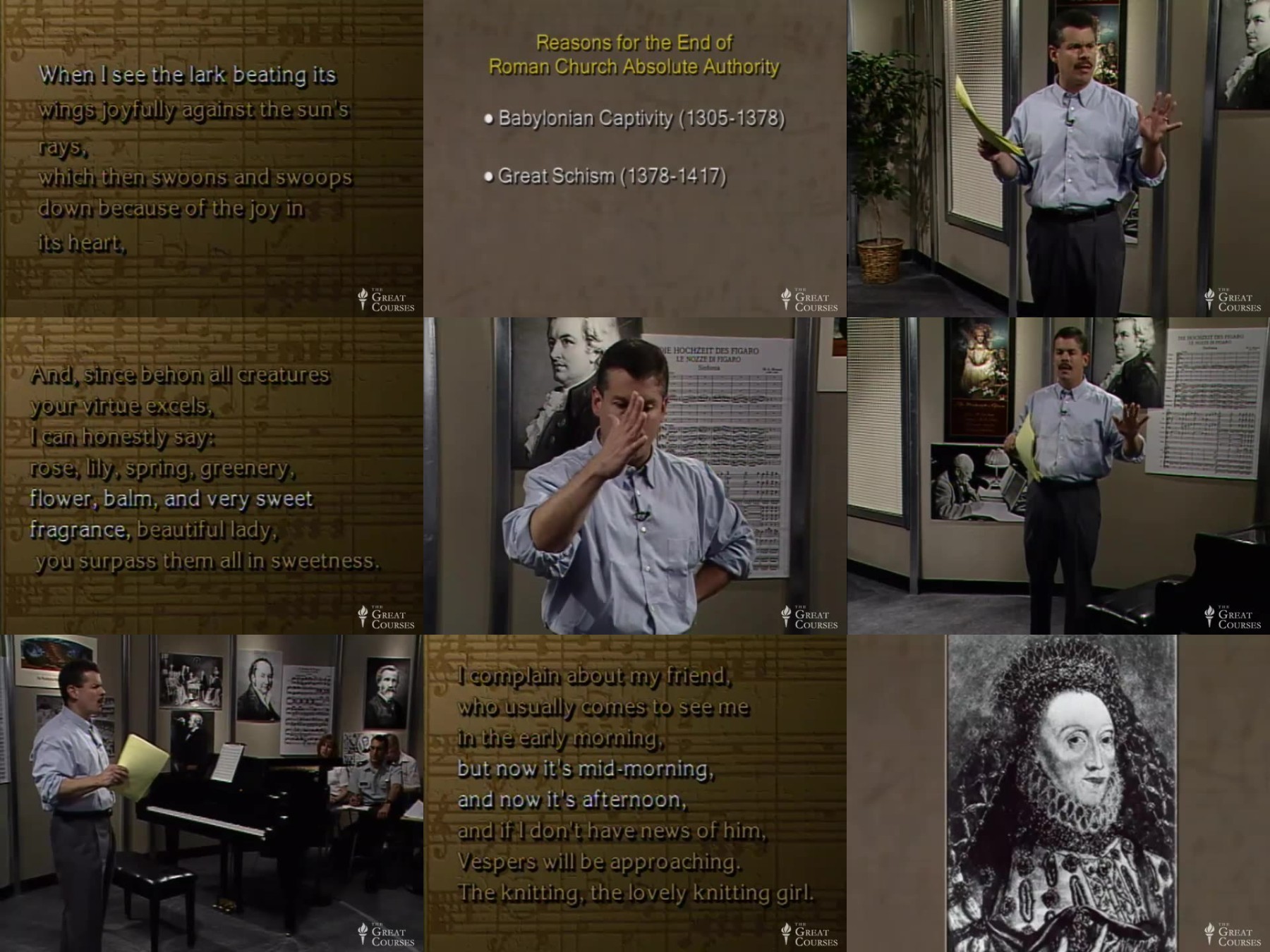
Screenshots
Exclusive eLearning Videos ← add to bookmarks