



• Regeln für den Dokumente-Bereich:

    In den Börsenbereich gehören nur Angebote die bereits den Allgemeinen Regeln entsprechen.

    Allgemeines:

    Nicht erlaubt im Dokumente-Bereich sind:

    - indizierte Titel (inkl. Comics)
    - extremistische Werke, Zeitschriften und Comics (egal, welche Richtung)
    - jegliche Art von Pornographie
    - Anleitungen zu kriminellen Handlungen, gleich welcher Art
    - sadistische, menschenverachtende oder ähnliche Werke

    Nutzt den "Bedanken"-Button, bei Sammelthreads führen jegliche Kommentare, positiv wie negativ, sehr schnell zu einer Unübersichtlichkeit des Threads. Downmeldungen sind an den Uploader zu richten

    Vor dem Einstellen zu beachten:

    - Suchfunktion

    Vergewissert euch, dass es euer Dokument noch nicht im Board gibt, Doppelposts werden kommentarlos gelöscht. Ist es schon vorhanden, tragt es als Mirror im bestehenden Post ein.

    - Threadtitel

    Idealerweise ist sofort zu erkennen um was es sich handelt. Verseht euren Titel mit den relevanten Informationen, das hilft euch und damit auch uns und allen Suchenden erheblich weiter.

    Beispiel: [Thriller] Dan Brown - Inferno oder bei Magazinen:

    Computerbild - 14/2014 (es muss ersichtlich sein, um welche Ausgabe und welches Magazin es sich handelt)

    Folgende Präfixe stehen im Unterforum "Unterhaltung" zur Verfügung:

    [Humor]
    [Drama]
    [Erotik]
    [Fantasy]
    [Krimi]
    [Roman]
    [Thriller]
    [Horror]
    [Science Fiction]

    Inhalt des Beitrags:

    Folgende Pflichtangaben gilt es einzuhalten:

    - Autor
    - Titel
    - Präfix
    - Cover
    - Genre
    - Inhaltsbeschreibung
    - enthaltene Formate
    - Gesamtgröße des Downloads
    - Hoster
    - ggf. Passwort

    Nicht erlaubt sind alle Dateien, die den Download unnötig aufblähen um eine Affiliategrenze zu erreichen, wie zB. mp3-files, übergroße Bilder, etc.

    Ebenso nicht erlaubt sind sämtliche Dateien mit DRM, persönlichen Daten, etc., diese werden kommentarlos zu eurem eigenem Schutz gelöscht.

    Achtet bitte bei der Konvertierung der Formate auf die Lesbarkeit, ein epub, was nur einfach durch Calibre gejagt wird um ein PDF zu erhalten, ist zu 99% eben nicht lesbar. Wenn ihr es nicht könnt, dann lasst es besser oder lest euch ein, wie man es richtig macht.


    Unterforum Comics:

    Threadtitel:

    Ähnlich, wie bei Unterhaltung und Magazinen, sollte der Titel alle relevanten Informationen enthalten, hier bitte

    - den Titel des Comics
    - den Verlag (einige Comics sind in verschiedenen Verlagen erschienen)
    - das Erscheinungsjahr

    Erlaubt sind folgende Formate:

    - CBR
    - CBZ

    Grundsätzlich gilt: jede Version eines Comics erhält einen eigenen Thread, Ersteller eines Comics können ihre Bände gerne mit dem Zusatz (Original-Release) versehen.

    Bei Unsicherheiten zur korrekten Benennung bitte die Informationen von www.comicguide.de nutzen.

    Inhalt des Beitrags:

    Pflichtangaben hier sind:

    - Titel des Bandes und ggf. Nummer
    - Cover
    - falls bekannt technische Daten (DPI, Breite, Speicherqualität)
    - Größe des Downloads
    - Hoster
    - ggf. Passwort
    - falls bekannt Releasenamen
  • Bitte registriere dich zunächst um Beiträge zu verfassen und externe Links aufzurufen.

*** Bestes IPTV *** bester Preis *** gratis Test ***


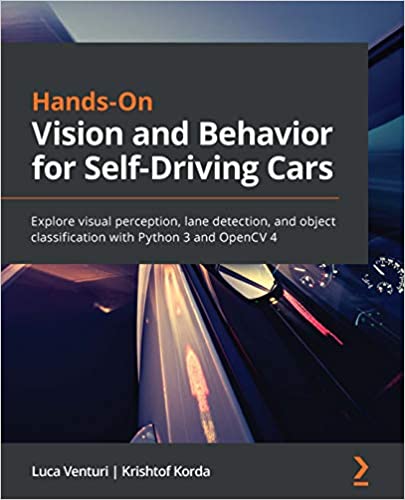
Hands-On Vision and Behavior for Self-Driving Cars Explore visual perception, lane detection & o...

gfxwap1

MyBoerse.bz Pro Member

FYiVZUht0huGsyJSsxPVLgNhZrtIiDL3.jpg

English | 2020 | ISBN-13: 978-1800203587 | 752 Pages | EPUB + Code| 13.68 MB

=========

A practical guide to learning visual perception for self-driving cars for computer vision and autonomous system engineers
Key Features

Explore the building blocks of the visual perception system in self-driving cars
Identify objects and lanes to define the boundary of driving surfaces using open-source tools like OpenCV and Python
Improve the object detection and classification capabilities of systems with the help of neural networks

Book Description

The visual perception capabilities of a self-driving car are powered by computer vision. The work relating to self-driving cars can be broadly classified into three components - robotics, computer vision, and machine learning. This book provides existing computer vision engineers and developers with the unique opportunity to be associated with this booming field.

You will learn about computer vision, deep learning, and depth perception applied to driverless cars. The book provides a structured and thorough introduction, as making a real self-driving car is a huge cross-functional effort. As you progress, you will cover relevant cases with working code, before going on to understand how to use OpenCV, TensorFlow and Keras to analyze video streaming from car cameras. Later, you will learn how to interpret and make the most of lidars (light detection and ranging) to identify obstacles and localize your position. You'll even be able to tackle core challenges in self-driving cars such as finding lanes, detecting pedestrian and crossing lights, performing semantic segmentation, and writing a PID controller.

By the end of this book, you'll be equipped with the skills you need to write code for a self-driving car running in a driverless car simulator, and be able to tackle various challenges faced by autonomous car engineers.
What you will learn

Understand how to perform camera calibration
Become well-versed with how lane detection works in self-driving cars using OpenCV
Explore behavioral cloning by self-driving in a video-game simulator
Get to grips with using lidars
Discover how to configure the controls for autonomous vehicles
Use object detection and semantic segmentation to locate lanes, cars, and pedestrians
Write a PID controller to control a self-driving car running in a simulator

Who this book is for

This book is for software engineers who are interested in learning about technologies that drive the autonomous car revolution. Although basic knowledge of computer vision and Python programming is required, prior knowledge of advanced deep learning and how to use sensors (lidar) is not needed.
Table of Contents

OpenCV Basics and Camera Calibration
Understanding and Working with Signals
Lane Detection
Deep Learning with Neural Networks
Deep Learning Workflow
Improving Your Neural Network
Detecting Pedestrians and Traffic Lights
Behavioral Cloning
Semantic Segmentation
Steering, Throttle, and Brake Control
Mapping Our Environments

 
Zurück
Oben Unten