



• Regeln für den Audio-Bereich:

    Allgemeine Boardregeln: MyBoerse-bz-Regelwerk Regelwerk Audioboerse

    1. Das richtige Forum

    Wähle ein passendes Unterforum für dein Angebot

    2. Doppelte Threads vermeiden / Ein Thread pro Interpret


    Da es hier langsam ausartet mit gleichen Interpreten, aber verschiedenen Jahren, gilt ab sofort: Nur noch ein Thread pro Interpret, unabhängig von der Jahreszahl der verschiedenen Alben. Wünschenswert wäre es wenn ihr den Titel ab sofort so benennt: Interpret - Diskographie

    Um Doppelpost zu vermeiden, nutze vor dem Posten die Suchenfunktion. Gibt es schon einen passenden Thread, dann poste Dein Angebot dort hinein. Für einzelne Alben einer Sammlung bzw. Hörbuchreihen bitte in den passenden Sammelthreads posten.

    3. Der richtige Titel

    Gib dem Thread einen einfachen aber vernünftigen Titel, der zum Angebot passt. Um den Thread besser über die Suche zu finden, solltest du einen normalen Titel benutzen. Bei Threads in den Foren Musik, HQ Audio / Lossless und Soundtracks / OST immer das Jahr am Ende des Threadtitels in Klammern angeben, z.B.: Interpretname - Albumname (2016)

    4. Die richtigen Angaben

    Ein Thread/Thema in der Audio-Börse muss dem User Informationen über das Angebot geben können.

    Pflichtangaben:

    Bild des Uploads
    Genre
    Bitrate der Musik Datei: in Kbit/s
    Hoster
    Größe in MB oder GB
    Tracklist

    Optional: Angabe wenn Cover dabei sind.


    Sollte ein Angebot diese Pflichtangaben nicht beinhalten, wird der Verfasser darauf hingewiesen. Sollte dieses dann nicht geändert werden, werden die Beiträge gelöscht.

    (Sollte der Upload nicht als mp3 vorliegen, sondern als ogg/Bin/Cue o.Ä., dann ist dies auch eine Pflichtangabe)

    5. Defekte/nicht verfügbare Links und andere Probleme mit einem Upload

    Sollte ein Upload down sein, dann meldet es per PN dem Uploader. Gibt es zwei Threads zum gleichen Thema oder ein Upload im falschen Forum, dann meldet dies via "Beitrag melden" Funktion, diese befindet sich neben dem Bedanken-Button.

    6. Reupp- /Hosteranfragen
    Reuppanfragen oder auch Anfragen ob es bei einem anderen Hoster geuppt werden kann, bitte direkt per PN an den Uploader und nicht in den Thread.
  • Bitte registriere dich zunächst um Beiträge zu verfassen und externe Links aufzurufen.

*** Bestes IPTV *** bester Preis *** gratis Test ***


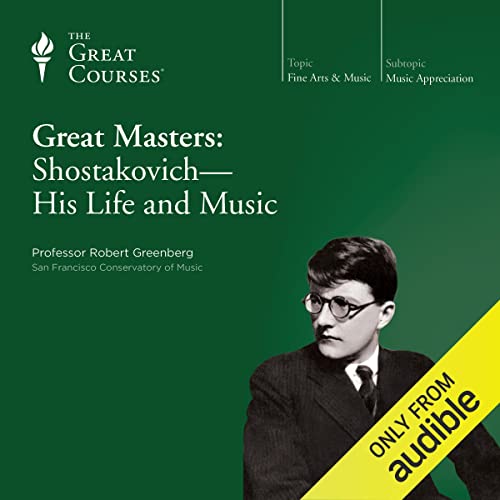
Great Masters: Shostakovich - His Life and Music [TTC Audio]

Srbija

MyBoerse.bz Pro Member
567f5e07a82666a9a3c9dac7df41ba37.jpg


Great Masters: Shostakovich - His Life and Music [TTC Audio]
English | 2002 | 6 hrs and 17 mins | MP3 | 152 MB

By: Robert Greenberg, The Great Courses
Narrated by: Robert Greenberg


Dmitri Shostakovich is without a doubt one of the central composers of the 20th century. His symphonies and string quartets are mainstays of the repertoire. But Shostakovich is also a figure whose story raises challenging and exciting issues that go far beyond music: they touch on questions of conscience, the moral role of the artist, the plight of humanity in the face of total war and mass oppression, and the inner life of history's bloodiest century. And though he was not without flaws, he was a faithful witness to the survival of the human spirit under totalitarianism.

And now you can discover the extraordinary life, times, and music of Shostakovich in a probing series of eight lectures from an acclaimed conductor, teacher, and music historian. Drawing on both the flood of declassified documents from the Soviet Union that began in 1991 and Shostakovich's own extraordinarily frank posthumous reminiscences, Professor Greenberg shows how Shostakovich, who, in the words of a friend, "did not want to rot in a prison or a graveyard" was still unwilling to become a docile instrument of the Soviet regime.

You'll learn how what he would not say publicly in words, he instead said through his music - messages from a buried life of his experiences during the terror of Stalin, the Nazi destruction of his country, postwar reconstruction, and the arms race.

In work after work, often composed under crushing difficulty and anxiety, you'll hear how he used a brilliant arsenal of ironic conceits, musical quotes from un-Soviet sources such as American jazz or Jewish klezmer tunes, and other techniques to assert the integrity of his art in the face of totalitarian oppression, and to pay, as he said, "homage to the dead."



Zurück
Oben Unten