



• Regeln für den Video-Bereich:

    In den Börsenbereich gehören nur Angebote die bereits den Allgemeinen Regeln entsprechen.

    Einteilung

    - Folgende Formate gehören in die angegeben Bereiche:
    - Filme: Encodierte Filme von BluRay, DVD, R5, TV, Screener sowie Telesyncs im Format DivX, XviD und x264.
    - DVD: Filme im Format DVD5, DVD9 und HD2DVD.
    - HD: Encodierte Filme mit der Auflösung 720p oder darüber von BluRay, DVD, R5, TV, Screener sowie Telesyncs im Format x264.
    - 3D: Encodierte Filme von BluRay, die in einem 3D Format vorliegen. Dies gilt auch für Dokus, Animation usw.
    - Serien: Cartoon/Zeichentrick, Anime, Tutorials, Dokumentationen, Konzerte/Musik, Sonstiges sind demnach in die entsprechenden Bereiche einzuordnen, auch wenn sie beispielsweise im High Definition-Format oder als DVD5/DVD9/HD2DVD vorliegen. Ausnahme 3D.
    - Bereich Englisch: Englische Releases gehören immer in diesen Bereich.
    - Bereich Talk: Der Bereich, in dem über die Releases diskutiert werden kann, darf, soll und erwünscht ist.


    Angebot/Beitrag erstellen

    - Ein Beitrag darf erst dann erstellt werden, wenn der Upload bei mindestens einem OCH komplett ist. Platzhalter sind untersagt.
    - Bei einem Scenerelease hat der Threadtitel ausschließlich aus dem originalen, unveränderten Releasenamen zu bestehen. Es dürfen keine Veränderungen wie z.B. Sterne, kleine Buchstaben o.ä. vorgenommen werden. Ausnahme Serienbörse:
    - Bei einem Sammelthread für eine Staffel entfällt aus dem Releasename natürlich der Name der Folge. Beispiel: Die Simpsons S21 German DVDRip XviD - ITG
    - Dementsprechend sind also u.a. verboten: Erweiterungen wie "Tipp", "empfehlenswert", "only", "reup", usw. / jegliche andere Zusatzinformation oder Ergänzung, welche nicht in obiger Beschreibung zu finden ist.

    Aufbau des Angebots und Threadtitel

    Der Titel nach folgendem Muster erstellt zu werden. <Name> [3D] [Staffel] [German] <Jahr> <Tonspur> [DL] [Auflösung] <Quelle> <Codec> - <Group>
    Beispiel: The Dark Knight German 2008 AC3 DVDRip XviD - iND
    Beispiel: The Dark Knight 2008 DTS DL BDRip x264 - iND
    Beispiel: The Dark Knight 2008 AC3 DL BDRip XviD - iND
    Beispiel: The Dark Knight German 2008 AC3 720p BluRay x264 iND
    Beispiel: The Dark Knight 2008 DTS DL 1080p BluRay x264 iND
    Beispiel: Die Simpsons S01 German AC3 DVDRip XviD iND
    Beispiel: Die Simpsons S20 German AC3 720p BluRay x264 iND
    Beispiel: Sword Art Online II Ger Sub 2014 AAC 1080p WEBRip x264 - peppermint
    Entsprechend sind also u.a. verboten: Sonderzeichen wie Klammern, Sterne, Ausrufezeichen, Unterstriche, Anführungszeichen / Erweiterungen wie "Tipp", "empfehlenswert", "only", "reup", usw. / jegliche andere Zusatzinformation oder Ergänzung, welche nicht in obiger Beschreibung zu finden ist
    Ausnahmen hiervon können in den Bereichen geregelt sein.

    Die Beiträge sollen wie folgt aufgebaut werden:
    Überschrift entspricht dem Threadtitel
    Cover
    kurze Inhaltsbeschreibung
    Format, Größe, Dauer sind gut lesbar für Downloader außerhalb des Spoilers zu vermerken
    Nfo sind immer Anzugeben und selbige immer im Spoiler in Textform.
    Sind keine Nfo vorhanden z.B. Eigenpublikationen, sind im Spoiler folgende Dateiinformationen zusätzlich anzugeben :
    Quelle
    Video (Auflösung und Bitrate)
    Ton (Sprache, Format und Bitrate der einzelnen Spuren)
    Untertitel (sofern vorhanden)
    Hosterangabe in Textform außerhalb eines Spoiler mit allen enthaltenen Hostern.
    Bei SD kann auf diese zusätzlichen Dateiinformationen verzichtet werden.

    Alle benötigten Passwörter sind, sofern vorhanden, in Textform im Angebot anzugeben.
    Spoiler im Spoiler mit Kommentaren :"Schon Bedankt?" sind unerwünscht.


    Releases

    - Sind Retail-Release verfügbar, sind alle anderen Variationen untersagt. Ausnahmen: Alle deutschen Retail-Release sind CUT, in diesem Fall sind dubbed UNCUT-Release zulässig.
    - Im Serien-Bereich gilt speziell: Wenn ein Retail vor Abschluss einer laufenden Staffel erscheint, darf diese Staffel noch zu Ende gebracht werden.62
    - Gleiche Releases sind unbedingt zusammenzufassen. Das bedeutet, es ist zwingend erforderlich, vor dem Erstellen eines Themas per Suchfunktion zu überprüfen, ob bereits ein Beitrag mit demselben Release besteht. Ist dies der Fall, ist der bereits vorhandene Beitrag zu verwenden.
    - P2P und Scene Releases dürfen nicht verändert oder gar unter einem iND Tag eingestellt werden.


    Support, Diskussionen und Suche

    - Supportanfragen sind entweder per PN oder im Bereich Talk zu stellen.
    - Diskussionen und Bewertungen sind im Talk Bereich zu führen. Fragen an die Uploader haben ausschließlich via PN zu erfolgen, und sind in den Angeboten untersagt.
    - Anfragen zu Upload-Wünschen sind nur im Bereich Suche Video erlaubt. Antworten dürfen nur auf Angebote von MyBoerse.bz verlinkt werden.


    Verbote

    - Untersagt sind mehrere Formate in einem einzigen Angebotsthread, wie beispielsweise das gleichzeitige Anbieten von DivX/XviD, 720p und 1080p in einem Thread. Pro Format, Release und Auflösung ist ein eigener Thread zu eröffnen.
    - Grundsätzlich ebenso verboten sind Dupes. Uploader haben sich an geeigneter Stelle darüber zu informieren, ob es sich bei einem Release um ein Dupe handelt.
    - Gefakte, nur teilweise lauffähige oder unvollständige Angebote sind untersagt. Dies gilt auch für eigene Publikationen, die augenscheinlich nicht selbst von z.B. einer DVD gerippt wurden. Laufende Serien, bei denen noch nicht alle Folgen verfügbar sind, dürfen erstellt und regelmäßig geupdatet werden.
    - Untersagt sind Angebote, welche nur und ausschließlich in einer anderen Sprache als deutsch oder englisch vorliegen. Ausnahmen sind VORHER mit den Moderatoren zu klären.


    Verstoß gegen die Regeln

    - Angebote oder Beiträge, die gegen die Forenregeln verstoßen, sind über den "Melden"-Button im Beitrag zu melden.
  • Bitte registriere dich zunächst um Beiträge zu verfassen und externe Links aufzurufen.

*** Bestes IPTV *** bester Preis *** gratis Test ***


Englische Tutorials

Udemy Masters Online Course Creator (Unofficial)| Accredited

47300864b327xqe08.jpg


Udemy Masters Online Course Creator (Unofficial)| Accredited
Published 07/2022
MP4 | Video: h264, 1280x720 | Audio: AAC, 44.1 KHz, 2 Ch
Genre: eLearning | Language: English + srt | Duration: 33 lectures (5h 29m) | Size: 7 GB


Become an Online Course Creator, Create Quality Content, Learn Technical Strategy, Build a Passive Income & Success!


What you'll learn
How to Teach on UDEMY & Online Platforms
Site Navigation| How to Use Tools, Categories & Titles
Utilizing UDEMY Outreach Marketing Tools (know your audience)
How to Market & Communicate with Your Audience
Lighting Your Videos & Glasses Issues
Video Styles & Audio Checks
How to Create a Cool Studio or Set
Understand How Reviews Work & Prepare for Negative Comments
How to Set Realistic Expectations Based on What You Teach
Employing the Right Mindset for Longevitiy
How to Process Serial Refunders
The Strategy of Responding to Bad Reviews
Magnet Courses & So Much More (Please See Curriculum)
Taking Responsibility for Your Success and Failures
Setting Realistic Goals
Procrastination Pep-Talk
Inspirational Message

Requirements
All Levels

Description
INTERNATIONALLY CERTIFIED & ACCREDITED

In this course you will learn a vast array of things from technical, to site navigation, to the spiritual endurance side of how to become successful in this endeavor and pursuit of teaching to an audience. I started off with zero students and over the course of a few years, have grown my Academy (POBA) of students to well over 9K students and at the point of writing this, almost at 10K students. I have built a community over time and went from no one interacting with me, to daily emails from students sharing their stories and asking questions, to even taking advantage of my services at Place of Bliss Sanctuary (POBS). I went from zero dollars in revenue to thousands per month, and this can be your reality too.

The development of creating content and all it entails can create for yourself more than just great courses, but a way to be part of and lead a community in your industry. We all want a sense of fulfilment in our work and in this way, you can do that. But you must take the time, be patient with the process and yourself, and allow your thinking to be solution oriented instead of turning to a nihilistic approach when things get hard.

This course will encourage you not only in the spiritual pursuit of going after your dreams but share tips and navigation information to get you started and philosophical direction that leads to long-term pursuit and success.

I teach through sharing stories and my experiences. This class will not have pdfs, graphs, charts and pies to examine. We will be examining the reality of being a course & content creator, how to do it and how to enjoy the process. If this sounds good, I'll see you in class! I anticipate I will be adding more to this course as I hear from students with questions, so this course can be a resource of ongoing support. Please see the curriculum for exact course topics.

See you in class! Love Sufi

Who this course is for
Entrepreneurs who have a dream of teaching online and growing a sustained residual income
Business owners who would like to guide an audience in a select industry and earn an income
Udemy Instructors who are having minor to no success, and would like to learn how to improve their teaching and product
Current Instructors who would like to earn a consistent income and learn new techniques & strategies
People who would like to build a community in their targeted industry through an online source
People who are interested in learning techniques and strategies of how to create content across many platforms
Teachers who have taught live in the past and would like to begin an online teaching community and opportunity
Healers, spiritual teachers, academics, artists, painters, creatives, IT specialists, gamers and more, who would like to help and guide others to an education in a targeted industry, build a community and long-term income


udemymastersonlinecoumeepa.jpg


******** Practice in Canada

dd1icg5joxkbe80jgqf0i3kiox.jpg


******** Practice In Canada
Last updated 2/2020
MP4 | Video: h264, 1280x720 | Audio: AAC, 44.1 KHz
Language: English | Size: 6.10 GB | Duration: 7h 51m

A comprehensive but easy to understand review of the practice of ******** using examples from Canadian sources.


What you'll learn
Learn about the fundamentals of Canadian ******** practice as you prepare for a career in ********. Video lessons will review important concepts including drug nomenclature, ******** practice, ******** law, ******** calculations and medical conditions and drug treatments.

Requirements
A keen interest in ******** practice and basic math and English skills.

Description
Learn about ******** practice in Canada. Review important concepts in ******** and receive free study guides to drugs and ******** law. This course is designed for those thinking of enrolling in ******** education programs such as ******** technician or ******** assistant. This course is also a great review of ******** concepts for those already working in a ******** setting or preparing for ******** exams. Great resources are provided that will allow you to continue your ******** experience long after finishing this course. Good luck in your ******** career!

Overview

Section 1: Introduction

Lecture 1 True Costs of Drugs Part 1

Lecture 2 Bad Prescription Handwriting

Lecture 3 Different Pharmacies - Different Dispensing Fees

Lecture 4 How drugs work in the body - an introduction

Section 2: Part 1 ******** Basics

Lecture 5 Pharmacokinetics vs Pharmacodynamics

Lecture 6 Drug Names

Lecture 7 True Costs of Drugs Part 2

Lecture 8 Always check the DIN

Lecture 9 Let me get the pharmacist for you

Lecture 10 SIG

Lecture 11 Mitte

Lecture 12 Interchangeability

Lecture 13 More on Pharmacokinetics and Pharmacodynamics

Section 3: Part 2 ******** Law

Lecture 14 ODB

Lecture 15 LU

Lecture 16 Great ******** Websites!

Lecture 17 NAPRA

Lecture 18 Federal ******** Law in Canada

Lecture 19 CDSA

Lecture 20 OCP Summary of Laws

Lecture 21 Brand Name Drugs

Lecture 22 More web resources

Section 4: Part 3 ******** Basics 2

Lecture 23 Medication Errors

Lecture 24 Legal definitions of narcotics

Lecture 25 MedsCheck

Lecture 26 Understanding Drug Schedules

Lecture 27 A drug definition

Lecture 28 ******** Computer Software

Lecture 29 Cardiovascular Drugs

Lecture 30 Patient information about drugs

Lecture 31 CPSO

Lecture 32 DS QD QA

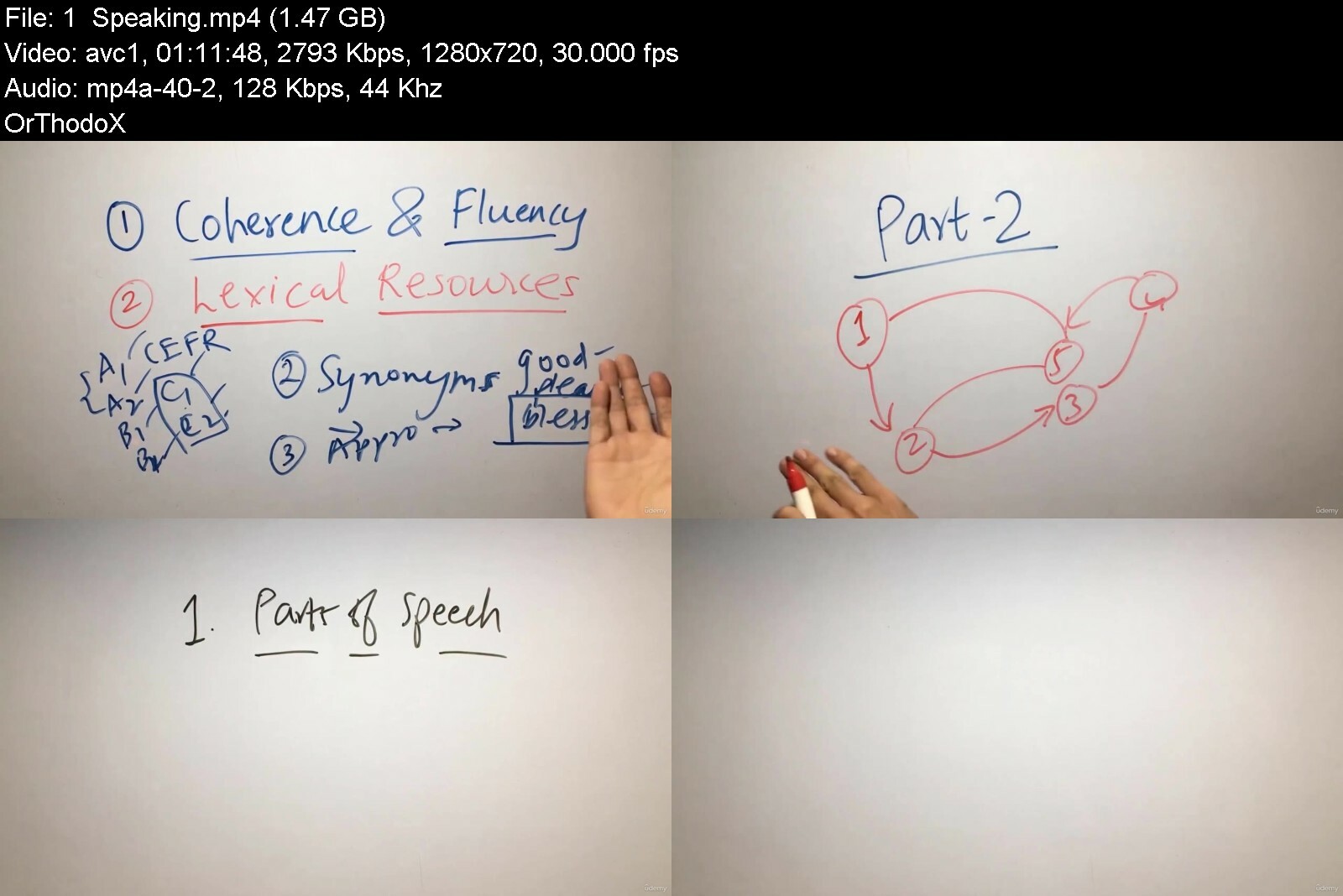
Lecture 33 Patient Profile Sheet

Lecture 34 Pain Medications

Lecture 35 Part-Fills

Lecture 36 Logged prescriptions, OCP and Pharmacist A or B

Lecture 37 Drug Interactions

Section 5: Part 4 ******** Math, Insurance, Online Pharmacies

Lecture 38 ******** Math 1

Lecture 39 ******** Math 2

Lecture 40 Insurance Cards and Adjudication

Lecture 41 Safe Online Pharmacies

Lecture 42 ******** Math 3

Lecture 43 Introduction to Non-Sterile Compounding

Lecture 44 Compounding Calculations

Lecture 45 OCP

Lecture 46 Asthma Medications

Lecture 47 Licensed Natural Health Products

Lecture 48 Drug Advisories

Lecture 49 Migraine Headaches

Lecture 50 ******** Math 4

Lecture 51 ******** Math 5

Section 6: Part 5 ******** Basics 3

Lecture 52 Birth Control

Lecture 53 Prescription Repeats

Lecture 54 Drug Dosage Forms - Tablets

Lecture 55 CPS

Lecture 56 GERD

Lecture 57 Prescription Transfers

Lecture 58 Prescription Transfer Mistakes

Lecture 59 Medications for Depression

Lecture 60 Pronouncing Drug Names

Lecture 61 Intervention Codes

Lecture 62 Blister Packaging

Lecture 63 Medications for Diabetes

Lecture 64 Off-Label Uses of Prescription Drugs

Section 7: Part 6 ******** Basics 4

Lecture 65 Dose Calculations by Weight Part 1

Lecture 66 Dose Calculations by Weight Part 2

Lecture 67 Dose Calculations by Weight Part 3

Lecture 68 Medications for Osteoporosis.

If you are curious about a career in ******** then this course is a good place to learn the concepts of ******** practice. If you need study information for ******** exams then your knowledge base is here. If you currently are a ******** professional then this course is an excellent review of ******** practices. Enrol and increase your knowledge of Canadian ******** practice.


********practiceincani1cmq.jpg


The IELTS 9.0 Masterclass (Complete)

ng5jfmhw0q049pgba9q4md5i1k.jpg


The IELTS 9.0 Masterclass (Complete)
Updated 07/2022
Genre: eLearning | MP4 | Video: h264, 1280x720 | Audio: AAC, 44.1 KHz
Language: English | Size: 5.20 GB | Duration: 26 lectures 10h 54m


What you'll learn
Discover how to boost your IELTS writing score to the highest level
Improve your chances of successfully living and working abroad
Possibility to achieve a band 8+/9.0 in the IELTS test
Learn new ideas on a variety of topics so you don't struggle for ideas


Requirements
It is recommend that you have a minimum English level before enrolling on this course
Understanding of the format of the IELTS exam is not mandatory, it is explained in the course (2022)

Description
Why is it helpful?

The IELTS 9.0 Masterclass offers easy to follow, step-by-step preparation that carefully builds your confidence and fluency. This is your complete IELTS preparation course (designed for Academic, can apply to General as well). Learn strategies, skills and methods to superpower your IELTS core and impress the examiner. Some images/ contents used in this course are under license: Creative Commons Attribution licence (reuse allowed).

What will you learn?

This course is appropriate for anybody aiming to achieve a band 8+ or even band 9 in the IELTS test, but, although challenging, it will also be appropriate for anybody aiming to achieve a band atleast 6.5 (university requirement). Topics covered

- Listening

- Reading

- Writing (Academic & General)

- Speaking

We'd recommend having a minimum English level of B1 before signing up. Over the duration of the course, your writing knowledge will expand as you learn a wealth of new words and expressions for many different topics, and your grammatical capabilities will improve as you see how written grammar is used in practice. Learn new ideas on a variety of topics so you don't struggle for ideas in the test.

Course structure

Learn the methods to supercharge your IELTS skills. Increase your IELTS confidence and score upto 9.0. Each lesson starts with a video lecture where you re presented with new vocabulary, its pronunciation, word forms, and example sentences. Videos range from about 30-40 minutes in length.

Instructor support

As part of the course, The Learnitive will provide constant support to all my students through the timely answer to all exam-related questions. Students can contact me via course messages or email.

Who this course is for
Students who want to learn how to get a high score (Band 9) in the IELTS Writing test
Although this course is aimed at those who need a higher band 9.0 in IELTS, it will also help those trying to get a 8+.


theielts9.0masterclashmd43.jpg


Theme Park Design

ev6jgyas13pr7ohwi7vpvqwer8.jpg


Theme Park Design
Last updated 3/2021
MP4 | Video: h264, 1280x720 | Audio: AAC, 44.1 KHz
Language: English | Size: 5.60 GB | Duration: 6h 28m

Learn how to become an Imagineer!


What you'll learn
Learn how to become an Imagineer
Learn the secrets of great attraction design
Find the theme park job that's best for you
Peek behind the scenes at the world's theme parks
Experience the thrill of opening a new ride
Explore backstage theme park technology
Learns tips for finding a theme park design job

Requirements
A passion for theme parks!

Description
If you want to design theme parks for a living, here's the class that shows you how! It's a fun class for everyone. You'll explore: art direction story writing themed architecture ride control show control audio and video lighting mechanics and hydraulics animatronics Steve Alcorn is the CEO of Alcorn McBride Inc., the company the engineers products for all of the world's major theme parks. Steve began his career by helping to design Epcot. Since then he has designed equipment for hundreds of rides and shows, and thousands of other attractions, all over the world. In this course you'll lean first hand from him, what it takes to become an Imagineer, and what all the different specialties there are in the field of theme park design. (Steve also hosts a non-video workshop where you can design your own attraction with his guidance. Read more about it at ) In Theme Park Design you'll learn: "Blue Sky" Brainstorming Conceptual Attraction Design Project Management Architecture and Structural Considerations Mechanical Engineering for Rides Safety and Monitoring Techniques Ride Control Engineering Show Systems Design Audio Video Systems Special Effects Whole Park Infrastructure Merchandise and Food Service Planning Test and Adjust Processes How to Find Theme Park Design Jobs Enrolling in Theme Park Design is like signing up for the crazy roller coaster ride that every theme park project turns into. Along the way you'll experience all the thrills, spills and chills of creating a new attraction and opening it to your guests! You'll also receive: lists of companies that do theme park design industry trade organizations roller coaster, haunted houses and attraction links tips on how to find jobs in the theme park industry Theme Park Design is open to everyone with a sincere interest in theme parks and a desire to have fun. Enroll today, and let Steve Alcorn show you how to become an Imagineer!

Overview

Section 1: The World of Theme Parks

Lecture 1 Welcome

Lecture 2 Demographics

Lecture 3 Operations

Lecture 4 Imagineers

Lecture 5 Rides

Lecture 6 Shows

Lecture 7 Other Attractions

Section 2: The Creative Process

Lecture 8 Concept

Lecture 9 Why Story is King

Lecture 10 Fitting Story to Audience

Lecture 11 A Dose of Reality

Lecture 12 Brainstorm

Lecture 13 Directors and Producers

Lecture 14 Writers

Lecture 15 Artists

Lecture 16 Media Design

Lecture 17 Blue Sky

Section 3: Design

Lecture 18 Design

Lecture 19 Construction

Lecture 20 Commissioning

Lecture 21 Meet the Engineers

Lecture 22 Architectural, Mechanical, and Structural Engineers

Lecture 23 Ride, Show, Audio, Video and Lighting Engineers

Lecture 24 Systems and Project Engineers

Lecture 25 The Show Control Engineer

Lecture 26 Types of Show Control

Lecture 27 You Want Me to Control What?

Lecture 28 Monitoring, Safety and Maintenance

Lecture 29 Alone in the Dark

Lecture 30 The Ride Control Engineer

Lecture 31 All Things That Move

Lecture 32 Safety

Lecture 33 How to Get Free Beer

Lecture 34 Kisses in the Dark

Lecture 35 The AV Engineer

Lecture 36 Audio

Lecture 37 Video

Lecture 38 Keep it Sounding Good

Lecture 39 Heard Any Good Ones Lately?

Lecture 40 Into the Void

Lecture 41 Lighting and Special Effects

Lecture 42 Nuts and Bolts

Section 4: Opening

Lecture 43 Details, Details

Lecture 44 102

Lecture 45 Welcome to my Theme Park

Lecture 46 Disneyland

Lecture 47 Building a City

Lecture 48 Sweating the Details

Lecture 49 Designing a Whole Theme Park

Lecture 50 Other Markets

Section 5: Becoming an Imagineer

Lecture 51 Mickey's Ten Commandments

Lecture 52 How Do I Get That Job?

Lecture 53 A Wish List

Lecture 54 Parting Thoughts

Open to everyone interested in theme parks and how to create them


themeparkdesign0leow.jpg


How to do your first research project

fjwyrag6bwvs66bx3z3bxlkceu.jpg


How To Do Your First Research Project
Last updated 1/2022
MP4 | Video: h264, 1280x720 | Audio: AAC, 44.1 KHz
Language: English | Size: 5.82 GB | Duration: 4h 28m

A beginner's guide to planning, conducting and describing a qualitative research study


What you'll learn
How to plan and conduct a qualitative research study!
The difference between a research idea, research aim and research question
What a paradigm, epistemology and ontology are
The link between research paradigms, research questions and research methods
Different participant recruitment techniques and know how many participants are enough in a research study
The difference between research design, research methodology and research methods
Different research designs, methodologies and methods
The aims of qualitative data analysis
Similarities and differences between different approaches to qualitative data analysis
Inductive, deductive and abductive reasoning
Different forms of bias and know how to address them
How to increase validity of the findings
The importance of piloting a research study
What to put in the limitations, results and conclusions sections

Requirements
No research skills or experience are required

Description
This course is an essential resource for undergraduate, postgraduate and doctoral students, as well as anyone else undertaking a qualitative research project. Using practical examples, I take you through what should happen at various stages in the project's schedule, starting with developing your research idea, research aims and research questions, and ending with a discussion of what to put in the Conclusions chapter.I also explain the general research designs (e.g. Quantitative vs Qualitative research) and research methodologies (narrative research, ethnography, case study, grounded theory and phenomenology), as well as methods of data collection and analysis. I discuss a range of other elements of a qualitative research study (have a look at the course structure to explore it further) and provide down-to-earth explanations of the most confusing and complex terminology and issues related to research (e.g. how many participants/research methods are enough in a research study, what is, and how to increase validity, or what are philosophical worldviews and why are they so important).This relaxed, but also clear and professional approach is in fact what my students (both those virtual and real-life) like most about my instruction. Take a minute to explore the course content, and join me in the course - I have a feeling that you will like it!

Overview

Section 1: Introduction

Lecture 1 What is "research" and who needs it? Introduction to the course

Lecture 2 Differences between qualitative and quantitative research

Section 2: Thinking of your research questions

Lecture 3 Research idea, research aim and research questions

Lecture 4 Characteristics of "good" and "bad" research questions

Lecture 5 What do research questions say about the researcher and the design of the study?

Section 3: Considering worldviews, paradigms and philosophies

Lecture 6 What the %&^$ are you talking about? Introduction to paradigms and philosophies

Lecture 7 Positivism, Interpretivism, Pragmatism, Epistemology & Ontology

Lecture 8 Why are philosophical worldviews important in practice

Section 4: Recruiting the participants for your study

Lecture 9 Sampling techniques

Lecture 10 Recruitment criteria, homogenous and heterogenous samples

Lecture 11 How many participants are enough in a qualitative study?

Lecture 12 Friends or Participants? Recruiting friends and acquaintaces

Section 5: Considering your research methodology

Lecture 13 Defining research design, research methodologies and research methods

Lecture 14 Narrative inquiry

Lecture 15 Phenomenology

Lecture 16 Grounded Theory

Lecture 17 Ethnography

Lecture 18 Case study research

Section 6: Thinking of different data sources

Lecture 19 Introduction to data collection methods

Lecture 20 Unstructured, semi-structured and structured interviews

Lecture 21 Group interviews and focus groups

Lecture 22 Observation

Lecture 23 Diaries/Journals

Lecture 24 Various forms of documents

Lecture 25 Open-ended questionnaire responses

Lecture 26 Collecting Art for your research

Lecture 27 How many data collection methods should you have?

Section 7: What to do with the data that you have gathered - Qualitative Data Analysis

Lecture 28 Introduction to Qualitative Data Analysis (QDA)

Lecture 29 Overview of common approaches to data analysis (and certain problems with them)

Lecture 30 More general approaches to QDA

Lecture 31 A practical, 3-step guide to analyzing qualitative data

Lecture 32 Using software for QDA - is it worth it and which one to use?

Lecture 33 Deductive and Inductive approaches, the role of theory in qualitative research

Section 8: Other important considerations

Lecture 34 Ensuring that the findings are convincing and trustworthy - Validity in research

Lecture 35 To pilot or not to pilot? A final rehearsal before your main study

Lecture 36 Avoiding mistakes from the past - considering the ethics in research

Section 9: The write-up

Lecture 37 Considering the limitations of your study ... and learning to love them

Lecture 38 Describing the results of your study

Lecture 39 The big finale, or writing the Conclusion chapter

Section 10: Conclusions

Lecture 40 Congratulations and the final word

Lecture 41 BONUS LECTURE

Students who want to learn about qualitative research,Professionals who want to conduct research in their workplace,Teachers who want to have a clear resource for teaching about qualitative research,Anyone interested in qualitative research


howtodoyourfirstresea0sfo5.jpg


Industrial Advanced Process Control Design and Optimization

cve3bnsk4nugmohbiitzqyefh5.jpg


Industrial Advanced Process Control Design And Optimization
Last updated 6/2022
MP4 | Video: h264, 1280x720 | Audio: AAC, 44.1 KHz
Language: English | Size: 6.37 GB | Duration: 13h 5m

Utilize powerful features of the DCS and PLC


What you'll learn
Learn how to design and build powerful controllers in the DCS/PLC.
Learn PID tuning, feedforward implementation, and parameter specification for all types of DCS/PLC controllers.
Learn how to precisely calculate tuning and other DCS parameters, eliminating guesswork and producing precise, optimized control action.
Learn how to be cautious when activating and commissioning new control schemes, avoiding errors, and initiating a control chain in the correct order.
Recognize when to utilize traditional advanced control and when to utilize multivariable model-predictive control.
Learn how to study a process and its P&IDs and confidently talk to the right people in the plant or control room.

Requirements
Course on Primary Process Control and Tuning that explains the fundamentals required for this Course. Course can be found on our Udemy profile.
2-year or 4-year degree in engineering or operations. A few months of plant/ engineering experience is desirable, but not required.

Description
The DCS and PLC have many powerful features that still remain under-utilized. This course shows you how to tune PIDs and build powerful optimizing controllers inside the DCS or PLC. During the course, we use several industrial process control software products Pitops, Simcet, Process Control CBT and ACSSI.The course assumes that attendees have completed PID100 course (PID100 is a prerequisite for this APC200 course).Attendees use real time-series plant data and identify multivariable closed-loop/open-loop dynamics. Then they build various control schemes all inside Pitops software cascade, constraint override, maximizing and minimizing constraint controllers, selectors, model-based controllers, dead-time compensators and many others.This course is designed more for engineers but also will offer tremendous value to operators, technicians and supervisors. PiControl software products used in this course are so very easy to use that the course can be comfortably followed by even new and inexperienced technicians. This course also covers advanced functions of PID controllers in more detail.Learning outcomes:At the end of the course, attendees will be able to study a process and its P&IDs and talk to the right people in the plant or control room and then design and build powerful controllers in the DCS/PLC. Attendees will become skilled in PID tuning, feedforward implementation, and parameter specification for all types of controllers in the DCS/PLC.Further, using scientific process control methods and software products they will be able to calculate tuning and other DCS parameters precisely, thus eliminating guesswork and generating precise, optimized control action.The course also trains attendees on how to be careful while activating and commissioning new control schemes, avoiding mistakes, and starting up a control chain in the right sequence.This course is all you will ever need to use the full potential of the DCS or PLC and build powerful new controllers to stabilize plant operation and push against economic, market, process, and equipment constraints. Attendees will also learn when to use traditional advanced control and when to use multivariable model- predictive control, a very practical and useful skill. The following topics are covered in this course:process Control HierarchyAdvanced Process Control (APC) Options and Strategies Need for Automatic Process ControlBenefits of Process ControlHow to Maximize Throughput and Minimize Utilities using APC Feedforward Control Theory and CalculationsFeedforward Lab Session using Pitops Decoupler StrategiesAdvanced Cascade ControlCascade Control Lab Session Illustrating an AC-TC Triple Cascade Cascade Control Tuning GuidelinesConstraint Override Selector Control Procedures and CalculationsHow to build correct DCS Configuration for Long Chain Control Schemes Startup and Chain Activation Procedures in the DCSPractical Rules and Tips for PID and APC SchemesModel-based ControlBias Update for Automatic Control Closed-Loop DynamicsGC-based Online Correction, PV Sample HoldUsing Rigorous Models for Closed-Loop Advanced Control with PID Integration Dead-Time CompensationInternal Model-Based Control and Lab Session Internal Model-Based Control Identifying Process Dynamics based on Operator Experience and Knowledge Identifying Process Dynamics based on DCS Trends and Historical DataContinue Lab (Practical) Sessions on System Identification and Tuning OptimizationIdentification of SISO Closed-Loop Process Transfer Functions Multi-Input Closed-Loop Transfer Function IdentificationIdentifying Process Dynamics based on analyzing actual Time-Sampled DataLab Session using Pitops to identify first and second order transfer functions using real plant data Use Pitops to identify multivariable transfer functions using real plant data in closed-loop mode Model-Predictive ControlWhen to use PID, Cascade PID, Advanced Regulatory, DMC, RMPCT, Rule-Based Control Identifying, Debugging, and Troubleshooting PID Tuning and Process Control Problems Online PID/APC Control Quality Monitoring and ReportingOnline Oscillation Detection and Online Control Sluggishness DetectionPID Control Quality Alerting to Smartphones for Improved Proactive Maintenance

Overview

Section 1: Introduction to Advanced Process Control

Lecture 1 Need and Benefits of Advanced Process Control

Section 2: Primary Process Control and PID Tuning Terminology Review

Lecture 2 Primary Process Control and PID Control Terminology

Section 3: Transfer Functions

Lecture 3 Transfer Functions - Advanced Concepts

Section 4: Nonlinear Processes and Adaptive Control

Lecture 4 Nonlinear Processes and Adaptive Contol

Section 5: Cascade Control Design

Lecture 5 Cascade PID

Lecture 6 PID Modes: Manual, Auto, Cascade

Lecture 7 PV Tracking, Anti-reset Windup, PID Equations and more

Section 6: Identification of Process Dynamics and why it matters

Lecture 8 Identification of Process Dynamics

Section 7: Constraint Control Strategies using Override Selectors

Lecture 9 Constraint Control Strategies using Override Selectors

Section 8: Feedforward Control

Lecture 10 Feedback and Feedforward control differences and Transfer Funciton calculations

Lecture 11 Important factors of Feedforward Control

Section 9: Ratio Control

Lecture 12 Ratio Control

Section 10: Dead Time Compensation

Lecture 13 Dead Time Compensation and Internal Model Control

Section 11: Decouplers

Lecture 14 Decouplers

Section 12: Inferential and Model-Based Control

Lecture 15 Continuous and Discrete Signals

Lecture 16 Inferential and Model-Based Control

Section 13: Split-Range Control

Lecture 17 Split-Range PID Control

Section 14: Average Temperature Control

Lecture 18 Average Temperature Control and other average variables

Section 15: Tuning and Troubleshooting Illustrations

Lecture 19 PID Tuning troubleshooting

Process Control Engineers, Advanced Process Control Engineers and Instrument Engineers,Lab Technicians and DCS/PLC Technicians,Managers and Supervisors


industrialadvancedproz8dgf.jpg


TTC - Secrets of Mental Math

mv5bztblmza2nmitnmiznzjilv.jpg


TTC - Secrets of Mental Math
MP4 | Video: h264, 1280x720 | Audio: AAC, 44.1 KHz, 2 Ch
Genre: eLearning | Language: English | Duration: 12 Lessons (6h 46m) | Size: 5.86 GB


Most of us, when faced with math problems like these, immediately reach for a calculator or a pen. But imagine if you could perform these and other seemingly difficult but surprisingly easy calculations right in your head. Seems like an impossible feat? It's not

Quick: What's 25 45? How about 742 300? Or 4821 9?
Most of us, when faced with math problems like these, immediately reach for a calculator or a pen. But imagine if you could perform these and other seemingly difficult but surprisingly easy calculations right in your head. Seems like an impossible feat? It's not.

One key to improving and expanding your math potential whether you're a corporate executive or a high-school student lies in the powerful ability to perform mental math calculations. Solving basic math problems in your head is a gateway to success in understanding and mastering higher mathematical fields such as algebra, statistics, and calculus. It's a skill that offers other lifelong benefits, including

giving you a competitive edge in school or at work;
keeping your mind active and sharp at any age;
improving your performance on standardized tests; and
learning to solve problems by using a variety of methods.
Mental mathematics also is valuable when you're shopping for groceries or figuring out how much to tip at a restaurant. And perhaps the best part? Learning how to do mental math can be fun especially when you're learning in the company of Professor Arthur T. Benjamin of Harvey Mudd College, one of the most engaging and entertaining members of The Great Courses faculty. The Secrets of Mental Math, his exciting new 12-lecture course, guides you through all the essential skills, tips, and tricks for improving and enhancing your ability to solve a range of mathematical problems right in your head.

Mental Math Made Simple

Mental math, as Professor Benjamin demonstrates, is not as daunting as it may seem. In fact, it's an ability you already have you just may not know it. Performing calculations in your head is all just a process of breaking down a large problem into simpler and simpler problems until it's finally reduced to a single answer.

Assuming no detailed knowledge of mathematics other than what you learned in elementary school, Professor Benjamin has designed The Secrets of Mental Math to be accessible to anyone looking to tap into or strengthen his or her mental calculating skills.

In the first part of the course, you focus on specific strategies for performing the basic nuts-and-bolts operations of mental mathematics.

Adding any two numbers up to three digits
Subtracting any two numbers up to three digits
Multiplying any two numbers up to two digits
Dividing any number by a number up to two digits
Dr. Benjamin fills each lecture with a wealth of practice problems to follow along with and get you engaged in the joys of mentally solving math problems.

Once you've gotten these four fundamental operations down, you then branch out into some interesting directions that continue to hone your mental math skills. Among the exciting skills you'll develop are

how to find approximate answers using the art of "guesstimation";
how to quickly find squares and square roots;
how to improve your memory for numbers (including phone and credit card numbers) by using a simple phonetic code;
how to approach enormous calculations with increased confidence and accuracy;
how to mentally determine the day of the week of any date in history; and
how to do rapid pencil-and-paper mathematics in ways seldom taught in school.
And his accompanying course guidebook is filled with additional problems you can use to practice your newfound skills.

Discover Valuable Mathematical Tips and Techniques

Throughout The Secrets of Mental Math, Professor Benjamin leads you through some fun and memorable techniques for tackling specific mathematical calculations. Here's an example of one strategy he calls "Create a Zero, Kill the Zero," helpful for determining the divisibility of any odd number that doesn't end in 5.

Is 1232 a multiple of 7?

Start by adding or subtracting a multiple of 7 to create a 0 at the end (1232 + 28 = 1260).
Kill the 0 from the new number (1260 becomes 126).
Add or subtract a multiple of 7 to create another zero at the end (126 + 14 = 140), then kill the 0 at the end.
Determine whether the new number is a multiple of the original divisor (yes, it's 14).
Thus, 1232 is a multiple of 7.
An Encouraging, Rewarding Look at Numbers

But you'll get more than just fun strategies to help make mental math easier. Learning with Professor Benjamin is like having a supportive coach right by your side someone to encourage you, challenge you, and instill mathematical confidence in you. It's this same teaching method that has won him a host of prestigious awards from the Mathematical Association of America, including the Deborah and Franklin Tepper Haimo Award for Distinguished College or University Teaching of Mathematics.

So prepare yourself for an unforgettable adventure in mental mathematics. Enjoyable, eye-opening, and immensely rewarding, The Secrets of Mental Math makes basic math quicker and easier than ever before. And it's a powerful way to take your first, more confident steps into the intriguing and undeniably fun world of numbers.

What Will You Learn?
Give yourself a competitive edge in school or at work and improve your performance on standardized tests.

Discover a simple trick that will let you mentally determine the day of the week of any date in history.

Quickly find squares and square roots.

Learn specific strategies for performing the nuts-and-bolts operations of mental mathematics.

Improve your memory for numbers (including phone and credit card numbers) by using a simple phonetic code.

Learn how to find approximate answers using the art of "guesstimation."


secretsofmentalmathi2din.jpg


Deutsch B1 - Der Beste Deutschkurs Online

lzk3yghej2lohellulhlxdyclg.jpg


Deutsch B1 - Der Beste Deutschkurs Online
Zuletzt aktualisiert am 2/2022
MP4 | Video: h264, 1280x720 | Audio: AAC, 44.1 KHz
Language: Deutsch | Size: 5.32 GB | Duration: 6h 19m

Lernen Sie Deutsch mit einem Muttersprachler und ausgebildetem Deutschlehrer ( ber 10 Jahre Erfahrung)


What you'll learn
die komplette B1 Grammatik
wichtiger Wortschatz vom B1 Niveau
Infinitiv mit zu
Wechselpr positionen
zweiteilige Konnektoren
Reflexivpronomen im Akkusativ und Dativ
Relativpronomen
Genitiv
Pr teritum
die Konnektoren trotzdem vs obwohl + weil vs deshalb
Konjunktiv II
Passiv
die Konnektoren seitdem + bis
die Konnektoren um...zu / damit
Verben + Pr positionen
Pronominaladverbien
Verben mit zwei Objekten
Indefinitpronomen
Plusquamperfekt
Adjektivdeklination mit Artikeln (bestimmt + unbestimmt)
Adjektivdeklination ohne Artikel
Passiv mit Modalverben
N-Deklination
Relativs tze
Partizip I + Partizip II als Adjektiv

Requirements
Du solltest schon ber Grundkenntnisse der deutschen Grammatik verf gen (A1+A2)

Description
Hi Leute!In diesem Kurs behandeln wir die komplette B1-Grammatik. Alle bungen und Beispiele stammen von mir selbst und ich habe ber ein Jahr gebraucht, um diesen Kurs fertigzustellen.Insgesamt gibt es 24 Lektionen (HD-Qualit t) in denen wir jeweils ein Grammatikthema behandeln und dann auch zusammen in den Videos bungen machen. So bekommt ihr das Gef hl, als ob ihr live mit mir im Klassenraum sitzt.Zu jeder Lektion gibt es noch ein bungsvideo f r euch, in dem ihr das Gelernte testen k nnt. Diese bungsvideos enthalten viele wichtige Beispiele und in ihnen wiederholen wir auch den wichtigen Wortschatz der Lektionen.Dazu gibt es f r jede Lektion Hausaufgaben zum Runterladen. In den Hausaufgaben findet ihr:- Erkl rungen + Beispiele- bungen- WortschatztrainingEs gibt nat rlich auch eine korrigierte Version. Ihr k nnt also direkt pr fen, ob ihr die Aufgaben richtig gemacht habt oder nicht.Nach diesem Kurs solltet ihr alle grundlegenden Grammatikthemen der deutschen Sprache beherrschen, sodass ihr direkt mit einem B2-Kurs weitermachen k nnt. In diesem Kurs arbeite ich mit einem Mix aus Untertiteln (Englisch/Deutsch) und auch Stellen, wo es keine Untertitel gibt. Dies ist besonders wichtig, weil ihr dann auch euer H rverst ndnis verbessern k nnt.Ich freue mich darauf, euch bald als Sch ler zu begr en.Liebe Gr eBenjamin

Overview

Section 1: B1.1 Lektion 1 - Infinitiv mit zu

Lecture 1 Infinitiv mit zu

Lecture 2 bungsvideo

Section 2: B1.1 Lektion 2 - Wechselpr positionen

Lecture 3 Wechselpr positionen

Lecture 4 bungsvideo

Section 3: B1.1 Lektion 3 - zweiteilige Konnektoren

Lecture 5 zweiteilige Konnektoren

Lecture 6 bungsvideo

Section 4: B1.1 Lektion 4 - Reflexivpronomen im Akkusativ + Dativ

Lecture 7 Reflexivpronomen im Akkusativ + Dativ

Lecture 8 bungsvideo

Section 5: B1.1 Lektion 5 - Relativpronomen im Akkusativ + Dativ

Lecture 9 Relativpronomen im Akkusativ + Dativ

Lecture 10 bungsvideo

Section 6: B1.1 Lektion 6 - Genitiv

Lecture 11 Genitiv

Lecture 12 bungsvideo

Section 7: B1.1 Lektion 7 - Pr teritum

Lecture 13 Pr teritum

Lecture 14 bungsvideo

Section 8: B1.1 Lektion 8 - trotzdem vs obwohl + deshalb vs weil

Lecture 15 trotzdem vs obwohl + deshalb vs weil

Lecture 16 bungsvideo

Section 9: B1.1 Lektion 9 - Konjunktiv II

Lecture 17 Konjunktiv II

Lecture 18 bungsvideo

Section 10: B1.1 Lektion 10 - Passiv Pr sens + Pr teritum

Lecture 19 Passiv Pr sens + Pr teritum

Lecture 20 bungsvideo

Section 11: B1.1 Lektion 11 - Konnektoren seitdem + bis und damit + um...zu

Lecture 21 Konnektoren seitdem + bis und damit + um...zu

Lecture 22 bungsvideo

Section 12: B1.2 Lektion 1 - Verben + Pr positionen

Lecture 23 Verben + Pr positionen

Lecture 24 bungsvideo

Section 13: B1.2 Lektion 2 - Pronominaladverbien

Lecture 25 Pronominaladverbien

Lecture 26 bungsvideo

Section 14: B1.2 Lektion 3 - Pronominaladverbien + Nebens tze

Lecture 27 Pronominaladverbien + Nebens tze

Lecture 28 bungsvideo

Section 15: B1.2 Lektion 4 - Verben mit zwei Objekten

Lecture 29 Verben mit zwei Objekten

Lecture 30 bungsvideo

Section 16: B1.2 Lektion 5 - Pronomen

Lecture 31 Pronomen

Lecture 32 bungsvideo

Section 17: B1.2 Lektion 6 - Plusquamperfekt

Lecture 33 Plusquamperfekt

Lecture 34 bungsvideo

Section 18: B1.2 Lektion 7 - Konnektoren nachdem + bevor

Lecture 35 Konnektoren nachdem + bevor

Lecture 36 bungsvideo

Section 19: B1.2 Lektion 8 - Adjektivdeklination nach dem bestimmten/unbestimmten Artikel

Lecture 37 Adjektivdeklination nach dem bestimmten/unbestimmten Artikel

Lecture 38 bungsvideo

Section 20: B1.2 Lektion 9 - Adjektivdeklination nach 0-Artikel

Lecture 39 Adjektivdeklination nach 0-Artikel

Lecture 40 bungsvideo

Section 21: B1.2 Lektion 10 - Passiv Modalverben

Lecture 41 Passiv Modalverben

Lecture 42 bungsvideo

Section 22: B1.2 Lektion 11 - N-Deklination

Lecture 43 N-Deklination

Lecture 44 bungsvideo

Section 23: B1.2 Lektion 12 - Relativpronomen + Pr positionen + wo/was als Relativpronomen

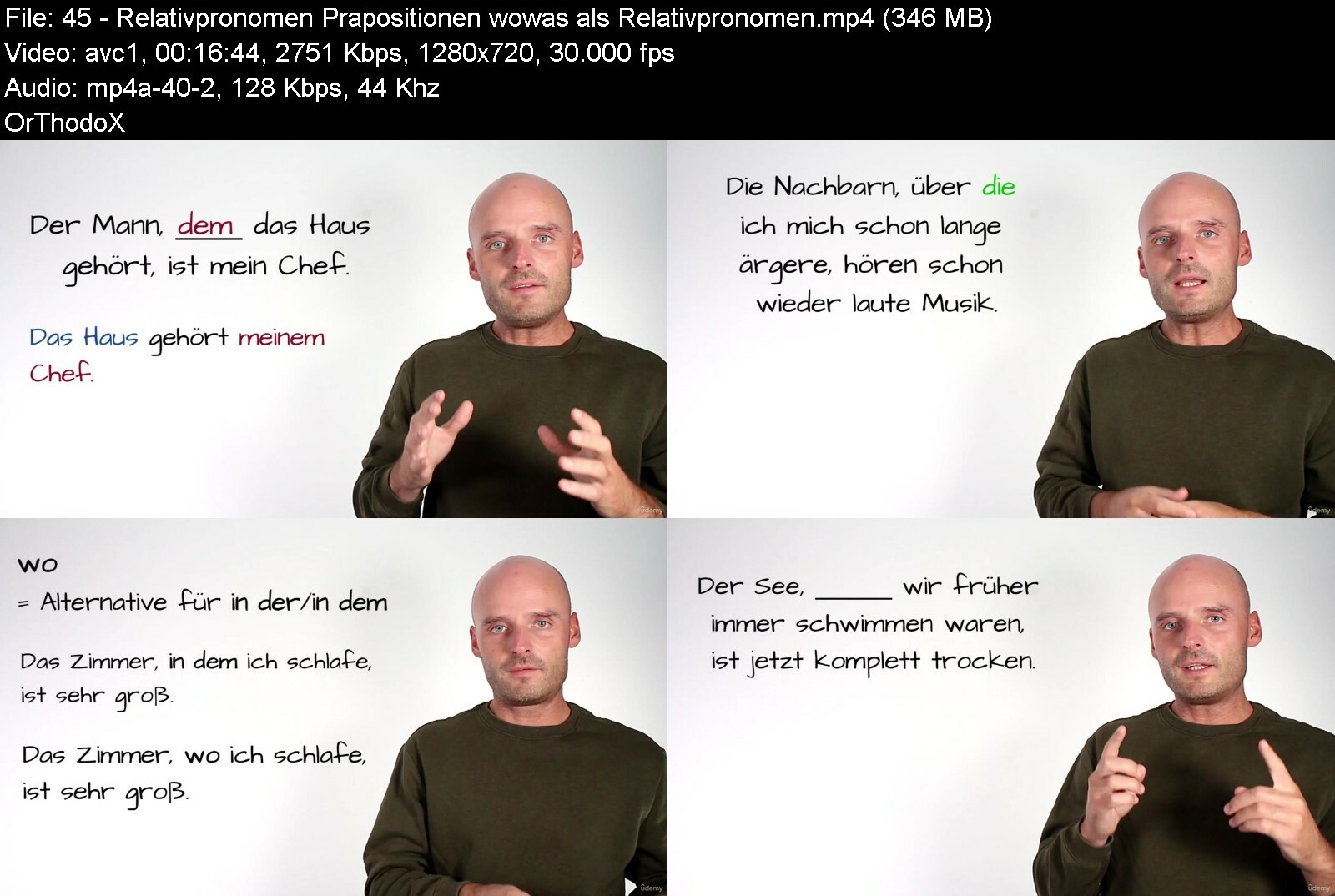
Lecture 45 Relativpronomen + Pr positionen + wo/was als Relativpronomen

Lecture 46 bungsvideo

Section 24: B1.2 Lektion 13 - Partizip I + II als Adjektiv

Lecture 47 Partizip I + II als Adjektiv

Lecture 48 bungsvideo

Dieser Kurs richtet sich an alle, die ihre Sprachkenntnisse erweitern und endlich die komplizierte deutsche Grammatik verstehe m chten.


deutschb1derbestedeut0zd04.jpg


Missile and Rocket Simulations in C++

48045127bf5g7ihs.jpg


Missile and Rocket Simulations in C++
Published 07/2022
MP4 | Video: h264, 1280x720 | Audio: AAC, 44.1 KHz, 2 Ch
Genre: eLearning | Language: English + srt | Duration: 17 lectures (13h 9m) | Size: 6.25 GB


Your Virtual Test Range


What you'll learn
Discover how high-fidelity missile and rocket simulations are built
Fly over the 'flat earth' and the 'WGS84 ellipsoidal earth' in six degrees-of-freedom
Model aerodynamics in aeroballistic and body axes
Stabilize and control airframes with autopilots
To improve INS navigation with GPS and star-trackers
Code IR and RF seekers with their error sources
Use proportional guidance to attack targets
Insert rocket boosters into orbit
Conduct Monte Carlo simulations to analyze miss distance
Establish footprints for air-to-ground missiles
Create launch envelopes for air-to-air missiles
Model your missile and rocket concepts in C++ based on the four prototypes
Conduct virtual flight tests on your computer

Requirements
You should come with a good understanding of aerodynamics, guidance and control, and C++ programming

Description
Take your missile or rocket to your virtual test range, that is your computer. Before you do, take my course and learn all about how to model missiles and rockets at fidelities that approach the real world with its six-degrees-of-freedom and uncertainties. Start with my C++ simulations and modify them for your concepts.

I provide you with four prototypes: air-to-ground missile, air-to-air missile, surface-to-air-missile, and surface-to-space rocket. You should come prepared with a solid foundation in aerodynamics, guidance and control, and C++ programming. Then study my 17 lectures and do the 24 exercises, using my four C++ simulations.

The air-to-ground missile with its IR seeker is either locked on the target before launch or is given target coordinates after launch by the aircraft via data link for midcourse guidance. The target can move and maneuver on the ground. The missile s aerodynamics are modeled in aeroballistic axes, and its autopilot consists of roll-, rate- and acceleration controllers. Proportional guidance, driven by the IR seeker, is used to home into the target. You will explore its performance with my AGM6 simulation, plot trajectories and create performance footprints.

With the air-to-air missile you protect the launch aircraft against an incoming missile. Here you study how missiles and aircraft are modeled with different fidelities. The self-protection missile is modeled in 6 DoF, the attacking missile in 5 DoF, and the aircraft in 3 DoF. Aerodynamics and autopilots are structured accordingly. Full 6 DoF aerodynamics in body axes for the self-protection missiles with full-up autopilot, IR seeker, and compensated pro-nav. The 5 DoF attacking missile is provided with trimmed aerodynamics, a simplified autopilot, and a kinematic seeker, while the 3 DoF aircraft is simply described by lift-slope and wing-loading, open-loop maneuvering, and a radar that tracks the incoming missile. You task will be, using my AAM6 simulation, to explore the launch envelope of the self-protection missile and its intercept accuracy.

Now I reverse the scenario and launch surface-to-air missiles against incoming short-range ballistic rockets and aircraft. Their ground radar serves to acquire and track the targets until they are within the acquisition range of the missiles for launch. Either IR or RF seekers will track the targets in the terminal engagement. I demonstrate the multi-object power of C++ by launching three missiles against three targets. Afterwards, you will follow my demonstrations by running the SAM6 simulation.

Finally, the surface-to-space rocket will take us to orbit. Our three-stage solid rocket booster has no control fins and is steered by thrust-vector control and reaction jets. To meet very stringent on-orbital conditions, an elaborate guidance scheme is used, based on the time-honored linear tangent guidance law. A key navigation part is the inertial navigation system updated by GPS and star-trackers, requiring the use of the WGS84 ellipsoidal earth model. You will run my SSR6 simulation with all its noise sources in the Monte Carlo mode to determine the accuracy of the insertion in terms of its mean and bivariate elliptical distribution.

As you diligently attend my 17 lectures, do the exercises, and study the code, you empower yourself to host your own design in my CADAC++ framework and take it to your virtual flight test range.

Who this course is for
Aerospace engineers who conceptualize missiles and rockets
Control engineers to test their G&C designs in missile and rocket simulations
Graduate students to get hands-on experience with missile and rocket simulations
C++ developers to study high fidelity aerospace simulations
Faculty to enrich their curriculum with aerospace simulations


missileandrocketsimuloiish.jpg


Review of Radar Signal Received in Presence of Noise

4761106baafw7c15.jpg


Review of Radar Signal Received in Presence of Noise
Last Updated 07/2022 MP4 | Video: h264, 1280x720 | Audio: AAC, 44.1 KHz, 2 Ch
Genre: eLearning | Language: English + srt | Duration: 7 lectures (4h 54m) | Size: 5.4 GB


Noise and echo signal


What you'll learn
Understanding the importance of Matched Filter Receivers in Radars.
Identify the type of antenna for radar receiver.
Categorize the noise figure and noise temperature at receiver front end.
Select the suitable duplexer at Radar receiver.

Requirements
Basic knowledge of communication needed

Description
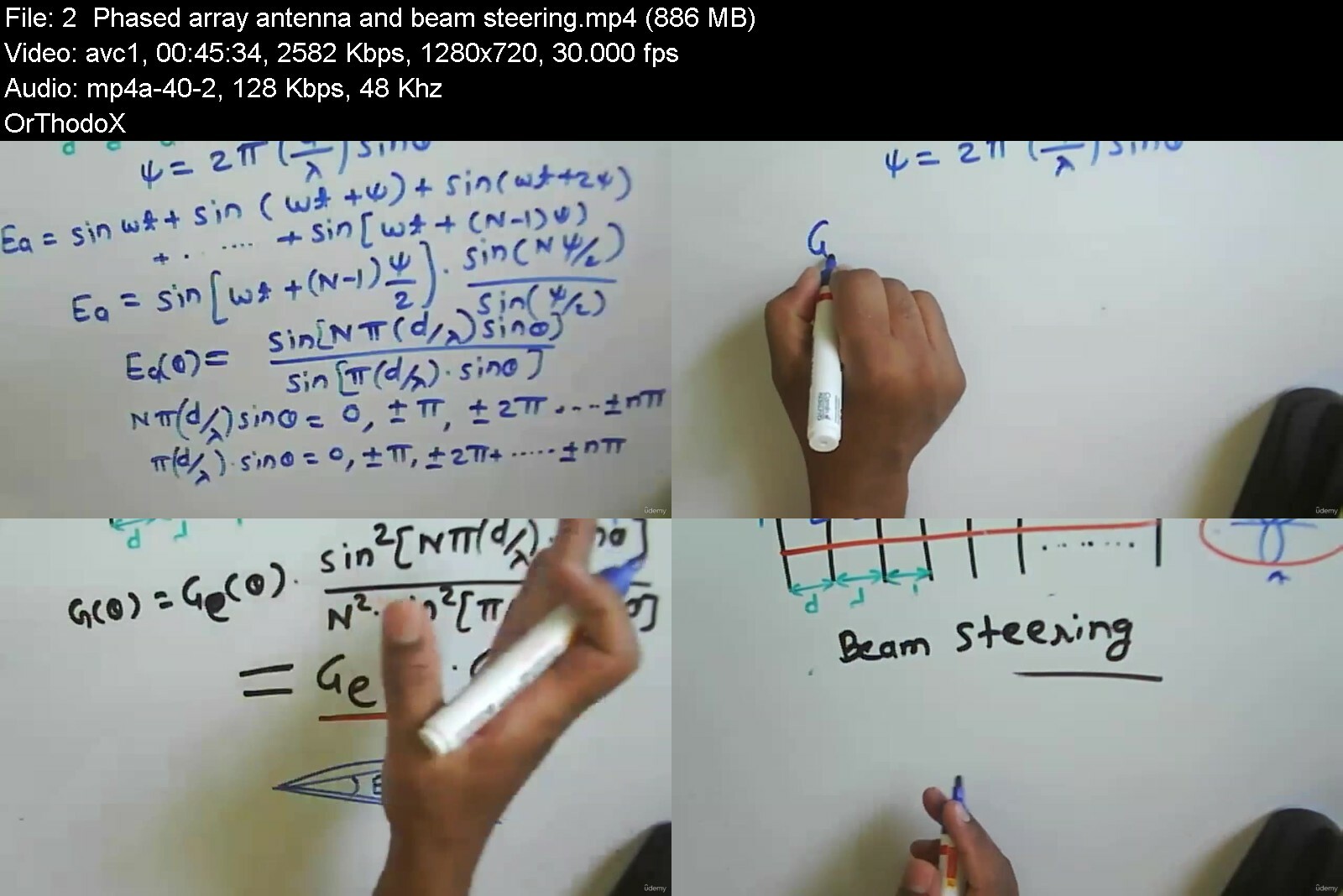
This course presents the radar receiver in brief. It contains the radar receiver components such as antenna, duplexer, filter etc. The signal received at radar receiver contains noise. The noise figure and noise temperature. The antenna used at radar receiver is discussed. Discussion of array antenna and its type such as broadband array antenna and end fire array antenna is explained in this course. The radiation pattern and beamwidth requirement is explained in this course. The phased array antenna basic concepts and radiation pattern is explained in this course, The antenna at receiver mainly needs beam steering and beamwidth variables for various applications. The advantages and limitations of phased array antenna is explained. The display types used at radar receiver discussed with suitable applications. The duplexers used in radar receiver is explained. The duplexer has two type branch type and balanced type, which is explained in detail with suitable diagram. This course introduces the matched filter receiver. The matched filter receiver derivation is explained with mathematical terms and elaborated for suitable use. Its characteristics and response are explained in this course. It describes the correlation function and cross correlation receiver. Efficiency of non-matched filter is elaborated in this course. It explains the matched filter with white and non-white noise in this course.

Who this course is for
Learner to understand the signal detection at radar receiver


reviewofradarsignalrem9d68.jpg


Vectors and Matrices

mathematical2520objecj6fqb.png


Vectors and Matrices
Published 07/2022
MP4 | Video: h264, 1280x720 | Audio: AAC, 44.1 KHz, 2 Ch
Genre: eLearning | Language: English | Duration: 23 lectures (16h 45m) | Size: 7 GB


Vectors in the plane and the space; Vector spaces; Matrix theory; Systems of linear equations


What you'll learn
Vectors in the plane and in the space: dot product and cross product of vectors; lines and planes; distances between points, lines, and planes
Vector spaces and spanning subspaces; linearly independence; basis; dimension
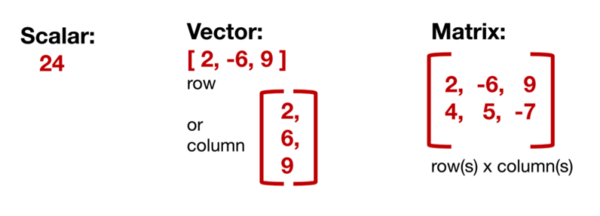
Matrix theory: operations on matrices; transpose of a matrix; invertible matrices; elementary row operations; diagonalization;
Systems of linear equations: matrix form of a system; elementary operations on systems of linear equations; determinants and Cramer's rule

Requirements
No college algebra is required

Description
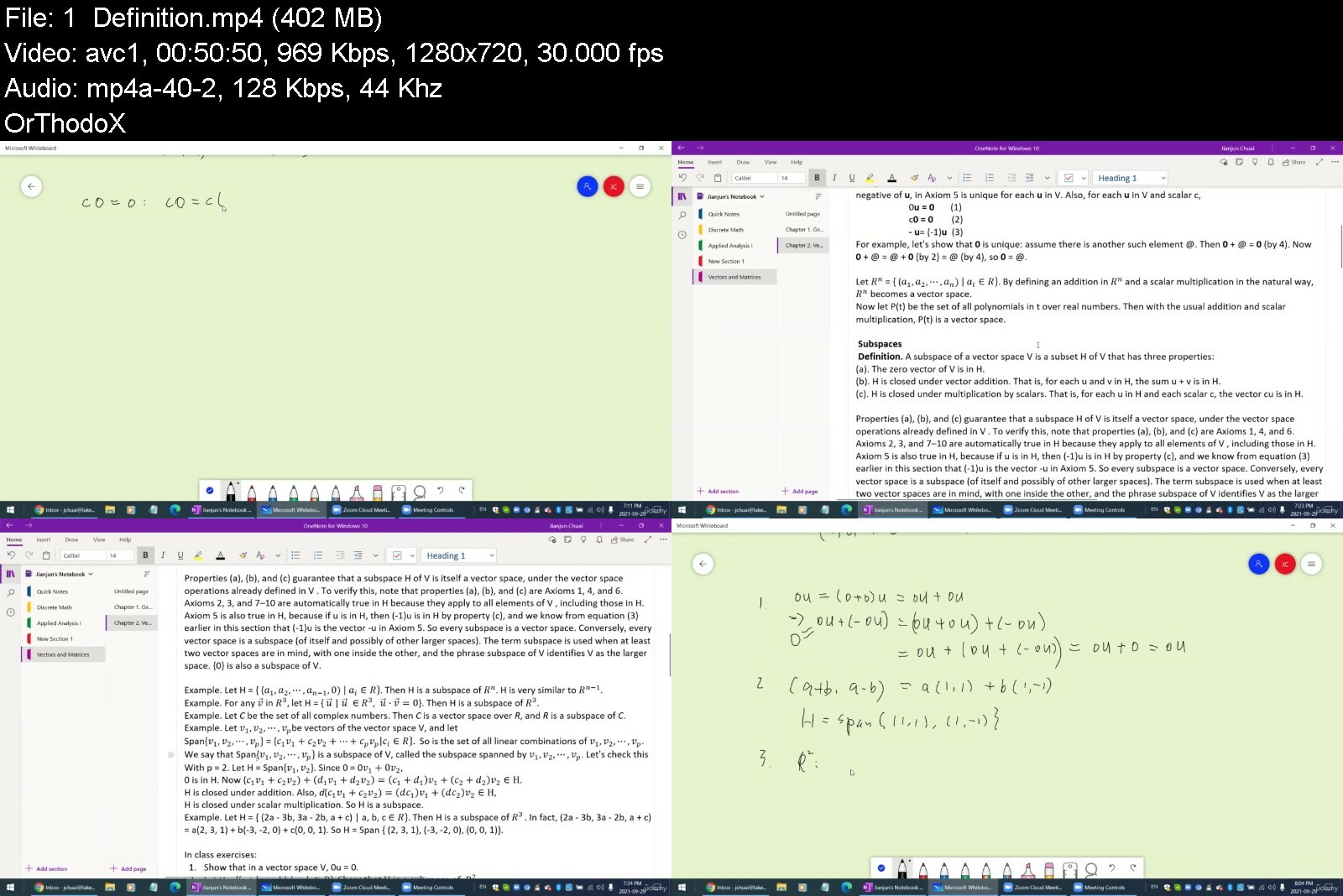
"Vectors and Matrices" is a one-term course for first-year undergraduate students containing the geometry of the plane and the space, and the most important part of linear algebra. It is taught through lectures and in-class exercises combined: in each class, I will first give a lecture, and then give one or two problems to be solved in class. No additional assignments are required. I taught this course in the Fall Semester of 2021, and all the students passed the course.

The course covers the following topics.

1. Vectors in the plane and the space: we will discuss dot product and cross product of vectors; equations of lines and planes; distances between points, lines, and planes.

2. Vector spaces: we will discuss subspaces and spanning subspaces; linear independence of vectors; the basis of a subspace; the dimension of a vector space.

3. Matrix theory: we will discuss operations on matrices (addition, subtraction, scalar multiplication, and multiplication of matrices); transpose of a matrix; invertible matrices; elementary row operations of matrices; eigenvalues and eigenvectors; diagonalization;

4. Systems of linear equations: we will discuss the matrix form of a system; elementary operations on systems of linear equations; determinants and Cramer's rule.

If you want to learn the most important part of linear algebra quickly, you are advised to take this course.

Who this course is for
Undergraduate students


vectorsandmatricesiyi9s.jpg


TTC - Reconsidering JFK

010223thumbs1emq.jpg


TTC - Reconsidering JFK
Released 07/2022
MP4 | Video: h264, 1280x720 | Audio: AAC, 44.1 KHz, 2 Ch
Genre: eLearning | Language: English | Duration: 12 Lessons (5h 59m) | Size: 5.13 GB


The John F. Kennedy presidency has an indelible hold on our imaginations. Even more than half a century later, we remain captivated by the charismatic young leader who promised us the moon, who remained steadfast in the face of nuclear catastrophe, who told us to ask not what your country...

The John F. Kennedy presidency has an indelible hold on our imaginations. Even more than half a century later, we remain captivated by the charismatic young leader who promised us the moon, who remained steadfast in the face of nuclear catastrophe, who told us to ask not what your country can do for you, but what you can do for your country and whose life was cut short by an assassination that remains shrouded in mystery.

Although so much ink has been spilled and so many films have been made about JFK, recent years have seen the public release of documents and interviews with the people who knew him best, shedding new light on a man who perhaps never fully revealed himself to anyone: the courageous soldier, the political neophyte, the stylish leader, the casual playboy. Who was JFK? And what do we know about his presidency now that it, too, has been abridged and romanticized by history?

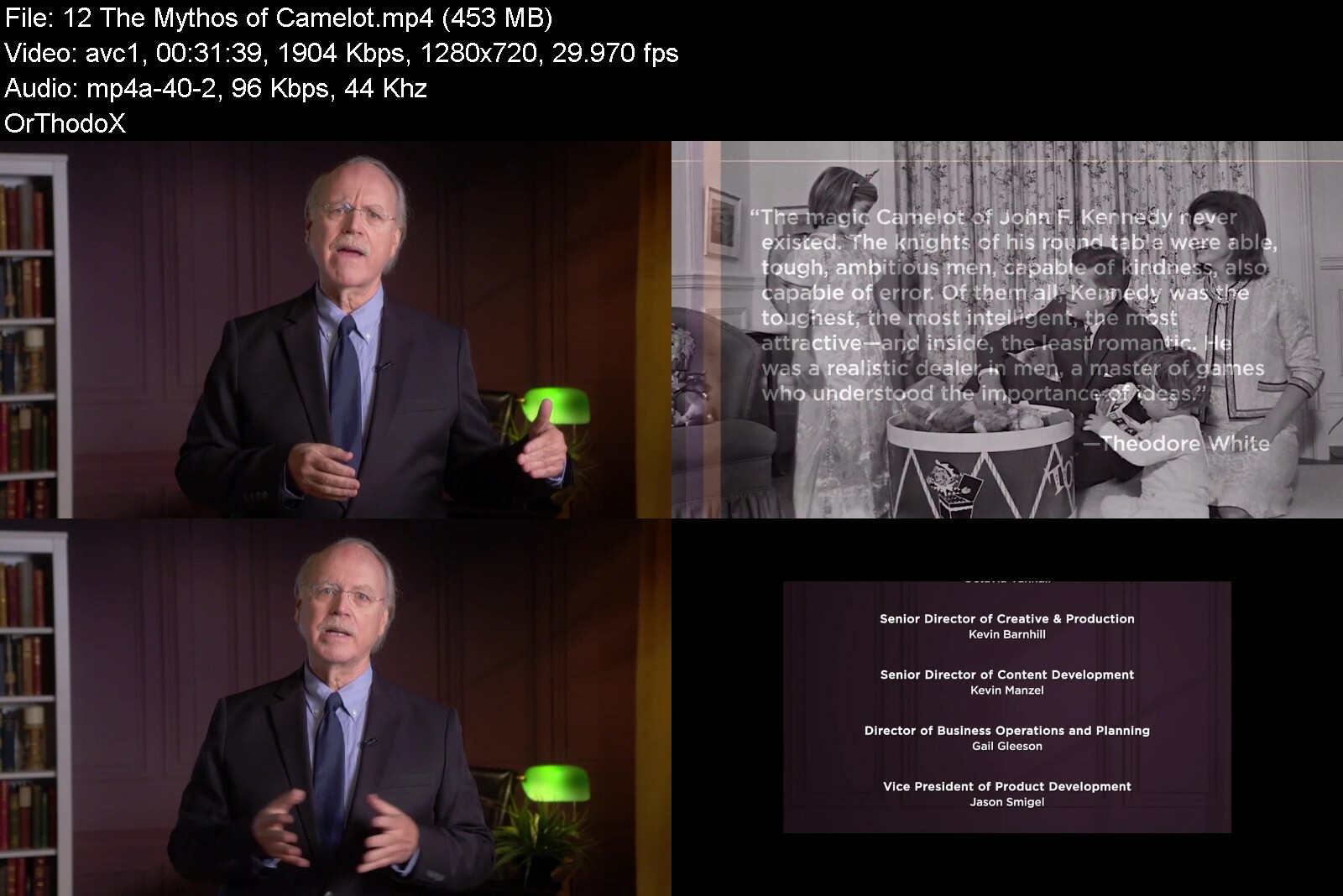
Reconsidering JFK is your chance to transport yourself back to a more innocent time in America, to a presidency mythologized in the romantic vision of Camelot. In these 12 in-depth lectures, Professor Michael Shelden of Indiana State University brings you the latest research and firsthand accounts to capture a fresh angle on a multifaceted, always fascinating American president.

Unlike most considerations of JFK, Professor Shelden takes you into the story through the eyes of people who experienced it. For instance, it is difficult to reflect on Kennedy s assassination in Dallas without also thinking about Lee Harvey Oswald and Jack Ruby, the CIA and the mob, the Zapruder film, and the grassy knoll.

But when you look at that fateful day through the eyes of those who lived it, a more fundamental question emerges: Why was JFK in Dallas to begin with? As you will discover through Professor Shelden s telling, political tensions in Texas threatened to split the Democratic Party apart. Here, you ll meet grumpy Lyndon Johnson, forced to go on a reconciliation tour, bickering with colleagues until the shots were fired.

Historians traffic in drama, focusing on the turning points that change the world forever. JFK s presidency certainly was a turning point, but what remains so compelling is the human drama behind events such as the Bay of Pigs or the Cuban Missile Crisis. Reconsidering JFK is a story of the human drama and the heart of the enigmatic man who changed the world.

The Rise of a Star

How did JFK become president? Although he came from a well-to-do and well-connected family, he was not the favored son to go into politics. As Professor Shelden recounts, young Jack in the 1950s was sickly and inexperienced, a war hero but also an unserious playboy. Most of all, he was part of a political establishment that expected young men to pay their dues.

Then, Professor Shelden takes you into the dramatic 1956 Democratic convention, where the young senator makes an astonishing showing, catching everyone off guard with his charisma and political savvy. You will see the wheeling and dealing that prevented him from achieving a place on Adlai Stevenson s ticket but also how this showing set young Jack up for a run at the presidency in 1960.

The human dramas surrounding JFK s rise are many, including

the role of mass media in building a candidate;
the nation s fears of a Catholic president;
the 1960 televised debates between Kennedy and Richard Nixon;
the tensions within the Democratic party between progressive New Englanders and southern segregationists; and
Kennedy s ability to mask his Addison s disease and project a winning image.
The Education of a President

What was the secret to his success as president? Projecting a winning image might get you elected, but once you become president you have to find a way to govern. In three short years, President Kennedy arguably faced more challenges, at home and abroad, than any president in the second half of the 20th century.

His first test came quickly, when the CIA armed a group of Cuban rebels and sent them off to storm a beach at the Bay of Pigs. Perhaps naively, Kennedy approved the invasion but then surprised almost everyone by resisting full-scale war with Cuba and by proxy, the Soviet Union. He may have been set up by hawkish Cold Warriors, but he showed resolve in resisting escalation.

The challenges didn t stop with the Bay of Pigs. Almost immediately, he was hit with problems around the world

rising tension in Vietnam, including a coup of President Diem;
labor negotiations with American corporate giants;
the Cuban Missile Crisis and the threat of nuclear annihilation;
the Civil Rights Movement and the urgent need for social change; and
hostile world leaders set on testing him any chance they could.
Uncover the interviews and documents to go inside the mind of Kennedy and his compatriots as they navigated a world in flux.

The Legacy of Camelot

In the days following Kennedy s assassination, his legacy began to take shape. Jacqueline Kennedy referred to their time in the White House as Camelot, implying JFK was a King Arthur knight errant. As a glamorous first lady, Jackie Kennedy certainly helped to build the mystique around this all-American couple.

But as you will learn, JFK was a master of compartmentalizing so that the range of people who knew him from Irish Catholics in Boston to Harvard friends to fellow sailors in World War II each saw a little something different. Now that 60 years have passed, we are able to examine the multiple shards of his identity and assemble a cohesive picture of a president easy to mythologize. Reconsidering JFK gives you a well-rounded character study of a compelling but flawed American icon.

What Will You Learn?
Get an inside look at the presidency of John F. Kennedy

Explore the political dynamics of the late 1950s to witness his rise to stardom

See how JFK navigated the Cold War as well as domestic trouble

Experience his optimistic vision for a better America

Reflect on his assassination and the legacy of Camelot


reconsideringjfkq6eyg.jpg


eBook


Zurück
Oben Unten