


• Regeln für den Video-Bereich:

    In den Börsenbereich gehören nur Angebote die bereits den Allgemeinen Regeln entsprechen.

    Einteilung

    - Folgende Formate gehören in die angegeben Bereiche:
    - Filme: Encodierte Filme von BluRay, DVD, R5, TV, Screener sowie Telesyncs im Format DivX, XviD und x264.
    - DVD: Filme im Format DVD5, DVD9 und HD2DVD.
    - HD: Encodierte Filme mit der Auflösung 720p oder darüber von BluRay, DVD, R5, TV, Screener sowie Telesyncs im Format x264.
    - 3D: Encodierte Filme von BluRay, die in einem 3D Format vorliegen. Dies gilt auch für Dokus, Animation usw.
    - Serien: Cartoon/Zeichentrick, Anime, Tutorials, Dokumentationen, Konzerte/Musik, Sonstiges sind demnach in die entsprechenden Bereiche einzuordnen, auch wenn sie beispielsweise im High Definition-Format oder als DVD5/DVD9/HD2DVD vorliegen. Ausnahme 3D.
    - Bereich Englisch: Englische Releases gehören immer in diesen Bereich.
    - Bereich Talk: Der Bereich, in dem über die Releases diskutiert werden kann, darf, soll und erwünscht ist.


    Angebot/Beitrag erstellen

    - Ein Beitrag darf erst dann erstellt werden, wenn der Upload bei mindestens einem OCH komplett ist. Platzhalter sind untersagt.
    - Bei einem Scenerelease hat der Threadtitel ausschließlich aus dem originalen, unveränderten Releasenamen zu bestehen. Es dürfen keine Veränderungen wie z.B. Sterne, kleine Buchstaben o.ä. vorgenommen werden. Ausnahme Serienbörse:
    - Bei einem Sammelthread für eine Staffel entfällt aus dem Releasename natürlich der Name der Folge. Beispiel: Die Simpsons S21 German DVDRip XviD - ITG
    - Dementsprechend sind also u.a. verboten: Erweiterungen wie "Tipp", "empfehlenswert", "only", "reup", usw. / jegliche andere Zusatzinformation oder Ergänzung, welche nicht in obiger Beschreibung zu finden ist.

    Aufbau des Angebots und Threadtitel

    Der Titel nach folgendem Muster erstellt zu werden. <Name> [3D] [Staffel] [German] <Jahr> <Tonspur> [DL] [Auflösung] <Quelle> <Codec> - <Group>
    Beispiel: The Dark Knight German 2008 AC3 DVDRip XviD - iND
    Beispiel: The Dark Knight 2008 DTS DL BDRip x264 - iND
    Beispiel: The Dark Knight 2008 AC3 DL BDRip XviD - iND
    Beispiel: The Dark Knight German 2008 AC3 720p BluRay x264 iND
    Beispiel: The Dark Knight 2008 DTS DL 1080p BluRay x264 iND
    Beispiel: Die Simpsons S01 German AC3 DVDRip XviD iND
    Beispiel: Die Simpsons S20 German AC3 720p BluRay x264 iND
    Beispiel: Sword Art Online II Ger Sub 2014 AAC 1080p WEBRip x264 - peppermint
    Entsprechend sind also u.a. verboten: Sonderzeichen wie Klammern, Sterne, Ausrufezeichen, Unterstriche, Anführungszeichen / Erweiterungen wie "Tipp", "empfehlenswert", "only", "reup", usw. / jegliche andere Zusatzinformation oder Ergänzung, welche nicht in obiger Beschreibung zu finden ist
    Ausnahmen hiervon können in den Bereichen geregelt sein.

    Die Beiträge sollen wie folgt aufgebaut werden:
    Überschrift entspricht dem Threadtitel
    Cover
    kurze Inhaltsbeschreibung
    Format, Größe, Dauer sind gut lesbar für Downloader außerhalb des Spoilers zu vermerken
    Nfo sind immer Anzugeben und selbige immer im Spoiler in Textform.
    Sind keine Nfo vorhanden z.B. Eigenpublikationen, sind im Spoiler folgende Dateiinformationen zusätzlich anzugeben :
    Quelle
    Video (Auflösung und Bitrate)
    Ton (Sprache, Format und Bitrate der einzelnen Spuren)
    Untertitel (sofern vorhanden)
    Hosterangabe in Textform außerhalb eines Spoiler mit allen enthaltenen Hostern.
    Bei SD kann auf diese zusätzlichen Dateiinformationen verzichtet werden.

    Alle benötigten Passwörter sind, sofern vorhanden, in Textform im Angebot anzugeben.
    Spoiler im Spoiler mit Kommentaren :"Schon Bedankt?" sind unerwünscht.


    Releases

    - Sind Retail-Release verfügbar, sind alle anderen Variationen untersagt. Ausnahmen: Alle deutschen Retail-Release sind CUT, in diesem Fall sind dubbed UNCUT-Release zulässig.
    - Im Serien-Bereich gilt speziell: Wenn ein Retail vor Abschluss einer laufenden Staffel erscheint, darf diese Staffel noch zu Ende gebracht werden.62
    - Gleiche Releases sind unbedingt zusammenzufassen. Das bedeutet, es ist zwingend erforderlich, vor dem Erstellen eines Themas per Suchfunktion zu überprüfen, ob bereits ein Beitrag mit demselben Release besteht. Ist dies der Fall, ist der bereits vorhandene Beitrag zu verwenden.
    - P2P und Scene Releases dürfen nicht verändert oder gar unter einem iND Tag eingestellt werden.


    Support, Diskussionen und Suche

    - Supportanfragen sind entweder per PN oder im Bereich Talk zu stellen.
    - Diskussionen und Bewertungen sind im Talk Bereich zu führen. Fragen an die Uploader haben ausschließlich via PN zu erfolgen, und sind in den Angeboten untersagt.
    - Anfragen zu Upload-Wünschen sind nur im Bereich Suche Video erlaubt. Antworten dürfen nur auf Angebote von MyBoerse.bz verlinkt werden.


    Verbote

    - Untersagt sind mehrere Formate in einem einzigen Angebotsthread, wie beispielsweise das gleichzeitige Anbieten von DivX/XviD, 720p und 1080p in einem Thread. Pro Format, Release und Auflösung ist ein eigener Thread zu eröffnen.
    - Grundsätzlich ebenso verboten sind Dupes. Uploader haben sich an geeigneter Stelle darüber zu informieren, ob es sich bei einem Release um ein Dupe handelt.
    - Gefakte, nur teilweise lauffähige oder unvollständige Angebote sind untersagt. Dies gilt auch für eigene Publikationen, die augenscheinlich nicht selbst von z.B. einer DVD gerippt wurden. Laufende Serien, bei denen noch nicht alle Folgen verfügbar sind, dürfen erstellt und regelmäßig geupdatet werden.
    - Untersagt sind Angebote, welche nur und ausschließlich in einer anderen Sprache als deutsch oder englisch vorliegen. Ausnahmen sind VORHER mit den Moderatoren zu klären.


    Verstoß gegen die Regeln

    - Angebote oder Beiträge, die gegen die Forenregeln verstoßen, sind über den "Melden"-Button im Beitrag zu melden.
  • Bitte registriere dich zunächst um Beiträge zu verfassen und externe Links aufzurufen.

*** Bestes IPTV *** bester Preis *** gratis Test ***


Englische Tutorials

Ms Office; Excel, Word, Access & Powerpoint 2019 - Beginners
iig1till5xzviap4bfp8bb1crd.jpg


Ms Office; Excel, Word, Access & Powerpoint 2019 - Beginners
Last updated 1/2022
MP4 | Video: h264, 1280x720 | Audio: AAC, 44.1 KHz
Language: English | Size: 14.48 GB | Duration: 33h 42m

Learn the essentials of Microsoft Office in this 4-course bundle for Office 365 or Office 2019 users.


What you'll learn
Learn the essential Microsoft Office Skills in this four-course bundle: Excel, Word, PowerPoint and Access
Learn practical methods to backup and recover your Excel spreadsheets and never lose data.
Effectively use autofill and flashfill so you are more productive in Microsoft Excel.
Discover the essentials of using formulas and functions in Excel
Discover how to create stunning charts and graphs in Excel
Learn practical methods to sort and filter your data in Excel
Discover new features in PowerPoint 2019 including Icons and 3D Models
Learn how to insert shapes, graphics and pictures to add some "zing" to your PowerPoint
Add charts, graphs and tables to your PowerPoint presentation information in a non-text format
Wow your audience by adding animations, audio and video to PowerPoint
Discover practical tips to present your PowerPoint presentation to your audience
Learn time saving techniques including how to copy slides, and exporting your presentation
Master the most common uses of Microsoft Word
Learn Word tools including using columns, indents, footers, borders and watermarks.
How to create a mail merge in Microsoft Word
Learn how to correctly Print envelopes and labels in Word
Learn to protect your Word document from changes
Insert professional pictures and graphics in your Word document
Make your Word documents look amazing by inserting and editing tables
Sorting information and running queries in Access
Navigating the Access 2019 interface
Discover how to into import data from Excel in Access
Learn Queries, use validations, how to create and print reports in Access
How to compact, repair and backup your Access database
How to create a linked table in Access

Requirements
Excel, Word, PowerPoint and Access installed on your machine. Preferably Office 2019 or Office 365

Description
**This course includes practice exercises and LIFETIME access**Learn Excel, PowerPoint, Access and Word 2019 with this tremendous value 4-course bundle from Office experts Simon Sez IT.Microsoft Office remains the go-to tool for the modern worker, yet so many workers don't utilize its full potential.We're here to make sure you aren't one of those people.In this Microsoft Office Beginners bundle, we make the four essential MS Office programs (Excel, Word, PowerPoint and Access) simple to understand. This bundle includes 4, full-length courses to help you achieve your goals.What's included?Excel 2019What's new in Excel 2019Creating workbooksEntering text, numbers and working with datesNavigating workbooksPage setup and print optionsWorking with rows, columns and cellsCut, Copy and PasteIntroduction to functions and formulasFormatting in Excel, including formatting cells and numbersCreating charts and graphsSorting and FilteringIntroduction to PivotTablesLogical and lookup formulas - the basicsPowerPoint 2019How to navigate around PowerPointPresentation dos and don'tsText and bullet edition optionsHow to use graphics, images, objects and shapesUsing SmartArtWorking with Charts and GraphsHow to utilize Master Slides and just how much time this could save youHow to add audio and video to a presentationAll about transitions between slidesAnimation, the animation pane and motion pathsSetting your slideshow optionsPresentation preparation and deliveryThe backstage area of PowerPoint including printing a presentationWord 2019How to get started with Word 2019Word 2019 basics including navigation, editing and savingCharacter formatting in Word including Format Painter and AutoCorrectHow to properly work with bullets and numbering in Microsoft WordAll about formatting paragraphs and managing listsWorking with Tables in Word including formatting, converting data and formulasPage appearance including page-breaks, watermarks and stylesAll about Sectioning a documentInserting graphics, pictures, shapes, icons and 3d models (new for 2019)How to work with envelopes and labelsAll about mail-merge and operating Word at scaleHow to create an Index or Contents pageReviewing and Printing in Word and Page SetupProtecting a Word document and basic macros in WordMicrosoft AccessWhere to start in Microsoft Access and whether to use a template or notHow to modify Access to suit your needsAll about importing data and the datasheet viewHow tables work in Access and how to create relationships between themCreating forms and sub-forms that feed data into your tablesHow to run queries in AccessSetting up validations and calculations using expressions in AccessPrinting from AccessTo start to use macros and Modal DialogThe basics of the Access web appExporting and reporting in Access***Exercise and demo files included***This bundle includes:29+ hours of video tutorials300+ individual video lecturesExercise files to practice what you learnedCertificate of completionHere's what our students are saying."Highly recommended this course to everyone.This is the best course i ever had. Good English that we can understand. Suberb..... I understood every lesson in the course."- Yunesh Garusinghe"I really love the way you describe all the things. the language of the instructions were really simple. I really gain a new knowledge and understanding from this course. I am really looking forward to apply this all in my work. Thank you."- Cavin Macwan"Nervous at first, had no idea how to do or work it . The instructor made it easy to follow along!"- Coreen TeohDid you know?Simon Sez IT teaches all sorts of software, including:- Microsoft Excel- Microsoft PowerPoint- Microsoft Word- Microsoft Project- Microsoft Outlook- QuickBooks- Photoshop Elements- Web Development Languages- And so much more!

Overview

Section 1: Excel 2019: Introduction

Lecture 1 Intro to Excel

Lecture 2 WATCH ME: Essential Information for a Successful Training Experience

Lecture 3 Course Exercise Files

Lecture 4 Downloadable Course Transcripts

Lecture 5 What's New In Excel 2019

Lecture 6 Course Overview

Lecture 7 Overview of the Excel window

Lecture 8 Mouse-Features

Lecture 9 Back Stage View

Section 2: Excel 2019 Beginner: Creating Workbooks

Lecture 10 Entering Text and Numbers

Lecture 11 Creating Basic Formulas

Lecture 12 Relative References

Lecture 13 Order of Operations

Lecture 14 Working with Ranges

Lecture 15 Module 2 - Practice Exercise

Section 3: Excel 2019 Beginner: Saving Workbooks

Lecture 16 Working with the-Save and Save As Commands

Lecture 17 File Extensions, Share, Export and Publish Files

Lecture 18 Module 3 - Practice Exercise

Section 4: Excel 2019 Beginner: Navigating Workbooks

Lecture 19 Opening a File

Lecture 20 Working with Larger Files

Lecture 21 Freeze Panes Option

Lecture 22 Split Screen Option

Lecture 23 Module 4 - Practice Exercise

Section 5: Excel 2019 Beginner: Page Setup & Print Options

Lecture 24 Headers and Footers

Lecture 25 Print Titles

Lecture 26 Comments

Lecture 27 Page Setup Options

Lecture 28 Fit to Print on One Page

Lecture 29 Printing Workbooks

Lecture 30 Module 5 - Practice Exercise

Section 6: Excel 2019 Beginners: Working with Rows, Columns and Cells

Lecture 31 Adding and deleting rows columns and cells

Lecture 32 Changing Column and-Row Widths

Lecture 33 Module 6 - Practice Exercise

Section 7: Excel 2019 Beginners: Moving Data

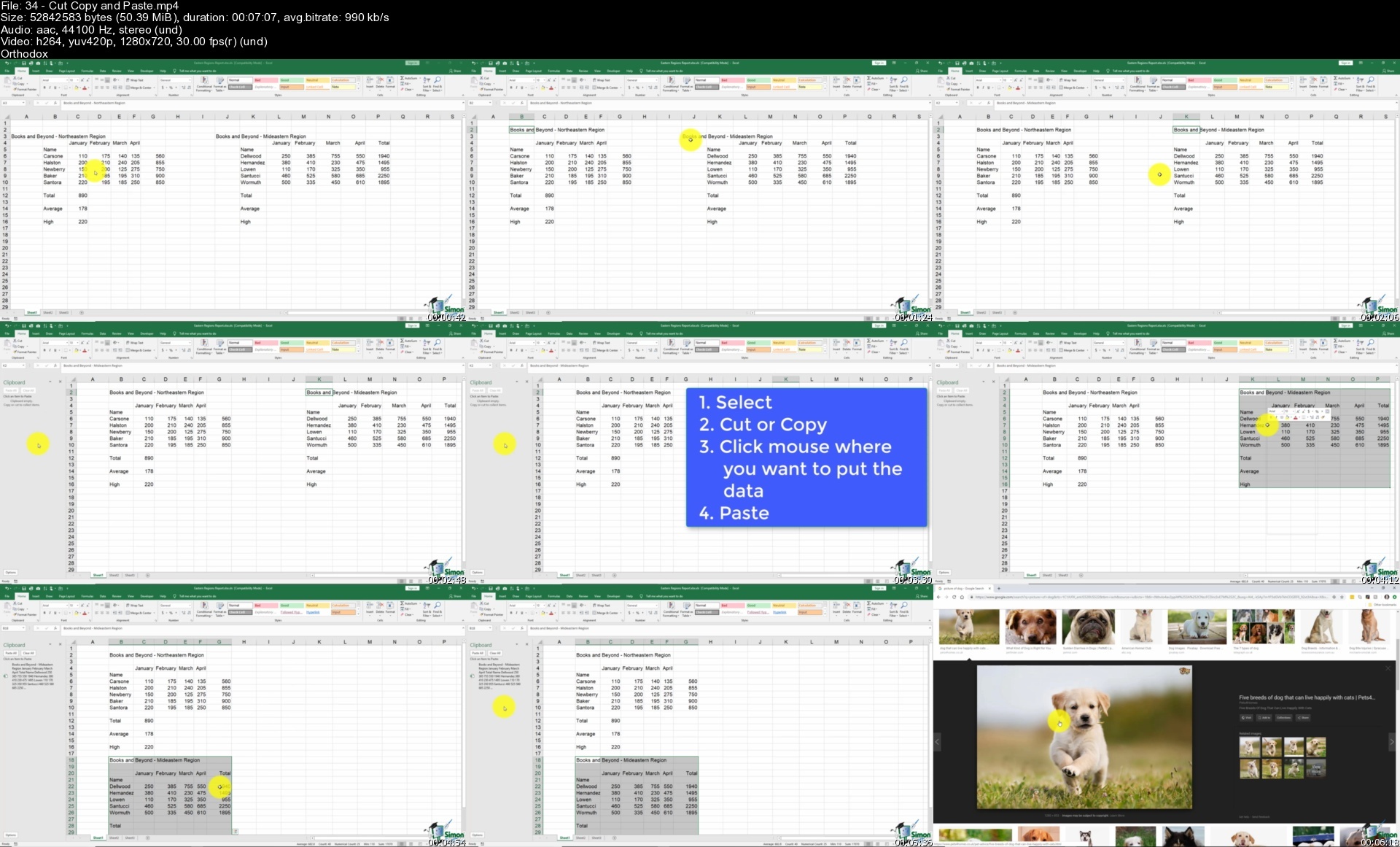
Lecture 34 Cut, Copy and Paste

Lecture 35 Copying Formulas

Lecture 36 Module 7 - Practice Exercise

Section 8: Excel 2019 Beginners: Formulas & Functions

Lecture 37 Overview of Formulas

Lecture 38 Create Formulas Using Functions Part 1

Lecture 39 Create Formulas Using Functions Part 2

Lecture 40 Absolute Values

Lecture 41 Module 8 - Practice Exercise

Section 9: Excel 2019 Beginner: Working with Sheets

Lecture 42 Working with the Save and Save As Commands

Lecture 43 Adding Deleting and Renaming Sheets

Lecture 44 Additional Sheet Tab Options

Lecture 45 3 Dimensional Formulas

Lecture 46 Module 9 - Practice Exercise

Section 10: Excel 2019 Beginner: Formatting Worksheets

Lecture 47 Formatting Cells Part 1

Lecture 48 Formatting Cells Part 2

Lecture 49 Formatting Numbers

Lecture 50 Borders and Shading

Lecture 51 Format as Table

Lecture 52 Using Styles

Lecture 53 Using Format Painter

Lecture 54 Protecting Sheets

Lecture 55 Fill Handle and Custom Lists

Lecture 56 Module 10 - Practice Exercise

Section 11: Excel 2019 Beginner: Charts

Lecture 57 Creating Charts

Lecture 58 Types of Charts

Lecture 59 Editing Charts Part 1

Lecture 60 Editing Charts Part 2

Lecture 61 Using Graphics to Enhance Charts

Lecture 62 Linking Chart Titles

Lecture 63 Module 11 - Practice Exercise

Section 12: Excel 2019 Beginner: Working with Names

Lecture 64 Creating Range Names

Lecture 65 Managing Names

Lecture 66 Using Names in Formulas

Lecture 67 Module 12 - Practice Exercise

Section 13: Excel 2019 Beginner: Sorting and Filtering

Lecture 68 Remove Duplicates

Lecture 69 Sort Data

Lecture 70 Filter Data

Lecture 71 Advanced Filters

Lecture 72 Module 13 - Practice Exercise

Section 14: Excel 2019 Beginner: Outlining and Subtotaling

Lecture 73 Creating an Outline

Lecture 74 Subtotals

Lecture 75 Module 14 - Practice Exercise

Section 15: Excel 2019 Beginner: Working with Views

Lecture 76 Arranging Files

Lecture 77 New Window Option

Lecture 78 Custom Views

Lecture 79 Module 15 - Practice Exercise

Section 16: Excel 2019 Beginner: Linking Files

Lecture 80 Creating Formulas Between File

Lecture 81 Working with Links

Lecture 82 Consolidating Data

Lecture 83 Module 16 - Practice Exercise

Section 17: Excel 2019 Beginner: Advanced Formula Creation

Lecture 84 If Statements

Lecture 85 VLookups

Lecture 86 Data Validation

Lecture 87 Formula Auditing

Lecture 88 Module 17 - Practice Exercise

Section 18: Excel 2019 Beginner: Pivot Tables

Lecture 89 Pivot Tables

Lecture 90 Pivot Charts

Lecture 91 Module 18 - Practice Exercise

Section 19: Excel 2019 Beginner: Additional Excel Features

Lecture 92 Slicers

Lecture 93 Goal Seeker

Lecture 94 Text to Columns

Lecture 95 Watch Window

Lecture 96 Customizing Ribbons and Tabs

Lecture 97 Module 19 - Practice Exercise

Section 20: Excel 2019 Beginner: Shortcuts

Lecture 98 Excel Shortcuts Every User Should Know

Section 21: Excel 2019 Beginner: Closing

Lecture 99 Closing Video

Section 22: Word 2019: Introduction

Lecture 100 Welcome and Overview

Lecture 101 WATCH ME: Essential Information for a Successful Training Experience

Lecture 102 Course Exercise Files

Lecture 103 Downloadable Course Transcripts

Lecture 104 Overview of the MS Word Screen

Lecture 105 The Backstage View

Section 23: Word 2019: Getting Started with Word

Lecture 106 Creating a New Blank Document

Lecture 107 Working with Non-Printing Characters and Line Spacing

Lecture 108 Saving a Document

Lecture 109 Opening a Document

Lecture 110 Navigating a Document

Lecture 111 Go To, Find and Replace

Lecture 112 Editing a Document

Lecture 113 Practice Exercise

Section 24: Character Formatting

Lecture 114 AutoCorrect Options

Lecture 115 Selecting Text

Lecture 116 Cut, Copy and Paste

Lecture 117 Character Formatting Options

Lecture 118 Format Painter

Lecture 119 Working with Numbers

Lecture 120 Working with Bullets

Lecture 121 Creating an Outline

Lecture 122 Practice Exercise

Section 25: Word 2019: Paragraph Formatting

Lecture 123 Alignment Options

Lecture 124 Line Spacing Options

Lecture 125 Working with Indents

Lecture 126 Working with Tabs

Lecture 127 Practice Exercise

Section 26: Word 2019: Managing Lists

Lecture 128 Sorting a List

Section 27: Word 2019: Tables

Lecture 129 Working with Tables

Lecture 130 Creating a Table

Lecture 131 Adding Rows and Columns to a Table

Lecture 132 Formatting Table Data

Lecture 133 Borders and Shading

Lecture 134 Sorting in a Table

Lecture 135 Drawing in a Table

Lecture 136 Converting Existing Data to a Table

Lecture 137 Quick Tables

Lecture 138 Using Formulas in Tables

Lecture 139 Practice Exercise

Section 28: Word 2019: Styles

Lecture 140 Working with Styles

Lecture 141 Creating Styles

Lecture 142 Editing Styles

Lecture 143 Practice Exercise

Section 29: Word 2019: Controlling Page Appearance

Lecture 144 Working with Page Breaks

Lecture 145 Working with Columns

Lecture 146 Adding a Watermark

Lecture 147 Headers and Footers

Section 30: Word 2019: Sectioning

Lecture 148 What is Sectioning?

Lecture 149 Sectioning a document

Lecture 150 Odd and Even Sections

Lecture 151 Practice Exercise

Section 31: Word 2019: Graphics

Lecture 152 Inserting Pictures

Lecture 153 Inserting Pictures into Existing Documents

Lecture 154 Picture Options

Lecture 155 Working with Shapes

Lecture 156 Icons and 3D Models

Lecture 157 SmartArt, Charts and Screenshots

Lecture 158 Practice Exercise

Section 32: Word 2019: Envelopes and Labels

Lecture 159 Working with Envelopes

Lecture 160 Working with Labels

Section 33: Word 2019: Mail Merges

Lecture 161 What is Mail Merge?

Lecture 162 Creating a Mail Merge Document - Part 1

Lecture 163 Creating a Mail Merge Document - Part 2

Lecture 164 Merging a Document with an Existing Data Source

Lecture 165 Merging Envelopes and Labels

Lecture 166 Merging a Directory

Lecture 167 Practice Exercise

Section 34: Word 2019: Page Setup Options

Lecture 168 Building Blocks

Lecture 169 Auto Text

Lecture 170 Practice Exercise

Section 35: Word 2019: Indexing and Table of Contents

Lecture 171 Creating an Index

Lecture 172 Creating a Table of Contents

Lecture 173 Practice Exercise

Section 36: Word 2019: Review and Printing

Lecture 174 Using the Thesaurus and Spell Check

Lecture 175 Comments

Lecture 176 Page Setup Options

Lecture 177 Printing

Lecture 178 Practice Exercise

Section 37: Word 2019: Other Word Options

Lecture 179 Word Options

Lecture 180 Protecting a Document

Lecture 181 Macros

Section 38: Word 2019: Wrap Up

Lecture 182 Closing

Section 39: PowerPoint 2019: Course Introduction

Lecture 183 Welcome and Overview

Lecture 184 WATCH ME: Essential Information for a Successful Training Experience

Lecture 185 Course Exercise Files

Lecture 186 Downloadable Course Transcripts

Section 40: PowerPoint 2019: Overview

Lecture 187 Navigate a PowerPoint Presentation

Lecture 188 Overview of the Screen and Views

Lecture 189 Exercise 1

Section 41: PowerPoint 2019: Getting Started

Lecture 190 Presentation Tips and Guidelines

Lecture 191 Creating a New Presentation

Lecture 192 Working with Slides

Lecture 193 Saving a Presentation

Lecture 194 Exercise 02

Section 42: PowerPoint 2019: Text and Bullet Editing Options

Lecture 195 Formatting Text

Lecture 196 Working with Bullets and Numbered Lists

Lecture 197 Exercise 03

Section 43: PowerPoint 2019: Adding Graphics

Lecture 198 Inserting Shapes

Lecture 199 Inserting Graphics

Lecture 200 Inserting Icons and 3D Models

Lecture 201 Inserting Pictures

Lecture 202 Exercise 04

Section 44: PowerPoint 2019: Working with objects

Lecture 203 Selecting Objects

Lecture 204 Editing Objects

Lecture 205 Formatting Objects - Part 1

Lecture 206 Formatting Objects - Part 2

Lecture 207 Arranging Objects

Lecture 208 Grouping Objects

Lecture 209 Exercise 05

Section 45: PowerPoint 2019: Editing pictures

Lecture 210 Picture Options

Lecture 211 Cropping Pictures

Lecture 212 Formatting Pictures

Lecture 213 Things You Can Do with Pictures

Lecture 214 Exercise 06

Section 46: PowerPoint 2019: Working with SmartArt

Lecture 215 Creating SmartArt

Lecture 216 Modifying SmartArt

Lecture 217 Creating a Flowchart using SmartArt

Lecture 218 Exercise 07

Section 47: PowerPoint 2019: Working with Tables

Lecture 219 Creating Tables

Lecture 220 Formatting Tables

Lecture 221 Inserting Tables

Lecture 222 Exercise 08

Section 48: PowerPoint 2019: Working with Charts

Lecture 223 Adding Charts

Lecture 224 Formatting Charts

Lecture 225 Inserting Charts from Microsoft Excel

Lecture 226 Exercise 09

Section 49: PowerPoint 2019: Unlocking the Power of Masters

Lecture 227 Using Master Slides

Lecture 228 Modifying Master Slides

Lecture 229 Creating a New Master Design Template

Lecture 230 Exercise 10

Section 50: PowerPoint 2019: Adding Media

Lecture 231 Adding Video to a Presentation

Lecture 232 Adding Audio to a Presentation

Lecture 233 Exercise 11

Section 51: PowerPoint 2019: Working with Transitions

Lecture 234 Applying Transitions

Lecture 235 Transition Options

Lecture 236 Exercise 12

Section 52: PowerPoint 2019: Animation

Lecture 237 Animating an Object

Lecture 238 Effect Options

Lecture 239 Working with the Animation Pane

Lecture 240 Motion Paths

Lecture 241 Triggers

Lecture 242 Exercise 13

Section 53: PowerPoint 2019: Hyperlinks and Action Buttons

Lecture 243 Working with Action Buttons

Lecture 244 Working with Hyperllinks

Lecture 245 Exercise 14

Section 54: PowerPoint 2019: Slideshow Options

Lecture 246 Onscreen Presentation Options

Lecture 247 Hiding Slides

Lecture 248 Changing the order of slides

Lecture 249 Copying slides

Lecture 250 Slideshow Options

Lecture 251 Exercise 15

Section 55: PowerPoint 2019: Preparing a presentation for delivery

Lecture 252 Rehearse Timings

Lecture 253 Recording a Presentation

Lecture 254 Slide Show Settings

Lecture 255 Creating a Custom Slide Show

Lecture 256 Exercise 16

Section 56: PowerPoint 2019: Exploring the Backstage Area

Lecture 257 Exporting options

Lecture 258 The Backstage Area

Lecture 259 Printing a Presentation

Lecture 260 Exercise 17

Section 57: PowerPoint 2019: Course Close

Lecture 261 Conclusion

Section 58: Access 2019 Beginners: Introduction

Lecture 262 Introduction to Access 2019

Lecture 263 WATCH ME: Essential Information for a Successful Training Experience

Lecture 264 Course Exercise Files

Lecture 265 Course Demo Files

Lecture 266 Downloadable Course Transcripts

Lecture 267 Acquiring Access 2019

Lecture 268 Structure of the Course

Section 59: Access 2019 Beginners: Getting Started with Access 2019

Lecture 269 Using Database Templates

Lecture 270 Creating, Saving and Opening Databases

Lecture 271 The Access Workspace and Backstage

Lecture 272 Online Help and Tell Me What You Want To Do

Section 60: Access 2019 Beginners: The Ribbon and Toolbars

Lecture 273 Working with the Ribbon

Lecture 274 The Quick Access Toolbar

Lecture 275 Contextual Menus

Lecture 276 The Status Bar

Section 61: Access 2019 Beginners: Keyboard Shortcuts and Key Tip

Lecture 277 Keyboard Shortcuts

Lecture 278 Key Tips

Section 62: Access 2019 Beginners: Access Options

Lecture 279 Exploring Access Options

Section 63: Access 2019 Beginners: Tables

Lecture 280 Creating a Table and Fields

Lecture 281 Indexed Field

Lecture 282 Lookup Wizard

Lecture 283 Numeric Fields

Lecture 284 Practice Exercise 01

Section 64: Access 2019 Beginners: Importing Data

Lecture 285 Importing Data from Excel

Lecture 286 Practice Exercise 02

Section 65: Access 2019 Beginners: Backup, Restore and Repair

Lecture 287 Backing up your Database

Lecture 288 Compact and Repair

Section 66: Access 2019 Beginners: Datasheet View

Lecture 289 Design in the Datasheet View

Lecture 290 Sorting and Filtering in Datasheet View

Lecture 291 Entering and Modifying Data in Datasheet View

Section 67: Access 2019 Beginners: Relationships

Lecture 292 Creating a Link Table

Lecture 293 Setting up Relationships

Lecture 294 Practice Exercise 03

Section 68: Access 2019 Beginners: Forms

Lecture 295 Creating a Form

Lecture 296 Modifying a Form

Lecture 297 Practice Exercise 04

Lecture 298 Forms in Layout View

Lecture 299 Forms in Design View

Lecture 300 Form Design

Lecture 301 Practice Exercise 05

Section 69: Access 2019 Beginners: Subforms

Lecture 302 Setting Up Subforms - Part 1

Lecture 303 Setting Up Subforms - Part 2

Lecture 304 Setting Up Subforms - Part 3

Lecture 305 Practice Exercise 06

Section 70: Access 2019 Beginners: Queries

Lecture 306 Creating a Query

Lecture 307 Joins

Lecture 308 Query Wizard

Lecture 309 Practice Exercise 07

Section 71: Access 2019 Beginners: Expressions

Lecture 310 Setting Up Validations

Lecture 311 Calculation using Expressions

Section 72: Access 2019 Beginners: Reports

Lecture 312 Basic Reports

Lecture 313 Report Design

Lecture 314 Complex Reports

Lecture 315 Practice Exercise 08

Section 73: Access 2019 Beginners: Printing

Lecture 316 Printing and Print Properties

Section 74: Access 2019 Beginners: More Data Types

Lecture 317 Yes/No, OLE Objects and Hyperlink Data Types

Section 75: Access 2019 Beginners: More About Forms

Lecture 318 Form Controls

Lecture 319 Form Themes

Lecture 320 Navigation Forms

Section 76: Access 2019 Beginners: Exporting

Lecture 321 Exporting an Access Database

Section 77: Access 2019 Beginners: Application Parts

Lecture 322 Adding Application Parts to a Database

Section 78: Access 2019 Beginners: More Access Options

Lecture 323 Additional Access 2019 Options

Section 79: Access 2019 Beginners: Info Tab

Lecture 324 Edit Database Properties and Encrypt with Password

Section 80: Access 2019 Beginners: Course Close

Lecture 325 Course Close

Section 81: Extras

Lecture 326 EXTRA LESSON: Designing Better Spreadsheets Webinar Recording

Lecture 327 EXTRA LESSON: Data Cleaning in Excel Webinar Recording

Lecture 328 EXTRA LESSON: Top Ten Excel Functions You HAVE to Know Webinar Recording

Lecture 329 EXTRA RESOURCE: The Most Frequently Used Excel Shortcuts - Infographic

Lecture 330 EXTRA RESOURCE: The Most Frequently Used PowerPoint Shortcuts - Infographic

Lecture 331 EXTRA RESOURCE: The Most Frequently Used Access Shortcuts - Infographic

Lecture 332 EXTRA RESOURCE: The Most Frequently Used Word Shortcuts - Infographic

Section 82: Congratulations!

Lecture 333 BONUS Lecture

Anyone new to Microsoft Office or upgrading from a previous version

Homepage

34cutcopyandpastes6vd3z.jpg


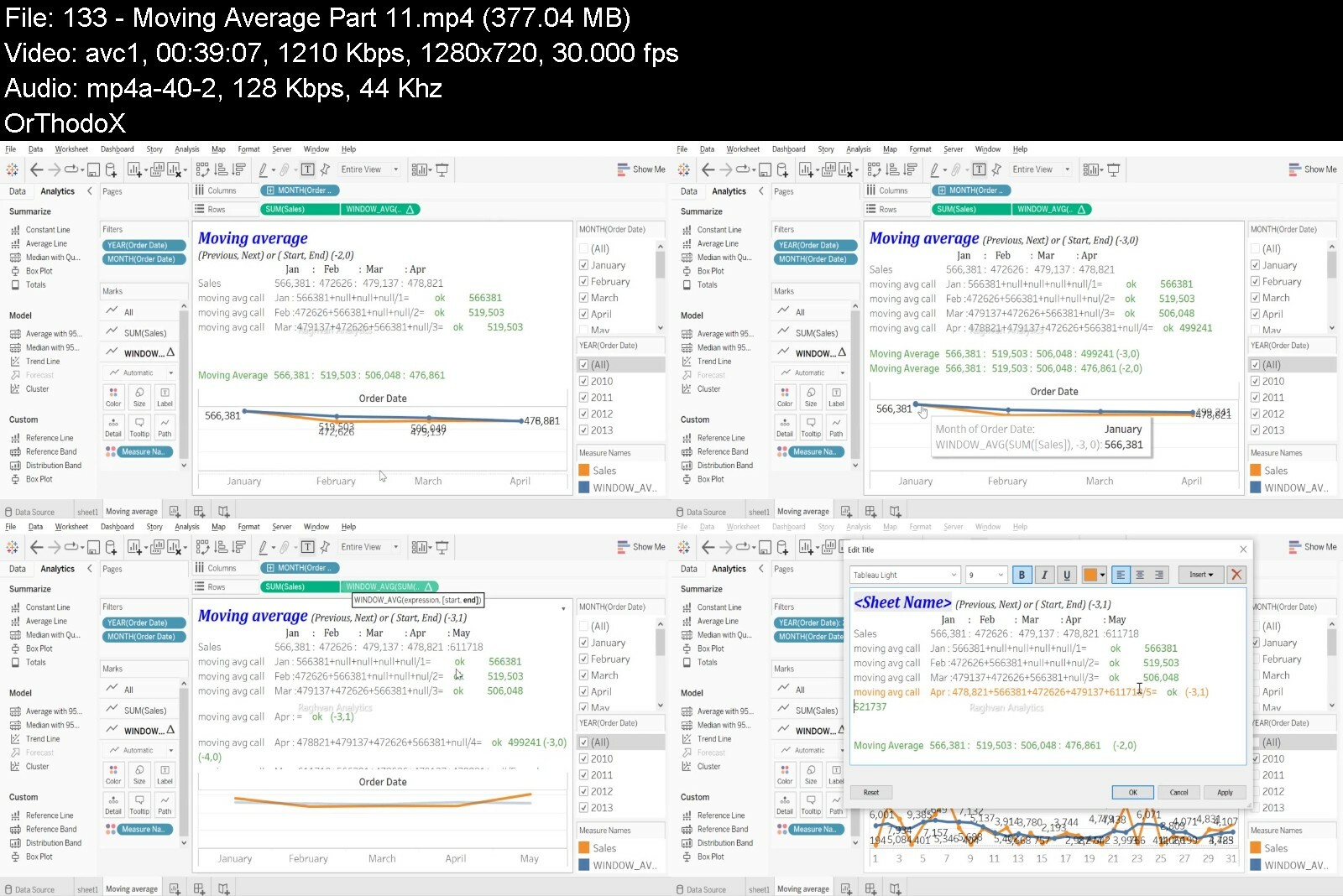
A To Z Tableau Course For Beginner & Intermediates

oor1mo7wthbjytwtriqgk47isz.jpg


A To Z Tableau Course For Beginner & Intermediates
Last updated 8/2022
MP4 | Video: h264, 1280x720 | Audio: AAC, 44.1 KHz
Language: English | Size: 8.26 GB | Duration: 20h 42m

Become a Data Visualization Analyst with proper understanding of Tableau. Explaining of every concept in details.


What you'll learn
Basics of Tableau
Tableau Charts & Visulization
Tableau Functions & Calculations
Union & Joins
Tableau Concepts in details
Filters

Requirements
Students should be Intermediate or undergraduates or graduates .
You should have basic understanding of mathematics.

Description
WHO'S THIS FOR?This course is designed specifically for freshers and also for those who want to switch career from Excel to Tableau .Tableau is a leading data visualization tool used for data analysis and business intelligence. Gartner's Magic Quadrant classified Tableau as a leader for analytics and business intelligence.Advantages of TableauData visualization.Quickly Create Interactive visualizations.Ease of Implementation.Tableau can handle large amounts of data.Use of other scripting languages in Tableau.Mobile Support and Responsive Dashboard.Tableau Company Strategy.Scheduling or notification of reports.PROBLEMS YOU'VE EXPERIENCED WITH EXCEL IN THE PASTExcel becomes slow or crashes when you have lots of data, formatting and Charts inside a workbook.Mistakenly working on the wrong file you saved.It's so annoying to email multiple Excel files to the same people everyday.It takes hours to create a dashboard with multiple charts and formula functions.Some time Excel files are used to store the large amount data which is a very wrong decision because to update the data everyday on that file is a headache because it takes so much time to get open and then to get save.Learn how to use a TABLEAU Desktop (Data Visualization) most demanded tool in the industry today. Give your career a boost. With our online tutorials, you will be amazed what you can achieved.Section 1 : Booster1 Introduction 2 Download 3 Install 4 Tableau Extension5 Connect with Database 6 Tableau Live & Extract 7 View Tables 8 Data Types9 Tableau Work Sheet Interface 10 Data Types Symbol 11 Adding new Sheet 12 Product Category & Sales13 Dimensions & Measures 14 Visualize data in workspace15 Make Hierarchy 16 Grouping17 Auto Generated Fields 5 18 Auto Generated Fields in Tableau19 Records Per Dimension data or Item 20 Granularity 21 Granularity and Drill Down 22 Table into chart form 23 Color label 24 Color label for two different dimension 25 Map 26 Normal 27 Dynamic Filter 28 Date Filter 1 29 Date Filter 2 (Part1) 30 Date Filter 2 (Part2) 31 Date Filter 2 (Part 3)32 Date Filter 3 33 Relevant Filter Explained34 Relevant Filter in Tableau 35 Set36 Discrete vs Continuous37 Filtering 38 Keep only and ExcludeSection 2 : Filters1 Filters 2 Type of Filters 3 Data Source Filters 4 Quick Filters 5 Dimension and Dependent Filters 6 Measure Filters 7 Context Filters Part1 8 Context Filters Part2 9 Context Filter Proper Details Part3 10 Date FilterSession 3 : Charts1 Introduction to charts 2 Create a Chart 3 Swap the Dimension & Measures 4 Bubble Chart5 Pie Chart 6 Tree Map 7 Stacked Tree Map 8 Word Map Chart8 Word Map Chart9 Geographical Map10 Geographical Bubble Map Measure11 Geographical Bubble Map with size and color Measure12 Geographical Bubble Map (Unknown error)13 Geographical Map with color Dimension14 Geographical Map with Date as Year Filter15 Month Year Filter16 Month Year Filter Apply17 Bar chart18 Bar chart color Measure19 Bar chart size Measure20 Bar chart size and color Measure21 Bar chart with dual axis22 Bar Stacked chart part 1 23 Bar Stacked chart part 2 24 Reference line scope Entire table 25 Reference line scope per cell 26 Reference line scope per pan 27 Tree Map Stacked in Bar Chart 28 Bar Chart with Date as Month Year Filter. 29 Bubble Chart color label 30 Bubble Chart color label as second dimension 31 Bubble Chart with motion 32 Line Chart 33 Line chart dual axis 34 Line Chart size Measure 35 Line chart dual Measure Date as Month Year Filter 36 Funnel Chart 1 37 Funnel Chart 2 Intro38 Funnel Chart 2 Created 39 Scattered chart 40 Water Fall Chart 41 Parameter part 1 42 Parameter part 2 43 Parameter with Dynamic Reference line 44 Scatter plot and Many more Part145 Scatter plot and Many more Part2 46 Scatter plot and Many more Part3 Section 4: Union & Joins1 Intro Joins2 Inner Join3 Left Join4 Right Join5 Full Join6 Inner Join In Tableau7 Left Join in Tableau8 Right Join In Tableau9 Full Join In Tableau10 Union11 Union in TableauSection 5 : Function Base1 Function Intro2 Sum ()3 Min () & Max ()4 Average ()5 Floor ()6 Ceiling ()7 Count ()8 Upper ()9 Lower ()10 Right () & Left ()Section 6 : Functions & Calculations Part11 Function Intro2 RANK() 3 RANK_DENSE()4 Rank Part 25 Rank_unique Part16 Rank_unique Part27 Rank_unique Part38 COUNT() vs CountD()9 Mid() 10 Len() 11 Find () 12 Mid() part 2 13 Trim() 14 Replace()15 Quick Table Calculations 16 Running Total 17 Difference 18 Percent Difference 19 Percent of Total 20 Moving Average Part 1 21 Moving Average Part 1 continuous 22 Date Functions () 24 Now() Today() 25 DateName and DatePart () 26 Date Diff () 27 Dateadd () 28 Datetrunc() 29 MakeDate() Section 7 : Functions & Calculations Part 21 round zero or round function 2 round 1 2 3 4 3 absolute() 4 Concatenate() 5 Replace() 6 Table Across 7 Table Down 8 Table Across Then Down Section 8 : Functions & Calculations Part 21 IF () 2 IF () in Tableau 3 IF () OR 4 IF () OR in Tableau 5 IF () AND 6 Nested IF () 7 Case () 8 Null() using if 9 Null() using if including OR AND 10 AND OR Part1 11 AND OR Part2
Overview
Section 1: Booster
Lecture 1 Introduction
Lecture 2 Download
Lecture 3 Install
Lecture 4 Tableau Extension
Lecture 5 Connect with Database
Lecture 6 Tableau Live & Extract
Lecture 7 View Tables
Lecture 8 Data Types
Lecture 9 Tableau Work Sheet Interface
Lecture 10 Data Types Symbol
Lecture 11 Adding new Sheet
Lecture 12 Product Category & Sales
Lecture 13 Dimensions & Measures
Lecture 14 Visualize data in workspace
Lecture 15 Make Hierarchy
Lecture 16 Grouping
Lecture 17 Auto Generated Fields 5
Lecture 18 Auto Generated Fields in Tableau
Lecture 19 Records Per Dimension data or Item
Lecture 20 Granularity
Lecture 21 Granularity and Drill Down
Lecture 22 Table into chart form
Lecture 23 Color label
Lecture 24 Map
Lecture 25 Normal
Lecture 26 Dynamic Filter
Lecture 27 Date Filter 1
Lecture 28 Date Filter 2 (Part1)
Lecture 29 Date Filter 2 (Part2)
Lecture 30 Date Filter 2 (Part 3)
Lecture 31 Date Filter 3
Lecture 32 Relevant Filter Explained
Lecture 33 Relevant Filter in Tableau
Lecture 34 Set
Lecture 35 Discrete vs Continuous
Lecture 36 Filtering
Lecture 37 Keep only and Exclude
Lecture 38 Join Intro
Section 2: Filters
Lecture 39 Filters
Lecture 40 Type of Filters
Lecture 41 Data Source Filters
Lecture 42 Quick Filters
Lecture 43 Dimension and Dependent Filters
Lecture 44 Measure Filters
Lecture 45 Context Filters Part1
Lecture 46 Context Filters Part2
Lecture 47 Context Filter Proper Details Part3
Lecture 48 Date Filter_
Section 3: Charts
Lecture 49 Introduction to charts
Lecture 50 Create a Chart
Lecture 51 Swap the Dimension & Measures
Lecture 52 Bubble Chart
Lecture 53 Pie Chart
Lecture 54 Tree Map
Lecture 55 Stacked Tree Map
Lecture 56 Word Map Chart
Lecture 57 Geographical Map
Lecture 58 Geographical Bubble Map Measure
Lecture 59 Geographical Bubble Map with size and color Measure
Lecture 60 Geographical Bubble Map (Unknown error)
Lecture 61 Geographical Map with color Dimension
Lecture 62 Geographical Map with Date as Year Filter
Lecture 63 Month Year Filter
Lecture 64 Month Year Filter Apply
Lecture 65 Bar chart
Lecture 66 Bar chart color Measure
Lecture 67 Bar chart size Measure
Lecture 68 Bar chart size and color Measure
Lecture 69 Bar chart with dual axis
Lecture 70 Bar Stacked chart part 1
Lecture 71 Bar Stacked chart part 2
Lecture 72 Reference line scope Entire table
Lecture 73 Reference line scope per cell
Lecture 74 Reference line scope per pan
Lecture 75 Tree Map Stacked in Bar Chart
Lecture 76 Bar Chart with Date as Month Year Filter.
Lecture 77 Bubble Chart color label
Lecture 78 Bubble Chart color label as second dimension
Lecture 79 Bubble Chart with motion
Lecture 80 Line Chart
Lecture 81 Line chart dual axis
Lecture 82 Line Chart size Measure
Lecture 83 Line chart dual Measure Date as Month Year Filter
Lecture 84 Funnel Chart 1
Lecture 85 Funnel Chart 2 Intro
Lecture 86 Funnel Chart 2 Created
Lecture 87 Scattered chart
Lecture 88 Water Fall Chart
Lecture 89 Parameter part 1
Lecture 90 Parameter part 2
Lecture 91 Parameter with Dynamic Reference line
Lecture 92 Scatter plot and Many more Part1
Lecture 93 Scatter plot and Many more Part2
Lecture 94 Scatter plot and Many more Part3
Lecture 95 Heat Map 1.1
Lecture 96 Heat Map 1.2
Lecture 97 Heat Map 1.3
Lecture 98 Heat Map 1.4
Lecture 99 Line Chart Multi Dimensions
Section 4: Union & Joins
Lecture 100 Intro Joins
Lecture 101 Inner Join
Lecture 102 Left Join
Lecture 103 Right Join
Lecture 104 Full Join
Lecture 105 Inner Join In Tableau
Lecture 106 Left Join in Tableau
Lecture 107 Right Join In Tableau
Lecture 108 Full Join In Tableau
Lecture 109 Union
Lecture 110 Union in Tableau
Section 5: Functions Booster
Lecture 111 Function Intro
Lecture 112 SUM()
Lecture 113 MIN() & MAX()
Lecture 114 AVERAGE()
Lecture 115 FLOOR()
Lecture 116 CEILING()
Lecture 117 COUNT()
Lecture 118 UPPER()
Lecture 119 LOWER()
Lecture 120 RIGHT() & Left ()
Section 6: Functions & Calculations Part 1
Lecture 121 Function
Lecture 122 RANK()
Lecture 123 Rank Dense ()
Lecture 124 Rank Part2
Lecture 125 Rank_Unique Part1
Lecture 126 Rank_unique Part2
Lecture 127 Rank_unique Part3
Lecture 128 Quick Table Calculations
Lecture 129 Running Total
Lecture 130 Difference
Lecture 131 Percent Difference
Lecture 132 Percent of Total
Lecture 133 Moving Average Part 1.1
Lecture 134 Moving Average Part 1.2
Lecture 135 Moving Average Part 1.3_
Lecture 136 COUNT() vs CountD()
Lecture 137 Mid()
Lecture 138 Len()
Lecture 139 Find ()
Lecture 140 Mid() part 2
Lecture 141 Trim()
Lecture 142 Replace()
Lecture 143 Date Functions ()
Lecture 144 Now() Today()
Lecture 145 DateName and DatePart ()
Lecture 146 Date Diff ()
Lecture 147 Dateadd ()
Lecture 148 Datetrunc()
Lecture 149 MakeDate()
Section 7: Function & Calculations Part 2
Lecture 150 round zero or round function
Lecture 151 round 1 2 3 4
Lecture 152 absolute()
Lecture 153 Concatenate()
Lecture 154 Replace()
Lecture 155 Table Across
Lecture 156 Table Down
Lecture 157 Table Across Then Down
Section 8: IF & Case Functions
Lecture 158 IF ()
Lecture 159 IF () in Tableau
Lecture 160 IF () OR
Lecture 161 IF () OR in Tableau
Lecture 162 IF () AND
Lecture 163 Nested IF ()
Lecture 164 Case ()
Lecture 165 Null() using if
Lecture 166 Null() using if OR AND
Lecture 167 AND OR Part1
Lecture 168 AND OR Part2
Lecture 169 Final
Tableau course for Beginners to Intermediate,Who want to become a Tableau Developer or Data Analyst


atoztableaucourseforbgxekp.jpg


Download from RapidGator


Download from DDownload


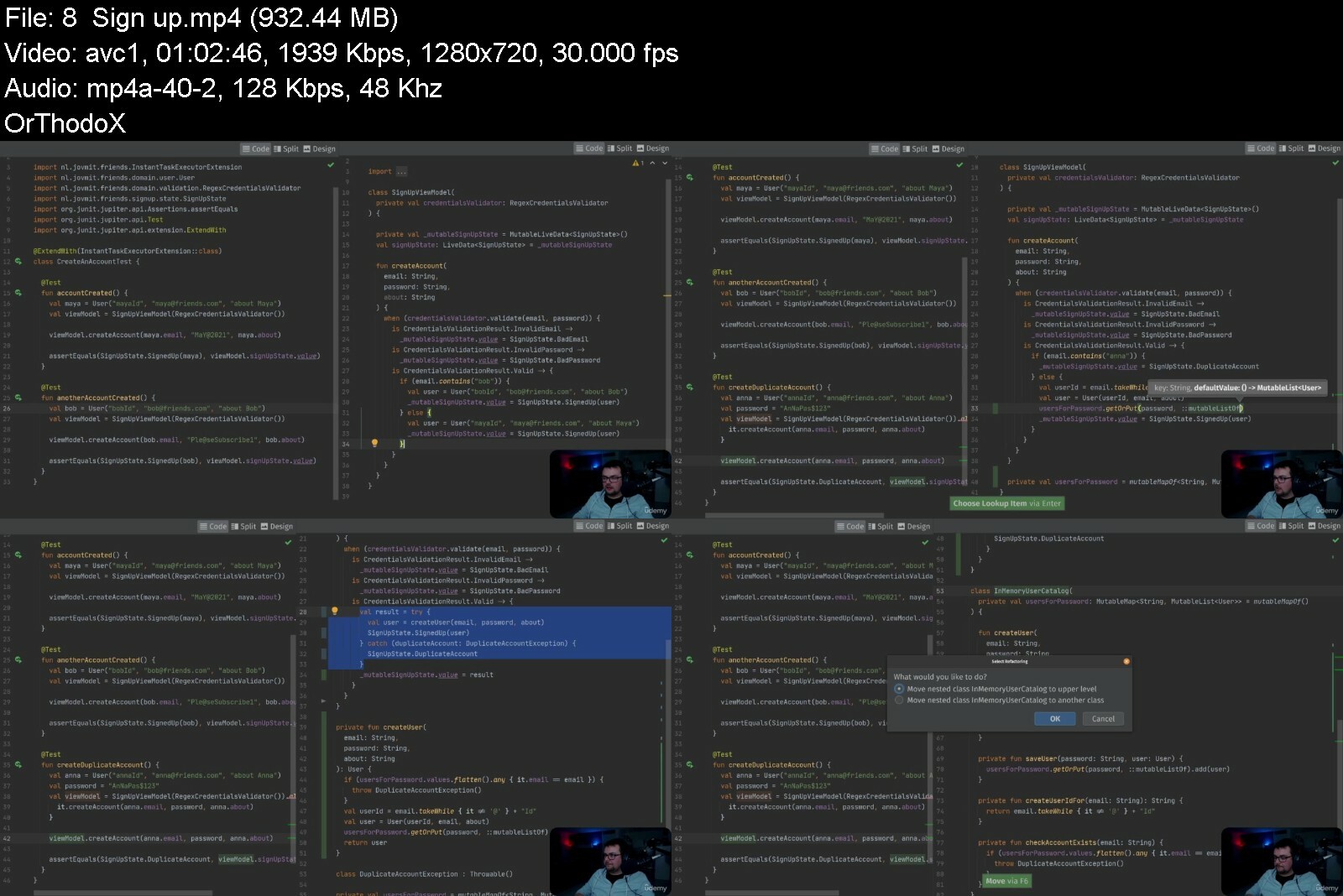
Test-Driven Development on Android (2022)

4650248559a8rfcup.jpg


Test-Driven Development on Android (2022)
Published 09/2022
MP4 | Video: h264, 1280x720 | Audio: AAC, 44.1 KHz, 2 Ch
Genre: eLearning | Language: English | Duration: 45 lectures (35h 6m) | Size: 26.3 GB


Get comfortable test driving code and evolve design using the feedback from the tests


What you'll learn
Write production Android apps using TDD
Get comfortable test-driving code
Evolutionary Design - Evolving the design by leveraging the feedback from the tests
Refactoring - Get confident in changing the structure of the code without breaking its behavior
Get familiar with Jetpack Compose
Testing from the user perspective (UI tests that run whole flow)
Set up a continuous delivery system that directly ships the new functionality on Google Play
Requirements
Kotlin programming language
Familiarity with Android development
Familiarity with JUnit. It's fine if you are not very knowledgeable for testing, you will learn many things on the go
Knowledge of Jetpack Compose is a plus, but not a requirement, as you will learn a lot about it along
Description
The objective of this course is the eXtreme Programming practices, particularly the technical ones. By the end of the course, you'll become comfortable with Test-Driven Development, Refactoring, Evolutionary Design, and Continuous Integration.
The instructor happens to work on an Android application throughout the course, but the technical knowledge, the practices, and the tips you will get from the lectures are applicable regardless of the language or the technology you are using.
As an extra, if you are an Android developer, you will also learn the basics of Jetpack Compose, and you'll get comfortable writing UI by using it. The course is targeting students with various experiences. There is certainly a lot of learnings in this course for both junior and senior developers.
By the time this course was created initially, certain technologies like Jetpack Compose were not stable. However, as they were evolving, they were being updated and re-explained in the course, even though the main focus of the course is not a particular technology, but rather good software development practices.
What's also very important, this course takes into consideration the gender and race-neutral position and makes sure that all the students feel welcome and comfortable following it. The instructor is going to be available for help throughout the entire course, as well as after finishing it.
Who this course is for
Beginner and advanced Android developers curious about better ways of developing high quality software, willing to learn more about testing and Jetpack Compose as a plus.


testdrivendevelopmentw4ege.jpg


Download from RapidGator


Download from DDownload


F1: Beginners Guide To Speaking Better English

ln7ufgnpgslbcddexhxpw0cd3s.jpg


F1: Beginners Guide To Speaking Better English
Last updated 2/2019
MP4 | Video: h264, 1280x720 | Audio: AAC, 44.1 KHz
Language: English | Size: 5.74 GB | Duration: 4h 27m

Beginner Level 1: Learn and Speak Better British English: Speak Smoother, Clearer and Correctly: English you can use


What you'll learn
Improve your British English speaking, smoothness and pronunciation with a native speaker
Learn useful and every day British English in sentences, phrases and vocabulary that you can use
Be confident to have easy British English conversation, know what to say and how to understand
Be confident to ask questions and understand the answers
Have easy, helpful British English vocabulary and be able to use this in useful sentences you can use every day
How to use the Present Simple Tense correctly in sentences, questions and conversations
Have good, practical question and sentence structure

Requirements
15 minutes each day to just listen and speak
No English needed - only time to practice

Description
Want to learn English but can't seem to get started or you drop out quickly? Your English lessons not interesting enough? Can't find a regular time to study and learn English? Don't have a native English speaker to learn English from and study with?If this is you, then This Learn English course is excellent for you.Short, quick, interesting learn English lessons from a well known ESL*teacher and expert Ajarn Ken will keep your attention long enough, No need to have a regular time to study, with these lessons you can learn on the go, just listen and speak along with a native English speaker speaking British English.You learn as you speak!!*It's an excellent way that Ken has taught thousands of students to be confident, clear and calm when speaking English. ____________________________________________________Ratings and Reviews - 88.8%31 Oct 2018 >>>>>> 39 Reviews - 32 - 4/5 Star Reviews"thank you , my pronunciation has improved as well as my listening . " ***** - Mostafa"Great course for beginners. Thank you very much. " ***** Gabriella"lecture one was really very practical hope 2nd will same like this " *****Shubham_______________________________________________________________________________________________This F1: Beginners Guide to Speaking Better British English course will improve and practice:your British English speaking skills by speaking along with Ken during the lessonyour British English reading skills by following the lesson bookletyour British English listening skills by listening along with Ken during the lessonyour British English pronunciation skills by following the lesson and copying KenYou will listen to Native British English speaker Ken give short English lessons. Your job is to follow and speak along with Ken. You will learn English as you speakYou will learn:basic vocabulary and sentence structures you can use in the present simple tense.how to speak British English smoother, clearer and have better pronunciation when speaking English.tips how to improve your confidence and fluency speaking British Englishhow to link words together to speak smoother and faster and correctly with learn English pronunciation lesssonshow to listen and write better British English with short English dictations from a native English speaker with British English*Who can use this course?Beginner English students who want to get confident speaking basic British EnglishEnglish students who want to improve their British English pronunciation and get good habits learning and speaking British English*What are the lessons?There are British English pronunciation lessons and practice lessons which I give you tips and advice how to speak British English as a native British English speaker does. We follow the lesson booklet you can download, in addition to using presentation slides, images and subtitles, you can speak along with me and follow and copy how I speak and pronounce British English correctly, smoothly and with confidence.The British English lessons are quite short but fast, I give you keywords as British English vocabulary in useful sentences you can use every day. There is a lesson booklet giving you a complete dialogue for each lesson that you can follow to improve your English readingThe British English lesson gives you time and space to speak along with Ken and this will help you learn, speak and understand British English better____________________Who gives the lectures?I'm Ken and I'm from the UK*and speak British English although I've lived in Portugal, Spain, Italy, Bulgaria, Thailand in the last 15 years and have been able to learn some conversational French, Portuguese, Spanish and I*can understand some Thai also. I've visited around 50 countries around the world so I am very well aware of cultural differences and have adapted myself over time to understand languages and what's important culturally.So you have a teacher who understands what it is to learn a language, how challenging and difficult it can be. This is why these courses maybe perfect for you as it comes from real experiences from myself and also my many, many students I've helped in Europe, South America and Asia over the last 10+ years.All of this experience goes into my course in many ways and these dictations are part of that.________What is Kens background?I've been a business trainer organising training workshops for companies and also I've been involved in language learning ever since I left the UK - both teaching and learning. Over the last few years, I've taught thousands of students in Europe, South America and more recently Asia where I've coached and taught newly graduated Asian students how to improve their English, confidence and give great career advice for those wanting to work in the aviation industry as cabin crew.___________ What is the Course Outline?Here's an overview of the topics from each lesson.Lesson 1An Introduction to the House, Basic numbers and How Many, Basic household Verbs Hints, Tips and Advice how to speak English betterPractice English Lesson to improve your English speakingLesson 2*Basic people, Using Is and Are, How to use WhoLesson 3How to use Name, Basic household vocabulary, Basic household Verbs Lesson 4*Basic numbers, Questions using Doing, How to use Thing Lesson 5*The days of the week, Using today, tomorrow and Yesterday, How to use First, Second, Third etc, Using Before and After Lesson 6*Basic colours, The use of Standing and Sitting, The use of Reading and WritingLesson 7*Basic mens clothes, How to use In Front Of and Behind, How to use Next To and Beside, The use of That OneLesson 8*How to use long and short, longer than and shorter than, Using The longest and the Shortest, Basic family members Lesson 9*How to talk about the ages of people and how old they are, How to use Young and Old and Younger and Older Than, Towns, Citys and Villages, How to use Large and Small, Larger and Smaller than and The Largest and Smallest Lesson 10The difference between Going to and Coming from, The difference between Taking From and Putting On, Using Opening and Closing, Basic parts of the body__________________________________Tips for learningMost importantly - do this course in*whichever way works best for you,*as with any form of learning, find out what works best for you and your strengths.*Read, speak, copy as often as you like*as only doing this, will you truly learn how to use English correctly.Get into a rhythm when you speak,*and when you practice like this, you will become smooth and fluent quicker.Don't be scared to open your mouth to speak,*English can be very different from your language with different sounds and vocals.*Don't be scared to change how*you speak,*copying not just what the words are but how they are spoken will improve your English much quicker.*Why Learn English Like this?By speaking the lesson*you will learn English 4 times faster*as you will be learning with your eyes, your ears and your voice. It really is a great way to improve your language skills, perhaps the best way.Speaking out loud*is where most students fall as they maybe don't have anyone to practice with and feel shy speaking with themselves. Do this and get into the habit of doing it and you will see your English speaking skills improve dramatically.
Overview
Section 1: Welcome to F1 Beginners Guide to Speaking Better English
Lecture 1 Welcome to F1 Beginners Guide to Speaking Better English
Section 2: Lesson 1: Basic household Vocab, Using How Many, Numbers, Household Verbs. F1L1
Lecture 2 Lesson 1: Learn English Hints and Tips w/ Ajarn Ken to speak better F1L1
Lecture 3 Lesson 1: Practice Speaking English Lesson with Ajarn Ken. F1L1P
Section 3: Lesson 2: Using Verb to Be in Present Simple Is and Are, Using Who F1L2
Lecture 4 Lesson 2: Learn English Hints and Tips w/ Ajarn Ken F1L2T
Lecture 5 Lesson 2: Practice Speaking English Lesson with Ajarn Ken. F1L2P
Section 4: Lesson 3: Basic Houshold nouns and Verbs, Using Name F1L3
Lecture 6 Lesson 3: Learn English Hints and Tips w/ Ajarn Ken F1L3
Lecture 7 Lesson 3: Practice Speaking English Lesson with Ajarn Ken. F1L3P
Section 5: Lesson 4: Present Continuous Questions, Using Thing, Basic Numbers F1L4
Lecture 8 Lesson 4: Learn English Hints and Tips w/ Ajarn Ken F1L4
Lecture 9 Lesson 4: Practice Speaking English Lesson with Ajarn Ken. F1L4P
Section 6: Lesson 5: Days, Today, Tomorrow, Yesterday, First, Second, Before/After F1L5
Lecture 10 Lesson 5: Learn English Hints and Tips w/ Ajarn Ken F1L5
Lecture 11 Lesson 5: Practice Speaking English Lesson with Ajarn Ken. F1L5P
Section 7: Lesson 6: Use Sitting and Standing, Reading and Writing, Basic Colours F1L6
Lecture 12 Lesson 6: Learn English Hints and Tips w/ Ajarn Ken F1L6
Lecture 13 Lesson 6: Practice Speaking English Lesson with Ajarn Ken. F1L6P
Section 8: Lesson 7: In front of and behind, next to and Beside, Using That One F1L7
Lecture 14 Lesson 7: Learn English Hints and Tips w/ Ajarn Ken F1L7
Lecture 15 Lesson 7: Practice Speaking English Lesson with Ajarn Ken. F1L7P
Section 9: Lesson 8: Adjectives, Comps. and Superlatives of short, long, Family Vocab F1L8
Lecture 16 Lesson 8: Learn English Hints and Tips w/ Ajarn Ken F1L8
Lecture 17 Lesson 8: Practice Speaking English Lesson with Ajarn Ken. F1L8P
Section 10: Lesson 9: Taking about adjectives, comp. and superlatives for ages and size F1L9
Lecture 18 Lesson 9: Learn English Hints and Tips w/ Ajarn Ken F1L9
Lecture 19 Lesson 9: Practice Speaking English Lesson with Ajarn Ken. F1L9P
Section 11: Lesson 10: Going To/Coming From, Putting On/Taking From, Parts of the Body F1L10
Lecture 20 Lesson 10: Learn English Hints and Tips w/ Ajarn Ken F1L10
Lecture 21 Lesson 10: Practice Speaking English Lesson with Ajarn Ken. F1L10P
Section 12: Lesson 11: Beginner Dictation to Listen & Write Better English w/ Ajarn Ken F1D1
Section 13: F1 Beginners Guide: Additional REsources to Speaking Better English
Lecture 22 Bonus Lecture:: Additional Resources
Students looking to start learning English for the first time,Students who want to learn British English,Students who want to practice English with a native speaker,Students who want a refresher from previous learning English Courses,Students who are too busy to plan their study time


f1beginnersguidetospeifig3.jpg


Download from RapidGator


Download from DDownload


Excellence In Sales Management

yqdfu4jgs1zj9r1okz6o6fliks.jpg


Excellence In Sales Management
Published 9/2022
MP4 | Video: h264, 1280x720 | Audio: AAC, 44.1 KHz
Language: English | Size: 5.77 GB | Duration: 4h 28m

to make a Great Sales and Marketing Career!


What you'll learn
Role of Sales Manager
Excellence requirements in Sales Management
Learning concepts like Deming's Wheel, SWOT, OSGM etc
Applying the concepts learnt through a real life case

Requirements
Willingness to learn about excellence sales management

Description
Want to Build a Great Sales and Marketing Career by gaining Excellence in Sales Management?Take a look at this course only where you will· Not only learn in depth how to do sales management excellently with concrete actionable advice, tools, techniques, processes and methodologies but also· Skill yourself by doing real life case assignments of different kinds· Preview 50% of lectures to see the content for yourself· Clear your doubts on this topic any time while doing the course· Get Udemy's 30 days Money Back Guarantee I started my journey as a Sales Manager after successfully completing my Management Training with Hindustan Unilever in 1985 and continued in sales and marketing over the years becoming General Manager Sales and Marketing with Johnson & Johnson in 1994. Over further periods of time that led me to become Managing Director of what is now Danone Nutrition in 2005. It has been very rewarding career in sales and marketing starting with Area Sales Manager in HULWhat I am sharing with you here is my learnings over these almost 20 years in sales and marketing in great companies like HUL, Johnson & Johnson and Danone Nutrition. I am sure you can do even better than me with these learnings!I have given a lot of real life assignments for you in this course from my experiences in sales management so that you can also skill yourself in addition learning the best practices in sales managementPreview for yourself 50% of lectures covering each section. If you like the content, enroll for the course, enjoy and skill yourself to build a great career in sales and marketing by gaining excellence in Sales Management! If don't like the content, please message about how can we modify it to meet your expectations.Please remember that this course comes with Udemy's 30 days Money Back Guarantee using which you can get a full refund if you are not satisfied even after doing the full course
Overview
Section 1: Introduction
Lecture 1 Introduction
Section 2: Overview
Lecture 2 Overview I
Lecture 3 Overview II
Section 3: Meeting and Exceeding Sales Targets
Lecture 4 Meeting and Exceeding Sales Targets I
Lecture 5 Meeting and Exceeding Sales Targets II
Lecture 6 Meeting and Exceeding Sales Targets III
Lecture 7 Meeting and Exceeding Sales Targets IV
Section 4: Meeting Profitability Goals
Lecture 8 Meeting Profitability Goals I
Lecture 9 Meeting Profitability Goals II
Section 5: Strategizing for your Area
Lecture 10 Strategizing for your Area I
Lecture 11 Strategizing for your Area II
Lecture 12 Strategizing for your Area III
Lecture 13 Strategizing for your Area IV
Lecture 14 Strategizing for your Area V
Lecture 15 Strategizing for your Area VI
Lecture 16 Strategizing for your Area VII
Section 6: Building a Strong Sales Team
Lecture 17 Building a Strong Sales Team I
Lecture 18 Building a Strong Sales Team II
Lecture 19 Building a Strong Sales Team III
Lecture 20 Building a Strong Sales Team IV
Lecture 21 Building a Strong Sales Team V
Lecture 22 Building a Strong Sales Team VI
Lecture 23 Building a Strong Sales Team VII
Section 7: Developing Strong Customer Relations
Lecture 24 Developing Strong Customer Relations I
Lecture 25 Developing Strong Customer Relations II
Lecture 26 Developing Strong Customer Relations III
Section 8: Sound Debtors Management
Lecture 27 Sound Debtors Management I
Lecture 28 Sound Debtors Management II
Section 9: Summary
Lecture 29 Summary
Salespersons who want to become sales managers,Sales Managers who want to become Excellent Sales Managers,MBA students who want to learn in-depth about Practical Sales Management


excellenceinsalesmanar5ir5.jpg


Download from RapidGator


Download from DDownload


Complete Voice Training Megacourse: Beginner To Expert

3qbqthcco9npji3zter0ycfdah.jpg


Complete Voice Training Megacourse: Beginner To Expert
Published 9/2022
MP4 | Video: h264, 1280x720 | Audio: AAC, 44.1 KHz
Language: English | Size: 11.41 GB | Duration: 9h 6m

Learn how to train and use your voice like a pro with this step-by-step course!


What you'll learn
The correct way to speak into a microphone or a public
The Anatomy of your voice box and how to take care of it
How to improve your breathing capacities
The connection between movement and voice acting
How to use your voice to create characters
Introductory view to the voice over industry options
Explore your vocal abilities
How to use your voice to generate emotions
The Do's and Don'ts of voice acting
The most common mistakes during speeches and presentations
Useful tips and tricks to help you take care of your voice

Requirements
No previous knowledge of voice training required
A desire to learn!
A positive attitude!

Description
Learn Voice Training!Have you always wanted to begin your journey in voice acting? Across the modern media landscape, there are many different places where the interpretive talents of the professional voice actor are used. Regardless your level as an actor, speaker, or storyteller, this is the course for you. Maybe you want to take care of your voice or know how to improve your breathing capacities. Whether you enjoy telling stories and jokes or hoping to make a career out of it, voice acting isn't only for the pros. You can take your voice, explore it, and create greater sound and better control - and we're here to teach you how.In this course, you're going to learn everything about Voice Training, from the anatomy of your voice box and learning breath control to improve the quality, range, and stamina of your voice. You'll even learn vocal exercises and warm-ups geared to enhance the sound of your singing voice. You will also learn how to make your presentation more powerful and more memorable.Our instructor has years of experience not only in voice training, but also in teaching and the expertly-crafted syllabus is designed to be easy to follow and thorough. We've even included plenty of examples explained for you to study. That's why this is the only Voice Training course you'll ever need to explore your voice and start acting, presenting, and narrating like a pro!Start voice training today!After taking this course, you will be able to:Create your own warm-upBring uniqueness to any interpretationPrepare your voice for any performanceChange your voice using the resonatorsIdentify the role of posture in voice trainingUnderstand the flow of air through your bodyDevelop your own style, find your signature voice
Overview
Section 1: Introduction
Lecture 1 Welcome to the course
Section 2: The Nature of Our Voice
Lecture 2 Introduction
Lecture 3 What Parts of Our Body Are Used to Manage Our Voice?
Lecture 4 Anatomy
Lecture 5 Singing
Lecture 6 Voice Acting
Lecture 7 Importance of Knowing Your Body
Lecture 8 Damages Caused Trough the Wrong Use of the Voice
Lecture 9 Preparation to Training
Lecture 10 Feel Your Voice System: Tension
Lecture 11 Feel Your Voice System: Release
Lecture 12 Feel Your Voice System: Posture Practice
Lecture 13 Conclusion
Lecture 14 Identify the Anatomy of Your Voice
Lecture 15 Is This a Correct Use of the Voice or Not
Lecture 16 Activity Suggestion for You to Do on Your Free Time
Section 3: Breathing
Lecture 17 Introduction
Lecture 18 Importance of Breathing
Lecture 19 Damages and Tips
Lecture 20 Exercise I
Lecture 21 Exercise II
Lecture 22 Air Column
Lecture 23 Practice I
Lecture 24 Practice II
Lecture 25 Practice III
Lecture 26 Conclusion
Lecture 27 Examples of Correct and Incorrect Use of Breathing
Lecture 28 Subjective Review of Texts Said
Lecture 29 Activity Suggestion for You to Do on Your Free Time
Section 4: Body and Movement
Lecture 30 Introduction
Lecture 31 Resonators
Lecture 32 Grotowski
Lecture 33 Other Authors
Lecture 34 Natomy: Resonators and Body Movement
Lecture 35 Common Mistakes
Lecture 36 Muscles Involved
Lecture 37 Practice I
Lecture 38 Movement
Lecture 39 How Movement Changes the Voice
Lecture 40 Control of the Voice
Lecture 41 Practice II
Lecture 42 Practice III
Lecture 43 Conclusion
Lecture 44 Is the Actor Moving or Not
Lecture 45 Activity Suggestion for You to Do on Your Free Time
Section 5: Voice Style
Lecture 46 Introduction
Lecture 47 Developing Your Own Style
Lecture 48 Your Signature Voice
Lecture 49 Allow Yourself to Play
Lecture 50 Effective Voice Acting Performance
Lecture 51 Practice I
Lecture 52 Voice Self Care
Lecture 53 Conclusion
Lecture 54 Final Activity
Section 6: Post Course
Lecture 55 Closure of the Course
Lecture 56 Last Words
Anyone who wants to learn how to become a voice actor - no experience needed!,Voice actors/actresses who want to improve their techniques and take care of their instrument (Voice),Anyone with specialised needs (dubbing actors, storytellers, speakers, students, teachers)


completevoicetrainingkifj7.jpg


Download from RapidGator


Download from DDownload


How To Successfully Prepare For An Interview In English

4862668898526zf74.jpg


How To Successfully Prepare For An Interview In English
Published 09/2022
MP4 | Video: h264, 1280x720 | Audio: AAC, 44.1 KHz, 2 Ch
Genre: eLearning | Language: English + srt | Duration: 130 lectures (14h 51m) | Size: 17.7 GB


Answering Interview Questions That Will Impress and Improve Your Chances of Getting The Job or Passing The Speaking Test


What you'll learn
The Types of Questions That Interviewers Ask And How To Prepare For These
What Details The Interviewer Is Looking For In A Question
How To Tell An Interesting Story About Your Experience That Is Relevant To The Interview Question
Show You Can Completely Understand The Question
How To Guide The Interview Towards Your Main Strengths
Tips, Advice and Guidance On Your Main Experience Topics To Talk About
How To Prepare and Structure Your Response
How To Answer With the Most Effective Details and Positively Finish Your Response
Guidance On How To Introduce Yourself At An Interview
How To Overcome Any Nervousness and Get The Interview Off To A Good Start
Requirements
Elementary English Learners
Intermediate English Learners
Advanced English Learners
Description
Hello there, Thanks for dropping by and having a look at this course
Getting the call to attend a job interview is a fantastic result, but this is when the real work starts. How are you going to prepare and what are you going to say?
For native English speakers this can be quite scary but for a non-native English speaker this must be doubly difficulty and daunting.
It's a fact of life in a lot of countries that having the ability to get a job or a career that you speak English can really up your income levels and change your life!
So preparing for a job interview in English is where you are going to have to start.
I'm Ajarn Ken and since 2008 I've been so lucky to have travelled extensively throughout the world and in that time I have helped more than 7,280 students improve their English skills and their confidence speaking English.
I helped, coached and mentored university graduates preparing for job interviews with international companies where English was the spoken language between colleagues and customers.
Hundreds of my students are still working as cabin crew with airlines all over the world and being able to pass the interview with confident English skills was the start of their new life.
This course will show you how not only to be confident to answer everyday interview questions in English but also to confidently provide back up examples that you can use to really enhance and improve your chances of getting that job.
Examples are so important as they make you believable and trustworthy at the interview and put you ahead of the competition by showing you understand the interview question AND being confident and competent enough to give a real example of your experience.
This course will
give you an overview of the question
let you into what the interviewer may be looking for from you
show you how to structure your response so you come across as confident
guide you how to finish your response positively - even if it's a negative question
give you the skills so the interviewer is interested in you and your experience
provide you with the skills to answer almost any interview question
There are also bonuses giving you an insight into interview questions, preparation, topics to prepare and how to introduce yourself.
This has already helped thousands of my students be confident English speakers and communicators - not just for jobs but also for speaking tests and general storytelling in English.
You can get all that experience from all those students plus my own experience teaching, travelling and learning languages. I really look forward to helping you on your journey to excellent English skills
Best wishes
Ajarn Ken
Who this course is for
Non-Native English Speakers Preparing For a Cabin Crew Interview
English Learners Preparing For a Job Interview in English or Speaking Test
English Learners Preparing For a Speaking Test and Exam
Non-Native Speakers Wanting To Practice Presentations in English


howtosuccessfullyprepxhibt.jpg


Download from RapidGator


Download from DDownload


Personal Finance #7-Insurance-Home & Car

486798440a5oaex0.jpg


Personal Finance #7-Insurance-Home & Car
Published 09/2022
MP4 | Video: h264, 1280x720 | Audio: AAC, 44.1 KHz, 2 Ch
Genre: eLearning | Language: English | Duration: 29 lectures (7h 14m) | Size: 5.5 GB


Learn risk mitigation strategy & how homeowners insurance and car insurance are used from a Certified Public Account CPA


What you'll learn
Define insurance
Implement a risk mitigation strategy
Construct a personal insurance plan
Define property insurance and explain how it fits into a risk mitigation strategy
Define liability insurance and how it fits into a risk mitigation strategy
Describe homeowners insurance and how it fits into a risk mitigation strategy
Describe renter's insurance and how it fits into a risk mitigation strategy
Describe car insurance
List the components of car insurance
Describe which types of car insurance may be required by law and why
Requirements
None
Description
This course focuses on personal finance decisions related to home and car insurance.
We will discuss the concept of insurance in general and how insurance fits into a personal finance strategy designed to medicate risk.
The course will define and explain property insurance and factors to consider when implementing property insurance planning.
We will also discuss liability insurance and how it fits into our risk management strategy.
Learners will be able to define homeowners' insurance and how to use it. We will also discuss renter's insurance, comparing and contrasting homeowners insurance and renters insurance.
The course will define car insurance, break down car insurance components, and discuss which kinds of insurance may be legally required and why.
For those components of car insurance that are not legally required, we will consider when it may still be appropriate to purchase them in accordance with our personal risk mitigation strategy.
We will also have practice problems, including downloadable Excel Workbooks, which users may also open using Google Sheets.
The Excel Workbooks will generally have at least two tabs. One tab will have the answer key so learners can deconstruct the problem. The second tab is where we work the practice problem step-by-step along with the instructional videos.
Who this course is for
Individual
Personal financial advisors


personalfinance7insurlkiws.jpg


Download from RapidGator


Download from DDownload


Latin Ii (First & Second Semester)

uqmnyxdhearsd2yaovrqn8ae38.jpg


Latin Ii (First & Second Semester)
Last updated 5/2016
MP4 | Video: h264, 1920x1080 | Audio: AAC, 44.1 KHz
Language: English | Size: 5.03 GB | Duration: 3h 59m

A second year of Latin language study


What you'll learn
Translate sentences and adapted texts from Latin in to English
Recite noun, pronoun and adjective declension charts
Recite verb conjugation charts
Understand the intricacies of Latin grammar

Requirements
Students must have covered the first half of Henle's Latin First Year (or equivalent)

Description
This course correspond to the second level of Latin language. It covers grammar, syntax, vocabulary, English derivatives and elements of Roman history and culture. This course is geared to students who have an interest in Latin and languages in general. It is taught thoroughly and carefully in order for the students to acquire a serious knowledge of the language. It follows the Henle Latin series that is used by many homeschoolers who study the language. This course covers the second half of Latin First Year. The book (hard copy or digital us a must. Exercises from the book are recommended at the end of every lesson to practice the newly acquired knowledge. Expect to complete the course in a year. So if you want to get serious exposure to the language that has always been the language of the educated, then dive in!
Overview
Section 1: Introduction
Lecture 1 Introduction
Lecture 2 Syllabus
Section 2: Review
Lecture 3 Introduction to Week 1 & 2
Lecture 4 Vocabulary Unit 1 Review
Lecture 5 Vocabulary Unit 2 Review
Lecture 6 Vocabulary Review Quiz Unit 1 & 2
Lecture 7 Noun and Adjective Declension
Lecture 8 Declension QUiz
Lecture 9 Conjugation: Present System Active
Lecture 10 Conjugation: Perfect System Active
Lecture 11 Conjugation: Present System Passive
Lecture 12 Present System Passive Translation
Section 3: Lesson 21
Lecture 13 Conjugation quiz
Lecture 14 Vocabulary 21
Lecture 15 Conjugation: Perfect System Passive
Lecture 16 Mastery Review Vocabulary # 2 (p.217)
Lecture 17 Lesson 21 Exercises
Lecture 18 Quiz Lesson 21
Section 4: Lesson 22
Lecture 19 Vocabulary 22
Lecture 20 The Present Subjunctive Active
Lecture 21 Purpose Clauses
Lecture 22 Primary Tenses
Lecture 23 Lesson 22 Exercises
Section 5: Lesson 23
Lecture 24 Vocabulary 23
Lecture 25 Conjugation: The Imperfect Subjunctive Active
Lecture 26 Secondary Tenses
Lecture 27 Adjectives Used as Nouns
Lecture 28 Lesson 23 Exercises
Section 6: Lesson 24
Lecture 29 Vocabulary 24
Lecture 30 Qui, quae, quod and Relative Clauses
Lecture 31 The Use of AD
Lecture 32 Relative Clauses of Purpose
Lecture 33 Purpose Clauses Introduced by QUO
Lecture 34 Lesson 24 Exercises
Section 7: Lesson 25
Lecture 35 Vocabulary 25
Lecture 36 Interrogative Adverbs
Lecture 37 Interrogative Particles
Lecture 38 Lesson 25 Exercises
Section 8: Lesson 26 (Week of November 9th)
Lecture 39 Vocabulary 26
Lecture 40 Perfect & Pluperfect Subjunctive Active
Lecture 41 Indirect Questions, Primary Sequence & Secondary Sequences
Lecture 42 Lesson 26 Exercises
Section 9: Lesson 27 (Week of November 16th)
Lecture 43 Vocabulary 27
Lecture 44 The Vocative
Lecture 45 Present Imperative Active
Lecture 46 Lesson 27 Exercises
Section 10: Lesson 28 (Week of November 23rd)
Lecture 47 Vocabulary 28
Lecture 48 Suus and Sui as Direct Reflexive
Lecture 49 Suus and Sui as Indirect Reflexive
Lecture 50 Lesson 28 Exercises
Section 11: Lesson 29 (Week of November 30th)
Lecture 51 Vocabulary 29
Lecture 52 Present Subjunctive Passive
Lecture 53 Imperfect Subjunctive Passive
Lecture 54 The Ablative of Cause
Lecture 55 Perfect System of the Passive Subjunctive
Lecture 56 Lesson 29 Exercises
Section 12: Lesson 30 (Week of December 7th)
Lecture 57 Vocabulary 30
Lecture 58 Perfect Passive Participles
Lecture 59 Lesson 30 Exercises
Section 13: Lesson 31 (Week of December 14th)
Lecture 60 Vocabulary 31
Lecture 61 Hic, Haec, Hoc
Lecture 62 Lesson 31 Exercises
Section 14: Lesson 32 (Week of January 4th)
Lecture 63 Vocabulary 32
Lecture 64 The Prepositions AB, EX and DE
Lecture 65 Lesson 32 Exercises
Section 15: Lesson 33 (Week of January 11th)
Lecture 66 Vocabulary 33
Lecture 67 ille
Lecture 68 Lesson 33 Exercises
Section 16: Lesson 34 (Week of January 18th)
Lecture 69 Vocabulary 34
Lecture 70 The Ablative of Separation
Lecture 71 Exercises
Section 17: Lesson 35 (Week of January 25th)
Lecture 72 Vocabulary 35
Lecture 73 Indicative of Possum
Lecture 74 The Infinitive Uses
Lecture 75 Subjunctive of Possum
Lecture 76 Lesson 35 Exercises
Section 18: Lesson 36 (Week of February 1st)
Lecture 77 Vocabulary 36
Lecture 78 Numerals
Lecture 79 Adjectives with Irregular Genitive and Dative
Lecture 80 Lesson 36 Exercises
Section 19: Lesson 37 (Week of February 8th & 15th)
Lecture 81 Vocabulary 37
Lecture 82 Third Conjugation in -IO
Lecture 83 Indicative Active of -IO Verbs
Lecture 84 Subjunctive Active of -IO Verbs
Lecture 85 Indicative Passive of -IO Verbs
Lecture 86 Subjunctive Passive of -IO Verbs
Lecture 87 Time When
Lecture 88 Extent of Time and Space
Lecture 89 Time Within Which
Lecture 90 Exercises
Section 20: Lesson 38 (Week of February 22nd)
Lecture 91 Vocabulary 38
Lecture 92 Dative Verbs
Lecture 93 Exercises
Section 21: Lesson 39 (Week of February 29th & March 7th)
Lecture 94 Vocabulary 39
Lecture 95 Perfect Infinitive
Lecture 96 Future Infinitive
Lecture 97 Accusative with Infinitive
Lecture 98 More on Accusative with Infinitive
Lecture 99 Passive Infinitive
Lecture 100 Lesson 39 Exercises
Section 22: Lesson 40 (Week of March 14th)
Lecture 101 Vocabulary 40
Lecture 102 Regular Comparison of Adjectives
Lecture 103 Declension of Comparative and Superlative Adjectives
Lecture 104 Ablative of Comparison
Lecture 105 Irregular Comparative and Superlative
Lecture 106 Exercises Lesson 40
Section 23: Lesson 41 (Week of April 11th & April 18th)
Lecture 107 Vocabulary 41
Lecture 108 Deponent Verbs
Lecture 109 Indicative of Deponent Verbs
Lecture 110 Subjunctive of Deponent Verbs
Lecture 111 Exercises Lesson 41
Section 24: Lesson 42
Lecture 112 Vocabulary 42
Lecture 113 Indicative of EO
Lecture 114 Subjunctive of EO
Lecture 115 Exercise Lesson 42
Section 25: Conclusion
Lecture 116 Final Exams and Quizzes
Students with a strong foundation of Latin I,Students who are motivated to deepen their knowledge of the Latin language,Not for students with no knowledge of Latin


latiniifirstsecondsemrrc9e.jpg


Download from RapidGator


Download from DDownload


Personal Finance #6-Housing: Purchase vs Renting

4867978a349cyewf.jpg


Personal Finance #6-Housing: Purchase vs Renting
Published 09/2022
MP4 | Video: h264, 1280x720 | Audio: AAC, 44.1 KHz, 2 Ch
Genre: eLearning | Language: English | Duration: 63 lectures (22h 44m) | Size: 18 GB


Home strategies for making personal housing decisions from a Certified Public Accountant (CPA)


What you'll learn
How to make the home, rent vs buy, decision
Process for selecting an apartment
How to analyze a lease agreement
Steps for purchasing a home
How to buy a home remotely
How to finance a first time home
How to apply for a mortgage loan
Describe the escrow process
Explain the difference between a loan officer and mortgage broker
List and describe warranties
Perform a loan estimate
Explain the home appraisal process
Define title and explain why it is important
Explain FHA Single Family Title II
Describe mortgage points and how to make decisions related to them
Describe Adjustable-Rate Mortgage (ARM)
Explain what a second mortgage is and when it would be useful
Requirements
None
Description
The course will focus on personal housing decisions.
The course will discuss how to approach the decision of purchasing or renting a home, which can be very complex given the long-term investment nature of a home purchase, the high cost relative to other expenses, and the different time frames between renting and purchasing.
We will discuss decisions related to renting, like selecting an apartment and analyzing the lease agreement.
Learners will understand concepts related to the home purchasing process. We will discuss the options for buying a home remotely, the importance of an inspection, the time frame to buy a home, and home buying apps that can be useful in the home buying process.
The course will also cover financing basics for first-time homebuyers, how to apply for a mortgage, what a mortgage clause is, and describe the escrow process.
We will compare a loan officer and a mortgage broker. Learners will understand different loan characteristics and much more.
The course will also have practice problems, including downloadable Excel Workbooks, which users may also open using Google Sheets.
The Excel Workbooks will generally have at least two tabs. One tab will have the answer key so learners can deconstruct the problem. The second tab is where we work the practice problem step-by-step along with the instructional videos.
Who this course is for
Individuals
Personal financial advisors
Real estate professionals


personalfinance6housigffrr.jpg


Download from RapidGator


Download from DDownload


The Complete Data Analytics Course in Excel

4026424cb2e45cexh.jpg


The Complete Data Analytics Course in Excel
Last updated 8/2022
MP4 | Video: h264, 1280x720 | Audio: AAC, 44.1 KHz, 2 Ch
Genre: eLearning | Language: English | Duration: 71 lectures (15h 4m) | Size: 9.3 GB


A complete data analysis course using the tools you already have


What you'll learn
Data Analytics
Data Visualization
Hypothesis Testing
Statistics
Forecasting
Excel
Regression
Monte Carlo Simulation
Linear Programming
Pivot Tables
Business Intelligence
Excel Analytics
Requirements
Basic Math
Description
Do you think you need to learn new software to perform data analysis, statistics, simulations? You don't! Everything you need to get started in the world of data analytics is already on your computer in the wonderful application called Excel.
This course will first acquaint you with the Excel environment including how to use simple and complex functions, hot-key shortcuts and navigation tips to make sure you work efficiently and effectively. From there, I lead you in lectures and practice exercises on the fundamental topics of data analytics.
Data Visualizations - Visualizing data is an important part in analyzing data as well as presenting and explaining what it means. Lectures in this course Included how to craft and use bar charts, line charts, radial charts, histograms, box and whisker charts, pie charts, conditional formatting and Sparklines.
Pivot Tables - Pivot Tables are very powerful, simple to use tools built into excel. The lectures will include how to structure data to get the most out of pivot tables, and then a few use cases including root cause analysis, comparative analysis, along with other visualization tools specific to pivot tables.
Statistics - The Statistics module is by far the most densely packed module in this course. As a statistician by training, I present a deep dive into the data behind the statistics and how to use different statistical tests based on different circumstances. The module is filled with different lectures and exercises involving ANOVA tests, T Tests, Chi-Squared Tests, Tests for Normality, Regression Analysis and more.
Forecasting - Organizations have to be able to anticipate the future. The forecasting tools presented in this course help us accomplish this feat. Forecasting is presented in two different ways - Factor forecasting and Time Series forecasting. For each approach to forecasting, many tools and techniques are introduced and reviewed including Regression analysis, Monte Carlo Simulation, Simple Moving Averages, and Auto-Regressive techniques.
Excel Tools - Excel has a lot of useful tools that don't quite fit neatly into any of the other modules. The last module of this course explores the use cases of using these tools. In particular, several archetypal problems are introduced and solved using the miscellaneous data analysis tools found in excel, including Excel Solver.
Who this course is for
Operations managers
Quality professionals
Industrial Engineers
Data Analysts
casual Excel users curious about data science


thecompletedataanalytdze4u.jpg


Download from RapidGator


Download from DDownload


Reinforcement Learning with Pytorch

a8qcldcunebba8gllhscmwyii2.jpg


Reinforcement Learning With Pytorch
Last updated 8/2020
MP4 | Video: h264, 1280x720 | Audio: AAC, 44.1 KHz
Language: English | Size: 8.56 GB | Duration: 7h 13m

Learn to apply Reinforcement Learning and Artificial Intelligence algorithms using Python, Pytorch and OpenAI Gym


What you'll learn
Reinforcement Learning basics
Tabular methods
Bellman equation
Q Learning
Deep Reinforcement Learning
Learning from video input

Requirements
Basic python knowledge is needed. AI / Machine Learning / Pytorch basics - nice to have but not fully necessary. Only open source tools will be in use.

Description
UPDATE:All the code and installation instructions have been updated and verified to work with Pytorch 1.6 !!Artificial Intelligence*is dynamically*edging its way*into our lives. It is already*broadly available and*we use it - sometimes even*not knowing it -*on daily basis. Soon it will be our permanent, every day*companion.And where*can we place Reinforcement*Learning in AI*world? Definitely*this is one of the most promising and fastest growing technologies that can eventually*lead us to General Artificial Intelligence! We can see multiple examples where AI*can achieve amazing results - from reaching*super human level while*playing games*to*solving*real life problems (robotics, healthcare, etc).Without a doubt*it's worth to know*and understand*it!And that's why this course has been created.We will go through multiple topics, focusing on most important and practical details.*We will start from very basic information, gradually*building our understanding, and finally*reaching the point where*we will make our agent learn in human-like way - only from video input!What's important - of course*we*need to cover some theory - but we will mainly focus on practical part. Goal is*to understand WHY*and HOW.In order to evaluate our algorithms we will*use*environments from - very popular -*OpenAI*Gym. We will start from basic text games, through more complex ones, up to challenging Atari gamesWhat*will be covered during the course ?*- Introduction to Reinforcement Learning- Markov Decision Process- Deterministic and stochastic environments- Bellman Equation- Q Learning- Exploration vs Exploitation- Scaling up- Neural Networks as function approximators- Deep Reinforcement Learning- DQN- Improvements to DQN- Learning from video input- Reproducing some of most popular RL solutions- Tuning parameters and general recommendationsSee you in the*class!
Overview
Section 1: Welcome to the course
Lecture 1 Welcome!
Lecture 2 Before you start - Videos quality!
Lecture 3 Resources
Section 2: Introduction
Lecture 4 Introduction #1
Lecture 5 Introduction #2
Lecture 6 Introduction #3
Lecture 7 Introduction #4
Lecture 8 Environment setup / Installation
Lecture 9 Lab. OpenAI Gym #1
Lecture 10 Lab. OpenAI Gym #2
Lecture 11 Lab. OpenAI Gym #3
Lecture 12 Lab. OpenAI Gym #4
Section 3: Tabular methods
Lecture 13 Deterministic & Stochastic environments
Lecture 14 Rewards
Lecture 15 Bellman equation #1
Lecture 16 Bellman equation #2
Lecture 17 Resource - code
Lecture 18 Lab. Algorithm for deterministic environments #1
Lecture 19 Lab. Algorithm for deterministic environments #2
Lecture 20 Lab. Algorithm for deterministic environments #3
Lecture 21 Lab. Algorithm for deterministic environments #4
Lecture 22 Lab. Test with stochastic environment
Lecture 23 Q-Learning
Lecture 24 Lab. Algorithm for stochastic environments
Lecture 25 Exploration vs Exploitation
Lecture 26 Lab. Egreedy
Lecture 27 Lab. Adaptive egreedy
Lecture 28 Bonus Lab. Value iteration
Lecture 29 Homework
Lecture 30 Homework. Solution
Lecture 31 Homework. Tuning
Section 4: Scaling up
Lecture 32 Scaling up
Lecture 33 Neural Networks review
Lecture 34 Lab. Neural Networks review #1
Lecture 35 Lab. Neural Networks review #2
Lecture 36 Lab. Random CartPole
Lecture 37 Lab. Epsilon egreedy revisited
Lecture 38 Lab. Pytorch updated ( version 0.4.0 )
Lecture 39 Article. Pytorch updated! (further versions)
Lecture 40 Lab. OpenAI Gym + Neural Network #1
Lecture 41 Lab. OpenAI Gym + Neural Network #2
Lecture 42 Lab. OpenAI Gym + Neural Network #3
Lecture 43 Lab. Extended logging
Section 5: DQN
Lecture 44 Deep Reinforcement Learning
Lecture 45 Lab. Deep Reinforcement Learning
Lecture 46 Lab. Tuning challenge
Lecture 47 Experience Replay
Lecture 48 Lab. Experience Replay #1
Lecture 49 Lab. Experience Replay #2
Lecture 50 Lab. Experience Replay #3
Lecture 51 DQN
Lecture 52 Lab. DQN
Section 6: DQN Improvements
Lecture 53 Double DQN
Lecture 54 Lab. Double DQN
Lecture 55 Dueling DQN
Lecture 56 Lab. Dueling DQN
Lecture 57 Lab. Dueling DQN Challenge
Section 7: DQN with video output
Lecture 58 CNN Review
Lecture 59 Lab. Random Pong
Lecture 60 Saving & Loading the Model
Lecture 61 Lab. Pong from video output #1
Lecture 62 Lab. Pong from video output #2
Lecture 63 Lab. Pong from video output #3
Lecture 64 Lab. Pong from video output #4
Lecture 65 Lab. Pong from video output #5
Lecture 66 Lab. Pong from video output #6
Lecture 67 Potential improvements
Lecture 68 Article. Stacking 4 images together
Section 8: Final notes
Lecture 69 What's next?
Anyone interested in artificial intelligence, data science, machine learning, deep learning and reinforcement learning.


reinforcementlearningh2fwv.jpg


Download from RapidGator


Download from DDownload


Zurück
Oben Unten