• Regeln für den Video-Bereich:

    In den Börsenbereich gehören nur Angebote die bereits den Allgemeinen Regeln entsprechen.

    Einteilung

    - Folgende Formate gehören in die angegeben Bereiche:
    - Filme: Encodierte Filme von BluRay, DVD, R5, TV, Screener sowie Telesyncs im Format DivX, XviD und x264.
    - DVD: Filme im Format DVD5, DVD9 und HD2DVD.
    - HD: Encodierte Filme mit der Auflösung 720p oder darüber von BluRay, DVD, R5, TV, Screener sowie Telesyncs im Format x264.
    - 3D: Encodierte Filme von BluRay, die in einem 3D Format vorliegen. Dies gilt auch für Dokus, Animation usw.
    - Serien: Cartoon/Zeichentrick, Anime, Tutorials, Dokumentationen, Konzerte/Musik, Sonstiges sind demnach in die entsprechenden Bereiche einzuordnen, auch wenn sie beispielsweise im High Definition-Format oder als DVD5/DVD9/HD2DVD vorliegen. Ausnahme 3D.
    - Bereich Englisch: Englische Releases gehören immer in diesen Bereich.
    - Bereich Talk: Der Bereich, in dem über die Releases diskutiert werden kann, darf, soll und erwünscht ist.


    Angebot/Beitrag erstellen

    - Ein Beitrag darf erst dann erstellt werden, wenn der Upload bei mindestens einem OCH komplett ist. Platzhalter sind untersagt.
    - Bei einem Scenerelease hat der Threadtitel ausschließlich aus dem originalen, unveränderten Releasenamen zu bestehen. Es dürfen keine Veränderungen wie z.B. Sterne, kleine Buchstaben o.ä. vorgenommen werden. Ausnahme Serienbörse:
    - Bei einem Sammelthread für eine Staffel entfällt aus dem Releasename natürlich der Name der Folge. Beispiel: Die Simpsons S21 German DVDRip XviD - ITG
    - Dementsprechend sind also u.a. verboten: Erweiterungen wie "Tipp", "empfehlenswert", "only", "reup", usw. / jegliche andere Zusatzinformation oder Ergänzung, welche nicht in obiger Beschreibung zu finden ist.

    Aufbau des Angebots und Threadtitel

    Der Titel nach folgendem Muster erstellt zu werden. <Name> [3D] [Staffel] [German] <Jahr> <Tonspur> [DL] [Auflösung] <Quelle> <Codec> - <Group>
    Beispiel: The Dark Knight German 2008 AC3 DVDRip XviD - iND
    Beispiel: The Dark Knight 2008 DTS DL BDRip x264 - iND
    Beispiel: The Dark Knight 2008 AC3 DL BDRip XviD - iND
    Beispiel: The Dark Knight German 2008 AC3 720p BluRay x264 iND
    Beispiel: The Dark Knight 2008 DTS DL 1080p BluRay x264 iND
    Beispiel: Die Simpsons S01 German AC3 DVDRip XviD iND
    Beispiel: Die Simpsons S20 German AC3 720p BluRay x264 iND
    Beispiel: Sword Art Online II Ger Sub 2014 AAC 1080p WEBRip x264 - peppermint
    Entsprechend sind also u.a. verboten: Sonderzeichen wie Klammern, Sterne, Ausrufezeichen, Unterstriche, Anführungszeichen / Erweiterungen wie "Tipp", "empfehlenswert", "only", "reup", usw. / jegliche andere Zusatzinformation oder Ergänzung, welche nicht in obiger Beschreibung zu finden ist
    Ausnahmen hiervon können in den Bereichen geregelt sein.

    Die Beiträge sollen wie folgt aufgebaut werden:
    Überschrift entspricht dem Threadtitel
    Cover
    kurze Inhaltsbeschreibung
    Format, Größe, Dauer sind gut lesbar für Downloader außerhalb des Spoilers zu vermerken
    Nfo sind immer Anzugeben und selbige immer im Spoiler in Textform.
    Sind keine Nfo vorhanden z.B. Eigenpublikationen, sind im Spoiler folgende Dateiinformationen zusätzlich anzugeben :
    Quelle
    Video (Auflösung und Bitrate)
    Ton (Sprache, Format und Bitrate der einzelnen Spuren)
    Untertitel (sofern vorhanden)
    Hosterangabe in Textform außerhalb eines Spoiler mit allen enthaltenen Hostern.
    Bei SD kann auf diese zusätzlichen Dateiinformationen verzichtet werden.

    Alle benötigten Passwörter sind, sofern vorhanden, in Textform im Angebot anzugeben.
    Spoiler im Spoiler mit Kommentaren :"Schon Bedankt?" sind unerwünscht.


    Releases

    - Sind Retail-Release verfügbar, sind alle anderen Variationen untersagt. Ausnahmen: Alle deutschen Retail-Release sind CUT, in diesem Fall sind dubbed UNCUT-Release zulässig.
    - Im Serien-Bereich gilt speziell: Wenn ein Retail vor Abschluss einer laufenden Staffel erscheint, darf diese Staffel noch zu Ende gebracht werden.62
    - Gleiche Releases sind unbedingt zusammenzufassen. Das bedeutet, es ist zwingend erforderlich, vor dem Erstellen eines Themas per Suchfunktion zu überprüfen, ob bereits ein Beitrag mit demselben Release besteht. Ist dies der Fall, ist der bereits vorhandene Beitrag zu verwenden.
    - P2P und Scene Releases dürfen nicht verändert oder gar unter einem iND Tag eingestellt werden.


    Support, Diskussionen und Suche

    - Supportanfragen sind entweder per PN oder im Bereich Talk zu stellen.
    - Diskussionen und Bewertungen sind im Talk Bereich zu führen. Fragen an die Uploader haben ausschließlich via PN zu erfolgen, und sind in den Angeboten untersagt.
    - Anfragen zu Upload-Wünschen sind nur im Bereich Suche Video erlaubt. Antworten dürfen nur auf Angebote von MyBoerse.bz verlinkt werden.


    Verbote

    - Untersagt sind mehrere Formate in einem einzigen Angebotsthread, wie beispielsweise das gleichzeitige Anbieten von DivX/XviD, 720p und 1080p in einem Thread. Pro Format, Release und Auflösung ist ein eigener Thread zu eröffnen.
    - Grundsätzlich ebenso verboten sind Dupes. Uploader haben sich an geeigneter Stelle darüber zu informieren, ob es sich bei einem Release um ein Dupe handelt.
    - Gefakte, nur teilweise lauffähige oder unvollständige Angebote sind untersagt. Dies gilt auch für eigene Publikationen, die augenscheinlich nicht selbst von z.B. einer DVD gerippt wurden. Laufende Serien, bei denen noch nicht alle Folgen verfügbar sind, dürfen erstellt und regelmäßig geupdatet werden.
    - Untersagt sind Angebote, welche nur und ausschließlich in einer anderen Sprache als deutsch oder englisch vorliegen. Ausnahmen sind VORHER mit den Moderatoren zu klären.


    Verstoß gegen die Regeln

    - Angebote oder Beiträge, die gegen die Forenregeln verstoßen, sind über den "Melden"-Button im Beitrag zu melden.
  • Bitte registriere dich zunächst um Beiträge zu verfassen und externe Links aufzurufen.

*** Bestes IPTV *** bester Preis *** gratis Test ***


Englische Tutorials

alooU9Q0hI05iDqI7ZYeCf9ref8CGcz0.jpg

ArtStation - Sci-Fi Corridor 3D by Eric Huang (With UE Assets)
Video: MPEG4 Video (H264) 1684x1066 30fps 59kbps | Audio: AAC 48000Hz stereo 160kbps
Genre: eLearning | Duration: 3hrs+ | Language: English | File size: 2.1 GB​


In this project, I was inspired by the visual direction of overwatch, I didn't go with the fully stylized art style, I'm trying to achieve a grudge and unique looking. The whole scene was baked in lightmaps, used Blender and substance painter for modeling and texturing.
Screenshots


8cd50a2d-80ee-41dd-a1f9-f43739f1d360.png

Introduction to Probability and Statistics for the year 2022
MP4 | Video: h264, 1280x720 | Audio: AAC, 44.1 KHz
Language: English | Size: 4.69 GB | Duration: 15h 55m​

16 Hours Course especially designed for the University Students who want to become Expert from very Basics Level.
What you'll learn
Understand why we study statistics.
Explain what is meant by descriptive statistics and inferential statistics.
Distinguish between a qualitative variable and a quantitative variable
Describe how a discrete variable is different from a continuous variable.
Organize qualitative data into a frequency table.
Present a frequency table as a bar chart.
Organize quantitative data into a frequency distribution.
Present a frequency distribution for quantitative data using histograms, frequency polygons, and cumulative frequency polygons.
Calculate the arithmetic mean, median, mode, and geometric mean.
Explain the characteristics, uses, advantages, and disadvantages of each measure of location.
Identify the position of the mean, median, and mode for both symmetric and skewed distributions.
Compute and interpret the range, mean deviation, variance, and standard deviation.
Understand the characteristics, uses, advantages, and disadvantages of each measure of dispersion.
Understand Chebyshev's theorem and the Empirical Rule as they relate to a set of observations.
Understand Skewness and Pearson Coefficient of Skewness for group data.
Define Permutation and Combination and Understand the Permutation Theorems with the help of examples.
Describe the classical, empirical, and subjective approaches to probability.
Explain the terms experiment, event, outcome, permutations, and combinations.
Define the terms conditional probability and joint probability.
Calculate probabilities using the rules of addition and rules of multiplication.
Understand General rules for Multiplication and Conditional probability and Beye's rule of conditional probability.
Understand Probability Distribution and Characteristics of a Probability Distribution.
Random Variables and Types of Random Variables ( Discrete Random Variables - Examples Continuous Random Variables - Examples )
Understand Probability Mass function (pmf)
Distinguish between discrete and continuous probability distributions.
Calculate the mean, variance, and standard deviation of a discrete probability distribution.
Describe the characteristics of and compute probabilities using the binomial ,Poisson,-ve binomial and geometric probability distribution.
Understand probability density function (PDF) with properties, function and examples.
Understand Cumulative distribution function (CDF) and Properties and Applications of CDF with Example
List the characteristics of the normal probability distribution.
Define and calculate z values.
Determine the probability an observation is between two points on a normal probability distribution.
Determine the probability an observation is above (or below) a point on a normal probability distribution.
Concept of Simple Linear Regression (Regression Model, Estimated Regression Equation, Regression Example,)
Coefficient of Determination andCoefficient of Correlation.
Define a hypothesis and hypothesis testing with six-step hypothesis-testing procedure.
Distinguish between a one-tailed and a two-tailed test of hypothesis.
Conduct a test of hypothesis about a population mean.
Requirements
Knowledge of basic algebra and comfortable with basic arithmetic (addition, subtraction, multiplication, division) of whole numbers.
All concepts are introduced slowly and gradually, but comfort with thinking analytically will be helpful.
Description
In this course, everything has been broken down into a simple structure to make learning and understanding easy for you.
Probability and statistics help to bring logic to a world replete with randomness and uncertainty. This course will give you the tools needed to understand data, science, philosophy, engineering, economics, and finance. You will learn not only how to solve challenging technical problems, but also how you can apply those solutions in everyday life and can solve many problems from the books for your exams.
With examples from our daily life and and from the famous books on these topics, you will gain a strong foundation for the study of statistical inference, stochastic processes, randomized algorithms, and other subjects where probability is needed.
As this course is specially designed for the University and High School Students who are facing difficulties in their studies and for those who want to boost up their skills in this field.
With this 16 Hours Probability and Statistics course,you can understand from very basic level and can become expert in this course.
Textbooks used for this course
Elementary Statistics by ALAN G. BLUMAN.(8th Edition)
Probability and Statistics for Engineers and Scientists by WALPOLE & MYERS YE.(9th Edition)
Lecture 1
What is meant by Statistics?
Formal Definition of Statistics and types of Statistics.
Uses of Statistics?
Population versus Sample.
Why take a sample instead of studying every member of the population?
Usefulness of a Sample in learning about a Population.
Variables
Types of variables
Discrete versus Continuous Variables
Summary of Types of Variables
Frequency Table
Relative Class Frequencies
Bar Charts
Frequency Distribution
EXAMPLE - Constructing Frequency Distributions: Quantitative Data
Constructing a Frequency Table - Example
Class Intervals and Midpoints with Examples
Relative Frequency Distribution
Graphic Presentation of a Frequency Distribution
Histogram
Histogram Using Excel
Frequency Polygon
Cumulative Frequency Distribution
Lecture 2
Numerical Descriptive Measures (Measures of location and dispersion)
Central Tendency
Population Mean
EXAMPLE - Population Mean
Sample Mean
EXAMPLE - Sample Mean
Properties of the Arithmetic Mean
The Median
Properties of the Median
EXAMPLES - Median
The Mode
Example - Mode
The Relative Positions of the Mean, Median and the Mode
The Geometric Mean
EXAMPLE - Geometric Mean
DISPERSION
Samples of Dispersions
Types of Dispersion
Examples
Range
Mean Deviation
Variance and Standard Deviation
Sample Variance
The Empirical Rule
Coefficient of Variance (C.V)
Examples
Lecture 3
Coefficient of Variance (C.V)
Example
Mean
Finding the Mean for group data
Median
Finding the Median for group data.
Mode
Finding the Mode for group data.
Finding the Variance & Standard Deviation for Grouped Data
Examples
Skewness
Examples
Pearson coefficient of Skewness (PC)
Examples
Lecture 4
Permutation
Permutation Theorem #1
Solve the above example by theorem.
Permutation Examples
Permutation Theorem #2
Combination
Examples
Difference between permutation & combination
Definitions
Experiment
Outcome
Event
Classical Probability
Examples
Mutually Exclusive and Independent Events
Empirical Probability
Example
Addition Rule
Example
Complement Rule
Example
Lecture 5
Conditional Probability
Formulae
Examples
Special Rule for Multiplication
Example
General Rule for Multiplication
Example
Contingency Table
Example
Generalized Conditional Probability
Example
Bayes' rule for conditional probability
Example
Lecture 6
What is a Probability Distribution?
Probability Distribution of Number of Heads Observed in 3 Tosses of a Coin
Characteristics of a Probability Distribution
Random Variables
Types of Random Variables
Discrete Random Variables - Examples
Continuous Random Variables - Examples
Prob. Mass function (pmf)
Probability Distribution
The Mean of a Discrete Probability Distribution
The Variance, and Standard Deviation of a Discrete Probability Distribution
Mean, Variance, and Standard Deviation of a Discrete Probability Distribution - Example
Mean of a Discrete Probability Distribution - Example
Variance and Standard Deviation of a Discrete Probability Distribution - Example
Discrete Probability Distribution
Binomial Probability Distribution.
Example
Poisson Probability Distribution.
Example
-ve binomial and Geometric Probability Distribution
Example
Lecture 7
Probability density function (PDF)
Properties of PDF
Example
Cumulative distribution function (CDF)
Properties of CDF
Example
The Family of Uniform Distributions
The Uniform Distribution
Mean and Standard Deviation
Examples
Lecture 8
Normal probability distribution
Examples
Characteristics of a Normal Probability Distribution
The Normal Distribution - Graphically
The Normal Distribution - Families
The Standard Normal Probability Distribution
Areas Under the Normal Curve
Z-TABLE
The Empirical Rule
Normal Distribution - Finding Probabilities
Examples
Using Z in Finding X Given Area -
Examples
Alternate Method
Simple Linear Regression
Simple Linear Regression Model
Graph
Simple Linear Regression Equation
Positive, Negative and Non Relationship
Estimation Process
Least Squares Method
Y-Intercept for the Estimated Regression Equation
Lecture 9
Correlation
Examples
Hypothesis
What is Hypothesis Testing?
Hypothesis Testing Steps
The null and alternative hypothesis
One and Two-tailed test
Lecture 10
Important Things to Remember about H0 and H1
Left-tail or Right-tail Test?
Parts of a Distribution in Hypothesis Testing
One-tail vs. Two-tail Test
Test of Single POP Mean (σ Unknown)
Test 1 and Test 2
Testing for a Population Mean with a Known Population Standard Deviation
Examples
Estimation and Confidence Intervals
Interval Estimates
Factors Affecting Confidence Interval Estimates
Confidence Interval Estimates for the Mean
When to Use the z or t Distribution for Confidence Interval Computation
Confidence Interval for the Mean - Example using the t-distribution
Student's t-distribution Table
Two-sample Tests of Hypothesis
Comparing two populations
Comparing two populations (Mean of Independent Samples)
Comparing Population Means with Unknown Population Standard Deviations (the Pooled t-test)
OZIS Academy is the best platform for struggling students as it provides a large no of quality and detailed courses. We offer courses from brilliant Ph.D. Professors from prestigious Universities who are experts in their relative fields. We have a team of well-experienced, full-time faculty and dedicated staff including talented retired and working University professors. Our mission is to impart most qualitative education by the way of systematic methodical and scientific approaches.
Visit our WEBSITE to get limited-time FREE & DISCOUNT COUPONS for our Udemy Courses
Who this course is for
Business Analysts/ Managers who want to expand on the current set of skills
Students that are taking or would like to take an introductory course in Statistics in college or an AP course in high school will find this course useful.
Current probability and statistics students, or students about to start probability and statistics who are looking to get ahead
Anyone curious to master Probability and Statistics in a short span of time
Home school parents looking for extra support with probability and statistics
Anyone who wants to study math for fun after being away from school for a while
Screenshots


1d57384b-de1f-4e36-abf4-a8445ce315d2.png

Mastering Exponential and Logarithmic Functions
MP4 | Video: h264, 1280x720 | Audio: AAC, 44.1 KHz
Language: English | Size: 9.98 GB | Duration: 21h 19m​

Work with exponential and logarithmic functions like mathematicians do! Includes 130+ sample problems and solutions.
What you'll learn
Understand the basics of logarithms and exponents
Create Scientific and Mathematical models involving exponents and logarithms
Solve simple and advanced Exponential Equations
Solve simple and advanced Logarithmic Equations
Use Exponents and Logarithms to solve real-world problems
130+ Provided problems and worked-out solutions
Requirements
This class develops further the ideas found in my other course entitled Mastering Exponents, Exponential Expressions and Equations.
Familiarity with exponents, their properties and solving exponential equations.
Familiarity with graphing on the Cartesian Coordinate System
Solving basic algebraic equations
A document is provided (with solutions) for students to assess if they have the basic skills requirements
Description
Are you struggling with exponential or logarithmic equations in your mathematics or science class? You've come to the right place!
This course will first help you to extend the basic principles of exponents to create functions modeling the real-world phenomena of growth and decay. Not only will you use exponents to create these models, but after learning the principles of logarithms, you will be better prepared to solve advanced exponential equations using logarithms. Additionally, you will use Euler's Number (the constant "e" which has a value of approximately 2.71828) and "natural" logarithms to work with and solve real-world problems involving continuous growth and decay. With an understanding of the principles of logarithms, you will be able to solve advanced exponential functions problems more efficiently and exactly than with other algebraic methods.
Develop confidence with exponential functions, the basic concept of a logarithm and properties of logarithms, and how to apply both exponents and logarithmic principles to solve real-world problems. This course builds on my previous course (Mastering Exponents, Exponential Expressions and Equations) and designed to supplement your existing and future mathematics and science classes.
General Topics Included in this course
Review of principles of exponents
A review of function notation and meaning
Development of Exponential Function models of real-world phenomena
Using Euler's Number (e = 2.71828...) as a base in situations involving continuous growth or decay
Basics of Logarithms
Properties of Logarithms
Solving Logarithmic Equations
Solving Real-World Problems with Exponents and Logarithms
Exponents and Logarithms Are Powerful Mathematical Tools!
With an understanding of exponents, models can be established to determine how long it will take for a population to double, or how long it will take for a pie that has been taken out of the oven to cool to half of its temperature.
If we know that an investment is earning 6% interest every year, we know that it will take 11.896 years to double in value. We can also predict that if a forest is losing 5% of its trees each year due to a bark beetle infestation, and the process is continuous, it will only take about 13.86 years for the forest to reach its half-life, or the time at which half of its trees have been lost.
How are such challenging problems solved? Come and discover the principles that governing Exponential and Logarithmic Functions to solve these, and other real-world types of problems involving growth and decay. As you master these useful tools, you will find greater success in your high school and college math and science courses.
Content and Overview
All advanced Algebra-based mathematics courses and most science courses require a clear understanding of exponents and logarithms, so learning the fundamental principles of exponents and logarithms, and how they are related, opens up a new world of understanding for you and gives you a leg up in your studies. This course was designed for high school and college level students who already understand the basic principles of exponents and can solve exponential functions by Algebraic processes. However, these concepts are then expanded to include exponential functions, logarithms, logarithmic functions and how to use these principles to solve real-world problems involving growth and decay. As you master these fundamental concepts, you will also form the basis for mastering other advanced mathematical topics such as logistic growth functions, Calculus and advanced polynomials.
In addition to topics listed previously, this course includes instruction on
Requirements for exponential functions
"Parent" exponential growth and decay functions
Exponential and Logarithmic functions with negative exponents
Transformations of exponential functions
Domain and range of exponential and logarithmic functions
Growth and decay problems involving money
Graphing exponential and logarithmic equations
Use of a scientific and/or graphing calculator to solve problems (TI-84 modeled)
Half-lives (halving times) and doubling times
Asymptotes of exponential and logarithmic functions and their meanings
A development of Euler's Number and how Continuous Exponential Functions are developed from this quantity
The difference between continuous vs. periodic (non-continuous) growth and decay
Effective interest rates
How exponents and logarithms are inverse operations mathematically
The difference between natural (base "e") logarithms and common logarithms ("base 10")
Ph levels in Chemistry
Decibel Levels
Methods of solving exponential and logarithmic equations
Change of base
The Rule of 72's
Using exponents to guess a number between 1 and any power of 2 (a fun extension)
The course is designed with lessons, regular checks for understanding with solutions worked out in the videos. In addition to myriad examples in the instruction, there are a total of 115 additional problems provided, 10 or more at the end of each section, by which to assess your understanding and progress. Answers can be checked using the provided answer keys or you can follow along with me on video as I work out the solutions with you.
I'm looking forward to working with you in this course!
Who this course is for
High school or college students needing help understanding Exponents, Exponential Functions, Logarithms and Logarithmic Functions.
Anyone needing to apply principles of Exponents and Logarithms to model and solve typical and advanced real-world problems.
Screenshots


933162d8-3b25-42cd-80a5-2066f28ca860.png

Bioinformatics Mastery: Vaccine Design
Genre: eLearning | MP4 | Video: h264, 1280x720 | Audio: AAC, 48.0 KHz
Language: English | Size: 2.17 GB | Duration: 4h 27m
(90% Practical and 10% Theory)

What you'll learn
Introduction to Immunology & Immunoinformatics
Brief overview of Vaccinology and Reverse Vaccinology
Hands on guidance on Vaccine Design Pipeline
Get to know various databases and tools in Vaccine Design Process
Functional analysis of antigenic proteins
Structural analysis of antigenic proteins
B cell epitope prediction
T cell epitope prediction
MHC binding prediction
Antigen modelling
Antibody modelling
Antigen-Antibody docking
Requirements
Basic immunology knowledge
Basic biochemistry knowledge
Basic molecular biology knowledge
Basic genetics knowledge
Basic computer knowledge
Internet
Description
Vaccinology is the branch of medicine concerned with the development of vaccines. The word "vaccinology" means Science of Vaccine Development. A vaccine is any preparation used as a preventive inoculation to confer immunity against a specific disease, usually employing an innocuous form of the disease agent, as killed or weakened bacteria or viruses, to stimulate antibody production. Conventionally, vaccine antigens are produced by genetic engineering technology. These products are sometimes referred to as recombinant vaccines.
However, with the help of reverse vaccinology or computational vaccine design pipelines, we can prepare vaccines without culturing microorganisms with aid of genomic information and computer. The basic idea behind reverse vaccinology is that an entire pathogenic genome can be screened using bioinformatics approaches to find antigenic genes that have the potential to become an ideal vaccine candidate. During this process, some of the traits that the genes are monitored for that may indicate antigenicity include genes that code for proteins with extracellular localization, signal peptides, and B-cell epitopes. Next, those genes are filtered for desirable attributes that would make good vaccine targets such as outer membrane proteins. Finally, selected antigenic proteins undergo normal wet-lab testing for immune responses. The major advantage of reverse vaccinology is finding vaccine targets quickly and efficiently without too much expense.
This course introduces you to the world of reverse vaccinology and computational vaccine design. Throughout the course, we will cover various immunoinformatics tools used in the vaccine design pipeline. We will start with the retrieval of the sequence of the antigenic protein. Then in the functional analysis of antigenic protein session, we will look more into antigenicity, allergic nature, and physicochemical properties of antigenic proteins. We will also look for structural features of the antigenic proteins like secondary structures, domains, and motifs. Then, we start analyzing the various types of epitopes in antigenic proteins. Finally, we model the structure of antigen and antibodies and then do docking to analyze their interaction.
The detailed course structure includes;
Introduction-Vaccine Design and Immunoinformatics
· Introduction to Immunology
· Introduction to Vaccine design and Reverse vaccinology
· Course Overview
Functional Analysis of Antigenic Proteins
· Primary protein structure prediction of antigenic protein
· Prediction of antigenicity of antigenic proteins
· Prediction of allergic nature of antigenic proteins
· Prediction of physiochemical properties of antigenic proteins
Structural Analysis of Antigenic Proteins
· Prediction of the secondary structure of the antigenic protein
· Prediction of domains and important sites in antigenic protein
Epitope Prediction
· Continuous B-cell epitope prediction
· Discontinuous B-cell epitope prediction
· Prediction of immunogenic regions in antigenic protein
· Prediction of glycoprotein antigen epitopes
· Cytotoxic T cell epitope prediction
· MHC class I and II prediction
· T cell epitopes processing prediction
· T cell epitopes Immunogenicity prediction
Antigen and Antibody Modelling &Docking
· Automated antigen modelling
· Alignment based antigen modelling
· Antibody modelling
· Antigen-Antibody Docking
Conclusion-Vaccine Design and Immunoinformatics
· Summary
· Paper Discussion
This course is a unique blend of theory and practical, where you will learn basic theory and then perform practical analysis of various vaccine design and immunoinformatics concepts. We assure you that after taking this course, your perspective will be very different for immunology and vaccine design. If you have any queries, please do not hesitate to contact me. I prepared this course as I have the aspiration for research and a passion for teaching. So, sign up for the course and see how fun, exciting, and rewarding the vaccine design and immunoinformatics tools are. We hope this course will be worth your money and time.
Who this course is for
Bachelor, Masters, Ph.D., students as well as Faculty and Professors from Bioinformatics background
Bachelor, Masters, Ph.D., students as well as Faculty and Professors from Immunology background
Bachelor, Masters, Ph.D., students as well as Faculty and Professors from Virology background
Bachelor, Masters, Ph.D., students as well as Faculty and Professors from Bacteriology background
Bachelor, Masters, Ph.D., students as well as Faculty and Professors from Microbiology background
Bachelor, Masters, Ph.D., students as well as Faculty and Professors from Biotechnology background
Bachelor, Masters, Ph.D., students as well as Faculty and Professors from Genetics and Genetic engineering background
Bachelor, Masters, Ph.D., students as well as Faculty and Professors from Life science background
Bachelor, Masters, Ph.D., students as well as Faculty and Professors from ******** background
Biotechnology, Bioinformatics and Pharmaceutical scientists from industry, academia, and regulatory agencies.
Screenshots


6af86141-709e-4ce0-855e-172ecaa44ff9.png

Hold2Earn: Best Profits Generation Casino Tokens To HODL
MP4 | Video: h264, 1280x720 | Audio: AAC, 44.1 KHz
Language: English | Size: 1.08 GB | Duration: 2h 1m
In this Cryptocurrency Masterclass for Beginners we cover the Best Profits Generation Casino Tokens To Buy & HODL.​

What you'll learn
Learn how to get in crypto
Learn how to use Web3 wallets
Anyone who wants to learn how to invest in Cryptocurrency and doesn't know where to start
Learn everything you need to know about the top gambling tokens
Learn everything you need to know about the top casinos integrating their own tokens and the blockchain technology
Requirements
The course is for newbies in the crypto space - starting from scratch
0 knowledge in the gambling or blockchain fields are required
You need access to the internet
You should have an open mind and be prepared to be blown away by the concept of DeFi
You should have a bank account and/or debit card to be able to buy cryptocurrencies and to get started
Description
Hi and welcome to this 'Hold2Earn: Best Profits Generation Casino Tokens To HODL' with us Top Things To Know.
The global casino and online gambling industry consists of gambling facilities that offer gambling possibilities such as table wagering games and gaming machines. It is common for these establishments to also provide dining, beverage, and lodging services. Legal online gaming on casino-style games is also a part of this industry. In 2021, the market size of the global casinos and online gambling industry reached 231 billion U.S. dollars. In that year, there were over one million workers employed at 5.3 thousand establishments worldwide.
Landing on our course page means you are in the right place at the right time.
The continuous novel coronavirus outbreak in 2020-2022, the money printing, the rising inflation rates, the new all time high real estate global prices, and the "new" work from home environment are only some of the reasons why Wall Street and retail investors are hedging their money in Bitcoin and other cryptocurrencies.
So is it late to join and make the first steps towards your early retirement and a better life? - NO! It is never too late to join at any time. The rise and development of the blockchain technology are yet to show their full potential and effects on everything around us!
What is Hold2Earn?
Depending on the casino the Hold2Earn concept allows you to choose your holding period(example: 1 day, 1 week, 1 month, etc.)
Gambling platforms or staking platforms allow you to track your holding's current results online
At the end of the holding period, you receive your share of the token pool
What is Play2Earn?
Most gambling tokens are play-to-earn tokens used in the blockchain casinos. The more you play, the more tokens you receive in the form of rewards or cashback.
So you are about to join something that will change our whole generation and understanding of finance, banking, internet, gaming, art, metaverse, decentralization, anonymity and more!
Are you ready to start your journey today and never look back again!
DISCLAIMER: The content of our course and lectures is intended FOR GENERAL INFORMATION PURPOSES not financial advice. The information contained herein is for educational informational purposes only. Nothing herein shall be construed to be financial, legal or tax advice. The content of this course is solely the opinions of the speaker who is not a licensed financial advisor or registered investment advisor. Purchasing cryptocurrencies poses considerable risk of loss. The speaker does not guarantee any particular outcome. Past performance does not indicate future results.
Who this course is for
Anyone who wants to learn how to invest in Cryptocurrency and doesn't know where to start
Investors interested to expand their portfolio
Traders & investors looking for hidden gems
People looking to create their retirement fund
Screenshots


QGot-Zuf9igu-Zdabyw01-Gl-Ids2lxeq7-SY.jpg

CAN and LIN Communication Protocols
MP4 | Video: h264, 1280x720 | Audio: AAC, 44.1 KHz
Language: English | Size: 1.98 GB | Duration: 4h 45m
Automotive Communication Protocols:CAN and LIN (Controller Area Network and Local Interconnect Network)​

What you'll learn
CAN, LIN and Flexray Automotive Communication Protocols
CAN protocol in depth
LIN protocol features and frame formats
Overview about flexray and features of flexray communication protocol
Learn to build CAN network using ARM cortex M3
Learn to build CAN network with Arduino using Model based design(simulink)
Requirements
Basics of Automotive and electronics
Description
Controller Area Network(CAN) & LIN protocols overview: Introduction to the Controller Area Network(CAN) & LIN protocol, Overview of Reasons for the development of Controller Area Network(CAN) & LIN, Comparison of Controller Area Network(CAN) with other serial communication protocols, Controller Area Network(CAN) vehicle network Architecture, Features of Controller Area Network(CAN) protocol, Frame formats of Controller Area Network(CAN)
DATA frame, Remote frame, error frame and Overload frame of Controller Area Network(CAN)
Arbitration process in Controller Area Network(CAN) communication protocol to resolve the BUS conflict
NRZ format of Controller Area Network(CAN) protocol
Bit-stuffing to avoid the problem cause due to NRZ format
Error handling and error detection
Different Types error such as Bit-stuff error, CRC error, ACK error, fixed-form error.
Differential voltage concept in Controller Area Network(CAN)
Controller Area Network(CAN) node interfacing levels
Controller Area Network(CAN) transceivers
Controller Area Network(CAN) physical layer: CAN nodes, CAN Bus voltage levels and node interfacing techniques, CAN bit timings and baud rate settings
Controller Area Network(CAN) data link layer: CAN Bus arbitration, CAN Bus Fault Confinement
Comparison between Controller Area Network(CAN) ans LIN
Limitation of Controller Area Network(CAN)
frame formats of LIN
Intra-vehicle network , Features of LIN protocol
LIN physical layer: LIN nodes, LIN Bus voltage levels and node interfacing techniques
PID Calculation (will be added soon)
Checksum Calculation (will be added soon)
Error detection and Handling not covered (will be added soon)
Comparison of CAN with Flexray
Flexary protocol overview
Flexray communication protocol features
Who this course is for
Automotive Engineers
Software developers
Software Testing professional in Automotive
Automobile engineers
automotive industry engineers
hardware and software developers, electronics engineers, engineering students, faculty members, technicians, and anybody who has fashion for building CAN and LIN network.
Embedded system professionals
Screenshots


Cyt-Ab-Og-Xwr-XEtdih-R5-C63qa-CXr-Lxwoly.jpg

Databricks Essentials for Spark Developers (Azure and AWS)
MP4 | Video: h264, 1280x720 | Audio: AAC, 44.1 KHz
Language: English | Size: 1.35 GB | Duration: 3h 49m
Learn about Databricks Features
What you'll learn​

Using Community Edition of Databricks to explore the platform
Signing up for Full Trial using Azure Databricks
Signing up for Full Trial using Databricks on AWS
Develop and Deploy Notebooks using Scala, Python as well as SQL using Databricks Platform
Understand the difference between interactive and job clusters
Formal Development and Deployment Life Cycle
Run jobs by attaching application as jar along with libraries
Overview of Cluster Pools
Installing and using databricks-cli
Requirements
Laptop with decent configuration
Knowledge of Apache Spark is highly desired
Description
Are you an experienced Spark Developer and want to understand about Databricks platform?
Conventionally we used to work on Data Engineering with clusters built using distributions. However, with cloud if we can separate storage from compute and leverage pay as you go model, the costs of infrastructure for Big Data Clusters can go down significantly.
Databricks is one such Cloud Choice!!!
As part of this course, you will be learning the essentials of Databricks Essentials.
Understand different editions such as Community, Databricks (AWS) and Azure Databricks
Signing up for community edition
Uploading data to DBFS
Developing using Databricks Notebook with Scala, Python as well as Spark SQL
Development Life Cycle using Scala with IntelliJ as IDE
Configuring jobs using Jar files
and many more
Who this course is for
Data Engineers who have good knowledge of Apache Spark using Scala or Python or Spark SQL
Data Scientists with working knowledge of Apache Spark
IT Aspirants who want to get started with Apache Spark on Cloud
Screenshots


8a191035-17f0-4c94-bfe2-819cef53734e.png

Undervalued Crypto Coins To OWN: Best Casino/Gambling Tokens
MP4 | Video: h264, 1280x720 | Audio: AAC, 44.1 KHz
Language: English | Size: 615 MB | Duration: 1h 0m
In this cryptocurrency Masterclass for beginners we cover the best and most undervalued casino coins you should own now!
What you'll learn​

Learn everything you need to know about the top gambling tokens
Learn everything you need to know about the top casinos integrating their own tokens and the blockchain technology
Learn how to get in crypto
Learn how to use Web3 wallets
Requirements
The course is for newbies in the crypto space - starting from scratch
0 knowledge in the gambling or blockchain fields are required
You need access to the internet
You should have an open mind and be prepared to be blown away by the concept of DeFi
You should have a bank account and/or debit card to be able to buy cryptocurrencies and to get started
Description
Hi and welcome to this 'Undervalued Crypto Coins To OWN: Best Casino/Gambling Tokens' with us Top Things To Know.
The global casino and online gambling industry consists of gambling facilities that offer gambling possibilities such as table wagering games and gaming machines. It is common for these establishments to also provide dining, beverage, and lodging services. Legal online gaming on casino-style games is also a part of this industry. In 2021, the market size of the global casinos and online gambling industry reached 231 billion U.S. dollars. In that year, there were over one million workers employed at 5.3 thousand establishments worldwide.
Landing on our course page means you are in the right place at the right time.
The continuous novel coronavirus outbreak in 2020-2022, the money printing, the rising inflation rates, the new all time high real estate global prices, and the "new" work from home environment are only some of the reasons why Wall Street and retail investors are hedging their money in Bitcoin and other cryptocurrencies.
So is it late to join and make the first steps towards your early retirement and a better life? - NO! It is never too late to join at any time. The rise and development of the blockchain technology are yet to show their full potential and effects on everything around us!
What is Hold2Earn?
Depending on the casino the Hold2Earn concept allows you to choose your holding period(example: 1 day, 1 week, 1 month, etc.)
Gambling platforms or staking platforms allow you to track your holding's current results online
At the end of the holding period, you receive your share of the token pool
What is Play2Earn?
Most gambling tokens are play-to-earn tokens used in the blockchain casinos. The more you play, the more tokens you receive in the form of rewards or cashback.
So you are about to join something that will change our whole generation and understanding of finance, banking, internet, gaming, art, metaverse, decentralization, anonymity and more!
Are you ready to start your journey today and never look back again!
DISCLAIMER: The content of our course and lectures is intended FOR GENERAL INFORMATION PURPOSES not financial advice. The information contained herein is for educational informational purposes only. Nothing herein shall be construed to be financial, legal or tax advice. The content of this course is solely the opinions of the speaker who is not a licensed financial advisor or registered investment advisor. Purchasing cryptocurrencies poses considerable risk of loss. The speaker does not guarantee any particular outcome. Past performance does not indicate future results.
Who this course is for
Anyone who wants to learn how to invest in Cryptocurrency and doesn't know where to start
Investors interested to expand their portfolio
Traders & investors looking for hidden gems
People looking to create their retirement fund
Screenshots


d097ef09-eaca-4443-89c3-b61d6be13aa9.png

CompTIA Security+ (SY0-601) Complete Course & Comptia Lab
Genre: eLearning | MP4 | Video: h264, 1280x720 | Audio: AAC, 44.1 KHz
Language: English | Size: 8.49 GB | Duration: 21h 30m
CompTIA Security + SY601, comptia security plus certification exam cource. CompTIA course will take you in cybersecurity

What you'll learn
Join our course in preparing for the CompTIA Security+ certification with real-world cybersecurity at our course.
You'll get step-by-step video tutorials along with hands-on exercises and practice tests that mirror real-world problems you'll encounter in a typical IT job.
OAK Academy offers top-rated CompTIA Security+ exam prep courses to help you prepare for the job market.
The CompTIA Security+ certification is an excellent baseline qualification for any IT professional working specifically in network security.
CompTIA Security+ challenges students with hands-on cybersecurity problems that mirror real-world problems they will encounter in the workplace.
The CompTIA Security+ says that a candidate understands basic cybersecurity concepts and can perform cybersecurity tasks.
The CompTIA Security+ exam (SY0-601) tests that the applicant has a basic knowledge to perform IT security tasks and work in the cybersecurity field.
The CompTIA Security+ exam is a vendor-neutral exam that tests applicants' knowledge of IT security and their ability to perform core security functions.
The CompTIA Security+ certification is the industry standard for testing the minimum skills that an IT security professional needs on the job.
What is CompTIA Security+ exam?
Why is the CompTIA Security + course important?
All information on CompTIA Security + exam questions.
Passing the CompTIA Security+ certification exam with confidence
What are Attacks, Threats and Vulnerabilities?
What should the architecture and design covered under CompTIA Security + be?
What Are Social Engineering Attacks?
Questions about network topologies and network attacks.
Questions about threat, what are threat types, how is threat analysis done.
Questions about Social Engineering Attacks.
Questions about a database, how is Database Security provided.
What are Attacks, Threats and Vulnerabilities in comptia?
What is a database, how is database security provided?
Questions about Cryptography and PKI? What type of Cryptography is used.
comptia security
CompTIA Security+(SYO-601)
comptia server
comptia security plus
CompTIA Security+certification
Understand computer security, its functions, and its components
Performing basic security configurations
Become an effective security technician in a business environment
Network topologies
Threat analysis
Requirements
Desire to get CompTIA Security + certification, CompTIA Security+SY0-601 , CompTIA Security plus.
Desire to learn CompTIA Security + , cyber security, Information Security, CompTIA Network+
Watching the lecture videos completely, to the end and in order.
Internet Connection
Any device you can watch the course, such as a mobile phone, computer or tablet.
Determination and patience to learn.
Nothing else! It's just you, your computer and your ambition to get started today
LIFETIME ACCESS, course updates, new content, anytime, anywhere, on any device
Description
Comptia security+, Comptia security +, security+, comptia, comptia security plus, security plus, comptia security certification, sy0-601, CompTIA Security+ (SY601)
Hello there,
Welcome to the " CompTIA Security+ (SY0-601) Complete Course & Comptia Lab " course.
CompTIA Security + SY601, comptia security plus certification exam cource. CompTIA course will take you in cybersecurity
Every internet-connected person is affected by issues pertaining to cybersecurity. As a result, cybersecurity professionals are increasingly in-demand. That's why OAK Academy offers top-rated CompTIA Security+ exam prep courses to help you prepare for the job market and also CompTIA Security+ certification is an excellent foundational qualification for any IT professional, especially in network security. CompTIA Security+ challenges students with hands-on cybersecurity challenges that reflect real-world problems they will encounter in the workplace.
Join our course in preparing for the CompTIA Security+ certification with real-world cybersecurity at our course. You'll get step-by-step video tutorials along with hands-on exercises and practice tests that mirror real-world problems you'll encounter in a typical IT security job.
Everything you need to pass the CompTIA Security+(SY0-601) is here.
Learn CompTIA Security + topics, (SY0-601) exam and to get Comptia security + certification.
This course walks you through all the things you need to pass the CompTIA Security + (SY601) exam, step by step.
You can pass the CompTIA Security + exam by studying the topics covered throughout the course.
By the way, you don't need to know anything for this course.
We will tell you all the things you need to pass the CompTIA Security + (SY601) exam.
Our course consists of 11 basic parts.
However, in order to better understand the topics, these basic topics are divided into parts and explained in 44 small chapters.
Each of the sections is important on its own. It also relates to other departments.
As you follow the course, you will hear the same terms in different lessons. This is because many terms in the field of Security can be used in relation to each other in different subjects.
For example, the subject of encryption is mentioned in many places.
Although the basic meaning is the same, usage types can gain different meanings on different platforms.
The narration of the topics is brief and for the exam.
We will make sample applications for some of the topics covered in our course.
We will create a virtual Lab for the application.
If you wish, you can improve yourself by using the topics covered in the lessons.
Because at the end of the course, you will see all the topics used in the field of Security.
All you have to do is search the subject on the internet and continue learning.
During the course, sample questions were given at the end of each section.
These questions are generally similar to questions that were previously found in the CompTIA Security + exam.
There is no such thing as the same question will always appear in the exam.
However, the questions to be asked on a certain subject are also close to each other.
This course is for CompTIA Security + (SY0-601).
CompTIA updates its exams every 3 years.
SY0-601 exam has been updated in 2020.
Basically in CompTIA Security + (SY0-601) exam;
1. Attacks, Threats, and Vulnerabilities
2. Architecture and Design
3. Implementation
4. Operations and Incident Response
5. Governance, Risk, and Compliance
Questions are asked from the fields. Throughout the course, topics related to these areas are explained.
This course is for Comptia Security + (SY0-601).
CompTIA updates its exams every 3 years.
SY0-601 exam has been updated in 2020.
CompTIA Security+(SYO-601)
Basically in CompTIA Security + (SY0-601) exam;
1. Attacks, Threats, and Vulnerabilities
2. Architecture and Design
3. Implementation
4. Operations and Incident Response
5. Governance, Risk, and Compliance
Questions are asked from the fields. Throughout the course, topics related to these areas are explained.
In this course you will learn;
Passing the CompTIA Security+ certification exam with confidence
Understand computer security, its functions, and its components
Performing basic security configurations
Become an effective security technician in a business environment
Network topologies
Threat analysis
Attacks, Threats and Vulnerabilities in the CompTIA Security + (SY0-601) exam
Architecture and Design in the CompTIA Security + (SY0-601) exam
Application in the CompTIA Security + (SY0-601) exam
Operations and Incident Response in the CompTIA Security + (SY0-601) exam
Governance, Risk and Compliance in the CompTIA Security + (SY0-601) exam
Is Comptia Security+ worth it?
Certifications tell hiring managers that potential recruits have the skills necessary to perform certain tasks and can save time spent on training. CompTIA Security+, in particular, says that a candidate understands basic cybersecurity concepts and can perform cybersecurity tasks. When you're new to the field, this certification proves you have this knowledge when you have little experience. The CompTIA Security+ certification tops Global Knowledge's list of top-paying certifications because it's a vendor-neutral certification that will help you land many well-paid, entry-level jobs. Once you have several years of experience in IT security it will be more important than certification.
What skills are assessed in Security+?
The CompTIA Security+ exam (SY0-601) tests the applicant's basic knowledge to perform IT security tasks and work in cybersecurity. Applicants will demonstrate skills in assessing the security of an enterprise environment, finding security flaws, and implementing solutions to improve security. They will also need to know how to monitor and secure cloud, mobile and IoT environments. The exam will test knowledge of and ability to follow governance, risk and compliance principles. Candidates who pass CompTIA Security+ certification will also be able to identify, monitor and respond to a security-related incident in the corporate IT environment. CompTIA Security+ is an entry-level certification and the first certification an IT security candidate must earn.
What areas does the CompTIA Security Exam cover?
The CompTIA Security+ exam is a vendor-neutral exam that tests applicants' knowledge of IT security and their ability to perform key security functions. About 20% of the questions will cover threats, vulnerabilities and attacks. Applicants must understand the various types of compromises and understand penetration testing and vulnerability scanning. An equal portion of the test will cover the technologies and tools a security professional will use to perform their security tasks. Then, about 16% of the test will be questions that test a candidate's knowledge of identity and access management. Approximately 15% of the exam will cover secure network concepts, architecture and design. The remainder of the exam will validate the applicant's knowledge of risk management best practices, cryptography, and Public Key Infrastructure (PKI).
What are some careers using CompTIA Security+?
CompTIA Security+ certification is the industry standard for testing the minimum skills an IT security professional needs on the job. This certification complies with ISO 17024 standards and meets the requirements of the Department of Defense directive 8140/8570.01-M. This certification covers the role of junior IT auditor/penetration tester. Another job title a Security+ holder may pursue is system administrator, whose responsibilities include maintaining user accounts and access that requires corporate security knowledge. Network administrator and security administrator jobs may also require applicants to be CompTIA Security+ certified. Of course, any hiring manager looking to fill positions involving IT security, such as a security professional, security consultant or security engineer will likely consider the Security+ certification as a bonus.
Is the CompTIA Security+ worth it?
Certifications tell hiring managers that potential hires have the necessary skills to perform specific tasks and can save time spent on training. Specifically speaking, the CompTIA Security+ says that a candidate understands basic cybersecurity concepts and can perform cybersecurity tasks. When you are new to the field, this certificate proves you have this knowledge when you have little experience. The CompTIA Security+ certification ranks high on Global Knowledge's list of top-paying certifications because it is a vendor-neutral certification that will help you get many well-paying, entry-level jobs. Once you have a few years of experience working in IT security, it will count for more than the certification.
What are the skills evaluated in Security+?
The CompTIA Security+ exam (SY0-501) tests that the applicant has a basic knowledge to perform IT security tasks and work in the cybersecurity field. Applicants will demonstrate their ability to assess the security of an enterprise environment, find security flaws, and implement solutions to improve security. They will also need to know how to monitor and secure cloud, mobile, and IoT environments. The exam will test knowledge of the principles of governance, risk, and compliance and the ability to follow those principles. Applicants that pass the CompTIA Security+ certification will also be able to identify, track, and respond to a security-related incident in the enterprise IT environment. The CompTIA Security+ is an entry-level certification and is the first certification an IT security candidate should earn.
What types of places hire people with a Security+ certifaciton?
Just about any business that requires IT staff to manage the software, applications, and infrastructure necessary to keep the business running are looking for security professionals that have a CompTIA Security+ certification. Because this certification meets the Department of Defense standards for security professionals, a Security+ professional can find a job working for a government agency, for laboratories that do work for the government, and for other companies that have government contracts. Other businesses looking for penetration testers, systems administrators, network administrators, and security administrators that are Security+ certified include major tech companies, state universities, healthcare companies, and insurance companies.
What skills or experience do I need before pursuing the CompTIA Security+ certifaction?
The CompTIA Security+ certification is an entry-level certification for information technology security professionals, so it is the first certificate a candidate on the CompTIA+ cybersecurity career path should take. Although this is an entry-level certificate, there are some things you should know to ensure you can succeed at taking the Security+ exam. You should have a fundamental knowledge of computer and networking concepts. It will also help if you already have the CompTIA A+ and Network+ certifications or equivalent knowledge. You should have some on-the-job experience in the IT field as well. It is recommended that you have six to nine months of networking experience and two years of IT administration experience before you take the exam.
What domains are covered in the CompTIA Security+ exam?
The CompTIA Security+ exam is a vendor-neutral exam that tests applicants' knowledge of IT security and their ability to perform core security functions. Around 20% of the questions will cover the topics of threats, vulnerabilities, and attacks. Applicants will have to understand various types of compromise and understand penetration testing and vulnerability scanning. An equal portion of the test will cover the technologies and tools a security professional will use to accomplish security tasks. Next, about 16% of the test will be questions that test a candidate's knowledge of identity and access management. Around 15% of the exam will cover secure network concepts, architecture, and design. The remaining portion of the exam will validate an applicant's knowledge of risk management best practices, cryptography, and Public Key Infrastructure (PKI).
What are some careers that use CompTIA Security+?
The CompTIA Security+ certification is the industry standard for testing the minimum skills that an IT security professional needs on the job. This certificate complies with ISO 17024 standards and meets the directive 8140/8570.01-M requirements of the Department of Defense. This certification covers the role of junior IT auditor/penetration tester. Another job title an applicant with a Security+ might pursue is system administrator, whose responsibilities include maintaining user accounts and access, which requires a knowledge of enterprise security. Network administrator and security administrator jobs may also require that applicants have CompTIA Security+ certification. Of course, any hiring manager looking to fill positions that involve IT security, like security specialist, security consultant, or security engineer, would most likely consider Security+ certification a bonus.
No prior knowledge is needed!
Why would you want to take this course?
Our answer is simple: The quality of teaching.
OAK Academy based in London is an online education company. OAK Academy gives education in the field of IT, Software, Design, development in English, Portuguese, Spanish, Turkish and a lot of different language on Udemy platform where it has over 1000 hours of video education lessons. OAK Academy both increase its education series number by publishing new courses, and it makes students aware of all the innovations of already published courses by upgrading.
When you enroll, you will feel the OAK Academy`s seasoned developers expertise. Questions sent by students to our instructors are answered by our instructors within 48 hours at the latest.
Video and Audio Production Quality
All our videos are created/produced as high-quality video and audio to provide you the best learning experience.
You will be,
Seeing clearly
Hearing clearly
Moving through the course without distractions
You'll also get
Lifetime Access to The Course
Fast & Friendly Support in the Q&A section
Udemy Certificate of Completion Ready for Download
Dive into now " CompTIA Security+ (SY0-601) Complete Course & Comptia Lab ".
CompTIA Security + SY601, comptia security plus certification exam cource. CompTIA course will take you in cybersecurity.
We offer full support, answering any questions.
See you in the course!
Who this course is for
Those who want to get CompTIA Sercurity + certificate.
Those who prepare yourself to CompTIA Security+(SYO-601) exam
Anyone interested in security
Those who have a career goal in the field of security.
Those who have a basic knowledge of security and want to take it to higher levels.
Those who want to step into the world of security.
Junior Security elements.
Screenshots















d7a26bf1-d5eb-4ea1-bc9a-ff20201b1237.png

Advanced Manifestation - 12 Universal Laws
MP4 | Video: h264, 1280x720 | Audio: AAC, 44.1 KHz
Language: English | Size: 1.33 GB | Duration: 1h 24m
Go Beyond the Law of Attraction to Attract Abundance
What you'll learn​

This course will teach you how to go beyond the Law of Attraction
The course breaks down the 12 Universal Laws of Life so you can easily apply them to your life in order to manifest your desires more easily.
Get the practical tools to reverse engineer any goal, desire, or outcome that you want in life.
Manifest your goals with ease!
Requirements
Open mind
Description
Are you struggling to manifest your goals?
Are you unclear about how the law of attraction works?
Do you feel like you're doing everything right but still not getting the results you want?
What if I told you that you are manifesting, but not what you want?
That's because you may be unaware of the 12 universal laws that govern the universe.
These laws operate in tandem with the law of attraction and affect your ability to manifest certain desires.
Learn the 12 Universal Laws of Manifestation and bring your desires into reality by understanding how to apply them in your life
The course breaks down the 12 Universal Laws of Life so you can easily apply them to your life in order to manifest your desires more easily.
You'll learn practical tools for how to reverse engineer any goal, desire, or outcome that you want in life.
And manifest your goals with ease!
You will learn about each law, and the practical ways to apply it in your life.
Don't let manifestations fail without knowing what you are doing wrong.
By the end of this course, you will be able to troubleshoot exactly why you are not able to manifest certain desires and know exactly what to do to attract them into your life.
You will learn why some things are difficult to manifest and what you can do to change that.
This course will teach you exactly what you need to do to attract your desired outcomes
Stop struggling and start using the power of the universe to get what you want!
Enroll in this course today and manifest your dream life!
Who this course is for
Law of Attraction Enthusiasts and Spiritual Knowledge Seekers
Screenshots


e4f58c53-1788-4927-a70e-af31a655f592.png

Master percentages in math
MP4 | Video: h264, 1280x720 | Audio: AAC, 44.1 KHz
Language: English | Size: 643 MB | Duration: 1h 7m
Get your child the help they need with percentages in math.
What you'll learn​

Students will gain confidence and self-esteem.
Students should achieve better grades in school.
Students should score higher on math tests.
Requirements
Be able to add, subtract, multiply, and divide whole numbers.
Be knowledgeable with math concepts up to the 5th grade.
Have access to a computer and printer
Description
*** Last updated May, 2018
Welcome to "Master Percentages in Math". My name is Scott Grierson and I will be leading you through this math course. I have been teaching math and creating curriculum for over a decade.
Who should take this math course?
This math course is intended for parents who want to help their children in 5th, 6th, or 7th grade math through percentages. 5th graders will have the chance to get ahead in school by learning about percentages, 6th graders can stay on pace, and 7th graders can catch up to their math classmates. Some adults choose to take this math course with their ****, however the course was designed so that students could complete the work independently on percentages.
What is in this math course?
Every topic in this math course has a video tutorial with practice problems for percentages. Then there is a short quiz to check for understanding of percentages. There are also two video practice tests to help you prepare for the final percentages exam at the end of the course. In addition, there is a bonus section with 7 worksheets and a pdf ebook using percentages in word problems. If you get stuck at any point, I am there to help. Simply click on the question and answer and I will be there to help you with percentages.
Why take this math course?
If your child is struggling with math percentages or you want to see your child get ahead, this course is for you. Students who take this course not only learn how to use percentages in math, but they also gain self-esteem and confidence.
Percentages are very confusing, percentages can be very hard to learn. and math class can be a frustrating experience for many children, but it doesn't have to be that way. When a student understands the fundamentals of math, the classroom transforms from a place of stress and anger into a place full of exciting adventures. The confidence that my students earn can be used each year as they conquer new math topics.
Who this course is for
Parents with 5th graders looking to get ahead in math.
Parents with 6th graders looking to stay on target.
Parents with 7th graders who need a little extra help in math.
Screenshots


7808652f-8989-4e8b-9fd0-e0b12686b3ee.png

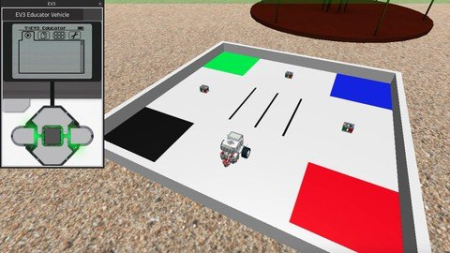
Virtual LEGO Robotics Toolkit Basics
MP4 | Video: h264, 1280x720 | Audio: AAC, 44.1 KHz
Language: English | Size: 570 MB | Duration: 43m
Learn to Program Virtual EV3 Robot​

What you'll learn
Learn to use virtual simulator to see programming output
Learn to program and control virtual robot
Learn to program a robot using EV3 Lab software
Learn to participate in Virtual Robot Competitions
Requirements
LEGO Mindstorms EV3 Lab Software(Free software)
Virtual Robotics Toolkit Software
Description
Do you want to learn robotics but do not have a robotics kit? If yes then this course is for you.
Virtual LEGO Robotics is a tool to learn coding through robotics in a game-like environment. In this course, you will learn how to use LEGO Mindstorms EV3 Lab software to control EV3 robots in Virtual Robotics toolkit software. In this course, I have explained how to download and install Virtual Robotics Toolkit software, how to connect EV3 Lab software with Virtual robotics toolkit software. I have given a brief idea of the Simple and Advanced mode toolbars of VRT.
After finishing this course you will also understand how to participate in virtual robotics competitions. You need to install two software on your computer before you enroll in this course. The first software is LEGO Mindstorms EV3 Lab software and another is Virtual Robotics Toolkit. LEGO Mindstorms EV3 Lab software is free software and Virtual Robotics Toolkit is paid software. When you install Virtual Robotics Toolkit software first time you will get 15 days trial and after that, you need to buy the software.
Learning outcomes
Learn to use the virtual simulator to see programming output
Learn to program and control a virtual robot
Learn to program a robot using EV3 Lab software
Learn to participate in Virtual Robot Competitions
Requirements for taking this course
You need LEGO Mindstorms EV3 Lab Software(Free software)
Virtual Robotics Toolkit Software
Who this course is for
Suitable for students age group 9+ years old
Students who are interested to start basic robotics and coding course
Students who are interested in Virtual Robot Programming
Teachers who are looking for some coding and robotics activities online
Screenshots


Zurück
Oben Unten