• Regeln für den Video-Bereich:

    In den Börsenbereich gehören nur Angebote die bereits den Allgemeinen Regeln entsprechen.

    Einteilung

    - Folgende Formate gehören in die angegeben Bereiche:
    - Filme: Encodierte Filme von BluRay, DVD, R5, TV, Screener sowie Telesyncs im Format DivX, XviD und x264.
    - DVD: Filme im Format DVD5, DVD9 und HD2DVD.
    - HD: Encodierte Filme mit der Auflösung 720p oder darüber von BluRay, DVD, R5, TV, Screener sowie Telesyncs im Format x264.
    - 3D: Encodierte Filme von BluRay, die in einem 3D Format vorliegen. Dies gilt auch für Dokus, Animation usw.
    - Serien: Cartoon/Zeichentrick, Anime, Tutorials, Dokumentationen, Konzerte/Musik, Sonstiges sind demnach in die entsprechenden Bereiche einzuordnen, auch wenn sie beispielsweise im High Definition-Format oder als DVD5/DVD9/HD2DVD vorliegen. Ausnahme 3D.
    - Bereich Englisch: Englische Releases gehören immer in diesen Bereich.
    - Bereich Talk: Der Bereich, in dem über die Releases diskutiert werden kann, darf, soll und erwünscht ist.


    Angebot/Beitrag erstellen

    - Ein Beitrag darf erst dann erstellt werden, wenn der Upload bei mindestens einem OCH komplett ist. Platzhalter sind untersagt.
    - Bei einem Scenerelease hat der Threadtitel ausschließlich aus dem originalen, unveränderten Releasenamen zu bestehen. Es dürfen keine Veränderungen wie z.B. Sterne, kleine Buchstaben o.ä. vorgenommen werden. Ausnahme Serienbörse:
    - Bei einem Sammelthread für eine Staffel entfällt aus dem Releasename natürlich der Name der Folge. Beispiel: Die Simpsons S21 German DVDRip XviD - ITG
    - Dementsprechend sind also u.a. verboten: Erweiterungen wie "Tipp", "empfehlenswert", "only", "reup", usw. / jegliche andere Zusatzinformation oder Ergänzung, welche nicht in obiger Beschreibung zu finden ist.

    Aufbau des Angebots und Threadtitel

    Der Titel nach folgendem Muster erstellt zu werden. <Name> [3D] [Staffel] [German] <Jahr> <Tonspur> [DL] [Auflösung] <Quelle> <Codec> - <Group>
    Beispiel: The Dark Knight German 2008 AC3 DVDRip XviD - iND
    Beispiel: The Dark Knight 2008 DTS DL BDRip x264 - iND
    Beispiel: The Dark Knight 2008 AC3 DL BDRip XviD - iND
    Beispiel: The Dark Knight German 2008 AC3 720p BluRay x264 iND
    Beispiel: The Dark Knight 2008 DTS DL 1080p BluRay x264 iND
    Beispiel: Die Simpsons S01 German AC3 DVDRip XviD iND
    Beispiel: Die Simpsons S20 German AC3 720p BluRay x264 iND
    Beispiel: Sword Art Online II Ger Sub 2014 AAC 1080p WEBRip x264 - peppermint
    Entsprechend sind also u.a. verboten: Sonderzeichen wie Klammern, Sterne, Ausrufezeichen, Unterstriche, Anführungszeichen / Erweiterungen wie "Tipp", "empfehlenswert", "only", "reup", usw. / jegliche andere Zusatzinformation oder Ergänzung, welche nicht in obiger Beschreibung zu finden ist
    Ausnahmen hiervon können in den Bereichen geregelt sein.

    Die Beiträge sollen wie folgt aufgebaut werden:
    Überschrift entspricht dem Threadtitel
    Cover
    kurze Inhaltsbeschreibung
    Format, Größe, Dauer sind gut lesbar für Downloader außerhalb des Spoilers zu vermerken
    Nfo sind immer Anzugeben und selbige immer im Spoiler in Textform.
    Sind keine Nfo vorhanden z.B. Eigenpublikationen, sind im Spoiler folgende Dateiinformationen zusätzlich anzugeben :
    Quelle
    Video (Auflösung und Bitrate)
    Ton (Sprache, Format und Bitrate der einzelnen Spuren)
    Untertitel (sofern vorhanden)
    Hosterangabe in Textform außerhalb eines Spoiler mit allen enthaltenen Hostern.
    Bei SD kann auf diese zusätzlichen Dateiinformationen verzichtet werden.

    Alle benötigten Passwörter sind, sofern vorhanden, in Textform im Angebot anzugeben.
    Spoiler im Spoiler mit Kommentaren :"Schon Bedankt?" sind unerwünscht.


    Releases

    - Sind Retail-Release verfügbar, sind alle anderen Variationen untersagt. Ausnahmen: Alle deutschen Retail-Release sind CUT, in diesem Fall sind dubbed UNCUT-Release zulässig.
    - Im Serien-Bereich gilt speziell: Wenn ein Retail vor Abschluss einer laufenden Staffel erscheint, darf diese Staffel noch zu Ende gebracht werden.62
    - Gleiche Releases sind unbedingt zusammenzufassen. Das bedeutet, es ist zwingend erforderlich, vor dem Erstellen eines Themas per Suchfunktion zu überprüfen, ob bereits ein Beitrag mit demselben Release besteht. Ist dies der Fall, ist der bereits vorhandene Beitrag zu verwenden.
    - P2P und Scene Releases dürfen nicht verändert oder gar unter einem iND Tag eingestellt werden.


    Support, Diskussionen und Suche

    - Supportanfragen sind entweder per PN oder im Bereich Talk zu stellen.
    - Diskussionen und Bewertungen sind im Talk Bereich zu führen. Fragen an die Uploader haben ausschließlich via PN zu erfolgen, und sind in den Angeboten untersagt.
    - Anfragen zu Upload-Wünschen sind nur im Bereich Suche Video erlaubt. Antworten dürfen nur auf Angebote von MyBoerse.bz verlinkt werden.


    Verbote

    - Untersagt sind mehrere Formate in einem einzigen Angebotsthread, wie beispielsweise das gleichzeitige Anbieten von DivX/XviD, 720p und 1080p in einem Thread. Pro Format, Release und Auflösung ist ein eigener Thread zu eröffnen.
    - Grundsätzlich ebenso verboten sind Dupes. Uploader haben sich an geeigneter Stelle darüber zu informieren, ob es sich bei einem Release um ein Dupe handelt.
    - Gefakte, nur teilweise lauffähige oder unvollständige Angebote sind untersagt. Dies gilt auch für eigene Publikationen, die augenscheinlich nicht selbst von z.B. einer DVD gerippt wurden. Laufende Serien, bei denen noch nicht alle Folgen verfügbar sind, dürfen erstellt und regelmäßig geupdatet werden.
    - Untersagt sind Angebote, welche nur und ausschließlich in einer anderen Sprache als deutsch oder englisch vorliegen. Ausnahmen sind VORHER mit den Moderatoren zu klären.


    Verstoß gegen die Regeln

    - Angebote oder Beiträge, die gegen die Forenregeln verstoßen, sind über den "Melden"-Button im Beitrag zu melden.
  • Bitte registriere dich zunächst um Beiträge zu verfassen und externe Links aufzurufen.


Englische Tutorials

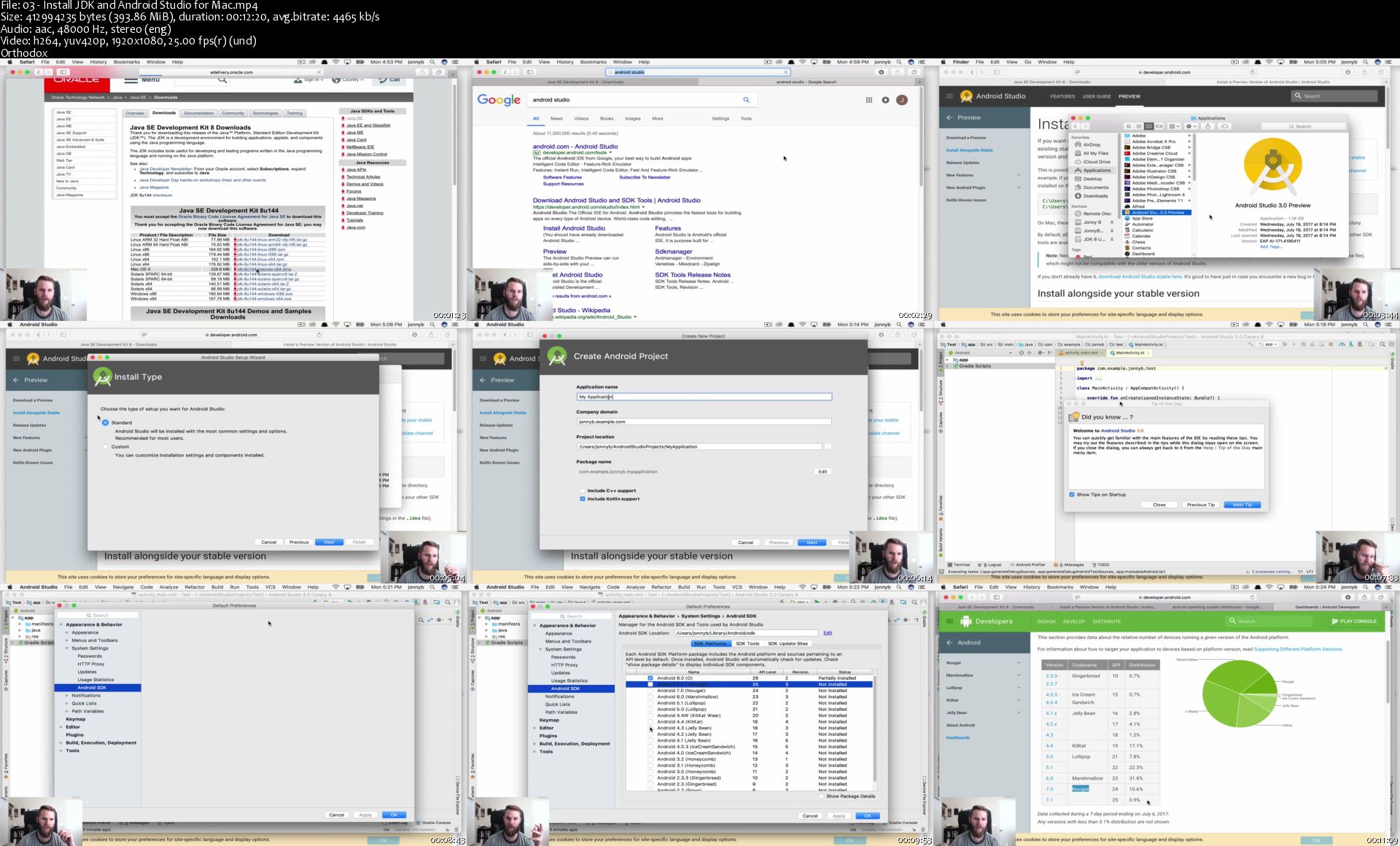
Kotlin for Android Crash Course

lekql-Mz-Sdg9-RAi-LWq-Fmz-GM8-Hu-VLVq-Eo-L.jpg


Kotlin for Android Crash Course
MP4 | Video: AVC 1918 x 1078 | Audio: AAC 48 Khz 2ch | Duration: 21:51:57 | 30.05 GB
Genre: eLearning | Language: English

Build professional, fully functional apps using Kotlin Submit apps to the Google Play store Requirements Must have PC with Windows 8+ OR macOS OR Linux/Ubuntu Recommend having an actual Android device but it is not required

03-Install-JDK-and-Android-Studio-for-Mac-s.jpg


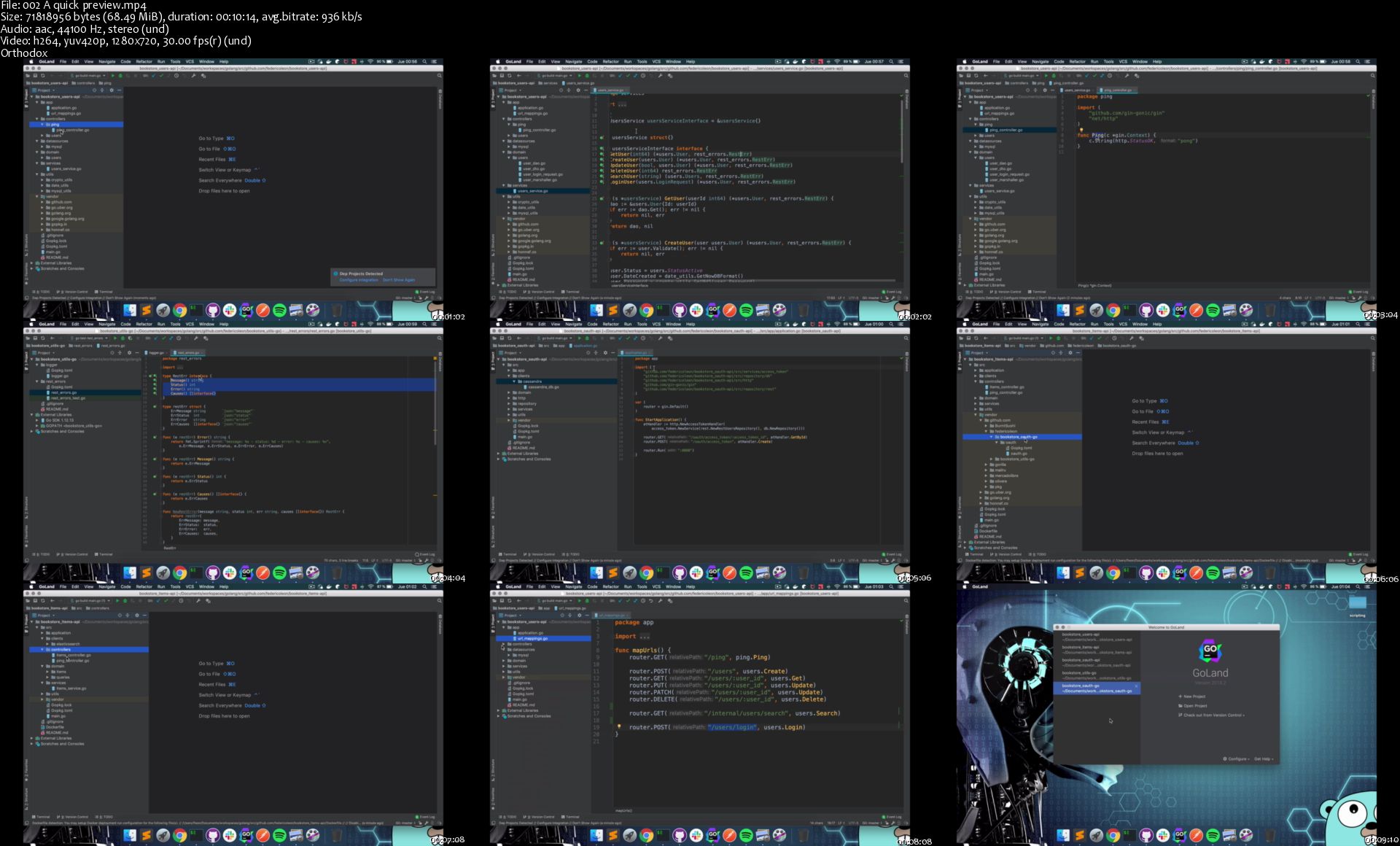
Golang - How to design and build REST microservices in Go

u-CAjyti3-ZUjwnw-YCakw4-Wp1u-Fa-Bffz-RJ.png


Golang - How to design and build REST microservices in Go
Hot & New| h264, yuv420p, 1280x720 |ENGLISH, aac, 44100 Hz, 2 channels, s16 | 20h 26 mn | 8.9 GB
Instructor: Federico León

All you need to integrate SQL & NoSQL databases, search engines and all the tools that you need in your REST API.
What you'll learn

How to structure and organize your microservice.
Domain Driven Development.
Hexagonal architecture applied.
MySQL integration and configuration.
Integrate Cassandra DB in your microservices.
Elasticsearch integration and configuration.
Logging to standard output and log files.
DAO pattern implementation.
How to build, publish and use a custom Go library.
Testing all the layers of your application.
How dependencies work in Go.

Requirements

Just complete the Golang tour available at Golang's website
Nice to have: Part 1 of this course

Description

Welcome!

In this second part of the series I'm working with MySQL, Cassandra and Elasticsearch as persistence layers and we're going to create 3 different microservices using different design patterns: MVC, featured MVC and Domain Driven Development implementing the Hexagonal architecture.

At the end of the course you'll learn:

How to structure our application's packages and code.

MVC pattern, Domain Driven Development and Hexagonal Architecture applied!

How to configure MySQL client in Go. DAO pattern implemented.

How to configure and use CassandraDB client in Go.

How to configure and use Elasticsearch in Go.

Testing and mocking database integrations.

Stress test the microservice with goroutines.

How dependencies work in Go.

How to build, publish, use and share a custom Go library.

Application design patterns.

Preparing our distributed logging system.

Real life examples and exercises.

I'm sure you're going to enjoy this course! if you have any doubts, please check the reviews on my other courses so you can get an idea about what you're about to get. This is real life and industry experience!

Hope to hear from you!

Fede.
Who this course is for:

Software engineers.
Software developers.
Technical leaders.
Architects.
Anyone who wants to get serious about microservices in Go.

Homepage

002-A-quick-preview-s.jpg


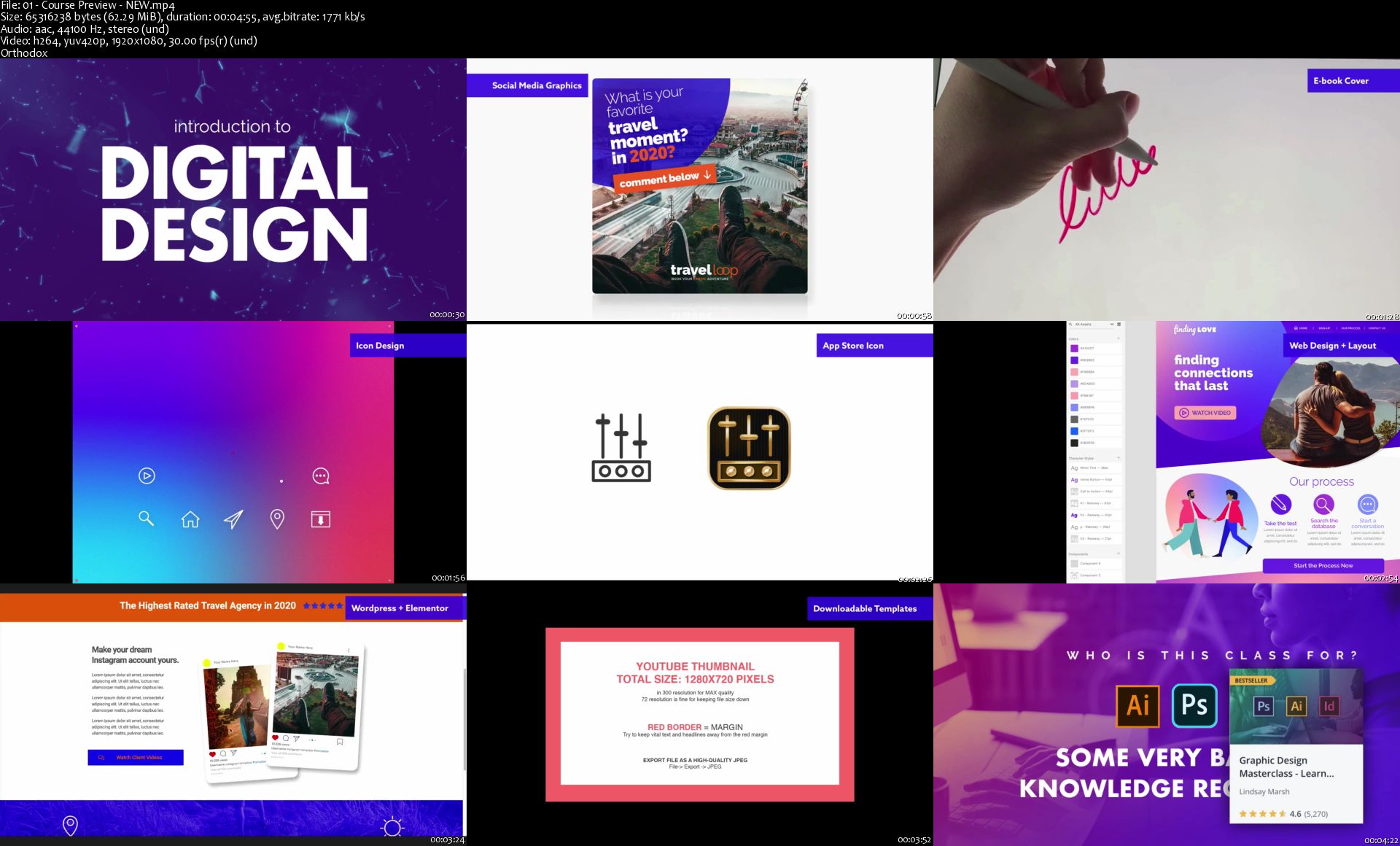
Digital Design Masterclass for Graphic Designers

maxresdefault.jpg


Digital Design Masterclass for Graphic Designers
Video: .MP4, 1920x1080, 30 fps | Audio: AAC, 44.1 kHz, 2ch | Duration: 9h 18m
Genre: eLearning | Language: English | Size: 7.7 GB

The future of design is digital. This course was designed to get graphic designers up to speed on the latest and greatest digitally focused projects so they can expand their skillset and offer more services.

This course is massive covering so many Digital design projects from social media, icon design, web design and more.

SOCIAL MEDIA DESIGN (Youtube, Facebook and Instagram)
ANIMATED GIFS
DIGITIZING SKETCHES
CREATING DIGITAL BRAND ASSETS
ICON SET DESIGN
APPLE APP STORE ICON DESIGN
E-BOOK COVERS
WEB DESIGN USING WORDPRESS
LANDING PAGE DESIGN USING ADOBE XD

First of all we go cover Digital Design theory, learn the different aspects of designing for digital like creating powerful social media campaigns, website designs, layout for digital and even taking about accessibility in digital design.

Next, we conquer several popular digital design projects including creating several YouTube thumbnails that drive users to click through. We even create an entire social media campaign and talk about how to design for facebook, instagram. We even talk about creating display ads for websites so you can feel comfortable expanding your skillset to all types of digital ad creation.
Need to know how to create animated gifs using Photoshops Timeline feature? We will create an animated display ad from our previous campaign and add movement and animation. We will also learn how to create GIFS from imported video clips.

Have you wanted to know how to create a compelling e-book cover? We will do just that and learn how to design for e-book covers. We talk about sizing, exporting and how to create a design that grabs the viewers attention. We will go over how to take hand written type and bring that into photoshop to use on our e-book and also learn how to work with other sketching apps to bring in hand written assets. We also create our own mock-up to display our final design.
A newly added project goes into more detail about how to create hand drawn assets in procreate or other sketching apps and how to bring them into Photoshop to create modern, dynamic campaigns that have style and a unique flair.

Do you like to sketch or illustrate? I even created a step by step project where we take a pencil sketch and digitize it using Adobe Illustrators Pen Tool. Knowing how to digitize sketches is a big part of expanding your skillset to the digital arena.
Icon design is at the center of any digital design projects. Icons can be used on websites, mobile apps, applications and more. Using a handy provided template we will create an entire cohesive icon set. We will learn how to use grids to create a thematic set and even learn how to add color and how to export our icons in all the right sizes for use everywhere.
After creating a simple, basic icon set we go even deeper to create a highly detailed Apple store App icon from scratch. We learn lots of tools, like how to use gradients to create a dimensional effect as well as the pattern tool and many more. We will learn how to export these files as well for use on the apple store as well as how to present our icon in a professional way.

It is hard to teach digital design for graphic designers without including a few sections that focus on web design. We will learn what our role is as graphic designers in this space as well as how to prepare and export files for web design projects.

We will learn from scratch Adobe Xd in a quick crash course. We will learn many aspects of strong web design and layout by creating a landing page together, step by step. We will even learn how to link our various pages to create a working prototype and learn some ways of how to export our files to the web developer.
Finally, we will conquer a basic front page website design for a travel company using Wordpress. We will learn the very basic of Wordpress and learn the very popular page building plug-in for Wordpress called Elementor to build out our webpage using video backgrounds, parallax images, icons, columns animated text and more! We use only the free version of Elementor so not purchases are bestiary to work through this course
Lastly, there are tons of downloadable resources in this class including pre-made templates for most of the projects. This includes Photoshop e-book, YouTube and social media templates and an icon set and app store icon template in Adobe Illustrator.

This course is not for those students who have never been in Adobe Photoshop and Illustrator before but this class is general enough for most beginner level graphic designers who are interested in adding to their skillset. For those who have never opened the Adobe software before I suggest taking the Graphic Design Masterclass to get a leg up on the basic tools.

This course assumes you have very basic working knowledge of Adobe Photoshop and illustrator and tools like Wordpress, Adobe Xd, Elementor page builder and more are taught from scratch so no prior experience is necessary.

01-Course-Preview-NEW-s.jpg


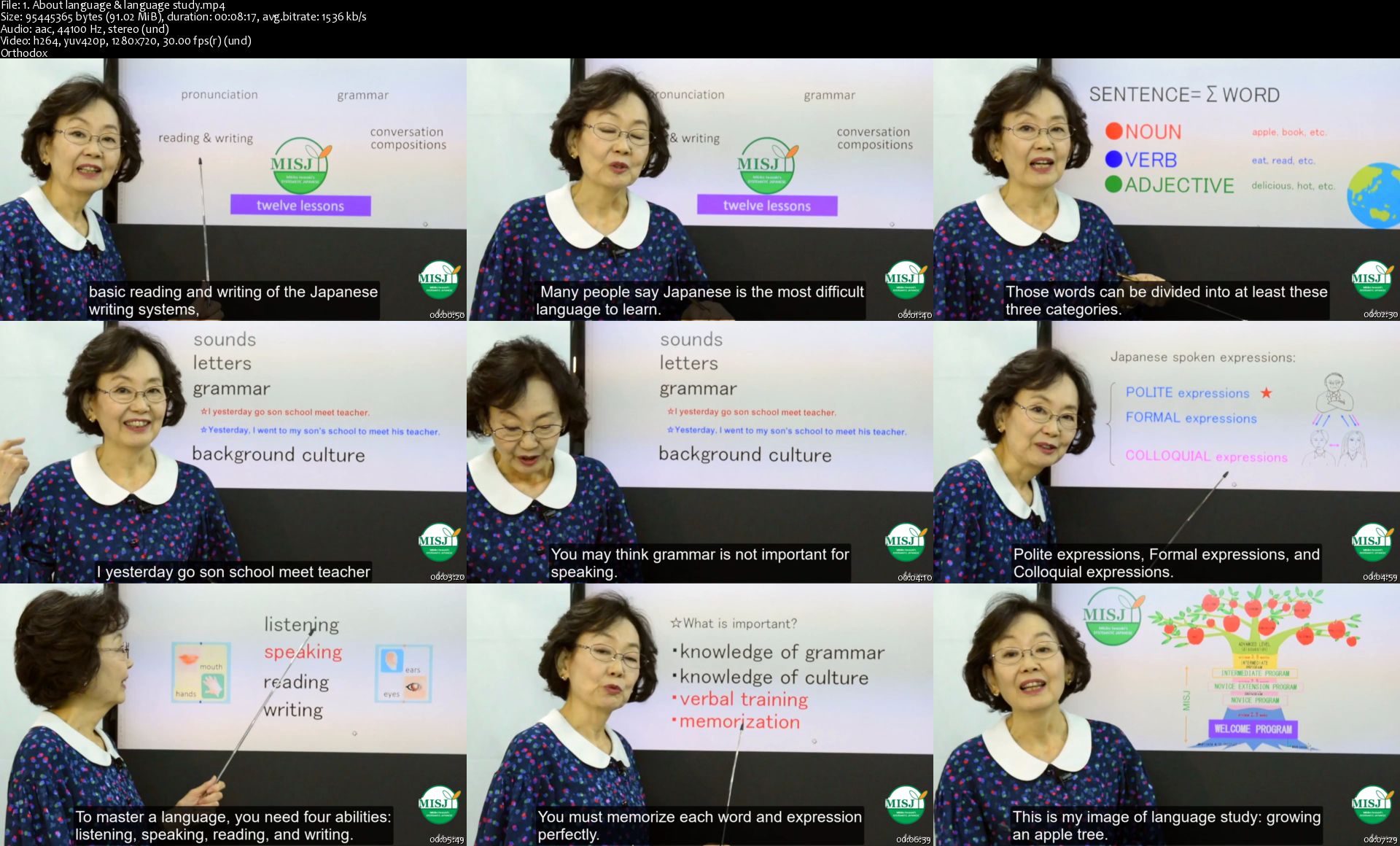
Japanese language course for beginners based on MISJ

LQXcj-TDNCZD2xy-QBD1v8-Esz4ayi-X503-Q.png


Japanese language course for beginners based on MISJ
h264, yuv420p, 1280x720 |ENGLISH, aac, 44100 Hz, 2 channels, s16 | 9h 22 mn | 11.7 GB
Instructor: Iwasaki Mikiko

MISJ WELCOME PROGRAM Section 1: Orientation, survival everyday conversations & how to handle Japanese NOUNS in Japanese
What you'll learn

Basic Japanese pronunciation
Basic reading and writing of Japanese hiragana and katakana characters
Basic grammar for making sentences using NOUNS
Basic conversation skills which reflect your intelligence, which will allow you to make friends and enjoy shopping.

Requirements

The willingness to learn Japanese language and culture
English listening ability
This program is carefully designed so that you can learn everything systematically. So, when you study this program for the first time, be sure to watch the videos from the beginning, in order, without jumping around to random topics. When you review, you may watch them in any order.
If you can smoothly read and write hiragana and katakana already, just skip those parts.

Description

First five lessons of the MISJ WELCOME PROGRAM.
Pronunciation, writing and reading of basic characters, how to make NOUN-based sentences, and how to ask and answer questions using these sentences. Conversational topics include: greetings, self-introductions, finding locations, asking for personal information such as names, home countries, occupations, ages, and telephone numbers, talking about family, ordering things, and shopping.
Who this course is for:

This is the first of three sections of the MISJ WELCOME PROGRAM. MISJ stands for Mikiko Iwasaki's Systematic Japanese.
The WELCOME PROGRAM is suitable for beginners who want to make a good start of learning Japanese. But it also helps people who want to re-build a solid foundation of Japanese language study.
Hundreds of our students, from countries across the world, recommend the MISJ WELCOME PROGRAM. Sign up today!

Homepage

1-About-language-language-study-s.jpg


Jim Rohn - Foundations For Success

00420783.png


Jim Rohn - Foundations For Success
MP4 + MP3+ PDF | Video: 960x540 | Audio: AAC, 44.1Khz , 2ch | Duration: 29 hours | Language: English | 12.7 GB

This program is PACKED with the same step-by-step training that Jim has taught to thousands who have become Master Thought Leaders, business superstars and influential people who have created inspired lives, exceeded their goals and contribute deeply to their families, community and culture.

Understand the timeless wisdom and simple philosophies that have catapulted these Modern Masters to unprecedented success, financial freedom, meaning, and impact.

Maximize time, energy and resources to drive the results you want in your life. Learn how to build an affluence plan and create a life of abundance and financial freedom.

Master the universal laws that have catapulted today's Masters to tremendous success.

Learn the philosophical shifts to create a life with more health, wealth, love, and happiness, so you never stop progressing.
Discover how to intelligently direct your emotions to leverage your potential.

Unlock the secrets to creating a life of fulfillment, purpose, and meaning that jolts you out of bed in the morning.
Learn how to skillfully paint solutions to keep customers happy and drive up profits.

Master proven leadership strategies that get noticed by employees, business partners, investors, and executives.

What You'll Learn Inside The Program

Each video module includes a workbook and downloadable audio file so that you can listen on the go. The training is introduced by a Master Thought Leader who will share his or her own perspective and best practices before leading you into the core Jim Rohn training. Darren Hardy closes each module with a final inspirational message.

Module 1: P​hilosophy - Mark Victor Hansen

Develop a guidance system to make your dreams come true
Lock in opportunities to enrich your life
Learn the simple truths that create massive success and join the 10%
Set your sail for success, joy, pleasure and abundance

Module 2: Attitude - Denis Waitley

Unlock your potential with these essential and powerful shifts
Avoid the diseases of attitude that sabotage success
Intelligently direct your emotions to leverage potential
Master the strategic shifts to live with intensity, passion and purpose

Module 3: Goals - Brian Tracy

Strategically craft goals to revolutionize your future
Create and implement a disciplined action-plan to achieve your dreams
Destination is determined by direction

Module 4: Leadership - John C. Maxwell

Build, inspire and lead your team to get results and drive success
Maximize time, energy and resources to get results
Master the skills of possibility, opportunity, rationality and ability
Discover and hone your optimal leadership style

Module 5: Lifestyle - Connie Podesta

Design an extraordinary life
Unlock the secrets to creating a life of meaning
Craft a life of possibilities, abundance and influence
Transform your future by developing the abilities to absorb, respond, reflect and act

Module 6: Communication - Les Brown

Master the art of effective communication
Relate to others with accuracy, sincerity, brevity and style
Pinpoint and hone your perfect communication style
Proven strategies to create deeper connections and masterful influence

Module 7: Influence - Tom Hopkins

Learn the proven presentation strategies for maximum impact
Master the art of persuasion to influence people and get results
Learn how to skillfully paint solutions to keep customers happy and drive up profits
Persuade with passion, authority and authenticity and get life-changing results

Module 8: Abundance - Tony Robbins

Build a life of financial independence and freedom
Learn the philosophy of the rich
Develop a financial statement & learn the disciplines of the top 1%
Create an affluence plan to develop and multiply wealth

Module 9: Productivity - Harvey Mackay

Maximize your most valuable asset (time)
Zero in with ultimate focus and work smarter not harder
Plan for your successful future so that you can create the lifestyle you desire

Module 10: ​Action - Darren Hardy

On any ONE day you can massively change the direction of your life!
Learn the 4 essential questions for instant action
Get the 3 proven strategies to change anything

Plus, For A Limited Time You Will Receive These Seven Valuable Bonuses:

BONUS #1
How to Have Your Best Year Ever with an Introduction by John Addison

In these 4 life-changing videos and companion downloadable audio files, Jim Rohn shows how simple it is to begin to turn dreams into reality and shares the proven principles that inform, educate, energize and inspire you to make this year your best year ever.

BONUS #2
Classic Collection Success Seminars

Jim Rohn's seminars, The Philosophy of Success and Skills for Success in the Marketplace highlight the success principles for creating a thriving business and a life that you love. Includes 2 hours of exclusive audio.

BONUS #3
Jim Rohn at the San Francisco Hilton

In this special seminar, Jim Rohn shared his most priceless insights on success in business and life, including turning ideas into profit and the principles of personal development. Includes 6 videos and 6 audio files.

BONUS #4
How to Use a Journal

Jim Rohn's seminars, The Philosophy of Success and Skills for Success in the Marketplace highlight the success principles for creating a thriving business and a life that you love. Includes 2 hours of exclusive audio.

BONUS #5
Living an Exceptional Life

Design your best life. In this life-changing 47-minute video and downloadable audio, Jim Rohn teaches the foundations for reaching your goals and living an engaged, passionate and affluent life.
Exceptional Life

BONUS #6
The Weekend Seminar

In this weekend seminar, Jim Rohn shares the ideas, strategies and proven principles that helped him achieve mega success in both business and in life. Includes 12 audio files.

BONUS #7
3 Keys to Greatness

Create an affluent life! In this video and audio guide to achieving financial independence and success, Jim Rohn covers the three places to begin in the quest for a future full of abundance, happiness and wealth.

BONUS #8
Mentor to the Masters

The documentary featuring today's Master Thought Leaders as they discuss the timeless message and mentorship of Jim Rohn and the ten Foundations for Success.

BONUS #9
Tony Robbins and Jim Rohn

Create an affluent life! In this video and audio guide to achieving financial independence and success, Jim Rohn covers the three places to begin in the quest for a future full of abundance, happiness and wealth.

BONUS #10
12-month Digital Subscription to SUCCESS Magazine

Discover your path to greater achievement. Each issue provides an inside look at the success habits of leading CEOs, entrepreneurs, athletes, celebrities and other great achievers. Learn their tips and methods for time management, setting goals, staying motivated, inspiring colleagues and employees, living a healthy lifestyle, balancing work and family and more!

0042077f.jpg
00420780.jpg

00420782.jpg
0042078a.jpg


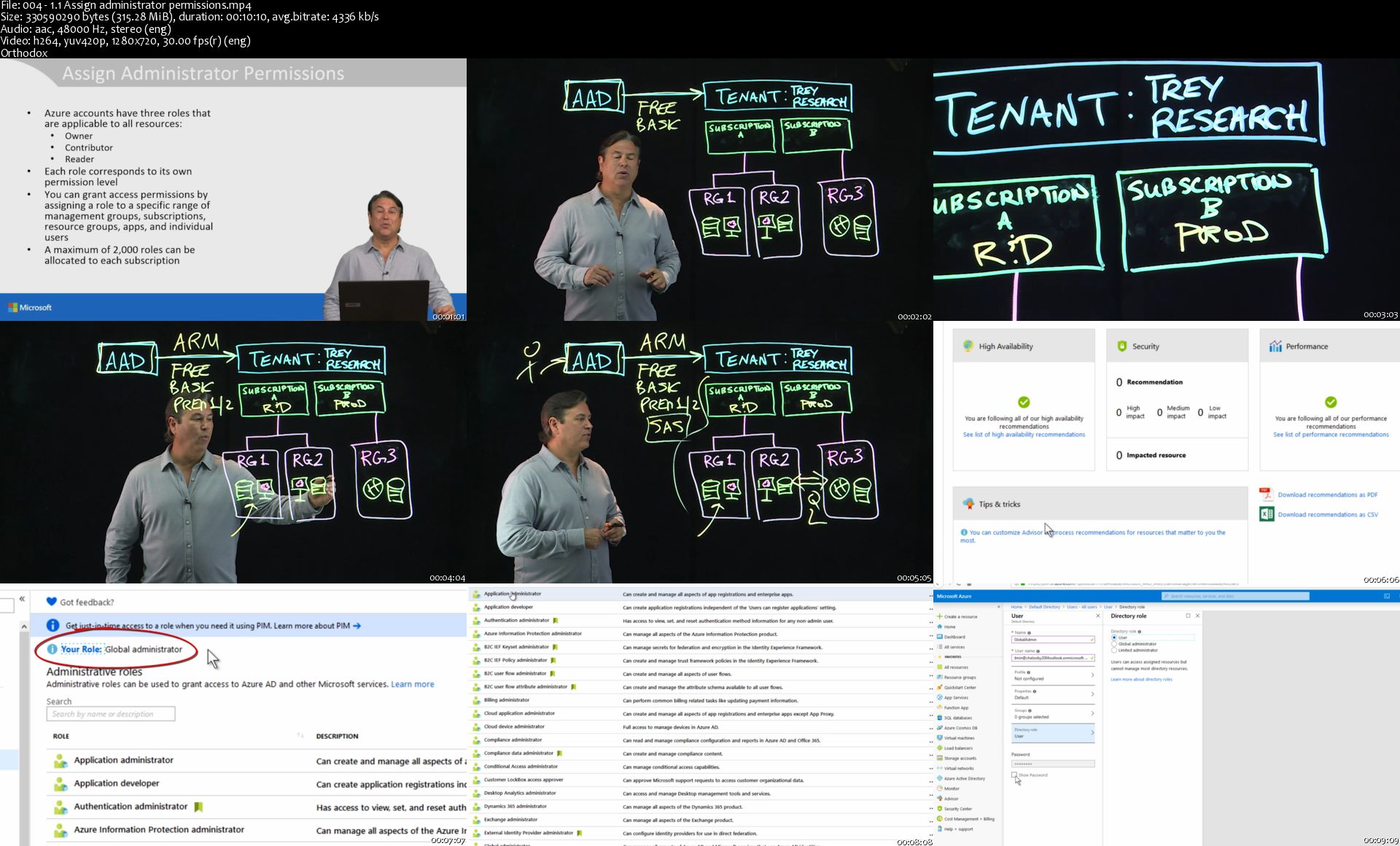
Exam AZ-103 Microsoft Azure Administrator (Video)

Hy-HT5-Rn8zh-Gp-QIn-Snez-Gk-Q2-ATOJG8g9-Q.jpg


Exam AZ-103 Microsoft Azure Administrator (Video)
Video: .MP4, 1280x720 30 fps | Audio: AAC, 48kHz, 2ch | Duration: 9h 3m
Genre: eLearning | Language: English | Size: 12.5 GB

The Exam AZ-103 Microsoft Azure Administrator (Video) offers full coverage of the MS AZ-103 exam so you can learn everything you need to know to pass the exam. Coverage includes cloud concepts, core Azure Services, Azure pricing and support, and the fundamentals of cloud security, privacy, compliance, and trust, with the goal of passing the AZ-103 Exam. The Exam AZ-103 Microsoft Azure Administrator (Video) offers 9 full hours of video training on all core concepts in the AZ-103 exam so you can fully understand cloud concepts, core Azure Services, Azure pricing and support, and the fundamentals of cloud security, privacy, compliance, and trust. It will prepare Azure Administrators to implement, monitor, and maintain Microsoft Azure solutions, including major services related to compute, storage, network, and security. With 9 hours of hands-on demonstrations, it will provide the knowledge necessary to pass the exam and become Microsoft Certified: Microsoft Azure Administrator.

With years of IT experience, numerous publications under his belt, and a wealth of expertise teaching in the field, Michael Shannon is uniquely qualified to prepare students for the Microsoft Azure Administrator AZ-103 exam.

Topics include:

Module 1: Manage Azure subscriptions and resources
Module 2: Implement and manage storage
Module 3: Deploy and manage virtual machines (VMs)
Module 4: Configure and manage virtual networks
Module 5: Manage identities

About the Instructor

Michael J. Shannon began his IT career when he transitioned from recording studio engineer to network technician for a major telecommunications company in the early 1990s. He soon began to focus on security and was one of the first 10 people to attain the HIPAA Certified Security Specialist. Throughout his 30 years in IT, he has worked as an employee, contractor, and consultant for several companies including Platinum Technologies, Fujitsu, IBM, State Farm, MindSharp, and Pearson, among others. Mr. Shannon has authored several books, training manuals, published articles, and CBT modules over the years as well. He is the senior technical instructor for Skillsoft Corporation, specializing in all things cloud and security. Skill Level
Intermediate/Advanced

Learn How To
Manage Azure subscriptions and resources
Implement and manage storage
Deploy and manage virtual machines (VMs)
Configure and manage virtual networks
Manage identities

Who Should Take This Course
Anyone preparing to take the Microsoft Azure Administrator AZ-103 exam
Anyone looking to understand Microsoft Azure from a broad perspective
Anyone with a Microsoft background interested in learning about cloud computing

Course Requirements
Experience with Microsoft operating systems combined with a fundamental knowledge of cloud computing and virtualization are recommended but not required.

Lesson Descriptions

Module 1, "Manage Azure Subscriptions and Resources," first works with how to manage Azure Subscriptions, and then moves on to analysis of resource utilization and consumption. The module finishes with how to manage resource groups and Role-based Access Control (RBAC).

Module 2, "Implement and Manage Storage," covers how to create and configure storage accounts. It also delves into importing and exporting data to Azure and configuring Azure files. The module finishes with Implementing Azure Backup.

Module 3, "Deploy and Manage Virtual Machines (VMs)," first tackles how to create and configure a VM for Windows and Linux. It then covers automating the deployment of VMs and how to Manage Azure VMs. The module ends with an exploration of the management of VM backups.

Module 4, "Configure and Manage Virtual Networks," discusses all things related to virtual networking infrastructure, including how to create connectivity between virtual networks, and implementing and managing virtual networking. Creating and configuring Network Security Groups (NSG) and implementing Azure load balancer are also covered. The last two lessons in this module explain monitoring and troubleshooting virtual networking, and integrating on-premises networks with virtual networking.

Module 5, "Manage Identities," covers managing Azure Active Directory (AD), managing Azure AD Objects, implementing and managing hybrid identities, and in the final lesson, implementing multi-factor authentication (MFA).

004-1-1-Assign-administrator-permissions-s.jpg


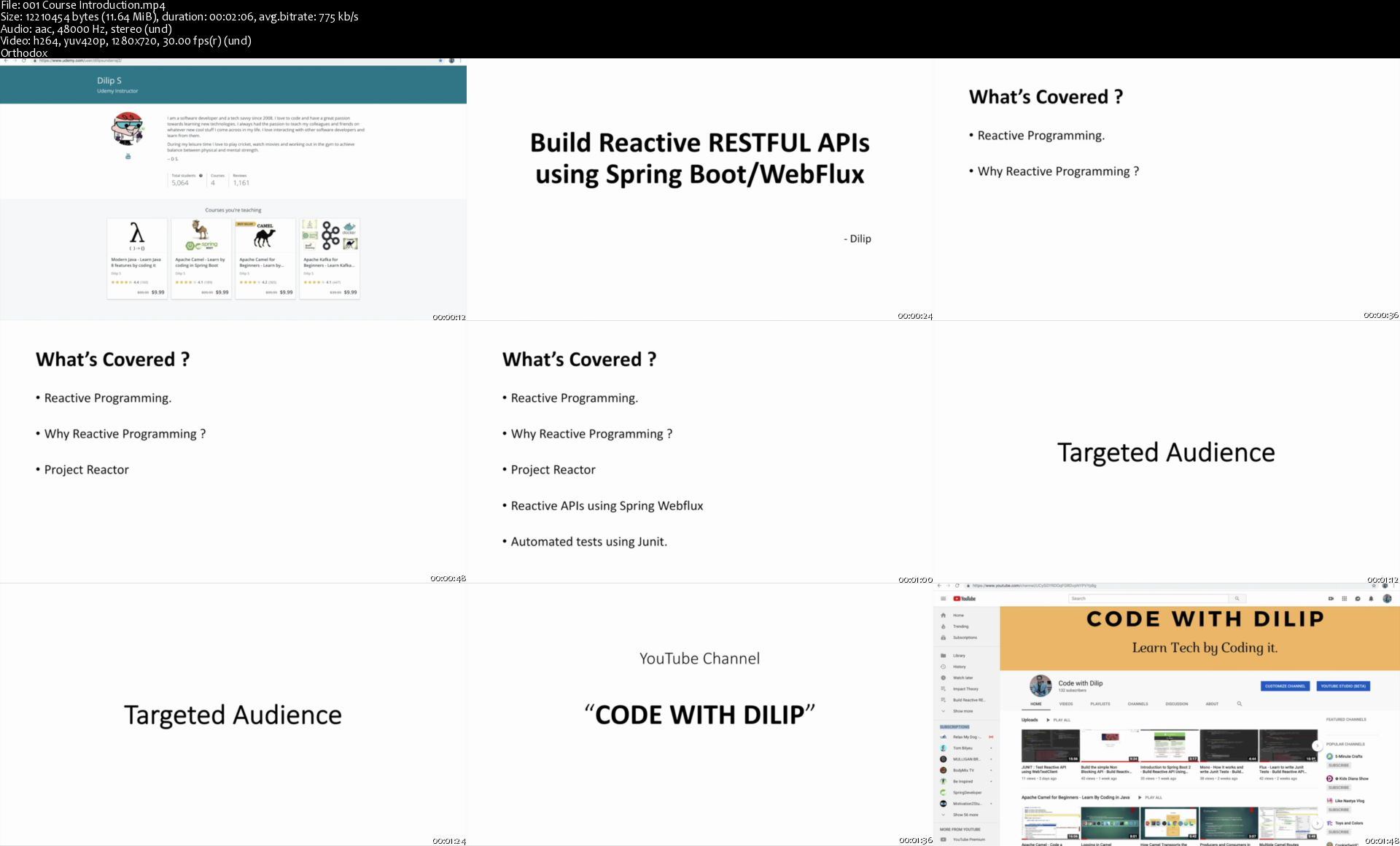
Build Reactive RESTFUL APIs using Spring Boot/WebFlux

X6-YP0-KMg6y-GDZieqb7-Pj-B8-V6-UOKz6eg3.png


Build Reactive RESTFUL APIs using Spring Boot/WebFlux
h264, yuv420p, 1280x720 |ENGLISH, aac, 48000 Hz, 2 channels, s16 | 9h 39 mn | 6.5 GB
Instructor: Dilip S

Learn to write reactive programming in Spring using WebFlux/Reactor and build Reactive RESTFUL APIs.
What you'll learn

What problems Reactive Programming is trying to solve ?
What is Reactive Programming?
Reactive Programming using Project Reactor
Learn to Write Reactive programming code with DB
Learn to Write Reactive Programming with Spring
Build a Reactive API from Scratch
Learn to build Non-Blocking clients using WebClient
Write end to end Automated test cases using JUNIT for the Reactive API

Requirements

At least JDK 8
Any one of the IDE like IntelliJ, Eclipse, etc.,
Spring Boot Knowledge is a must to make the most out of this course

Description

This course is structured to give you both the theoretical and coding aspect of Reactive Programming and Reactive RestFul APIs using Spring WebFlux.

If you are looking forward to learn the below listed things:

What is Reactive Programming ?

Write Reactive Programming code with Spring WebFlux.

Write Reactive Programming code with DB.

Building Reactive RestFul APIs with Spring WebFlux

Then this is the right course for you. This is a pure hands on oriented course where you will be writing lots of code.

By the end of this course you will have the complete understanding of coding and implementing a Reactive API using Spring WebFlux.

Why Reactive Programming ?

This section highlights about the need for reactive programming and explains in detail about the current execution model in spring-mvc.

This sections explains about the drawbacks in spring-mvc.

This section explains about the concurrency model in spring-mvc.

What is Reactive Programming?

This section talks about "What is Reactive Programming ?"

How Reactive programming works in a nutshell using a simple example.

This section will give you all an introduction to Reactive Streams Specification.

This section will give all an introduction to "Reactive Libraries" that are out there.

Getting started with Project Reactor

This section will give you all the fundamentals of Project Reactor and explore the project reactor using some examples.

This section covers the Reactive Types Flux and Mono in detail.

Setting up the Project for this course

In this section we will set up the project for this course using the Spring Intializr website.

Reactive Programming (Flux and Mono) - Hands on + Junit Testing

In this section we will explore about how Flux and Mono works via code.

We will do live coding on how to write Junit test cases using Flux and Mono.

We will explore lot of different operators in Flux and Mono.

Build the first Non Blocking RESTFUL API using Annotated Controllers - Hands On

In this section we will build the first non blocking API using the annotated controllers.

This section covers the fundamentals of how the reactive API works.

This sections also covers the coding aspect of how to return a Flux/Mono from an end point.

This section also covers how to write JUNIT test cases using WebTestClient.

Build Non Blocking RESTFUL API using Functional Web - Hands On

In this section we will build the non blocking API using the Functional Web Module.

This sections explains about the RouterFunction and HandlerFunction which forms the foundation for Function Web Module.

This section also covers how to write JUNIT test cases using WebTestClient.

Spring WebFlux & Netty - Execution Model

This section explains about the different layers behind WebFlux to serve a HTTP Request/Response.

This sections covers the concepts of NETTY such as Channel, EventLoop and some of the technical aspects of Netty.

Overview of the Reactive API

This section will give you an Overview of the Reactive API that we are going to build as part of this course.

Reactive Programming in Databases - MongoDB - Hands On

In this section we will learn about how to write the reactive programming code with MongoDB.

Define the Item Document for the project.

This section covers about how to configure different profiles in Spring Boot.

In this section we will set up the ItemReactive Mongo DB adapter.

This section also covers how to write JUNIT test cases for the reactive repository.

Build the Item Reactive API Endpoint - Using RestController

In this section we will learn about how to code the Item CRUD Reactive API using the @RestController approach.

This section also covers how to write automated tests using JUNIT and the non blocking test client WebTestClient.

Build the Item Reactive API Endpoint - Using Functional Web

In this section we will learn about how to code the Item CRUD Reactive API using the Functional Web approach.

This section also covers how to write automated tests using JUNIT and the non blocking test client WebTestClient.

Build Non Blocking Client using WebClient

In this section we will explore the techniques to interact with Reactive API using the WebClient.

Learn the techniques to Invoke the Reactive API using exchange() and retrieve() methods.

We will explore the GET, PUT, POST and DELETE operations using the WebClient.

Handling Exceptions in WebFlux - RestController

In this section we will code and explore different approaches to handle the exceptions/errors that occurs in the reactive api that's built using RestController.

Handle exceptions using @ExceptionHandler and @ControllerAdvice.

This section also covers how to write JUNIT test cases for the Exception scenarios.

Handling Exceptions in WebFlux - Functional Web

In this section we will code and explore different approaches to handle the exceptions/errors that occurs in the reactive api that's built using Functional Web.

Handle exceptions using WebExceptionHandler.

This section also covers how to write JUNIT test cases for the Exception scenarios.

WebClient - Exception Handling

In this section we will code and explore how to handle the exceptions using the WebClient.

Learn the techniques to handle the exceptions using exchange() and retrieve() methods.

Streaming Real Time Data using WebFlux - Server Side Events (SSE)

In this section we will code and learn about build an endpoint for Streaming RealTime Data using Mongo DB and Spring WebFlux.

This section covers about the Tailable Cursors and Capped Collections in Mongo DB.

Build a Non Blocking Streaming Endpoint and interact with the Mongo DB using the @Tailable annotation.

Learn to write Automated Tests using JUNIT for the Streaming Endpoints (SSE).

Who this course is for:

Anyone who is willing to learn and build Reactive APIs using Spring WebFlux

Homepage

001-Course-Introduction-s.jpg


Jordan Mackey - Make Money On Youtube Made Easy 2019 Edition

006e0b6f.jpg


Jordan Mackey - Make Money On Youtube Made Easy 2019
WEBRip | English | MP4 | 1920 x 1080 | AVC ~1729 Kbps | 29.970 fps
AAC | 128 Kbps | 44.1 KHz | 2 channels | ~6 hours | 5.89 GB
Genre: eLearning Video / Business, Sales, Marketing

In this unique course I will take you step-by-step using the EXACT blueprint and secrets I used to generate this income on Youtube. I will teach you the essential secret tricks I have used to get over $100,000 on Youtube using videos that YOU DON'T HAVE TO MAKE! You don't have to have a camera, a microphone, or make your own videos. There is no other course like this and you will not find this information anywhere else.

I will serve as your over-the-shoulder guide through the entire process and give you secrets such as how to choose a successful niche, how to download, upload, and monetize videos LEGALLY that do not have copyright licenses, secret tips to increase views and watch time, how to create unlimited youtube channels using unlimited phone numbers, how to gain additional views and subscribers easily, how to avoid getting your channel deleted or getting copyright strikes, how to get rid of copyright strikes, how to get past the youtube demonitization bots, how to get past the monetization review process quickly and easily, how to get your videos ranking on the search results, how to effectively use SEO strategies, and a secret trick to making more money on youtube than ANYONE else is able to generate doing one simple secret that will increase your revenue times 10. This will also work in ANY COUNTRY IN THE WORLD, so no matter where you live you can make money on Youtube.

I will also teach you a VERY EASY way you can get to the monetization review process within two weeks with just ONE video! This means you will be able to have a monetized channel to start making money within just a couple weeks, with barely any work involved!

As an added bonus, which will be WORTH THE PRICE of the course on it's own, you will be given access to a special facebook group that is dedicated to students helping each other grow each other's youtube channels through giving free subscribes, likes, comment, views, and watch time to other student's channels. This means your channel will grow EXTREMELY FAST and you will reach the monetization review process in no time, because you will be given free subscribes, views, likes, and comments on your channel by other students! This is ONLY available to students who have purchased the course.

What Will I Get Out Of This Course?
You will receive step-by-step training on every single aspect of generating revenue on Youtube, WITHOUT having to make your own videos! You will receive the blueprint I used and the special tips and tricks for how to choose a successful niche, how to download, upload, and monetize videos LEGALLY that do not have copyright licenses, secret tips to increase views and watch time, how to create unlimited youtube channels using unlimited phone numbers, secret to increasing views and subscribers, how to avoid getting your channel deleted or getting copyright strikes, how to get rid of copyright strikes, how to get past the youtube demonitization bots, how to get past the monitization review process quickly and easily, how to get your videos ranking on the search results, and a secret trick to making more money on youtube than ANYONE else is able to generate doing one simple secret that will increase your revenue times 10. You will also receive access to a special mastermind where I will answer any questions you have and can get tips, tricks, and answer questions from other students, as well as a Facebook group where all of the students will help you grow your channel quickly by giving you free subscribers, views, and watch time!

006e0be1.png

006e0be2.png

006e0be3.png

006e0be4.png


Machine Learning Masterclass

Machine-Learning-Masterclass-Udemy-Coupon-Free-696x436.jpg


Machine Learning Masterclass
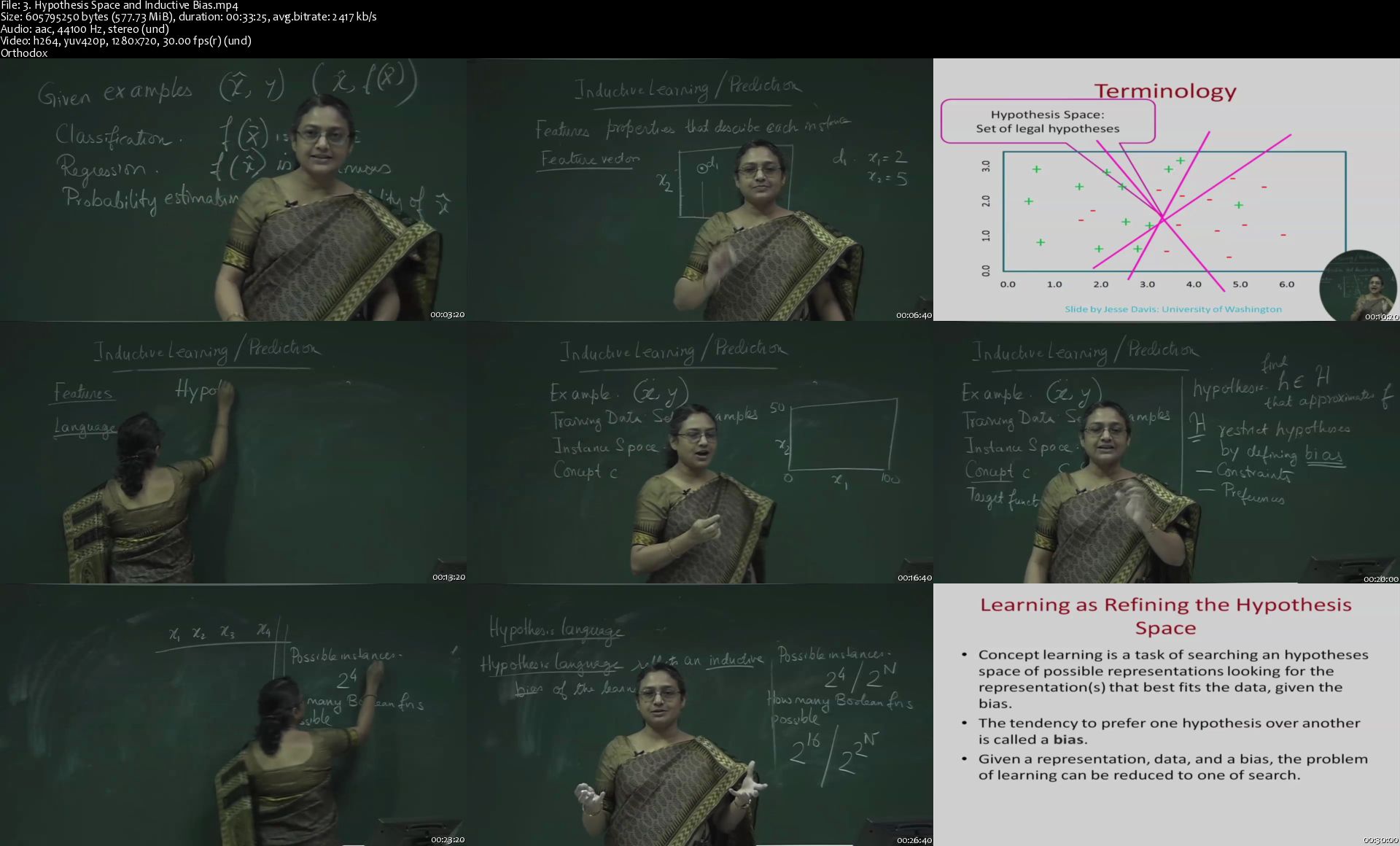
Video: .MP4, 1280x720 30 fps | Audio: AAC, 44.1 kHz, 2ch | Duration: 53:44:40
Genre: eLearning | Language: English + Subtitles | Size: 57.4 GB
Top University Professor


What you'll learn

Hypothesis Space and Inductive Bias
Evaluation and Cross-Validation
Linear Regression
Learning Decision Tree
Python Exercise on Decision Tree and Linear Regression
and Much MUch More!!

Requirements
Beginners are Welcome!

Description
Hello everyone and welcome to this course on an introduction to machine learning
in this course we will have a quick introduction to machine learning and this will not be very deep in a mathematical sense but it will have some amount of mathematical trigger and what we will be doing in this course is covering different paradigms of machine learning and with special emphasis on classification and regression tasks and also will introduce you to various other machine learning paradigms. In this introductory lecture set of lectures I will give a very quick overview of the different kinds of machine learning paradigms and therefore I call this lectures machine learning. )
A brief introduction with emphasis on brief right, so the rest of the course would be a more elongated introduction to machine learning right.
So what is machine learning so I will start off with a canonical definition put out by Tom Mitchell in 97 and so a machine or an agent I deliberately leave the beginning undefined because you could also apply this to non machines like biological agents so an agent is said to learn from experience with respect to some class of tasks right and the performance measure P if the learners performance tasks in the class as measured by P improves with experience.
So what we get from this first thing is we have to define learning with respect to a specific class of tasks right it could be answering exams in a particular subject right or it could be diagnosing patients of a specific illness right.
So but we have to be very careful about defining the set of tasks on which we are going to define this learning right, and the second thing we need is of a performance measure P right so in the absence of a performance measure P you would start to make vague statement like oh I think something is happening right that seems to be a change and something learned is there is some learning going on and stuff like that.
So if you want to be clearer about measuring whether learning is happening or not you first need to define some kind of performance criteria right.
So for example if you talk about answering questions in an exam your performance criterion could very well be the number of marks that you get or if you talk about diagnosing illness then your performance measure would be the number of patients that you say are the number of patients who did not have adverse reaction to the drugs you gave them there could be variety of ways of defining performance measures depending on what you are looking for right and the third important component here is experience right.
So with experience the performance has to improve right and so what we mean by experience here in the case of writing exams it could be writing more exams right so the more the number of exams you write the better you write it better you get it test taking or it could be a patient's in the case of diagnosing illnesses like the more patients that you look at the better you become at diagnosing illness right.
So these are the three components so you need a class of tasks you need a performance measure and you need some well-defined experience so this kind of learning right where you are learning to improve your performance based on experience is known as a this kind of learning where you are trying to where you learn to improve your performance with experience is known as inductive learning.
And then the basis of inductive learning goes back several centuries people have been debating about inductive learning for hundreds of years now and are only more recently we have started to have more quantified mechanisms of learning right. So but one thing I always point out to people is that if you take this definition with a pinch of salt, so for example you could think about the task as fitting your foot comfortably right.
So you could talk about whether a slipper fits your foot comfortably or let me put so I always say that you should take this definition with a pinch of salt because take the example of a slipper you know, so the slipper is supposed to give protection to your foot right and a performance measure for the slipper would be whether it is fitting the leg comfortably or not or whether it is you know as people say there is biting your leg or is it
Chaffin your feet right and with experience you know as the slipper knows more and more about your foot as you keep varying the slipper for longer periods of time it becomes better at the task of fitting your foot right as measured by whether it is shattering your foot or whether it is biting your foot or not right.
So would you say that the slipper is learned to fit to your foot well by this definition yes right so we have to take this with a pinch of salt and so not every system that confirms to this definition of learning can be set to learn usually okay. (Refer Slide Time: 06:11) So going on so there are different machine learning paradigms that we will talk about and the first one is supervised learning where you learn an input to output map right so you are given some kind of an input it could be a description of the patient who comes to comes to the clinic and the output that have to produce is whether the patient has a certain disease or not so this they had to learn this kind of an input to output map or the input could be some kind of equation right and then output would be the answer to the question or it could be a true or false question I give you a description of the question you have to give me true or false as the output.
And in supervised learning what you essentially do is on a mapping from this input to the required output right if the output that you are looking for happens to be a categorical output like whether he has a disease or does not have a disease or whether the answer is true or false then the supervised learning problem is called the classification problem right and if the output happens to be a continuous value like, so how long will this product last before it fails right or what is the expected rainfall tomorrow right so those kinds of problems they would be called as regression problems. These are supervised learning problems where the output is a continuous value and these are called as regression problems. So we will look at in more detail
classification and regression as we go on right, so the second class of problems are known as unsupervised learning problems right where the goal is not really to produce an output in response to an input but given a set of in data right we have to discover patterns in the data right. So that is more of the testicle unsupervised learning there is no real desired output that we are looking for right we are more interested in finding patterns in the data. So clustering right is one task one unsupervised learning task where you are interested
in finding cohesive groups among the input pattern right, for example I might be looking at customers who come to my shop right and I want to figure out if there are categories of customers like so maybe college students could be one category and sewing IT professionals could be another category and so on so forth and when I'm looking at this kinds of grouping in my data, so I would call that a clustering task right.
So the other popular unsupervised learning paradigm is known as the Association rule mining or frequent pattern mining where you are interested in finding a frequent co-occurrence of items right in the data that is given to you so whenever A comes to my shop B also comes to my shop right. So those kinds of co-occurrence so I can always say that okay if I see A then there is likely very likely that B is also in my shop somewhere you know so I can learn these kinds of associations between data right. And again we look at this later in more detail
these are I mean there are many different variants on supervised and unsupervised learning but these are the main ones that we look at so the third form of learning which is called reinforcement learning it is neither supervised or unsupervised in nature and typically these are problems where you are learning to control the behavior of a system and I will give you more intuition intone enforcement learning now
in one of the later modules, so like I said earlier. (Refer Slide Time: 09:33) So for every task right, so you need to have some kind of a performance measure so if you are looking at classification the performance measure is going to be classification error so typically right.
So we will talk about many, many different performance measures in the duration of this course but the typical performance measure you would want to use this classification error it's how many of the items or how many of the patients did I get incorrect so how many of them who are not having the disease today predict had the disease and how many of them that had the disease that I missed right. So that would be one of the
measures that I would use and that would be the measure that we want to use but we will see later that often that is not is not possible to actually learn directly with respect to this measure. So we use other forms right and likewise for regression again so we have the prediction error suppose I say it is going to rain like 23 millimeters and then it ends up raining like 49centimeters I do not know so that is a huge prediction error right and in terms of clustering so this is little becomes a little trickier to define performance measures we don't
know what is a good clustering algorithm because we do not know what how to measure the quality of clusters.
So people come up with all different kinds of measures and so one of the more popular ones is a scatter or spread of the cluster that essentially tells you how spread out the points are that belong to a single group if you remember we are supposed to find cohesive groups, so if the group is not that cohesive it's not all of them are not together then you would say the clustering is of a poorer quality and if you have other ways of measuring things like Alec was telling you, so if you know that people are college students right and then you can figure out that how many what fraction of your cluster or college students.
So you can do this kinds of external evaluations so one measure that people use popularly there is known as purity right and in the Association rule mining we use variety of measures called support and confidence that takes a little bit of work to explain support in confidence so I will defer it and I talked about Association rules in detail and in more in the reinforcement learning tasks so if we remember I told you it is learning to control so you are going to have a cost for controlling the system and also the measure here is cost and you would
like to minimize the cost that you are going to accrue while controlling the system. So these are the basic machine learning tasks. (Refer Slide Time: 12:11) So there are several challenges when you are trying to build a build a machine learning solution right so a few of these I have listed on this slide right the first one is you have to think about how good is a model that you have learned right so I talked about a few measures on the previous slide but often those are not sufficient there are other practical considerations that come into play and
we will look at some of these towards thee there was a middle of the course somewhere right and the bulk of the time would be spent on answering the second question which is how do I choose a model right. So given some kind of data which will be the experience that we are talking about so given this experience how would I choose how would I choose a model right that somehow learns what I want to do right so how that improves itself with experience and so on so how do I choose this model and how do I actually find the parameters of the model that gives me the right answer right. So this is what we will spend much of our time on in this
course and then there are a whole bunch of other things that you really have to answer to be able to build a useful machine loose full data analytics or data mining solutions questions like do I have enough data do I have enough experience to say that my model is good right it's the data efficient quality that could be errors in the data right suppose I have medical data and a is recorded as 225, so what does that mean it could be 225 days in which case it is a reasonable number it could be 22.5 years again is a reasonable number or 22.5 months is reasonable.
But if it is 225 years it's not a reasonable number so there is something wrong in the data right so how do you handle these things or noise in images right or missing values so I will talk briefly about handling missing values later in the course but this is as I mentioned in the beginning is a machine learning course right and this is not there is not primarily it is primarily concerned about the algorithms of machine learning and the and the math and the intuition behind those and not necessarily about the questions of building a practical
systems based on this. So I will be talking about many of these issues during the course but just that I want to reiterate that will not be the focus right and so the next challenge I have listed here is how confident can I be of the results and I want that I certainly we will talk a little bit because the whole premise of reporting machine learning results depends on how confident you can be of the results right and the last question am I describing the data correctly.
So that is a very, very domain dependent and the question that you can answer only with your experience as a machine learning or a data scientist professional or with time right, so but there are typical questions that you would like to ask that are there on the slides so from the next in the next module we look at the different learning paradigms in slightly more detail.
If you remember in supervised learning we talked about experience right where you have some kind of a description of the data. So in this case let us assume that I have a customer database and I am describing that by two attributes here, age and income.
So I have each customer that comes to my shop I know the age of the customer and the income level of the customers right. (Refer Slide Time: 00:48) And my goal is to predict whether the customer will buy a computer or not buy a computer right. So I have this kind of labeled data that is given to me for building a classifier right, remember we talked about classification where the output is a discrete value in this case it is yes or no, yes this is the person will buy a computer, no the person will not buy a computer.
And the way I describe the input is through a set of attributes in this case we are looking at age and income as the attributes that describe the customer right. And so now the goal is to come up with a function right, come up with a mapping that will take the age and income as the input and it will give you an output that says the person will buy the computer or not buy the computer. So there are many different ways in which you can create this function and given that we are actually looking at a geometric interpretation of the data,
I am looking at data as points in space. (Refer Slide Time: 01:57) The one of the most natural ways of thinking about defining this function is by drawing lines or curves on the input space right.
So here is one possible example, so here I have drawn a line and everything to the left of the line right. So these are points that are red right, so everything to the left of the line would be classified as will not buy a computer, everything to the right of the line where the predominantly the data points are blue will be classified as will buy a computer. So how would the function look like, it will look like something like if the income of a person remember that the x-axis is income and the y-axis is age.
So in this case it basically says that if the income of the person is less than some value right, less than some X then the person will not buy a computer. If the income is greater than X the person will buy your computer. So that is the kind of a simple function that we will define. It will just notice that way we completely ignore one of the variables here which is the age. So we are just going by income, if the income is less than some X then the person will not buy a computer, if the income is greater than X the person will buy a computer. So is this a good rule more or less I mean we get most of the points correct right except a few right.
So it looks like yeah, we can we can survive with this rule right. So this is not too bad right, but then you can do slightly better. (Refer Slide Time: 03:29) All right, so now we got those two red points that those just keep that points are on the wrong side of the line earlier. Now seem to be on the right side right, so
everything to the left of this line will not buy a computer, everything to the right will buy a computer right, everyone moves to the right will buy a computer. So if you think about what has happened here, so we have improved our performance measure right. So the cost of something, so what is the cost here. So earlier we are only paying attention to the income right, but now we have to pay attention to the age as well right. So the older you are right, so the income threshold at which we will buy a computer is higher
right. So the younger you are, younger means lower on the y axis, so the younger you are the income threshold at which you will buy a computer is lower right. So is that clear, so the older you are right, so the income threshold is shifted to the right here right so the older you are, so you need to have a higher income before you buy a computer and the anger you are your income threshold is lower, so you do not mind buying a computer even if your income is slightly lesser right.
So now we have to start paying attention to the age right, but then the advantage is you get much better performance right can you do better than this yes okay. (Refer Slide Time: 04:54) Now almost everything is correct except that one pesky red point, but everything else is correct. And so what has happened here we get much better performance, but at the cost of having a more complex classifier right. So earlier if you thought about it in geometric terms, so first you had a line that was parallel to the y-axis therefore, I just needed to define a intercept on the x-axis right. So if X is less than some value then it was one class was greater than some value was another class.
Then the second function it was actually a slighting line like that, so I needed to define both the intercept and the slope right. And now here it is now a quadratic so I have to define three parameters right. So I have to define something like ax2+ bx+c, so I have defined the ABC the three parameters in order to find the quadratic, and I am getting better performance. So can you do better than this. (Refer Slide Time: 05:57)
Okay the sum for does not seem right correct seems to be too complex a function just to be getting this one point there right. And I am not sure I am not even sure how many parameters you need for drawing that because Microsoft use some kind of spline PowerPoint use some kind of spline interpolation to draw this curve I am pretty sure that it is lot, lot more parameters than it is worth another thing to note here is that that particular red point that you see is actually surrounded by a sea of blue right. So it is quite likely that there was some glitch there either the person actually bought a computer and we never we have not recorded it has been having what computer or there are some extremist reason the person comes into the shop sure that is going to buy a computer but then gets a phone call saying that some emergency please come out immediately and therefore he left without buying a computer right there could be variety of reasons for why that noise occurred and this will probably be the more appropriate classifier right. So these are the kinds of issues I would like to think about what is the complexity of the classifier that I would like to have right and versus the accuracy of the classifier, so how good
is the classifier in actually recovering the right input output map and or their noise data in the in the input in the experience that I am getting is it clean or is there noise on it and if so how do I handle that noise these are the kinds of issues that we have to look at okay. (Refer Slide Time: 07:31) So these kinds of lines that we drew right kind of hiding one assumption that we are making so the thing is the data that comes to me comes as discrete points in the space right and from these discrete points in the space I need to generalize and be able to say something about the entire state space right so I do not care where the data point is on the x and y-axis right I should be able to give a label to that right. If I do not have some kind of assumption about these lines right and if you do not have some kind of assumptions about these lines the only thing I can do is if the same customer comes again hey or somebody who has exact same age and income as that cause customer comes again I can tell you whether the person is going to buy a computer or not buy a computer but I will not be able to tell you about anything else outside of the experience right. So the assumption we made is everything to the left of a line is going to do one thing or the other right so everything to the left of the line will not buy the computer everything to the right or everyone to the right will buy a computer this is an assumption I made the assumption was the Lions are able to segregate people who buy from who do not buy the lines or the curves were able to segregate people who will buy from who will not buy so that is a kind of an assumption I made about the distribution of the input data and the class labels. So this kind of assumptions that we make about these lines are known as inductive biases in general inductive bias has like two different categories one is called language bias which is essentially the type of lines that I am going to draw my gonna draw straight lines or am I going to draw curves and what order polynomials am I going to look at and so on so forth these for my language bias and such bias is the other form of inductive bias that tells me how in what order am I going to examine all these possible lines right
. So that gives me the gives me a search bias right, so putting these two these things together we are able to generalize from a few training points to the entire space of inputs right I will make this more formal as we go on and then in the next night set of modules right. (Refer Slide Time: 10:01) And so here is one way of looking at the whole process so I am going to be giving you a set of data which we will call the training set so the training set will be will consists of say as an input which we'll call as X and an output which we call as Y right, so I am going to have a set of inputs I have X1, X2, X3, X4 likewise I will have Y1, Y2, Y3, Y4 and t
his data is fed into a training this data is fed into a training algorithm right and so the data is going to look like this in our case right. So remember our X's are the input variable success all the inputs so in this case that should have the income and the age, so x1 is like 30,000 and 25 and x2 is like 80,000 and 45 and so on so forth and the Y's or the
labels they correspond to the colors in the previous picture right so y1 does not buy a computer Y2 buys a computer and so on so forth so this essentially gives me the color coding so y1 is essentially red and y2 is blue right and I really if I am going to use something numeric this is what we will be doing later on I really cannot be using these values first of all wise or not numeric and the X is varied too much right. So the first coordinate in the X is like 30,000 and 80,000 and so on so forth and the second coordinate is like 25 and 45 so that is a lot a lot smaller in magnitude so this will lead to some kind of numerical instabilities, so what will typically end up doing is normalizing these so that they form appropriate approximately in the same range so you can see that I have try to normalize these X values between 0 and 1 right.
So have chosen an income level of say 2 lakhs it is the maximum and age of 100 and you can see the normalized values and likewise for buys and not buy I have taken not by as - 1 and by as computer is + 1these are arbitrary choices, now but later on you will see that there are specific reasons for wanting to choose this encoding in this way alright and then the training algorithm chugs over this data right and it will produce a classifier so now this classifier I do not know I do not know whether it is good or bad right so we had a straight line in the first case right an axis parallel line if we did not know the good or bad and we needed to have some mechanism by which we evaluate this right. So how do we do the evaluation typically is that you have what is
called a test set or a validation set right so this is another set of x and y paths like we had in the training set, so again in the test set we know what the labels are it is just that we are not showing it to the training algorithm we know what the labels are because we need to use the correct labels to evaluate whether your trading algorithm is doing good or bad right so, so this process by which this evaluation happens is called validation later then of the validation. If you are happy with the quality of the classifier we can keep it if you are not happy they go back to the training algorithm and say hey I am not happy with what you produced give me something different right, so we have to either iterate over the algorithm again we will go over the data again and try to refine the parameter estimation or we could even think of changing some parameter values and then trying to redo the training algorithm all over again but this is the general process and we will see that many of the different algorithms that we look, look at in the course of fitting the course of these lectures actually follow this kind of a process okay so what happens inside that green box. (Refer Slide Time: 13:48) So inside the training algorithm is that there will be this learning agent right which will take an input and it will p
roduce an output white at which it thinks is the correct output right but it will compare it against the actual target why it was given for the in the training right, so in the training you actually have a target why so it will compare it against a target why right and then figure out what the error is and use the error to change the agent right so then it can produce the right output next time around this is essentially an iterative process so you see that input okay produce an output Y ha
t and then you take the target Y. You can compare it to the Y hat figure out what is the error and use the error to change the agent again right and this is by and large the way most of the learning all algorithms will operate most of the classification algorithms or even regression algorithms will open it and we will see how each of this works as, we go on right there are many, many applications. (Refer Slide Time: 14:46) I mean this is too numerous to list here are a few examples you could look at say a fraud detection right, so we have
some data where the input is a set of transactions made by a user and then you can flag each transaction as a valid transaction or not you could look at sentiment analysis you know varied Lee called opinion mining or buzz analysis etc. Where I give you a piece of text or a review written about and a product or a movie and then you tell me whether the movies whether the review is positive or whether is negative and what are the negative points that people are mentioning about and so on so forth and. This again a classification task or you could use it for doing churn prediction where you are going to say whether a customer who is in the system is likely to leave your system is going to continue using your product or using your service for a longer period of time, so this is essentially churn so when a person leaves your services you call the person earner and you can label what the person is Channel or not and I have been giving you examples form medical diagnosis all through apart from actually diagnosing whether a person has the disease or not you could also use it for risk analysis in the slightly indirect way I talked about that when we when we do the algorithms for classification. So we talked about how we are interested in learning different lines or curves that can separate different classes in supervised learning and, so this curves can be represented using different structures and throughout the course we will be looking at different kinds of learning mechanisms like artificial neural networks support vector machines decision trees nearest neighbors and Bayesian networks and these are some of the popular ones and we look at these in more detail as the course progresses so another supervised learning problem is the one of prediction. (Refer Slide Time: 16:45) Or regression where the output that you are going to pred
ict is no longer a discrete value it is not like we will buy a computer whereas not buy a computer it is more of a continuous value so here is an example, where at different times of day you have recorded the temperature so the input to the system is going to be the time of day and the output from the system is going to be the temperature that was measured at a particular point at the time right so you are going to get your experience or your training data is going to take this form so the blue points woul
d be your input and the red points would be the outputs that you are expected to predict. So note here that the outputs are continuous or real value right and so you could think of this in this toy example as points to the left being day and the points to the right being night right and just as in the previous case of classification, so we could try to do these simple as possible fit in this case which would be to draw a straight line that is as close as possible to these points now you do see that like in the classification case when it choose a simple solution there are certain points at which we are making large errors right so we could try to fix that.
And try to do something more fancy but you can see that while the daytime temperatures are more or less fine with the night times we seem to be doing something really off right because we are going off too much to thee the right-hand side all right how are you could do something more complex just like in the classification case where we wanted to get that one point right so we could try and fit all these temperatures that were given to us by looking at a sufficiently complex curve. And again this as we discussed earlier is probably not the right answer and you are probably in this case surprisingly or better off fitting the straight line rig
ht and so these kinds of solutions where we trying to fit the noise in the data we are trying to make the solution predict the noise in the training data correctly are known as over fitting over fit solut
ions and one of the things that we look to avoid in, in machine learning is to over fit to the training data. (Refer Slide Time: 19:21) So we will talk about this again and then new course right and so what we do is typically we would like to do what is called linear regression some of you might have come across this and of different circumstances and the typical aim in linear regression is to say take the error that your line is making so if you take an example point let us say I take any let us say I take an example point somewhere here righ
t. So this is the actual training data that is given to you and this is the prediction that your line is making at this point so this quantity is essentially the, the prediction error that this line is making and so what you do is you try to find that line that has the least prediction error right so you take the square of the errors that your prediction is making and then you try to minimize the, the sum of the squares of the errors why do we take the squares. (Refer Slide Time: 20:31) Because errors could be both positive or negative and we want to make sure that you are minimizing that regardless of the sign of the error okay and so with sufficient data right so a linear regression is simple enough you could just already using matrix inversions as we will see later but with many dimensions like the challenge is to avoid
over fitting like we talked about earlier and then there are many ways of avoiding this. And so I will again talk about this in detail when we look at linear regression
right so one point that I want to make is that linear regression is not as simple as it sounds right so here is an example so I have two input variables x1 and x2 right and if I try to fit a straight line with x1 and x2 I will probably end up with something like a1 x1 plus a2 x2 right and that looks like, like a plane in two dimensions right. But then if I just take these two dimensions and then transform them transform the input so instead of saying just the x1 and x2 if I say my input is going to look like x1 square x2 squared x1 x2 and then the x1 and x2 s it was in the beginning so instead of looking at a two-dimensional input if I am going to look at a 5 dimensional input right. So that wil
l and out now I am going to fit a line or a linear plane in this 5 dimensional input so that will be like a1 x1 squared plus a2 x2 square plus a3 x1 x2 plus a4 x1 plus a5 x2 now that is no longer the equation of a line in two dimensions right so that is the equation of a second-order polynomial in two dimensions but I can still think of this as doing linear regression because I am only fitting a function that is going to be linear in the input variables right so by choosing an appropriate transformation of the inputs. (Refer Slide Time: 22:38) I can fit any higher-order function so I could solve very complex problems using linear regression and so it is not really a weak method as you would think at first, first glance again we will
look at this in slightly more detail in the later lectures right and regression our prediction can be applied in a variety of places one popular places in time series prediction you could think about predicting rainfall in a certain region or how much you are going to spend on your telephone calls you could think of doing even classification using this.
If you think of you remember our encoding of plus 1 and minus 1 for the class labels so you could think of plus 1 and minus 1 as the outputs right and then you can fit a regression line regression curve to that and if the output is greater than 0 you would say this classis plus 1 its output is less than 0 you see the class is minus 1 so it could use the regression ideas to fitness will solve the classificat
ion problem and you could also do data addiction. So I really do not want to you know give you all the millions of data points that I have in my data set but what I would do is essentially fit the curve to that and then give you just the coefficients of the curve right. And more often than not that is sufficient for us to get a sense of the data and that brings us to the next application I have listed their which is trend analysis so I am not really interested in quite many times. I
am not interested in the actual values of the data but more in the, the trends so for example I have a solution that I am trying to measure the running times off and I am not really interested in the actual running time because with 37seconds to 38 seconds is not going to tell me much. But I would really like to know if the running time scales linearly or exponentially with the size of the important all right so those kinds of analysis again can be done using regression and in the last one here is again risk factor analysis like we had in classification and you can look at which are the factors that contribute most to the output so that brings us to the end of this module on supervised learning,,
Hello and welcome to this module on introduction to unsupervised learning, right. So in supervised learning we looked at how you will handle training data that had labels on it. (Refer Slide Time: 00:26) So this is this particular place this is a classification data set where red denotes one class and blue denotes the other class right. (Refer Slide Time: 00:35) And in unsupervised learning right so you basically have a lot of data that is given to you but they do not have any labels attached to them right so we look at first at the problem of clus
tering where your goal is to find groups of coherent or cohesive data points in this input space right so here is an example of possible clusters. (Refer Slide Time: 00:57) So those set of data points could form a cluster right and again now those set of data points could form a cluster and again those and those so there are like four clusters that we have identified in this in this setup so one thing to note here is that even in something like clustering so I need to have some form of a bias right so in this case the bias that I am having is in the shape of the cluster so I am assuming that the clusters are all ellipsoids right and therefore you know I have been drawing a specific shape curves for representing the clusters.
And also note that not all data points need to fall into clusters and there are a couple of points there that do not fall into any of the clusters this is primarily a artifact of me assuming that they are ellipsoids but still there are other points in the center is actually faraway from
all the other points in the in the data set to be considered as what are known as outliers so when you do clustering so there are two things so one is you are interested in finding cohesive groups of points and the second is you are also interested in finding data points that do not conform to the patterns in the input and these are known as outliers all right. (Refer Slide Time: 02:23) And that is as many mean different ways of an which you can accomplish clustering and we will look at a few in the course and the applications are numerous right so here are a few representative ones so one thing is to look at customer data right and try to discover the classes of customers you kno
w there are so earlier we looked at in the supervised learning case we looked at is that a customer will buy a computer or will not buy a computer as opposed to that we could just take all the customer data that you have and try to just group them into different kinds
of customers who come to your shop and then you could do some kind of targeted promotions and different classes of customers right. And this need not
necessarily come with labels you know I am not going to tell you that okay this customer is class 1 that customer is class 2 you are just going to find out which of the customers are more similar with each other all right. And as the second application which you have illustrated here is that I could do clustering on image pixels so that you could discover different regions in the image and then you could do some segmentation based on that different region so for example here it have a picture of a picture of a beach scene and then you are able to figure out the clouds and the sand and the sea and the tree from the image so that allows you to make more sense out of the image right.
Or you could do clustering on world usages right and you could discover synonyms and you could also do clustering on documents right and depending on which kind of documents are similar to each other and if I give you a collection of say 100,000 documents I might be able to figure out what are the different topics that are discussed in this collection of documents and many ways in which you can use clustering rule mining. (Refer Slide Time: 04:17)
And as I should give you a site about the usage of the word mining here so many of you might have heard of the term data mining and more often than not the purported data mining tasks are essentially machine learning problems right so it could be classification regression and so on so forth and the first problem that was essentially introduced as a mining problem and not as a learning problem was the one of mining frequent patterns and associations and that is one of the reasons
I call this Association rule mining as opposed to Association rule learning just to keep the historic connection intact right, so in Association rule mining we are interested in finding frequent patterns that occur in the input data and then we are looking at conditional dependencies among these patterns right.
And so for example if A and B occur together often right then I could say something like if A happens then B will happen let us suppose that so you have customers that are coming to your shop and whenever customer A visits your shop custom B also tags along with him right, so the next time you find customary
A somewhere in the shop so you can know that customer B is already there in the shop along with A. Or with very high confidence you could say that B is also in the shop at some somewhere else maybe not with A but somewhere else in the shop all right, so these are the kinds of rules that we are looking at Association rules which are conditional dependencies if A has come then B is also there right and so the Association rule mining process usually goes in two stages so the first thing is we find all frequent patterns. So A happens often so A is a customer that comes to measure the store often right and then I find that A and B are paths of customers that come to my store often so if I once I have that right A comes to my store often an A and B comes to my store often then I can derive associations from this kind this frequent patterns right and also you could do this in the variety of different settings you could find sequences in time series data right and where you could look at triggers for certain events. Or you could look at fault analysis right by looking at a sequence of events that happened and you can figure out which event occurs more often with the fault right or you could look at transactions data which is the most popular example given here is what is called Market Basket data so you go to a shop and you buy a bunch of things together and you put them in your basket so what is there in your basket right so this forms the transaction so you buy say eggs, milk and bread and so all of this go together in your basket. And then you can find out what are the frequently occurring patterns in this purchase data and
then you can make rules out of those or you could look at finding patterns and graphs that is typically used in social network analysis so which kind of interactions among entities happen often right so that is a that is another question that is what we looking at right. (Refer Slide Time: 07:31) So the most popular thing here is mining transactions so the most popular application here is mining transactions and as I mentioned earlier transaction is a collection o
f items that are bought together right and so here is a little bit of terminology and it is a set or a subset of items is often called an item set in the Association rule mining community and so the first step that you have to do is find fre
quent item sets right. And you can conclude that item set A if it is frequent implies item set B if both A and AUB or frequent item sets right so A and B are subset so AUB is another subset so if both A and AUB or frequent item sets then you can say that item set A implies item set B right and like I mentioned earlier so there are many applications here so you could think of predicting co-occurrence of events. (Refer Slide Time: 08:31) And Market Basket analysis and type series analysis like I mentioned earlier you could think of trigger events or false causes of False and so on so forth right so this brings us to the end of this module introducing unsupervised learning.
it is a 30 day refund period!! So you have nothing to lose!!

Who this course is for:
Anybody who wants to gain knowledge about Data science, python and Machine Learning

Homepage

3-Hypothesis-Space-and-Inductive-Bias-s.jpg


MasterClass.Com ALL Courses Collection 2020

7d05f6973b911c180cbc792ced386d53.png

MasterClass.Com ALL Courses Collection 2020 | 117 GB
MasterClass is an immersive online experience that offers access to genius by allowing anyone to take online classes with the world's best. Our instructors include Alice Waters, Chris Hadfield, Dan Brown, Daniel Negreanu,Gordon Ramsay,Judd Apatow,Helen Mirren,Kevin Spacey,Kevin Spacey,Werner Herzog,Hans Zimmer and more.

Include:
- Alice Waters Teaches The Art of Home Cooking - MasterClass
- Chris Hadfield Teaches Space Exploration - MasterClass
- Dan Brown Teaches Writing Thrillers - MasterClass
- Daniel Negreanu Teaches Poker - MasterClass
- Gordon Ramsay Teaches Restaurant Recipes - MasterClass
- Judd Apatow Teaches Comedy - MasterClass
- Helen Mirren Teaches Acting - MasterClass
- Kevin Spacey Teaches Acting - MasterClass
- Werner Herzog Teaches Filmmaking - MasterClass
- Hans Zimmer Teaches Film Scoring - MasterClass
- Ken Burns Teaches Documentary Filmmaking - MasterClass
- Margaret Atwood Teaches Creative Writing - MasterClass
- Mira Nair Teaches Independent Filmmaking - MasterClass
- Spike Lee Teaches Independent Filmmaking - MasterClass
- Marc Jacobs Teaches Fashion Design - MasterClass
- Martin Scorsese Teaches Filmmaking - MasterClass
- Malcolm Gladwell Teaches Writing - MasterClass
- R.L. Stine Teaches Writing for Young Audiences - MasterClass
- Reba McEntire Teaches Country Music - MasterClass
- Ron Howard Teaches Directing - MasterClass
- Samuel L. Jackson Teaches Acting - MasterClass
- Serena Williams Teaches Tennis - MasterClass
- Shonda Rhimes Teaches Writing for Television - MasterClass
- Stephen Curry Teaches Shooting, Ball-Handling, and Scoring - MasterClass
- Thomas Keller Teaches Cooking Techniques II: Meats, Stocks & Sauces - MasterClass
- Tom Morello Teaches Electric Guitar - MasterClass
- Thomas Keller Teaches Cooking Techniques - MasterClass
- Steve Martin Teaches Comedy - MasterClass
- Usher Teaches the Art of Performance - MasterClass
- Wolfgang Puck Teaches Cooking - MasterClass

HOmepage:

Link Download
Extract files with WinRar 5 or Latest !
 
Asian Efficiency - Finisher's Fastlane Course

9413ee7e27ecba64fa839eec956a0553.png

AsianEfficiency Finisher's Fastlane - Increase your productivity and focus | 1.39 GB
How to Finish Everything You Start, So You Can Finally Achieve Your Most Important Goals
This New System Lets You Focus on What Matters - Even If You're Overwhelmed and Don't Know Where to Start

Finisher's Fastlane: The Key to Finishing What You Start and Achieving Your Goals
Our system is the key to doing the Deep Work that will finally let you start and finish everything you need to do to accomplish your goals.
Do you feel like you're overflowing with ideas and new opportunities, but you don't know where to start?
We have practical steps to help you zoom out, prioritize, and work on what matters.

Here's what you'll get in the Finisher's Fastlane:
- 5 Focus Hacks to boost your focus immediately - you can do these TODAY and feel the results instantly
- How to get clarity on your big goal and vision for the future
- How to organize your calendar and schedule for Deep Work
- How to prioritize your projects and tasks so you always focus on the right things
- How to organize your desk and office for optimal focus and performance
- How to find the ONE THING you need to work on - even if you have 100+ items on your to-do list right now
- The right way to politely deal with a boss or manager who disrupts your focus (and get back to your work that matters)
- How to say no without hurting anyone's feelings, so you can firmly prioritize your focus
- How to balance multiple, competing goals from multiple sources (essential if you work in a corporate setting) - Elite only
- The power of tailored conversation, and how Brooks's coworker used it to land a phenomenal promotion offer - Elite only

Screenshots
88864cea999184b4c7c5061fce56c33d.jpg

HOmepage:

Link Download
Extract files with WinRar 5 or Latest !
 
Ben And Laura - Food Video School

8a98a7629ae39770fa32040ebc7c26b0.jpg

Ben And Laura - Food Video School | 3.01 GB
MAKE DELICIOUS FOOD VIDEOS
BRING YOUR RECIPES TO LIFE
What if you could capture your recipes through captivating videos? What if you could make videos that get attention and promote your work?

Now You Can.
MAKE VIDEOS NOW
Learn How To:
Create a Recipe Storyboard
Distinguish and Perfect Your Style
Master Your Camera Settings
Capture Your Recipe from the Best Angles
Make Food Look Mouth Watering
Edit Videos Like a Pro
Export for Different Platforms
& SO MUCH MORE!
LEARN FROM EXPERTS
Ben and Laura of October Creative have been creating food videos professionally for more than 2 years, helping blogs like Gimme Some Oven, Oh She Glows, and Minimalist Baker expand their reach and grow their brands.
They've partnered with Dana of Minimalist Baker to create this entirely video-based course.
This is the team of experts you want training you in food videography.

Here's just a small sampling of the 100s of Videos Ben and Laura have created:
How to Make Basil Pesto - Cookie & Kate
Slow Cooker Potato Soup - Gimme Some Oven
Flourless Pumpkin Bars - The Detoxinista
The World's Easiest (VEGAN) Cinnamon Rolls - Minimalist Baker

JOIN TODAY
WHAT'S INSIDE?
Determining Your Style
Mastering Your Camera for Video
Creating a Streamlined Workflow
Composition and Styling Tips
Storyboarding your Recipe
Working with Natural and Artificial Light
Editing in Premiere Pro
Finishing Touches & Exporting
BONUS! Creating Videos with Your iPhone!

Check Out the Full 100+ Video Lesson List!

LEARN HOW TO MAKE THIS VIDEO
Among hours of technical training and skill development, this course walks you through the entire process of making this Chocolate Chip Muffins Recipe Video.

Plus, you'll have access to all the raw footage we used to create this video so you can follow along, step-by-step, as we bring this video to life in the editing process. How cool is that?

JOIN TODAY
What's this Course Worth?
Videography Workshop: $3,000 + Travel
Food Videographers typically charge between $400 - $1500 PER VIDEO
Food Video School is an investment in yourself to develop a very desirable and marketable skill.
With the patience and practice to master these tools, you can easily recoup the cost of this
course. Then you can invest it directly in your own business, or use it to work with other brands!

HOmepage:

Screenshots
29271c40aa00eb702fbb625a19ee9075.jpg


Link Download
Extract files with WinRar 5 or Latest !
 
Zurück
Oben Unten