• Regeln für den Video-Bereich:

    In den Börsenbereich gehören nur Angebote die bereits den Allgemeinen Regeln entsprechen.

    Einteilung

    - Folgende Formate gehören in die angegeben Bereiche:
    - Filme: Encodierte Filme von BluRay, DVD, R5, TV, Screener sowie Telesyncs im Format DivX, XviD und x264.
    - DVD: Filme im Format DVD5, DVD9 und HD2DVD.
    - HD: Encodierte Filme mit der Auflösung 720p oder darüber von BluRay, DVD, R5, TV, Screener sowie Telesyncs im Format x264.
    - 3D: Encodierte Filme von BluRay, die in einem 3D Format vorliegen. Dies gilt auch für Dokus, Animation usw.
    - Serien: Cartoon/Zeichentrick, Anime, Tutorials, Dokumentationen, Konzerte/Musik, Sonstiges sind demnach in die entsprechenden Bereiche einzuordnen, auch wenn sie beispielsweise im High Definition-Format oder als DVD5/DVD9/HD2DVD vorliegen. Ausnahme 3D.
    - Bereich Englisch: Englische Releases gehören immer in diesen Bereich.
    - Bereich Talk: Der Bereich, in dem über die Releases diskutiert werden kann, darf, soll und erwünscht ist.


    Angebot/Beitrag erstellen

    - Ein Beitrag darf erst dann erstellt werden, wenn der Upload bei mindestens einem OCH komplett ist. Platzhalter sind untersagt.
    - Bei einem Scenerelease hat der Threadtitel ausschließlich aus dem originalen, unveränderten Releasenamen zu bestehen. Es dürfen keine Veränderungen wie z.B. Sterne, kleine Buchstaben o.ä. vorgenommen werden. Ausnahme Serienbörse:
    - Bei einem Sammelthread für eine Staffel entfällt aus dem Releasename natürlich der Name der Folge. Beispiel: Die Simpsons S21 German DVDRip XviD - ITG
    - Dementsprechend sind also u.a. verboten: Erweiterungen wie "Tipp", "empfehlenswert", "only", "reup", usw. / jegliche andere Zusatzinformation oder Ergänzung, welche nicht in obiger Beschreibung zu finden ist.

    Aufbau des Angebots und Threadtitel

    Der Titel nach folgendem Muster erstellt zu werden. <Name> [3D] [Staffel] [German] <Jahr> <Tonspur> [DL] [Auflösung] <Quelle> <Codec> - <Group>
    Beispiel: The Dark Knight German 2008 AC3 DVDRip XviD - iND
    Beispiel: The Dark Knight 2008 DTS DL BDRip x264 - iND
    Beispiel: The Dark Knight 2008 AC3 DL BDRip XviD - iND
    Beispiel: The Dark Knight German 2008 AC3 720p BluRay x264 iND
    Beispiel: The Dark Knight 2008 DTS DL 1080p BluRay x264 iND
    Beispiel: Die Simpsons S01 German AC3 DVDRip XviD iND
    Beispiel: Die Simpsons S20 German AC3 720p BluRay x264 iND
    Beispiel: Sword Art Online II Ger Sub 2014 AAC 1080p WEBRip x264 - peppermint
    Entsprechend sind also u.a. verboten: Sonderzeichen wie Klammern, Sterne, Ausrufezeichen, Unterstriche, Anführungszeichen / Erweiterungen wie "Tipp", "empfehlenswert", "only", "reup", usw. / jegliche andere Zusatzinformation oder Ergänzung, welche nicht in obiger Beschreibung zu finden ist
    Ausnahmen hiervon können in den Bereichen geregelt sein.

    Die Beiträge sollen wie folgt aufgebaut werden:
    Überschrift entspricht dem Threadtitel
    Cover
    kurze Inhaltsbeschreibung
    Format, Größe, Dauer sind gut lesbar für Downloader außerhalb des Spoilers zu vermerken
    Nfo sind immer Anzugeben und selbige immer im Spoiler in Textform.
    Sind keine Nfo vorhanden z.B. Eigenpublikationen, sind im Spoiler folgende Dateiinformationen zusätzlich anzugeben :
    Quelle
    Video (Auflösung und Bitrate)
    Ton (Sprache, Format und Bitrate der einzelnen Spuren)
    Untertitel (sofern vorhanden)
    Hosterangabe in Textform außerhalb eines Spoiler mit allen enthaltenen Hostern.
    Bei SD kann auf diese zusätzlichen Dateiinformationen verzichtet werden.

    Alle benötigten Passwörter sind, sofern vorhanden, in Textform im Angebot anzugeben.
    Spoiler im Spoiler mit Kommentaren :"Schon Bedankt?" sind unerwünscht.


    Releases

    - Sind Retail-Release verfügbar, sind alle anderen Variationen untersagt. Ausnahmen: Alle deutschen Retail-Release sind CUT, in diesem Fall sind dubbed UNCUT-Release zulässig.
    - Im Serien-Bereich gilt speziell: Wenn ein Retail vor Abschluss einer laufenden Staffel erscheint, darf diese Staffel noch zu Ende gebracht werden.62
    - Gleiche Releases sind unbedingt zusammenzufassen. Das bedeutet, es ist zwingend erforderlich, vor dem Erstellen eines Themas per Suchfunktion zu überprüfen, ob bereits ein Beitrag mit demselben Release besteht. Ist dies der Fall, ist der bereits vorhandene Beitrag zu verwenden.
    - P2P und Scene Releases dürfen nicht verändert oder gar unter einem iND Tag eingestellt werden.


    Support, Diskussionen und Suche

    - Supportanfragen sind entweder per PN oder im Bereich Talk zu stellen.
    - Diskussionen und Bewertungen sind im Talk Bereich zu führen. Fragen an die Uploader haben ausschließlich via PN zu erfolgen, und sind in den Angeboten untersagt.
    - Anfragen zu Upload-Wünschen sind nur im Bereich Suche Video erlaubt. Antworten dürfen nur auf Angebote von MyBoerse.bz verlinkt werden.


    Verbote

    - Untersagt sind mehrere Formate in einem einzigen Angebotsthread, wie beispielsweise das gleichzeitige Anbieten von DivX/XviD, 720p und 1080p in einem Thread. Pro Format, Release und Auflösung ist ein eigener Thread zu eröffnen.
    - Grundsätzlich ebenso verboten sind Dupes. Uploader haben sich an geeigneter Stelle darüber zu informieren, ob es sich bei einem Release um ein Dupe handelt.
    - Gefakte, nur teilweise lauffähige oder unvollständige Angebote sind untersagt. Dies gilt auch für eigene Publikationen, die augenscheinlich nicht selbst von z.B. einer DVD gerippt wurden. Laufende Serien, bei denen noch nicht alle Folgen verfügbar sind, dürfen erstellt und regelmäßig geupdatet werden.
    - Untersagt sind Angebote, welche nur und ausschließlich in einer anderen Sprache als deutsch oder englisch vorliegen. Ausnahmen sind VORHER mit den Moderatoren zu klären.


    Verstoß gegen die Regeln

    - Angebote oder Beiträge, die gegen die Forenregeln verstoßen, sind über den "Melden"-Button im Beitrag zu melden.
  • Bitte registriere dich zunächst um Beiträge zu verfassen und externe Links aufzurufen.

*** Bestes IPTV *** bester Preis *** gratis Test ***


Englische Tutorials

4960k3dbo.jpg


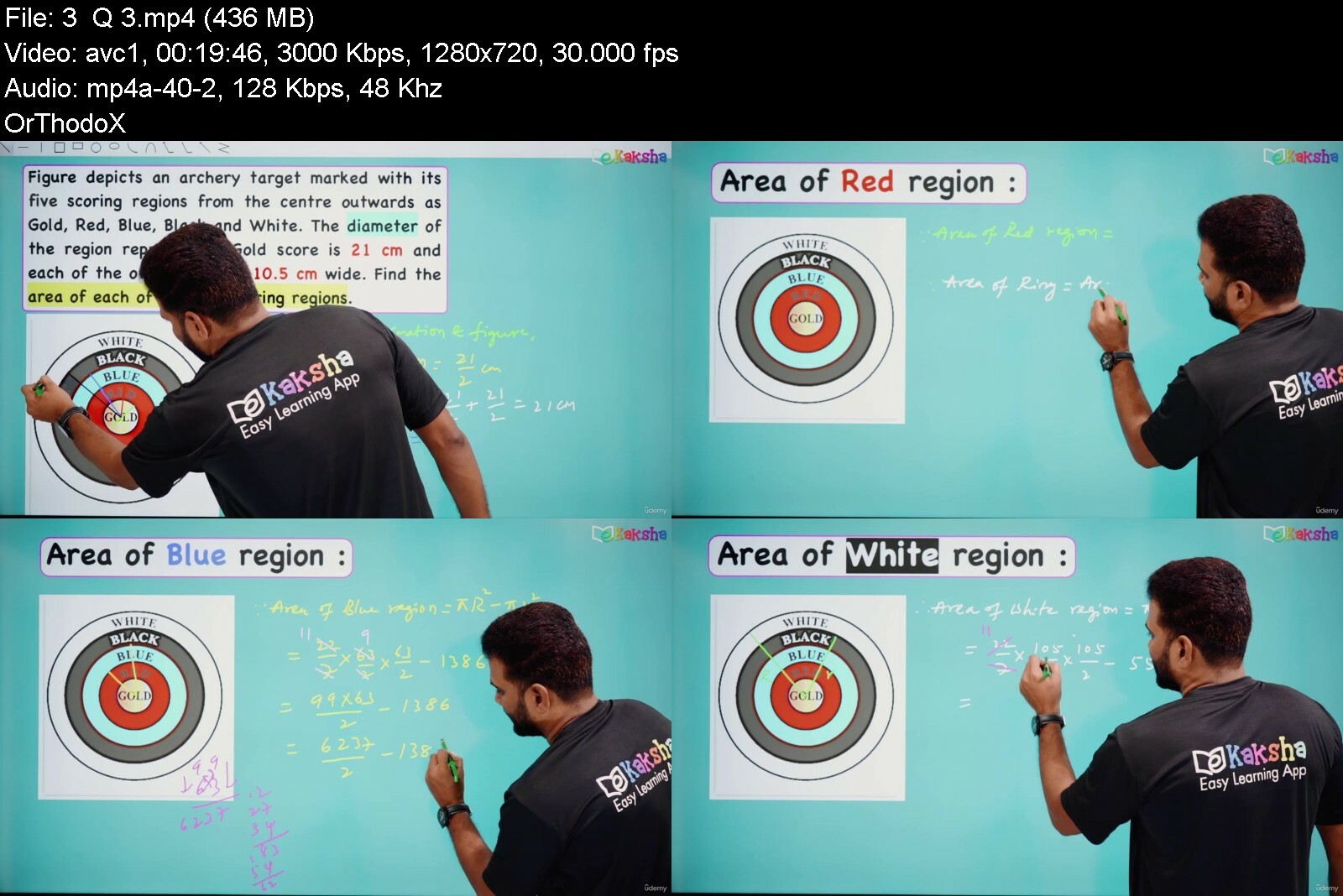
Become A Master of Mensuration - Areas related to Circles
Published 11/2022
Created by Lakshmi Narayana
MP4 | Video: h264, 1280x720 | Audio: AAC, 44.1 KHz, 2 Ch
Genre: eLearning | Language: English | Duration: 69 Lectures ( 7h 56m ) | Size: 10.1 GB


High school math that covers Areas related to Circle in detail, with a step-by-step approach with formulae and solutions


What you'll learn
Review of Concepts of Area and Perimeter of a Circle.
Areas of Sector and Segment of a Circle.
Circumference of Circle.
Length of an Arc of a Sector.
Perimeter of Sector.
Area of minor segment and major segment.
Areas of Combination of Plane Figures.
Applications of perimeter and Area of Sector, Segment and Circles.
At the end of the course, students will not only have learned about the topics in detail but also be able to solve various problems based on them.

Requirements
Basic knowledge of fundamental operations -Addition, Subtraction, Product and Division.
Each chapter is inbuilt with prerequisite knowledge classes where the child gets immense knowledge and a clear understanding of the chapters.

Description
This course is carefully designed to explain various applications of Mensuration - Areas related to Circles.It has 69 lectures spanning around eight hours of on-demand videos that are divided into 7 sessions. The course is divided into a simplified day-by-day learning schedule.Each topic is divided into simple sessions and explained extensively by solving multiple questions. Each session contains a detailed explanation of the concept.An online test related to the concept for immediate assessment of understanding.Session-based daily home assignments with a separate key. The students are encouraged to solve practice questions and quizzes provided at the end of each session.This course will give you a firm understanding of the fundamentals and is designed in a way that a person with little or no previous knowledge can also understand very well.It covers 100% video solutions of the NCERT exercises , with selected NCERT exemplars and R D Sharma.Our design meets the real classroom experience by following classroom teaching practices. We have designed this course by keeping in mind all the needs of students and their desire to become masters in math. This course is designed to benefit all levels of learners and will be the best gift for board-appearing students. Students love these easy methods and explanations. They enjoy learning maths and never feel that maths is troublesome.Topics covered in the course:Review of Concepts of Area and Perimeter of a Circle.Areas of Sector and Segment of a CircleCircumference of CircleLength of an Arc of a SectorPerimeter of SectorArea of minor segment and major segment.Areas of Combination of Plane FiguresApplications of perimeter and Area of Sector, Segment and Circles.With this course you'll also getPerfect your mathematical skills on Mensuration - Areas related to Circles.A Udemy Certificate of Completion is available for download.Feel free to contact me with any questions or clarifications you might have.I can't wait for you to get started on mastering the real number systems.I look forward to seeing you on the course! :)Benefits of Taking this Course:On completion of this course, one will have detailed knowledge of the chapter and be able to easily solve all the problems, which can lead to scoring well in exams with the help of explanatory videos ensure complete concept understanding.Downloadable resources help in applying your knowledge to solve various problems.Quizzes help in testing your knowledge. In short, one can excel in math by taking this course.

Who this course is for
This course has been designed for students of the Grade 10th CBSE, ICSE, SSC, GCSE, IGCSE, SAT, ACT, GRE, and other board-appearing students and competitive exam aspirants.
Students studying for the public or other competitive examinations.
Home-school parents are looking for extra support with the fundamentals.
Anyone interested in revising or learning the basics of mathematics should.
Students in junior high and high school/secondary schools.
Anyone who wants to proficient mathematics and the solving different real life situations on Mensuration - Areas related to Circles well.
Anyone who wants to study math for fun after taking a break from school.
It will also benefit schools who wish to run classes in the absence of a teacher and make learning fun for their students.
It will also benefit teachers and schools who wish to improve their teaching skills and make learning fun for their students.
For 11th, 9th, and 8th grade students, this will help as a bridge course.


becomeamasterofmensur7jdce.jpg


exqgfpip7kyp0btymkoofouiga.jpg


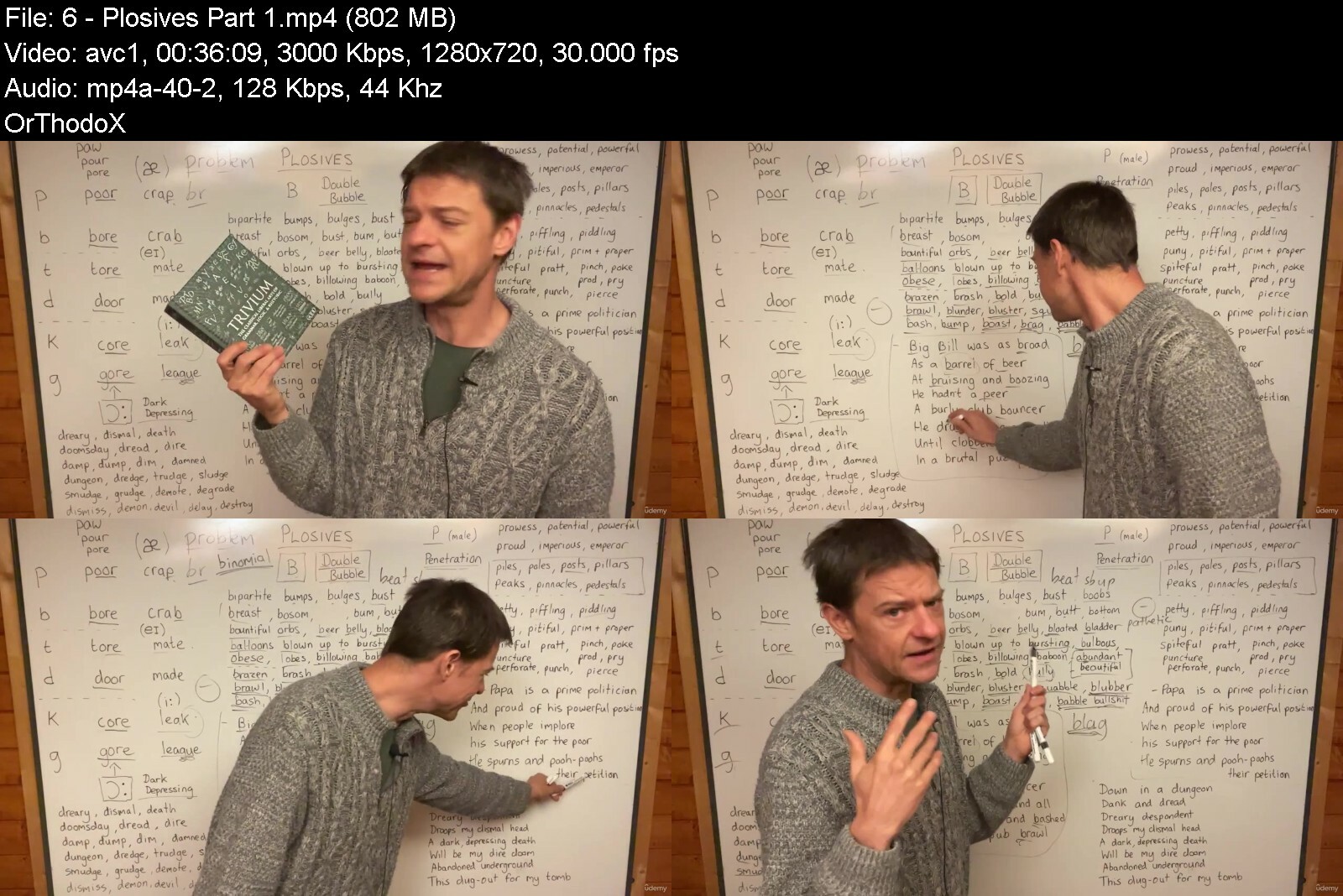
Master Uk Pronunciation
Published 11/2022
MP4 | Video: h264, 1280x720 | Audio: AAC, 44.1 KHz
Language: English | Size: 15.64 GB | Duration: 12h 3m

Sharpen your speaking skills


What you'll learn
Confidently identify and correctly pronounce voiced and unvoiced fricatives ( , , f, v, s, z, , , , d )
Confidently identify and correctly pronounce voiced and unvoiced plosives (p, b, t, d, g, k)
Memorize the sounds contained in regular spelling patterns
Memorize a large number of homophones and stress patterns
Memorize a large number of spelling irregularities and silent letters
Confidently identify and correctly pronounce approximants and nasals
Confidently identify and correctly pronounce short vowels, long vowels, and diphthongs
Master the pronunciation of poems, songs, and tongue twisters

Requirements
A pre-intermediate level of English is required
A passionate enthusiasm for speaking English is desired

Description
This course delves into the details of the UK accent known as Received Pronunciation, BBC English, or Queen's English. The accent is actually one of many in the UK, but it has long been considered 'a gold standard', so it is this form of pronunciation that we find in Oxford and Cambridge dictionaries. As you progress through the course, you will learn all the consonant and vowel sounds, examining how they are pronounced and spelt. Spelling irregularities, a notorious difficulty of the English language, are one of the many topics that are repeated to ensure that you memorize the sounds and corresponding spelling. You will swiftly learn the phonetic IPA symbols while watching the lectures and doing the quizzes. And by the end of the course, you will be able to speak clearly, concisely, and coherently, just as the presenters on the BBC do. The following materials are included:Downloadable lectures, so you may watch them on any device at any time (UK native teacher with 20 years' experience)Lectures cover the consonant sounds (fricatives, plosives, approximants), vowel sounds (short, long, and diphthong), silent letters, homophones, stress, tongue twisters, poems, and typical mistakes. After each lecture, a quiz follows which tests your understanding of the topic. These quizzes enable you to memorize the IPA symbols, the spelling irregularities, and the subtle nuances between slightly different sounds.PDFs are included in each section that have numerous tongue twisters to help you get your mouth around the weird and wonderful sounds of the mighty English language. Video lectures are included so that you can practice these difficult sounds.Some of my favourite poems are included in this course; I feel that poetry and songs are enjoyable and effective ways to improve your pronunciation. One must pronounce with passion!Typical pronunciation mistakes examinedAsk me questions on those topics which cause the most confusion, and I answer all your questions within 24 hours on the Q and A section. I will be with you at every step of this courseLifetime membership (more lessons and resources added every month)

Overview
Section 1: Introduction

Lecture 1 How to sharpen your pronunciation skills

Section 2: Indicative Fricatives

Lecture 2 Voiced and Voiceless TH

Lecture 3 Fricatives

Lecture 4 ____TION and ______SION

Lecture 5 Minimal Pairs - FRICATIVES

Section 3: Explosive Plosives

Lecture 6 Plosives - Part 1

Lecture 7 Plosives - Part 2

Lecture 8 Past Tense _____ed Sounds

Lecture 9 Minimal Pairs - PLOSIVES

Section 4: Exuberant Approximants and Noble Nasals

Lecture 10 R / W

Lecture 11 How to pronounce plural nouns and singular verbs

Lecture 12 L / R / W / Y

Lecture 13 N / M / NG

Lecture 14 Minimal Pairs - APPROXIMANTS and NASALS

Section 5: Short Vowels

Lecture 15 Short Vowels

Lecture 16 Silent Letters A - H

Lecture 17 Stress

Lecture 18 The Unstressed Schwa Sound

Lecture 19 Minimal Pairs - SHORT VOWELS

Section 6: Long Vowels

Lecture 20 Short V Long

Lecture 21 Short V Long 2

Lecture 22 Homophones - Part 1

Lecture 23 Walk, Work, Wok

Lecture 24 Silent Letters I - Z

Lecture 25 Minimal Pairs - LONG VOWELS

Section 7: Short, Long and Diphthong

Lecture 26 Short, Long and Diphthong

Lecture 27 Homophones - Part 2

Lecture 28 EA sounds

Lecture 29 OUGH sounds

Lecture 30 IE sounds

Lecture 31 OUR sounds

Lecture 32 Minimal Pairs - Short, Long, and Diphthong

Section 8: Poems for Practice

Lecture 33 The Raven

Section 9: Mishaps, Misunderstandings, and Mistakes

Lecture 34 Common Mistakes with Pronunciation

Lecture 35 Common Mistakes with Pronunciation 2

Lecture 36 Common Mistakes with Pronunciation 3

Lecture 37 Common Mistakes with Pronunciation 4

Lecture 38 Common Mistakes with Pronunciation 5

Section 10: Pronunciation Peculiarities

Lecture 39 The Glottal Stop

Anyone who wants to improve their English pronunciation skills,Any student who finds pronunciation challenging - I sympathize. I do too.


masterukpronunciationjgirj.jpg


4962gxf4y.jpg


Become A Master of Statistics
Published 11/2022
Created by Lakshmi Narayana
MP4 | Video: h264, 1280x720 | Audio: AAC, 44.1 KHz, 2 Ch
Genre: eLearning | Language: English | Duration: 71 Lectures ( 8h 34m ) | Size: 10.9 GB


High school math that covers Statistics in detail, with a step-by-step approach with formulae and solutions.


What you'll learn
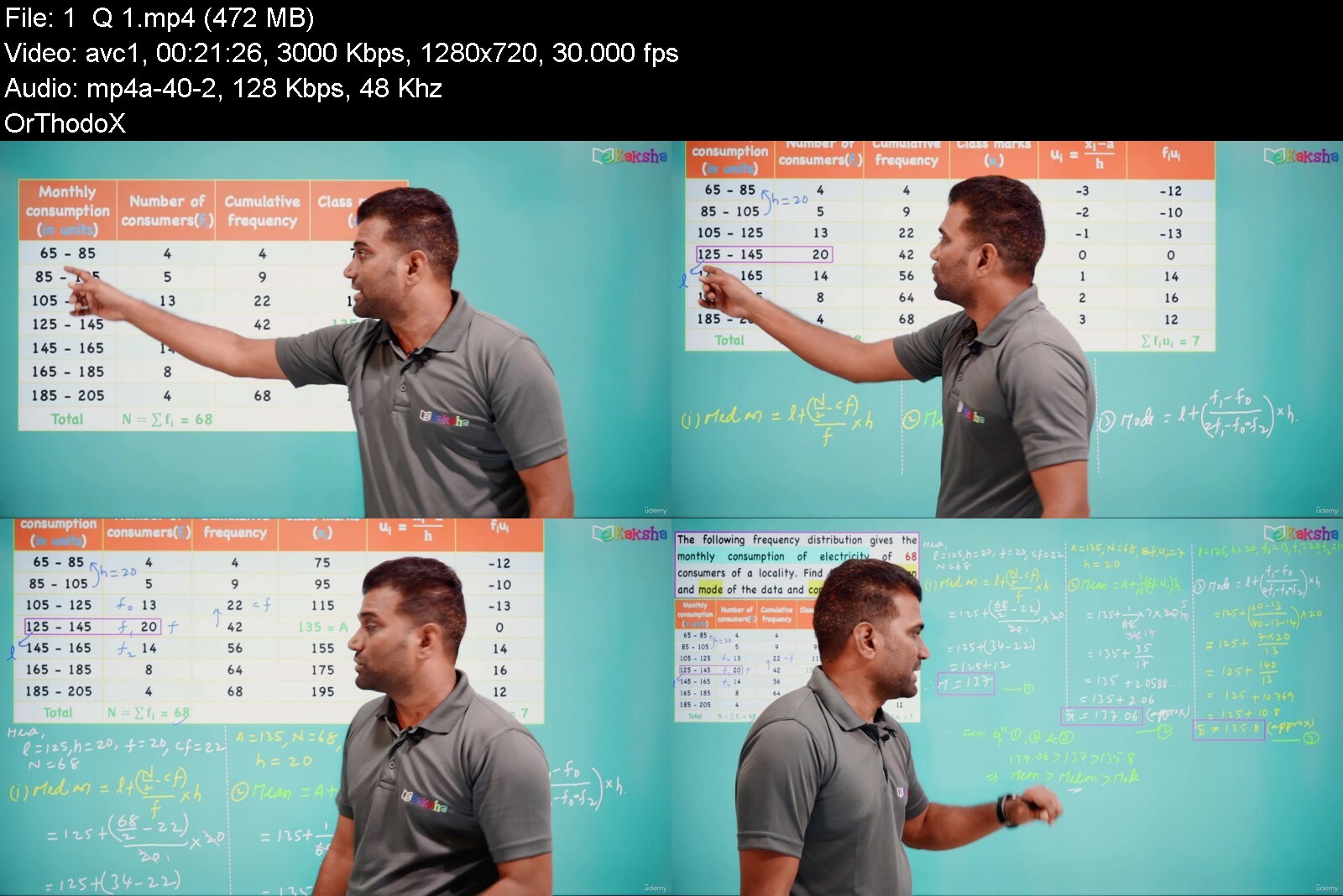
Mean of Grouped Data
Mode of Grouped Data
Median of Grouped Data
Graphical Representation of Cumulative Frequency Distribution
Median from cumulative frequency curve/Ogive curve.
At the end of the course, students will not only have learned about the topics in detail but also be able to solve various problems based on them.

Requirements
Basic elementary math knowledge.
Each chapter is inbuilt with prerequisite knowledge classes where the child gets immense knowledge and a clear understanding of the chapters.

Description
This course is carefully designed to explain various applications of Statistics .It has 71 lectures spanning more than eight and half hours of on-demand videos that are divided into 10 sessions. The course is divided into a simplified day-by-day learning schedule.Each topic is divided into simple sessions and explained extensively by solving multiple questions. Each session contains a detailed explanation of the concept.An online test related to the concept for immediate assessment of understanding.Session-based daily home assignments with a separate key. The students are encouraged to solve practice questions and quizzes provided at the end of each session.This course will give you a firm understanding of the fundamentals and is designed in a way that a person with little or no previous knowledge can also understand very well.It covers 100% video solutions of the NCERT exercises , with selected NCERT exemplars and R D Sharma.Our design meets the real classroom experience by following classroom teaching practices. We have designed this course by keeping in mind all the needs of students and their desire to become masters in math. This course is designed to benefit all levels of learners and will be the best gift for board-appearing students. Students love these easy methods and explanations. They enjoy learning maths and never feel that maths is troublesome.Topics covered in the course:Mean of Grouped DataMode of Grouped DataMedian of Grouped DataGraphical Representation of Cumulative Frequency DistributionMedian from cumulative frequency curve/Ogive curve.With this course you'll also get:perfect your mathematical skills on Statistics.A Udemy Certificate of Completion is available for download.Feel free to contact me with any questions or clarifications you might have.I can't wait for you to get started on mastering the real number systems.I look forward to seeing you on the course! :)Benefits of Taking this Course:On completion of this course, one will have detailed knowledge of the chapter and be able to easily solve all the problems, which can lead to scoring well in exams with the help of explanatory videos ensure complete concept understanding.Downloadable resources help in applying your knowledge to solve various problems.Quizzes help in testing your knowledge. In short, one can excel in math by taking this course.

Who this course is for
This course has been designed for students of Grade 10th CBSE, ICSE, SSC, GCSE, IGCSE, SAT, ACT, GRE, and other board-appearing students.
These are the people whose jobs require them to solve Statistical -related problems.
Students studying for the public or other competitive examinations as well as job aspirants.
Home-school parents are looking for extra support with the fundamentals.
Anyone interested in revising or learning the basics of mathematics should.
Students in junior high and high school/secondary schools.
Anyone who wants to proficient mathematics and the solving different real life situations on Statistics well.
Anyone who wants to study math for fun after taking a break from school.
It will also benefit schools who wish to run classes in the absence of a teacher and make learning fun for their students.
It will also benefit teachers and schools who wish to improve their teaching skills and make learning fun for their students.
For 11th, 9th, and 8th grade students, this will help as a bridge course.


becomeamasterofstatis8bf6h.jpg


8vaup11le6rstwo4wym8lx5f9w.jpg


Easy And Simple Sanskrit Grammar For Beginners Fluency
Last updated 2/2022
MP4 | Video: h264, 1280x720 | Audio: AAC, 44.1 KHz
Language: English | Size: 23.10 GB | Duration: 54h 25m

For Fluency in Sanskrit language


What you'll learn
Sandhi Prakaranam - Vowel, Consonant and Visarga Sandhi Step by Step with Practice Sessions
Karaka Prakaranam - Shabdamanjari - Declension of 21 forms of Vowel and Consonant ending Noun
Ting Prakaranam - Dhatumanjari - Derivation of 9 forms of 8 Verb Categories in 8 Tense/Moods
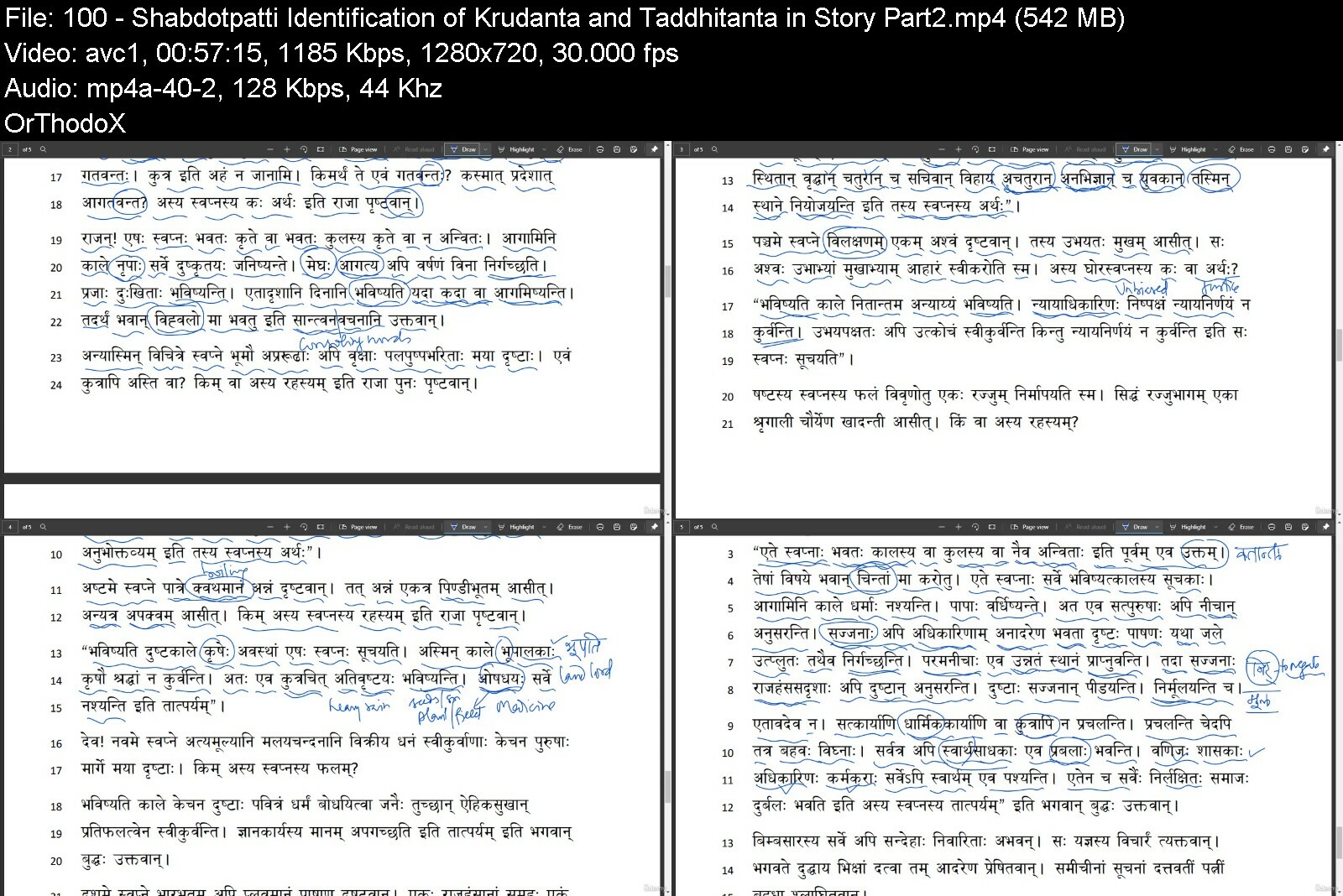
Krt-Taddhita Roopa Siddhi - Shabdotpatti - How different Words are Produced in Sanskrit
Karmani-Nijanta-Prayoga - Causal and Passive Verb form generations and its use in sentences
Exposure to Sanskrit Grammar Concepts for further studies
50 plus Story and Shloka Anvayaracana - To identify Sandhi, Shabda, Dhatu, Lakara, Vakya prayoga and Krt-Taddhita Padam

Requirements
Basic Preliminary Knowledge of Sanskrit to read and write
Those who enrolled to my Beginners course and Competency Course

Description
This course exposes to the Grammar Concepts in Sanskrit for Beginners, and you can enrich your knowledge of Sanskrit Language Grammar, which are dealt in 5 different levels. My earlier Course-1, Sanskrit for absolute Beginners structured in 3 levels and Course-2, Competency in Sanskrit Language structured in 2 levels, dealt with the Language-Structure of Sanskrit, which are absolute essentials topics to get good grip in spoken Sanskrit, understand lectures delivered in Sanskrit, Story Comprehension and Shloka Deconstruction.To add up further to our Sanskrit Language knowledge; Sandhi Procedures, Vibhakti Procedures, Verb-form Procedures, Noun-form Procedures, Causal and Passive Verb-form procedures are the most important topics in Sanskrit Language, which are dealt in individual levels from 6 to 10, to read and understand old Sanskrit Texts like Bhagavatgita, Puranam, different Shastram and Sutram, Kavyam like Ramayanam and Mahabharatam etc. on our own. Please preview my course intro video for more info.Having completed all my three courses, you can choose your area of interest to study further the Sanskrit Scriptures and you will find very comfortable and easy to understand the texts and its meaning, when you read on your own or listen to lectures of Guru or Teachers who teaches Vedic Upanishads, Ramayanam or Mahabharatam, Patanjali Yoga Sutram etc.I want every one of my student to become individually self sufficient, to explore on their own the literatures and scriptures in Sanskrit and As I promised, I launched this 3rd and final course to get a complete and big-picture of this oldest Vedic language. I am sure after completion of all my three courses namely, Beginners course, Competency course and Fluency course, you will be confident and clear to choose the subject of your interest in Sanskrit to take up further studies. These three course put together, will give you the Complete and Comprehensive big picture of Sanskrit Language's structure and I am sure, you will be in a position to take up the right future course of action in exploring the treasure hidden in Sanskrit Scriptures like Puranam, Shastram, Kavyam, Sutram etc.My other two courses are well received and many are happy about the course structure and subject materials. Hope, this course also will get your support, there by encouraging my initiatives to launch further useful courses to your needs.Please give a try and give your valuable ratings and comments.Wish you all the very best in your efforts!!

Overview
Section 1: Introduction to Beginners Sanskrit Grammar for Fluency

Lecture 1 Introduction to Beginners Sanskrit Grammar Course Contents Level 6-10

Lecture 2 Introduction to Great Sanskrit Grammarian Panini and his works Part-1

Lecture 3 Introduction to Great Sanskrit Grammarian Panini and his works Part-2

Section 2: Students Materials and online resources discussed in this Course-3

Lecture 4 Study Materials like Stories, Subhashitam and Verb lists with online resources

Lecture 5 PPT of the lectures in this course - Not designed for printing

Section 3: Beginners Sanskrit Grammar to Swara Sandhi - Level6

Lecture 6 Beginners Sanskrit Grammar Swara Sandhi - Part-1

Lecture 7 Beginners Sanskrit Grammar Swara Sandhi - Part-2

Lecture 8 Beginners Sanskrit Grammar Swara Sandhi - Part-3

Lecture 9 Beginners Sanskrit Grammar Swara Sandhi - Part-4

Lecture 10 Beginners Sanskrit Grammar Swara Sandhi - Part-5

Lecture 11 Beginners Sanskrit Grammar Swara Sandhi - Part-6

Lecture 12 Beginners Sanskrit Grammar Swara Sandhi - Part-7

Lecture 13 Beginners Sanskrit Grammar Swara Sandhi - Part-8

Section 4: Beginners Sanskrit Grammar to Hal Sandhi Level-6

Lecture 14 Beginners Sanskrit Grammar Hal Sandhi Part-1

Lecture 15 Beginners Sanskrit Grammar Hal Sandhi Part-2

Lecture 16 Beginners Sanskrit Grammar Hal Sandhi Part-3

Lecture 17 Beginners Sanskrit Grammar Hal Sandhi Part-4

Lecture 18 Beginners Sanskrit Grammar Hal Sandhi Part-5

Lecture 19 Beginners Sanskrit Grammar Hal Sandhi Part-6

Lecture 20 Beginners Sanskrit Grammar Hal Sandhi Part-7

Lecture 21 Beginners Sanskrit Grammar Hal Sandhi Part-8

Section 5: Beginners Sanskrit Grammar Visarga Sandhi Level-6

Lecture 22 Beginners Sanskrit Grammar Visarga Sandhi Part-1

Lecture 23 Beginners Sanskrit Grammar Visarga Sandhi Part-2

Lecture 24 Beginners Sanskrit Grammar Visarga Sandhi Part-3

Lecture 25 Beginners Sanskrit Grammar Visarga Sandhi Part-4

Section 6: Exercises and Demonstration of All Sandhi for Beginners Sanskrit Grammar Level-6

Lecture 26 Exercises and Demonstration of All Sandhi for Beginners Sanskrit Grammar part-1

Lecture 27 Exercises and Demonstration of All Sandhi for Beginners Sanskrit Grammar part-2

Lecture 28 Exercises and Demonstration of All Sandhi for Beginners Sanskrit Grammar part-3

Lecture 29 Exercises and Demonstration of All Sandhi for Beginners Sanskrit Grammar part-4

Lecture 30 Exercises and Demonstration of All Sandhi for Beginners Sanskrit Grammar part-5

Lecture 31 Exercises and Demonstration of All Sandhi for Beginners Sanskrit Grammar part-6

Lecture 32 Exercises and Demonstration of All Sandhi for Beginners Sanskrit Grammar part-7

Lecture 33 Exercises and Demonstration of All Sandhi for Beginners Sanskrit Grammar part-8

Section 7: Beginners Sanskrit Grammar of Consonant ending Noun forms in all cases Level-7

Lecture 34 Beginners Sanskrit Grammar of Shabdamanjari Noun forms in all cases part-1

Lecture 35 Beginners Sanskrit Grammar of Shabdamanjari Noun forms in all cases part-2

Lecture 36 Beginners Sanskrit Grammar of Shabdamanjari Noun forms in all cases part-3

Lecture 37 Beginners Sanskrit Grammar of Shabdamanjari Noun forms in all cases part-4

Lecture 38 Beginners Sanskrit Grammar of Shabdamanjari Noun forms in all cases part-5

Lecture 39 Beginners Sanskrit Grammar of Shabdamanjari Noun forms in all cases part-6

Lecture 40 Beginners Sanskrit Grammar of Shabdamanjari Noun forms in all cases part-7

Lecture 41 Beginners Sanskrit Grammar of Shabdamanjari Noun forms in all cases part-8

Lecture 42 Beginners Sanskrit Grammar of Shabdamanjari Noun forms in all cases part-9

Lecture 43 Beginners Sanskrit Grammar of Shabdamanjari Noun forms in all cases part-10

Lecture 44 Beginners Sanskrit Grammar of Shabdamanjari Noun forms in all cases part-11

Lecture 45 Beginners Sanskrit Grammar of Shabdamanjari Noun forms in all cases part-12

Lecture 46 Beginners Sanskrit Grammar of Shabdamanjari Noun forms in all cases part-13

Lecture 47 Beginners Sanskrit Grammar of Shabdamanjari Noun forms in all cases part-14

Lecture 48 Beginners Sanskrit Grammar of Shabdamanjari Noun forms in all cases part-15

Lecture 49 Beginners Sanskrit Grammar of Shabdamanjari Noun forms in all cases part-16

Lecture 50 Beginners Sanskrit Grammar of Shabdamanjari Noun forms in all cases part-17

Lecture 51 Beginners Sanskrit Grammar of Shabdamanjari Noun forms in all cases part-18

Section 8: Beginners Sanskrit Grammar of Vowel ending Noun forms in all cases Level-7

Lecture 52 Beginners Sanskrit Grammar of Shabdamanjari Noun forms in all cases part-19

Lecture 53 Beginners Sanskrit Grammar of Shabdamanjari Noun forms in all cases part-20

Lecture 54 Beginners Sanskrit Grammar of Shabdamanjari Noun forms in all cases part-21

Lecture 55 Beginners Sanskrit Grammar of Shabdamanjari Noun forms in all cases part-22

Lecture 56 Beginners Sanskrit Grammar of Shabdamanjari Noun forms in all cases part-23

Lecture 57 Beginners Sanskrit Grammar of Shabdamanjari Noun forms in all cases part-24

Lecture 58 Beginners Sanskrit Grammar of Shabdamanjari Noun forms in all cases part-25

Lecture 59 Beginners Sanskrit Grammar of Shabdamanjari Noun forms in all cases part-26

Lecture 60 Beginners Sanskrit Grammar of Shabdamanjari Noun forms in all cases part-27

Lecture 61 Beginners Sanskrit Grammar of Shabdamanjari Noun forms in all cases part-28

Lecture 62 Beginners Sanskrit Grammar of Shabdamanjari Noun forms in all cases part-29

Section 9: Beginners Sanskrit Grammar Verb form and Derivation Level-8

Lecture 63 Beginners Sanskrit Grammar of Dhatumanjari Verb forms in 8 tenses part-1

Lecture 64 Beginners Sanskrit Grammar of Dhatumanjari Verb forms in 8 tenses part-2

Lecture 65 Beginners Sanskrit Grammar of Dhatumanjari Verb forms in 8 tenses part-3

Lecture 66 Beginners Sanskrit Grammar of Dhatumanjari Verb forms in 8 tenses part-4

Lecture 67 Beginners Sanskrit Grammar of Dhatumanjari Verb forms in 8 tenses part-5

Lecture 68 Beginners Sanskrit Grammar of Dhatumanjari Verb forms in 8 tenses part-6

Lecture 69 Beginners Sanskrit Grammar of Dhatumanjari Verb forms in 8 tenses part-7

Lecture 70 Beginners Sanskrit Grammar of Dhatumanjari Verb forms in 8 tenses part-8

Lecture 71 Beginners Sanskrit Grammar of Dhatumanjari Verb forms in 8 tenses part-9

Lecture 72 Beginners Sanskrit Grammar of Dhatumanjari Verb forms in 8 tenses part-10

Lecture 73 Beginners Sanskrit Grammar of Dhatumanjari Verb forms in 8 tenses part-11

Lecture 74 Beginners Sanskrit Grammar of Dhatumanjari Verb forms in 8 tenses part-12

Lecture 75 Beginners Sanskrit Grammar of Dhatumanjari Verb forms in 8 tenses part-13

Lecture 76 Beginners Sanskrit Grammar of Dhatumanjari Verb forms in 8 tenses part-14

Lecture 77 Beginners Sanskrit Grammar of Dhatumanjari Verb forms in 8 tenses part-15

Lecture 78 Beginners Sanskrit Grammar of Dhatumanjari Verb forms in 8 tenses part-16

Lecture 79 Beginners Sanskrit Grammar of Dhatumanjari Verb forms in 8 tenses part-17

Lecture 80 Beginners Sanskrit Grammar of Dhatumanjari Verb forms in 8 tenses part-18

Lecture 81 Beginners Sanskrit Grammar of Dhatumanjari Verb forms in 8 tenses part-19

Lecture 82 Beginners Sanskrit Grammar of Dhatumanjari Verb forms in 8 tenses part-20

Lecture 83 Beginners Sanskrit Grammar of Dhatumanjari Verb forms in 8 tenses part-21

Section 10: Beginners Sanskrit Grammar Shabdotpatti Krudanta and Taddhitanta concept Level-9

Lecture 84 Shabdotpatti Intro and Krudanta forms of Yat Nyat Kyap part-1

Lecture 85 Shabdotpatti Intro and Krudanta forms of Yat Nyat Kyap part-2

Lecture 86 Shabdotpatti Intro and Krudanta forms of Yat Nyat Kyap part-3

Lecture 87 Shabdotpatti Krudanta Lyut Aniyar part-1

Lecture 88 Shabdotpatti Krudanta Lyut Aniyar part-2

Lecture 89 Shabdotpatti Krudanta Shtru Shanach

Lecture 90 Shabdotpatti Krudanta Trich Tumun Tavyat

Lecture 91 Shabdotpatti Krudanta Kta Ktavatu Ktvaa Lyap

Lecture 92 Shabdotpatti Krudanta Nvul Ktin

Lecture 93 Shabdotpatti Taddhita An shyanj

Lecture 94 Shabdotpatti Taddhita Matup Nini

Lecture 95 Shabdotpatti Taddhita Tamap Tarap Iyasun Ishtan

Lecture 96 Shabdotpatti Taddhita Mayat tal tva

Lecture 97 Shabdotpatti Taddhita Stripratyaya-Tap Ngip

Lecture 98 Shabdotpatti Taddhita Tak Dhak etc

Lecture 99 Shabdotpatti Identification of Krudanta and Taddhitanta in Story Part-1

Lecture 100 Shabdotpatti Identification of Krudanta and Taddhitanta in Story Part-2

Section 11: Beginners Sanskrit Grammar Nijanta Karmani Verbs concept Level-10

Lecture 101 Beginners Sanskrit Grammar of Causal-Passive Verb forms in sentences part-1

Lecture 102 Beginners Sanskrit Grammar of Causal-Passive Verb forms in sentences part-2

Lecture 103 Beginners Sanskrit Grammar of Causal-Passive Verb forms in sentences part-3

Lecture 104 Beginners Sanskrit Grammar of Causal-Passive Verb forms in sentences part-4

Lecture 105 Beginners Sanskrit Grammar of Causal-Passive Verb forms in sentences part-5

Lecture 106 Beginners Sanskrit Grammar of Causal-Passive Verb forms in sentences part-6

Lecture 107 Beginners Sanskrit Grammar of Causal-Passive Verb forms in sentences part-7

Lecture 108 Beginners Sanskrit Grammar of Causal-Passive Verb forms in sentences part-8

Lecture 109 Beginners Sanskrit Grammar of Causal-Passive Verb forms in sentences part-9

Lecture 110 Beginners Sanskrit Grammar of Causal-Passive Verb forms in sentences part-10

Lecture 111 Beginners Sanskrit Grammar of Causal-Passive Verb forms in sentences part-11

Section 12: Course Completion remarks of Comprehensive Complete Easy Sanskrit for Beginners

Lecture 112 Course Completion and Recap of Subjects studied in all three Sanskrit Courses

Those who want to understand Sanskrit Texts, Scriptures, Stories and Shloka can take up this course,Those who want to Speak and Write Sanskrit error free Or those who are familiar with my Beginner's Course Topics


easyandsimplesanskrit97elh.jpg


11717ecdpx.jpg


TTC - Learning Spanish: How to Understand and Speak a New Language
MP4 | Video: h264, 1280x720 | Audio: AAC, 44.1 KHz, 2 Ch
Genre: eLearning | Language: English | Duration: 30 Lessons (21h 34m) | Size: 15.5 GB


Have you ever tried to learn another language, only to abandon your efforts due to boredom or frustration? In this highly effective course, we re pleased to present an approach that turns the tables on the problems so many people face in learning a new language

Have you ever tried to learn another language, only to abandon your efforts due to boredom or frustration? In this highly effective course, we re pleased to present an approach that turns the tables on the problems so many people face in learning a new language. Experience the fastest and most direct way to get up and running with a beautiful and highly useful language. Learning Spanish: How to Understand and Speak a New Language offers you an exciting and practical way to quickly build the ability to communicate in Spanish.

In 30 highly engaging lessons, this ingeniously constructed program leads you sequentially through the core building blocks of competence in spoken Spanish. In each lesson, you ll get under the hood of the language, learning the key concepts of grammar, culture, and vocabulary that will make acquiring Spanish easier than you ever imagined.

You'll also gain a rich working vocabulary that will prepare you for a wide range of everyday situations. The end of each lesson includes audio exercises that will build your pronunciation, comprehension, and conversational skills. Plus, the workbook includes plenty of reading and writing exercises to practice and build upon what you learn.

This course is designed to cover the curriculum of a first semester college course in Spanish. Throughout the lessons, you ll explore how to learn a language and start communicating. Your teacher, world-class language instructor Professor Bill Worden of the University of Alabama, has refined this approach over more than 20 years, distilling the step-by-step system that works the best for adult learners. As an integral part of the language lessons themselves, he teaches a set of learning strategies that will enable you to be a successful language learner and will help you actively use and remember the material.

Even if you believe you have no aptitude for language learning, this course will show you otherwise. If you follow these fun and rewarding lessons, and practice by using the specially crafted accompanying audio and print materials, by the end of the course you ll be able to converse in Spanish, and to communicate about work, leisure, food, family, friends, travel, and much more.

Useful, Beautiful, and Mind-Expanding

Spanish is the third most widely spoken language in the world. Increasingly relevant in global culture and economics, it s the official language of 20 countries, plus the territory of Puerto Rico. Half a billion people speak it, including over 50 million in the U.S., and every day we encounter Spanish speakers right around the corner. For these reasons and more, Spanish is one of the most useful languages on earth.

Spanish is also one of the great Romance languages of Europe, with a rich and glorious literature from both the Old and New Worlds, and whose poetic sensibility and sensual rhythms make it one of the most beautiful languages in the world to hear and speak.

Learning a foreign language is one of life s most broadening experiences, allowing you to travel into other cultures, to build new friendships and professional contacts, and to communicate with a vast segment of the human population where conversation would otherwise never take place.

For these reasons and more, learning Spanish is a practical, enjoyable educational endeavor, and Learning Spanish is designed to provide the tools you need to embark on this journey into an important and incredibly useful language.

Master the Essentials of Spoken Spanish

The remarkable effectiveness of this course rests on Professor Worden s skill in breaking down the core elements of Spanish into an easily learnable sequence. From the beginning, you ll work with key material and concepts that help you build a fundamental feel for the language.

The lessons begin with simple groundwork for Spanish: the proper pronunciation of consonant and vowel sounds, the alphabet, and greetings and responses to greetings. With these building blocks, you can start speaking to people in Spanish right away!

From there, you ll delve into the most important part of speech: verbs. This is anything but dry, rote repetition: you ll discover verbs through their living context, by using them in many different practical settings, getting a visceral sense of how they operate in everyday speaking, and, most importantly, experiencing how they form the basis for expressing yourself in Spanish.

By working sequentially with ser and estar the two Spanish verbs meaning to be plus vital verbs such as ir (to go), tener (to have), hacer (to make or do), and querer (to want or to love), you ll learn to talk about basic thoughts, feelings, and actions.

You ll build on the ability to express yourself with verbs through in-depth practice with the forms and uses of Spanish nouns, adjectives, adverbs, prepositions, and pronouns, and an ever-expanding vocabulary all the necessary linguistic tools that will allow you to communicate successfully in Spanish.

Enriching the language lessons, Professor Worden exposes you to the culture and ethos of the Spanish-speaking world. At key moments, you ll explore Spanish literature, soccer rivalries, family relationships, and more. You ll also learn about variations in how Spanish is spoken in different regions of the world.

Lay the Groundwork for Real Conversations

Professor Worden has structured this course to give you the ability to communicate about many kinds of practical, daily situations. Across the span of the lessons, you ll learn to negotiate common activities and concerns in Spanish through these vital subjects and forms of speech

Understand a full range of social greetings and expressions used in social interactions.
Learn to express time, days, and dates in Spanish, as well as to count and use numbers.
Study how to talk about emotions and mental states.
Develop vocabulary on subjects such as social life, the family, the home, food and drink, money, the Internet, travel, leisure activities, the human body, romantic relations, and more.
Study how to make useful affirmative and negative statements, and learn the rules for commands (also called imperatives), which are indispensable for everyday speech.
Learn to form interrogatives and to ask and answer questions vital skills for building conversational fluency in Spanish.
Throughout the course, you ll deepen your facility with verbs as you learn how to speak about events using the present tense, become familiar with two different ways to talk about future events, and practice talking about the past using several key expressions and the preterite tense.

Discover Principles of Successful Language Learning

As a key component of this course, you ll use specific study tools and approaches that will allow you to succeed with Spanish.

First, in addition to the video lessons, the program provides the core resources of an audio glossary for each lesson, audio speaking activities, and a course workbook.

Following each lesson, the audio glossary will give you practice with pronunciation, listening to a native speaker, and reviewing the lesson s new vocabulary.
The speaking activities that follow the audio glossary help you improve your listening and speaking skills as you become comfortable with dialogues and interactions in Spanish.
The exercises in the workbook develop your reading and writing skills in Spanish while you practice the vocabulary and grammar presented in the lessons. The workbook also contains enlightening Cultural Reading sections about different aspects of the cultures of the Spanish-speaking world.
As an added benefit, Professor Worden teaches you a range of specific learning strategies that help you to fully incorporate and remember the material, and that help you build real conversational skill. Among these strategies, you ll learn about

the mindset of successful language learners, which involves developing a positive response to the unfamiliar, and approaching the new language as a puzzle to be solved;
ways to remember new words and build vocabulary, using all five senses;
how to find a real world connection to the language, and use your Spanish from the beginning;
sources available all around you for practicing, such as reading the news and listening to news broadcasts in Spanish;
three potent listening tools for deepening your comprehension; and
specific, easy-to-implement approaches to remembering key points of grammar.
Knowing and using these strategies will help you acquire and begin using Spanish more quickly than you may have thought possible.

Experience the Magic of Speaking a New Language

Learning a new language opens the door to an entirely new dimension of experience, and brings you a much broader and deeper connection with the world. In just 30 lessons, Learning Spanish: How to Understand and Speak a New Language teaches you the essentials of Spanish, empowering you to converse with Spanish speakers and to embark on the extraordinary journey of discovery that a new language brings. By simply using these lessons and the accompanying materials, you ll enjoy a life-changing skill.

What Will You Learn?
Learn the gender of Spanish nouns by practicing each new noun with its masculine or feminine definite article.

Practice times, days, months, and seasons, and learn how to ask questions or express information with this vocabulary.

Study how to conjugate verbs of this type as you learn a range of new verbs.

Learn about regional differences in the language as it's spoken across the world.

Explore helpful strategies for learning and remembering new vocabulary.


learningspanishhowtout1cuv.jpg


3yicjxvokltacai7tjub1n7d3i.jpg


Algebra 2 Video Series
Last updated 12/2021
MP4 | Video: h264, 1280x720 | Audio: AAC, 44.1 KHz
Language: English | Size: 22.23 GB | Duration: 33h 57m

Providing an in-depth review of Algebra 2


What you'll learn
Quadratics, polynomials, exponents and logarithms, and more!

Requirements
You should have already completed an Algebra 1 or equivalent course.

Description
This course is designed to be your companion throughout your Algebra 2 journey, and also a helpful support tool once you move on into new math courses. This course will cover all topics typically taught in an Algebra 2 class. Our lessons are detailed and we provide explanations behind concepts as well as the concepts themselves.

Overview
Section 1: Course Materials

Section 2: Unit 1 - Equations and Inequalities

Lecture 1 Lesson - Real Number System and Properties of Real Numbers

Lecture 2 Lesson - Expressions and Operations

Lecture 3 Lesson - Solving Equations Review

Lecture 4 Lesson - Absolute Value Equations

Lecture 5 Lesson - Solving Inequalities Review

Lecture 6 Lesson - Absolute Value Inequalities

Section 3: Unit 2 - Linear Functions and Systems of Equations

Lecture 7 Lesson - Relations and Functions Review

Lecture 8 Lesson - Linear Functions

Lecture 9 Lesson - Finding Equations of Lines/Applications of Linear Functions

Lecture 10 Lesson - Solving Systems of Equations by Graphing and Substitution

Lecture 11 Lesson - Solving Systems by Elimination/Applications of Linear Systems

Lecture 12 Lesson - Solving Systems with Three Variables

Lecture 13 Lesson - Linear Inequalities

Lecture 14 Lesson - Systems of Linear Inequalities

Section 4: Unit 3 - Parent Functions and Transformations

Lecture 15 Lesson - Piecewise and Greatest Integer Functions

Lecture 16 Lesson - Transformations of Functions

Lecture 17 Lesson - Graphing Absolute Value Equations and Inequalities

Lecture 18 Lesson - Quadratic Functions in Standard Form

Lecture 19 Lesson - Quadratic Functions in Vertex Form

Lecture 20 Lesson - Quadratic Functions: Converting from Standard to Vertex Form

Section 5: Unit 4 - Solving Quadratic Functions and Complex Solutions

Lecture 21 Lesson - Solving Quadratic Functions by Graphing

Lecture 22 Lesson - Factoring Quadratics Review

Lecture 23 Lesson - Solving Quadratics by Factoring

Lecture 24 Lesson - Representing Quadratic Functions

Lecture 25 Lesson - Simplifying Radicals

Lecture 26 Lesson - Solving Quadratics by Square Roots

Lecture 27 Lesson - Imaginary Numbers

Lecture 28 Lesson - Complex Numbers and Their Operations

Lecture 29 Lesson - Solving Quadratic Functions by Completing the Square

Lecture 30 Proof of Quadratic Formula

Lecture 31 Lesson - Solving Using Quadratic Formula

Lecture 32 Lesson - Solving Quadratics: Putting it all Together

Lecture 33 Lesson - Applications of Quadratic Functions

Section 6: Unit 5 - Polynomial Functions

Lecture 34 Lesson - Monomials and Polynomials Review

Lecture 35 Lesson - Factoring Polynomials Review

Lecture 36 Lesson - Solving Polynomial Functions by Factoring

Lecture 37 Lesson - Dividing Polynomials

Lecture 38 Lesson - Operations with Polynomials

Lecture 39 Lesson - Graphing Polynomials Part 1

Lecture 40 Lesson - Graphing Polynomials Part 2

Section 7: Unit 6 - Radical Functions

Lecture 41 Lesson - nth Roots and Simplifying Radicals

Lecture 42 Lesson - Adding, Subtracting, and Multiplying Radicals

Lecture 43 Lesson - Dividing Radicals

Lecture 44 Lesson - Rational Exponents

Lecture 45 Lesson - Radical Equations

Lecture 46 Lesson - Graphing Radical Equations

Lecture 47 Lesson - Inverse Relations and Functions

Lecture 48 Lesson - Graphing Inverses

Section 8: Unit 7 - Exponential and Logarithmic Functions

Lecture 49 Lesson - Graphing Exponential Functions

Lecture 50 Lesson - Solving Exponential Equations

Lecture 51 Lesson - Introduction to Logarithms

Lecture 52 Lesson - Properties of Logarithms

Lecture 53 Lesson - Graphing Logarithms

Lecture 54 Lesson - Solving Logarithmic Equations

Lecture 55 Lesson - Solving Exponential Equations using Logarithms

Lecture 56 Lesson - Natural Logarithms

Lecture 57 Lesson - Applications of Exponents and Logarithms

Section 9: Unit 8 - Rational Functions

Lecture 58 Lesson - Simplifying Rational Expressions/Multiplying and Dividing

Lecture 59 Lesson - Adding/Subtracting Rational Expressions

Lecture 60 Lesson - Complex Fractions

Lecture 61 Lesson - Applications of Rational Functions

Lecture 62 Lesson - Graphing Reciprocal Functions

Lecture 63 Lesson - Graphing Rational Functions

Lecture 64 Lesson - Solving Rational Equations

Lecture 65 Lesson - Variation

Section 10: Unit 9 - Conic Sections

Lecture 66 Lesson - Conic Sections Intro/General Form of Conics

Lecture 67 Lesson - Circles

Lecture 68 Lesson - Ellipses

Lecture 69 Lesson - Hyperbolas

Lecture 70 Lesson - Parabolas

Section 11: Unit 10 - Sequences and Series

Lecture 71 Lesson - Introduction to Sequences and Series

Lecture 72 Lesson - Arithmetic Sequences and Series

Lecture 73 Lesson - Geometric Sequences and Series

Lecture 74 Lesson - Application of Sequences and Series

Section 12: Unit 11 - Probability and Statistics

Lecture 75 Lesson - Permutations and Combinations

Lecture 76 Lesson - Theoretical/Experimental Probability

Lecture 77 Lesson - Conditional Probability

Lecture 78 Lesson - Measures of Central Tendency/Normal Distribution

Section 13: Unit 12 - Trigonometry

Lecture 79 Lesson - Right Triangle Trigonometry

Lecture 80 Lesson - The Unit Circle

Students looking to get ahead in their studies of Algebra or those who need additional support.


algebra2videoseries9zf2k.jpg


47292081e7638sdp2.jpg


A complete course on ACT Math | ACT Prep made easy
Instructors: Sandeep Kumar Mathur
21 sections 46 lectures 12h 3m
Video: MP4 1280x720 44 KHz | English + Sub
Updated 11/2022 | Size: 15.5 GB

A course on ACT Math preparation that boosts your confidence and inspires you to solve ACT Math problems with an ease.


What you'll learn
You will get a refresher of Matrices
You will get a refresher of Determinants
You will get step by step solution of Questions
Tips and Tricks to solve ACT Exam questions

Requirements
You will understand solution of questions step by step on each topic

Description
If you find it difficult to remember various formulas of Math ? If you have a feeling of not being confident in Geometry ? If you facing difficulty in solving Trigonometry questions and feel that you need to strengthen your basics? Then you have come to the right place.

Here, this course covers the topics of following areas

Preliminaries

Percentage

Ratio and Proportion

Average

Logarithms

Linear Equations

Linear Inequalities

Quadratic Equations

Arithmetic Progression

Geometric Progression

Permutations and Combinations

Probability

Geometry

Mensuration

Mean Median Mode

Trigonometry

Matrices

Determinants

Coordinate Geometry

I am sure that this course will be create a strong platform for students and those who are planning for appearing in competitive tests and studying higher Mathematics.

You will also get a good support in Q&A section . It is also planned that based on your feed back, new topics like special series ,statistics etc. will be added to the course. Hope the course will develop better understanding and boost the self confidence of the students. You will also get 30 Days Money back guarantee.

Waiting for you inside the course! Enroll today !

Let's make your ACT dreams come true !!

Important Note: The course is intended for purchase by adults. Those under 18 years may use the services only if a parent or guardian opens their account, handles any enrollments, and manages their account usage.

Who this course is for
Whosoever wish to improve math skills


Homepage

acompletecourseonactmzndn5.jpg


hw2yfrufdstqhn9zke3chp6es1.jpg


Optimization Engineering For Machine Learning and AI
Updated 11/2022
Genre: eLearning | MP4 | Video: h264, 1280x720 | Audio: AAC, 44.1 KHz
Language: English | Size: 15.1 GB | Duration: 37 lectures 25h 5m


What you'll learn
Convex optimization theory and concepts for machine learning and AI
Engineering mathematics of convex optimization for ML, DL, and AI
Convex optimization methods and techniques in ML, DL, and AI
Convex optimization applications and use cases in engineering fields


Requirements
Basic knowledge of Mathematics
Desire to learn the subject of convex optimization

Description
Optimization is a core fundamental area for machine learning and AI in general. Moreover, Convex optimization is a subfield of mathematical optimization that studies the problem of minimizing or maximizing convex functions over convex sets. Many classes of convex optimization problems admit polynomial-time algorithms, whereas mathematical optimization is in general NP-hard.

In the first lesson/lecture of this course, we will talk about the following points

What is Optimization?

Examples on Optimization

Factors of Optimization

Reliable/Efficient Problems

Goals & Topics of this Course

Brief History on Optimization

=======

In the second lesson/lecture, we will be covering important points on convex sets, which are the following

00:00:00 Affine Combination

00:01:33 Affine Set

00:08:21 Convex Combination

00:09:25 Convex Set

00:13:45 Convex Hull

00:16:28 Example 1-Convex Cones

00:16:55 Conic Combination

00:20:47 Example 2-Hyperplanes

00:24:22 Example 3-Euclidean Ball

00:26:37 Example 4-Ellipsoid

00:30:40 Norms

00:35:51 Example 5-Polyhedra

00:41:18 Example 6-Positive Semidefinite cone

00:54:31 Operations preserving convexity

01:15:10 Closed & Open set

01:21:10 Solid sets

01:26:25 Pointed set

01:26:57 Proper cones

01:27:28 Generalized Inequalities

01:34:12 Minimum & Minimal Elements

01:46:28 Partial Order

01:48:53 Properties of Generalized Inequalities

01:53:09 Dual Cones

02:04:31 Dual Inequalities

=======

In the third lesson/lecture of this course on convex optimization, we will be covering important points on convex functions, which are the following

00:01:14 Definition of Convex Function

00:03:31 Examples of Convex Function

00:13:50 Convexity in Higher Dimensions

00:24:30 First-order Condition

00:27:08 Second-order Conditions

00:35:17 Epigraphs

00:37:25 Jensen's Inequality

00:39:49 Operations preserving Convexity

00:52:21 Conjugate Convex function

01:02:09 Quasi Convex functions

01:11:14 Log-Convex functions

01:16:16 Convexity with respect to generalized inequalities

=======

In Lecture 4 of this course on convex optimization, we will be covering the fundamental principles of convex optimization, which include the following

00:00 Standard form

04:19 Feasible point

05:07 Globally Optimum point

05:50 Locally Optimum point

15:04 Explicit & Implicit constraints

30:10 Optimality criterion for differentiable cost functions

34:48 Supporting Hyperplane

=======

In Lecture 5 of this course on convex optimization, we will be covering Linear Programming and the Simplex algorithm, which was introduced by George Dantzig. The outline of the lecture is as follows

00:00:00 What is a Linear Program (LP) ?

00:07:24 LP feasible set

00:10:22 LP forms

00:10:50 Standard form LP

00:10:50 Standard form LP

00:11:24 Slack variables

00:13:08 Inequality form LP

00:13:34 Omitting inequality constraints

00:20:38 LP Example: The Diet Problem

00:25:49 The SIMPLEX Algorithm: Method and the usage of Non-basic, Slack, and Artificial variables

00:33:59 The SIMPLEX Algorithm - Example: Iteration 0

00:40:37 The SIMPLEX Algorithm - Example: Iteration 1

00:48:18 The SIMPLEX Algorithm - Example: Iteration 2

00:55:27 The SIMPLEX Algorithm - Example: Iteration 3

01:00:13 MATLAB: Implementing SIMPLEX

01:53:15 MATLAB: Verifying with linprog

01:58:48 George Bernard Dantzig

01:59:12 SIMPLEX: Geometric Interpretation

02:01:09 SIMPLEX: Time Complexity

=======

In Lecture 6 of this course on convex optimization, we will cover the essentials of Quadratic Programming.The outline of the lecture is as follows

00:00 Intro

00:32 What is a Quadratic Program (QP) ?

03:24 QP reformulation

06:05 Illustrating the optimal solution

16:54 Solving a QP on MATLAB

25:43 Outro

=======

In Lecture 7 of this course on convex optimization, we will cover the essentials of Quadratically Constrained Quadratic Programs, i.e. QCQPs.The outline of the lecture is as follows

00:00 Intro

00:33 What is a Quadratically Constrained Quadratic Program (QCQP) ?

05:16 QCQP Feasible Set

06:01 MATLAB Illustration of QCQP Feasible Set

13:39 QCQP Application 1: Minimizing a linear function over a centered ellipsoid

30:42 QCQP Application 2: Minimizing a linear function over an uncentered ellipsoid

37:16 QCQP Application 3: Minimizing a quadratic function over a centered ellipsoid

42:36 Outro

=======

In Lecture 8 of this course on convex optimization, we will cover Second Order Cone Programming, i.e. SOCPs. The outline of the lecture is as follows

00:00:00 What is Second Order Cone Programming (SOCP) ?

00:02:37 QCQP as an SOCP

00:20:25 Robust Linear Programming as an SOCP

00:31:06 Linear Programming with Random Constraints as an SOCP

00:41:09 Sum of Norms minimization as an SOCP

00:47:27 Max of Norms minimization as an SOCP

00:49:40 Hyperbolic Constrained Programs as SOCPs

00:58:59 Quadratic Fractional Problems as SOCPs

01:02:16 Outro


In Lecture 9 of this course on convex optimization, we will cover Geometric Programs, i.e. GPs. The outline of the lecture is as follows

00:00 Intro

01:51 Monomials and Posynomials

10:45 GP problem formulation (polynomial form)

19:50 Relevant papers

23:12 GP in convex form

29:27 Example 1: Frobenius Norm Diagonal Scaling

33:25 Example 2: Volume Maximization given aspect ratios and area limitations

38:12 Summary

=====

In Lecture 10 of this course on convex optimization, we will cover Generalized Geometric Programs, i.e. GPs. The outline of the lecture is as follows

00:00 Intro

01:16 Generalized Posynomials

08:46 Generalized Geometric Program (GGP)

09:45 GGP as a GP

17:40 Example 1: Floor Planning (GGP)

23:48 Example 2: Power Control (GP)

33:00 Example 3: Digital Circuit Design (GGP)

37:26 Mixed-Integer Geometric Program

39:27 Outro

======

In Lecture 11 of this course on convex optimization, we will cover Semidefinite programming, i.e. SDPs. The outline of the lecture is as follows

00:00 Intro

01:05 Generalized Inequality Constraints

05:18 Conic Programs

07:59 Linear Matrix Inequality (LMI)

09:56 LMI brief history (Lyapunov, Kalman, Ricatti etc..)

18:10 Semidefinite Programming (SDP)

21:56 SOCP as SDP

29:30 Eigenvalue Minimization

32:43 Matrix Norm Minimization

34:39 Outro

=====

In Lecture 12 of this course on convex optimization, we will cover various topics related to Vector optimization, such as Pareto optimal points and the Pareto frontier, which is a well known boundary studied in Game theory, risk and trade-off analysis, portfolio analysis, etc. The topics covered are outlined as follows

00:00:00 Intro

00:01:55 What is Vector Optimization ?

00:06:38 Optimal points & the set of achievable objective values

00:13:27 Pareto optimal points

00:18:56 BLUE estimator (example)

00:28:09 Scalarization

00:32:03 Pareto Frontier (Boundary)

00:38:28 Minimal Upper Bound on a set of matrices (example)

00:43:36 Plotting a Pareto front of regularized least squares on MATLAB (1st way: the genetic algorithm)

00:47:43 Plotting a Pareto front of regularized least squares on MATLAB (2nd way: using fminsearch)

00:53:43 Multicriterion optimization

01:01:39 Scalarization for Multicriterion optimization

01:06:51 Analytical Pareto Front of Regularized Least Squares

01:09:44 Plotting a Pareto front of regularized least squares on MATLAB (3rd way: Analytically)

01:12:08 Outro

======

In Lecture 13 of this course on convex optimization, we will cover various topics related to Vector optimization, such as Pareto optimal points and the Pareto frontier, which is a well known boundary studied in Game theory, risk and trade-off analysis, portfolio analysis, etc. The topics covered are outlined as follows

00:00 Intro

00:29 Reminder: Multicriterion Optimization

03:17 Multicriterion Optimization: A closer look

09:02 Optimal Trade-off Analysis

12:38 Outro

========

In Lecture 14 of this course on Convex Optimization, we introduce the Lagrangian duality theory. In essence, for each optimization problem (convex or not), we can associate a certain function referred to as the Lagrangian function. This function, in turn, has a dual function (which serves as an infimum over the variable of interest x). It turns out that, for any optimisation problem, the dual function is a lower bound on the optimal value of the optimisation problem in hand. This lecture focuses on many examples that derive the Lagrangian and the associated dual functions. MATLAB implementations are also presented to give useful insights. This lecture is outlined as follows

00:00 Intro

01:00 Lagrangian function and duality

04:02 Lagrangian dual function

06:46 Lower bound on the optimal value

09:16 MATLAB: Lower bound verification

15:28 Example 1 - Least Squares

17:48 Example 2 - Linear Programming

20:48 Example 3 - Two-way Partitioning

26:04 Relationship between conjugate function and the dual function

31:22 Example 4 - Equality Constrained Norm minimization

33:37 Example 5 - Entropy Maximization

35:44 Outro

========

In Lecture 15 of this course on Convex Optimization, we talk about a very very important topic in convex optimisation that is the Lagrange Dual Problem. This lecture is outlined as follows

00:00:00 Intro

00:00:44 Revision: Lagrange Dual Function

00:01:30 The Dual Problem

00:06:54 Example 1: Dual Problem of Standard LP

00:08:59 Example 2: Dual Problem of Inequality LP

00:13:59 Weak Duality

00:16:24 Example 3: The 2-way Partitioning Problem (Revisited)

00:21:42 Strong Duality

00:23:15 Slater s Condition

00:24:32 What is a Relative Interior (Convex Analysis by Tyrell Rockefellar) ?

00:28:16 Generalization of Slater s Condition

00:29:26 Example 4: Duality of LS problems

00:38:33 Example 5: Duality of LP problems

00:54:52 Example 6: Duality of QCQP problems

00:59:22 Example 7 : Duality of the Entropy Maximization Problem

01:03:48 Example 8 : Duality of the Trust Region Problem (non-convex problem)

01:11:51 Outro

======

In Lecture 16 of this course on Convex Optimization, we talk about a very practical topic, when it comes to numerical optimization algorithms, and that is the -suboptimal inequality, which could report how good of an estimate we have. Said differently, the Lagrangian dual feasible points ( , ) provides a proof or certificate of the dual gap.

00:00 Intro

01:59 Lagrangian & Dual Functions

03:40 How good of an estimate ? (Certificate)

07:09 -suboptimal

10:09 Stopping Criterion

17:23 Outro

====

In Lecture 17 of this course on Convex Optimization, we talk about Complementary Slackness, which could be used a test for optimality, or it could even tell us which constraints are active and which are not !!

This lecture is outlined as follows

00:00 Intro

00:46 What is Complementary Slackness ?

08:15 A Genie Example

14:45 Another Genie Example

16:00 Outro

=====

In Lecture 18 of this course on Convex Optimization, we talk about KKT conditions for nonconvex and convex optimization problems.

This lecture is outlined as follows

00:00 Intro

00:57 KKT Conditions for NonConvex Problems

04:32 KKT Conditions for Convex Problems

07:48 Example

10:47 Outro

=======

In Lecture 19 of this course on Convex Optimization, we talk about Perturbation and Sensitivity Analysis of general and convex optimization problems.

This lecture is outlined as follows

00:00 Intro

02:34 Perturbed Optimization Problem

16:33 Global Perturbation Behavior

37:35 Local Perturbation Behavior

49:36 Shadow Price Interpretation

53:40 Outro

=======

In Lecture 20 of this course on Convex Optimization, we talk about Equivalent Reformulations of general and convex optimization problems.

This lecture is outlined as follows

00:00:00 Intro

00:01:46 Reformulation 1: Introducing new variables

00:25:06 Log-Sum-Exponential Cost

00:33:23 Norm Minimization

00:49:39 Reformulation 1 (cont'd): Introducing constraint variables

01:05:11 Reformulation 2: Cost Transformation

01:14:23 Reformulation 3: Constraint Absorption

01:32:05 Summary

========

In Lecture 21 of this course on Convex Optimization, we talk about the theorem of weak alternatives of general optimization problems.

This lecture is outlined as follows

00:00 Introduction

04:02 Feasibility Problem

05:41 Optimization Feasibility Problem

07:55 Dual Function

08:41 Note on Strong Alternatives

10:43 Dual Problem

13:12 Weak Duality

13:41 Relating (S) with (T)

15:16 Weak Alternatives

17:31 Why Weak Alternatives ?

19:33 Summary

23:18 Outro

======

In Lecture 22 of this course on Convex Optimization, we talk about the theorem of strong alternatives of convex optimization problems.

This lecture is outlined as follows

01:43 Introduction

02:13 Strengthening Weak Alternatives

03:21 Strong Alternatives Conditions

08:27 Strict Inequality Case

09:49 Strong Alternatives of Linear Inequalities

13:31 Strong Alternatives of Strict Linear Inequalities

22:46 Strong Alternatives of Intersection of Ellipsoids

34:53 Summary

38:46 Outro

=======

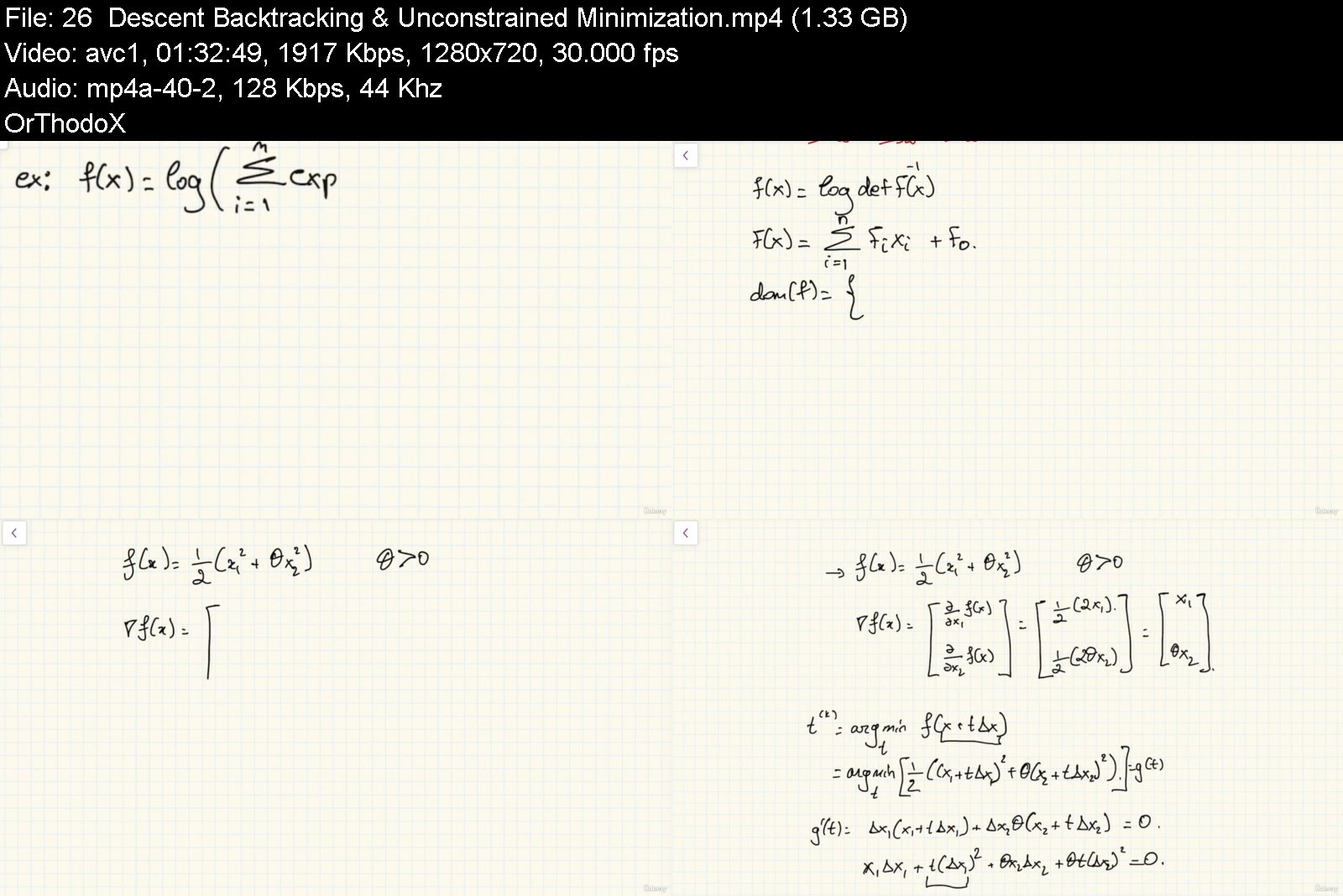
In Lecture 23 of this course on Convex Optimization, we focus on algorithms that solve unconstrained minimization type problems. The lecture evolves around unconstrained minimization problems that might or might not enjoy closed form solutions. Descent methods are discussed along with exact line search and backtracking. MATLAB implementations are given along the way.

This lecture is outlined as follows

00:00:00 Introduction

00:01:06 Unconstrained Minimization

00:01:36 Iterative Algorithm Assumptions

00:04:28 Gradient Equivalence

00:09:04 Unconstrained Least Squares

00:20:13 Unconstrained Geometric Program

00:28:10 Initial Subset Assumption

00:35:16 Intuitive Solution of Logarithmic Barrier Minimization

00:40:42 Generalization of Logarithmic Barriers

00:42:57 Descent Methods

00:50:42 Gradient Descent

00:52:59 Exact Line Search

00:56:23 Backtracking

01:00:25 MATLAB: Gradient Descent with Exact Line Search

01:17:35 MATLAB: Gradient Descent with Backtracking

01:20:12 MATLAB: Gradient Descent with Explicit Step Size Update

01:28:07 Summary

01:30:59 Outro

=====

References

[1] Boyd, Stephen, and Lieven Vandenberghe. Convex optimization. Cambridge university press, 2004.

[2] Nesterov, Yurii. Introductory lectures on convex optimization: A basic course. Vol. 87. Springer Science & Business Media, 2013. Reference no. 3

[3] Ben-Tal, Ahron, and Arkadi Nemirovski. Lectures on modern convex optimization: analysis, algorithms, and engineering applications. Vol. 2. Siam, 2001.

Who this course is for
Computer Engineers
Electical Engineers
Communication Engineers
Civil Engineers
Industrial Engineers
Mechanical Engineers
Programers
Developers
Coders
App Builders
AI and ML Professionals


optimizationengineerilfeo8.jpg


48365606d38udf09.jpg


Precalculus 3: Trigonometry
Last updated 3/2023 MP4 | Video: h264, 1280x720 | Audio: AAC, 44.1 KHz, 2 Ch
Genre: eLearning | Language: English | Duration: 209 lectures (51h 56m) | Size: 36.3 GB


Mathematics from high school to university


What you'll learn
How to solve problems in trigonometry (illustrated with 215 solved problems), in both geometrical and functional contexts, and why these methods work.
You get a crash course in Euclidean geometry: angles, triangles, polygons, similar triangles (proportions), inscribed and circumscribed circles, bisectors, etc.
Number pi: its definition as the ratio of the perimeter to the diameter of a disk, relation to the area of a disk, some geometrical approximations.
The geometric definitions (by ratios in right triangles) of three trigonometric functions (sin, cos, tan) and their reciprocals (secant, cosecant, cotangent).
Exact values of trigonometric functions for angles of 15, 18, 30, 36, 45, 60, 72, 75, and 22.5 degrees: geometric derivations, and with help of formulas.
Solving triangles (finding side lengths and measures of all angles, knowing some of them), both right and oblique, with help of trigonometry.
Degree vs radian: how to use proportions for recalculating degrees to radians and back; reference angles.
The functional definition of sine, cosine and tangent, with help of unit circle and circular movement; properties of these functions.
The definition of trigonometric (circular) functions (sin, cos, tan) for *any* real number using the unit circle in the coordinate system.
Reference Angles Theorem with proof (by geometrical illustration) and applications; supplementary identities and the complementary angle properties.
Periodic functions. Sinusoids: period, amplitude, phase shift, vertical shift. Transformations of graphs of trigonometric functions.
Pythagorean theorem and Pythagorean triples. Law of Cosines, Law of Sines: formulation, proofs, and applications in problem solving.
Various trigonometric identities with proofs, geometrical illustrations, and applications for problem solving.
The Pythagorean Identities; Reciprocal Identities; Quotient Identities; Even/odd identities.
Sum and Difference Identities for sine and cosine with proofs, geometrical illustrations, and applications.
Sum To Product and Product To Sum Formulas for sine and cosine, with derivations and applications.
Double (Half) Angles Identities with geometrical illustrations, proofs, and applications in problem solving.
Inverse functions to sine, cosine and tangent, their definitions, properties and graphs.
Compositions of trigonometric functions with inverse trigonometric functions; identities involving inverse trigonometric functions.
Complex numbers and their trigonometric (polar) form; consequences of the Sum Identities for sin and cos for multiplication of complex numbers in polar form.
De Moivre's formula (positive natural powers of complex numbers) and its application to quick recreation of formulas for sine and cosine of multiples of angles.
Trigonometric equations: various types and corresponding methods for solutions; depicting the solution sets on the graphs and on the unit circle.
You get a sneak peek into trigonometry in a future Calculus class (how some trigonometric formulas are used there).
You get a plethora of geometric illustrations, supporting your intuition and understanding of trigonometry.

Requirements
High-school mathematics, mainly arithmetic; solving simple equations (linear and quadratic) with one unknown; some (but very few) polynomial equations will be solved during the course, but you can skip them if you want to (no problem at all; it will not affect your understanding of trigonometry)
Precalculus 1: Basic notions (mainly the concept of function and related concepts; sets; logic)
You will get a very brief introduction to *complex numbers* in this course, just enough for presenting one of applications of trigonometry, and for a nice illustration of the formulas for sine and cosine of a sum
Some basic geometry (angles, triangles, polygons); a crash course (6 hours) is provided in Section 2 of this course (can be skipped if you feel that you master basics of geometry)
You are always welcome with your questions. If something in the lectures is unclear, please, ask. It is best to use QA, so that all the other students can see my additional explanations about the unclear topics. Remember: you are never alone with your doubts, and it is to everybody's advantage if you ask your questions on the forum.

Description
Precalculus 3: Trigonometry

Mathematics from high school to university

1. Introduction to the course

You will learn: what is awaiting in this course, and what you are going to learn.

2. Crash course in Euclidean geometry

You will learn: everything you need to know about geometry in order to feel comfortable with the new content in this course: geometrical concepts such as straight lines, straight line segments, angles, triangles (acute, right, obtuse), polygons, circles (inscribed, circumscribed), congruence rules for triangles (SSS, SAS, ASA), similar triangles, Thales' theorem, Pythagorean theorem, congruence rules for right triangles (HA, HL, LL), measuring angles, measuring distances, computing area of squares and triangles, isometries in the plane (symmetries, rotations, translations).

3.14159... The magnificent number

You will learn: about the number : its meaning for circles and disks, and some basic (geometrical) approximation methods.

4. Trigonometric functions of acute angles: the geometric approach

You will learn: the geometric definition of six trigonometric functions, why there are six of them, and how we can know that they are well defined as functions of (acute) angles; first (very basic) relationships between these functions.

5. Computing exact values of trigonometric functions

You will learn: how to derive the exact values of trigonometric functions for angles: 15, 18, 30, 36, 45, 54, 60, 72, 75, and 22.5 degrees using geometric methods; we will also derive, also using just geometry, some trigonometric formulas valid for acute angles (but later, in the second half of the course, you will learn that all of them are valid just for any angle, so they are really worth learning); these formulas will be then used for computing values of trigonometric functions for some angles (knowing the values for some other angles). We will, step by step, create the graph of the sine and cosine functions for acute angles.

6. An introduction to inverse trigonometric functions and to solving triangles

You will learn: the geometrical meaning of inverse trigonometric functions arcsine, arccosine and arctangent) for acute angles, and how to use them in simple problem solving (more advanced problem solving with triangles comes later in the course).

7. From degrees to radians: why and how

You will learn: the definition of radian; how to calculate degrees to radians and back, using proportions; the values of the most common angles in radians; angles in the Cartesian coordinate system.

8. Trigonometric (circular) functions of any angle: the unit circle and circular motion

You will learn: two ways of expanding the trigonometric functions sine and cosine (defined geometrically, for acute angles, in Section 3) to any angles (or, actually, to any real number)

[1] a static one: cos t = x, sin t = y, where (x,y) are the coordinates of the intersection point between the unit circle and the terminal side for the angle of t radians, in standard position (obviously functions R -> R as each point has exactly one pair of Cartesian coordinates),

[2] a dynamic one: a point is moving along the unit circle starting in the point (1,0) for t = 0, and continuing counterclockwise until the point on the circle where the length of the path from the beginning to this point is t; the coordinates of this point define the cosine and the sine functions as follows: x = cos t and y = sin t (obviously functions R -> R as each point has exactly one pair of Cartesian coordinates).

In order to construct these functions, we will wrap the number axis on the unit circle, which is a really cool operation.

9. Basic properties of six trigonometric (circular) functions; graphing

You will learn: the definition of the other circular functions (tangent, and the three reciprocals) defined with help of sine and cosine; basic properties following immediately from the definitions and symmetries of the unit circle: the domain and range for all these functions, Reference Angles Identities, monotonicity in intervals, being even or odd, periodicity (a new concept, not introduced in Precalculus 1), the graphs; basic relationships between these functions: the Pythagorean Identity, cofunction identities. You will also learn the etymology of the names sine, tangent, and secant.

10. Trigonometric identities; graph transformations

You will learn: good news for those who were afraid they were wasting their time in Section 5: everything done back there will be reused here! The only topic which must be redone is the derivation of the Sum Identities for sine and cosine, as the derivations done in Section 5 were geometrical and restricted to acute angles. All the other formulas (the double angle formulas, the power reduction formulas, half angle formulas, tangent half angle formulas, and triple angle formulas) were proven by formula manipulation, so they are valid also in the new situation. Two new groups of formulas (sum to product, and product to sum formulas). The Sum Identities will be used for graph transformations, which will also be discussed in this section. The terminology related to sinusoids will be introduced (period, phase, amplitude).

11. Inverse trigonometric functions, their properties, and graphs

You will learn: about the inverse trigonometric functions arcsine, arccosine, and arctangent (the inverse to their reciprocals can be studied from the Precalculus book: pages 824-833; this is not covered in our course), their properties, graphs, and some interesting compositions with the trigonometric (circular) functions.

12. More identities

You will learn: how to prove trigonometric identities.

13. Trigonometric equations

You will learn: how to solve some basic types of trigonometric equations, how to write a series of solutions, and how to interpret both equations and their solution sets graphically. The following types of equations (or: methods of solving equations) are discussed

[a] the very basic types of trigonometric equations: sin x = a, cos x = a, tan x = a,

using sum or difference identities for sine and cosine,

[c] factorization: Sum-To-Product Formulas,

[d] factorization of polynomials,

[e] using the Product-To-Sum Formulas,

[f] reducing the degree of trigonometric functions,

[g] solution method by Universal Substitution: tangent of half argument,

[h] homogenous equations,

combinations of the methods above.

14. Some applications of trigonometry

You will learn: Including applications would make this course twice as large, so I will just concentrate on the most common applications. The lectures will not have the same level of detail as the lectures in the previous sections, but by now, you are probably able to read and understand Chapter 11 in the Precalculus book on your own, so do it and ask me questions if needed. I will address the following topics in this section

[a] slopes of straight lines in the coordinate system,

The Law of Cosines as a generalization of Pythagorean Theorem,

[c] a sine-based formula for the area of a triangle,

[d] The Law of Sines,

[e] Heron's Formula; solving oblique triangles,

[f] vectors in the plane (or in the 3-space) and angles between them,

[g] rotations and their matrices,

[h] complex numbers: rectangular and polar form,

multiplication of complex numbers and an explanation of how its geometry is determined by the Sum Identities for the sine and cosine,

[j] de Moivre's formula for taking powers of complex numbers,

[k] roots of unity.

15. Sneak peek into trigonometry in Calculus

You will learn: This section will give you some pointers to applications of trigonometry in Calculus. The purpose is not to teach you this stuff, but rather to give you an idea about how the skills gained during this course will help you in the future Calculus class. The topics mentioned here are

[a] the limit of (sin x)/x in zero, and its importance in Calculus,

the slope of a straight line and its importance for Differential Calculus,

[c] differentiability of the sine and cosine: which formulas to use,

[d] the derivatives (with examples of the sine, cosine, tangent, arcsine, and arctangent) and their role in finding extremums and for determining intervals of monotonicity,

[e] classes of functions (C^0, C^1, C^2, ) and some fun trigonometric examples,

[f] a word about Fourier and spirographs, Euler's formula, and Euler's identity,

[g] trigonometric functions in solutions of differential equations,

[h] polar coordinates in the plane,

cylindrical and spherical coordinates,

[j] parametric curves,

[k] Power Reduction Formulas and integration,

[l] Trigonometric substitutions in integrals.

16. Problem-solving: varia

You will learn: This section gives you a Sm rg sbord of problems to solve; the difficulty level varies, and, as the problems are not linked to specific sections, you will have to decide on your own what method to choose. Generally, the problems and exercises in the previous sections were on a basic level (with some minor exceptions), and the problems in this section are somewhat harder. Originally, I planned to assign badges Basic, Medium, or Hard to each problem, but then I thought: Each problem you can't solve is hard; each problem you can solve is simple (for you). So I changed my mind, and the problems are just presented to you without any labels.

17. Extras

You will learn: about all the courses we offer, and where to find discount coupons. You will also get a glimpse into our plans for future courses, with approximate (very hypothetical!) release dates.

Also, make sure that you check with your professor what parts of the course you will need for your final exam. Such things vary from country to country, from university to university, and they can even vary from year to year at the same university.

A detailed description of the content of the course, with all the 208 videos and their titles, and with the texts of all the 215 problems solved during this course, is presented in the resource file List_of_all_Videos_and_Problems_Precalculus_3.pdf under video 1 ("Introduction to the course"). This content is also presented in video 1.

Who this course is for
Students who plan to study Algebra, Complex Numbers, Calculus or Real Analysis
High school students curious about university mathematics; the course is intended for purchase by adults for these students
Everybody who wants to brush up their high school maths and gain a deeper understanding of the subject
College and university students studying advanced courses, who want to understand all the details (concerning trigonometry) they might have missed in their earlier education
Students wanting to learn trigonometry, for example for their College Algebra class.


precalculus3trigonomexlclr.jpg


xyukrguqlnt1on0lsjpxbkcdhs.jpg


The Complete French Course : Learn French - Low Intermediate
Published 10/2022
MP4 | Video: h264, 1280x720 | Audio: AAC, 44.1 KHz
Language: English | Size: 11.52 GB | Duration: 11h 43m

French Language Course for Low Intermediate level A2 to B1 (Part 1/2). Advance your knowledge with a native teacher


What you'll learn
Deepen your knowledge of French and advance from A2 to B1.
Learn the important French vocabulary and grammar for the level A2
Learn all the tools you need for building longer and more complex sentences
Speak real French confidently on familiar topics
Can deal with most situations while travelling in France
Start to express your opinion on different topics

Requirements
You should have a good knowledge of the French A1 vocabulary and grammar
Ideally my first course : The Complete French Course : Learn French - Beginners

Description
Bonjour tout le monde !My name is Yohann and I will help you learn our beautiful French language.First, If you are a complete beginner, please consider taking my first class : The Complete French Course : Learn French - Beginners. You can find it on my instructor profile. It is a popular course and will probably suit you better if you don't have much knowledge of French.Now, if you finished my first course or know the basics and want to move on to an intermediate level of French with a well structured and fun course, then you are at the right place. Here you will expand your vocabulary and grammar knowledge with new topics and be able to build more complex sentences. How does it work ? The course is divided in 18 lessons (~12 hours of videos) all following a very logical progression which is based on many years of teaching and dozens of French methods. I also use the exact same material with my private students in one to one lessons and I can assure you that they improve !Each lesson has a specific objective or theme using real-life situations to learn new vocabulary and grammar. All this new knowledge is tested through many exercises. For that part, you will need a pen and a piece of paper to do the exercises with me. It's easy, just follow the instructions on the video !After each lesson you will have access to the summary of the lesson, extra exercises (with corrections) and a vocabulary list. So please, do your homework :)Which level will I reach ? At the end of this course you will have completed the A2.1 level. You will need to finish the second part of this course (which I'm already working on) in order to finish the A2.2 level and reach the beginning of B1.Check out the preview lessons available and see if this course would be a good fit for you. And finally, don't hesitate to contact me, I'm ready to answer any questions you might have !Ready to start ? See you in class !

Overview

Section 1: Parler de la m t o

Lecture 1 Parler de la m t o

Lecture 2 Vocabulaire de la m t o

Lecture 3 Exercices

Lecture 4 Le futur proche (r vision)

Lecture 5 Comprendre orale - La m t o

Lecture 6 Les v tements (r vision)

Lecture 7 Les expressions fran aises

Lecture 8 Situer dans l'ann e

Section 2: La France et ses r gions

Lecture 9 La France et ses r gions

Lecture 10 Quiz sur la France

Lecture 11 Situer un lieu

Lecture 12 Devinettes (riddles)

Lecture 13 Le pronom Y (pour remplacer le lieu)

Lecture 14 Quiz sur le vin

Section 3: D crire un lieu

Lecture 15 D crire un lieu

Lecture 16 Vocabulaire : d crire une r gion / une ville

Lecture 17 L'accord de l'adjectif

Lecture 18 La place de l'adjectif

Section 4: Comprendre & crire un programme

Lecture 19 Comprendre & crire un programme

Lecture 20 Compr hension orale - Programme de vacances

Lecture 21 Le futur simple - Construction

Lecture 22 Exercices

Lecture 23 Expression orale - Faire une pr vision

Lecture 24 Le pronom ON

Lecture 25 Comprendre une chanson fran aise

Section 5: Choisir un cadeau

Lecture 26 Choisir un cadeau

Lecture 27 Vocabulaire - Les cadeaux

Lecture 28 Compr hension orale - Choisir un cadeau

Lecture 29 Verbes directs et indirects

Lecture 30 Les pronoms COD et COI

Lecture 31 Exercices

Lecture 32 Conseiller

Section 6: Acheter en magasin

Lecture 33 Acheter en magasin

Lecture 34 Compr hension orale - Dans un grand magasin

Lecture 35 Les expressions dans un magasin

Lecture 36 Compr hension orale - Acheter un ordinateur

Lecture 37 Exercices - L'informatique (IT)

Section 7: D crire un objet et sa fonction

Lecture 38 D crire un objet et sa fonction

Lecture 39 Vocabulaire - Description d'un produit

Lecture 40 Les pronoms relatifs QUI et QUE

Lecture 41 Exercices

Lecture 42 Indiquer la fonction d'un objet

Lecture 43 Vocabulaire

Lecture 44 Devinez l'objet !

Lecture 45 Vendre un objet

Section 8: Faire sa liste des courses

Lecture 46 Faire sa liste des courses

Lecture 47 Vocabulaire de la nourriture

Lecture 48 Les articles partitifs

Lecture 49 Compr hension orale - Une liste de courses

Lecture 50 Les expressions de quantit

Section 9: Chez le commer ant

Lecture 51 Chez le commer ant

Lecture 52 Commerces et commer ants

Lecture 53 Exercices

Lecture 54 Le pronom EN

Lecture 55 Exercices

Lecture 56 Vocabulaire

Lecture 57 Faites vos courses !

Section 10: Caract riser un restaurant

Lecture 58 Caract riser un restaurant

Lecture 59 Description d'un restaurant

Lecture 60 Exercices vocabulaire

Lecture 61 Pr senter son restaurant pr f r

Section 11: Commander au restaurant

Lecture 62 Commander au restaurant

Lecture 63 Les plats du menu

Lecture 64 Compr hension orale - Au restaurant

Lecture 65 Les expressions pour commander

Lecture 66 Exercices

Lecture 67 Compr hension orale - Commentaires au restaurant

Lecture 68 Ne ... plus - Ne ... que

Lecture 69 Production orale - Commandez !

Section 12: Parler du pass

Lecture 70 Parler du pass

Lecture 71 Compr hension crite - Souvenir d' cole

Lecture 72 L'imparfait

Lecture 73 Exercices imparfait

Lecture 74 A vous ! L'imparfait l'oral

Section 13: Faire des comparaisons

Lecture 75 Faire des comparaisons

Lecture 76 Compr hension crite - Un changement de vie

Lecture 77 La comparaison - Explications

Lecture 78 Exercices

Lecture 79 Pr ciser une comparaison

Lecture 80 Ville ou Campagne

Section 14: D crire un logement

Lecture 81 D crire un logement

Lecture 82 Vocabulaire de la maison

Lecture 83 Les appareils de la maison

Lecture 84 Comprendre la description d'un logement

Section 15: Les transformations / Les travaux de la maison

Lecture 85 Les transformations de la maison

Lecture 86 Compr hension crite

Lecture 87 Les marqueurs temporels - Il y a et Depuis

Lecture 88 Les travaux

Lecture 89 Exercices - Les transformations

Lecture 90 Imparfait, pass compos et pr sent

Lecture 91 Exercices

Section 16: Rechercher un logement

Lecture 92 Rechercher un logement

Lecture 93 Comprendre une petite annonce

Lecture 94 Compr hension orale - S'informer sur un logement

Lecture 95 Exercices

Lecture 96 Production orale - A vous !

Lecture 97 Production crite - D crivez votre logement

Section 17: La colocation

Lecture 98 La colocation

Lecture 99 Compr hension crite

Lecture 100 Vocabulaire - Le m nage

Lecture 101 Chercher une colocation

Section 18: Conjugaison (r vision)

Lecture 102 Conjugaison

Lecture 103 R vision des temps

Lecture 104 Tests de conjugaison

Lecture 105 Conclusion - Prochain cours

If you want to take your French to the next level,If you finished my previous course and want to have a logical progression,If you want to take the DELF A2 or a similar exam,If you already learned some French in the past and would like to pursue the dream of speaking French ;)


thecompletefrenchcourtfe43.jpg


oxtgrnjfzkjffcv9nma0haffnl.jpg


English Learning Strategy
Published 11/2022
MP4 | Video: h264, 1280x720 | Audio: AAC, 44.1 KHz
Language: English | Size: 30.87 GB | Duration: 26h 39m

Become the English speaker people LOVE to listen to. Teaching and Feedback from 30 year veteran native English Coach.


What you'll learn
More than 25 hours and over 200 lectures. All English learners will benefit from comprehensive, clear explanations of how to achieve full English fluency.
Become an enthusiastic confident person that loves speaking, and a speaker people love listening to. Isn t this what you really want?
Develop effective, fun, exciting learning strategies, and plans that motivate and inspire you to take your current English level to full English fluency fast.
Evaluate your current English level and understand the real benefits of using your level to build your knowledge pyramid . Learn what skills you need.
Learn the fastest way to build and multiply your Active vocabulary using the Word Multiplier Tool , then use your words to build the life you want.
Develop clear positive expectations for English proficiency certification tests such as TOEFL and IELTS. Use the guidelines and templates to create success.
Understand Obstacles to Learning English. Create successful attitudes and habits that allow you to minimize or completely eliminate these dream killers .
Experience real-life class demonstrations of learning exercises that produce fantastic results. Avoid ineffective learning.
Position yourself to be a true leader in the business world and in your personal life with your positive, organized communications skills.
Utilize my researched, tested, and organized best resources and tools list. This list contains the best free sites, links, ideas, and recommendations.
Build your understanding and application of the best attitudes, mindsets, values, principles, habits, and character traits all perpetual lifelong learners use.
Learn the tools and methods the professionals use.
Create compelling, exciting English learning goals that will pull you to the top. Learn to connect your wants and needs with your powerful internal energies.
Create a professional-level introduction video by following the step-by-step Course Project assignment.
Improve pronunciation by understanding the simple pronunciation rules English use.
Learn and use English in every section of the course.

Requirements
Some prior understanding of English is required.
A willingness to make progress, learn, and turn dreams into reality.

Description
More than 25 hours and over 200 lectures. Welcome to the MOST inspirational English language course, which will teach you EXACTLY everything you need to know to successfully and effectively understand and manage your English learning process.I guarantee that this course contains information not found anywhere on the internet or the Language learning market or your money back. This course and the exercises, resources, and class project are for anybody, anywhere in the world, that really wants and needs to speak English confidently. Here are some of the many topics and skills covered in this excellent, one-of-a-kind course:How to create enthusiasm for learning English.Learn how to best learn all of the basic and advanced components of reading, writing, listening, and speaking.Learn how to convert your past obstacles and difficulties into your strengths.Learn the best ways to quickly improve your listening comprehension by 40, 50, 0r 100%.Understand how to use grammar and how to really appreciate and love grammar.Learn how to quickly multiply your word power. Why learn one word when you can learn 6 or 10 or 12?Create a powerful class project while you are going through the course. This will reinforce what you are learning and create a valuable skill you can use to improve your life. Learn and do relaxation and visualization exercises that improve your learning rates.Learn what "Optimal Mental State" is and learn how to put yourself into your Optimal Mental State when and where you need it.Learn about the power of Certified English Proficiency tests and EVERYTHING you need to know to obtain a high test score. Watch and learn from real online classroom situations. Learn many of the best tools and resources you have available to you to learn English faster than at any time before. Learn how to find, develop and use your inner gifts and talents to best learn English.This course is different:There are many English learning books, classes, courses, Youtube channels, tutorials, and social media sites teaching English. And you can learn something from all of them. However, none of them contains the overall learning strategy you must understand so that you can effectively design your learning program. It is essential you understand "what needs to be learned" and "the best way to organize and structure" the learning process. That is exactly what this course does. In addition, this course teaches you the # 1 most important skill for learning English. How to condition and use your mind for maximum learning benefits. About the Author:Robert Erickson is a professional English language teacher, artist, author, and entrepreneur with an incredible passion for helping people from all walks of life reach their English skills to the next level. Robert understands how valuable top-level professional English communication skills can improve people's lives and is motivated and inspired by the many success stories he has had the privilege of participating in. This course and the many course links, downloadable files, exercises, and course assignments are everything you need to create English learning progress and success in your life. This course is a 25-40 hour English lesson and course that includes all of the tools you need to learn more, faster, and more completely than you have ever done before. This course is based on 30 years of teaching experience and knowledge of what really works, and what doesn't. Please sign up for this course now to begin making progress, real progress that creates genuine enthusiasm. I guarantee that this is the most time-saving, motivational, information-packed English language video course available anywhere or your money back (30-day money-back guarantee) RespectfullyRobert Erickson

Overview

Section 1: Learn English!

Lecture 1 Thank you!

Lecture 2 Course Overview!

Lecture 3 Who is this course for?

Lecture 4 The Benefits of Speaking English!

Lecture 5 How to use this course!

Lecture 6 You have the power!

Lecture 7 Introduction Activities List

Lecture 8 Section 1 Skills Conclusion

Section 2: Strategies

Lecture 9 Pre-Lesson Questions

Lecture 10 Moral Imperative!

Lecture 11 Design Your Path!

Lecture 12 Priorities!

Lecture 13 Strategies Activities List

Lecture 14 Section 2 Skills Conclusion

Section 3: The best way to learn!

Lecture 15 Pre-Learning Questions to ask

Lecture 16 Belief

Lecture 17 The Power of Positivity

Lecture 18 Program Your Subconscious Mind for Success Concepts

Lecture 19 Program Your Subconscious Mind for Success Actions

Lecture 20 Progress not Perfection

Lecture 21 Motivation

Lecture 22 Goals

Lecture 23 Organization: Why!

Lecture 24 Organization: What!

Lecture 25 Organization: How!

Lecture 26 Time

Lecture 27 Health

Lecture 28 Skills

Lecture 29 Best Way to Learn Activities List

Lecture 30 Section 3 Skills Conclusion

Section 4: What You Must Learn!

Lecture 31 Pre-Lesson Questions

Lecture 32 What You Must Learn Introduction!

Lecture 33 How to use this section!

Lecture 34 The Alphabet!

Lecture 35 Numbers!

Lecture 36 Syllables!

Lecture 37 Affixes!

Lecture 38 Vocabulary!

Lecture 39 Ten Important Parts of Speech!

Lecture 40 Sentences!

Lecture 41 4 Types of Sentences!

Lecture 42 Subject / Verb Agreement!

Lecture 43 Questions!

Lecture 44 Types of Questions!

Lecture 45 Verbs and Verb Tenses!

Lecture 46 Pronunciation!

Lecture 47 Vowels and Vowel Rules!

Lecture 48 Passive and Active Voice!

Lecture 49 Grammar!

Lecture 50 4 Disciplines!

Lecture 51 Tools and Resources!

Lecture 52 Parting Notes!

Lecture 53 What You Must Learn Activities List

Lecture 54 Section 4 Skills Conclusion

Section 5: Vocabulary

Lecture 55 Pre-Lesson Questions

Lecture 56 Vocabulary Introduction!

Lecture 57 Vocabulary Mindset!

Lecture 58 Vocabulary Methods!

Lecture 59 Decoding!

Lecture 60 Word Classification!

Lecture 61 The Multiplier Tool!

Lecture 62 Multiplier Add-Ons!

Lecture 63 Mental Associations!

Lecture 64 More Vocabulary Tools!

Lecture 65 Vocabulary Wrap!

Lecture 66 Vocabulary Activities List

Lecture 67 Section 5 Skills Conclusion

Section 6: Reading

Lecture 68 Pre-Lesson Questions

Lecture 69 Reading Introduction!

Lecture 70 Why Read Well!

Lecture 71 A Library Card!

Lecture 72 Reading Benefits!

Lecture 73 How to Become Great!

Lecture 74 Passive & Active Reading!

Lecture 75 Optimal Mental State for Reading!

Lecture 76 Reading Check List!

Lecture 77 Reading: Fast and Slow!

Lecture 78 Decoding!

Lecture 79 The Simple Story!

Lecture 80 Reading Skills!

Lecture 81 After Action Report

Lecture 82 Accountability and Book Clubs!

Lecture 83 Reading Recommendations!

Lecture 84 Ask Me About Reading!

Lecture 85 Reading Thank you!

Lecture 86 Reading Activities List

Lecture 87 Section 6 Skills Conclusion

Section 7: Listening

Lecture 88 Pre-Lesson Questions

Lecture 89 Listening Introduction!

Lecture 90 Active Listening!

Lecture 91 Benefits and Rewards!

Lecture 92 Situations!

Lecture 93 Components Introduction!

Lecture 94 Listening 1-7

Lecture 95 Listening 8-18

Lecture 96 Listening 19-26

Lecture 97 Real LIfe Listening!

Lecture 98 Listening Exercises!

Lecture 99 English Proficiency Tests!

Lecture 100 Recap and Wrap!

Lecture 101 Listening Activities List

Lecture 102 Section 7 Skills Conclusion

Section 8: Writing

Lecture 103 Pre-Lesson Questions

Lecture 104 Writing Welcome!

Lecture 105 Certification Test Preparation!

Lecture 106 Benefits and Why You Should Write!

Lecture 107 Writing: Application and Use!

Lecture 108 All the Basics!

Lecture 109 Next Level Advanced!

Lecture 110 The Big Mistakes!

Lecture 111 Writing Tools!

Lecture 112 Writing Wrap-up!

Lecture 113 Writing Activities List

Lecture 114 Section 8 Skills Conclusion

Section 9: Speaking

Lecture 115 Pre-Lesson Questions

Lecture 116 Speaking Introduction!

Lecture 117 Motivation!

Lecture 118 Mindset and Expectations!

Lecture 119 The Need to Practice!

Lecture 120 Content, Delivery, Results!

Lecture 121 Where to Practice!

Lecture 122 Speaker's Checklist!

Lecture 123 Environments!

Lecture 124 Job Interviews!

Lecture 125 Public Speaking!

Lecture 126 Speaking Wrap!

Lecture 127 Speaking Activities List

Lecture 128 Section 9 Skills Conclusion

Section 10: Pronunciation

Lecture 129 Pre-Lesson Questions

Lecture 130 Pronunciation Introduction!

Lecture 131 Your Voice!

Lecture 132 Stress, Rhythm and Intonation!

Lecture 133 Rules (and exceptions)!

Lecture 134 The Alphabet!

Lecture 135 Syllables!

Lecture 136 Syllable Division!

Lecture 137 Syllable Stress!

Lecture 138 Vowels!

Lecture 139 Accents!

Lecture 140 Rhyming Words!

Lecture 141 Letter Combinations!

Lecture 142 Silent Letters!

Lecture 143 Homonyms!

Lecture 144 Affixes!

Lecture 145 Pronunciation of "ed"!

Lecture 146 Songs, Jingles & Tongue Twisters!

Lecture 147 Lazy Tongue & Reductions!

Lecture 148 Contractions!

Lecture 149 Best Practices / How to Learn!

Lecture 150 Pronunciation Parting Words!

Lecture 151 Pronunciation Activities List

Lecture 152 Section 10 Skills Conclusion

Section 11: Learning Levels!

Lecture 153 Pre-Lesson Questions

Lecture 154 Levels Introduction!

Lecture 155 Levels Importance!

Lecture 156 Levels Mindset!

Lecture 157 Levels Metrics!

Lecture 158 Find Your Level!

Lecture 159 Class Levels!

Lecture 160 Levels Timetable / Expectations!

Section 12: Levels 1-2-3

Lecture 161 Pre-Intermediate!

Lecture 162 Intermediate!

Lecture 163 Upper-Intermediate!

Section 13: Advanced Levels!

Lecture 164 Advanced

Lecture 165 Levels Resources!

Lecture 166 Levels Final!

Lecture 167 Levels Activities List

Lecture 168 Section 11, 12 and 13 Skills Conclusion

Section 14: Certification Tests

Lecture 169 Pre-Lesson Questions

Lecture 170 Certification Introduction!

Lecture 171 What are Proficiency Tests?

Lecture 172 Test Types!

Lecture 173 What a Certification Test Is (and isn't)!

Lecture 174 Who Requires a Test!

Lecture 175 Why is a Test Required?

Lecture 176 Who Needs the Test?

Lecture 177 Why Get Certified?

Lecture 178 Which Test is Best!

Lecture 179 All the Steps / Short Version

Lecture 180 English Skills Needed!

Lecture 181 "Soft Skills" Needed

Lecture 182 Financial Planning!

Lecture 183 Pre-Study Steps!

Lecture 184 Study & Learn!

Lecture 185 Self-Study!

Lecture 186 Paid Preparation Courses!

Lecture 187 Top Strategies!

Lecture 188 Certification Mindset!

Lecture 189 Time Management!

Lecture 190 Sub Vocalization!

Lecture 191 Word Families!

Lecture 192 Questions are your Friends!

Lecture 193 Process of Elimination!

Lecture 194 Trial Tests!

Lecture 195 Certification: Writing!

Lecture 196 Essay Writing Introduction!

Lecture 197 Essay Writing!

Lecture 198 Test Day!

Lecture 199 Receive Your Test Score!

Lecture 200 Make It Pay!

Lecture 201 Stay Current!

Lecture 202 Certification Resources!

Lecture 203 Certification Final!

Lecture 204 Certification Section Activities List

Lecture 205 Section 14 Skills Conclusion

Section 15: Obstacles and Solutions

Lecture 206 Pre-Lesson Questions

Lecture 207 Obstacles Introduction

Lecture 208 Motivation!

Lecture 209 Organization!

Lecture 210 Learning to Learn!

Lecture 211 Fear Part 1

Lecture 212 Fear Part 2

Lecture 213 Procrastination!

Lecture 214 Distractions!

Lecture 215 Time!

Lecture 216 Emotions!

Lecture 217 Financials!

Lecture 218 A Simple Plan!

Lecture 219 Solutions Activities List

Lecture 220 Section 15 Skills Conclusion

Section 16: Program Your Mind for Success Part 2

Lecture 221 Pre-Lesson Questions

Lecture 222 Program Your Mind!

Lecture 223 How The Human Mind Works!

Lecture 224 Positive Thinking vs Positive Programming!

Lecture 225 Programming Steps! Goals!

Lecture 226 Programming Steps! Affirmations!

Lecture 227 Programming Steps! Implanting!

Lecture 228 Sandra's Story!

Lecture 229 What Now?

Lecture 230 Bonus: Case File.

Lecture 231 Program Your Mind for Maximum Benefit Activities List

Lecture 232 Section 16 Skills Conclusion

Section 17: Resources and Tools

Lecture 233 Pre-Lesson Questions

Lecture 234 Tools Introduction!

Lecture 235 Learning Mindset!

Lecture 236 Habits!

Lecture 237 Health!

Lecture 238 Location!

Lecture 239 Notes & Lists!

Lecture 240 Music!

Lecture 241 Entertainment!

Lecture 242 Books!

Lecture 243 Social Media!

Lecture 244 Websites!

Lecture 245 Print!

Lecture 246 Podcasts!

Lecture 247 Apps!

Lecture 248 Technology!

Lecture 249 People!

Lecture 250 Jobs and Career!

Lecture 251 Adventure!

Lecture 252 Guided Instruction!

Lecture 253 Tools and Resources Final!

Lecture 254 Bonus!

Lecture 255 Section Activities List

Lecture 256 Section 17 Skills Conclusion

Section 18: Commencement!

Lecture 257 Time to fly!

Section 19: Questions and Answers: FAQ's

Lecture 258 Questions and Answers Introduction and Process

Section 20: Classroom Exercises

Lecture 259 Pre-Lesson Questions

Lecture 260 Class Room Demonstration Activities List

Lecture 261 Class Room Exercise #1

Lecture 262 Section 20 Skills Conclusion

Lecture 263 Bonus Lecture

English students who want and need to see faster progress.,Anyone who want to create a better world for themselves, their family and the planet.,Anyone who is planning on attending University.,Anyone who wishes to have the ability to conduct successful Job Interviews.,Anyone who wants to be heard.


englishlearningstratenvdwb.jpg


bc2wrka59yagsagpxnrohi7cfg.jpg


Complete Comprehensive And Easy Sanskrit For Beginners
Last updated 11/2021
MP4 | Video: h264, 1280x720 | Audio: AAC, 44.1 KHz
Language: English | Size: 25.96 GB | Duration: 61h 3m

Learn Sanskrit from Alphabets to become a Pro


What you'll learn
Right from Alphabets to Story Comprehension and Shloka Deconstruction
Nouns, Pronouns, Verbs, Tenses, Adjectives, Numbers, Time, Vibhakti (Cases) etc.
Krtanta Shabda like Ktavatu, Tumun, Ktva and Lyap
Over hundred Verbs and Nouns
Present, Past, Future and Order-Request Complete Verb Forms
Over hundred Avyayam (Indeclinables)
All these with exercises and practice sessions using over 160 lectures

Requirements
No Prior knowledge of Sanskrit is required. The course is for Absolute Beginners
You just need to dedicate One Hour per Day and follow my methodologies!
You can complete this course comfortably with in three months time

Description
This is a Complete and Comprehensive Sanskrit Course for Absolute Beginners to learn right from Alphabets to become a Pro. The entire course is divided in to three levels and the lessons are taken step by step, in easy explanations and exercises, level after level to make a strong and thorough base to learn further my courses and to become a pro gradually. Follow my tips and methods to easily and quickly grasp the oldest language which contains a treasure of knowledge in its different scriptures.You will be taken through lesson after lesson in easy steps to develop the language knowledge right from the base. The language structure is very important to understand and in this course I given more importance to explain the basic structure of the language, through worksheets, different exercises and gradually adding on new topics.In Level One, you will learn the Alphabets, reading and writing methods, listening and pronouncing, splitting words in to alphabets and after completing the entire discussions in this level, you will be comfortable to read, write, listen and write, introduction to nouns, verbs, pronouns and forming simple sentences in Present Tense, so that you can take the next step of learning words, meanings and sentence constructions.In Level Two, you will learn Past Tense, Future Tense, Order-Request Mood, around hundred nouns and verbs, pronouns and how different forms of the nouns and verbs are formed in Sanskrit. Because in Sanskrit every word either noun or verb is complete in itself with meaning like gender, number and case for each noun - person, number and tense for each verb, the exercises and explanations will prepare the students confidently and comfortably to take up further lessons of Level Three.In Level Three, you will further learn numbers, time, days, indeclinable, adjectives, and different conjunction particles to construct complex sentences. With many example of sentence constructions and tips to use the correct verb forms or noun forms, and the usage of different particles discussed, you will be prepared to comprehend a story and actual deconstruction of Shloka to get the meaning out of it. You will see nearly some forty dialog and the meanings, expression of the Sanskrit Language and you will be prepared to create your own dialog.End of Level Three, you will be taken through a complete Ramayana Story and around fifty Shlokas with word by word explanations and the style of expressions in Sanskrit. I am sure by the end of this course you will be comfortable and confident to learn further text and subjects of Sanskrit, to improve your skills. By completing the the Course One Exercise I discussed in the last, you will be confident to construct your correct sentences and deconstruct a Shloka on your own. Please watch the promo video to know more about this course.

Overview

Section 1: Alphabets of Sanskrit and Learning Methods for Absolute Beginners Level-1

Lecture 1 A Brief Introduction to Sanskrit Learning Strategies for Absolute Beginners

Lecture 2 A Brief Introduction to Sanskrit Scriptures for Absolute Beginners

Lecture 3 Introduction to Simple and Easy Sanskrit Alphabets for Absolute Beginners

Lecture 4 Introduction to Sanskrit Alphabet Writing Methods for Absolute Beginners

Lecture 5 Introduction to Sanskrit Conjunct Consonants for Absolute Beginners

Lecture 6 Introduction to Sanskrit Words and Splitting Words in to Alphabets

Lecture 7 Introduction to Sanskrit Dictation - Listen and Write for Absolute Beginners

Lecture 8 Complete Sanskrit Alphabet Writing Exercises - Worksheet for Absolute Beginners

Lecture 9 Supplementary for Reading and Writing Practices - for Absolute Beginners

Section 2: Noun, Pronoun and Gender of Sanskrit for Absolute Beginners Level-1

Lecture 10 Introduction to Sanskrit Pronoun, Noun and Gender for Absolute Beginner

Lecture 11 Explanation and usage of Sanskrit Masculine Gender Noun and Pronoun

Lecture 12 Explanation and usage of Sanskrit Feminine Gender Noun and Pronoun

Lecture 13 Explanation and usage of Sanskrit Neuter Gender Noun and Pronoun

Lecture 14 Combined usage of Masculine Feminine and Neuter Gender Noun and Pronouns

Lecture 15 Combined usage of Gender Noun and Pronouns with assignments

Lecture 16 Key and explanations to Combined usage of Gender, Noun and Pronoun assignment

Section 3: Interrogative Pronoun in Sanskrit for Absolute Beginners Level-1

Lecture 17 Concepts of Interrogative Pronoun in Sanskrit for Absolute Beginners

Lecture 18 Explanation and usage of Interrogative Male Pronoun in Sanskrit language

Lecture 19 Explanation and usage of Interrogative Feminine Pronoun in Sanskrit language

Lecture 20 Explanation and usage of Interrogative Neuter Pronoun in Sanskrit language

Lecture 21 Explanation and Usage of Interrogative Pronouns with assignments

Lecture 22 Explanation and Usage of Interrogative Pronouns with key to assignments

Lecture 23 Explanation and Demonstration of Singular, Dual and Plural of Masculine Nouns

Lecture 24 Explanation and Demonstration of Singular, Dual and Plural of Feminine Nouns

Lecture 25 More explanation of Feminine Nouns for singular, dual and plural forms

Lecture 26 Demonstration and explanation of Neuter Noun's singular, dual and plural forms

Lecture 27 Combine usage and demo on singular, dual and plural form of all genders

Lecture 28 More explanation and demonstration with assignment for genders and numbers

Lecture 29 Key and explanations to Combined usage numbers interrogation and assignment

Section 4: Concepts of Verbs and Indeclinable of Sanskrit Language Level-1

Lecture 30 Presentation on basic concepts of verbs in Sanskrit Language

Lecture 31 Affirmative and Negative Answer in Sanskrit Language for Beginners

Lecture 32 Demonstration and explanation of Yes and No type answer to questions

Lecture 33 Introduction of Verbs and complete sentence in Sanskrit for Beginners

Lecture 34 Demonstration and Explanation of verb forms and complete sentence in Sanskrit

Lecture 35 Key to assignment and recap of concepts of this section

Section 5: More common Verbs and forms in Present Tense in Sanskrit for Beginners Level-1

Lecture 36 Concepts of Verbs and Forms in Present Tense and common Peculiar Verb forms

Lecture 37 Demonstration and Explanation of different verb forms for Beginners

Lecture 38 Usage of Karoti verb form in sentences for Beginners

Lecture 39 Demonstration and Explanation of Karoti verb forms for Beginners

Lecture 40 More Practice on Karoti Verb forms and complete nine forms of verbs

Lecture 41 Demonstration and assignment on common verb forms for Beginners

Lecture 42 Key and explanation to complete verb form and recap of concepts of this section

Section 6: 2nd and 1st Person and complete nine verb forms in Present Tense Level-1

Lecture 43 Complete nine verb forms and three persons in Sanskrit for Beginners

Lecture 44 Demonstration and explanation of 1st person in Sanskrit for Beginners

Lecture 45 Demonstration and explanation of 2nd person in Sanskrit for Beginners

Lecture 46 Demonstration of all nine verb forms and assignment for Beginners

Lecture 47 Key to assignment and usage of nine verb form of the first verb meaning IS

Lecture 48 Practice and explanation of nine verb forms and assignment for Beginners

Lecture 49 Key to assignment and recap of concepts of all nine verb forms

Section 7: Bhavan, Bhavati, Dhatu Root and Verb forms for Beginners in Sanskrit Level-1

Lecture 50 Concepts of Bhavan, Bhavati and Dhatu Root in Sanskrit for Beginners

Lecture 51 Demonstration and assignment on Bhavan and Bhavati

Lecture 52 More Demo and assignment with basic IS verb

Lecture 53 Explanation on Getting verb forms from Dhatu Root in Sanskrit with assignment

Lecture 54 Key to assignment and practice sheets for concepts of this section

Lecture 55 Conclusion of Level-1 subjects and Intro to Level-2 subjects

Section 8: Accusative Case in Sanskrit for Beginners Level-2

Lecture 56 Easy and Simple Concepts of Accusative Case in Sanskrit for Beginners

Lecture 57 Part-1 of Easy and Simple Concepts of Accusative Case in Sanskrit

Lecture 58 Part-2 of Easy and Simple Concepts of Accusative Case in Sanskrit

Lecture 59 Part-3 of Easy and Simple Concepts of Accusative Case in Sanskrit

Lecture 60 Part-4 of Easy and Simple Concepts of Accusative Case in Sanskrit

Lecture 61 Part-5 of Easy and Simple Concepts of Accusative Case in Sanskrit

Lecture 62 Part-6 of Easy and Simple Concepts of Accusative Case in Sanskrit

Lecture 63 Part-7 of Easy and Simple Concepts of Accusative Case in Sanskrit

Section 9: Simple Concepts of Order Request and Causal form Verbs in Sanskrit for Level-2

Lecture 64 Part-1 of Easy and Simple Concepts of Causal Verb Forms in Sanskrit

Lecture 65 Part-2 of Easy and Simple Concepts of Causal Verb Forms in Sanskrit

Lecture 66 Part-3 of Easy and Simple Concepts of Causal Verb Forms in Sanskrit

Lecture 67 Part-4 of Easy and Simple Concepts of Causal Verb Forms in Sanskrit

Section 10: Easy and Simple Concepts of Sambodhana Vibhakti Forms in Sanskrit Level-2

Lecture 68 Part-1 of Easy and Simple Concepts of Vocative Case in Sanskrit

Lecture 69 Part-2 of Easy and Simple Concepts of Vocative Case in Sanskrit

Section 11: Easy and Simple Concepts of Day and Time Period in Sanskrit Level-2

Lecture 70 Easy and Simple Concepts of Time Period and Day in Sanskrit for Beginners

Section 12: Easy and Simple Concepts of Past Tense form of Verbs in Sanskrit Level-2

Lecture 71 Part-1 Easy and Simple Concepts of Past Tense verb forms in Sanskrit

Lecture 72 Part-2 Easy and Simple Concepts of Past Tense verb forms in Sanskrit

Lecture 73 Part-3 Easy and Simple Concepts of Past Tense verb forms in Sanskrit

Lecture 74 Part-4 Easy and Simple Concepts of Past Tense verb forms in Sanskrit

Lecture 75 Part-5 Easy and Simple Concepts of Past Tense verb forms in Sanskrit

Lecture 76 Part-6 Easy and Simple Concepts of Past Tense verb forms in Sanskrit

Section 13: Easy and Simple Concepts of Ktvatu Krdanta form of Verbs in Sanskrit Level-2

Lecture 77 Part-1 of Easy and Simple Concepts of Ktvatu Krdanta form of Verbs in Sanskrit

Lecture 78 Part-2 of Easy and Simple Concepts of Ktvatu Krdanta form of Verbs in Sanskrit

Lecture 79 Part-3 of Easy and Simple Concepts of Ktvatu Krdanta form of Verbs in Sanskrit

Lecture 80 Part-4 of Easy and Simple Concepts of Ktvatu Krdanta form of Verbs in Sanskrit

Lecture 81 Part-5 of Easy and Simple Concepts of Ktvatu Krdanta form of Verbs in Sanskrit

Section 14: Easy and Simple Concepts of Future Tense form of Verbs in Sanskrit Level-2

Lecture 82 Part-1 of Easy and Simple Concepts of Future Tense form of Verbs in Sanskrit

Lecture 83 Part-2 of Easy and Simple Concepts of Future Tense form of Verbs in Sanskrit

Lecture 84 Part-3 of Easy and Simple Concepts of Future Tense form of Verbs in Sanskrit

Lecture 85 Part-4 of Easy and Simple Concepts of Future Tense form of Verbs in Sanskrit

Lecture 86 Part-5 of Easy and Simple Concepts of Future Tense form of Verbs in Sanskrit

Section 15: Easy and Simple Concepts of Ktva Krdanta form of Verbs in Sanskrit Level-2

Lecture 87 Part-1 of Easy and Simple Ktva Krdanta Forms Explanation and Demo

Lecture 88 Part-2 of Easy and Simple Ktva Krdanta Forms Explanation and Demo

Section 16: Easy and Simple Concepts Lyap Krdanta Forms Explanation and Demo Level-2

Lecture 89 Part-1 of Easy and Simple Concepts Lyap Krdanta Forms Explanation and Demo

Lecture 90 Part-2 of Easy and Simple Concepts Lyap Krdanta Forms Explanation and Demo

Lecture 91 Part-3 of Easy and Simple Concepts Lyap Krdanta Forms Explanation and Demo

Lecture 92 Part-4 of Easy and Simple Concepts Lyap Krdanta Forms Explanation and Demo

Section 17: Easy and Simple Concepts Tumun Krdanta Forms Explanation and Demo Level-2

Lecture 93 Part-1 of Easy and Simple Concepts Tumun Krdanta Forms Explanation and Demo

Lecture 94 Part-2 of Easy and Simple Concepts Tumun Krdanta Forms Explanation and Demo

Lecture 95 Part-3 of Easy and Simple Concepts Tumun Krdanta Forms Explanation and Demo

Section 18: Easy and Simple Concepts Instrumental Case Explanation and Demo Level-2

Lecture 96 Part-1 of Easy and Simple Concepts Instrumental Case Explanation and Demo

Lecture 97 Part-2 of Easy and Simple Concepts Instrumental Case Explanation and Demo

Lecture 98 Part-3 of Easy and Simple Concepts Instrumental Case Explanation and Demo

Lecture 99 Part-4 of Easy and Simple Concepts Instrumental Case Explanation and Demo

Lecture 100 Part-5 of Easy and Simple Concepts Instrumental Case Explanation and Demo

Section 19: Easy and Simple Concepts Dative Case Explanation and Demo Level-2

Lecture 101 Part-1 of Easy and Simple Concepts Dative Case Explanation and Demo

Lecture 102 Part-2 of Easy and Simple Concepts Dative Case Explanation and Demo

Lecture 103 Part-3 of Easy and Simple Concepts Dative Case Explanation and Demo

Lecture 104 Part-4 of Easy and Simple Concepts Dative Case Explanation and Demo

Lecture 105 Part-5 of Easy and Simple Concepts Dative Case Explanation and Demo

Lecture 106 Part-6 of Easy and Simple Concepts Dative Case Explanation and Demo

Section 20: Easy and Simple Concepts Ablative Case Explanation and Demo Level-2

Lecture 107 Part-1 of Easy and Simple Concepts Ablative Case Explanation and Demo

Lecture 108 Part-2 Easy and Simple Concepts Ablative Case Explanation and Demo

Lecture 109 Part-3 Easy and Simple Concepts Ablative Case Explanation and Demo

Lecture 110 Part-4 Easy and Simple Concepts Ablative Case Explanation and Demo

Section 21: Easy and Simple Concepts Genitive Case Explanation and Demo Level-2

Lecture 111 Part-1 Easy and Simple Concepts Genitive Case Explanation and Demo

Lecture 112 Part-2 Easy and Simple Concepts Genitive Case Explanation and Demo

Lecture 113 Part-3 Easy and Simple Concepts Genitive Case Explanation and Demo

Lecture 114 Part-4 Easy and Simple Concepts Genitive Case Explanation and Demo

Lecture 115 Part-5 Easy and Simple Concepts Genitive Case Explanation and Demo

Section 22: Easy and Simple Concepts Locative Case Explanation and Demo Level-2

Lecture 116 Part-1 Easy and Simple Concepts Locative Case Explanation and Demo

Lecture 117 Part-2 Easy and Simple Concepts Locative Case Explanation and Demo

Lecture 118 Part-3 Easy and Simple Concepts Locative Case Explanation and Demo

Section 23: Easy and Simple Concepts of Numbers in Sanskrit for Beginners Level-2

Lecture 119 Part-1 of Easy and Simple Concepts of Numbers in Sanskrit

Lecture 120 Part-2 of Easy and Simple Concepts of Numbers in Sanskrit

Section 24: Easy and Simple Concepts of Time in Sanskrit for Beginners Level-2

Lecture 121 Part-1 of Easy and Simple Concepts of Time in Sanskrit

Lecture 122 Part-2 of Easy and Simple Concepts of Time in Sanskrit

Lecture 123 Part-3 of Easy and Simple Concepts of Time in Sanskrit

Section 25: Recap of Level-2 Sanskrit Subjects Covered for Beginners Level-2

Lecture 124 Part-1 of Recap of Level-2 Sanskrit Subjects Covered for Beginners

Lecture 125 Part-2 of Recap of Level-2 Sanskrit Subjects Covered for Beginners

Section 26: Simple and Easy Expression and Dialogs in Sanskrit for Beginners Level-2

Lecture 126 Part-1 of Simple Easy Expression and Conversation Dialogs in Sanskrit

Lecture 127 Part-2 of Simple Easy Expression and Conversation Dialogs in Sanskrit

Lecture 128 Part-3 of Simple Easy Expression and Conversation Dialogs in Sanskrit

Lecture 129 Part-4 of Simple Easy Expression and Conversation Dialogs in Sanskrit

Lecture 130 Part-5 of Simple Easy Expression and Conversation Dialogs in Sanskrit

Lecture 131 Part-6 of Simple Easy Expression and Conversation Dialogs in Sanskrit

Lecture 132 Part-7 of Simple Easy Expression and Conversation Dialogs in Sanskrit

Lecture 133 Part-8 of Simple Easy Expression and Conversation Dialogs in Sanskrit

Lecture 134 Part-9 of Simple Easy Expression and Conversation Dialogs in Sanskrit

Lecture 135 Part-10 of Simple Easy Expression and Conversation Dialogs in Sanskrit

Lecture 136 Part-11 of Simple Easy Expression and Conversation Dialogs in Sanskrit

Lecture 137 Part-12 of Simple Easy Expression and Conversation Dialogs in Sanskrit

Lecture 138 Part-13 of Simple Easy Expression and Conversation Dialogs in Sanskrit

Lecture 139 Part-14 of Simple Easy Expression and Conversation Dialogs in Sanskrit

Section 27: Simple Easy Expression and Philosophy Subhashitam Shloka in Sanskrit Level-2

Lecture 140 Part-1 of Simple Easy Expression and Philosophy in Subhashitam Shloka

Lecture 141 Part-2 of Simple Easy Expression and Philosophy in Subhashitam Shloka

Lecture 142 Part-3 of Simple Easy Expression and Philosophy in Subhashitam Shloka

Section 28: Recap of Level-2 Sanskrit Subjects and Level-3 Intro for Beginners Level-2

Lecture 143 Recap of Level-2 Sanskrit Subjects and Level-3 Intro for Beginners

Section 29: Basic Idea about Sanskrit Conversational Aspects for Beginners Level-3

Lecture 144 Basic and Simple Idea about Sanskrit Conversational Aspects

Lecture 145 Basic and Simple Idea about Sanskrit Greetings Aspects

Lecture 146 Basic and Simple Idea about Sanskrit Direction related Aspects

Lecture 147 Basic and Simple Idea about Sanskrit Interrogation Aspects

Lecture 148 Basic and Simple Idea about Sanskrit Common Conjunction Aspects

Lecture 149 Basic and Simple Idea about Sanskrit Paired Conjunction Aspects

Lecture 150 Basic and Simple Idea about Sanskrit Indefinite Pronoun Aspects

Lecture 151 Basic and Simple Idea about Sanskrit Comparison Aspects

Lecture 152 Basic and Simple Idea about Sanskrit Adjective Adverb Aspects

Lecture 153 Basic and Simple Idea about Sanskrit Ordinal Number Aspects

Lecture 154 Basic and Simple Idea about Sanskrit Writing Rules Aspects

Lecture 155 Basic and Simple Idea about Sanskrit Avyayam Aspects

Section 30: Ramayana Sanskrit Story Comprehension Basic Aspects for Beginners Level-3

Lecture 156 Part-1 of Ramayana Sanskrit Story Comprehension for Beginners

Lecture 157 Part-2 of Ramayana Sanskrit Story Comprehension for Beginners

Lecture 158 Part-3 of Ramayana Sanskrit Story Comprehension for Beginners

Lecture 159 Part-4 of Ramayana Sanskrit Story Comprehension for Beginners

Lecture 160 Part-5 of Ramayana Sanskrit Story Comprehension for Beginners

Lecture 161 Part-6 of Ramayana Sanskrit Story Comprehension for Beginners

Section 31: Subhashitam Deconstruction and Comprehension in Sanskrit for Beginners Level-3

Lecture 162 Part-1 of Subhashitam Deconstruction and Comprehension in Sanskrit

Lecture 163 Part-2 of Subhashitam Deconstruction and Comprehension in Sanskrit

Lecture 164 Part-3 of Subhashitam Deconstruction and Comprehension in Sanskrit

Section 32: Recap of Sanskrit Course-1 all 3 Levels and assignment for Beginners Level-3

Lecture 165 Recap of Course-1 all Three Levels and assignment for your self test

Lecture 166 Intro to Course-2 and Conclusion of Course-1

Those who want to understand Sanskrit Texts, Scriptures, Stories and Shloka,Those who are taking Sanskrit in School and other Sanskrit Exams,Those who want to Speak and Write Sanskrit error free




completecomprehensive3gewe.jpg


Zurück
Oben Unten