• Regeln für den Video-Bereich:

    In den Börsenbereich gehören nur Angebote die bereits den Allgemeinen Regeln entsprechen.

    Einteilung

    - Folgende Formate gehören in die angegeben Bereiche:
    - Filme: Encodierte Filme von BluRay, DVD, R5, TV, Screener sowie Telesyncs im Format DivX, XviD und x264.
    - DVD: Filme im Format DVD5, DVD9 und HD2DVD.
    - HD: Encodierte Filme mit der Auflösung 720p oder darüber von BluRay, DVD, R5, TV, Screener sowie Telesyncs im Format x264.
    - 3D: Encodierte Filme von BluRay, die in einem 3D Format vorliegen. Dies gilt auch für Dokus, Animation usw.
    - Serien: Cartoon/Zeichentrick, Anime, Tutorials, Dokumentationen, Konzerte/Musik, Sonstiges sind demnach in die entsprechenden Bereiche einzuordnen, auch wenn sie beispielsweise im High Definition-Format oder als DVD5/DVD9/HD2DVD vorliegen. Ausnahme 3D.
    - Bereich Englisch: Englische Releases gehören immer in diesen Bereich.
    - Bereich Talk: Der Bereich, in dem über die Releases diskutiert werden kann, darf, soll und erwünscht ist.


    Angebot/Beitrag erstellen

    - Ein Beitrag darf erst dann erstellt werden, wenn der Upload bei mindestens einem OCH komplett ist. Platzhalter sind untersagt.
    - Bei einem Scenerelease hat der Threadtitel ausschließlich aus dem originalen, unveränderten Releasenamen zu bestehen. Es dürfen keine Veränderungen wie z.B. Sterne, kleine Buchstaben o.ä. vorgenommen werden. Ausnahme Serienbörse:
    - Bei einem Sammelthread für eine Staffel entfällt aus dem Releasename natürlich der Name der Folge. Beispiel: Die Simpsons S21 German DVDRip XviD - ITG
    - Dementsprechend sind also u.a. verboten: Erweiterungen wie "Tipp", "empfehlenswert", "only", "reup", usw. / jegliche andere Zusatzinformation oder Ergänzung, welche nicht in obiger Beschreibung zu finden ist.

    Aufbau des Angebots und Threadtitel

    Der Titel nach folgendem Muster erstellt zu werden. <Name> [3D] [Staffel] [German] <Jahr> <Tonspur> [DL] [Auflösung] <Quelle> <Codec> - <Group>
    Beispiel: The Dark Knight German 2008 AC3 DVDRip XviD - iND
    Beispiel: The Dark Knight 2008 DTS DL BDRip x264 - iND
    Beispiel: The Dark Knight 2008 AC3 DL BDRip XviD - iND
    Beispiel: The Dark Knight German 2008 AC3 720p BluRay x264 iND
    Beispiel: The Dark Knight 2008 DTS DL 1080p BluRay x264 iND
    Beispiel: Die Simpsons S01 German AC3 DVDRip XviD iND
    Beispiel: Die Simpsons S20 German AC3 720p BluRay x264 iND
    Beispiel: Sword Art Online II Ger Sub 2014 AAC 1080p WEBRip x264 - peppermint
    Entsprechend sind also u.a. verboten: Sonderzeichen wie Klammern, Sterne, Ausrufezeichen, Unterstriche, Anführungszeichen / Erweiterungen wie "Tipp", "empfehlenswert", "only", "reup", usw. / jegliche andere Zusatzinformation oder Ergänzung, welche nicht in obiger Beschreibung zu finden ist
    Ausnahmen hiervon können in den Bereichen geregelt sein.

    Die Beiträge sollen wie folgt aufgebaut werden:
    Überschrift entspricht dem Threadtitel
    Cover
    kurze Inhaltsbeschreibung
    Format, Größe, Dauer sind gut lesbar für Downloader außerhalb des Spoilers zu vermerken
    Nfo sind immer Anzugeben und selbige immer im Spoiler in Textform.
    Sind keine Nfo vorhanden z.B. Eigenpublikationen, sind im Spoiler folgende Dateiinformationen zusätzlich anzugeben :
    Quelle
    Video (Auflösung und Bitrate)
    Ton (Sprache, Format und Bitrate der einzelnen Spuren)
    Untertitel (sofern vorhanden)
    Hosterangabe in Textform außerhalb eines Spoiler mit allen enthaltenen Hostern.
    Bei SD kann auf diese zusätzlichen Dateiinformationen verzichtet werden.

    Alle benötigten Passwörter sind, sofern vorhanden, in Textform im Angebot anzugeben.
    Spoiler im Spoiler mit Kommentaren :"Schon Bedankt?" sind unerwünscht.


    Releases

    - Sind Retail-Release verfügbar, sind alle anderen Variationen untersagt. Ausnahmen: Alle deutschen Retail-Release sind CUT, in diesem Fall sind dubbed UNCUT-Release zulässig.
    - Im Serien-Bereich gilt speziell: Wenn ein Retail vor Abschluss einer laufenden Staffel erscheint, darf diese Staffel noch zu Ende gebracht werden.62
    - Gleiche Releases sind unbedingt zusammenzufassen. Das bedeutet, es ist zwingend erforderlich, vor dem Erstellen eines Themas per Suchfunktion zu überprüfen, ob bereits ein Beitrag mit demselben Release besteht. Ist dies der Fall, ist der bereits vorhandene Beitrag zu verwenden.
    - P2P und Scene Releases dürfen nicht verändert oder gar unter einem iND Tag eingestellt werden.


    Support, Diskussionen und Suche

    - Supportanfragen sind entweder per PN oder im Bereich Talk zu stellen.
    - Diskussionen und Bewertungen sind im Talk Bereich zu führen. Fragen an die Uploader haben ausschließlich via PN zu erfolgen, und sind in den Angeboten untersagt.
    - Anfragen zu Upload-Wünschen sind nur im Bereich Suche Video erlaubt. Antworten dürfen nur auf Angebote von MyBoerse.bz verlinkt werden.


    Verbote

    - Untersagt sind mehrere Formate in einem einzigen Angebotsthread, wie beispielsweise das gleichzeitige Anbieten von DivX/XviD, 720p und 1080p in einem Thread. Pro Format, Release und Auflösung ist ein eigener Thread zu eröffnen.
    - Grundsätzlich ebenso verboten sind Dupes. Uploader haben sich an geeigneter Stelle darüber zu informieren, ob es sich bei einem Release um ein Dupe handelt.
    - Gefakte, nur teilweise lauffähige oder unvollständige Angebote sind untersagt. Dies gilt auch für eigene Publikationen, die augenscheinlich nicht selbst von z.B. einer DVD gerippt wurden. Laufende Serien, bei denen noch nicht alle Folgen verfügbar sind, dürfen erstellt und regelmäßig geupdatet werden.
    - Untersagt sind Angebote, welche nur und ausschließlich in einer anderen Sprache als deutsch oder englisch vorliegen. Ausnahmen sind VORHER mit den Moderatoren zu klären.


    Verstoß gegen die Regeln

    - Angebote oder Beiträge, die gegen die Forenregeln verstoßen, sind über den "Melden"-Button im Beitrag zu melden.
  • Bitte registriere dich zunächst um Beiträge zu verfassen und externe Links aufzurufen.

*** Bestes IPTV *** bester Preis *** gratis Test ***


Englische Tutorials

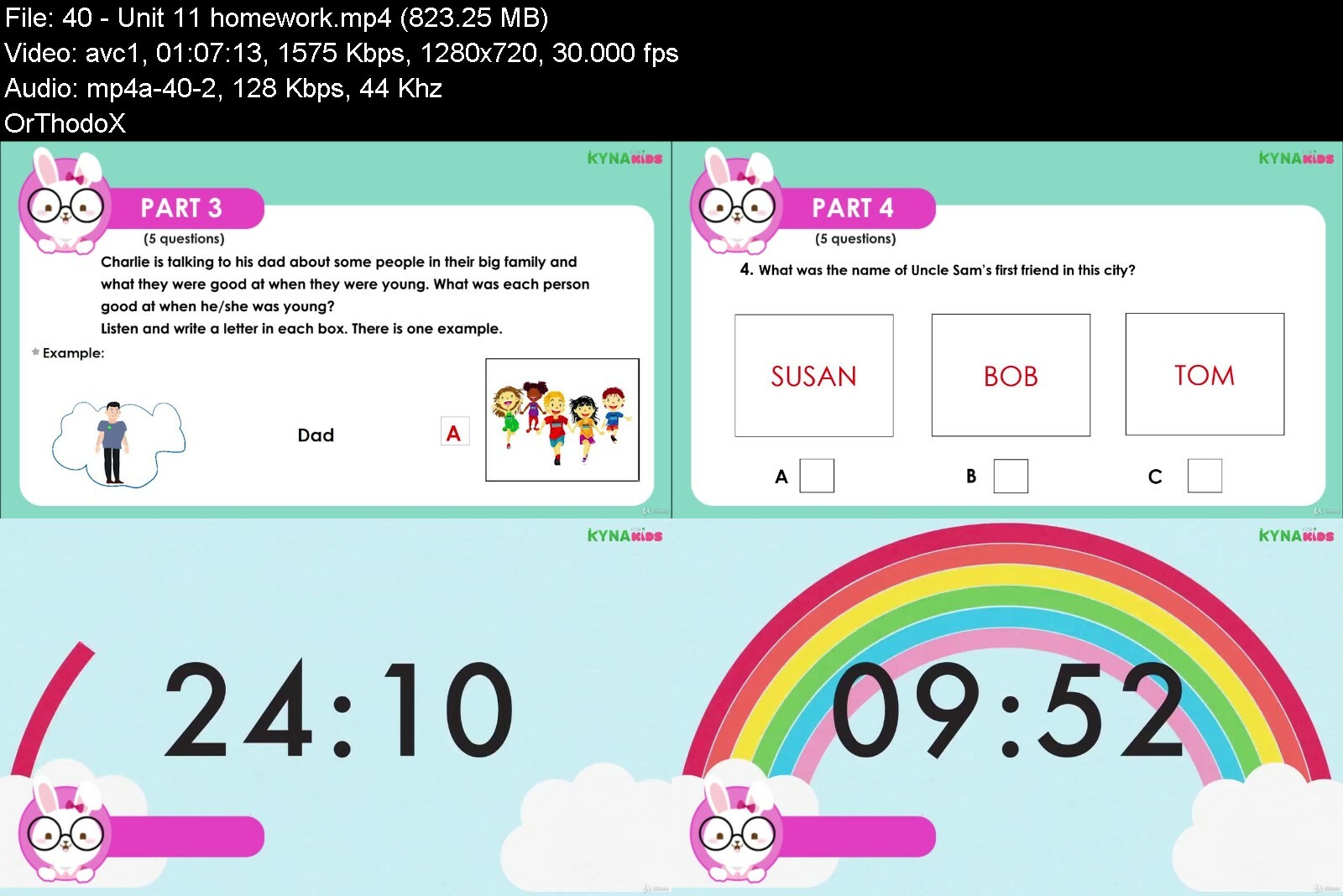
Cambridge English For Beginners - Movers - A1

rp9ebbrrejjsh2fgubyrlc5ita.jpg


Cambridge English For Beginners - Movers - A1
Last updated 8/2020
MP4 | Video: h264, 1280x720 | Audio: AAC, 44.1 KHz
Language: English | Size: 24.50 GB | Duration: 37h 15m

Cambridge English - Movers - A1


What you'll learn
34+ learning hours with 28 units
50+ Structures, 500+ new words
Learn vocabulary with flashcard
Practise listening with short conversations developed by native speakers
Practise reading with plentiful source of sentences and daily conversations
Practise speaking with native accent
Study grammar - structure with simple examples, easy to remember
Many fun games and homewords are provided to keep children excited about learning

Requirements
None

Description
This course aims to enhance the whole 4 skills for you: listening, speaking, reading and writing. It is designed based on Cambridge curriculum supported and tested by Oxford University.This course help you achieve more than 500+ new word and you can use English for daily conversations because this course contains 50+ structures, sentences used frequently in daily life.There are plenty number of Materials for you to practise in this course including homework sheet, test, mock test.....This course is also suitable for learners who are studying for Movers test, equivalent to A1 Certificate
Overview
Section 1: UNIT 1: ABOUT CHARLIE
Lecture 1 Lesson 1: Hello, I'm Charlie!
Lecture 2 Lesson 2: Football is Charlie's favourite sports.
Section 2: UNIT 2: CHARLIE IS VERY GOOD AT FOOTBALL
Lecture 3 Lesson 3: I'm very good at hockey
Lecture 4 Lesson 4: Charlie is very good at football.
Lecture 5 Unit Review
Lecture 6 Unit 2 homework
Section 3: UNIT 3: CHARLIE GOES TO SCHOOL EVERY MONDAY
Lecture 7 Lesson 5: Charlie goes to school every Monday.
Lecture 8 Lesson 6: What do you do every Monday, Charlie?
Lecture 9 Unit Review
Lecture 10 Unit homework
Section 4: UNIT 4: CHARLIE IS DOING HOMEWORK.
Lecture 11 LESSON 7: What's the matter with Charlie?
Lecture 12 LESSON 8: Shall I help you with your homework, Charlie?
Lecture 13 Unit Review
Lecture 14 Unit homework
Section 5: UNIT 5: GIVE IT TO THE TEACHER
Lecture 15 LESSON 9: Give it to the teacher!
Lecture 16 LESSON 10: Charlie learned to play the guitar yesterday!
Lecture 17 Unit Review
Lecture 18 UNIT HOMEWORK
Section 6: UNIT 6: WHERE'S CHARLIE?
Lecture 19 LESSON 11: Charlie is reading books in the library
Lecture 20 LESSON 12: I went to the market yesterday with my class!
Lecture 21 Unit Review
Lecture 22 UNIT HOMEWORK
Section 7: UNIT 7: COURSE REVIEW
Lecture 23 Course Review 1
Lecture 24 Final exam
Section 8: UNIT 8: WHO'S THAT?
Lecture 25 Lesson 13: What did you do when you were thirty years old, grandpa?
Lecture 26 Lesson 14: My brother is taller than me.
Lecture 27 Unit Review
Lecture 28 Unit homework
Section 9: UNIT 9: MY MUM IS A VEGETARIAN. SHE NEVER EATS MEAT
Lecture 29 Lesson 15: My mum never eats meat.
Lecture 30 Lesson 16: My brother reads more quickly than my sister.
Lecture 31 Unit Review
Lecture 32 Unit 9 homework
Section 10: UNIT 10: MY FATHER IS A DOCTOR
Lecture 33 Lesson 17: My father is a doctor.
Lecture 34 Lesson 18: My mother works at the hospital.
Lecture 35 Unit Review
Lecture 36 Unit 10 homework
Section 11: UNIT 11: WHERE DID YOU WORK, GRANDPA?
Lecture 37 Lesson 19: Where did you work, Grandpa?
Lecture 38 Lesson 20: My grandma worked at the Central supermarket.
Lecture 39 Unit Review
Lecture 40 Unit 11 homework
Section 12: UNIT 12: WHAT DID YOU DO YESTERDAY, CHARLIE?
Lecture 41 Lesson 21: I went for a ride in my uncle's new car.
Lecture 42 Lesson 22: My family went to the cafe yesterday.
Lecture 43 Unit Review
Lecture 44 Unit 12 homework
Section 13: UNIT 13: WHERE DID YOUR FAMILY GO LAST SUMMER?
Lecture 45 Lesson 23: We went to the beach for summer holiday.
Lecture 46 Lesson 24: The weather was nice!
Lecture 47 Unit Review
Lecture 48 Unit 13 homework
Section 14: UNIT 14: COURSE REVIEW
Lecture 49 Course Review 1
Lecture 50 Final exam
Section 15: UNIT 15: CHARLIE! YOU ARE LATE!
Lecture 51 Lesson 25: Charlie! Get up! Take a shower.
Lecture 52 Lesson 26: Where are my shorts, Mum?
Lecture 53 Unit Review
Lecture 54 Unit homework
Section 16: UNIT 16: MUST I DO THAT?
Lecture 55 Lesson 27: You must do your homework, Charlie.
Lecture 56 Lesson 28: Must I wear this sweater?
Lecture 57 Unit Review
Lecture 58 Unit 16 homework
Section 17: UNIT 17: WHERE IS THE MAT?
Lecture 59 Lesson 29: The mat is in the kitchen.
Lecture 60 Lesson 30: The DVD player is upstairs.
Lecture 61 Unit Review
Lecture 62 Unit 17 homework
Section 18: UNIT 18: SHALL I HELP YOU CLEAN THE BEDROOM, MUM?
Lecture 63 Lesson 31: Shall I help you clean the bedroom, mum?
Lecture 64 Lesson 32: Mum wants me to clean up the living room.
Lecture 65 Unit Review
Lecture 66 Unit 18 homework
Section 19: UNIT 19: IT'S DINNER TIME
Lecture 67 Lesson 33: We eat dinner at seven o'clock.
Lecture 68 Lesson 34: I want to drink some juice, mum.
Lecture 69 Unit Review
Lecture 70 Unit 19 homework
Section 20: UNIT 20: IT'S TIME TO GO TO BED!
Lecture 71 Lesson 35: What time is it?
Lecture 72 Lesson 36: It's time to go to bed!
Lecture 73 Unit Review
Lecture 74 Unit 20 homework
Section 21: COURSE REVIEW
Lecture 75 Course Review 5
Lecture 76 Final exam
Section 22: UNIT 22: I THINK HE'S VERY NICE.
Lecture 77 Lesson 37: I think he's very nice.
Lecture 78 Lesson 38: Daisy is really good at dancing.
Lecture 79 Unit Review
Lecture 80 Unit homework
Section 23: UNIT 23: LET'S HAVE FUN!
Lecture 81 Lesson 39: How about going to the cinema this weekend?
Lecture 82 Lesson 40: Daisy is the girl who is eating an ice cream.
Lecture 83 Unit Review
Lecture 84 Unit homework
Section 24: UNIT 24: I GO TO SCHOOL BY BUS.
Lecture 85 Lesson 41: I go to school by bus.
Lecture 86 Lesson 42: We are late!
Lecture 87 Unit Review
Lecture 88 Unit homework
Section 25: UNIT 25: LET'S GO SHOPPING FOR OUR NEW APARTMENT!
Lecture 89 Lesson 43: Let's go shopping for our new apartment!
Lecture 90 Lesson 44: This is the house where my grandparents live
Lecture 91 Unit Review
Lecture 92 Unit homework
Section 26: UNIT 26: WHAT DID YOU DO LAST WEEKEND LILY?
Lecture 93 Lesson 45: What did you do last weekend Lily?
Lecture 94 Lesson 46: What's your son doing today Mrs. Box?
Lecture 95 Unit Review
Lecture 96 Unit homework
Section 27: UNIT 27: I'M LOOKING FOR MY GLASSES.
Lecture 97 Lesson 47: I'm looking for my glasses.
Lecture 98 Lesson 48: Where is the shopping centre?
Lecture 99 Unit Review
Lecture 100 Unit homework
Section 28: COURSE REVIEW
Lecture 101 Course Review 7
Lecture 102 Final exam
Beginners who learning English from scratch,Learners who want to improve all 4 skills: listening, reading, writing, speaking,Learners who are preparing for Movers test,Learners who want to approach Cambridge curriculum


cambridgeenglishforbe6oiyg.jpg


Download from RapidGator


Download from DDownload



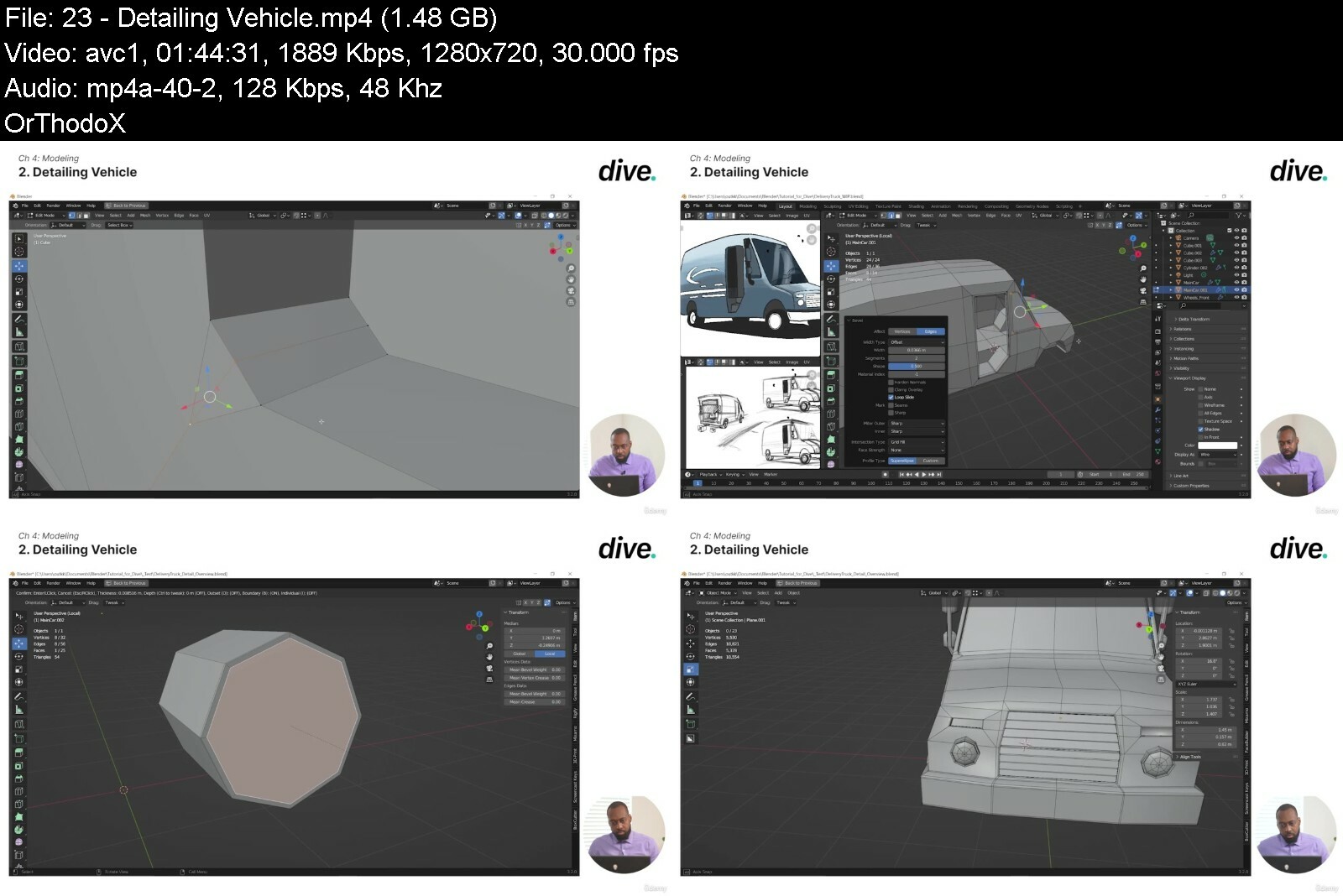
Blender : Give Life To Your 3D Models With Blender 3D

o07lyux6lzcwhpz0iod6afzcw0.jpg


Blender : Give Life To Your 3D Models With Blender 3D
Published 9/2022
MP4 | Video: h264, 1280x720 | Audio: AAC, 44.1 KHz
Language: English | Size: 6.96 GB | Duration: 8h 41m

Learn all the basics, modeling & lighting techniques


What you'll learn
The basics of this powerful 3D design software
How to create eye-catching images and complex models with simple shapes
Skills and confidence you need to start adding amazing 3D artwork to your portfolio
Create 3D models
Understand the principles of modelling

Requirements
Laptop that is capable of Running Blender

Description
Instructor CredentialsMy name is Mike Louis, and I'll be your instructor for the Blender course. As a Creative Director and professional 3D Artist, I create design visuals to explain, teach complex ideas, solve problems and grab people's attention. For close to 20 years, I've helped businesses visually and technically communicate with, train, and market to their target audience.As the CEO and Creative Director of a creative design studio called 'PolygonsWild', my team and I have helped various brands such as Limu, AVT Simulation, Meggitt, CAE, and Florida Tech, to stand out from the competition with my team's impressive and defined designs.I've been drawing and illustrating ever since I first could hold a pencil; however, my journey as a professional 3D Designer and Multimedia Specialist began when I started my degree at Full Sail University. Initially, I primarily used Maya and Photoshop for 3D animation but then decided to try out Blender, which then became my favored 3D software.Since then I've worked as a 3D, Simulation, and Design consultant at CAE, Multimedia Specialist, and 3D Consultant at Deloitte, and now work as a Metaverse & NFT Creative Consultant & Strategist at GPC/NAPA Auto Parts & Racing.Course Description<Blender: Stylized 3D Modeling> is for those who are either brand-new to Blender or have had some exposure to it but need to understand it better.This Blender course will cover all the basics, Modeling & Lighting techniques that especially focus on vehicle modeling skills such as making use of Moodboard, Blocking, Detailing, Scene Lighting, and basic and advanced animation workshops. I would recommend this course to beginners in Blender and in 3D in general. Also those who are experienced and may be looking for a refresher or interested in a more stylized approach to add to their portfolio.To StudentsOnce you finish this course, you'll be able to start designing your own 3D models with confidence, create complicated looking images using simple shapes, and add up amazing artworks in your portfolio.What I require from you before taking this course is to have an open mind and to be patient. One of the best ways to learn is to keep playing each video back and forth, until you fully understand the content and the skills.Don't forget to have fun along the way!
Overview
Section 1: Instructor Introduction
Lecture 1 Introduction to the Course
Section 2: Chapter 1: Basics of 3D
Lecture 2 What is 3D?
Lecture 3 Where is 3D Used?
Lecture 4 Getting to Know Blender 3D Software
Section 3: Chapter 2 Blender Basics
Lecture 5 Where to Download Blender
Lecture 6 Blender Interface / UI Basics
Lecture 7 Navigation in Blender Viewport
Lecture 8 Select and Transform Objects in Blender
Lecture 9 Layouts and Workspaces in Blender
Lecture 10 Adding Objects in 3D Scene
Lecture 11 Blender Modes
Lecture 12 Geometry Basics
Lecture 13 Mesh Editing
Lecture 14 Modifier Overview
Lecture 15 Modeling Basics
Section 4: Chapter 3: Concept Building
Lecture 16 Art Styles
Lecture 17 References
Lecture 18 Creating a Moodboard - Pinterest
Lecture 19 Creating a Moodboard - PureRef
Lecture 20 Creating a Moodboard - Milanote
Lecture 21 Conceptualizing and Sketching
Section 5: Chapter 4: Modeling
Lecture 22 Blocking Vehicle
Lecture 23 Detailing Vehicle
Lecture 24 Blocking Environment
Lecture 25 Detailing Environment
Section 6: Chapter 5: Materials
Lecture 26 Material Overview & Basic Materials
Lecture 27 Material
Section 7: Chapter 6: Lighting
Lecture 28 Lighting Overview
Lecture 29 Scene Lighting in Blender
Section 8: Chapter 7: Animation
Lecture 30 Blender Animation Overview
Lecture 31 Looping Animation
Section 9: Chapter 8: Rendering
Lecture 32 Final Render
Artists who want to learn to bring their assets alive,Complete beginners who are willing to work hard


blendergivelifetoyouruochk.jpg


Download from RapidGator


Download from DDownload



Basic Land Surveying

ekuzpkfonbd177zcd2monshfs3.jpg


Basic Land Surveying
Published 8/2022
MP4 | Video: h264, 1280x720 | Audio: AAC, 44.1 KHz
Language: English | Size: 48.48 GB | Duration: 37h 10m

Basic of Geomatics, Chain Survey, Compass Survey, Levelling Survey, Theodolite Survey, Plane Table Survey


What you'll learn
1] Basics of Land Surveying
2] Chain Surveying
3] Compass Surveying
4] Theodolite Surveying
5] Levelling Surveying
6] Plane Table Surveying

Requirements
Be able to know basic of units of measurement
Be able to know basic of Engineering Drawing
Minimum Educational Qualification - SSC 10th Pass

Description
Learning Objectives of this Course are:1. To learn about the term surveying, various instruments and possible error.2. To learn Linear Measurement methods and way of conduction.3. To learn about the measurement at elevation and of Directions , contour development process.4. To understand and learn performing Plane table surveying.Course Outcomes:At the end of the course the student will be able to:1. Define principles of Surveying, Remote Sensing and Geomatics.2. Describe different instruments, tools, applications and techniques to determine the positions on the surface ofthe earth, change detection.3. To perform Liner measurement methods of surveying.4. Differentiate the techniques for setting out alignments, curves, other layouts, modern survey systems etc.5. To perform survey at elevation and conduct Plane Table survey.Brief Course Content:Unit-I - Basics of Geomatics / Surveying - Unit-II - Linear Measurement (Chain Surveying)Unit-III - Measurement of Elevations (Levelling Surveying)Unit-IV - Measurement of Direction (Compass Surveying)Unit-V - Traversing (Theodolite Surveying)Unit-VI - Plane Table SurveyingReference Books Recommended:1. D. Clarke: Plane and Geodatic Surveying, Volume I & II2. T.P. Kanetkar & Kulkarni: Surveying & Levelling, Part I & II.3. B.C. Punmia : Surveying I & II.4. N.N. Basak : Surveying & Levelling.Top 5 Advantages of Land Surveying:Land Survey helps us to prepare for construction in the similar way you consult interior desiginer and structural engineers on building design you need to consult land survey engineer to know the potential of the land. Land surveyor can help you begin work without any issue.It is not possible to measure the plot of new land without the help of Land Survey as it might leads to inappropriate land measurements. So a proper land survey is necessary as it clearly states property boundaries which can further help the management teams for appropriate construction plan and will save you from property line trouble and disputes with neighbor.Without proper land survey the value of property can be over or under valued so there is necessity for accurate land survey. If you want to understand fully your worth and purchase based on location, landscape and hardscape you will need to hire proper land survey engineer.It is necessary to understand the topographical details before purchasing the property. Detection of soil and structural issues, determination of flood prone area and get accurate representation of plot it is necessary for engineers to conduct land survey. A proper land survey will help you protect from disaster and push back and halt construction.To separate business owner from residential and commercial purposes landowners may want to begin with plot parceling. For proper division of property into pre-determined section which can be priced and handed over correctly without any inaccuracies there is a need for proper land survey.
Overview
Section 1: Unit-I - Basics of Geomatics / Surveying
Lecture 1 Need Concept & Objective
Lecture 2 Classification and Principal of Surveying
Lecture 3 Units of Measurement
Lecture 4 Accuracy and Errors
Lecture 5 Eliminations of Errors
Lecture 6 Maps and Scales
Lecture 7 Map Projection, Numbering and Elements
Section 2: Unit-II - Linear Measurement (Chain Surveying)
Lecture 8 Introduction to Linear Measurement
Lecture 9 Instruments for Chain Surveying
Lecture 10 Errors in Linear Measurement
Lecture 11 Chain and Tape Corrections
Lecture 12 Obstacles in Chaining
Lecture 13 Chaining on Sloping Ground
Lecture 14 Setting Perpendicular Offsets
Lecture 15 Area by Chain Surveying
Lecture 16 Linear Measurement by Optical Methods
Section 3: Unit-III - Measurement of Elevations (Levelling Surveying)
Lecture 17 Introduction and Concepts of Levelling
Lecture 18 Types of Bench Marks
Lecture 19 Types of Levels
Lecture 20 Use of Levelling Instrument
Lecture 21 Height of Instrument Method
Lecture 22 Rise and Fall Method
Lecture 23 Profile Levelling and Cross Sectioning
Lecture 24 Curvature & Refraction
Lecture 25 Contour Surveying
Lecture 26 Method of Contouring
Section 4: Unit-IV - Measurement of Direction (Compass Surveying)
Lecture 27 Measurement of Bearing
Lecture 28 Types of Bearing
Lecture 29 Magnetic Declination
Lecture 30 Local Attraction
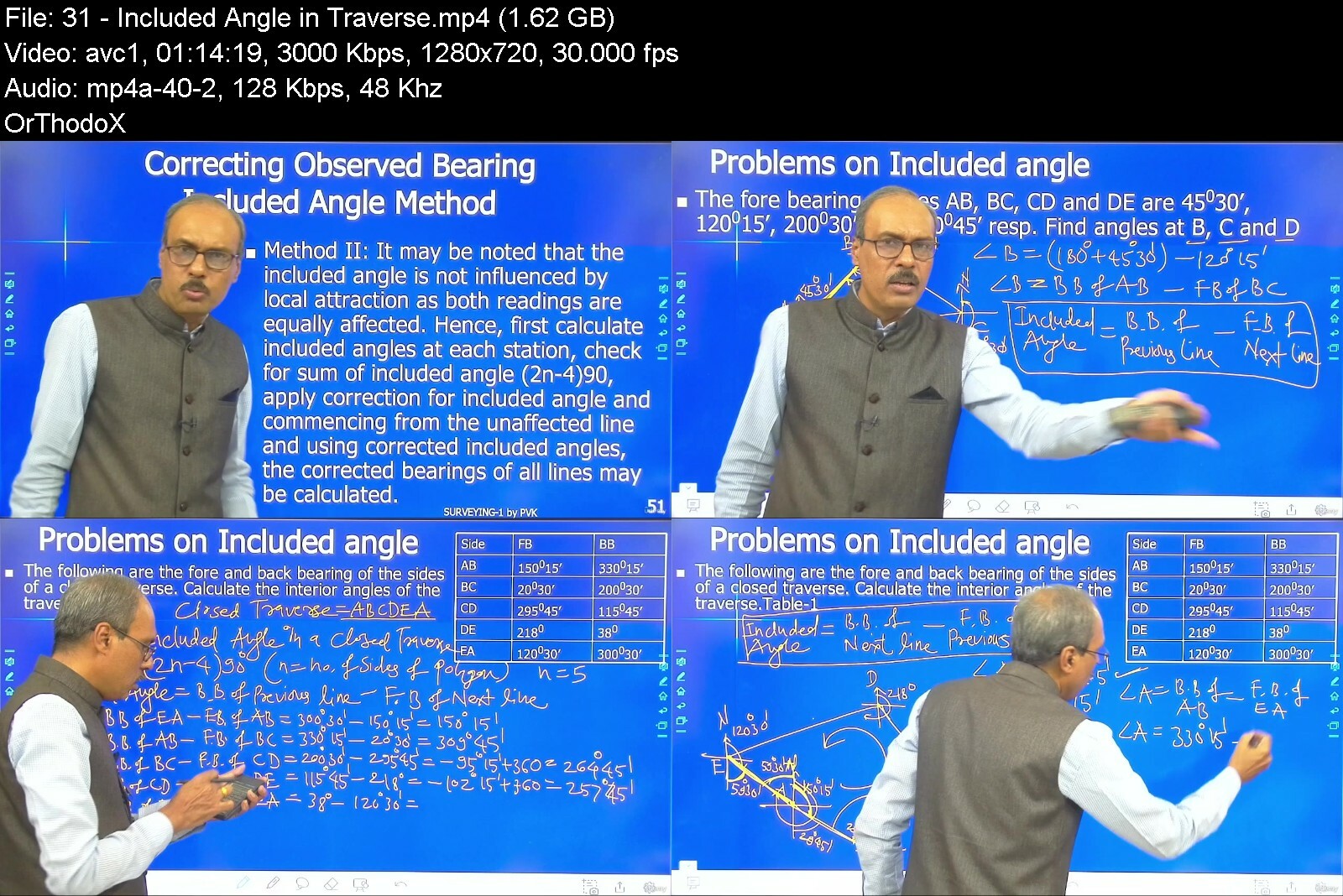
Lecture 31 Included Angle in Traverse
Lecture 32 Compass Traversing
Lecture 33 Errors in Compass Surveying
Section 5: Unit-V - Traversing (Theodolite Surveying)
Lecture 34 Introduction to Theodolite
Lecture 35 Angle Measurement using Theodolite
Lecture 36 Taking Reading using Vernier Theodolite
Lecture 37 Methods of Theodolite Traversing
Lecture 38 Problems on Latitude & Departure
Lecture 39 Gale's Traverse Table
Section 6: Unit-VI - Plane Table Surveying
Lecture 40 Instruments for Plane Table Surveying
Lecture 41 Procedure for Plane Table Surveying
Lecture 42 Advantages and Limitations of PTS
Lecture 43 Method of Orientation of PTS
Lecture 44 Three Point Problem in Plane Table Surveying
Lecture 45 Area of Irregular Figure
Lecture 46 Introduction to Total Station
ITI Draughtsman civil / Architectural Draftsman / Building construction / Mason / Surveying Students,Polytechnic civil engineering students, construction site supervisors, civil engineering assistant,UG Students of Civil Engineering, Building site supervisor, Practicing Civil Engineers


basiclandsurveyingxwfjd.jpg


Download from RapidGator


Download from DDownload


Mastering American Culture And Business For Newcomers

8vi9oaueljo3tjjyudwvy8be22.jpg


Mastering American Culture And Business For Newcomers
Published 9/2022
MP4 | Video: h264, 1280x720 | Audio: AAC, 44.1 KHz
Language: English | Size: 8.89 GB | Duration: 6h 58m

A Three-Part Course Focused on American Culture, Socializing in America, and Conquering American Business


What you'll learn
Basic American History and Culture
How to Socialize With North Americans
How to Succeed in North American Business
How to Become a Successful Leader in North America
You'll be taught by two American lawyers who are the children of immigrants and know what it takes to succeed as someone new to America

Requirements
A working knowledge of English will be helpful. That said, don't worry if English is not your first language--just listening to our videos and our use of the English language will help improve your English skills!
While this course is focused on helping immigrants and newcomers from Asian countries succeed in America, ANYONE looking to learn more about American culture and succeeding in American business can benefit from this course
A willingness to take the concepts learned in this course and apply them in real-world settings

Description
America has its own unique culture and rules. No matter how educated or hard-working you are, to succeed in America, it is absolutely necessary to learn the cultural norms that make America so unique. That's where we come in. This course is dedicated to helping Asian immigrants and newcomers from other countries master the cultural skills that are necessary for succeeding in America. The course is taught by two American lawyers--Ryan and Kristian--who share their knowledge and experience about what it takes to succeed in North America. The course contains over 100 videos which are separated into three complimentary sections: (1) American Culture; (2) Socializing in America; and (3) American Business Culture.In the First section, we address American Culture with videos such as American History (The Civil War, the Great Depression, World Wars I and II, Vietnam, etc.), American Food, Politics, American Hygiene, American Drinking Culture, American Drug Culture, and What's Illegal in America.In the Second section, we address Socializing in America. Here, the curriculum dives into topics including Making Friends in America, Restaurant Etiquette, Cultural Faux Pas (i.e. Cultural "No-Nos"), ****** in America, and American Sex Culture.Finally, in the Third section, American Business Culture, we use the knowledge you've gained to show you how to succeed in American business. Here, we cover topics such as Drafting a Resume, Conquering the Interview Process, Asking for a Raise or Promotion, and Giving an Unforgettable Speech. While the course focuses on helping Asian businesspeople and students, the content is general enough that anyone looking to learn about American culture and business can benefit from our videos.Join us and and unlock the secrets to succeeding in America as a newcomer.
Overview
Section 1: Introduction
Lecture 1 Introduction
Section 2: American Culture
Lecture 2 History: American History
Lecture 3 History: The American Revolution and The Start of a Nation
Lecture 4 History: The Civil War
Lecture 5 History: The Great Depression of 1929
Lecture 6 History: World Wars I and II
Lecture 7 History: Jim Crow Laws and the Civil Rights Movement: 1950s and 60s
Lecture 8 History: The Vietnam War
Lecture 9 History: September 11th and the War on Terror
Lecture 10 History: The Black Lives Matter Movement
Lecture 11 History: COVID 19
Lecture 12 Food: American Food and Eating Habits
Lecture 13 Food: Famous American Foods and Where to Find Them
Lecture 14 Politics: Politics in America
Lecture 15 Politics: American Politics Parties
Lecture 16 Politics: Asian Communities and Modern American Politics
Lecture 17 Geography: America's Physical Geography
Lecture 18 Geography: America's Cultural Geography
Lecture 19 Religion in America
Lecture 20 Fashion: American Fashion and Clothing
Lecture 21 Fashion: Dressing for the Occasion for Men
Lecture 22 Fashion: Dressing for the Occasion for Women
Lecture 23 American Sports
Lecture 24 American Hygiene
Lecture 25 Gender: Gender in America
Lecture 26 Gender: Femininity in America
Lecture 27 Gender: Masculinity in America
Lecture 28 Gender: Closing Remarks on Masculinity and Femininity in America
Lecture 29 American LGBTQ+ Culture
Lecture 30 Alcohol: American Drinking Culture
Lecture 31 Alcohol: What to Drink in Different Settings
Lecture 32 Alcohol: Different Types of Alcohol
Lecture 33 Alcohol: How to Drink
Lecture 34 American Drug Culture
Lecture 35 Transportation in America
Lecture 36 What's Illegal in America?
Section 3: Socializing in America
Lecture 37 Making Friends: It's Not Personal/Getting Over the Fear of Talking to People
Lecture 38 Making Friends: To Make Friends, Start by Looking Within
Lecture 39 Making Friends: Types of Friends
Lecture 40 Making Friends: Where to Meet Friends
Lecture 41 Making Friends: Meeting Friends Online
Lecture 42 Making Friends: Meeting Friends Offline
Lecture 43 Becoming a Master Conversationalist: Making an Introduction
Lecture 44 Becoming a Master Conversationalist: Keeping a Conversation Going
Lecture 45 Becoming a Master Conversationalist: Off-Limit Topics
Lecture 46 Becoming a Master Conversationalist: Ending a Conversation
Lecture 47 Developing and Maintaining Friendships: What to do Within 24 Hours of Meeting
Lecture 48 Developing and Maintaining Friendships: Your Second Meeting
Lecture 49 Developing and Maintaining Friendships: Consistent Follow-Up
Lecture 50 Always Look for Opportunities to Help Others
Lecture 51 Treat the Janitor with the Same Respect as You Treat the Owner
Lecture 52 Restaurant Etiquette
Lecture 53 Restaurant Etiquette: Making a Reservation and Dress Code
Lecture 54 Restaurant Etiquette: Arriving and Getting Seated
Lecture 55 Restaurant Etiquette: Western Utensils and How to Use Them
Lecture 56 Restaurant Etiquette: Ordering Food and Interacting with Bussers and Waiters
Lecture 57 Restaurant Etiquette: Etiquette While Eating
Lecture 58 Restaurant Etiquette: Dining Conversation
Lecture 59 Restaurant Etiquette: Paying the Bill and Tipping
Lecture 60 Cultural Faux Pas: What Not to Do
Lecture 61 Cultural Faux Pas: Who Not to Say
Lecture 62 Social Media Etiquette: LinkedIn
Lecture 63 Social Media Etiquette: Twitter
Lecture 64 Social Media Etiquette: Facebook
Lecture 65 Social Media Etiquette: Instagram
Lecture 66 ******: Where to Find a Date
Lecture 67 ******: Asking Someone Out on a Date
Lecture 68 ******: First Come First Serve
Lecture 69 ******: Interracial Relationships
Lecture 70 American Sexual Culture
Section 4: Succeeding in American Business
Lecture 71 American Business
Lecture 72 Drafting a Resume
Lecture 73 Conquering the Interview Process: Preparing for the Interview
Lecture 74 Conquering the Interview Process: Do Your Research
Lecture 75 Conquering the Interview Process: Interview Etiquette and Body Language
Lecture 76 Conquering the Interview Process: Thank You Notes
Lecture 77 Conquering the Interview Process: Handling Technical Interview Questions
Lecture 78 Conquering the Interview Process: Common Interview Questions
Lecture 79 Going From the Mailroom to the C-Suite
Lecture 80 Going from the Mailroom to the C-Suite: Gain as Much Experience as You Can
Lecture 81 Going from the Mailroom to the C-Suite: Time and Dedication are Unavoidable
Lecture 82 Going from the Mailroom to the C-Suite: Look for Opportunities to Add Value
Lecture 83 Going from the Mailroom to the C-Suite: Adopt a We Not Me Approach
Lecture 84 Going from the Mailroom to the C-Suite: Always Deliver and Do So on Time
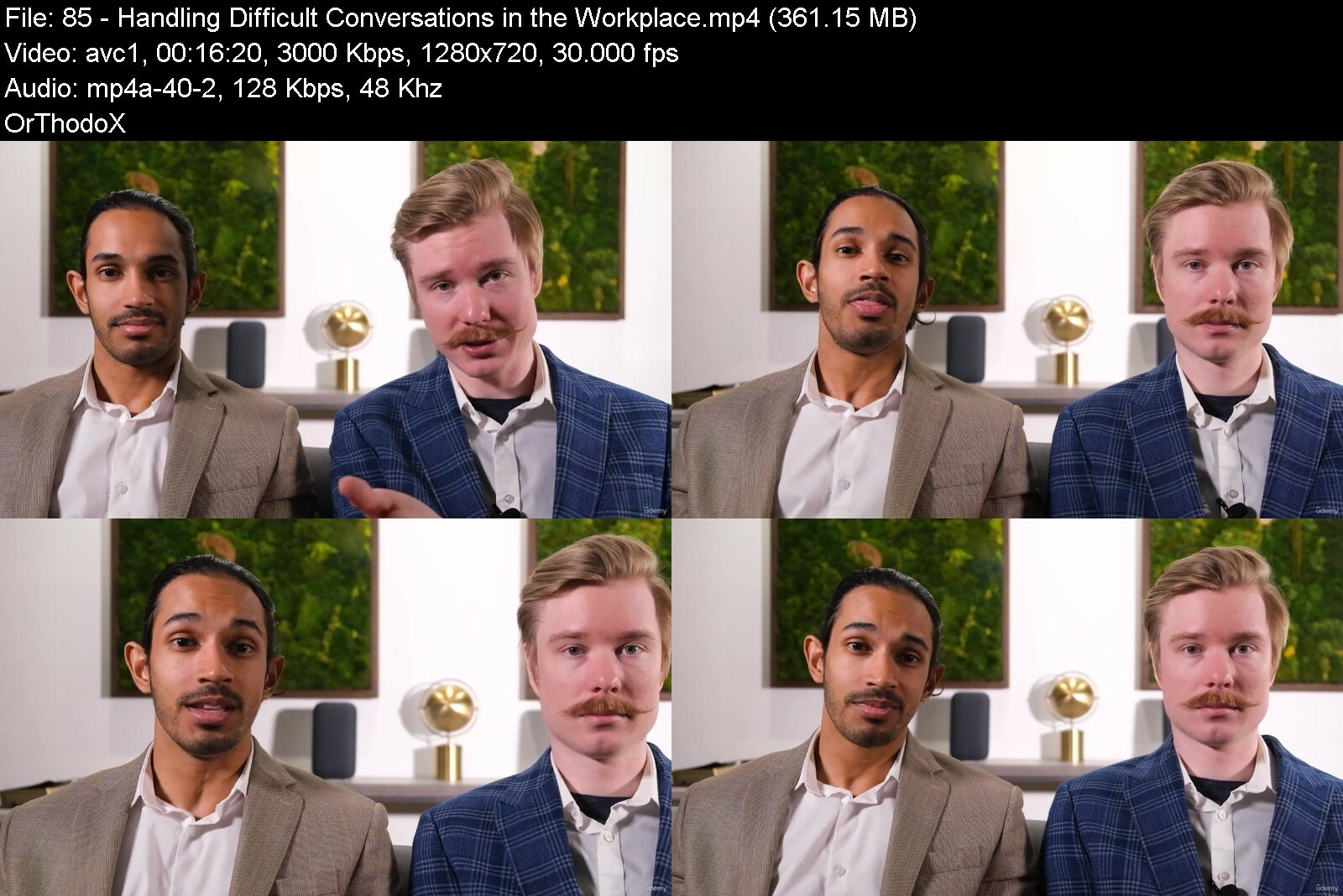
Lecture 85 Handling Difficult Conversations in the Workplace
Lecture 86 Asking for a Raise or Promotion
Lecture 87 Interacting with Superiors and Work Colleagues
Lecture 88 How to Interact at Social Events vs. Work Events
Lecture 89 Giving an Unforgettable Speech
Lecture 90 Giving an Unforgettable Speech: Entertaining Your Audience is Your Top Priority
Lecture 91 Giving an Unforgettable Speech: Enthusiasm
Lecture 92 Giving an Unforgettable Speech: Smile
Lecture 93 Giving an Unforgettable Speech: Tone, Pacing, and Pausing
Lecture 94 Giving an Unforgettable Speech: Using Humor
Lecture 95 Giving an Unforgettable Speech: Using Props
Lecture 96 Giving an Unforgettable Speech: The Shorter the Better
Lecture 97 Giving an Unforgettable Speech: Slides Are for Your Audience's Benefit
Lecture 98 Giving an Unforgettable Speech: Practice, Practice, Practice
Lecture 99 Conclusion
Immigrants and newcomers from Asia and elsewhere who want to succeed in American business and social circles,Anyone looking to become an effective American leader,Anyone Looking to learn more about American culture, socializing in America, and American business


masteringamericancults6dxt.jpg


Download from RapidGator


Download from DDownload


The Complete Drums Course From Scratch - For All Ages

iwn7ekqlm0vocd0dvmvju6tfes.jpg


The Complete Drums Course From Scratch - For All Ages
Published 8/2022
MP4 | Video: h264, 1280x720 | Audio: AAC, 44.1 KHz
Language: English | Size: 17.51 GB | Duration: 14h 30m

The drum path from Zero to Advanced


What you'll learn
The student will be able to perform live on stage professionally for free and money.
The student will be able to teach drums from zero to advanced.
The student will play songs from all music genres after practicing the set of songs explained in detail in this course.
The student will learn the role of every part of the drum set, all the drum techniques, the drum notation from A to Z and all the drum rudiments.

Requirements
Drum Sticks.
Drum Set or pillows in the shape of a drums.
The student can get the book version of this course from Amazon (The drum path from zero to advanced) at completion to teach students drums.

Description
The drum path is the ultimate guide for drum enthusiasts. The student will get to learn everything he/she needs to know from the very basics of handling the drums to advanced drumming techniques through which he/she will be able to perform on stage professionally and with confidence. The aim of this course is to provide the most adequate learning experience a future drummer needs.This course is book based, meaning, the course follows "The drum path from zero to advanced" book method for it to be that well structured. The student can buy the book after buying the course but it is not mandatory. The book will be needed after the student completes the course if he/she ever decides to teach the drums, because he/she will need it as their drums program.This course is divided into eight parts: - Course Introduction- Interviews with Students That Took This*Course- From Zero to Beginner- From Beginner to Intermediate- From Intermediate to Advanced- Rudiments- Genres and Songs to Play- Drums ChallengesIn The drum path, the student will learn about:- The drum kit components- The right posture on drums- The music notation from A to Z- All exercises that a student needs to follow to become an advanced drummer in order- The first 25 Drum Rudiments- The drummer's favorite genres and songs to play along- The challenges to develop independence
Overview
Section 1: Course Introduction
Lecture 1 Introduction to The drum path from zero to advanced
Lecture 2 What's Inside?
Lecture 3 Guidelines
Lecture 4 Drum Kit Components
Lecture 5 Drumstick Grip and Wrist Motion
Lecture 6 Drum Set Posture
Lecture 7 Introduction to Drum Rhythms and Drum Fills: Drum Rhythms
Lecture 8 Drum Fills
Lecture 9 Combining Drum Rhythms with Drum Fills
Section 2: Interviews With Students Who Took This Course
Lecture 10 Interview 1
Lecture 11 Interview 2
Lecture 12 Interview 3
Lecture 13 Interview 4
Lecture 14 Interview 5
Lecture 15 Interview 6
Lecture 16 Interview 7
Section 3: From Zero To Beginner
Lecture 17 Introduction to Music Theory: Music Notes
Lecture 18 Introduction to Music Theory: Music Symbols
Lecture 19 Tempo
Lecture 20 Snare Drum Notation
Lecture 21 Exercises on Snare Drum
Lecture 22 Exercises on Snare Drum: Exercise 1
Lecture 23 Exercises on Snare Drum: Exercise 2
Lecture 24 Bass Drum Notation
Lecture 25 Exercises on Bass Drum
Lecture 26 Exercises on Bass Drum: Exercise 1
Lecture 27 Exercises on Bass Drum: Exercise 2
Lecture 28 Exercises on Bass Drum and Snare Drum Combined
Lecture 29 Exercises on Bass Drum and Snare Drum Combined: Exercise 1
Lecture 30 Exercises on Bass Drum and Snare Drum Combined: Exercise 2
Lecture 31 Hi-Hat Cymbals Notation
Lecture 32 Hi-Hat Cymbals Notation: Exercise
Lecture 33 Exercises on Hi-Hat Cymbals, Snare Drum and Bass Drum Combined
Lecture 34 Exercises on Hi-Hat Cymbals, Snare Drum and Bass Drum Combined: Exercise 1
Lecture 35 Exercises on Hi-Hat Cymbals, Snare Drum and Bass Drum Combined: Exercise 2
Lecture 36 Exercises on Hi-Hat Cymbals, Snare Drum and Bass Drum Combined: Exercise 3
Lecture 37 Rests
Lecture 38 Exercises with Rests
Lecture 39 Exercises with Rests: Exercise 1
Lecture 40 Exercises with Rests: Exercise 2
Lecture 41 Exercises with Rests: Exercise 3
Lecture 42 Repeat Signs + Exercise with Repeat Signs
Lecture 43 Repeat Signs + Exercise with Repeat Signs: Exercise
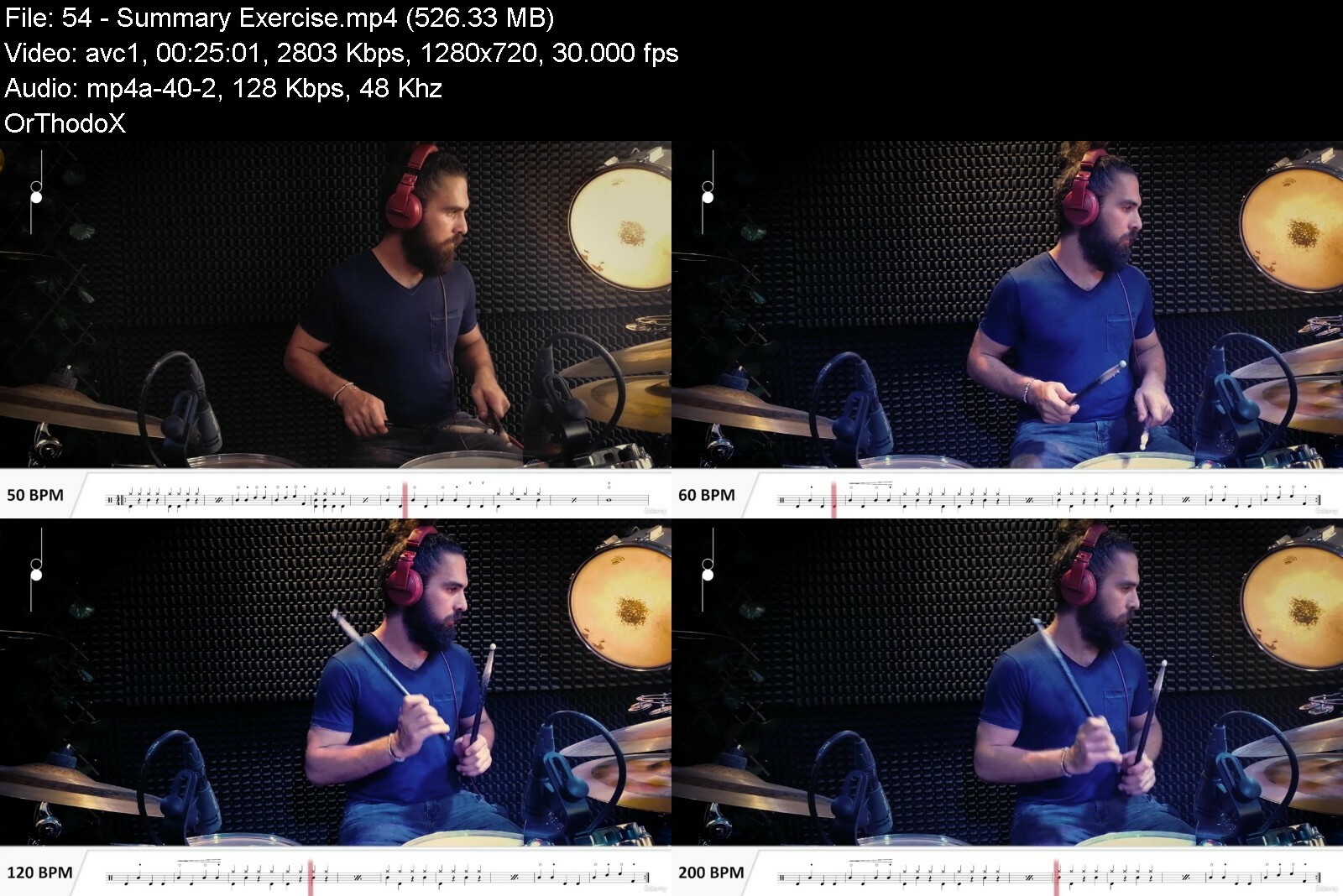
Lecture 44 Summary
Lecture 45 Summary: Exercise
Lecture 46 Accents + Exercises with Accents
Lecture 47 Accents + Exercises with Accents: Exercise 1
Lecture 48 Accents + Exercises with Accents: Exercise 2
Lecture 49 Tom 1, Tom 2 & Floor Tom Notation
Lecture 50 Exercises on Tom 1, Tom 2 and Floor Tom
Lecture 51 Exercises on Tom 1, Tom 2 and Floor Tom: Exercise 1
Lecture 52 Exercises on Tom 1, Tom 2 and Floor Tom: Exercise 2
Lecture 53 Summary
Lecture 54 Summary: Exercise
Lecture 55 Open Hi-Hat Cymbals Notation
Lecture 56 Exercises with Open Hi-Hat Cymbals
Lecture 57 Exercises with Open Hi-Hat Cymbals: Exercise 1
Lecture 58 Exercises with Open Hi-Hat Cymbals: Exercise 2
Lecture 59 Exercises with Open Hi-Hat Cymbals: Exercise 3
Lecture 60 Ride Cymbal Notation + Exercises with Ride Cymbal
Lecture 61 Ride Cymbal Notation + Exercises with Ride Cymbal: Exercise 1
Lecture 62 Ride Cymbal Notation + Exercises with Ride Cymbal: Exercise 2
Lecture 63 Ride Cymbal Notation + Exercises with Ride Cymbal: Exercise 3
Lecture 64 Hi-Hat Cymbals Pedal Notation + Exercises with Hi-Hat Cymbals Pedal
Lecture 65 Hi-Hat Cymbals Pedal Notation + Exercises with Hi-Hat Cymbals Pedal: Exercise 1
Lecture 66 Hi-Hat Cymbals Pedal Notation + Exercises with Hi-Hat Cymbals Pedal: Exercise 2
Lecture 67 Hi-Hat Cymbals Pedal Notation + Exercises with Hi-Hat Cymbals Pedal: Exercise 3
Lecture 68 Crash Cymbal Notation + Exercises with Crash Cymbal
Lecture 69 Crash Cymbal Notation + Exercises with Crash Cymbal: Exercise 1
Lecture 70 Crash Cymbal Notation + Exercises with Crash Cymbal: Exercise 2
Section 4: From Beginner To Intermediate
Lecture 71 Eighth Note
Lecture 72 Exercises with Eighth Notes on Snare Drum
Lecture 73 Exercises with Eighth Notes on Snare Drum: Exercise 1
Lecture 74 Exercises with Eighth Notes on Snare Drum: Exercise 2
Lecture 75 Exercises with Eighth Notes on Snare Drum: Exercise 3
Lecture 76 Exercises with Eighth Notes on Snare Drum: Exercise 4
Lecture 77 Exercises with Eighth Notes on Snare Drum: Exercise 5
Lecture 78 Exercises with Eighth Notes on Snare Drum: Exercise 6
Lecture 79 Exercises with Eighth Notes on Snare Drum: Exercise 7
Lecture 80 Exercises with Eighth Notes on Snare Drum: Exercise 8
Lecture 81 Exercises with Eighth Notes on Hi-Hat Cymbals, Snare Drum and Bass Drum
Lecture 82 Exercises with Eighth Notes on Hi-Hat Cymbals, Snare Drum and Bass Drum: Ex 1
Lecture 83 Exercises with Eighth Notes on Hi-Hat Cymbals, Snare Drum and Bass Drum: Ex 2
Lecture 84 Exercises with Eighth Notes on Hi-Hat Cymbals, Snare Drum and Bass Drum: Ex 3
Lecture 85 Exercises with Eighth Notes on All Drums
Lecture 86 Exercises with Eighth Notes on All Drums: Exercise 1
Lecture 87 Exercises with Eighth Notes on All Drums: Exercise 2
Lecture 88 Exercises with Eighth Notes on All Drums: Exercise 3
Lecture 89 Eighth Rest + Exercises with Eighth Rest
Lecture 90 Eighth Rest + Exercises with Eighth Rest: Exercise 1
Lecture 91 Eighth Rest + Exercises with Eighth Rest: Exercise 2
Lecture 92 Eighth Rest + Exercises with Eighth Rest: Exercise 3
Lecture 93 Dotted Notes
Lecture 94 Summary
Lecture 95 Summary: Exercise 1
Lecture 96 Summary: Exercise 2
Lecture 97 Summary: Exercise 3
Lecture 98 Summary: Exercise 4
Lecture 99 Flam Notation + Exercise with Flams
Lecture 100 Flam Notation + Exercise with Flams: Exercise
Lecture 101 Sixteenth Note
Lecture 102 Exercises with Sixteenth Notes on Snare Drum
Lecture 103 Exercises with Sixteenth Notes on Snare Drum: Exercise 1
Lecture 104 Exercises with Sixteenth Notes on Snare Drum: Exercise 2
Lecture 105 Exercises with Sixteenth Notes on Snare Drum: Exercise 3
Lecture 106 Exercises with Sixteenth Notes on Snare Drum: Exercise 4
Lecture 107 Exercises with Sixteenth Notes on Snare Drum: Exercise 5
Lecture 108 Exercises with Sixteenth Notes on Snare Drum: Exercise 6
Lecture 109 Exercises with Sixteenth Notes on Snare Drum: Exercise 7
Lecture 110 Exercises with Sixteenth Notes on Hi-Hat Cymbals, Snare Drum and Bass Drum
Lecture 111 Exercises with Sixteenth Notes on Hi-Hat Cymbals, Snare Drum and Bass Drum: Ex 1
Lecture 112 Exercises with Sixteenth Notes on Hi-Hat Cymbals, Snare Drum and Bass Drum: Ex 2
Lecture 113 Exercises with Sixteenth Notes on Hi-Hat Cymbals, Snare Drum and Bass Drum: Ex 3
Lecture 114 Exercises with Sixteenth Notes on Hi-Hat Cymbals, Snare Drum and Bass Drum: Ex 4
Lecture 115 Exercises with Sixteenth Notes on All Drums
Lecture 116 Exercises with Sixteenth Notes on All Drums: Exercise 1
Lecture 117 Exercises with Sixteenth Notes on All Drums: Exercise 2
Lecture 118 Exercises with Sixteenth Notes on All Drums: Exercise 3
Lecture 119 Summary (Part 1)
Lecture 120 Summary (Part 1): Exercise
Lecture 121 Summary (Part 2)
Lecture 122 Summary (Part 2): Exercise
Lecture 123 Sixteenth Notes Combinations on Snare Drum
Lecture 124 Sixteenth Notes Combinations on Snare Drum: Exercise
Lecture 125 Sixteenth Notes Combinations on Hi-Hat and Ride Cymbals
Lecture 126 Sixteenth Notes Combinations on Hi-Hat and Ride Cymbals: Exercise 1
Lecture 127 Sixteenth Notes Combinations on Hi-Hat and Ride Cymbals: Exercise 2
Lecture 128 Sixteenth Notes Combinations on Hi-Hat and Ride Cymbals: Exercise 3
Lecture 129 Sixteenth Notes Combinations on Hi-Hat and Ride Cymbals: Exercise 4
Lecture 130 Sixteenth Notes on All Drums
Lecture 131 Sixteenth Notes on All Drums: Exercise
Lecture 132 Eighth Note Triplet
Lecture 133 Eighth Note Triplet: Exercise
Lecture 134 Exercise with Eighth Note Triplets on Snare Drum
Lecture 135 Exercise with Eighth Note Triplets on Snare Drum: Exercise
Lecture 136 Exercise with Eighth Note Triplets on All Drums (Part 1)
Lecture 137 Exercise with Eighth Note Triplets on All Drums (Part 1): Exercise
Lecture 138 Exercise with Eighth Note Triplets on All Drums (Part 2)
Lecture 139 Exercise with Eighth Note Triplets on All Drums (Part 2): Exercise
Section 5: From Intermediate To Advanced
Lecture 140 Thirty-Second Note
Lecture 141 Exercises with Thirty-Second Notes on Snare Drum (Part 1)
Lecture 142 Exercises with Thirty-Second Notes on Snare Drum (Part 1): Exercise 1
Lecture 143 Exercises with Thirty-Second Notes on Snare Drum (Part 1): Exercise 2
Lecture 144 Exercises with Thirty-Second Notes on Snare Drum (Part 1): Exercise 3
Lecture 145 Exercises with Thirty-Second Notes on Snare Drum (Part 1): Exercise 4
Lecture 146 Exercise with Thirty-Second Notes on Snare Drum (Part 2)
Lecture 147 Exercise with Thirty-Second Notes on Snare Drum (Part 2): Exercise
Lecture 148 Exercise with Thirty-Second Notes on All Drums
Lecture 149 Exercise with Thirty-Second Notes on All Drums: Exercise
Lecture 150 Thirty-Second Notes Combinations on Snare Drum
Lecture 151 Thirty-Second Notes Combinations on Snare Drum: Exercise 1
Lecture 152 Thirty-Second Notes Combinations on Snare Drum: Exercise 2
Lecture 153 Thirty-Second Notes Combinations on Snare Drum: Exercise 3
Lecture 154 Thirty-Second Notes Combinations on All Drums
Lecture 155 Thirty-Second Notes Combinations on All Drums: Exercise 1
Lecture 156 Thirty-Second Notes Combinations on All Drums: Exercise 2
Lecture 157 Thirty-Second Notes Combinations on All Drums: Exercise 3
Lecture 158 Sextuplet
Lecture 159 Sextuplet: Exercise
Lecture 160 Exercise with Sextuplets on Snare Drum
Lecture 161 Exercise with Sextuplets on Snare Drum: Exercise
Lecture 162 Exercises with Sextuplets on All Drums
Lecture 163 Exercises with Sextuplets on All Drums: Exercise 1
Lecture 164 Exercises with Sextuplets on All Drums: Exercise 2
Lecture 165 Exercises with Sextuplets on All Drums: Exercise 3
Lecture 166 Summary
Lecture 167 Summary: Exercise
Section 6: Rudiments
Lecture 168 25 Rudiments
Section 7: Genres and Songs to Play
Lecture 169 Rock
Lecture 170 Blues
Lecture 171 Disco
Lecture 172 Funk
Lecture 173 Hip Hop / R & B
Lecture 174 Alternative Rock
Lecture 175 Punk Rock
Lecture 176 Bossa Nova
Lecture 177 Oriental
Lecture 178 Swing
Lecture 179 Country
Lecture 180 Reggae
Lecture 181 Khaliji
Lecture 182 Samba Rhythms
Section 8: Drums Challenges
Lecture 183 Last Challenge (Part 1)
Lecture 184 Last Challenge (Part 2)
Lecture 185 Last Challenge (Part 3)
This is The drum path, a certified drum academy that teaches drums for all ages.,The drummer will get to learn everything he/she needs to know from the very basics of handling the drums to advanced drumming techniques through which he/she will be able to perform on stage professionally and with confidence. The aim of this course is to provide the most adequate learning experience a future drummer needs. In The drum path, the student will learn about:,- The drum kit components,- The right posture on drums,- The introductory exercises,- The music notation from A to Z,- The advanced exercises,- The 25 Drum Rudiments,- The drummer's favorite genres and songs to play along,- The challenges to develop independence


thecompletedrumscours12cjk.jpg


Download from RapidGator


Download from DDownload


How To Digitally Draw/Paint A Realistic Dragon In Photoshop

How To Digitally Draw/Paint A Realistic Dragon In Photoshop
Last updated 4/2018
MP4 | Video: h264, 1280x720 | Audio: AAC, 44.1 KHz
Language: English | Size: 5.17 GB | Duration: 5h 6m

(Creature Concept art and illustration)


What you'll learn
Students will understand the need for basic form underneath creature design, as well as learning how to do extremely detailed textures, as well as learn how it is affected by light and shadows.

Requirements
Must have a basic understanding of Photoshop and be able to use a graphics tablet (i.e. Wacom Intuos, Cintiq, etc)

Description
Learn my techniques for creating dragons digitally in photoshop by using real photos of an alligator. I begin by taking you though my process and inspiration on how (and why) I draw my dragons the way I do. (Inspirations from the past combined with modern studies of anatomy in dinosaurs and real animals.) The actual painting itself is a new frontier for me, as I challenge myself to go another level beyond the typical way that I have always illustrated dragons up until now. Not only do I explore intricate detail for both the creature and this surroundings, I also stumble a bit with a few things (such as the background) and show you how I recover from that.

Overview

Section 1: Introduction

Lecture 1 Introduction

Lecture 2 Drawing a dragon head (form and inspiration)

Lecture 3 The Body Form (2 legs)

Lecture 4 The Body Form (4 legs)

Lecture 5 Loosely sketching the basic Dragon Shape/Form.

Lecture 6 Adjusting the shape, adding loose detail

Lecture 7 Adding detail (the face)

Lecture 8 Adding detail (tone, add some to background)

Lecture 9 Begin to add some color...

Lecture 10 Add detail to lower jaw...

Lecture 11 Liquify face; add detail to horns/spikes...

Lecture 12 Add teeth; zoom out, create ambiguous background shapes...

Lecture 13 Adjusting the head; Adding detail to the body...

Lecture 14 More head detail; detailing the neck...

Lecture 15 More neck detail; color...

Lecture 16 More neck detail/color- continuing down to the body.

Lecture 17 Begin detailing the rest of the body; more color adjustments...

Lecture 18 More detail to the body; background...

Lecture 19 Revising the background...

Lecture 20 Add detail to new background...

Lecture 21 More detail to background (mists, blue sky, mountains); Dragon detail...

Lecture 22 Adjust Dragon proportions; add more detail...

Lecture 23 Zoom in, tighten detail...

Lecture 24 Tightening, adding more detail...

Lecture 25 Zoom in, tighten teeth, snout detail...

Lecture 26 Tighter detail to background...

Lecture 27 Tighter background detail cont'd...

Lecture 28 Final details.

People who want to learn how to become stronger at creating creatures digitally for concept art, illustration, and even animation.

Homepage


Structural Design of Buildings using Etabs Software

4619182c24d2tvcxl.jpg


Structural Design of Buildings using Etabs Software
Published 09/2022
MP4 | Video: h264, 1280x720 | Audio: AAC, 44.1 KHz, 2 Ch
Genre: eLearning | Language: English + srt | Duration: 107 lectures (7h 59m) | Size: 6.2 GB

Structural Analysis and design of Five Storey RCC building from Scratch in Etabs (Real Project)


What you'll learn
Basic concepts of Structural Analysis and Design
Students learn modelling and design of multi storey structures in Etabs software.
Students can Prepare detailed drawings of column, footing, slab, beams, staircase.
Export the software design results and cross verify as per IS code provisions


Requirements
Etabs software shall be installed in the system
Autocad software
Basic knowledge of Structural Engineering


Description
This course is mainly designed to bridge the gap between theoretical and practical knowledge and it teaches you all the basic things you need for analyzing and designing an RCC structure. This helps you to understand all the basic concepts of Structural Analysis which is the backbone of Structural Design and continues to the process of design and detailing of the structure. This course ensures that you do not need to have any prior experience in structural analysis and design software.

The systematic arrangement of this course helps to you learn the software and all the concepts from scratch and will take you to the next level. At end of this course, students will be thought how to make a safe and economical structure as per industrial standards.

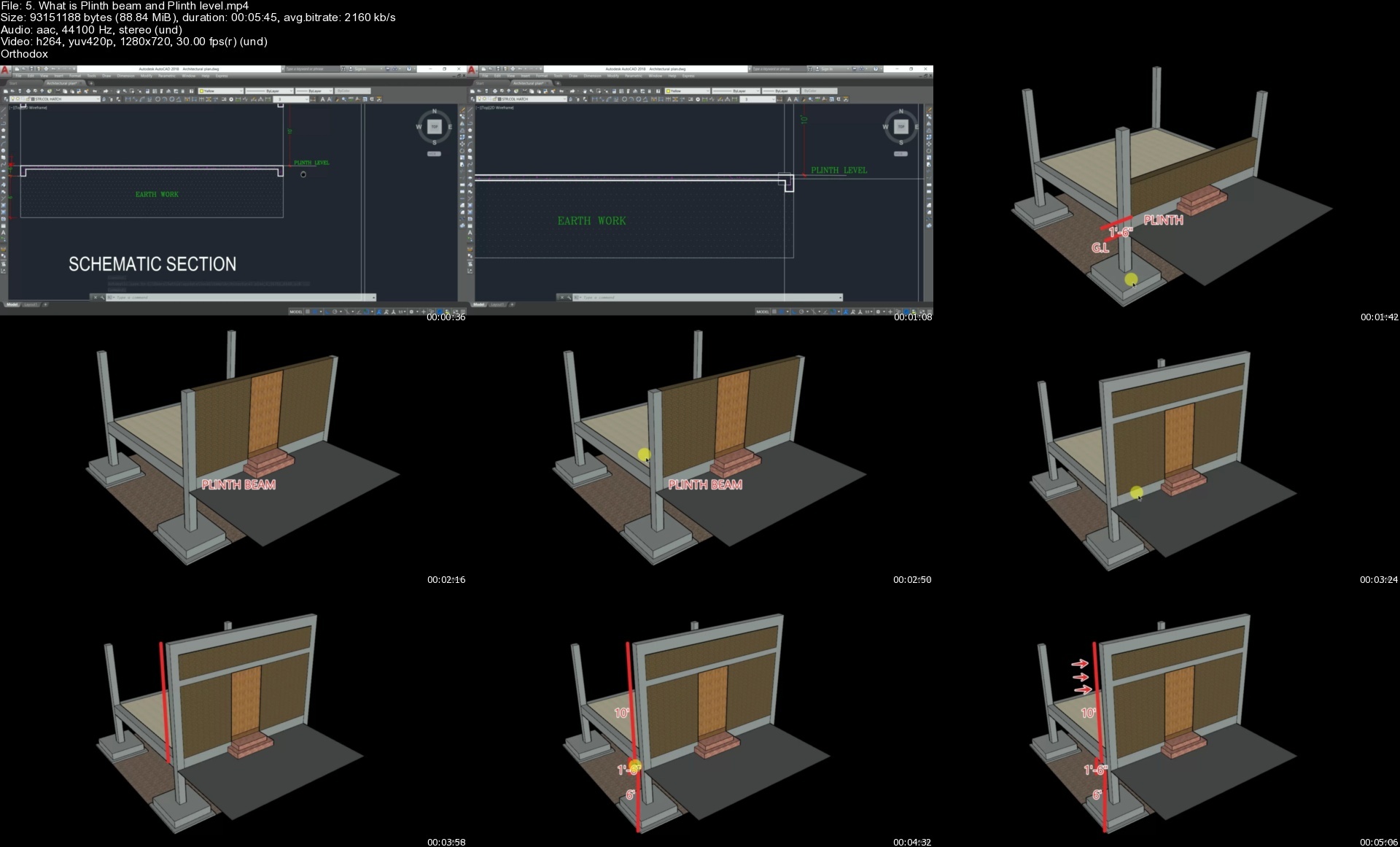
This course starts by explaining the concepts of structural Analysis and the relation between structural analysis and design, the concepts of structural members, how to study the architectural drawings, how to locate the column positions, how to make a framing plan, how to make plinth beam layout, how to arrive the preliminary size of all the structural members, how to create grid model in Etabs, how to define material properties with stress-strain curve explanation, how to define & assign member properties, load transfer mechanism, detailed explanation of load calculation for all structural members including staircase, wind load, and seismic load calculation, define and assigning loads, load combinations, structural analysis, post analysis check, structural design in Etabs, design and detailing of all the structural members as per codes and standards.

This course will be useful for civil engineers and structural engineers.

Indian Standard codes like IS-456:2000, IS-875 Part-1, IS-875 Part-2, IS-875 Part-3, IS- 1893-2016, IS-13970, and IS-16700 are explained as per the requirement.

Who this course is for
Civil Engineers
Structural Engineers
Any one who is curious to learn about structural engineering

Homepage


5.whatisplinthbeamandx0fka.jpg


Kotlin In Action - Kotlin Programming For Absolute Beginners

gweu1qrstnqlh3bxgzn5rp4cgs.jpg


Kotlin In Action - Kotlin Programming For Absolute Beginners
Last updated 9/2019
MP4 | Video: h264, 1280x720 | Audio: AAC, 44.1 KHz
Language: English | Size: 8.85 GB | Duration: 21h 29m

Learn Programming with Kotlin and Kotlin Programming best practices - Develop Kotlin Apps like a Pro Kotlin Developer


What you'll learn
Master Kotlin Programming and best practices behind professional Kotlin and Android apps
Modern kotlin programming from scratch
Kotlin functional and Object Oriented Programming
Collections and Lambda expressions
Kotlin coroutines
How to harness the full power of computers via programming in Kotlin
Master the principles behind popular programming languages such as PHP, Java, Javascript, Swift, C#, C++ or Scala
Sharpen your skills in android development by learning the popular java based programming language Kotlin
Kotlin Generics
Exceptions handling and creating custom Exceptions

Requirements
No programming experience is required
A windows or a mac or a linux computer
Passion and Commitment to become a professional programmer

Description
The main goal of this course is to teach you how to program computers using the Kotlin programming language. Kotlin is a new programming language sponsored by JetBrains and Google through the Kotlin Foundation. Kotlin is a general-purpose programming language known for its conciseness, safety, and interoperability with other programming languages such as Java. I will demonstrate the power of Modern Programming in Kotlin and help you obtain the skills to dramatically increase your career prospects as an Android developer and Kotlin Programmer. My name is Morteza Kordi, senior mobile app developer and Udemy instructor with over 70,000 satisfied students, and I've designed Kotlin in Action - Kotlin programming for Android developers with one thing in mind: Programming should be learned by creating real-world apps while having fun.Here are the benefits of Kotlin programming:Kotlin allows writing less code. Kotlin is fully compatible with Java. Kotlin imposes no runtime overhead. Kotlin has a strong community. Kotlin suits multi-platform development. Kotlin development offers more safety.Here is what you're going to learn in this course:Basics of ProgrammingTypes and Operations in KotlinBasic Control FlowAdvanced Control FlowFunctionsNullabilityArrays and ListsMaps and SetsLambdasClassesObjectsPropertiesMethodsAdvanced ClassesEnum ClassesInterfacesGenericsKotlin and Java InteroperabilityExceptionsFunctional ProgrammingI'll personally be answering any questions you might have and I'll be happy to provide links, resources, and any help I can offer to help you learn programming and Kotlin development.

Overview

Section 1: Introduction to Programming

Lecture 1 Why we should learn programming

Lecture 2 What is Programming

Lecture 3 Learn programming step by step

Lecture 4 Action taking!

Section 2: Introduction to Kotlin

Lecture 5 Why Kotlin

Lecture 6 What Kotlin really is?

Lecture 7 How to master Kotlin

Lecture 8 Let's take Action Now!

Section 3: Get the softwares

Lecture 9 Download JDK

Lecture 10 Download IntelliJ IDEA

Lecture 11 Set up IDE

Lecture 12 How to Create a new kotlin file

Section 4: Basics of Programming

Lecture 13 Chapter Intro

Lecture 14 Computers, how do they really work

Lecture 15 Representing numbers in programming

Lecture 16 Binary numbers in programming

Lecture 17 More about binary numbers in programming

Lecture 18 Converting base 10 to base 2

Lecture 19 Hexadecimal numbers

Lecture 20 How code works

Lecture 21 Comments in programming

Lecture 22 Printing out in kotlin

Lecture 23 Arithmetic operations

Lecture 24 Simple operations in programming

Lecture 25 Decimal numbers

Lecture 26 The remainder operation

Lecture 27 Shift operations in programming

Lecture 28 Order of operations

Lecture 29 Math functions

Lecture 30 Naming data in programming

Lecture 31 Constants in programming

Lecture 32 Variables in programming

Lecture 33 Meaningful naming

Lecture 34 Increment & Decrement

Lecture 35 Key points & Exercises

Section 5: Types and Operations in Kotlin

Lecture 36 Chapter Intro

Lecture 37 Type conversion in kotlin

Lecture 38 Operators with mixed types

Lecture 39 Type inference

Lecture 40 Strings in programming

Lecture 41 Representing strings

Lecture 42 Unicode

Lecture 43 Strings in kotlin - Characters & Strings

Lecture 44 Concatenation

Lecture 45 String templates

Lecture 46 Multi-line Strings in Kotlin

Lecture 47 Pairs & Triples in Kotlin

Lecture 48 Numeric types in kotlin

Lecture 49 Any, Unit and Nothing

Lecture 50 Key points &Exercises

Section 6: Basic Control Flow

Lecture 51 Chapter Intro

Lecture 52 Comparison Operators

Lecture 53 Boolean operators

Lecture 54 Boolean Logic

Lecture 55 String equality

Lecture 56 If expression

Lecture 57 Short circuiting

Lecture 58 Encapsulating variables

Lecture 59 Loops

Lecture 60 While Loops

Lecture 61 Repeat-while loops

Lecture 62 Breaking out of a Loop

Lecture 63 Key points of the chapter

Lecture 64 Exercises

Section 7: Advanced Control flow

Lecture 65 Chapter Intro

Lecture 66 Ranges in Kotlin

Lecture 67 For Loop

Lecture 68 Labeled Statements

Lecture 69 When Expression

Lecture 70 Returning Values in Kotlin

Lecture 71 Advanced When Expressions

Lecture 72 Key points of the Chapter

Lecture 73 Exercises

Section 8: Functions

Lecture 74 Chapter Intro

Lecture 75 Function basics

Lecture 76 Function Parameters

Lecture 77 Returning Values from Functions

Lecture 78 Parameters as Constants

Lecture 79 Function Overloading

Lecture 80 Function Variables

Lecture 81 Lack of Return

Lecture 82 Function writing Tips

Lecture 83 Key points of the Chapter

Lecture 84 Exercises

Section 9: Nullability

Lecture 85 Chapter Intro

Lecture 86 Introduction to Null

Lecture 87 Sentinel values

Lecture 88 Introduction to Nullable Types

Lecture 89 Null Checking

Lecture 90 Not null assertion Operator

Lecture 91 Smart casts

Lecture 92 Safe calls

Lecture 93 The Let in Kotlin

Lecture 94 Elvis operator

Lecture 95 Key points of the Chapter

Lecture 96 Exercises

Section 10: Arrays and Lists

Lecture 97 Chapter Intro

Lecture 98 Arrays in Kotlin

Lecture 99 Why Arrays are Useful

Lecture 100 Creating Arrays

Lecture 101 Arrays of Primitive Types

Lecture 102 Lists in Kotlin

Lecture 103 Creating Lists

Lecture 104 Mutable Lists

Lecture 105 Using properties and Methods

Lecture 106 Indexing

Lecture 107 Slice by Ranges

Lecture 108 Checking for an Array element

Lecture 109 Appending Elements

Lecture 110 Inserting Elements

Lecture 111 Removing Elements

Lecture 112 Updating Elements

Lecture 113 Iterating over a List

Lecture 114 Nullability and Collection types

Lecture 115 Key points of the Chapter

Lecture 116 Exercises

Section 11: Maps and Sets

Lecture 117 Chapter Intro

Lecture 118 Creating Maps

Lecture 119 Indexing in Pairs

Lecture 120 Using properties and functions on Maps

Lecture 121 Adding Elements

Lecture 122 Updating map Elements

Lecture 123 Removing Elements

Lecture 124 Iterating through map

Lecture 125 Key points of the Maps

Lecture 126 Sets in Kotlin

Lecture 127 Creating Sets

Lecture 128 Converting Array to Set

Lecture 129 Getting Elements from Sets

Lecture 130 Adding and removing Elements from Sets

Lecture 131 Key points of the Chapter

Lecture 132 Exercises

Section 12: Lambdas

Lecture 133 Chapter Intro

Lecture 134 Basics of Lambdas

Lecture 135 Lambda shorthand

Lecture 136 It keyword in Lambda

Lecture 137 Lambda as argument

Lecture 138 Meaningless Return Value

Lecture 139 Capturing Lambda Expressions

Lecture 140 Lambda sorting

Lecture 141 Lambdas Iteration

Lecture 142 Key points of the Chapter

Lecture 143 Exercises

Section 13: Classes

Lecture 144 Chapter Intro

Lecture 145 Creating Classes

Lecture 146 Reference Types

Lecture 147 Working with References

Lecture 148 Object Identity

Lecture 149 Methods and Mutability

Lecture 150 Mutability and Constants

Lecture 151 State and side effects

Lecture 152 Data Classes

Lecture 153 Destructuring declaration

Lecture 154 Key points of the Chapter

Lecture 155 Exercises

Section 14: Objects

Lecture 156 Chapter Intro

Lecture 157 Singletons

Lecture 158 Named Objects

Lecture 159 Processing Singleton Pattern

Lecture 160 Using Singleton

Lecture 161 Objects vs Classes

Lecture 162 Static members

Lecture 163 Creating companion Objects

Lecture 164 Anonymous Objects

Lecture 165 Key points of the Chapter

Lecture 166 Exercises

Section 15: Properties

Lecture 167 Chapter Intro

Lecture 168 Constructor Properties

Lecture 169 Default Values

Lecture 170 Property Initializers

Lecture 171 Custom Accessors

Lecture 172 Custom Getters

Lecture 173 Custom Setters

Lecture 174 Companion Object Properties

Lecture 175 Delegated Properties

Lecture 176 Observable Properties

Lecture 177 Variable Limitation

Lecture 178 Lazy Properties

Lecture 179 Late init

Lecture 180 Extension properties

Lecture 181 Key points of the Chapter

Lecture 182 Exercises

Section 16: Methods

Lecture 183 Chapter Intro

Lecture 184 Introduction to Methods

Lecture 185 Methods vs Getters and Setters

Lecture 186 Function Conversion to Method

Lecture 187 Introduction to This keyword

Lecture 188 Object Methods

Lecture 189 Extension Methods

Lecture 190 Companion Object Extension

Lecture 191 Key points of the Chapter

Lecture 192 Exercises

Section 17: Advanced Classes

Lecture 193 Chapter Intro

Lecture 194 Introduction to Inheritance

Lecture 195 Polymorphism

Lecture 196 Checking runtime Hierarchy

Lecture 197 Inheritance Methods and Override

Lecture 198 Super Keyword

Lecture 199 Inheritance Prevention

Lecture 200 Abstract Classes

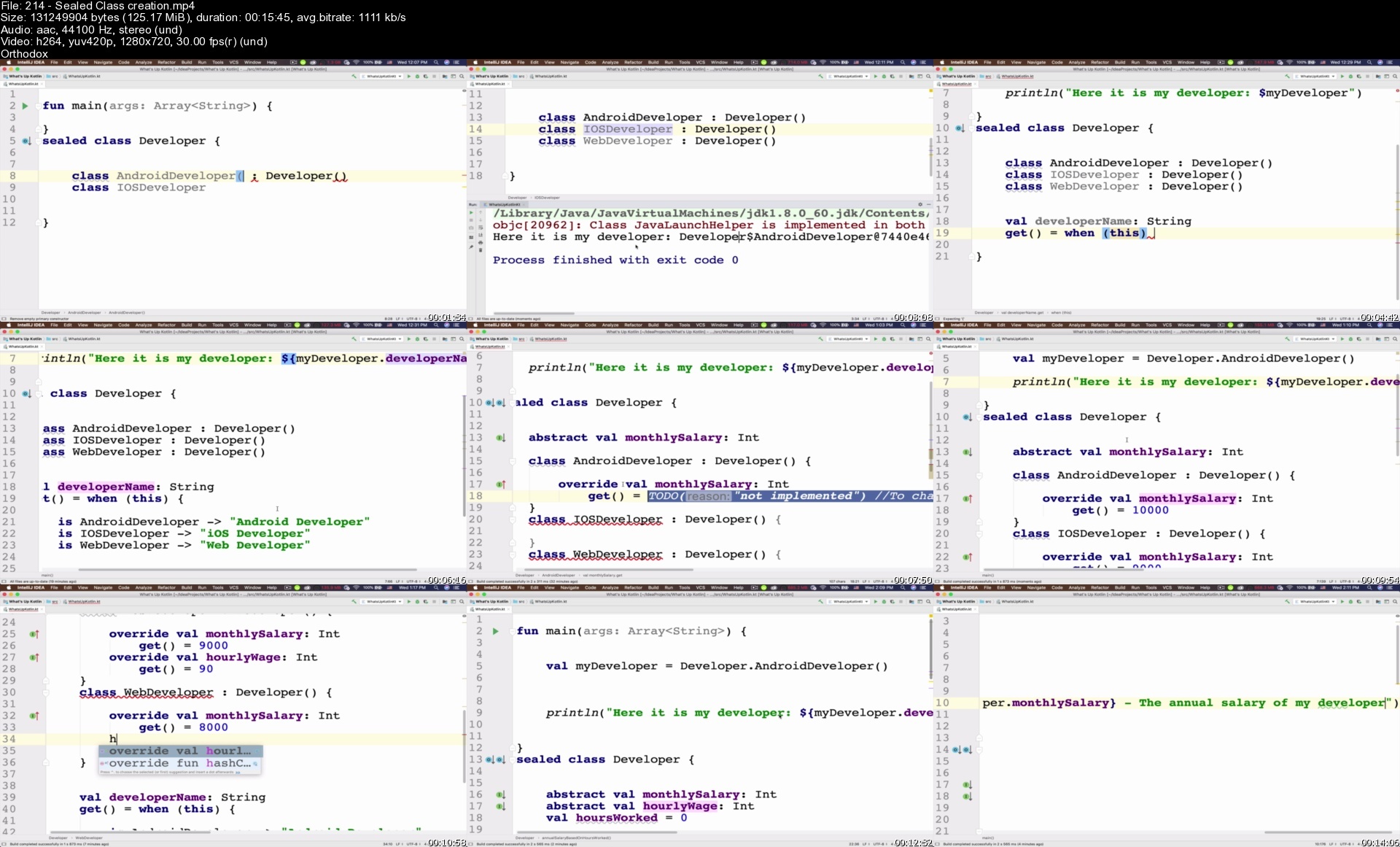
Lecture 201 Sealed Classes

Lecture 202 Secondary Constructors

Lecture 203 Nested and Inner Classes

Lecture 204 Visibility modifiers

Lecture 205 Why Inheritance

Lecture 206 Key points of the Chapter

Lecture 207 Exercises

Section 18: Enum Classes

Lecture 208 Chapter Intro

Lecture 209 Creating Enums

Lecture 210 Case order modification

Lecture 211 Enum properties and functions

Lecture 212 Enums vs When

Lecture 213 Enum vs Sealed Class

Lecture 214 Sealed Class creation

Lecture 215 Enumeration and State machine

Lecture 216 Nullable and Enums

Lecture 217 Key points of the Chapter

Lecture 218 Exercises

Section 19: Interfaces

Lecture 219 Chapter Intro

Lecture 220 Introduction to Interfaces

Lecture 221 Interface Syntax

Lecture 222 Interface Methods

Lecture 223 Default Method implementation

Lecture 224 Interface Properties

Lecture 225 Interface Inheritance

Lecture 226 Implementing multiple Interfaces

Lecture 227 Iterator

Lecture 228 Comparable

Lecture 229 Key points of the Chapter

Lecture 230 Exercises

Section 20: Generics

Lecture 231 Chapter Intro

Lecture 232 Lists

Lecture 233 Maps

Lecture 234 Extension functions vs Generic constraints

Lecture 235 Creating Generic Constraints - Part 1

Lecture 236 Creating Generic Constraints - Part 2

Lecture 237 Creating Generic Constraints - Part 3

Lecture 238 Creating Generic Constraints - Part 4

Lecture 239 Creating Generic Constraints - Part 5

Lecture 240 Creating Generic Constraints - Part 6

Lecture 241 Generic Interfaces - Part 1

Lecture 242 Generic Interfaces - Part 2

Lecture 243 Generic Interfaces - Part 3

Lecture 244 Generic Interfaces - Part 4

Lecture 245 Generic Interfaces - Part 5

Lecture 246 Generic Interfaces - Part 6

Lecture 247 Generic Interfaces - Part 7

Lecture 248 In and out declarations - Part 1

Lecture 249 In and out declarations - Part 2

Lecture 250 In and out declarations - Part 3

Lecture 251 In and out declarations - Part 4

Lecture 252 In and out declarations - Part 5

Lecture 253 Key points of the Chapter

Lecture 254 Exercises

Section 21: Kotlin and Java interoperability

Lecture 255 Chapter Intro

Lecture 256 Mixing Code - Getters and Setters

Lecture 257 Kotlin Class as Java property

Lecture 258 Java Class extension functions

Lecture 259 Free functions

Lecture 260 Java nullability

Lecture 261 Accessing nested Kotlin Objects with Java code

Lecture 262 Static values and functions vs Kotlin

Section 22: Exceptions

Lecture 263 Chapter Intro

Lecture 264 What is an Exception? - Part 1

Lecture 265 What is an Exception? - Part 2

Lecture 266 Throwing Exceptions

Lecture 267 Handling Exceptions

Lecture 268 Creating custom Exceptions - Part 1

Lecture 269 Creating custom Exceptions - Part 2

Lecture 270 Checked Exceptions

Lecture 271 Try/Catch Expression

Lecture 272 Key points of the Chapter

Lecture 273 Exercises

Section 23: Functional Programming

Lecture 274 Chapter Intro

Lecture 275 What is Functional Programming?

Lecture 276 Coding in Functional Programming - Part 1

Lecture 277 Coding in Functional Programming - Part 2

Lecture 278 Coding in Functional Programming - Part 3

Lecture 279 First-class and Higher-order functions

Lecture 280 Functions as argument

Lecture 281 Returning Functions

Lecture 282 Lambdas in Functional Programming

Beginners who are new to programming and kotlin,Intermediate developers who want to master modern programming and kotlin programming language,Advanced developers who want to enhance their programming skills and learn the best practices in modern programming,People who want to get employed as a Software Developer in app development companies,People who want to become a Freelancer and work from the comfort of their homes,People who want to program computers just for fun,Android developers who want to become an advanced Kotlin developers

Homepage


214sealedclasscreatiok2i6i.jpg


Women'S Self Defense Course

tdbjuwmn7qaipsv2dnhy503fb4.jpg


Women'S Self Defense Course
Published 8/2022
MP4 | Video: h264, 1280x720 | Audio: AAC, 44.1 KHz
Language: English | Size: 6.08 GB | Duration: 4h 58m

Empower yourself with the skills to fight back with this comprehensive, easy to learn, Women's Self Defense Course!


What you'll learn
Understand crucial mental skills such awareness, avoidance, de-escalation, boundary setting, and verbal commands to avoid potentially harmful situations.
Develop simple and effective reactions to hit soft or vital targets on an attacker in almost any situation.
Learn quick and effective techniques against common grabs and holds such as wrist grabs, choke, hair grabs and more.
Explore ground-based defenses against common attacks and pinned positions. Assess targets, leverage your strengths, and get to safety.

Requirements
There are no prerequisites for taking this course or prior experience needed. Many of the skills are also very easily adaptable to individual physical abilities.
Make sure you have plenty of space to practice as well as a soft surface to work on for the ground portions of training such as a yoga mat or carpeted area.
This training can also be done with a partner and is encouraged however it is not necessary to have a training partner, and this can be done alone as well. Be patient, take your time and don't be afraid of using as much repetition or rewinding as you need to help build the skills!

Description
This course is designed to take you through a comprehensive skills set covering a variety of topics and scenarios both on your feet and on the ground. Starting with understanding the basics and progressing through several specific techniques to escape common holds and attacks as well as ground based defense.Key Skills:Where to hit, soft/vital targets!How to attack safely for you and effectively to them!Quick responses to escape common holds and grabs (wrist, chokes, hair grabs, etc.)What to do if you are on the ground and how to get an attacker off of you!Course Outline:Lecture: "Layers of Defense" - Mental skills to avoid potentially dangerous situations.Lesson #1 - Stand Up: Single Wrist & Double Wrist GrabLesson #2 - Ground: Kicking & Keeping DistanceLesson #3 - Stand Up: Front & Rear ChokesLesson #4 - Ground: Mounted Defense (attacker sitting on top of you)Lesson #5 - Stand Up: Bear Hug & Rear Hair GrabLesson #6 - Ground: Inside Guar (attacker is between your legs)Lesson #7 - Stand Up: Rear One Arm Choke (drag back)Lesson #8 - Ground: Pinned On Your Stomach (attacker is sitting on your back)Lesson #9 - Stand Up: FULL REVIEW of all Stand Up SkillsLesson #10 - Ground: FULL REVIEW of all Ground SkillsNo previous experience is required. Lessons are designed for all levels and abilities and are formatted to follow along and practice with the instructor. Have a friend you want to train with? These skills are also great to work with a training partner. Grab a friend and let's get started!

Overview

Section 1: Layer of Defense

Lecture 1 Training & Planning

Lecture 2 Awareness

Lecture 3 Avoidance

Lecture 4 De-escalation

Lecture 5 Verbal Commands

Lecture 6 Distance & Preparation

Lecture 7 Physical Skills

Section 2: Lesson #1: Stand Up Skills (Wrist Grabs)

Lecture 8 Basics: Palm Heel Strike

Lecture 9 Basics: Eye Jab

Lecture 10 Basics: Throat Strike

Lecture 11 Basics: Knee Strike

Lecture 12 Basics: Instep Kick

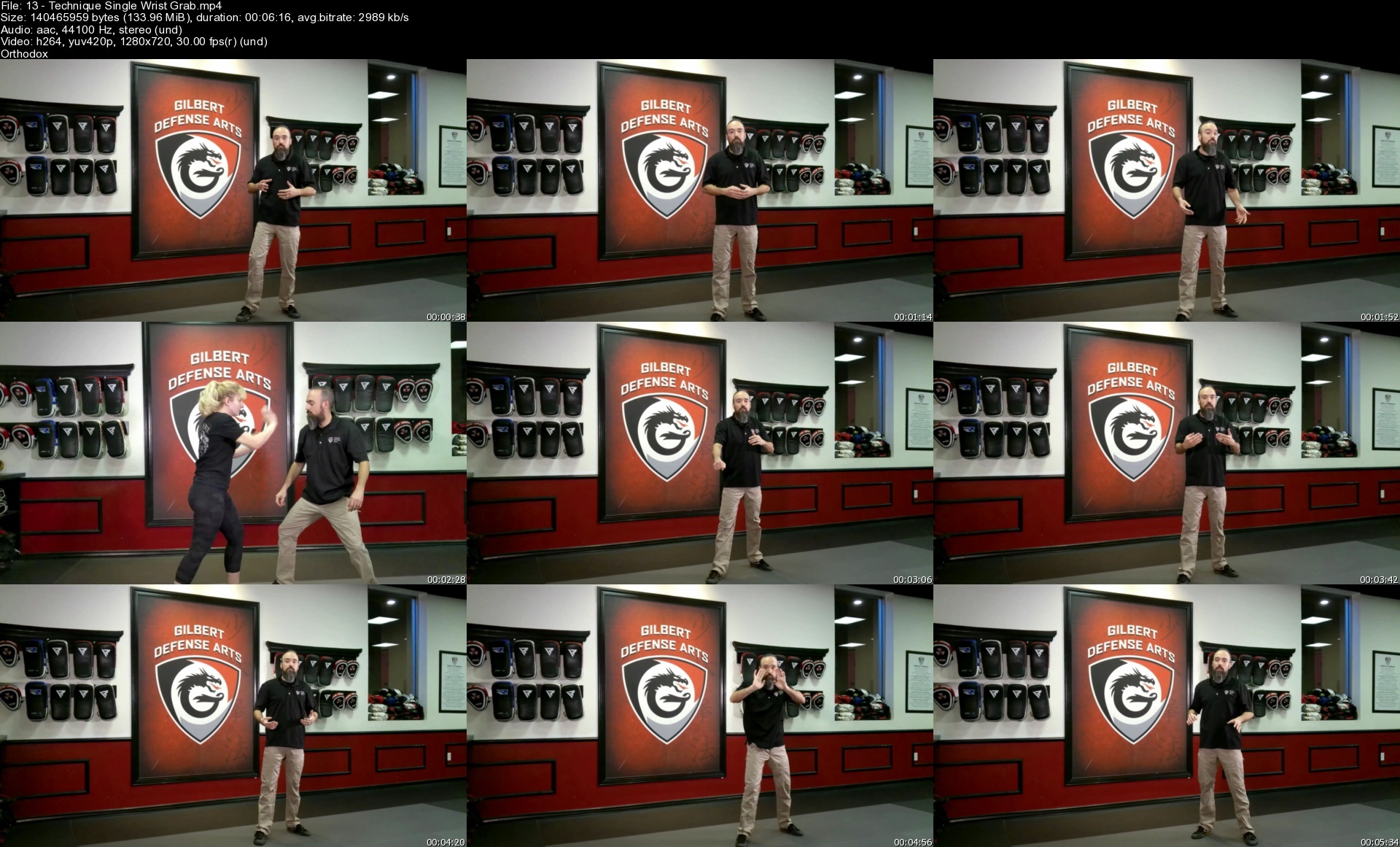
Lecture 13 Technique: Single Wrist Grab

Lecture 14 Technique: Double Wrist Grab

Section 3: Lesson #2 Ground Skills (Kicking & Distance)

Lecture 15 Basics: On Your Back. How to fall, prepare and defense from your back.

Lecture 16 Basics: On Your Side - Distance and Kick

Lecture 17 Basics: From Hands & Knees - Kicking and Get Up!

Lecture 18 Basics: Review All Kicks & Positions

Lecture 19 Basics: Mobility - Keep them in front of you!

Lecture 20 Drill #1 - Move!

Lecture 21 Drill #2 - Move & Kick!

Lecture 22 Drill #3 - Move, Kick, and Get Up!

Section 4: Lesson #3 Stand Up Skills (Chokes)

Lecture 23 Basics: Forward Elbow

Lecture 24 Basics: Side Elbow

Lecture 25 Basics: Rear Elbow

Lecture 26 Basics: Cover & Protect

Lecture 27 Technique: Front Choke

Lecture 28 Technique: Rear Choke

Section 5: Lesson #4 - Ground Skills (Mounted Defense)

Lecture 29 Basics: Position Breakdown & Initial Attacks

Lecture 30 Basics: Bridging / Bridge & Reach Skill

Lecture 31 Basics: Shrimping

Lecture 32 Technique: 1) Hit & Get Up, 2) Hit Shrimp/Push, Get Up!

Lecture 33 Technique: 3) Full Technique

Lecture 34 Technique: Attack Variations (Hand Grabs & Chokes)

Section 6: Lesson #5 - Stand Up Skills (Bear Hug / Hair Grab)

Lecture 35 Basics: Rear Driving Elbow

Lecture 36 Basics: Rear Hammer

Lecture 37 Basics: Rear Round Elbow

Lecture 38 Basics: Scoop Kick

Lecture 39 Technique: Bear Hug

Lecture 40 Technique: Hair Grab

Section 7: Lesson #6 - Ground Skills (Inside Guard "between legs")

Lecture 41 Basics: Position Breakdown & Initial Attacks

Lecture 42 Technique: "Inching"

Lecture 43 Technique: "Shrimping"

Lecture 44 Technique: "Hook & Roll"

Section 8: Lesson #7 - Stand Up Skills (Rear One Arm Choke)

Lecture 45 Basics: Rear Elbow, Rear Hammer, Rear Round Elbow

Lecture 46 Technique: Early Recognition & Response

Lecture 47 Technique: Late Recognition (tight hold/drag back)

Lecture 48 Technique: Quick Response (eye jab)

Section 9: Lesson #8 - Ground Skills (Pinned On Your Stomach)

Lecture 49 Technique: Above The Hips

Lecture 50 Technique: Below The Hips

Lecture 51 Technique: Approaching From Below (Grabbing Ankles/Feet)

Section 10: Lesson #9 - Stand Up (FULL REVIEW)

Lecture 52 Review: All Attacks (Strikes & Kicks)

Lecture 53 Review: All Grab Techniques

Lecture 54 Drill: 2 Minute Drill On All Grab Techniques

Section 11: Lesson #10 - Ground Skills (FULL REVIEW)

Lecture 55 Review: Kicking & Distance

Lecture 56 Review: Mounted Defense

Lecture 57 Review: Inside Guard "Between Legs"

Lecture 58 Review: Pinned On Stomach

This course is for individuals who are interesting in developing a simple and effective response to physical threats and how to avoid potentially dangerous situations. Whether this is your first time exploring any sort of self defense training or you are an experienced practitioner our goal is that you leave this course with a plan. You don't have to be perfect at it, you don't have to even remember everything, however just understanding that you CAN do something and that you HAVE a response is a huge step in the right direction for your personal safety! Like any skill the more you do the better you will own that skill. Be patient, stick with it and don't be afraid to put in some good repetitions! We are excited to be on this journey with you and look forward to helping to empower you to be a better, stronger, and more prepared version of yourself!

Homepage


13techniquesinglewrish9ez6.jpg


Google Cloud Platform Professional Cloud Developer Bootcamp

pfalzyop4a8ugbmrgp9oylze67.jpg


Google Cloud Platform Professional Cloud Developer Bootcamp
Last updated 11/2020
MP4 | Video: h264, 1280x720 | Audio: AAC, 44.1 KHz
Language: English | Size: 7.26 GB | Duration: 20h 54m

Google Cloud Platform Certification - A way to distinguish your self in the AWS world!


What you'll learn
How to obtain the Google Cloud Platform Cloud Developer Certification
Understand what the objectives are for the Cloud Developer Certification
Deploy best practices for application development
Choose the appropriate data storage option for application data
Implement federated identity management
Develop loosely coupled application components or microservices
Debug, trace, and monitor applications

Requirements
Developers that have experience with Google Cloud Platform
Developers reading to take the Google Cloud Platform Cloud Developer Exam
Developers who need to get certified in a leading cloud certification

Description
Course updated 02/04/2022A Professional Cloud Developer builds scalable and highly available applications using Google recommended practices and tools that leverage fully managed services. This individual has experience with next generation databases, runtime environments and developer tools. They also have proficiency with at least one general purpose programming language and are skilled with using Stackdriver to produce meaningful metrics and logs to debug and trace code. This course is meant to be a course developed to be targeted for taking the Google Cloud Professional Cloud Developer Exam. Content is fresh and has been customized for the exam materials. It would be expected or at a minimum to have experience with Google Cloud and be a developer. Course has been compressed the study objectives listed by Google Cloud and we have taken the Cloud Developer exam. The exam is very challenging and will challenge the "average" developer in many respects but mainly around how well you understand GCP best practices and services. All Exam Objectives covered. Course has a FREE introduction to Google Cloud section. Section 1: Designing highly scalable, available, and reliable cloud-native applications Section 2: Building and Testing ApplicationsSection 3: Deploying applicationsSection 4: Integrating Google Cloud Platform Services Section 5: Managing Application Performance MonitoringCertification TestTips, demos galore. Joseph Holbrook. TechCommanders and GCPGurus

Overview

Section 1: Introduction to Course

Lecture 1 Introduction

Lecture 2 Course Prerequisites to be successful

Lecture 3 What is a GCP Professional Cloud Developer?

Lecture 4 Cloud Developer Exam Objectives

Lecture 5 Cloud Developer Deep Dive Notes

Lecture 6 Course Setup

Section 2: Course Readiness

Lecture 7 Course Material Download

Lecture 8 What are Test Tips?

Lecture 9 Whiteboards and Demos

Lecture 10 Sign up for Free Tier or Credits if available

Lecture 11 GCP Pricing Calculator

Lecture 12 SDK Install

Lecture 13 Read the GCP Cloud Developer Deep Dive Notes.

Section 3: Introduction to Google Cloud Platform

Lecture 14 Google Cloud Intro (Condensed Version)

Lecture 15 GCP Hierarchy

Lecture 16 Whiteboard GCP Hierarchy

Lecture 17 Demo - Projects

Lecture 18 Compute Options

Section 4: Compute Engine

Lecture 19 Compute Engine

Lecture 20 Compute Engine Demo

Lecture 21 Instance Groups

Lecture 22 Instance Groups Demo

Section 5: App Engine - PaaS

Lecture 23 App Engine Security Scanner

Lecture 24 App Engine Demo

Lecture 25 App Engine or Kubernetes Engine

Section 6: Kubernetes Engine

Lecture 26 Kubernetes Engine

Lecture 27 Demo- Kubernetes Engine

Lecture 28 Whiteboard - Kubernetes

Section 7: Cloud Functions

Lecture 29 Cloud Functions Basics

Lecture 30 Cloud Functions Demo

Section 8: Cloud Storage

Lecture 31 Data Storage Basics

Lecture 32 Cloud Storage Basics

Lecture 33 Cloud Storage

Lecture 34 Cloud Storage Demo Part2

Section 9: Networking

Lecture 35 Networking Overview

Lecture 36 VPC Overview

Lecture 37 IP Addressing

Lecture 38 Networking Whiteboard

Lecture 39 Networking Demo

Lecture 40 VPC Whiteboard

Lecture 41 Hybrid Connectivity Networking Whiteboard

Section 10: Developing on Google Cloud Platform

Lecture 42 Download SDK

Lecture 43 Devops on GCP Part 1

Lecture 44 Devops on GCP Part 2

Lecture 45 Cloud Source Repositories Demo

Lecture 46 Cloud Build Demo

Lecture 47 Demo Gcloud Commands

Section 11: 1. Designing highly scalable, available, and reliable cloud-native applications

Lecture 48 Section 1 Coverage

Lecture 49 1.1 Designing performant applications and APIs

Lecture 50 Infrastructure as a Service vs. Container as a Service vs. Platform as a Service

Lecture 51 Portability vs. platform-specific design

Lecture 52 Evaluating System Considerations

Lecture 53 Operating system versions and base runtimes of services

Lecture 54 Service Locality

Lecture 55 Whiteboard Service Locality

Lecture 56 Locality Test Tips

Lecture 57 Microservices

Lecture 58 Whiteboard- Microservices

Lecture 59 Testips - Microservices

Lecture 60 Defining a key structure for high write applications using Cloud Storage, Cloud

Lecture 61 Defining a key structure Test Tips

Lecture 62 Session management

Lecture 63 Test Tips Session Management

Lecture 64 Loosely coupled applications using asynchronous Cloud Pub/Sub events

Lecture 65 Demo Pub Sub

Lecture 66 Test Tips Cloud Pub Sub

Lecture 67 Deploying and securing an API with cloud endpoints

Lecture 68 Demo Cloud Endpoints

Lecture 69 Test Tips -API Management

Lecture 70 Health checks

Lecture 71 TestTips Healthchecks

Lecture 72 Google-recommended practices and documentation

Lecture 73 1.2 Designing secure applications

Lecture 74 Applicable regulatory requirements and legislation

Lecture 75 TestTips Regulatory Requirements

Lecture 76 Security mechanisms that protect services and resources

Lecture 77 TestTips Security Mechanisms

Lecture 78 Storing and rotating secrets

Lecture 79 Secrets Whiteboard

Lecture 80 TestTips Secrets

Lecture 81 IAM roles for users/groups/service accounts

Lecture 82 IAM Whiteboard

Lecture 83 TestTips IAM

Lecture 84 HTTPs certificates

Lecture 85 Test Tips Https Certificates

Lecture 86 Demo Https Certificates

Lecture 87 Google-recommended practices and documentation

Lecture 88 1.3 Managing application data.

Lecture 89 Defining database schemas for Google-managed databases

Lecture 90 TestTips Defining Schema

Lecture 91 Session Management

Lecture 92 TestTips Session Management

Lecture 93 Loosely Coupled Apps - Cloud Pub/Sub

Lecture 94 Demo - Loosely Coupled Apps - Cloud Pub/Sub

Lecture 95 Whiteboard - Cloud Pub/Sub

Lecture 96 TestTips Loosely Coupled Apps - Cloud Pub/Sub

Lecture 97 Deploying and securing an API with cloud endpoints

Lecture 98 Demo Deploying and securing an API with cloud endpoints

Lecture 99 TesTips Deploying and securing an API with cloud endpoints

Lecture 100 TestTips Health Checks

Lecture 101 Health Checks

Lecture 102 Choosing data storage options based on use case considerations

Lecture 103 TestTips Data Storage

Lecture 104 Working with data ingestion systems

Lecture 105 TestTips Data Ingestion

Lecture 106 Following Google-recommended practices and documentation

Lecture 107 1.4 Re-architecting applications from local services to Google Cloud Platform.

Lecture 108 Using managed services

Lecture 109 Using the strangler pattern for migration

Lecture 110 Strangler Whiteboard

Lecture 111 Codelabs - Exercise for Practice- Cloud Functions

Lecture 112 Codelabs - Cloud Pub/sub

Lecture 113 Google-recommended practices and documentation

Lecture 114 Section Review Questions

Section 12: 2. Building and Testing Applications

Lecture 115 Section 2 Building and Testing Applications

Lecture 116 2.1 Setting up your development environment.

Lecture 117 Local application development emulations

Lecture 118 Developer Tools and SDK

Lecture 119 Demo SDK Install and basic commands

Lecture 120 Demo SDK Emulators

Lecture 121 TesTips SDK

Lecture 122 Creating GCP projects

Lecture 123 Demo CLI Create Project

Lecture 124 TestTips Create Project

Lecture 125 2.2 Building a continuous integration pipeline

Lecture 126 Creating a Cloud Source Repository and committing code to it

Lecture 127 DevOps and Pipelines

Lecture 128 Developing unit tests for all code written

Lecture 129 Developing an integration pipeline using services

Lecture 130 Reviewing test results of continuous integration pipeline

Lecture 131 TestTips

Lecture 132 Whiteboard - DevOps

Lecture 133 2.3 Testing. Considerations include

Lecture 134 Performance Testing

Lecture 135 Whiteboard Testing

Lecture 136 TestTips Testing

Lecture 137 2.4 Writing code

Lecture 138 Algorithm design

Lecture 139 Modern application patterns

Lecture 140 Efficiency

Lecture 141 TestTips

Lecture 142 Section Review Questions

Section 13: 3. Deploying applications

Lecture 143 Section 3

Lecture 144 3.1 Implementing appropriate deployment strategies based on the target compute

Lecture 145 Blue Green Deployments

Lecture 146 Whiteboard App Engine

Lecture 147 Demo App Engine

Lecture 148 3.2 Deploying applications and services on Compute Engine

Lecture 149 Launching a compute instance using GCP Console and Cloud SDK

Lecture 150 Moving a persistent disk to different VM

Lecture 151 Creating an autoscaled managed instance group using an instance template

Lecture 152 Generating/uploading a custom SSH key for instances

Lecture 153 Configuring a VM for Stackdriver monitoring and logging

Lecture 154 Creating an instance with a startup script that installs software

Lecture 155 Creating custom metadata tags

Lecture 156 Creating a load balancer for Compute Engine instances

Lecture 157 3.3 Deploying applications and services on Google Kubernetes Engine

Lecture 158 Deploying a GKE cluster

Lecture 159 Kubenetes Engine Whiteboard

Lecture 160 Kubenetes Engine Clusters Demo

Lecture 161 TestTips

Lecture 162 3.4 Deploying an application to App Engine. Considerations include

Lecture 163 Scaling configuration

Lecture 164 GKE or App Engine

Lecture 165 TestTips App Engine

Lecture 166 Cloud Functions that are triggered via an event

Lecture 167 Cloud Functions that are invoked via HTTP

Lecture 168 3.6 Creating data storage resources. Tasks include

Lecture 169 Creating a Cloud SQL instance

Lecture 170 Cloud Datastore

Lecture 171 Creating BigQuery datasets

Lecture 172 Creating a Cloud Storage bucket

Lecture 173 Creating a Cloud Pub/Sub topic

Lecture 174 TestTips Create data storage

Lecture 175 3.7 Deploying and implementing networking resources. Tasks include: Creating an

Lecture 176 Creating an auto mode VPC with subnets

Lecture 177 Setting up a domain using Cloud DNS

Lecture 178 TestTips Networking

Lecture 179 3.8 Automating resource provisioning with Deployment Manager

Lecture 180 Deployment Manager

Lecture 181 Deployment Manager Demo

Lecture 182 TestTips

Lecture 183 3.9 Managing Service accounts. Tasks include: Creating a service account with a

Lecture 184 Service Accounts

Lecture 185 Save KeyFile

Lecture 186 Codelabs

Lecture 187 TestTips

Lecture 188 Section Review Questions

Section 14: 4. Integrating Google Cloud Platform Services

Lecture 189 Section 4 Overview

Lecture 190 4.1 Integrating an application with Data and Storage services.

Lecture 191 Enable Bigquery and permissions on dataset

Lecture 192 SQL Searches/Selects

Lecture 193 Whiteboard- Fetching Ingesting data

Lecture 194 Codelab -Biquery

Lecture 195 BigTable or BigQuery

Lecture 196 Writing an SQL query to retrieve data from relational databases

Lecture 197 Connecting to SQL

Lecture 198 Gsutil Storing and retrieving objects from Google Storage

Lecture 199 Quickstart - Cloud Storage GsUtil

Lecture 200 Connecting to a Cloud SQL instance

Lecture 201 Enabling Cloud Spanner and configuring an instance

Lecture 202 Cloud Spanner Whitepaper

Lecture 203 Demo -Cloud Spanner

Lecture 204 Cloud Spanner Best Practices

Lecture 205 DataProc or Dataflow

Lecture 206 TestTips

Lecture 207 Configuring a Cloud Pub/Sub push subscription to call an endpoint

Lecture 208 Data Ingestion Sources

Lecture 209 4.2 Integrating an application with compute services. Tasks include

Lecture 210 Provisioning and configuring networks

Lecture 211 Writing an application that publishes/consumes from Cloud Pub/Sub

Lecture 212 Authenticating users by using Oauth2 Web Flow and Identity Aware Proxy

Lecture 213 Reading instance metadata to obtain application configuration

Lecture 214 TestTips Oath

Lecture 215 4.3 Integrating Google Cloud APIs with applications. Tasks include

Lecture 216 Enable API

Lecture 217 Using Pre Trained ML APIS

Lecture 218 Using service accounts to make Google API calls

Lecture 219 Using APIs Calls

Lecture 220 Making API calls

Lecture 221 Using the Cloud SDK to perform Basic Tasks

Lecture 222 DLP API

Lecture 223 TestTips

Lecture 224 Section Review Questions

Section 15: Section 5. Managing Application Performance Monitoring

Lecture 225 Section 5 Overview

Lecture 226 Objectives 5.1 Installing Monitoring and Logging

Lecture 227 Install Stackdriver Monitoring Agent

Lecture 228 Objectives 5.2

Lecture 229 Debugging a VM image with serial port

Lecture 230 Using the CLI tools

Lecture 231 Analyzing a failed VM instance

Lecture 232 Sending Logs from a VM

Lecture 233 TestTips

Lecture 234 Objectives 5.3

Lecture 235 Monitoring Dashboard and Views

Lecture 236 Create Monitoring Dashboard Stackdriver

Lecture 237 Viewing Logs In Console

Lecture 238 Viewing Syslogs from a VM

Lecture 239 Streaming Logs

Lecture 240 Creating Logging Sinks

Lecture 241 Create Custom Metrics

Lecture 242 Graphing Metrics

Lecture 243 Using Stackdriver Debugger

Lecture 244 Review Stack Traces

Lecture 245 TestTips

Lecture 246 Objectives 5.4

Lecture 247 Setting Up time checks and basic alerts

Lecture 248 Troubleshooting Network Issues

Lecture 249 API Debbugging

Lecture 250 Codelab Networking For Developers

Lecture 251 Review App Performance Stackdriver

Lecture 252 Troubleshooting Image and OS

Lecture 253 Docs and Support

Lecture 254 TestTips

Lecture 255 Section Review Questions

Section 16: Case Study - Hiplocal

Lecture 256 Case Study Overview

Lecture 257 Case Study Sample Questions

Lecture 258 TestTips

Section 17: Resources to help Study and Tips to Prepare!

Lecture 259 Pricing Calculator

Lecture 260 Qwiklabs

Lecture 261 Codelabs Free to Use

Lecture 262 Stackoverflow

Lecture 263 Project Treehouse

Lecture 264 GCP Pricing Calculator

Lecture 265 GCP Stencils and Icons

Lecture 266 Gcping

Section 18: Practice Exam

Lecture 267 Bonus Lecture- Additional Practice Exams

Section 19: Course Closeout

Lecture 268 Top Ten Things to Focus on the Cloud Developer Exam 12/2018

Lecture 269 Deep Dive Notes for exam

Lecture 270 Comparing AWS to GCP Certifications

Lecture 271 Good Luck and Course Closeout

Developers that have experience with Google Cloud Platform,pplication developers who want to build cloud-native applications or redesign existing applications that will run on Google Cloud Platform

Homepage


160kubenetesenginecluyxf6m.jpg


Python 3 And Data Science Mastery - Practical Python 3

ai2lu0pufuu6nqfs1esoozeixg.jpg


Python 3 And Data Science Mastery - Practical Python 3
Last updated 5/2022
MP4 | Video: h264, 1280x720 | Audio: AAC, 44.1 KHz
Language: English | Size: 8.69 GB | Duration: 26h 45m

Develop Python 3 and Data Science Apps - Python 3 and Data Science Class - Real World Python 3 and Data Science Projects


What you'll learn
Develop python based applications
Develop marketing applications with Python
Mine twitter data with Python to get grasp of people's opinion on trending matters
Develop Natural Language Processing (NLP) applications with Python to process everyday language
Create Machine Learning applications with Python to make your computer smart and automate the boring tasks
Create Deep Learning applications with Python to add Artificial Intelligence to your machine learning models and create even smarter models
Use IBM Watson to unlock the vast world of unstructured data and create your own language translator applications with Python
Create Big Data applications with the help of the Relational Databases and Python clear and concise syntax
Use Data Science to predict business predictions and business intelligence
Automate everyday tasks and save time

Requirements
No programming experience needed. You will learn everything you need to know
A computer with Windows, Mac, Linux, ChromeOS operating system installed

Description
The main goal of this course is to teach you how to code using Python 3 & Data Science. My name is Morteza Kordi, Senior Python Programmer & Data Science Specialist and Udemy instructor with over 70,000 satisfied students, and I've designed The Ultimate Hands-On Python 3 and Data Science Bootcamp with one thing in mind: you should learn by practicing your skills and building apps. I'll personally be answering any questions you might have and I'll be happy to provide links, resources, and any help I can offer to help you master Python 3 & data Science as well as Machine Learning. In this course, I will demonstrate the power of Python & Data Science, and how I dramatically increased my career prospects as a Programmer. New to Programming or Python? I'll personally teach you the fundamentals of programming & Python. you will master the basics before diving into the advanced stuff. So no programming experience is required.Want to learn about Natural Language Processing (NLP)? This Course contains a comprehensive course about NLP too. Want to learn about IBM Watson and Cognitive Computing? If you want to process unstructured data, deal with human limitations, improve performance and abilities or handle enormous quantities of data then you should learn IBM Watson and Cognitive Computing. This Course has the answer for you.Want to learn Machine Learning? If you want to simplify your product marketing, get accurate sales forecasts, facilitate accurate medical predictions and diagnoses, simplify time-intensive documentation in data entry, improve the precision of financial rules and models, and easy spam detection then you should learn Machine Learning. Again This Course has the answer for you.Want to learn Deep Learning? Do you struggle with processing large numbers of features? If yes, then you should learn Deep Learning. Again This Course covers this topic too!So... Why This Course?!Learn to code like the pros - not just copy and pasteLearn the Latest Python 3 APIs and services - we don't teach old junkLearn to build apps - a lot of themNo Programming Experience is neededBuild Real-world AppsLifetime SupportDon't wait and join us now by clicking the BUY NOW button!

Overview

Section 1: Introduction

Lecture 1 Introduction

Section 2: Download & Install the Required Softwares

Lecture 2 Install Anaconda

Lecture 3 Update Anaconda

Lecture 4 Our package managers

Lecture 5 Install jupyter-matplotlib

Lecture 6 Download and Install Visual Studio Code

Section 3: Learn to Use IPyton & Jupyter Notebooks

Lecture 7 IPython

Lecture 8 Jupyter Notebook

Section 4: Python Programming Basics

Lecture 9 Variables

Lecture 10 Source code

Lecture 11 Arithmetic

Lecture 12 Source code

Lecture 13 Strings - Single Quoted & Double Quoted Strings

Lecture 14 Source code

Lecture 15 Triple-quoted Strings

Lecture 16 Source code

Lecture 17 Get input from user

Lecture 18 Source code

Lecture 19 Decision making

Lecture 20 Objects

Lecture 21 Source code

Section 5: Control Statements in Python

Lecture 22 if, elif and else

Lecture 23 Source code

Lecture 24 while loop

Lecture 25 Source code

Lecture 26 for loop

Lecture 27 Source code

Lecture 28 Augmented assignments

Lecture 29 Source code

Lecture 30 Sequence iteration

Lecture 31 Source code

Lecture 32 Sentinel iteration

Lecture 33 Source code

Lecture 34 Range function

Lecture 35 Source code

Lecture 36 Decimal type

Lecture 37 Source code

Lecture 38 Logical operators

Lecture 39 Source code

Section 6: Functions in Python

Lecture 40 Defining functions

Lecture 41 Source code

Lecture 42 Functions with multiple parameters

Lecture 43 Source code

Lecture 44 Random number generation

Lecture 45 Source code

Lecture 46 math Module

Lecture 47 Source code

Lecture 48 Default Argument Value

Lecture 49 Source code

Lecture 50 Keyword Arguments

Lecture 51 Source code

Lecture 52 Arbitrary Parameter List

Lecture 53 Source code

Lecture 54 Methods

Lecture 55 Source code

Lecture 56 Scoping

Lecture 57 Source code

Lecture 58 Import statement

Lecture 59 Source code

Lecture 60 Function arguments

Lecture 61 Source code

Lecture 62 Reproducibility

Lecture 63 Source code

Section 7: Sequences in Python Programming - Master Lists & Tuples

Lecture 64 Intro - What we are going to learn in this section of the course

Lecture 65 Install Code-Runner Extension in Visual Studio Code

Lecture 66 A List of Integer Values & Accessing List Elements With Positive Indices

Lecture 67 Source Code

Lecture 68 Negatives Indices & Math Operations to access elements & Mutable Lists

Lecture 69 Source Code

Lecture 70 Populating list with a range & Concatenation Operator & Boolean Operations

Lecture 71 Source Code

Lecture 72 Tuples

Lecture 73 Tuples Source Code

Lecture 74 Why you should learn about sequence unpacking in Python

Lecture 75 Unpacking Tuples, Strings & Lists

Lecture 76 Unpacking Tuples, Strings & Lists - Source Code

Lecture 77 Unpacking Range of Integer Values

Lecture 78 Unpacking Range of Integer Values - Source Code

Lecture 79 Use "Unpacking" to add swapping feature to your app

Lecture 80 Use "Unpacking" to add swapping feature to your app - Source Code

Lecture 81 Unpacking Enumerated Sequences With their Indices & Corresponding Values

Lecture 82 Unpacking Enumerated Sequences - Source Code

Lecture 83 Create a primitive bar chart with # ;)

Lecture 84 Source Code

Lecture 85 Slice an ordered subset of sequence values

Lecture 86 Source Code

Lecture 87 Slice an intermittent subset of sequence values

Lecture 88 Source Code

Lecture 89 Use negative indices to slice a reversed subset of sequence values

Lecture 90 Source Code

Lecture 91 Count backwards the sequence - "The HARD way"

Lecture 92 Source Code

Lecture 93 Update a subset of sequence values

Lecture 94 Source Code

Lecture 95 Delete a subset of sequence values

Lecture 96 Source Code

Lecture 97 Modify an intermittent subset of sequence values

Lecture 98 Source Code

Lecture 99 Determine the identity of your sequence object after slicing

Lecture 100 Source Code

Lecture 101 Del Statement

Lecture 102 Source Code

Lecture 103 Pass a list object to a function - Passing by reference explained!

Lecture 104 Source Code

Lecture 105 The Sort Method

Lecture 106 Source Code

Lecture 107 The Sorted Function

Lecture 108 Source Code

Lecture 109 Sequence Searching

Lecture 110 Source Code

Lecture 111 Usages of "in" and "not in" keywords when it comes to sequence searching

Lecture 112 Source Code

Lecture 113 Inserting & Appending

Lecture 114 Source Code

Lecture 115 Extend your list

Lecture 116 Source Code

Lecture 117 Remove & Clear List Elements

Lecture 118 Source Code

Lecture 119 Count up the list items and determine the occurrence

Lecture 120 Source Code

Lecture 121 Reverse your list elements

Lecture 122 Source Code

Lecture 123 How to create a shallow list copy of your list elements

Lecture 124 Source Code

Lecture 125 How to create a shallow list copy of your list elements

Lecture 126 Source Code

Lecture 127 Stack Data Structure and the pop() function

Lecture 128 Source Code

Lecture 129 Simple List Comprehension Creation

Lecture 130 Source Code

Lecture 131 Complex List Comprehension Creation

Lecture 132 Source Code

Lecture 133 Add decision making to your list comprehension

Lecture 134 Source Code

Lecture 135 Apply List Comprehension other sorts of sequences

Lecture 136 Source Code

Lecture 137 Generator Expression Vs List Comprehension - Which one is better?

Lecture 138 Source Code

Lecture 139 Generator Expressions

Lecture 140 Source Code

Lecture 141 Functional Programming With Filter()

Lecture 142 Source Code

Lecture 143 Use Lambda Expression to Simplify the Process of Filtering

Lecture 144 Source Code

Lecture 145 Functional Programming With Map()

Lecture 146 Source Code

Lecture 147 Functional Programming With Reduce()

Lecture 148 Source Code

Lecture 149 The ord fucntion - Get the numeric value of your sequence!

Lecture 150 Source Code

Lecture 151 Sequence processing with min() and max()

Lecture 152 Source Code

Lecture 153 The Zip Function

Lecture 154 Source Code

Lecture 155 Two Dimensional Arrays

Lecture 156 Source Code

Section 8: Dictionaries & Sets in Python

Lecture 157 Intro - What is dictionary & set

Lecture 158 How to create a dictionary in Python

Lecture 159 Source Code

Lecture 160 Iterate through a dictionary

Lecture 161 Source Code

Lecture 162 Access, Update and Insert new Entities to your Dictionary

Lecture 163 Source Code

Lecture 164 Remove Entities From your Dictionary

Lecture 165 Source Code

Lecture 166 Get Function

Lecture 167 Source Code

Lecture 168 Keys & Values Methods and Operations

Lecture 169 Source Code

Lecture 170 Dictionary Comparison

Lecture 171 Source Code

Lecture 172 Sets

Lecture 173 Source Code

Lecture 174 Comparing Sets

Lecture 175 Source Code

Lecture 176 Union Function

Lecture 177 Source Code

Lecture 178 Intersection Function

Lecture 179 Source Code

Lecture 180 Difference Function

Lecture 181 Source Code

Lecture 182 Symmetric Difference Function

Lecture 183 Source Code

Lecture 184 IsDisjoint Function

Lecture 185 Source Code

Lecture 186 Update Method

Lecture 187 Source Code

Lecture 188 Add Method

Lecture 189 Source Code

Lecture 190 Remove Method

Lecture 191 Source Code

Section 9: Array Oriented Programming With Numpy

Lecture 192 Intro

Lecture 193 Creating Arrays & Two Dimensional Arrays Using Numpy

Lecture 194 Source Code

Lecture 195 Numpy Array Attributes

Lecture 196 Source Code

Lecture 197 Populate your array with special values

Lecture 198 Source Code

Lecture 199 Create Arrays Using Ranges

Lecture 200 Source Code

Section 10: Master Strings in Python

Lecture 201 Intro

Lecture 202 Presentation Types

Lecture 203 Source Code

Lecture 204 Field Widths & Alignment

Lecture 205 Source Code

Lecture 206 Numeric Formatting

Lecture 207 Source Code

Lecture 208 String's Format Method

Lecture 209 Source Code

Lecture 210 Concatenating & Repeating Strings

Lecture 211 Source Code

Lecture 212 Stripping Whitespace From Strings

Lecture 213 Source Code

Section 11: Files & Exceptions in Python

Lecture 214 Intro

Lecture 215 Learn about files in Python - How Python treats them?

Lecture 216 How to write to a text file

Lecture 217 Source Code

Lecture 218 How to read data from a text file

Lecture 219 Source Code

Lecture 220 Update your text file

Lecture 221 Source Code

Lecture 222 Exception Handling

Lecture 223 Facing Invalid Data or Input

Lecture 224 Source Code

Lecture 225 Try Statement

Lecture 226 Source Code

Lecture 227 Finally Clause

Lecture 228 Source Code

Lecture 229 Extra point: Wrap the with statement with try suit

Lecture 230 Source Code

Section 12: Object Oriented Programming

Lecture 231 Intro

Lecture 232 Create your custom class

Lecture 233 Source Code

Lecture 234 Attribute access control

Lecture 235 Properties

Lecture 236 Source Code

Lecture 237 Private attribute simulation

Lecture 238 Source Code

Lecture 239 Inheritance

Lecture 240 Source Code

Lecture 241 Polymorphism

Lecture 242 Source Code

Lecture 243 Duck typing

Lecture 244 Source Code

Lecture 245 Object class

Lecture 246 Operator overloading

Section 13: Natural Language Processing (NLP)

Lecture 247 Intro

Lecture 248 Get Textblob

Lecture 249 Create Textblobg

Lecture 250 Source Code

Lecture 251 Text tokenizing

Lecture 252 Source Code

Lecture 253 Parts of speech tagging

Lecture 254 Source Code

Lecture 255 Noun phrase extraction

Lecture 256 Source Code

Lecture 257 Textblob's default sentiment analyzer

Lecture 258 Source Code

Lecture 259 NaiveBayesAnalyzer

Lecture 260 Source Code

Lecture 261 Language detection and translation

Lecture 262 Source Code

Lecture 263 Pluralization & Singularization

Lecture 264 Source Code

Lecture 265 Spell checking & Correction

Lecture 266 Source Code

Section 14: Twitter Data Mining

Lecture 267 Intro

Lecture 268 Create your twitter developer account

Lecture 269 Get yourself comfortable with reading Twitter API docs

Lecture 270 Create your first twitter app project and access the private credentials

Lecture 271 Install the tweepy module on your system

Lecture 272 Authenticate with twitter

Lecture 273 Source Code

Lecture 274 Access information of a twitter account

Lecture 275 Source Code

Lecture 276 Access user's followers and friends by using cursor object

Lecture 277 Source Code

Lecture 278 Find out who the user's followers are!

Lecture 279 Source Code

Lecture 280 Find out who the user's followings are!

Lecture 281 Source Code

Lecture 282 Get user's latest tweets

Lecture 283 Source Code

Lecture 284 Search the recent tweets

Lecture 285 Source Code

Section 15: IBM Watson & Cognitive Computing

Lecture 286 Intro

Lecture 287 IBM Watson explained

Lecture 288 Create an IBM cloud account

Lecture 289 Install the necessary components

Lecture 290 Translator app demo

Lecture 291 Translator app to do list

Lecture 292 Register for the speech to text service

Lecture 293 Register for the text to speech service

Lecture 294 Register for the language translator service

Lecture 295 Import Watson SDK classes and media modules

Lecture 296 Source code

Lecture 297 Translate function & entry point

Lecture 298 Source Code

Lecture 299 Record user's voice function

Lecture 300 Source code

Lecture 301 Step #1 : Record english audio

Lecture 302 Source code

Lecture 303 Speech to text function

Lecture 304 Source code

Lecture 305 Step #2: Transcribe english speech to english text

Lecture 306 Source code

Lecture 307 Translate function

Lecture 308 Source code

Lecture 309 Step #3: Translate the english text into french text

Lecture 310 Source code

Lecture 311 Text to speech function

Lecture 312 Source code

Lecture 313 Step #4: Convert the french text into spoken french audio

Lecture 314 Source code

Lecture 315 Play function

Lecture 316 Source code

Lecture 317 Step #5: Play french audio

Lecture 318 Source code

Lecture 319 Step #6: Record french audio

Lecture 320 Source code

Lecture 321 Step #7: Transcribe the french speech to french text

Lecture 322 Source code

Lecture 323 Step #8: Translate the french text into english text

Lecture 324 Source code

Lecture 325 Step #9: Convert the english text into spoken english audio

Lecture 326 Source code

Lecture 327 Step #10: Play english audio & finishing touches

Lecture 328 Source code

Lecture 329 Project source code

Section 16: Machine learning in Python

Lecture 330 Intro

Lecture 331 Machine Learning Types

Lecture 332 Classification model

Lecture 333 Scikit-Learn library

Lecture 334 Datasets

Lecture 335 Digits dataset

Lecture 336 K-Nearest Neighbors Algorithm

Lecture 337 Hyperparameters

Lecture 338 Loading the digits dataset

Lecture 339 Source code

Lecture 340 Target & Data attributes

Lecture 341 Source code

Lecture 342 Set up data

Lecture 343 Source code

Lecture 344 Create a diagram

Lecture 345 Source code

Lecture 346 Display digit images

Lecture 347 Source code

Lecture 348 Splitting data for training and testing purposes

Lecture 349 Source code

Lecture 350 Training & Testing size customization

Lecture 351 Source code

Lecture 352 Create the Model

Lecture 353 Source code

Lecture 354 Train the Model

Lecture 355 Source code

Lecture 356 Predict data & Test your model

Lecture 357 Source code

Lecture 358 Final source code

Section 17: Deep learning in Python

Lecture 359 Introduction

Lecture 360 Deep learning models

Lecture 361 Neural networks

Lecture 362 Artificial neurons

Lecture 363 Artificial Neural Network Diagram

Lecture 364 Iterative learning process

Lecture 365 How synapses are activated

Lecture 366 Backpropagation technique

Lecture 367 Tensors

Lecture 368 Convnets

Lecture 369 MNIST digits dataset

Lecture 370 Probabilistic classification

Lecture 371 Keras reproducibility

Lecture 372 Keras neural network components

Lecture 373 Loading MNIST Dataset

Lecture 374 Source code

Lecture 375 Explore MNIST Data

Lecture 376 Source code

Lecture 377 Digits visualization

Lecture 378 Source code

Lecture 379 Data preparation process - Reshaping

Lecture 380 Source code

Lecture 381 Data preparation - Normalization

Lecture 382 Source code

Lecture 383 Data preparation - Converting labels to categorical data

Lecture 384 Source code

Lecture 385 Neural Network Creation

Lecture 386 Source code

Lecture 387 Integrating layers into the network

Lecture 388 Source code

Lecture 389 The Convolution Process

Lecture 390 Add Conv2D Layer

Lecture 391 Source code

Lecture 392 Conv2D Output Dimensionality

Lecture 393 Overfitting

Lecture 394 Add a Pooling Layer

Lecture 395 Source code

Lecture 396 Add One More Convolution Layer

Lecture 397 Source code

Lecture 398 Add one more pooling layer

Lecture 399 Source code

Lecture 400 Add Flatten Layer

Lecture 401 Source code

Lecture 402 Add a Dense Layer to reduce the features

Lecture 403 Source code

Lecture 404 Add a Dense Layer to produce the final results

Lecture 405 Source code

Lecture 406 Model's Summary

Lecture 407 Source code

Lecture 408 Model Structure Visualization

Lecture 409 Source code

Lecture 410 Compile the model

Lecture 411 Source code

Lecture 412 Train the model

Lecture 413 Source code

Lecture 414 Evaluate the model

Lecture 415 Source code

Lecture 416 Predict data

Lecture 417 Source code

Lecture 418 Display the incorrect predictions

Lecture 419 Source code

Lecture 420 Visualize the incorrect predictions

Lecture 421 Source code

Lecture 422 Access the wrong predictions' probabilities

Lecture 423 Source code

Lecture 424 Saving & Loading our model

Lecture 425 Source code

Section 18: Big Data

Lecture 426 Databases

Lecture 427 Relational databases

Lecture 428 Create a sqlite database

Lecture 429 Source code

Lecture 430 Create a table

Lecture 431 Source code

Lecture 432 Create a list of martial arts

Lecture 433 Source code

Lecture 434 Insert data into the database

Lecture 435 Source code

Lecture 436 Access the database data

Lecture 437 Source code

Lecture 438 Update the database data

Lecture 439 Source code

Lecture 440 Delete the database data

Lecture 441 Source code

Section 19: Data Science

Lecture 442 Intro to datascience

Lecture 443 Descriptive statistics

Lecture 444 Source code

Lecture 445 Measures of central tendency

Lecture 446 Mean

Lecture 447 Source code

Lecture 448 Median

Lecture 449 Source code

Lecture 450 Mode

Lecture 451 Source code

Lecture 452 Measures of Dispersion

Lecture 453 Variance

Lecture 454 Source code

Lecture 455 Standard deviation

Lecture 456 Source code

Lecture 457 Static visualization

Lecture 458 Import the necessary modules

Lecture 459 Source code

Lecture 460 Roll the dice

Lecture 461 Source code

Lecture 462 Set the title and style of your visualization

Lecture 463 Source code

Lecture 464 Start the visualization

Lecture 465 Source code

Lecture 466 Setting up title for each bar

Lecture 467 Source code

People with no programming experience who are curious about creating their own Python & Data Science applications,Beginner Python developers who are curious about creating Data Science applications,People who are curious about Natural Language Processing (NLP) and want to develop their own NLP applications with Python,People who are curious about making their computers smart using Machine Learning & Deep Learning with Python,People who are curious about mining precious data from twitter and create their own marketing applications with Python,People who are curious about cognitive programming and want to create smart applications by taking advantage of unstructured data

Homepage


40definingfunctionss9eion.jpg


Full Stack Java-Angular 14 (Français) : Back Et Front End

bpv9hizwiuyfwdrqppgrx6ce0s.jpg


Full Stack Java-Angular 14 (Français) : Back Et Front End
MP4 | Video: h264, 1280x720 | Audio: AAC, 44.1 KHz
Language: French | Size: 7.39 GB | Duration: 12h 22m

Devenez Full-Stack Java-Angular avec Spring Boot[Rest API],NodeJs[Npm],rxjs,TypeScript,JPA,Maven,H2,IDE[Eclipse Vs Code]


What you'll learn
L'initialisation d'un projet en Spring Boot et Angular
Création de WEB services REST FULL avec Spring REST API
Créer votre premier site web en mode FULL STACK grâce à Spring Boot et Angular
Connecter un Back Java et utilisés les expositions de services coté Front Angular
Utilisation de base de données mémoire H2
Utilisation du Framework JPA et Hibernate pour la persistance des données en BDD H2
Utilisation de node JS et Npm
Utiliser maven

Requirements
Avoir des notions en programmation est requise
Avoir des connaissance en Java et du Framework Maven
Avoir des notions en Angular (Pas obligatoire)
Avoir des notions en SQL et sur les SGBD
Avoir une bonne connaissance en HTML et CSS avec Bootstrap

Description
Bienvenue dans ce cours ou vous apprenez à devenir développeur Full Stack en Spring Boot service Rest Api et Angular 14 .Avec l'évolution des nouvelles technologies (Développements web applicatifs) , nombreuses sont les entreprises et ESN qui sollicitent les développeurs Full Stack , notamment en Java - Angular ou encore en Java - React.Java est un langage de programmation de plus en plus demandé sur le marché de l'Informatique, que cela soit en France ou ailleurs dans le monde. Angular est un Framework côté client Front, open source, basé sur TypeScript . C'est est une réécriture complète d'AngularJS qui vous permet de bien utilisé les composants de votre application. De nos jours, rare sont les développeurs ayant une double casquette de développeur Back et Front . Par conséquent , avoir une compétence supplémentaire en développement Front avec Angular est très apprécié par les recruteurs , et serait pour vous un atout incontournable pour créer la différence et être compétitif sur le marché. Vous avez un minimum en Java et n'avez pas de compétences en Angular , ou vous avez besoin de bien révisez votre cours pour aller plus loin, pas de problème ce cours est fait pour vous .Dans ce cour :Vous apprendrez les bases du développement Web complet en développant une application de gestion des utilisateurs à l'aide Spring Boot et Angular ;Vous construirez votre application gestion des utilisateurs étape par étape(Je vous fournis tous les codes sources en HTML pour mieux comprendre avec moi);Vous utiliserez Angular (Frontend Framework), TypeScript Basics, Angular CLI , Spring Boot (REST API Framework), Vous utiliserez Maven (gestion des dépendances), Node (npm), Visual Studio Code (TypeScript IDE), Eclipse (Java IDE) et Tomcat Embedded Web Server;Vous utiliserez une base de données mémoire H2 pour valider la persistance de données avec JPA(Java Persistance Api);Vous Utiliserez Postman dans le cadre du test de Services.Bonne Formation ! Best Regards

Who this course is for
Passionnés de la programmation en Informatique,Chef de projet dans le domaine du développement d'application web,Ingenieurs études et développements

Homepage


4telechargerjavajdk8ecui1p.jpg


Zurück
Oben Unten