• Regeln für den Video-Bereich:

    In den Börsenbereich gehören nur Angebote die bereits den Allgemeinen Regeln entsprechen.

    Einteilung

    - Folgende Formate gehören in die angegeben Bereiche:
    - Filme: Encodierte Filme von BluRay, DVD, R5, TV, Screener sowie Telesyncs im Format DivX, XviD und x264.
    - DVD: Filme im Format DVD5, DVD9 und HD2DVD.
    - HD: Encodierte Filme mit der Auflösung 720p oder darüber von BluRay, DVD, R5, TV, Screener sowie Telesyncs im Format x264.
    - 3D: Encodierte Filme von BluRay, die in einem 3D Format vorliegen. Dies gilt auch für Dokus, Animation usw.
    - Serien: Cartoon/Zeichentrick, Anime, Tutorials, Dokumentationen, Konzerte/Musik, Sonstiges sind demnach in die entsprechenden Bereiche einzuordnen, auch wenn sie beispielsweise im High Definition-Format oder als DVD5/DVD9/HD2DVD vorliegen. Ausnahme 3D.
    - Bereich Englisch: Englische Releases gehören immer in diesen Bereich.
    - Bereich Talk: Der Bereich, in dem über die Releases diskutiert werden kann, darf, soll und erwünscht ist.


    Angebot/Beitrag erstellen

    - Ein Beitrag darf erst dann erstellt werden, wenn der Upload bei mindestens einem OCH komplett ist. Platzhalter sind untersagt.
    - Bei einem Scenerelease hat der Threadtitel ausschließlich aus dem originalen, unveränderten Releasenamen zu bestehen. Es dürfen keine Veränderungen wie z.B. Sterne, kleine Buchstaben o.ä. vorgenommen werden. Ausnahme Serienbörse:
    - Bei einem Sammelthread für eine Staffel entfällt aus dem Releasename natürlich der Name der Folge. Beispiel: Die Simpsons S21 German DVDRip XviD - ITG
    - Dementsprechend sind also u.a. verboten: Erweiterungen wie "Tipp", "empfehlenswert", "only", "reup", usw. / jegliche andere Zusatzinformation oder Ergänzung, welche nicht in obiger Beschreibung zu finden ist.

    Aufbau des Angebots und Threadtitel

    Der Titel nach folgendem Muster erstellt zu werden. <Name> [3D] [Staffel] [German] <Jahr> <Tonspur> [DL] [Auflösung] <Quelle> <Codec> - <Group>
    Beispiel: The Dark Knight German 2008 AC3 DVDRip XviD - iND
    Beispiel: The Dark Knight 2008 DTS DL BDRip x264 - iND
    Beispiel: The Dark Knight 2008 AC3 DL BDRip XviD - iND
    Beispiel: The Dark Knight German 2008 AC3 720p BluRay x264 iND
    Beispiel: The Dark Knight 2008 DTS DL 1080p BluRay x264 iND
    Beispiel: Die Simpsons S01 German AC3 DVDRip XviD iND
    Beispiel: Die Simpsons S20 German AC3 720p BluRay x264 iND
    Beispiel: Sword Art Online II Ger Sub 2014 AAC 1080p WEBRip x264 - peppermint
    Entsprechend sind also u.a. verboten: Sonderzeichen wie Klammern, Sterne, Ausrufezeichen, Unterstriche, Anführungszeichen / Erweiterungen wie "Tipp", "empfehlenswert", "only", "reup", usw. / jegliche andere Zusatzinformation oder Ergänzung, welche nicht in obiger Beschreibung zu finden ist
    Ausnahmen hiervon können in den Bereichen geregelt sein.

    Die Beiträge sollen wie folgt aufgebaut werden:
    Überschrift entspricht dem Threadtitel
    Cover
    kurze Inhaltsbeschreibung
    Format, Größe, Dauer sind gut lesbar für Downloader außerhalb des Spoilers zu vermerken
    Nfo sind immer Anzugeben und selbige immer im Spoiler in Textform.
    Sind keine Nfo vorhanden z.B. Eigenpublikationen, sind im Spoiler folgende Dateiinformationen zusätzlich anzugeben :
    Quelle
    Video (Auflösung und Bitrate)
    Ton (Sprache, Format und Bitrate der einzelnen Spuren)
    Untertitel (sofern vorhanden)
    Hosterangabe in Textform außerhalb eines Spoiler mit allen enthaltenen Hostern.
    Bei SD kann auf diese zusätzlichen Dateiinformationen verzichtet werden.

    Alle benötigten Passwörter sind, sofern vorhanden, in Textform im Angebot anzugeben.
    Spoiler im Spoiler mit Kommentaren :"Schon Bedankt?" sind unerwünscht.


    Releases

    - Sind Retail-Release verfügbar, sind alle anderen Variationen untersagt. Ausnahmen: Alle deutschen Retail-Release sind CUT, in diesem Fall sind dubbed UNCUT-Release zulässig.
    - Im Serien-Bereich gilt speziell: Wenn ein Retail vor Abschluss einer laufenden Staffel erscheint, darf diese Staffel noch zu Ende gebracht werden.62
    - Gleiche Releases sind unbedingt zusammenzufassen. Das bedeutet, es ist zwingend erforderlich, vor dem Erstellen eines Themas per Suchfunktion zu überprüfen, ob bereits ein Beitrag mit demselben Release besteht. Ist dies der Fall, ist der bereits vorhandene Beitrag zu verwenden.
    - P2P und Scene Releases dürfen nicht verändert oder gar unter einem iND Tag eingestellt werden.


    Support, Diskussionen und Suche

    - Supportanfragen sind entweder per PN oder im Bereich Talk zu stellen.
    - Diskussionen und Bewertungen sind im Talk Bereich zu führen. Fragen an die Uploader haben ausschließlich via PN zu erfolgen, und sind in den Angeboten untersagt.
    - Anfragen zu Upload-Wünschen sind nur im Bereich Suche Video erlaubt. Antworten dürfen nur auf Angebote von MyBoerse.bz verlinkt werden.


    Verbote

    - Untersagt sind mehrere Formate in einem einzigen Angebotsthread, wie beispielsweise das gleichzeitige Anbieten von DivX/XviD, 720p und 1080p in einem Thread. Pro Format, Release und Auflösung ist ein eigener Thread zu eröffnen.
    - Grundsätzlich ebenso verboten sind Dupes. Uploader haben sich an geeigneter Stelle darüber zu informieren, ob es sich bei einem Release um ein Dupe handelt.
    - Gefakte, nur teilweise lauffähige oder unvollständige Angebote sind untersagt. Dies gilt auch für eigene Publikationen, die augenscheinlich nicht selbst von z.B. einer DVD gerippt wurden. Laufende Serien, bei denen noch nicht alle Folgen verfügbar sind, dürfen erstellt und regelmäßig geupdatet werden.
    - Untersagt sind Angebote, welche nur und ausschließlich in einer anderen Sprache als deutsch oder englisch vorliegen. Ausnahmen sind VORHER mit den Moderatoren zu klären.


    Verstoß gegen die Regeln

    - Angebote oder Beiträge, die gegen die Forenregeln verstoßen, sind über den "Melden"-Button im Beitrag zu melden.
  • Bitte registriere dich zunächst um Beiträge zu verfassen und externe Links aufzurufen.


Englische Tutorials


0ded363ffbe7006c333bb208ebb6ff30.jpg

Call Control with CUCME for Cisco CICD (210-060)
June 2016 | MP4 | Video: AVC 1280x720 | Audio: AAC 44KHz 2ch | Duration: 3h 38m | 422 MB
Genre: eLearning | Language: English​

Part 2 in a 5 part series, this course will introduce you to Call Control with Cisco Unified Communications Manager Express for CICD 210-060 and helps those seeking certification preparation training for the Cisco CICD 210-060 certification exam.

Collaboration technologies are changing the world, and Cisco is leading the charge with its enterprise-class collaboration solutions. Cisco Unified Communications Manager Express is a major component in the overall Cisco collaboration suite of products. In this course, , you'll learn basic concepts for configuring a Cisco Unified CME environment. Next, you'll learn about dial plan and call routing concepts using CUCME. Finally, you'll learn about popular telephony features available to you when using CUCME. After watching this course, you'll have a better understanding of using Call Control with CUCME for CICD 210-060 and will be better prepared if you chose to pursue the Cisco CICD 210-060 certification exam.

Recommend Download Link Hight Speed | Please Say Thanks Keep Topic Live ​
 

3b43e05be4cbecd3ab73be1aa7788b3e.jpg

Complete Python Web Course: Build 8 Python Web Apps
MP4 | Video: AVC 1280x720 | Audio: AAC 44KHz 2ch | Duration: 16 Hours | 1.38 GB
Genre: eLearning | Language: English​

Build Python Web Applications from Beginner to Expert using Python and Flask

The Complete Python Web Developer Course will lead you down a path of understanding and skill that may well, with work and patience, result in an income boost or a career change.

It is a one-stop-shop covering everything you need to start having ideas and creating Python web applications that engage visitors and provide them with value. In addition, I'll always be available to help you further your learning and explore more avenues for success.

What do you have to do?

You'll have immediate access to 8 carefully designed sections, each teaching and guiding you into creating a web application using Python: your challenge. I've created thorough, extensive, but easy to follow content which you'll easily understand and absorb.

I recommend taking your time, as software development doesn't happen overnight. Each section should take approximately one week, including developing the weekly challenge, reading around the subject, and practising further.

The course starts with the basics, including Python fundamentals, programming, and user interaction.
Then we will move onto how the internet works, making web requests and parsing webpages to get data from them using Python.
Now that you'll have all the knowledge required, we'll introduce our database of choice, MongoDB, and then proceed into creating our first Python web application: a blog where users can register and publish posts.
Then we will create a fantastic application to notify you when prices of items in online stores go down; a really useful web app!
After, we will be creating a more complex application using everything we know, to allow teachers and students to register, create courses, send notifications, and interact with one another.
Finally, we will explore creating a social network, the challenges it presents, and how we could solve them.
During all this, we'll be learning about deploying our application, making it performing so it can scale to thousands of users, and usability and security issues.

Over the entire course you will learn:

Python
HTML
CSS
Responsive Design with Bootstrap
JavaScript
jQuery
MongoDB
Linux (UNIX)
APIs (both creating them and interacting with them)
Deployments to Heroku and DigitalOcean
What else will you get?

A friendly community to support you at all times
Personal contact with me: I'm always available to answer questions and help out
Lifetime access to course materials, even as more are released (and they are, very often!)
Hands-on learning to ensure you're absorbing everything
A true understanding of the concepts of software development, design, and operations
By the time you're done with the course you'll have a fantastic set of fundamentals and extensive knowledge of Python, which will allow you to easily continue learning and developing more and more advanced and engaging web applications.

It doesn't matter how old you are or what you do professionally. I guarantee that ANYONE can benefit from learning development and Python, but especially web application development.

Note the course is extremely new, and content is being continuously added. Although it is already very extensive, not all 8 apps are available yet. The last couple ones are being recorded at this moment and will be coming over the next couple weeks. After that, more apps will be added over time, and thus might end up spanning more than 8 apps.

Recommend Download Link Hight Speed | Please Say Thanks Keep Topic Live ​

 

1a2d93e437acc08d3310065ed032a219.jpg

Concept Art: Creature Design Workflow
Duration: 2 Hours | Video: h264, yuv420p, 1280x720 30fps | Audio: aac, 44100 Hz, 2 ch | 297 MB
Genre: eLearning | Language: English​

Welcome to my Skillshare class! I have been an concept artist and character designer for years, and I am going to share with you my process on concepting a creature silhouette and sketch.

The course will focus on the workflow of creature concept design, starting out with a topic, to brainstorming and sketching and refining it to a final solid concept.
This class is great for someone passionate about art, and who wants to refine their style and learn a solid foundation on which to build and design your creature.

What You'll Learn
Students will learn the brainstorming and concepting process of designing a creature. The class will cover brainstorming, proper work flow, and how to streamline from your topic or idea into a final concept design.
Brainstorming. This often occurs even before you lift your pencil or tablet pen to draw!
Creating Silhouettes & Shapes. Working with various silhouettes to come up with your creature's shape.
Sketching. Exploring various details within your sketch and techniques on merging your silhouette with your sketch
Refining Your Character. Playing around with simple colors to complete your rough concept

Recommend Download Link Hight Speed | Please Say Thanks Keep Topic Live ​

 

3588810b0191877ea6171210d671e98c.jpg

Coursera - Bitcoin and Cryptocurrency Technologies (2016)
MP4 | VP8 606kbps | English | 960x540 | 30fps | 12 hours | Vorbis stereo 128kbps | 4.77 GB
Genre: eLearning | Language: English​

There's a lot of excitement about Bitcoin, but also a lot of confusion about what Bitcoin is and how it works. We're offering this course focusing on the computer science behind Bitcoin to help cut through the hype and get to the core of what makes Bitcoin unique.

To really understand what is special about Bitcoin, we need to understand how it works at a technical level. We'll address the important questions about Bitcoin, such as:

How does Bitcoin work? What makes Bitcoin different? How secure are your Bitcoins? How anonymous are Bitcoin users? What determines the price of Bitcoins? Can cryptocurrencies be regulated? What might the future hold?

After this course, you'll know everything you need to be able to separate fact from fiction when reading claims about Bitcoin and other cryptocurrencies. You'll have the conceptual foundations you need to engineer secure software that interacts with the Bitcoin network. And you'll be able to integrate ideas from Bitcoin in your own projects.

Course Lecturers:
Arvind Narayanan, Princeton University
Joseph Bonneau, Princeton University
Edward Felten, Princeton University
Andrew Miller, University of Maryland

The course consists twelve topics, each corresponding to a lecture, and a chapter in our textbook. Most weeks will have two topics each.

Intro to Crypto and Cryptocurrencies
How Bitcoin Achieves Decentralization
Mechanics of Bitcoin
How to Store and Use Bitcoins
Bitcoin mining
Bitcoin and anonymity
Community, Politics, and Regulation
Alternative Mining Puzzles
Bitcoin as a platform
Altcoins and the Cryptocurrency Ecosystem
The future of Bitcoin?
onus lecture History of cryptocurrencies

The class will consist of lecture videos broken up into 5-7 segments, each 10-15 minutes in length. Each segment contains 1 or 2 integrated quiz questions.

There will also be standalone homeworks that are not part of video lectures.

Recommend Download Link Hight Speed | Please Say Thanks Keep Topic Live ​

 

981e5990352b0362f24939f23c4cc0a6.jpg

Coursera - Heterogeneous Parallel Programming
MP4 | VP8 759kbps | English | 960x540 | 25fps | 11 hours | Vorbis stereo 128kbps | 4.57 GB
Genre: eLearning | Language: English​

This course introduces concepts, languages, techniques, and patterns for programming heterogeneous, massively parallel processors. Its contents and structure have been significantly revised based on the experience gained from its initial offering in 2012. It covers heterogeneous computing architectures, data-parallel programming models, techniques for memory bandwidth management, and parallel algorithm patterns.

All computing systems, from mobile to supercomputers, are becoming heterogeneous, massively parallel computers for higher power efficiency and computation throughput. While the computing community is racing to build tools and libraries to ease the use of these systems, effective and confident use of these systems will always require knowledge about low-level programming in these systems. This course is designed for students to learn the essence of low-level programming interfaces and how to use these interfaces to achieve application goals. CUDA C, with its good balance between user control and verboseness, will serve as the teaching vehicle for the first half of the course. Students will then extend their learning into closely related programming interfaces such as OpenCL, OpenACC, and C++AMP.

The course is unique in that it is application oriented and only introduces the necessary underlying computer science and computer engineering knowledge for understanding. It covers the concept of data parallel execution models, memory models for managing locality, tiling techniques for reducing bandwidth consumption, parallel algorithm patterns, overlapping computation with communication, and a variety of heterogeneous parallel programming interfaces. The concepts learned in this course form a strong foundation for learning other types of parallel programming systems.

Week One: Introduction to Heterogeneous Computing, Overview of CUDA C, and Kernel-Based Parallel Programming, with lab tour and programming assignment of vector addition in CUDA C.

Week Two: Memory Model for Locality, Tiling for Conserving Memory Bandwidth, Handling Boundary Conditions, and Performance Considerations, with programming assignment of simple matrix-matrix multiplication in CUDA C.

Week Three: Parallel Convolution Pattern, with programming assignment of tiled matrix-matrix multiplication in CUDA C.

Week Four: Parallel Scan Pattern, with programming assignment of parallel convolution in CUDA C.

Week Five: Parallel Histogram Pattern and Atomic Operations, with programming assignment of parallel scan in CUDA C.

Week Six: Data Transfer and Task Parallelism, with programming assignment of parallel histogram in CUDA C.

Week Seven: Introduction to OpenCL, Introduction to C++AMP, Introduction to OpenACC, with programming assignment of vector addition using streams in CUDA C.

Week Eight: Course Summary, Other Related Programming Models -Thrust, Bolt, and CUDA FORTRAN, with programming assignment of simple matrix-matrix multiplication in choice of OpenCL, C++AMP, or OpenACC.

Week Nine: complete any remaining lab assignments, with optional, bonus programming assignments in choice of OpenCL, C++AMP, or OpenACC.

Recommend Download Link Hight Speed | Please Say Thanks Keep Topic Live ​

 

1e5ba8d4c9dadb9f7381433e31edd4b1.jpg

Coursera - The Hardware/Software Interface Training Video
MP4 | AVC 85kbps | English | 960x540 | 30fps | 19 hours | AAC stereo 118kbps | 1.22 GB
Genre: eLearning | Language: English​

Examines key computational abstraction levels below modern high-level languages. From Java/C to assembly programming, to basic processor and system organization. This course examines key computational abstraction levels below modern high-level languages; number representation, assembly language, introduction to C, memory management, the operating-system process model, high-level machine architecture including the memory hierarchy, and how high-level languages are implemented.

We will develop students' sense of "what really happens" when software runs - and that this question can be answered at several levels of abstraction, including the hardware architecture level, the assembly level, the C programming level and the Java programming level. The core around which the course is built is C, assembly, and low-level data representation, but this is connected to higher levels (roughly how basic Java could be implemented), lower levels (the general structure of a processor and the memory hierarchy), and the role of the operating system (but not how the operating system is implemented).

This course should develop students' sense of "what really happens" when software runs - and convey that this question can be answered at several levels of abstraction, including the hardware architecture level, the assembly level, the C programming level and the Java programming level. The core around which the course is built is C, assembly, and low-level data representation, but this is connected to higher levels (roughly how basic Java could be implemented), lower levels (the general structure of a processor), and the role of the operating system (but not how the operating system is implemented). For (computer science) students wanting to specialize at higher levels of abstraction, this could in the extreme be the only course they take that considers the "C level" and below. However, most will take a subset of Systems Programming, Hardware Design and Implementation, Operating Systems, Compilers, etc. For students interested in hardware, embedded systems, computer engineering, computer architecture, etc., this course is the introductory course after which other courses will delve both deeper (into specific topics) and lower (into hardware implementation, circuit design, etc.). The course has three principal themes:

Representation: how different data types (from simple integers to arrays of data structures) are represented in memory, how instructions are encoded, and how memory addresses (pointers) are generated and used to create complex structures.
Translation: how high-level languages are translated into the basic instructions embodied in process hardware with a particular focus on C and Java.
Control flow: how computers organize the order of their computations, keep track of where they are in large programs, and provide the illusion of multiple processes executing in parallel.
At the end of this course, students should:
understand the multi-step process by which a high-level program becomes a stream of instructions executed by a processor;
know what a pointer is and how to use it in manipulating complex data structures;
be facile enough with assembly programming (X86) to write simple pieces of code and understand how it maps to high-level languages (and vice-versa);
understand the basic organization and parameters of memory hierarchy and its importance for system performance;
be able to explain the role of an operating system;
know how Java fundamentally differs from C;
grasp what parallelism is and why it is important at the system level; and
be more effective programmers (more efficient at finding bugs, improved intuition about system performance).

Topics:
Number representation
Assembly language
Basics of C
Memory management
Operating-system process model
High-level machine architecture
Memory hierarchy
Implementation of high-level languages

Recommend Download Link Hight Speed | Please Say Thanks Keep Topic Live ​
 

8ddf80ff2e0f85212d8322153488bfb3.jpg

Create your own Set of Social Media Vector Icons with Adobe Illustrator
MP4 | Video: AVC 1280x720 | Audio: AAC 44KHz 2ch | Duration: 1H 18M | 702 MB
Genre: eLearning | Language: English​

This course teaches you the basics of Adobe Illustrator while showing you, step by step, how to create a set of amazing Social Media vector icons. By the end of this course you'll be able to take any image on the Web, and transform it in to a vector of your very own. In addition, you'll become comfortable with the Adobe Illustrator working environment, and build experience with a number of key tools, methods and sneaky shortcuts.

You'll create logo icons for:

Twitter
Vine
Facebook
Snapchat
Instagram
and Pinterest!
There are also Bonus tutorials on Transparency and Black and White alterations!

After this course you'll be able to market yourself as someone who can confidently and quickly edit logos, or even create vector logos from scratch, using images you or your client find online.

Before you begin this course, please open the following links in separate tabs:

Please open all 6 links listed below in separate tabs. These are links to the images that I used to create my Logo Icons. This course will be a lot easier to follow and understand if you use the same images as me.

Recommend Download Link Hight Speed | Please Say Thanks Keep Topic Live ​

 

5cbfa09ec88419b6692d61bf253c664f.jpg

Creating Secure PHP Websites
WEBRip | English | MP4 | 1280 x 800 | AVC ~119 kbps | AAC ~128 Kbps | 44.1 KHz | 1 channel | 04:16:28 | 538.4 MB
Genre: Video Tutorial / Web design​

Hackers target PHP web applications more often than other sites because most PHP code is written by developers with little security experience. Protecting web applications from these attacks has become an essential skill for all PHP developers. Creating Secure PHP Websites shows you how to meet the most important security challenges when developing websites with PHP.

Instructor Kevin Skoglund covers the techniques and PHP code needed to develop sites that are more secure, and to avoid common mistakes. Learn how to configure PHP properly and filter input and escape output. Then check out step-by-step defenses against the most common forms of attack, and the best practices to use for encryption and user authentication.

Content
├── 0. Introduction
│ ├── 00_01-welcome.mp4
│ └── 00_02-exercisefiles.mp4
├── 1. Security Overview
│ ├── 01_01-whatissecurity.mp4
│ ├── 01_02-securityandphp.mp4
│ └── 01_03-generalsecurityprinciples.mp4
├── 2. Securing Your PHP Installation
│ ├── 02_01-versionsuptodate.mp4
│ ├── 02_02-phpinfophpmyadmin.mp4
│ ├── 02_03-registerglobals.mp4
│ ├── 02_04-errorreporting.mp4
│ ├── 02_05-magicquotes.mp4
│ ├── 02_06-safemode.mp4
│ ├── 02_07-otherconfigs.mp4
│ └── 02_08-sharedhost.mp4
├── 3. Filtering Input and Controlling Output
│ ├── 03_01-validatinginput.mp4
│ ├── 03_02-sanitizingdata.mp4
│ ├── 03_03-labelingvariables.mp4
│ ├── 03_04-keepcodeprivate.mp4
│ └── 03_05-smartlogging.mp4
├── 4. Defending against the Most Common Attacks
│ ├── 04_01-crosssitescripting.mp4
│ ├── 04_02-crosssiterequestforgery.mp4
│ ├── 04_03-sqlinjection.mp4
│ ├── 04_04-urlmanipulation.mp4
│ ├── 04_05-fakedrequestsforms.mp4
│ ├── 04_06-cookietheft.mp4
│ ├── 04_07-encryptingcookies.mp4
│ ├── 04_08-signingcookies.mp4
│ ├── 04_09-sessionhijacking.mp4
│ ├── 04_10-remotesystemexecution.mp4
│ ├── 04_11-phpcodeinjection.mp4
│ ├── 04_12-fileuploadabuse.mp4
│ ├── 04_13-securinguploadedfiles.mp4
│ ├── 04_14-filepermissions.mp4
│ ├── 04_15-limitingfilesize.mp4
│ └── 04_16-validatefiletype.mp4
├── 5. Encryption and User Authentication
│ ├── 05_01-passwordencryption.mp4
│ ├── 05_02-passwordrequirements.mp4
│ ├── 05_03-authentication.mp4
│ ├── 05_04-throttling.mp4
│ ├── 05_05-blacklistingips.mp4
│ └── 05_06-resettokens.mp4
├── 6. Conclusion
│ └── 06_01-goodbye.mp4

Recommend Download Link Hight Speed | Please Say Thanks Keep Topic Live ​

 

33041e2ad14672fe3d28d58a4794f9c2.jpg

Creative Workflow in Adobe Photoshop - Quickly Design a Coffee Packaging Range
Duration: 33m | Video: h264, yuv420p, 1280x720 30fps | Audio: aac, 44100 Hz, 2 ch | 457 MB
Genre: eLearning | Language: English​

In this class you will learn an easy workflow inside Adobe Photoshop that allows you to quickly make multiple color variations of your design.

This is extremely helpful while designing a packaging range, for example for different types of Coffee.
(like this example)
This technique of adjustment layers allows you to quickly explore different creative options all inside the same document with just a few clicks.

Along the way you will find some helpful tips and tricks. Such as the use of Smart Objects
So grab a cup of Coffee, hit the Enroll button and create a stunning Package Design.

Recommend Download Link Hight Speed | Please Say Thanks Keep Topic Live ​

 

33e1e6361646f43a2cf15e7171f4f36e.jpg

CSS3 In Webdesign With Code Examples
Duration: 1hr 12m | Video: h264, yuv420p, 1280x720 30fps | Audio: aac, 44100 Hz, 2 ch | 154 MB
Genre: eLearning | Language: English​

In this class you'll learn how CSS3 used in webdesign with code examples, if you are a web designer and want to learn how to code then this class is for you.

Recommend Download Link Hight Speed | Please Say Thanks Keep Topic Live ​

 

492341cc7257f653088d70a8cf759dec.jpg

Curves and Levels with Dave Cross
Duration: 90m | Video: h264, yuv420p, 1280x720 30fps | Audio: aac, 44100 Hz, 2 ch | 1.28 GB
Genre: eLearning | Language: English​

What is the best way to adjust your image? In Curves and Levels, Dave Cross will edit images using Levels, Curves, Camera Raw, and Lightroom to demonstrate the differences between each approach.

You'll look at the advantages of each technique and learn when you should use each method. You'll walk away with a better understanding of how these important techniques work and how to decide which tool to use for the job.

Recommend Download Link Hight Speed | Please Say Thanks Keep Topic Live ​

 

79b4842d06f6e67f38f735a786afe3a3.jpg

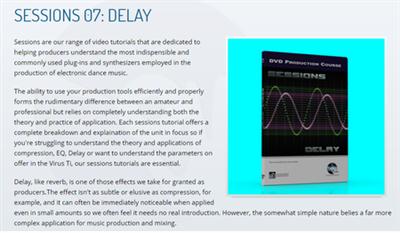
Dance Music Production - Sessions 07 Delay (2016)
WEBRip | English | MOV | 1280 x 720 | AVC ~1064 kbps | 30 fps
AAC | 115 Kbps | 44.1 KHz | 2 channels | 04:29:33 | 1.61 GB​

Genre: Video Tutorial / Sound Processing
Sessions are our range of video tutorials that are dedicated to helping producers understand the most indispensible and commonly used plug-ins and synthesizers employed in the production of electronic dance music.

The ability to use your production tools efficiently and properly forms the rudimentary difference between an amateur and professional but relies on completely understanding both the theory and practice of application. Each sessions tutorial offers a complete breakdown and explaination of the unit in focus so if you're struggling to understand the theory and applications of compression, EQ, Delay or want to understand the parameters on offer in the Virus Ti, our sessions tutorials are essential.
Delay, like reverb, is one of those effects we take for granted as producers.The effect isn't as subtle or elusive as compression, for example, and it can often be immediately noticeable when applied even in small amounts so we often feel it needs no real introduction. However, the somewhat simple nature belies a far more complex application for music production and mixing.
For this session we unravel and explain the intricacies of employing delay. We begin by introducing the basic parameters that form the basis of all delay units before examining the importance of musical notation, the significance of delay timing in a mix, feedback uses, how to calculate the best delay times, the principles of echo, snapback, ADT, dynamic delay, filtered tails, tail processing, interference, comb filtering, chorusing, flanging, rhythmical delay taps and the uses of delayed frequency modulation to increase presence and dimensionality within a mix.
Throughout the tutorial we show why its such an influential effect and why a detailed understanding of delay will invariably change the sound of your music and mixing, making it appear cohesive, wider, bigger and exhibit a three-dimensional stage, all in all, producing a more professional mix.
In addition, for this tutorial, we also examine SoundToys Echoboy. This has become the industry standard delay unit of many professional so we discuss each parameter in detail and show how - through its wealth of modulation options - it has become one of the most creative and must have effects for the production of dance music.

Recommend Download Link Hight Speed | Please Say Thanks Keep Topic Live ​

 
Zurück
Oben Unten