• Regeln für den Video-Bereich:

    In den Börsenbereich gehören nur Angebote die bereits den Allgemeinen Regeln entsprechen.

    Einteilung

    - Folgende Formate gehören in die angegeben Bereiche:
    - Filme: Encodierte Filme von BluRay, DVD, R5, TV, Screener sowie Telesyncs im Format DivX, XviD und x264.
    - DVD: Filme im Format DVD5, DVD9 und HD2DVD.
    - HD: Encodierte Filme mit der Auflösung 720p oder darüber von BluRay, DVD, R5, TV, Screener sowie Telesyncs im Format x264.
    - 3D: Encodierte Filme von BluRay, die in einem 3D Format vorliegen. Dies gilt auch für Dokus, Animation usw.
    - Serien: Cartoon/Zeichentrick, Anime, Tutorials, Dokumentationen, Konzerte/Musik, Sonstiges sind demnach in die entsprechenden Bereiche einzuordnen, auch wenn sie beispielsweise im High Definition-Format oder als DVD5/DVD9/HD2DVD vorliegen. Ausnahme 3D.
    - Bereich Englisch: Englische Releases gehören immer in diesen Bereich.
    - Bereich Talk: Der Bereich, in dem über die Releases diskutiert werden kann, darf, soll und erwünscht ist.


    Angebot/Beitrag erstellen

    - Ein Beitrag darf erst dann erstellt werden, wenn der Upload bei mindestens einem OCH komplett ist. Platzhalter sind untersagt.
    - Bei einem Scenerelease hat der Threadtitel ausschließlich aus dem originalen, unveränderten Releasenamen zu bestehen. Es dürfen keine Veränderungen wie z.B. Sterne, kleine Buchstaben o.ä. vorgenommen werden. Ausnahme Serienbörse:
    - Bei einem Sammelthread für eine Staffel entfällt aus dem Releasename natürlich der Name der Folge. Beispiel: Die Simpsons S21 German DVDRip XviD - ITG
    - Dementsprechend sind also u.a. verboten: Erweiterungen wie "Tipp", "empfehlenswert", "only", "reup", usw. / jegliche andere Zusatzinformation oder Ergänzung, welche nicht in obiger Beschreibung zu finden ist.

    Aufbau des Angebots und Threadtitel

    Der Titel nach folgendem Muster erstellt zu werden. <Name> [3D] [Staffel] [German] <Jahr> <Tonspur> [DL] [Auflösung] <Quelle> <Codec> - <Group>
    Beispiel: The Dark Knight German 2008 AC3 DVDRip XviD - iND
    Beispiel: The Dark Knight 2008 DTS DL BDRip x264 - iND
    Beispiel: The Dark Knight 2008 AC3 DL BDRip XviD - iND
    Beispiel: The Dark Knight German 2008 AC3 720p BluRay x264 iND
    Beispiel: The Dark Knight 2008 DTS DL 1080p BluRay x264 iND
    Beispiel: Die Simpsons S01 German AC3 DVDRip XviD iND
    Beispiel: Die Simpsons S20 German AC3 720p BluRay x264 iND
    Beispiel: Sword Art Online II Ger Sub 2014 AAC 1080p WEBRip x264 - peppermint
    Entsprechend sind also u.a. verboten: Sonderzeichen wie Klammern, Sterne, Ausrufezeichen, Unterstriche, Anführungszeichen / Erweiterungen wie "Tipp", "empfehlenswert", "only", "reup", usw. / jegliche andere Zusatzinformation oder Ergänzung, welche nicht in obiger Beschreibung zu finden ist
    Ausnahmen hiervon können in den Bereichen geregelt sein.

    Die Beiträge sollen wie folgt aufgebaut werden:
    Überschrift entspricht dem Threadtitel
    Cover
    kurze Inhaltsbeschreibung
    Format, Größe, Dauer sind gut lesbar für Downloader außerhalb des Spoilers zu vermerken
    Nfo sind immer Anzugeben und selbige immer im Spoiler in Textform.
    Sind keine Nfo vorhanden z.B. Eigenpublikationen, sind im Spoiler folgende Dateiinformationen zusätzlich anzugeben :
    Quelle
    Video (Auflösung und Bitrate)
    Ton (Sprache, Format und Bitrate der einzelnen Spuren)
    Untertitel (sofern vorhanden)
    Hosterangabe in Textform außerhalb eines Spoiler mit allen enthaltenen Hostern.
    Bei SD kann auf diese zusätzlichen Dateiinformationen verzichtet werden.

    Alle benötigten Passwörter sind, sofern vorhanden, in Textform im Angebot anzugeben.
    Spoiler im Spoiler mit Kommentaren :"Schon Bedankt?" sind unerwünscht.


    Releases

    - Sind Retail-Release verfügbar, sind alle anderen Variationen untersagt. Ausnahmen: Alle deutschen Retail-Release sind CUT, in diesem Fall sind dubbed UNCUT-Release zulässig.
    - Im Serien-Bereich gilt speziell: Wenn ein Retail vor Abschluss einer laufenden Staffel erscheint, darf diese Staffel noch zu Ende gebracht werden.62
    - Gleiche Releases sind unbedingt zusammenzufassen. Das bedeutet, es ist zwingend erforderlich, vor dem Erstellen eines Themas per Suchfunktion zu überprüfen, ob bereits ein Beitrag mit demselben Release besteht. Ist dies der Fall, ist der bereits vorhandene Beitrag zu verwenden.
    - P2P und Scene Releases dürfen nicht verändert oder gar unter einem iND Tag eingestellt werden.


    Support, Diskussionen und Suche

    - Supportanfragen sind entweder per PN oder im Bereich Talk zu stellen.
    - Diskussionen und Bewertungen sind im Talk Bereich zu führen. Fragen an die Uploader haben ausschließlich via PN zu erfolgen, und sind in den Angeboten untersagt.
    - Anfragen zu Upload-Wünschen sind nur im Bereich Suche Video erlaubt. Antworten dürfen nur auf Angebote von MyBoerse.bz verlinkt werden.


    Verbote

    - Untersagt sind mehrere Formate in einem einzigen Angebotsthread, wie beispielsweise das gleichzeitige Anbieten von DivX/XviD, 720p und 1080p in einem Thread. Pro Format, Release und Auflösung ist ein eigener Thread zu eröffnen.
    - Grundsätzlich ebenso verboten sind Dupes. Uploader haben sich an geeigneter Stelle darüber zu informieren, ob es sich bei einem Release um ein Dupe handelt.
    - Gefakte, nur teilweise lauffähige oder unvollständige Angebote sind untersagt. Dies gilt auch für eigene Publikationen, die augenscheinlich nicht selbst von z.B. einer DVD gerippt wurden. Laufende Serien, bei denen noch nicht alle Folgen verfügbar sind, dürfen erstellt und regelmäßig geupdatet werden.
    - Untersagt sind Angebote, welche nur und ausschließlich in einer anderen Sprache als deutsch oder englisch vorliegen. Ausnahmen sind VORHER mit den Moderatoren zu klären.


    Verstoß gegen die Regeln

    - Angebote oder Beiträge, die gegen die Forenregeln verstoßen, sind über den "Melden"-Button im Beitrag zu melden.
  • Bitte registriere dich zunächst um Beiträge zu verfassen und externe Links aufzurufen.

++ Premium IPTV ++ 7000 Live Sender ++ UHD Qualität ++ Mediathek mit 18.000 Inhalten ++


VenneTV


Englische Tutorials

German grammar - word order

npq6rsh4wkwb7evrrwyfq2gj2i.jpg


German grammar - word order
Genre: eLearning | MP4 | Video: h264, 1280x720 | Audio: aac, 44100 Hz
Language: English | Size: 744 MB| Duration: 3h 11m


What you'll learn
Understand where the verb goes in basic and complicated sentences.
Understand what 'time, manner, place' in German word order means.
Understand which conjunctions push the verb to the end and which don't.
Understand when to use 'nicht' or 'kein' and where to position 'nicht'.
Understand in which order to place object pronouns in German sentences.
Understand how to use relative pronouns.
Requirements
You should have some knowledge of the German language.
You need pen and paper for some exercises.
You'll need a printer if you wish to print out some of the handouts.
You may also want to sit in a quiet room without too much background noise.

Description
Are you a German learner who is struggling with word order?

Do you find it difficult to work out where the subject, verb and object goes?

Do you wish you knew what it means if a book or teacher talks about 'TMP'?

Do you know which conjunctions push the verb to the end and which don't?

Do you know what relative pronouns are?

This course is for any German learners. It is designed to accompany the learners as they progress through their German textbook or lessons. It is not necessarily designed for you to work your way through from beginning to end.

If you are a beginner, then start with the beginners' section and move on at a later date.

If you are an intermediate student, then you might want to watch all the beginners' videos to revise what you have already learned, or pick those bits that you are still struggling with before moving on to the intermediate section.

If you are an advanced student, you might also want to check out the beginners and intermediate section as there might be things you've forgotten or not realised. If you do find a topic that you know well, just move on.

It doesn't matter how quickly you complete the course - it isn't a race - the important bit is that you understand the German word order!

German grammar seems to be very complicated but is actually very logical, and this course will show you with very basic sentences how logical it is. By going back to basics with easy sentences, you will make sense of the German word order. You will know which conjunctions do what and how to use relative pronouns.

With the help of the videos, handouts, quizzes and worksheets
this course will take you from "Ich verstehe nicht" to "Ich verstehe"!

How is this course different from other courses?

Most German courses or textbooks cover many topics, but not always in great detail. Normally, there is a tutor to explain more. That can be a problem for those who are teaching themselves as they might not have anybody to explain further.

My courses are in depth, easy to understand and come with worksheets, quizzes, assignments to help you practice what you have learned.


Who this course is for:
This course is for all learners, no matter how long you've been studying German.
It is the perfect support for beginners who have started learning about word order.
Intermediate students will find some revision in the beginners' section, before moving to the intermediate level.
Advanced German learners might find this course a welcome revision and learn more in the advanced section.


Homepage
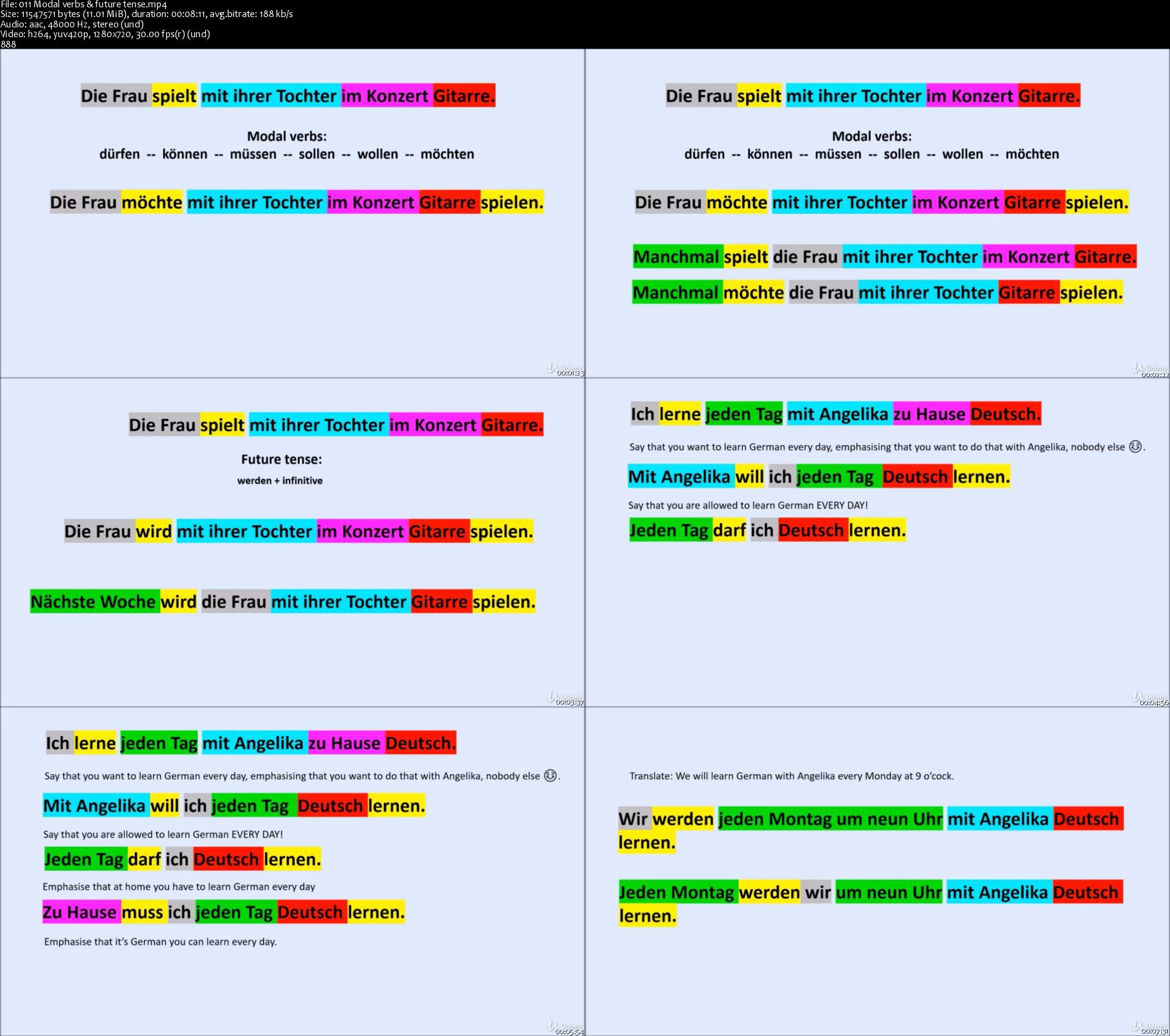
011modalverbsfuturete85ks4.jpg


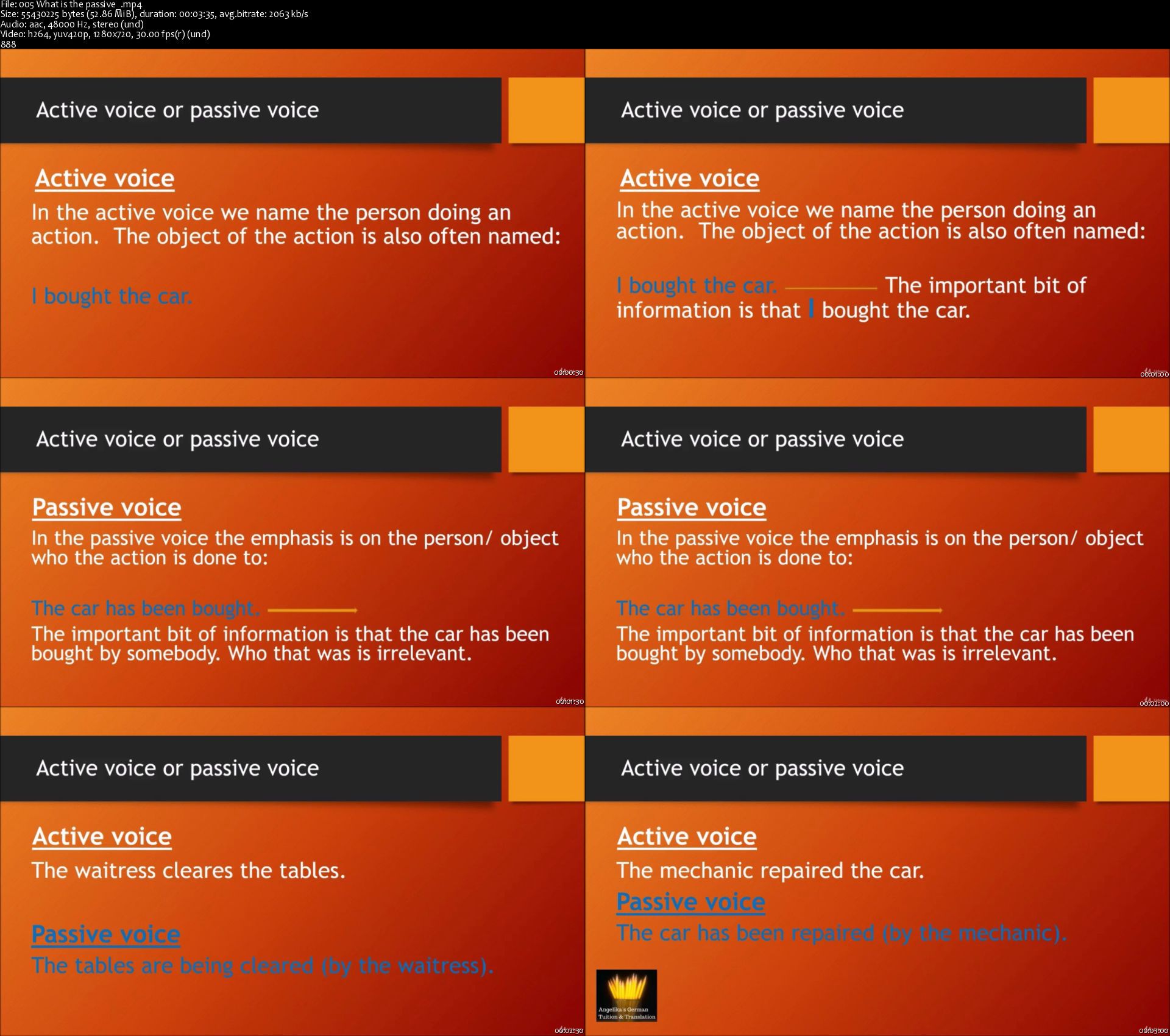
German grammar - the tenses #4 - the passive voice

ugsebxsp3r6ngr2rwljprq2jrl.jpg


German grammar - the tenses #4 - the passive voice
Genre: eLearning | MP4 | Video: h264, 1280x720 | Audio: aac, 44100 Hz
Language: English | Size: 983 MB | Duration: 1h 23m


What you'll learn
Understand what the passive is and when it's used.
Know how to form the passive in the present tense.
Know how to form the passive in the past tenses.
Know how to form the passive in the future tenses.
Understand how to use alternatives to the passive voice.
Requirements
You should be able to conjugate German verbs in the present tense.
You should be able to conjugate German verbs in the past tenses.
You should be able to conjugate German verbs in the future tenses.
You'll need pen and paper for some of the exercises.
You'll need a printer if you wish to print out some of the handouts.

Description
Welcome to the landing page of my German passive course! If this is what you were looking for you will already have learned a lot of German.

So, congratulations for getting this far! You will have survived many hurdles during your German learning journey but now you've come across another problem - the passive voice!

Many textbooks cover the passive but only briefly and my students never found the explanations enough. That's why I made this course. I broke down the passive into lots of sections with easy videos with exercises for reinforcement.

At the end of this course you'll wonder why you found the passive difficult!

There is only one stipulation: you must know how to conjugate German verbs in all the tenses

the present tense

the imperfect tense

the perfect tense

the pluperfect tense

the future tense

the future perfect tense

If you are struggling with the present, past or future tenses, then please learn those first, either with a textbook or my courses. But if you feel confident, then dive in!

I can't promise you passive learning, but I can promise you a better knowledge of the passive voice in German!

How is this course different from other courses?

Most German courses or textbooks cover many topics, but not always in great detail. Normally, there is a tutor to explain more. That can be a problem for those who are teaching themselves as they might not have anybody to explain further.

My courses are in depth, easy to understand and come with worksheets, quizzes, assignments to help you practice what you have learned.


Who this course is for:
Students who have learned German for a while and are working towards A-level or B2 (Common European Framework)


Homepage

005whatisthepassives6vkym.jpg


German grammar - the tenses #1 - the present tense

zyhzsszi3zg2sdlyj43ja79jxw.jpg


German grammar - the tenses #1 - the present tense
Genre: eLearning | MP4 | Video: h264, 1280x720 | Audio: aac, 44100 Hz
Language: English | Size: 589 MB | Duration: 1h 35m


What you'll learn
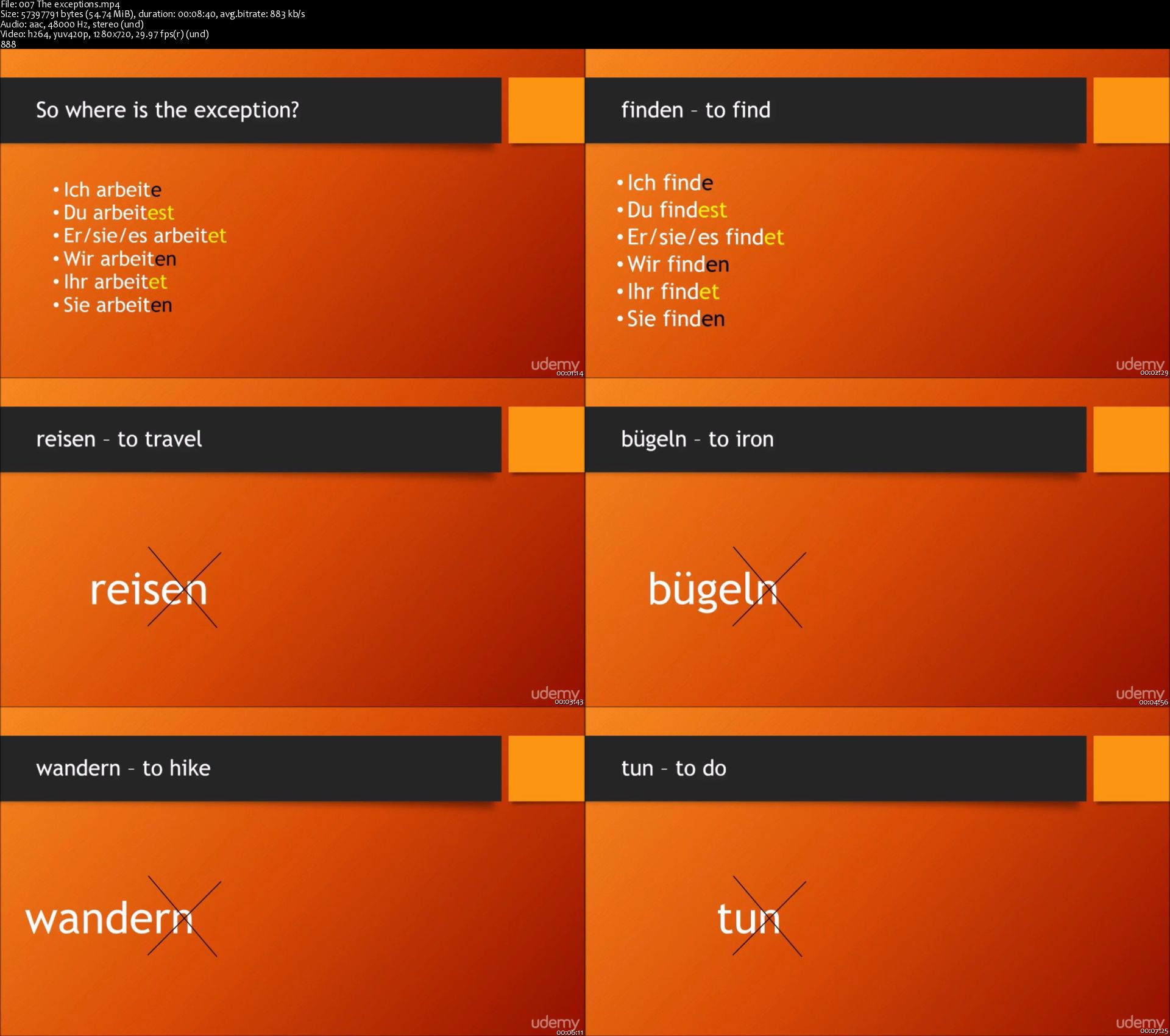
Understand and use German regular & irregular verbs in the present tense
Understand and use German separable & inseparable verbs in the present tense
Understand and use German reflexive verbs in the present tense
Understand and use German impersonal verbs in the present tense
Understand and use German modal verbs in the present tense
Understand and use the imperative in German
Understand what happens to new verbs
Requirements
pen and paper to make notes
a printer to print out the four puzzles (if wished)

Description
Are you a German learner and struggling to conjugate German verbs?

Do you keep on forgetting which verb endings you need? Do you often wonder if it's a regular or irregular verb?

Is this really annoying you?

Then this course is going to help you!

In this course we will only look at German verbs in the present tense and we'll cover the following types of German verbs:

regular verbs

irregular verbs

separable verbs

inseparable verbs

verbs that can be separable & inseparable

reflexive verbs

impersonal verbs

modal verbs

the imperative

and new verbs

This course is not necessarily designed for you to work your way through.

if you are a beginner following a textbook, then follow this course as and when you cover things in your book. For example, when you start learning about regular verbs, then watch the regular verb videos and don't worry about anything else. Watch the next videos when you have come across those verbs in your book.

If, however, you are a beginner AND a grammar geek, who wants to know about grammar, then go ahead and watch all the videos one after another

If you are an intermediate or advanced student, then either watch all the videos to revise what you have already learned, or pick those chapter that you are struggling with.

It doesn't matter how quickly you complete the course - it isn't a race - the important bit is that you can conjugate verbs in the present tense!

At the end of the course you will have a better understanding of German verbs in the present tense which will make life a lot easier when you learn the other German tenses.

How is this course different from other courses?

Most German courses or textbooks cover many topics, but not always in great detail. Normally, there is a tutor to explain more. That can be a problem for those who are teaching themselves as they might not have anybody to explain further.

My courses are in depth, easy to understand and come with worksheets, quizzes, assignments to help you practice what you have learned.


Who this course is for:
This course is for any level
Beginners will find it a useful addition to their textbook
Intermediate learner will find it a useful revision for the present tense
Advanced learners might find it useful to go over the basics again


Homepage

007theexceptionsshyjf7.jpg


German grammar - the tenses #2 - the past tenses (updated 11/2020)

29i3ncptros9c9nd331j025jbp.jpg


German grammar - the tenses #2 - the past tenses (updated 11/2020)
Genre: eLearning | MP4 | Video: h264, 1280x720 | Audio: aac, 44100 Hz
Language: English | Size: 309 MB | Duration: 1h 38m


What you'll learn
Understand the difference between the perfect and the imperfect tense
Understand when to use HABEN or SEIN in the perfect tense
Understand how to form past participles of regular verbs
Understand how to form past participles of irregular verbs
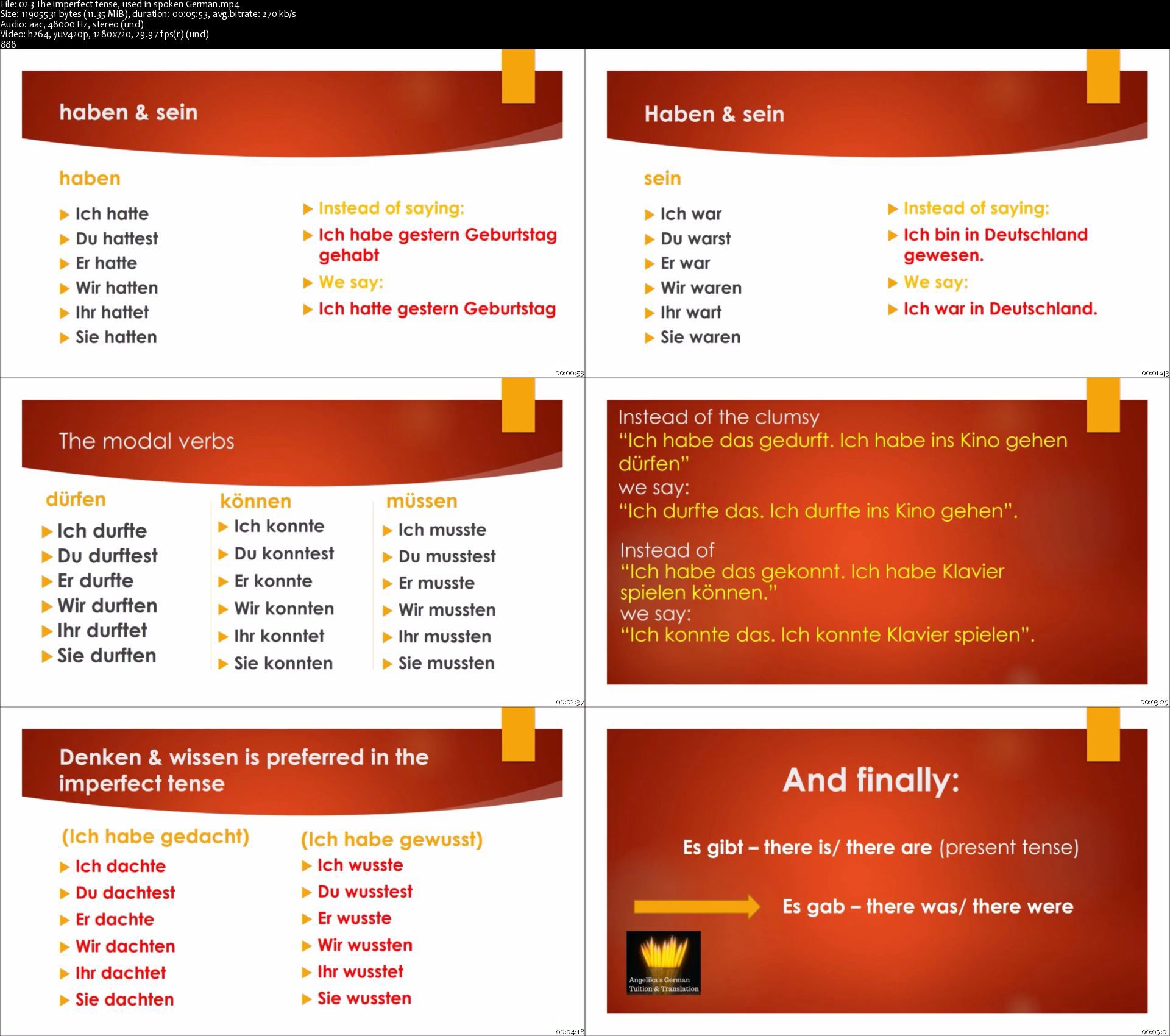
Understand how to conjugate regular verbs in the imperfect tense
Understand how to conjugate irregular verbs in the imperfect tense
Understand what the pluperfect tense is and how to use it
Have a better understanding about the German past tenses
Understand what happens to new verbs
Requirements
Pen and paper to make notes
A printer if students wish to print out the lists (optional)
Students need to be familiar with German verbs in the present tense before starting this course.

Description
Are you a German learner and struggling to conjugate German verbs in the past tense?

Do you keep on forgetting how the German verbs change from the present tense to the past tense? Do you often wonder if it's a regular or irregular verb or if you need to use HABEN or SEIN?

Is this really annoying you?

Then this course is going to help you!

In this course we will only look at German verbs in the past tense and we'll cover the following:

the perfect tense with haben

the perfect tense with sein

regular verbs

irregular verbs

separable verbs

inseparable verbs

the imperfect tense

the pluperfect tense

new verbs

This course is not necessarily designed for you to work your way through.

If you are a beginner then this course isn't for you yet. This course assumes that you already have a sound knowledge of the present tense, so make sure you know how to conjugate verbs in the present tense before buying this course.

If you are an advanced student, you probably know everything in this course but it might be a welcome refresher.

If you are an intermediate student, then either watch all the videos to revise what you have already learned, or pick those chapter that you are struggling with.

It doesn't matter how quickly you complete the course - it isn't a race - the important bit is that you can conjugate verbs in the past tense!

At the end of the course you will have a better understanding of German verbs in the past tense which will make life a lot easier when you want to be able to tell people in German about things you have done.

How is this course different from other courses?

Most German courses or textbooks cover many topics, but not always in great detail. Normally, there is a tutor to explain more. That can be a problem for those who are teaching themselves as they might not have anybody to explain further.

My courses are in depth, easy to understand and come with worksheets, quizzes, assignments to help you practice what you have learned.


Who this course is for:
This course is not for beginners.
This course is for intermediate learners who have a sound knowledge of the German present tense and want to move on to the past tenses.
Advanced learners might find it useful to go the basics again.


Homepage

023theimperfecttenseu6ykwh.jpg


German grammar - the tenses #3 - the future tenses

l3l33dgwmb4m8t9tegkoj6kjpv.jpg


German grammar - the tenses #3 - the future tenses
Genre: eLearning | MP4 | Video: h264, 1280x720 | Audio: aac, 48000 Hz
Language: English | VTT | Size: 238 MB | Duration: 1h 15m


What you'll learn
Understand when to use the present tense or the future tense in German
Understand which modal verbs are useful for talking about future intentions
Know which German verbs might be better to use for future plans instead of modal verbs
Have a better understanding of the conditional
Know when and how to use the future perfect tense in German
Understand what happens to new verbs
Requirements
Pen and paper to make notes
Students need to be familiar with German verbs in the present tense before starting this course.

Description
Are you a German learner and not sure how to use the future tense in German?

Do you get the future tense mixed up with the past tense? Do you wish you had several ways to talk in German about future intentions?

Then this course is going to help you!

In this course we will only look at ways for talking about the future and we'll cover:

the present tense with time phrases

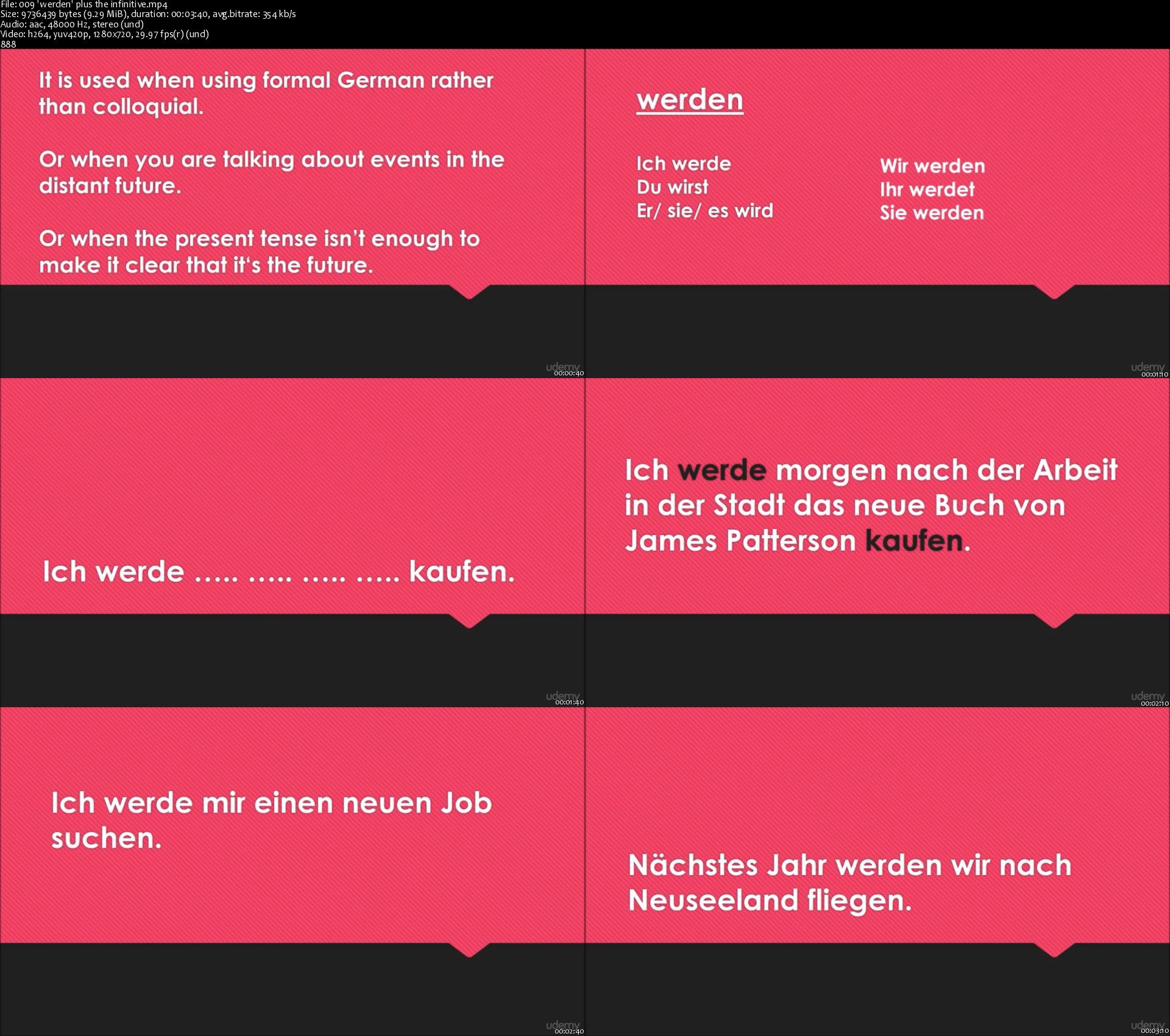
the 'proper' future tense

some modal verbs

verbs governing the infinitive

the conditional

and finally the future perfect.

If you are a beginner then this course isn't for you yet. This course assumes that you already have a sound knowledge of the present tense, so make sure you know how to conjugate verbs in the present tense before buying this course.

If you are an advanced student, you probably know everything in this course but it might be a welcome refresher.

If you are an intermediate student, then you might not have learned the future tense yet or you might have just started, in which case this course is perfect for you!

It doesn't matter how quickly you complete the course - it isn't a race - the important bit is that you can use the future tense!

At the end of the course you will have some good understanding of the German future tense which will make life a lot easier when you want to be able to tell people in German about your future plans.

How is this course different from other courses?

Most German courses or textbooks cover many topics, but not always in great detail. Normally, there is a tutor to explain more. That can be a problem for those who are teaching themselves as they might not have anybody to explain further.

My courses are in depth, easy to understand and come with worksheets, quizzes, assignments to help you practice what you have learned.


Who this course is for:
This course is not for beginners.
This course is for intermediate learners who have a sound knowledge of the German present tense and want to move on to the future tenses.
Advanced learners might find it useful to go the basics again.


Homepage

009werdenplustheinfinpxjiz.jpg


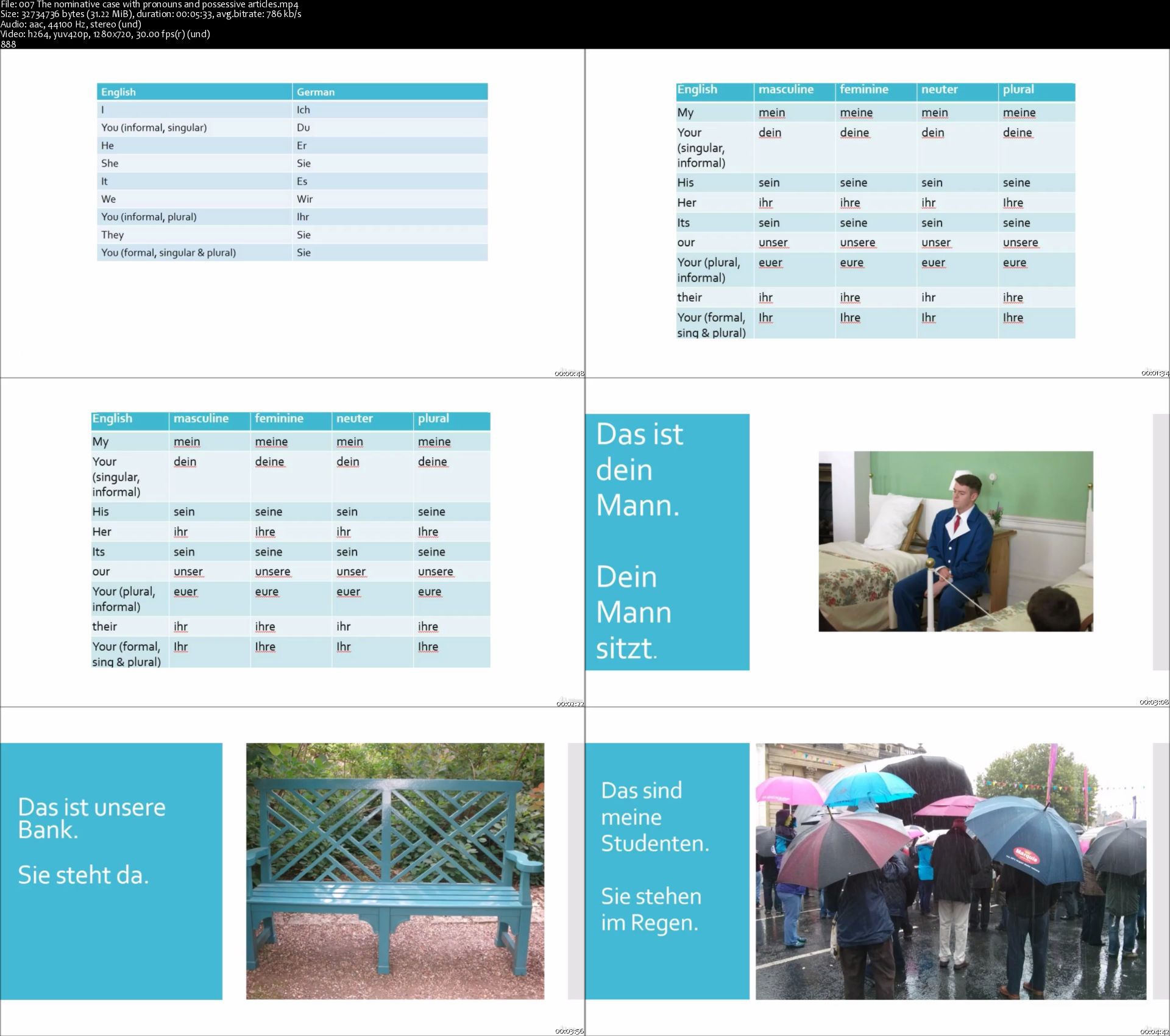
German grammar - the four cases

glaj2demawrh7lvyokierpiks1.jpg


German grammar - the four cases
Genre: eLearning | MP4 | Video: h264, 1280x720 | Audio: aac, 48000 Hz
Language: English | Size: 387 MB | Duration: 2h 47m


What you'll learn
Understand the meaning of the nominative, accusative, dative and genitive cases
Understand when and how definite and indefinite articles change
Understand and be able to use the different prepositions
Be able to use adjectives correctly before nouns, depending on gender and cases
Requirements
You should have some knowledge of the German language and grammar.

Description
Are you a German learner who is struggling with prepositions?

Do you find it difficult to work out what the subject, direct or indirect object of a sentence is?

Do you wish you knew what the correct ending to an adjective before a noun is?

Do you actually need to know what the nominative, accusative, dative and genitive cases are?

Well, you could learn German just parrot fashion, but that would take ages and be very boring!

If, however, you want to have conversations in German using your own sentences, you need some grammar.

The German grammar seems very complicated but is actually very logical, and this course will show you with very basic sentences how logical it is.

By going back to basics with easy sentences, you will make sense of the nominative, accusative, dative and genitive case. You will know which preposition to use and when, and which adjective ending to use.

With the help of the videos, handouts, quizzes and worksheets
this course will take you from "I'm confused" to "I understand"!

How is this course different from other courses?

Most German courses or textbooks cover many topics, but not always in great detail. Normally, there is a tutor to explain more. That can be a problem for those who are teaching themselves as they might not have anybody to explain further.

My courses are in depth, easy to understand and come with worksheets, quizzes, assignments to help you practice what you have learned.


Who this course is for:
Intermediate German learners who have some knowledge of German grammar.
Advanced German learners might find this course a welcome revision of the cases.


Homepage

007thenominativecasewy9k4f.jpg


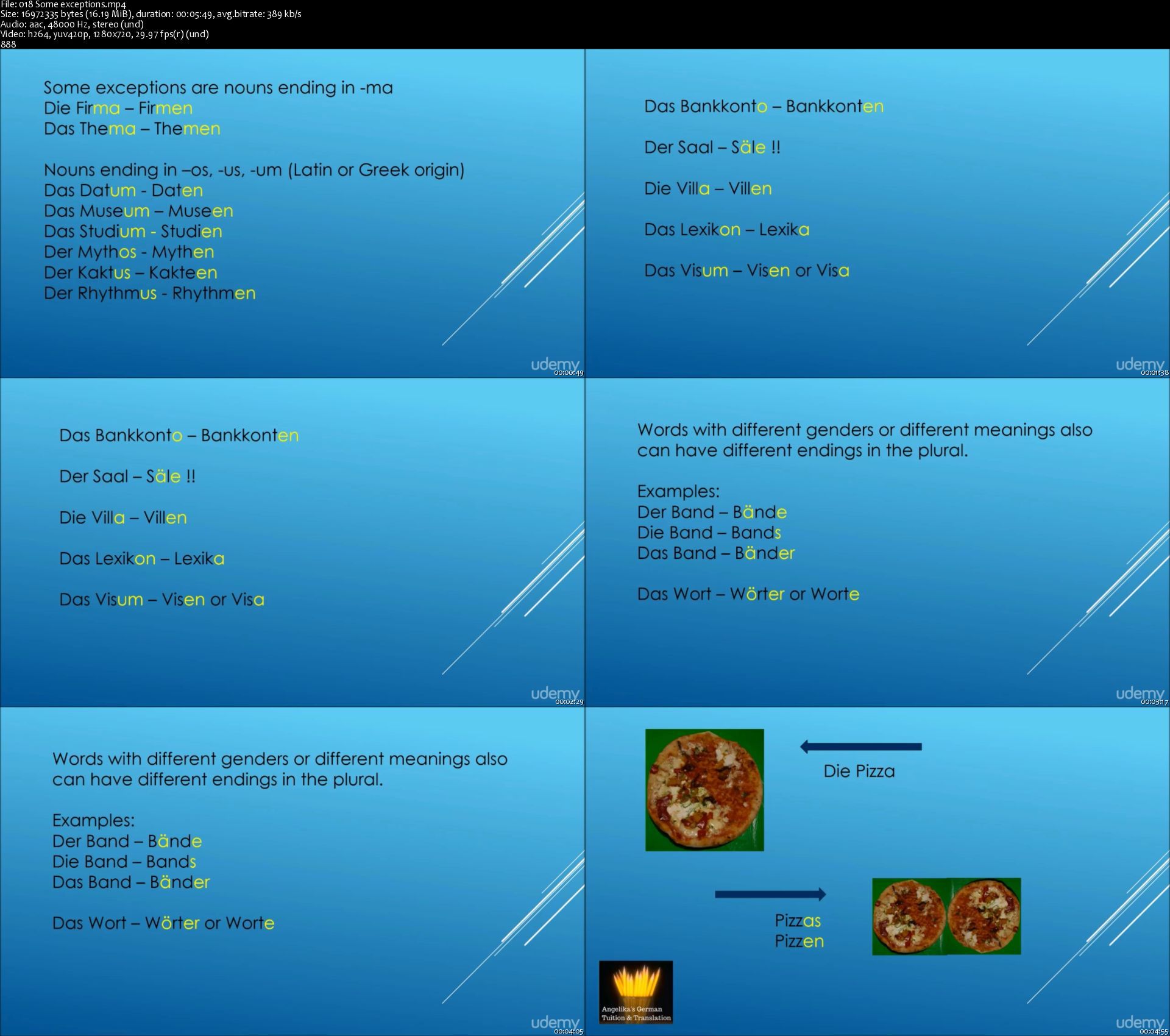
German grammar - gender #2 - the plurals

czaefylefp4emmjmd3gipo4ke6.jpg


German grammar - gender #2 - the plurals
Genre: eLearning | MP4 | Video: h264, 1280x720 | Audio: aac, 48000 Hz
Language: English | Size: 167 MB | Duration: 49m


What you'll learn
know which German plural nouns take an n or en ending
know which German plural nouns take an e or an umlaut plus an e ending
know which German plural nouns take an er or an umlaut plus an er ending
know which German nouns just need an umlaut to change the word from singular to plural
know which German nouns stay the same, whether singular or plural
know which German plural nouns need an s ending
have a general better understanding of German plural nouns
Requirements
You should have started learning German, either with a tutor or on your own.
No additional material required, although you might find it beneficial if you print out the PDFs and add your own notes.

Description
Are you a German learner and struggling to work out what ending a German noun needs in the plural?

Do you remember if cakes in German is Kuchen, Küchen or Kuchens?

Are you struggling to work out if flowers are Blumen or Blümen?

And what about the car? What is the plural of das Auto or der Wagen?

Is this really annoying you?

Then this course is going to help you by showing you which nouns take an 'n' or 'en', which take an 'e' or an umlaut and a 'e' or which take an 'er' or an umlaut and an 'er'. You will also learn which nouns don't change, just add an umlaut or need an 's'.

At the end of the course you will have a better understanding of German plural nouns, which will make life a lot easier when you communicate in German.

How is this course different from other courses?

Most German courses or textbooks cover many topics, but not always in great detail. Normally, there is a tutor to explain more. That can be a problem for those who are teaching themselves as they might not have anybody to explain further.

My courses are in depth, easy to understand and come with worksheets, quizzes, assignments to help you practice what you have learned.


Who this course is for:
This course is for anybody who is learning German and who is struggling with plural nouns.
It will make it easier for beginners to understand what endings to use when talking about more than one thing.
It will help intermediate learners, whose German is quite good but they haven't worked out how to form German plurals.
It might be a good revision for advanced learners, whose grammar is really good, but who muddle through the plural nouns hoping nobody will notice the wrong endings.


Homepage

018someexceptionssh0k6n.jpg


German grammar - gender #1 - Is it der, die or das?

xqgvmczt5gxgdwwnplampzjk91.jpg


German grammar - gender #1 - Is it der, die or das?
Genre: eLearning | MP4 | Video: h264, 1920x1080 | Audio: aac, 48000 Hz
Language: English | Size: 362 MB | Duration: 1h 45m


What you'll learn
know which nouns are always masculine
know which nouns are usually masculine
know which nouns are always feminine
know which nouns are usually feminine
know which nouns are always neuter
know which nouns are usually neuter
know how to work out the gender of a compound noun
have a general better understanding of German nouns
Requirements
You should have started learning German, either with a tutor or on your own.
No additional material required, although you might find it beneficial if you print out the PDFs and add your own notes.

Description
Are you a German learner and struggling to work out when THE means der, die or das?

Do you remember if the German word for cake is der, die or das Kuchen?

Are you struggling to work out if the flower is der, die or das Blume?

And what about the car? Is it der, die or das Auto, or der, die or das Wagen?

Is this really annoying you?

Then this course is going to help you by showing you which German nouns are always or usually masculine, always or usually feminine and always or usually neuter. You will also learn how to work out the gender of compound nouns and of new German words.

At the end of the course you will have a better understanding of German gender which will make life a lot easier when you learn other German grammar rules.

How is this course different from other courses?

Most German courses or textbooks cover many topics, but not always in great detail. Normally, there is a tutor to explain more. That can be a problem for those who are teaching themselves as they might not have anybody to explain further.

My courses are in depth, easy to understand and come with worksheets, quizzes, assignments to help you practice what you have learned.


Who this course is for:
This course is for anybody who is learning German and who is struggling with gender.
It will make it easier for beginners to understand when to use der, die or das.
It will help those who already understand a lot of German grammar but struggle to use it because they don't know the gender of a noun.


Homepage

010nounswhicharealway85jd2.jpg


Zuletzt bearbeitet:
German For You Intermediate: German Verbs Masterclass

vwyecwybpcztjdx7xq3xx0xjty.jpg


German For You Intermediate: German Verbs Masterclass
Genre: eLearning | MP4 | Video: h264, 1280x720 | Audio: aac, 44100 Hz
Language: English | VTT | Size: 1.63 GB | Duration: 3h 43m


What you'll learn
Expand your vocabulary with many useful German verbs.
Learn about common features and differences between verbs.
Use German verbs correctly in different contexts.
Understand structures that can change the meaning of verbs.
Requirements
I recommend a solid A2-level in German in order to be able to follow the course without major problems. The examples and tests include grammar up to level B1.
At least basic knowledge of the following grammar topics is recommended: German tenses (Präsens, Präteritum, Perfekt, Futur I), Infinitiv mit zu, passive voice, relative clauses.
You should be familiar with different verb types: modal verbs, separable verbs, prefix verbs.

Description
You might know the difference between kaufen and einkaufen, and maybe the difference between packen and einpacken. But do you know all the different meanings of vorgehen? And when is the opposite nachgehen, and when nachkommen? Or is it hintergehen?

German verbs can be a real challenge!

For this course I collected all kinds of different verbs, the ones, that are synonymous but not always, the ones that have more than one meaning and the ones that you can use instead of generic verbs, so you can make your language more interesting and precise. The focus is on useful verbs, not on exotic ones, so you will actually be able to use them.

I also included a brief overview of the grammar surrounding the verbs, and included some extra information, e.g. certain exceptions, that you might find useful.

There are short tests for each lecture in the 'Verben'-section, so you can practice how to use the verbs you study, put them in sentences, and have a few more examples at hand. There is also a test at the end of the additional grammar section, of course.

If you are unable to follow the explanations in German (the "free speech" might be a bit too much for some learners), you can use the English subtitles. Keep in mind, that for practical reasons they aren't word-by-word translations. Learners on higher levels can train their listening by using the German subtitles parallel to the audio. Of course, you can also turn them off completely.

Don't forget to collect the pdf-sheets for your verb overviews!


Who this course is for:
Students on an elementary level, intermediate and higher intermediate students (German level A2 to B2).
Advanced students, who want to do some review work and possibly expand their vocabulary further.
Anybody who has a love for the German language.


Homepage

35.aufgebenvs.gebenauhikry.jpg


German for You Intermediate: Business Language & More

arhx1rzntaiydnggwecv4r9j33.jpg


German for You Intermediate: Business Language & More
Genre: eLearning | MP4 | Video: h264, 1280x720 | Audio: aac, 44100 Hz
Language: English | VTT | Size: 1.27 GB | Duration: 2h 7m


What you'll learn
Use formal language and business language correctly
Expand your business vocabulary
Talk on the phone, write emails, give presentations
Learn about specific terminology and contract language
Make requests and suggestions, voice criticism politely
Requirements
Your reading comprehension and knowledge of German grammar should be on an intermediate level. If your German is on a lower level, you will likely still be able to follow as I included many translations and the explanations are in English. In that case, you might not be able to understand all the structures that are used in the example sentences. As the relevant grammar points are not actually taught in this course, you would have to acquire that knowledge elsewhere.

Description
Formal German and business language is different from everyday language. How German business language is different from general German is one thing you will learn in this course. This knowledge is essential for your language acquisition because you need to know on which areas of the language you have to concentrate.

From each of those areas I collected material that is especially useful for studying formal and Business German. We will create a very solid foundation for you, and you will learn a lot of words, expressions and phrases. You will be able to apply these in various situations, correctly and in an adequate context.

Apart from specific areas of language acquisition, I will also give you some additional information to enable you to keep on studying after having completed this course.


Who this course is for:
Intermediate, higher intermediate and advanced students of German
Students of German who want to be able to speak more formal and sound more competent, e.g. in writing
Students of German who want to use German in a business environment


Homepage

1.whentousethegenitivntk5w.jpg


German for You B2: Upper Intermediate

ortipapixe6pvz5mc9oysuxjc4.jpg


German for You B2: Upper Intermediate
Genre: eLearning | MP4 | Video: h264, 1280x720 | Audio: aac, 44100 Hz
Language: English | VTT | Size: 2.31 GB | Duration: 5h 57m


What you'll learn
Understand and use German on an upper intermediate level.
Expand your vocabulary through examples and exercises while studying key grammar.
Two-part connectors, participles, paraphrasing, word combinations and more.
Further your understanding of the German language by connecting existing knowledge to new information.
Requirements
A completed B1 level is recommended to follow this course properly.
All cases and declensions, reflexive verbs, verbs with prepositions, word order including the position of "nicht", subclauses including relative clauses, all tenses, Infinitiv + zu, the Konjunktiv, passive voice.
A list of the grammar topics that should have been studied up to this point can also be found in the overview (landing page) of my course A2/B1 Grammar, Elementary to Intermediate.

Description
This course will support you in reaching or expanding the B2 level in German. It will provide you with vocabulary, structure explanations, examples and exercises. The goal is to understand, speak and write German correctly on a higher intermediate level and give your language more variety.

I tried to keep the explanations as simple as possible, so the theory shouldn't be overwhelming. We will work with a lot of examples to help you understand how certain structures are used in various contexts. Of course, there will also be practice video lectures, quizzes, assignments and some downloadable exercises that you can find by clicking on 'Ressources' (next to the video player in the lecture list; they are attached to some of the lectures). For some assignments the solutions will be given. Others are supposed to support independent learning and can be shared with others.

This course will not directly prepare you for a B2 exam, but it will help you to further your fluency and accuracy in German which will certainly serve you well in reaching your goals.

Please note that the speed of the videos can be changed in case you find them too fast (or too slow). This setting can be found on the bottom left of the Udemy video player (standard setting: 1x).


Who this course is for:
Intermediate students of German who finished B1.
Students on a B2 level who want to expand and/or review what they have learnt.
Students of C1 who want to review and/or close some knowledge gaps.


Homepage

2.anwendungsxgjc8.jpg


Linkedin Learning Microsoft Power Automate Business Process Flows-XQZT

197319690_05-04-connecting_results_stages_c.jpg


Linkedin Learning Microsoft Power Automate Business Process Flows-XQZT | MKV | 207.43 MiB

517 kb/s 1280x720 | AAC 160 kb/s 2 CH eng


NFO:
File List:

File: 01.01-automating_for_efficiency.mkv
Size: 3516904 bytes (3.35 MiB), duration: 00:00:54, avg.bitrate: 521 kb/s
Audio: aac, 48000 Hz, stereo (eng)
Video: h264, yuv420p, 1280x720, 30.00 fps(r) (eng)
Subtitles: eng


Download ( Size: 207.43 MiB ):
Filehosts: Nitroflare, Rapidgator


oHeopzn.png

1 Link/s
262BE41A77.png


5hSo1Ay.png

1 Link/s
B0A1C5A47A.png


Zurück
Oben Unten