


• Regeln für den Dokumente-Bereich:

    In den Börsenbereich gehören nur Angebote die bereits den Allgemeinen Regeln entsprechen.

    Allgemeines:

    Nicht erlaubt im Dokumente-Bereich sind:

    - indizierte Titel (inkl. Comics)
    - extremistische Werke, Zeitschriften und Comics (egal, welche Richtung)
    - jegliche Art von Pornographie
    - Anleitungen zu kriminellen Handlungen, gleich welcher Art
    - sadistische, menschenverachtende oder ähnliche Werke

    Nutzt den "Bedanken"-Button, bei Sammelthreads führen jegliche Kommentare, positiv wie negativ, sehr schnell zu einer Unübersichtlichkeit des Threads. Downmeldungen sind an den Uploader zu richten

    Vor dem Einstellen zu beachten:

    - Suchfunktion

    Vergewissert euch, dass es euer Dokument noch nicht im Board gibt, Doppelposts werden kommentarlos gelöscht. Ist es schon vorhanden, tragt es als Mirror im bestehenden Post ein.

    - Threadtitel

    Idealerweise ist sofort zu erkennen um was es sich handelt. Verseht euren Titel mit den relevanten Informationen, das hilft euch und damit auch uns und allen Suchenden erheblich weiter.

    Beispiel: [Thriller] Dan Brown - Inferno oder bei Magazinen:

    Computerbild - 14/2014 (es muss ersichtlich sein, um welche Ausgabe und welches Magazin es sich handelt)

    Folgende Präfixe stehen im Unterforum "Unterhaltung" zur Verfügung:

    [Humor]
    [Drama]
    [Erotik]
    [Fantasy]
    [Krimi]
    [Roman]
    [Thriller]
    [Horror]
    [Science Fiction]

    Inhalt des Beitrags:

    Folgende Pflichtangaben gilt es einzuhalten:

    - Autor
    - Titel
    - Präfix
    - Cover
    - Genre
    - Inhaltsbeschreibung
    - enthaltene Formate
    - Gesamtgröße des Downloads
    - Hoster
    - ggf. Passwort

    Nicht erlaubt sind alle Dateien, die den Download unnötig aufblähen um eine Affiliategrenze zu erreichen, wie zB. mp3-files, übergroße Bilder, etc.

    Ebenso nicht erlaubt sind sämtliche Dateien mit DRM, persönlichen Daten, etc., diese werden kommentarlos zu eurem eigenem Schutz gelöscht.

    Achtet bitte bei der Konvertierung der Formate auf die Lesbarkeit, ein epub, was nur einfach durch Calibre gejagt wird um ein PDF zu erhalten, ist zu 99% eben nicht lesbar. Wenn ihr es nicht könnt, dann lasst es besser oder lest euch ein, wie man es richtig macht.


    Unterforum Comics:

    Threadtitel:

    Ähnlich, wie bei Unterhaltung und Magazinen, sollte der Titel alle relevanten Informationen enthalten, hier bitte

    - den Titel des Comics
    - den Verlag (einige Comics sind in verschiedenen Verlagen erschienen)
    - das Erscheinungsjahr

    Erlaubt sind folgende Formate:

    - CBR
    - CBZ

    Grundsätzlich gilt: jede Version eines Comics erhält einen eigenen Thread, Ersteller eines Comics können ihre Bände gerne mit dem Zusatz (Original-Release) versehen.

    Bei Unsicherheiten zur korrekten Benennung bitte die Informationen von www.comicguide.de nutzen.

    Inhalt des Beitrags:

    Pflichtangaben hier sind:

    - Titel des Bandes und ggf. Nummer
    - Cover
    - falls bekannt technische Daten (DPI, Breite, Speicherqualität)
    - Größe des Downloads
    - Hoster
    - ggf. Passwort
    - falls bekannt Releasenamen
  • Bitte registriere dich zunächst um Beiträge zu verfassen und externe Links aufzurufen.

*** Bestes IPTV *** bester Preis *** gratis Test ***


Design of Systems on a Chip Design and Test

visoft

MyBoerse.bz Pro Member

006b48af_medium.jpg

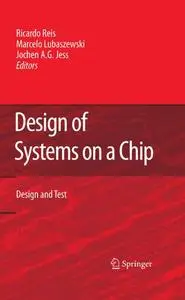
Design of Systems on a Chip: Design and Test by Ricardo Reis
English | PDF | 2007 | 237 Pages | ISBN : 0387324992 | 4.5 MB​


English | PDF | 2007 | 237 Pages | ISBN : 0387324992 | 4.5 MB
Design of Systems on a Chip: Design&Test is the second of two volumes addressing the design challenges associated with new generations of the semiconductor technology. The various chapters are the compilations of tutorials presented at workshops in the recent years by prominent authors from all over the world.
Technology, productivity and quality are the main aspects under consideration to establish the major requirements for the design and test of upcoming systems on a chip. In particular this second book include contributions on three different, but complementary axes: core design, computer-aided design tools and test methods. A collection of chapters deal with the heterogeneity aspect of core designs, showing the diversity of parts that may share the same substrate in a state-of-the-art system on a chip. The second part of the book discusses CAD in three different levels of design abstraction, from system level to physical design. The third part deals with test methods. The topic is addressed from different viewpoints: in terms of chip complexity, test is discussed from the core and system prospective; in terms of signal heterogeneity, the digital, mixed-signal and microsystem prospective are considered.
Fault-tolerance in integrated circuits is not an exclusive concern regarding space designers or highly-reliable application engineers. Rather, designers of next generation products must cope with reduced margin noises due to technological advances. The continuous evolution of the fabrication technology process of semiconductor components, in terms of transistor geometry shrinking, power supply, speed, and logic density, has significantly reduced the reliability of very deep submicron integrated circuits, in face of the various internal and external sources of noise. The very popular Field Programmable Gate Arrays, customizable by SRAM cells, are a consequence of the integrated circuit evolution with millions of memory cells to implement the logic, embedded memories, routing, and more recently with embedded microprocessors cores. These re-programmable systems-on-chip platforms must be fault-tolerant to cope with present days requirements. This book discusses fault-tolerance techniques for SRAM-based Field Programmable Gate Arrays (FPGAs). It starts by showing the model of the problem and the upset effects in the programmable architecture. In the sequence, it shows the main fault tolerance techniques used nowadays to protect integrated circuits against errors. A large set of methods for designing fault tolerance systems in SRAM-based FPGAs is described. Some presented techniques are based on developing a new fault-tolerant architecture with new robustness FPGA elements. Other techniques are based on protecting the high-level hardware description before the synthesis in the FPGA. The reader has the flexibility of choosing the most suitable fault-tolerance technique for its project and to compare a set of fault tolerant techniques for programmable logic applications.
Without You And Your Support We Can't Continue
Thanks For Buying Premium From My Links For Support


Recommend Download Link Hight Speed | Please Say Thanks Keep Topic Live

 
Zurück
Oben Unten