• Regeln für den Video-Bereich:

    In den Börsenbereich gehören nur Angebote die bereits den Allgemeinen Regeln entsprechen.

    Einteilung

    - Folgende Formate gehören in die angegeben Bereiche:
    - Filme: Encodierte Filme von BluRay, DVD, R5, TV, Screener sowie Telesyncs im Format DivX, XviD und x264.
    - DVD: Filme im Format DVD5, DVD9 und HD2DVD.
    - HD: Encodierte Filme mit der Auflösung 720p oder darüber von BluRay, DVD, R5, TV, Screener sowie Telesyncs im Format x264.
    - 3D: Encodierte Filme von BluRay, die in einem 3D Format vorliegen. Dies gilt auch für Dokus, Animation usw.
    - Serien: Cartoon/Zeichentrick, Anime, Tutorials, Dokumentationen, Konzerte/Musik, Sonstiges sind demnach in die entsprechenden Bereiche einzuordnen, auch wenn sie beispielsweise im High Definition-Format oder als DVD5/DVD9/HD2DVD vorliegen. Ausnahme 3D.
    - Bereich Englisch: Englische Releases gehören immer in diesen Bereich.
    - Bereich Talk: Der Bereich, in dem über die Releases diskutiert werden kann, darf, soll und erwünscht ist.


    Angebot/Beitrag erstellen

    - Ein Beitrag darf erst dann erstellt werden, wenn der Upload bei mindestens einem OCH komplett ist. Platzhalter sind untersagt.
    - Bei einem Scenerelease hat der Threadtitel ausschließlich aus dem originalen, unveränderten Releasenamen zu bestehen. Es dürfen keine Veränderungen wie z.B. Sterne, kleine Buchstaben o.ä. vorgenommen werden. Ausnahme Serienbörse:
    - Bei einem Sammelthread für eine Staffel entfällt aus dem Releasename natürlich der Name der Folge. Beispiel: Die Simpsons S21 German DVDRip XviD - ITG
    - Dementsprechend sind also u.a. verboten: Erweiterungen wie "Tipp", "empfehlenswert", "only", "reup", usw. / jegliche andere Zusatzinformation oder Ergänzung, welche nicht in obiger Beschreibung zu finden ist.

    Aufbau des Angebots und Threadtitel

    Der Titel nach folgendem Muster erstellt zu werden. <Name> [3D] [Staffel] [German] <Jahr> <Tonspur> [DL] [Auflösung] <Quelle> <Codec> - <Group>
    Beispiel: The Dark Knight German 2008 AC3 DVDRip XviD - iND
    Beispiel: The Dark Knight 2008 DTS DL BDRip x264 - iND
    Beispiel: The Dark Knight 2008 AC3 DL BDRip XviD - iND
    Beispiel: The Dark Knight German 2008 AC3 720p BluRay x264 iND
    Beispiel: The Dark Knight 2008 DTS DL 1080p BluRay x264 iND
    Beispiel: Die Simpsons S01 German AC3 DVDRip XviD iND
    Beispiel: Die Simpsons S20 German AC3 720p BluRay x264 iND
    Beispiel: Sword Art Online II Ger Sub 2014 AAC 1080p WEBRip x264 - peppermint
    Entsprechend sind also u.a. verboten: Sonderzeichen wie Klammern, Sterne, Ausrufezeichen, Unterstriche, Anführungszeichen / Erweiterungen wie "Tipp", "empfehlenswert", "only", "reup", usw. / jegliche andere Zusatzinformation oder Ergänzung, welche nicht in obiger Beschreibung zu finden ist
    Ausnahmen hiervon können in den Bereichen geregelt sein.

    Die Beiträge sollen wie folgt aufgebaut werden:
    Überschrift entspricht dem Threadtitel
    Cover
    kurze Inhaltsbeschreibung
    Format, Größe, Dauer sind gut lesbar für Downloader außerhalb des Spoilers zu vermerken
    Nfo sind immer Anzugeben und selbige immer im Spoiler in Textform.
    Sind keine Nfo vorhanden z.B. Eigenpublikationen, sind im Spoiler folgende Dateiinformationen zusätzlich anzugeben :
    Quelle
    Video (Auflösung und Bitrate)
    Ton (Sprache, Format und Bitrate der einzelnen Spuren)
    Untertitel (sofern vorhanden)
    Hosterangabe in Textform außerhalb eines Spoiler mit allen enthaltenen Hostern.
    Bei SD kann auf diese zusätzlichen Dateiinformationen verzichtet werden.

    Alle benötigten Passwörter sind, sofern vorhanden, in Textform im Angebot anzugeben.
    Spoiler im Spoiler mit Kommentaren :"Schon Bedankt?" sind unerwünscht.


    Releases

    - Sind Retail-Release verfügbar, sind alle anderen Variationen untersagt. Ausnahmen: Alle deutschen Retail-Release sind CUT, in diesem Fall sind dubbed UNCUT-Release zulässig.
    - Im Serien-Bereich gilt speziell: Wenn ein Retail vor Abschluss einer laufenden Staffel erscheint, darf diese Staffel noch zu Ende gebracht werden.62
    - Gleiche Releases sind unbedingt zusammenzufassen. Das bedeutet, es ist zwingend erforderlich, vor dem Erstellen eines Themas per Suchfunktion zu überprüfen, ob bereits ein Beitrag mit demselben Release besteht. Ist dies der Fall, ist der bereits vorhandene Beitrag zu verwenden.
    - P2P und Scene Releases dürfen nicht verändert oder gar unter einem iND Tag eingestellt werden.


    Support, Diskussionen und Suche

    - Supportanfragen sind entweder per PN oder im Bereich Talk zu stellen.
    - Diskussionen und Bewertungen sind im Talk Bereich zu führen. Fragen an die Uploader haben ausschließlich via PN zu erfolgen, und sind in den Angeboten untersagt.
    - Anfragen zu Upload-Wünschen sind nur im Bereich Suche Video erlaubt. Antworten dürfen nur auf Angebote von MyBoerse.bz verlinkt werden.


    Verbote

    - Untersagt sind mehrere Formate in einem einzigen Angebotsthread, wie beispielsweise das gleichzeitige Anbieten von DivX/XviD, 720p und 1080p in einem Thread. Pro Format, Release und Auflösung ist ein eigener Thread zu eröffnen.
    - Grundsätzlich ebenso verboten sind Dupes. Uploader haben sich an geeigneter Stelle darüber zu informieren, ob es sich bei einem Release um ein Dupe handelt.
    - Gefakte, nur teilweise lauffähige oder unvollständige Angebote sind untersagt. Dies gilt auch für eigene Publikationen, die augenscheinlich nicht selbst von z.B. einer DVD gerippt wurden. Laufende Serien, bei denen noch nicht alle Folgen verfügbar sind, dürfen erstellt und regelmäßig geupdatet werden.
    - Untersagt sind Angebote, welche nur und ausschließlich in einer anderen Sprache als deutsch oder englisch vorliegen. Ausnahmen sind VORHER mit den Moderatoren zu klären.


    Verstoß gegen die Regeln

    - Angebote oder Beiträge, die gegen die Forenregeln verstoßen, sind über den "Melden"-Button im Beitrag zu melden.
  • Bitte registriere dich zunächst um Beiträge zu verfassen und externe Links aufzurufen.

++ Premium IPTV ++ 7000 Live Sender ++ UHD Qualität ++ Mediathek mit 18.000 Inhalten ++


VenneTV


Data Science Fundamentals Part 1: Learning Basic Concepts, Data Wrangling, and Databases with Python

babymore87

MyBoerse.bz Pro Member
355898b2c2602a10a523d17bd9e3a5f9.webp

Free Download Data Science Fundamentals Part 1: Learning Basic Concepts, Data Wrangling, and Databases with Python
Published 8/2017
By Jonathan Dinu
MP4 | Video: h264, 1280x720 | Audio: AAC, 44.1 KHz, 2 Ch
Genre: eLearning | Language: English + subtitle | Duration: 20h 54m | Size: 18.2 GB

Data Science Fundamentals LiveLessons teaches you the foundational concepts, theory, and techniques you need to know to become an effective data scientist
20 Hours of Video InstructionData Science Fundamentals LiveLessons teaches you the foundational concepts, theory, and techniques you need to know to become an effective data scientist. The videos present you with applied, example-driven lessons in Python and its associated ecosystem of libraries, where you get your hands dirty with real datasets and see real results.
Description
If nothing else, by the end of this video course you will have analyzed a number of datasets from the wild, built a handful of applications, and applied machine learning algorithms in meaningful ways to get real results. And along the way you learn the best practices and computational techniques used by a professional data scientist. More specifically, you learn how to acquire data that is openly accessible on the Internet by working with APIs. You learn how to parse XML and JSON data to load it into a relational database. About the InstructorJonathan Dinu is an author, researcher, and most importantly, an educator. He is currently pursuing a Ph.D. in Computer Science at Carnegie Mellon's Human Computer Interaction Institute (HCII), where he is working to democratize machine learning and artificial intelligence through interpretable and interactive algorithms. Previously, he founded Zipfian Academy (an immersive data science training program acquired by Galvanize), has taught classes at the University of San Francisco, and has built a Data Visualization MOOC with Udacity. In addition to his professional data science experience, he has run data science trainings for a Fortune 500 company and taught workshops at Strata, PyData, and DataWeek (among others). He first discovered his love of all things data while studying Computer Science and Physics at UC Berkeley, and in a former life he worked for Alpine Data Labs developing distributed machine learning algorithms for predictive analytics on Hadoop.
Jonathan has always had a passion for sharing the things he has learned in the most creative ways he can. When he is not working with students, you can find him blogging about data, visualization, and education at hopelessoptimism.com or rambling on Twitter @jonathandinu.Skill LevelBeginnerWhat You Will LearnHow to get up and running with a Python data science environmentThe essentials of Python 3, including object-oriented programmingThe basics of the data science process and what each step entailsHow to build a simple (yet powerful) recommendation engine for Airbnb listingsWhere to find quality data sources and how to work with APIs programmaticallyStrategies for parsing JSON and XML into a structured formThe basics of relational databases and how to use an ORM to interface with them in PythonBest practices of data validation, including common data quality checksWho Should Take This CourseAspiring data scientists looking to break into the field and learn the essentials necessaryJournalists, consultants, analysts, or anyone else who works with data and looking to take a programmatic approach to exploring data and conducting analysesQuantitative researchers interested in applying theory to real projects and taking a computational approach to modeling.Software engineers interested in building intelligent applications driven by machine learningPracticing data scientists already familiar with another programming environment looking to learn how to do data science with PythonCourse
Requirements
Basic understanding of programmingFamiliarity with Python and statistics are a plusLesson DescriptionsLesson 1: Introduction to Data Science with Python
Lesson 1 begins with a working definition of data science (as we use it in the course), gives a brief history of the field, and provides motivating examples of data science products and applications. This lesson covers how to get set up with a data science programming environment locally, as well as gives you a crash course in the Python programming language if you are unfamiliar with it or are coming from another language such as R. Finally, it ends with an overview of the concepts and tools that the rest of the lessons cover to hopefully motivate you for and excite you about what's to come!
Lesson 2: The Data Science Process-Building Your First Application
Lesson 2 introduces the data science process by walking through an end-to-end example of building your very first data science application, an AirBnB listing recommender.
You continue to learn how to work with and manipulate data in Python, without any external libraries yet, and leverage the power of the built-in Python standard library. The core application of this lesson covers the basics of building a recommendation engine and shows you how, with simple statistics and a little ingenuity, you can build a compelling recommender, given the right data. And finally, it ends with a formal treatment of the data science process and the individual steps it entails.
Lesson 3: Acquiring Data-Sources and Methods
Lesson 3 begins the treatment of each of the specific stages of the data science process, starting with the first: data acquisition. The lesson covers the basics of finding the appropriate data source for your problem and how to download the datasets you need once you have found them.
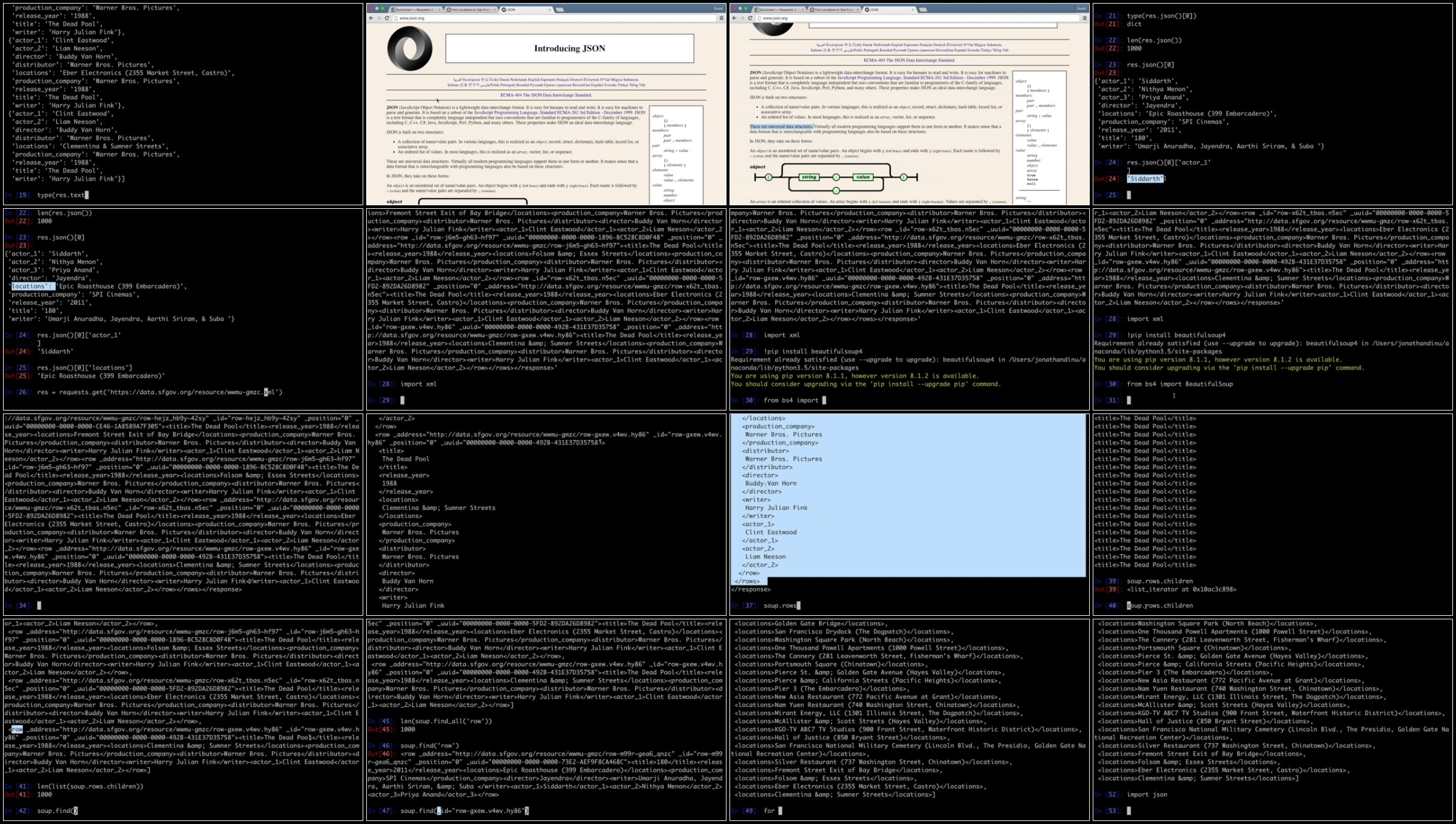
Starting with an overview of how the infrastructure behind the Internet works, you learn how to programmatically make HTTP requests in Python to access data through APIs, as well as the basics of two of the most common data formats: JSON and XML. The lesson ends by setting up the dataset we use for the rest of the course: Foursquare Venues.
Working with the Foursquare dataset, you learn how to interact with APIs and do some minor web scraping. You also learn how to find and acquire data from a variety of sources and keep track of its lineage all along the way. You learn to put yourself in the data science mindset and how to see the data (hidden in plain sight) that we interact with every day.
Lesson 4: Adding Structure-Data Parsing and Storage
Lesson 4 picks up with the second stage of what traditionally is referred to as an extract, transform, and load (ETL) pipeline, adding structure through the transformation of raw data.
You see how to work with a variety of data formats, including XML and JSON, by parsing the data we have acquired to eventually load it into an environment better-suited to exploration and analysis: a relational database. But before we load our data into a database, we take a short diversion to talk about how to conceptually model structure in data with code. You get a primer in object-oriented programming and learn how to leverage it to create abstractions and data models that define how you can interface with your data.
Lesson 5: Storing Data: Relational Databases (with SQLite)
Lesson 5 starts with an introduction to one of the most ubiquitous data technologies-the relational database. The lesson serves as an end cap to the ETL pipeline of the previous videos. You learn the ins and outs of the various strategies for storing data and see how to map the abstractions you created in Python to database tables through the use of an object-relational mapper (ORM). By being able to query and manipulate data with Python while persisting data in a database reliably, the interface ORMs provide gives you the best of both worlds.
Lesson 6: Data Validation and Exploration
Lesson 6 starts by showing you how to effectively query your data to understand what it contains, uncover any biases it might contain, and learn the best practices of dealing with missing values. After you have validated the quality of the data, you use descriptive statistics to learn how your data is distributed as well as learn the limits of point statistics (or rather single number estimates) and why it is often necessary to use visual techniques.
About LiveLessons Video Training
The LiveLessons Video Training series publishes hundreds of hands-on, expert-led video tutorials covering a wide selection of technology topics designed to teach you the skills you need to succeed. This professional and personal technology video series features world-leading author instructors published by your trusted technology brands: Addison-Wesley, Cisco Press, IBM Press, Pearson IT Certification, Prentice Hall, Sams, and Que. Topics include: IT Certification, Programming, Web Development, Mobile Development, Home and Office Technologies, Business and Management, and more. View all LiveLessons on InformIT at:

Recommend Download Link Hight Speed | Please Say Thanks Keep Topic Live
No Password - Links are Interchangeable

 

f3b7a10b23a3430b9e92e82d91d5757b.jpg

Data Science Fundamentals Part 1: Learning Basic Concepts, Data Wrangling, and Databases with Python
MP4 | Video: h264, 1280x720 | Audio: AAC, 44.1 KHz, 2 Ch
Genre: eLearning | Language: English + subtitle | Duration: 20h 54m | Size: 18.2 GB​

If nothing else, by the end of this video course you will have analyzed a number of datasets from the wild, built a handful of applications, and applied machine learning algorithms in meaningful ways to get real results. And along the way you learn the best practices and computational techniques used by a professional data scientist. More specifically, you learn how to acquire data that is openly accessible on the Internet by working with APIs. You learn how to parse XML and JSON data to load it into a relational database. About the InstructorJonathan Dinu is an author, researcher, and most importantly, an educator. He is currently pursuing a Ph.D. in Computer Science at Carnegie Mellon's Human Computer Interaction Institute (HCII), where he is working to democratize machine learning and artificial intelligence through interpretable and interactive algorithms. Previously, he founded Zipfian Academy (an immersive data science training program acquired by Galvanize), has taught classes at the University of San Francisco, and has built a Data Visualization MOOC with Udacity. In addition to his professional data science experience, he has run data science trainings for a Fortune 500 company and taught workshops at Strata, PyData, and DataWeek (among others). He first discovered his love of all things data while studying Computer Science and Physics at UC Berkeley, and in a former life he worked for Alpine Data Labs developing distributed machine learning algorithms for predictive analytics on Hadoop.

Jonathan has always had a passion for sharing the things he has learned in the most creative ways he can. When he is not working with students, you can find him blogging about data, visualization, and education at hopelessoptimism.com or rambling on Twitter @jonathandinu.Skill LevelBeginnerWhat You Will LearnHow to get up and running with a Python data science environmentThe essentials of Python 3, including object-oriented programmingThe basics of the data science process and what each step entailsHow to build a simple (yet powerful) recommendation engine for Airbnb listingsWhere to find quality data sources and how to work with APIs programmaticallyStrategies for parsing JSON and XML into a structured formThe basics of relational databases and how to use an ORM to interface with them in PythonBest practices of data validation, including common data quality checksWho Should Take This CourseAspiring data scientists looking to break into the field and learn the essentials necessaryJournalists, consultants, analysts, or anyone else who works with data and looking to take a programmatic approach to exploring data and conducting analysesQuantitative researchers interested in applying theory to real projects and taking a computational approach to modeling.Software engineers interested in building intelligent applications driven by machine learningPracticing data scientists already familiar with another programming environment looking to learn how to do data science with PythonCourse RequirementsBasic understanding of programmingFamiliarity with Python and statistics are a plusLesson DescriptionsLesson 1: Introduction to Data Science with Python
Lesson 1 begins with a working definition of data science (as we use it in the course), gives a brief history of the field, and provides motivating examples of data science products and applications. This lesson covers how to get set up with a data science programming environment locally, as well as gives you a crash course in the Python programming language if you are unfamiliar with it or are coming from another language such as R. Finally, it ends with an overview of the concepts and tools that the rest of the lessons cover to hopefully motivate you for and excite you about what's to come!

Lesson 2: The Data Science Process-Building Your First Application

Lesson 2 introduces the data science process by walking through an end-to-end example of building your very first data science application, an AirBnB listing recommender.

You continue to learn how to work with and manipulate data in Python, without any external libraries yet, and leverage the power of the built-in Python standard library. The core application of this lesson covers the basics of building a recommendation engine and shows you how, with simple statistics and a little ingenuity, you can build a compelling recommender, given the right data. And finally, it ends with a formal treatment of the data science process and the individual steps it entails.

Lesson 3: Acquiring Data-Sources and Methods

Lesson 3 begins the treatment of each of the specific stages of the data science process, starting with the first: data acquisition. The lesson covers the basics of finding the appropriate data source for your problem and how to download the datasets you need once you have found them.

Starting with an overview of how the infrastructure behind the Internet works, you learn how to programmatically make HTTP requests in Python to access data through APIs, as well as the basics of two of the most common data formats: JSON and XML. The lesson ends by setting up the dataset we use for the rest of the course: Foursquare Venues.

Working with the Foursquare dataset, you learn how to interact with APIs and do some minor web scraping. You also learn how to find and acquire data from a variety of sources and keep track of its lineage all along the way. You learn to put yourself in the data science mindset and how to see the data (hidden in plain sight) that we interact with every day.

Lesson 4: Adding Structure-Data Parsing and Storage

Lesson 4 picks up with the second stage of what traditionally is referred to as an extract, transform, and load (ETL) pipeline, adding structure through the transformation of raw data.

You see how to work with a variety of data formats, including XML and JSON, by parsing the data we have acquired to eventually load it into an environment better-suited to exploration and analysis: a relational database. But before we load our data into a database, we take a short diversion to talk about how to conceptually model structure in data with code. You get a primer in object-oriented programming and learn how to leverage it to create abstractions and data models that define how you can interface with your data.

Lesson 5: Storing Data: Relational Databases (with SQLite)

Lesson 5 starts with an introduction to one of the most ubiquitous data technologies-the relational database. The lesson serves as an end cap to the ETL pipeline of the previous videos. You learn the ins and outs of the various strategies for storing data and see how to map the abstractions you created in Python to database tables through the use of an object-relational mapper (ORM). By being able to query and manipulate data with Python while persisting data in a database reliably, the interface ORMs provide gives you the best of both worlds.

Lesson 6: Data Validation and Exploration

Lesson 6 starts by showing you how to effectively query your data to understand what it contains, uncover any biases it might contain, and learn the best practices of dealing with missing values. After you have validated the quality of the data, you use descriptive statistics to learn how your data is distributed as well as learn the limits of point statistics (or rather single number estimates) and why it is often necessary to use visual techniques.

About LiveLessons Video Training

The LiveLessons Video Training series publishes hundreds of hands-on, expert-led video tutorials covering a wide selection of technology topics designed to teach you the skills you need to succeed. This professional and personal technology video series features world-leading author instructors published by your trusted technology brands: Addison-Wesley, Cisco Press, IBM Press, Pearson IT Certification, Prentice Hall, Sams, and Que. Topics include: IT Certification, Programming, Web Development, Mobile Development, Home and Office Technologies, Business and Management, and more. View all LiveLessons on InformIT at:

035-37-Parsing-Data-with-Python-JSON-and-XML.jpg

 
Zurück
Oben Unten