• Regeln für den Video-Bereich:

    In den Börsenbereich gehören nur Angebote die bereits den Allgemeinen Regeln entsprechen.

    Einteilung

    - Folgende Formate gehören in die angegeben Bereiche:
    - Filme: Encodierte Filme von BluRay, DVD, R5, TV, Screener sowie Telesyncs im Format DivX, XviD und x264.
    - DVD: Filme im Format DVD5, DVD9 und HD2DVD.
    - HD: Encodierte Filme mit der Auflösung 720p oder darüber von BluRay, DVD, R5, TV, Screener sowie Telesyncs im Format x264.
    - 3D: Encodierte Filme von BluRay, die in einem 3D Format vorliegen. Dies gilt auch für Dokus, Animation usw.
    - Serien: Cartoon/Zeichentrick, Anime, Tutorials, Dokumentationen, Konzerte/Musik, Sonstiges sind demnach in die entsprechenden Bereiche einzuordnen, auch wenn sie beispielsweise im High Definition-Format oder als DVD5/DVD9/HD2DVD vorliegen. Ausnahme 3D.
    - Bereich Englisch: Englische Releases gehören immer in diesen Bereich.
    - Bereich Talk: Der Bereich, in dem über die Releases diskutiert werden kann, darf, soll und erwünscht ist.


    Angebot/Beitrag erstellen

    - Ein Beitrag darf erst dann erstellt werden, wenn der Upload bei mindestens einem OCH komplett ist. Platzhalter sind untersagt.
    - Bei einem Scenerelease hat der Threadtitel ausschließlich aus dem originalen, unveränderten Releasenamen zu bestehen. Es dürfen keine Veränderungen wie z.B. Sterne, kleine Buchstaben o.ä. vorgenommen werden. Ausnahme Serienbörse:
    - Bei einem Sammelthread für eine Staffel entfällt aus dem Releasename natürlich der Name der Folge. Beispiel: Die Simpsons S21 German DVDRip XviD - ITG
    - Dementsprechend sind also u.a. verboten: Erweiterungen wie "Tipp", "empfehlenswert", "only", "reup", usw. / jegliche andere Zusatzinformation oder Ergänzung, welche nicht in obiger Beschreibung zu finden ist.

    Aufbau des Angebots und Threadtitel

    Der Titel nach folgendem Muster erstellt zu werden. <Name> [3D] [Staffel] [German] <Jahr> <Tonspur> [DL] [Auflösung] <Quelle> <Codec> - <Group>
    Beispiel: The Dark Knight German 2008 AC3 DVDRip XviD - iND
    Beispiel: The Dark Knight 2008 DTS DL BDRip x264 - iND
    Beispiel: The Dark Knight 2008 AC3 DL BDRip XviD - iND
    Beispiel: The Dark Knight German 2008 AC3 720p BluRay x264 iND
    Beispiel: The Dark Knight 2008 DTS DL 1080p BluRay x264 iND
    Beispiel: Die Simpsons S01 German AC3 DVDRip XviD iND
    Beispiel: Die Simpsons S20 German AC3 720p BluRay x264 iND
    Beispiel: Sword Art Online II Ger Sub 2014 AAC 1080p WEBRip x264 - peppermint
    Entsprechend sind also u.a. verboten: Sonderzeichen wie Klammern, Sterne, Ausrufezeichen, Unterstriche, Anführungszeichen / Erweiterungen wie "Tipp", "empfehlenswert", "only", "reup", usw. / jegliche andere Zusatzinformation oder Ergänzung, welche nicht in obiger Beschreibung zu finden ist
    Ausnahmen hiervon können in den Bereichen geregelt sein.

    Die Beiträge sollen wie folgt aufgebaut werden:
    Überschrift entspricht dem Threadtitel
    Cover
    kurze Inhaltsbeschreibung
    Format, Größe, Dauer sind gut lesbar für Downloader außerhalb des Spoilers zu vermerken
    Nfo sind immer Anzugeben und selbige immer im Spoiler in Textform.
    Sind keine Nfo vorhanden z.B. Eigenpublikationen, sind im Spoiler folgende Dateiinformationen zusätzlich anzugeben :
    Quelle
    Video (Auflösung und Bitrate)
    Ton (Sprache, Format und Bitrate der einzelnen Spuren)
    Untertitel (sofern vorhanden)
    Hosterangabe in Textform außerhalb eines Spoiler mit allen enthaltenen Hostern.
    Bei SD kann auf diese zusätzlichen Dateiinformationen verzichtet werden.

    Alle benötigten Passwörter sind, sofern vorhanden, in Textform im Angebot anzugeben.
    Spoiler im Spoiler mit Kommentaren :"Schon Bedankt?" sind unerwünscht.


    Releases

    - Sind Retail-Release verfügbar, sind alle anderen Variationen untersagt. Ausnahmen: Alle deutschen Retail-Release sind CUT, in diesem Fall sind dubbed UNCUT-Release zulässig.
    - Im Serien-Bereich gilt speziell: Wenn ein Retail vor Abschluss einer laufenden Staffel erscheint, darf diese Staffel noch zu Ende gebracht werden.62
    - Gleiche Releases sind unbedingt zusammenzufassen. Das bedeutet, es ist zwingend erforderlich, vor dem Erstellen eines Themas per Suchfunktion zu überprüfen, ob bereits ein Beitrag mit demselben Release besteht. Ist dies der Fall, ist der bereits vorhandene Beitrag zu verwenden.
    - P2P und Scene Releases dürfen nicht verändert oder gar unter einem iND Tag eingestellt werden.


    Support, Diskussionen und Suche

    - Supportanfragen sind entweder per PN oder im Bereich Talk zu stellen.
    - Diskussionen und Bewertungen sind im Talk Bereich zu führen. Fragen an die Uploader haben ausschließlich via PN zu erfolgen, und sind in den Angeboten untersagt.
    - Anfragen zu Upload-Wünschen sind nur im Bereich Suche Video erlaubt. Antworten dürfen nur auf Angebote von MyBoerse.bz verlinkt werden.


    Verbote

    - Untersagt sind mehrere Formate in einem einzigen Angebotsthread, wie beispielsweise das gleichzeitige Anbieten von DivX/XviD, 720p und 1080p in einem Thread. Pro Format, Release und Auflösung ist ein eigener Thread zu eröffnen.
    - Grundsätzlich ebenso verboten sind Dupes. Uploader haben sich an geeigneter Stelle darüber zu informieren, ob es sich bei einem Release um ein Dupe handelt.
    - Gefakte, nur teilweise lauffähige oder unvollständige Angebote sind untersagt. Dies gilt auch für eigene Publikationen, die augenscheinlich nicht selbst von z.B. einer DVD gerippt wurden. Laufende Serien, bei denen noch nicht alle Folgen verfügbar sind, dürfen erstellt und regelmäßig geupdatet werden.
    - Untersagt sind Angebote, welche nur und ausschließlich in einer anderen Sprache als deutsch oder englisch vorliegen. Ausnahmen sind VORHER mit den Moderatoren zu klären.


    Verstoß gegen die Regeln

    - Angebote oder Beiträge, die gegen die Forenregeln verstoßen, sind über den "Melden"-Button im Beitrag zu melden.
  • Bitte registriere dich zunächst um Beiträge zu verfassen und externe Links aufzurufen.

++ Premium IPTV ++ 7000 Live Sender ++ UHD Qualität ++ Mediathek mit 18.000 Inhalten ++


VenneTV


Cste Certification Professional Software Testing Skills

babymore87

MyBoerse.bz Pro Member
97f9e5a94739b8eeb59c5830ba8a4c4a.webp

Cste Certification Professional Software Testing Skills
Published 8/2026
MP4 | Video: h264, 1920x1080 | Audio: AAC, 44.1 KHz
Language: English | Size: 1.35 GB | Duration: 1h 34m
CSTE Certification: Software Testing Fundamentals, Quality Assurance, Defect Management, Risk, Metrics, and Governance

What you'll learn
Understand software testing principles, purposes, objectives, quality, and assurance concepts.
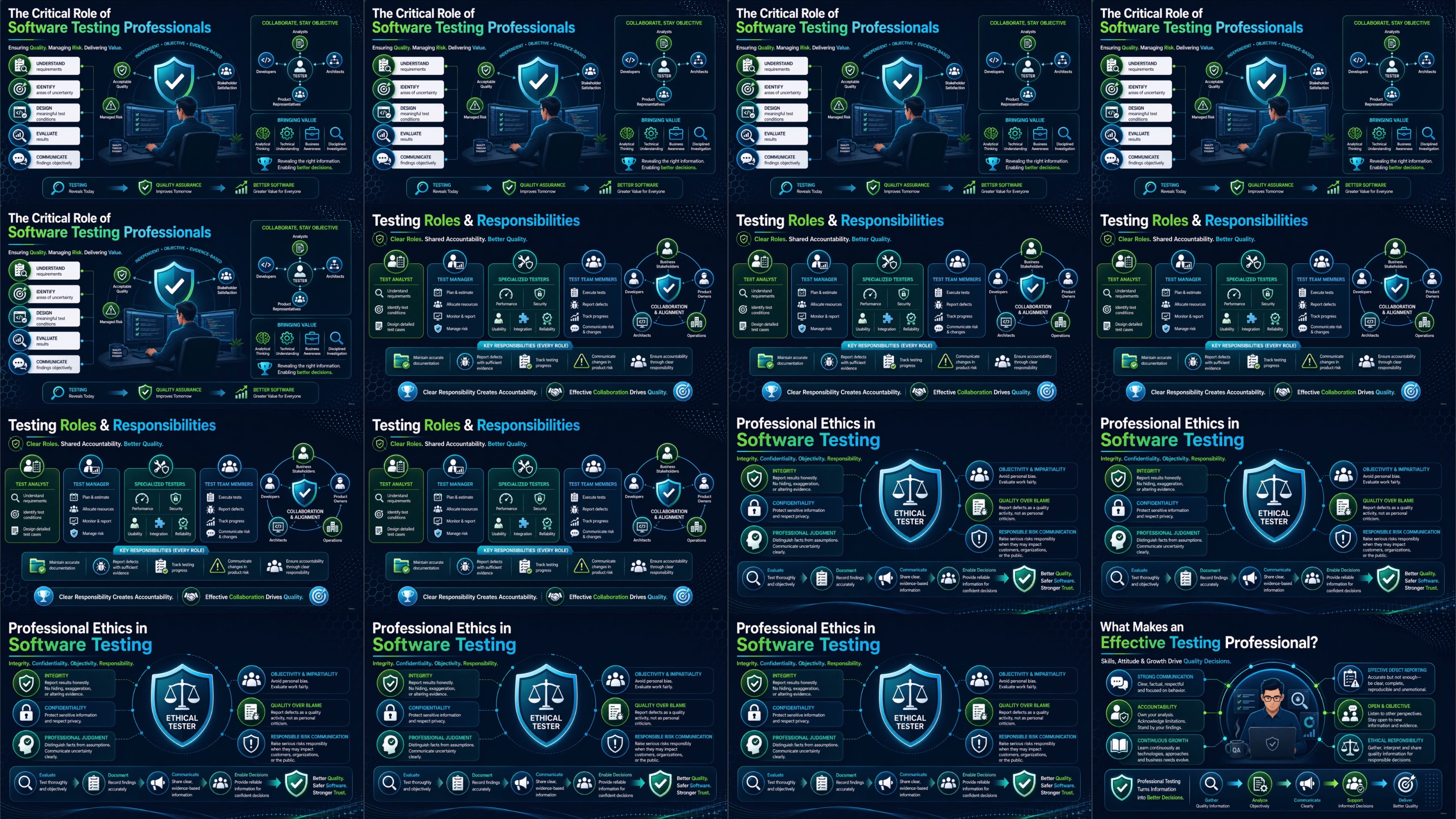
Understand tester roles, responsibilities, ethics, and testing across development life cycles.
Understand test policy, strategy, objectives, scope, governance, and structured planning.
Apply concepts of test estimation, scheduling, staffing, resource allocation, and budgeting.
Understand team structures, role assignment, accountability, collaboration, and test independence.
Interpret test progress, control actions, status reports, metrics, and documentation needs.
Analyze key requirements for completeness, traceability, consistency, and testability.
Apply test design techniques and evaluate useful coverage across critical software areas.
Distinguish reviews, inspections, and walkthroughs and understand the role in early defect detection.
Understand execution, results evaluation, integration, system, acceptance, and regression testing.
Identify, classify, report, track, and analyze defects through their life cycle and root causes.
Evaluate security, performance, usability, and compatibility requirements in software quality.
Analyze software risks, prioritize testing effort, and interpret quality metrics and key indicators.
Understand configuration management, change control, test environments, and process maturity.
Requirements
A willingness and interest to learn about CSTE Certification: Professional Software Testing Skills.
Description
This CSTE Certification course is designed to build a structured and practical understanding of professional software testing, software quality, and test management concepts. The course begins with the foundations of software testing, including its purpose, objectives, core principles, quality concepts, quality assurance fundamentals, professional responsibilities, and the role of testing throughout the software development life cycle. From there, it develops into a broader understanding of how testing activities are planned, organized, managed, monitored, controlled, and documented within professional software environments.You will learn how test policies, test strategies, and test planning frameworks provide direction for testing activities, and how estimation, scheduling, resources, and budgeting influence the effectiveness of a testing effort. The course also explains how testing teams can be organized, how responsibilities are assigned, and why clear accountability, collaboration, and professional ethics are essential for maintaining reliable quality practices. You will explore test monitoring, test control, reporting, and documentation so that you can understand how testing progress and product quality are measured and communicated to stakeholders.A major part of the course focuses on test analysis, design, and execution. You will examine requirements analysis, testability assessment, traceability, test case design techniques, and different forms of test coverage. The course explains specification based, structure based, and experience based testing approaches, along with important techniques such as equivalence partitioning, boundary value analysis, decision table testing, and state transition testing. You will also study static testing methods, including reviews, inspections, and walkthroughs, and understand how these activities help identify defects before software execution begins.The course then develops your understanding of dynamic testing by examining testing levels, execution processes, and result evaluation. You will learn how component, integration, system, acceptance, and regression testing contribute different forms of evidence about software quality. You will also understand the relationship between test execution, expected results, observed behavior, retesting, regression testing, and defect investigation. These concepts provide a strong foundation for evaluating whether software satisfies both technical requirements and business expectations.Defect management is covered in detail, including defect identification, classification, reporting, severity, priority, and the defect life cycle. You will learn how defects move from discovery through evaluation, assignment, correction, retesting, and closure, and how professional defect reporting supports effective communication between testers, developers, managers, and stakeholders. The course also explores root cause analysis and defect prevention, helping you understand how organizations can move beyond correcting individual problems and instead improve processes to reduce the likelihood of similar defects occurring again.You will also study important quality characteristics and specialized testing requirements related to security, performance, usability, and compatibility. These topics explain how software quality extends beyond basic functional correctness and how different quality expectations must be evaluated according to system purpose, user needs, technical environments, and business risk. The course provides a structured understanding of how testers assess these requirements and how they contribute to a broader view of product quality.Another important area of the course is software quality measurement. You will learn how quality metrics, test measurements, and performance indicators help organizations evaluate testing progress, product condition, defect trends, coverage, and testing effectiveness. The course emphasizes the importance of selecting meaningful measurements, interpreting them in context, and avoiding the mistake of treating individual metrics as complete representations of software quality. You will also explore how measurement supports informed decision making, accountability, and continuous improvement.Risk based testing and software risk management are examined as essential approaches for prioritizing testing effort. You will learn how risks are identified, assessed, prioritized, treated, and monitored throughout the software development life cycle. The course explains how probability and impact influence testing priorities, how high risk areas receive greater attention, and how test results provide evidence that helps stakeholders understand remaining uncertainty. This risk focused approach connects testing decisions with business impact, technical complexity, and operational consequences.The course also covers configuration management, change control, and test environment governance. You will understand why software versions, requirements, test cases, environments, configurations, and related items must be controlled so that testing remains repeatable and traceable. You will also learn how changes are evaluated and managed, how impact analysis supports regression testing decisions, and why controlled test environments are essential for producing reliable testing evidence.Finally, the course explores process improvement, quality models, testing maturity, and continuous testing maturity. You will learn how organizations use defect information, measurements, reviews, process analysis, and lessons learned to strengthen their testing capabilities over time. The course explains how mature testing organizations develop more consistent processes, clearer responsibilities, stronger risk management, better measurement, and improved quality governance while continuing to adapt to changing technologies, business priorities, and development methods.By completing this course, you will develop a comprehensive understanding of software testing as a professional quality discipline rather than simply an activity for finding defects. You will gain structured knowledge of testing principles, planning, design, execution, defect management, quality measurement, risk management, governance, and process improvement, giving you a strong conceptual foundation for working with software testing and quality management practices in professional environments.
Aspiring Software Testers: Learners who want to build a structured foundation in software testing principles, processes, and quality concepts.,Junior QA Professionals: Early career quality assurance professionals seeking broader knowledge of testing, planning, defects, and quality management.,Software Testing Professionals: Testers who want to strengthen their understanding of test strategy, test design, execution, monitoring, and reporting.,Quality Assurance Analysts: Professionals responsible for software quality who want deeper knowledge of assurance, control, metrics, and improvement practices.,Test Analysts: Professionals involved in requirements analysis, testability assessment, test case design, coverage, and result evaluation.,Test Leads and Coordinators: Individuals responsible for organizing testing activities, assigning responsibilities, monitoring progress, and coordinating teams.,Test Managers: Professionals involved in test planning, estimation, scheduling, budgeting, resource management, governance, and reporting.,Software Developers: Developers who want to better understand testing levels, defect prevention, regression testing, quality risks, and testing responsibilities.,Business and Systems Analysts: Analysts who want to improve their understanding of requirement quality, testability, traceability, and acceptance expectations.,Software Quality Professionals: Individuals interested in quality metrics, performance indicators, root cause analysis, defect prevention, and process improvement.,Risk and Governance Professionals: Professionals who need to understand risk based testing, software risk management, change control, and quality governance.,Project and Delivery Professionals: Team members who work with testing schedules, resources, quality risks, release decisions, and software development life cycles.,Professionals Working With Specialized Quality Requirements: Learners who need conceptual knowledge of security, performance, usability, and compatibility testing.,Learners Interested in Testing Maturity: Professionals who want to understand configuration management, quality models, continuous improvement, and testing maturity.
Homepage

Recommend Download Link Hight Speed | Please Say Thanks Keep Topic Live
No Password - Links are Interchangeable

 

764914494_yxusj-u4g6751z6pnz.jpg

CSTE Certification: Professional Software Testing Skills
Published 8/2026
MP4 | Video: h264, 1920x1080 | Audio: AAC, 44.1 KHz, 2 Ch
Genre: eLearning | Language: English (US) | Duration: 1.5 h | Size: 1.35 GB​

This CSTE Certification course is designed to build a structured and practical understanding of professional software testing, software quality, and test management concepts. The course begins with the foundations of software testing, including its purpose, objectives, core principles, quality concepts, quality assurance fundamentals, professional responsibilities, and the role of testing throughout the software development life cycle. From there, it develops into a broader understanding of how testing activities are planned, organized, managed, monitored, controlled, and documented within professional software environments.
You will learn how test policies, test strategies, and test planning frameworks provide direction for testing activities, and how estimation, scheduling, resources, and budgeting influence the effectiveness of a testing effort. The course also explains how testing teams can be organized, how responsibilities are assigned, and why clear accountability, collaboration, and professional ethics are essential for maintaining reliable quality practices. You will explore test monitoring, test control, reporting, and documentation so that you can understand how testing progress and product quality are measured and communicated to stakeholders.
A major part of the course focuses on test analysis, design, and execution. You will examine requirements analysis, testability assessment, traceability, test case design techniques, and different forms of test coverage. The course explains specification based, structure based, and experience based testing approaches, along with important techniques such as equivalence partitioning, boundary value analysis, decision table testing, and state transition testing. You will also study static testing methods, including reviews, inspections, and walkthroughs, and understand how these activities help identify defects before software execution begins.
The course then develops your understanding of dynamic testing by examining testing levels, execution processes, and result evaluation. You will learn how component, integration, system, acceptance, and regression testing contribute different forms of evidence about software quality. You will also understand the relationship between test execution, expected results, observed behavior, retesting, regression testing, and defect investigation. These concepts provide a strong foundation for evaluating whether software satisfies both technical requirements and business expectations.
Defect management is covered in detail, including defect identification, classification, reporting, severity, priority, and the defect life cycle. You will learn how defects move from discovery through evaluation, assignment, correction, retesting, and closure, and how professional defect reporting supports effective communication between testers, developers, managers, and stakeholders. The course also explores root cause analysis and defect prevention, helping you understand how organizations can move beyond correcting individual problems and instead improve processes to reduce the likelihood of similar defects occurring again.
You will also study important quality characteristics and specialized testing requirements related to security, performance, usability, and compatibility. These topics explain how software quality extends beyond basic functional correctness and how different quality expectations must be evaluated according to system purpose, user needs, technical environments, and business risk. The course provides a structured understanding of how testers assess these requirements and how they contribute to a broader view of product quality.
Another important area of the course is software quality measurement. You will learn how quality metrics, test measurements, and performance indicators help organizations evaluate testing progress, product condition, defect trends, coverage, and testing effectiveness. The course emphasizes the importance of selecting meaningful measurements, interpreting them in context, and avoiding the mistake of treating individual metrics as complete representations of software quality. You will also explore how measurement supports informed decision making, accountability, and continuous improvement.
Risk based testing and software risk management are examined as essential approaches for prioritizing testing effort. You will learn how risks are identified, assessed, prioritized, treated, and monitored throughout the software development life cycle. The course explains how probability and impact influence testing priorities, how high risk areas receive greater attention, and how test results provide evidence that helps stakeholders understand remaining uncertainty. This risk focused approach connects testing decisions with business impact, technical complexity, and operational consequences.
The course also covers configuration management, change control, and test environment governance. You will understand why software versions, requirements, test cases, environments, configurations, and related items must be controlled so that testing remains repeatable and traceable. You will also learn how changes are evaluated and managed, how impact analysis supports regression testing decisions, and why controlled test environments are essential for producing reliable testing evidence.
Finally, the course explores process improvement, quality models, testing maturity, and continuous testing maturity. You will learn how organizations use defect information, measurements, reviews, process analysis, and lessons learned to strengthen their testing capabilities over time. The course explains how mature testing organizations develop more consistent processes, clearer responsibilities, stronger risk management, better measurement, and improved quality governance while continuing to adapt to changing technologies, business priorities, and development methods.
By completing this course, you will develop a comprehensive understanding of software testing as a professional quality discipline rather than simply an activity for finding defects. You will gain structured knowledge of testing principles, planning, design, execution, defect management, quality measurement, risk management, governance, and process improvement, giving you a strong conceptual foundation for working with software testing and quality management practices in professional environments.


yxusj-3-Roles-Responsibilities-And-Ethics-Of-Software-Testing-Professionals.jpg

764914587_yxusj-s7c1z608yrp6.jpg

 
Zurück
Oben Unten