• Regeln für den Video-Bereich:

    In den Börsenbereich gehören nur Angebote die bereits den Allgemeinen Regeln entsprechen.

    Einteilung

    - Folgende Formate gehören in die angegeben Bereiche:
    - Filme: Encodierte Filme von BluRay, DVD, R5, TV, Screener sowie Telesyncs im Format DivX, XviD und x264.
    - DVD: Filme im Format DVD5, DVD9 und HD2DVD.
    - HD: Encodierte Filme mit der Auflösung 720p oder darüber von BluRay, DVD, R5, TV, Screener sowie Telesyncs im Format x264.
    - 3D: Encodierte Filme von BluRay, die in einem 3D Format vorliegen. Dies gilt auch für Dokus, Animation usw.
    - Serien: Cartoon/Zeichentrick, Anime, Tutorials, Dokumentationen, Konzerte/Musik, Sonstiges sind demnach in die entsprechenden Bereiche einzuordnen, auch wenn sie beispielsweise im High Definition-Format oder als DVD5/DVD9/HD2DVD vorliegen. Ausnahme 3D.
    - Bereich Englisch: Englische Releases gehören immer in diesen Bereich.
    - Bereich Talk: Der Bereich, in dem über die Releases diskutiert werden kann, darf, soll und erwünscht ist.


    Angebot/Beitrag erstellen

    - Ein Beitrag darf erst dann erstellt werden, wenn der Upload bei mindestens einem OCH komplett ist. Platzhalter sind untersagt.
    - Bei einem Scenerelease hat der Threadtitel ausschließlich aus dem originalen, unveränderten Releasenamen zu bestehen. Es dürfen keine Veränderungen wie z.B. Sterne, kleine Buchstaben o.ä. vorgenommen werden. Ausnahme Serienbörse:
    - Bei einem Sammelthread für eine Staffel entfällt aus dem Releasename natürlich der Name der Folge. Beispiel: Die Simpsons S21 German DVDRip XviD - ITG
    - Dementsprechend sind also u.a. verboten: Erweiterungen wie "Tipp", "empfehlenswert", "only", "reup", usw. / jegliche andere Zusatzinformation oder Ergänzung, welche nicht in obiger Beschreibung zu finden ist.

    Aufbau des Angebots und Threadtitel

    Der Titel nach folgendem Muster erstellt zu werden. <Name> [3D] [Staffel] [German] <Jahr> <Tonspur> [DL] [Auflösung] <Quelle> <Codec> - <Group>
    Beispiel: The Dark Knight German 2008 AC3 DVDRip XviD - iND
    Beispiel: The Dark Knight 2008 DTS DL BDRip x264 - iND
    Beispiel: The Dark Knight 2008 AC3 DL BDRip XviD - iND
    Beispiel: The Dark Knight German 2008 AC3 720p BluRay x264 iND
    Beispiel: The Dark Knight 2008 DTS DL 1080p BluRay x264 iND
    Beispiel: Die Simpsons S01 German AC3 DVDRip XviD iND
    Beispiel: Die Simpsons S20 German AC3 720p BluRay x264 iND
    Beispiel: Sword Art Online II Ger Sub 2014 AAC 1080p WEBRip x264 - peppermint
    Entsprechend sind also u.a. verboten: Sonderzeichen wie Klammern, Sterne, Ausrufezeichen, Unterstriche, Anführungszeichen / Erweiterungen wie "Tipp", "empfehlenswert", "only", "reup", usw. / jegliche andere Zusatzinformation oder Ergänzung, welche nicht in obiger Beschreibung zu finden ist
    Ausnahmen hiervon können in den Bereichen geregelt sein.

    Die Beiträge sollen wie folgt aufgebaut werden:
    Überschrift entspricht dem Threadtitel
    Cover
    kurze Inhaltsbeschreibung
    Format, Größe, Dauer sind gut lesbar für Downloader außerhalb des Spoilers zu vermerken
    Nfo sind immer Anzugeben und selbige immer im Spoiler in Textform.
    Sind keine Nfo vorhanden z.B. Eigenpublikationen, sind im Spoiler folgende Dateiinformationen zusätzlich anzugeben :
    Quelle
    Video (Auflösung und Bitrate)
    Ton (Sprache, Format und Bitrate der einzelnen Spuren)
    Untertitel (sofern vorhanden)
    Hosterangabe in Textform außerhalb eines Spoiler mit allen enthaltenen Hostern.
    Bei SD kann auf diese zusätzlichen Dateiinformationen verzichtet werden.

    Alle benötigten Passwörter sind, sofern vorhanden, in Textform im Angebot anzugeben.
    Spoiler im Spoiler mit Kommentaren :"Schon Bedankt?" sind unerwünscht.


    Releases

    - Sind Retail-Release verfügbar, sind alle anderen Variationen untersagt. Ausnahmen: Alle deutschen Retail-Release sind CUT, in diesem Fall sind dubbed UNCUT-Release zulässig.
    - Im Serien-Bereich gilt speziell: Wenn ein Retail vor Abschluss einer laufenden Staffel erscheint, darf diese Staffel noch zu Ende gebracht werden.62
    - Gleiche Releases sind unbedingt zusammenzufassen. Das bedeutet, es ist zwingend erforderlich, vor dem Erstellen eines Themas per Suchfunktion zu überprüfen, ob bereits ein Beitrag mit demselben Release besteht. Ist dies der Fall, ist der bereits vorhandene Beitrag zu verwenden.
    - P2P und Scene Releases dürfen nicht verändert oder gar unter einem iND Tag eingestellt werden.


    Support, Diskussionen und Suche

    - Supportanfragen sind entweder per PN oder im Bereich Talk zu stellen.
    - Diskussionen und Bewertungen sind im Talk Bereich zu führen. Fragen an die Uploader haben ausschließlich via PN zu erfolgen, und sind in den Angeboten untersagt.
    - Anfragen zu Upload-Wünschen sind nur im Bereich Suche Video erlaubt. Antworten dürfen nur auf Angebote von MyBoerse.bz verlinkt werden.


    Verbote

    - Untersagt sind mehrere Formate in einem einzigen Angebotsthread, wie beispielsweise das gleichzeitige Anbieten von DivX/XviD, 720p und 1080p in einem Thread. Pro Format, Release und Auflösung ist ein eigener Thread zu eröffnen.
    - Grundsätzlich ebenso verboten sind Dupes. Uploader haben sich an geeigneter Stelle darüber zu informieren, ob es sich bei einem Release um ein Dupe handelt.
    - Gefakte, nur teilweise lauffähige oder unvollständige Angebote sind untersagt. Dies gilt auch für eigene Publikationen, die augenscheinlich nicht selbst von z.B. einer DVD gerippt wurden. Laufende Serien, bei denen noch nicht alle Folgen verfügbar sind, dürfen erstellt und regelmäßig geupdatet werden.
    - Untersagt sind Angebote, welche nur und ausschließlich in einer anderen Sprache als deutsch oder englisch vorliegen. Ausnahmen sind VORHER mit den Moderatoren zu klären.


    Verstoß gegen die Regeln

    - Angebote oder Beiträge, die gegen die Forenregeln verstoßen, sind über den "Melden"-Button im Beitrag zu melden.
  • Bitte registriere dich zunächst um Beiträge zu verfassen und externe Links aufzurufen.

*** Bestes IPTV *** bester Preis *** gratis Test ***


Complete neural signal processing and analysis Zero to hero

babymore87

MyBoerse.bz Pro Member
aebb95e049a28067ae098467a4665c16.webp

Free Download Complete neural signal processing and analysis Zero to hero
Last updated 12/2025
Created by Mike X Cohen
MP4 | Video: h264, 1920x1080 | Audio: AAC, 44.1 KHz, 2 Ch
Level: All | Genre: eLearning | Language: English + subtitle | Duration: 233 Lectures ( 46h 54m ) | Size: 19.7 GB

Learn signal processing and statistics using brain electrical data with expert instruction and code challenges in MATLAB
What you'll learn
Signal processing
Time series data analysis
Statistics (non-parametric)
Neuroscience (brain science)
Spectral analysis application
Applied math
Requirements
Basic MATLAB knowledge
Access to MATLAB or Octave
Description
Use your brain to learn signal processing, data analysis, and statistics... by learning about brains!If you are reading this, I guess you have a brain. Your brain generates electrical signals that can be measured using electrodes, which are like small antennas. These electrical signals are rreeeeeaaallly complicated, because the brain is really complicated! But learning how to analyze brain electrical signals is an amazing and fascinating way to learn about signal processing, data visualization, spectral analysis, synchronization (connectivity) analyses, and statistics (in particular, permutation-based statistics).What do you get in this course?This course contains over 46 hours of video instruction, plus TONS of MATLAB exercises, problem sets, and challenges.If you do all the MATLAB exercises, this course is easily well over 100 hours of educational content.And you get access to the Q&A forum, where you can post specific questions about the course material and I answer as quickly as I can (typically 1-2 days).By the end of this course, you will have confidence in processing, cleaning, analyzing, and performing statistics on brain electrical activity.What do you need to know before joining this course?I have tried to make this course accessible to anyone who is interested in learning neural signal processing and time series analysis.I believe you can simply start this course without any formal background in neuroscience/biology, and without any background in signal processing/math/statistics. That said, some background in these topics will definitely be helpful.However, I do assume that you have access to MATLAB (or Octave), and that you have some basic MATLAB coding skills (variables, for-loops, basic plotting). If you are a total noob to MATLAB, then please first take an intro-MATLAB course and then come back here. Why should you trust this weird Mike X Cohen guy?I've been teaching this material for almost 20 years. I'm really dedicated to teaching and I work really hard to improve my courses each year. Check out the reviews of this course and my other courses to see what my students think of my teaching style and dedication.I've also written several textbooks on neural data analysis and scientific programming. And there are more books and more courses on the way!... but you have to watch out for my weird sense of humor. You've been warned...
Who this course is for
Anyone interested in applied signal processing
Interested in non-parametric statistics
Existing or aspiring neuroscience students
Anyone who wants to know what brain electrical signals look like
Homepage

Recommend Download Link Hight Speed | Please Say Thanks Keep Topic Live
No Password - Links are Interchangeable
 

736113583_yxusj-720rp1d5dro4.jpg

Complete Neural Signal Processing And Analysis: Zero To Hero
Last updated 11/2022
MP4 | Video: h264, 1920x1080 | Audio: AAC, 44.1 KHz
Language: English | Size: 19.63 GB | Duration: 46h 54m​

Learn signal processing and statistics using brain electrical data with expert instruction and code challenges in MATLAB

What you'll learn

Signal processing

Time series data analysis

Statistics (non-parametric)

Neuroscience (brain science)

Spectral analysis application

Applied math

Requirements

Basic MATLAB knowledge

Access to MATLAB or Octave

Description

Use your brain to learn signal processing, data analysis, and statistics. by learning about brains!If you are reading this, I guess you have a brain. Your brain generates electrical signals that can be measured using electrodes, which are like small antennas. These electrical signals are rreeeeeaaallly complicated, because the brain is really complicated! But learning how to analyze brain electrical signals is an amazing and fascinating way to learn about signal processing, data visualization, spectral analysis, synchronization (connectivity) analyses, and statistics (in particular, permutation-based statistics).What do you get in this course?This course contains over 46 hours of video instruction, plus TONS of MATLAB exercises, problem sets, and challenges.If you do all the MATLAB exercises, this course is easily well over 100 hours of educational content.And you get access to the Q&A forum, where you can post specific questions about the course material and I answer as quickly as I can (typically 1-2 days).By the end of this course, you will have confidence in processing, cleaning, analyzing, and performing statistics on brain electrical activity.What do you need to know before joining this course?I have tried to make this course accessible to anyone who is interested in learning neural signal processing and time series analysis.I believe you can simply start this course without any formal background in neuroscience/biology, and without any background in signal processing/math/statistics. That said, some background in these topics will definitely be helpful.However, I do assume that you have access to MATLAB (or Octave), and that you have some basic MATLAB coding skills (variables, for-loops, basic plotting). If you are a total noob to MATLAB, then please first take an intro-MATLAB course and then come back here. Why should you trust this weird Mike X Cohen guy?I've been teaching this material for almost 20 years. I'm really dedicated to teaching and I work really hard to improve my courses each year. Check out the reviews of this course and my other courses to see what my students think of my teaching style and dedication.I've also written several textbooks on neural data analysis and scientific programming. And there are more books and more courses on the way!. but you have to watch out for my weird sense of humor. You've been warned.

Overview

Section 1: Introduction

Lecture 1 Broad introduction to neural time series analysis

Lecture 2 Neural data science as source sepatation

Lecture 3 What to expect from this course

Lecture 4 A quick note about how this went from 2 to 1 course

Lecture 5 Download this file if you are using Octave (otherwise ignore)

Section 2: The basics of neural signal processing

Lecture 6 Download MATLAB materials for this course

Lecture 7 Origin, significance, and interpretation of EEG

Lecture 8 Overview of possible preprocessing steps

Lecture 9 ICA for data cleaning

Lecture 10 Signal artifacts (not) to worry about

Lecture 11 Topographical mapping

Lecture 12 Overview of time-domain analyses (ERPs)

Lecture 13 Motivations for rhythm-based analyses

Lecture 14 Interpreting time-frequency plots

Lecture 15 The empirical datasets used in this course

Lecture 16 MATLAB: EEG dataset

Lecture 17 MATLAB: V1 dataset

Lecture 18 Where to get more EEG data?

Lecture 19 Simulating data to understand analysis methods

Lecture 20 Problem set: introduction and explanation

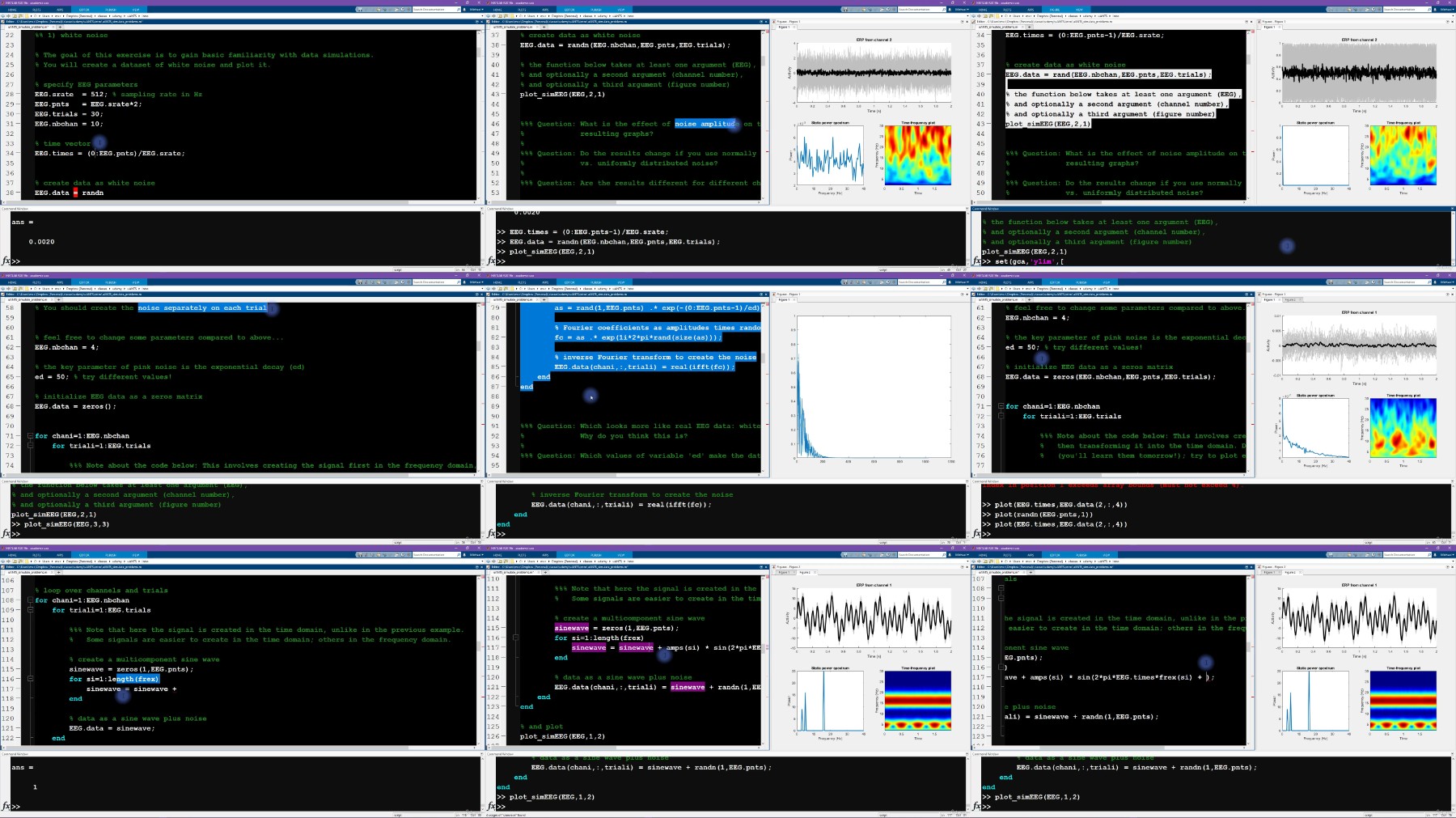
Lecture 21 Problem set (1/2): Simulating and visualizing data

Lecture 22 Problem set (2/2): Simulating and visualizing data

Lecture 23 Planck, neuron, universe

Section 3: Simulating time series signals and noise

Lecture 24 MATLAB files for this section

Lecture 25 Why simulate data?

Lecture 26 Generating white and pink noise

Lecture 27 The three important equations (sine, Gaussian, Euler's)

Lecture 28 Generating "chirps" (frequency-modulated signals)

Lecture 29 Non-stationary narrowband activity via filtered noise

Lecture 30 Transient oscillation

Lecture 31 The eeglab EEG structure

Lecture 32 Project 1-1: Channel-level EEG data

Lecture 33 Project 1-1: Solutions

Lecture 34 Projecting dipoles onto EEG electrodes

Lecture 35 Project 1-2: dipole-level EEG data

Lecture 36 Project 1-2: Solutions

Section 4: Time-domain analyses

Lecture 37 MATLAB files for this section

Lecture 38 Event-related potential (ERP)

Lecture 39 Lowpass filter an ERP

Lecture 40 Compute the average reference

Lecture 41 Butterfly plot and topo-variance time series

Lecture 42 Topography time series

Lecture 43 Simulate ERPs from two dipoles

Lecture 44 Project 2-1: Quantify the ERP as peak-mean or peak-to-peak

Lecture 45 Project 2-1: Solutions

Lecture 46 Project 2-2: ERP peak latency topoplot

Lecture 47 Project 2-2: Solutions

Section 5: Static spectral analysis

Lecture 48 Download MATLAB materials for this section

Lecture 49 Course tangent: self-accountability in online learning

Lecture 50 Time and frequency domains

Lecture 51 Sine waves

Lecture 52 MATLAB: Sine waves and their parameters

Lecture 53 Complex numbers

Lecture 54 Euler's formula

Lecture 55 MATLAB: Complex numbers and Euler's formula

Lecture 56 The dot product

Lecture 57 MATLAB: Dot product and sine waves

Lecture 58 Complex sine waves

Lecture 59 MATLAB: Complex sine waves

Lecture 60 The complex dot product

Lecture 61 MATLAB: The complex dot product

Lecture 62 Fourier coefficients

Lecture 63 MATLAB: The discrete-time Fourier transform

Lecture 64 MATLAB: Fourier coefficients as complex numbers

Lecture 65 Frequencies in the Fourier transform

Lecture 66 Positive and negative frequencies

Lecture 67 Accurate scaling of Fourier coefficients

Lecture 68 MATLAB: Positive/negative spectrum; amplitude scaling

Lecture 69 MATLAB: Spectral analysis of resting-state EEG

Lecture 70 MATLAB: Quantify alpha power over the scalp

Lecture 71 The perfection of the Fourier transform

Lecture 72 The inverse Fourier transform

Lecture 73 MATLAB: Reconstruct a signal via inverse FFT

Lecture 74 Frequency resolution and zero-padding

Lecture 75 MATLAB: Frequency resolution and zero-padding

Lecture 76 Estimation errors and Fourier coefficients

Lecture 77 Signal nonstationarities

Lecture 78 MATLAB: Examples of sharp nonstationarities on power spectra

Lecture 79 MATLAB: Examples of smooth nonstationarities on power spectra

Lecture 80 Welch's method for smooth spectral decomposition

Lecture 81 MATLAB: Welch's method on phase-slip data

Lecture 82 MATLAB: Welch's method on resting-state EEG data

Lecture 83 MATLAB: Welch's method on V1 dataset

Lecture 84 Problem set (1/2): Spectral analyses of real and simulated data

Lecture 85 Problem set (2/2): Spectral analyses of real and simulated data

Section 6: More on static spectral analyses

Lecture 86 MATLAB files for this section

Lecture 87 Program the Fourier transform from scratch!

Lecture 88 Program the inverse Fourier transform from scratch!

Lecture 89 Spectral separation on simulated dipole data

Lecture 90 FFT of stationary and non-stationary simulated data

Lecture 91 FFT and Welch's method on EEG resting state data

Lecture 92 To taper or not to taper?

Lecture 93 Extracting average power from a frequency band

Lecture 94 Comparing average spectra vs. spectra of an average

Lecture 95 Project 3-1: Topography of spectrally separated activity

Lecture 96 Project 3-1: Solutions

Lecture 97 Project 3-2: Topography of alpha-theta ratio

Lecture 98 Project 3-2: Solutions

Section 7: Time-frequency analysis

Lecture 99 Download MATLAB materials for this section

Lecture 100 Morlet wavelets in time and in frequency

Lecture 101 MATLAB: Getting to know Morlet wavelets

Lecture 102 Convolution in the time domain

Lecture 103 MATLAB: Time-domain convolution

Lecture 104 Convolution as spectral multiplication

Lecture 105 MATLAB: The five steps of convolution

Lecture 106 MATLAB: Convolve real data with a Gaussian

Lecture 107 MATLAB: Complex Morlet wavelets

Lecture 108 Complex Morlet wavelet convolution

Lecture 109 Convolution coding tips

Lecture 110 MATLAB: Complex Morlet wavelet convolution

Lecture 111 MATLAB: Convolution with all trials!

Lecture 112 MATLAB: A full time-frequency power plot!

Lecture 113 Averaging phase values

Lecture 114 Inter-trial phase clustering (ITPC/ITC)

Lecture 115 MATLAB: ITPC

Lecture 116 Parameters of Morlet wavelet (time-frequency trade-off)

Lecture 117 MATLAB: Time-frequency trade-off

Lecture 118 The stationarity assumption of wavelet convolution

Lecture 119 The "1/f" structure of spectral brain dynamics

Lecture 120 Baseline normalization of time-frequency power

Lecture 121 MATLAB: Baseline normalization of TF plots

Lecture 122 Scale-free dynamics via detrended fluctuation analysis (DFA)

Lecture 123 MATLAB: detrended fluctuation analysis

Lecture 124 The filter-Hilbert time-frequency method

Lecture 125 MATLAB: Filter-Hilbert

Lecture 126 The short-time Fourier transform (STFFT)

Lecture 127 MATLAB: STFFT

Lecture 128 Comparing wavelet, filter-Hilbert, and STFFT

Lecture 129 The multi-taper method

Lecture 130 Within-subject, cross-trial regression

Lecture 131 MATLAB: Cross-trial regression

Lecture 132 Temporal resolution vs. precision, pre- and post-convolution

Lecture 133 MATLAB: Downsampling time-frequency results

Lecture 134 MATLAB: Linear vs. logarithmic frequency scaling

Lecture 135 Separating phase-locked and non-phase-locked activity

Lecture 136 MATLAB: Total, non-phase-locked, and phase-locked power

Lecture 137 Edge effects, buffer zones, and data epoch length

Lecture 138 Problem set (1/3): Time-frequency analysis

Lecture 139 Problem set (2/3): Time-frequency analysis

Lecture 140 Problem set (3/3): Time-frequency analysis

Section 8: More on time-frequency analysis

Lecture 141 MATLAB files for this section

Lecture 142 Create a family of complex Morlet wavelets

Lecture 143 Create a time-frequency plot of a nonlinear chirp

Lecture 144 Compare wavelet-derived spectrum and FFT

Lecture 145 Wavelet convolution of close frequencies

Lecture 146 Time-frequency power of multitrial EEG activity

Lecture 147 Baseline normalize power with dB and % change

Lecture 148 Exploring wavelet parameters in real data

Lecture 149 Exploring wavelet parameters in simulated data

Lecture 150 Inter-trial phase clustering before vs. after removing ERP

Lecture 151 Downsampling time-frequency power

Lecture 152 Visualize time-frequency power from all channels

Lecture 153 Instantaneous frequency in simulated data

Lecture 154 Instantaneous frequency in real data

Lecture 155 Project 4-1: Phase-locked, non-phase-locked, and total power

Lecture 156 Project 4-1: Solutions

Lecture 157 Narrowband filtering and the Hilbert transform

Lecture 158 Project 4-2: Time-frequency power plot via filter-Hilbert

Lecture 159 Project 4-2: Solutions

Section 9: Synchronization analyses

Lecture 160 Download MATLAB materials for this section

Lecture 161 Four things to keep in mind about connectivity

Lecture 162 Volume conduction and what to do about it

Lecture 163 Intuition about phase synchronization

Lecture 164 Inter-site phase clustering (ISPC)

Lecture 165 MATLAB: ISPC

Lecture 166 Surface Laplacian for connectivity analyses

Lecture 167 MATLAB: Laplacian in simulated data

Lecture 168 MATLAB: Laplacian in real EEG data

Lecture 169 Phase-lag-based connectivity

Lecture 170 MATLAB: phase-lag index

Lecture 171 When to use phase-lag vs. phase-clustering measures

Lecture 172 MATLAB: Phase synchronization in voltage and Laplacian data

Lecture 173 Connectivity over time vs. over trials

Lecture 174 MATLAB: Connectivity over time vs. over trials

Lecture 175 MATLAB: Simulating data to test connectivity methods

Lecture 176 Two methods of power-based connectivity

Lecture 177 Granger causality (prediction)

Lecture 178 MATLAB: Granger causality

Lecture 179 "Hubness" from graph theory

Lecture 180 MATLAB: Connectivity hubs

Lecture 181 When to use which connectivity method?

Lecture 182 Problem set (1/2): Pairwise synchronization

Lecture 183 Problem set (2/2): Pairwise synchronization

Section 10: More on synchronization analyses

Lecture 184 MATLAB files for this section

Lecture 185 Synchronization in simulated noisy oscillators

Lecture 186 Spurious connectivity in narrowband noise

Lecture 187 Phase synchronization matrices in multitrial data

Lecture 188 Power time series correlations

Lecture 189 Power correlations over trials

Lecture 190 Scalp Laplacian for electrode-level connectivity

Lecture 191 All-to-all synchronization and "hubness" (graph theory)

Lecture 192 Phase-lag index

Lecture 193 Project 5-1: ISPC and PLI, with and without Laplacian

Lecture 194 Project 5-1: Solutions

Lecture 195 Project 5-2: Seeded phase vs. power coupling

Lecture 196 Project 5-2: Solutions

Section 11: Permutation-based statistics

Lecture 197 Download MATLAB materials for this section

Lecture 198 Introduction: The basis of statistics, necessity, and levels

Lecture 199 Parametric vs. nonparametric statistics

Lecture 200 Permutation-based statistics

Lecture 201 MATLAB: Permutation testing and shuffling

Lecture 202 MATLAB: Permutation testing in real data

Lecture 203 Multiple comparisons and limitations of Bonferroni method

Lecture 204 Cluster-based multiple comparisons correction

Lecture 205 MATLAB: Cluster correction

Lecture 206 Extreme pixel-based multiple comparisons correction

Lecture 207 MATLAB: Extreme pixel correction

Lecture 208 Illustrating statistical significance in plots

Lecture 209 Subject- vs. group-level analyses

Lecture 210 Error bars and guessing significance

Lecture 211 Three approaches for group-level statistics

Lecture 212 MATLAB: Extracting features for group analyses

Lecture 213 Circular inference ("double-dipping")

Section 12: More on permutation testing statistics

Lecture 214 MATLAB files for this section

Lecture 215 Permutation testing for one variable and two groups

Lecture 216 Meta-permutation test for increased stability

Lecture 217 Permutation testing in simulated time series

Lecture 218 Permutation testing for cluster correction in simulated data

Lecture 219 Permutation testing and cluster correction in real EEG data

Lecture 220 Project 7-1: Effects of noise smoothness on cluster correction

Lecture 221 Project 7-1: Solutions

Lecture 222 Project 7-2: Simulate time-frequency data for statistical testing

Lecture 223 Project 7-2: Solutions

Section 13: Multivariate components analysis

Lecture 224 MATLAB files for this section

Lecture 225 Background knowledge for this section

Lecture 226 Simulate multicomponent EEG data

Lecture 227 Create covariance matrices based on time and on frequency

Lecture 228 Principal components analysis (PCA) of simulated data

Lecture 229 Time-based GED for source-separation in simulated data

Lecture 230 Frequency-based GED for source-separation in simulated data

Lecture 231 Project 6-1: GED for interacting alpha sources

Lecture 232 Project 6-1: Solutions

Section 14: Bonus section

Lecture 233 Bonus lecture

Anyone interested in applied signal processing,Interested in non-parametric statistics,Existing or aspiring neuroscience students,Anyone who wants to know what brain electrical signals look like

736113654_yxusj-yu3mn5a55w06.jpg

ecGEtOO7_o.jpg


7fb90246b91b60f0a5e9649468058763.jpg

Complete Neural Signal Processing And Analysis: Zero To Hero
Last updated 11/2022
MP4 | Video: h264, 1920x1080 | Audio: AAC, 44.1 KHz
Language: English | Size: 19.63 GB | Duration: 46h 54m​

What you'll learn

Signal processing

Time series data analysis

Statistics (non-parametric)

Neuroscience (brain science)

Spectral analysis application

Applied math

Requirements

Basic MATLAB knowledge

Access to MATLAB or Octave

Description

Use your brain to learn signal processing, data analysis, and statistics. by learning about brains!If you are reading this, I guess you have a brain. Your brain generates electrical signals that can be measured using electrodes, which are like small antennas. These electrical signals are rreeeeeaaallly complicated, because the brain is really complicated! But learning how to analyze brain electrical signals is an amazing and fascinating way to learn about signal processing, data visualization, spectral analysis, synchronization (connectivity) analyses, and statistics (in particular, permutation-based statistics).What do you get in this course?This course contains over 46 hours of video instruction, plus TONS of MATLAB exercises, problem sets, and challenges.If you do all the MATLAB exercises, this course is easily well over 100 hours of educational content.And you get access to the Q&A forum, where you can post specific questions about the course material and I answer as quickly as I can (typically 1-2 days).By the end of this course, you will have confidence in processing, cleaning, analyzing, and performing statistics on brain electrical activity.What do you need to know before joining this course?I have tried to make this course accessible to anyone who is interested in learning neural signal processing and time series analysis.I believe you can simply start this course without any formal background in neuroscience/biology, and without any background in signal processing/math/statistics. That said, some background in these topics will definitely be helpful.However, I do assume that you have access to MATLAB (or Octave), and that you have some basic MATLAB coding skills (variables, for-loops, basic plotting). If you are a total noob to MATLAB, then please first take an intro-MATLAB course and then come back here. Why should you trust this weird Mike X Cohen guy?I've been teaching this material for almost 20 years. I'm really dedicated to teaching and I work really hard to improve my courses each year. Check out the reviews of this course and my other courses to see what my students think of my teaching style and dedication.I've also written several textbooks on neural data analysis and scientific programming. And there are more books and more courses on the way!. but you have to watch out for my weird sense of humor. You've been warned.

Overview

Section 1: Introduction

Lecture 1 Broad introduction to neural time series analysis

Lecture 2 Neural data science as source sepatation

Lecture 3 What to expect from this course

Lecture 4 A quick note about how this went from 2 to 1 course

Lecture 5 Download this file if you are using Octave (otherwise ignore)

Section 2: The basics of neural signal processing

Lecture 6 Download MATLAB materials for this course

Lecture 7 Origin, significance, and interpretation of EEG

Lecture 8 Overview of possible preprocessing steps

Lecture 9 ICA for data cleaning

Lecture 10 Signal artifacts (not) to worry about

Lecture 11 Topographical mapping

Lecture 12 Overview of time-domain analyses (ERPs)

Lecture 13 Motivations for rhythm-based analyses

Lecture 14 Interpreting time-frequency plots

Lecture 15 The empirical datasets used in this course

Lecture 16 MATLAB: EEG dataset

Lecture 17 MATLAB: V1 dataset

Lecture 18 Where to get more EEG data?

Lecture 19 Simulating data to understand analysis methods

Lecture 20 Problem set: introduction and explanation

Lecture 21 Problem set (1/2): Simulating and visualizing data

Lecture 22 Problem set (2/2): Simulating and visualizing data

Lecture 23 Planck, neuron, universe

Section 3: Simulating time series signals and noise

Lecture 24 MATLAB files for this section

Lecture 25 Why simulate data?

Lecture 26 Generating white and pink noise

Lecture 27 The three important equations (sine, Gaussian, Euler's)

Lecture 28 Generating "chirps" (frequency-modulated signals)

Lecture 29 Non-stationary narrowband activity via filtered noise

Lecture 30 Transient oscillation

Lecture 31 The eeglab EEG structure

Lecture 32 Project 1-1: Channel-level EEG data

Lecture 33 Project 1-1: Solutions

Lecture 34 Projecting dipoles onto EEG electrodes

Lecture 35 Project 1-2: dipole-level EEG data

Lecture 36 Project 1-2: Solutions

Section 4: Time-domain analyses

Lecture 37 MATLAB files for this section

Lecture 38 Event-related potential (ERP)

Lecture 39 Lowpass filter an ERP

Lecture 40 Compute the average reference

Lecture 41 Butterfly plot and topo-variance time series

Lecture 42 Topography time series

Lecture 43 Simulate ERPs from two dipoles

Lecture 44 Project 2-1: Quantify the ERP as peak-mean or peak-to-peak

Lecture 45 Project 2-1: Solutions

Lecture 46 Project 2-2: ERP peak latency topoplot

Lecture 47 Project 2-2: Solutions

Section 5: Static spectral analysis

Lecture 48 Download MATLAB materials for this section

Lecture 49 Course tangent: self-accountability in online learning

Lecture 50 Time and frequency domains

Lecture 51 Sine waves

Lecture 52 MATLAB: Sine waves and their parameters

Lecture 53 Complex numbers

Lecture 54 Euler's formula

Lecture 55 MATLAB: Complex numbers and Euler's formula

Lecture 56 The dot product

Lecture 57 MATLAB: Dot product and sine waves

Lecture 58 Complex sine waves

Lecture 59 MATLAB: Complex sine waves

Lecture 60 The complex dot product

Lecture 61 MATLAB: The complex dot product

Lecture 62 Fourier coefficients

Lecture 63 MATLAB: The discrete-time Fourier transform

Lecture 64 MATLAB: Fourier coefficients as complex numbers

Lecture 65 Frequencies in the Fourier transform

Lecture 66 Positive and negative frequencies

Lecture 67 Accurate scaling of Fourier coefficients

Lecture 68 MATLAB: Positive/negative spectrum; amplitude scaling

Lecture 69 MATLAB: Spectral analysis of resting-state EEG

Lecture 70 MATLAB: Quantify alpha power over the scalp

Lecture 71 The perfection of the Fourier transform

Lecture 72 The inverse Fourier transform

Lecture 73 MATLAB: Reconstruct a signal via inverse FFT

Lecture 74 Frequency resolution and zero-padding

Lecture 75 MATLAB: Frequency resolution and zero-padding

Lecture 76 Estimation errors and Fourier coefficients

Lecture 77 Signal nonstationarities

Lecture 78 MATLAB: Examples of sharp nonstationarities on power spectra

Lecture 79 MATLAB: Examples of smooth nonstationarities on power spectra

Lecture 80 Welch's method for smooth spectral decomposition

Lecture 81 MATLAB: Welch's method on phase-slip data

Lecture 82 MATLAB: Welch's method on resting-state EEG data

Lecture 83 MATLAB: Welch's method on V1 dataset

Lecture 84 Problem set (1/2): Spectral analyses of real and simulated data

Lecture 85 Problem set (2/2): Spectral analyses of real and simulated data

Section 6: More on static spectral analyses

Lecture 86 MATLAB files for this section

Lecture 87 Program the Fourier transform from scratch!

Lecture 88 Program the inverse Fourier transform from scratch!

Lecture 89 Spectral separation on simulated dipole data

Lecture 90 FFT of stationary and non-stationary simulated data

Lecture 91 FFT and Welch's method on EEG resting state data

Lecture 92 To taper or not to taper?

Lecture 93 Extracting average power from a frequency band

Lecture 94 Comparing average spectra vs. spectra of an average

Lecture 95 Project 3-1: Topography of spectrally separated activity

Lecture 96 Project 3-1: Solutions

Lecture 97 Project 3-2: Topography of alpha-theta ratio

Lecture 98 Project 3-2: Solutions

Section 7: Time-frequency analysis

Lecture 99 Download MATLAB materials for this section

Lecture 100 Morlet wavelets in time and in frequency

Lecture 101 MATLAB: Getting to know Morlet wavelets

Lecture 102 Convolution in the time domain

Lecture 103 MATLAB: Time-domain convolution

Lecture 104 Convolution as spectral multiplication

Lecture 105 MATLAB: The five steps of convolution

Lecture 106 MATLAB: Convolve real data with a Gaussian

Lecture 107 MATLAB: Complex Morlet wavelets

Lecture 108 Complex Morlet wavelet convolution

Lecture 109 Convolution coding tips

Lecture 110 MATLAB: Complex Morlet wavelet convolution

Lecture 111 MATLAB: Convolution with all trials!

Lecture 112 MATLAB: A full time-frequency power plot!

Lecture 113 Averaging phase values

Lecture 114 Inter-trial phase clustering (ITPC/ITC)

Lecture 115 MATLAB: ITPC

Lecture 116 Parameters of Morlet wavelet (time-frequency trade-off)

Lecture 117 MATLAB: Time-frequency trade-off

Lecture 118 The stationarity assumption of wavelet convolution

Lecture 119 The "1/f" structure of spectral brain dynamics

Lecture 120 Baseline normalization of time-frequency power

Lecture 121 MATLAB: Baseline normalization of TF plots

Lecture 122 Scale-free dynamics via detrended fluctuation analysis (DFA)

Lecture 123 MATLAB: detrended fluctuation analysis

Lecture 124 The filter-Hilbert time-frequency method

Lecture 125 MATLAB: Filter-Hilbert

Lecture 126 The short-time Fourier transform (STFFT)

Lecture 127 MATLAB: STFFT

Lecture 128 Comparing wavelet, filter-Hilbert, and STFFT

Lecture 129 The multi-taper method

Lecture 130 Within-subject, cross-trial regression

Lecture 131 MATLAB: Cross-trial regression

Lecture 132 Temporal resolution vs. precision, pre- and post-convolution

Lecture 133 MATLAB: Downsampling time-frequency results

Lecture 134 MATLAB: Linear vs. logarithmic frequency scaling

Lecture 135 Separating phase-locked and non-phase-locked activity

Lecture 136 MATLAB: Total, non-phase-locked, and phase-locked power

Lecture 137 Edge effects, buffer zones, and data epoch length

Lecture 138 Problem set (1/3): Time-frequency analysis

Lecture 139 Problem set (2/3): Time-frequency analysis

Lecture 140 Problem set (3/3): Time-frequency analysis

Section 8: More on time-frequency analysis

Lecture 141 MATLAB files for this section

Lecture 142 Create a family of complex Morlet wavelets

Lecture 143 Create a time-frequency plot of a nonlinear chirp

Lecture 144 Compare wavelet-derived spectrum and FFT

Lecture 145 Wavelet convolution of close frequencies

Lecture 146 Time-frequency power of multitrial EEG activity

Lecture 147 Baseline normalize power with dB and % change

Lecture 148 Exploring wavelet parameters in real data

Lecture 149 Exploring wavelet parameters in simulated data

Lecture 150 Inter-trial phase clustering before vs. after removing ERP

Lecture 151 Downsampling time-frequency power

Lecture 152 Visualize time-frequency power from all channels

Lecture 153 Instantaneous frequency in simulated data

Lecture 154 Instantaneous frequency in real data

Lecture 155 Project 4-1: Phase-locked, non-phase-locked, and total power

Lecture 156 Project 4-1: Solutions

Lecture 157 Narrowband filtering and the Hilbert transform

Lecture 158 Project 4-2: Time-frequency power plot via filter-Hilbert

Lecture 159 Project 4-2: Solutions

Section 9: Synchronization analyses

Lecture 160 Download MATLAB materials for this section

Lecture 161 Four things to keep in mind about connectivity

Lecture 162 Volume conduction and what to do about it

Lecture 163 Intuition about phase synchronization

Lecture 164 Inter-site phase clustering (ISPC)

Lecture 165 MATLAB: ISPC

Lecture 166 Surface Laplacian for connectivity analyses

Lecture 167 MATLAB: Laplacian in simulated data

Lecture 168 MATLAB: Laplacian in real EEG data

Lecture 169 Phase-lag-based connectivity

Lecture 170 MATLAB: phase-lag index

Lecture 171 When to use phase-lag vs. phase-clustering measures

Lecture 172 MATLAB: Phase synchronization in voltage and Laplacian data

Lecture 173 Connectivity over time vs. over trials

Lecture 174 MATLAB: Connectivity over time vs. over trials

Lecture 175 MATLAB: Simulating data to test connectivity methods

Lecture 176 Two methods of power-based connectivity

Lecture 177 Granger causality (prediction)

Lecture 178 MATLAB: Granger causality

Lecture 179 "Hubness" from graph theory

Lecture 180 MATLAB: Connectivity hubs

Lecture 181 When to use which connectivity method?

Lecture 182 Problem set (1/2): Pairwise synchronization

Lecture 183 Problem set (2/2): Pairwise synchronization

Section 10: More on synchronization analyses

Lecture 184 MATLAB files for this section

Lecture 185 Synchronization in simulated noisy oscillators

Lecture 186 Spurious connectivity in narrowband noise

Lecture 187 Phase synchronization matrices in multitrial data

Lecture 188 Power time series correlations

Lecture 189 Power correlations over trials

Lecture 190 Scalp Laplacian for electrode-level connectivity

Lecture 191 All-to-all synchronization and "hubness" (graph theory)

Lecture 192 Phase-lag index

Lecture 193 Project 5-1: ISPC and PLI, with and without Laplacian

Lecture 194 Project 5-1: Solutions

Lecture 195 Project 5-2: Seeded phase vs. power coupling

Lecture 196 Project 5-2: Solutions

Section 11: Permutation-based statistics

Lecture 197 Download MATLAB materials for this section

Lecture 198 Introduction: The basis of statistics, necessity, and levels

Lecture 199 Parametric vs. nonparametric statistics

Lecture 200 Permutation-based statistics

Lecture 201 MATLAB: Permutation testing and shuffling

Lecture 202 MATLAB: Permutation testing in real data

Lecture 203 Multiple comparisons and limitations of Bonferroni method

Lecture 204 Cluster-based multiple comparisons correction

Lecture 205 MATLAB: Cluster correction

Lecture 206 Extreme pixel-based multiple comparisons correction

Lecture 207 MATLAB: Extreme pixel correction

Lecture 208 Illustrating statistical significance in plots

Lecture 209 Subject- vs. group-level analyses

Lecture 210 Error bars and guessing significance

Lecture 211 Three approaches for group-level statistics

Lecture 212 MATLAB: Extracting features for group analyses

Lecture 213 Circular inference ("double-dipping")

Section 12: More on permutation testing statistics

Lecture 214 MATLAB files for this section

Lecture 215 Permutation testing for one variable and two groups

Lecture 216 Meta-permutation test for increased stability

Lecture 217 Permutation testing in simulated time series

Lecture 218 Permutation testing for cluster correction in simulated data

Lecture 219 Permutation testing and cluster correction in real EEG data

Lecture 220 Project 7-1: Effects of noise smoothness on cluster correction

Lecture 221 Project 7-1: Solutions

Lecture 222 Project 7-2: Simulate time-frequency data for statistical testing

Lecture 223 Project 7-2: Solutions

Section 13: Multivariate components analysis

Lecture 224 MATLAB files for this section

Lecture 225 Background knowledge for this section

Lecture 226 Simulate multicomponent EEG data

Lecture 227 Create covariance matrices based on time and on frequency

Lecture 228 Principal components analysis (PCA) of simulated data

Lecture 229 Time-based GED for source-separation in simulated data

Lecture 230 Frequency-based GED for source-separation in simulated data

Lecture 231 Project 6-1: GED for interacting alpha sources

Lecture 232 Project 6-1: Solutions

Section 14: Bonus section

Lecture 233 Bonus lecture

Anyone interested in applied signal processing,Interested in non-parametric statistics,Existing or aspiring neuroscience students,Anyone who wants to know what brain electrical signals look like

16-Problem-set-12-Simulating-and-visualizing-data.jpg

 
Zurück
Oben Unten