Follow along with the video below to see how to install our site as a web app on your home screen.
Anmerkung: This feature currently requires accessing the site using the built-in Safari browser.
Regeln für den Dokumente-Bereich:
In den Börsenbereich gehören nur Angebote die bereits den Allgemeinen Regeln entsprechen.
Allgemeines:
Nicht erlaubt im Dokumente-Bereich sind:
- indizierte Titel (inkl. Comics)
- extremistische Werke, Zeitschriften und Comics (egal, welche Richtung)
- jegliche Art von Pornographie
- Anleitungen zu kriminellen Handlungen, gleich welcher Art
- sadistische, menschenverachtende oder ähnliche Werke
Nutzt den "Bedanken"-Button, bei Sammelthreads führen jegliche Kommentare, positiv wie negativ, sehr schnell zu einer Unübersichtlichkeit des Threads. Downmeldungen sind an den Uploader zu richten
Vor dem Einstellen zu beachten:
- Suchfunktion
Vergewissert euch, dass es euer Dokument noch nicht im Board gibt, Doppelposts werden kommentarlos gelöscht. Ist es schon vorhanden, tragt es als Mirror im bestehenden Post ein.
- Threadtitel
Idealerweise ist sofort zu erkennen um was es sich handelt. Verseht euren Titel mit den relevanten Informationen, das hilft euch und damit auch uns und allen Suchenden erheblich weiter.
Beispiel: [Thriller] Dan Brown - Inferno oder bei Magazinen:
Computerbild - 14/2014 (es muss ersichtlich sein, um welche Ausgabe und welches Magazin es sich handelt)
Folgende Präfixe stehen im Unterforum "Unterhaltung" zur Verfügung:
- Autor
- Titel
- Präfix
- Cover
- Genre
- Inhaltsbeschreibung
- enthaltene Formate
- Gesamtgröße des Downloads
- Hoster
- ggf. Passwort
Nicht erlaubt sind alle Dateien, die den Download unnötig aufblähen um eine Affiliategrenze zu erreichen, wie zB. mp3-files, übergroße Bilder, etc.
Ebenso nicht erlaubt sind sämtliche Dateien mit DRM, persönlichen Daten, etc., diese werden kommentarlos zu eurem eigenem Schutz gelöscht.
Achtet bitte bei der Konvertierung der Formate auf die Lesbarkeit, ein epub, was nur einfach durch Calibre gejagt wird um ein PDF zu erhalten, ist zu 99% eben nicht lesbar. Wenn ihr es nicht könnt, dann lasst es besser oder lest euch ein, wie man es richtig macht.
Unterforum Comics:
Threadtitel:
Ähnlich, wie bei Unterhaltung und Magazinen, sollte der Titel alle relevanten Informationen enthalten, hier bitte
- den Titel des Comics
- den Verlag (einige Comics sind in verschiedenen Verlagen erschienen)
- das Erscheinungsjahr
Erlaubt sind folgende Formate:
- CBR
- CBZ
Grundsätzlich gilt: jede Version eines Comics erhält einen eigenen Thread, Ersteller eines Comics können ihre Bände gerne mit dem Zusatz (Original-Release) versehen.
Bei Unsicherheiten zur korrekten Benennung bitte die Informationen von www.comicguide.de nutzen.
Inhalt des Beitrags:
Pflichtangaben hier sind:
- Titel des Bandes und ggf. Nummer
- Cover
- falls bekannt technische Daten (DPI, Breite, Speicherqualität)
- Größe des Downloads
- Hoster
- ggf. Passwort
- falls bekannt Releasenamen
Du verwendest einen veralteten Browser. Es ist möglich, dass diese oder andere Websites nicht korrekt angezeigt werden. Du solltest ein Upgrade durchführen oder einen alternativen Browser verwenden.
Collection Download Ebooks Best Seller Updated Daily
Differential Forms and Applications by Manfredo P. Carmo
English | PDF | 1994 | 124 Pages | ISBN : 3540576185 | 8.3 MB
This is a free translation of a set of notes published originally in Portuguese in 1971. They were translated for a course in the College of Differential Geome try, ICTP, Trieste, 1989. In the English translation we omitted a chapter on the Frobenius theorem and an appendix on the nonexistence of a complete hyperbolic plane in euclidean 3-space (Hilbert's theorem). For the present edition, we introduced a chapter on line integrals. In Chapter 1 we introduce the differential forms in Rn. We only assume an elementary knowledge of calculus, and the chapter can be used as a basis for a course on differential forms for "users" of Mathematics. In Chapter 2 we start integrating differential forms of degree one along curves in Rn. This already allows some applications of the ideas of Chapter 1. This material is not used in the rest of the book. In Chapter 3 we present the basic notions of differentiable manifolds. It is useful (but not essential) that the reader be familiar with the notion ofa regular surface in R3. In Chapter 4 we introduce the notion of manifold with boundary and prove Stokes theorem and Poincare's lemma. Starting from this basic material, we could follow any of the possi ble routes for applications: Topology, Differential Geometry, Mechanics, Lie Groups, etc. We have chosen Differential Geometry. For simplicity, we re stricted ourselves to surfaces.
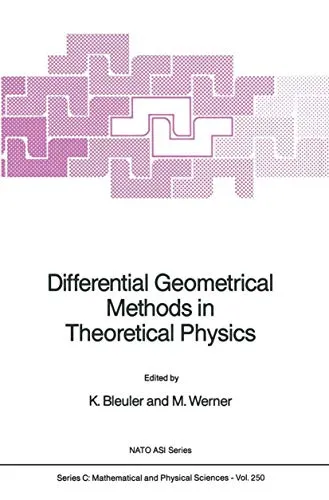
Differential Geometrical Methods in Theoretical Physics by K. Bleuler, M. Werner
English | PDF | 1988 | 474 Pages | ISBN : 9027728208 | 50.7 MB
The recent most impressive developments in theoretical physics, i.e. gauge and string theories with their far- reaching relations to basic concepts of present day mathematics brought a renewed and intense exchange between mathematicians and physicists. In a way the past few years might be compared to the great period of the mid-twenties with its really decisive mathematical contributions to the foundations of both quantum theory as well as general relativity .. Among others, this far-reaching exchange led H.Weyl in 1929 to the formulation of his (second) gauge principle (concerning the phase of the quantum mechanical wave function) which led, in turn (through the most natural generalization by C.N.Yang and R.Mills in 1954) to present day gauge theory which brought, first of all, a real breakthrough with respect to a theoretical inter- pretation of an enormous realm of data in modern particle physics. It led, in fact, to the well-known unification of electromagnetism with weak interactions (Weinberg-Salam theory) and, at the same time, to a most natural unifica- tion of particle and nuclear physics through QCD which deals with the basic quark-gluon structure of heavy matter, e.g. hadrons.
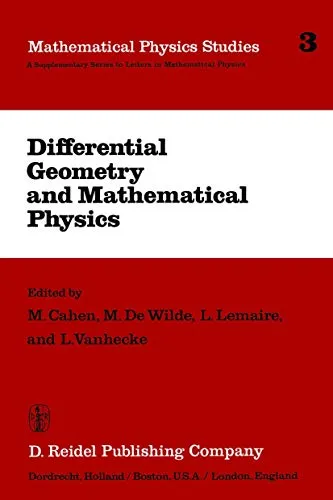
Differential Geometry and Mathematical Physics: Lectures given at the Meetings of the Belgian Contact Group on Differential Geometry held at Liège, May 2-3, 1980 and at Leuven, February 6-8, 1981 by M. Cahen, M. Wilde, L. Lemaire, L. Vanhecke
English | PDF | 1983 | 187 Pages | ISBN : 9027715084 | 13.2 MB
This volume contains the text of the lectures which were given at the Differential Geometry Meeting held at Liege in 1980 and at the Differential Geometry Meeting held at Leuven in 1981. The first of these meetings was more orientated toward mathematical physics; the second has a stronger flavour of analysis. The Editors are pleased to thank the lectures who contributed scientifically to these two meetings. They are also grateful to Professor M. F1ato who has encouraged publication of these contributions in the Mathematical Physics Studies Series. We also thank the F.N.R.S. who supported financially the Contact group in differential geometry. The Universite de Liege and the Katholieke Universiteit Leuven which have given us a warm hospitality have contributed to the success of these meetings. We express our gratitude. The Editors. M. Caken et al. (6ds.), Differential Geametry and Mathematical Physics, vii. vii Copyright e 1983 by D. Reidel Publishing Company. Lectures given at the Meeting of the Belgian Contact Group on Differential Geometry held at Liege, May 2-3,1980 SIMULTANEOUS DEFORMATIONS OF A LIE ALGEBRA AND ITS MODULES D. Arnal University of Dijon INTRODUCTION We expose here some results which are obtained by a team at the University of Dijon. This team included Jean-Claude Cortet, Georges Pinczon and myself.
Differential Geometry and Relativity: A Volume in Honour of André Lichnerowicz on His 60th Birthday by M. Cahen, M. Flato
English | PDF | 1976 | 302 Pages | ISBN : 9027707456 | 34.2 MB
On the occasion of the sixtieth birthday of Andre Lichnerowicz a number of his friends, many of whom have been his students or coworkers, decided to celebrate this event by preparing a jubilee volume of contributed articles in the two main fields of research marked by Lichnerowicz's work, namely differential geometry and mathematical physics. Limitations of space and time did not enable us to include papers from all Lichnerowicz's friends nor from all his former students. It was equally impossible to reflect in a single book the great variety of subjects tackled by Lichnerowicz. In spite of these limitations, we hope that this book reflects some of the present trends of fields in which he worked, and some of the subjects to which he contributed in his long - and not yet finished - career. This career was very much marked by the influence of his masters, Elie Cartan who introduced him to research in mathematics, mainly in geometry and its relations with mathematical physics, and Georges Darmois who developed his interest for mechanics and physics, especially the theory of relativity and electromagnetism. This par ticular combination, and his personal talent, made of him a natural scientific heir and continuator of the French mathematical physics school in the tradition of Henri Poincare. Some of his works would even be best qualified by a new field name, that of physical ma thematics: branches of pure mathematics entirely motivated by physics.
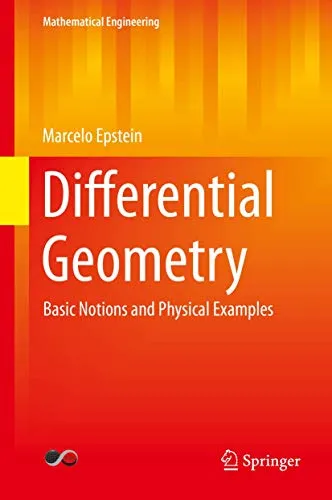
Differential Geometry: Basic Notions and Physical Examples by Marcelo Epstein
English | PDF (True) | 2014 | 147 Pages | ISBN : 3319069195 | 1.9 MB
Differential Geometry offers a concise introduction to some basic notions of modern differential geometry and their applications to solid mechanics and physics.
Concepts such as manifolds, groups, fibre bundles and groupoids are first introduced within a purely topological framework. They are shown to be relevant to the description of space-time, configuration spaces of mechanical systems, symmetries in general, microstructure and local and distant symmetries of the constitutive response of continuous media.
Once these ideas have been grasped at the topological level, the differential structure needed for the description of physical fields is introduced in terms of differentiable manifolds and principal frame bundles. These mathematical concepts are then illustrated with examples from continuum kinematics, Lagrangian and Hamiltonian mechanics, Cauchy fluxes and dislocation theory.
This book will be useful for researchers and graduate students in science and engineering.
[/b]
Differential Geometry in the Large: Seminar Lectures New York University 1946 and Stanford University 1956 by Heinz Hopf
English | PDF | 1983 | 192 Pages | ISBN : 3540120041 | 11.9 MB
These notes consist of two parts: 1) Selected Topics in Geometry, New York University 1946, Notes by Peter Lax. 2) Lectures on Differential Geometry in the Large, Stanford University 1956, Notes by J. W. Gray. They are reproduced here with no essential change. Heinz Hopf was a mathematician who recognized important mathema tical ideas and new mathematical phenomena through special cases. In the simplest background the central idea or the difficulty of a problem usually becomes crystal clear. Doing geometry in this fashion is a joy. Hopf's great insight allows this approach to lead to serious ma thematics, for most of the topics in these notes have become the star ting-points of important further developments. I will try to mention a few. It is clear from these notes that Hopf laid the emphasis on poly hedral differential geometry. Most of the results in smooth differen tial geometry have polyhedral counterparts, whose understanding is both important and challenging. Among recent works I wish to mention those of Robert Connelly on rigidity, which is very much in the spirit of these notes (cf. R. Connelly, Conjectures and open questions in ri gidity, Proceedings of International Congress of Mathematicians, Hel sinki 1978, vol. 1, 407-414 ) * A theory of area and volume of rectilinear'polyhedra based on de compositions originated with Bolyai and Gauss.
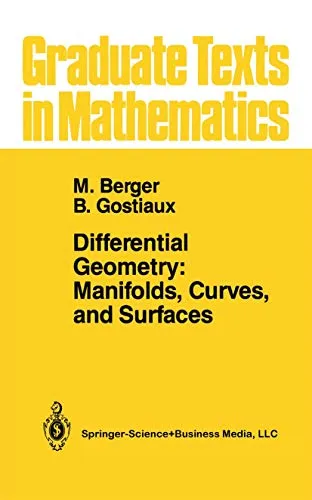
Differential Geometry: Manifolds, Curves, and Surfaces: Manifolds, Curves, and Surfaces by Marcel Berger , Bernard Gostiaux
English | PDF (True) | 1988 | 487 Pages | ISBN : 0387966269 | 34.9 MB
This book consists of two parts, different in form but similar in spirit. The first, which comprises chapters 0 through 9, is a revised and somewhat enlarged version of the 1972 book Geometrie Differentielle. The second part, chapters 10 and 11, is an attempt to remedy the notorious absence in the original book of any treatment of surfaces in three-space, an omission all the more unforgivable in that surfaces are some of the most common geometrical objects, not only in mathematics but in many branches of physics. Geometrie Differentielle was based on a course I taught in Paris in 1969- 70 and again in 1970-71. In designing this course I was decisively influ enced by a conversation with Serge Lang, and I let myself be guided by three general ideas. First, to avoid making the statement and proof of Stokes' formula the climax of the course and running out of time before any of its applications could be discussed. Second, to illustrate each new notion with non-trivial examples, as soon as possible after its introduc tion. And finally, to familiarize geometry-oriented students with analysis and analysis-oriented students with geometry, at least in what concerns manifolds.
Differential Geometry of Foliations: The Fundamental Integrability Problem by Bruce L. Reinhart
English | PDF | 1983 | 204 Pages | ISBN : 3642690173 | 46.7 MB
Whoever you are! How can I but offer you divine leaves . . . ? Walt Whitman The object of study in modern differential geometry is a manifold with a differ ential structure, and usually some additional structure as well. Thus, one is given a topological space M and a family of homeomorphisms, called coordinate sys tems, between open subsets of the space and open subsets of a real vector space V. It is supposed that where two domains overlap, the images are related by a diffeomorphism, called a coordinate transformation, between open subsets of V. M has associated with it a tangent bundle, which is a vector bundle with fiber V and group the general linear group GL(V). The additional structures that occur include Riemannian metrics, connections, complex structures, foliations, and many more. Frequently there is associated to the structure a reduction of the group of the tangent bundle to some subgroup G of GL(V). It is particularly pleasant if one can choose the coordinate systems so that the Jacobian matrices of the coordinate transformations belong to G. A reduction to G is called a G-structure, which is called integrable (or flat) if the condition on the Jacobians is satisfied. The strength of the integrability hypothesis is well-illustrated by the case of the orthogonal group On. An On-structure is given by the choice of a Riemannian metric, and therefore exists on every smooth manifold.
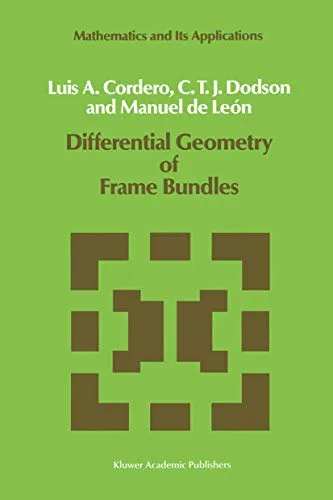
Differential Geometry of Frame Bundles by uis A. Cordero , C. T. J. Dodson , Manuel León
English | PDF | 1989 | 234 Pages | ISBN : 0792300122 | 13.5 MB
It isn't that they can't see the solution. It is Approach your problems from the right end and begin with the answers. Then one day, that they can't see the problem perhaps you will find the final question. G. K. Chesterton. The Scandal of Father 'The Hermit Oad in Crane Feathers' in R. Brown 'The point of a Pin'. van Gu!ik's The Chillese Maze Murders. Growing specialization and diversification have brought a host of monographs and textbooks on increasingly specialized topics. However, the "tree" of knowledge of mathematics and related fields does not grow only by putting forth new branches. It also happens, quite often in fact, that branches which were thought to be completely disparate are suddenly seen to be related. Further, the kind and level of sophistication of mathematics applied in various sciences has changed drastically in recent years: measure theory is used (non-trivially) in regional and theoretical economics; algebraic geometry interacts with physics; the Minkowsky lemma, coding theory and the structure of water meet one another in packing and covering theory; quantum fields, crystal defects and mathematical programming profit from homotopy theory; Lie algebras are relevant to filtering; and prediction and electrical engineering can use Stein spaces. And in addition to this there are such new emerging subdisciplines as "experimental mathematics", "CFD", "completely integrable systems", "chaos, synergetics and large-scale order", which are almost impossible to fit into the existing classification schemes. They draw upon widely different sections of mathematics.
Differential Manifolds by Serge Lang
English | PDF | 1985 | 232 Pages | ISBN : 0387961135 | 16.6 MB
The present volume supersedes my Introduction to Differentiable Manifolds written a few years back. I have expanded the book considerably, including things like the Lie derivative, and especially the basic integration theory of differential forms, with Stokes' theorem and its various special formulations in different contexts. The foreword which I wrote in the earlier book is still quite valid and needs only slight extension here. Between advanced calculus and the three great differential theories (differential topology, differential geometry, ordinary differential equations), there lies a no-man's-land for which there exists no systematic exposition in the literature. It is the purpose of this book to fill the gap. The three differential theories are by no means independent of each other, but proceed according to their own flavor. In differential topology, one studies for instance homotopy classes of maps and the possibility of finding suitable differentiable maps in them (immersions, embeddings, isomorphisms, etc.). One may also use differentiable structures on topological manifolds to determine the topological structure of the manifold (e.g. it la Smale [26]).
Johannes Kabatek, "Differential Object Marking in Romance: The third wave "
English | ISBN: 3110646560 | 2021 | 379 pages | EPUB | 2 MB
After a "first wave" of traditional studies on prepositional accusatives and a "second wave" exploring the typological dimensions of Differential Object Marking in Bossong's footsteps, a new line of research is currently introducing new methods, deepening the level of analysis, and offering new perspectives on the issue. This volume presents 11 innovative, original contributions representative of this "third wave" of studies on DOM in Romance.
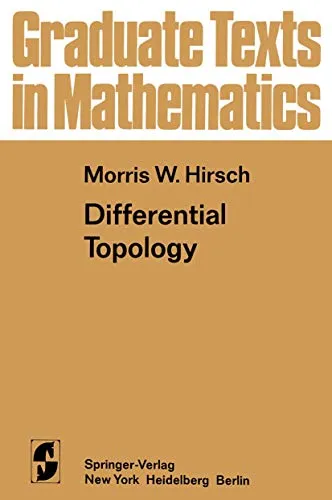
Differential Topology by Morris W. Hirsch
English | PDF | 1976 | 230 Pages | ISBN : 0387901485 | 18.4 MB
This book presents some of the basic topological ideas used in studying differentiable manifolds and maps. Mathematical prerequisites have been kept to a minimum; the standard course in analysis and general topology is adequate preparation. An appendix briefly summarizes some of the back ground material. In order to emphasize the geometrical and intuitive aspects of differen tial topology, I have avoided the use of algebraic topology, except in a few isolated places that can easily be skipped. For the same reason I make no use of differential forms or tensors. In my view, advanced algebraic techniques like homology theory are better understood after one has seen several examples of how the raw material of geometry and analysis is distilled down to numerical invariants, such as those developed in this book: the degree of a map, the Euler number of a vector bundle, the genus of a surface, the cobordism class of a manifold, and so forth. With these as motivating examples, the use of homology and homotopy theory in topology should seem quite natural. There are hundreds of exercises, ranging in difficulty from the routine to the unsolved. While these provide examples and further developments of the theory, they are only rarely relied on in the proofs of theorems.