• Regeln für den Dokumente-Bereich:

    In den Börsenbereich gehören nur Angebote die bereits den Allgemeinen Regeln entsprechen.

    Allgemeines:

    Nicht erlaubt im Dokumente-Bereich sind:

    - indizierte Titel (inkl. Comics)
    - extremistische Werke, Zeitschriften und Comics (egal, welche Richtung)
    - jegliche Art von Pornographie
    - Anleitungen zu kriminellen Handlungen, gleich welcher Art
    - sadistische, menschenverachtende oder ähnliche Werke

    Nutzt den "Bedanken"-Button, bei Sammelthreads führen jegliche Kommentare, positiv wie negativ, sehr schnell zu einer Unübersichtlichkeit des Threads. Downmeldungen sind an den Uploader zu richten

    Vor dem Einstellen zu beachten:

    - Suchfunktion

    Vergewissert euch, dass es euer Dokument noch nicht im Board gibt, Doppelposts werden kommentarlos gelöscht. Ist es schon vorhanden, tragt es als Mirror im bestehenden Post ein.

    - Threadtitel

    Idealerweise ist sofort zu erkennen um was es sich handelt. Verseht euren Titel mit den relevanten Informationen, das hilft euch und damit auch uns und allen Suchenden erheblich weiter.

    Beispiel: [Thriller] Dan Brown - Inferno oder bei Magazinen:

    Computerbild - 14/2014 (es muss ersichtlich sein, um welche Ausgabe und welches Magazin es sich handelt)

    Folgende Präfixe stehen im Unterforum "Unterhaltung" zur Verfügung:

    [Humor]
    [Drama]
    [Erotik]
    [Fantasy]
    [Krimi]
    [Roman]
    [Thriller]
    [Horror]
    [Science Fiction]

    Inhalt des Beitrags:

    Folgende Pflichtangaben gilt es einzuhalten:

    - Autor
    - Titel
    - Präfix
    - Cover
    - Genre
    - Inhaltsbeschreibung
    - enthaltene Formate
    - Gesamtgröße des Downloads
    - Hoster
    - ggf. Passwort

    Nicht erlaubt sind alle Dateien, die den Download unnötig aufblähen um eine Affiliategrenze zu erreichen, wie zB. mp3-files, übergroße Bilder, etc.

    Ebenso nicht erlaubt sind sämtliche Dateien mit DRM, persönlichen Daten, etc., diese werden kommentarlos zu eurem eigenem Schutz gelöscht.

    Achtet bitte bei der Konvertierung der Formate auf die Lesbarkeit, ein epub, was nur einfach durch Calibre gejagt wird um ein PDF zu erhalten, ist zu 99% eben nicht lesbar. Wenn ihr es nicht könnt, dann lasst es besser oder lest euch ein, wie man es richtig macht.


    Unterforum Comics:

    Threadtitel:

    Ähnlich, wie bei Unterhaltung und Magazinen, sollte der Titel alle relevanten Informationen enthalten, hier bitte

    - den Titel des Comics
    - den Verlag (einige Comics sind in verschiedenen Verlagen erschienen)
    - das Erscheinungsjahr

    Erlaubt sind folgende Formate:

    - CBR
    - CBZ

    Grundsätzlich gilt: jede Version eines Comics erhält einen eigenen Thread, Ersteller eines Comics können ihre Bände gerne mit dem Zusatz (Original-Release) versehen.

    Bei Unsicherheiten zur korrekten Benennung bitte die Informationen von www.comicguide.de nutzen.

    Inhalt des Beitrags:

    Pflichtangaben hier sind:

    - Titel des Bandes und ggf. Nummer
    - Cover
    - falls bekannt technische Daten (DPI, Breite, Speicherqualität)
    - Größe des Downloads
    - Hoster
    - ggf. Passwort
    - falls bekannt Releasenamen
  • Bitte registriere dich zunächst um Beiträge zu verfassen und externe Links aufzurufen.

++ Premium IPTV ++ 7000 Live Sender ++ UHD Qualität ++ Mediathek mit 18.000 Inhalten ++


VenneTV


Collection Download Ebooks Best Seller Updated Daily

ff49a5148d40550b34772d36eaa4acca.webp

Thou Savage Woman by Blessin Adams
English | January 1, 2025 | ISBN: 0008500177 | 304 pages | PDF | 1.34 Mb
LADY KILLERS AND FEMME FATALES - STORIES OF MURDER MOST FOUL - HAVE GRIPPED PUBLIC IMAGINATION FOR CENTURIES

Early Modern Britain was awash with pamphlets, ballads, woodcuts broadcasting bloodthirsty tales of traitorous wives, greedy mistresses, cunning female poisoning lacing the supper with deadly substances; of child killers and spiteful witches, stories of women wholly and unnaturally wicked. These were printed or sung, tacked the walls of alehouses, sold in the streets for pennies and read voraciously to thrill all. But why? When the vast majority of murders then (and now) are committed by men.
In this bold, page-turning new history, former police officer and historian Blessin Adams tells stories of women whose violent crimes shattered the narrow confines of their gender - and whose notoriety revealed a society that was at once repulsed by and attracted to murderous female rebellion. Based on detailed research in court archives, each chapter explores murders that thrilled and terrified the British public; the crimes that caused the most concern and provoked the most debate. Women in this period killed rarely, and when they did it was usually within the context of extreme provocation or domestic violence. Adams has the ability of the best crime novelists in recreating the setting in which each case occurred as well as the motivations of each perpetrator.
Thou Savage Woman reminds us that women in the past had voices, that they sought to control their bodies and their environments and that they also had the capacity for committing acts of unspeakable violence.


UploadCloud

Fileaxa


Links are Interchangeable - Single Extraction
 
abf4624375a2045e1a3dec739d1a2091.webp

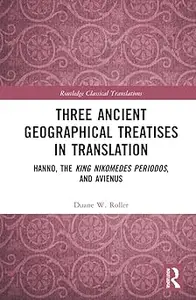
Duane W. Roller, "Three Ancient Geographical Treatises in Translation "
English | ISBN: 0367462540 | 2021 | 212 pages | EPUB | 801 KB
This volume is a translation and commentary on the works of three geographers from Greco-Roman antiquity: Hanno of Carthage, from around 500 BC; the author of the Periodos Dedicated to King Nikomedes, from the last half of the second century BC; and Avienus, from the fourth century AD.

The modern translations of texts in this book represent 1,000 years of Greco-Roman geographical scholarship, and thus provide an overview of the discipline from its beginnings to late antiquity. Readers will learn about the development of Greek geography, and the earliest adventures outside the Mediterranean into the Atlantic, as far south as the tropics and north toward the Arctic. These explorations make for fascinating stories about early human endeavors into an unknown world.
Read more


UploadCloud

Fileaxa


Links are Interchangeable - Single Extraction
 
d5a9420e6a06edfa358b87ac255ca3ca.webp

Three Simple Questions : Knowing the God of Love, Hope, and Purpose By Rueben P. Job
2011 | 83 Pages | ISBN: 1426741545 | EPUB | 1 MB
Rueben P. Job, author of Three Simple Rules, brings us a new insight on how to live a Christ-like life and explores the three most basic and profound questions at the center of our faith--questions that all major religions try to answer and around which there seems to be much confusion: Who is God? Who am I? Who are we together? In three brief and engaging chapters, readers will explore these questions and gain new understanding of the answers: Know that God is greater than you can imagine Believe that you are God's beloved child Be the love of Christ in the world They will also discover the greatness and goodness of God, the value of every beloved child of God, and the impact we can have in the world when we live as Jesus lived. Each chapter concludes with a simple spiritual practice to help readers remember and respond to what they have read, followed by a prayer. Now it is time for you to know, believe and become the answers. In its first paragraphs, Three Simple Questions triggered my hunger for hope. I hung on each word thereafter. By the time I finished my reading, I was filled to overflowing. I was drawn deeper by the notion of a God too small. Prayer as the place where we receive our identity was profound. I cheered with the truth that God loves all. I was intrigued by the imagery of my being a "holy chalice." The three daily practices are refreshing and engaging. In short, the read filled me with grace. --Bishop Sharon Brown Christopher


Fileaxa


Links are Interchangeable - Single Extraction
 
697ab48352302060605f0cf5a6656939.webp

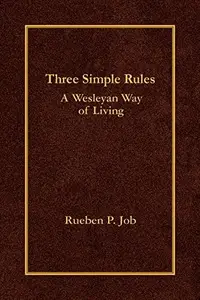
Three Simple Rules : A Wesleyan Way of Living By Rueben P. Job
2007 | 78 Pages | ISBN: 0687649668 | EPUB | 1 MB
In Three Simple Rules, Rueben Job offers an interpretation of John Wesley's General Rules for today's readers. For individual reading or group study, this insightful work calls us to mutual respect, unity and a deeper daily relationship with God. This simple but challenging look at three commands, "do no harm, do good, stay in love with God," calls us to mutual respect, unity, and a deeper relationship with God. "Every year I review the three general rules of the United Methodist Church with those who are being ordained. Now I have a wonderful ordination gift to give them in Bishop Job's, Three Simple Rules, to start and deepen the conversation as they enter a new relationship with the church. Bishop Job has described "by attending upon all the ordinances of God" to be to "stay in love with God." It's a fresh language that speaks especially to long-time Christians and United Methodists." Sally Dyck, Resident Bishop, Minnesota Area "Three Simple Rules is a new catechism for everyone wanting to follow Jesus Christ. These practices for holy living should replace the membership vows in every church Don't let the title fool you. Bishop Job writes, 'The rules are simple, but the way is not easy. Only those with great courage will attempt it, and only those with great faith will be able to walk this exciting and demanding way.'" John Hopkins, Resident Bishop, East Ohio Area Table of Contents: Introduction The World In Which We Live First Do No Harm Do All the Good You Can Stay in Love with God A Guide for Daily Prayer


UploadCloud

Fileaxa


Links are Interchangeable - Single Extraction
 
0380c9be4127c624745d2f2a720f5821.webp

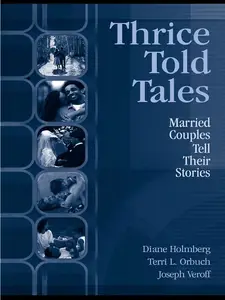
Thrice Told Tales : Married Couples Tell Their Stories By Diane Holmberg; Terri L. Orbuch; Joseph Veroff
2003 | 246 Pages | ISBN: 0805840990 | EPUB | 1 MB
Researchers have studied marriage for decades, but how is the transition to married life actually experienced by the couples involved? From an insider's perspective, Thrice Told Tales examines married couples' own stories of their relationship. A representative sample of 199 African-American and 177 White married couples were asked to tell the story of their relationship. It provides accounts of courtships, weddings, honeymoons, their adjustment in the early years, and hopes for the future. These stories were first collected a few months after their weddings, and again in the third and seventh years of their marriages. What features of their relationship do the couples highlight as central in the early years? How do their stories change over time? What can we learn about couples' marital well-being by analyzing their stories? How do the stories of men and women, and of White and African-American couples differ? These questions were systematically addressed using extensive coding schemes and comprehensive quantitative analyses. Details of the coding system and procedures are included, making this volume a useful reference for any researcher contemplating analysis of narrative data. However, the key points are also explained in simple prose and illustrated with quotes from the couples' own stories, making the book accessible to anyone with an interest in how young couples experience married life today.


Fileaxa


Links are Interchangeable - Single Extraction
 
95c65740052d2c3b0506719d08fd234b.webp

Tiergestützte Therapie mit Hunden: Grundlagen, Tierethik und Praxis der therapeutischen Arbeit
Deutsch | 2025 | ISBN: 3662708558 | 179 Pages | PDF (True) | 13 MB
Die tiergestützte Therapie ist seit einigen Jahren in aller Munde und wird immer häufiger auch in die psychotherapeutische Behandlung von Menschen integriert. Doch wie genau können Therapiebegleithunde die psychotherapeutische Arbeit erweitern und unterstützen? Wie lassen sich dabei Tierschutz und Menschenwohl vereinen? Welche Hunde eignen sich für den Einsatz als Therapiebegleithund und wie werden sie auf ihren Einsatz vorbereitet?


UploadCloud

Fileaxa


Links are Interchangeable - Single Extraction
 
69ed1f1b648c12bbb6a7c4fca7a13894.webp

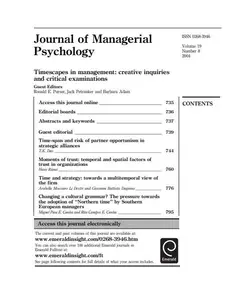
Timescapes in Management : Creative Enquiries and Critical Examinations By Ronald E. Purser; Barbara Adam; Jack Petranker
2004 | 110 Pages | ISBN: 1845442245 | PDF | 1 MB
Time has been referred to as the hidden dimension (Hall, 1983), an implicit challenge that for many years went largely unanswered in the field of management studies. A few pioneers explored aspects of temporality in organizational studies (for an excellent review see Bluedorn, 2002; Das, 1986), but for the most part the discipline seemed content to go along with unexamined assumptions and peremptory conclusions. Perhaps the dawn of the new millennium has had something to do with it, but this era of neglect shows signs of coming to an end. Future theorists may mark the turning point as the annual conference of the Academy of Management held in Toronto in 2000, which took time as its theme. Thousands of academics and practitioners found themselves confronting hundreds of papers on the theme of time, and some came away with a sense of new ideas stirring. Following the conference, a special issue of the Academy of Management Review took up the theme of time as a research lens in organizations (Anconna et al, 2001). One of the sessions organized for the 2000 AOM Conference featured presentations by all three of the editors for this special issue of JMP. Organized by Ronald Purser in his capacity as Chair of the Organizational Development and Change Division of the AOM, the All-Academy session challenged organizational scholars to be more reflexive in their theorizing of time. The theme for the session was Barbara Adam's notion of "timescapes," which decenters linear, objectivist conceptions of time, opening discourse to temporal modes that are normally ignored or marginalized (Adam, 1998). In 2002, the three of us joined forces with a number of well-known scholars in the field to organize a small conference (about 20 participants) devoted to the theme of time. The conference title was "Dynamic time and creative inquiry in organizational change." Precisely because time was the theme, we focused in on the time that conferees would spend together, and determined to depart from the usual conference format in several key respects. First, we required all presenters to make their papers available in advance on the website of the Center for Creative Inquiry (interested readers can find them at ). Equally important, we asked them to submit short biographical statements and a photo. The site provided for exchanges on the papers, as well as on the design of the conference. These innovations, though relatively minor, had a tremendous impact on the conference. By the time participants gathered at a secluded site in Essex, MA, they shared a history. Though most of us had never met, we knew something about each other, and we had all already taken an active role in preparing for the conference. To build on this promising beginning, the conference organizers announced that this would be an "improvisational conference." Although we established a structure intended to make sure that everyone would have a chance to present, we also agreed that we would feel free to modify that structure as we went along. On a micro-level, we asked participants to find ways to make their presentations more dynamic and improvisational. A few of the presenters took improvisation as their overt theme, but our aim was to have everyone share in the sense that we would be laying down our path as we walked it. At the very least, we reasoned, this commitment would make us more aware of the temporal dimension, since we would be confronting it at every turn-not in the usual mode of deadlines and tight schedules, but as an arena of open possibilities. The results were gratifying. No one wandering into the event would have mistaken it for a rave, but the participants seemed to share a sense of greater freedom and more meaningful exchanges. As one of us (Purser) had said in advance of the conference, at most conferences the most fruitful parts take place in the hallways between events; we were aiming for a conference that was "all hallways." We surely fell short, but it was a good beginning. The present issue of JMP grows directly out of the Essex conference. Our original thought was that we would look for a forum to publish some of the papers that grew out of the conference, but as we thought it through, we realized it would be more fruitful - and more true to the theme of time as indeterminate - to invite contributions through a more traditional call for papers. We solicited contributions that could help "spark a creative inquiry into the multiplicity of temporalities that constitute managerial experience and organizational life," and urged a transdisciplinary approach. The articles published here were selected from the many contributions we received in response. The papers collected here can be read individually as contributions to the field of management psychology that break new ground by introducing or exploring in new ways the multi-faceted timescapes within which organizational actors work, plan, and contrive to succeed. They can also be read as contributions to an ongoing dialogue that aims to rethink time at a deep level. Our sense is that the temporal dimension as it is presently understood imposes limits on the possibilities for organizations, management, and managers - limits that we will begin to recognize more clearly only when we are on the way to overcoming them. In this broader sense, readers may want to read the articles in this special issue in light of one another. It would be foolish to impose an artificial unity on a collection of papers submitted by authors with widely differing concerns and backgrounds. Yet there are themes and approaches that carry across papers, so that each illuminates the others. Here we will trace one pathway through the collection, certain that others will find other, equally fruitful approaches. We begin with the article by T.K. Das, truly a pioneer in the field of temporal studies. His concern here is with the temporalities of opportunism: those situations in which a partner in a strategic alliance deliberately undermines that alliance for the sake of private advantage. Das assesses the conditions that make opportunism more or less like in terms of the temporal horizon (short-term or long-term) of possible opportunistic action, Descriptionted against the degree of risk to the relationship that such an action will engender. The underlying issue here is one of identity: a business that enters a strategic alliance maintains its own identity intact, and thus can contemplate betraying the alliance without having to rethink its own image and commitments. Noteworthy about this analysis is that it takes the "standard" understanding of time for granted. Managers take actions now to get desired results in the future. In the logic appropriate to such a linear approach, opportunistic acts are always an option. The article by Ramos investigates the theme of trust, closely related to the issue of opportunism that concerns Das. However, he does so from a very different perspective. Ramos starts from the idea that existing timescapes lead to "excessive stress, unoriginality and even distrust," and aims to sketch out an alternative. Focusing on the distinction between chronos (conventional linear time) and kairos (the right time, the time for appropriate action), he suggests that management could approach decisions in ways that invited the application of wisdom and judgment rather than simply good results. For Ramos, opportunism could never be "timely" in a kairotic sense; as he writes, a "partisan focus on organizational goals will never be reconcilable with trust". This framework raises a number of important questions. Must one possess wisdom in order to act in a "timely" manner? If so, how shall such wisdom arise? Could a different approach to time itself lead to wisdom, and could such wisdom inform a different management ethos? Ramos rightly points out that due to external constraints, few managers will realistically be able to pursue such a possibility. Still, an important question has been raised. A different approach to time requires a different kind of knowledge, but what if the different knowledge in question is the knowledge of time? Perhaps the very act of naming and exploring kairos is a step toward such knowledge, and hence a step toward wisdom. With Li Destri and Dagnino, we return to a more conventional (though multiple) understanding of time. The authors contrast objective, Newtonian, linear time, in which all moments are homogeneous, with subjective, Bergsonian, qualitative time, in which each moment is uniquely conditioned by the web of memory and anticipation in which it arises. They link the former to classic economic rationalism, which reasons probabilistically from past patterns to future likelihoods, while they associate the latter with the entrepreneurial spark that reacts to the uncertainty of the future with creative solutions. Drawing on the Austrian process view, they suggest that each of these approaches has application at different times in the life cycle of an organization, and on this basis suggest that a focus on different kinds of temporality might make it possible to build a bridge between entrepreneurial studies and strategic management. Interestingly, the Bergsonian approach introduced in this article is not difficult to reconcile with the more conventional temporal analysis presupposed in Das, for opportunism anticipates what is possible in the unique circumstances and conditions of this precise moment, and in this sense is entrepreneurial. Perhaps the reason for this congeniality is that subjective approaches to time, like objective approaches, are founded in identity, and thus extend themselves across time in characteristic ways. Like Li Destri and Dagnino, the E Cunhas distinguish two kinds of time. In their case these are monochronic time, as practiced in northern Europe, and polychronic time, as practiced in southern Europe. There is a tendency to regard these two modes of time (originally identified by Hall) as akin to objective and subjective time, but the E Cunhas reject this comparison. Instead, they contend that polychronic time focuses on relationships rather than results; in another formulation, they suggest that it is maternal rather than paternal. The E Cunhas buttress these conclusions with references to an empirical study of eighty Portuguese managers and their difficulties in integrating the values learned in a polychromic society into an increasingly monochronic world economic order. Perhaps we could speak here of another kind of identity: not the objective identity of the organization or the subjective identity of the individual actor, but the relational identity that arises in community, giving rise to its own temporality. The interplay of subjective time, identity, and the temporal structures that shape the world of management also figures prominently in the article by Sharon Turnbull. The study on which this paper is based looked at senior managers nearing the age of retirement in a large public-sector organization going through significant changes. Accustomed to viewing their own careers as describing a linear trajectory through time, the study participants found themselves strangely at a loss when they reached a point where, their careers nearing an end, this model no longer held. In effect, they were forced to confront the existential question of how the reality of death (translated into the corporate realm as retirement) figures into the subjective experience of time. Turnbull's discussion of this and related points helps clarify that subjective reactions to socially constituted temporal structures are often inseparable from those structures, which take on an "objective" life of their own. For the executives she studied, the unexpected disjunction between the subjective and objective left them in a state of temporal anxiety, struggling to fit their identities into alternative temporal modalities. The final article, by Sierk Ybema, is wholly at home in the realm of the subjective. Drawing an analogy to studies of organizational nostalgia, Ybema identifies an approach to the future that he calls "postalgia": a way of framing a common destiny meant simultaneously to unite, to exclude, and to determine who shall hold power. He is explicit about the emotional component of this approach to time, reminding us that the "algia" in postalgia comes from a word meaning "grief" or "distress." If Ybema, like the E Cunhas, throws us squarely into the middle of a world (and corresponding timescape) centered on group identity, he also suggests a way out. The kind of time on which he focuses is related to the telling of stories. Could the story could be told differently? Would it perhaps be possible to engage time in a way that told no stories at all? If that happened, we would not be thrown back on the rational timescape of the economic decision-maker (for as Ybema notes, economic rationality is its own kind of story, perhaps a story at one remove from psychological realities). Instead, we might be in touch with a different dimension of time. Instead of competing for ownership of the present through nostalgic or postalgic accounts, we might be able simply to accept the present, and with it the past and the future. Could that approach relieve our grief and distress? Could this way of relating to time open the gate to wisdom? Time will tell. Ronald E. Purser, Jack Petranker and Barbara Adam Guest Editors Previously published in: Journal of Managerial Psychology, Volume 19, Number 8, 2004


Fileaxa


Links are Interchangeable - Single Extraction

 
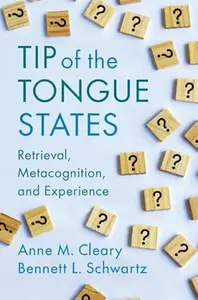
65c3a58198d353afe0d2653fac91e884.webp

Tip of the Tongue States: Retrieval, Metacognition, and Experience
English | 2025 | ISBN: 1009372033 | 263 Pages | PDF | 2 MB
The tip-of-the-tongue state-the feeling that something that we cannot recall is close to coming to mind-is a window onto many facets of the human mind. It lies at an intersection where memory mechanisms, language processes, attention, metacognition, conscious awareness, goal-driven behaviours, curiosity, and even decision-making and risk-taking all seem to cross. In this book, Anne Cleary and Bennett Schwartz explain how tip-of-the-tongue states fit into our overall cognitive systems and what they tell us about the nature of cognition and consciousness. The tip-of-the-tongue state can wield enormous power over our attentional focus and what we choose to do next, regardless of what we had been doing before the onset of the feeling. In short, it wields the ability to redirect our mind. Cleary and Schwartz's text will appeal to students and researchers interested in the workings of the mind and brain.


UploadCloud

Fileaxa


Links are Interchangeable - Single Extraction

 
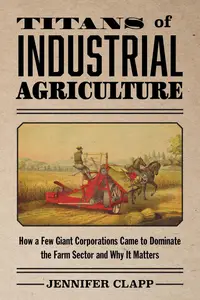
61e4512ef383ce8842db12a9d7de417d.webp

Titans of Industrial Agriculture: How a Few Giant Corporations Came to Dominate the Farm Sector and Why It Matters (One Planet) by Jennifer Clapp
English | February 18, 2025 | ISBN: 0262551705 | 474 pages | PDF | 9.11 Mb
How a small handful of giant transnational corporations has come to dominate the farm inputs sector, why it matters, and what can be done about it.

Every year, hundreds of billions of dollars' worth of farm machinery, fertilizer, seeds, and pesticides are sold to farmers around the world. Although agricultural inputs are a huge sector of the global economy, the lion's share of that market is controlled by a relatively small number of very large transnational corporations. The high degree of concentration among these agribusiness titans is striking, considering that just a few hundred years ago agricultural inputs were not even marketed goods. In Titans of Industrial Agriculture, Jennifer Clapp explains how we got from there to here, outlining the forces that enabled this extreme concentration of power and the entrenchment of industrial agriculture.
Clapp reveals that the firms that rose to the top of these sectors benefited from distinct market, technology, and policy advantages ****** back a century or more that enabled them to expand their businesses through mergers and acquisitions that made them even bigger and more powerful. These dynamics matter because the firms at the top have long shaped industrial farming practices that, in turn, have generated enormous social, ecological, and health impacts on the planet and the future of food systems. Beyond analyzing how these problems have arisen and manifested, the book examines recent efforts to address corporate power and dominance in food systems and assesses the prospects for change.
Among the first works to examine deep roots of corporate power in agriculture, Titans of Industrial Agriculture helps illuminate just how corporate actors have encouraged the "lock-in" of industrial agriculture, despite all its known social and ecological costs.


UploadCloud

Fileaxa


Links are Interchangeable - Single Extraction

 
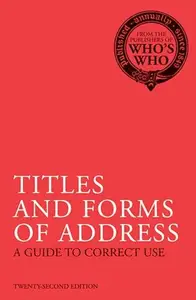
f0de83e1732bb6ae257b9577bfc29736.webp

Titles and Forms of Address: A Guide to Correct Use By
2008 | 241 Pages | ISBN: 0713683252 | PDF | 1 MB
A guide to correct forms of address in speech and correspondence. Itcovers both formal and social occasions, and includes the forms ofaddress for bishops, peers, privy counsellors, ambassadors, JPs andmayors. This edition is updated to cover changing conventions.


Fileaxa


Links are Interchangeable - Single Extraction

 
08fe03fdc85bb9f087bf768972d2eb21.webp

To Meet and Satisfy a Very Hungry People : The Origins and Fortunes of English Pentecostalism, 1907-1925 By Timothy B. Walsh
2012 | 298 Pages | ISBN: 1842275763 | EPUB | 1 MB
A scholarly examination of the emergence of English Pentecostalism at the beginning of the twentieth century. This study aims to elucidate the origins of how the Pentecostal message came to England, highlighting reasons for its appeal to an initially small constituency, while tracing its emergence in specific religious localities which ranged from Anglican vestry, to mission hall platform, to domestic drawing room. Its chief purpose is to examine the origins and emergence of a distinctively English version of the Pentecostal phenomenon.


UploadCloud

Fileaxa


Links are Interchangeable - Single Extraction

 
b8787e86f69ce06cfa9cd29ba4a73621.webp

To Recruit and Advance : Women Students and Faculty in Science and Engineering By National Research Council; Policy and Global Affairs; Committee on Women in Science and Engineering; Committee on the Guide to Recruiting and Advancing Women Scientists and Engineers in Academia
2006 | 145 Pages | ISBN: 0309095212 | PDF | 1 MB
Although more women than men participate in higher education in the United States, the same is not true when it comes to pursuing careers in science and engineering. To Recruit and Advance: Women Students and Faculty in Science and Engineering identifies and discusses better practices for recruitment, retention, and promotion for women scientists and engineers in academia. Seeking to move beyond yet another catalog of challenges facing the advancement of women in academic science and engineering, this book describes actions actually taken by universities to improve the situation for women. Serving as a guide, it examines the following: Recruitment of female undergraduates and graduate students. Ways of reducing attrition in science and engineering degree programs in the early undergraduate years. Improving retention rates of women at critical transition points'from undergraduate to graduate student, from graduate student to postdoc, from postdoc to first faculty position. Recruitment of women for tenure-track positions. Increasing the tenure rate for women faculty. Increasing the number of women in administrative positions. This guide offers numerous solutions that may be of use to other universities and colleges and will be an essential resource for anyone interested in improving the position of women students, faculty, deans, provosts, and presidents in science and engineering.


UploadCloud

Fileaxa


Links are Interchangeable - Single Extraction

 
Zurück
Oben Unten