



• Regeln für den Dokumente-Bereich:

    In den Börsenbereich gehören nur Angebote die bereits den Allgemeinen Regeln entsprechen.

    Allgemeines:

    Nicht erlaubt im Dokumente-Bereich sind:

    - indizierte Titel (inkl. Comics)
    - extremistische Werke, Zeitschriften und Comics (egal, welche Richtung)
    - jegliche Art von Pornographie
    - Anleitungen zu kriminellen Handlungen, gleich welcher Art
    - sadistische, menschenverachtende oder ähnliche Werke

    Nutzt den "Bedanken"-Button, bei Sammelthreads führen jegliche Kommentare, positiv wie negativ, sehr schnell zu einer Unübersichtlichkeit des Threads. Downmeldungen sind an den Uploader zu richten

    Vor dem Einstellen zu beachten:

    - Suchfunktion

    Vergewissert euch, dass es euer Dokument noch nicht im Board gibt, Doppelposts werden kommentarlos gelöscht. Ist es schon vorhanden, tragt es als Mirror im bestehenden Post ein.

    - Threadtitel

    Idealerweise ist sofort zu erkennen um was es sich handelt. Verseht euren Titel mit den relevanten Informationen, das hilft euch und damit auch uns und allen Suchenden erheblich weiter.

    Beispiel: [Thriller] Dan Brown - Inferno oder bei Magazinen:

    Computerbild - 14/2014 (es muss ersichtlich sein, um welche Ausgabe und welches Magazin es sich handelt)

    Folgende Präfixe stehen im Unterforum "Unterhaltung" zur Verfügung:

    [Humor]
    [Drama]
    [Erotik]
    [Fantasy]
    [Krimi]
    [Roman]
    [Thriller]
    [Horror]
    [Science Fiction]

    Inhalt des Beitrags:

    Folgende Pflichtangaben gilt es einzuhalten:

    - Autor
    - Titel
    - Präfix
    - Cover
    - Genre
    - Inhaltsbeschreibung
    - enthaltene Formate
    - Gesamtgröße des Downloads
    - Hoster
    - ggf. Passwort

    Nicht erlaubt sind alle Dateien, die den Download unnötig aufblähen um eine Affiliategrenze zu erreichen, wie zB. mp3-files, übergroße Bilder, etc.

    Ebenso nicht erlaubt sind sämtliche Dateien mit DRM, persönlichen Daten, etc., diese werden kommentarlos zu eurem eigenem Schutz gelöscht.

    Achtet bitte bei der Konvertierung der Formate auf die Lesbarkeit, ein epub, was nur einfach durch Calibre gejagt wird um ein PDF zu erhalten, ist zu 99% eben nicht lesbar. Wenn ihr es nicht könnt, dann lasst es besser oder lest euch ein, wie man es richtig macht.


    Unterforum Comics:

    Threadtitel:

    Ähnlich, wie bei Unterhaltung und Magazinen, sollte der Titel alle relevanten Informationen enthalten, hier bitte

    - den Titel des Comics
    - den Verlag (einige Comics sind in verschiedenen Verlagen erschienen)
    - das Erscheinungsjahr

    Erlaubt sind folgende Formate:

    - CBR
    - CBZ

    Grundsätzlich gilt: jede Version eines Comics erhält einen eigenen Thread, Ersteller eines Comics können ihre Bände gerne mit dem Zusatz (Original-Release) versehen.

    Bei Unsicherheiten zur korrekten Benennung bitte die Informationen von www.comicguide.de nutzen.

    Inhalt des Beitrags:

    Pflichtangaben hier sind:

    - Titel des Bandes und ggf. Nummer
    - Cover
    - falls bekannt technische Daten (DPI, Breite, Speicherqualität)
    - Größe des Downloads
    - Hoster
    - ggf. Passwort
    - falls bekannt Releasenamen
  • Bitte registriere dich zunächst um Beiträge zu verfassen und externe Links aufzurufen.

++ Premium IPTV ++ 7000 Live Sender ++ UHD Qualität ++ Mediathek mit 18.000 Inhalten ++


VenneTV


Collection Download Ebooks Best Seller Updated Daily

463463242cc5d68195857e976b84d956.webp

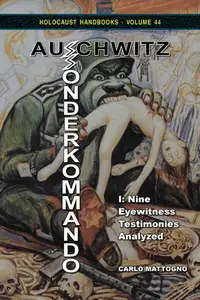
Sonderkommando Auschwitz I: Nine Eyewitness Testimonies Analyzed
Carlo Mattogno
English | 2024 | ISBN: 1591482585 | 304 Pages | True PDF | 5.1 MB

To this day, the 1979 book Auschwitz Inferno: The Testimony of a Sonderkommando by former Auschwitz inmate and putative Sonderkommando member Filip Müller, who claims to have worked in the gas chambers of Auschwitz for three years, has a great influence both on the popular perception of Auschwitz and on historians probing or purporting to probe this camp's history. The late Raul Hilberg, for instance, one of the most-influential mainstream Holocaust scholars, called Müller "a remarkable, accurate, reliable person."
The first half of the present book critically analyzes Müller's various post-war writings and testimonies, starting with a brief essay he wrote just after the war, then his testimony during the Frankfurt Auschwitz Trial in 1964, the interviews he gave Claude Lanzmann for his epic 1985 documentary Shoah, and of course his 1979 book, which was to an unknown degree ghostwritten by one Helmut Freitag. A thorough analysis and comparison of these texts reveals that Müller's memory seems to have improved with the decades rather than faded. His later stories have him involved everywhere in Auschwitz where the mainstream narrative reported there was some dramatic action. But a closer look at what Müller (or Freitag) wrote reveals that they pilfered it from other writers, complete with historical mistakes and physical nonsense. One of Müller's main sources of such plagiarism was a book by Hungarian physician and proven impostor Miklós Nyiszli, but he also stole from the tales of the well-known false witnesses Kurt Gerstein and Rudolf Höss.
The second part of the present book analyzes the accounts of eight more witnesses who claim to have been members of the Auschwitz Sonderkommando: Dov Paisikovic, Stanisław Jankowski, Henryk Mandelbaum, Ludwik Nagraba, Joshuah Rosenblum, Aaron Pilo, David Fliamenbaum and Samij Karolinskij. The first three among them made substantial depositions which are often cited in Holocaust literature on Auschwitz, whereas the other five are less-well-known. A common feature of all of their accounts is that they follow a narrative developed after the war by the Soviet propaganda units which occupied Auschwitz after the German retreat. Large parts of that narrative are today considered wrong or at least exaggerated even by mainstream scholars. So how come these witnesses told the same overarching ideological lies in impressive concert, while they diverged on many concrete specifics on which they should have agreed, if their tales concerned actual events or conditions they all experienced in the same places and times? Find the answers in this revealing study!


Fileaxa


Links are Interchangeable - Single Extraction

 
ac3e89ee6b249614096b5b914dc9e7c7.webp

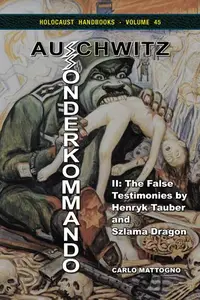
Sonderkommando Auschwitz II: The False Testimonies by Henryk Tauber and Szlama Dragon
Carlo Mattogno
English | 2022 | ISBN: 1591482593 | 257 Pages | ePUB | 6.9 MB

Neither Henryk Tauber nor Szlama Dragon is a name that rings a bell among the general populace, or even among most aficionados of World War II history. In fact, even in literature dealing with the Holocaust, these two names are not prominent by any means. For instance, the late Holocaust scholar Raul Hilberg, still today considered one of the leading orthodox Holocaust scholars, never mentioned either of them in his iconic standard work The Destruction of the European Jews. More-modern Holocaust scholars, however, such as Jean-Claude Pressac, Robert van Pelt and Franciszek Piper, acknowledge that the testimonies of these two Auschwitz survivors are among the most-important when it comes to delineating the details of how Jews deported to Auschwitz are said to have been murdered there en masse.
After the testimonies of many world-famous Holocaust witnesses, such as Rudolf Höss (see Vol. 35 of this series) and Miklós Nyiszli (Vol. 37), have been thoroughly discredited by revisionist critiques, the orthodoxy has shifted ist reliance for their narrative heavily to these two witnesses. It is therefore now pivotal to scrutinize their post-war testimonies with the same critical method that has already led to the downfall of hundreds of false Holocaust witnesses. The present study does exactly that.
Both Tauber and Dragon testified three times after the war. While these testimonies contain several contradictions, the crucial aspect of their statements is that they both geared what they had to say toward the goal of confirming the Soviet propaganda story of 4 million murdered Auschwitz inmates. To achieve this, both witnesses made statements that are technically and physically impossible and at times utterly absurd. When making concrete claims about alleged events in the camp, many of their claims are refuted by documented contradictory facts. In other words: both were mere puppets in the Soviet post-war scheme of emplacing a false atrocity narrative surrounding the former Auschwitz Camp to the everlasting ennoblement of the Soviet victory, and the everlasting shame of those who went down in defeat.


Fileaxa


Links are Interchangeable - Single Extraction

 
0ca8e895155caab7cade5abbbd29f7c1.webp

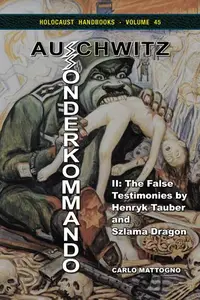
Sonderkommando Auschwitz II: The False Testimonies by Henryk Tauber and Szlama Dragon
Carlo Mattogno
English | 2024 | ISBN: 1591482593 | 257 Pages | True PDF | 7.1 MB

Neither Henryk Tauber nor Szlama Dragon is a name that rings a bell among the general populace, or even among most aficionados of World War II history. In fact, even in literature dealing with the Holocaust, these two names are not prominent by any means. For instance, the late Holocaust scholar Raul Hilberg, still today considered one of the leading orthodox Holocaust scholars, never mentioned either of them in his iconic standard work The Destruction of the European Jews. More-modern Holocaust scholars, however, such as Jean-Claude Pressac, Robert van Pelt and Franciszek Piper, acknowledge that the testimonies of these two Auschwitz survivors are among the most-important when it comes to delineating the details of how Jews deported to Auschwitz are said to have been murdered there en masse.
After the testimonies of many world-famous Holocaust witnesses, such as Rudolf Höss (see Vol. 35 of this series) and Miklós Nyiszli (Vol. 37), have been thoroughly discredited by revisionist critiques, the orthodoxy has shifted ist reliance for their narrative heavily to these two witnesses. It is therefore now pivotal to scrutinize their post-war testimonies with the same critical method that has already led to the downfall of hundreds of false Holocaust witnesses. The present study does exactly that.
Both Tauber and Dragon testified three times after the war. While these testimonies contain several contradictions, the crucial aspect of their statements is that they both geared what they had to say toward the goal of confirming the Soviet propaganda story of 4 million murdered Auschwitz inmates. To achieve this, both witnesses made statements that are technically and physically impossible and at times utterly absurd. When making concrete claims about alleged events in the camp, many of their claims are refuted by documented contradictory facts. In other words: both were mere puppets in the Soviet post-war scheme of emplacing a false atrocity narrative surrounding the former Auschwitz Camp to the everlasting ennoblement of the Soviet victory, and the everlasting shame of those who went down in defeat.


Fileaxa


Links are Interchangeable - Single Extraction
 
2a18b8a1b9725965413567c80ae2d912.webp

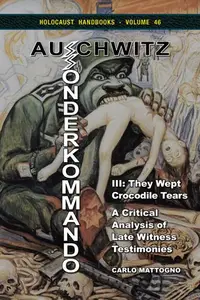
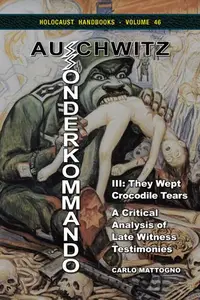
Sonderkommando Auschwitz III: They Wept Crocodile Tears. A Critical Analysis of Late Witness Testimonies
Carlo Mattogno
English | 2022 | ISBN: 1591482984 | 232 Pages | ePUB | 2 MB

In response to the rise of Holocaust revisionism in the first half of the 1980s, Israeli Historian Gideon Greif decided to record and publish the recollections of former Auschwitz inmates who claim to have served in the so-called Sonderkommando. This inmate unit is claimed to have been charged with assisting the SS in mass-murdering Jewish deportees in the infamous gas chambers, and obliterating the victims' bodies on pyres and in cremation furnaces. Greif claims that many surviving members of this unit refused to testify in the immediate postwar era, presumably because not even their fellow Jews would believe their outrageous stories. In 1995, Greif published his collection of testimonies in German, and ten years later also in English under the title We Wept without Tears.
If fellow Jews sympathetic to their co-religionists already doubted the veracity of these testimonies at a time when the witnesses' memories were still fresh, one can imagine how critical scholars would evaluate depositions made many decades later, when memories had inevitably deteriorated and were to a large degree replaced with impressions created by the biggest historical propaganda campaign the world has ever seen.
This book critically reviews the statements by the former Auschwitz inmates interviewed by Greif (Josef Sackar, Abraham and Szlama Dragon, Jaakov Gabai, Eliezer Eisenschmidt, Shaul Chasan and Leon Cohen). The scope of this study is extended by including the testimonies of three Jews who had been deported to Auschwitz from Greece, among them the memoirs of Shlomo Venezia, whose various testimonies were publicized in Italy with great fanfare during the 1990s and early 2000s. This review of Sonderkommando testimonies is rounded out by a critique of several brief depositions by a few further witnesses hardly known to historiography.
The author shows that all of these testimonies, just like those analyzed in the other two volumes of this trilogy, fly in the face of documented and forensically proven facts, are riddled with internal inconsistencies, and in many aspects contradict other witness statements and the orthodox narrative. They are studded with historical and technical absurdities taken straight from propaganda fables long-since-rejected as untrue even by mainstream historians. In the author's assessment, all these witnesses fall into three main categories: intentional liars, braggarts and morons.


Fileaxa


Links are Interchangeable - Single Extraction
 
920bea367c1d6b5f84d04cba45b66370.webp

Sonderkommando Auschwitz III: They Wept Crocodile Tears. A Critical Analysis of Late Witness Testimonies
Carlo Mattogno
English | 2024 | ISBN: 1591482984 | 232 Pages | True PDF | 8.7 MB

In response to the rise of Holocaust revisionism in the first half of the 1980s, Israeli Historian Gideon Greif decided to record and publish the recollections of former Auschwitz inmates who claim to have served in the so-called Sonderkommando. This inmate unit is claimed to have been charged with assisting the SS in mass-murdering Jewish deportees in the infamous gas chambers, and obliterating the victims' bodies on pyres and in cremation furnaces. Greif claims that many surviving members of this unit refused to testify in the immediate postwar era, presumably because not even their fellow Jews would believe their outrageous stories. In 1995, Greif published his collection of testimonies in German, and ten years later also in English under the title We Wept without Tears.
If fellow Jews sympathetic to their co-religionists already doubted the veracity of these testimonies at a time when the witnesses' memories were still fresh, one can imagine how critical scholars would evaluate depositions made many decades later, when memories had inevitably deteriorated and were to a large degree replaced with impressions created by the biggest historical propaganda campaign the world has ever seen.
This book critically reviews the statements by the former Auschwitz inmates interviewed by Greif (Josef Sackar, Abraham and Szlama Dragon, Jaakov Gabai, Eliezer Eisenschmidt, Shaul Chasan and Leon Cohen). The scope of this study is extended by including the testimonies of three Jews who had been deported to Auschwitz from Greece, among them the memoirs of Shlomo Venezia, whose various testimonies were publicized in Italy with great fanfare during the 1990s and early 2000s. This review of Sonderkommando testimonies is rounded out by a critique of several brief depositions by a few further witnesses hardly known to historiography.
The author shows that all of these testimonies, just like those analyzed in the other two volumes of this trilogy, fly in the face of documented and forensically proven facts, are riddled with internal inconsistencies, and in many aspects contradict other witness statements and the orthodox narrative. They are studded with historical and technical absurdities taken straight from propaganda fables long-since-rejected as untrue even by mainstream historians. In the author's assessment, all these witnesses fall into three main categories: intentional liars, braggarts and morons.


Fileaxa


Links are Interchangeable - Single Extraction
 
630a25c0a4de67905842b54911160070.webp

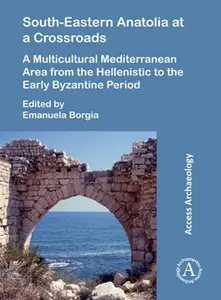
South-Eastern Anatolia at a Crossroads: A Multicultural Mediterranean Area from the Hellenistic to the Early Byzantine Period
by Emanuela Borgia
English | 2025 | ISBN: 1789695767 | 240 Pages | True PDF | 27 MB

South-Eastern Anatolia at a Crossroads collects the papers presented in a thematic session at the 2018 EAA Congress held at Barcelona. The contributions analyse an area of the Mediterranean encompassing all the regions south of the Taurus range (Cilicia, Isauria, Pamphylia and Pisidia) facing the sea and, throughout their history, in direct contact with the island of Cyprus to the south and with the coast of northern Syria to the east. South-Eastern Anatolia is revealed as a key crossroads of people and cultures, at a crucial point between East and West. Due to its strategic geographic position connecting Anatolia and Syria via maritime and terrestrial routes and to the ease of contact with the whole eastern Mediterranean, the region was characterised by manifold processes of mobility, migration and cultural interchanges. The papers collected in this volume range chronologically from the Hellenization phase to the Byzantine age, concentrating on how the various cultural identities interacted and contributed to the formation of a very particular Mediterranean identity, revealed by manifold historical and archaeological aspects.


Fileaxa


Links are Interchangeable - Single Extraction
 
e09d1cc1c50e8a3b51c3d51a1e6a6900.webp

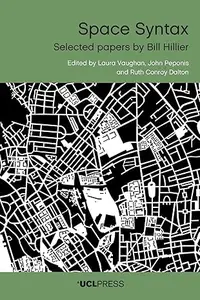
Space Syntax: Selected Papers by Bill Hillier
by Laura Vaughan, John Peponis
English | 2025 | ISBN: 1800087705 | 728 Pages | True PDF | 12 MB

Discover the visionary ideas that redefined architecture and urbanism-Bill Hillier's most influential writings on space syntax, all in one critical volume.
Few scholars have reshaped our understanding of architecture and urban design as profoundly as Bill Hillier. Space Syntax compiles the most influential works from his career, spanning over half a century, to showcase the evolution of his innovative theories on the spatial structure of cities and the social functions of built environments.
Including his early explorations of architecture as a research discipline and his later theories on how spatial configurations influence human movement and urban vitality, this collection provides a definitive overview of Hillier's intellectual legacy. Featuring newly redrawn figures, rare texts, and expert introductions from leading theorists and practitioners, the volume offers fresh viewpoints on the continued relevance of space syntax in contemporary research and practice.
Relevant to subjects ranging from archaeology to physics, Space Syntax cements Hillier's place as a revolutionary thinker whose ideas continue to shape how we design and understand space.


Fileaxa


Links are Interchangeable - Single Extraction
 
edfcc2110de9575548be9c5256219783.webp

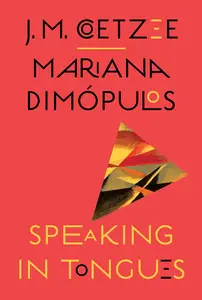
Speaking in Tongues by J. M. Coetzee, Mariana Dimópulos
English | May 6th, 2025 | ISBN: 1324096454 | 144 pages | True EPUB | 0.58 MB
Lit Hub's Most Anticipated Books of 2025

In this provocative dialogue, a Nobel laureate novelist and a leading translator investigate the nature of language and the challenges of translation.
"An intelligent, moving, and supremely humane act of criticism that reveals just how difficult and wondrous it can be to inhabit a language that is not your own." - Merve Emre
Language, historically speaking, has always been slippery. Two dictionaries provide two different maps of the universe: which one is true, or are both false? Speaking in Tongues-taking the form of a dialogue between Nobel laureate novelist J. M. Coetzee and eminent translator Mariana Dimópulos-examines some of the most pressing linguistic issues that plague writers and translators well into the twenty-first century.
The authors address questions that we must answer in order to understand contemporary society. They inquire if one can truly love an acquired language, and they question why certain languages, like Spanish, have gender differences built into them. They examine the threat of monolingualism and ask how we can counter, if at all, the global spread of the English language, which seems to maraud like a colonial power. They question whether it should be the duty of the translator to remove morally objectionable, misogynistic, or racist language. And in the conclusion, Coetzee even speculates whether it's only mathematics that can tell the truth about everything.
Drawing from decades of experience in the craft of language, both Dimópulos and Coetzee face the reality, as did Walter Benjamin over a century ago in his seminal essay "The Task of the Translator," that when it comes to self-expression, some things will always get lost in translation. Speaking in Tongues finally emerges as an engaging and accessible work of philosophy, shining a light on some of the most important linguistic and philological issues of our time.


Fileaxa


Links are Interchangeable - Single Extraction
 
06b102496c225c8604ba976a6ef2bfda.webp

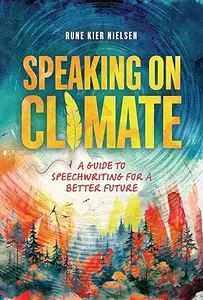
Speaking on Climate: A Guide to Speechwriting for a Better Future
by Rune Kier Nielsen
English | 2025 | ASIN: B0D6KQS414 | 200 Pages | True ePUB | 13.1 MB

A Junior Library Guild Gold Standard Selection
What makes a good speech? Better yet, what makes an effective speech?
A speech can inform, entertain, educate. But effective speeches inspire an audience to act and build a sense of community. The climate crisis is a pressing issue, and the ability to successfully communicate about it is crucial to bring people together to make meaningful change.
Discover how to stand up, speak your mind, and encourage your audience past climate silence. By analyzing speeches and how they worked, social anthropologist and professional speechwriter Rune Kier Nielsen breaks down nine common flaws of climate rhetoric and how to fix them in this thorough, engaging guide to speechwriting toward climate action.
"A lively, concise, and practical antidote to climate anxiety and a guide to positive action."-Kirkus Reviews
"Speaking on Climate by Rune Kier Nielsen is a crucial guide for anyone committed to using the power of words to drive meaningful climate action."-Ingmar Rentzhog, founder & CEO, Wedonthavetime.org
"Rune Kier Nielsen's Speaking on Climate inspires readers' passion for climate change and equips them with the tools to communicate effectively."-S. Kelley Harrell, author of From Elder to Ancestor: Nature Kinship for All Seasons of Life


Fileaxa


Links are Interchangeable - Single Extraction
 
479c09d66aa6198d121714037980bd97.webp

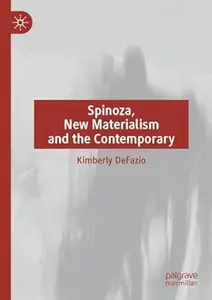
Spinoza, New Materialism and the Contemporary
by Kimberly DeFazio
English | 2025 | ISBN: 1349699446 | 184 Pages | True ePUB | 0.3 MB

Spinoza, New Materialism and the Contemporary is a book about change. Through its border passing interpretations, it not only transforms the dominant contemporary views of Spinoza but, more significantly, it puts into question the assumptions of those that have produced the dominant view, such as Althusser, Negri, Deleuze, as well as the new materialism and the ontological turn, including Latour, Bennett and Braidotti. These interpretations deploy Spinoza as a trope by which they suspend the class contradictions of capitalism and construct a new spiritual capitalism. This book, through materialist analysis of Spinoza, puts class back in cultural theory.


Fileaxa


Links are Interchangeable - Single Extraction
 
1474f0efc69eec3150ae55177d40f235.webp

Spinoza, New Materialism and the Contemporary
by Kimberly DeFazio
English | 2025 | ISBN: 1349699446 | 184 Pages | True PDF | 2.06 MB

Spinoza, New Materialism and the Contemporary is a book about change. Through its border passing interpretations, it not only transforms the dominant contemporary views of Spinoza but, more significantly, it puts into question the assumptions of those that have produced the dominant view, such as Althusser, Negri, Deleuze, as well as the new materialism and the ontological turn, including Latour, Bennett and Braidotti. These interpretations deploy Spinoza as a trope by which they suspend the class contradictions of capitalism and construct a new spiritual capitalism. This book, through materialist analysis of Spinoza, puts class back in cultural theory.


Fileaxa


Links are Interchangeable - Single Extraction
 
9af4a76c36372a6ae3aef157c53c38c4.webp

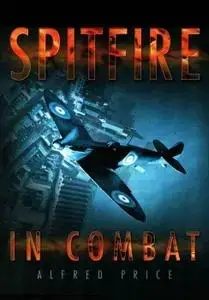
Alfred Price - Spitfire in Combat
Sutton Publishing | 2003 | ISBN: 0750931604 | English | 196 pages | PDF | 154.17 MB
The Supermarine Spitfire is probably the most famous fighter aircraft of all time, with a distinctive shape and sound that mark it out from most other aircraft of the World War II period. Alfred Price employs first-hand accounts to evoke a series of snapshots of the Spitfire, showing what it was really like to fly this legendary aircraft in combat. From the biplane era of the 1930s to the Jet Age of the 1950s the Spitfire, through continuous adaptation and development, proved itself the equal of any of its competitors, whether friend or foe. The author explores important aspects of the Spitfire's evolution, from the specially modified "speed" Spitfire of 1938 to the history of the top scoring Spitfire, EN398, and the postwar Spitfire PR19 recce missions over China.


Fileaxa


Links are Interchangeable - Single Extraction
 
Zurück
Oben Unten