



• Regeln für den Dokumente-Bereich:

    In den Börsenbereich gehören nur Angebote die bereits den Allgemeinen Regeln entsprechen.

    Allgemeines:

    Nicht erlaubt im Dokumente-Bereich sind:

    - indizierte Titel (inkl. Comics)
    - extremistische Werke, Zeitschriften und Comics (egal, welche Richtung)
    - jegliche Art von Pornographie
    - Anleitungen zu kriminellen Handlungen, gleich welcher Art
    - sadistische, menschenverachtende oder ähnliche Werke

    Nutzt den "Bedanken"-Button, bei Sammelthreads führen jegliche Kommentare, positiv wie negativ, sehr schnell zu einer Unübersichtlichkeit des Threads. Downmeldungen sind an den Uploader zu richten

    Vor dem Einstellen zu beachten:

    - Suchfunktion

    Vergewissert euch, dass es euer Dokument noch nicht im Board gibt, Doppelposts werden kommentarlos gelöscht. Ist es schon vorhanden, tragt es als Mirror im bestehenden Post ein.

    - Threadtitel

    Idealerweise ist sofort zu erkennen um was es sich handelt. Verseht euren Titel mit den relevanten Informationen, das hilft euch und damit auch uns und allen Suchenden erheblich weiter.

    Beispiel: [Thriller] Dan Brown - Inferno oder bei Magazinen:

    Computerbild - 14/2014 (es muss ersichtlich sein, um welche Ausgabe und welches Magazin es sich handelt)

    Folgende Präfixe stehen im Unterforum "Unterhaltung" zur Verfügung:

    [Humor]
    [Drama]
    [Erotik]
    [Fantasy]
    [Krimi]
    [Roman]
    [Thriller]
    [Horror]
    [Science Fiction]

    Inhalt des Beitrags:

    Folgende Pflichtangaben gilt es einzuhalten:

    - Autor
    - Titel
    - Präfix
    - Cover
    - Genre
    - Inhaltsbeschreibung
    - enthaltene Formate
    - Gesamtgröße des Downloads
    - Hoster
    - ggf. Passwort

    Nicht erlaubt sind alle Dateien, die den Download unnötig aufblähen um eine Affiliategrenze zu erreichen, wie zB. mp3-files, übergroße Bilder, etc.

    Ebenso nicht erlaubt sind sämtliche Dateien mit DRM, persönlichen Daten, etc., diese werden kommentarlos zu eurem eigenem Schutz gelöscht.

    Achtet bitte bei der Konvertierung der Formate auf die Lesbarkeit, ein epub, was nur einfach durch Calibre gejagt wird um ein PDF zu erhalten, ist zu 99% eben nicht lesbar. Wenn ihr es nicht könnt, dann lasst es besser oder lest euch ein, wie man es richtig macht.


    Unterforum Comics:

    Threadtitel:

    Ähnlich, wie bei Unterhaltung und Magazinen, sollte der Titel alle relevanten Informationen enthalten, hier bitte

    - den Titel des Comics
    - den Verlag (einige Comics sind in verschiedenen Verlagen erschienen)
    - das Erscheinungsjahr

    Erlaubt sind folgende Formate:

    - CBR
    - CBZ

    Grundsätzlich gilt: jede Version eines Comics erhält einen eigenen Thread, Ersteller eines Comics können ihre Bände gerne mit dem Zusatz (Original-Release) versehen.

    Bei Unsicherheiten zur korrekten Benennung bitte die Informationen von www.comicguide.de nutzen.

    Inhalt des Beitrags:

    Pflichtangaben hier sind:

    - Titel des Bandes und ggf. Nummer
    - Cover
    - falls bekannt technische Daten (DPI, Breite, Speicherqualität)
    - Größe des Downloads
    - Hoster
    - ggf. Passwort
    - falls bekannt Releasenamen
  • Bitte registriere dich zunächst um Beiträge zu verfassen und externe Links aufzurufen.


Collection Download Ebooks Best Seller Updated Daily

dc9e3e77da77509279c2b8c96a0824a6.webp

Quantum Gravity Phenomenology II
by Arundhati Dasgupta, Alfredo Iorio
English | 2024 | ISBN: 3725823715 | 220 Pages | PDF | 4.85 MB

Quantum gravity is at the frontier of research in physics. The four known interactions - gravitational, electromagnetic, strong and weak nuclear forces - have successfully described all known phenomena, with the exception of the dark sector. Of the four, the quantum of gravitational interaction is yet to be discovered, due to the weakness of the interaction at small scales. However, gravitational interaction is very strong for astrophysical objects, and bizarre phenomena have been tested experimentally. Using general relativity, gravity is shown as the theory of space-time, and theoretical predictions of black holes, and gravitational lensing, have all been observed in astrophysics. Gravitational waves, recently discovered, brings forth new hope for observational gravitational physics in the realm of the infinitesimal, to the point that the physics of quantum gravity may be within reach. The two volumes of the Universe Special Issue on quantum gravity phenomenology are therefore very timely, with papers describing the search for quantum signatures of gravity in observational physics. Due to the difficulty or impossibility of direct experiments, One of the avenues explored is analog models of gravity. Curved graphene was used to simulate the geometry of the outside of a black hole, and supersonic matter waves could simulate horizon behavior in fluids. Volume I of the Special Issue focuses on these "simulated quantum gravity experiments" or analog models with papers by pioneers in the field. Volume II describes quantum effects in astrophysical and cosmological phenomena which provide predictions for future experiments.


Fileaxa


Links are Interchangeable - Single Extraction

 
b383f375bff958ef72a1610f8e6d2078.webp

Quantum Gravity, Quantum Cosmology and Lorentzian Geometries by Giampiero Esposito
English | PDF | 1994 | 343 Pages | ISBN : N/A | 22.9 MB
This book is aimed at theoretical and mathematical physicists and mathematicians interested in modern gravitational physics. I have thus tried to use language familiar to readers working on classical and quantum gravity, paying attention both to difficult calculations and to existence theorems, and discussing in detail the current literature. The first aim of the book is to describe recent work on the problem of boundary conditions in one-loop quantum cosmology. The motivation of this research was to under stand whether supersymmetric theories are one-loop finite in the presence of boundaries, with application to the boundary-value problemsoccurring in quantum cosmology. Indeed, higher-loop calculations in the absence of boundaries are already available in the litera ture, showing that supergravity is not finite. I believe, however, that one-loop calculations in the presence of boundaries are more fundamental, in that they provide a more direct check of the inconsistency of supersymmetric quantum cosmology from the perturbative point of view. It therefore appears that higher-order calculations are not strictly needed, if the one-loop test already yields negative results. Even though the question is not yet settled, this research has led to many interesting, new applications of areas of theoretical and mathematical physics such as twistor theory in flat space, self-adjointness theory, the generalized Riemann zeta-function, and the theory of boundary counterterms in super gravity. I have also compared in detail my work with results by other authors, explaining, whenever possible, the origin of different results, the limits of my work and the unsolved problems.

[/b]


Fileaxa


Links are Interchangeable - Single Extraction

 
2f15ecbb279ec4b0d3c244ff9a2d2479.webp

Quantum Groups and Noncommutative Spaces: Perspectives on Quantum Geometry by Matilde Marcolli, Deepak Parashar
English | PDF | 2011 | 246 Pages | ISBN : 3834814423 | 2.3 MB
This book is aimed at presenting different methods and perspectives in the theory of Quantum Groups, bridging between the algebraic, representation theoretic, analytic, and differential-geometric approaches. It also covers recent developments in Noncommutative Geometry, which have close relations to quantization and quantum group symmetries. The volume collects surveys by experts which originate from an acitvity at the Max-Planck-Institute for Mathematics in Bonn.

Contributions byTomasz Brzezinski, Branimir Cacic, Rita Fioresi, Rita Fioresi and Fabio Gavarini, Debashish Goswami, Christian Kassel, Avijit Mukherjee, Alfons Van Daele, Robert Wisbauer, Alessandro Zampini
The volume is aimed as introducing techniques and results on Quantum Groups and Noncommutative Geometry, in a form that is accessible to other researchers in related areas as well as to advanced graduate students.
The topics covered are of interest to both mathematicians and theoretical physicists.
Prof. Dr. Matilde Marcolli, Department of Mathematics, California Institute of Technology, Pasadena, California, USA.
Dr. Deepak Parashar, Cambridge Cancer Trials Centre and MRC Biostatistics Unit, University of Cambridge, United Kingdom.
[/b]


Fileaxa


Links are Interchangeable - Single Extraction
 
3ed138c22d6b8e6c6341dfd96c63d1ba.webp

Quantum Mechanics: An Introduction by Walter Greiner
English | PDF | 1989 | 351 Pages | ISBN : 3540187553 | 32.4 MB
Quantum Dynamics is a major survey of quantum theory based on Walter Greiner's long-running and highly successful course at the University of Frankfurt. The key to understanding in quantum theory is to reinforce lecture attendance and textual study by working through plenty of representative and detailed examples. Firm belief in this principle led Greiner to develop his unique course and to transform it into a remarkable and comprehensive text. The text features a large number of examples and exercises involving many of the most advanced topics in quantum theory. These examples give practical and precise demonstrations of how to use the often subtle mathematics behind quantum theory. The text is divided into five volumes: Quantum Mechanics I - An Introduction, Quantum Mechanics II - Symmetries, Relativistic Quantum Mechanics, Quantum Electrodynamics, Gauge Theory of Weak Interactions. These five volumes take the reader from the fundamental postulates of quantum mechanics up to the latest research in particle physics. Volume 1, Quantum Mechanics I - An Introduction, lays the foundation for the rest of the course. Starting from black-body radiation, the photo-electric effect and wave-particle duality, Greiner goes on to discuss the uncertainty relations, spin and many-body systems, then discusses applications to the hydrogen atom and the Stern-Gerlach and Einstein-de Haas experiments. The mathematics of representation theory, S-matrices, perturbation theory, eigenvalues and hypergeometric differential equations are presented in detail, with 84 fully and carefully worked examples and exercises to consolidate the material. Volume 2 presents a particularly appealing and successful theme in advanced quantum mechanics - symmetries. After a brief introduction to symmetries in classical mechanics, the text turns to their relevance in quantum mechanics, the consequences of rotation symmetry and the general theory of Lie groups. The Isospin group, hypercharge, SU (3) and their applications are all dealt with in depth before a chapter on charm and SU (3) leads to the frontiers of research in particle physics. Almost a hundred detailed, worked examples and problems make this a truly unique text on a fascinating side of modern physics.

[/b]


Fileaxa


Links are Interchangeable - Single Extraction
 
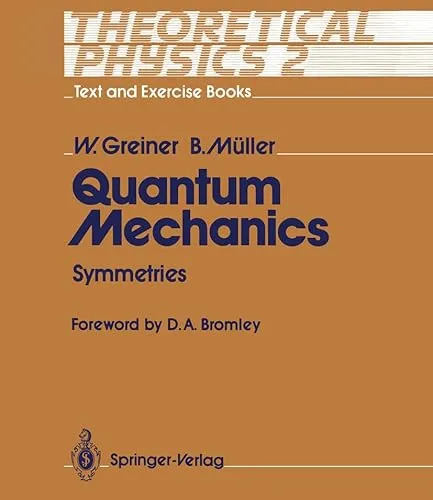
f7754e56d84cad3af83db5e27208bda1.webp

Quantum Mechanics: Symmetries by Walter Greiner , Berndt Müller
English | PDF | 1989 | 376 Pages | ISBN : 3540192018 | 34.3 MB
"Quantum Dynamics" is a major survey of quantum theory based on Walter Greiner's long-running and highly successful courses at the University of Frankfurt. The key to understanding in quantum theory is to reinforce lecture attendance and textual study by working through plenty of representative and detailed examples. Firm belief in this principle led Greiner to develop his unique course and to transform it into a remarkable and comprehensive text. The text features a large number of examples and exercises involving many of the most advanced topics in quantum theory. These examples give practical and precise demonstrations of how to use the often subtle mathematics behind quantum theory. The text is divided into five volumes: Quantum Mechanics I - An Introduction, Quantum Mechanics II - Symmetries, Relativistic Quantum Mechanics, Quantum Electrodynamics, Gauge Theory of Weak Interactions. These five volumes take the reader from the fundamental postulates of quantum mechanics up to the latest research in particle physics. Volume 2 presents a particularly appealing and successful theme in advanced quantum mechanics - symmetries. After a brief introduction to symmetries in classical mechanics, the text turns to their relevance in quantum mechanics, the consequences of rotation symmetry and the general theory of Lie groups. The Isospin group, hypercharge, SU (3) and their applications are all dealt with in depth before a chapter on charm and SU (3) leads to the frontiers of research in particle physics. Almost a hundred detailed, worked examples and problems make this a truly unique text on a fascinating side of modern physics.

[/b]


Fileaxa


Links are Interchangeable - Single Extraction
 
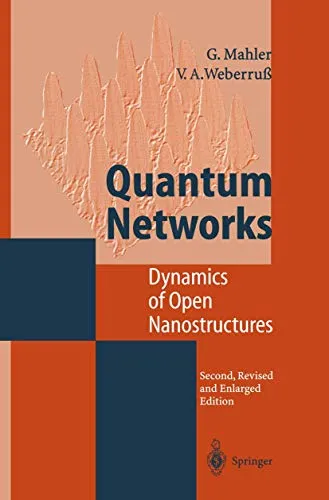
abba37647e9a542fe83e0ab49cc6e2f4.webp

Quantum Networks: Dynamics of Open Nanostructures by Günter Mahler , Volker A. Weberruß
English | PDF | 1998 | 416 Pages | ISBN : 3540636684 | 36.8 MB
Quantum Networks is focused on density matrix theory cast into a product operator representation, particularly adapted to describing networks of finite state subsystems. This approach is important for understanding non-classical aspects such as single subsystem and multi-subsystem entanglement. An intuitive picture evolves of how these features are generated and destroyed by interactions with the environment. This second edition has been revised and enlarged. For better clarity the text has been partly reorganized and figures and formulae are presented in a more attractive way.

[/b]


Fileaxa


Links are Interchangeable - Single Extraction
 
263f692dc77b53ed35549f9243975500.webp

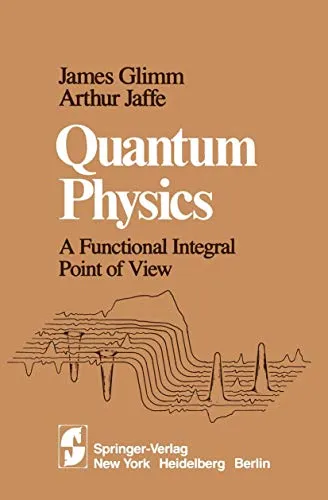
Quantum Physics: A Functional Integral Point of View by James Glimm , Arthur Jaffe
English | PDF | 1981 | 429 Pages | ISBN : 0387905626 | 29 MB
This book is addressed to one problem and to three audiences. The problem is the mathematical structure of modem physics: statistical physics, quantum mechanics, and quantum fields. The unity of mathemati cal structure for problems of diverse origin in physics should be no surprise. For classical physics it is provided, for example, by a common mathematical formalism based on the wave equation and Laplace's equation. The unity transcends mathematical structure and encompasses basic phenomena as well. Thus particle physicists, nuclear physicists, and con densed matter physicists have considered similar scientific problems from complementary points of view. The mathematical structure presented here can be described in various terms: partial differential equations in an infinite number of independent variables, linear operators on infinite dimensional spaces, or probability theory and analysis over function spaces. This mathematical structure of quantization is a generalization of the theory of partial differential equa tions, very much as the latter generalizes the theory of ordinary differential equations. Our central theme is the quantization of a nonlinear partial differential equation and the physics of systems with an infinite number of degrees of freedom. Mathematicians, theoretical physicists, and specialists in mathematical physics are the three audiences to which the book is addressed. Each of the three parts is written with a different scientific perspective.

[/b]


Fileaxa


Links are Interchangeable - Single Extraction
 
151e95bb5a0a285b692cb3abeb7e8c21.webp

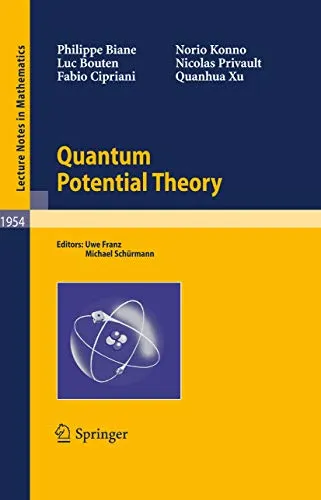
Quantum Potential Theory by Philippe Biane , Luc Bouten , Fabio Cipriani , Norio Konno , Nicolas Privault , Quanhua Xu
English | PDF (True) | 2008 | 467 Pages | ISBN : 3540693645 | 3.5 MB
This volume contains the revised and completed notes of lectures given at the school "Quantum Potential Theory: Structure and Applications to Physics," held at the Alfried-Krupp-Wissenschaftskolleg in Greifswald from February 26 to March 10, 2007.

Quantum potential theory studies noncommutative (or quantum) analogs of classical potential theory. These lectures provide an introduction to this theory, concentrating on probabilistic potential theory and it quantum analogs, i.e. quantum Markov processes and semigroups, quantum random walks, Dirichlet forms on C* and von Neumann algebras, and boundary theory. Applications to quantum physics, in particular the filtering problem in quantum optics, are also presented.
[/b]


Fileaxa


Links are Interchangeable - Single Extraction
 
98772172282d04de30c16ba77d4a992d.webp

Quantum Statistical Mechanics in the Natural Sciences: A Volume Dedicated to Lars Onsager on the Occasion of his Seventieth Birthday by Stephan L. Mintz, Susan M. Widmayer
English | PDF | 1974 | 494 Pages | ISBN : 1461345340 | 43.4 MB
leagues and, in many cases, students, of Professor Onsager. Professor Onsager, himself, has contributed a paper on Illife in early times" to the volume. Among the topics discussed are some interesting applications of low temperature experimental techniques to cardiology and astrophysics. We would like to express our particular appreciation to Mrs. Helga Billings and Miss Sara Lesser for their excellent typing of these Proceedings and to Mrs. Jacquelyn Zagursky, as well as to Mrs. Billings and Miss Lesser for their invaluable assistance with the details of the conference and the publication of these Proceedings. The Editors CONTENTS Section One BIOLOGY Life in the Early Days Lars Onsager. . . . . . . . . . . . . . . . . . . . . . . . . . . . . . . . . . . . 1 The Fluctuating Enzyme Giorgio Careri. . . . . . . . . . . . . . . . . . . . . . . . . . . . . . . . . . 15 Diffusion Control in Biochemical Reactions Manfred Eigen. . . . . . . . . . . . . . . . . . . . . . . . . . . . . . . . . . . 37 Phase Transitions of Phospholipids Julian Sturtevant. . . . . . . . . . . . . . . . . . . . . . . . . . . . . . . 63 Theory and Density Measurements of the Lipid Bilayer Phase Transition John F. Nagle. . . . . . . . . . . . . . . . . . . . . . . . . . . . . . . . . . . 85 Stability of Helical Nucleic Acids Neville R. Kallenbach. . . . . . . . . . . . . . . . . . . . . . . . . . . 95 Thermodynamic Perspectives and the Origin of Life Sidney W. Fox. . . . . . . . . . . . . . . . . . . . . . . . . . . . . . . . . . . 119 Section Two STATISTICAL MECHANICS High Frequency Dielectric Response in Dipolar Systems Roberto Lobo, John E. Robinson, Sergio Rodriguez. 143 ix x CONTENTS Exact Derivation of the Onsager Limiting Law Thomas J. Murphy 157 The Effect of Wall Charge on the Capillary Rise of Electrolytes Lars Onsager, Edmund Drauglis 167 Density of States of Topologically Disordered Amorphous Semiconductors Jill C. Bonner, J. F. Nagle 201 Irreversibility Willis E. Lamb, Jr. 213 Surface Specific Heat of Crystals.

[/b]


Fileaxa


Links are Interchangeable - Single Extraction
 
0c06e457e27f2d6c651805259e018cea.webp

Quantum Theory of Polymers as Solids by János J. Ladik
English | PDF | 1988 | 420 Pages | ISBN : 1468452355 | 32.6 MB
The goal of this monograph is to summarize the different quantum mechanical methods developed in the last 20 years to treat the electronic structure of polymers. Owing to the nature of the problem, these methods consist of a mixture of quantum-chemical and solid-state physical tech niques. The theory described in Part I treats, besides the Hartree-Fock problem, the· electron correlation, and it has also been developed for disordered polymeric systems. Though for obvious reasons the book could not include all the existing calculations, each new method des cribed is illustrated by a few applications, with a discussion of the numerical results obtained. Far more details see the Introduction to Part I. The second part contains the theoretical calculation of different properties of polymers based on the methods systematically introduced in the first part. The properties calculated include the electronic and vibrational spectra of polymers, and the computation of their transport, magnetic, and mechanical properties. In cases where reliable ex perimental data are available, the theoretical results are compared with them.

[/b]


Fileaxa


Links are Interchangeable - Single Extraction
 
806c5d6d8e5477f6d87d26a9291f24fd.webp

Quantum Theory of the Chemical Bond by R. Daudel
English | PDF | 1974 | 119 Pages | ISBN : 9027702640 | 10 MB
The present text is a rational analysis of the concept of the chemical bond by means of the principles of wave mechanics. The discussion of the material has been arranged so as to render its main content comprehensible for readers who may not have had pre"ious training in quantum mechanics. The text comprises three major parts. It begins with an exposition of the fundamental ideas. In this section the principles are reviewed from which de Broglie developed his mechanics; this allows the book to be read by chemistry majors and freshmen alike. However, we believe that it may also be of interest to university-and college teachers who must include certain aspects of quantum chemistry into their courses while being insufficiently familiar with the subject. It may even be of interest to science teachers in secondary schools. Finally, having been a witness to the evolution of these notions for over a quarter of a century, we present certain concepts from a particular point of view which might prove attractive to chemists of all kinds, perhaps even quantum chemists. The second, more technical part summarizes the methods of constructing wave functions that describe the electrons in molecules. This section can only be fully appreciated by those readers who are familiar with some aspects of the algorithms used in quantum mechanics.

[/b]


Fileaxa


Links are Interchangeable - Single Extraction
 
e299fddc455ecaf2ffd7da9f5cef2c4c.webp

Quarrel with the King: The Story of an English Family on the High Road to Civil War by Adam Nicolson
English | November 11, 2008 | ISBN: 0061154318, 0061154326 | True EPUB | 336 pages | 1.4 MB
Quarrel with the King tells the story of the first four earls of Pembroke, their wives, children, estates, tenants, and allies, following their high and glamorous trajectory from the 1520s through 1650-the most turbulent and dramatic years of English history-across three generations of change, ambition, resistance, and war. The Pembrokes were at the heart of it all: the richest family in England, with old blood and new drive, led as much by a succession of extraordinary women as by their husbands and sons.

It is also the story of a power struggle, over a long century, between the family and the growing strength of the English Crown. For decades, questions of loyalty simmered: Was government about agreement and respect, or authority and compulsion? What status did traditional rights have in a changing world? Did a national emergency mean those rights could be ignored or overturned? These were the issues that in 1642 would lead to a brutal civil war, the bloodiest conflict England has ever experienced, in which the earl of Pembroke-who had been loyal till then-had no choice but to rebel against a king who he felt had betrayed both him and his country.
At other times, the Pembrokes both threatened the Crown and acted as its bruisingly efficient and violent agents. They were ambivalent figures: flag bearers for an ancient England and time servers in some of the most corrupt courts England has ever known; fawning courtiers and indulgent landlords; puritanical aristocrats and rebel grandees. Nicolson's book amounts to a study in all the ambiguities involved in the exercise and maintenance of power and status.


Fileaxa


Links are Interchangeable - Single Extraction
 
Zurück
Oben Unten