• Regeln für den Video-Bereich:

    In den Börsenbereich gehören nur Angebote die bereits den Allgemeinen Regeln entsprechen.

    Einteilung

    - Folgende Formate gehören in die angegeben Bereiche:
    - Filme: Encodierte Filme von BluRay, DVD, R5, TV, Screener sowie Telesyncs im Format DivX, XviD und x264.
    - DVD: Filme im Format DVD5, DVD9 und HD2DVD.
    - HD: Encodierte Filme mit der Auflösung 720p oder darüber von BluRay, DVD, R5, TV, Screener sowie Telesyncs im Format x264.
    - 3D: Encodierte Filme von BluRay, die in einem 3D Format vorliegen. Dies gilt auch für Dokus, Animation usw.
    - Serien: Cartoon/Zeichentrick, Anime, Tutorials, Dokumentationen, Konzerte/Musik, Sonstiges sind demnach in die entsprechenden Bereiche einzuordnen, auch wenn sie beispielsweise im High Definition-Format oder als DVD5/DVD9/HD2DVD vorliegen. Ausnahme 3D.
    - Bereich Englisch: Englische Releases gehören immer in diesen Bereich.
    - Bereich Talk: Der Bereich, in dem über die Releases diskutiert werden kann, darf, soll und erwünscht ist.


    Angebot/Beitrag erstellen

    - Ein Beitrag darf erst dann erstellt werden, wenn der Upload bei mindestens einem OCH komplett ist. Platzhalter sind untersagt.
    - Bei einem Scenerelease hat der Threadtitel ausschließlich aus dem originalen, unveränderten Releasenamen zu bestehen. Es dürfen keine Veränderungen wie z.B. Sterne, kleine Buchstaben o.ä. vorgenommen werden. Ausnahme Serienbörse:
    - Bei einem Sammelthread für eine Staffel entfällt aus dem Releasename natürlich der Name der Folge. Beispiel: Die Simpsons S21 German DVDRip XviD - ITG
    - Dementsprechend sind also u.a. verboten: Erweiterungen wie "Tipp", "empfehlenswert", "only", "reup", usw. / jegliche andere Zusatzinformation oder Ergänzung, welche nicht in obiger Beschreibung zu finden ist.

    Aufbau des Angebots und Threadtitel

    Der Titel nach folgendem Muster erstellt zu werden. <Name> [3D] [Staffel] [German] <Jahr> <Tonspur> [DL] [Auflösung] <Quelle> <Codec> - <Group>
    Beispiel: The Dark Knight German 2008 AC3 DVDRip XviD - iND
    Beispiel: The Dark Knight 2008 DTS DL BDRip x264 - iND
    Beispiel: The Dark Knight 2008 AC3 DL BDRip XviD - iND
    Beispiel: The Dark Knight German 2008 AC3 720p BluRay x264 iND
    Beispiel: The Dark Knight 2008 DTS DL 1080p BluRay x264 iND
    Beispiel: Die Simpsons S01 German AC3 DVDRip XviD iND
    Beispiel: Die Simpsons S20 German AC3 720p BluRay x264 iND
    Beispiel: Sword Art Online II Ger Sub 2014 AAC 1080p WEBRip x264 - peppermint
    Entsprechend sind also u.a. verboten: Sonderzeichen wie Klammern, Sterne, Ausrufezeichen, Unterstriche, Anführungszeichen / Erweiterungen wie "Tipp", "empfehlenswert", "only", "reup", usw. / jegliche andere Zusatzinformation oder Ergänzung, welche nicht in obiger Beschreibung zu finden ist
    Ausnahmen hiervon können in den Bereichen geregelt sein.

    Die Beiträge sollen wie folgt aufgebaut werden:
    Überschrift entspricht dem Threadtitel
    Cover
    kurze Inhaltsbeschreibung
    Format, Größe, Dauer sind gut lesbar für Downloader außerhalb des Spoilers zu vermerken
    Nfo sind immer Anzugeben und selbige immer im Spoiler in Textform.
    Sind keine Nfo vorhanden z.B. Eigenpublikationen, sind im Spoiler folgende Dateiinformationen zusätzlich anzugeben :
    Quelle
    Video (Auflösung und Bitrate)
    Ton (Sprache, Format und Bitrate der einzelnen Spuren)
    Untertitel (sofern vorhanden)
    Hosterangabe in Textform außerhalb eines Spoiler mit allen enthaltenen Hostern.
    Bei SD kann auf diese zusätzlichen Dateiinformationen verzichtet werden.

    Alle benötigten Passwörter sind, sofern vorhanden, in Textform im Angebot anzugeben.
    Spoiler im Spoiler mit Kommentaren :"Schon Bedankt?" sind unerwünscht.


    Releases

    - Sind Retail-Release verfügbar, sind alle anderen Variationen untersagt. Ausnahmen: Alle deutschen Retail-Release sind CUT, in diesem Fall sind dubbed UNCUT-Release zulässig.
    - Im Serien-Bereich gilt speziell: Wenn ein Retail vor Abschluss einer laufenden Staffel erscheint, darf diese Staffel noch zu Ende gebracht werden.62
    - Gleiche Releases sind unbedingt zusammenzufassen. Das bedeutet, es ist zwingend erforderlich, vor dem Erstellen eines Themas per Suchfunktion zu überprüfen, ob bereits ein Beitrag mit demselben Release besteht. Ist dies der Fall, ist der bereits vorhandene Beitrag zu verwenden.
    - P2P und Scene Releases dürfen nicht verändert oder gar unter einem iND Tag eingestellt werden.


    Support, Diskussionen und Suche

    - Supportanfragen sind entweder per PN oder im Bereich Talk zu stellen.
    - Diskussionen und Bewertungen sind im Talk Bereich zu führen. Fragen an die Uploader haben ausschließlich via PN zu erfolgen, und sind in den Angeboten untersagt.
    - Anfragen zu Upload-Wünschen sind nur im Bereich Suche Video erlaubt. Antworten dürfen nur auf Angebote von MyBoerse.bz verlinkt werden.


    Verbote

    - Untersagt sind mehrere Formate in einem einzigen Angebotsthread, wie beispielsweise das gleichzeitige Anbieten von DivX/XviD, 720p und 1080p in einem Thread. Pro Format, Release und Auflösung ist ein eigener Thread zu eröffnen.
    - Grundsätzlich ebenso verboten sind Dupes. Uploader haben sich an geeigneter Stelle darüber zu informieren, ob es sich bei einem Release um ein Dupe handelt.
    - Gefakte, nur teilweise lauffähige oder unvollständige Angebote sind untersagt. Dies gilt auch für eigene Publikationen, die augenscheinlich nicht selbst von z.B. einer DVD gerippt wurden. Laufende Serien, bei denen noch nicht alle Folgen verfügbar sind, dürfen erstellt und regelmäßig geupdatet werden.
    - Untersagt sind Angebote, welche nur und ausschließlich in einer anderen Sprache als deutsch oder englisch vorliegen. Ausnahmen sind VORHER mit den Moderatoren zu klären.


    Verstoß gegen die Regeln

    - Angebote oder Beiträge, die gegen die Forenregeln verstoßen, sind über den "Melden"-Button im Beitrag zu melden.
  • Bitte registriere dich zunächst um Beiträge zu verfassen und externe Links aufzurufen.

*** Bestes IPTV *** bester Preis *** gratis Test ***


Cisco Nexus Vpc (Virtual Port Channel) Training

Tutorials

MyBoerse.bz Pro Member
bb35c674bb5cad2a0c924ae0a7a380df.jpeg

Free Download Cisco Nexus Vpc (Virtual Port Channel) Training
Published 11/2023
MP4 | Video: h264, 1920x1080 | Audio: AAC, 44.1 KHz
Language: English | Size: 6.13 GB | Duration: 7h 19m
Learn Cisco Nexus vPC with Step-by-Step Lab Workbook

What you'll learn
vPC - virtual Port Channel Fundamentals
vPC - virtual Port Channel Configuration
vPC - virtual Port Channel Components
vPC - virtual Port Channel Device Role
vPC - virtual Port Channel Deployment Scenarios
vPC - Single-Sided virtual Port Channel
vPC - Double-Sided virtual Port Channel
vPC System MAC and Local MAC Address
Type1 & Type2 Consistency Checks
Cisco Fabric Services
Cisco Nexus vPC & NIC Teaming
Introduction to Stack Wise, VSS, and vPC
vPC Failure Scenarios
vPC with Firewall
vPC Peer-Gateway Feature
Requirements
Basic Knowledge of Simulation Software EVE-NG.
Personal Computer with 16GB of RAM.
CCNA Routing & Switching Knowledge.
General understanding of network fundamentals.
Working knowledge of networking technology.
Description
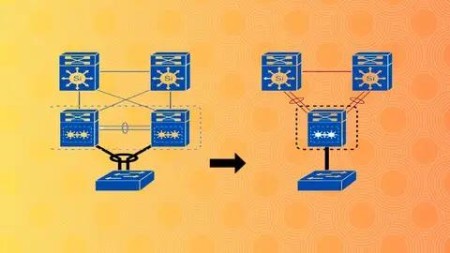
vPC is a virtualization technology that presents paired or two Nexus devices as a unique Layer 2 logical node to the access layer devices or endpoints. vPC belongs to Multi chassis EtherChannel[MCEC] family of technology. A virtual port channel (vPC) allows links that are physically connected to two different Cisco Nexus 7000/5000/9000 Series devices to appear as a single port channel to a third device. The third device can be a switch, server, firewall, load balancer or any other networking device that supports link aggregation technology.VPC or Virtual Port Channel is a Cisco proprietary feature available on the Nexus platform. Two switches of the same model can be combined into a VPC pair, which can establish a single EtherChannel, also known as a link aggregate or a port channel, across both switches to a third switch or server. This peering device doesn't know that it is connected to two different switches, and it just needs to support link aggregation either statically or using Link Aggregation Control Protocol (LACP). MultiChassis EtherChannel (MCEC) or MultiChassis Link Aggregation (MLAG) terms refer to the technique of bundling links across more than 1 device. VPC is Cisco's implementation of MCEC/MLAG on the Nexus line of switches. Similarly, Cisco Catalyst switches support Virtual Switching System (VSS) or StackWise-based MLAGs.
Overview
Section 1: Cisco VPC
Lecture 1 Intro to Nexus OS & Switches
Lecture 2 Workbooks, Links & EVE-NG Topologies
Lecture 3 Intro to StackWise, VSS and vPC
Lecture 4 Introduction to vPC
Lecture 5 Virtual Port Channel Summary
Lecture 6 vPC Components
Lecture 7 Upload 5K & 7K Images to EVE-NG
Lecture 8 Upload Nexus 9K Images to EVE-NG
Lecture 9 Boot Loader Prompt for Nexus 9K
Lecture 10 vPC Deployment Types
Lecture 11 Single-Sided vPC Steps
Lecture 12 Single-Sided vPC with Switch Lab
Lecture 13 Single-Sided vPC with NIC Teaming Lab
Lecture 14 Double-Sided vPC Steps
Lecture 15 Double-Sided vPC Lab
Lecture 16 vPC Device Role
Lecture 17 System & Local MAC Address
Lecture 18 Consistency Checks
Lecture 19 Consistency Checks Lab
Lecture 20 Cisco Fabric Services
Section 2: vPC Failure Scenarios
Lecture 21 vPC Failure Scenarios
Lecture 22 vPC Keep-Alive Link is Down
Lecture 23 vPC Peer Link is Down
Lecture 24 vPC Member Port are Down
Lecture 25 vPC Peer Switch is Down
Lecture 26 Peer-Link Failure, Followed by Keep-Alive
Lecture 27 Keep-Alive Failure, Followed by Peer-Link
Section 3: vPC Features
Lecture 28 vPC Peer-Gateway Feature
Lecture 29 Peer-Gateway Feature Lab
Lecture 30 vPC Peer-Switch Feature
Lecture 31 Peer-Switch Feature Lab
Section 4: Bonus
Lecture 32 vPC with Firewall Lab
Lecture 33 Deployment Scenarios
Network administrators,Network support technicians,Help desk technicians.,System Engineer and Security Engineer

Homepage


Recommend Download Link Hight Speed | Please Say Thanks Keep Topic Live
No Password - Links are Interchangeable

 

7f10c5466e93c43607c52c3a0d0bac49.jpg

Cisco Nexus Vpc (Virtual Port Channel) Training
Published 11/2023
MP4 | Video: h264, 1920x1080 | Audio: AAC, 44.1 KHz
Language: English | Size: 6.13 GB | Duration: 7h 19m​

Learn Cisco Nexus vPC with Step-by-Step Lab Workbook

What you'll learn

vPC - virtual Port Channel Fundamentals

vPC - virtual Port Channel Configuration

vPC - virtual Port Channel Components

vPC - virtual Port Channel Device Role

vPC - virtual Port Channel Deployment Scenarios

vPC - Single-Sided virtual Port Channel

vPC - Double-Sided virtual Port Channel

vPC System MAC and Local MAC Address

Type1 & Type2 Consistency Checks

Cisco Fabric Services

Cisco Nexus vPC & NIC Teaming

Introduction to Stack Wise, VSS, and vPC

vPC Failure Scenarios

vPC with Firewall

vPC Peer-Gateway Feature

Requirements

Basic Knowledge of Simulation Software EVE-NG.

Personal Computer with 16GB of RAM.

CCNA Routing & Switching Knowledge.

General understanding of network fundamentals.

Working knowledge of networking technology.

Description

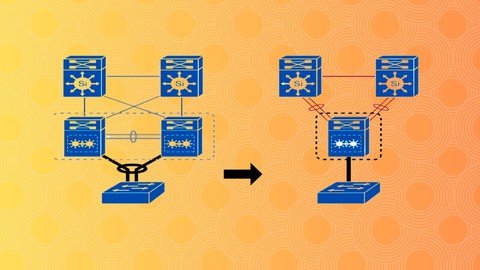
vPC is a virtualization technology that presents paired or two Nexus devices as a unique Layer 2 logical node to the access layer devices or endpoints. vPC belongs to Multi chassis EtherChannel [MCEC] family of technology. A virtual port channel (vPC) allows links that are physically connected to two different Cisco Nexus 7000/5000/9000 Series devices to appear as a single port channel to a third device. The third device can be a switch, server, firewall, load balancer or any other networking device that supports link aggregation technology.VPC or Virtual Port Channel is a Cisco proprietary feature available on the Nexus platform. Two switches of the same model can be combined into a VPC pair, which can establish a single EtherChannel, also known as a link aggregate or a port channel, across both switches to a third switch or server. This peering device doesn't know that it is connected to two different switches, and it just needs to support link aggregation either statically or using Link Aggregation Control Protocol (LACP). MultiChassis EtherChannel (MCEC) or MultiChassis Link Aggregation (MLAG) terms refer to the technique of bundling links across more than 1 device. VPC is Cisco's implementation of MCEC/MLAG on the Nexus line of switches. Similarly, Cisco Catalyst switches support Virtual Switching System (VSS) or StackWise-based MLAGs.

Overview

Section 1: Cisco VPC

Lecture 1 Intro to Nexus OS & Switches

Lecture 2 Workbooks, Links & EVE-NG Topologies

Lecture 3 Intro to StackWise, VSS and vPC

Lecture 4 Introduction to vPC

Lecture 5 Virtual Port Channel Summary

Lecture 6 vPC Components

Lecture 7 Upload 5K & 7K Images to EVE-NG

Lecture 8 Upload Nexus 9K Images to EVE-NG

Lecture 9 Boot Loader Prompt for Nexus 9K

Lecture 10 vPC Deployment Types

Lecture 11 Single-Sided vPC Steps

Lecture 12 Single-Sided vPC with Switch Lab

Lecture 13 Single-Sided vPC with NIC Teaming Lab

Lecture 14 Double-Sided vPC Steps

Lecture 15 Double-Sided vPC Lab

Lecture 16 vPC Device Role

Lecture 17 System & Local MAC Address

Lecture 18 Consistency Checks

Lecture 19 Consistency Checks Lab

Lecture 20 Cisco Fabric Services

Section 2: vPC Failure Scenarios

Lecture 21 vPC Failure Scenarios

Lecture 22 vPC Keep-Alive Link is Down

Lecture 23 vPC Peer Link is Down

Lecture 24 vPC Member Port are Down

Lecture 25 vPC Peer Switch is Down

Lecture 26 Peer-Link Failure, Followed by Keep-Alive

Lecture 27 Keep-Alive Failure, Followed by Peer-Link

Section 3: vPC Features

Lecture 28 vPC Peer-Gateway Feature

Lecture 29 Peer-Gateway Feature Lab

Lecture 30 vPC Peer-Switch Feature

Lecture 31 Peer-Switch Feature Lab

Section 4: Bonus

Lecture 32 vPC with Firewall Lab

Lecture 33 Deployment Scenarios

Network administrators,Network support technicians,Help desk technicians.,System Engineer and Security Engineer

0rRsChLq_o.jpg

 
Zurück
Oben Unten