




• Regeln für den Video-Bereich:

    In den Börsenbereich gehören nur Angebote die bereits den Allgemeinen Regeln entsprechen.

    Einteilung

    - Folgende Formate gehören in die angegeben Bereiche:
    - Filme: Encodierte Filme von BluRay, DVD, R5, TV, Screener sowie Telesyncs im Format DivX, XviD und x264.
    - DVD: Filme im Format DVD5, DVD9 und HD2DVD.
    - HD: Encodierte Filme mit der Auflösung 720p oder darüber von BluRay, DVD, R5, TV, Screener sowie Telesyncs im Format x264.
    - 3D: Encodierte Filme von BluRay, die in einem 3D Format vorliegen. Dies gilt auch für Dokus, Animation usw.
    - Serien: Cartoon/Zeichentrick, Anime, Tutorials, Dokumentationen, Konzerte/Musik, Sonstiges sind demnach in die entsprechenden Bereiche einzuordnen, auch wenn sie beispielsweise im High Definition-Format oder als DVD5/DVD9/HD2DVD vorliegen. Ausnahme 3D.
    - Bereich Englisch: Englische Releases gehören immer in diesen Bereich.
    - Bereich Talk: Der Bereich, in dem über die Releases diskutiert werden kann, darf, soll und erwünscht ist.


    Angebot/Beitrag erstellen

    - Ein Beitrag darf erst dann erstellt werden, wenn der Upload bei mindestens einem OCH komplett ist. Platzhalter sind untersagt.
    - Bei einem Scenerelease hat der Threadtitel ausschließlich aus dem originalen, unveränderten Releasenamen zu bestehen. Es dürfen keine Veränderungen wie z.B. Sterne, kleine Buchstaben o.ä. vorgenommen werden. Ausnahme Serienbörse:
    - Bei einem Sammelthread für eine Staffel entfällt aus dem Releasename natürlich der Name der Folge. Beispiel: Die Simpsons S21 German DVDRip XviD - ITG
    - Dementsprechend sind also u.a. verboten: Erweiterungen wie "Tipp", "empfehlenswert", "only", "reup", usw. / jegliche andere Zusatzinformation oder Ergänzung, welche nicht in obiger Beschreibung zu finden ist.

    Aufbau des Angebots und Threadtitel

    Der Titel nach folgendem Muster erstellt zu werden. <Name> [3D] [Staffel] [German] <Jahr> <Tonspur> [DL] [Auflösung] <Quelle> <Codec> - <Group>
    Beispiel: The Dark Knight German 2008 AC3 DVDRip XviD - iND
    Beispiel: The Dark Knight 2008 DTS DL BDRip x264 - iND
    Beispiel: The Dark Knight 2008 AC3 DL BDRip XviD - iND
    Beispiel: The Dark Knight German 2008 AC3 720p BluRay x264 iND
    Beispiel: The Dark Knight 2008 DTS DL 1080p BluRay x264 iND
    Beispiel: Die Simpsons S01 German AC3 DVDRip XviD iND
    Beispiel: Die Simpsons S20 German AC3 720p BluRay x264 iND
    Beispiel: Sword Art Online II Ger Sub 2014 AAC 1080p WEBRip x264 - peppermint
    Entsprechend sind also u.a. verboten: Sonderzeichen wie Klammern, Sterne, Ausrufezeichen, Unterstriche, Anführungszeichen / Erweiterungen wie "Tipp", "empfehlenswert", "only", "reup", usw. / jegliche andere Zusatzinformation oder Ergänzung, welche nicht in obiger Beschreibung zu finden ist
    Ausnahmen hiervon können in den Bereichen geregelt sein.

    Die Beiträge sollen wie folgt aufgebaut werden:
    Überschrift entspricht dem Threadtitel
    Cover
    kurze Inhaltsbeschreibung
    Format, Größe, Dauer sind gut lesbar für Downloader außerhalb des Spoilers zu vermerken
    Nfo sind immer Anzugeben und selbige immer im Spoiler in Textform.
    Sind keine Nfo vorhanden z.B. Eigenpublikationen, sind im Spoiler folgende Dateiinformationen zusätzlich anzugeben :
    Quelle
    Video (Auflösung und Bitrate)
    Ton (Sprache, Format und Bitrate der einzelnen Spuren)
    Untertitel (sofern vorhanden)
    Hosterangabe in Textform außerhalb eines Spoiler mit allen enthaltenen Hostern.
    Bei SD kann auf diese zusätzlichen Dateiinformationen verzichtet werden.

    Alle benötigten Passwörter sind, sofern vorhanden, in Textform im Angebot anzugeben.
    Spoiler im Spoiler mit Kommentaren :"Schon Bedankt?" sind unerwünscht.


    Releases

    - Sind Retail-Release verfügbar, sind alle anderen Variationen untersagt. Ausnahmen: Alle deutschen Retail-Release sind CUT, in diesem Fall sind dubbed UNCUT-Release zulässig.
    - Im Serien-Bereich gilt speziell: Wenn ein Retail vor Abschluss einer laufenden Staffel erscheint, darf diese Staffel noch zu Ende gebracht werden.62
    - Gleiche Releases sind unbedingt zusammenzufassen. Das bedeutet, es ist zwingend erforderlich, vor dem Erstellen eines Themas per Suchfunktion zu überprüfen, ob bereits ein Beitrag mit demselben Release besteht. Ist dies der Fall, ist der bereits vorhandene Beitrag zu verwenden.
    - P2P und Scene Releases dürfen nicht verändert oder gar unter einem iND Tag eingestellt werden.


    Support, Diskussionen und Suche

    - Supportanfragen sind entweder per PN oder im Bereich Talk zu stellen.
    - Diskussionen und Bewertungen sind im Talk Bereich zu führen. Fragen an die Uploader haben ausschließlich via PN zu erfolgen, und sind in den Angeboten untersagt.
    - Anfragen zu Upload-Wünschen sind nur im Bereich Suche Video erlaubt. Antworten dürfen nur auf Angebote von MyBoerse.bz verlinkt werden.


    Verbote

    - Untersagt sind mehrere Formate in einem einzigen Angebotsthread, wie beispielsweise das gleichzeitige Anbieten von DivX/XviD, 720p und 1080p in einem Thread. Pro Format, Release und Auflösung ist ein eigener Thread zu eröffnen.
    - Grundsätzlich ebenso verboten sind Dupes. Uploader haben sich an geeigneter Stelle darüber zu informieren, ob es sich bei einem Release um ein Dupe handelt.
    - Gefakte, nur teilweise lauffähige oder unvollständige Angebote sind untersagt. Dies gilt auch für eigene Publikationen, die augenscheinlich nicht selbst von z.B. einer DVD gerippt wurden. Laufende Serien, bei denen noch nicht alle Folgen verfügbar sind, dürfen erstellt und regelmäßig geupdatet werden.
    - Untersagt sind Angebote, welche nur und ausschließlich in einer anderen Sprache als deutsch oder englisch vorliegen. Ausnahmen sind VORHER mit den Moderatoren zu klären.


    Verstoß gegen die Regeln

    - Angebote oder Beiträge, die gegen die Forenregeln verstoßen, sind über den "Melden"-Button im Beitrag zu melden.
  • Bitte registriere dich zunächst um Beiträge zu verfassen und externe Links aufzurufen.

++ Premium IPTV ++ 7000 Live Sender ++ UHD Qualität ++ Mediathek mit 18.000 Inhalten ++


VenneTV


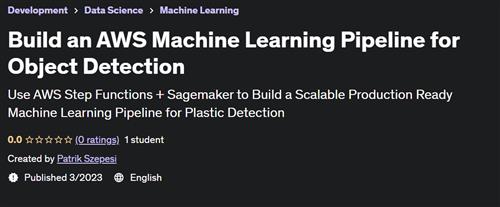
Build an AWS Machine Learning Pipeline for Object Detection

Tutorials

MyBoerse.bz Pro Member
60c4a13b78f3de50596bc188cd9cf420.jpeg

Free Download Build an AWS Machine Learning Pipeline for Object Detection
Published 3/2023
Created by Patrik Szepesi
MP4 | Video: h264, 1280x720 | Audio: AAC, 44.1 KHz, 2 Ch
Genre: eLearning | Language: English | Duration: 137 Lectures ( 16h 18m ) | Size: 7.34 GB

Use AWS Step Functions + Sagemaker to Build a Scalable Production Ready Machine Learning Pipeline for Plastic Detection
Free Download What you'll learn
Learn how you can use Google's Open Images Dataset V7 to use any custom dataset you want
Create Sagemaker Domains
Upload and Stream data into you Sagemaker Environment
Learn how to set up secure IAM roles on AWS
Build a Production Ready Object detection Algorithm
Use Pandas, Numpy for Feature and Data Engineering
Understanding Object detection annotations
Visualising Images and Bounding Boxes with Matplotlib
Learn how Sagemaker's Elastic File System(EFS) works
Use AWS' built in Object detection detection algorithm with Transfer Learning
How to set up Transfer Learning with both VGG-16 and ResNet-50 in AWS
Learn how to save images to RecordIO format
Learn what RecordIO format is
Learn what .lst files are and why we need them with Object Detection in AWS
Learn how to do Data Augmentation for Object detection
Gain insights into how we can manipulate our input data with data augmentation
Learn AWS Pricing for SageMaker, Step Functions, Batch Transformation Jobs, Sagemaker EFS, and many more
Learn how to choose the ideal compute(Memory, vCPUs, GPUS and kernels) for your Sagemaker tasks
Learn how to install dependencies to a Sagemaker Notebook
Setup Hyperparameter Tuning Jobs in AWS
Set up Training Jobs in AWS
Learn how to Evaluate Object detection models with mAP(mean average precision) score
Set up Hyperparameter tuning jobs with Bayesian Search
Learn how you can configure Batch Size, Epochs, optimisers(Adam, RMSProp), Momentum, Early stopping, Weight decay, overfitting prevention and many more in AWS
Monitor a Training Job in Real time with Metrics
Use Cloudwatch to look at various logs
How to Test your model in a Sagemaker notebook
Learn what Batch Transformation is
Set up Batch Transformation Jobs
How to use Lambda functions
Saving outputs to S3 bucket
Prepare Training and Test Datasets
Data Engineering
How to build Complex Production Ready Machine Learning Pipelines with AWS Step Functions
Use any custom dataset to build an Object detection model
Use AWS Cloudformation with AWS Step Functions to set up a Pipeline
Learn how to use Prebuilt Pipelines to Configure to your own needs
Learn how you can Create any Custom Pipelines with Step Functions(with GUI as well)
Learn how to Integrate Lambda Functions with AWS Step Functions
Learn how to Create and Handle Asynchronous Machine Learning Pipelines
How to use Lambda to read and write from S3
AWS best practices
Using AWS EventBridge to setup CRON jobs to tell you Pipeline when to Run
Learn how to Create End-to-End Machine Learning Pipelines
Learn how to Use Sagemaker Notebooks in Production and Schedule Jobs with them
Learn Machine Learning Pipeline Design
Create a MERN stack web app to interact with our Machine Learning Pipeline
How to set up a production ready Mongodb database for our Web App
Learn how to use React, Nextjs, Mongodb, ExpressJs to build a web application
Create and Interact with JSON files
Put Convolutional Neural Networks into Production
Deep Learning Techniques
How to clean up an AWS account after you are done
Train Machine Learning models on AWS
How to use AWS' GPUs to speed up Machine Learning Training jobs
Learn what AWS Elastic Container Registry(ECS) is and how you can download Machine Learning Algorithms from it
AWS Security Best practices
Requirements
Laptop with Internet Access
AWS account
Knowledge of Python and basic Machine Learning
Spend 20-50 dollars on AWS if you want to follow along with me. Note that you can still follow along without having to pay any money
Description
Welcome to the ultimate course on creating a scalable, secure, complex machine learning pipeline with Sagemaker, Step Functions, and Lambda functions. In this course, we will cover all the necessary steps to create a robust and reliable machine learning pipeline, from data preprocessing to hyperparameter tuning for object detection.We will start by introducing you to the basics of AWS Sagemaker, a fully-managed service that provides developers and data scientists with the ability to build, train, and deploy machine learning models quickly and easily. You will learn how to use Sagemaker to preprocess and prepare your data for machine learning, as well as how to build and train your own machine learning models using Sagemaker's built-in algorithms.Next, we will dive into AWS Step Functions, which allow you to coordinate and manage the different steps of your machine learning pipeline. You will learn how to create a scalable, secure, and robust machine learning pipeline using Step Functions, and how to use Lambda functions to trigger your pipeline's different steps.In addition, we will cover deep learning related topics, including how to use neural networks for object detection, and how to use hyperparameter tuning to optimize your machine learning models for different use cases.Finally, we will walk you through the creation of a web application that will interact with your machine learning pipeline. You will learn how to use React, Next.js, Express, and MongoDB to build a web app that will allow users to submit data to your pipeline, view the results, and track the progress of their jobs.By the end of this course, you will have a deep understanding of how to create a scalable, secure, complex machine learning pipeline using Sagemaker, Step Functions, and Lambda functions. You will also have the skills to build a web app that can interact with your pipeline, opening up new possibilities for how you can use your machine learning models to solve real-world problems.
Who this course is for
For developers who want to take their machine learning skills to the next lever by being able to not only build machine learning models, but also incorporate them in a complex, secure production ready machine learning pipeline
Homepage

Recommend Download Link Hight Speed | Please Say Thanks Keep Topic Live
Links are Interchangeable - Single Extraction

 

796654022_yxusj-j0dy1232xqw0.jpg

Build an AWS Machine Learning Pipeline for Object Detection
MP4 | Video: h264, 1920x1080 | Audio: AAC, 44.1 KHz
Language: English (US) | Size: 9.70 GB | Duration: 16h 30m​

What you'll learn
Learn how you can use Google's Open Images Dataset V7 to use any custom dataset you want
Create Sagemaker Domains
Upload and Stream data into you Sagemaker Environment
Learn how to set up secure IAM roles on AWS
Build a Production Ready Object detection Algorithm
Use Pandas, Numpy for Feature and Data Engineering
Understanding Object detection annotations
Visualising Images and Bounding Boxes with Matplotlib
Learn how Sagemaker's Elastic File System(EFS) works
Use AWS' built in Object detection detection algorithm with Transfer Learning
How to set up Transfer Learning with both VGG-16 and ResNet-50 in AWS
Learn how to save images to RecordIO format
Learn what RecordIO format is
Learn what .lst files are and why we need them with Object Detection in AWS
Learn how to do Data Augmentation for Object detection
Gain insights into how we can manipulate our input data with data augmentation
Learn AWS Pricing for SageMaker, Step Functions, Batch Transformation Jobs, Sagemaker EFS, and many more
Learn how to choose the ideal compute(Memory, vCPUs, GPUS and kernels) for your Sagemaker tasks
Learn how to install dependencies to a Sagemaker Notebook
Setup Hyperparameter Tuning Jobs in AWS
Set up Training Jobs in AWS
Learn how to Evaluate Object detection models with mAP(mean average precision) score
Set up Hyperparameter tuning jobs with Bayesian Search
Learn how you can configure Batch Size, Epochs, optimisers(Adam, RMSProp), Momentum, Early stopping, Weight decay, overfitting prevention and many more in AWS
Monitor a Training Job in Real time with Metrics
Use Cloudwatch to look at various logs
How to Test your model in a Sagemaker notebook
Learn what Batch Transformation is
Set up Batch Transformation Jobs
How to use Lambda functions
Saving outputs to S3 bucket
Prepare Training and Test Datasets
Data Engineering
How to build Complex Production Ready Machine Learning Pipelines with AWS Step Functions
Use any custom dataset to build an Object detection model
Use AWS Cloudformation with AWS Step Functions to set up a Pipeline
Learn how to use Prebuilt Pipelines to Configure to your own needs
Learn how you can Create any Custom Pipelines with Step Functions(with GUI as well)
Learn how to Integrate Lambda Functions with AWS Step Functions
Learn how to Create and Handle Asynchronous Machine Learning Pipelines
How to use Lambda to read and write from S3
AWS best practices
Using AWS EventBridge to setup CRON jobs to tell you Pipeline when to Run
Learn how to Create End-to-End Machine Learning Pipelines
Learn how to Use Sagemaker Notebooks in Production and Schedule Jobs with them
Learn Machine Learning Pipeline Design
Create a MERN stack web app to interact with our Machine Learning Pipeline
How to set up a production ready Mongodb database for our Web App
Learn how to use React, Nextjs, Mongodb, ExpressJs to build a web application
Create and Interact with JSON files
Put Convolutional Neural Networks into Production
Deep Learning Techniques
How to clean up an AWS account after you are done
Train Machine Learning models on AWS
How to use AWS' GPUs to speed up Machine Learning Training jobs
Learn what AWS Elastic Container Registry(ECS) is and how you can download Machine Learning Algorithms from it
AWS Security Best practices

Requirements
Laptop with Internet Access
AWS account
Knowledge of Python and basic Machine Learning
Spend 20-50 dollars on AWS if you want to follow along with me. Note that you can still follow along without having to pay any money

Description
Welcome to the ultimate course on creating a scalable, secure, complex machine learning pipeline with Sagemaker, Step Functions, and Lambda functions. In this course, we will cover all the necessary steps to create a robust and reliable machine learning pipeline, from data preprocessing to hyperparameter tuning for object detection.We will start by introducing you to the basics of AWS Sagemaker, a fully-managed service that provides developers and data scientists with the ability to build, train, and deploy machine learning models quickly and easily. You will learn how to use Sagemaker to preprocess and prepare your data for machine learning, as well as how to build and train your own machine learning models using Sagemaker's built-in algorithms.Next, we will dive into AWS Step Functions, which allow you to coordinate and manage the different steps of your machine learning pipeline. You will learn how to create a scalable, secure, and robust machine learning pipeline using Step Functions, and how to use Lambda functions to trigger your pipeline's different steps.In addition, we will cover deep learning related topics, including how to use neural networks for object detection, and how to use hyperparameter tuning to optimize your machine learning models for different use cases.Finally, we will walk you through the creation of a web application that will interact with your machine learning pipeline. You will learn how to use React, Next.js, Express, and MongoDB to build a web app that will allow users to submit data to your pipeline, view the results, and track the progress of their jobs.By the end of this course, you will have a deep understanding of how to create a scalable, secure, complex machine learning pipeline using Sagemaker, Step Functions, and Lambda functions. You will also have the skills to build a web app that can interact with your pipeline, opening up new possibilities for how you can use your machine learning models to solve real-world problems.

Who this course is for:
For developers who want to take their machine learning skills to the next lever by being able to not only build machine learning models, but also incorporate them in a complex, secure production ready machine learning pipeline

For More Courses Visit & Bookmark Your Preferred Language Blog
From Here:--------


796654094_yxusj-ini69r9760pv.jpg

ALXRQIVa_o.jpg


RapidGator
-.part01.rar
-.part02.rar
-.part03.rar
-.part04.rar
-.part05.rar
-.part06.rar
-.part07.rar
-.part08.rar
-.part09.rar
-.part10.rar
-.part11.rar
DDownload
-.part01.rar
-.part02.rar
-.part03.rar
-.part04.rar
-.part05.rar
-.part06.rar
-.part07.rar
-.part08.rar
-.part09.rar
-.part10.rar
-.part11.rar
NitroFlare
-.part01.rar
-.part02.rar
-.part03.rar
-.part04.rar
-.part05.rar
-.part06.rar
-.part07.rar
-.part08.rar
-.part09.rar
-.part10.rar
-.part11.rar
​
 
Zurück
Oben Unten
