



• Regeln für den Dokumente-Bereich:

    In den Börsenbereich gehören nur Angebote die bereits den Allgemeinen Regeln entsprechen.

    Allgemeines:

    Nicht erlaubt im Dokumente-Bereich sind:

    - indizierte Titel (inkl. Comics)
    - extremistische Werke, Zeitschriften und Comics (egal, welche Richtung)
    - jegliche Art von Pornographie
    - Anleitungen zu kriminellen Handlungen, gleich welcher Art
    - sadistische, menschenverachtende oder ähnliche Werke

    Nutzt den "Bedanken"-Button, bei Sammelthreads führen jegliche Kommentare, positiv wie negativ, sehr schnell zu einer Unübersichtlichkeit des Threads. Downmeldungen sind an den Uploader zu richten

    Vor dem Einstellen zu beachten:

    - Suchfunktion

    Vergewissert euch, dass es euer Dokument noch nicht im Board gibt, Doppelposts werden kommentarlos gelöscht. Ist es schon vorhanden, tragt es als Mirror im bestehenden Post ein.

    - Threadtitel

    Idealerweise ist sofort zu erkennen um was es sich handelt. Verseht euren Titel mit den relevanten Informationen, das hilft euch und damit auch uns und allen Suchenden erheblich weiter.

    Beispiel: [Thriller] Dan Brown - Inferno oder bei Magazinen:

    Computerbild - 14/2014 (es muss ersichtlich sein, um welche Ausgabe und welches Magazin es sich handelt)

    Folgende Präfixe stehen im Unterforum "Unterhaltung" zur Verfügung:

    [Humor]
    [Drama]
    [Erotik]
    [Fantasy]
    [Krimi]
    [Roman]
    [Thriller]
    [Horror]
    [Science Fiction]

    Inhalt des Beitrags:

    Folgende Pflichtangaben gilt es einzuhalten:

    - Autor
    - Titel
    - Präfix
    - Cover
    - Genre
    - Inhaltsbeschreibung
    - enthaltene Formate
    - Gesamtgröße des Downloads
    - Hoster
    - ggf. Passwort

    Nicht erlaubt sind alle Dateien, die den Download unnötig aufblähen um eine Affiliategrenze zu erreichen, wie zB. mp3-files, übergroße Bilder, etc.

    Ebenso nicht erlaubt sind sämtliche Dateien mit DRM, persönlichen Daten, etc., diese werden kommentarlos zu eurem eigenem Schutz gelöscht.

    Achtet bitte bei der Konvertierung der Formate auf die Lesbarkeit, ein epub, was nur einfach durch Calibre gejagt wird um ein PDF zu erhalten, ist zu 99% eben nicht lesbar. Wenn ihr es nicht könnt, dann lasst es besser oder lest euch ein, wie man es richtig macht.


    Unterforum Comics:

    Threadtitel:

    Ähnlich, wie bei Unterhaltung und Magazinen, sollte der Titel alle relevanten Informationen enthalten, hier bitte

    - den Titel des Comics
    - den Verlag (einige Comics sind in verschiedenen Verlagen erschienen)
    - das Erscheinungsjahr

    Erlaubt sind folgende Formate:

    - CBR
    - CBZ

    Grundsätzlich gilt: jede Version eines Comics erhält einen eigenen Thread, Ersteller eines Comics können ihre Bände gerne mit dem Zusatz (Original-Release) versehen.

    Bei Unsicherheiten zur korrekten Benennung bitte die Informationen von www.comicguide.de nutzen.

    Inhalt des Beitrags:

    Pflichtangaben hier sind:

    - Titel des Bandes und ggf. Nummer
    - Cover
    - falls bekannt technische Daten (DPI, Breite, Speicherqualität)
    - Größe des Downloads
    - Hoster
    - ggf. Passwort
    - falls bekannt Releasenamen
  • Bitte registriere dich zunächst um Beiträge zu verfassen und externe Links aufzurufen.

*** Bestes IPTV *** bester Preis *** gratis Test ***


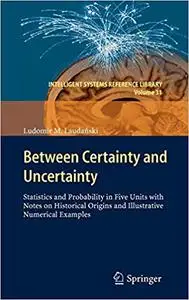
Between Certainty and Uncertainty Statistics and Probability in Five Units with Notes on Historic...

visoft

MyBoerse.bz Pro Member

006bb08a_medium.jpg

Ludomir M. Laudański, "Between Certainty and Uncertainty: Statistics and Probability in Five Units with Notes on Historical Origins and Illustr"
English | ISBN: 3642256961 | 2013 | 318 pages | PDF | 16 MB​


„Between Certainty & Uncertainty" is a one-of-a-kind short course on statistics for students, engineers and researchers. It is a fascinating introduction to statistics and probability with notes on historical origins and 80 illustrative numerical examples organized in the five units:
· Chapter 1 Descriptive Statistics: Compressing small samples, basic averages - mean and variance, their main properties including God's proof; linear transformations and z-scored statistics .
· Chapter 2 Grouped data: Udny Yule's concept of qualitative and quantitative variables. Grouping these two kinds of data. Graphical tools. Combinatorial rules and qualitative variables. Designing frequency histogram. Direct and coded evaluation of quantitative data. Significance of percentiles.
· Chapter 3 Regression and correlation: Geometrical distance and equivalent distances in two orthogonal directions as a prerequisite to the concept of two regression lines. Misleading in interpreting two regression lines. Derivation of the two regression lines. Was Hubble right? Houbolt's cloud. What in fact measures the correlation coefficient?
· Chapter 4 Binomial distribution: Middle ages origins of the binomials; figurate numbers and combinatorial rules. Pascal's Arithmetical Triangle. Bernoulli's or Poisson Trials? John Arbuthnot curing binomials. How Newton taught S. Pepys probability. Jacob Bernoulli's Weak Law of Large Numbers and others.
· Chapter 5 Normal distribution and binomial heritage - Tables of the normal distribution. Abraham de Moivre and the second theorem of de Moivre-Laplace.
· Chapter 1 Descriptive Statistics: Compressing small samples, basic averages - mean and variance, their main properties including God's proof; linear transformations and z-scored statistics .
· Chapter 2 Grouped data: Udny Yule's concept of qualitative and quantitative variables. Grouping these two kinds of data. Graphical tools. Combinatorial rules and qualitative variables. Designing frequency histogram. Direct and coded evaluation of quantitative data. Significance of percentiles.
· Chapter 3 Regression and correlation: Geometrical distance and equivalent distances in two orthogonal directions as a prerequisite to the concept of two regression lines. Misleading in interpreting two regression lines. Derivation of the two regression lines. Was Hubble right? Houbolt's cloud. What in fact measures the correlation coefficient?
· Chapter 4 Binomial distribution: Middle ages origins of the binomials; figurate numbers and combinatorial rules. Pascal's Arithmetical Triangle. Bernoulli's or Poisson Trials? John Arbuthnot curing binomials. How Newton taught S. Pepys probability. Jacob Bernoulli's Weak Law of Large Numbers and others.
· Chapter 5 Normal distribution and binomial heritage - Tables of the normal distribution. Abraham de Moivre and the second theorem of de Moivre-Laplace.

Recommend Download Link Hight Speed | Please Say Thanks Keep Topic Live

 
Zurück
Oben Unten